Opposition to the Nazi
regime
• Describe the opposition to the Nazis.
• Explain who opposed the Nazis and
why.
• Evaluate the extent and significance of
opposition to the Nazis.
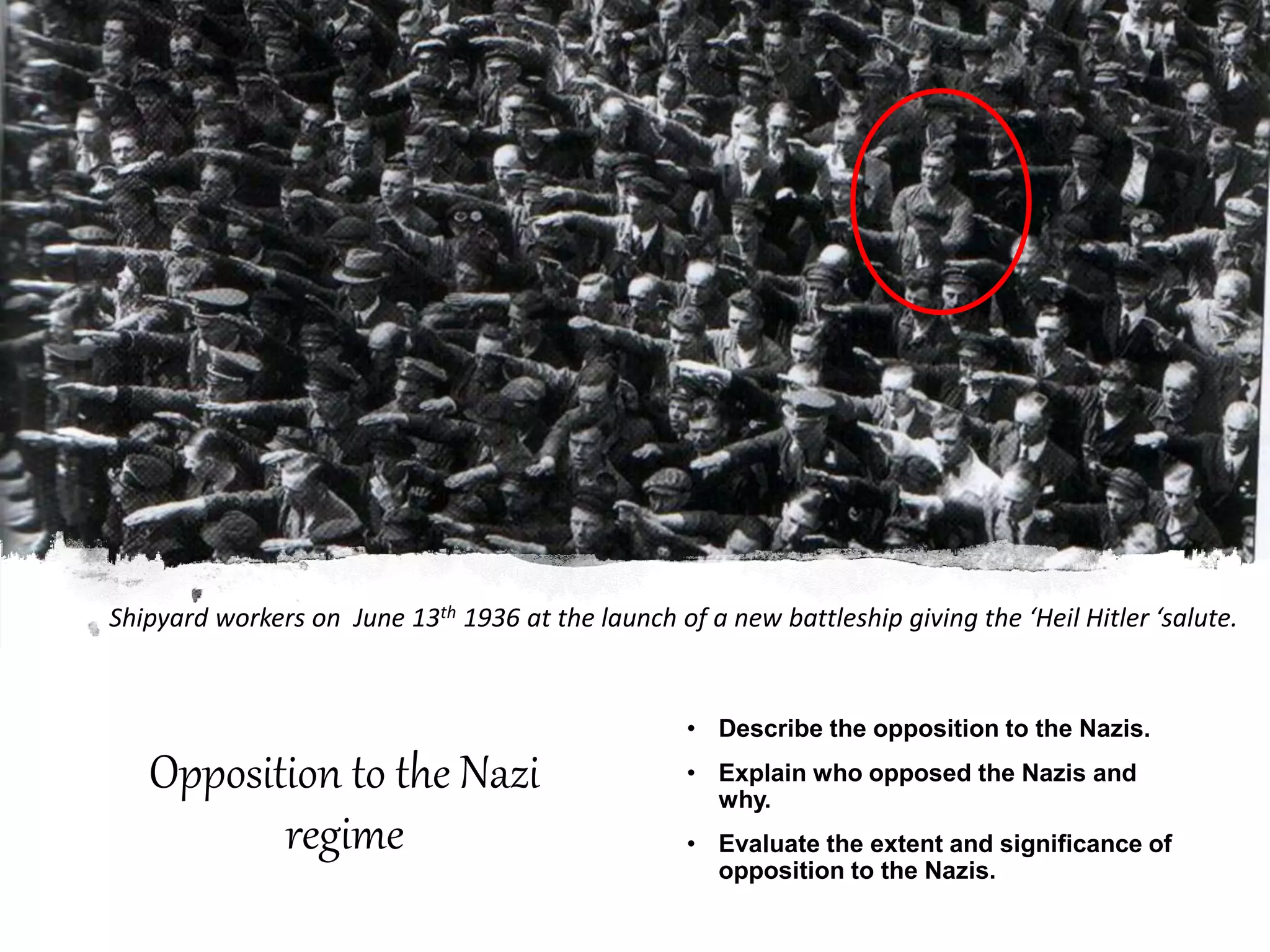
Shipyard workers on June 13th 1936 at the launch of a new battleship giving the ‘Heil Hitler ‘salute.
Did You Hear the One About
Hitler?
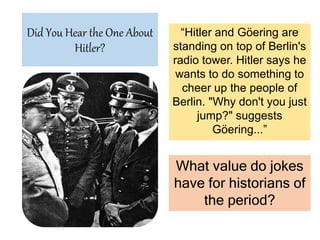
“Hitler and Göering are
standing on top of Berlin's
radio tower. Hitler says he
wants to do something to
cheer up the people of
Berlin. "Why don't you just
jump?" suggests
Göering...”
What value do jokes
have for historians of
the period?
Opposition in Hitler’s Germany
Stop @ 11:30 (if you want to watch more you can but it is focused on WW2 which is not in the syllabus)
Opposition against the Nazi regime took a variety of
forms ranging from general discontent and
widespread grumbling over fairly small matters like
wages and consumer goods, to political activism,
open resistance and attempted coups. Between
1933 and 1944 there were at least a dozen
assassination attempts on Hitler’s life.
However during the Nazi regime very little of this
opposition posed a real threat to the power of Hitler.
Why was this the case?
Overview
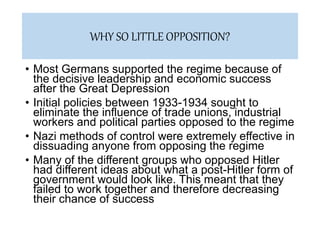
• Most Germans supported the regime because of
the decisive leadership and economic success
after the Great Depression
• Initial policies between 1933-1934 sought to
eliminate the influence of trade unions, industrial
workers and political parties opposed to the regime
• Nazi methods of control were extremely effective in
dissuading anyone from opposing the regime
• Many of the different groups who opposed Hitler
had different ideas about what a post-Hitler form of
government would look like. This meant that they
failed to work together and therefore decreasing
their chance of success
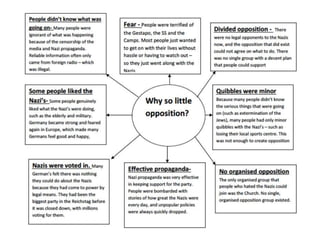
WHY SO LITTLE OPPOSITION?
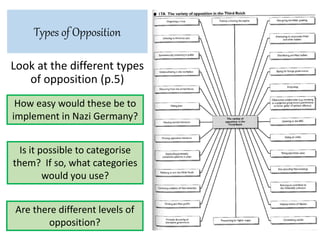
Types of Opposition
Look at the different types
of opposition (p.5)
How easy would these be to
implement in Nazi Germany?
Is it possible to categorise
them? If so, what categories
would you use?
Are there different levels of
opposition?
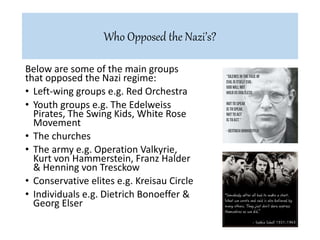
Below are some of the main groups
that opposed the Nazi regime:
• Left-wing groups e.g. Red Orchestra
• Youth groups e.g. The Edelweiss
Pirates, The Swing Kids, White Rose
Movement
• The churches
• The army e.g. Operation Valkyrie,
Kurt von Hammerstein, Franz Halder
& Henning von Tresckow
• Conservative elites e.g. Kreisau Circle
• Individuals e.g. Dietrich Bonoeffer &
Georg Elser
Who Opposed the Nazi’s?
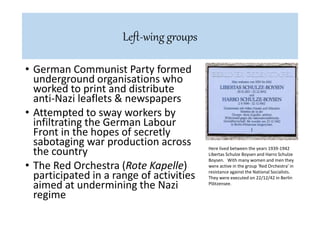
• German Communist Party formed
underground organisations who
worked to print and distribute
anti-Nazi leaflets & newspapers
• Attempted to sway workers by
infiltrating the German Labour
Front in the hopes of secretly
sabotaging war production across
the country
• The Red Orchestra (Rote Kapelle)
participated in a range of activities
aimed at undermining the Nazi
regime
Left-wing groups
Here lived between the years 1939-1942
Libertas Schulze Boysen and Harro Schulze
Boysen. With many women and men they
were active in the group ‘Red Orchestra’ in
resistance against the National Socialists.
They were executed on 22/12/42 in Berlin
Plötzensee.
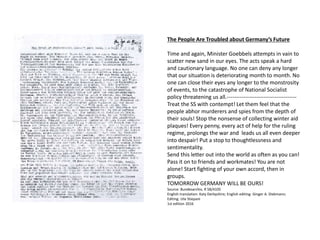
The People Are Troubled about Germany’s Future
Time and again, Minister Goebbels attempts in vain to
scatter new sand in our eyes. The acts speak a hard
and cautionary language. No one can deny any longer
that our situation is deteriorating month to month. No
one can close their eyes any longer to the monstrosity
of events, to the catastrophe of National Socialist
policy threatening us all.--------------------------------------
Treat the SS with contempt! Let them feel that the
people abhor murderers and spies from the depth of
their souls! Stop the nonsense of collecting winter aid
plaques! Every penny, every act of help for the ruling
regime, prolongs the war and leads us all even deeper
into despair! Put a stop to thoughtlessness and
sentimentality.
Send this letter out into the world as often as you can!
Pass it on to friends and workmates! You are not
alone! Start fighting of your own accord, then in
groups.
TOMORROW GERMANY WILL BE OURS!
Source: Bundesarchiv, R 58/4105
English translation: Katy Derbyshire; English editing: Ginger A. Diekmann;
Editing: Ute Stiepani
1st edition 2016
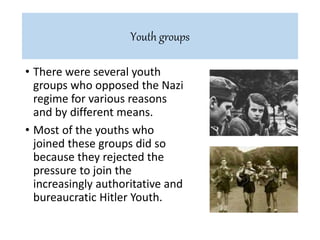
• There were several youth
groups who opposed the Nazi
regime for various reasons
and by different means.
• Most of the youths who
joined these groups did so
because they rejected the
pressure to join the
increasingly authoritative and
bureaucratic Hitler Youth.
Youth groups
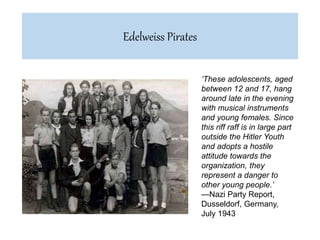
‘These adolescents, aged
between 12 and 17, hang
around late in the evening
with musical instruments
and young females. Since
this riff raff is in large part
outside the Hitler Youth
and adopts a hostile
attitude towards the
organization, they
represent a danger to
other young people.’
—Nazi Party Report,
Dusseldorf, Germany,
July 1943
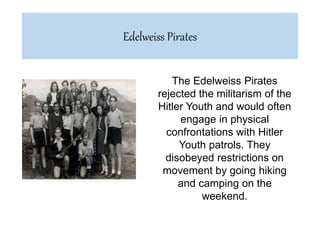
Edelweiss Pirates
The Edelweiss Pirates
rejected the militarism of the
Hitler Youth and would often
engage in physical
confrontations with Hitler
Youth patrols. They
disobeyed restrictions on
movement by going hiking
and camping on the
weekend.
Edelweiss Pirates
“Swing Types”
• In 1942 Hans Scholl, a medical student at the University of
Munich, his sister Sophie Scholl, Christoph Probst, Willi Graf,
and Alexander Schmorell founded the “White Rose”
movement, one of the few German groups that spoke out
against Nazi genocidal policies.
• At great risk, “White Rose” members transported and
mailed mimeographed leaflets that denounced the regime.
• In their attempt to stop the war effort, they advocated the
sabotage of the armaments industry. “We will not be silent,”
they wrote to their fellow students. “We are your bad
conscience. The White Rose will not leave you in peace!"
Because the students were aware that only military force
could end Nazi domination, they limited their aims to
achieve “a renewal from within of the severely wounded
German spirit.”
White Rose
• Numerous Protestant church groups had existed before Nazi
Germany. But these were absorbed into the Nazi Reich
Church. Some individuals refused to recognise this new
church and the Nazis naturally saw them as a threat. 175
Protestant pastors were arrested; probably the two most
famous were Martin Niemöller and Dietrich Bonhoffer.
• The Catholic Church fared no better despite the July 1933
Concordat signed between the Papacy and Nazi Germany.
When it became clear that the Catholic Church was suffering
just as much as Protestant churches, Pius XI issued ‘With
Burning Anxiety’ (Mit brennender Sorge) and some Catholic
priests took a stand. This ended with 693 being arrested for
“oppositional activities”.
The Church
• Opposition from within the army didn’t really appear
until it was clear that Hitler was steering Germany
towards war.
• A group that included conservative military officers and
diplomats believed that Hitler's violent death should
signal a general anti-Nazi revolt. Military officers
attempted to assassinate Hitler on July 20, 1944, in his
East Prussian headquarters at Rastenburg. Colonel
Claus Schenk von Stauffenberg left a bomb in a
briefcase near Hitler during a military briefing about
the eastern front
The ARMY
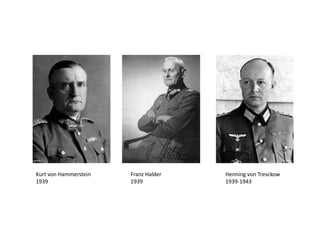
Kurt von Hammerstein
1939
Franz Halder
1939
Henning von Tresckow
1939-1943
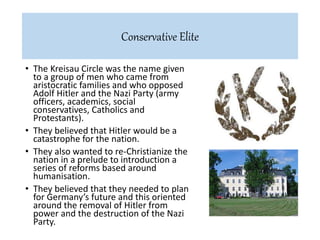
• The Kreisau Circle was the name given
to a group of men who came from
aristocratic families and who opposed
Adolf Hitler and the Nazi Party (army
officers, academics, social
conservatives, Catholics and
Protestants).
• They believed that Hitler would be a
catastrophe for the nation.
• They also wanted to re-Christianize the
nation in a prelude to introduction a
series of reforms based around
humanisation.
• They believed that they needed to plan
for Germany’s future and this oriented
around the removal of Hitler from
power and the destruction of the Nazi
Party.
Conservative Elite
• Dietrich Bonoeffer – Lutheran pastor who resisted
the Nazi regime by distributing anti-Nazi leaflets &
resistance posters
• Georg Elser – a small-town carpenter from
Southern Germany who attempted to assassinate
Hitler, Goring and Goebbels by placing a bomb
where Hitler was due to give a speech to mark the
anniversary of the attempted putsch in 1923.
Individuals
• Using what you have learnt this lesson and your
own research complete the table on pp. 6- 8 of
your booklets.
Overview of those who opposed Hitler
What type of source questions are being asked?
- Describe
- Identify and account (perspective)
- Compare
- To what extent (judgement)
Source Questions
What type of source questions are being asked?
Look through sources a – g in your booklets
then answer the practice HSC exam questions.
Source Questions
Read through the BBC Bitesize website revision
points and complete the online test:
https://www.bbc.com/bitesize/guides/z2p3k2p/re
vision/1
CONSOLIDATE

Opposition.pptx

  • 1.
    Opposition to theNazi regime • Describe the opposition to the Nazis. • Explain who opposed the Nazis and why. • Evaluate the extent and significance of opposition to the Nazis. Shipyard workers on June 13th 1936 at the launch of a new battleship giving the ‘Heil Hitler ‘salute.
  • 2.
    Did You Hearthe One About Hitler? “Hitler and Göering are standing on top of Berlin's radio tower. Hitler says he wants to do something to cheer up the people of Berlin. "Why don't you just jump?" suggests Göering...” What value do jokes have for historians of the period?
  • 3.
    Opposition in Hitler’sGermany Stop @ 11:30 (if you want to watch more you can but it is focused on WW2 which is not in the syllabus)
  • 4.
    Opposition against theNazi regime took a variety of forms ranging from general discontent and widespread grumbling over fairly small matters like wages and consumer goods, to political activism, open resistance and attempted coups. Between 1933 and 1944 there were at least a dozen assassination attempts on Hitler’s life. However during the Nazi regime very little of this opposition posed a real threat to the power of Hitler. Why was this the case? Overview
  • 5.
    • Most Germanssupported the regime because of the decisive leadership and economic success after the Great Depression • Initial policies between 1933-1934 sought to eliminate the influence of trade unions, industrial workers and political parties opposed to the regime • Nazi methods of control were extremely effective in dissuading anyone from opposing the regime • Many of the different groups who opposed Hitler had different ideas about what a post-Hitler form of government would look like. This meant that they failed to work together and therefore decreasing their chance of success WHY SO LITTLE OPPOSITION?
  • 7.
    Types of Opposition Lookat the different types of opposition (p.5) How easy would these be to implement in Nazi Germany? Is it possible to categorise them? If so, what categories would you use? Are there different levels of opposition?
  • 8.
    Below are someof the main groups that opposed the Nazi regime: • Left-wing groups e.g. Red Orchestra • Youth groups e.g. The Edelweiss Pirates, The Swing Kids, White Rose Movement • The churches • The army e.g. Operation Valkyrie, Kurt von Hammerstein, Franz Halder & Henning von Tresckow • Conservative elites e.g. Kreisau Circle • Individuals e.g. Dietrich Bonoeffer & Georg Elser Who Opposed the Nazi’s?
  • 9.
    • German CommunistParty formed underground organisations who worked to print and distribute anti-Nazi leaflets & newspapers • Attempted to sway workers by infiltrating the German Labour Front in the hopes of secretly sabotaging war production across the country • The Red Orchestra (Rote Kapelle) participated in a range of activities aimed at undermining the Nazi regime Left-wing groups Here lived between the years 1939-1942 Libertas Schulze Boysen and Harro Schulze Boysen. With many women and men they were active in the group ‘Red Orchestra’ in resistance against the National Socialists. They were executed on 22/12/42 in Berlin Plötzensee.
  • 10.
    The People AreTroubled about Germany’s Future Time and again, Minister Goebbels attempts in vain to scatter new sand in our eyes. The acts speak a hard and cautionary language. No one can deny any longer that our situation is deteriorating month to month. No one can close their eyes any longer to the monstrosity of events, to the catastrophe of National Socialist policy threatening us all.-------------------------------------- Treat the SS with contempt! Let them feel that the people abhor murderers and spies from the depth of their souls! Stop the nonsense of collecting winter aid plaques! Every penny, every act of help for the ruling regime, prolongs the war and leads us all even deeper into despair! Put a stop to thoughtlessness and sentimentality. Send this letter out into the world as often as you can! Pass it on to friends and workmates! You are not alone! Start fighting of your own accord, then in groups. TOMORROW GERMANY WILL BE OURS! Source: Bundesarchiv, R 58/4105 English translation: Katy Derbyshire; English editing: Ginger A. Diekmann; Editing: Ute Stiepani 1st edition 2016
  • 11.
    • There wereseveral youth groups who opposed the Nazi regime for various reasons and by different means. • Most of the youths who joined these groups did so because they rejected the pressure to join the increasingly authoritative and bureaucratic Hitler Youth. Youth groups
  • 12.
    ‘These adolescents, aged between12 and 17, hang around late in the evening with musical instruments and young females. Since this riff raff is in large part outside the Hitler Youth and adopts a hostile attitude towards the organization, they represent a danger to other young people.’ —Nazi Party Report, Dusseldorf, Germany, July 1943 Edelweiss Pirates
  • 13.
    The Edelweiss Pirates rejectedthe militarism of the Hitler Youth and would often engage in physical confrontations with Hitler Youth patrols. They disobeyed restrictions on movement by going hiking and camping on the weekend. Edelweiss Pirates
  • 14.
  • 15.
    • In 1942Hans Scholl, a medical student at the University of Munich, his sister Sophie Scholl, Christoph Probst, Willi Graf, and Alexander Schmorell founded the “White Rose” movement, one of the few German groups that spoke out against Nazi genocidal policies. • At great risk, “White Rose” members transported and mailed mimeographed leaflets that denounced the regime. • In their attempt to stop the war effort, they advocated the sabotage of the armaments industry. “We will not be silent,” they wrote to their fellow students. “We are your bad conscience. The White Rose will not leave you in peace!" Because the students were aware that only military force could end Nazi domination, they limited their aims to achieve “a renewal from within of the severely wounded German spirit.” White Rose
  • 16.
    • Numerous Protestantchurch groups had existed before Nazi Germany. But these were absorbed into the Nazi Reich Church. Some individuals refused to recognise this new church and the Nazis naturally saw them as a threat. 175 Protestant pastors were arrested; probably the two most famous were Martin Niemöller and Dietrich Bonhoffer. • The Catholic Church fared no better despite the July 1933 Concordat signed between the Papacy and Nazi Germany. When it became clear that the Catholic Church was suffering just as much as Protestant churches, Pius XI issued ‘With Burning Anxiety’ (Mit brennender Sorge) and some Catholic priests took a stand. This ended with 693 being arrested for “oppositional activities”. The Church
  • 17.
    • Opposition fromwithin the army didn’t really appear until it was clear that Hitler was steering Germany towards war. • A group that included conservative military officers and diplomats believed that Hitler's violent death should signal a general anti-Nazi revolt. Military officers attempted to assassinate Hitler on July 20, 1944, in his East Prussian headquarters at Rastenburg. Colonel Claus Schenk von Stauffenberg left a bomb in a briefcase near Hitler during a military briefing about the eastern front The ARMY
  • 18.
    Kurt von Hammerstein 1939 FranzHalder 1939 Henning von Tresckow 1939-1943
  • 19.
    • The KreisauCircle was the name given to a group of men who came from aristocratic families and who opposed Adolf Hitler and the Nazi Party (army officers, academics, social conservatives, Catholics and Protestants). • They believed that Hitler would be a catastrophe for the nation. • They also wanted to re-Christianize the nation in a prelude to introduction a series of reforms based around humanisation. • They believed that they needed to plan for Germany’s future and this oriented around the removal of Hitler from power and the destruction of the Nazi Party. Conservative Elite
  • 20.
    • Dietrich Bonoeffer– Lutheran pastor who resisted the Nazi regime by distributing anti-Nazi leaflets & resistance posters • Georg Elser – a small-town carpenter from Southern Germany who attempted to assassinate Hitler, Goring and Goebbels by placing a bomb where Hitler was due to give a speech to mark the anniversary of the attempted putsch in 1923. Individuals
  • 21.
    • Using whatyou have learnt this lesson and your own research complete the table on pp. 6- 8 of your booklets. Overview of those who opposed Hitler
  • 22.
    What type ofsource questions are being asked? - Describe - Identify and account (perspective) - Compare - To what extent (judgement) Source Questions
  • 23.
    What type ofsource questions are being asked? Look through sources a – g in your booklets then answer the practice HSC exam questions. Source Questions
  • 24.
    Read through theBBC Bitesize website revision points and complete the online test: https://www.bbc.com/bitesize/guides/z2p3k2p/re vision/1 CONSOLIDATE

Editor's Notes

  • #2 https://www.independent.co.uk/news/world/europe/the-tragically-powerful-story-behind-the-lone-german-who-refused-to-give-hitler-the-nazi-salute-a7214386.html
  • #3 http://www.spiegel.de/international/new-book-on-nazi-era-humor-did-you-hear-the-one-about-hitler-a-434399.html https://www.aljazeera.com/archive/2006/09/2008410132225493873.html https://www.tribuneindia.com/2006/20061001/spectrum/book8.htm