Optimisation

                Dr. Stuart Mitchell
                       LMRC
               University of Auckland
               s.mitchell@auckland.ac.nz
                    Kiwi Pycon 2009
Contents of presentation
What is Mathematical Programing
        When is it useful
 The Wedding Guest Problem
What is Mathematical programing
• A simple mathematically precise way of stating
  optimisation problems.
• Use mathematically rigorous way to find a
  solution
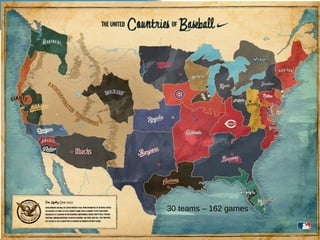
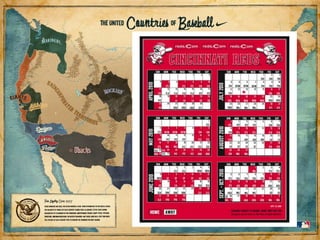
30 teams – 162 games
What is Mathematical programing
• A simple mathematically precise way of stating
  optimisation problems.
• Use mathematically rigorous way to find a
  solution
What is Mathematical programing
• A simple mathematically precise way of stating
  optimisation problems.
• Use mathematically rigorous way to find a
  solution
When is it useful
• There is a decision problem


• There is lots of data


• There is money to be made
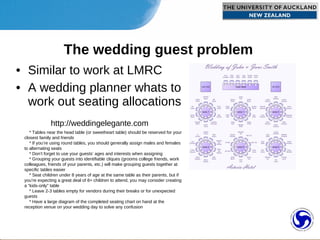
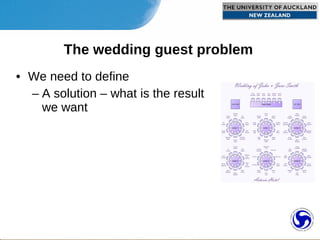
The wedding guest problem
• Similar to work at LMRC
• A wedding planner whats to
  work out seating allocations
              http://weddingelegante.com
    * Tables near the head table (or sweetheart table) should be reserved for your
 closest family and friends
    * If you’re using round tables, you should generally assign males and females
 to alternating seats
    * Don’t forget to use your guests’ ages and interests when assigning
    * Grouping your guests into identifiable cliques (grooms college friends, work
 colleagues, friends of your parents, etc.) will make grouping guests together at
 specific tables easier
    * Seat children under 8 years of age at the same table as their parents, but if
 you’re expecting a great deal of 8+ children to attend, you may consider creating
 a “kids-only” table
    * Leave 2-3 tables empty for vendors during their breaks or for unexpected
 guests
    * Have a large diagram of the completed seating chart on hand at the
 reception venue on your wedding day to solve any confusion
The wedding guest problem
• We need to define
  – A solution – what is the result
    we want
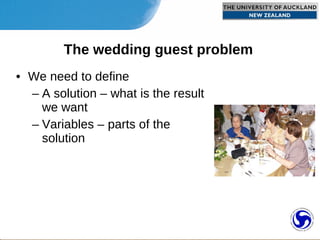
The wedding guest problem
• We need to define
  – A solution – what is the result
    we want
  – Variables – parts of the
    solution
The wedding guest problem
• We need to define
  – A solution – what is the result
    we want
  – Variables – parts of the solution
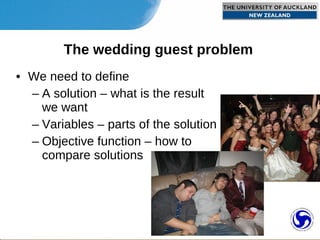
  – Objective function – how to
    compare solutions
The wedding guest problem
• We need to define
  – A solution – what is the result
    we want
  – Variables – parts of the solution
  – Objective function – how to
    compare solutions
  – Constraints – define a solution
     • In terms of the variables
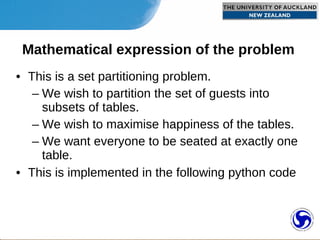
Mathematical expression of the problem
• This is a set partitioning problem.
   – We wish to partition the set of guests into
     subsets of tables.
   – We wish to maximise happiness of the tables.
   – We want everyone to be seated at exactly one
     table.
• This is implemented in the following python code
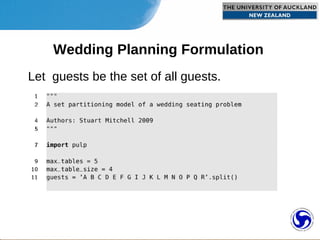
Wedding Planning Formulation
Let guests be the set of all guests.
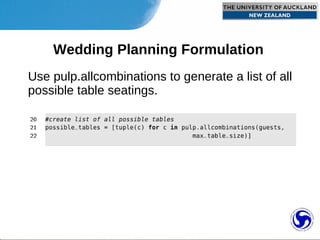
Wedding Planning Formulation
Use pulp.allcombinations to generate a list of all
possible table seatings.
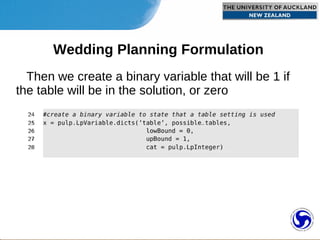
Wedding Planning Formulation
  Then we create a binary variable that will be 1 if
the table will be in the solution, or zero
Wedding Planning Formulation
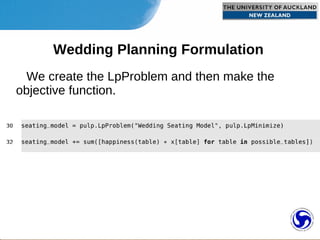
  We create the LpProblem and then make the
objective function.
Wedding Planning Formulation
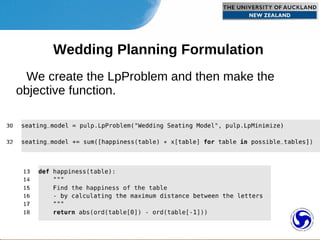
  We create the LpProblem and then make the
objective function.
Wedding Planning Formulation
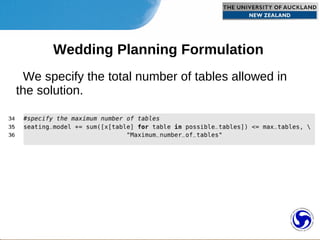
 We specify the total number of tables allowed in
the solution.
Wedding Planning Formulation
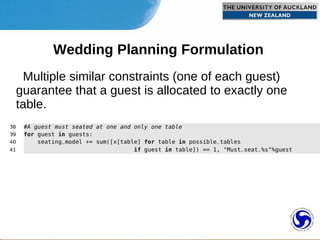
 Multiple similar constraints (one of each guest)
guarantee that a guest is allocated to exactly one
table.
Wedding Planning Formulation
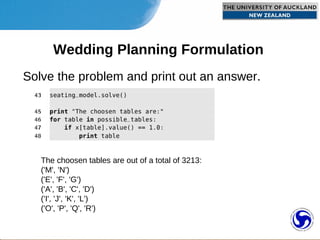
Solve the problem and print out an answer.


   The choosen tables are out of a total of 3213:
   ('M', 'N')
   ('E', 'F', 'G')
   ('A', 'B', 'C', 'D')
   ('I', 'J', 'K', 'L')
   ('O', 'P', 'Q', 'R')
Why Pulp
• MIT Licence

• Installation (google-code or pypi)

• Syntax

• Interoperabilty

• Documentation
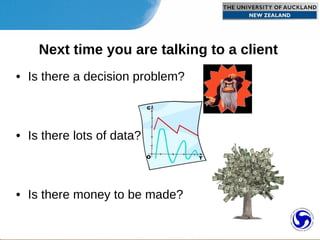
Next time you are talking to a client
• Is there a decision problem?


• Is there lots of data?


• Is there money to be made?

Operations Research and Optimization in Python using PuLP

  • 1.
    Optimisation Dr. Stuart Mitchell LMRC University of Auckland s.mitchell@auckland.ac.nz Kiwi Pycon 2009
  • 2.
    Contents of presentation Whatis Mathematical Programing When is it useful The Wedding Guest Problem
  • 3.
    What is Mathematicalprograming • A simple mathematically precise way of stating optimisation problems. • Use mathematically rigorous way to find a solution
  • 4.
    30 teams –162 games
  • 6.
    What is Mathematicalprograming • A simple mathematically precise way of stating optimisation problems. • Use mathematically rigorous way to find a solution
  • 7.
    What is Mathematicalprograming • A simple mathematically precise way of stating optimisation problems. • Use mathematically rigorous way to find a solution
  • 8.
    When is ituseful • There is a decision problem • There is lots of data • There is money to be made
  • 9.
    The wedding guestproblem • Similar to work at LMRC • A wedding planner whats to work out seating allocations http://weddingelegante.com * Tables near the head table (or sweetheart table) should be reserved for your closest family and friends * If you’re using round tables, you should generally assign males and females to alternating seats * Don’t forget to use your guests’ ages and interests when assigning * Grouping your guests into identifiable cliques (grooms college friends, work colleagues, friends of your parents, etc.) will make grouping guests together at specific tables easier * Seat children under 8 years of age at the same table as their parents, but if you’re expecting a great deal of 8+ children to attend, you may consider creating a “kids-only” table * Leave 2-3 tables empty for vendors during their breaks or for unexpected guests * Have a large diagram of the completed seating chart on hand at the reception venue on your wedding day to solve any confusion
  • 10.
    The wedding guestproblem • We need to define – A solution – what is the result we want
  • 11.
    The wedding guestproblem • We need to define – A solution – what is the result we want – Variables – parts of the solution
  • 12.
    The wedding guestproblem • We need to define – A solution – what is the result we want – Variables – parts of the solution – Objective function – how to compare solutions
  • 13.
    The wedding guestproblem • We need to define – A solution – what is the result we want – Variables – parts of the solution – Objective function – how to compare solutions – Constraints – define a solution • In terms of the variables
  • 14.
    Mathematical expression ofthe problem • This is a set partitioning problem. – We wish to partition the set of guests into subsets of tables. – We wish to maximise happiness of the tables. – We want everyone to be seated at exactly one table. • This is implemented in the following python code
  • 15.
    Wedding Planning Formulation Letguests be the set of all guests.
  • 16.
    Wedding Planning Formulation Usepulp.allcombinations to generate a list of all possible table seatings.
  • 17.
    Wedding Planning Formulation Then we create a binary variable that will be 1 if the table will be in the solution, or zero
  • 18.
    Wedding Planning Formulation We create the LpProblem and then make the objective function.
  • 19.
    Wedding Planning Formulation We create the LpProblem and then make the objective function.
  • 20.
    Wedding Planning Formulation We specify the total number of tables allowed in the solution.
  • 21.
    Wedding Planning Formulation Multiple similar constraints (one of each guest) guarantee that a guest is allocated to exactly one table.
  • 22.
    Wedding Planning Formulation Solvethe problem and print out an answer. The choosen tables are out of a total of 3213: ('M', 'N') ('E', 'F', 'G') ('A', 'B', 'C', 'D') ('I', 'J', 'K', 'L') ('O', 'P', 'Q', 'R')
  • 23.
    Why Pulp • MITLicence • Installation (google-code or pypi) • Syntax • Interoperabilty • Documentation
  • 24.
    Next time youare talking to a client • Is there a decision problem? • Is there lots of data? • Is there money to be made?