Operations of Strings,
Lists, Tuples, and
Dictionaries in Python
This presentation will guide you through essential operations for
common Python data structures: strings, lists, tuples, and dictionaries.
We'll explore key methods, manipulations, and use cases to enhance
your Python proficiency.
by Ayush
Introduction to String Operations
Strings in Python
Strings are sequences of characters enclosed in single (' ')
or double (" ") quotes. They are used to represent text data
in Python.
String Operations
Python offers a rich set of operations for manipulating
strings, including slicing, concatenation, repetition, and
formatting.
Slicing, Concatenation,
and Repetition in Strings
1 Slicing
Extracting a substring from
a string based on starting
and ending indices.
2 Concatenation
Combining multiple strings
into a single string using
the '+' operator.
3 Repetition
Repeating a string multiple times using the '*' operator.
List Operations: Creation,
Indexing, and
Manipulation
Creating a List
Lists are ordered collections of
items, enclosed in square
brackets [].
Accessing Elements
Accessing individual items in a
list using their index, starting
from 0.
Manipulating Lists
Modifying lists by adding, removing, or changing elements.
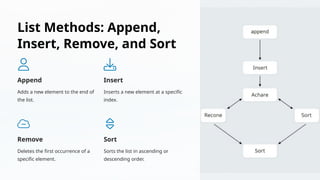
List Methods: Append,
Insert, Remove, and Sort
Append
Adds a new element to the end of
the list.
Insert
Inserts a new element at a specific
index.
Remove
Deletes the first occurrence of a
specific element.
Sort
Sorts the list in ascending or
descending order.
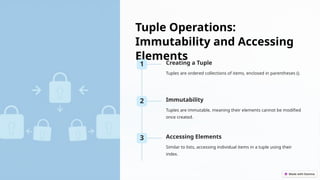
Tuple Operations:
Immutability and Accessing
Elements
1 Creating a Tuple
Tuples are ordered collections of items, enclosed in parentheses ().
2 Immutability
Tuples are immutable, meaning their elements cannot be modified
once created.
3 Accessing Elements
Similar to lists, accessing individual items in a tuple using their
index.
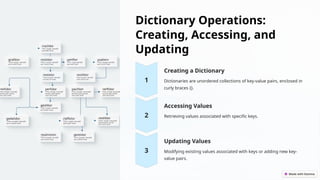
Dictionary Operations:
Creating, Accessing, and
Updating
Creating a Dictionary
Dictionaries are unordered collections of key-value pairs, enclosed in
curly braces {}.
Accessing Values
Retrieving values associated with specific keys.
Updating Values
Modifying existing values associated with keys or adding new key-
value pairs.
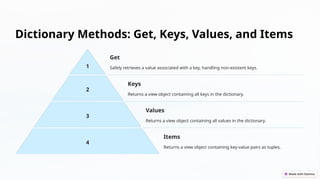
Dictionary Methods: Get, Keys, Values, and Items
1
Get
Safely retrieves a value associated with a key, handling non-existent keys.
2
Keys
Returns a view object containing all keys in the dictionary.
3
Values
Returns a view object containing all values in the dictionary.
4
Items
Returns a view object containing key-value pairs as tuples.
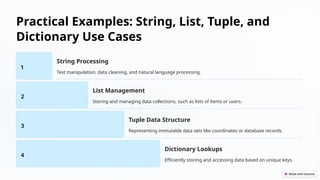
Practical Examples: String, List, Tuple, and
Dictionary Use Cases
1
String Processing
Text manipulation, data cleaning, and natural language processing.
2
List Management
Storing and managing data collections, such as lists of items or users.
3
Tuple Data Structure
Representing immutable data sets like coordinates or database records.
4
Dictionary Lookups
Efficiently storing and accessing data based on unique keys.
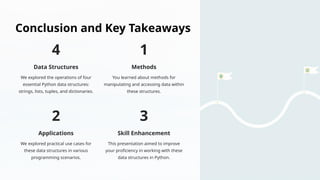
Conclusion and Key Takeaways
4
Data Structures
We explored the operations of four
essential Python data structures:
strings, lists, tuples, and dictionaries.
1
Methods
You learned about methods for
manipulating and accessing data within
these structures.
2
Applications
We explored practical use cases for
these data structures in various
programming scenarios.
3
Skill Enhancement
This presentation aimed to improve
your proficiency in working with these
data structures in Python.

Operations-of-Strings-Lists-Tuples-and-Dictionaries-in-Python (1).pptx

  • 1.
    Operations of Strings, Lists,Tuples, and Dictionaries in Python This presentation will guide you through essential operations for common Python data structures: strings, lists, tuples, and dictionaries. We'll explore key methods, manipulations, and use cases to enhance your Python proficiency. by Ayush
  • 2.
    Introduction to StringOperations Strings in Python Strings are sequences of characters enclosed in single (' ') or double (" ") quotes. They are used to represent text data in Python. String Operations Python offers a rich set of operations for manipulating strings, including slicing, concatenation, repetition, and formatting.
  • 3.
    Slicing, Concatenation, and Repetitionin Strings 1 Slicing Extracting a substring from a string based on starting and ending indices. 2 Concatenation Combining multiple strings into a single string using the '+' operator. 3 Repetition Repeating a string multiple times using the '*' operator.
  • 4.
    List Operations: Creation, Indexing,and Manipulation Creating a List Lists are ordered collections of items, enclosed in square brackets []. Accessing Elements Accessing individual items in a list using their index, starting from 0. Manipulating Lists Modifying lists by adding, removing, or changing elements.
  • 5.
    List Methods: Append, Insert,Remove, and Sort Append Adds a new element to the end of the list. Insert Inserts a new element at a specific index. Remove Deletes the first occurrence of a specific element. Sort Sorts the list in ascending or descending order.
  • 6.
    Tuple Operations: Immutability andAccessing Elements 1 Creating a Tuple Tuples are ordered collections of items, enclosed in parentheses (). 2 Immutability Tuples are immutable, meaning their elements cannot be modified once created. 3 Accessing Elements Similar to lists, accessing individual items in a tuple using their index.
  • 7.
    Dictionary Operations: Creating, Accessing,and Updating Creating a Dictionary Dictionaries are unordered collections of key-value pairs, enclosed in curly braces {}. Accessing Values Retrieving values associated with specific keys. Updating Values Modifying existing values associated with keys or adding new key- value pairs.
  • 8.
    Dictionary Methods: Get,Keys, Values, and Items 1 Get Safely retrieves a value associated with a key, handling non-existent keys. 2 Keys Returns a view object containing all keys in the dictionary. 3 Values Returns a view object containing all values in the dictionary. 4 Items Returns a view object containing key-value pairs as tuples.
  • 9.
    Practical Examples: String,List, Tuple, and Dictionary Use Cases 1 String Processing Text manipulation, data cleaning, and natural language processing. 2 List Management Storing and managing data collections, such as lists of items or users. 3 Tuple Data Structure Representing immutable data sets like coordinates or database records. 4 Dictionary Lookups Efficiently storing and accessing data based on unique keys.
  • 10.
    Conclusion and KeyTakeaways 4 Data Structures We explored the operations of four essential Python data structures: strings, lists, tuples, and dictionaries. 1 Methods You learned about methods for manipulating and accessing data within these structures. 2 Applications We explored practical use cases for these data structures in various programming scenarios. 3 Skill Enhancement This presentation aimed to improve your proficiency in working with these data structures in Python.