LEAN MANUFACTURING: methodology that aims to optimize processes by
eliminating waste, improving quality, and increasing overall efficiency in the
production and delivery of goods or services.
Total Quality Management (TQM) is a strategy that focuses on continuous
improvement, customer satisfaction, and employee involvement to enhance
organizational performance and create a culture of quality.
SUPPLY CHAIN MANAGEMENT strategy: involves efficiently coordinating the
various stages of production, distribution, and delivery to optimize processes,
reduce costs, and enhance overall performance throughout the supply chain.
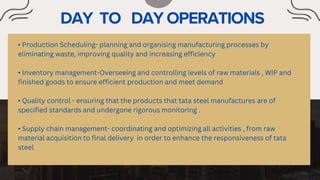
• Production Scheduling- planning and organising manufacturing processes by
eliminating waste, improving quality and increasing efficiency
• Inventory management-Overseeing and controlling levels of raw materials , WIP and
finished goods to ensure efficient production and meet demand
• Quality control - ensuring that the products that tata steel manufactures are of
specified standards and undergone rigorous monitoring .
• Supply chain management- coordinating and optimizing all activities , from raw
material acquisition to final delivery in order to enhance the responsiveness of tata
steel
• Economic Indicators
• Customer Relationship Management (CRM)
• Market Research
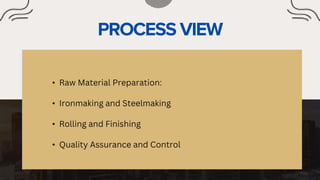
• Raw Material Preparation:
• Ironmaking and Steelmaking
• Rolling and Finishing
• Quality Assurance and Control
• Raw Material Sourcing:Tata Steel starts its production process by getting the materials it
needs. They have their own mines for iron ore and coal, which are essential
• Manufacturing and Logistics:Tata Steel has a bunch of big factories where they make steel.
They have a smart strategy that helps the process runs smoothly
• Distribution and customer service:Tata Steel has places where they store and send out the
steel they make. They have these centers and offices all over the world to reach
customers.
• Embrace Industry 4.0 Practices:Explore Industry 4.0 technologies, such as artificial intelligence,
machine learning, and the Internet of Things.
• Continuous Process Improvement:Establish a culture of continuous improvement by encouraging
employee participation in process optimization initiatives. Implement feedback
• Leverage Technology for Process Automation:Adopt technological advancements to automate
repetitive tasks, improve process control, and enhance data collection and analysis. Implement
automation solutions in areas like material handling, quality control, and production scheduling.
• Just-In-Time (JIT) Manufacturing:
• Demand Forecasting:
• Continuous Process Improvement:
• Efficient supply Chain Management
• Timely Parts Delivery
• Continuous Quality Control
• Lean Manufacturing
• Innovative practices
• Customer Centric Approaches
• Historical Data Analysis
• Market Trend Monitoring
• Predictive Analytics Techniques
• Manufacturing sector
• Assembly line production
• Suppliers,
• Manufacturing plants,
• Distribution centers
• Dealerships.
• An effective performance improvement strategy for Ford Motors
• The implementation of Total Quality Management (TQM)
• Continuous Improvement methodologies.
THANK
YOU!

OPERATIONS MANAGEMENT.pptx

  • 3.
    LEAN MANUFACTURING: methodologythat aims to optimize processes by eliminating waste, improving quality, and increasing overall efficiency in the production and delivery of goods or services. Total Quality Management (TQM) is a strategy that focuses on continuous improvement, customer satisfaction, and employee involvement to enhance organizational performance and create a culture of quality. SUPPLY CHAIN MANAGEMENT strategy: involves efficiently coordinating the various stages of production, distribution, and delivery to optimize processes, reduce costs, and enhance overall performance throughout the supply chain.
  • 4.
    • Production Scheduling-planning and organising manufacturing processes by eliminating waste, improving quality and increasing efficiency • Inventory management-Overseeing and controlling levels of raw materials , WIP and finished goods to ensure efficient production and meet demand • Quality control - ensuring that the products that tata steel manufactures are of specified standards and undergone rigorous monitoring . • Supply chain management- coordinating and optimizing all activities , from raw material acquisition to final delivery in order to enhance the responsiveness of tata steel
  • 5.
    • Economic Indicators •Customer Relationship Management (CRM) • Market Research
  • 6.
    • Raw MaterialPreparation: • Ironmaking and Steelmaking • Rolling and Finishing • Quality Assurance and Control
  • 7.
    • Raw MaterialSourcing:Tata Steel starts its production process by getting the materials it needs. They have their own mines for iron ore and coal, which are essential • Manufacturing and Logistics:Tata Steel has a bunch of big factories where they make steel. They have a smart strategy that helps the process runs smoothly • Distribution and customer service:Tata Steel has places where they store and send out the steel they make. They have these centers and offices all over the world to reach customers.
  • 8.
    • Embrace Industry4.0 Practices:Explore Industry 4.0 technologies, such as artificial intelligence, machine learning, and the Internet of Things. • Continuous Process Improvement:Establish a culture of continuous improvement by encouraging employee participation in process optimization initiatives. Implement feedback • Leverage Technology for Process Automation:Adopt technological advancements to automate repetitive tasks, improve process control, and enhance data collection and analysis. Implement automation solutions in areas like material handling, quality control, and production scheduling.
  • 10.
    • Just-In-Time (JIT)Manufacturing: • Demand Forecasting: • Continuous Process Improvement:
  • 11.
    • Efficient supplyChain Management • Timely Parts Delivery • Continuous Quality Control • Lean Manufacturing • Innovative practices • Customer Centric Approaches
  • 12.
    • Historical DataAnalysis • Market Trend Monitoring • Predictive Analytics Techniques
  • 13.
    • Manufacturing sector •Assembly line production
  • 14.
    • Suppliers, • Manufacturingplants, • Distribution centers • Dealerships.
  • 15.
    • An effectiveperformance improvement strategy for Ford Motors • The implementation of Total Quality Management (TQM) • Continuous Improvement methodologies.
  • 16.