Operations Management for MBAs 5th Edition Meredith Solutions Manual
1.
Operations Management forMBAs 5th Edition
Meredith Solutions Manual download pdf
https://testbankdeal.com/product/operations-management-for-mbas-5th-
edition-meredith-solutions-manual/
Visit testbankdeal.com to explore and download the complete
collection of test banks or solution manuals!
2.
Here are somerecommended products for you. Click the link to
download, or explore more at testbankdeal.com
Operations Management for MBAs 5th Edition Meredith Test
Bank
https://testbankdeal.com/product/operations-management-for-mbas-5th-
edition-meredith-test-bank/
Operations and Supply Chain Management for MBAs 6th
Edition Meredith Test Bank
https://testbankdeal.com/product/operations-and-supply-chain-
management-for-mbas-6th-edition-meredith-test-bank/
Project Management in Practice 5th Edition Meredith
Solutions Manual
https://testbankdeal.com/product/project-management-in-practice-5th-
edition-meredith-solutions-manual/
Survey of ECON 3rd Edition Sexton Solutions Manual
https://testbankdeal.com/product/survey-of-econ-3rd-edition-sexton-
solutions-manual/
3.
Marketing Real PeopleReal Choices Canadian 4th Edition
Solomon Test Bank
https://testbankdeal.com/product/marketing-real-people-real-choices-
canadian-4th-edition-solomon-test-bank/
Analysis for Financial Management 11th Edition Higgins
Test Bank
https://testbankdeal.com/product/analysis-for-financial-
management-11th-edition-higgins-test-bank/
Human Anatomy and Physiology 9th Edition Marieb Test Bank
https://testbankdeal.com/product/human-anatomy-and-physiology-9th-
edition-marieb-test-bank/
Principles of Modern Chemistry 8th Edition Oxtoby
Solutions Manual
https://testbankdeal.com/product/principles-of-modern-chemistry-8th-
edition-oxtoby-solutions-manual/
Making the Team A Guide for Managers 6th Edition Thompson
Solutions Manual
https://testbankdeal.com/product/making-the-team-a-guide-for-
managers-6th-edition-thompson-solutions-manual/
4.
Fundamentals of InvestmentsValuation and Management 7th
Edition Jordan Test Bank
https://testbankdeal.com/product/fundamentals-of-investments-
valuation-and-management-7th-edition-jordan-test-bank/
5.
Chapter 6 –Page 1
Chapter 6
Managing Process Improvement Projects
Chapter Summary
The first part of the chapter defines a project. The second part of the chapter covers the project
portfolio, the project life cycle, organizing the project team, and project plans. The third part of the
chapter discusses scheduling the project (with both certain and uncertain activity times), project
management software, and Goldratt’s critical chain concept. The fourth, and last, part of the
chapter, discusses controlling project cost and performance with earned value.
Discussion Outline
I. Introduction
II. Defining a Project
III. Planning the Project
A. Project Portfolio
B. Project Life Cycle
C. Projects in the Organizational Structure
D. Organizing the Project Team
E. Project Plans
IV. Scheduling the Project
A. Project Scheduling with Certain Activity Times: A Process Improvement Example
1. Project Completion and Critical Paths
2. Slack Time
B. Project Scheduling with Uncertain Activity Times
1. Calculating activity durations
2. Probabilities of Completion
3. Simulating Project Completion Times
C. Project Management Software Capabilities
D. Goldratt’s Critical Chain
1. Inflated Activity Time Estimates
2. Activity Time Variability with Path Interdependencies
3. Resource Dependence
V. Controlling the Project: Earned Value
6.
Chapter 6 –Page 2
Chapter Teaching Tips
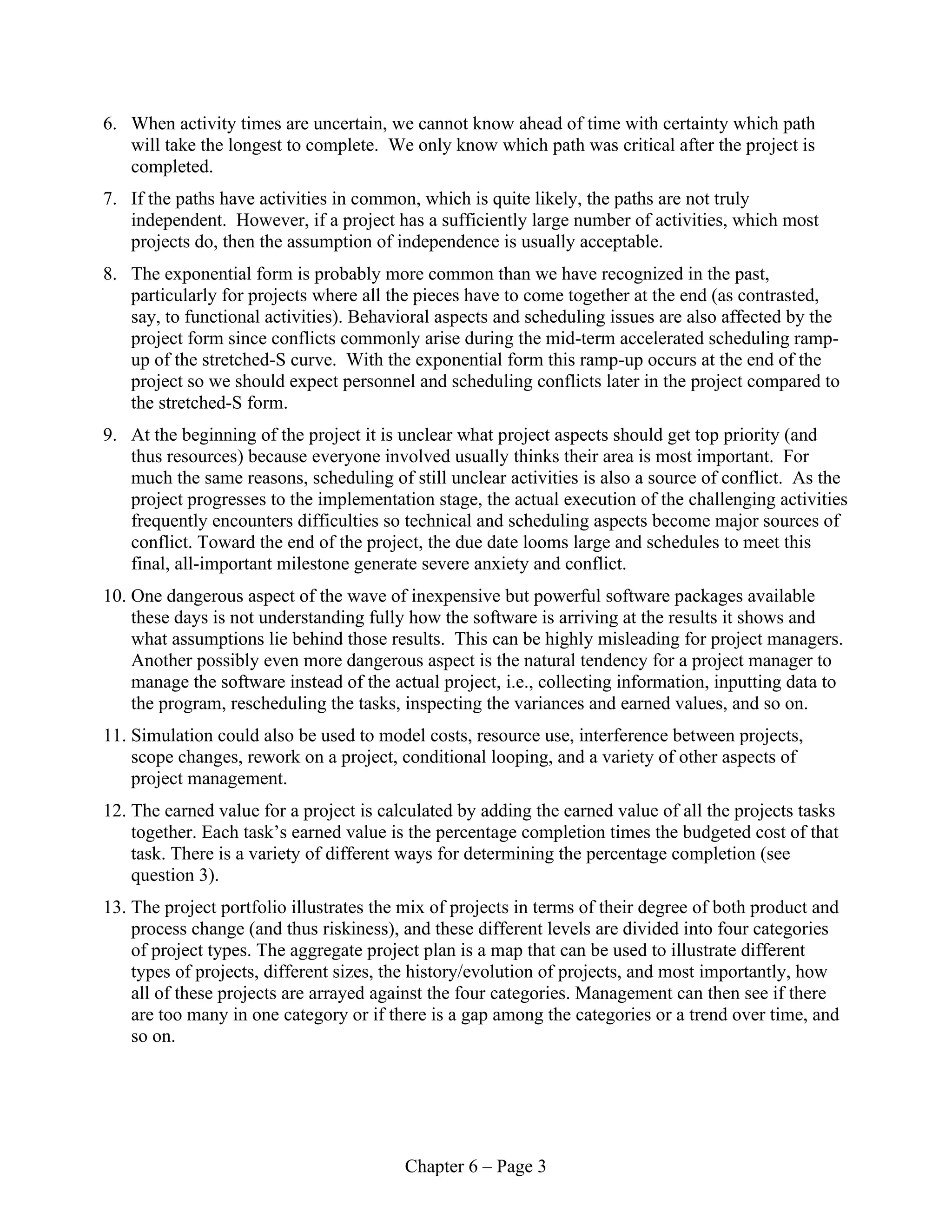
One way to introduce this chapter is to focus on the growth of projects in our society. Another, and
often more engaging, introduction is to devise a project with the class or with one person currently
engaged in a project involving multiple people (e.g., a campus career day), lay out the work
breakdown structure, estimate the activities and the times, and construct and solve the PERT
network. Another engaging issue is to ask the class how they might track the progress of a project
as it progresses. How would they actually measure the amount of progress attained—task-by-task
or by looking at the overall project? Could they trust someone who says that their task, or the
project, is 99% done? If not, what surrogate measures would be helpful for tracking project
progress?
Illustrative Answers to the Expand Your Understanding Questions
1. This major strategic error is more common than any other mistake. It is important to realize that
it is precisely because the tasks are defined so poorly that it is necessary to take longer to plan
the work that must be done. Although we would want to avoid “analysis paralysis,” the
overwhelming tendency is to plan too little rather than too much.
2. The cost-schedule reconciliation charts are more straightforward but cannot easily be compared
since the vertical axis is not the same in both charts. A project manager unfamiliar with the
earned value concept might therefore prefer the reconciliation charts.
3. One simple way is to equate the value with the cost of materials and resources used to date, but
this defeats the purpose. In reality, resources are usually brought in long before a task is
complete and only a minor additional increase in cost (e.g., a day's wages) may represent the
final attainment of a task with considerable value. It is the responsibility of the project manager
to decide on what task completions, or even partial completions, represent value completed for
the sponsor. In practice, there are five commonly used ways (all with potential pitfalls) to
measure earned value: 0-100% (i.e., no credit for the task budget [not actual spending] until a
task is completely finished), 50-50% (half of the budget when the task starts, half when done),
as a percentage of a scarce, critical resource used in proportion to progress (e.g., yards of
concrete poured for a road or building), percent of budgeted time passed since start of the task,
and percent of the budget spent since start of the task.
4. Because typically more things can go wrong than right, the optimistic times will probably be
more accurate.
5. Of the reasons listed in the text for the growth in project operations, the need for quick response
to customers’ needs given today's increasingly intense competition is likely the primary driving
force toward projects.
7.
Chapter 6 –Page 3
6. When activity times are uncertain, we cannot know ahead of time with certainty which path
will take the longest to complete. We only know which path was critical after the project is
completed.
7. If the paths have activities in common, which is quite likely, the paths are not truly
independent. However, if a project has a sufficiently large number of activities, which most
projects do, then the assumption of independence is usually acceptable.
8. The exponential form is probably more common than we have recognized in the past,
particularly for projects where all the pieces have to come together at the end (as contrasted,
say, to functional activities). Behavioral aspects and scheduling issues are also affected by the
project form since conflicts commonly arise during the mid-term accelerated scheduling ramp-
up of the stretched-S curve. With the exponential form this ramp-up occurs at the end of the
project so we should expect personnel and scheduling conflicts later in the project compared to
the stretched-S form.
9. At the beginning of the project it is unclear what project aspects should get top priority (and
thus resources) because everyone involved usually thinks their area is most important. For
much the same reasons, scheduling of still unclear activities is also a source of conflict. As the
project progresses to the implementation stage, the actual execution of the challenging activities
frequently encounters difficulties so technical and scheduling aspects become major sources of
conflict. Toward the end of the project, the due date looms large and schedules to meet this
final, all-important milestone generate severe anxiety and conflict.
10. One dangerous aspect of the wave of inexpensive but powerful software packages available
these days is not understanding fully how the software is arriving at the results it shows and
what assumptions lie behind those results. This can be highly misleading for project managers.
Another possibly even more dangerous aspect is the natural tendency for a project manager to
manage the software instead of the actual project, i.e., collecting information, inputting data to
the program, rescheduling the tasks, inspecting the variances and earned values, and so on.
11. Simulation could also be used to model costs, resource use, interference between projects,
scope changes, rework on a project, conditional looping, and a variety of other aspects of
project management.
12. The earned value for a project is calculated by adding the earned value of all the projects tasks
together. Each task’s earned value is the percentage completion times the budgeted cost of that
task. There is a variety of different ways for determining the percentage completion (see
question 3).
13. The project portfolio illustrates the mix of projects in terms of their degree of both product and
process change (and thus riskiness), and these different levels are divided into four categories
of project types. The aggregate project plan is a map that can be used to illustrate different
types of projects, different sizes, the history/evolution of projects, and most importantly, how
all of these projects are arrayed against the four categories. Management can then see if there
are too many in one category or if there is a gap among the categories or a trend over time, and
so on.
8.
Chapter 6 –Page 4
Apply Your Understanding: e-Razor, Incorporated
The purpose of this case is to reinforce student skills in regards to putting together an aggregate
project plan. The case describes eight project and/or process modification projects and students are
asked to put them into a aggregate project plan.
Answers to Questions
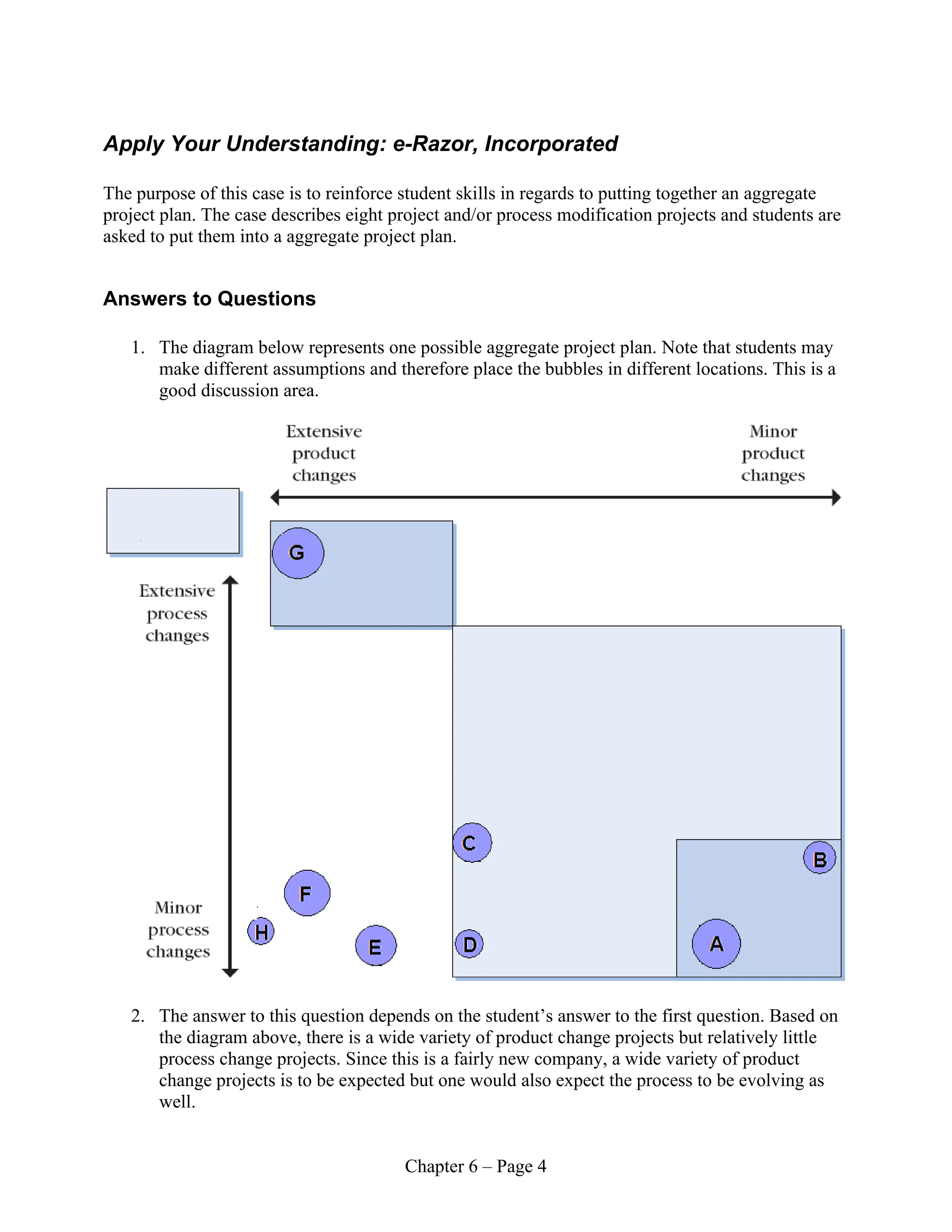
1. The diagram below represents one possible aggregate project plan. Note that students may
make different assumptions and therefore place the bubbles in different locations. This is a
good discussion area.
2. The answer to this question depends on the student’s answer to the first question. Based on
the diagram above, there is a wide variety of product change projects but relatively little
process change projects. Since this is a fairly new company, a wide variety of product
change projects is to be expected but one would also expect the process to be evolving as
well.
9.
Chapter 6 –Page 5
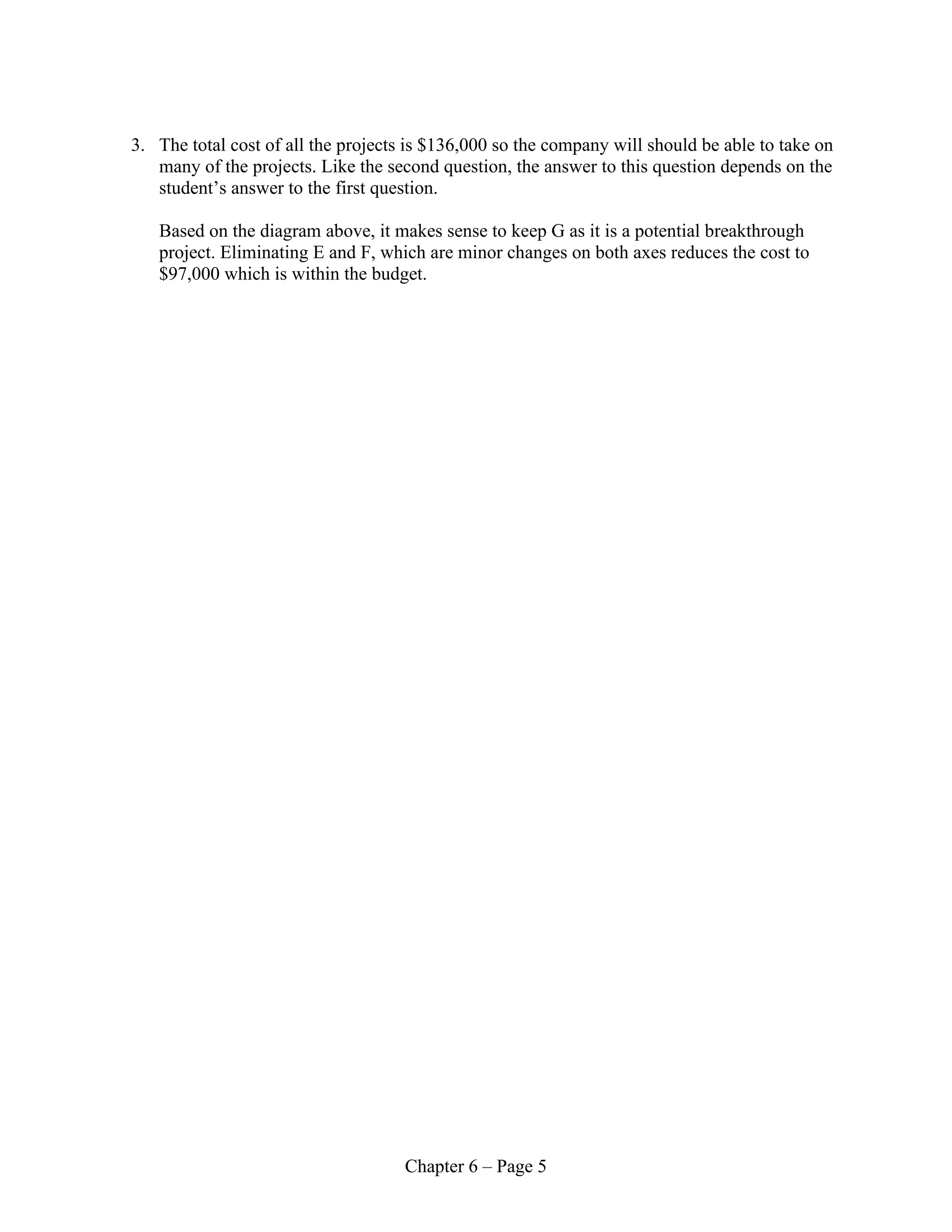
3. The total cost of all the projects is $136,000 so the company will should be able to take on
many of the projects. Like the second question, the answer to this question depends on the
student’s answer to the first question.
Based on the diagram above, it makes sense to keep G as it is a potential breakthrough
project. Eliminating E and F, which are minor changes on both axes reduces the cost to
$97,000 which is within the budget.
10.
Chapter 6 –Page 6
Apply Your Understanding: Nutri-Sam
The purpose of this case is to reinforce students’ skills in analyzing projects with probabilistic time
estimates. The case also provides students with an opportunity to use spreadsheets to simulate the
completion of the project and use the results of the simulation to perform standard probability
calculations.
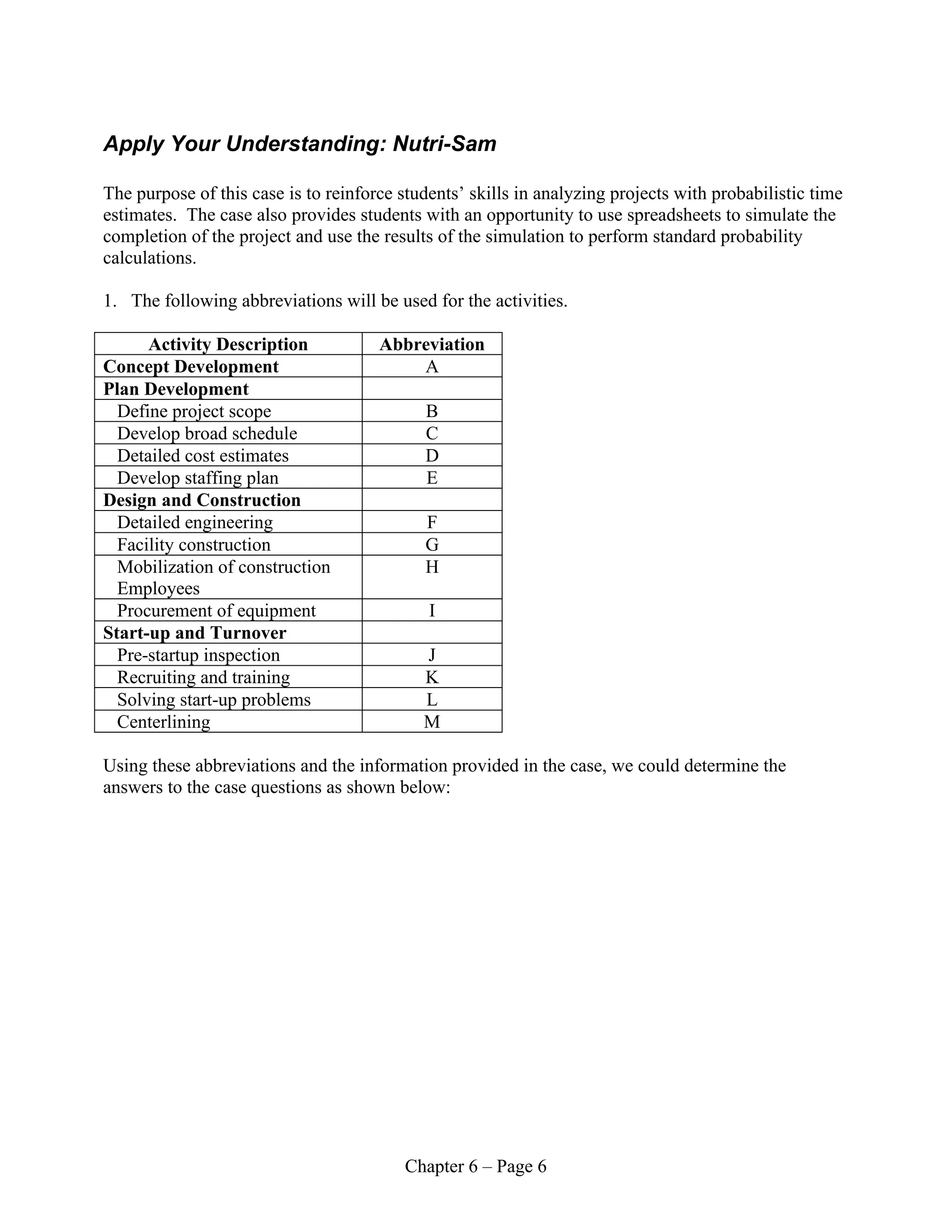
1. The following abbreviations will be used for the activities.
Activity Description Abbreviation
Concept Development A
Plan Development
Define project scope B
Develop broad schedule C
Detailed cost estimates D
Develop staffing plan E
Design and Construction
Detailed engineering F
Facility construction G
Mobilization of construction
Employees
H
Procurement of equipment I
Start-up and Turnover
Pre-startup inspection J
Recruiting and training K
Solving start-up problems L
Centerlining M
Using these abbreviations and the information provided in the case, we could determine the
answers to the case questions as shown below:
11.
Chapter 6 –Page 7
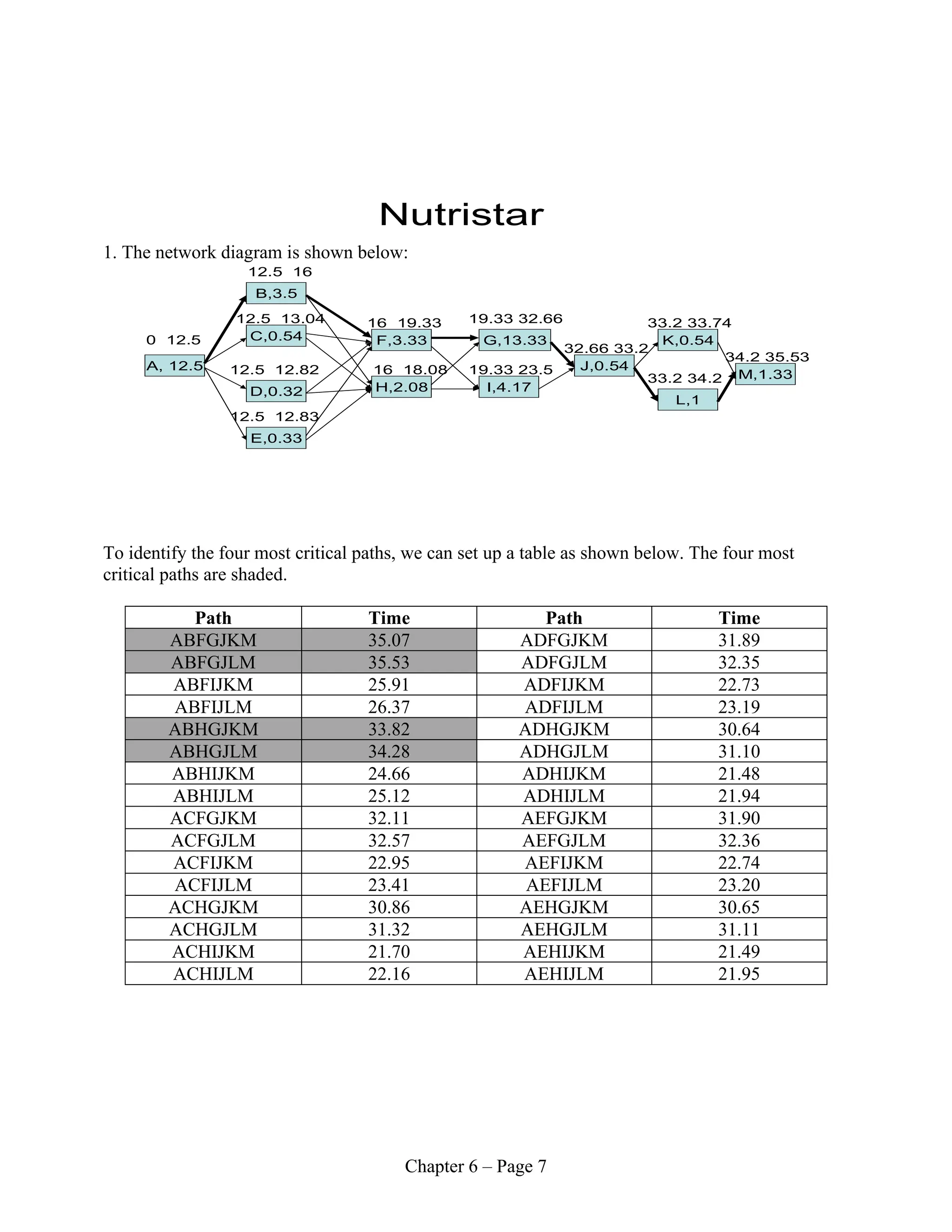
Nutristar
A, 12.5
B,3.5
C,0.54
D,0.32
E,0.33
F,3.33
H,2.08
G,13.33
I,4.17
J,0.54
K,0.54
L,1
M,1.33
0 12.5
12.5 16
12.5 13.04
12.5 12.82
12.5 12.83
16 18.08
16 19.33 19.33 32.66
19.33 23.5
32.66 33.2
33.2 33.74
33.2 34.2
34.2 35.53
1. The network diagram is shown below:
To identify the four most critical paths, we can set up a table as shown below. The four most
critical paths are shaded.
Path Time Path Time
ABFGJKM 35.07 ADFGJKM 31.89
ABFGJLM 35.53 ADFGJLM 32.35
ABFIJKM 25.91 ADFIJKM 22.73
ABFIJLM 26.37 ADFIJLM 23.19
ABHGJKM 33.82 ADHGJKM 30.64
ABHGJLM 34.28 ADHGJLM 31.10
ABHIJKM 24.66 ADHIJKM 21.48
ABHIJLM 25.12 ADHIJLM 21.94
ACFGJKM 32.11 AEFGJKM 31.90
ACFGJLM 32.57 AEFGJLM 32.36
ACFIJKM 22.95 AEFIJKM 22.74
ACFIJLM 23.41 AEFIJLM 23.20
ACHGJKM 30.86 AEHGJKM 30.65
ACHGJLM 31.32 AEHGJLM 31.11
ACHIJKM 21.70 AEHIJKM 21.49
ACHIJLM 22.16 AEHIJLM 21.95
12.
Chapter 6 –Page 8
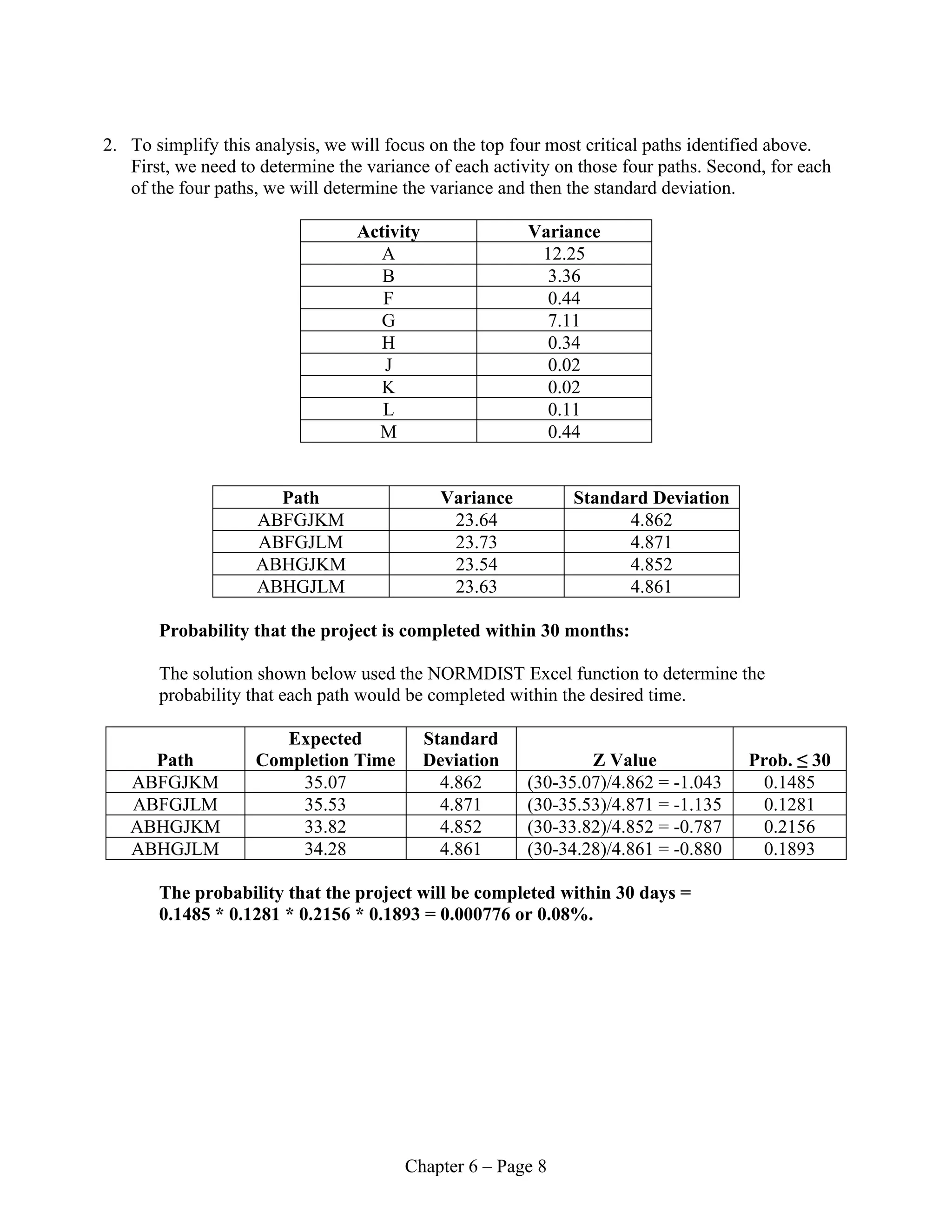
2. To simplify this analysis, we will focus on the top four most critical paths identified above.
First, we need to determine the variance of each activity on those four paths. Second, for each
of the four paths, we will determine the variance and then the standard deviation.
Activity Variance
A 12.25
B 3.36
F 0.44
G 7.11
H 0.34
J 0.02
K 0.02
L 0.11
M 0.44
Path Variance Standard Deviation
ABFGJKM 23.64 4.862
ABFGJLM 23.73 4.871
ABHGJKM 23.54 4.852
ABHGJLM 23.63 4.861
Probability that the project is completed within 30 months:
The solution shown below used the NORMDIST Excel function to determine the
probability that each path would be completed within the desired time.
Path
Expected
Completion Time
Standard
Deviation Z Value Prob. ≤ 30
ABFGJKM 35.07 4.862 (30-35.07)/4.862 = -1.043 0.1485
ABFGJLM 35.53 4.871 (30-35.53)/4.871 = -1.135 0.1281
ABHGJKM 33.82 4.852 (30-33.82)/4.852 = -0.787 0.2156
ABHGJLM 34.28 4.861 (30-34.28)/4.861 = -0.880 0.1893
The probability that the project will be completed within 30 days =
0.1485 * 0.1281 * 0.2156 * 0.1893 = 0.000776 or 0.08%.
13.
Chapter 6 –Page 9
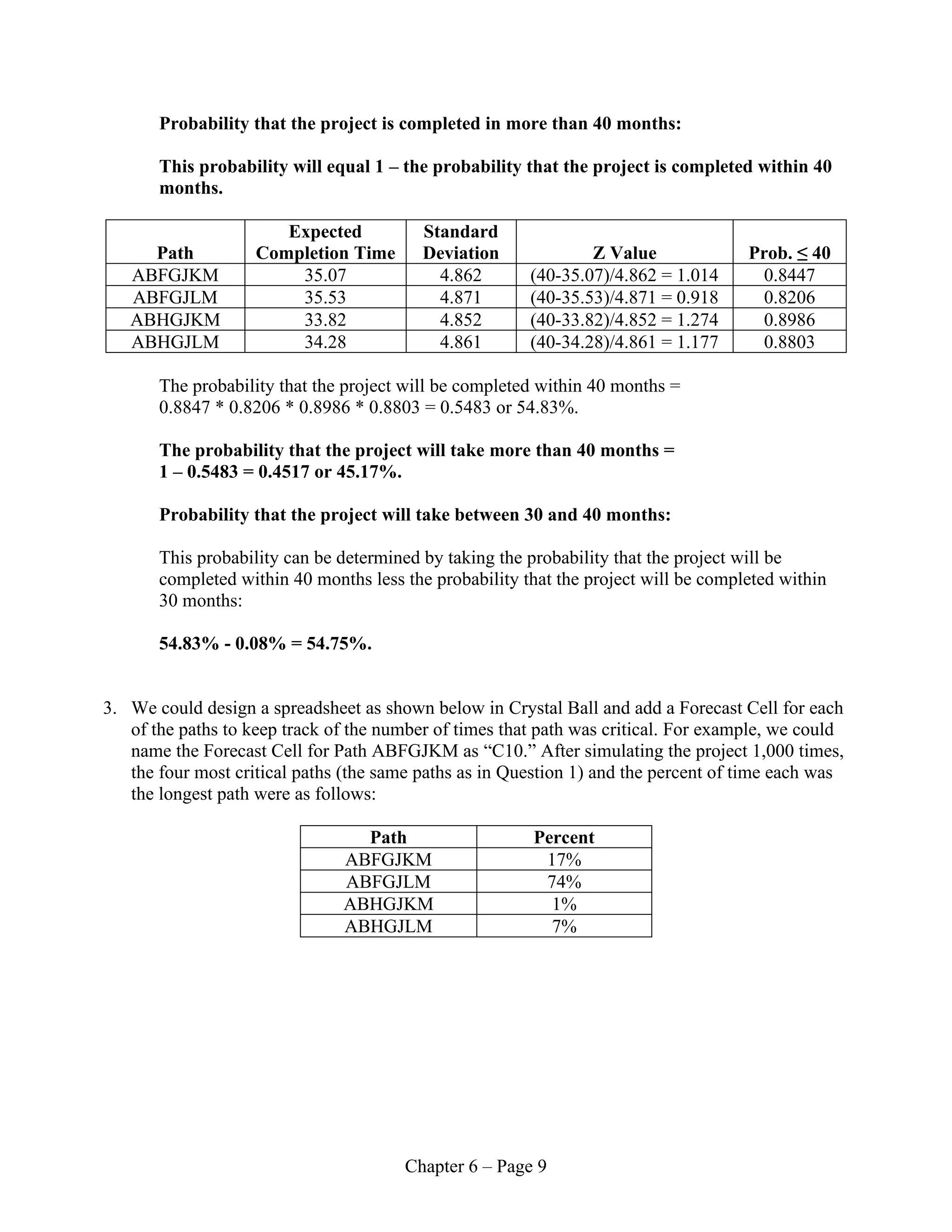
Probability that the project is completed in more than 40 months:
This probability will equal 1 – the probability that the project is completed within 40
months.
Path
Expected
Completion Time
Standard
Deviation Z Value Prob. ≤ 40
ABFGJKM 35.07 4.862 (40-35.07)/4.862 = 1.014 0.8447
ABFGJLM 35.53 4.871 (40-35.53)/4.871 = 0.918 0.8206
ABHGJKM 33.82 4.852 (40-33.82)/4.852 = 1.274 0.8986
ABHGJLM 34.28 4.861 (40-34.28)/4.861 = 1.177 0.8803
The probability that the project will be completed within 40 months =
0.8847 * 0.8206 * 0.8986 * 0.8803 = 0.5483 or 54.83%.
The probability that the project will take more than 40 months =
1 – 0.5483 = 0.4517 or 45.17%.
Probability that the project will take between 30 and 40 months:
This probability can be determined by taking the probability that the project will be
completed within 40 months less the probability that the project will be completed within
30 months:
54.83% - 0.08% = 54.75%.
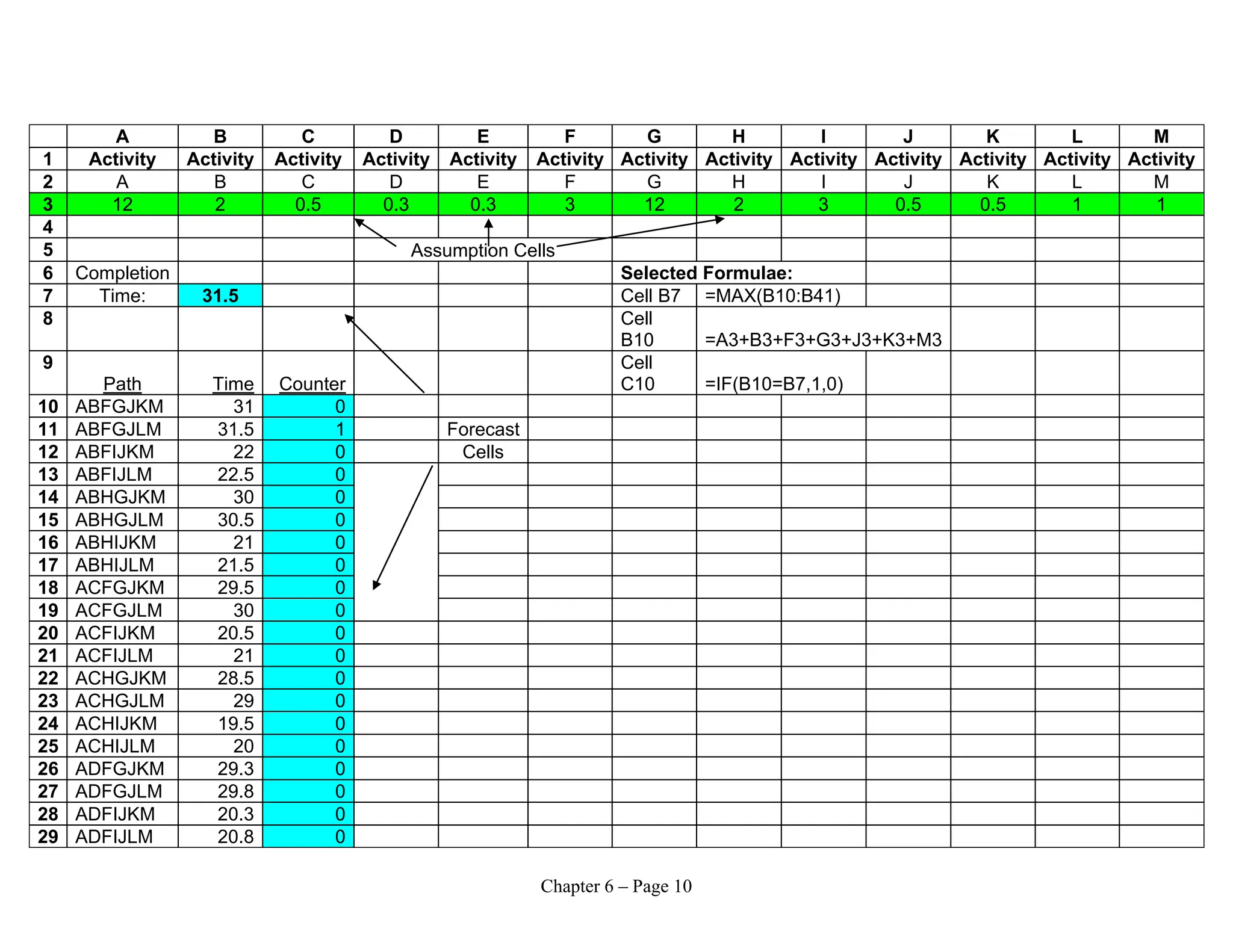
3. We could design a spreadsheet as shown below in Crystal Ball and add a Forecast Cell for each
of the paths to keep track of the number of times that path was critical. For example, we could
name the Forecast Cell for Path ABFGJKM as “C10.” After simulating the project 1,000 times,
the four most critical paths (the same paths as in Question 1) and the percent of time each was
the longest path were as follows:
Path Percent
ABFGJKM 17%
ABFGJLM 74%
ABHGJKM 1%
ABHGJLM 7%
14.
Chapter 6 –Page 10
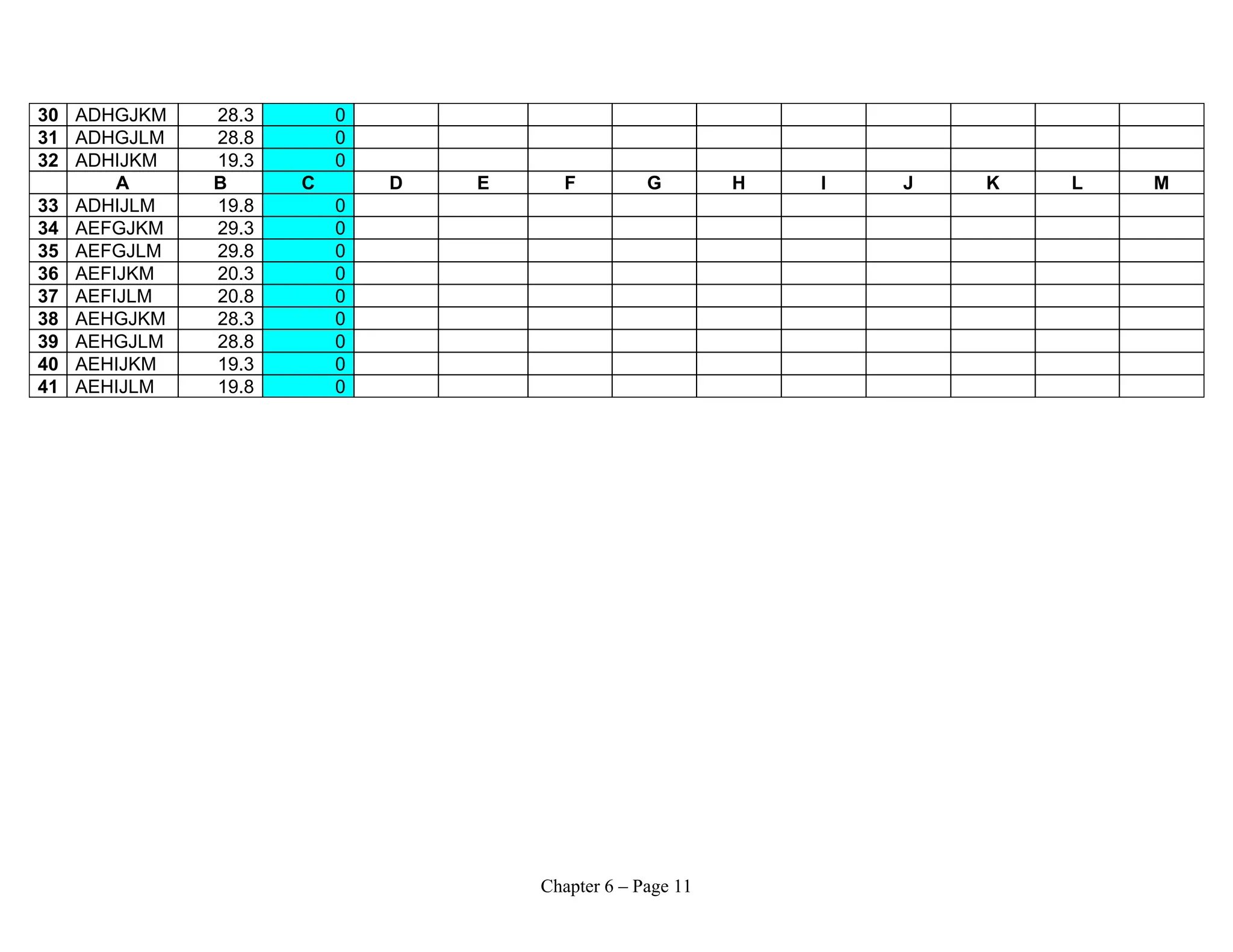
A B C D E F G H I J K L M
1 Activity Activity Activity Activity Activity Activity Activity Activity Activity Activity Activity Activity Activity
2 A B C D E F G H I J K L M
3 12 2 0.5 0.3 0.3 3 12 2 3 0.5 0.5 1 1
4
5 Assumption Cells
6 Completion Selected Formulae:
7 Time: 31.5 Cell B7 =MAX(B10:B41)
8 Cell
B10 =A3+B3+F3+G3+J3+K3+M3
9
Path Time Counter
Cell
C10 =IF(B10=B7,1,0)
10 ABFGJKM 31 0
11 ABFGJLM 31.5 1 Forecast
12 ABFIJKM 22 0 Cells
13 ABFIJLM 22.5 0
14 ABHGJKM 30 0
15 ABHGJLM 30.5 0
16 ABHIJKM 21 0
17 ABHIJLM 21.5 0
18 ACFGJKM 29.5 0
19 ACFGJLM 30 0
20 ACFIJKM 20.5 0
21 ACFIJLM 21 0
22 ACHGJKM 28.5 0
23 ACHGJLM 29 0
24 ACHIJKM 19.5 0
25 ACHIJLM 20 0
26 ADFGJKM 29.3 0
27 ADFGJLM 29.8 0
28 ADFIJKM 20.3 0
29 ADFIJLM 20.8 0
15.
Chapter 6 –Page 11
30 ADHGJKM 28.3 0
31 ADHGJLM 28.8 0
32 ADHIJKM 19.3 0
A B C D E F G H I J K L M
33 ADHIJLM 19.8 0
34 AEFGJKM 29.3 0
35 AEFGJLM 29.8 0
36 AEFIJKM 20.3 0
37 AEFIJLM 20.8 0
38 AEHGJKM 28.3 0
39 AEHGJLM 28.8 0
40 AEHIJKM 19.3 0
41 AEHIJLM 19.8 0
16.
Chapter 6 –Page 12
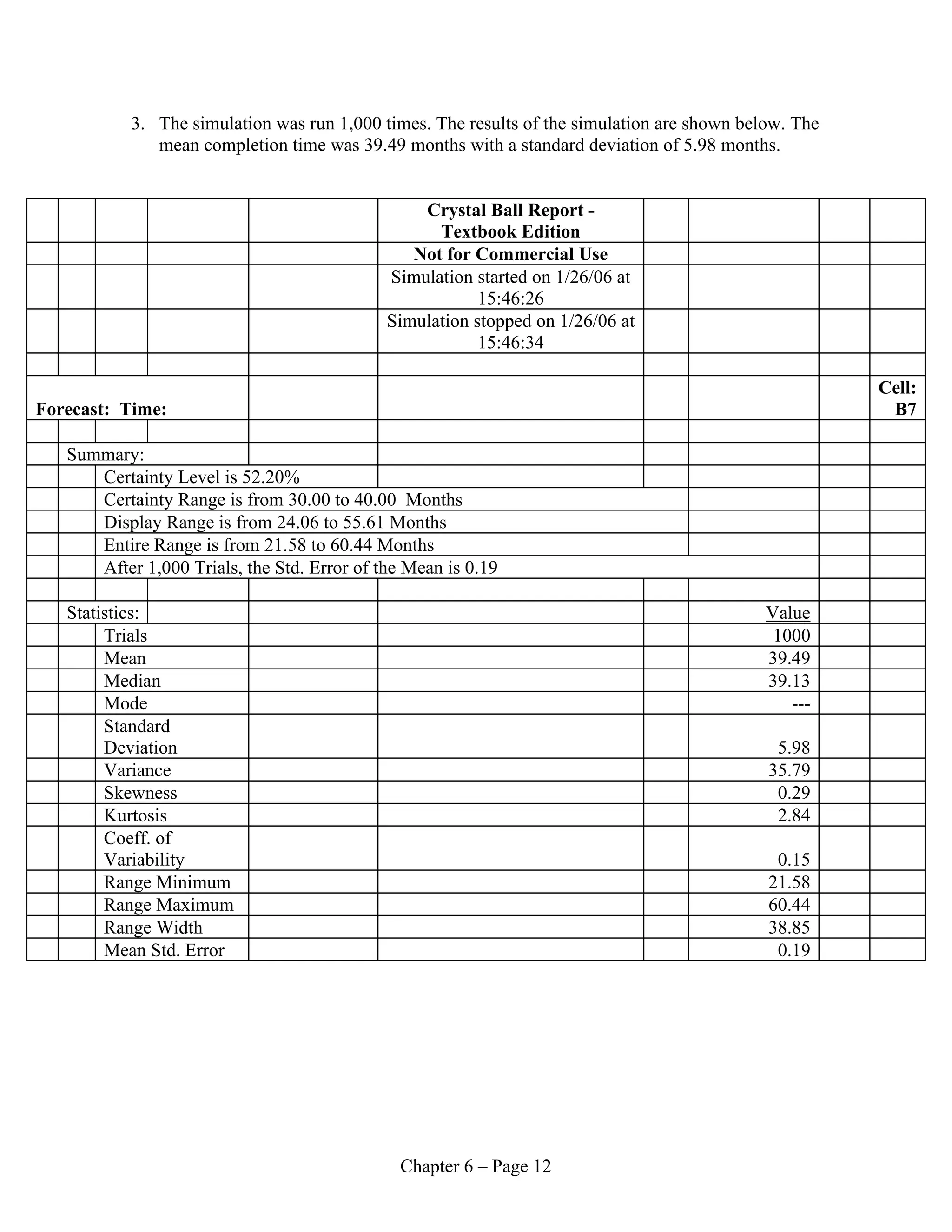
3. The simulation was run 1,000 times. The results of the simulation are shown below. The
mean completion time was 39.49 months with a standard deviation of 5.98 months.
Crystal Ball Report -
Textbook Edition
Not for Commercial Use
Simulation started on 1/26/06 at
15:46:26
Simulation stopped on 1/26/06 at
15:46:34
Forecast: Time:
Cell:
B7
Summary:
Certainty Level is 52.20%
Certainty Range is from 30.00 to 40.00 Months
Display Range is from 24.06 to 55.61 Months
Entire Range is from 21.58 to 60.44 Months
After 1,000 Trials, the Std. Error of the Mean is 0.19
Statistics: Value
Trials 1000
Mean 39.49
Median 39.13
Mode ---
Standard
Deviation 5.98
Variance 35.79
Skewness 0.29
Kurtosis 2.84
Coeff. of
Variability 0.15
Range Minimum 21.58
Range Maximum 60.44
Range Width 38.85
Mean Std. Error 0.19
17.
Chapter 6 –Page 13
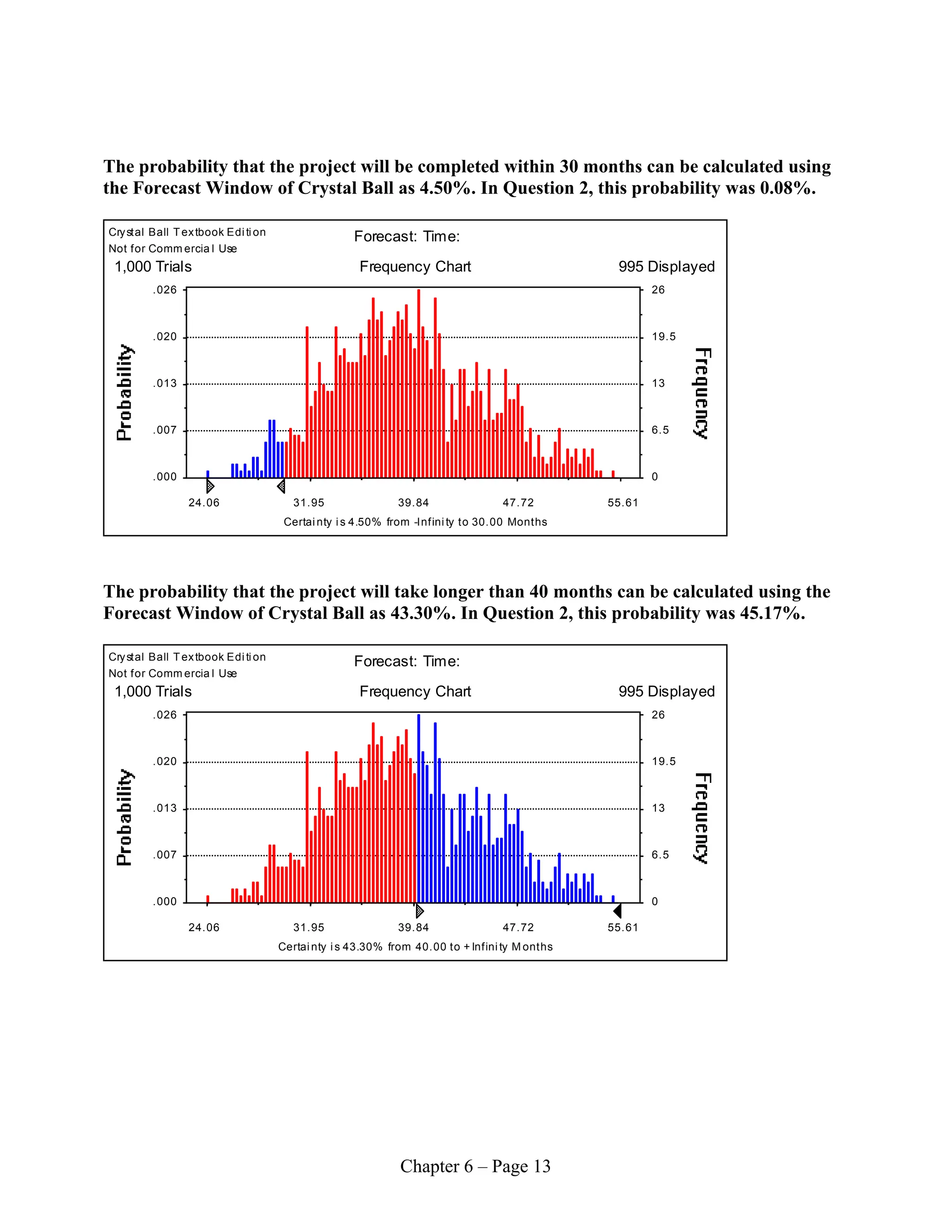
The probability that the project will be completed within 30 months can be calculated using
the Forecast Window of Crystal Ball as 4.50%. In Question 2, this probability was 0.08%.
Crystal Ball Textbook Edi ti on
Not for Comm ercia l Use
Frequency Chart
Certai nty i s 4.50% from -Infini ty to 30.00 Months
.000
.007
.013
.020
.026
0
6.5
13
19.5
26
24.06 31.95 39.84 47.72 55.61
1,000 Trials 995 Displayed
Forecast: Time:
The probability that the project will take longer than 40 months can be calculated using the
Forecast Window of Crystal Ball as 43.30%. In Question 2, this probability was 45.17%.
Crystal Ball Textbook Edi ti on
Not for Comm ercia l Use
Frequency Chart
Certai nty i s 43.30% from 40.00 to + Infini ty M onths
.000
.007
.013
.020
.026
0
6.5
13
19.5
26
24.06 31.95 39.84 47.72 55.61
1,000 Trials 995 Displayed
Forecast: Time:
18.
Chapter 6 –Page 14
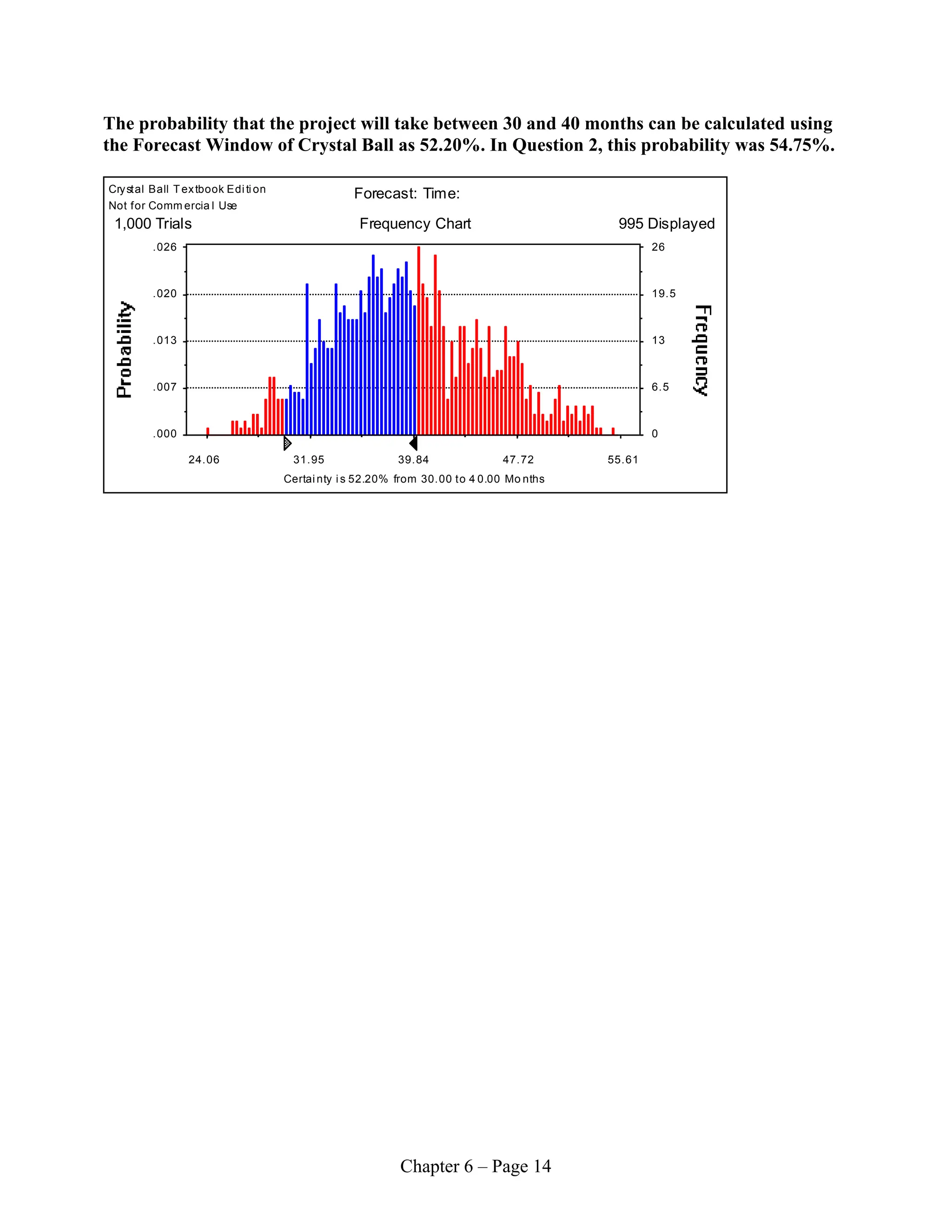
The probability that the project will take between 30 and 40 months can be calculated using
the Forecast Window of Crystal Ball as 52.20%. In Question 2, this probability was 54.75%.
Crystal Ball Textbook Edi ti on
Not for Comm ercia l Use
Frequency Chart
Certai nty i s 52.20% from 30.00 to 4 0.00 Mo nths
.000
.007
.013
.020
.026
0
6.5
13
19.5
26
24.06 31.95 39.84 47.72 55.61
1,000 Trials 995 Displayed
Forecast: Time:
19.
Chapter 6 –Page 15
Suggested Cases/Readings
Case: Biogen Inc.: rBeta Interferon Manufacturing Process Development (Hvd. 9-696-083)
Although there is no teaching note with this case, it is a great example of a failing major
project and the focus of the analysis is fairly clear: What did Biogen do well? What did they do
wrong? Was project management appropriate for them at this time? If not, what should they have
done? What were the 3-4 root causes of their problems? What should they do now?
Case: The Project Manager/Customer Interface (U. of Virginia Darden School, TN: UVA-
OM-0739TN)
This is a good case for illustrating some of the behavioral issues that can arise between a
project manager and the customer. In this situation, the project went fine but the customer’s
interference caused major cost overruns that the customer refused to pay. The issue of who on the
customer’s side is authorized legally to speak for the customer becomes a major point of contention
in the case.
Case: Corning Glass Works: The Z-Glass Project (Hvd. 9-681-091, TN 5-683-045)
This case is an excellent portrayal of the real problems involved in implementing a project,
particularly concerning human behavior and organizational issues. The technical analysis of
laboratory data (especially footnotes) is crucial in the determination of the correct conclusions in
the case also.
Case: Northeast Research Laboratories (B) (Hvd. 9--175-184)
This is a qualitative case involving a post-audit of a project "failure." It concerns a
meddling customer's representative who botches the supplier's project, which the customer then
wishes to cancel. It heavily focuses on human behavior and organizational issues.
Case: Plus Development Corporation (A) (Hvd. 9-687-001, TN 5-690-093)
This case concerns the development of a new, innovative disk drive for computers and the
strategy for producing it. A complication is that the project team is composed of a Japanese
manufacturing team and an American design team but they have different strategies for how to
produce the new product.
Reading: What’s Your Project’s Real Price Tag? (Q. W. Fleming and J. M. Koppelman,
Harvard Business Review, September 2003, pp. 20-22)
The authors argue against tracking the cost of a project using only two dimensions: planned
costs and actual costs. They advise companies to use earned-value management and the cost
performance index, in particular, to monitor project progress.
Reading: Why Good Projects Fail Anyway (N. E. Matta and R. N. Ashkenas, Harvard
Business Review, September 2003, pp. 109-114)
This article discusses how difficult it is for project managers to predict all the activities and
work streams that will be needed to complete a project and to integrate all of the disparate activities
of a project. The author recommends the use of rapid-results initiatives to produce a measurable
(CHALMERS is going.)
Wait!I’d better see her. (Opens door with right hand—holding it
open.) Show her in here.
CHALMERS (in doubt). In there, sir? (Pointing to door R.)
JOHN (pointing back into room with left hand). No. Here! Here!
(Exit down R.)
(Exit CHALMERS door L.)
(CHALMERS shows in MAMIE SCOTT. She is a girl about 27, petite but
pretty, dressed with many furbelows and other fluffy things. She
looks around, as she enters, with a swagger air, sees CHALMERS
smiling, freezes her with a look. CHALMERS straightens herself and
goes off door L. with nose in air. MAMIE looks round room
humming or singing a tune, places parasol on settee at back, and
comes down C. Enter JOHN, undoing collar and tie.)
MAMIE. Hullo, Jack!
JOHN. Hullo, you dear little thing! (In a playful temper.) But you
mustn’t come here—really.
MAMIE. Why not? I thought you said the cat was away at
Folkestone?
JOHN. And please don’t call my wife a cat.
(Exit JOHN into room R.)
MAMIE (with an elaborate curtsy). Oh, I beg the cat’s pardon.
(Sweeping round room she sees photograph on table L.C.). Say Jack,
whose picture’s this?
JOHN (spoken off). Which one?
MAMIE. This one, here, by the telephone!
JOHN (spoken off). Oh, that is my wife.
22.
MAMIE. Your wife?Some girl! She’s not the sort of first wife I’d
pick out if I was going to be your second.
JOHN (spoken off). Why not?
MAMIE. Looks too darned healthy—I’d have to wait too long for
you.
(Enter JOHN door R.)
JOHN. She’s come home unexpectedly.
MAMIE (jumps in terror, and makes a dive for vanity bag she has
placed on table L.C.) Jack!
JOHN. Oh, it’s all right. She’s out just now.
MAMIE. Phew! You did give me a fright!
JOHN. But it’s true—she is home, all the same.
(Exit into room R.)
MAMIE. Well, come out here and talk to me. I won’t keep you long.
JOHN (spoken off). I can’t—I’m only half dressed.
MAMIE. Well, I’ll come in there. (Crossing to door R.)
JOHN. No, no, this is a bedroom.
MAMIE. I’m not afraid of bedrooms!
JOHN (spoken off). Give me a minute—just a minute!
MAMIE. Come out as you are. I’m not particular.
JOHN (spoken off). I won’t be two ticks.
MAMIE (loudly). Right-o! (Sits in arm-chair down R.C. and
commences to powder her face.) I say, Jack! Do you know that you
didn’t give me back the necklace last night!
(JOHN enters and creeps off again.)
23.
(A little louder.)I say, Jacko! do—you—know—you didn’t give—me—
back that necklace—last night? (The words slightly smothered by
using powder puff on mouth.)
(Enter JOHN in dressing-gown.)
JOHN. I say, Mamie, that hat does suit you! You look awfully
sweet!
MAMIE. You go on, Jack. You’re the champion long-distance kidder
in the universe.
JOHN (crossing to left of MAMIE). But I mean it. It suits you
awfully.
MAMIE. Oh, awfully! (Mockingly.) Do you know you didn’t give me
back the necklace last night—you know—the pearl necklace?
JOHN (hesitating). No, er—I know I didn’t. We both forgot all
about it, didn’t we?
MAMIE (laughing). We did. (Both laugh amusedly, thinking it a
great joke.)
JOHN. I left it in my coat, and I left the coat at the club.
MAMIE (rising—alarmed). Jack. It isn’t lost?
JOHN (pressing her gently into chair). Sit down. Sit down and don’t
worry. It can’t be lost. If it is, I’ll buy you another, that’s all.
MAMIE. Five—hundred—pounds!
JOHN. Yes. I can’t forget that! But it’s a mere flea-bite to me.
MAMIE. Jack, you don’t understand, the Rajah looks on it as an
heirloom—he wouldn’t part with it for the world—that’s why I
wanted to wear it—it was such a cute idea. But I promised faithfully
to return it to the Rajah to-day.
JOHN. Can’t you make some excuse?
MAMIE. How can I? Have you been to the Club?
JOHN. No, I can’t possibly go down there for a day or two—for a
particular reason.
24.
MAMIE. Oh, Ido hope it isn’t lost. Can’t you ’phone?
JOHN. Oh, yes. I did ’phone, but the club ’phone seems to be out
of order.
MAMIE. That’s torn it! What will the Rajah think of me!
JOHN. Now don’t worry. If you’ll only wait everything will be all
right. In any case if it is lost, I’ll buy you another exactly like it. I
can’t say more, can I?
MAMIE. You really mean that?
JOHN. Of course I do—I never break my word. I’m even going to
get some money to-day—out of accidents—I mean, in case of
accidents. Now, listen! I’m awfully glad you’ve called. My wife’s left
me!
MAMIE (rising and throwing arms round JOHN’S neck). Jack—
darling!
JOHN (gently but firmly disengaging her arms). Yes, but only for a
little while—and I want you to do me a favour.
MAMIE. Of course I will, Jack.
JOHN. I’m expecting a man here presently to examine me.
MAMIE. To examine you?
JOHN. Yes, I’m very ill, you know—I was in a ’bus accident the
other day, and—er—things have been getting worse.
MAMIE. Poor old Jack! I am sorry. (Pulling his face to her with
hand under his chin.) But you don’t look ill.
JOHN (turning face again to front). No, I’m one of those who bear
up to the last! Now, listen, when this man calls I want you to
pretend that I’m bad. Of course I am bad, but while he’s here I am
sure to be a little worse. Mrs. Ayers—that is me—has been speaking
to him on the ’phone and naturally when he comes he’ll expect to
see me—that is—Mrs. Ayers—I—I see, you don’t understand.
MAMIE (very sympathetically). Jack, dear, you haven’t injured your
head, have you?
25.
JOHN. No, it’squite all right. Nothing to do, but—er—don’t say
you’re my wife. Just pat me on the head now and then and moan
“Poor John”—you understand? . . .
MAMIE. Yes, I understand. “Poor John.” But say, this is spoof,
you’re not really ill, Jack, are you?
JOHN. Of course not—oh, yes, I am—but don’t worry, I’m going to
get better. Just “poor John!” Lay it on thick!
MAMIE. I see—“Poor John.” (Crosses up to mantelpiece, removes
hat and tidies her hair at glass.)
(TULLY enters hurriedly, sees MAMIE, makes a bolt for door L. JOHN
catches him by coat and pulls him back.)
TULLY. It’s all right, John—(as he enters).
JOHN (to MAMIE). Excuse me a moment.
TULLY (to JOHN). Doctor Green was out, but they’ll send him round
directly he comes back. He’s out on a case—about a poor little
woman—a poor little woman—(whispers in JOHN’S ear) who . . .
(then aloud) both—both doing well.
JOHN. Well, that’s more than we can say. Now I must go and finish
dressing, or rather undressing. (Sees MAMIE.) Oh, let me introduce
you to little Mamie Scott.
TULLY (alarmed). Is she—is she—fast!
JOHN. Fast?
TULLY. Is she a hussy?
JOHN. You’ll like her immensely, come on.
TULLY (in terror). No, no! I couldn’t. I’ve never spoken to anyone
like that in my life.
JOHN (taking hold of TULLY). Don’t be a fool.
TULLY. Oh, no, no! What would they think of me down at the
Mission—besides I wouldn’t know what to say to her.
JOHN. Why not?
26.
TULLY. I’ve nevermet a fluff.
JOHN. You do get hold of the most extraordinary expressions.
(Calling to MAMIE.) Mamie! Let me introduce you to a very old chum
of mine. Mr. Bertram Tully—Miss Mamie Scott.
(JOHN crosses to door R. MAMIE crosses over to TULLY.)
MAMIE (taking TULLY’S hand). Oh, what a beautiful boy! (Pulls a
long face.)
JOHN. Talk to him, Mamie. He has a wonderful flow of
conversation. I shan’t be long.
(Exit JOHN door R.)
(MAMIE beckons TULLY with head and eyes—and edges down to arm-
chair R. Sits. TULLY, very nervous, edges down to chair L. Sits.)
TULLY (playing with bottoms of his trouser legs and trying to make
conversation). Do you ever go—er—go—go—— No! (Tries again.)
Would you like to—to—to—— No! (Has another try.) It’s—it’s
wonderful how the fine weather lasts!
MAMIE (very amused all the time). Ripping, isn’t it?
TULLY. Yes, isn’t it?
MAMIE. Are you married?
TULLY. No, I regret to say.
MAMIE. A bit of luck in store for some one.
TULLY. Oh, thank you!
MAMIE. I expect you have a gay old time.
TULLY (twiddling his fingers down his leg). No, not so very gay.
. . .
MAMIE. I know—you’re a fly-by-night.
TULLY. No, I assure you all my people are most respectable.
27.
MAMIE. Well then,you’re a dark horse.
TULLY (mystified). A dark—horse?
MAMIE. You know, one of those outsiders who comes up with a
rush on the rails at the last minute, and wins by a short head. Do
you get me?
TULLY. I don’t quite understand what you mean.
MAMIE. I mean you can go the pace when you like. (She raises her
dress and picks a piece of fluff from the hem—blows it into space.)
TULLY. No, I don’t go. . . . (Sees MAMIE exposing a deal of leg—he
is very embarrassed—wipes his forehead with handkerchief.) No, I
don’t go at all! (Rising, and backing away from her.)
MAMIE. What do you do to amuse yourself?
TULLY. I go to chapel on Wednesdays and Saturdays (doing a sort
of Skating Act with legs and twisting backwards and forwards) and I
attend the Mission on Tuesdays and Fridays. (Again down to her and
seeing leg, stumbles backwards and wiping forehead with
handkerchief keeps up this business, doing a sort of skating waltz.)
MAMIE. Did they teach you that ragtime down at the Mission?
(Jumping up.) I like your drunken step—I must get hold of that!
(Catches TULLY and forces him round the room as if dancing a
ragtime—MAMIE sings and dances as well.)
TULLY (breaks away from MAMIE and rushes to door R. and
knocking on door—feverishly). John! John!
JOHN (spoken off). What is it? What is it?
TULLY. I’m being tempted!
JOHN (spoken off). Well, stick it! Don’t be a fool!
(TULLY rushes up to window R. then down again to arm-chair. MAMIE
follows him up and down on L. side of table. She motions to him
with her eyes, coyly, to sit in arm-chair, he succumbs. Sits gingerly
on front of chair. MAMIE sits on arm of chair and puts right arm
round his neck. TULLY snatches it away nervously.)
28.
MAMIE. Now tellme, what’s this Mission for?
TULLY. It’s for the poor people. (Sees MAMIE’S exposed ankle—
turns away nervously.) We give them musical evenings to keep them
out of the public-houses. I play the flute.
MAMIE. You do what?
TULLY. I play the flute.
MAMIE. Oh, help!
TULLY. Oh, they like it!
(Bell heard outside door L.)
MAMIE (starting). I wonder what that is? (Goes to door R. calling
to JOHN.) Jack! Jack! There’s a ring at the bell—do you think it can
be the cat?
TULLY (rising and going up C.). A cat wouldn’t ring the bell surely.
(Enter JOHN dressed in pyjamas and dressing-gown, from door R.)
JOHN. She couldn’t possibly be here yet awhile whatever
happened.
(Enter CHALMERS L. with card on salver—and crosses to JOHN.)
And please don’t call my wife a cat!
MAMIE. I’m sorry. (Sits in arm-chair.)
JOHN (reading card). Good! Show him in at once. (To CHALMERS.)
(Exit CHALMERS door L.)
It’s Mr. Nixon Trippett!
MAMIE. Mr. How Much?
JOHN. Mr. Nixon Trippett—the Inspector from the Motor ’Bus
Company—the man I told you about who’s going to examine me. Sit
down, and ask him to wait. Say I shan’t be long.
29.
TULLY (perplexed). Whathave we got to do?
JOHN. Mamie will tell you all about it.
(Exit JOHN R.)
MAMIE. Now, listen here, Bertie Brighteyes.
TULLY. Oh, stop it! (Down C.).
MAMIE. All we’ve got to do is to keep on saying “Poor John!”
TULLY. Poor John!
MAMIE. I’m to pretend I’m John’s wife.
TULLY. Poor John!
MAMIE (rising). What do you mean?
(NIXON TRIPPETT enters, shown on by CHALMERS. He is a very ugly
man of forty, dressed in frock coat and wearing spectacles. He is
almost shabby genteel. CHALMERS retires—TULLY nervously retreats
from MAMIE and seeing TRIPPETT advances with uncertainty.)
TULLY (to TRIPPETT). Poor John! I mean Mr. Ayers won’t be a
minute. Will you take a seat. (Brings chair down from table L.C. and
places it C. in a line with arm-chair R. and small chair L.)
TRIPPETT (places hat on table L.C. and coming down to chair C.).
Thank you, sir. (All sit. MAMIE in arm-chair. TRIPPETT chair C. TULLY
chair L.) Thank you, sir. (Removes gloves.)
(JOHN groans loudly off R.)
(All rise slowly and simultaneously with eyes fixed on door R., then
sit again.)
(JOHN groans again very loudly. All rise. MAMIE gets behind arm-
chair. TRIPPETT drags chair up to table L.C. keeping eyes on door R.
all the time. TULLY stands by chair L. gazing at door R.)
30.
(JOHN enters groaningfrom door R.; he is in pyjamas, with a blanket
wrapped round him. MAMIE assists him into arm-chair, JOHN
groaning all the time.)
TRIPPETT (advancing timidly to JOHN). Er—Mr. Ayers—are you the
injured person?
JOHN. Oh—oh—oh oh!! (Groans.)
TRIPPETT (again advancing cautiously). Might I ask if you are the
injured person?
JOHN. Don’t I look like it. Do you think I’m doing this to be funny?
MAMIE (patting JOHN’S head). P-o-or John!
TULLY. Poor John!
TRIPPETT (glares at TULLY—then over to him). Do you think it
would be advisable for me to call another day?
JOHN. No, it’s all right, I can stick it.
MAMIE. He’s awfully brave, you know.
TRIPPETT. You ought to have kept in bed. (Going to table R.C.) It
would have been better if I hadn’t let you know I was coming.
(Places gloves on table.)
JOHN. Oh no, it wouldn’t.
MAMIE. Poor John!
TULLY. Poor John!
TRIPPETT (gazes first at MAMIE and then at TULLY). Well now, may I
ask a few questions that will help me to make out my report? (Pulls
notebook and pencil out and looks round for something to write on.)
JOHN. Yes, ask as many as you like. (To TULLY.) Bring that table
over for Mr. Stickson Triplets.
TRIPPETT. Not Stickson Triplets! Nixon Trippett!
(TULLY brings small table from down L. and places it on left of arm-
chair. TRIPPETT brings chair from left of table R.C. and places it on
31.
left of smalltable.)
JOHN. I beg your pardon.
(TULLY moves round to back of arm-chair on left of MAMIE.)
TRIPPETT (sits and preparing to write in notebook). Now then, Mr.
—John Ayers, isn’t it?
JOHN. Yes, John Ayers.
(TRIPPETT writes.)
Oh, my back! Oh!
MAMIE. Poor John!
TULLY. Poor John!
TRIPPETT (looks at TULLY, then writing again). Tell me, Mr. Ayers,
are you married?
JOHN. Of course! (Absent-mindedly taking TULLY’S hand in mistake
for MAMIE’S and places it by his face. Realizing his mistake he throws
it away calling him a “silly ass” and then taking MAMIE’S hand.) Yes,
of course!
TRIPPETT. Any—family?
MAMIE. Yes.
JOHN. No!!
TRIPPETT (writing in book). Yes and no. What is your height?
JOHN. Four feet four and a bit.
TRIPPETT. Age?
JOHN. Forty-two.
TRIPPETT. Chest measurement?
JOHN. Forty-two, too.
TRIPPETT. Ever been vaccinated?
32.
JOHN. Well, mygodfather was Mr. Tully and my godmother was
——
TRIPPETT. I said vaccinated——
JOHN. Oh, I beg——
TULLY. Oh no, he never catches anything!
TRIPPETT (writing again). Now, Mr. Ayers, you say you were
travelling in one of the company’s ’buses when this accident took
place.
JOHN. Of course I was—last Friday—coming from Kew. Oh!
(Groans.)
MAMIE. Poor John!
TULLY. Poor John!
JOHN (to MAMIE). I’m afraid you won’t have me with you much
longer, darling!
MAMIE. A-a-h! O-w-h! (Cries aloud.)
TULLY (leaning over and looking into TRIPPETT’S face). It’s hard to
see him struck down like this!
(TRIPPETT rises slightly annoyed. TULLY retreats to window R., then
out of window and in by window L., starts back when he sees
TRIPPETT still watching and pointing at him with his pencil.)
TRIPPETT (resuming). Could you tell me who was inside the ’bus,
or describe the people in any way?
JOHN. There was a Mr. Richard Turner——
TRIPPETT (breaking in). Yes, we have acknowledged his claim. A
cheque for five hundred was sent him this morning.
JOHN (jumping up and leaning over to TRIPPETT). What!!!
(Recovering himself and sitting again.) Oh, it’s only a spasm, that’s
all, oh, I am bad!
TRIPPETT. Could you describe anyone else who was in the ’bus?
33.
JOHN. There weretwo soldiers in khaki and a very fat old woman.
(TRIPPETT writes. TULLY sidles round to back of arm-chair again.)
TRIPPETT. Did these people make any statement or pass any
remark?
JOHN. When the collision occurred some one said it was like being
out at the front.
TRIPPETT. The stout lady said that.
(MAMIE turns away smiling. TULLY shows surprise and disgust.)
JOHN. No, Mr. Trippett. The soldier!
MAMIE. Poor John!
TULLY (who is now on left of TRIPPETT—pats TRIPPETT’S head). Poor
John!
TRIPPETT (turns on TULLY very annoyed, then back to JOHN). Now
may I ask—why didn’t you report this at the time?
JOHN. How could I? I was too stunned, I suppose.
TRIPPETT. I quite appreciate what you say, Mr. Ayers, but it’s one
of our rules that you should have lodged your complaint at the time
the accident occurred.
JOHN. I suppose if a man was killed stone dead, he ought to leave
his name and address.
TRIPPETT. If he knew where he was going. But in this case the
situation is rather difficult. The Mr. Turner you mentioned just now
informed us that he was the only passenger injured in the accident
and the other occupants of the ’bus rather bear out his statement.
JOHN. How does he know? He couldn’t see my back!
TRIPPETT. You see, you have no witnesses. (Shrugs.)
JOHN. No witnesses indeed! Oh yes, I have. Don’t you run away
with any idea like that. My friend Tully here was sitting next to me in
34.
the ’bus thewhole of the time!
(TULLY almost collapses.)
TRIPPETT. Oh, indeed—indeed!
TULLY (quickly and very agitated—down to L. of TRIPPETT). But I
make no claim! Indeed I don’t. No. I make no claim! I make no
claim at all!
TRIPPETT. I don’t think I have your name and address?
TULLY. Mr. Bertram Josiah Tully. (Very important.) Number 14 Saint
Mark’s Mansions.
TRIPPETT (writing—then to TULLY). And you yourself were not
injured?
TULLY. Not at present—I mean, not a scratch!
MAMIE. Poor John!
TULLY. Poor John!
TRIPPETT (looks at JOHN). How do you account for that, if he was
sitting next to you, Mr. Ayers?
JOHN. When the collision came I fell forward on the two soldiers—
they had been in training for months and were as hard as nails, and
naturally I sprained my back, while Mr. Tully here shot forward right
on top of the fat old woman!
TRIPPETT. And not hurt?
JOHN. She was enormously fat!
TRIPPETT (to TULLY, who is now up again behind arm-chair). And
did you pass any comment at the time?
JOHN. No, but the woman did!
TULLY. I think I said, “Oh, dear, dear, (pause) dear!”
JOHN. Of course I shall have to take proceedings against your
company if it costs me every penny my wife’s got. I mean, that I’ve
got!
35.
TRIPPETT. I don’tthink that will be necessary, Mr. Ayers, our
company is a very generous one, and although we cannot
acknowledge any legal obligation we like to treat our passengers as
fairly as we can——
JOHN. I’m sure you do.
TRIPPETT. We like to make friends——
JOHN. You have a friendly face, Mr. Trippett.
TRIPPETT. We want to see you riding in our ’buses again.
JOHN. Mind you, I like your ’buses.
TULLY. They’re such a pretty colour.
(MAMIE digs TULLY in ribs.)
TRIPPETT. And if this matter could be settled at once, I’m sure you
would be most satisfied.
JOHN. I’m sure I should.
TRIPPETT. Now speaking without prejudice, what sum of money do
you fancy would compensate you?
JOHN (to MAMIE). What do you think, dear?
(TULLY signalling five hundred on fingers.)
You see, there’ll be all the doctor’s expenses, a terrible loss of time
and money—probably funeral expenses——
MAMIE. Ah—a—a—h. (Sobs.)
TULLY. Ah—a—a—h. (Sobs.)
MAMIE (sobs). I can’t bear it!
JOHN (to TRIPPETT). Suppose we say five hundred—without
prejudice, as you say.
TRIPPETT (raises his eyebrows). I’m afraid that’s quite out of the
question. Do you realize what five hundred means? I’m afraid we
couldn’t entertain anything like that. But I’ll tell you what I will do. If
36.
you like tosettle the matter off-hand now and give me your
signature. I’ll pay down at once, the sum of—(taking note from
pocket and presenting it to JOHN)—five pounds.
JOHN. Don’t be absurd!
TRIPPETT. A five-pound Bank of England note, Mr. Ayers; you could
go away for a nice little holiday on a five-pun’ note.
JOHN (rises, anger rising). Really I think you’ve come here to insult
me.
TRIPPETT. Certainly not, Mr. Ayers—and without prejudice I think
you would be well advised to accept my offer.
JOHN (up to TRIPPETT). And without prejudice I think you’re a silly
ass! (TRIPPETT rises.)
MAMIE (comforting JOHN). Don’t upset yourself, John.
JOHN. Why doesn’t he offer me a bag of nuts or a balloon!!
TRIPPETT (getting gloves from table R.C.). I’m sorry you look at
things in that light, Mr. Ayers. (TULLY during this speech gets
TRIPPETT’S hat and holds it perched high up on his right hand, with
his other hand he holds the door L. open.) All I can do is to hand in
my report. (Going left.) The company’s doctor will come and
examine you, and the matter will be out of my hands. (Knocks into
TULLY, sees hat, takes it, bows to TULLY, goes to door L., turns.) I
wish you good-day, sir, (to JOHN) and I hope you’ll soon get better.
(Exit L. TRIPPETT, followed by TULLY.)
JOHN. I don’t think I shall—£5 for a broken back!
TULLY (rushing on from door L.). It’s all right, John—Mrs. Ayers has
come back.
JOHN. What!!
MAMIE. Your wife, Jack! Hide me!
JOHN (MAMIE tries to get under table R.C. JOHN pulls her back). No,
that way! Hide her, Tully. (TULLY wandering aimlessly about. JOHN
37.
pushes him upto window R.C. MAMIE gathers up hat, etc., and goes
window R.C. TULLY gets MAMIE’S parasol from settee and JOHN pushes
him out of window.) Quick behind those curtains and take those
things away. (Throwing MAMIE’S gloves after TULLY.)
(JOHN gets into easy chair quickly, with blanket still round him—
groans.)
(Enter PAMELA door L.)
PAMELA (seeing JOHN, alarmed). John! John! I didn’t expect to find
you like this.
JOHN. And I didn’t expect to see you back quite so soon.
PAMELA. I’ve come to say I’m sorry. Mother has seen that necklace
you gave me—(placing her bag on table down C.)—and she says it’s
worth five hundred pounds——
JOHN. Mother knows!
PAMELA. But it is valuable.
JOHN. Of course it is. Instead of spending my money on riotous
living I’ve been spending it on you.
PAMELA. How good of you! But do tell me, what has happened?
JOHN. Don’t be alarmed. You know I was in a ’bus accident the
other day?
PAMELA. You were not hurt.
JOHN. Things have developed since. I think they are going to
compensate me.
PAMELA (joyfully). Then, you are not really ill? (Goes down below
table.)
JOHN (rising). That depends—I am going into that bedroom
(pointing R.), and I’m not coming out until that ’bus company gives
me five hundred pounds, not if I’ve got to lie there for a month!
PAMELA. Oh, don’t say that, John!
38.
JOHN. I knowwhat I’m doing—I’ll teach them to offer me a
balloon—I mean a five-pound nut—no, not nut—note. Now please
go and get the bed ready. (Leading PAMELA to door R.)
PAMELA. But John——?
JOHN. Do go—to oblige me—I’m expecting the doctor here at any
minute. (Pushes PAMELA off door R.)
(JOHN signals to TULLY, who drags MAMIE out by the hand—they
come down a few steps.)
Quick—quick as you can——
(PAMELA re-enters. TULLY and MAMIE get behind curtains again
quickly.)
PAMELA. But, John, it may be weeks and weeks before these
people pay out the money——
JOHN (holding blanket high up to obscure PAMELA’S view of the
room). Now, do please, do as I ask you, if the doctor finds me out of
bed, it’ll ruin me.
PAMELA (going back into room R.). Oh, very well!
(Exit PAMELA.)
(JOHN signals and TULLY drags MAMIE across to door L.)
JOHN. Go on! Hurry up! Hurry up!
(They are nearly across to door when PAMELA re-enters.)
PAMELA (enters). But, John, it’s just occurred to me——
(TULLY and MAMIE turn and PAMELA faces them. JOHN falls over
blanket down R. TULLY still holds MAMIE’S hand, in his other hand
he has MAMIE’S parasol.)
39.
JOHN. Oh—er—I don’tthink you have met before.
PAMELA (slowly). I—don’t—think—we—have.
JOHN. Let me introduce you. This is my wife (pointing to PAMELA),
and this is (pointing to MAMIE)—this is—this is Mrs. Tully!
TULLY (drops MAMIE’S hand—thunderstruck). What!!
PAMELA (doubtfully). Mrs.—Tully?
JOHN. Yes, he was married secretly a week ago.
TULLY (boiling with rage). Oh—I say!!
(MAMIE turns her ring round to look like wedding ring and holds
hand up conspicuously.)
JOHN. I’m sorry to let the cat out of the bag, old man, but it can’t
be helped!
TULLY (rushes across stage in front of table and arm-chair, with
MAMIE’S sunshade raised in a threatening manner). John! John!
JOHN (kneeling to TULLY—pleadingly). Bertram! Bertram!!
TULLY (TULLY’S face relaxes and develops into a broad smile). Oh,
John! John!! (Giggles.)
(PAMELA and MAMIE shake hands C.)
CURTAIN.
40.
ACT II
SCENE.—Same asAct I.
(Two weeks have elapsed since the events in the preceding Act. For
alteration of furniture, see notes at end of play.)
(JOHN AYERS and TULLY are seated at a small table down C. JOHN in
arm-chair on right of table. TULLY in small chair left of table. They
are playing cards. JOHN is dressed in pyjamas with blanket round
him as in Act I. TULLY wears a lounge suit and slippers.)
(As the curtain rises JOHN is shuffling the cards and dealing for
nap.)
(PAMELA enters from bedroom R. and then adjusts her hat, looking in
mirror by fireplace. She wears the pearl necklace.)
(JOHN deals.)
PAMELA. I must say I think it is very good of you, Mr. Tully.
TULLY. Beg pardon, Mrs. Ayers.
PAMELA. I say it’s very good of you to come and sit with John as
you do.
TULLY. Oh, not at all, Mrs. Ayers. It’s a pleasure. John’s one of the
best, in the world.
JOHN (quickly). No, that’s not your card. (Picking up one of TULLY’S
cards and looking at it.) Oh, yes it is. (Putting card down again.)
TULLY. But he’s a dirty cheat.
JOHN. Heaven helps those who help themselves.
41.
TULLY. No, John,we’re here to help others.
JOHN. Then what are the others here for?
TULLY. To help the others, I suppose.
JOHN (calling to hand). Well, I’ll go two.
TULLY. Now, Mrs. Ayers, didn’t we stipulate that there were to be
no two’s? (To JOHN.) At two-handed nap you can’t call less than
three surely.
(They both argue loudly.)
PAMELA (looking round). Now don’t quarrel, there’s good children.
JOHN. Tully’s a bad loser.
TULLY. I’m not. You’re a bad player. How can we possibly call two’s
—it’s no game at all.
JOHN. Well, I go—three!
TULLY. Very good, I pass three.
(They play the hand. PAMELA strolls down, putting on gloves, and
watches game.)
JOHN. Play to that. I’ll give you “two’s.” That’s one. (Plays again.)
TULLY. Trump! Aha!
JOHN. I’m not afraid of that.
TULLY. You won’t get this. (Plays card.)
JOHN. Thank you. (Leads again.)
TULLY (takes the trick). That’s another one up against you. (Leads
again.)
JOHN (takes the trick). Got it! Got it! Got it!
(PAMELA comes down to top of table.)
TULLY. Nothing could touch a hand like that.
42.
JOHN (teasing TULLY).You get the cards, Tully, but you don’t know
how to play them.
PAMELA. Oh, I think Mr. Tully plays a very excellent game.
(They start dealing.)
Now just a moment.
JOHN. Where are you going?
PAMELA. I just want to run round and see how mother is. I’ll leave
John in your care, Mr. Tully.
TULLY. Certainly, Mrs. Ayers.
PAMELA (to TULLY). Would you mind answering the door?
JOHN. Answering the door? Of course he will. What’s he here for?
PAMELA. We sent the maids away a week ago, they talk so.
JOHN. Cook said she knew positively there was nothing the matter
with me at all.
PAMELA. So I’ve given them a holiday.
TULLY. Much the wisest thing to do.
PAMELA (to TULLY). If the inspector or the doctor from the ’bus
company calls, just ask him in and say I shall not be long. And you,
John——
JOHN. Oh, I shall get into bed like a flash of lightning.
PAMELA. I don’t suppose they’ll come.
JOHN (looking at PAMELA). Do you think it’s wise to wear that
necklace on these dark nights. You might have it stolen.
PAMELA (smiling and displaying necklace). Ah! I’ve been waiting for
you to notice it.
JOHN. Well, it’s running a risk. I should leave it at home if I were
you.
PAMELA. Does it look valuable to you?
JOHN. Of course it does.
43.
PAMELA. Well, itisn’t—this is only imitation.
TULLY. Oh, it looks just the same to me.
PAMELA. Mother had the real one copied for thirty shillings, she
was so afraid I should lose it.
TULLY. That’s very thoughtful.
JOHN. Mother does know.
PAMELA (posing). But it looks genuine, doesn’t it?
JOHN. It looks jolly good. (Artfully.) What have you done with the
real one?
PAMELA. Ah! that’s telling! I’m never going to part with that as long
as I live. (Crossing to door L.). Shall I give your love to mother?
JOHN. No!
PAMELA. John!
JOHN. I mean yes.
(Exit PAMELA.)
Yes, if you like. (To TULLY.) That’s the fourteenth love I’ve sent to
mother this week.
(Door slams off L.)
(TULLY shuffles cards.)
I don’t mind telling you, Tully, I’m more than sick of this business.
I’ve been shut up now for nearly a fortnight.
TULLY. But the doctor from the ’bus company ought to have called
on you long ago.
JOHN. He did call—last Friday week, and I happened to be out.
Just my luck. Pam saw him and made some excuse, and he said he’d
call again. But he hasn’t been near the place since.
(TULLY deals the cards for nap.)
44.
TULLY. Their ideais of course to tire you out.
JOHN. And we’ve got to be careful. Did you read about Dick
Turner?
TULLY. He got his five hundred pounds out of them, didn’t he?
JOHN. Yes. But do you know the latest? They’re going to have him
up for fraud.
TULLY. Oh, dear! dear! dear! What does Mrs. Ayers say about it?
JOHN. The Turner case has rather upset her. She’s terribly afraid of
the law. If you mention the word she has a panic.
TULLY. So you see, good people are the happiest after all.
JOHN. But they don’t always look it. (Looks at TULLY with a grin.)
Let me see now, it’s my call, isn’t it?
TULLY. No, John, you called last time.
JOHN. So I did. You’re quite right.
TULLY (jubilant). I’m going nap!
JOHN. You’re—going—nap?
TULLY. Yes!
JOHN (rising). Hark! It’s the doctor—the doctor from the ’bus
company. (Flings off blanket and rushes to door R., groaning as if in
pain.)
TULLY (runs to window). There’s nobody there. Desist! (Comes
down to door L.) Desist!
(JOHN stops groaning.)
There’s nobody at the door—not a sign of anyone.
JOHN. Really, are you sure? (Coming to table C.)
TULLY. Quite sure.
JOHN (mixing cards up all together). All right! Deal again. Deal
again. (Sits.)
45.
TULLY (comes totable—looks with disgust at cards, gathers them
up and sits). It’s a very funny thing, John, but every time I call nap
you imagine you hear the doctor coming. Coincidence, I suppose.
(Gives a big sigh.)
JOHN. What’s the matter with you, Tully? Have you ever been in
love?
TULLY (looks and smiles). I was nearly caught once.
JOHN. Oh, what was her name?
TULLY. Agnes. (Sorrowfully.) She made a vow that if she ever met
a really good man she would love him though he be as ugly as sin.
JOHN. And she loved you?
TULLY. Devotedly.
JOHN. Why didn’t you marry the girl?
TULLY. She was so expensive.
JOHN. They all are. I don’t believe woman was the rib of man I
believe she was the expendix—I mean the appendix—no use to
anybody.
TULLY. That’s what makes me so timid. I’m so afraid that one of
these days some woman will get me into a corner and make me do
something thoughtless. (Cards dealt.)
JOHN. I shouldn’t worry about that if I were you. Let me see, it’s
my call, isn’t it?
TULLY. Yes.
JOHN. Well, I pass!
TULLY. You pass? Well—I—I—you can’t hear the doctor coming,
can you?
JOHN. N—o.
TULLY. Well, I’m going—nap!!
JOHN. What again?
TULLY. You haven’t given me a chance yet!
46.
JOHN (rises). Ihave an idea.
TULLY. No, no, play this hand first; I’ve called nap.
JOHN (searches on table L.C.). No, it’s not there.
TULLY. What are you looking for?
JOHN. The—real necklace!
TULLY. She wouldn’t leave it about like that.
JOHN. You don’t know—she might.
(Postman’s double knock heard off L.)
(Rushing for bedroom door.) The doctor! The doctor! (The blanket is
left in arm-chair.)
TULLY. It isn’t—it isn’t the doctor. It’s the postman. It’s the
postman. I know his knock.
(JOHN goes out of door L., returns with a letter and reads it C.)
JOHN (speaking off). Yes! You’re right. There’s a letter in the box.
(Enters.)
TULLY. I told you it was only the postman. Do come and play this
nap out. I’ve got such beautiful cards!
JOHN. Hang your nap—this is serious. It’s from little Mamie Scott.
TULLY. Mamie Scott? Who’s she?
JOHN. You know—your wife!
TULLY. Oh, don’t start that again, please! (Rises.)
JOHN (reading from letter). “The Rajah declines to wait any longer
for his necklace and threatens to place the matter in the hands of
the police.”
TULLY. Oh, dear! dear! dear!
JOHN. You’d better go and tell her the necklace is having its clasp
repaired and is coming back from the jeweller’s to-morrow.
47.
TULLY. Is it?
JOHN.Oh, do have a little common sense. I think I know where to
find her. Put on your hat and go round to the Five Hundred Club.
TULLY. Is that a ladies’ club?
JOHN. No—er—mixed.
TULLY. No, I couldn’t do that—really.
JOHN. Why not?
TULLY. I never believed in mixed schools or mixed bathing, and I’m
certainly not going to a mixed club at my time of life.
JOHN. All you’ve got to do is to ask for Miss Mamie Scott.
TULLY. No, no. I’ve never been to such a place as the Five
Hundred Club in my life.
JOHN. Take your Cheque Book with you. They’ll make you very
welcome.
TULLY. A great deal too welcome, I expect. No, I couldn’t do it.
Why don’t you go?
JOHN. How can I? I’m ill in bed. It’s a hundred to one if I put my
foot on the doorstep I should run into the arms of the doctor,
Pamela and the whole ’bus company. Ruin, divorce and fraud await
me on the doorstep.
TULLY. Well, I’m not going.
JOHN. Don’t forget you’re in this as well as me; if that necklace is
lost you’re a party to it.
TULLY. Oh, don’t say that.
JOHN. You’ve acknowledged that little woman as your wife. She’s
not the sort to be played with.
TULLY. Oh, don’t talk like that.
JOHN. But I do talk like that.
TULLY. Here—take my key—step over the balcony—(pointing to
window L.C.)—get through my window and go out through my flat
48.
and come backthe same way.
JOHN. Along the balcony and through your flat! They wouldn’t see
me then. I could do it in twenty minutes in a taxi, couldn’t I?
TULLY. Easily!
JOHN. Top-hole—that’s splendid!
(Exit door R.)
TULLY. There isn’t a soul at home—the maid’s out. (At card-table—
calling.) I say, you’ll play this nap out when you come back?
JOHN (spoken off). What say?
TULLY. You’ll play this nap out when you come back?
JOHN (spoken off). Oh yes!
TULLY. I’ll leave the cards just as they are.
JOHN (spoken off). Right-o!
TULLY. I won’t look at your hand.
JOHN (off). All right!
TULLY. Do you know this is the fourth nap I’ve been done out of?
JOHN (off). Bad luck!
TULLY. How long will you be?
JOHN (off). About twenty minutes, I should say.
TULLY. Somehow I don’t quite like being left here alone.
JOHN (off). Why not?
TULLY. I have a presentiment of impending disaster.
JOHN (off). Say it again!
TULLY (shouting). I have an impediment of presenting disaster.
(JOHN enters in overcoat, muffler and hat. N.B.—He completes his
change after next exit.)
49.
JOHN. You doget hold of the most absurd expressions! Now, all
we’ve got to do is to keep Mamie quiet until we get this money and
then everything will be O.K. (Crossing up to window, L.C.). I’ll be as
quick as I can. Which way do I go?
(Both by open window up L.C.)
TULLY. Just step over the balcony.
(Exit JOHN through window.)
The second window to the right. (Calling after JOHN.) Mind the
geraniums, just step over them and don’t be seen.
JOHN (heard off). They’ll take me for a creeper, won’t they?
(TULLY stands out on balcony watching JOHN.)
(PAMELA rushes in dramatically, closing the door after her.)
PAMELA. John! John! The doctor—the doctor. (Rushes across and
opens door R., calling off.) John! The doctor from the Motor ’Bus
Company is coming—John. (Back to C., moves card-table to L.) John,
John! Where are you!
(TULLY comes down from window.)
Oh, Mr. Tully, where’s John?
TULLY. I couldn’t say at the moment.
PAMELA. John! Is he in the house?
(TULLY opening and shutting his mouth, but saying nothing.)
Oh, please don’t stand there yawning!
TULLY. I’m not yawning. I’m trying to say something.
PAMELA. Where—is—John?
50.
Welcome to ourwebsite – the perfect destination for book lovers and
knowledge seekers. We believe that every book holds a new world,
offering opportunities for learning, discovery, and personal growth.
That’s why we are dedicated to bringing you a diverse collection of
books, ranging from classic literature and specialized publications to
self-development guides and children's books.
More than just a book-buying platform, we strive to be a bridge
connecting you with timeless cultural and intellectual values. With an
elegant, user-friendly interface and a smart search system, you can
quickly find the books that best suit your interests. Additionally,
our special promotions and home delivery services help you save time
and fully enjoy the joy of reading.
Join us on a journey of knowledge exploration, passion nurturing, and
personal growth every day!
testbankdeal.com



![Chapter 6 – Page 2
Chapter Teaching Tips
One way to introduce this chapter is to focus on the growth of projects in our society. Another, and
often more engaging, introduction is to devise a project with the class or with one person currently
engaged in a project involving multiple people (e.g., a campus career day), lay out the work
breakdown structure, estimate the activities and the times, and construct and solve the PERT
network. Another engaging issue is to ask the class how they might track the progress of a project
as it progresses. How would they actually measure the amount of progress attained—task-by-task
or by looking at the overall project? Could they trust someone who says that their task, or the
project, is 99% done? If not, what surrogate measures would be helpful for tracking project
progress?
Illustrative Answers to the Expand Your Understanding Questions
1. This major strategic error is more common than any other mistake. It is important to realize that
it is precisely because the tasks are defined so poorly that it is necessary to take longer to plan
the work that must be done. Although we would want to avoid “analysis paralysis,” the
overwhelming tendency is to plan too little rather than too much.
2. The cost-schedule reconciliation charts are more straightforward but cannot easily be compared
since the vertical axis is not the same in both charts. A project manager unfamiliar with the
earned value concept might therefore prefer the reconciliation charts.
3. One simple way is to equate the value with the cost of materials and resources used to date, but
this defeats the purpose. In reality, resources are usually brought in long before a task is
complete and only a minor additional increase in cost (e.g., a day's wages) may represent the
final attainment of a task with considerable value. It is the responsibility of the project manager
to decide on what task completions, or even partial completions, represent value completed for
the sponsor. In practice, there are five commonly used ways (all with potential pitfalls) to
measure earned value: 0-100% (i.e., no credit for the task budget [not actual spending] until a
task is completely finished), 50-50% (half of the budget when the task starts, half when done),
as a percentage of a scarce, critical resource used in proportion to progress (e.g., yards of
concrete poured for a road or building), percent of budgeted time passed since start of the task,
and percent of the budget spent since start of the task.
4. Because typically more things can go wrong than right, the optimistic times will probably be
more accurate.
5. Of the reasons listed in the text for the growth in project operations, the need for quick response
to customers’ needs given today's increasingly intense competition is likely the primary driving
force toward projects.](https://image.slidesharecdn.com/4304-250621093913-f972c5fa/75/Operations-Management-for-MBAs-5th-Edition-Meredith-Solutions-Manual-6-2048.jpg)