OpenAI Just Announced Codex: A
cloud engineering agent that excels in
handling several tasks in parallel.
The world of software development is constantly evolving. New languages, frameworks, and
tools appear at a rapid pace, all aiming to help engineers build better software, faster. But
what if there was a tool that could act as a true partner in the coding process, understanding
your goals and helping you achieve them more efficiently? OpenAI has introduced
something that aims to do just that.
Meet Codex: Your AI Partner in Code
OpenAI has unveiled Codex, a cloud-based software engineering agent. Think of it not just
as a smart piece of software, but as a highly capable assistant that can work alongside
developers on a multitude of tasks. It's designed to understand instructions, write code, fix
problems, and even help you understand your own codebase better. This isn't about
replacing human ingenuity; it's about augmenting it, allowing developers to focus on the
more creative and strategic aspects of their work.
What Exactly is OpenAI's Codex?
Codex represents a significant step in applying artificial intelligence to the practical
challenges of software creation. It's built to be a versatile tool in a developer's arsenal.
More Than Just an Autocomplete: A True Engineering Agent
Many developers are familiar with AI-powered code completion tools. Codex goes much
further. It doesn't just suggest the next line of code; it can take on entire tasks. You can ask it
to implement a new feature, write tests for existing code, find and fix bugs, or even refactor
parts of your application for better performance or clarity. It can process these requests,
work on them independently, and then present you with the results, often in the form of a
proposed code change.
Who is Codex For?
Initially, Codex is being made available to users of ChatGPT Pro, Team, and Enterprise. The
plan is to extend access to Plus and Edu users in the near future. This phased rollout allows
OpenAI to gather feedback and refine the system. Whether you're a solo developer, part of a
small startup, or a member of a large engineering organization, Codex has the potential to
change how you approach your daily coding work.
The Cloud-Powered Brain: codex-1
The intelligence behind Codex comes from a model called codex-1. This is a version of
OpenAI's advanced AI, specifically optimized for software engineering tasks. It has been
trained using a technique called reinforcement learning, where it learned from real-world
coding assignments across various environments. This training helps it generate code that
not only works but also tends to follow human-like style and preferences, adheres closely to
instructions, and can even iteratively run tests until a satisfactory outcome is achieved.
Ready to see what an AI coding partner can do for you? Explore Codex Now
Peeking Behind the Curtain: How Codex Operates
Understanding how Codex works can help you appreciate its capabilities and how to best
interact with it. It’s a blend of sophisticated AI, secure execution environments, and
mechanisms for user guidance and verification.
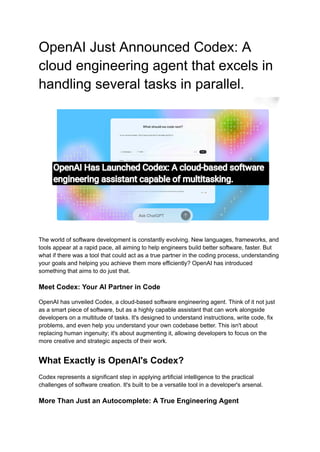
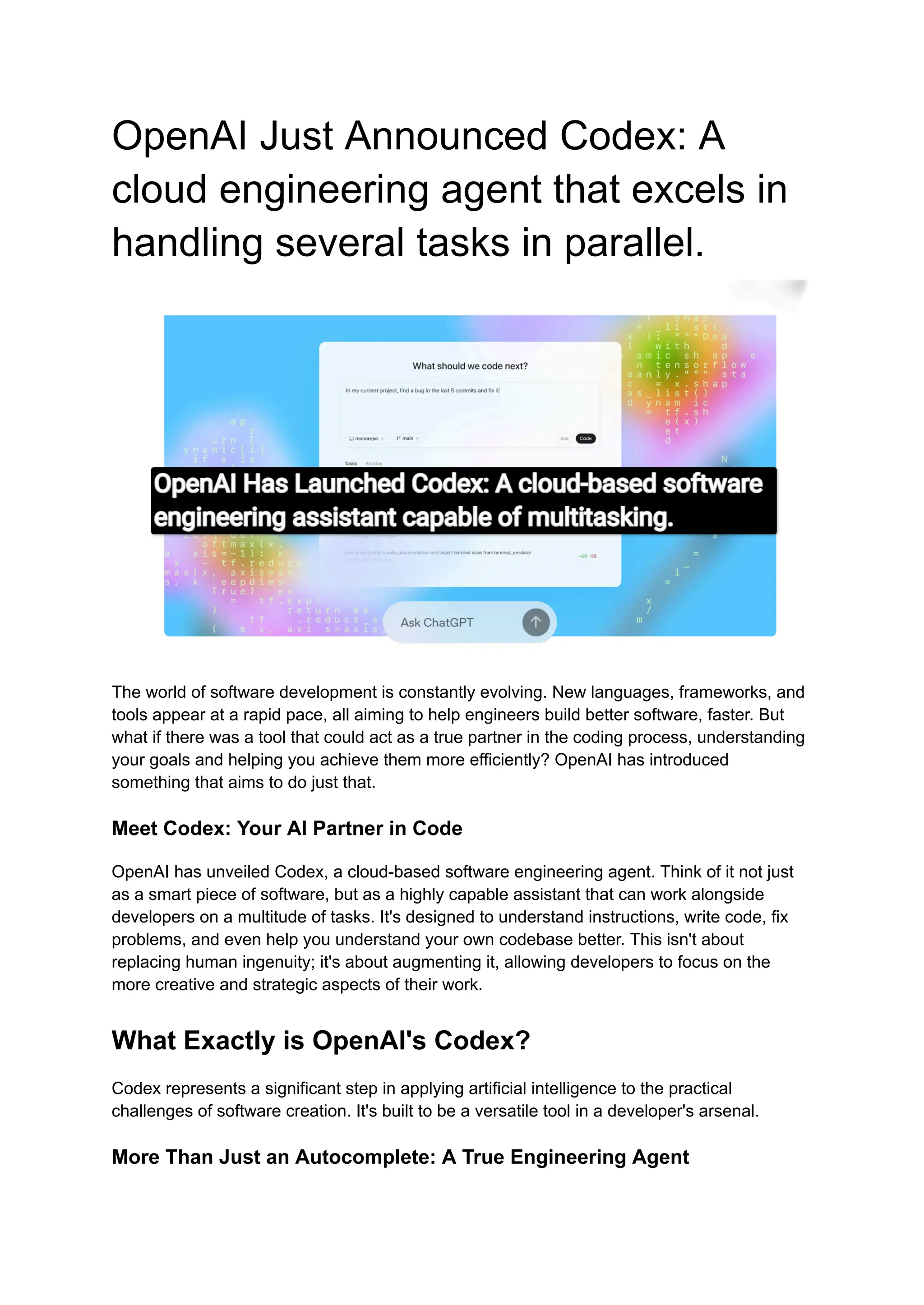
Initiating Tasks: A Simple Conversation
Accessing Codex is straightforward for those with an appropriate ChatGPT account. Users
can typically find it in the ChatGPT sidebar. Assigning a new coding task is as simple as
typing a prompt describing what you need and clicking a "Code" button. If you have
questions about your existing codebase, there's an "Ask" function for that too. This
conversational interface makes it easy to delegate work to Codex.
Secure Sandboxes: Isolated Work Environments
Each task you give to Codex is processed independently in its own separate, isolated
environment in the cloud. This sandbox comes preloaded with your repository, giving Codex
the context it needs. Within this secure space, Codex can read and edit files, and run
commands, including test suites, code linters, and type checkers. The time it takes to
complete a task can vary from a few minutes to around half an hour, depending on how
involved the request is. You can keep an eye on its progress in real time.
Following Your Lead: The AGENTS.md File
To help Codex understand the specifics of your project, you can guide it using AGENTS.md
files placed within your repository. These are simple text files, much like the familiar
README.md files. In AGENTS.md, you can provide instructions on how Codex should
navigate your codebase, which commands to run for testing, and how to best align with your
project's established practices and coding standards. Just like a human developer joining a
new team, Codex performs best when it has a well-configured development environment,
reliable tests, and clear documentation. Even without these custom guides, codex-1 shows
strong performance on coding evaluations.
Keeping Track: Transparency and Verifiability
When Codex finishes a task, it commits its changes within its sandboxed environment. A key
aspect of its design is transparency. Codex provides evidence of its actions by citing terminal
logs and test outputs. This allows you to trace each step it took to arrive at the solution. You
can then review the results, ask for more revisions, open a GitHub pull request with the
changes, or directly integrate them into your local development setup. You also have the
ability to configure the Codex environment to mirror your actual development environment as
closely as possible.
Learning and Adapting: Alignment with Human Practices
A primary focus during the training of codex-1 was to ensure its outputs align well with
human coding preferences and quality standards. Compared to earlier models, codex-1 is
designed to produce cleaner code modifications that are more readily reviewable by humans
and easier to integrate into standard development workflows.
Curious about how AI can streamline your coding? Discover the capabilities of Codex. You
can also Try Codex directly.
Codex in Practice: Solving Real-World Coding
Challenges
The true measure of a tool like Codex is its ability to handle the kinds of tasks developers
face every day. The provided examples of Codex working on established open-source
projects offer a glimpse into its practical utility.
Untangling Knots: Fixing Complex Bugs
Software bugs can be notoriously tricky to diagnose and fix. Codex has demonstrated an
ability to understand bug reports, analyze existing code, and propose solutions. For
instance, it was tasked with addressing an issue in Astropy's modeling library where a
separability_matrix wasn't computing separability correctly for certain types of nested
models. Codex was able to identify the problematic logic in the _cstack function and
provide a corrected implementation, along with a new test case to verify the fix and prevent
regressions. This shows an ability to reason about complex interactions within a codebase.
Streamlining and Modernizing: Code Refactoring
Codex can also assist with refactoring code. In an example involving Matplotlib's
mlab._spectral_helper function, a bug was identified where the window correction was
not being handled correctly for windows with negative values (like flattop windows). The
issue was that an np.abs call was being applied unnecessarily. Codex proposed a fix that
removed the incorrect absolute value application and used a more appropriate method for
scaling, aligning with practices seen in libraries like SciPy. It also added a test case
specifically for windows with negative values to ensure the correction worked as intended.
Building Anew: Feature Implementation and Testing
Beyond fixing bugs, Codex can help write new features and the tests to go with them. While
the examples focused on fixes, the underlying capability to understand code structure and
intent allows Codex to generate new code that fits into an existing project. It can also draft
documentation for the code it writes or modifies.
Answering Your Codebase Questions
Sometimes, the challenge isn't writing or fixing code, but understanding it. Codex can be
prompted to explain parts of a codebase, trace data flows, or summarize the purpose of
specific modules. This can be invaluable for developers new to a project or when revisiting
unfamiliar sections of code.
The examples with Astropy, Matplotlib, and Django (where Codex addressed an issue with
duration-only expressions on SQLite and MySQL by improving how DurationField values
are converted and how DurationExpression handles arithmetic) highlight Codex's
capacity to make precise, context-aware changes. It doesn't just make a guess; it analyzes
the problem and offers a targeted solution, often including the necessary tests to prove its
correctness.
Want to experience this power firsthand? Try Codex and see how it can help with your
projects.
More Articles for you:
●​ Cutting Down on Multiple AI Tools for Greater Business Efficiency
●​ Effortless Organic Traffic: Say Goodbye to ChatGPT! Join the
AmpCast AI Games Live Event on May 24-26 to 10X Your Traffic
Using AI Agents.
●​ Creates Lead-Boosting Quizzes from Any Content Instantly With This
Smart AI Quiz Generator
●​ 16 Surefire Ways to Optimize Your Business Website for Better SEO
●​ Building High-Converting Webinar Funnels: A Comprehensive
Framework for Scaling Sales and Engagement
Building with Responsibility: Safety and Security in
Codex
Introducing powerful AI tools into software development brings with it a responsibility to
consider safety and security. OpenAI has designed Codex with these considerations in mind.
Guarding Against Misuse: A Focus on Ethical AI
It's critical to prevent AI-driven software engineering tools from being used for malicious
purposes, such as creating malware. However, it's equally important that safety measures
don't unnecessarily obstruct legitimate and beneficial uses, which might sometimes involve
techniques (like low-level kernel engineering) that could theoretically be misused.
Codex has been trained to identify and refuse requests aimed at developing harmful
software. It's designed to distinguish these from legitimate tasks and support the latter.
OpenAI has also updated its policy frameworks and conducted safety evaluations to
strengthen these boundaries.
Fortified Execution: The Secure Cloud Container
The Codex agent carries out its work entirely within a secure, isolated container in the cloud.
A very important security feature is that during task execution, internet access is disabled.
This restricts the agent's interaction to only the code explicitly provided through GitHub
repositories and any pre-installed dependencies configured by the user via a setup script.
The agent cannot reach out to external websites, APIs, or other online services, limiting its
operational scope and potential for unintended interactions.
You're in Control: Review and Validation
Codex is presented as a research preview, and user oversight is a key part of its safe use.
The transparency features, like citations of terminal logs and test results, allow users to
check its work. If Codex is uncertain about something or encounters test failures, it's
designed to communicate these issues. This enables users to make well-informed decisions
about how to proceed. It remains vital for users to manually review and validate all code
generated by the agent before integrating and running it.
Learn more about responsible AI in coding with Codex.
From the Trenches: How Developers are Leveraging
Codex
The real test of any new technology is how it performs in the hands of actual users. OpenAI
has been using Codex internally and has also collaborated with a group of external testers to
see how it fares across different codebases, development styles, and teams.
Inside OpenAI: A Boost to Daily Engineering
Technical teams at OpenAI have begun incorporating Codex into their daily routines.
Engineers there often use it to handle repetitive, well-defined tasks that can interrupt focus,
such as refactoring code, renaming variables consistently, or writing unit tests. It's also
proving useful for creating initial scaffolding for new features, connecting different software
components, fixing bugs, and even drafting documentation. Teams are developing new
habits around Codex, like using it to help triage on-call issues, plan tasks for the day, and
offload background work so they can maintain momentum on primary objectives. By
reducing the need to switch contexts frequently and helping to surface forgotten tasks,
Codex is assisting OpenAI's engineers in shipping software faster and concentrating on the
most impactful work.
Feedback from the Field: Early Testers Share Their Experiences
The insights from external partners are particularly valuable:
●​ Cisco is investigating how Codex can help their engineering teams bring ambitious
ideas to fruition more quickly. As early design partners, Cisco is helping to shape
Codex's future by assessing it for real-world applications across their product lines
and sharing their findings with OpenAI.​
●​ Temporal utilizes Codex to speed up feature development, debug problems, write
and run tests, and refactor large codebases. They also find it helpful for keeping their
engineers in a state of flow by running complex tasks in the background, which
accelerates iteration cycles.​
●​ Superhuman employs Codex to accelerate small but recurring tasks, such as
improving test coverage and resolving integration failures. It also helps them ship
features faster by enabling product managers to contribute minor code changes
themselves (with an engineer performing the final code review), freeing up
engineering time.​
●​ Kodiak Robotics is using Codex to assist in writing debugging tools, enhancing test
coverage, and refactoring code. This accelerates the development of the Kodiak
Driver, their autonomous driving technology. Codex has also become a useful
reference tool, helping engineers understand unfamiliar parts of their software stack
by providing relevant context and information about past changes.​
Making Codex Work for You: Tips from Early Use
Based on the experiences of these early testers, a recommended approach is to assign
well-scoped tasks to multiple Codex agents at the same time. It's also beneficial to
experiment with different kinds of tasks and various ways of phrasing your prompts to fully
explore what the model can do.
Ready to join these innovative teams? Start using Codex today.
Codex On-the-Go: Introducing Updates to the Codex
CLI
For developers who prefer working in a terminal environment, OpenAI offers the Codex CLI
(Command Line Interface). This lightweight, open-source coding agent brings the
capabilities of models like o3 and o4-mini directly into your local workflow.
Power in Your Terminal: The Codex Command Line Interface
The Codex CLI allows you to pair with AI models to complete tasks more quickly without
leaving your terminal. It's designed for developers who are comfortable with command-line
tools and want to integrate AI assistance directly into their existing development habits.
Meet codex-mini-latest: Optimized for CLI Workflows
OpenAI is releasing a smaller version of codex-1, specifically designed for use in the
Codex CLI. This new model, available in the API as codex-mini-latest, is optimized for
low-latency code question-answering and editing, making for faster workflows in the
terminal. While being faster and more responsive, it retains the same strengths in
understanding instructions and matching coding style. This model is now the default in the
Codex CLI, and the underlying snapshot will be updated regularly as improvements are
made.
Easier Access: Simplified Authentication and Credits
Connecting your developer account to the Codex CLI is now much simpler. Instead of
needing to manually generate and configure an API token, you can sign in with your
ChatGPT account and choose the API organization you wish to use. The system will
automatically generate and configure the API key for you. Additionally, Plus and Pro users
who sign in to Codex CLI with ChatGPT can redeem free API credits ($5 for Plus and $50 for
Pro, for the first 30 days after the announcement) to explore its capabilities.
Getting Your Hands on Codex: Availability, Access, and
Considerations
As Codex rolls out, here’s what you need to know about accessing it and what to keep in
mind as an early user.
Who Can Start Using Codex Today?
Codex is initially becoming available to ChatGPT Pro, Enterprise, and Team users globally.
OpenAI plans to expand access to Plus and Edu users soon. This phased approach allows
for a more controlled introduction and helps gather diverse user feedback.
What to Expect: Generous Access and Future Pricing
For the initial weeks of the rollout, users will have generous access to Codex at no extra
cost. This period is intended to allow developers to explore what Codex can do. Following
this introductory phase, OpenAI will introduce rate-limited access and flexible pricing options,
enabling users to purchase additional usage as needed.
For developers building applications with the codex-mini-latest model via the API, it is
priced per million input and output tokens, with a discount for prompt caching.
Understanding the Current State: A Research Preview
It's good to remember that Codex is still in its early stages of development and is being
released as a research preview. This means it currently has some limitations. For example, it
doesn't yet support image inputs, which can be useful for frontend development tasks. Also,
the ability to course-correct the agent while it's actively working on a task is not yet a feature.
Delegating tasks to a remote agent also inherently takes longer than interactive editing
within a local IDE, which might require some adjustment in workflow. Over time, the
interaction with Codex agents is expected to feel more like asynchronous collaboration with
human colleagues.
See if Codex is available for you.
The Road Ahead: The Evolving Landscape of AI in
Software Engineering
The introduction of Codex is part of a broader vision for how AI can transform software
development. OpenAI sees a future where AI agents become indispensable partners for
developers.
A Future of Collaboration: Developers and AI Agents
The aim is a future where developers can focus on the work they want to own – the creative,
architectural, and strategic parts of software engineering – and delegate other tasks to AI
agents. This synergy is expected to allow developers to move faster and be more
productive. OpenAI is working on a suite of Codex tools that will support both real-time
collaboration (like pair programming with an AI) and asynchronous delegation (handing off
larger tasks).
Blending Interactions: Real-Time Assistance and Delegated Tasks
Pairing with AI tools like the Codex CLI is already becoming a common practice, helping
developers accelerate their coding. However, the asynchronous, multi-agent workflow
introduced by Codex in ChatGPT is envisioned to become a standard way for engineers to
produce high-quality code. Ultimately, these two modes of interaction – real-time pairing and
task delegation – are expected to merge. Developers will likely collaborate with AI agents
across their Integrated Development Environments (IDEs) and other everyday tools to ask
questions, get suggestions, and offload longer tasks, all within a unified workflow.
Expanding Horizons: Deeper Tool Integrations
Looking forward, OpenAI plans to introduce more interactive and flexible agent workflows.
Developers will soon be able to provide guidance to Codex mid-task, collaborate on
implementation strategies, and receive proactive updates on progress. Deeper integrations
with the tools developers already use are also on the roadmap. Today, Codex connects with
GitHub. Soon, users might be able to assign tasks from the Codex CLI, the ChatGPT
Desktop application, or even from tools like issue trackers or continuous integration (CI)
systems.
The Bigger Picture: Productivity, Skills, and the Developer Role
Software engineering is one of the first fields to witness substantial productivity gains driven
by AI. This opens up new possibilities, especially for individuals and small teams, allowing
them to tackle more ambitious projects. While optimistic about these advancements, OpenAI
is also working with partners to better understand the wider effects of broad agent adoption
on developer workflows, how skills will develop across people with different experience
levels, and the impact across various geographic regions. This is just the beginning of a new
chapter.
Are you ready for the future of coding? Try Codex and be part of the evolution.
The Guiding Principles: A Note on the Codex System
Message
To help developers understand how codex-1 behaves by default and to enable them to
tailor Codex for their custom workflows, OpenAI has shared the system message used by
codex-1. This system message contains a set of instructions that guide the agent. For
example, it encourages Codex to run all tests mentioned in an AGENTS.md file. However, if a
developer is short on time, they can instruct Codex to skip these tests. The system message
covers how to handle Git repositories, interpret AGENTS.md files, and provide citations for its
work, ensuring a degree of consistency and predictability in its operations. This transparency
allows for more effective collaboration between the human developer and the AI agent.
A New Chapter for Developers
OpenAI's Codex is more than just a new tool; it's an invitation to rethink how software is built.
By offering a powerful AI agent capable of understanding complex instructions, writing and
fixing code, and working within established development practices, Codex aims to free up
developers to focus on innovation and problem-solving at a higher level. As it evolves and
becomes more deeply integrated into the developer ecosystem, it promises to be a
significant factor in shaping the future of software engineering. The journey is just beginning,
and the possibilities are vast.
Begin your journey with Codex.
More Articles for you:
●​ Cutting Down on Multiple AI Tools for Greater Business Efficiency
●​ Effortless Organic Traffic: Say Goodbye to ChatGPT! Join the
AmpCast AI Games Live Event on May 24-26 to 10X Your Traffic
Using AI Agents.
●​ Creates Lead-Boosting Quizzes from Any Content Instantly With This
Smart AI Quiz Generator
●​ 16 Surefire Ways to Optimize Your Business Website for Better SEO
●​ Building High-Converting Webinar Funnels: A Comprehensive
Framework for Scaling Sales and Engagement

OpenAI Just Announced Codex: A cloud engineering agent that excels in handling several tasks in parallel.

  • 1.
    OpenAI Just AnnouncedCodex: A cloud engineering agent that excels in handling several tasks in parallel. The world of software development is constantly evolving. New languages, frameworks, and tools appear at a rapid pace, all aiming to help engineers build better software, faster. But what if there was a tool that could act as a true partner in the coding process, understanding your goals and helping you achieve them more efficiently? OpenAI has introduced something that aims to do just that. Meet Codex: Your AI Partner in Code OpenAI has unveiled Codex, a cloud-based software engineering agent. Think of it not just as a smart piece of software, but as a highly capable assistant that can work alongside developers on a multitude of tasks. It's designed to understand instructions, write code, fix problems, and even help you understand your own codebase better. This isn't about replacing human ingenuity; it's about augmenting it, allowing developers to focus on the more creative and strategic aspects of their work. What Exactly is OpenAI's Codex? Codex represents a significant step in applying artificial intelligence to the practical challenges of software creation. It's built to be a versatile tool in a developer's arsenal. More Than Just an Autocomplete: A True Engineering Agent
  • 2.
    Many developers arefamiliar with AI-powered code completion tools. Codex goes much further. It doesn't just suggest the next line of code; it can take on entire tasks. You can ask it to implement a new feature, write tests for existing code, find and fix bugs, or even refactor parts of your application for better performance or clarity. It can process these requests, work on them independently, and then present you with the results, often in the form of a proposed code change. Who is Codex For? Initially, Codex is being made available to users of ChatGPT Pro, Team, and Enterprise. The plan is to extend access to Plus and Edu users in the near future. This phased rollout allows OpenAI to gather feedback and refine the system. Whether you're a solo developer, part of a small startup, or a member of a large engineering organization, Codex has the potential to change how you approach your daily coding work. The Cloud-Powered Brain: codex-1 The intelligence behind Codex comes from a model called codex-1. This is a version of OpenAI's advanced AI, specifically optimized for software engineering tasks. It has been trained using a technique called reinforcement learning, where it learned from real-world coding assignments across various environments. This training helps it generate code that not only works but also tends to follow human-like style and preferences, adheres closely to instructions, and can even iteratively run tests until a satisfactory outcome is achieved. Ready to see what an AI coding partner can do for you? Explore Codex Now Peeking Behind the Curtain: How Codex Operates Understanding how Codex works can help you appreciate its capabilities and how to best interact with it. It’s a blend of sophisticated AI, secure execution environments, and mechanisms for user guidance and verification. Initiating Tasks: A Simple Conversation Accessing Codex is straightforward for those with an appropriate ChatGPT account. Users can typically find it in the ChatGPT sidebar. Assigning a new coding task is as simple as typing a prompt describing what you need and clicking a "Code" button. If you have questions about your existing codebase, there's an "Ask" function for that too. This conversational interface makes it easy to delegate work to Codex. Secure Sandboxes: Isolated Work Environments Each task you give to Codex is processed independently in its own separate, isolated environment in the cloud. This sandbox comes preloaded with your repository, giving Codex the context it needs. Within this secure space, Codex can read and edit files, and run commands, including test suites, code linters, and type checkers. The time it takes to
  • 3.
    complete a taskcan vary from a few minutes to around half an hour, depending on how involved the request is. You can keep an eye on its progress in real time. Following Your Lead: The AGENTS.md File To help Codex understand the specifics of your project, you can guide it using AGENTS.md files placed within your repository. These are simple text files, much like the familiar README.md files. In AGENTS.md, you can provide instructions on how Codex should navigate your codebase, which commands to run for testing, and how to best align with your project's established practices and coding standards. Just like a human developer joining a new team, Codex performs best when it has a well-configured development environment, reliable tests, and clear documentation. Even without these custom guides, codex-1 shows strong performance on coding evaluations. Keeping Track: Transparency and Verifiability When Codex finishes a task, it commits its changes within its sandboxed environment. A key aspect of its design is transparency. Codex provides evidence of its actions by citing terminal logs and test outputs. This allows you to trace each step it took to arrive at the solution. You can then review the results, ask for more revisions, open a GitHub pull request with the changes, or directly integrate them into your local development setup. You also have the ability to configure the Codex environment to mirror your actual development environment as closely as possible. Learning and Adapting: Alignment with Human Practices A primary focus during the training of codex-1 was to ensure its outputs align well with human coding preferences and quality standards. Compared to earlier models, codex-1 is designed to produce cleaner code modifications that are more readily reviewable by humans and easier to integrate into standard development workflows. Curious about how AI can streamline your coding? Discover the capabilities of Codex. You can also Try Codex directly. Codex in Practice: Solving Real-World Coding Challenges The true measure of a tool like Codex is its ability to handle the kinds of tasks developers face every day. The provided examples of Codex working on established open-source projects offer a glimpse into its practical utility. Untangling Knots: Fixing Complex Bugs Software bugs can be notoriously tricky to diagnose and fix. Codex has demonstrated an ability to understand bug reports, analyze existing code, and propose solutions. For instance, it was tasked with addressing an issue in Astropy's modeling library where a
  • 4.
    separability_matrix wasn't computingseparability correctly for certain types of nested models. Codex was able to identify the problematic logic in the _cstack function and provide a corrected implementation, along with a new test case to verify the fix and prevent regressions. This shows an ability to reason about complex interactions within a codebase. Streamlining and Modernizing: Code Refactoring Codex can also assist with refactoring code. In an example involving Matplotlib's mlab._spectral_helper function, a bug was identified where the window correction was not being handled correctly for windows with negative values (like flattop windows). The issue was that an np.abs call was being applied unnecessarily. Codex proposed a fix that removed the incorrect absolute value application and used a more appropriate method for scaling, aligning with practices seen in libraries like SciPy. It also added a test case specifically for windows with negative values to ensure the correction worked as intended. Building Anew: Feature Implementation and Testing Beyond fixing bugs, Codex can help write new features and the tests to go with them. While the examples focused on fixes, the underlying capability to understand code structure and intent allows Codex to generate new code that fits into an existing project. It can also draft documentation for the code it writes or modifies. Answering Your Codebase Questions Sometimes, the challenge isn't writing or fixing code, but understanding it. Codex can be prompted to explain parts of a codebase, trace data flows, or summarize the purpose of specific modules. This can be invaluable for developers new to a project or when revisiting unfamiliar sections of code. The examples with Astropy, Matplotlib, and Django (where Codex addressed an issue with duration-only expressions on SQLite and MySQL by improving how DurationField values are converted and how DurationExpression handles arithmetic) highlight Codex's capacity to make precise, context-aware changes. It doesn't just make a guess; it analyzes the problem and offers a targeted solution, often including the necessary tests to prove its correctness. Want to experience this power firsthand? Try Codex and see how it can help with your projects. More Articles for you: ●​ Cutting Down on Multiple AI Tools for Greater Business Efficiency
  • 5.
    ●​ Effortless OrganicTraffic: Say Goodbye to ChatGPT! Join the AmpCast AI Games Live Event on May 24-26 to 10X Your Traffic Using AI Agents. ●​ Creates Lead-Boosting Quizzes from Any Content Instantly With This Smart AI Quiz Generator ●​ 16 Surefire Ways to Optimize Your Business Website for Better SEO ●​ Building High-Converting Webinar Funnels: A Comprehensive Framework for Scaling Sales and Engagement Building with Responsibility: Safety and Security in Codex Introducing powerful AI tools into software development brings with it a responsibility to consider safety and security. OpenAI has designed Codex with these considerations in mind. Guarding Against Misuse: A Focus on Ethical AI It's critical to prevent AI-driven software engineering tools from being used for malicious purposes, such as creating malware. However, it's equally important that safety measures don't unnecessarily obstruct legitimate and beneficial uses, which might sometimes involve techniques (like low-level kernel engineering) that could theoretically be misused. Codex has been trained to identify and refuse requests aimed at developing harmful software. It's designed to distinguish these from legitimate tasks and support the latter. OpenAI has also updated its policy frameworks and conducted safety evaluations to strengthen these boundaries. Fortified Execution: The Secure Cloud Container The Codex agent carries out its work entirely within a secure, isolated container in the cloud. A very important security feature is that during task execution, internet access is disabled. This restricts the agent's interaction to only the code explicitly provided through GitHub repositories and any pre-installed dependencies configured by the user via a setup script. The agent cannot reach out to external websites, APIs, or other online services, limiting its operational scope and potential for unintended interactions. You're in Control: Review and Validation Codex is presented as a research preview, and user oversight is a key part of its safe use. The transparency features, like citations of terminal logs and test results, allow users to check its work. If Codex is uncertain about something or encounters test failures, it's
  • 6.
    designed to communicatethese issues. This enables users to make well-informed decisions about how to proceed. It remains vital for users to manually review and validate all code generated by the agent before integrating and running it. Learn more about responsible AI in coding with Codex. From the Trenches: How Developers are Leveraging Codex The real test of any new technology is how it performs in the hands of actual users. OpenAI has been using Codex internally and has also collaborated with a group of external testers to see how it fares across different codebases, development styles, and teams. Inside OpenAI: A Boost to Daily Engineering Technical teams at OpenAI have begun incorporating Codex into their daily routines. Engineers there often use it to handle repetitive, well-defined tasks that can interrupt focus, such as refactoring code, renaming variables consistently, or writing unit tests. It's also proving useful for creating initial scaffolding for new features, connecting different software components, fixing bugs, and even drafting documentation. Teams are developing new habits around Codex, like using it to help triage on-call issues, plan tasks for the day, and offload background work so they can maintain momentum on primary objectives. By reducing the need to switch contexts frequently and helping to surface forgotten tasks, Codex is assisting OpenAI's engineers in shipping software faster and concentrating on the most impactful work. Feedback from the Field: Early Testers Share Their Experiences The insights from external partners are particularly valuable: ●​ Cisco is investigating how Codex can help their engineering teams bring ambitious ideas to fruition more quickly. As early design partners, Cisco is helping to shape Codex's future by assessing it for real-world applications across their product lines and sharing their findings with OpenAI.​ ●​ Temporal utilizes Codex to speed up feature development, debug problems, write and run tests, and refactor large codebases. They also find it helpful for keeping their engineers in a state of flow by running complex tasks in the background, which accelerates iteration cycles.​ ●​ Superhuman employs Codex to accelerate small but recurring tasks, such as improving test coverage and resolving integration failures. It also helps them ship features faster by enabling product managers to contribute minor code changes themselves (with an engineer performing the final code review), freeing up engineering time.​
  • 7.
    ●​ Kodiak Roboticsis using Codex to assist in writing debugging tools, enhancing test coverage, and refactoring code. This accelerates the development of the Kodiak Driver, their autonomous driving technology. Codex has also become a useful reference tool, helping engineers understand unfamiliar parts of their software stack by providing relevant context and information about past changes.​ Making Codex Work for You: Tips from Early Use Based on the experiences of these early testers, a recommended approach is to assign well-scoped tasks to multiple Codex agents at the same time. It's also beneficial to experiment with different kinds of tasks and various ways of phrasing your prompts to fully explore what the model can do. Ready to join these innovative teams? Start using Codex today. Codex On-the-Go: Introducing Updates to the Codex CLI For developers who prefer working in a terminal environment, OpenAI offers the Codex CLI (Command Line Interface). This lightweight, open-source coding agent brings the capabilities of models like o3 and o4-mini directly into your local workflow. Power in Your Terminal: The Codex Command Line Interface The Codex CLI allows you to pair with AI models to complete tasks more quickly without leaving your terminal. It's designed for developers who are comfortable with command-line tools and want to integrate AI assistance directly into their existing development habits. Meet codex-mini-latest: Optimized for CLI Workflows OpenAI is releasing a smaller version of codex-1, specifically designed for use in the Codex CLI. This new model, available in the API as codex-mini-latest, is optimized for low-latency code question-answering and editing, making for faster workflows in the terminal. While being faster and more responsive, it retains the same strengths in understanding instructions and matching coding style. This model is now the default in the Codex CLI, and the underlying snapshot will be updated regularly as improvements are made. Easier Access: Simplified Authentication and Credits Connecting your developer account to the Codex CLI is now much simpler. Instead of needing to manually generate and configure an API token, you can sign in with your ChatGPT account and choose the API organization you wish to use. The system will automatically generate and configure the API key for you. Additionally, Plus and Pro users
  • 8.
    who sign into Codex CLI with ChatGPT can redeem free API credits ($5 for Plus and $50 for Pro, for the first 30 days after the announcement) to explore its capabilities. Getting Your Hands on Codex: Availability, Access, and Considerations As Codex rolls out, here’s what you need to know about accessing it and what to keep in mind as an early user. Who Can Start Using Codex Today? Codex is initially becoming available to ChatGPT Pro, Enterprise, and Team users globally. OpenAI plans to expand access to Plus and Edu users soon. This phased approach allows for a more controlled introduction and helps gather diverse user feedback. What to Expect: Generous Access and Future Pricing For the initial weeks of the rollout, users will have generous access to Codex at no extra cost. This period is intended to allow developers to explore what Codex can do. Following this introductory phase, OpenAI will introduce rate-limited access and flexible pricing options, enabling users to purchase additional usage as needed. For developers building applications with the codex-mini-latest model via the API, it is priced per million input and output tokens, with a discount for prompt caching. Understanding the Current State: A Research Preview It's good to remember that Codex is still in its early stages of development and is being released as a research preview. This means it currently has some limitations. For example, it doesn't yet support image inputs, which can be useful for frontend development tasks. Also, the ability to course-correct the agent while it's actively working on a task is not yet a feature. Delegating tasks to a remote agent also inherently takes longer than interactive editing within a local IDE, which might require some adjustment in workflow. Over time, the interaction with Codex agents is expected to feel more like asynchronous collaboration with human colleagues. See if Codex is available for you. The Road Ahead: The Evolving Landscape of AI in Software Engineering The introduction of Codex is part of a broader vision for how AI can transform software development. OpenAI sees a future where AI agents become indispensable partners for developers.
  • 9.
    A Future ofCollaboration: Developers and AI Agents The aim is a future where developers can focus on the work they want to own – the creative, architectural, and strategic parts of software engineering – and delegate other tasks to AI agents. This synergy is expected to allow developers to move faster and be more productive. OpenAI is working on a suite of Codex tools that will support both real-time collaboration (like pair programming with an AI) and asynchronous delegation (handing off larger tasks). Blending Interactions: Real-Time Assistance and Delegated Tasks Pairing with AI tools like the Codex CLI is already becoming a common practice, helping developers accelerate their coding. However, the asynchronous, multi-agent workflow introduced by Codex in ChatGPT is envisioned to become a standard way for engineers to produce high-quality code. Ultimately, these two modes of interaction – real-time pairing and task delegation – are expected to merge. Developers will likely collaborate with AI agents across their Integrated Development Environments (IDEs) and other everyday tools to ask questions, get suggestions, and offload longer tasks, all within a unified workflow. Expanding Horizons: Deeper Tool Integrations Looking forward, OpenAI plans to introduce more interactive and flexible agent workflows. Developers will soon be able to provide guidance to Codex mid-task, collaborate on implementation strategies, and receive proactive updates on progress. Deeper integrations with the tools developers already use are also on the roadmap. Today, Codex connects with GitHub. Soon, users might be able to assign tasks from the Codex CLI, the ChatGPT Desktop application, or even from tools like issue trackers or continuous integration (CI) systems. The Bigger Picture: Productivity, Skills, and the Developer Role Software engineering is one of the first fields to witness substantial productivity gains driven by AI. This opens up new possibilities, especially for individuals and small teams, allowing them to tackle more ambitious projects. While optimistic about these advancements, OpenAI is also working with partners to better understand the wider effects of broad agent adoption on developer workflows, how skills will develop across people with different experience levels, and the impact across various geographic regions. This is just the beginning of a new chapter. Are you ready for the future of coding? Try Codex and be part of the evolution. The Guiding Principles: A Note on the Codex System Message To help developers understand how codex-1 behaves by default and to enable them to tailor Codex for their custom workflows, OpenAI has shared the system message used by
  • 10.
    codex-1. This systemmessage contains a set of instructions that guide the agent. For example, it encourages Codex to run all tests mentioned in an AGENTS.md file. However, if a developer is short on time, they can instruct Codex to skip these tests. The system message covers how to handle Git repositories, interpret AGENTS.md files, and provide citations for its work, ensuring a degree of consistency and predictability in its operations. This transparency allows for more effective collaboration between the human developer and the AI agent. A New Chapter for Developers OpenAI's Codex is more than just a new tool; it's an invitation to rethink how software is built. By offering a powerful AI agent capable of understanding complex instructions, writing and fixing code, and working within established development practices, Codex aims to free up developers to focus on innovation and problem-solving at a higher level. As it evolves and becomes more deeply integrated into the developer ecosystem, it promises to be a significant factor in shaping the future of software engineering. The journey is just beginning, and the possibilities are vast. Begin your journey with Codex. More Articles for you: ●​ Cutting Down on Multiple AI Tools for Greater Business Efficiency ●​ Effortless Organic Traffic: Say Goodbye to ChatGPT! Join the AmpCast AI Games Live Event on May 24-26 to 10X Your Traffic Using AI Agents. ●​ Creates Lead-Boosting Quizzes from Any Content Instantly With This Smart AI Quiz Generator ●​ 16 Surefire Ways to Optimize Your Business Website for Better SEO ●​ Building High-Converting Webinar Funnels: A Comprehensive Framework for Scaling Sales and Engagement