Introduction
The software development landscape is undergoing a paradigm shift
with the advent of AI-powered coding assistants. GitHub Copilot,
launched in 2021, was an early step towards AI-assisted
programming, and now, with the introduction of GitHub Copilot
Agent, we are witnessing a new era of AI-driven software
development. But what does this mean for developers, businesses,
and the future of coding?
The integration of AI into coding has always been an exciting yet
controversial topic. While some developers welcome automation,
others fear that AI might replace human programmers. However,
rather than replacing developers, AI coding assistants like GitHub
Copilot Agent act as collaborative partners, enabling engineers
to code more efficiently and focus on high-level problem-solving
rather than tedious, repetitive tasks.
The Evolution of AI Coding Assistants
AI coding assistants have significantly evolved over the past few
years, moving from simple autocomplete suggestions to context-
aware code generation and debugging support.
GitHub Copilot Agent represents the next stage in this evolution,
offering:
• Deeper codebase understanding: It can analyze and
comprehend entire projects, making suggestions beyond simple
code completions.
• End-to-end coding assistance: From generating boilerplate
code to debugging and optimizing existing code, it can assist at every
stage of the development lifecycle.
• Integration with third-party tools: With the GitHub Copilot
Partner Program, developers can extend its capabilities by
integrating external tools and services.
• Automated Documentation Generation: Copilot Agent can
generate docstrings, README files, and in-line documentation,
making it easier for teams to maintain large codebases.
• Enhanced AI-driven Testing: By suggesting unit tests and
integration test cases, it reduces the time spent on debugging and
ensures robust code quality.
Unlike earlier AI tools that primarily provided simple code
autocompletion, modern AI coding assistants leverage deep learning
models trained on vast repositories of open-source code. This allows
them to offer context-aware assistance, helping developers debug,
refactor, and even understand unfamiliar codebases.
Why GitHub Copilot Agent Matters?
The rise of GitHub Copilot Agent reflects a broader industry trend —
AI is no longer just an aid but a co-developer in software
engineering.
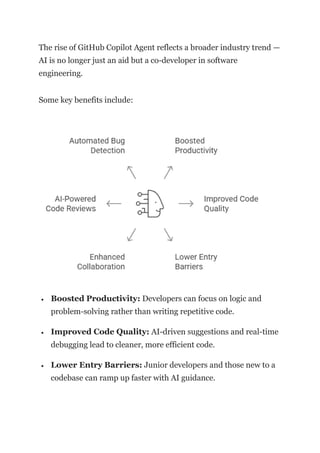
Some key benefits include:
• Boosted Productivity: Developers can focus on logic and
problem-solving rather than writing repetitive code.
• Improved Code Quality: AI-driven suggestions and real-time
debugging lead to cleaner, more efficient code.
• Lower Entry Barriers: Junior developers and those new to a
codebase can ramp up faster with AI guidance.
• Enhanced Collaboration: AI-generated documentation and
contextual suggestions improve teamwork and project
maintenance.
• AI-Powered Code Reviews: GitHub Copilot Agent can
analyze pull requests and suggest improvements, making code
review processes more efficient.
• Automated Bug Detection: By leveraging AI models trained
on millions of bug patterns, Copilot Agent can proactively flag
potential security vulnerabilities and logical errors.
This shift is not just about making coding easier but also about
reshaping software development methodologies. With AI-driven
assistance, agile development processes can become even more
iterative, allowing for rapid prototyping and deployment with fewer
errors.
The Expanding AI Coding Ecosystem
The introduction of Copilot Agent is part of a larger movement in
AI-enhanced development environments. Other players, including
Amazon CodeWhisperer and Google’s AlphaCode, are competing to
redefine how software is written. The integration of AI-powered
coding assistants into development workflows is no longer optional
— it is becoming a necessity for efficiency and innovation.
The ecosystem of AI coding assistants extends beyond GitHub
Copilot Agent.
Here are some key players and trends in the AI coding space:
Amazon CodeWhisperer: A strong competitor, providing AI-
driven coding suggestions within AWS environments.
Google AlphaCode: A research-oriented AI system designed to
solve competitive programming problems.
OpenAI Codex: The underlying model behind Copilot, which
continues to push the boundaries of AI-assisted programming.
AI-Powered IDEs: Tools like JetBrains AI Assistant and VS Code
extensions are integrating AI for smart refactoring and error
prediction.
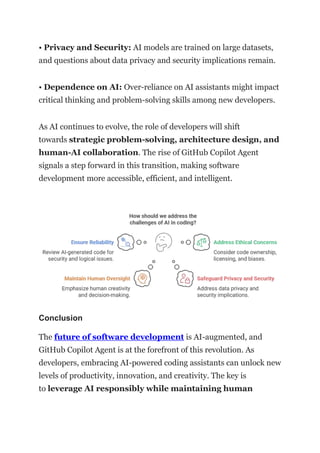
Challenges and the Road Ahead
While AI coding assistants present enormous benefits, challenges
remain:
• Reliability: AI-generated code must be reviewed for security
vulnerabilities and logical correctness.
• Ethical Concerns: The use of AI in coding raises concerns
around code ownership, licensing, and biases.
• Human Oversight: AI is a powerful tool but cannot replace
human creativity and decision-making.
• Privacy and Security: AI models are trained on large datasets,
and questions about data privacy and security implications remain.
• Dependence on AI: Over-reliance on AI assistants might impact
critical thinking and problem-solving skills among new developers.
As AI continues to evolve, the role of developers will shift
towards strategic problem-solving, architecture design, and
human-AI collaboration. The rise of GitHub Copilot Agent
signals a step forward in this transition, making software
development more accessible, efficient, and intelligent.
Conclusion
The future of software development is AI-augmented, and
GitHub Copilot Agent is at the forefront of this revolution. As
developers, embracing AI-powered coding assistants can unlock new
levels of productivity, innovation, and creativity. The key is
to leverage AI responsibly while maintaining human
oversight, ensuring that the code we write remains high-
quality, secure, and ethical.
The role of developers is not diminishing — it is evolving. AI
can handle repetitive tasks, but human ingenuity is still required for
architecture design, problem-solving, and ethical considerations.
Rather than replacing software engineers, AI coding assistants
empower them to focus on innovation and higher-order
thinking.
What are your thoughts on AI coding assistants? Do you see them as
a valuable tool or a potential challenge to software development?

GitHub Copilot Agent and the Rise of AI Coding Assistants.pdf

  • 1.
    Introduction The software developmentlandscape is undergoing a paradigm shift with the advent of AI-powered coding assistants. GitHub Copilot, launched in 2021, was an early step towards AI-assisted programming, and now, with the introduction of GitHub Copilot Agent, we are witnessing a new era of AI-driven software development. But what does this mean for developers, businesses, and the future of coding? The integration of AI into coding has always been an exciting yet controversial topic. While some developers welcome automation, others fear that AI might replace human programmers. However, rather than replacing developers, AI coding assistants like GitHub Copilot Agent act as collaborative partners, enabling engineers to code more efficiently and focus on high-level problem-solving rather than tedious, repetitive tasks. The Evolution of AI Coding Assistants AI coding assistants have significantly evolved over the past few years, moving from simple autocomplete suggestions to context- aware code generation and debugging support. GitHub Copilot Agent represents the next stage in this evolution, offering:
  • 2.
    • Deeper codebaseunderstanding: It can analyze and comprehend entire projects, making suggestions beyond simple code completions. • End-to-end coding assistance: From generating boilerplate code to debugging and optimizing existing code, it can assist at every stage of the development lifecycle. • Integration with third-party tools: With the GitHub Copilot Partner Program, developers can extend its capabilities by integrating external tools and services. • Automated Documentation Generation: Copilot Agent can generate docstrings, README files, and in-line documentation, making it easier for teams to maintain large codebases. • Enhanced AI-driven Testing: By suggesting unit tests and integration test cases, it reduces the time spent on debugging and ensures robust code quality. Unlike earlier AI tools that primarily provided simple code autocompletion, modern AI coding assistants leverage deep learning models trained on vast repositories of open-source code. This allows them to offer context-aware assistance, helping developers debug, refactor, and even understand unfamiliar codebases. Why GitHub Copilot Agent Matters?
  • 3.
    The rise ofGitHub Copilot Agent reflects a broader industry trend — AI is no longer just an aid but a co-developer in software engineering. Some key benefits include: • Boosted Productivity: Developers can focus on logic and problem-solving rather than writing repetitive code. • Improved Code Quality: AI-driven suggestions and real-time debugging lead to cleaner, more efficient code. • Lower Entry Barriers: Junior developers and those new to a codebase can ramp up faster with AI guidance.
  • 4.
    • Enhanced Collaboration:AI-generated documentation and contextual suggestions improve teamwork and project maintenance. • AI-Powered Code Reviews: GitHub Copilot Agent can analyze pull requests and suggest improvements, making code review processes more efficient. • Automated Bug Detection: By leveraging AI models trained on millions of bug patterns, Copilot Agent can proactively flag potential security vulnerabilities and logical errors. This shift is not just about making coding easier but also about reshaping software development methodologies. With AI-driven assistance, agile development processes can become even more iterative, allowing for rapid prototyping and deployment with fewer errors. The Expanding AI Coding Ecosystem The introduction of Copilot Agent is part of a larger movement in AI-enhanced development environments. Other players, including Amazon CodeWhisperer and Google’s AlphaCode, are competing to redefine how software is written. The integration of AI-powered coding assistants into development workflows is no longer optional — it is becoming a necessity for efficiency and innovation. The ecosystem of AI coding assistants extends beyond GitHub Copilot Agent.
  • 5.
    Here are somekey players and trends in the AI coding space: Amazon CodeWhisperer: A strong competitor, providing AI- driven coding suggestions within AWS environments. Google AlphaCode: A research-oriented AI system designed to solve competitive programming problems. OpenAI Codex: The underlying model behind Copilot, which continues to push the boundaries of AI-assisted programming. AI-Powered IDEs: Tools like JetBrains AI Assistant and VS Code extensions are integrating AI for smart refactoring and error prediction. Challenges and the Road Ahead While AI coding assistants present enormous benefits, challenges remain: • Reliability: AI-generated code must be reviewed for security vulnerabilities and logical correctness. • Ethical Concerns: The use of AI in coding raises concerns around code ownership, licensing, and biases. • Human Oversight: AI is a powerful tool but cannot replace human creativity and decision-making.
  • 6.
    • Privacy andSecurity: AI models are trained on large datasets, and questions about data privacy and security implications remain. • Dependence on AI: Over-reliance on AI assistants might impact critical thinking and problem-solving skills among new developers. As AI continues to evolve, the role of developers will shift towards strategic problem-solving, architecture design, and human-AI collaboration. The rise of GitHub Copilot Agent signals a step forward in this transition, making software development more accessible, efficient, and intelligent. Conclusion The future of software development is AI-augmented, and GitHub Copilot Agent is at the forefront of this revolution. As developers, embracing AI-powered coding assistants can unlock new levels of productivity, innovation, and creativity. The key is to leverage AI responsibly while maintaining human
  • 7.
    oversight, ensuring thatthe code we write remains high- quality, secure, and ethical. The role of developers is not diminishing — it is evolving. AI can handle repetitive tasks, but human ingenuity is still required for architecture design, problem-solving, and ethical considerations. Rather than replacing software engineers, AI coding assistants empower them to focus on innovation and higher-order thinking. What are your thoughts on AI coding assistants? Do you see them as a valuable tool or a potential challenge to software development?