2
Open addressing
Outline
Chained hashtables require special memory allocation
– Can we create a hash table without significant memory allocation?
We will deal with collisions by storing collisions elsewhere
– We will define an implicit rule which tells us where to look next
3.
3
Open addressing
Background
Explicitly storingreferences to the next object due to a collision
requires memory
– Linked lists require a pointer to the next node
– Scatter tables require a pointer to the next cell
We will implicit rules which dictate where to look next
6
Open addressing
Open Addressing
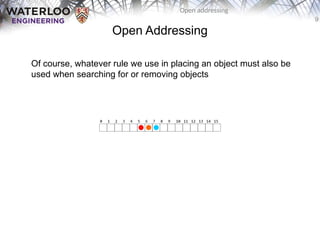
Wecould have a rule which says:
– Look in the next bin to see if it is occupied
– Such a rule is implicit—we do not follow an explicit link
7.
7
Open addressing
Open Addressing
Therule must be general enough to deal with the fact that the next
cell could also be occupied
– For example, continue searching until the first empty bin is found
– The rule must be simple to follow—i.e., fast
8.
8
Open addressing
Open Addressing
Wecould then store the object in the next location
– Problem: we can only store as many objects as there are entries in the
array: the load factor l ≤ 1
11
Open addressing
Open Addressing
Thereare numerous strategies for defining the order in which the
bins should be searched:
– Linear probing
– Quadratic probing
– Double hashing
There are many alternate strategies, as well:
– Last come, first served
• Always place the object into the bin moving what may be there already
– Cuckoo hashing
12.
12
Open addressing
Summary
This shorttopic introduces the concept of open addressing
– Use a predefined sequence of bins which should be searched
– We need a fast rule that can be easily followed
– We must ensure that we are not making too many searches
– The load factor will never be greater than one
13.
13
Open addressing
References
Wikipedia, http://en.wikipedia.org/wiki/Hash_function
[1]Cormen, Leiserson, and Rivest, Introduction to Algorithms, McGraw Hill, 1990.
[2] Weiss, Data Structures and Algorithm Analysis in C++, 3rd
Ed., Addison Wesley.
These slides are provided for the ECE 250 Algorithms and Data Structures course. The
material in it reflects Douglas W. Harder’s best judgment in light of the information available to
him at the time of preparation. Any reliance on these course slides by any party for any other
purpose are the responsibility of such parties. Douglas W. Harder accepts no responsibility for
damages, if any, suffered by any party as a result of decisions made or actions based on these
course slides for any other purpose than that for which it was intended.




![13
Open addressing
References
Wikipedia, http://en.wikipedia.org/wiki/Hash_function
[1] Cormen, Leiserson, and Rivest, Introduction to Algorithms, McGraw Hill, 1990.
[2] Weiss, Data Structures and Algorithm Analysis in C++, 3rd
Ed., Addison Wesley.
These slides are provided for the ECE 250 Algorithms and Data Structures course. The
material in it reflects Douglas W. Harder’s best judgment in light of the information available to
him at the time of preparation. Any reliance on these course slides by any party for any other
purpose are the responsibility of such parties. Douglas W. Harder accepts no responsibility for
damages, if any, suffered by any party as a result of decisions made or actions based on these
course slides for any other purpose than that for which it was intended.](https://image.slidesharecdn.com/9-251011025133-676b98c8/85/Open_addressing-examples-with-c-programming-pptx-13-320.jpg)


