Sustainable Technology Entrepreneurship for
Scientists and Engineers
Overview
  • Institutional Context
  • Motivation
  • NCIIA Grant and Initial Planning
  • Curriculum Development
  • Implementation (First Iteration)
  • Assessment
  •Second Iteration and The Path Forward
Sustainable Technology Entrepreneurship for
Scientists and Engineers
Overview
  • Institutional Context
  • Motivation
  • NCIIA Grant and Initial Planning
  • Curriculum Development
  • Implementation (First Iteration)
  • Assessment
  •Second Iteration and The Path Forward
Institutional Context
Sustainable Technology Entrepreneurship for Scientists and Engineers

Colorado State University
• Land Grant Mission (Ag Sciences, Engineering, Extension)
• Peace Corps Legacy
• Engineering Research and Focus on Clean Energy
    • $545 million per faculty in engineering
• Clean Energy and BOP Spinoff Companies
    • Envirofit International, Solix Biofuels, Abound Solar
• GSSE Program
• Entrepreneurial Community but No Formal
Entrepreneurship Courses for Engineering Grad Students
Institutional Context
CSU Peace Corps Legacy
•Former CSU Civil Engineering Professor Maury Albertson (1919 – 2009),
was director of the U.S. Congressional study on the Point 4 Youth Corps (an
early name for the Peace Corps initiative).
•Albertson and CSU colleagues authored the book, "New Frontiers for
American Youth - Perspective on the Peace Corps," which served as the
blueprint for the Peace Corps.

• To date, over 1500 CSU alumni have served in the
Peace Corps since its creation in 1961.
• In 2010-2011, CSU was named 10th among
universities with the most nominations for Peace Corps
service and 1st in the nation for the recruitment of highly
skilled volunteers.
• Currently, 93 CSU alumni serve as volunteers.
Institutional Context
Engineering Research Programs

• On a per-faculty basis, NSF ranked Colorado State 1st in the nation
among all public universities in federally funded research.
• Annual research expenditures of $546,000 per faculty member in FY10.
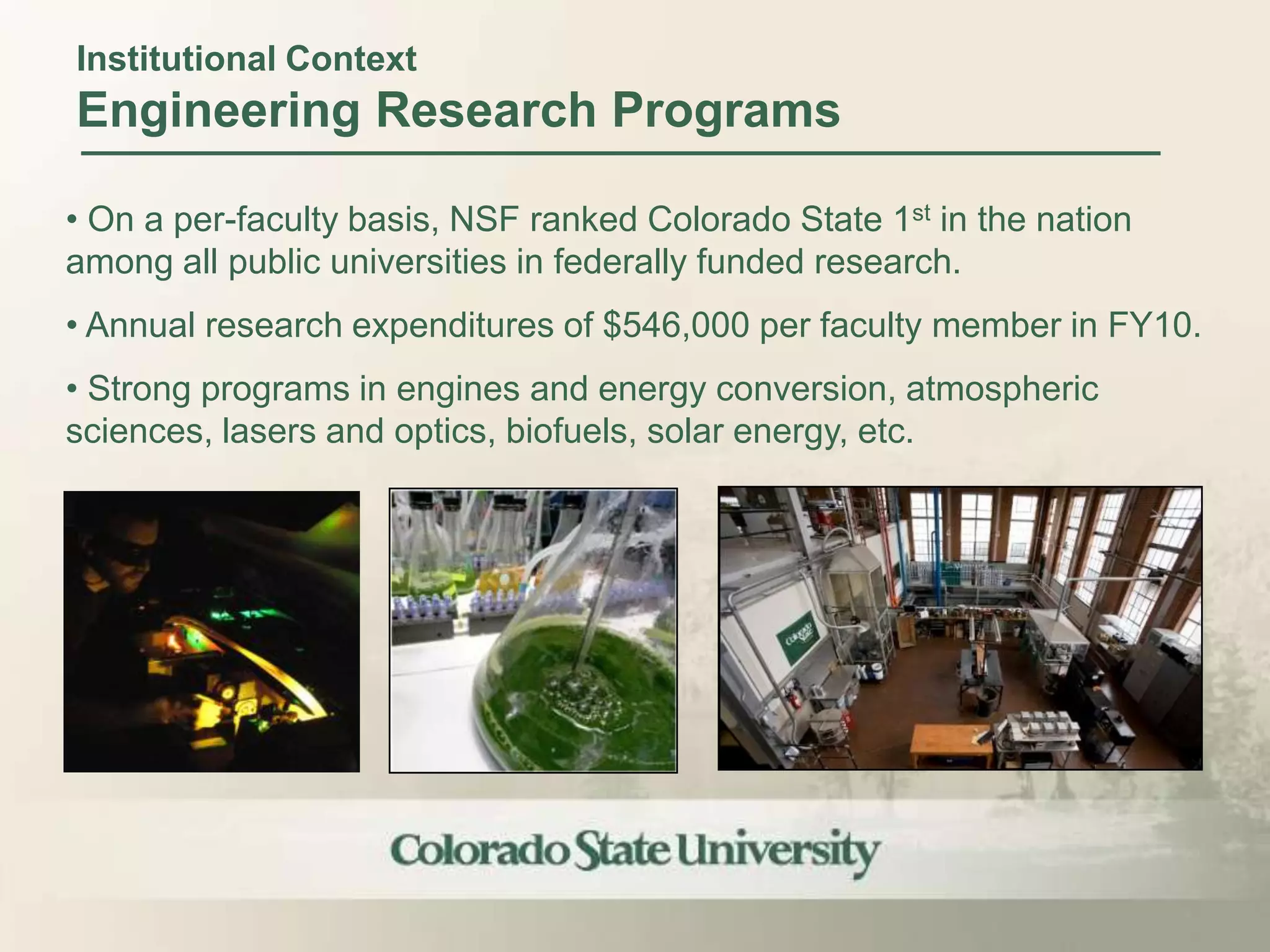
• Strong programs in engines and energy conversion, atmospheric
sciences, lasers and optics, biofuels, solar energy, etc.
Institutional Context
Recent Clean Energy Spinoff Companies
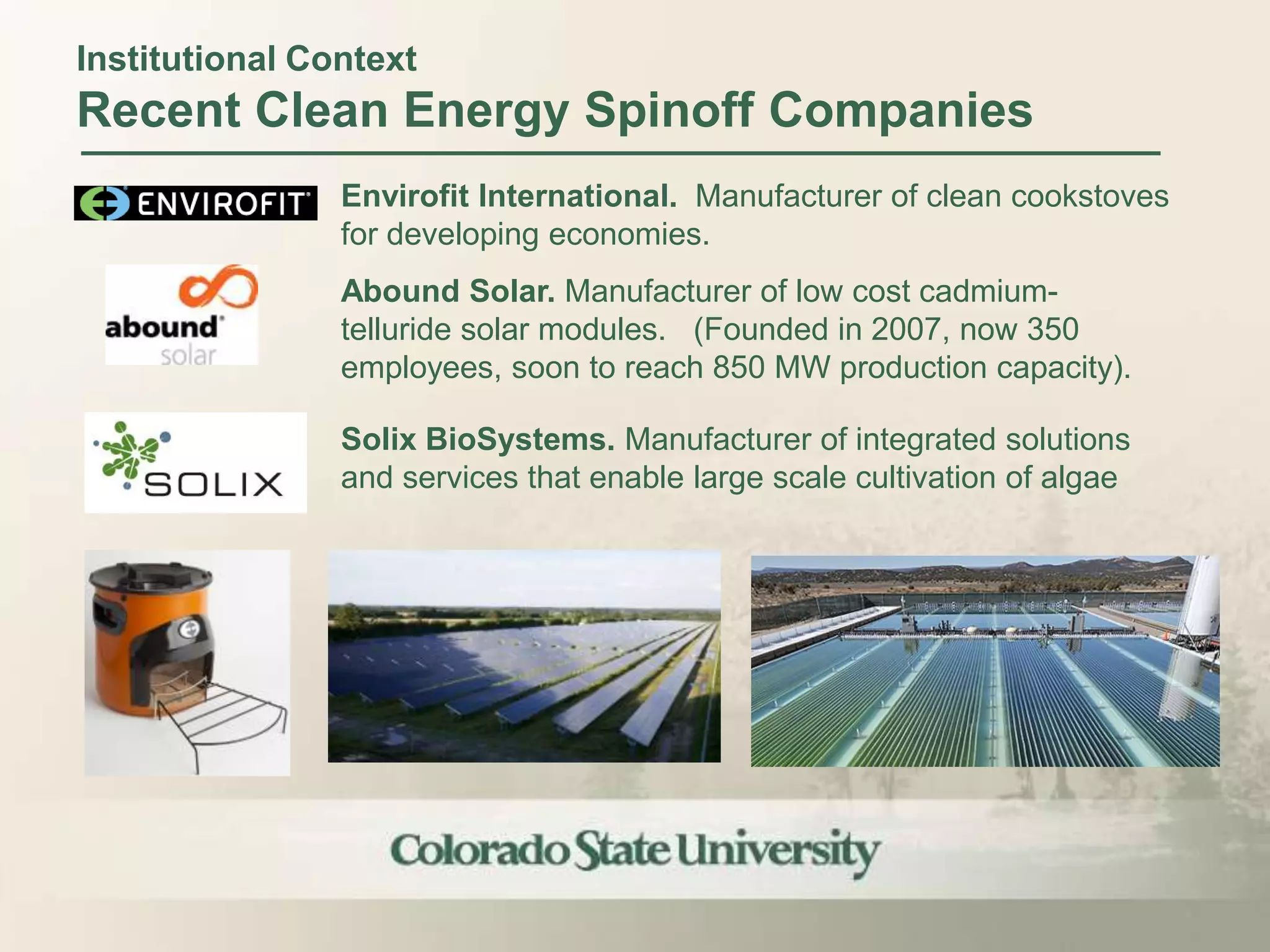
                Envirofit International. Manufacturer of clean cookstoves
                for developing economies.
                Abound Solar. Manufacturer of low cost cadmium-
                telluride solar modules. (Founded in 2007, now 350
                employees, soon to reach 850 MW production capacity).

                Solix BioSystems. Manufacturer of integrated solutions
                and services that enable large scale cultivation of algae
Institutional Context
Recent Clean Energy Spinoff Companies
                Envirofit International. Manufacturer of clean cookstoves
                for developing economies.
                Abound Solar. Manufacturer of low cost cadmium-
                telluride solar modules. (Founded in 2007, now 350
                employees, soon to reach 850 MW production capacity).

                Solix BioSystems. Manufacturer of integrated solutions
                and services that enable large scale cultivation of algae
Institutional Context
The GSSE Program


 The GSSE is a Masters of Business Administration (MBA) program at CSU
 whose goal is to prepare a new generation of entrepreneurs who aim to
 leverage CSU’s research, technology and business know-how to
 create, build and grow global, sustainable enterprises with lasting impact.
Institutional Context
The GSSE Program


    GSSE students form Enterprise Teams and work in base of the
    pyramid markets on ventures that serve people, planet and profit.
Institutional Context
The GSSE Program


  GSEE Cohort Approach
  • Annual Class of 25 students
  • 50/50 split of international to U.S.
  • Very experienced (average age 30)
  • GSSE students are
    engineers, managers, scientists, economists, RPCVs
    & other development workers
  • Assembled into E-teams of 3 to 5 members.
Institutional Context
The GSSE Program


   GSSE International Cohort Approach –
   Iraq, Philippines, India, Chile, Ghana, Mongolia, Venezuela, Ecuador,
   Nepal, Vietnam, Sri Lanka, Madagascar, Nigeria, USA
Sustainable Technology Entrepreneurship for
Scientists and Engineers
Overview
  • Institutional Context
  • Motivation
  • NCIIA Grant and Initial Planning
  • Curriculum Development
  • Implementation (First Iteration)
  • Assessment
  •Second Iteration and The Path Forward
Motivation for ENT Program in Eng and Ag
Sustainable Technology Entrepreneurship for Scientists and Engineers

• Most early GSSE projects were technology intensive:
    • distribution network for solar lights and radios (Ghana and Peru),
    • small diesel engines for irrigation (Bangladesh, Ethiopia),
    • hydraulic hybrid technology transit buses (India)
    • bio-diverse products from wildlife-friendly agriculture (Cambodia).
• Solutions to these problems required substantial technological expertise
from engineering and/or agricultural sciences.
•The GSSE program did not include a formal means of interfacing GSSE
students with engineering and agricultural science students.

• Meanwhile…no formal entrepreneurial training opportunities existed for
graduate students in engineering or agricultural sciences.
Sustainable Technology Entrepreneurship for
Scientists and Engineers
Overview
  • Institutional Context
  • Motivation
  • NCIIA Grant and Initial Planning
  • Curriculum Development
  • Implementation (First Iteration)
  • Assessment
  •Second Iteration and The Path Forward
NCIIA Grant and Initial Planning
 Sustainable Technology Entrepreneurship for Scientists and Engineers

In Fall 2008, a meeting was convened at the “south office”
of the Engines and Energy Conversion Laboratory
between GSSE, engineering and agricultural sciences
faculty.
In 2009 a Course and Program Grant was obtained from
the NCIIA to formalize a linkage between the GSSE
program and engineering and agricultural science
graduate students.
The objectives of the new program are twofold:
    • Instill an entrepreneurial mindset and global/
    sustainable perspective among engineering and
    agricultural science students.
    • Provide engineering/agricultural science expertise
    and rapid product realization resources to enterprise
    teams within the GSSE program.
Sustainable Technology Entrepreneurship for
Scientists and Engineers
Overview
  • Institutional Context
  • Motivation
  • NCIIA Grant and Initial Planning
  • Curriculum Development
  • Implementation (First Iteration)
  • Assessment
  • Second Iteration and The Path Forward
Initial Planning and Curriculum Development
Sustainable Technology Entrepreneurship for Scientists and Engineers

From Jim Collins Good to Great
and The Social Sectors (2005)


                                      What are you            - Core values
                                    deeply passionate         - Vision and mission
                                         about?


                                                                         -Time
 Unique and            What can you be           What drives your
 valuable               the best in the          resource engine?        -Money
 contribution             world at?
                                                                         -Brand
Initial Planning and Curriculum Development
 Sustainable Technology Entrepreneurship for Scientists and Engineers

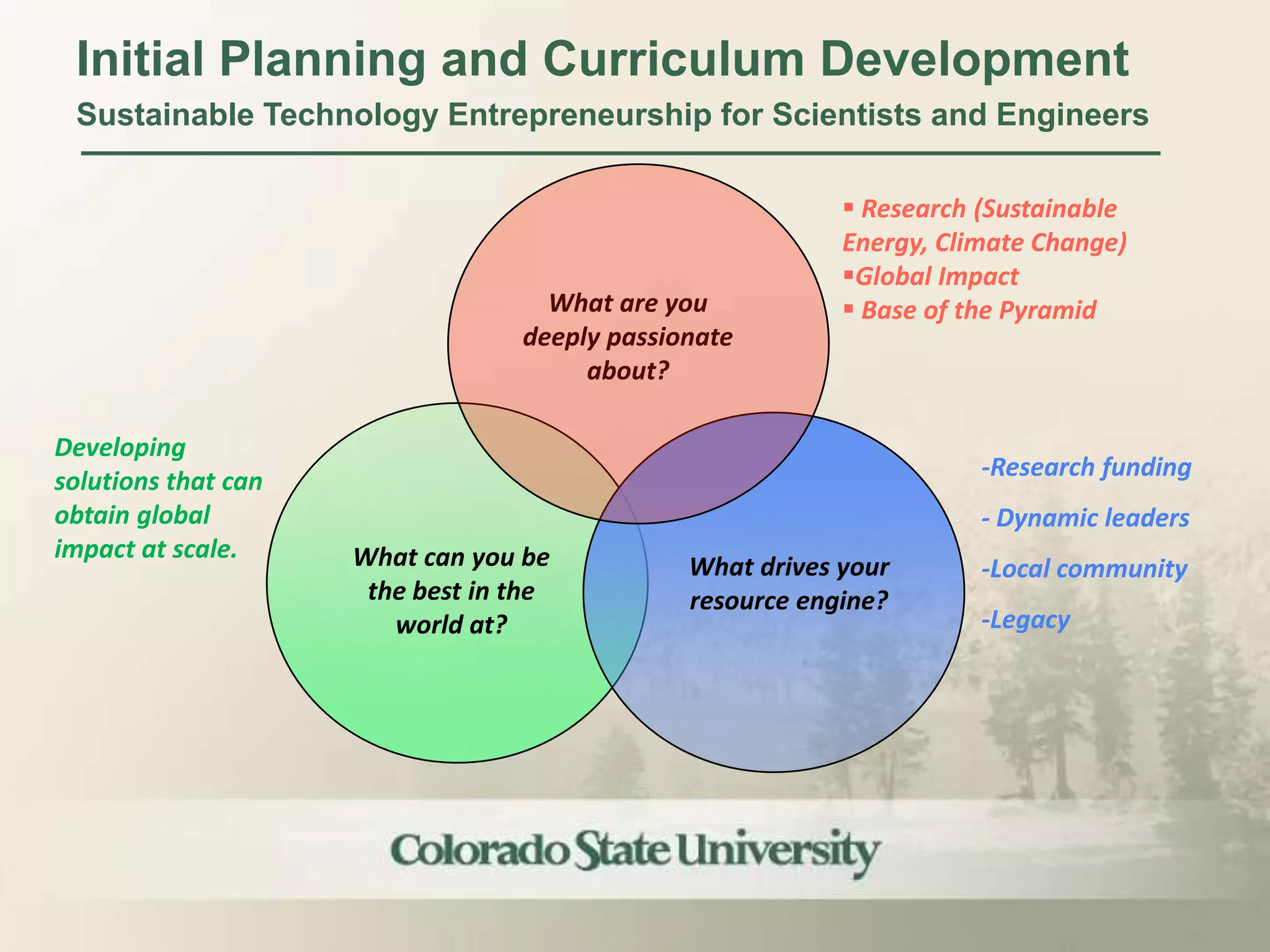
                                                            Research (Sustainable
                                                           Energy, Climate Change)
                                                           Global Impact
                                    What are you            Base of the Pyramid
                                  deeply passionate
                                       about?

Developing
                                                                      -Research funding
solutions that can
obtain global                                                         - Dynamic leaders
impact at scale.     What can you be           What drives your       -Local community
                      the best in the          resource engine?
                        world at?                                     -Legacy
Initial Planning and Curriculum Development
Sustainable Technology Entrepreneurship for Scientists and Engineers

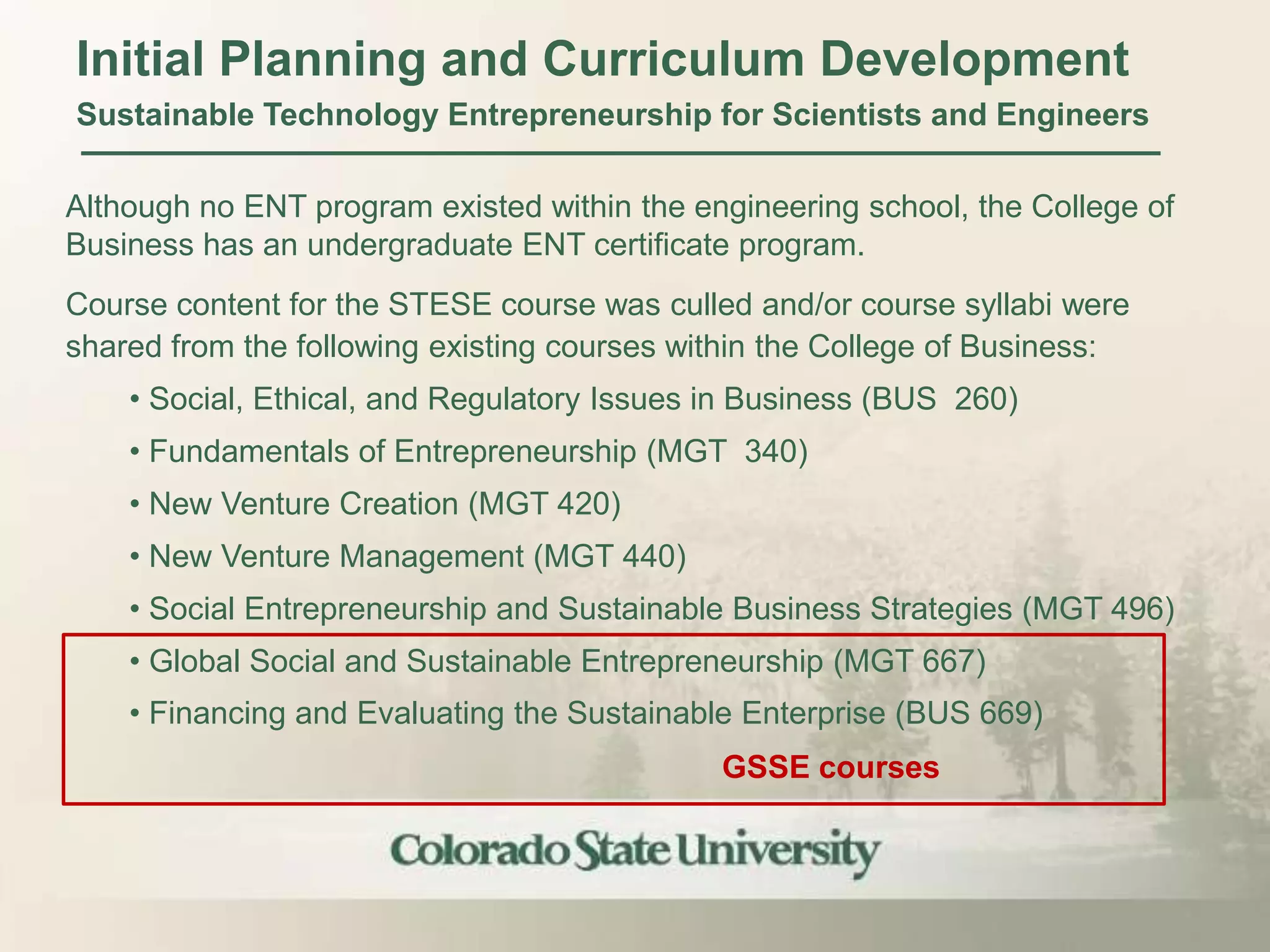
Although no ENT program existed within the engineering school, the College of
Business has an undergraduate ENT certificate program.
Course content for the STESE course was culled and/or course syllabi were
shared from the following existing courses within the College of Business:
    • Social, Ethical, and Regulatory Issues in Business (BUS 260)
    • Fundamentals of Entrepreneurship (MGT 340)
    • New Venture Creation (MGT 420)
    • New Venture Management (MGT 440)
    • Social Entrepreneurship and Sustainable Business Strategies (MGT 496)
    • Global Social and Sustainable Entrepreneurship (MGT 667)
    • Financing and Evaluating the Sustainable Enterprise (BUS 669)
Initial Planning and Curriculum Development
Sustainable Technology Entrepreneurship for Scientists and Engineers

Although no ENT program existed within the engineering school, the College of
Business has an undergraduate ENT certificate program.
Course content for the STESE course was culled and/or course syllabi were
shared from the following existing courses within the College of Business:
    • Social, Ethical, and Regulatory Issues in Business (BUS 260)
    • Fundamentals of Entrepreneurship (MGT 340)
    • New Venture Creation (MGT 420)         Undergraduate COB courses
    • New Venture Management (MGT 440)
    • Social Entrepreneurship and Sustainable Business Strategies (MGT 496)
    • Global Social and Sustainable Entrepreneurship (MGT 667)
    • Financing and Evaluating the Sustainable Enterprise (BUS 669)
Initial Planning and Curriculum Development
Sustainable Technology Entrepreneurship for Scientists and Engineers

Although no ENT program existed within the engineering school, the College of
Business has an undergraduate ENT certificate program.
Course content for the STESE course was culled and/or course syllabi were
shared from the following existing courses within the College of Business:
    • Social, Ethical, and Regulatory Issues in Business (BUS 260)
    • Fundamentals of Entrepreneurship (MGT 340)
    • New Venture Creation (MGT 420)
    • New Venture Management (MGT 440)
    • Social Entrepreneurship and Sustainable Business Strategies (MGT 496)
    • Global Social and Sustainable Entrepreneurship (MGT 667)
    • Financing and Evaluating the Sustainable Enterprise (BUS 669)
                                             GSSE courses
Initial Planning and Curriculum Development
Sustainable Technology Entrepreneurship for Scientists and Engineers
  Week   Focus Area            Content                                    Existing Course(s)
  1      Entrepreneurial       Introduction, historical perspective,      MGT 340
         Mindset               entrepreneurial mindset
  2      Entrepreneurial       E-ship and the economy :A global           MGT 340
         Mindset               perspective
  3      Opportunity           Recognizing opportunities and generating   MGT 340
         Identification        ideas
  4      Opportunity           Intellectual property protection           MGT 340, MGT 420
         Identification
  5      Opportunity           Market and Customer: Business Model and    MGT 340
         Assessment            Value Chain
  6      Opportunity           Building a Team: HR Decisions,             MGT 340,MGT 420
         Assessment            Partnerships
  7      Opportunity           Legal Forms of Business Organization       MGT 420, MGT 440
         Assessment
  8      Opportunity           Financing the Venture: Bootstrapping,      MGT 420,MGT 440
         Assessment            Debt, Equity
  9      Base of the Pyramid   From Obligation to Opportunity             MGT 496, MGT 667
  10     Base of the Pyramid   Entrepreneurial Approaches in the          MGT 496, MGT 667
                               Developing World
  11     Base of the Pyramid   The Fortune at the Bottom of the Pyramid   MGT 496, MGT 667
  12     Base of the Pyramid   Microcredit                                MGT 496, BUS 669
  13     New Venture           Managing the Early Stage Company           MGT 440
         Management
  14     New Venture           Stages of Growth, Venture Capital          MGT 440
         Management
  15     New Venture           Legal, Insurance and Regulatory Issues     MGT 440
         Management
Initial Planning for Resources
Sustainable Technology Entrepreneurship for Scientists and Engineers

Product development space was provided at the Global Innovation Center for
Energy, Health and Environment, which is housed at the CSU Engines and
Energy Conversion Laboratory (www.eecl.colostate.edu).
Sustainable Technology Entrepreneurship for
Scientists and Engineers
Overview
  • Institutional Context
  • Motivation
  • NCIIA Grant and Initial Planning
  • Curriculum Development
  • Implementation (First Iteration)
  • Assessment
  •Second Iteration and The Path Forward
First Iteration (Spring 2010)
MECH 581/AREC 581 – Sustainable Technology Entrepreneurship

Course was dual listed (MECH 581/AREC 581) and team taught by
Marchese, Graff and Hudnut.
Enrollment consisted of 40 students among 6 different majors.
The formal meeting time for the class was a single weekly 3-hour block, which
was split into a weekly lecture, activity and guest speaker.
Team project was a major component of the course and accounted for over 50
percent of the grade for each student.
The 16-week semester was divided into four general topic areas: entrepreneurial
mindset, product realization, base of the pyramid and new venture management.
Required readings were as follows:
   • FastTrac TechVenture Entrepreneur Manual: Maximizing the Potential of
   your Tech Business. Kauffman Foundation, 2009
   • Out of Poverty: What Works When Traditional Approaches Fail. Paul
   Polak, Berrett-Koehler Publishers (September 1, 2009).
First Iteration (Spring 2010)
MECH 581/AREC 581 – Sustainable Technology Entrepreneurship
 Week   Topic(s)                    Readings                           Guest Speaker

  1     Innovation,                 Nidumolu, Prahalad, &              Bryan Willson,
                                                 1
        Entrepreneurship, and       Rangaswami [ ]                     Co-Founder, Envirofit
        Development                                                    International; Co-Founder,
                                                                       Solix Biofuels
                                           2
  2     Idea Generation and         Polak[ ], Intro, Ch. 1-3
        Entrepreneurs               Millennium Development Goals [3]
  3     Envirofit Case Study        Polak [18], Ch. 4-5                Nathan Lorenz,
                                    Envirofit Case Study [ ]
                                                            3          VP Engineering, Envirofit
                                                                       International

  4     Identifying Customer        Polak [18], Ch. 6-7                Stephen Schmutzer,
        Needs and Market                       4
                                    FastTrac [ ] Ch. 2-3               Co-Founder, Firefly Medical
        Analysis                                           5
                                    Ulrich and Eppinger [ ], Ch. 4
  5     Business Model and          Polak [18], Ch. 8-10
        Metrics                     FastTrac[20] Ch. 4, 6,

  6     In class book report        None
        discussion
  7     Product Specifications      Ulrich and Eppinger [21], Ch. 5    Lou Bucelli, Bucelli and Co,
                                                                       LLC.
  8     Network and Partnerships    Polak [18], Ch. 11-12              Ken Petersen, professor of
                                                                       supply chain management,
                                                                       CSU College of Business

  9     Spring Break

  10    Design for Sustainability   Otto and Wood, Ch.15.              Justin Discoe,
                                                                       Co-Founder, Sprig Toys
  11    Design for Affordability                                       Paul Polak
  12    Ethical, Political and      FastTrac [20] Ch. 8                Scott Deeter,
        Regulatory Aspects                                             CEO, Ventria Bioscience
discussion
                                                                  Lou Bucelli, Bucelli and Co,
First Iteration (Spring 2010)Ch. 5
  7      Product Specifications
                  Ulrich and Eppinger [21],
                                                                  LLC.
    8    Network and Partnerships    Polak [18], Ch. 11-12        Ken Petersen, professor of
MECH 581/AREC 581 – Sustainable Technology                       Entrepreneurship
                                                                  supply chain management,
                                                                  CSU College of Business

    9    Spring Break

    10   Design for Sustainability   Otto and Wood, Ch.15.         Justin Discoe,
                                                                   Co-Founder, Sprig Toys
    11   Design for Affordability                                  Paul Polak
    12   Ethical, Political and      FastTrac [20] Ch. 8           Scott Deeter,
         Regulatory Aspects                                        CEO, Ventria Bioscience


    13   In class Organizational     None                          None
         Profiles discussion
    14   Intellectual Property       FastTrac [20], Ch. 8          Tim Reeser,
                                                        6
                                     Mutschler & Graff [ ]         COO, Cynergy,
    15   Ownership,                  FastTrac [20] Ch. 7 and 9     Catherine Merigold,
         Compensation, Funding,                                    General Partner, Vista
         Stages of Growth and                                      Ventures
         Exit

    16   Final Presentations


1
. Nidumolu, Prahalad, & Rangaswami Why Sustainability is Now the Key Driver of Innovation”
Harvard Business Review, September 2009, pp. 56-64.
Team Projects (Spring 2010)
MECH 581/AREC 581 – Sustainable Technology Entrepreneurship

Project Title             Opportunity Statement
Fresh Point               Provide a branding label indicating purified water for tourists traveling in
                          India and locals living in well-traveled areas.
Grounds for Change        Reduce the time of drying and losses in production due to contamination
                          during the coffee drying process.
Pine Beetle Power         Selling locally grown Colorado beetle-killed pine biomass for residential
                          and municipal heating needs.
SEED                      The engineered 2HP diesel pumpset will give small scale farmers (≤2.5
                          acres) the opportunity to purchase a cost effective and easily portable
                          device which can meet their irrigation needs.
Simple Solar Irrigation   Labor free irrigation with increased capacity and well depth provides the
Pumps                     small farmer with an attractive invest opportunity for higher productivity
MicrobeSeed               Develop a bioengineered microbe mix and waste vehicle retrofit capable of
                          increasing landfill gas production rates for methane generation.
Thin Air                  An engineered, sustainable, accessible nitrogen fertilizer for small
                          Ethiopian farms.
Village Energy            A scalable energy distribution network for families without electricity in India

Upepo Maji Uhuru          A simple, low-cost, wind-powered water pump that enables increased
                          income through irrigation while limiting the manual labor required
Sustainable Technology Entrepreneurship for
Scientists and Engineers
Overview
  • Institutional Context
  • Motivation
  • NCIIA Grant and Initial Planning
  • Curriculum Development
  • Implementation (First Iteration)
  • Assessment
  •Second Iteration and The Path Forward
Assessment (Spring 2010)
MECH 581/AREC 581 – Sustainable Technology Entrepreneurship

Team projects were not quite as successful as hoped:
    •Existing GSSE projects were either too far along (e.g. SEED) or too early
    stage (e.g. Thin Air) for optimal contribution from STESE team.
    •Need exists to improve GSSE project “in flow” and “out flow” from STESE.
Guest speakers were viewed very positively.
Kauffman handbook was not used very effectively.
Student evaluation results were strong, but reflected that this was a work in
progress:
    •14% answered “strongly agree” and 86 % answered “agree” to the
    question “Overall, I would rate this course as good.”
    •44 % answered “strongly agree” and 56 % answered “agree” to the
    question “Overall, I would rate these teachers as good”.
    • 69 % answered “strongly agree” and 31 % answered “agree” to the
    question, “The teachers were enthusiastic about the course.”
Sustainable Technology Entrepreneurship for
Scientists and Engineers
Overview
  • Institutional Context
  • Motivation
  • NCIIA Grant and Initial Planning
  • Curriculum Development
  • Implementation (First Iteration)
  • Assessment
  • Second Iteration and The Path Forward
Second Iteration (Spring 2011)
MECH 581/AREC 581 – Sustainable Technology Entrepreneurship

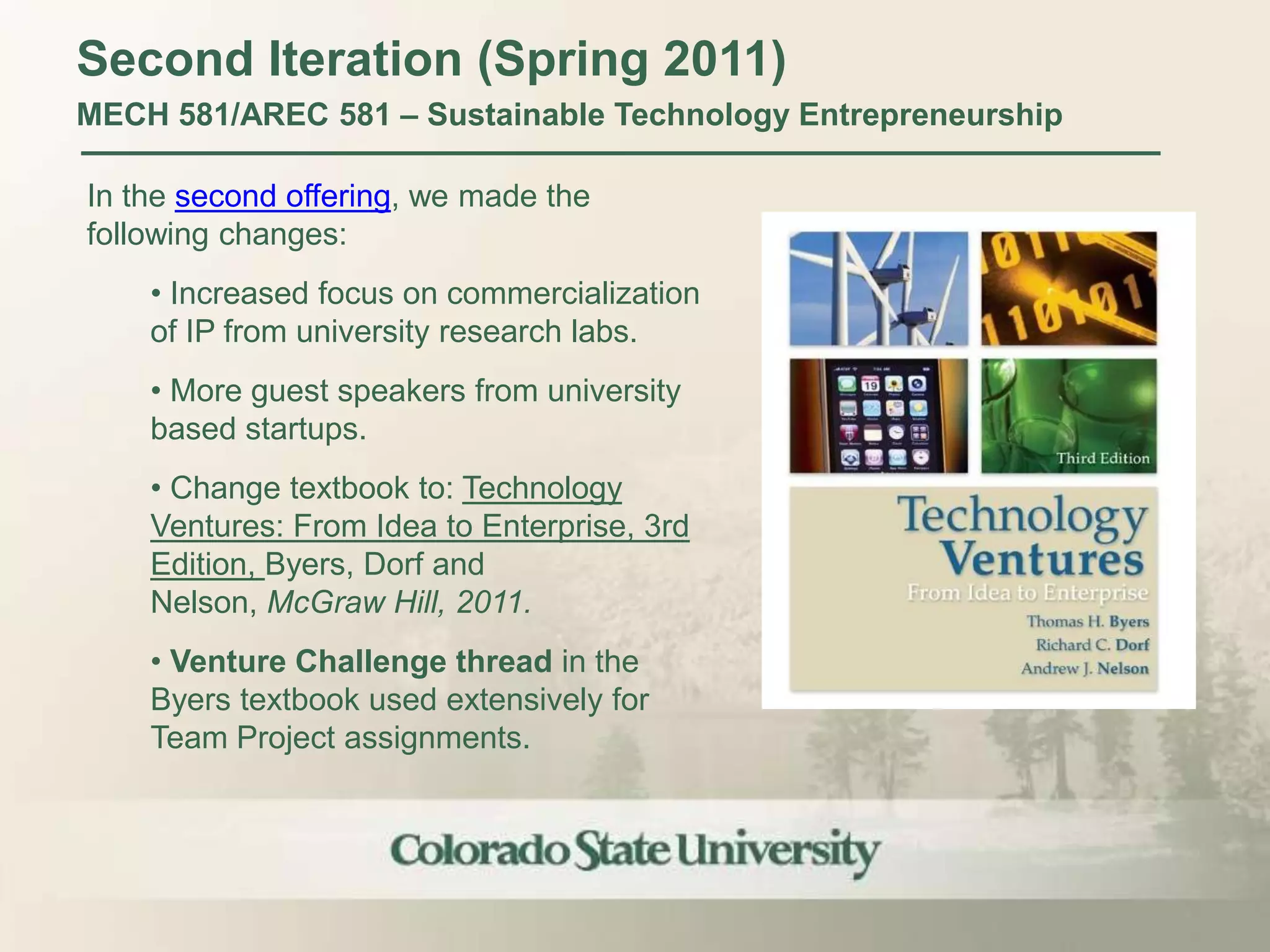
In the second offering, we made the
following changes:
    • Increased focus on commercialization
    of IP from university research labs.
    • More guest speakers from university
    based startups.
    • Change textbook to: Technology
    Ventures: From Idea to Enterprise, 3rd
    Edition, Byers, Dorf and
    Nelson, McGraw Hill, 2011.
    • Venture Challenge thread in the
    Byers textbook used extensively for
    Team Project assignments.
Second Iteration (Spring 2011)
MECH 581/AREC 581 – Sustainable Technology Entrepreneurship


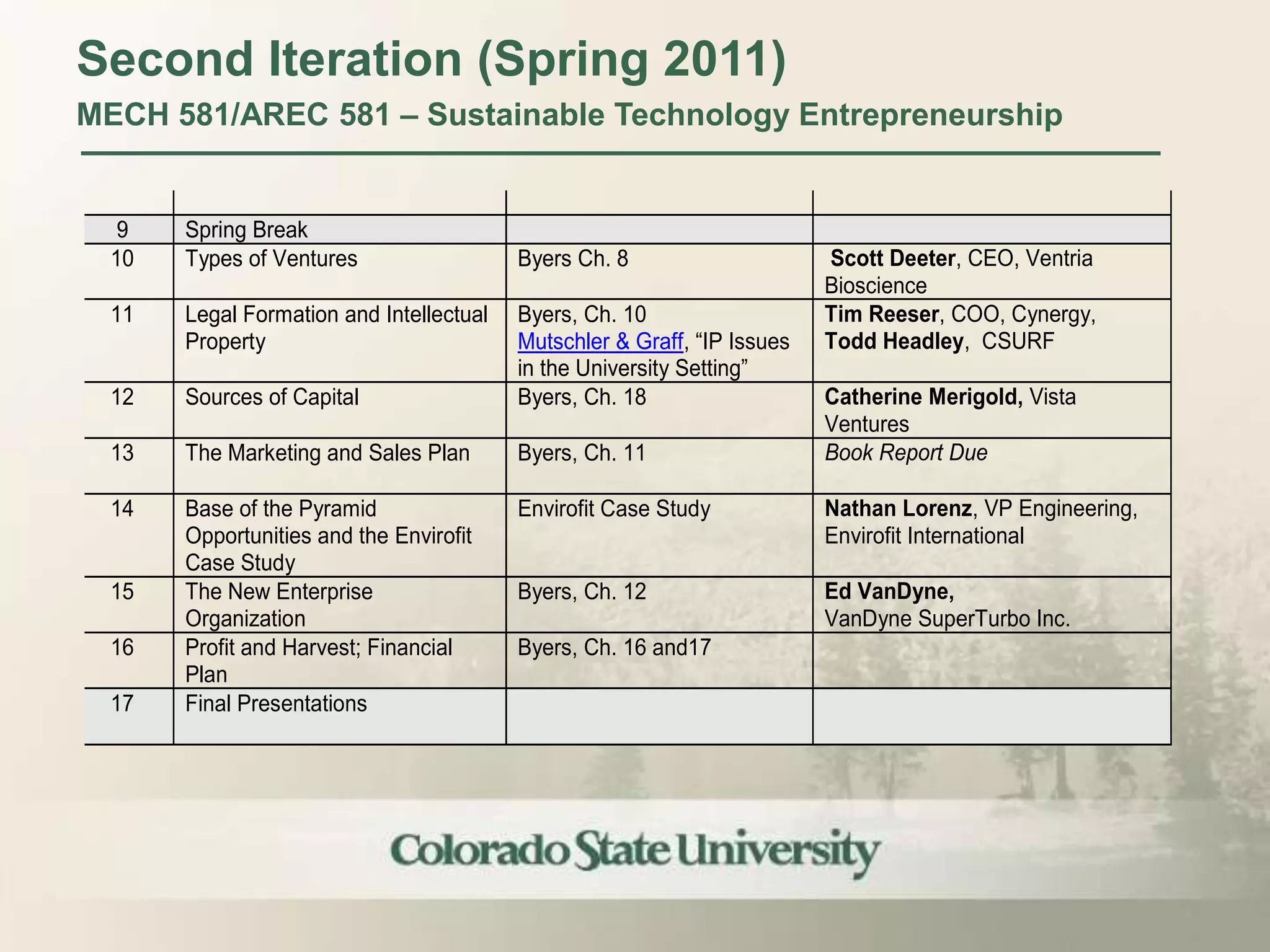
Week   Topic(s)                           Readings                        Guest Speakers
 1     Innovation, Entrepreneurship,                                      Lou Bucelli, Bucelli and Co, LLC.
       and Development
 2     Economic Growth and the            Byers, Ch. 1                    Amy Prieto,
       Technology Entrepreneur            Polak, Chapters 1-3             Co-Founder, Prieto Battery
 3     Opportunity Evaluation and                                         Stephen Schmutzer, Founder,
       Product Planning                                                   Firefly Medical
 4     Competitive Strategy               Byers, Ch. 4                    Bryan Willson
                                                                          Co-Founder, Envirofit International
                                                                          and Solix Biofuels
 5     Innovation Strategies              Byers Ch. 5, 11.8, 11.9         W.S. Sampath,
                                                                          Co-Founder, Abound Solar
 6     Indentifying Customer Needs        Ulrich and Eppinger, Ch. 4      Ken Reardon
                                          Polak, Chap 4-5                 CTO, OptiEnz Sensors
 7     The Business Plan                  Byers, Ch. 7                    Justin Discoe, co-founder, Sprig
                                                                          Toys
 8     Product Specifications             Ulrich and Eppinger, Ch. 5

  9    Spring Break
 10    Types of Ventures                  Byers Ch. 8                     Scott Deeter, CEO, Ventria
                                                                          Bioscience
 11    Legal Formation and Intellectual   Byers, Ch. 10                   Tim Reeser, COO, Cynergy,
       Property                           Mutschler & Graff, “IP Issues   Todd Headley, CSURF
                                          in the University Setting”
 12    Sources of Capital                 Byers, Ch. 18                   Catherine Merigold, Vista
                                                                          Ventures
 13    The Marketing and Sales Plan       Byers, Ch. 11                   Book Report Due
5    Innovation Strategies              Byers Ch. 5, 11.8, 11.9          W.S. Sampath,
                                                                            Co-Founder, Abound Solar
Second Iteration (Spring 2011)
 6  Indentifying Customer Needs Ulrich and Eppinger, Ch. 4
                                Polak, Chap 4-5
                                                                            Ken Reardon
                                                                            CTO, OptiEnz Sensors
MECH 581/AREC 581 – Sustainable Technology
  7  The Business Plan   Byers, Ch. 7                                      Entrepreneurship Sprig
                                                                            Justin Discoe, co-founder,
                                                                            Toys
   8    Product Specifications             Ulrich and Eppinger, Ch. 5

   9    Spring Break
  10    Types of Ventures                  Byers Ch. 8                       Scott Deeter, CEO, Ventria
                                                                             Bioscience
  11    Legal Formation and Intellectual   Byers, Ch. 10                     Tim Reeser, COO, Cynergy,
        Property                           Mutschler & Graff, “IP Issues     Todd Headley, CSURF
                                           in the University Setting”
  12    Sources of Capital                 Byers, Ch. 18                     Catherine Merigold, Vista
                                                                             Ventures
  13    The Marketing and Sales Plan       Byers, Ch. 11                     Book Report Due

  14    Base of the Pyramid                Envirofit Case Study              Nathan Lorenz, VP Engineering,
        Opportunities and the Envirofit                                      Envirofit International
        Case Study
  15    The New Enterprise                 Byers, Ch. 12                     Ed VanDyne,
        Organization                                                         VanDyne SuperTurbo Inc.
  16    Profit and Harvest; Financial      Byers, Ch. 16 and17
        Plan
  17    Final Presentations
Team Projects (Spring 2011)
MECH 581/AREC 581 – Sustainable Technology Entrepreneurship

Team Name         Value Proposition
AMD Solutions     Develop a lower cost, biologically based system to remediate
                  heavy metal waste streams from mining operations.


Breath Easy       Develop the next generation value added powered air purifying
                  respirator (PAPR) control system that offers vast improvements in
                  filter life and breathing resistance over traditional, industry
                  adopted control systems.
EcoFuego          Monitor CO and CO2 from base of the pyramid cookstoves; use
                  the need to verify carbon credits to pay for installation of systems
                  that reduce CO emissions through continuous feedback for user.
ADVentures        Develop and design anaerobic digestion systems which will meet
                  the waste management and energy demands of the 21st century
                  in an efficient and sustainable manner.

PV India          Develop India-based manufacturing facility for Cd-Te solar cells.
Sustainable Technology Entrepreneurship for
Scientists and Engineers
Overview
  • Institutional Context
  • Motivation
  • NCIIA Grant and Initial Planning
  • Curriculum Development
  • Implementation (First Iteration)
  • Assessment
  • Second Iteration and The Path Forward
Longer Term Assessment
Sustainable Technology Entrepreneurship for Scientists and Engineers

                                                                        Goal
 Outcome                                                  Year         Year Year
                                                          1            3     5+
 Number of COE and CAS grad students per year enrolled in 25           40    40
 first-semester STESE course.
 Number of COE and COS grad students whose master’s              6     10    10
 and/or Ph.D theses are directly related to a GSSE and/or
 STESE project.
 Percentage of GSSE projects per year that result in             10%   NA    NA
 successful startup ventures before the advent of the
 proposed program.
 Percentage and number of GSSE projects per year that            NA    25%   33%
 result in successful startup ventures after the advent of the
 proposed program.
 Percentage of COE and CAS graduate students who                 NA    NA    5%,
 participated in the program who are involved in startup                     15%
 ventures 5 years, 10 years, 15 years after graduation.                      25%
The Path Forward
Sustainable Technology Entrepreneurship for Scientists and Engineers
Acknowledgments
Sustainable Technology Entrepreneurship for Scientists and Engineers


Development of the STESE course was supported
by a Course and Program Grant from the National
Collegiate Inventors and Innovators Alliance
(NCIIA).

The authors would also like to acknowledge the
support of the Department Heads of Mechanical
Engineering, Management and Agricultural
Resource Economics.

Open2012 new-graduate-course-sustainability-marchese

  • 2.
    Sustainable Technology Entrepreneurshipfor Scientists and Engineers Overview • Institutional Context • Motivation • NCIIA Grant and Initial Planning • Curriculum Development • Implementation (First Iteration) • Assessment •Second Iteration and The Path Forward
  • 3.
    Sustainable Technology Entrepreneurshipfor Scientists and Engineers Overview • Institutional Context • Motivation • NCIIA Grant and Initial Planning • Curriculum Development • Implementation (First Iteration) • Assessment •Second Iteration and The Path Forward
  • 4.
    Institutional Context Sustainable TechnologyEntrepreneurship for Scientists and Engineers Colorado State University • Land Grant Mission (Ag Sciences, Engineering, Extension) • Peace Corps Legacy • Engineering Research and Focus on Clean Energy • $545 million per faculty in engineering • Clean Energy and BOP Spinoff Companies • Envirofit International, Solix Biofuels, Abound Solar • GSSE Program • Entrepreneurial Community but No Formal Entrepreneurship Courses for Engineering Grad Students
  • 5.
    Institutional Context CSU PeaceCorps Legacy •Former CSU Civil Engineering Professor Maury Albertson (1919 – 2009), was director of the U.S. Congressional study on the Point 4 Youth Corps (an early name for the Peace Corps initiative). •Albertson and CSU colleagues authored the book, "New Frontiers for American Youth - Perspective on the Peace Corps," which served as the blueprint for the Peace Corps. • To date, over 1500 CSU alumni have served in the Peace Corps since its creation in 1961. • In 2010-2011, CSU was named 10th among universities with the most nominations for Peace Corps service and 1st in the nation for the recruitment of highly skilled volunteers. • Currently, 93 CSU alumni serve as volunteers.
  • 6.
    Institutional Context Engineering ResearchPrograms • On a per-faculty basis, NSF ranked Colorado State 1st in the nation among all public universities in federally funded research. • Annual research expenditures of $546,000 per faculty member in FY10. • Strong programs in engines and energy conversion, atmospheric sciences, lasers and optics, biofuels, solar energy, etc.
  • 7.
    Institutional Context Recent CleanEnergy Spinoff Companies Envirofit International. Manufacturer of clean cookstoves for developing economies. Abound Solar. Manufacturer of low cost cadmium- telluride solar modules. (Founded in 2007, now 350 employees, soon to reach 850 MW production capacity). Solix BioSystems. Manufacturer of integrated solutions and services that enable large scale cultivation of algae
  • 8.
    Institutional Context Recent CleanEnergy Spinoff Companies Envirofit International. Manufacturer of clean cookstoves for developing economies. Abound Solar. Manufacturer of low cost cadmium- telluride solar modules. (Founded in 2007, now 350 employees, soon to reach 850 MW production capacity). Solix BioSystems. Manufacturer of integrated solutions and services that enable large scale cultivation of algae
  • 9.
    Institutional Context The GSSEProgram The GSSE is a Masters of Business Administration (MBA) program at CSU whose goal is to prepare a new generation of entrepreneurs who aim to leverage CSU’s research, technology and business know-how to create, build and grow global, sustainable enterprises with lasting impact.
  • 10.
    Institutional Context The GSSEProgram GSSE students form Enterprise Teams and work in base of the pyramid markets on ventures that serve people, planet and profit.
  • 11.
    Institutional Context The GSSEProgram GSEE Cohort Approach • Annual Class of 25 students • 50/50 split of international to U.S. • Very experienced (average age 30) • GSSE students are engineers, managers, scientists, economists, RPCVs & other development workers • Assembled into E-teams of 3 to 5 members.
  • 12.
    Institutional Context The GSSEProgram GSSE International Cohort Approach – Iraq, Philippines, India, Chile, Ghana, Mongolia, Venezuela, Ecuador, Nepal, Vietnam, Sri Lanka, Madagascar, Nigeria, USA
  • 13.
    Sustainable Technology Entrepreneurshipfor Scientists and Engineers Overview • Institutional Context • Motivation • NCIIA Grant and Initial Planning • Curriculum Development • Implementation (First Iteration) • Assessment •Second Iteration and The Path Forward
  • 14.
    Motivation for ENTProgram in Eng and Ag Sustainable Technology Entrepreneurship for Scientists and Engineers • Most early GSSE projects were technology intensive: • distribution network for solar lights and radios (Ghana and Peru), • small diesel engines for irrigation (Bangladesh, Ethiopia), • hydraulic hybrid technology transit buses (India) • bio-diverse products from wildlife-friendly agriculture (Cambodia). • Solutions to these problems required substantial technological expertise from engineering and/or agricultural sciences. •The GSSE program did not include a formal means of interfacing GSSE students with engineering and agricultural science students. • Meanwhile…no formal entrepreneurial training opportunities existed for graduate students in engineering or agricultural sciences.
  • 15.
    Sustainable Technology Entrepreneurshipfor Scientists and Engineers Overview • Institutional Context • Motivation • NCIIA Grant and Initial Planning • Curriculum Development • Implementation (First Iteration) • Assessment •Second Iteration and The Path Forward
  • 16.
    NCIIA Grant andInitial Planning Sustainable Technology Entrepreneurship for Scientists and Engineers In Fall 2008, a meeting was convened at the “south office” of the Engines and Energy Conversion Laboratory between GSSE, engineering and agricultural sciences faculty. In 2009 a Course and Program Grant was obtained from the NCIIA to formalize a linkage between the GSSE program and engineering and agricultural science graduate students. The objectives of the new program are twofold: • Instill an entrepreneurial mindset and global/ sustainable perspective among engineering and agricultural science students. • Provide engineering/agricultural science expertise and rapid product realization resources to enterprise teams within the GSSE program.
  • 17.
    Sustainable Technology Entrepreneurshipfor Scientists and Engineers Overview • Institutional Context • Motivation • NCIIA Grant and Initial Planning • Curriculum Development • Implementation (First Iteration) • Assessment • Second Iteration and The Path Forward
  • 18.
    Initial Planning andCurriculum Development Sustainable Technology Entrepreneurship for Scientists and Engineers From Jim Collins Good to Great and The Social Sectors (2005) What are you - Core values deeply passionate - Vision and mission about? -Time Unique and What can you be What drives your valuable the best in the resource engine? -Money contribution world at? -Brand
  • 19.
    Initial Planning andCurriculum Development Sustainable Technology Entrepreneurship for Scientists and Engineers  Research (Sustainable Energy, Climate Change) Global Impact What are you  Base of the Pyramid deeply passionate about? Developing -Research funding solutions that can obtain global - Dynamic leaders impact at scale. What can you be What drives your -Local community the best in the resource engine? world at? -Legacy
  • 20.
    Initial Planning andCurriculum Development Sustainable Technology Entrepreneurship for Scientists and Engineers Although no ENT program existed within the engineering school, the College of Business has an undergraduate ENT certificate program. Course content for the STESE course was culled and/or course syllabi were shared from the following existing courses within the College of Business: • Social, Ethical, and Regulatory Issues in Business (BUS 260) • Fundamentals of Entrepreneurship (MGT 340) • New Venture Creation (MGT 420) • New Venture Management (MGT 440) • Social Entrepreneurship and Sustainable Business Strategies (MGT 496) • Global Social and Sustainable Entrepreneurship (MGT 667) • Financing and Evaluating the Sustainable Enterprise (BUS 669)
  • 21.
    Initial Planning andCurriculum Development Sustainable Technology Entrepreneurship for Scientists and Engineers Although no ENT program existed within the engineering school, the College of Business has an undergraduate ENT certificate program. Course content for the STESE course was culled and/or course syllabi were shared from the following existing courses within the College of Business: • Social, Ethical, and Regulatory Issues in Business (BUS 260) • Fundamentals of Entrepreneurship (MGT 340) • New Venture Creation (MGT 420) Undergraduate COB courses • New Venture Management (MGT 440) • Social Entrepreneurship and Sustainable Business Strategies (MGT 496) • Global Social and Sustainable Entrepreneurship (MGT 667) • Financing and Evaluating the Sustainable Enterprise (BUS 669)
  • 22.
    Initial Planning andCurriculum Development Sustainable Technology Entrepreneurship for Scientists and Engineers Although no ENT program existed within the engineering school, the College of Business has an undergraduate ENT certificate program. Course content for the STESE course was culled and/or course syllabi were shared from the following existing courses within the College of Business: • Social, Ethical, and Regulatory Issues in Business (BUS 260) • Fundamentals of Entrepreneurship (MGT 340) • New Venture Creation (MGT 420) • New Venture Management (MGT 440) • Social Entrepreneurship and Sustainable Business Strategies (MGT 496) • Global Social and Sustainable Entrepreneurship (MGT 667) • Financing and Evaluating the Sustainable Enterprise (BUS 669) GSSE courses
  • 23.
    Initial Planning andCurriculum Development Sustainable Technology Entrepreneurship for Scientists and Engineers Week Focus Area Content Existing Course(s) 1 Entrepreneurial Introduction, historical perspective, MGT 340 Mindset entrepreneurial mindset 2 Entrepreneurial E-ship and the economy :A global MGT 340 Mindset perspective 3 Opportunity Recognizing opportunities and generating MGT 340 Identification ideas 4 Opportunity Intellectual property protection MGT 340, MGT 420 Identification 5 Opportunity Market and Customer: Business Model and MGT 340 Assessment Value Chain 6 Opportunity Building a Team: HR Decisions, MGT 340,MGT 420 Assessment Partnerships 7 Opportunity Legal Forms of Business Organization MGT 420, MGT 440 Assessment 8 Opportunity Financing the Venture: Bootstrapping, MGT 420,MGT 440 Assessment Debt, Equity 9 Base of the Pyramid From Obligation to Opportunity MGT 496, MGT 667 10 Base of the Pyramid Entrepreneurial Approaches in the MGT 496, MGT 667 Developing World 11 Base of the Pyramid The Fortune at the Bottom of the Pyramid MGT 496, MGT 667 12 Base of the Pyramid Microcredit MGT 496, BUS 669 13 New Venture Managing the Early Stage Company MGT 440 Management 14 New Venture Stages of Growth, Venture Capital MGT 440 Management 15 New Venture Legal, Insurance and Regulatory Issues MGT 440 Management
  • 24.
    Initial Planning forResources Sustainable Technology Entrepreneurship for Scientists and Engineers Product development space was provided at the Global Innovation Center for Energy, Health and Environment, which is housed at the CSU Engines and Energy Conversion Laboratory (www.eecl.colostate.edu).
  • 25.
    Sustainable Technology Entrepreneurshipfor Scientists and Engineers Overview • Institutional Context • Motivation • NCIIA Grant and Initial Planning • Curriculum Development • Implementation (First Iteration) • Assessment •Second Iteration and The Path Forward
  • 26.
    First Iteration (Spring2010) MECH 581/AREC 581 – Sustainable Technology Entrepreneurship Course was dual listed (MECH 581/AREC 581) and team taught by Marchese, Graff and Hudnut. Enrollment consisted of 40 students among 6 different majors. The formal meeting time for the class was a single weekly 3-hour block, which was split into a weekly lecture, activity and guest speaker. Team project was a major component of the course and accounted for over 50 percent of the grade for each student. The 16-week semester was divided into four general topic areas: entrepreneurial mindset, product realization, base of the pyramid and new venture management. Required readings were as follows: • FastTrac TechVenture Entrepreneur Manual: Maximizing the Potential of your Tech Business. Kauffman Foundation, 2009 • Out of Poverty: What Works When Traditional Approaches Fail. Paul Polak, Berrett-Koehler Publishers (September 1, 2009).
  • 27.
    First Iteration (Spring2010) MECH 581/AREC 581 – Sustainable Technology Entrepreneurship Week Topic(s) Readings Guest Speaker 1 Innovation, Nidumolu, Prahalad, & Bryan Willson, 1 Entrepreneurship, and Rangaswami [ ] Co-Founder, Envirofit Development International; Co-Founder, Solix Biofuels 2 2 Idea Generation and Polak[ ], Intro, Ch. 1-3 Entrepreneurs Millennium Development Goals [3] 3 Envirofit Case Study Polak [18], Ch. 4-5 Nathan Lorenz, Envirofit Case Study [ ] 3 VP Engineering, Envirofit International 4 Identifying Customer Polak [18], Ch. 6-7 Stephen Schmutzer, Needs and Market 4 FastTrac [ ] Ch. 2-3 Co-Founder, Firefly Medical Analysis 5 Ulrich and Eppinger [ ], Ch. 4 5 Business Model and Polak [18], Ch. 8-10 Metrics FastTrac[20] Ch. 4, 6, 6 In class book report None discussion 7 Product Specifications Ulrich and Eppinger [21], Ch. 5 Lou Bucelli, Bucelli and Co, LLC. 8 Network and Partnerships Polak [18], Ch. 11-12 Ken Petersen, professor of supply chain management, CSU College of Business 9 Spring Break 10 Design for Sustainability Otto and Wood, Ch.15. Justin Discoe, Co-Founder, Sprig Toys 11 Design for Affordability Paul Polak 12 Ethical, Political and FastTrac [20] Ch. 8 Scott Deeter, Regulatory Aspects CEO, Ventria Bioscience
  • 28.
    discussion Lou Bucelli, Bucelli and Co, First Iteration (Spring 2010)Ch. 5 7 Product Specifications Ulrich and Eppinger [21], LLC. 8 Network and Partnerships Polak [18], Ch. 11-12 Ken Petersen, professor of MECH 581/AREC 581 – Sustainable Technology Entrepreneurship supply chain management, CSU College of Business 9 Spring Break 10 Design for Sustainability Otto and Wood, Ch.15. Justin Discoe, Co-Founder, Sprig Toys 11 Design for Affordability Paul Polak 12 Ethical, Political and FastTrac [20] Ch. 8 Scott Deeter, Regulatory Aspects CEO, Ventria Bioscience 13 In class Organizational None None Profiles discussion 14 Intellectual Property FastTrac [20], Ch. 8 Tim Reeser, 6 Mutschler & Graff [ ] COO, Cynergy, 15 Ownership, FastTrac [20] Ch. 7 and 9 Catherine Merigold, Compensation, Funding, General Partner, Vista Stages of Growth and Ventures Exit 16 Final Presentations 1 . Nidumolu, Prahalad, & Rangaswami Why Sustainability is Now the Key Driver of Innovation” Harvard Business Review, September 2009, pp. 56-64.
  • 29.
    Team Projects (Spring2010) MECH 581/AREC 581 – Sustainable Technology Entrepreneurship Project Title Opportunity Statement Fresh Point Provide a branding label indicating purified water for tourists traveling in India and locals living in well-traveled areas. Grounds for Change Reduce the time of drying and losses in production due to contamination during the coffee drying process. Pine Beetle Power Selling locally grown Colorado beetle-killed pine biomass for residential and municipal heating needs. SEED The engineered 2HP diesel pumpset will give small scale farmers (≤2.5 acres) the opportunity to purchase a cost effective and easily portable device which can meet their irrigation needs. Simple Solar Irrigation Labor free irrigation with increased capacity and well depth provides the Pumps small farmer with an attractive invest opportunity for higher productivity MicrobeSeed Develop a bioengineered microbe mix and waste vehicle retrofit capable of increasing landfill gas production rates for methane generation. Thin Air An engineered, sustainable, accessible nitrogen fertilizer for small Ethiopian farms. Village Energy A scalable energy distribution network for families without electricity in India Upepo Maji Uhuru A simple, low-cost, wind-powered water pump that enables increased income through irrigation while limiting the manual labor required
  • 30.
    Sustainable Technology Entrepreneurshipfor Scientists and Engineers Overview • Institutional Context • Motivation • NCIIA Grant and Initial Planning • Curriculum Development • Implementation (First Iteration) • Assessment •Second Iteration and The Path Forward
  • 31.
    Assessment (Spring 2010) MECH581/AREC 581 – Sustainable Technology Entrepreneurship Team projects were not quite as successful as hoped: •Existing GSSE projects were either too far along (e.g. SEED) or too early stage (e.g. Thin Air) for optimal contribution from STESE team. •Need exists to improve GSSE project “in flow” and “out flow” from STESE. Guest speakers were viewed very positively. Kauffman handbook was not used very effectively. Student evaluation results were strong, but reflected that this was a work in progress: •14% answered “strongly agree” and 86 % answered “agree” to the question “Overall, I would rate this course as good.” •44 % answered “strongly agree” and 56 % answered “agree” to the question “Overall, I would rate these teachers as good”. • 69 % answered “strongly agree” and 31 % answered “agree” to the question, “The teachers were enthusiastic about the course.”
  • 32.
    Sustainable Technology Entrepreneurshipfor Scientists and Engineers Overview • Institutional Context • Motivation • NCIIA Grant and Initial Planning • Curriculum Development • Implementation (First Iteration) • Assessment • Second Iteration and The Path Forward
  • 33.
    Second Iteration (Spring2011) MECH 581/AREC 581 – Sustainable Technology Entrepreneurship In the second offering, we made the following changes: • Increased focus on commercialization of IP from university research labs. • More guest speakers from university based startups. • Change textbook to: Technology Ventures: From Idea to Enterprise, 3rd Edition, Byers, Dorf and Nelson, McGraw Hill, 2011. • Venture Challenge thread in the Byers textbook used extensively for Team Project assignments.
  • 34.
    Second Iteration (Spring2011) MECH 581/AREC 581 – Sustainable Technology Entrepreneurship Week Topic(s) Readings Guest Speakers 1 Innovation, Entrepreneurship, Lou Bucelli, Bucelli and Co, LLC. and Development 2 Economic Growth and the Byers, Ch. 1 Amy Prieto, Technology Entrepreneur Polak, Chapters 1-3 Co-Founder, Prieto Battery 3 Opportunity Evaluation and Stephen Schmutzer, Founder, Product Planning Firefly Medical 4 Competitive Strategy Byers, Ch. 4 Bryan Willson Co-Founder, Envirofit International and Solix Biofuels 5 Innovation Strategies Byers Ch. 5, 11.8, 11.9 W.S. Sampath, Co-Founder, Abound Solar 6 Indentifying Customer Needs Ulrich and Eppinger, Ch. 4 Ken Reardon Polak, Chap 4-5 CTO, OptiEnz Sensors 7 The Business Plan Byers, Ch. 7 Justin Discoe, co-founder, Sprig Toys 8 Product Specifications Ulrich and Eppinger, Ch. 5 9 Spring Break 10 Types of Ventures Byers Ch. 8 Scott Deeter, CEO, Ventria Bioscience 11 Legal Formation and Intellectual Byers, Ch. 10 Tim Reeser, COO, Cynergy, Property Mutschler & Graff, “IP Issues Todd Headley, CSURF in the University Setting” 12 Sources of Capital Byers, Ch. 18 Catherine Merigold, Vista Ventures 13 The Marketing and Sales Plan Byers, Ch. 11 Book Report Due
  • 35.
    5 Innovation Strategies Byers Ch. 5, 11.8, 11.9 W.S. Sampath, Co-Founder, Abound Solar Second Iteration (Spring 2011) 6 Indentifying Customer Needs Ulrich and Eppinger, Ch. 4 Polak, Chap 4-5 Ken Reardon CTO, OptiEnz Sensors MECH 581/AREC 581 – Sustainable Technology 7 The Business Plan Byers, Ch. 7 Entrepreneurship Sprig Justin Discoe, co-founder, Toys 8 Product Specifications Ulrich and Eppinger, Ch. 5 9 Spring Break 10 Types of Ventures Byers Ch. 8 Scott Deeter, CEO, Ventria Bioscience 11 Legal Formation and Intellectual Byers, Ch. 10 Tim Reeser, COO, Cynergy, Property Mutschler & Graff, “IP Issues Todd Headley, CSURF in the University Setting” 12 Sources of Capital Byers, Ch. 18 Catherine Merigold, Vista Ventures 13 The Marketing and Sales Plan Byers, Ch. 11 Book Report Due 14 Base of the Pyramid Envirofit Case Study Nathan Lorenz, VP Engineering, Opportunities and the Envirofit Envirofit International Case Study 15 The New Enterprise Byers, Ch. 12 Ed VanDyne, Organization VanDyne SuperTurbo Inc. 16 Profit and Harvest; Financial Byers, Ch. 16 and17 Plan 17 Final Presentations
  • 36.
    Team Projects (Spring2011) MECH 581/AREC 581 – Sustainable Technology Entrepreneurship Team Name Value Proposition AMD Solutions Develop a lower cost, biologically based system to remediate heavy metal waste streams from mining operations. Breath Easy Develop the next generation value added powered air purifying respirator (PAPR) control system that offers vast improvements in filter life and breathing resistance over traditional, industry adopted control systems. EcoFuego Monitor CO and CO2 from base of the pyramid cookstoves; use the need to verify carbon credits to pay for installation of systems that reduce CO emissions through continuous feedback for user. ADVentures Develop and design anaerobic digestion systems which will meet the waste management and energy demands of the 21st century in an efficient and sustainable manner. PV India Develop India-based manufacturing facility for Cd-Te solar cells.
  • 37.
    Sustainable Technology Entrepreneurshipfor Scientists and Engineers Overview • Institutional Context • Motivation • NCIIA Grant and Initial Planning • Curriculum Development • Implementation (First Iteration) • Assessment • Second Iteration and The Path Forward
  • 38.
    Longer Term Assessment SustainableTechnology Entrepreneurship for Scientists and Engineers Goal Outcome Year Year Year 1 3 5+ Number of COE and CAS grad students per year enrolled in 25 40 40 first-semester STESE course. Number of COE and COS grad students whose master’s 6 10 10 and/or Ph.D theses are directly related to a GSSE and/or STESE project. Percentage of GSSE projects per year that result in 10% NA NA successful startup ventures before the advent of the proposed program. Percentage and number of GSSE projects per year that NA 25% 33% result in successful startup ventures after the advent of the proposed program. Percentage of COE and CAS graduate students who NA NA 5%, participated in the program who are involved in startup 15% ventures 5 years, 10 years, 15 years after graduation. 25%
  • 39.
    The Path Forward SustainableTechnology Entrepreneurship for Scientists and Engineers
  • 40.
    Acknowledgments Sustainable Technology Entrepreneurshipfor Scientists and Engineers Development of the STESE course was supported by a Course and Program Grant from the National Collegiate Inventors and Innovators Alliance (NCIIA). The authors would also like to acknowledge the support of the Department Heads of Mechanical Engineering, Management and Agricultural Resource Economics.