Open Source:
Open Choice
A DevOps Guide for OSS Adoption
hilafish1@gmail.com LinkedIn: Hila Fish twitter: @Hilafish1
Hila Fish
Senior DevOps / Infrastructure Engineer / SRE @ Wix.com
Open Source: Open Choice
➔ Senior DevOps Engineer / SRE @ Wix.com
➔ 15 years experience in tech
➔ AWS Community Builder
➔ Conferences co-organizer -
DevOpsDays TLV & StatsCraft
➔ Mentor @ courses, communities
➔ DevOps culture fan
➔ Lead singer in a cover band
🎤
Hi! I’m Hila Fish
Open Source Software
(OSS) is...
Publicly available
Can be modified at will
Open Source: Open Choice
Late 90’s
Photo by Red Dot on Unsplash
Open Source: Open Choice
Photo by Anne Nygård on Unsplash
Today
Open Source: Open Choice
What’s So Good
about Open Source?
I ❤ OSS
Open Source: Open Choice
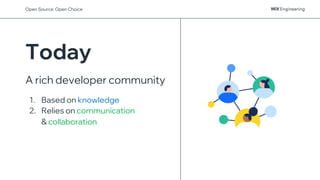
Today
A rich developer community
1. Based on knowledge
2. Relies on communication
& collaboration
Open Source: Open Choice
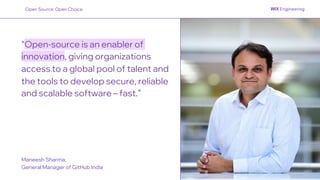
“Open-source is an enabler of
innovation, giving organizations
access to a global pool of talent and
the tools to develop secure, reliable
and scalable software – fast.”
Maneesh Sharma,
General Manager of GitHub India
Open Source: Open Choice
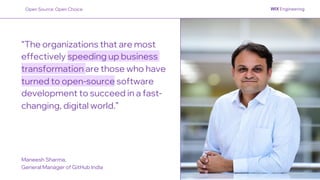
“The organizations that are most
effectively speeding up business
transformation are those who have
turned to open-source software
development to succeed in a fast-
changing, digital world.”
Maneesh Sharma,
General Manager of GitHub India
Open Source: Open Choice
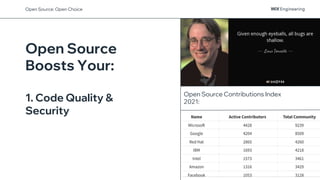
Open Source Contributions Index
2021:
Open Source
Boosts Your:
1. Code Quality &
Security
Open Source: Open Choice
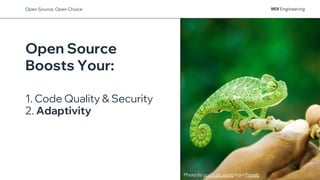
Photo by yuvi's picworld from Pexels
Open Source
Boosts Your:
1. Code Quality & Security
2. Adaptivity
Open Source: Open Choice
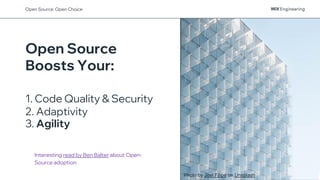
Photo by Joel Filipe on Unsplash
Open Source
Boosts Your:
1. Code Quality & Security
2. Adaptivity
3. Agility
Interesting read by Ben Balter about Open-
Source adoption
Open Source: Open Choice
The DevOps
Perspective
I ❤ OSS
Open Source: Open Choice
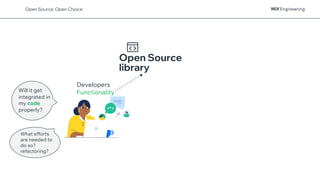
Open Source
library
Will it get
integrated in
my code
properly?
Open Source: Open Choice
Developers
Functionality
What efforts
are needed to
do so?
refactoring?
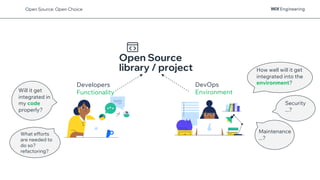
Open Source
library / project
Will it get
integrated in
my code
properly?
Maintenance
...?
How well will it get
integrated into the
environment?
Security
...?
Open Source: Open Choice
DevOps
Environment
Developers
Functionality
What efforts
are needed to
do so?
refactoring?
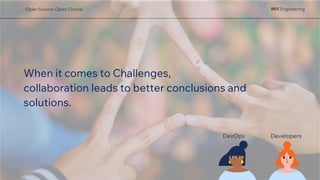
When it comes to Challenges,
collaboration leads to better conclusions and
solutions.
Developers
DevOps
Open Source: Open Choice
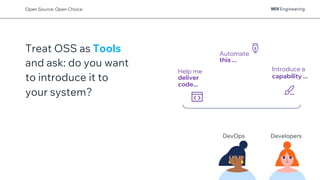
Treat OSS as Tools
and ask: do you want
to introduce it to
your system?
Automate
this ...
Help me
deliver
code...
Introduce a
capability ...
Open Source: Open Choice
Developers
DevOps
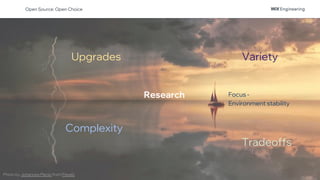
Upgrades
Complexity
Research
Variety
Tradeoffs
Focus -
Environment stability
Photo by Johannes Plenio from Pexels
Open Source: Open Choice
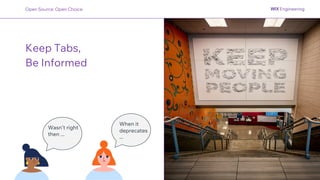
Keep Tabs,
Be Informed
Wasn’t right
then ...
When it
deprecates
...
Open Source: Open Choice
When Should We Consider
Open Source?
I ❤ OSS
Open Source: Open Choice
Uncommon
Use Case
Open Source: Open Choice
Limited
Budget
Photo by Emil Kalibradov on Unsplash
Open Source: Open Choice
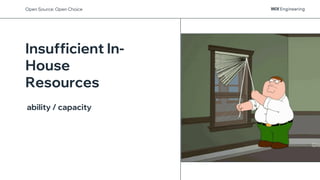
Insufficient In-
House
Resources
ability / capacity
Open Source: Open Choice
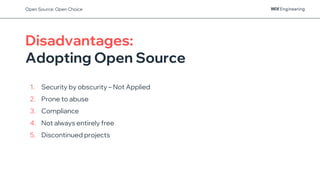
Disadvantages:
Adopting Open Source
1. Security by obscurity – Not Applied
Open Source: Open Choice
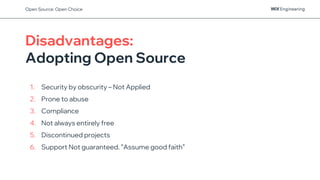
Disadvantages:
Adopting Open Source
1. Security by obscurity – Not Applied
2. Prone to abuse
Open Source: Open Choice
Disadvantages:
Adopting Open Source
1. Security by obscurity – Not Applied
2. Prone to abuse
3. Compliance
Open Source: Open Choice
Disadvantages:
Adopting Open Source
1. Security by obscurity – Not Applied
2. Prone to abuse
3. Compliance
4. Not always entirely free
Open Source: Open Choice
Disadvantages:
Adopting Open Source
1. Security by obscurity – Not Applied
2. Prone to abuse
3. Compliance
4. Not always entirely free
5. Discontinued projects
Open Source: Open Choice
Disadvantages:
Adopting Open Source
1. Security by obscurity – Not Applied
2. Prone to abuse
3. Compliance
4. Not always entirely free
5. Discontinued projects
6. Support Not guaranteed. ”Assume good faith”
Open Source: Open Choice
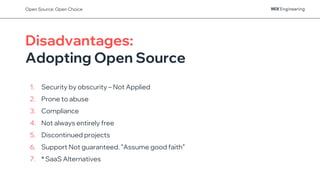
Disadvantages:
Adopting Open Source
1. Security by obscurity – Not Applied
2. Prone to abuse
3. Compliance
4. Not always entirely free
5. Discontinued projects
6. Support Not guaranteed. ”Assume good faith”
7. * SaaS Alternatives
Open Source: Open Choice
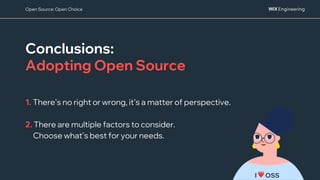
Conclusions:
Adopting Open Source
1. There’s no right or wrong, it’s a matter of perspective.
2. There are multiple factors to consider.
Choose what’s best for your needs.
I ❤ OSS
Open Source: Open Choice
How Do We Choose
an Open-Source
Project?
I ❤ OSS
Open Source: Open Choice
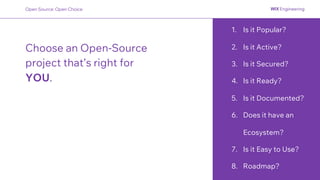
1. Is it Popular?
2. Is it Active?
3. Is it Secured?
4. Is it Ready?
5. Is it Documented?
6. Does it have an
Ecosystem?
7. Is it Easy to Use?
8. Roadmap?
Choose an Open-Source
project that’s right for
YOU.
Open Source: Open Choice
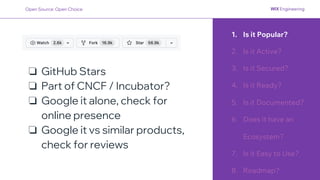
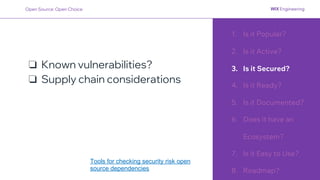
1. Is it Popular?
2. Is it Active?
3. Is it Secured?
4. Is it Ready?
5. Is it Documented?
6. Does it have an
Ecosystem?
7. Is it Easy to Use?
8. Roadmap?
❏ GitHub Stars
❏ Part of CNCF / Incubator?
❏ Google it alone, check for
online presence
❏ Google it vs similar products,
check for reviews
Open Source: Open Choice
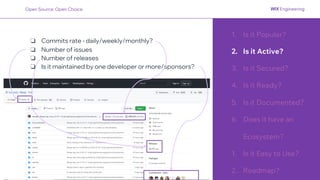
❏ Commits rate - daily/weekly/monthly?
❏ Number of issues
❏ Number of releases
❏ Is it maintained by one developer or more/sponsors?
1. Is it Popular?
2. Is it Active?
3. Is it Secured?
4. Is it Ready?
5. Is it Documented?
6. Does it have an
Ecosystem?
1. Is it Easy to Use?
2. Roadmap?
Open Source: Open Choice
1. Is it Popular?
2. Is it Active?
3. Is it Secured?
4. Is it Ready?
5. Is it Documented?
6. Does it have an
Ecosystem?
7. Is it Easy to Use?
8. Roadmap?
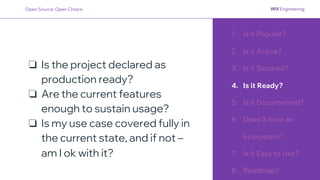
❏ Known vulnerabilities?
❏ Supply chain considerations
Open Source: Open Choice
Tools for checking security risk open
source dependencies
1. Is it Popular?
2. Is it Active?
3. Is it Secured?
4. Is it Ready?
5. Is it Documented?
6. Does it have an
Ecosystem?
7. Is it Easy to Use?
8. Roadmap?
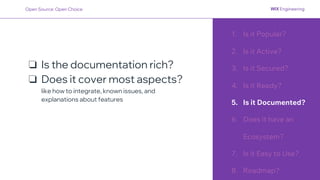
❏ Is the project declared as
production ready?
❏ Are the current features
enough to sustain usage?
❏ Is my use case covered fully in
the current state, and if not –
am I ok with it?
Open Source: Open Choice
1. Is it Popular?
2. Is it Active?
3. Is it Secured?
4. Is it Ready?
5. Is it Documented?
6. Does it have an
Ecosystem?
7. Is it Easy to Use?
8. Roadmap?
❏ Is the documentation rich?
❏ Does it cover most aspects?
like how to integrate, known issues, and
explanations about features
Open Source: Open Choice
1. Is it Popular?
2. Is it Active?
3. Is it Secured?
4. Is it Ready?
5. Is it Documented?
6. Does it have an
Ecosystem?
7. Is it Easy to Use?
8. Roadmap?
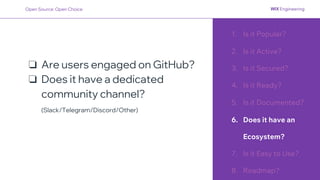
❏ Are users engaged on GitHub?
❏ Does it have a dedicated
community channel?
(Slack/Telegram/Discord/Other)
Open Source: Open Choice
1. Is it Popular?
2. Is it Active?
3. Is it Secured?
4. Is it Ready?
5. Is it Documented?
6. Does it have an
Ecosystem?
7. Is it Easy to Use?
8. Roadmap?
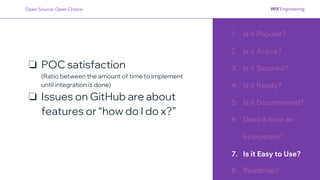
❏ POC satisfaction
(Ratio between the amount of time to implement
until integration is done)
❏ Issues on GitHub are about
features or “how do I do x?”
Open Source: Open Choice
1. Is it Popular?
2. Is it Active?
3. Is it Secured?
4. Is it Ready?
5. Is it Documented?
6. Does it have an
Ecosystem?
7. Is it Easy to Use?
8. Roadmap?
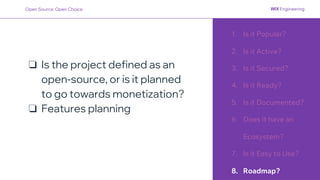
❏ Is the project defined as an
open-source, or is it planned
to go towards monetization?
❏ Features planning
Open Source: Open Choice
How To Choose an OSS Project
1. Ask the general questions – cover the Basics
I ❤ OSS
Open Source: Open Choice
➔ Is the project in a ready-enough state?
Basic metrics
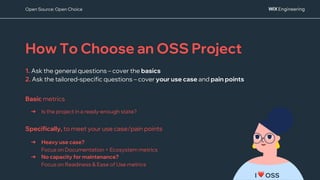
How To Choose an OSS Project
1. Ask the general questions – cover the basics
2. Ask the tailored-specific questions – cover your use case and pain points
I ❤ OSS
➔ Is the project in a ready-enough state?
Basic metrics
➔ Heavy use case?
Focus on Documentation + Ecosystem metrics
➔ No capacity for maintenance?
Focus on Readiness & Ease of Use metrics
Specifically, to meet your use case/pain points
Open Source: Open Choice
I ❤ OSS
How To Choose an OSS Project
1. Ask the general questions – cover the Basics
2. Ask the tailored-specific questions – cover Your use case and pain points
3. POC
4. Rely on your research –
Ecosystem to the rescue
Engage in GitHub - raise issues/contribute for its (and your) success
Open Source: Open Choice
I ❤ OSS
How To Contribute
Without Writing Code
1. Open Issues - bug Fixes / Feature requests
2. Modify documentation
3. Share your use case – write blog posts (i.e. Script-Server)
4. Share tools you’ve found with colleagues and techy friends
5. Company/individuals sponsorship
6. Hold an open-source mindset
7. Spread the word on Open-Source at conferences 😃
Open Source: Open Choice
Thank
You!
Hila Fish
Senior DevOps / Infrastructure Engineer / SRE @ Wix.com
hilafish1@gmail.com LinkedIn: Hila Fish twitter: @Hilafish1
Q&A
Any questions?
Hila Fish
Senior DevOps / Infrastructure Engineer / SRE @ Wix.com
hilafish1@gmail.com LinkedIn: Hila Fish twitter: @Hilafish1

OSMC 2022 | Open Source: Open Choice – A DevOps Guide for OSS Adoption by Hila Fish

  • 1.
    Open Source: Open Choice ADevOps Guide for OSS Adoption hilafish1@gmail.com LinkedIn: Hila Fish twitter: @Hilafish1 Hila Fish Senior DevOps / Infrastructure Engineer / SRE @ Wix.com
  • 2.
    Open Source: OpenChoice ➔ Senior DevOps Engineer / SRE @ Wix.com ➔ 15 years experience in tech ➔ AWS Community Builder ➔ Conferences co-organizer - DevOpsDays TLV & StatsCraft ➔ Mentor @ courses, communities ➔ DevOps culture fan ➔ Lead singer in a cover band 🎤 Hi! I’m Hila Fish
  • 3.
    Open Source Software (OSS)is... Publicly available Can be modified at will Open Source: Open Choice
  • 4.
    Late 90’s Photo byRed Dot on Unsplash Open Source: Open Choice
  • 5.
    Photo by AnneNygård on Unsplash Today Open Source: Open Choice
  • 6.
    What’s So Good aboutOpen Source? I ❤ OSS Open Source: Open Choice
  • 7.
    Today A rich developercommunity 1. Based on knowledge 2. Relies on communication & collaboration Open Source: Open Choice
  • 8.
    “Open-source is anenabler of innovation, giving organizations access to a global pool of talent and the tools to develop secure, reliable and scalable software – fast.” Maneesh Sharma, General Manager of GitHub India Open Source: Open Choice
  • 9.
    “The organizations thatare most effectively speeding up business transformation are those who have turned to open-source software development to succeed in a fast- changing, digital world.” Maneesh Sharma, General Manager of GitHub India Open Source: Open Choice
  • 10.
    Open Source ContributionsIndex 2021: Open Source Boosts Your: 1. Code Quality & Security Open Source: Open Choice
  • 11.
    Photo by yuvi'spicworld from Pexels Open Source Boosts Your: 1. Code Quality & Security 2. Adaptivity Open Source: Open Choice
  • 12.
    Photo by JoelFilipe on Unsplash Open Source Boosts Your: 1. Code Quality & Security 2. Adaptivity 3. Agility Interesting read by Ben Balter about Open- Source adoption Open Source: Open Choice
  • 13.
    The DevOps Perspective I ❤OSS Open Source: Open Choice
  • 14.
    Open Source library Will itget integrated in my code properly? Open Source: Open Choice Developers Functionality What efforts are needed to do so? refactoring?
  • 15.
    Open Source library /project Will it get integrated in my code properly? Maintenance ...? How well will it get integrated into the environment? Security ...? Open Source: Open Choice DevOps Environment Developers Functionality What efforts are needed to do so? refactoring?
  • 16.
    When it comesto Challenges, collaboration leads to better conclusions and solutions. Developers DevOps Open Source: Open Choice
  • 17.
    Treat OSS asTools and ask: do you want to introduce it to your system? Automate this ... Help me deliver code... Introduce a capability ... Open Source: Open Choice Developers DevOps
  • 18.
    Upgrades Complexity Research Variety Tradeoffs Focus - Environment stability Photoby Johannes Plenio from Pexels Open Source: Open Choice
  • 19.
    Keep Tabs, Be Informed Wasn’tright then ... When it deprecates ... Open Source: Open Choice
  • 20.
    When Should WeConsider Open Source? I ❤ OSS Open Source: Open Choice
  • 21.
  • 22.
    Limited Budget Photo by EmilKalibradov on Unsplash Open Source: Open Choice
  • 23.
    Insufficient In- House Resources ability /capacity Open Source: Open Choice
  • 24.
    Disadvantages: Adopting Open Source 1.Security by obscurity – Not Applied Open Source: Open Choice
  • 25.
    Disadvantages: Adopting Open Source 1.Security by obscurity – Not Applied 2. Prone to abuse Open Source: Open Choice
  • 26.
    Disadvantages: Adopting Open Source 1.Security by obscurity – Not Applied 2. Prone to abuse 3. Compliance Open Source: Open Choice
  • 27.
    Disadvantages: Adopting Open Source 1.Security by obscurity – Not Applied 2. Prone to abuse 3. Compliance 4. Not always entirely free Open Source: Open Choice
  • 28.
    Disadvantages: Adopting Open Source 1.Security by obscurity – Not Applied 2. Prone to abuse 3. Compliance 4. Not always entirely free 5. Discontinued projects Open Source: Open Choice
  • 29.
    Disadvantages: Adopting Open Source 1.Security by obscurity – Not Applied 2. Prone to abuse 3. Compliance 4. Not always entirely free 5. Discontinued projects 6. Support Not guaranteed. ”Assume good faith” Open Source: Open Choice
  • 30.
    Disadvantages: Adopting Open Source 1.Security by obscurity – Not Applied 2. Prone to abuse 3. Compliance 4. Not always entirely free 5. Discontinued projects 6. Support Not guaranteed. ”Assume good faith” 7. * SaaS Alternatives Open Source: Open Choice
  • 31.
    Conclusions: Adopting Open Source 1.There’s no right or wrong, it’s a matter of perspective. 2. There are multiple factors to consider. Choose what’s best for your needs. I ❤ OSS Open Source: Open Choice
  • 32.
    How Do WeChoose an Open-Source Project? I ❤ OSS Open Source: Open Choice
  • 33.
    1. Is itPopular? 2. Is it Active? 3. Is it Secured? 4. Is it Ready? 5. Is it Documented? 6. Does it have an Ecosystem? 7. Is it Easy to Use? 8. Roadmap? Choose an Open-Source project that’s right for YOU. Open Source: Open Choice
  • 34.
    1. Is itPopular? 2. Is it Active? 3. Is it Secured? 4. Is it Ready? 5. Is it Documented? 6. Does it have an Ecosystem? 7. Is it Easy to Use? 8. Roadmap? ❏ GitHub Stars ❏ Part of CNCF / Incubator? ❏ Google it alone, check for online presence ❏ Google it vs similar products, check for reviews Open Source: Open Choice
  • 35.
    ❏ Commits rate- daily/weekly/monthly? ❏ Number of issues ❏ Number of releases ❏ Is it maintained by one developer or more/sponsors? 1. Is it Popular? 2. Is it Active? 3. Is it Secured? 4. Is it Ready? 5. Is it Documented? 6. Does it have an Ecosystem? 1. Is it Easy to Use? 2. Roadmap? Open Source: Open Choice
  • 36.
    1. Is itPopular? 2. Is it Active? 3. Is it Secured? 4. Is it Ready? 5. Is it Documented? 6. Does it have an Ecosystem? 7. Is it Easy to Use? 8. Roadmap? ❏ Known vulnerabilities? ❏ Supply chain considerations Open Source: Open Choice Tools for checking security risk open source dependencies
  • 37.
    1. Is itPopular? 2. Is it Active? 3. Is it Secured? 4. Is it Ready? 5. Is it Documented? 6. Does it have an Ecosystem? 7. Is it Easy to Use? 8. Roadmap? ❏ Is the project declared as production ready? ❏ Are the current features enough to sustain usage? ❏ Is my use case covered fully in the current state, and if not – am I ok with it? Open Source: Open Choice
  • 38.
    1. Is itPopular? 2. Is it Active? 3. Is it Secured? 4. Is it Ready? 5. Is it Documented? 6. Does it have an Ecosystem? 7. Is it Easy to Use? 8. Roadmap? ❏ Is the documentation rich? ❏ Does it cover most aspects? like how to integrate, known issues, and explanations about features Open Source: Open Choice
  • 39.
    1. Is itPopular? 2. Is it Active? 3. Is it Secured? 4. Is it Ready? 5. Is it Documented? 6. Does it have an Ecosystem? 7. Is it Easy to Use? 8. Roadmap? ❏ Are users engaged on GitHub? ❏ Does it have a dedicated community channel? (Slack/Telegram/Discord/Other) Open Source: Open Choice
  • 40.
    1. Is itPopular? 2. Is it Active? 3. Is it Secured? 4. Is it Ready? 5. Is it Documented? 6. Does it have an Ecosystem? 7. Is it Easy to Use? 8. Roadmap? ❏ POC satisfaction (Ratio between the amount of time to implement until integration is done) ❏ Issues on GitHub are about features or “how do I do x?” Open Source: Open Choice
  • 41.
    1. Is itPopular? 2. Is it Active? 3. Is it Secured? 4. Is it Ready? 5. Is it Documented? 6. Does it have an Ecosystem? 7. Is it Easy to Use? 8. Roadmap? ❏ Is the project defined as an open-source, or is it planned to go towards monetization? ❏ Features planning Open Source: Open Choice
  • 42.
    How To Choosean OSS Project 1. Ask the general questions – cover the Basics I ❤ OSS Open Source: Open Choice ➔ Is the project in a ready-enough state? Basic metrics
  • 43.
    How To Choosean OSS Project 1. Ask the general questions – cover the basics 2. Ask the tailored-specific questions – cover your use case and pain points I ❤ OSS ➔ Is the project in a ready-enough state? Basic metrics ➔ Heavy use case? Focus on Documentation + Ecosystem metrics ➔ No capacity for maintenance? Focus on Readiness & Ease of Use metrics Specifically, to meet your use case/pain points Open Source: Open Choice
  • 44.
    I ❤ OSS HowTo Choose an OSS Project 1. Ask the general questions – cover the Basics 2. Ask the tailored-specific questions – cover Your use case and pain points 3. POC 4. Rely on your research – Ecosystem to the rescue Engage in GitHub - raise issues/contribute for its (and your) success Open Source: Open Choice
  • 45.
    I ❤ OSS HowTo Contribute Without Writing Code 1. Open Issues - bug Fixes / Feature requests 2. Modify documentation 3. Share your use case – write blog posts (i.e. Script-Server) 4. Share tools you’ve found with colleagues and techy friends 5. Company/individuals sponsorship 6. Hold an open-source mindset 7. Spread the word on Open-Source at conferences 😃 Open Source: Open Choice
  • 46.
  • 47.
    Thank You! Hila Fish Senior DevOps/ Infrastructure Engineer / SRE @ Wix.com hilafish1@gmail.com LinkedIn: Hila Fish twitter: @Hilafish1
  • 48.
    Q&A Any questions? Hila Fish SeniorDevOps / Infrastructure Engineer / SRE @ Wix.com hilafish1@gmail.com LinkedIn: Hila Fish twitter: @Hilafish1