Orthopedic conference
Ext. Torpathom Preukprasert
Case
A 12 year old boy
No underlying disease
CC.Motorcycle accident 3 hr PTA
P.I. ผู้ป่วยโดนรถจักรยานยนต์เฉี่ยวขณะซ้อนมอเตอไซค์ ผู้ป่วยล้มลงขา
กระแทกพื้น ผู้ป่วยยังมีสติแต่ไม่สามารถยืนและทรงตัวได้ มีอาการเจ็บ
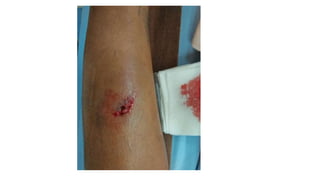
บริเวณขาซ้ายและมีแผลเปิดขนาดประมาณ 1cm ที่หน้าแข้งข้างซ้าย
Primary Survey
A. Can talk, No neck pain, can move neck, not tender along c-spine
B. No wound, no dyspnea, clear breath sound, no adventitious sound,
trachea in midline
C. BP 114/72mmHg, HR 84/min cap. Refill <2 sec, no active bleeding
wound ,pelvic compression negative
D. E4V5M6, pupil 3mm RTLBE
E. Deep wound ~1 cm at left shaft tibial
Secondary survey
• Allergy : no history
• Medication : no current medication
• Past history : no underlying disease
• Last meal : 4 hr PTA
Physical exam
• GA: Thai boy, good conciousness
• VS : BP 114/72mmHg HR 84/min RR18/min
• HEENT : normal conjunctivae, anicteric scerlae
• Heart : normal S1S2, no murmur
• Lungs : clear both lung
• Abdomen : soft, not tender
• Neurological : grossly intact
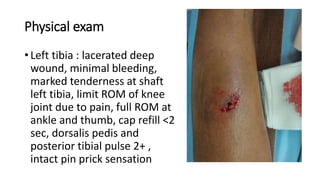
• Left tibia : lacerated deep
wound, minimal bleeding,
marked tenderness at shaft
left tibia, limit ROM of knee
joint due to pain, full ROM at
ankle and thumb, cap refill <2
sec, dorsalis pedis and
posterior tibial pulse 2+ ,
intact pin prick sensation
Physical exam
• Thoracolumbar spine : no tenderness along T-L spine,
no pain on flexion and extension
Physical exam
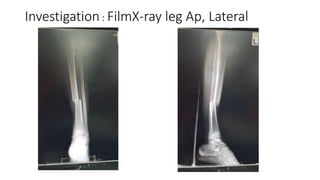
Investigation : FilmX-ray leg Ap, Lateral
Diagnosis
• Open fracture shaft left tibia
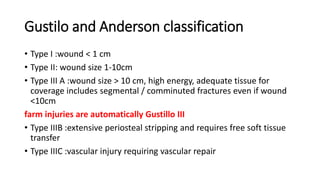
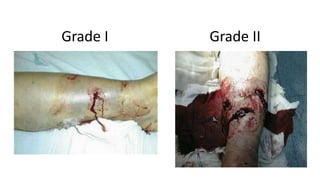
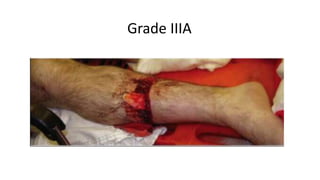
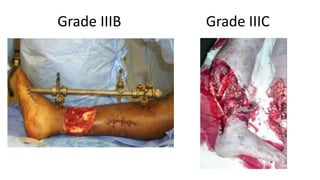
Gustilo and Anderson classification
• Type I :wound < 1 cm
• Type II: wound size 1-10cm
• Type III A :wound size > 10 cm, high energy, adequate tissue for
coverage includes segmental / comminuted fractures even if wound
<10cm
farm injuries are automatically Gustillo III
• Type IIIB :extensive periosteal stripping and requires free soft tissue
transfer
• Type IIIC :vascular injury requiring vascular repair
Grade I Grade II
Grade IIIA
Grade IIIB Grade IIIC
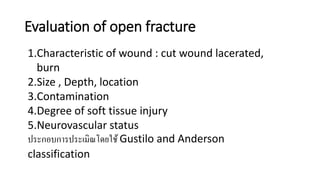
Evaluation of open fracture
1.Characteristic of wound : cut wound lacerated,
burn
2.Size , Depth, location
3.Contamination
4.Degree of soft tissue injury
5.Neurovascular status
ประกอบการประเมิณโดยใช้ Gustilo and Anderson
classification
Management of open fracture
• Initial in the emergency room
1. ATB and Tetanus prophylaxis
2. Control bleeding
3. Assessment neurovascular and soft tissue injury
4. Dressing : remove gross debris and soak sterlie NSS
on the wound
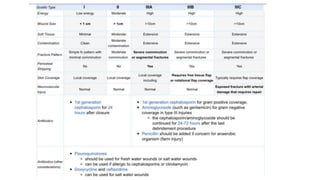
Antibiotic Indications for Open Fractures
1. Gustillo I and II :1st generation cephalosporin
2. Gustillo III :1st generation cephalosporin + aminoglycoside
3. With farm injury :1st generation cephalosporin + aminoglycoside +
PCN , add PCN for clostridia
4. Duration :initiate as soon as possible
• increased infection rate when delayed > 3 hours from time of injury
• continue for 72 hours after I&D
Management in OR
1. Aggressive debridement and irrigation :Type I: 3, Type II: 6L, Type
III: 9L
• surgical debridement 6-8 hours after time of injury
• grossly contaminated wounds are irrigated in emergency
2. bony fragments without soft tissue attachment can be removed
3. Fracture stabilisation: internal or external fixation
4. Can place antibiotic bead-pouch in open dirty wounds
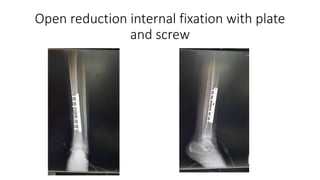
Open reduction internal fixation with plate
and screw
Wound closure
• 1. Primary closure : clean and no necrotic tissue or
foreign material
• 2. Secondary closure : flap and graft
• 3. Delayed primary closure : high infected rate (Class
III)
Rehabilitation
• Elevation การยก Extremities ให้สูงหลังผ่าตัดสามารถลดอาการบวมได้
แต่ไม่ควรยกสูงเกิน 10cm
• Benefit
1. ป้องกัน Muscle atrophy
2. ป้องกัน joint stiffness
3. เพิ่ม circulation, venous, lymphatic return
Thank you for your attention

Open fracture

  • 1.
  • 2.
    Case A 12 yearold boy No underlying disease CC.Motorcycle accident 3 hr PTA P.I. ผู้ป่วยโดนรถจักรยานยนต์เฉี่ยวขณะซ้อนมอเตอไซค์ ผู้ป่วยล้มลงขา กระแทกพื้น ผู้ป่วยยังมีสติแต่ไม่สามารถยืนและทรงตัวได้ มีอาการเจ็บ บริเวณขาซ้ายและมีแผลเปิดขนาดประมาณ 1cm ที่หน้าแข้งข้างซ้าย
  • 3.
    Primary Survey A. Cantalk, No neck pain, can move neck, not tender along c-spine B. No wound, no dyspnea, clear breath sound, no adventitious sound, trachea in midline C. BP 114/72mmHg, HR 84/min cap. Refill <2 sec, no active bleeding wound ,pelvic compression negative D. E4V5M6, pupil 3mm RTLBE E. Deep wound ~1 cm at left shaft tibial
  • 4.
    Secondary survey • Allergy: no history • Medication : no current medication • Past history : no underlying disease • Last meal : 4 hr PTA
  • 6.
    Physical exam • GA:Thai boy, good conciousness • VS : BP 114/72mmHg HR 84/min RR18/min • HEENT : normal conjunctivae, anicteric scerlae • Heart : normal S1S2, no murmur • Lungs : clear both lung • Abdomen : soft, not tender • Neurological : grossly intact
  • 7.
    • Left tibia: lacerated deep wound, minimal bleeding, marked tenderness at shaft left tibia, limit ROM of knee joint due to pain, full ROM at ankle and thumb, cap refill <2 sec, dorsalis pedis and posterior tibial pulse 2+ , intact pin prick sensation Physical exam
  • 8.
    • Thoracolumbar spine: no tenderness along T-L spine, no pain on flexion and extension Physical exam
  • 9.
  • 10.
  • 11.
    Gustilo and Andersonclassification • Type I :wound < 1 cm • Type II: wound size 1-10cm • Type III A :wound size > 10 cm, high energy, adequate tissue for coverage includes segmental / comminuted fractures even if wound <10cm farm injuries are automatically Gustillo III • Type IIIB :extensive periosteal stripping and requires free soft tissue transfer • Type IIIC :vascular injury requiring vascular repair
  • 13.
  • 14.
  • 15.
  • 16.
    Evaluation of openfracture 1.Characteristic of wound : cut wound lacerated, burn 2.Size , Depth, location 3.Contamination 4.Degree of soft tissue injury 5.Neurovascular status ประกอบการประเมิณโดยใช้ Gustilo and Anderson classification
  • 17.
    Management of openfracture • Initial in the emergency room 1. ATB and Tetanus prophylaxis 2. Control bleeding 3. Assessment neurovascular and soft tissue injury 4. Dressing : remove gross debris and soak sterlie NSS on the wound
  • 18.
    Antibiotic Indications forOpen Fractures 1. Gustillo I and II :1st generation cephalosporin 2. Gustillo III :1st generation cephalosporin + aminoglycoside 3. With farm injury :1st generation cephalosporin + aminoglycoside + PCN , add PCN for clostridia 4. Duration :initiate as soon as possible • increased infection rate when delayed > 3 hours from time of injury • continue for 72 hours after I&D
  • 19.
    Management in OR 1.Aggressive debridement and irrigation :Type I: 3, Type II: 6L, Type III: 9L • surgical debridement 6-8 hours after time of injury • grossly contaminated wounds are irrigated in emergency 2. bony fragments without soft tissue attachment can be removed 3. Fracture stabilisation: internal or external fixation 4. Can place antibiotic bead-pouch in open dirty wounds
  • 20.
    Open reduction internalfixation with plate and screw
  • 21.
    Wound closure • 1.Primary closure : clean and no necrotic tissue or foreign material • 2. Secondary closure : flap and graft • 3. Delayed primary closure : high infected rate (Class III)
  • 22.
    Rehabilitation • Elevation การยกExtremities ให้สูงหลังผ่าตัดสามารถลดอาการบวมได้ แต่ไม่ควรยกสูงเกิน 10cm • Benefit 1. ป้องกัน Muscle atrophy 2. ป้องกัน joint stiffness 3. เพิ่ม circulation, venous, lymphatic return
  • 23.
    Thank you foryour attention