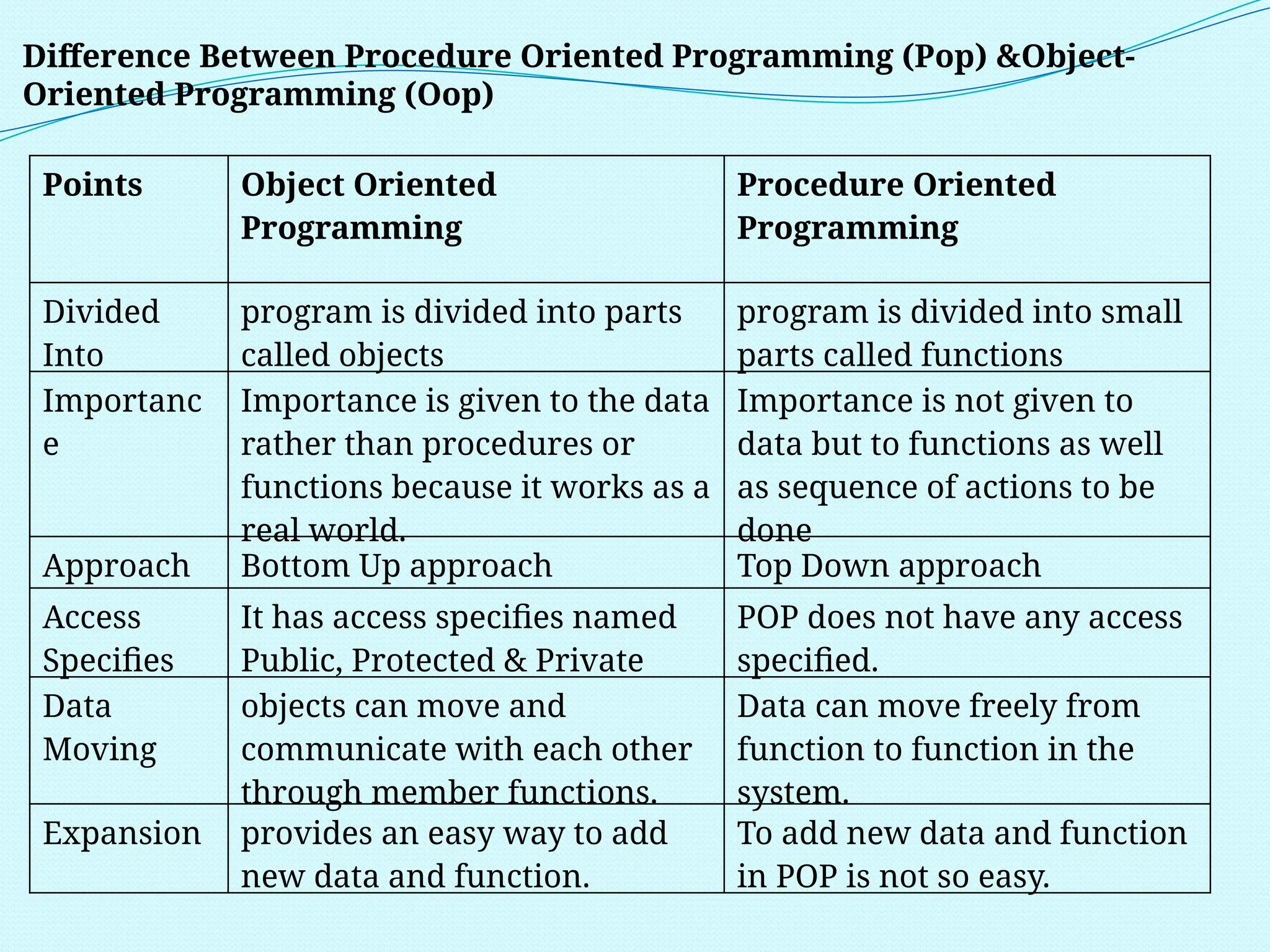
Difference Between Procedure Oriented Programming (Pop) &Object-
Oriented Programming (Oop)
Points Object Oriented
Programming
Procedure Oriented
Programming
Divided
Into
program is divided into parts
called objects
program is divided into small
parts called functions
Importanc
e
Importance is given to the data
rather than procedures or
functions because it works as a
real world.
Importance is not given to
data but to functions as well
as sequence of actions to be
done
Approach Bottom Up approach Top Down approach
Access
Specifies
It has access specifies named
Public, Protected & Private
POP does not have any access
specified.
Data
Moving
objects can move and
communicate with each other
through member functions.
Data can move freely from
function to function in the
system.
Expansion provides an easy way to add
new data and function.
To add new data and function
in POP is not so easy.
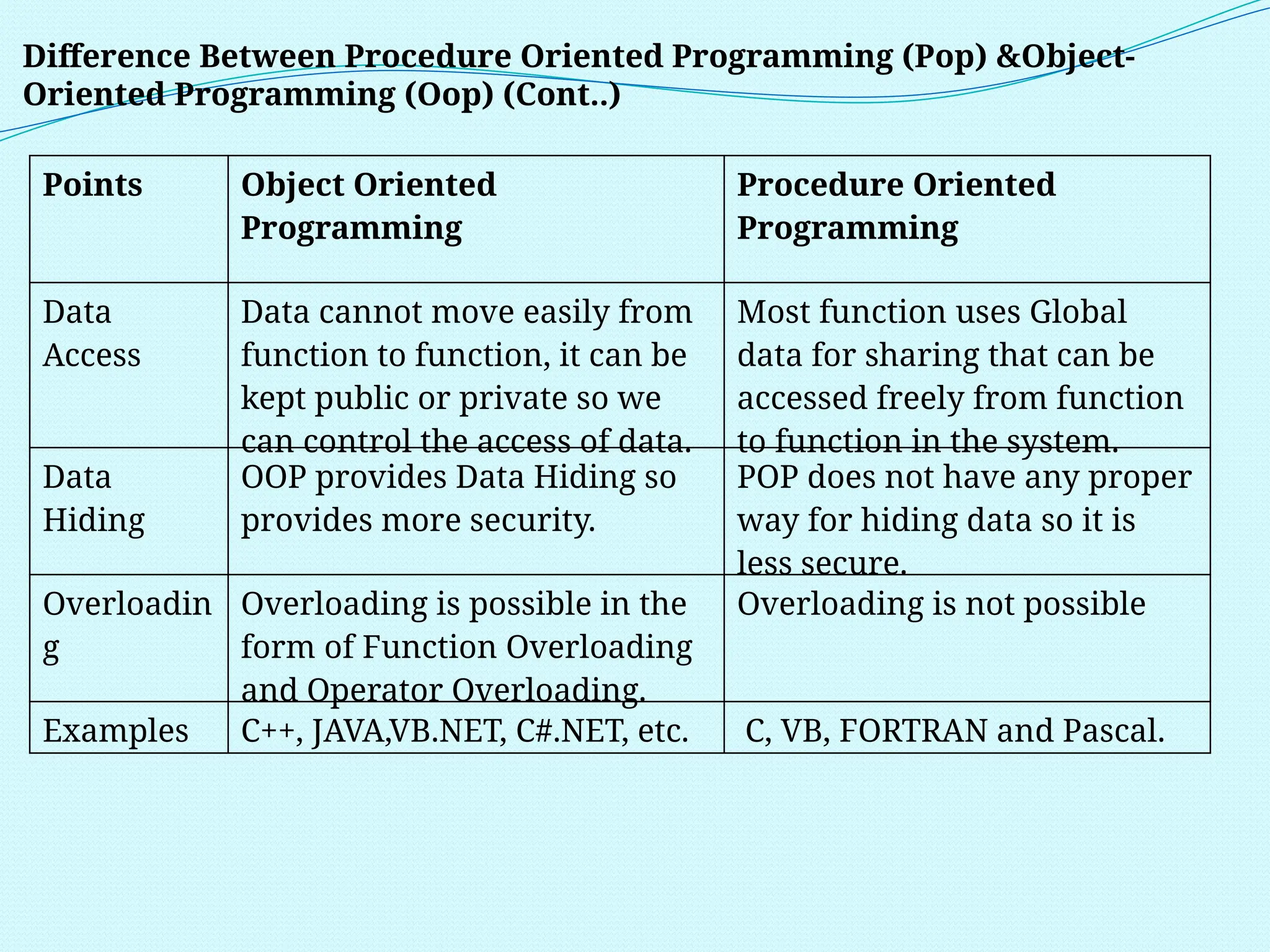
Difference Between Procedure Oriented Programming (Pop) &Object-
Oriented Programming (Oop) (Cont..)
Points Object Oriented
Programming
Procedure Oriented
Programming
Data
Access
Data cannot move easily from
function to function, it can be
kept public or private so we
can control the access of data.
Most function uses Global
data for sharing that can be
accessed freely from function
to function in the system.
Data
Hiding
OOP provides Data Hiding so
provides more security.
POP does not have any proper
way for hiding data so it is
less secure.
Overloadin
g
Overloading is possible in the
form of Function Overloading
and Operator Overloading.
Overloading is not possible
Examples C++, JAVA,VB.NET, C#.NET, etc. C, VB, FORTRAN and Pascal.
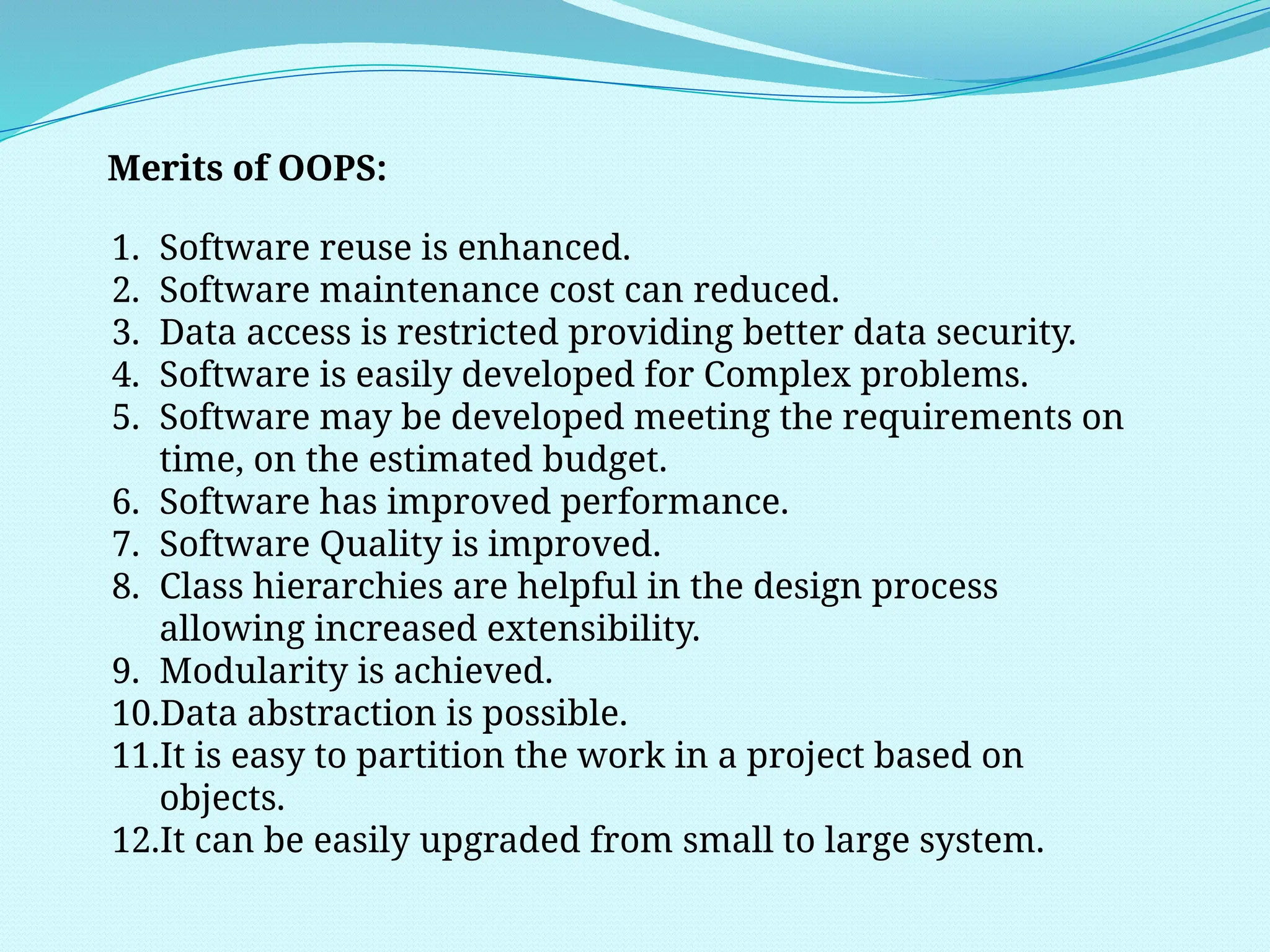
Merits of OOPS:
1. Software reuse is enhanced.
2. Software maintenance cost can reduced.
3. Data access is restricted providing better data security.
4. Software is easily developed for Complex problems.
5. Software may be developed meeting the requirements on
time, on the estimated budget.
6. Software has improved performance.
7. Software Quality is improved.
8. Class hierarchies are helpful in the design process
allowing increased extensibility.
9. Modularity is achieved.
10.Data abstraction is possible.
11.It is easy to partition the work in a project based on
objects.
12.It can be easily upgraded from small to large system.
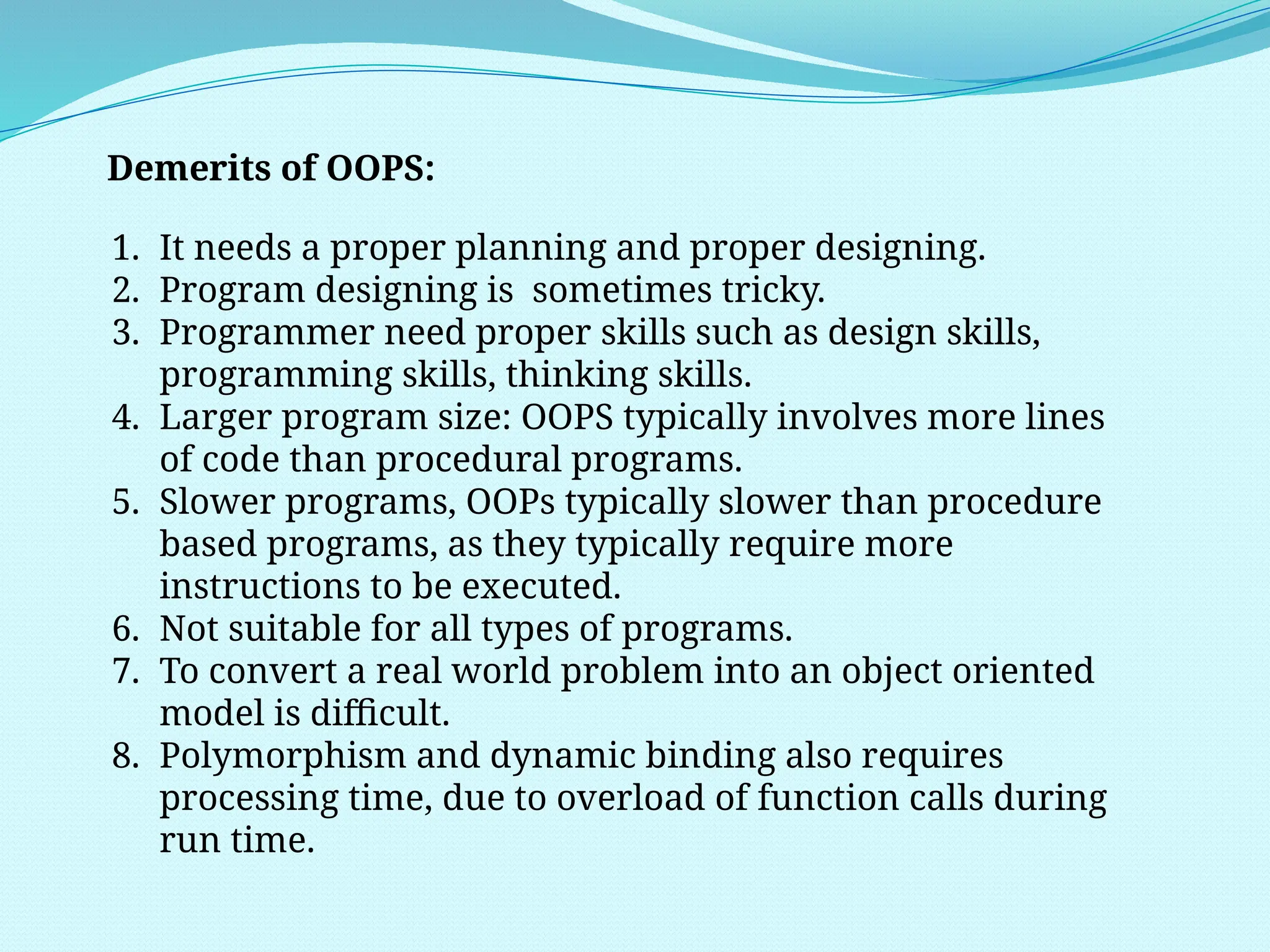
Demerits of OOPS:
1. It needs a proper planning and proper designing.
2. Program designing is sometimes tricky.
3. Programmer need proper skills such as design skills,
programming skills, thinking skills.
4. Larger program size: OOPS typically involves more lines
of code than procedural programs.
5. Slower programs, OOPs typically slower than procedure
based programs, as they typically require more
instructions to be executed.
6. Not suitable for all types of programs.
7. To convert a real world problem into an object oriented
model is difficult.
8. Polymorphism and dynamic binding also requires
processing time, due to overload of function calls during
run time.
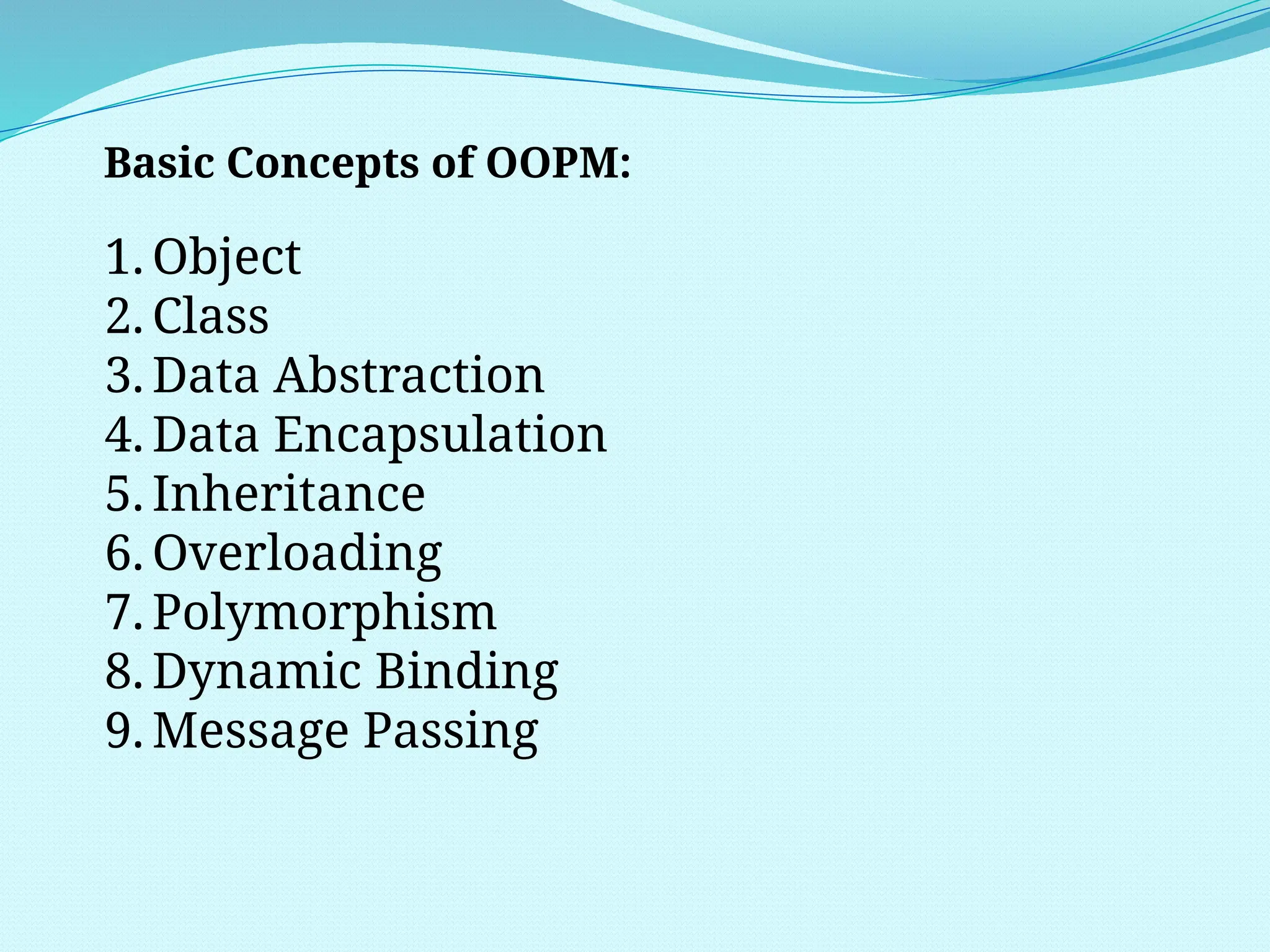
Basic Concepts of OOPM:
1. Object
2. Class
3. Data Abstraction
4. Data Encapsulation
5. Inheritance
6. Overloading
7. Polymorphism
8. Dynamic Binding
9. Message Passing
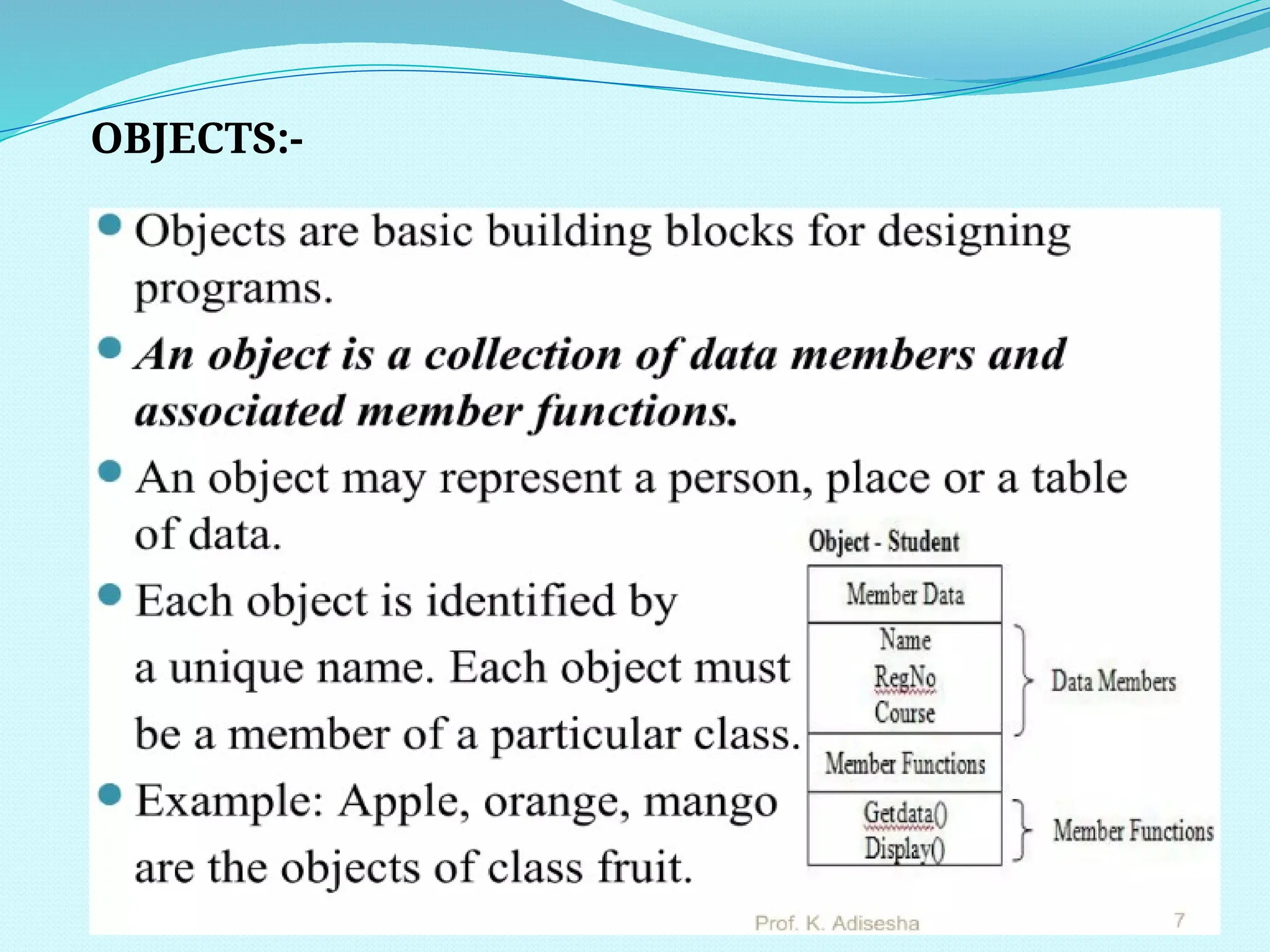
OBJECTS:-
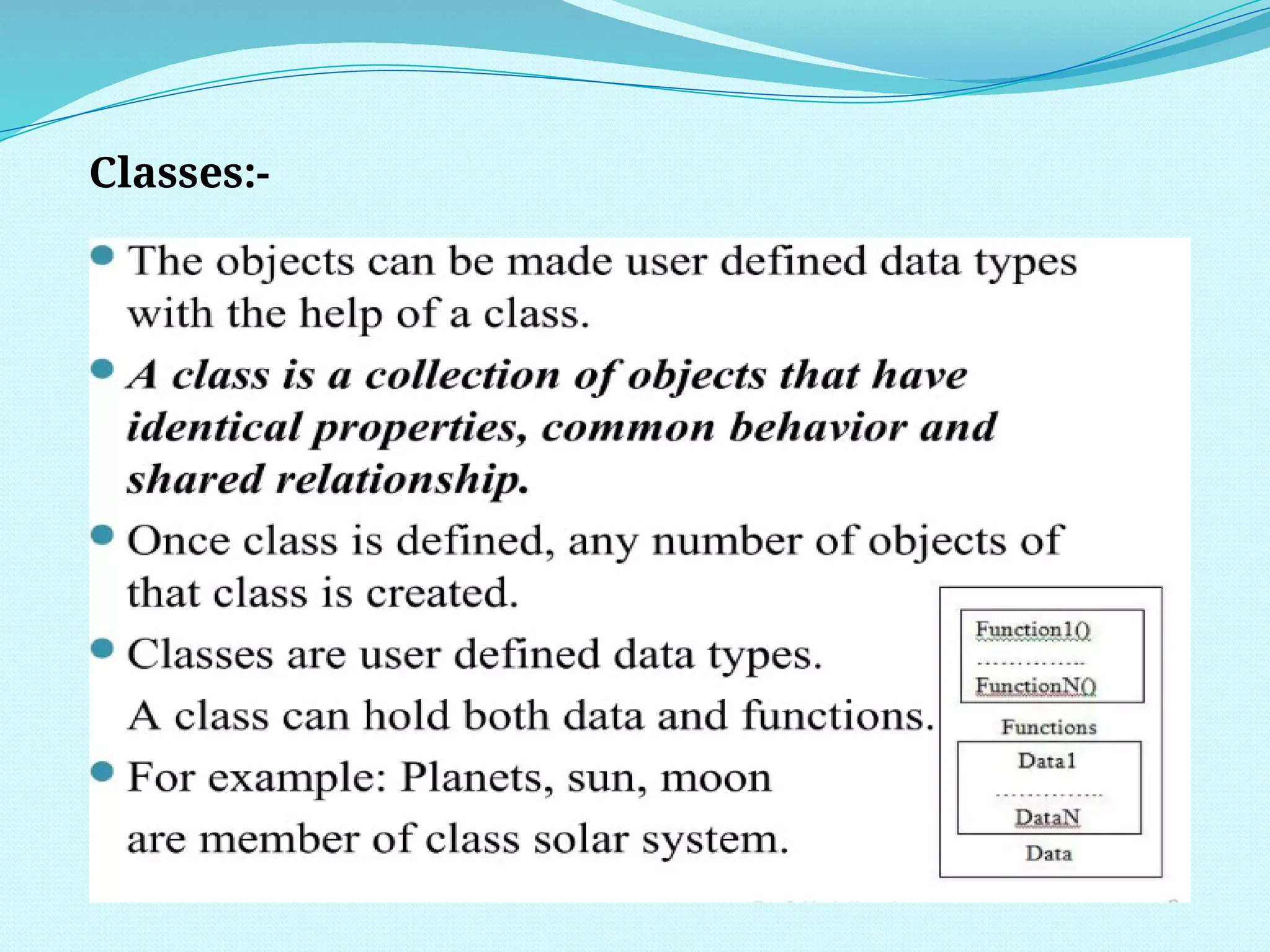
Classes:-
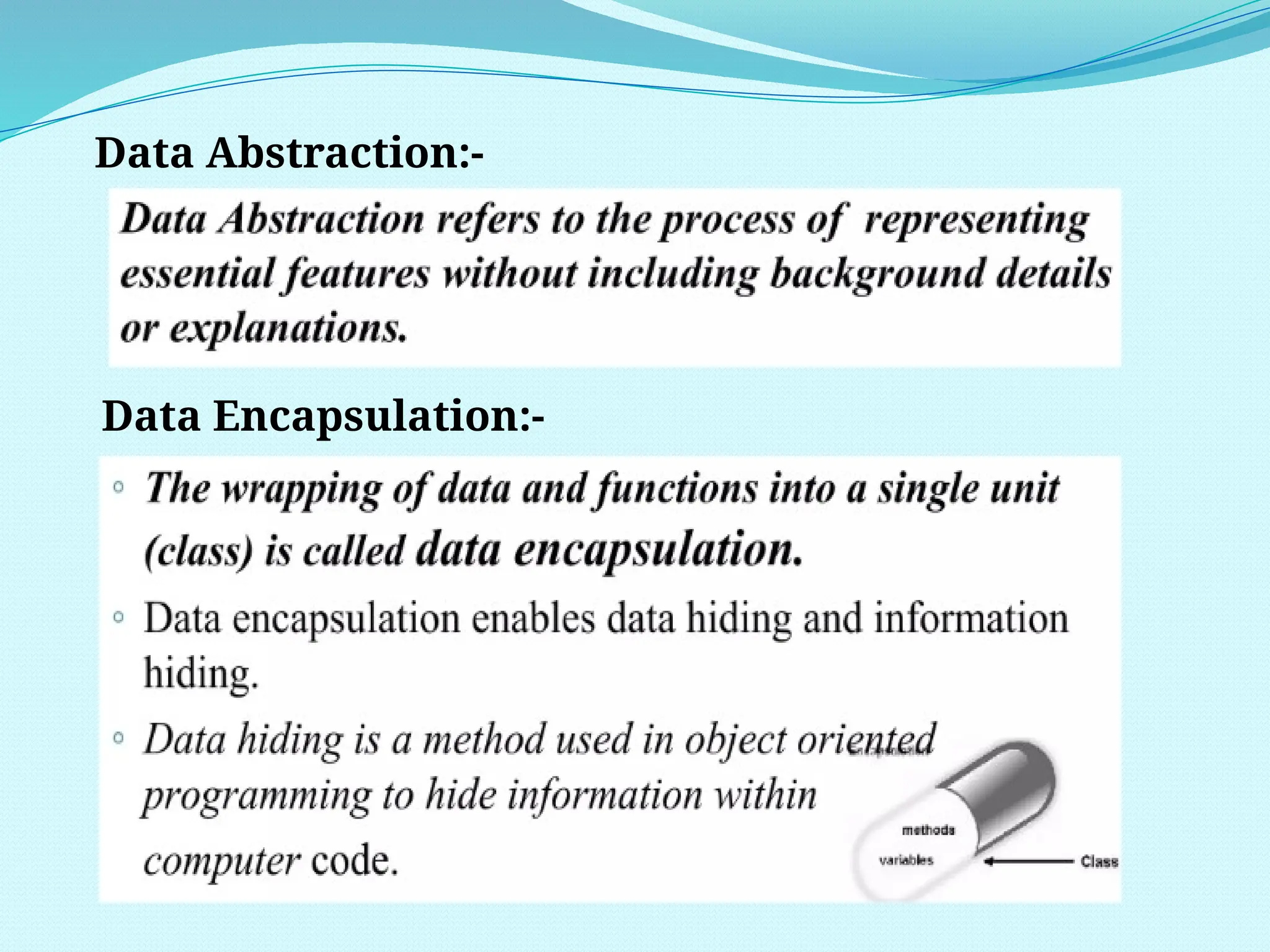
Data Abstraction:-
Data Encapsulation:-
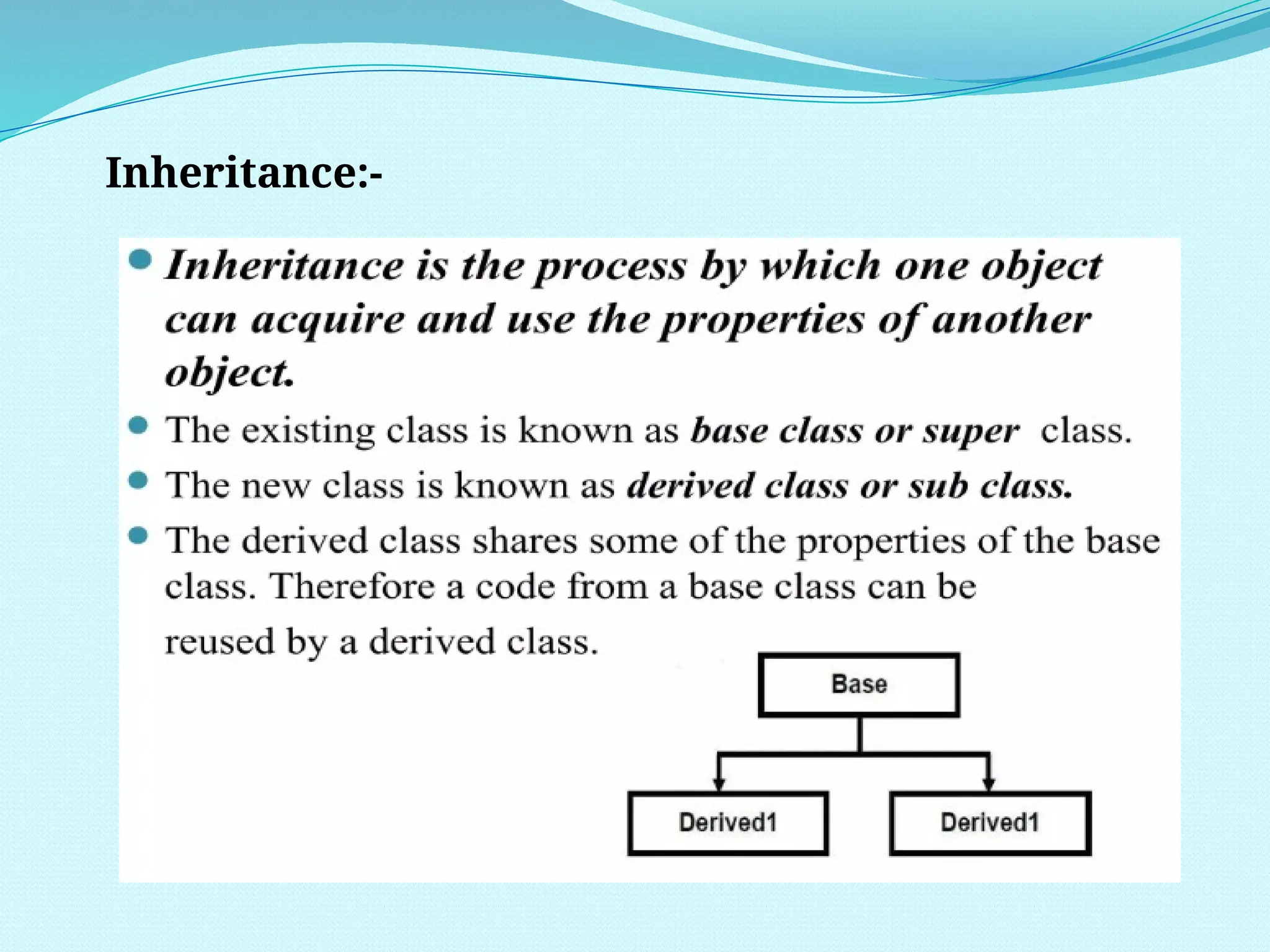
Inheritance:-
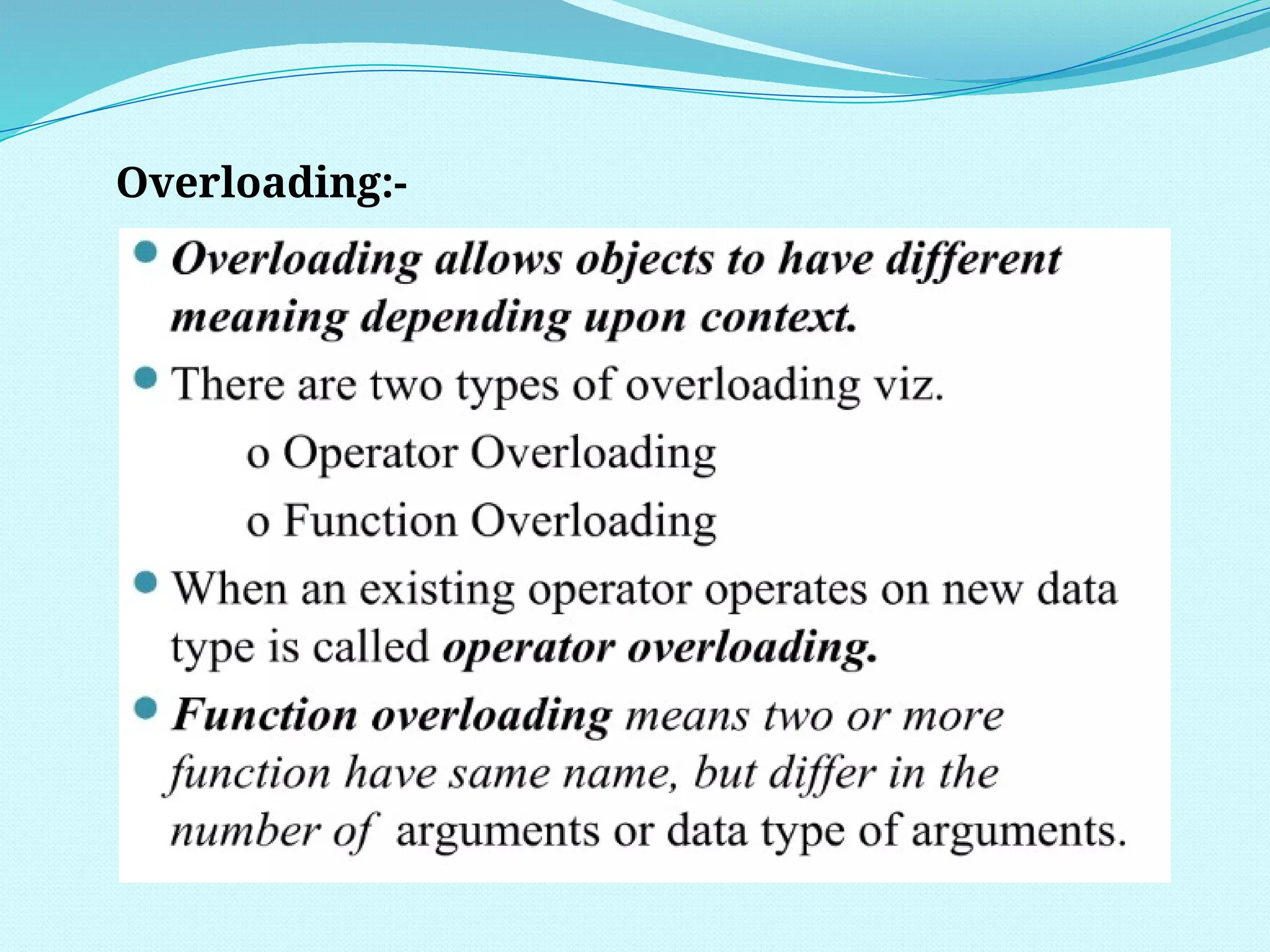
Overloading:-
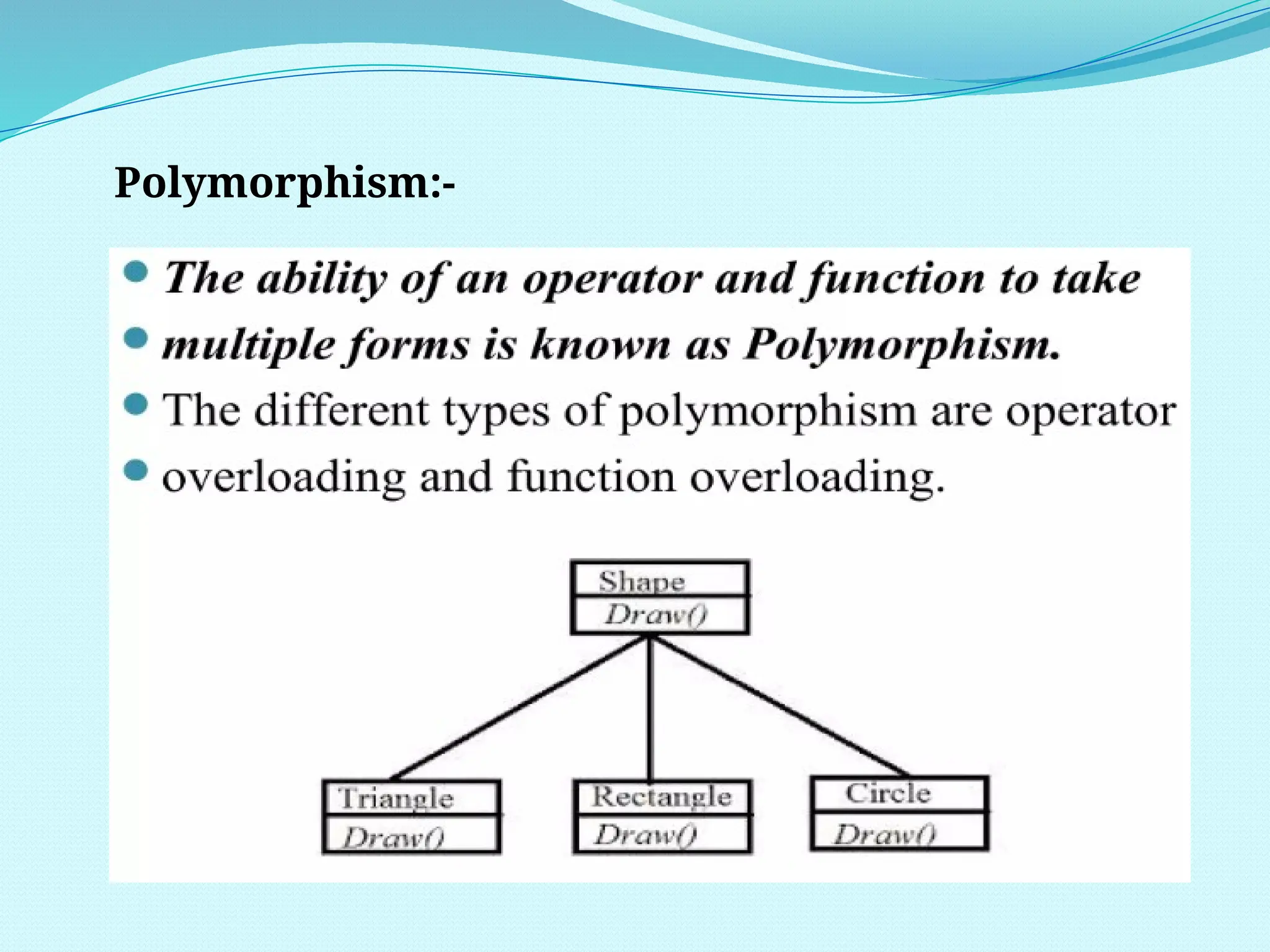
Polymorphism:-
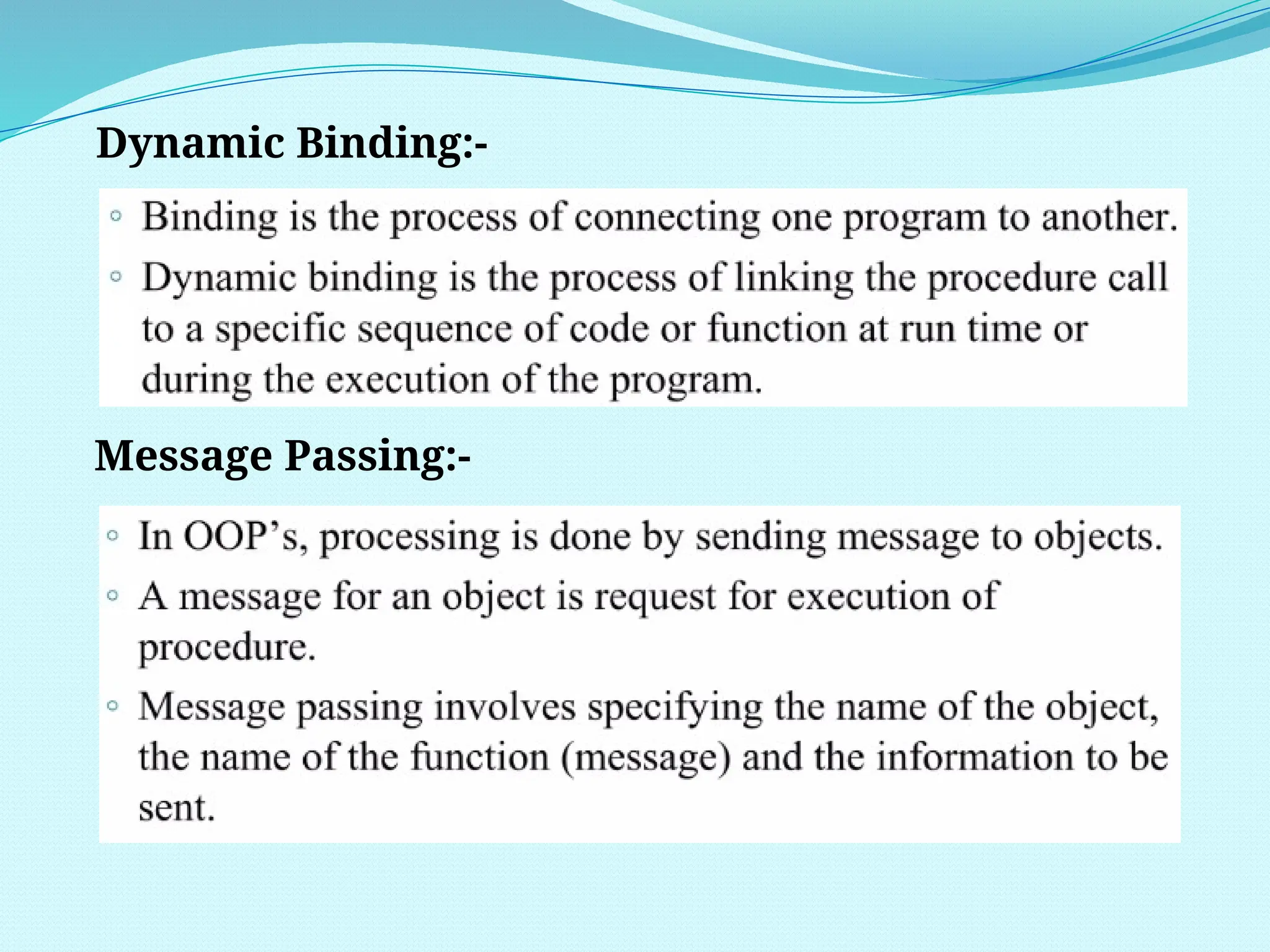
Dynamic Binding:-
Message Passing:-

OOPs Concepts Like Diff Between OOP and POP,merits demarit and their imp concepts.pptx

  • 1.
    Difference Between ProcedureOriented Programming (Pop) &Object- Oriented Programming (Oop) Points Object Oriented Programming Procedure Oriented Programming Divided Into program is divided into parts called objects program is divided into small parts called functions Importanc e Importance is given to the data rather than procedures or functions because it works as a real world. Importance is not given to data but to functions as well as sequence of actions to be done Approach Bottom Up approach Top Down approach Access Specifies It has access specifies named Public, Protected & Private POP does not have any access specified. Data Moving objects can move and communicate with each other through member functions. Data can move freely from function to function in the system. Expansion provides an easy way to add new data and function. To add new data and function in POP is not so easy.
  • 2.
    Difference Between ProcedureOriented Programming (Pop) &Object- Oriented Programming (Oop) (Cont..) Points Object Oriented Programming Procedure Oriented Programming Data Access Data cannot move easily from function to function, it can be kept public or private so we can control the access of data. Most function uses Global data for sharing that can be accessed freely from function to function in the system. Data Hiding OOP provides Data Hiding so provides more security. POP does not have any proper way for hiding data so it is less secure. Overloadin g Overloading is possible in the form of Function Overloading and Operator Overloading. Overloading is not possible Examples C++, JAVA,VB.NET, C#.NET, etc. C, VB, FORTRAN and Pascal.
  • 3.
    Merits of OOPS: 1.Software reuse is enhanced. 2. Software maintenance cost can reduced. 3. Data access is restricted providing better data security. 4. Software is easily developed for Complex problems. 5. Software may be developed meeting the requirements on time, on the estimated budget. 6. Software has improved performance. 7. Software Quality is improved. 8. Class hierarchies are helpful in the design process allowing increased extensibility. 9. Modularity is achieved. 10.Data abstraction is possible. 11.It is easy to partition the work in a project based on objects. 12.It can be easily upgraded from small to large system.
  • 4.
    Demerits of OOPS: 1.It needs a proper planning and proper designing. 2. Program designing is sometimes tricky. 3. Programmer need proper skills such as design skills, programming skills, thinking skills. 4. Larger program size: OOPS typically involves more lines of code than procedural programs. 5. Slower programs, OOPs typically slower than procedure based programs, as they typically require more instructions to be executed. 6. Not suitable for all types of programs. 7. To convert a real world problem into an object oriented model is difficult. 8. Polymorphism and dynamic binding also requires processing time, due to overload of function calls during run time.
  • 5.
    Basic Concepts ofOOPM: 1. Object 2. Class 3. Data Abstraction 4. Data Encapsulation 5. Inheritance 6. Overloading 7. Polymorphism 8. Dynamic Binding 9. Message Passing
  • 6.
  • 7.
  • 8.
  • 9.
  • 10.
  • 11.
  • 12.