Object-Oriented Programming
(OOP) Principles
Technical Interview Preparation
Presented by: [Your Name]
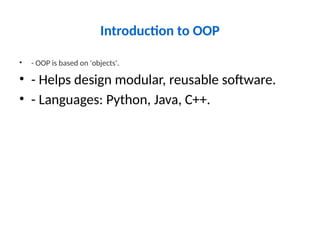
Introduction to OOP
• - OOP is based on 'objects'.
• - Helps design modular, reusable software.
• - Languages: Python, Java, C++.
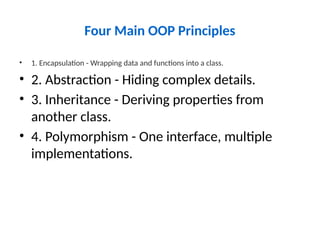
Four Main OOP Principles
• 1. Encapsulation - Wrapping data and functions into a class.
• 2. Abstraction - Hiding complex details.
• 3. Inheritance - Deriving properties from
another class.
• 4. Polymorphism - One interface, multiple
implementations.
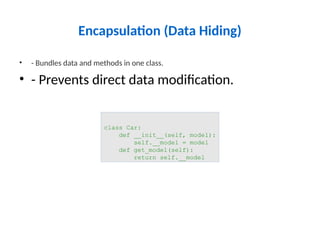
Encapsulation (Data Hiding)
• - Bundles data and methods in one class.
• - Prevents direct data modification.
class Car:
def __init__(self, model):
self.__model = model
def get_model(self):
return self.__model
Abstraction (Hiding Complexity)
• - Shows essential details, hides complexity.
• - Simplifies development.
from abc import ABC, abstractmethod
class Animal(ABC):
@abstractmethod
def make_sound(self):
pass
class Dog(Animal):
def make_sound(self):
return 'Woof!'
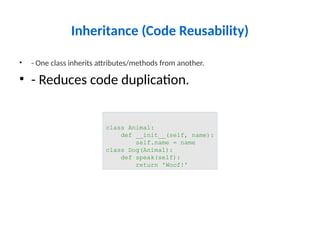
Inheritance (Code Reusability)
• - One class inherits attributes/methods from another.
• - Reduces code duplication.
class Animal:
def __init__(self, name):
self.name = name
class Dog(Animal):
def speak(self):
return 'Woof!'
Polymorphism (Multiple Forms)
• - Same function name, different behaviors.
class Animal:
def speak(self):
pass
class Dog(Animal):
def speak(self):
return 'Woof!'
class Cat(Animal):
def speak(self):
return 'Meow!'
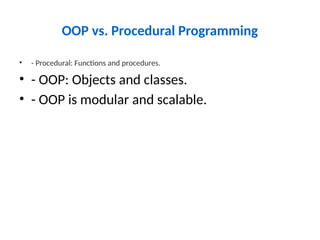
OOP vs. Procedural Programming
• - Procedural: Functions and procedures.
• - OOP: Objects and classes.
• - OOP is modular and scalable.
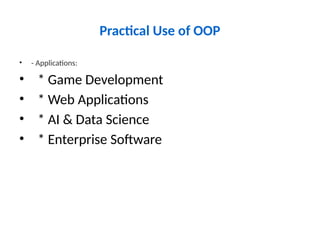
Practical Use of OOP
• - Applications:
• * Game Development
• * Web Applications
• * AI & Data Science
• * Enterprise Software
Conclusion & Questions
• - OOP structures programming.
• - Encourages reusable, maintainable code.
• - Any questions?

OOP_Presentation_Enhanced_Updated_with new Topics

  • 1.
    Object-Oriented Programming (OOP) Principles TechnicalInterview Preparation Presented by: [Your Name]
  • 2.
    Introduction to OOP •- OOP is based on 'objects'. • - Helps design modular, reusable software. • - Languages: Python, Java, C++.
  • 3.
    Four Main OOPPrinciples • 1. Encapsulation - Wrapping data and functions into a class. • 2. Abstraction - Hiding complex details. • 3. Inheritance - Deriving properties from another class. • 4. Polymorphism - One interface, multiple implementations.
  • 4.
    Encapsulation (Data Hiding) •- Bundles data and methods in one class. • - Prevents direct data modification. class Car: def __init__(self, model): self.__model = model def get_model(self): return self.__model
  • 5.
    Abstraction (Hiding Complexity) •- Shows essential details, hides complexity. • - Simplifies development. from abc import ABC, abstractmethod class Animal(ABC): @abstractmethod def make_sound(self): pass class Dog(Animal): def make_sound(self): return 'Woof!'
  • 6.
    Inheritance (Code Reusability) •- One class inherits attributes/methods from another. • - Reduces code duplication. class Animal: def __init__(self, name): self.name = name class Dog(Animal): def speak(self): return 'Woof!'
  • 7.
    Polymorphism (Multiple Forms) •- Same function name, different behaviors. class Animal: def speak(self): pass class Dog(Animal): def speak(self): return 'Woof!' class Cat(Animal): def speak(self): return 'Meow!'
  • 8.
    OOP vs. ProceduralProgramming • - Procedural: Functions and procedures. • - OOP: Objects and classes. • - OOP is modular and scalable.
  • 9.
    Practical Use ofOOP • - Applications: • * Game Development • * Web Applications • * AI & Data Science • * Enterprise Software
  • 10.
    Conclusion & Questions •- OOP structures programming. • - Encourages reusable, maintainable code. • - Any questions?