OOP
Lecture-2
Dr. Mohammad Shahidul Islam
Assistant professor
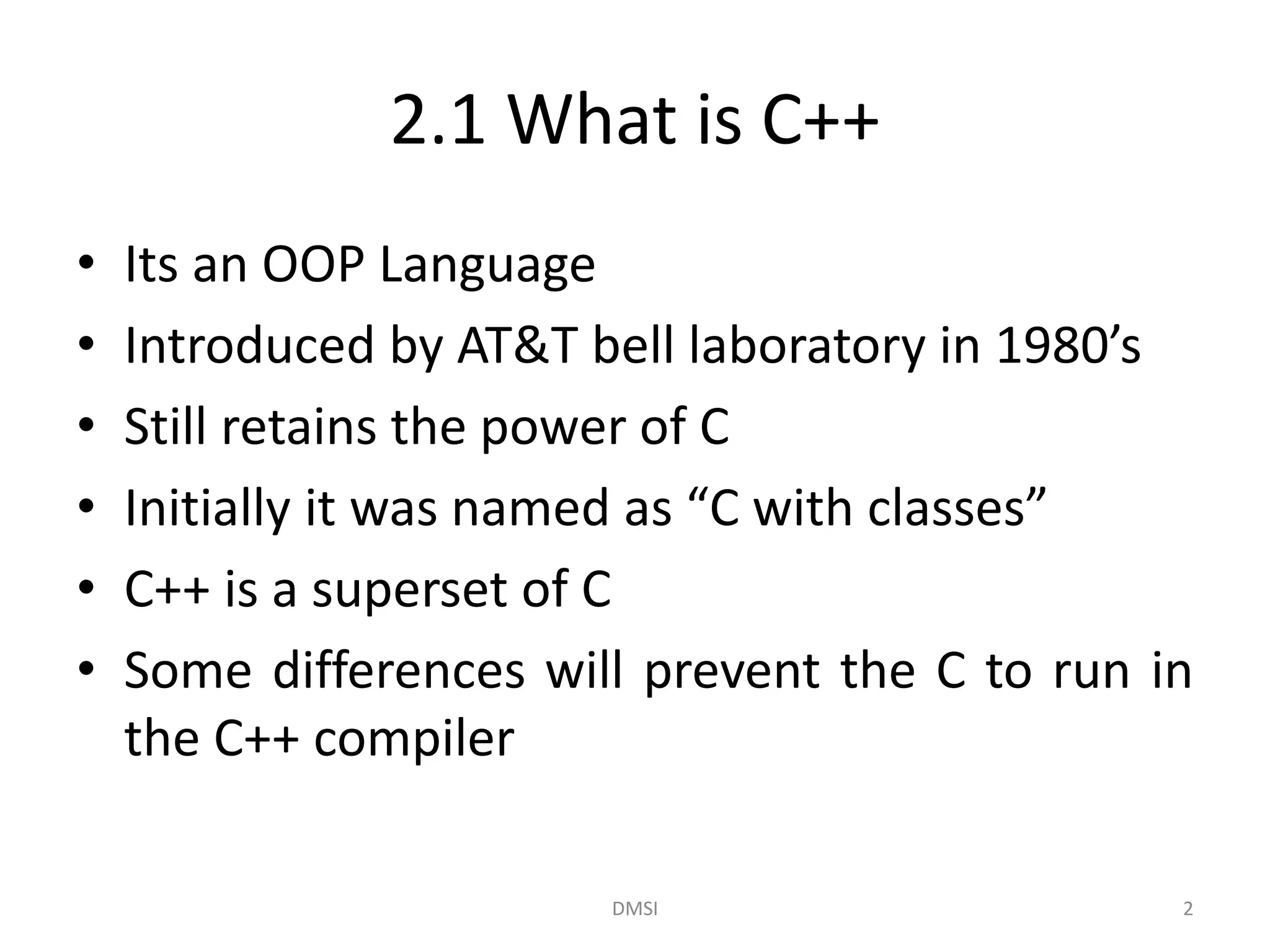
2.1 What is C++
• Its an OOP Language
• Introduced by AT&T bell laboratory in 1980’s
• Still retains the power of C
• Initially it was named as “C with classes”
• C++ is a superset of C
• Some differences will prevent the C to run in
the C++ compiler
DMSI 2
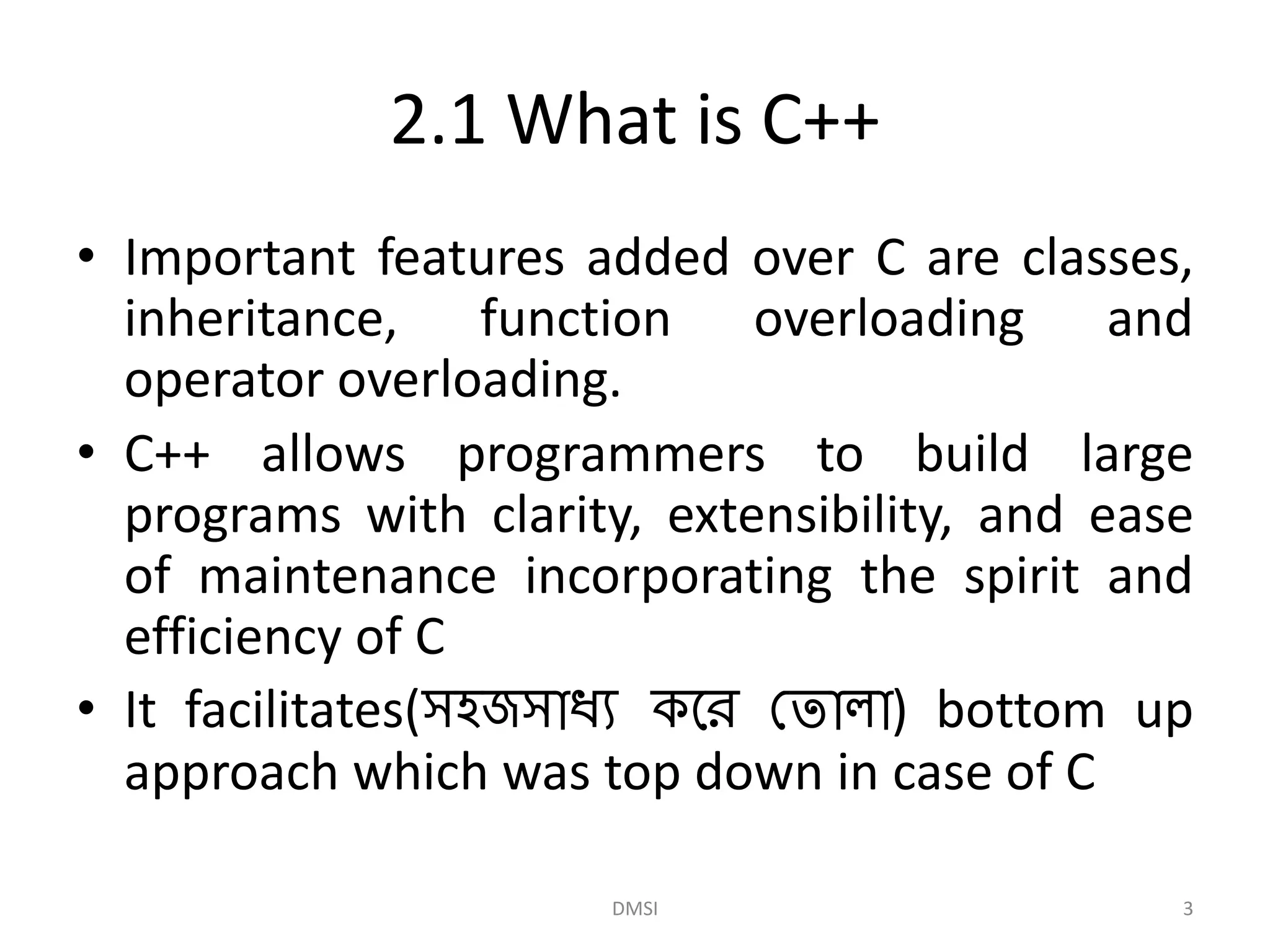
2.1 What is C++
• Important features added over C are classes,
inheritance, function overloading and
operator overloading.
• C++ allows programmers to build large
programs with clarity, extensibility, and ease
of maintenance incorporating the spirit and
efficiency of C
• It facilitates(সহজসাধ্য করে ত ালা) bottom up
approach which was top down in case of C
DMSI 3
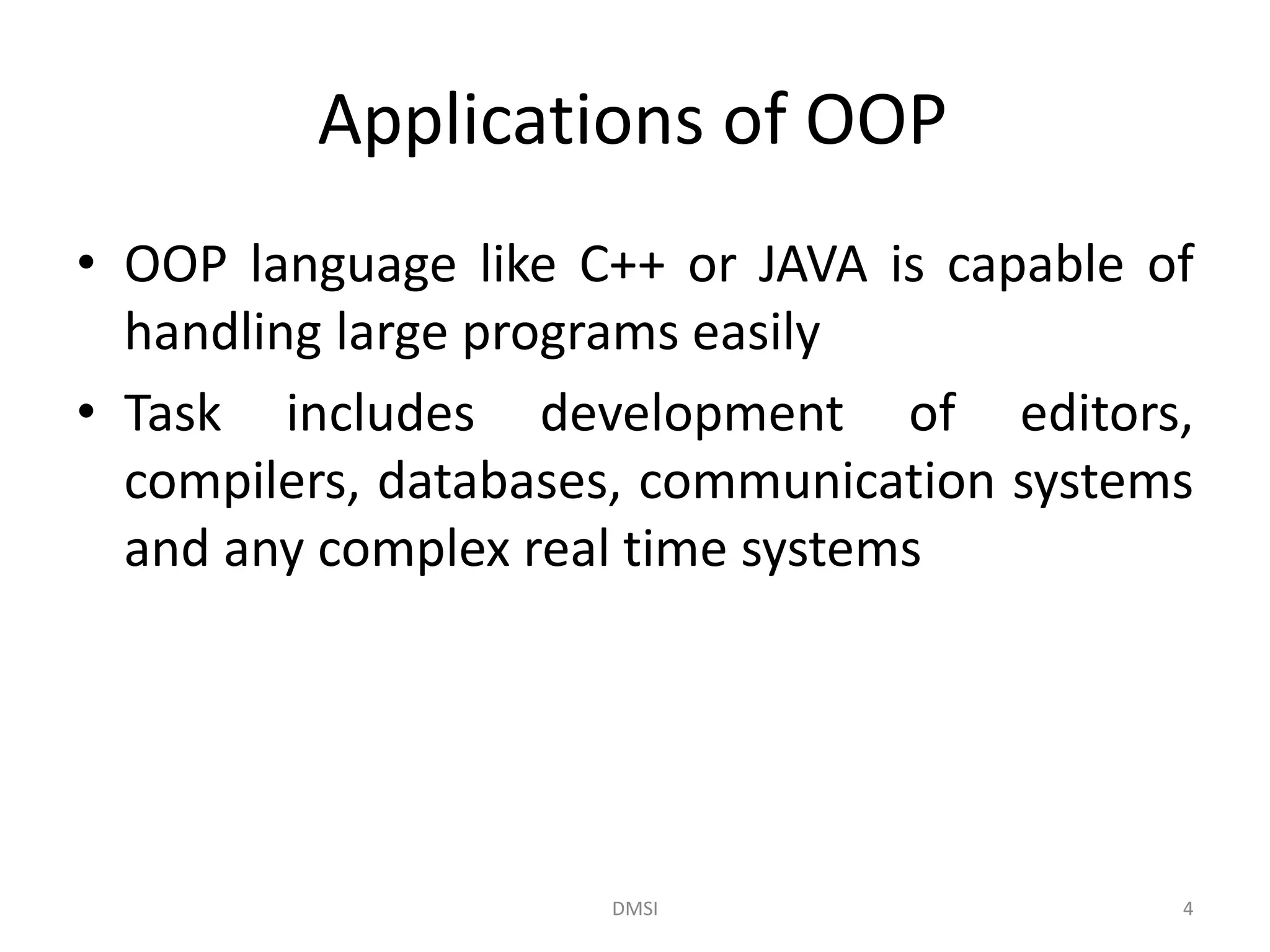
Applications of OOP
• OOP language like C++ or JAVA is capable of
handling large programs easily
• Task includes development of editors,
compilers, databases, communication systems
and any complex real time systems
DMSI 4
Applications of OOP
• Since C++ allows us to create hierarchy-related
objects, we can build special object oriented
libraries which can be used later by many
programmers.
• While C++ is able to map the real-world problem
properly, the C part of C++ gives the language the
ability to get close to the machine-level details.
• C++ programs are easily maintainable and
expandable. When a new feature needs to be
implemented, it is vary easy to add to the exiting
structure of an object.
DMSI 5
2.3 A Simple C++ Program
• Printing a string
# include <iostream> // include header file
using namespace std;
Int main()
{
Cout<< “my name is ………..”; //C++ statement
Return 0;
} // end of example
• Program Features
– only one function, main(). //can have more
– Like C the C++ statements terminate with semicolons
DMSI 6
Example (cont.)
• Comments
– C++ introduces a new comment symbol //
– Note that there is no closing symbol
• for*(j=0; j<n; /* loops n times */ J++)
– Can we use double slash?
• Output Operator:
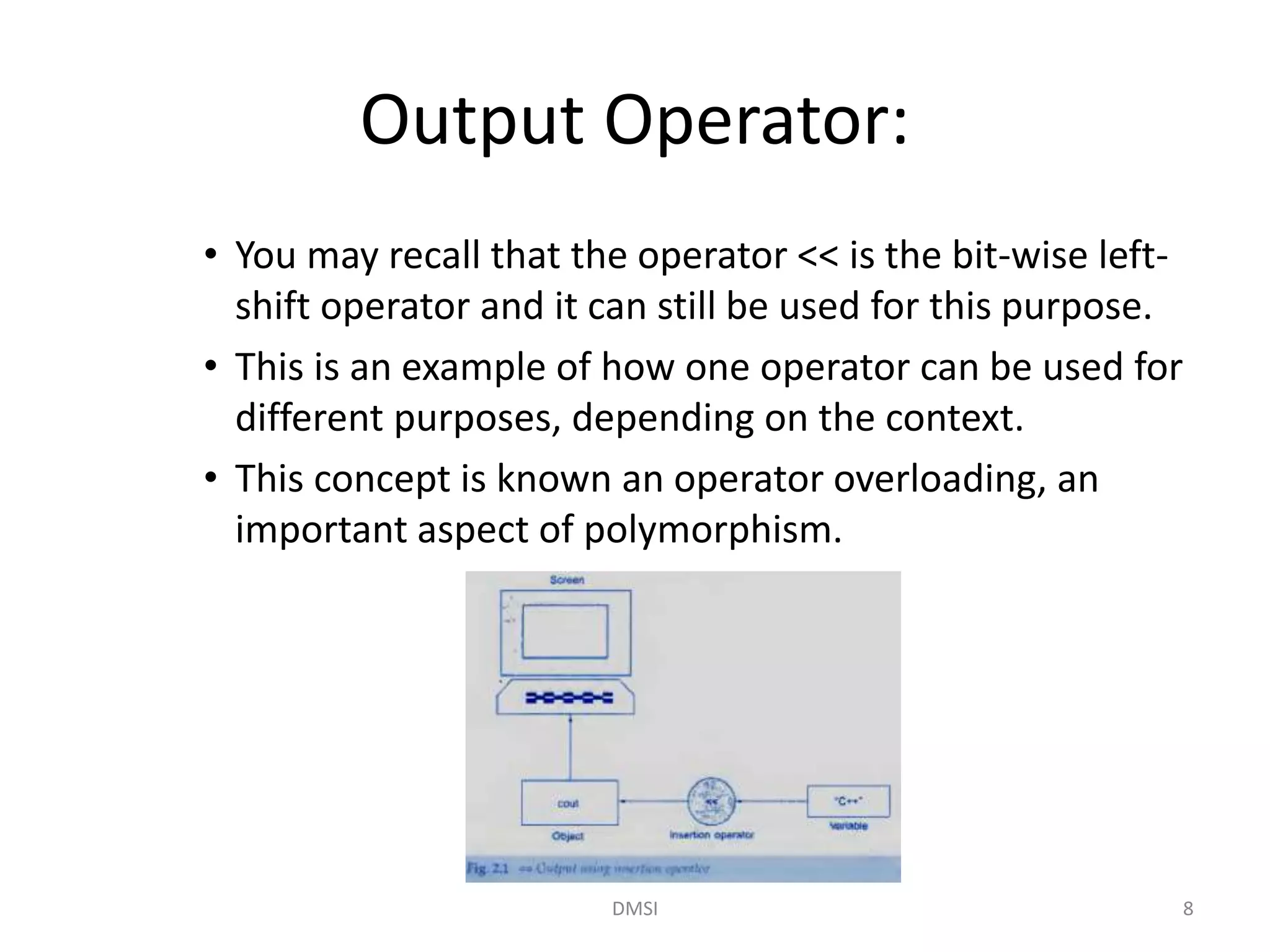
• two ne C++ features, cout and <<.
• The operator << is called the insertion or put to
operator
DMSI 7
Output Operator:
• You may recall that the operator << is the bit-wise left-
shift operator and it can still be used for this purpose.
• This is an example of how one operator can be used for
different purposes, depending on the context.
• This concept is known an operator overloading, an
important aspect of polymorphism.
DMSI 8
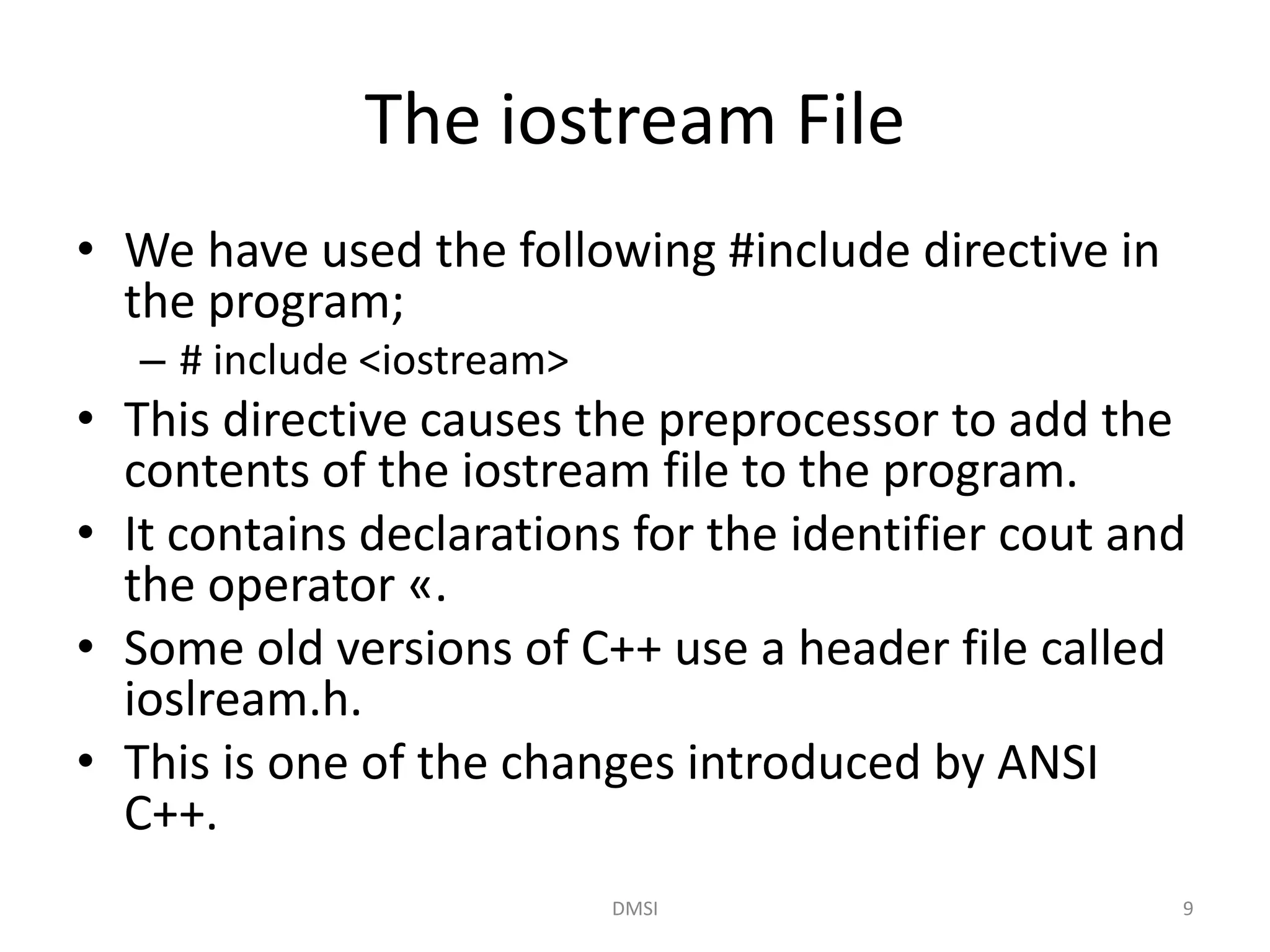
The iostream File
• We have used the following #include directive in
the program;
– # include <iostream>
• This directive causes the preprocessor to add the
contents of the iostream file to the program.
• It contains declarations for the identifier cout and
the operator «.
• Some old versions of C++ use a header file called
ioslream.h.
• This is one of the changes introduced by ANSI
C++.
DMSI 9
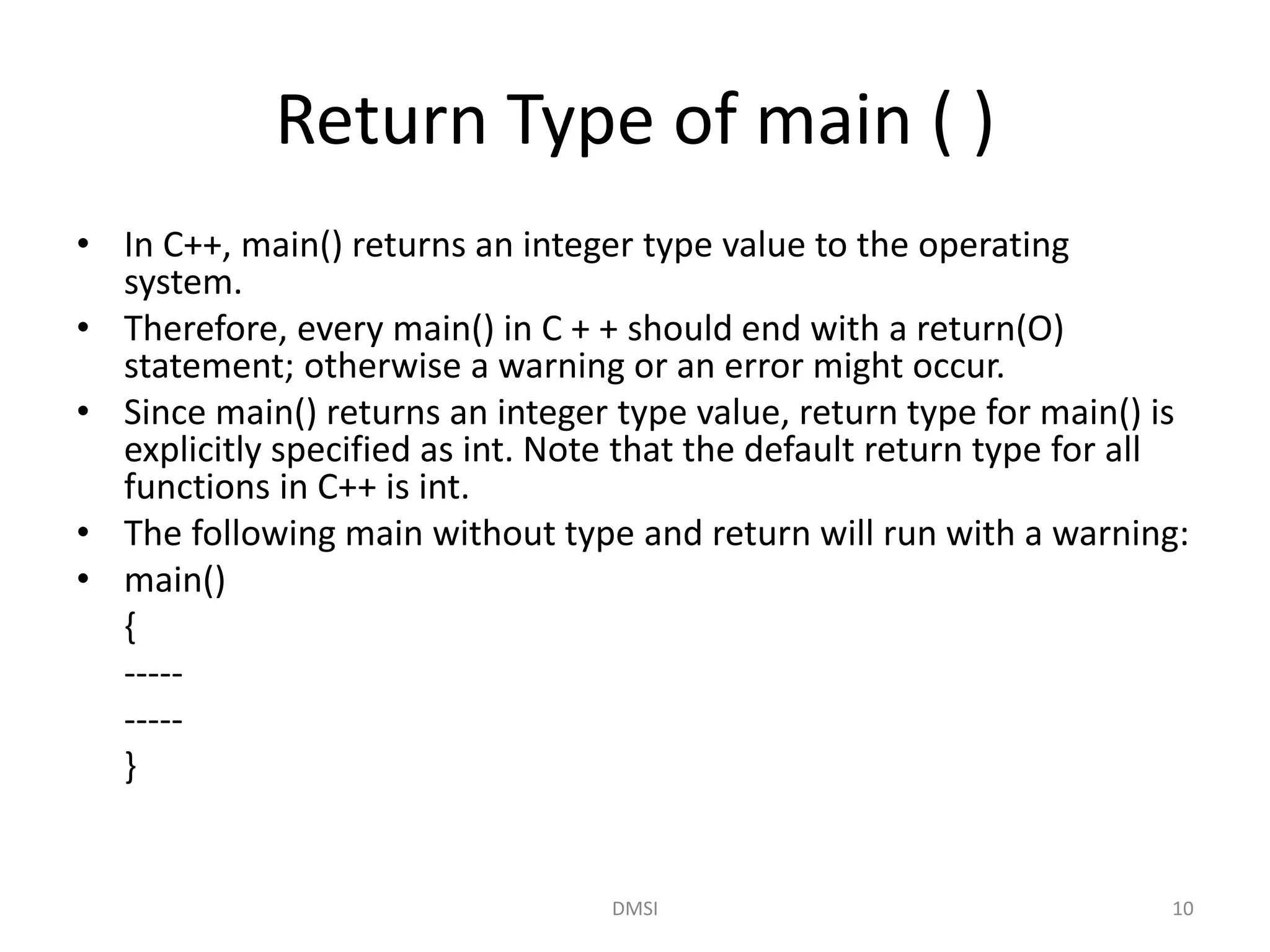
Return Type of main ( )
• In C++, main() returns an integer type value to the operating
system.
• Therefore, every main() in C + + should end with a return(O)
statement; otherwise a warning or an error might occur.
• Since main() returns an integer type value, return type for main() is
explicitly specified as int. Note that the default return type for all
functions in C++ is int.
• The following main without type and return will run with a warning:
• main()
{
-----
-----
}
DMSI 10
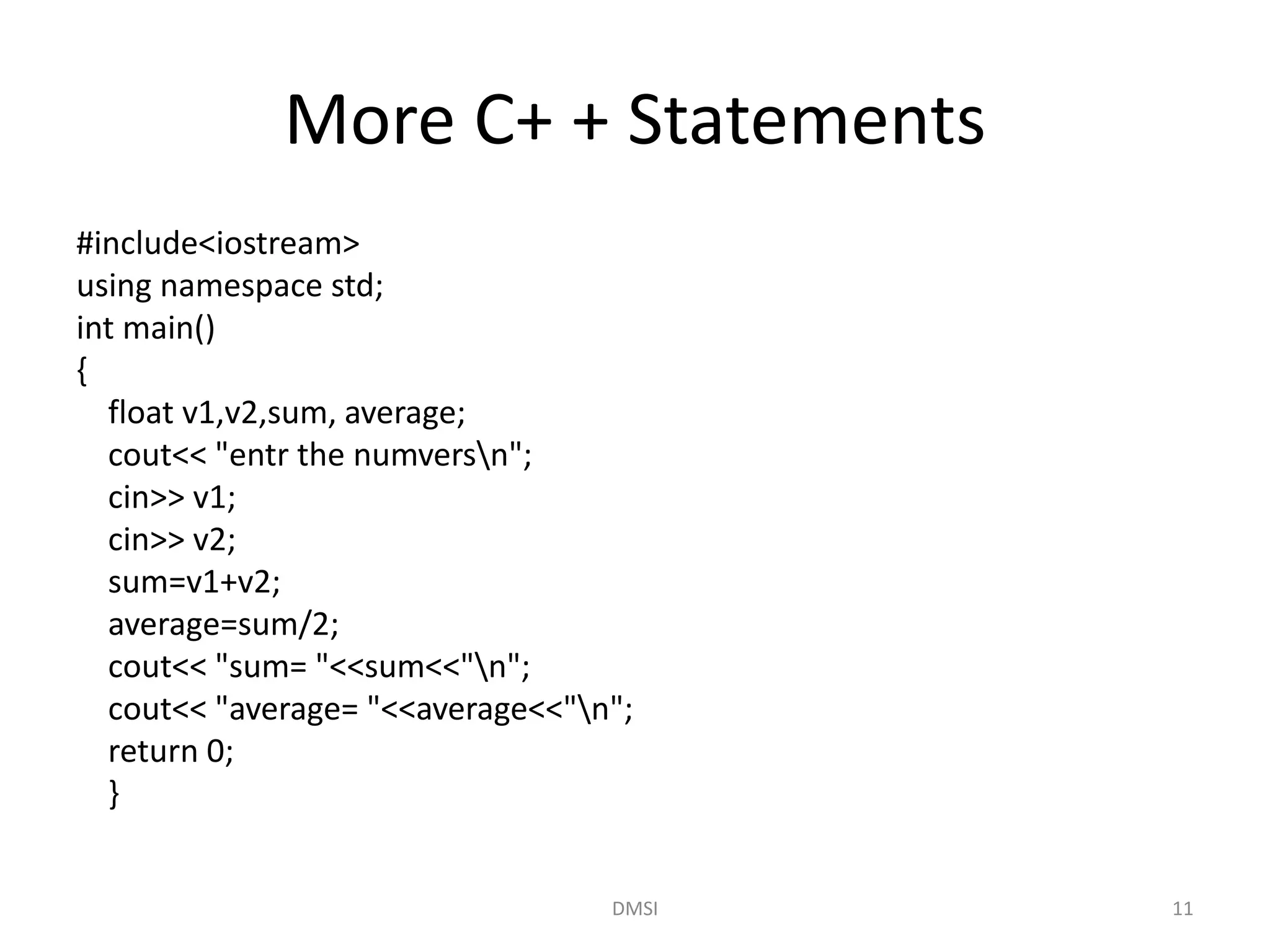
More C+ + Statements
#include<iostream>
using namespace std;
int main()
{
float v1,v2,sum, average;
cout<< "entr the numversn";
cin>> v1;
cin>> v2;
sum=v1+v2;
average=sum/2;
cout<< "sum= "<<sum<<"n";
cout<< "average= "<<average<<"n";
return 0;
}
DMSI 11
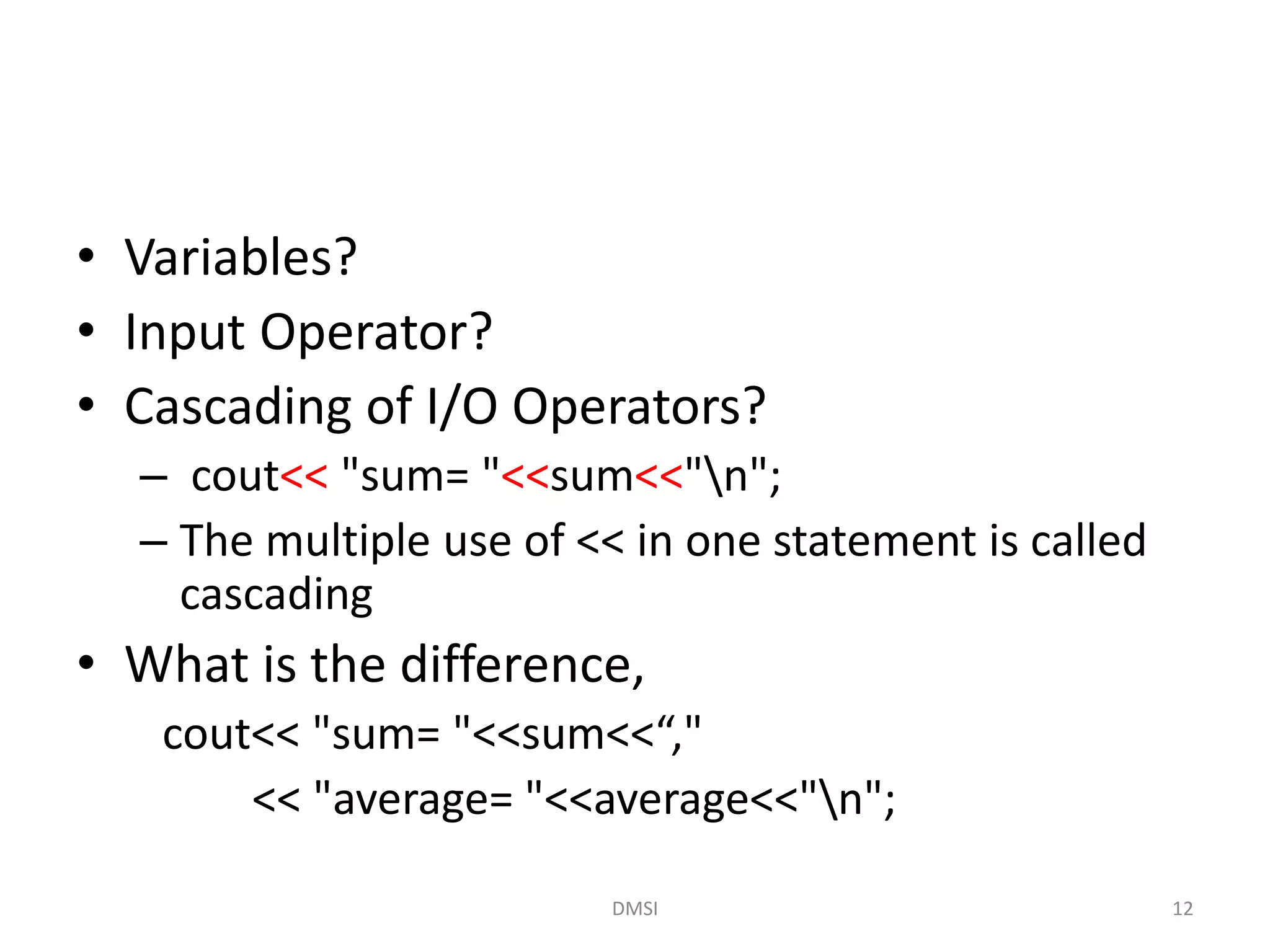
• Variables?
• Input Operator?
• Cascading of I/O Operators?
– cout<< "sum= "<<sum<<"n";
– The multiple use of << in one statement is called
cascading
• What is the difference,
cout<< "sum= "<<sum<<“,"
<< "average= "<<average<<"n";
DMSI 12
Class
#include <iostream>
using namespace std;
class person
{
char name[30];
int age;
public:
void getdata(void);
void display(void);
};
void person:: getdata(void)
{
cout<<"enter the namen";
cin>> name;
cout<<"enter the agen";
cin>>age;
}
void person:: display(void)
{
cout<<"Name of the person:
"<<name<<"n";
cout<<"Age of the person:
"<<age<<"n";
}
int main()
{
person p;
p.getdata();
p.display();
return 0;
}
Class (cont.)
• Class person has two two functions called
member function.
• The main program uses person to declare
variables of its type.
• Here P is an object of type person.
Classes in Java:
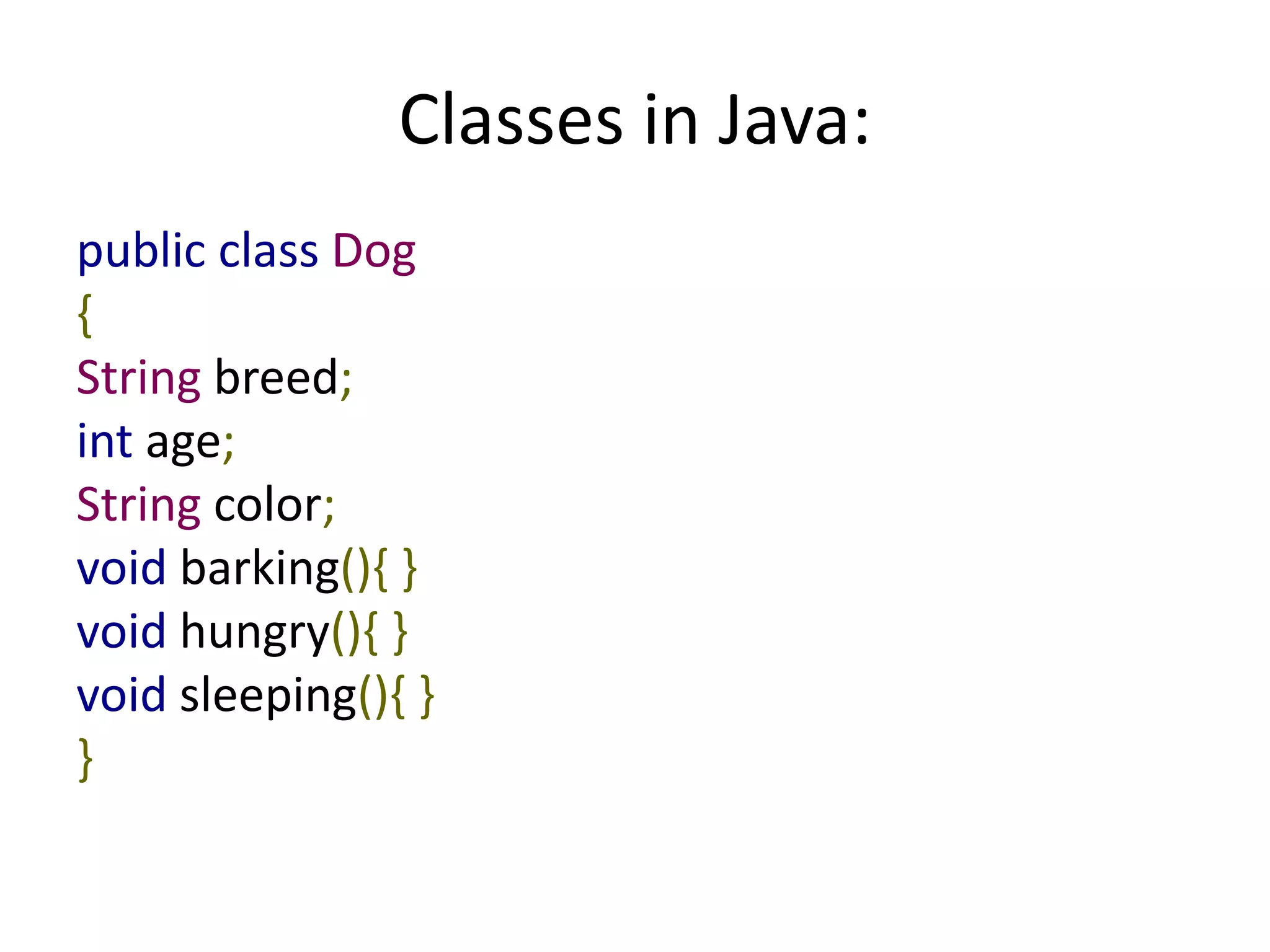
public class Dog
{
String breed;
int age;
String color;
void barking(){ }
void hungry(){ }
void sleeping(){ }
}
Structure of C++ program
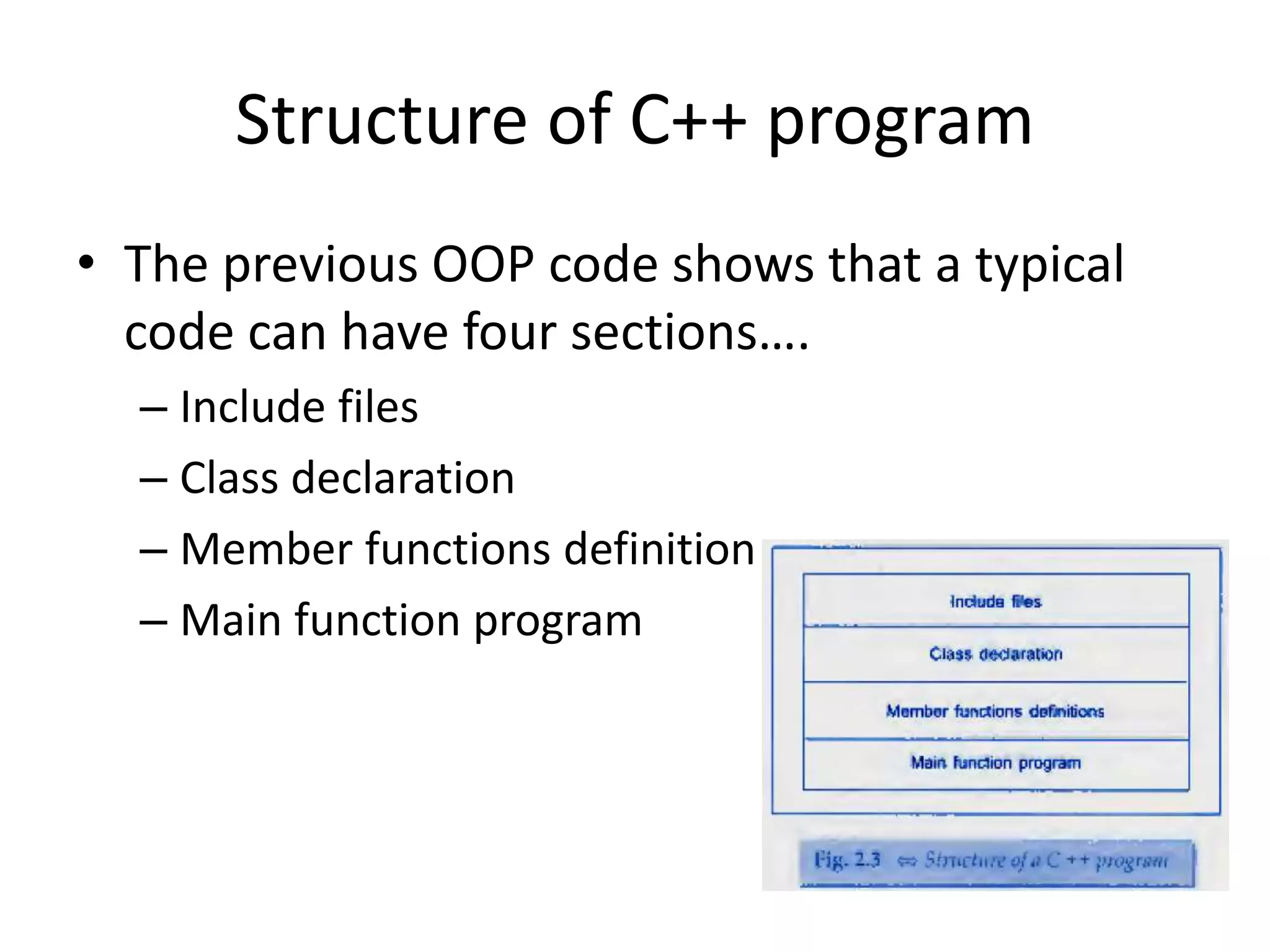
• The previous OOP code shows that a typical
code can have four sections….
– Include files
– Class declaration
– Member functions definition
– Main function program
Client-Server model
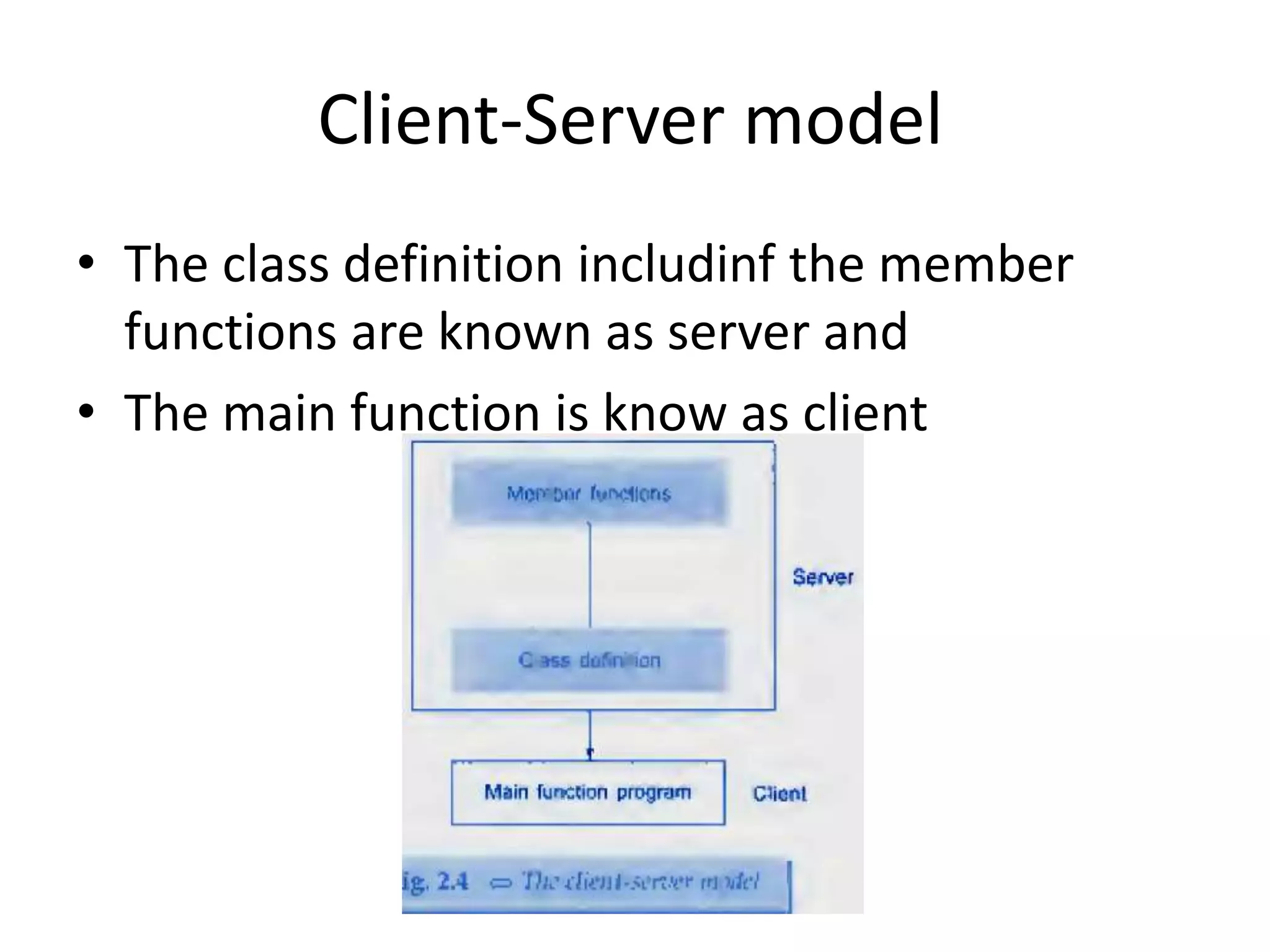
• The class definition includinf the member
functions are known as server and
• The main function is know as client
Creating source file
• In C++ we can use text editor to create it
• In UNIX we can use vi or ed editor
• In dos we can use edlin
• The created file should have appropritae
extension to be recognised.
Compiling and Linking
• The process of compiling and linking again
depends upon the operating system.
• Each system has its own command to run.
DMSI 19

Oop l2

  • 1.
    OOP Lecture-2 Dr. Mohammad ShahidulIslam Assistant professor
  • 2.
    2.1 What isC++ • Its an OOP Language • Introduced by AT&T bell laboratory in 1980’s • Still retains the power of C • Initially it was named as “C with classes” • C++ is a superset of C • Some differences will prevent the C to run in the C++ compiler DMSI 2
  • 3.
    2.1 What isC++ • Important features added over C are classes, inheritance, function overloading and operator overloading. • C++ allows programmers to build large programs with clarity, extensibility, and ease of maintenance incorporating the spirit and efficiency of C • It facilitates(সহজসাধ্য করে ত ালা) bottom up approach which was top down in case of C DMSI 3
  • 4.
    Applications of OOP •OOP language like C++ or JAVA is capable of handling large programs easily • Task includes development of editors, compilers, databases, communication systems and any complex real time systems DMSI 4
  • 5.
    Applications of OOP •Since C++ allows us to create hierarchy-related objects, we can build special object oriented libraries which can be used later by many programmers. • While C++ is able to map the real-world problem properly, the C part of C++ gives the language the ability to get close to the machine-level details. • C++ programs are easily maintainable and expandable. When a new feature needs to be implemented, it is vary easy to add to the exiting structure of an object. DMSI 5
  • 6.
    2.3 A SimpleC++ Program • Printing a string # include <iostream> // include header file using namespace std; Int main() { Cout<< “my name is ………..”; //C++ statement Return 0; } // end of example • Program Features – only one function, main(). //can have more – Like C the C++ statements terminate with semicolons DMSI 6
  • 7.
    Example (cont.) • Comments –C++ introduces a new comment symbol // – Note that there is no closing symbol • for*(j=0; j<n; /* loops n times */ J++) – Can we use double slash? • Output Operator: • two ne C++ features, cout and <<. • The operator << is called the insertion or put to operator DMSI 7
  • 8.
    Output Operator: • Youmay recall that the operator << is the bit-wise left- shift operator and it can still be used for this purpose. • This is an example of how one operator can be used for different purposes, depending on the context. • This concept is known an operator overloading, an important aspect of polymorphism. DMSI 8
  • 9.
    The iostream File •We have used the following #include directive in the program; – # include <iostream> • This directive causes the preprocessor to add the contents of the iostream file to the program. • It contains declarations for the identifier cout and the operator «. • Some old versions of C++ use a header file called ioslream.h. • This is one of the changes introduced by ANSI C++. DMSI 9
  • 10.
    Return Type ofmain ( ) • In C++, main() returns an integer type value to the operating system. • Therefore, every main() in C + + should end with a return(O) statement; otherwise a warning or an error might occur. • Since main() returns an integer type value, return type for main() is explicitly specified as int. Note that the default return type for all functions in C++ is int. • The following main without type and return will run with a warning: • main() { ----- ----- } DMSI 10
  • 11.
    More C+ +Statements #include<iostream> using namespace std; int main() { float v1,v2,sum, average; cout<< "entr the numversn"; cin>> v1; cin>> v2; sum=v1+v2; average=sum/2; cout<< "sum= "<<sum<<"n"; cout<< "average= "<<average<<"n"; return 0; } DMSI 11
  • 12.
    • Variables? • InputOperator? • Cascading of I/O Operators? – cout<< "sum= "<<sum<<"n"; – The multiple use of << in one statement is called cascading • What is the difference, cout<< "sum= "<<sum<<“," << "average= "<<average<<"n"; DMSI 12
  • 13.
    Class #include <iostream> using namespacestd; class person { char name[30]; int age; public: void getdata(void); void display(void); }; void person:: getdata(void) { cout<<"enter the namen"; cin>> name; cout<<"enter the agen"; cin>>age; } void person:: display(void) { cout<<"Name of the person: "<<name<<"n"; cout<<"Age of the person: "<<age<<"n"; } int main() { person p; p.getdata(); p.display(); return 0; }
  • 14.
    Class (cont.) • Classperson has two two functions called member function. • The main program uses person to declare variables of its type. • Here P is an object of type person.
  • 15.
    Classes in Java: publicclass Dog { String breed; int age; String color; void barking(){ } void hungry(){ } void sleeping(){ } }
  • 16.
    Structure of C++program • The previous OOP code shows that a typical code can have four sections…. – Include files – Class declaration – Member functions definition – Main function program
  • 17.
    Client-Server model • Theclass definition includinf the member functions are known as server and • The main function is know as client
  • 18.
    Creating source file •In C++ we can use text editor to create it • In UNIX we can use vi or ed editor • In dos we can use edlin • The created file should have appropritae extension to be recognised.
  • 19.
    Compiling and Linking •The process of compiling and linking again depends upon the operating system. • Each system has its own command to run. DMSI 19