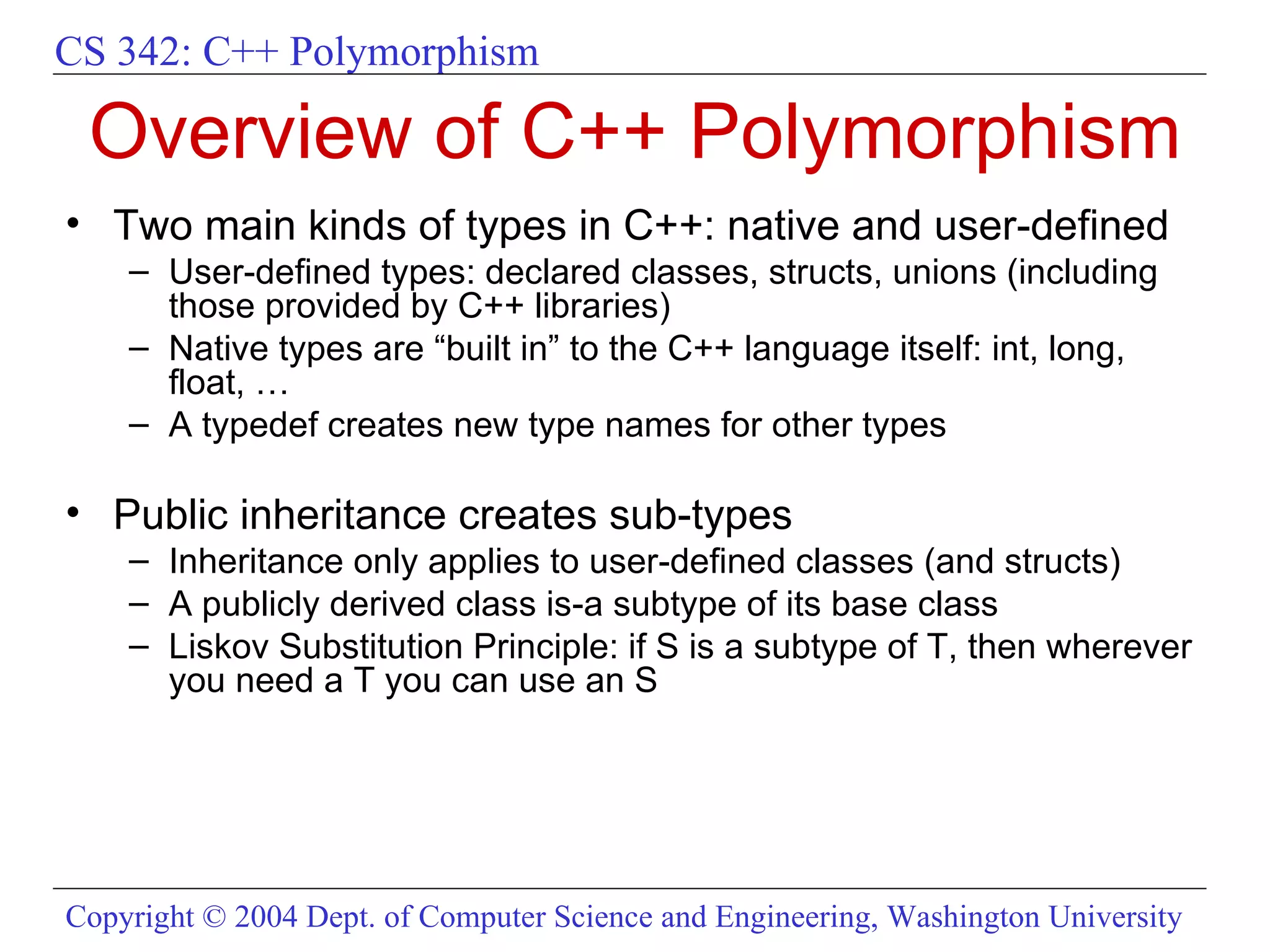
Overview of C++ Polymorphism Two main kinds of types in C++: native and user-defined User-defined types: declared classes, structs, unions (including those provided by C++ libraries) Native types are “built in” to the C++ language itself: int, long, float, … A typedef creates new type names for other types Public inheritance creates sub-types Inheritance only applies to user-defined classes (and structs) A publicly derived class is-a subtype of its base class Liskov Substitution Principle: if S is a subtype of T, then wherever you need a T you can use an S
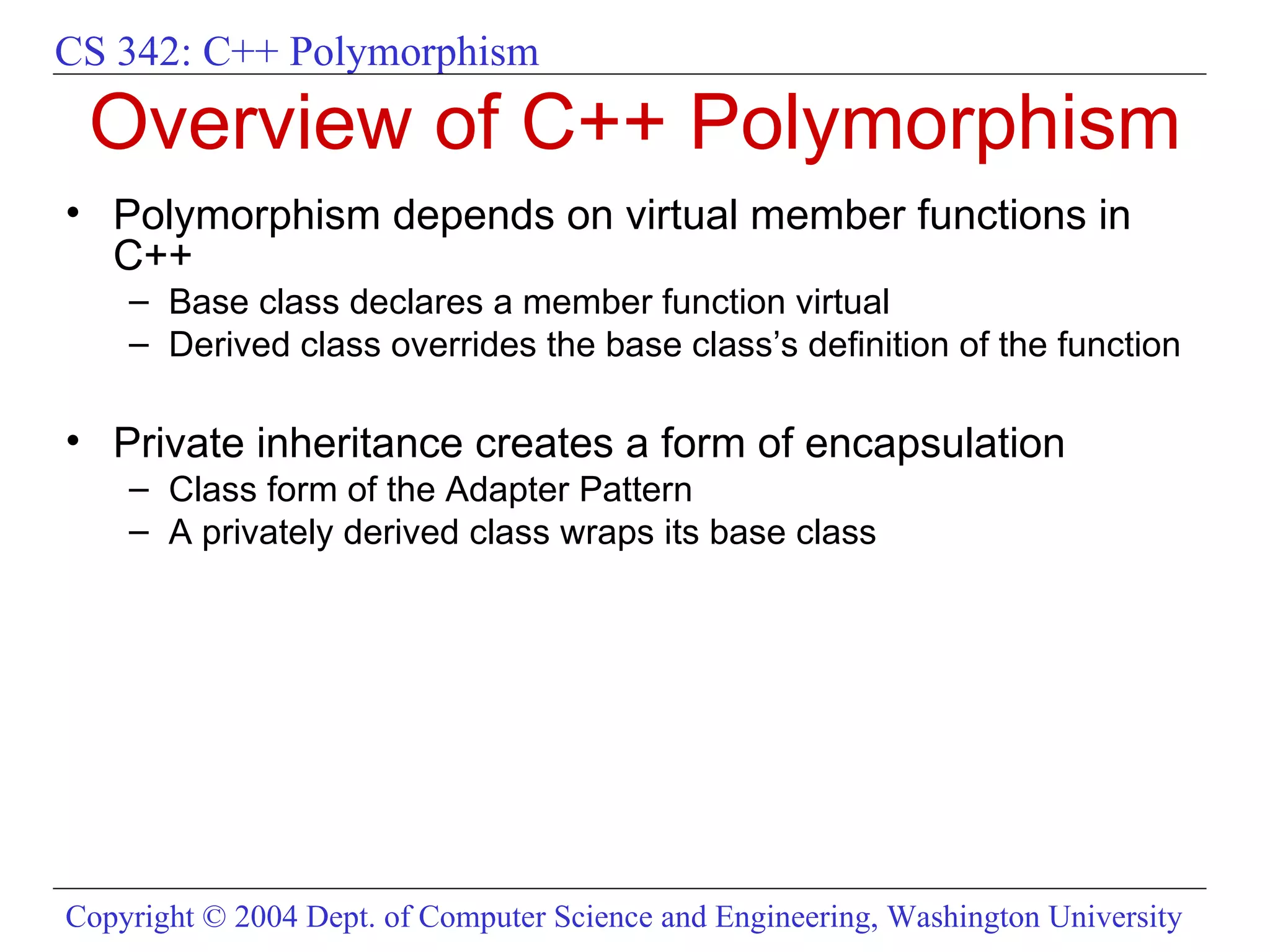
Overview of C++ Polymorphism Polymorphism depends on virtual member functions in C++ Base class declares a member function virtual Derived class overrides the base class’s definition of the function  Private inheritance creates a form of encapsulation  Class form of the Adapter Pattern A privately derived class wraps its base class
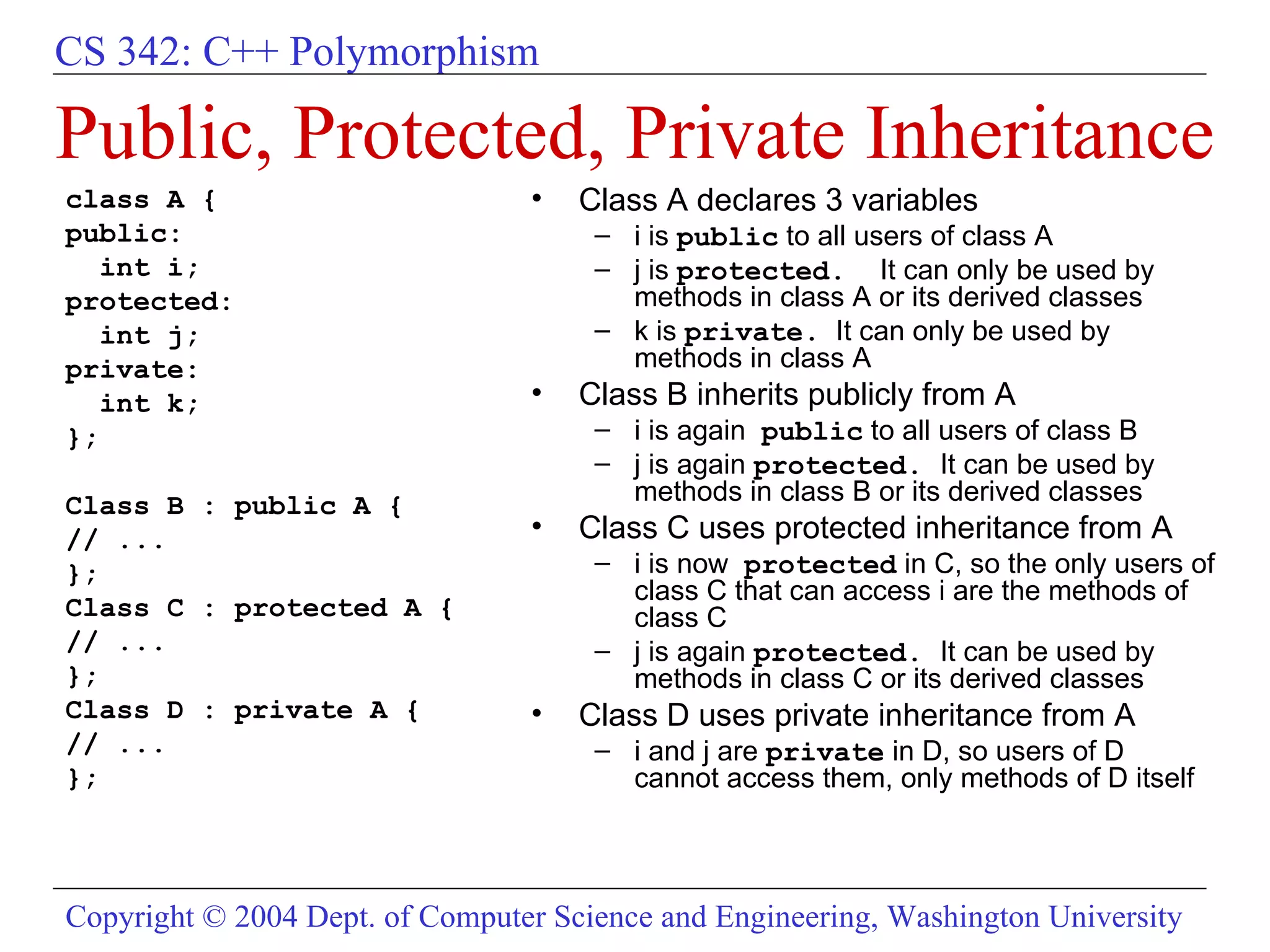
Public, Protected, Private Inheritance class A { public:  int i; protected:  int j; private:  int k; }; Class B : public A {  // ... }; Class C : protected A { // ... }; Class D : private A { // ... }; Class A declares 3 variables  i is  public  to all users of class A j is  protected.  It can only be used by methods in class A or its derived classes k is  private.   It can only be used by methods in class A Class B inherits publicly from A i is again  public  to all users of class B j is again  protected.  It can be used by methods in class B or its derived classes Class C uses protected inheritance from A i is now  protected  in C, so the only users of class C that can access i are the methods of class C  j is again  protected.  It can be used by methods in class C or its derived classes Class D uses private inheritance from A i and j are  private  in D, so users of D cannot access them, only methods of D itself
Inheritance & Constructor Ordering class A { public: A(int i) :m_i(i) { cout << &quot;A“ << endl;} ~A() {cout<<&quot;~A&quot;<<endl;} private:  int m_i; }; class B : public A { public: B(int i, int j) :A(i), m_j(j) { cout << “B” << endl;} ~B() {cout << “~B” << endl;} private:  int m_j_; }; int main (int, char *[]) { B b(2,3); return 0; }; Class and member construction order  B constructor called on object b in main Passes integer values 2 and 3 B constructor calls A constructor passes value 2 to A constructor via initializer list A constructor initializes member  m_i   with passed value 2 Body of A constructor runs outputs “A” B constructor initializes member  m_j with passed value 3 Body of B constructor runs outputs “B”
Inheritance & Destructor Ordering class A { public: A(int i) :m_i(i) { cout << &quot;A“ << endl;} ~A() {cout<<&quot;~A&quot;<<endl;} private:  int m_i; }; class B : public A { public: B(int i, int j) :A(i), m_j(j) { cout << “B” << endl;} ~B() {cout << “~B” << endl;} private:  int m_j_; }; int main (int, char *[]) { B b(2,3); return 0; }; Class and member destructor order:  B destructor called on object b in main Body of B destructor runs outputs “~B” B destructor calls member  m_j  “destructor” int  is a built-in type, so it’s a no-op B destructor calls A destructor Body of A destructor runs outputs “~A” A destructor calls member  m_i  destructor  again a no-op Compare dtor and ctor order at the level of each class, the order of steps is reversed in ctor vs. dtor ctor: base class, members, body dtor: body, members, base class
Virtual Functions class A { public: A () {cout<<&quot; A&quot;;} virtual ~A () {cout<<&quot; ~A&quot;;} }; class B : public A { public: B () :A() {cout<<&quot; B&quot;;} virtual ~B() {cout<<&quot; ~B&quot;;} }; int main (int, char *[]) { // prints &quot;A B&quot; A *ap = new B; // prints &quot;~B ~A&quot; : would only // print &quot;~A&quot; if non-virtual delete ap; return 0; }; Used to support polymorphism with pointers and references Declared virtual in a base class Can be overridden in derived class Overriding only happens when signatures are the same Otherwise it just overloads the function or operator name Ensures derived class function definition is resolved dynamically E.g., that destructors farther down the hierarchy get called
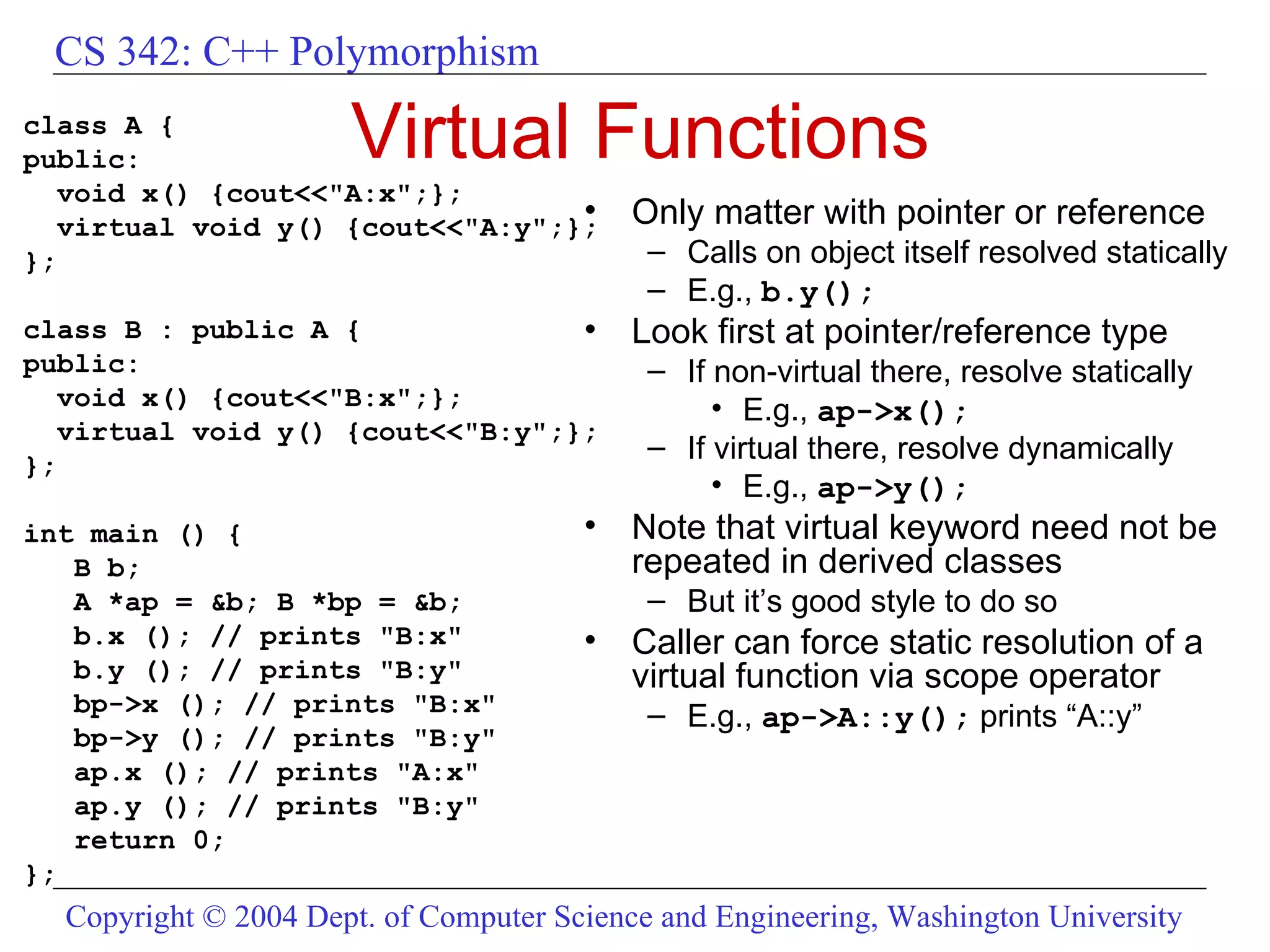
Virtual Functions class A { public: void x() {cout<<&quot;A:x&quot;;}; virtual void y() {cout<<&quot;A:y&quot;;}; }; class B : public A { public: void x() {cout<<&quot;B:x&quot;;}; virtual void y() {cout<<&quot;B:y&quot;;}; }; int main () { B b; A *ap = &b; B *bp = &b; b.x (); // prints &quot;B:x&quot; b.y (); // prints &quot;B:y&quot; bp->x (); // prints &quot;B:x&quot; bp->y (); // prints &quot;B:y&quot; ap.x (); // prints &quot;A:x&quot; ap.y (); // prints &quot;B:y&quot; return 0; }; Only matter with pointer or reference Calls on object itself resolved statically E.g.,  b.y(); Look first at pointer/reference type If non-virtual there, resolve statically E.g.,  ap->x(); If virtual there, resolve dynamically E.g.,  ap->y(); Note that virtual keyword need not be repeated in derived classes But it’s good style to do so Caller can force static resolution of a virtual function via scope operator E.g.,  ap->A::y();  prints “A::y”
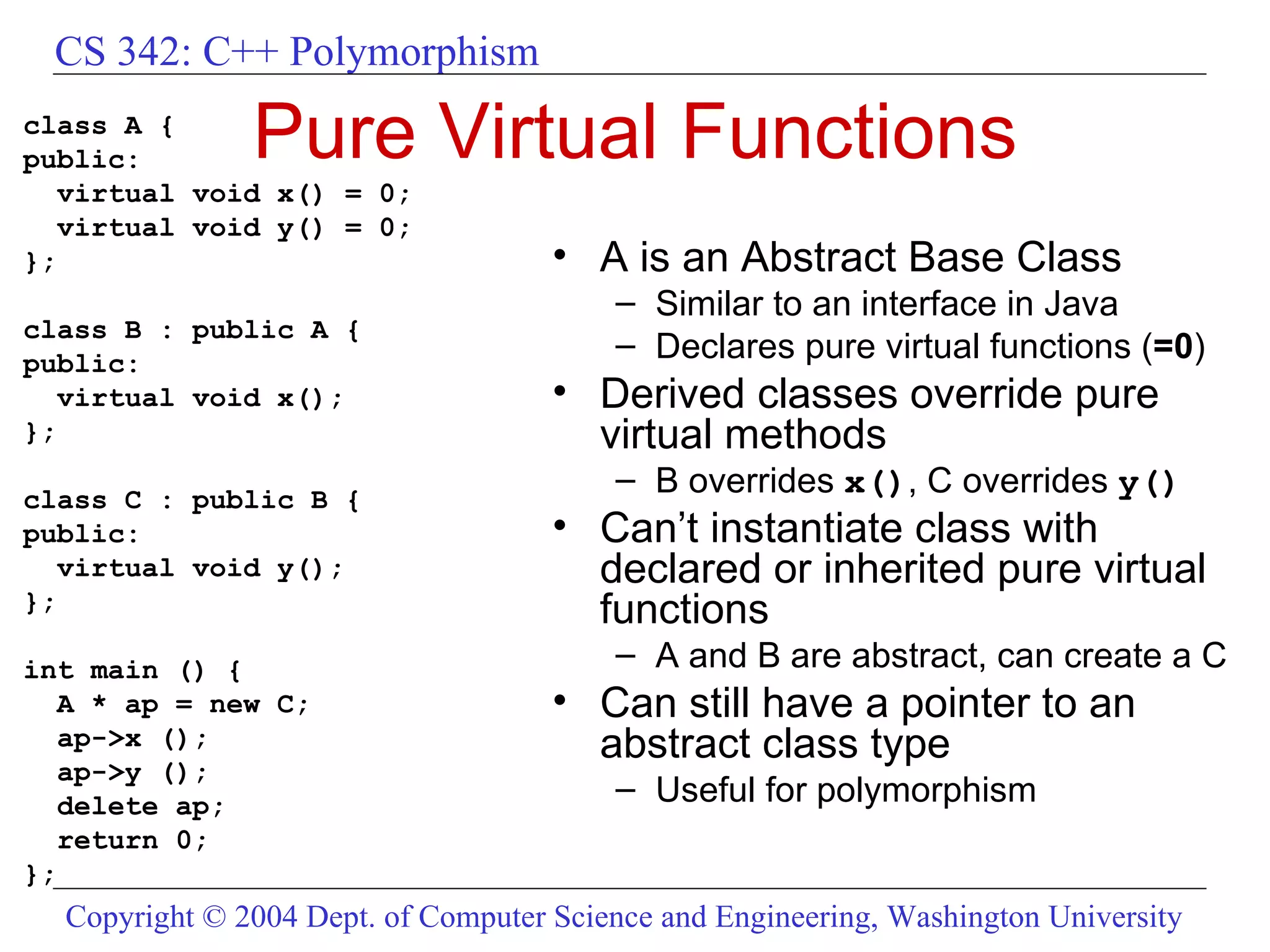
Pure Virtual Functions class A { public: virtual void x() = 0; virtual void y() = 0; }; class B : public A { public: virtual void x(); }; class C : public B { public: virtual void y(); }; int main () { A * ap = new C; ap->x (); ap->y (); delete ap; return 0; }; A is an Abstract Base Class Similar to an interface in Java Declares pure virtual functions ( =0 ) Derived classes override pure virtual methods B overrides  x() , C overrides  y() Can’t instantiate class with declared or inherited pure virtual functions A and B are abstract, can create a C Can still have a pointer to an abstract class type Useful for polymorphism
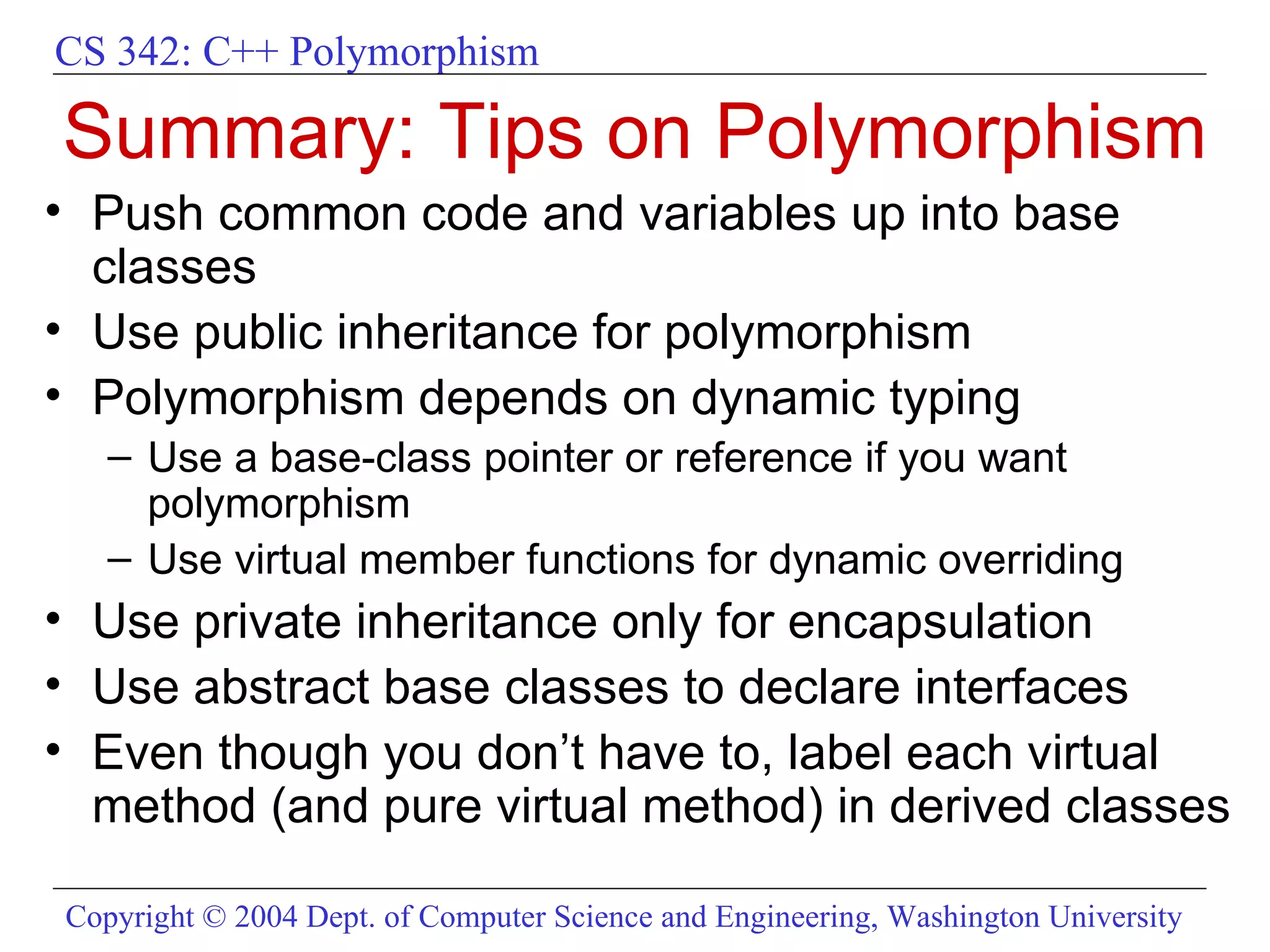
Summary: Tips on Polymorphism Push common code and variables up into base classes Use public inheritance for polymorphism Polymorphism depends on dynamic typing Use a base-class pointer or reference if you want polymorphism Use virtual member functions for dynamic overriding Use private inheritance only for encapsulation Use abstract base classes to declare interfaces Even though you don’t have to, label each virtual method (and pure virtual method) in derived classes

C++ polymorphism

  • 1.
    Overview of C++Polymorphism Two main kinds of types in C++: native and user-defined User-defined types: declared classes, structs, unions (including those provided by C++ libraries) Native types are “built in” to the C++ language itself: int, long, float, … A typedef creates new type names for other types Public inheritance creates sub-types Inheritance only applies to user-defined classes (and structs) A publicly derived class is-a subtype of its base class Liskov Substitution Principle: if S is a subtype of T, then wherever you need a T you can use an S
  • 2.
    Overview of C++Polymorphism Polymorphism depends on virtual member functions in C++ Base class declares a member function virtual Derived class overrides the base class’s definition of the function Private inheritance creates a form of encapsulation Class form of the Adapter Pattern A privately derived class wraps its base class
  • 3.
    Public, Protected, PrivateInheritance class A { public: int i; protected: int j; private: int k; }; Class B : public A { // ... }; Class C : protected A { // ... }; Class D : private A { // ... }; Class A declares 3 variables i is public to all users of class A j is protected. It can only be used by methods in class A or its derived classes k is private. It can only be used by methods in class A Class B inherits publicly from A i is again public to all users of class B j is again protected. It can be used by methods in class B or its derived classes Class C uses protected inheritance from A i is now protected in C, so the only users of class C that can access i are the methods of class C j is again protected. It can be used by methods in class C or its derived classes Class D uses private inheritance from A i and j are private in D, so users of D cannot access them, only methods of D itself
  • 4.
    Inheritance & ConstructorOrdering class A { public: A(int i) :m_i(i) { cout << &quot;A“ << endl;} ~A() {cout<<&quot;~A&quot;<<endl;} private: int m_i; }; class B : public A { public: B(int i, int j) :A(i), m_j(j) { cout << “B” << endl;} ~B() {cout << “~B” << endl;} private: int m_j_; }; int main (int, char *[]) { B b(2,3); return 0; }; Class and member construction order B constructor called on object b in main Passes integer values 2 and 3 B constructor calls A constructor passes value 2 to A constructor via initializer list A constructor initializes member m_i with passed value 2 Body of A constructor runs outputs “A” B constructor initializes member m_j with passed value 3 Body of B constructor runs outputs “B”
  • 5.
    Inheritance & DestructorOrdering class A { public: A(int i) :m_i(i) { cout << &quot;A“ << endl;} ~A() {cout<<&quot;~A&quot;<<endl;} private: int m_i; }; class B : public A { public: B(int i, int j) :A(i), m_j(j) { cout << “B” << endl;} ~B() {cout << “~B” << endl;} private: int m_j_; }; int main (int, char *[]) { B b(2,3); return 0; }; Class and member destructor order: B destructor called on object b in main Body of B destructor runs outputs “~B” B destructor calls member m_j “destructor” int is a built-in type, so it’s a no-op B destructor calls A destructor Body of A destructor runs outputs “~A” A destructor calls member m_i destructor again a no-op Compare dtor and ctor order at the level of each class, the order of steps is reversed in ctor vs. dtor ctor: base class, members, body dtor: body, members, base class
  • 6.
    Virtual Functions classA { public: A () {cout<<&quot; A&quot;;} virtual ~A () {cout<<&quot; ~A&quot;;} }; class B : public A { public: B () :A() {cout<<&quot; B&quot;;} virtual ~B() {cout<<&quot; ~B&quot;;} }; int main (int, char *[]) { // prints &quot;A B&quot; A *ap = new B; // prints &quot;~B ~A&quot; : would only // print &quot;~A&quot; if non-virtual delete ap; return 0; }; Used to support polymorphism with pointers and references Declared virtual in a base class Can be overridden in derived class Overriding only happens when signatures are the same Otherwise it just overloads the function or operator name Ensures derived class function definition is resolved dynamically E.g., that destructors farther down the hierarchy get called
  • 7.
    Virtual Functions classA { public: void x() {cout<<&quot;A:x&quot;;}; virtual void y() {cout<<&quot;A:y&quot;;}; }; class B : public A { public: void x() {cout<<&quot;B:x&quot;;}; virtual void y() {cout<<&quot;B:y&quot;;}; }; int main () { B b; A *ap = &b; B *bp = &b; b.x (); // prints &quot;B:x&quot; b.y (); // prints &quot;B:y&quot; bp->x (); // prints &quot;B:x&quot; bp->y (); // prints &quot;B:y&quot; ap.x (); // prints &quot;A:x&quot; ap.y (); // prints &quot;B:y&quot; return 0; }; Only matter with pointer or reference Calls on object itself resolved statically E.g., b.y(); Look first at pointer/reference type If non-virtual there, resolve statically E.g., ap->x(); If virtual there, resolve dynamically E.g., ap->y(); Note that virtual keyword need not be repeated in derived classes But it’s good style to do so Caller can force static resolution of a virtual function via scope operator E.g., ap->A::y(); prints “A::y”
  • 8.
    Pure Virtual Functionsclass A { public: virtual void x() = 0; virtual void y() = 0; }; class B : public A { public: virtual void x(); }; class C : public B { public: virtual void y(); }; int main () { A * ap = new C; ap->x (); ap->y (); delete ap; return 0; }; A is an Abstract Base Class Similar to an interface in Java Declares pure virtual functions ( =0 ) Derived classes override pure virtual methods B overrides x() , C overrides y() Can’t instantiate class with declared or inherited pure virtual functions A and B are abstract, can create a C Can still have a pointer to an abstract class type Useful for polymorphism
  • 9.
    Summary: Tips onPolymorphism Push common code and variables up into base classes Use public inheritance for polymorphism Polymorphism depends on dynamic typing Use a base-class pointer or reference if you want polymorphism Use virtual member functions for dynamic overriding Use private inheritance only for encapsulation Use abstract base classes to declare interfaces Even though you don’t have to, label each virtual method (and pure virtual method) in derived classes