1:1 Vision
Primitivo Garcia Elementary School
The vision for 1:1 integration in the classrooms rests with the understanding that the
best computer is the one right here in our heads. The devices in Garcia will be used in
thoughtful, purposeful, and instructional ways. Teachers will be able to note when and
why students are engaged with laptops in their lesson plans as they plan assignments
for its use.
All students Grades 1-6 have functioning laptops for building use only; the laptops do
not go home/leave the building. We have six (6) spare/extra laptops for new students.
The use of the technology requires a different mindset of teachers. What appears to be
a loss of control is really an increase in learning. Allowing students time to work on
purposeful assignments on the laptop while a teacher facilitates the learning is a critical
element of an integrated classroom. Teachers need time to fully develop a technology
enhanced classroom. They need to feel the freedom to fail while attempting and
retrying to integrate technology in instruction and to craft meaningful and purposeful
assignments using the device.
Teachers and students are learning with each other. A supportive and interactive
learning culture exists in the classroom. There is a since of practice in learning the
capabilities of technology in the classroom. Teachers need to stay at it when working
with something new to build and expand their own capacity of technology use. The
administration needs to understand and support the "dip" in trajectory with the 1:1
implementation. It is unrealistic to think that something new will be implemented
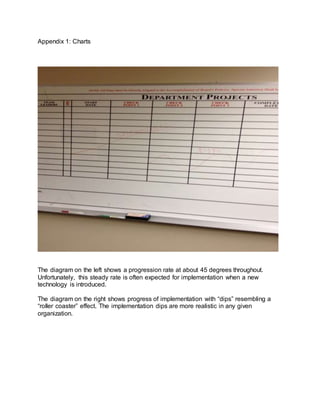
successfully from the start. Garcia is on its way up from a dip. (See chart)
The laptops are instructional tools. Everything cannot be solved by a computer.
Discussion and collaboration are important elements of learning that cannot be done on
a laptop. The process of learning to take notes appropriately during or after a discussion
and saving/filing them takes practice. The ability to attend to the group and participate
in the discussion while taking notes is an important skill. Students and teachers can
work together to practice this skill. Sharing and responding to notes is another
element. The use of Google Docs or other collaborative tools are important for teachers
to know and to utilize. Teachers need to embrace the technology by using it.
There are basic computer skills that come from using the devices in e-collaborative
ways. The technology enhanced assessments require students to underscore, scroll,
toggle, drag and drop, and respond in text boxes. Students and teachers can learn and
practice basic computer and keyboarding skills when everyone in the classroom is using
the device in constructive educational ways. Purposeful assignments include:
 directed research (using credible websites to develop new knowledge and cite its
source)
 evaluate the credibility of websites and make appropriate choices
 compare and contrast two stories
 graph information
 know how and where to find data on their progress on assignments, tests,
homework, and projects
 use graphic organizations such as Venn diagrams, T-charts or Fish bone to
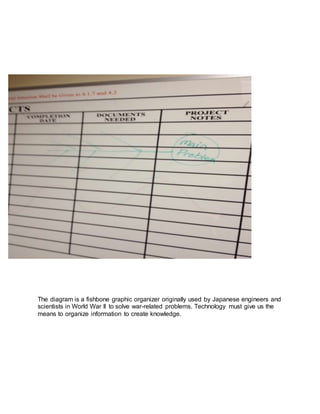
visually add details to understanding or problem-solving (See Fish Bone
example)
It is important for students to be able to see their thinking and to know how to capture
their thoughts and express them in a variety of ways both in print and digitally. Students
need to have an accurate knowledge base, and charting their thinking shows teachers
when to reinforce and encourage thinking or when to identify errors and correct.
Students must be able to organize information electronically to manage assignments
and make sense of the world.
Teachers need to teach right from wrong uses of technology. There is an ethical
dimension of technology that needs to be taught and expected for successful
educational use by teachers and students. Students need to know what are the
appropriate and inappropriate uses of applications on a device. Teachers need to know
that appropriate instructional use of devices is expected of them and of their students.
(See chart)
Technology can facilitate communication, but it cannot replace the value in meeting and
discussing ideas, issues, and concerns with students, fellow teachers, and parents.
Respect and consideration of others are expected in personal and digital
communication.
From this vision, teachers and students can start to make meaningful changes to
teaching and learning. It is expected that Year 2 of the 1:1 implementation will show
evidence of expanded technology integration in each classroom. Teachers will develop
lessons and assignments from the curriculum that utilize the digital resources and
complementary device-based activities.
Students will develop their computer skills through frequent activities and assignments
required by meaningful assignments. They will develop multi-media presentations
available through appropriate applications. Classrooms will have students and teachers
learning and working collaboratively in ways they will come to know and appreciate as
they integrate technology in their educational endeavors.
Appendix 1: Charts
The diagram on the left shows a progression rate at about 45 degrees throughout.
Unfortunately, this steady rate is often expected for implementation when a new
technology is introduced.
The diagram on the right shows progress of implementation with “dips” resembling a
“roller coaster” effect. The implementation dips are more realistic in any given
organization.
The diagram is a fishbone graphic organizer originally used by Japanese engineers and
scientists in World War II to solve war-related problems. Technology must give us the
means to organize information to create knowledge.
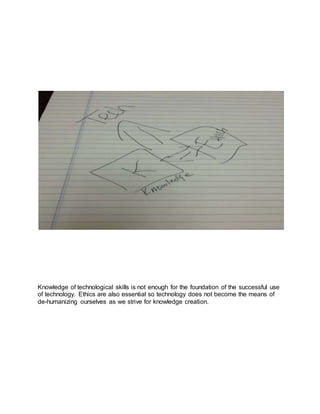
Knowledge of technological skills is not enough for the foundation of the successful use
of technology. Ethics are also essential so technology does not become the means of
de-humanizing ourselves as we strive for knowledge creation.
Technology must constantly be evaluated for its intended and unintended
consequences.
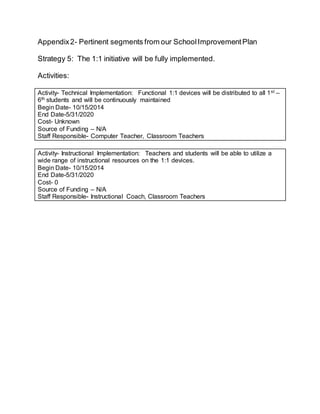
Appendix2- Pertinent segments from our SchoolImprovementPlan
Strategy 5: The 1:1 initiative will be fully implemented.
Activities:
Activity- Technical Implementation: Functional 1:1 devices will be distributed to all 1st –
6th students and will be continuously maintained
Begin Date- 10/15/2014
End Date-5/31/2020
Cost- Unknown
Source of Funding – N/A
Staff Responsible- Computer Teacher, Classroom Teachers
Activity- Instructional Implementation: Teachers and students will be able to utilize a
wide range of instructional resources on the 1:1 devices.
Begin Date- 10/15/2014
End Date-5/31/2020
Cost- 0
Source of Funding – N/A
Staff Responsible- Instructional Coach, Classroom Teachers

One-to-One Vision

  • 1.
    1:1 Vision Primitivo GarciaElementary School The vision for 1:1 integration in the classrooms rests with the understanding that the best computer is the one right here in our heads. The devices in Garcia will be used in thoughtful, purposeful, and instructional ways. Teachers will be able to note when and why students are engaged with laptops in their lesson plans as they plan assignments for its use. All students Grades 1-6 have functioning laptops for building use only; the laptops do not go home/leave the building. We have six (6) spare/extra laptops for new students. The use of the technology requires a different mindset of teachers. What appears to be a loss of control is really an increase in learning. Allowing students time to work on purposeful assignments on the laptop while a teacher facilitates the learning is a critical element of an integrated classroom. Teachers need time to fully develop a technology enhanced classroom. They need to feel the freedom to fail while attempting and retrying to integrate technology in instruction and to craft meaningful and purposeful assignments using the device. Teachers and students are learning with each other. A supportive and interactive learning culture exists in the classroom. There is a since of practice in learning the capabilities of technology in the classroom. Teachers need to stay at it when working with something new to build and expand their own capacity of technology use. The administration needs to understand and support the "dip" in trajectory with the 1:1 implementation. It is unrealistic to think that something new will be implemented successfully from the start. Garcia is on its way up from a dip. (See chart) The laptops are instructional tools. Everything cannot be solved by a computer. Discussion and collaboration are important elements of learning that cannot be done on a laptop. The process of learning to take notes appropriately during or after a discussion and saving/filing them takes practice. The ability to attend to the group and participate in the discussion while taking notes is an important skill. Students and teachers can work together to practice this skill. Sharing and responding to notes is another element. The use of Google Docs or other collaborative tools are important for teachers to know and to utilize. Teachers need to embrace the technology by using it. There are basic computer skills that come from using the devices in e-collaborative ways. The technology enhanced assessments require students to underscore, scroll, toggle, drag and drop, and respond in text boxes. Students and teachers can learn and practice basic computer and keyboarding skills when everyone in the classroom is using the device in constructive educational ways. Purposeful assignments include:  directed research (using credible websites to develop new knowledge and cite its source)  evaluate the credibility of websites and make appropriate choices
  • 2.
     compare andcontrast two stories  graph information  know how and where to find data on their progress on assignments, tests, homework, and projects  use graphic organizations such as Venn diagrams, T-charts or Fish bone to visually add details to understanding or problem-solving (See Fish Bone example) It is important for students to be able to see their thinking and to know how to capture their thoughts and express them in a variety of ways both in print and digitally. Students need to have an accurate knowledge base, and charting their thinking shows teachers when to reinforce and encourage thinking or when to identify errors and correct. Students must be able to organize information electronically to manage assignments and make sense of the world. Teachers need to teach right from wrong uses of technology. There is an ethical dimension of technology that needs to be taught and expected for successful educational use by teachers and students. Students need to know what are the appropriate and inappropriate uses of applications on a device. Teachers need to know that appropriate instructional use of devices is expected of them and of their students. (See chart) Technology can facilitate communication, but it cannot replace the value in meeting and discussing ideas, issues, and concerns with students, fellow teachers, and parents. Respect and consideration of others are expected in personal and digital communication. From this vision, teachers and students can start to make meaningful changes to teaching and learning. It is expected that Year 2 of the 1:1 implementation will show evidence of expanded technology integration in each classroom. Teachers will develop lessons and assignments from the curriculum that utilize the digital resources and complementary device-based activities. Students will develop their computer skills through frequent activities and assignments required by meaningful assignments. They will develop multi-media presentations available through appropriate applications. Classrooms will have students and teachers learning and working collaboratively in ways they will come to know and appreciate as they integrate technology in their educational endeavors.
  • 3.
    Appendix 1: Charts Thediagram on the left shows a progression rate at about 45 degrees throughout. Unfortunately, this steady rate is often expected for implementation when a new technology is introduced. The diagram on the right shows progress of implementation with “dips” resembling a “roller coaster” effect. The implementation dips are more realistic in any given organization.
  • 4.
    The diagram isa fishbone graphic organizer originally used by Japanese engineers and scientists in World War II to solve war-related problems. Technology must give us the means to organize information to create knowledge.
  • 5.
    Knowledge of technologicalskills is not enough for the foundation of the successful use of technology. Ethics are also essential so technology does not become the means of de-humanizing ourselves as we strive for knowledge creation.
  • 6.
    Technology must constantlybe evaluated for its intended and unintended consequences.
  • 7.
    Appendix2- Pertinent segmentsfrom our SchoolImprovementPlan Strategy 5: The 1:1 initiative will be fully implemented. Activities: Activity- Technical Implementation: Functional 1:1 devices will be distributed to all 1st – 6th students and will be continuously maintained Begin Date- 10/15/2014 End Date-5/31/2020 Cost- Unknown Source of Funding – N/A Staff Responsible- Computer Teacher, Classroom Teachers Activity- Instructional Implementation: Teachers and students will be able to utilize a wide range of instructional resources on the 1:1 devices. Begin Date- 10/15/2014 End Date-5/31/2020 Cost- 0 Source of Funding – N/A Staff Responsible- Instructional Coach, Classroom Teachers