The
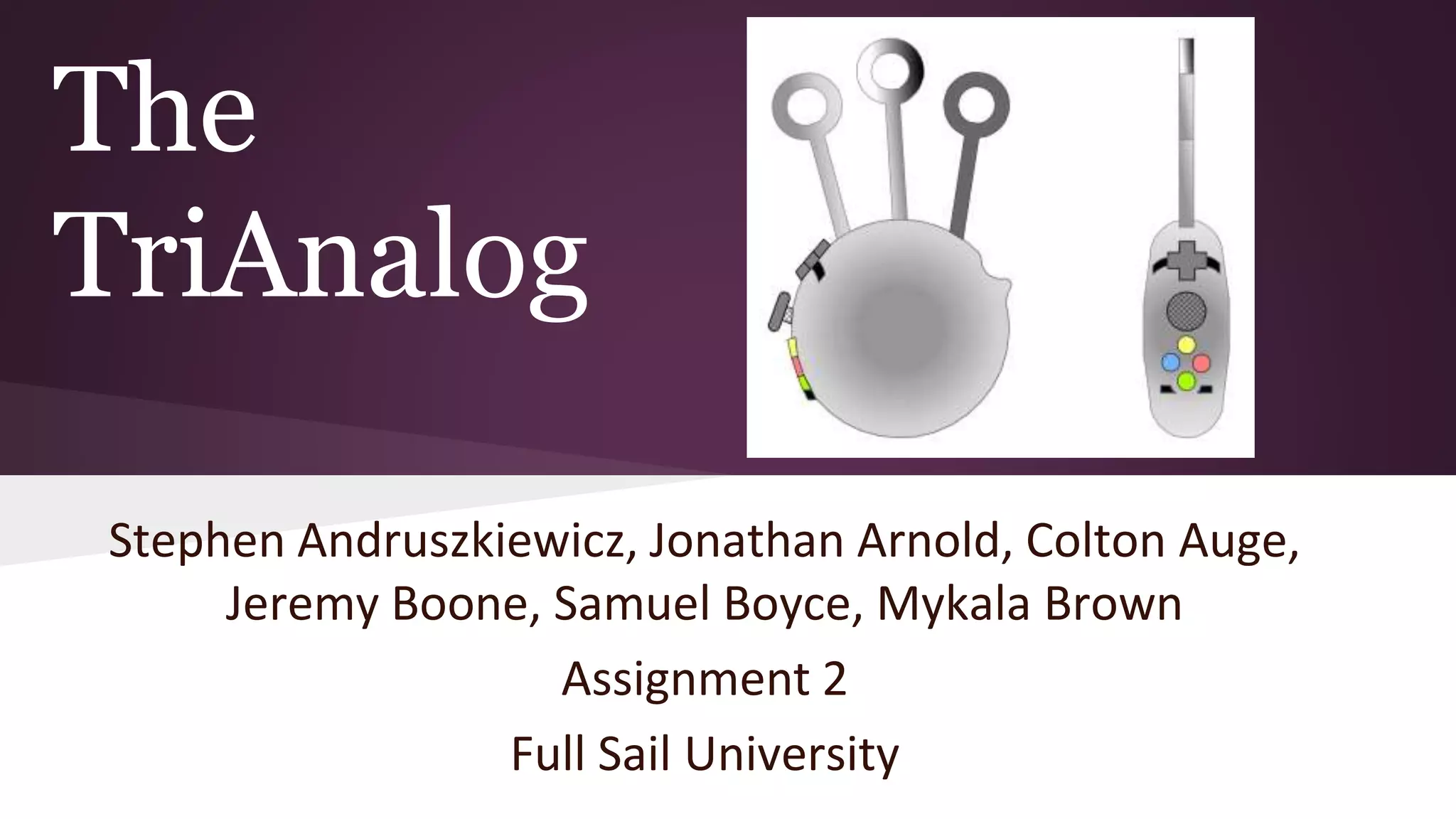
TriAnalog
Stephen Andruszkiewicz, Jonathan Arnold, Colton Auge,
Jeremy Boone, Samuel Boyce, Mykala Brown
Assignment 2
Full Sail University
Abstract
This presentation shows the design for a controller
that can be used for a person with one hand. The
inspiration and design methodology is shared as
well as design assumptions. Schematics for the
design as well as a prototype are shown. Three
games are mapped to the buttons on the controller.
A Post Mortem discusses what went right and
wrong during the design process.
Introduction
Video games are an endless source of entertainment and a great way
to bond with friends and family. For many, video games are a part
of their everyday life. However, thousands of people are never able
to play games or have the ability taken away from them by an illness
or tragic accident.
Players with physical disabilities have a simple problem: they’re
unable to properly use mainstream controllers. By designing new
controllers built with their disabilities in mind, players are given the
opportunity to play the games they have been missing.
Design Purpose
Many of today’s controllers are designed and built with two
hands in mind, which makes them challenging to use for
people who only have the use of one hand. Our goal is to
create a controller that is comfortable and functional while
keeping their particular needs in mind. These needs include
multiple-use buttons, cross-platform functionality, and
being comfortable and easy to use. Our design will allow
our users to experience games the way they’re meant to be
experienced.
Inspiration
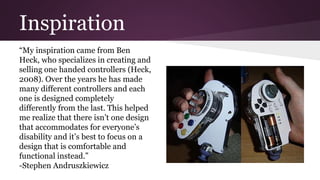
“My inspiration came from Ben
Heck, who specializes in creating and
selling one handed controllers (Heck,
2008). Over the years he has made
many different controllers and each
one is designed completely
differently from the last. This helped
me realize that there isn’t one design
that accommodates for everyone’s
disability and it’s best to focus on a
design that is comfortable and
functional instead.”
-Stephen Andruszkiewicz
Inspiration (cont.)
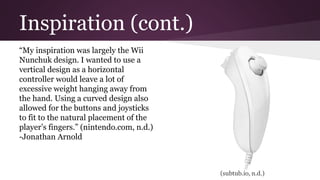
“My inspiration was largely the Wii
Nunchuk design. I wanted to use a
vertical design as a horizontal
controller would leave a lot of
excessive weight hanging away from
the hand. Using a curved design also
allowed for the buttons and joysticks
to fit to the natural placement of the
player’s fingers.” (nintendo.com, n.d.)
-Jonathan Arnold
(subtub.io, n.d.)
Inspiration (cont.)
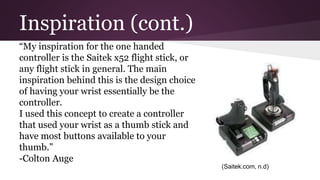
“My inspiration for the one handed
controller is the Saitek x52 flight stick, or
any flight stick in general. The main
inspiration behind this is the design choice
of having your wrist essentially be the
controller.
I used this concept to create a controller
that used your wrist as a thumb stick and
have most buttons available to your
thumb.”
-Colton Auge
(Saitek.com, n.d)
Inspiration (cont.)
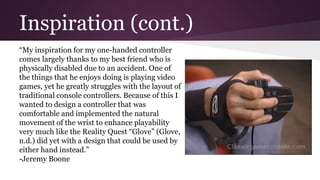
“My inspiration for my one-handed controller
comes largely thanks to my best friend who is
physically disabled due to an accident. One of
the things that he enjoys doing is playing video
games, yet he greatly struggles with the layout of
traditional console controllers. Because of this I
wanted to design a controller that was
comfortable and implemented the natural
movement of the wrist to enhance playability
very much like the Reality Quest “Glove” (Glove,
n.d.) did yet with a design that could be used by
either hand instead.”
-Jeremy Boone
Inspiration (cont.)
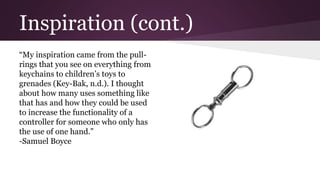
“My inspiration came from the pull-
rings that you see on everything from
keychains to children’s toys to
grenades (Key-Bak, n.d.). I thought
about how many uses something like
that has and how they could be used
to increase the functionality of a
controller for someone who only has
the use of one hand.”
-Samuel Boyce
Inspiration (cont.)
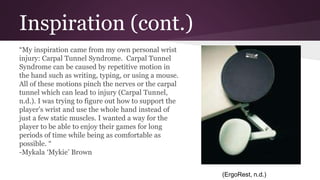
“My inspiration came from my own personal wrist
injury: Carpal Tunnel Syndrome. Carpal Tunnel
Syndrome can be caused by repetitive motion in
the hand such as writing, typing, or using a mouse.
All of these motions pinch the nerves or the carpal
tunnel which can lead to injury (Carpal Tunnel,
n.d.). I was trying to figure out how to support the
player’s wrist and use the whole hand instead of
just a few static muscles. I wanted a way for the
player to be able to enjoy their games for long
periods of time while being as comfortable as
possible. “
-Mykala ‘Mykie’ Brown
(ErgoRest, n.d.)
Design Method
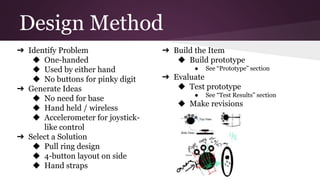
➔ Identify Problem
◆ One-handed
◆ Used by either hand
◆ No buttons for pinky digit
➔ Generate Ideas
◆ No need for base
◆ Hand held / wireless
◆ Accelerometer for joystick-
like control
➔ Select a Solution
◆ Pull ring design
◆ 4-button layout on side
◆ Hand straps
➔ Build the Item
◆ Build prototype
● See “Prototype” section
➔ Evaluate
◆ Test prototype
● See “Test Results” section
◆ Make revisions
Design Method (cont.)
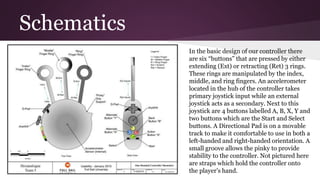
Schematics
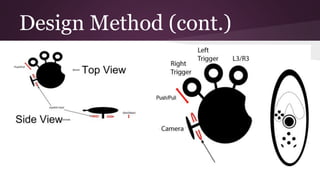
In the basic design of our controller there
are six “buttons” that are pressed by either
extending (Ext) or retracting (Ret) 3 rings.
These rings are manipulated by the index,
middle, and ring fingers. An accelerometer
located in the hub of the controller takes
primary joystick input while an external
joystick acts as a secondary. Next to this
joystick are 4 buttons labelled A, B, X, Y and
two buttons which are the Start and Select
buttons. A Directional Pad is on a movable
track to make it comfortable to use in both a
left-handed and right-handed orientation. A
small groove allows the pinky to provide
stability to the controller. Not pictured here
are straps which hold the controller onto
the player’s hand.
Design Assumptions
“Comfort plays an important role for any controller; it allows the
user to forget the controller is there and get completely
immersed in the game they’re playing (Allison, 2014). It was
important to make sure that our controller felt comfortable and
natural in our player’s hand and didn’t cause any unneeded
discomfort. We created a design that easily fits in the palm of
your hand and can be strapped on almost like a glove it so it feel
as natural to use as possible.”
-Stephen Andruszkiewicz
Design Assumptions
“It is important to not require a base so a player can use it freely
however they like. Using a flat analog stick, much like that of the
PSP or the 3DS, will prevent obstruction of other buttons and
will keep the players fingers closer to the device and therefore
lessen extensive stretching or cramping of the hand. Providing
the player with controller straps will keep the controller from
being fumbled with or dropped.”
-Jonathan Arnold
Design Assumptions
“To me, the freedom of movement and control is important when
considering a accessible controller such as this. In theory,
utilizing the accelerometer as a thumb stick gives the player with
one had the same amount control as a player with a two handed
controller.
This is also considering that a common user used 4 fingers using
a controller. Using the accelerometer this makes one less finger
to design around and makes user control roughly similar to the
base experience.”
-Colton Auge
Design Assumptions
“Because we wanted to create a controller that was completely usable
by just one hand we wanted to make sure to also incorporate a flexible
design that gave players the freedom to easily use it properly with either
the right or left hand. Because of this we believed that the design had to
be mostly symmetrical whether it primarily favored a vertical or
horizontal design so that it could be easily ‘flipped’ depending on which
hand was being used. We believed that if we created an asymmetrical
controller and restricted the design to favor a certain hand that it would
limit it’s versatility and exclude a significant amount of potential
players.”
-Jeremy Boone
Design Assumptions
“The muscles of the hand are complicated and moving
individual digits can be difficult. However, given an
appropriate amount of tension in the ‘buttons’ of the pull
rings I believe we can make a functional controller. The
complexity of these hand muscles also means that the hand
is capable of great flexibility and precise control (Taylor,
n.d.). For this reason I think our basic design is solid.”
-Samuel Boyce
Design Assumptions
“It is important to us that the player should be able to get into any sort of
position they want while they play games. We began to think about how we
played games and many of us mention that we either began to slump down or
lean forward until our forearms rested onto our legs. If we made a controller that
limited the freedom to comfortably play games, there would be problems. We
came up with the wireless USB accelerometer which would allow the player to
have this sort of freedom of moving about. Not only can the player sit how ever
they want, they can also connect it to any platform with a USB port meaning they
do not need to buy multiple controllers for different platforms. With the
accelerometer, the player can reuse the full function of their hand and wrist
without favoring one more than the other creating less strain.”
-Mykala ‘Mykie’ Brown
First-Person Shooter
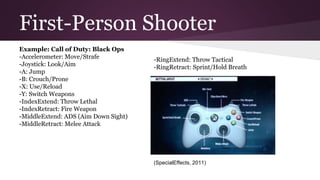
Example: Call of Duty: Black Ops
-Accelerometer: Move/Strafe
-Joystick: Look/Aim
-A: Jump
-B: Crouch/Prone
-X: Use/Reload
-Y: Switch Weapons
-IndexExtend: Throw Lethal
-IndexRetract: Fire Weapon
-MiddleExtend: ADS (Aim Down Sight)
-MiddleRetract: Melee Attack
-RingExtend: Throw Tactical
-RingRetract: Sprint/Hold Breath
(SpecialEffects, 2011)
First-Person Shooter (cont.)
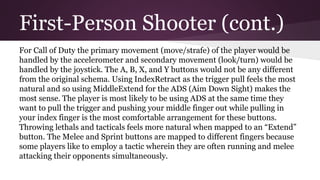
For Call of Duty the primary movement (move/strafe) of the player would be
handled by the accelerometer and secondary movement (look/turn) would be
handled by the joystick. The A, B, X, and Y buttons would not be any different
from the original schema. Using IndexRetract as the trigger pull feels the most
natural and so using MiddleExtend for the ADS (Aim Down Sight) makes the
most sense. The player is most likely to be using ADS at the same time they
want to pull the trigger and pushing your middle finger out while pulling in
your index finger is the most comfortable arrangement for these buttons.
Throwing lethals and tacticals feels more natural when mapped to an “Extend”
button. The Melee and Sprint buttons are mapped to different fingers because
some players like to employ a tactic wherein they are often running and melee
attacking their opponents simultaneously.
Platformer
Platformer games generally share a few key
features: moving platforms, a multitude of
enemies, and fast paced action. For a player to
traverse stages with all of these obstacles and
conditions they must be provided with tight
controls and a comfortable controller. Platformers
also generally utilize few buttons on the
controller. Mega Man uses two face buttons, one
D-pad, and start to access the menu. Using the
entire controller as a joystick allows the player to
easily reach the two face buttons required to
jump and shoot. Because of this a player can
run, jump, and shoot simultaneously with comfort
and ease.
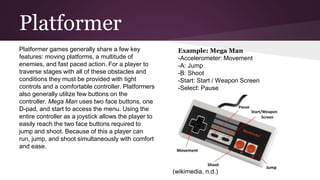
Example: Mega Man
-Accelerometer: Movement
-A: Jump
-B: Shoot
-Start: Start / Weapon Screen
-Select: Pause
(wikimedia, n.d.)
Racing
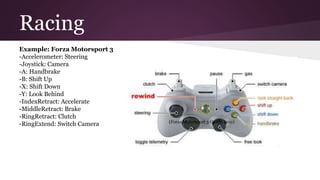
Example: Forza Motorsport 3
-Accelerometer: Steering
-Joystick: Camera
-A: Handbrake
-B: Shift Up
-X: Shift Down
-Y: Look Behind
-IndexRetract: Accelerate
-MiddleRetract: Brake
-RingRetract: Clutch
-RingExtend: Switch Camera (Forza Motorsport 3 Guide, 2011)
Racing (cont.)
Forza Motorsport 3 worked incredibly well with our controller.
The player can use the index and middle trigger to control their
rate of acceleration and deceleration depending on the amount of
pressure they apply. The player can retract the ring trigger and
simultaneously press the face buttons to swap gears without
losing any momentum. Using the accelerometer to steer offers a
whole new dimension of immersion for the player. Every button
on our controller is easily accessible, allowing multiple buttons to
be pressed simultaneously which is vital for preserving the flow
of any racing game.
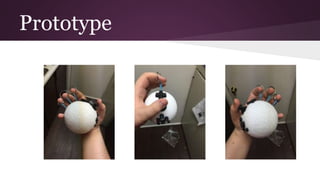
Prototype
Test Results
Upon use of the controller it becomes very apparent that the size
of a hand makes a great factor in the use of the controller, not
just the comfort.
While I was able to make a model which fit my hand, a user with
smaller hands would have difficulty hitting the directional pad
without hitting the thumb stick. The user with smaller hands
would also strain their thumbs reaching the face buttons.
We designed around this, however, with the use of a track which
changes the position of the directional pad to a more natural and
comfortable state.
Post Mortem
What went correctly?
As a team, we all had the basic idea of making sure this was strictly a one handed controller. We didn’t want to hinder the
player’s movements by throwing in pedals for the feet or having some sort of mouthpiece. We gave the player the utmost
freedom when it came to playing games. We all agreed that the controller needs to be able to freely switch from left handed to
right without having to flip a switch or change parts. We kept thinking about the one handed gamers and what would be difficult
for them. We didn’t want them to use their mouth to pull onto straps or having to get assistance just to put together the
controller.
After brainstorming, we finally agreed that Sam’s original idea was the best solution to what we wanted. A controller that was
easy to use and able to switch between left well as right handed without having extra parts. Adding adjustments to Sam’s
original idea came rather quickly as all of our individual ideas were on the same page. We all wanted a way for the player not to
drop the controller which we came up with the straps. We also wanted the D-Pad to be accessible no matter which hand was
being used so we came up with adding a small track so the D-Pad could switch from either side. We chose the track because this
was the only way to have it so the palm wouldn’t accidently be resting onto it.
What was nice with visualizing the final result is that we were all keeping in mind that the thumb only has a limited amount of
movement in spite of the fact that it is the strongest finger so adding in all the necessary buttons that would not be controlled by
the rings came fairly easily and quickly. The last adjustment we came up with was making the controller base rounded yet
having a slight curve, making it feel more natural against the player’s hand as they held onto our controller.
Post Mortem (cont.)
What went incorrectly?
We all had the same sort of idea: making sure the whole hand would be able to use the controls. Yet a problem we ran into was
that several designs had bases. We realized quickly that a gamer would always have to have a table readily available to be able to
place it down and most coffee tables are not chest level. This meant the player would have to lean over to make sure the base was
flat on the coffee table.
Another problem we ran into was the placement of buttons. We had to remember a one handed gamer needs to be able to hold
onto the controller without dropping it while pressing the buttons. Too many buttons and it becomes unstable making it easier for
the player to have the controller fall out of their hand or put strain on their fingers.
One of our other challenges was also dealing with support and balance. We knew that if there weren’t any sort of straps that it
didn’t matter where the placement of the buttons were located, there would still be a high risk that the player would drop the
controller by mistake. At first we thought of using a glove but we determined that the controller would have to be sold with three
different sized gloves. After scrapping that idea we thought of using a single band but even then that still didn’t feel like there
would be enough support.
Once we came up with an idea for the straps we discovered that the pinky was just hanging off to the side. The pinky is not the
strongest finger and having it resting on a curve angle was not idea. We thought of another ring but that seemed to put too much
strain. Another was making a small triangle piece for the pinky to rest on. It took a lot to figure out what would best suit the
player’s need when it came to balance and support which was something we were not expecting to go so wrong so quickly.
Post Mortem (cont.)
What did we learn from this activity?
We all learned that brainstorming can quickly become off topic without us even realizing it. When one person came up
with an idea it would sometimes spark a story that went along with the inspiration which lead to another story.We often
had to get back on track. Brainstorming also taught us that coming up with ideas can lead an entire team running around
in circles overlooking that the perfect idea is right there in front of them. Sometimes the best ideas are not fancy or brand
spanking new. They are old ideas that simply need some tweaking.
Designing a controller for a one handed player is difficult when you have the ability of both hands. This was something
that we kept having to remember while designing our controller. We would come up with brilliant ideas yet as we began to
talk the idea through we quickly discovered that it was more of a hassle than a useful aid.
With brainstorming or designing anything with a team, there is always the problem of agreeing upon the few core ideas of
the design. Some team member may want to go off into a different direction with let’s say the size while the other half
want to keep it as is. There has to be a check and balances in place so that all team members are satisfied well as feel like
they contributed something towards the final product.
References
(n.d.) NES Controller. Retrieved January 18, 2015, from
http://upload.wikimedia.org/wikipedia/commons/8/83/NES-controller.jpg
(n.d.) Nintendo Wii Nunchuk. Retrieved January 17, 2015, from
http://subtub.io/OscControllerKit/Presentation/files/img/nintendo_wii_nunchuk.png
(n.d.) Nintendo Store. Retrieved January 18, 2015, from
https://store.nintendo.com/ng3/browse/productDetailColorSizePicker.jsp?productId=prod150198
Allison, P. (2014, December 12). The surprising uses of games controllers. Retrieved January 18, 2015, from
http://www.bbc.com/future/story/20141212-press-x-press-y-fire-laser
Carpal Tunnel Syndrome Fact Sheet. (2012, July 1). Retrieved January 18, 2015, from
http://www.ninds.nih.gov/disorders/carpal_tunnel/detail_carpal_tunnel.htm
ErgoRest with Mouse Pad. (n.d.). Retrieved January 17, 2015, from http://www.ergonomics.co.uk/ergorest_mouse_pad.html
References (cont.)
Forza Motorsport 3 Guide. (2011, June 17). Retrieved January 17, 2015, from https://sites.google.com/site/forza3guide/home/controls-and-
settings
Heck, B. (2008, March 16). Retrieved January 17, 2015, from http://www.benheck.com/new-single-handed-controller/#more-355
Key-Bak #500 Quick Release Pull-Apart Key Ring and more Key-Bak Accessories at SpecialistID.com. (n.d.). Retrieved January 16, 2015, from
http://www.specialistid.com/Quick_Release_Pull_Apart_Key_Ring_p/500.htm
Playstation Illustrated - Glove (n.d.). Retrieved January 17, 2015 from
http://www.psillustrated.com/psillustrated/hard_rev.php/292/glove-playstation.html
Saitek.com (n.d.) Retrieved from http://www.saitek.com/uk/prod/x52pro.html
SpecialEffect's accessible GameBase. (2011, August 3). Retrieved January 17, 2015, from http://www.gamebase.info/magazine/read/call-of-
duty-black-ops---re-mappingcontroller-game-options_669.html
Taylor, T. (n.d.). Muscles of the Hand and Wrist. Retrieved January 16, 2015, from http://www.innerbody.com/image_skel13/ligm27.html

One Handed Controller Prototype

  • 1.
    The TriAnalog Stephen Andruszkiewicz, JonathanArnold, Colton Auge, Jeremy Boone, Samuel Boyce, Mykala Brown Assignment 2 Full Sail University
  • 2.
    Abstract This presentation showsthe design for a controller that can be used for a person with one hand. The inspiration and design methodology is shared as well as design assumptions. Schematics for the design as well as a prototype are shown. Three games are mapped to the buttons on the controller. A Post Mortem discusses what went right and wrong during the design process.
  • 3.
    Introduction Video games arean endless source of entertainment and a great way to bond with friends and family. For many, video games are a part of their everyday life. However, thousands of people are never able to play games or have the ability taken away from them by an illness or tragic accident. Players with physical disabilities have a simple problem: they’re unable to properly use mainstream controllers. By designing new controllers built with their disabilities in mind, players are given the opportunity to play the games they have been missing.
  • 4.
    Design Purpose Many oftoday’s controllers are designed and built with two hands in mind, which makes them challenging to use for people who only have the use of one hand. Our goal is to create a controller that is comfortable and functional while keeping their particular needs in mind. These needs include multiple-use buttons, cross-platform functionality, and being comfortable and easy to use. Our design will allow our users to experience games the way they’re meant to be experienced.
  • 5.
    Inspiration “My inspiration camefrom Ben Heck, who specializes in creating and selling one handed controllers (Heck, 2008). Over the years he has made many different controllers and each one is designed completely differently from the last. This helped me realize that there isn’t one design that accommodates for everyone’s disability and it’s best to focus on a design that is comfortable and functional instead.” -Stephen Andruszkiewicz
  • 6.
    Inspiration (cont.) “My inspirationwas largely the Wii Nunchuk design. I wanted to use a vertical design as a horizontal controller would leave a lot of excessive weight hanging away from the hand. Using a curved design also allowed for the buttons and joysticks to fit to the natural placement of the player’s fingers.” (nintendo.com, n.d.) -Jonathan Arnold (subtub.io, n.d.)
  • 7.
    Inspiration (cont.) “My inspirationfor the one handed controller is the Saitek x52 flight stick, or any flight stick in general. The main inspiration behind this is the design choice of having your wrist essentially be the controller. I used this concept to create a controller that used your wrist as a thumb stick and have most buttons available to your thumb.” -Colton Auge (Saitek.com, n.d)
  • 8.
    Inspiration (cont.) “My inspirationfor my one-handed controller comes largely thanks to my best friend who is physically disabled due to an accident. One of the things that he enjoys doing is playing video games, yet he greatly struggles with the layout of traditional console controllers. Because of this I wanted to design a controller that was comfortable and implemented the natural movement of the wrist to enhance playability very much like the Reality Quest “Glove” (Glove, n.d.) did yet with a design that could be used by either hand instead.” -Jeremy Boone
  • 9.
    Inspiration (cont.) “My inspirationcame from the pull- rings that you see on everything from keychains to children’s toys to grenades (Key-Bak, n.d.). I thought about how many uses something like that has and how they could be used to increase the functionality of a controller for someone who only has the use of one hand.” -Samuel Boyce
  • 10.
    Inspiration (cont.) “My inspirationcame from my own personal wrist injury: Carpal Tunnel Syndrome. Carpal Tunnel Syndrome can be caused by repetitive motion in the hand such as writing, typing, or using a mouse. All of these motions pinch the nerves or the carpal tunnel which can lead to injury (Carpal Tunnel, n.d.). I was trying to figure out how to support the player’s wrist and use the whole hand instead of just a few static muscles. I wanted a way for the player to be able to enjoy their games for long periods of time while being as comfortable as possible. “ -Mykala ‘Mykie’ Brown (ErgoRest, n.d.)
  • 11.
    Design Method ➔ IdentifyProblem ◆ One-handed ◆ Used by either hand ◆ No buttons for pinky digit ➔ Generate Ideas ◆ No need for base ◆ Hand held / wireless ◆ Accelerometer for joystick- like control ➔ Select a Solution ◆ Pull ring design ◆ 4-button layout on side ◆ Hand straps ➔ Build the Item ◆ Build prototype ● See “Prototype” section ➔ Evaluate ◆ Test prototype ● See “Test Results” section ◆ Make revisions
  • 12.
  • 13.
    Schematics In the basicdesign of our controller there are six “buttons” that are pressed by either extending (Ext) or retracting (Ret) 3 rings. These rings are manipulated by the index, middle, and ring fingers. An accelerometer located in the hub of the controller takes primary joystick input while an external joystick acts as a secondary. Next to this joystick are 4 buttons labelled A, B, X, Y and two buttons which are the Start and Select buttons. A Directional Pad is on a movable track to make it comfortable to use in both a left-handed and right-handed orientation. A small groove allows the pinky to provide stability to the controller. Not pictured here are straps which hold the controller onto the player’s hand.
  • 14.
    Design Assumptions “Comfort playsan important role for any controller; it allows the user to forget the controller is there and get completely immersed in the game they’re playing (Allison, 2014). It was important to make sure that our controller felt comfortable and natural in our player’s hand and didn’t cause any unneeded discomfort. We created a design that easily fits in the palm of your hand and can be strapped on almost like a glove it so it feel as natural to use as possible.” -Stephen Andruszkiewicz
  • 15.
    Design Assumptions “It isimportant to not require a base so a player can use it freely however they like. Using a flat analog stick, much like that of the PSP or the 3DS, will prevent obstruction of other buttons and will keep the players fingers closer to the device and therefore lessen extensive stretching or cramping of the hand. Providing the player with controller straps will keep the controller from being fumbled with or dropped.” -Jonathan Arnold
  • 16.
    Design Assumptions “To me,the freedom of movement and control is important when considering a accessible controller such as this. In theory, utilizing the accelerometer as a thumb stick gives the player with one had the same amount control as a player with a two handed controller. This is also considering that a common user used 4 fingers using a controller. Using the accelerometer this makes one less finger to design around and makes user control roughly similar to the base experience.” -Colton Auge
  • 17.
    Design Assumptions “Because wewanted to create a controller that was completely usable by just one hand we wanted to make sure to also incorporate a flexible design that gave players the freedom to easily use it properly with either the right or left hand. Because of this we believed that the design had to be mostly symmetrical whether it primarily favored a vertical or horizontal design so that it could be easily ‘flipped’ depending on which hand was being used. We believed that if we created an asymmetrical controller and restricted the design to favor a certain hand that it would limit it’s versatility and exclude a significant amount of potential players.” -Jeremy Boone
  • 18.
    Design Assumptions “The musclesof the hand are complicated and moving individual digits can be difficult. However, given an appropriate amount of tension in the ‘buttons’ of the pull rings I believe we can make a functional controller. The complexity of these hand muscles also means that the hand is capable of great flexibility and precise control (Taylor, n.d.). For this reason I think our basic design is solid.” -Samuel Boyce
  • 19.
    Design Assumptions “It isimportant to us that the player should be able to get into any sort of position they want while they play games. We began to think about how we played games and many of us mention that we either began to slump down or lean forward until our forearms rested onto our legs. If we made a controller that limited the freedom to comfortably play games, there would be problems. We came up with the wireless USB accelerometer which would allow the player to have this sort of freedom of moving about. Not only can the player sit how ever they want, they can also connect it to any platform with a USB port meaning they do not need to buy multiple controllers for different platforms. With the accelerometer, the player can reuse the full function of their hand and wrist without favoring one more than the other creating less strain.” -Mykala ‘Mykie’ Brown
  • 20.
    First-Person Shooter Example: Callof Duty: Black Ops -Accelerometer: Move/Strafe -Joystick: Look/Aim -A: Jump -B: Crouch/Prone -X: Use/Reload -Y: Switch Weapons -IndexExtend: Throw Lethal -IndexRetract: Fire Weapon -MiddleExtend: ADS (Aim Down Sight) -MiddleRetract: Melee Attack -RingExtend: Throw Tactical -RingRetract: Sprint/Hold Breath (SpecialEffects, 2011)
  • 21.
    First-Person Shooter (cont.) ForCall of Duty the primary movement (move/strafe) of the player would be handled by the accelerometer and secondary movement (look/turn) would be handled by the joystick. The A, B, X, and Y buttons would not be any different from the original schema. Using IndexRetract as the trigger pull feels the most natural and so using MiddleExtend for the ADS (Aim Down Sight) makes the most sense. The player is most likely to be using ADS at the same time they want to pull the trigger and pushing your middle finger out while pulling in your index finger is the most comfortable arrangement for these buttons. Throwing lethals and tacticals feels more natural when mapped to an “Extend” button. The Melee and Sprint buttons are mapped to different fingers because some players like to employ a tactic wherein they are often running and melee attacking their opponents simultaneously.
  • 22.
    Platformer Platformer games generallyshare a few key features: moving platforms, a multitude of enemies, and fast paced action. For a player to traverse stages with all of these obstacles and conditions they must be provided with tight controls and a comfortable controller. Platformers also generally utilize few buttons on the controller. Mega Man uses two face buttons, one D-pad, and start to access the menu. Using the entire controller as a joystick allows the player to easily reach the two face buttons required to jump and shoot. Because of this a player can run, jump, and shoot simultaneously with comfort and ease. Example: Mega Man -Accelerometer: Movement -A: Jump -B: Shoot -Start: Start / Weapon Screen -Select: Pause (wikimedia, n.d.)
  • 23.
    Racing Example: Forza Motorsport3 -Accelerometer: Steering -Joystick: Camera -A: Handbrake -B: Shift Up -X: Shift Down -Y: Look Behind -IndexRetract: Accelerate -MiddleRetract: Brake -RingRetract: Clutch -RingExtend: Switch Camera (Forza Motorsport 3 Guide, 2011)
  • 24.
    Racing (cont.) Forza Motorsport3 worked incredibly well with our controller. The player can use the index and middle trigger to control their rate of acceleration and deceleration depending on the amount of pressure they apply. The player can retract the ring trigger and simultaneously press the face buttons to swap gears without losing any momentum. Using the accelerometer to steer offers a whole new dimension of immersion for the player. Every button on our controller is easily accessible, allowing multiple buttons to be pressed simultaneously which is vital for preserving the flow of any racing game.
  • 25.
  • 26.
    Test Results Upon useof the controller it becomes very apparent that the size of a hand makes a great factor in the use of the controller, not just the comfort. While I was able to make a model which fit my hand, a user with smaller hands would have difficulty hitting the directional pad without hitting the thumb stick. The user with smaller hands would also strain their thumbs reaching the face buttons. We designed around this, however, with the use of a track which changes the position of the directional pad to a more natural and comfortable state.
  • 27.
    Post Mortem What wentcorrectly? As a team, we all had the basic idea of making sure this was strictly a one handed controller. We didn’t want to hinder the player’s movements by throwing in pedals for the feet or having some sort of mouthpiece. We gave the player the utmost freedom when it came to playing games. We all agreed that the controller needs to be able to freely switch from left handed to right without having to flip a switch or change parts. We kept thinking about the one handed gamers and what would be difficult for them. We didn’t want them to use their mouth to pull onto straps or having to get assistance just to put together the controller. After brainstorming, we finally agreed that Sam’s original idea was the best solution to what we wanted. A controller that was easy to use and able to switch between left well as right handed without having extra parts. Adding adjustments to Sam’s original idea came rather quickly as all of our individual ideas were on the same page. We all wanted a way for the player not to drop the controller which we came up with the straps. We also wanted the D-Pad to be accessible no matter which hand was being used so we came up with adding a small track so the D-Pad could switch from either side. We chose the track because this was the only way to have it so the palm wouldn’t accidently be resting onto it. What was nice with visualizing the final result is that we were all keeping in mind that the thumb only has a limited amount of movement in spite of the fact that it is the strongest finger so adding in all the necessary buttons that would not be controlled by the rings came fairly easily and quickly. The last adjustment we came up with was making the controller base rounded yet having a slight curve, making it feel more natural against the player’s hand as they held onto our controller.
  • 28.
    Post Mortem (cont.) Whatwent incorrectly? We all had the same sort of idea: making sure the whole hand would be able to use the controls. Yet a problem we ran into was that several designs had bases. We realized quickly that a gamer would always have to have a table readily available to be able to place it down and most coffee tables are not chest level. This meant the player would have to lean over to make sure the base was flat on the coffee table. Another problem we ran into was the placement of buttons. We had to remember a one handed gamer needs to be able to hold onto the controller without dropping it while pressing the buttons. Too many buttons and it becomes unstable making it easier for the player to have the controller fall out of their hand or put strain on their fingers. One of our other challenges was also dealing with support and balance. We knew that if there weren’t any sort of straps that it didn’t matter where the placement of the buttons were located, there would still be a high risk that the player would drop the controller by mistake. At first we thought of using a glove but we determined that the controller would have to be sold with three different sized gloves. After scrapping that idea we thought of using a single band but even then that still didn’t feel like there would be enough support. Once we came up with an idea for the straps we discovered that the pinky was just hanging off to the side. The pinky is not the strongest finger and having it resting on a curve angle was not idea. We thought of another ring but that seemed to put too much strain. Another was making a small triangle piece for the pinky to rest on. It took a lot to figure out what would best suit the player’s need when it came to balance and support which was something we were not expecting to go so wrong so quickly.
  • 29.
    Post Mortem (cont.) Whatdid we learn from this activity? We all learned that brainstorming can quickly become off topic without us even realizing it. When one person came up with an idea it would sometimes spark a story that went along with the inspiration which lead to another story.We often had to get back on track. Brainstorming also taught us that coming up with ideas can lead an entire team running around in circles overlooking that the perfect idea is right there in front of them. Sometimes the best ideas are not fancy or brand spanking new. They are old ideas that simply need some tweaking. Designing a controller for a one handed player is difficult when you have the ability of both hands. This was something that we kept having to remember while designing our controller. We would come up with brilliant ideas yet as we began to talk the idea through we quickly discovered that it was more of a hassle than a useful aid. With brainstorming or designing anything with a team, there is always the problem of agreeing upon the few core ideas of the design. Some team member may want to go off into a different direction with let’s say the size while the other half want to keep it as is. There has to be a check and balances in place so that all team members are satisfied well as feel like they contributed something towards the final product.
  • 30.
    References (n.d.) NES Controller.Retrieved January 18, 2015, from http://upload.wikimedia.org/wikipedia/commons/8/83/NES-controller.jpg (n.d.) Nintendo Wii Nunchuk. Retrieved January 17, 2015, from http://subtub.io/OscControllerKit/Presentation/files/img/nintendo_wii_nunchuk.png (n.d.) Nintendo Store. Retrieved January 18, 2015, from https://store.nintendo.com/ng3/browse/productDetailColorSizePicker.jsp?productId=prod150198 Allison, P. (2014, December 12). The surprising uses of games controllers. Retrieved January 18, 2015, from http://www.bbc.com/future/story/20141212-press-x-press-y-fire-laser Carpal Tunnel Syndrome Fact Sheet. (2012, July 1). Retrieved January 18, 2015, from http://www.ninds.nih.gov/disorders/carpal_tunnel/detail_carpal_tunnel.htm ErgoRest with Mouse Pad. (n.d.). Retrieved January 17, 2015, from http://www.ergonomics.co.uk/ergorest_mouse_pad.html
  • 31.
    References (cont.) Forza Motorsport3 Guide. (2011, June 17). Retrieved January 17, 2015, from https://sites.google.com/site/forza3guide/home/controls-and- settings Heck, B. (2008, March 16). Retrieved January 17, 2015, from http://www.benheck.com/new-single-handed-controller/#more-355 Key-Bak #500 Quick Release Pull-Apart Key Ring and more Key-Bak Accessories at SpecialistID.com. (n.d.). Retrieved January 16, 2015, from http://www.specialistid.com/Quick_Release_Pull_Apart_Key_Ring_p/500.htm Playstation Illustrated - Glove (n.d.). Retrieved January 17, 2015 from http://www.psillustrated.com/psillustrated/hard_rev.php/292/glove-playstation.html Saitek.com (n.d.) Retrieved from http://www.saitek.com/uk/prod/x52pro.html SpecialEffect's accessible GameBase. (2011, August 3). Retrieved January 17, 2015, from http://www.gamebase.info/magazine/read/call-of- duty-black-ops---re-mappingcontroller-game-options_669.html Taylor, T. (n.d.). Muscles of the Hand and Wrist. Retrieved January 16, 2015, from http://www.innerbody.com/image_skel13/ligm27.html