Order Cycle Exceptions
OrderPlaced Order Picked In Transit
Order
Delivered
Return Order
Return Picked
Delivered to
seller
Seller
Buyer App Logistics Customer
Customer Returns the Product after delivery
*Seller can also provide Logistics
*Seller/ customer can also provide
Logistics
Defective/ Damaged
Partial Product
Wrong Product
4.
Safeguard and CheckMechanism
Order
Processed
In transit Delivered
Return
Return in
transit
Return
Delivered
Insuranc
e
Provider
Logistics
Provider
Seller
Seller Customer
Logistics
CCTV Video
*Serial Number
CCTV Video
X Ray Scan
Shares Product
Video and Image
CCTV Video QC Check by Logistics
before pickup
CCTV Video
X Ray Scan
Proof of Delivery
Signed by seller
5.
Who bears thecost?
Order Placed Order Picked In Transit
Order
Delivered
Return Order
Return Picked
Delivered to
seller
Seller
Buyer App Logistics Customer
Customer Returns the Product after delivery
*Seller can also provide Logistics
*Seller/ customer can also provide
Logistics
Replacement can be delivered
After return is picked from
customer
Customer Returns the Product after delivery
6.
Return
Reason
Responsible Partner Product
Cost
SellerApp
commission
Buyer App
commission
Logistics
Damaged
Product
Logistics Partial/ Full Yes Yes Yes
Seller Yes Yes Yes
Fraud customer
(Seller bears cost)
Yes
Partial Product
Delivery
Logistics Partial Yes Yes Yes
Seller Yes Yes Yes
Fraud Customer
( Seller bears cost)
Yes
Wrong Product
Delivered
Seller Yes Yes Yes
Logistics Full Yes Yes Yes
Buyer App
Yes( if
damaged in
transit)
Yes Yes
Defective/
Dead on arrival
Seller Yes Yes Yes
Customer
cancels order
Seller Yes
Who bears the cost?
7.
Operational Challenges
Order PlacedOrder Picked In Transit
Order
delivered
Returns the
product
Return picked
Delivered to
seller
Seller
Buyer App Customer
Seller is the delivery partner
*Seller/ customer can also provide
return logistics
Customer signs POD via app
Or seller marks order delivered
Through a messaging / missed call
Based system
If customer ships return:
Seller to mark return
Delivered, only then
Refund to customer
is processed
Buyer App –Search and Discovery
Sorting Search results
• Price
• GMV
• Traffic/ Conversion
• Units Sold
• Product Rating
• Sponsored Product
Sorting of sellers on Product
Page
• Seller Rating
• Recent Seller Operational
Metrics
• Delivery Timeline
Is enough information being shared by the seller app to ensure sellers products have fair chance of
discovery in search results?
New
Seller
Old
Seller
Rating
Reputation
Reviews
10.
Catalog Challenges
Duplicate
Products
• Ensurecatalog
of sellers include
EAN/UPC
numbers
wherever
possible
• No new
creation of
product if
EAN/UPC is in
the database
UI Problem
• Multiple sellers
have listed the
same product
but with
different
images/
product
description
fields
• Which listing
must be shown
to the
customer?
Tax Rates
• HSN codes
need to be
associated with
every product
to identify
correct tax rate
• Can be seller
editable or
picked directly
from GS1
database
Taxonomy
• Buyer app is
unaware of
product
category
• Product
categories must
be defined and
standardized
Return Period
• Sellers are being
asked to share
the return
period of
products
• Are the buyer
app systems
equipped to
deal with this
data?
• How will this
effect seller
payout?
11.
Buyer App –Ad Platform
Common
Ad portal
Manage
Ads
Payments
Analytics
Every ad portal has different properties, ways of
bidding for keywords and settlement terms
A common portal for the convenience of sellers
where they can create ads, view analytics and
manage payments
Payments can be made in advance or on a billing
cycle as the ad platform prefers
Open access to ad properties which are at times
managed manually, outside the scope of small sellers
12.
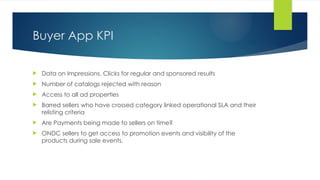
Buyer App KPI
Data on Impressions, Clicks for regular and sponsored results
Number of catalogs rejected with reason
Access to all ad properties
Barred sellers who have crossed category linked operational SLA and their
relisting criteria
Are Payments being made to sellers on time?
ONDC sellers to get access to promotion events and visibility of the
products during sale events.
13.
Buyer App Challenges
ShortTerm
• Working with new catalogs
• Category identification of products
from Gateway
• Operational challenges in absence of
established communication channels
within network
• Managing customers escalations from
ONDC Network
• Visibility of products from new sellers
Long Term
• Marketing costs to attract customers vs
commissions charged
• Retaining existing marketplace sellers
to ONDC Network partners in case of
low commissions
• Pending cases with Network Partners
( ODR/ Court)
• High Cost of integration and
adaptation to guidelines and policies
from the Network
14.
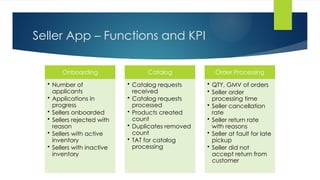
Seller App –Functions and KPI
Onboarding
• Number of
applicants
• Applications in
progress
• Sellers onboarded
• Sellers rejected with
reason
• Sellers with active
inventory
• Sellers with inactive
inventory
Catalog
• Catalog requests
received
• Catalog requests
processed
• Products created
count
• Duplicates removed
count
• TAT for catalog
processing
Order Processing
• QTY, GMV of orders
• Seller order
processing time
• Seller cancellation
rate
• Seller return rate
with reasons
• Seller at fault for late
pickup
• Seller did not
accept return from
customer
15.
Seller App -Onboarding
Pre onboarding Info
Category
commission
Logistic
Charges
Payment
Gateway
Charges
Seller app
charge
Payment
Timelines
GST/ Multiple Registrations
PAN Card
Bank Details ( Cancelled Cheque)
Warehouse Address (Multiple)
Basic Criteria
Must be visible on all seller
apps and their communication
channels
16.
Seller app –Catalog Creation
Existing
Products
• Pull data from
known sources-
Flipkart, Amazon
• Sellers can share
links of these
products
• Faster way to
upload catalogs
New Products
• If EAN/UPC is not a
match, create a
new product
• Identify minimum
mandatory
parameters for
each category of
products
ERP
Live Inventory Sync
ONDC Network Buyer Apps
A live inventory and price sync mechanism
from an ERP system is critical for sellers and
ONDC as a network to scale
17.
Merchant Helpdesk
Order related
•Suspicious Buyer
• Incomplete address
• Order not picked
• Tech Issue in processing
Catalog related
• Catalog not uploaded
• Unable to edit catalog
• Brand Approval
Payment related
• Incorrect Payment
• Payment not received
• TCS/ TDS related
Returns related
• Return not received
• Damaged product received
Seller Performance related
• Request for removal of
review
• Relist after getting debarred
Promotions related
• Ad not visible
• Unable to create ads
Common Merchant Issues
18.
Seller App -Challenges
Short Term
• Attracting new and first time sellers
• Less number of orders initially
• Operational challenges in absence of
established communication channels
within network
• Educating New sellers as the platform
evolves
• Ensuring sellers and logistic partners are
adhering to the timelines and
Long Term
• Are commissions enough to sustain the
business
• Retaining sellers who have faced
operational difficulties
• Pending cases with Network Partners
( ODR/ Court)
• Will a fixed platform and logistic fee
model work or should sellers be
charged for every transaction
Logistics - KPI
Order
Processed
Intransit Delivered
Return
Return in
transit
Return
Delivered
Order
Processed
In transit Delivered
Return
Return in
transit
Return
Delivered
Seller Customer
Logistics
Time Taken to deliver Order
Time taken to deliver
return order
Time taken to pick the order
Time taken to pick the order
Time taken to pick return order
Cost Based
• Order Qty, Value damaged in
transit
• Insurance claims by sellers
Coverage Based
• List of pin codes ( Forward)
• List of pin codes ( Reverse)
21.
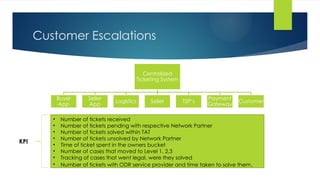
Customer Escalations
Centralized
Ticketing System
Buyer
App
Seller
App
LogisticsSeller TSP’s
Payment
Gateway
Customer
• Number of tickets received
• Number of tickets pending with respective Network Partner
• Number of tickets solved within TAT
• Number of tickets unsolved by Network Partner
• Time of ticket spent in the owners bucket
• Number of cases that moved to Level 1, 2,3
• Tracking of cases that went legal, were they solved
• Number of tickets with ODR service provider and time taken to solve them.
KPI
22.
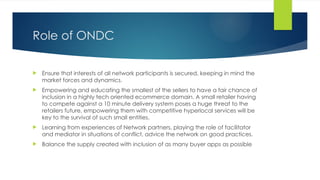
Role of ONDC
Ensure that interests of all network participants is secured, keeping in mind the
market forces and dynamics.
Empowering and educating the smallest of the sellers to have a fair chance of
inclusion in a highly tech oriented ecommerce domain. A small retailer having
to compete against a 10 minute delivery system poses a huge threat to the
retailers future, empowering them with competitive hyperlocal services will be
key to the survival of such small entities.
Learning from experiences of Network partners, playing the role of facilitator
and mediator in situations of conflict, advice the network on good practices.
Balance the supply created with inclusion of as many buyer apps as possible
Editor's Notes
#3 Customer Returns the Product after delivery
When customer returns the product, the reverse logistics partner would pick up the order, and deliver it back to the customer. Return can be due to the following reasons:
Defective/ Damaged Product – seller or logistics can be at fault
Partial Product Delivery – seller or logistics can be at fault
Wrong Product Delivered – seller, logistics or even buyer app ( wrong catalog shown) can be at fault
#4 It is advisable that insurance provider be allocated to handle the costs in case a product is damaged/ partially damaged during transit. This can be implemented in two ways:
The logistics partner has a tie up with an insurance provider and extends this facility to the seller, the seller in such a case may be covered for insurance claims for transit damage as per the provisions made between logistics provider and the seller.
Seller might be charged a fee for every order processed based on the product category they deal in and this will cover them for the transit damage.
Check Mechanisms for a healthy network:
Ask sellers to add Serial numbers (difficult to implement, limited use at scale) of products and videos (CCTV) proving either the packaging is intact or product with the serial number is visible. This data can be added to the shipping labels/manifests and invoices. Videos should be uploaded before processing the shipping label.
Logistic service providers who have access to x ray scanning facility/ CCTV video can help check cases of fraud.
Return QC Check: RTO’s that will be picked up need to be verified by the logistics provider
Return to be acknowledged by seller ( signed proof of delivery document)
#5 If the product is non returnable, but has visible signs of damage, defects- then order can be returned, seller will bear the cost for Return and replacement logistics ( if provided).
When customer returns the product, the reverse logistics partner would pick up the order, and deliver it back to the customer. Return can be due to the following reasons:
Damaged Product – seller or logistics can be at fault
Basis the check mechanisms in place( Serial number/ video), we can identify if seller has shipped the right product, the product quality on the basis of video shared. So seller can be held accountable for the cost. In case seller themselves have shipped the product, the seller is at fault. If the seller is not at fault, it is likely the product was damaged in transit, or the customer is fraud ( has damaged the product, might have a history of similar cases). If the customer checks out, then ideally this cost should then be taken up by the logistics partner.
Cost for logistics: Product cost( partial/ full) + Commission (seller app) + commission( buyer app) + Logistics ( forward+ return)
Cost for seller: Product Cost (as loss) + Commission (seller app) + commission( buyer app) + Logistics ( forward+ return)
Fraud customer case: Seller will bear the cost ( ideally, buyer app commission should not be taken in this case)
2. Partial Product Delivery – seller or logistics can be at fault
Seller can be identified basis, the serial number, or video, if the product part was genuinely missing from the packaging, the seller may ship the rest of the item(s) to the customer through the network partners. If the video shows that the full product was shipped, in that case the logistics or customer is at fault, if the customer checks out, logistics partner needs to bear that cost
Cost for logistics: Product cost( partial) + Commission (seller app) + commission( buyer app) + Logistics ( forward+ return)
Cost for seller: Product Cost (as loss) + Commission (seller app) + commission( buyer app) + Logistics ( forward+ return)
Fraud customer case: Seller will bear the cost( ideally, buyer app commission should not be taken in this case)
3. Wrong Product Delivered – seller, logistics or even buyer app ( wrong catalog shown) can be at fault
Buyer app displays the wrong catalog, buyer app will bear the cost of: Logistics( forward + return) + commissions ( seller app)
If catalog was provided by seller, in such case seller pays the cost. If logistics is at fault, the correct product must be identified and delivered, unless it is lost and in such a case logistics bears all the costs.
Cost for logistics: Product cost( Full) + Commission (seller app) + commission( buyer app) + Logistics ( forward+ return)
4. Defective/ Dead on arrival : Seller bears the cost : Commission (seller app) + commission( buyer app) + Logistics ( forward+ return)
5. Customer Returns the Product or cancel order which is in transit
If product has not been shipped : No cost for seller
If product has been shipped: Cost for seller : Forward, Reverse Logistics ( can be deducted from refund given to customer if buyer app wishes so)
* If customer provides reverse logistics, once the bill is shared, it has to be deducted from the payout of the responsible partner.
** All replacement logistic cost to be borne by the responsible partner.
***A seller who delivers the product on their own and has cash on delivery option enabled must ensure a COD balance account is maintained, in cases where customer has to be refunded for a COD order, then the refund can be paid via this COD account. One has to ensure that the value of orders does not exceed the COD balance of the seller.
#6 When customer returns the product, the reverse logistics partner would pick up the order, and deliver it back to the customer. Return can be due to the following reasons:
Damaged Product – seller or logistics can be at fault
Basis the check mechanisms in place( Serial number/ video), we can identify if seller has shipped the right product, the product quality on the basis of video shared. So seller can be held accountable for the cost. In case seller themselves have shipped the product, the seller is at fault. If the seller is not at fault, it is likely the product was damaged in transit, or the customer is fraud ( has damaged the product, might have a history of similar cases). If the customer checks out, then ideally this cost should then be taken up by the logistics partner.
Cost for logistics: Product cost( partial/ full) + Commission (seller app) + commission( buyer app) + Logistics ( forward+ return)
Cost for seller: Product Cost (as loss) + Commission (seller app) + commission( buyer app) + Logistics ( forward+ return)
Fraud customer case: Seller will bear the cost ( ideally, buyer app commission should not be taken in this case)
2. Partial Product Delivery – seller or logistics can be at fault
Seller can be identified basis, the serial number, or video, if the product part was genuinely missing from the packaging, the seller may ship the rest of the item(s) to the customer through the network partners. If the video shows that the full product was shipped, in that case the logistics or customer is at fault, if the customer checks out, logistics partner needs to bear that cost
Cost for logistics: Product cost( partial) + Commission (seller app) + commission( buyer app) + Logistics ( forward+ return)
Cost for seller: Product Cost (as loss) + Commission (seller app) + commission( buyer app) + Logistics ( forward+ return)
Fraud customer case: Seller will bear the cost( ideally, buyer app commission should not be taken in this case)
3. Wrong Product Delivered – seller, logistics or even buyer app ( wrong catalog shown) can be at fault
Buyer app displays the wrong catalog, buyer app will bear the cost of: Logistics( forward + return) + commissions ( seller app)
If catalog was provided by seller, in such case seller pays the cost. If logistics is at fault, the correct product must be identified and delivered, unless it is lost and in such a case logistics bears all the costs.
Cost for logistics: Product cost( Full) + Commission (seller app) + commission( buyer app) + Logistics ( forward+ return)
4. Defective/ Dead on arrival : Seller bears the cost : Commission (seller app) + commission( buyer app) + Logistics ( forward+ return)
5. Customer Returns the Product or cancel order which is in transit
If product has not been shipped : No cost for seller
If product has been shipped: Cost for seller : Forward, Reverse Logistics ( can be deducted from refund given to customer if buyer app wishes so)
* If customer provides reverse logistics, once the bill is shared, it has to be deducted from the payout of the responsible partner.
** All replacement logistic cost to be borne by the responsible partner.
#7 In case the seller delivers the product, order tracking might not be possible in such a case.
One must ensure there is a mechanism to mark the orders delivered at the time of delivery. This can be an app based solution which collects the GPS coordinates, customer name and signature or in places where internet connectivity is an issue, a simple messaging or a missed call based system that then marks the order delivered in real time. The reason why we need this to be done in real time is that once the customer wants to return the product, they wont be able to make that choice in the buyer app as the order status will be still in transit.
If the customer returns the product and ships it themselves and reverse logistics is not available from the network partner, in such cases tracking is not possible. In such cases, the seller will mark the order delivered once they receive the order. Refund to customer should only be given once seller has received the order
#8 Seller: To be paid after order return window is closed
Logistics Partner: To be paid after order return window is closed, unless it is a Cash on Delivery order in which case a logistics partner may want this to be paid in advance
Seller App commission: To be paid after order return window is closed
Buyer App commission: To be paid after order return window is closed
Buyer App Ad: Prepaid or after ads are run as per their system ( monthly billing, or campaign wise settlement)
#9 As a buyer platform, one would consider the following parameters in ranking/ sorting the search query results:
1. Sorting search results by: Price, GMV, Traffic, Conversion, Units, Product rating, sponsored product (backed by Ad)
2. Sorting sellers within product page by: seller rating, previous Operational SLA metrics, delivery timeline
In such a case, is ONDC as a network capturing all the parameters required from the seller app and thus giving the best chance for a seller and their products to be discovered on any buyer app. Ideally, the sorting logic parameters must be shared from the seller platform to ensure sellers on ONDC network get a fair representation just like any other captive seller would get on the Buyer App.
Understanding the perspective of the journey of a new seller vs an old one. How can a new sellers products be discoverable given they might not fare high in the buying logic adapted by a buyer app.
#10 Reference for these suggestions are taken directly from the ONDC Catalog Template of Sellerapp: http://ec2-34-221-130-80.us-west-2.compute.amazonaws.com/x/d?c=27238015&l=b31e733f-548e-4107-a807-a5498ee7b7a4&r=012879f5-45da-4ff5-8340-d61e397bc30a
As a buyer app, these are the challenges one might face from a catalog’s perspective:
1. From the search results shared by the gateway, identifying the parent SKU provided will be a challenge, one does not want duplicate results in search.
2. Considering product description fields shared by sellers might vary for the same product, which product description/ image/ video must a buyer app show to the customer? Consider a case where after going through the product features, a customer then chooses a seller, only to find that a different color product has been delivered, this becomes a challenge from a UI perspective as well.
3. Are Tags/ product name/ description enough to identify a products category and the HSN code( tax rate associated with it)
Q. does gateway or seller app follow appropriate measures to avoid duplicate listings
Q. Should taxonomy/ category tree be defined
Q. EAN/UPC + HSN codes to be included in seller catalogs
Q. Most efficient way to create catalogs for existing products on other portals
Q. Do buyer apps consider the return period values shared by sellers, if so are their systems in place so that payment to seller is only released after return period
#11 Current scenario: All ad platforms have their own properties, methods in which keywords, negative keywords, bidding is done. Not all ad platforms have the capability to offer in depth targeting, certain platforms don’t ask for keywords to be targeted, they have a list a premade group of keywords ( ad groups) that are defined by the products category
For the convenience of a seller, can a NP provide a single platform to manage ads for all buyer apps, rather than the seller having to individually register on different platforms and collate data from there.
The ad platforms are also different in the way they operate their settlements. One platform might allow the seller to run ads first and then pay for them from the earnings of their sale, others might want outstanding to be settled within a particular time frame, or a platform might want the seller to pay for the ads in advance. This situations creates the space for an ad platform aggregator which can be allowed to collect payments towards ads in advance.
The platform must offer basic minimum services a merchant helpdesk, share gst invoices for the ad spend.
Short term: Engage third party Digital marketing ad agencies, help sellers understand the ad space and let the service providers run ads on their behalf until an ad aggregator arrives. A common login can be shared with the sellers to login to the respective ad platforms
Long term: Let ONDC monitor if guidelines for ads are being followed ( Media rating council’s standards on Viewable impressions or a new standard which can be set for India), for example: how would an impression be counted? Can ad platforms share their data on the bids vs the impressions given for the campaigns run so that a seller gets to know that they have paid a fair amount for the impressions/ clicks they get, current system is closed and not transparent. Certain ad properties are not accessible to ordinary sellers, in such cases can ONDC provide access to these ad properties to all sellers.
#12 KPI
Data of impressions, clicks, sellers who opted for ads – impressions and clicks
Data of products not shown, rejected because the catalog did not qualify minimum parameters
Are all ad properties accessible to ONDC sellers
Sellers whose products are not shown because they have exceeded category wise returns
Relisting criteria for sellers whose operational parameters can be improved
Can ONDC sellers opt into promotion events
Are sellers being paid on time
#14 Onboarding:
Number of applicants
Number of applications in progress
Number of sellers onboarded
Number of sellers rejected with reasons
Number of sellers with active inventory
Number of sellers with inactive inventory
Catalog:
Number of catalog requests received
Number of catalog requests processed
Number of catalog request rejected with reason
More information required from seller
Number of products created
Number of duplicate removed
TAT for catalog processing
Order Processing Cycle
Number of orders/ items
GMV of products
Seller order processing time
Seller cancellation rate
Seller return rate- reasons for the return
Seller at fault for late pickup
Number of orders liquidated- seller did not accept the return
#15 Sellers must be aware of the policies of the seller platform, basic information like commission on respective categories, costs that are to be borne by sellers( logistics, Payment Gateway) and payment timelines must be mentioned openly on seller apps
Basic requirement to verify sellers: GST, PAN, Bank details (with cancelled cheque), warehouse address ( to be verified from GSTN)
Seller app must be able to be configured in a scenario where seller has multiple warehouses, or seller has multiple GST registrations( working from different states)
At all times, sellers status of GST number to be verified from GSTN, verify if returns are being filed regularly. We do not want to be giving orders to a seller whose GST number has been put on hold/cancelled or if a seller is operating from a different location not mentioned in additional place of business, or to a seller who is not filing returns to provide input credit to their customers.
#16 Existing Products: Ideally, pull data from existing sources i.e Amazon, Flipkart, Brand websites etc.
New Products:
Taxonomy to be defined by ONDC
Include EAN/UPC in catalog field to ensure duplicate listings are not created
HSN code can be either asked from seller, or be pulled from GS1 database from the EAN number shared
Ask seller about the processing time required to procure the product
Seller must freely be able to make changes to the inventory or price of the product, given there are a minimum of 2 sale events in a month on any platform, it will be preferred that seller apps give this functionality of editing these values in real time to sellers. Eventually, seller app can also have provisions to connect with an ERP system( Tally, Zoho etc) to sync live inventory.
Requirements from a seller dashboard perspective
#19 To minimize the risk for all network partners, it is best that an intelligence network be created to ensure fraud sellers and fraud customers are kept out of the system. While this information may be available to individual network partners in their years of business, access to this information at a central level might be critical in curtailing costs and keeping the network healthy.
Payment Gateway: Will have information on customers involved in financial frauds
Buyer Apps: Will have information on customers that have been involved in fraud behavior, example- returning a different product and claiming refund
Seller Apps: They will have information on sellers, example- a seller might be sending defective items to claim insurance
Logistic Network: They will have addresses of places where potential fraud has happened, they might have very high return rates, in another use case, to identify addresses that are not traceable or do not exist.
#20 Logistics
Pick order from seller and deliver to customer
Return orders to seller which are cancelled or returned by customer
Collect cash for COD Orders
Enabling COD functionality ( with a few logistic partners) involves sellers to place a deposit in a prepaid account so that logistic charges can be processed. In such cases, having one account from where any logistic partner can deduct this charge would be ideal.
KPI
Time based
Time taken to pick order from seller
Time taken to deliver order to customer
Time taken for reverse pickup from customer
Time taken to deliver reverse pickup to seller
Cost Based:
Number of orders damaged in transit, value of orders damaged in transit
Damage cost covered by insurance for seller, claim amount received by seller
Number of sellers who left due to logistic issues
Coverage Based
List of pin codes eligible for delivery ( forward)
List of pin codes eligible for delivery(reverse)
#21 A centralized ticketing system to handle customer escalations, that automates the first level of response and allocates the ticket to the appropriate owner. All responses have to be filed within a reasonable TAT defined by ONDC. Ideally, information that is awaited from seller, or any other network partner must be available to the respondent of the ticket at first glance so that minimum time is spent collecting the information to make an informed decision. Example: A cctv video footage/ x ray from a logistic partner, serial numbers from seller should already move and be readily available if the nature of the case requires this information.
KPI:
Number of tickets received
Number of tickets pending with respective Network Partner
Number of tickets solved within TAT
Number of tickets unsolved by Network Partner
Time of ticket spent in the owners bucket
Number of cases that moved to Level 1, 2,3
Tracking of cases that went legal, were they solved
Number of tickets with ODR service provider and time taken to solve them.
Concern: In the existing system, the network partners get 7 days to respond within themselves which is a lot of time, the more the number of days we keep the customer waiting, the higher are the chances for them to move to consumer forum/ legal route.
Disputes within Network Partners: While the ODR system will try to handle the cases, it must be in agreement between all network participants that this mechanism must be treated as the final authority on decision making. Even though ONDC wishes to play a role of facilitator and not regulator, an established line of communication with the affected network parties is critical for a smooth operating network. In case a network partner wishes to exist, adequate policies must be established to ensure all exist clause conditions are met and no other network partner is affected in their operations and settlements.