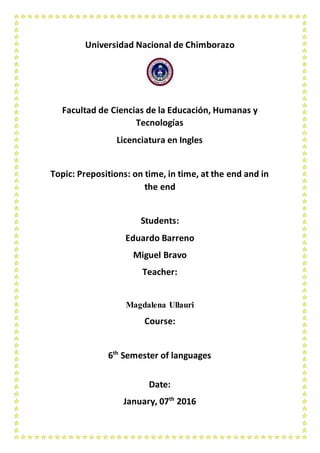
Universidad Nacional de Chimborazo
Facultad de Ciencias de la Educación, Humanas y
Tecnologías
Licenciatura en Ingles
Topic: Prepositions: on time, in time, at the end and in
the end
Students:
Eduardo Barreno
Miguel Bravo
Teacher:
Magdalena Ullauri
Course:
6th
Semester of languages
Date:
January, 07th
2016
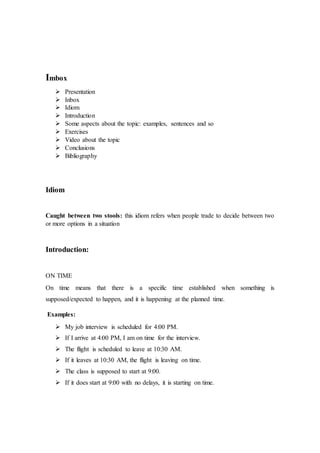
Imbox
 Presentation
 Inbox
 Idiom
 Introduction
 Some aspects about the topic: examples, sentences and so
 Exercises
 Video about the topic
 Conclusions
 Bibliography
Idiom
Caught between two stools: this idiom refers when people trade to decide between two
or more options in a situation
Introduction:
ON TIME
On time means that there is a specific time established when something is
supposed/expected to happen, and it is happening at the planned time.
Examples:
 My job interview is scheduled for 4:00 PM.
 If I arrive at 4:00 PM, I am on time for the interview.
 The flight is scheduled to leave at 10:30 AM.
 If it leaves at 10:30 AM, the flight is leaving on time.
 The class is supposed to start at 9:00.
 If it does start at 9:00 with no delays, it is starting on time.
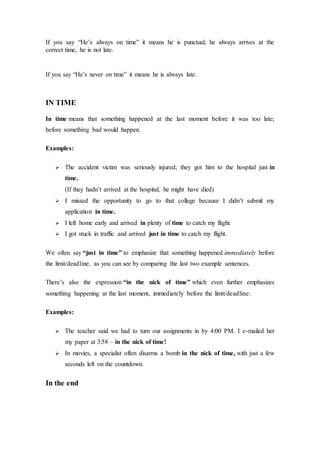
If you say “He’s always on time” it means he is punctual; he always arrives at the
correct time, he is not late.
If you say “He’s never on time” it means he is always late.
IN TIME
In time means that something happened at the last moment before it was too late;
before something bad would happen.
Examples:
 The accident victim was seriously injured; they got him to the hospital just in
time.
(If they hadn’t arrived at the hospital, he might have died)
 I missed the opportunity to go to that college because I didn’t submit my
application in time.
 I left home early and arrived in plenty of time to catch my flight.
 I got stuck in traffic and arrived just in time to catch my flight.
We often say “just in time” to emphasize that something happened immediately before
the limit/deadline, as you can see by comparing the last two example sentences.
There’s also the expression “in the nick of time” which even further emphasizes
something happening at the last moment, immediately before the limit/deadline:
Examples:
 The teacher said we had to turn our assignments in by 4:00 PM. I e-mailed her
my paper at 3:58 – in the nick of time!
 In movies, a specialist often disarms a bomb in the nick of time, with just a few
seconds left on the countdown.
In the end
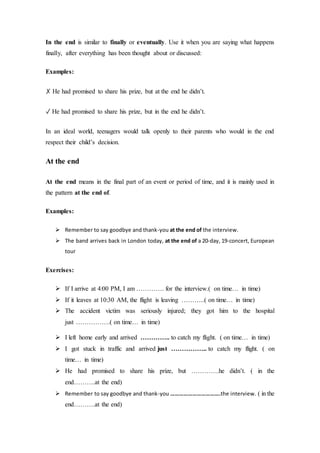
In the end is similar to finally or eventually. Use it when you are saying what happens
finally, after everything has been thought about or discussed:
Examples:
✗ He had promised to share his prize, but at the end he didn’t.
✓ He had promised to share his prize, but in the end he didn’t.
In an ideal world, teenagers would talk openly to their parents who would in the end
respect their child’s decision.
At the end
At the end means in the final part of an event or period of time, and it is mainly used in
the pattern at the end of.
Examples:
 Remember to say goodbye and thank-you at the end of the interview.
 The band arrives back in London today, at the end of a 20-day, 19-concert, European
tour
Exercises:
 If I arrive at 4:00 PM, I am …………. for the interview.( on time… in time)
 If it leaves at 10:30 AM, the flight is leaving ………..( on time… in time)
 The accident victim was seriously injured; they got him to the hospital
just …………….( on time… in time)
 I left home early and arrived ………….. to catch my flight. ( on time… in time)
 I got stuck in traffic and arrived just …………….. to catch my flight. ( on
time… in time)
 He had promised to share his prize, but ………….he didn’t. ( in the
end……….at the end)
 Remember to say goodbye and thank-you …………………………….the interview. ( in the
end……….at the end)
Conclusions:
Prepositions are important because they work to connect various parts of a
sentence. Prepositions tell us where something is in relation to something else or how
things are related in space —in, on, to, with, over, under, onto, into, beside or where
so/sth is going (to church)
Bibliography
 Copyright © Shayna McHugh 2014 recovered by this page:
http://www.espressoenglish.net/english-prepositions-difference-
between-in-time-and-on-time/
 Macmillan Publishers Limited 2009 – 2016 Recovered by this page :
http://www.macmillandictionaryblog.com/language-tip-of-the-week-
atin-the-end

On time-in-time

  • 1.
    Universidad Nacional deChimborazo Facultad de Ciencias de la Educación, Humanas y Tecnologías Licenciatura en Ingles Topic: Prepositions: on time, in time, at the end and in the end Students: Eduardo Barreno Miguel Bravo Teacher: Magdalena Ullauri Course: 6th Semester of languages Date: January, 07th 2016
  • 2.
    Imbox  Presentation  Inbox Idiom  Introduction  Some aspects about the topic: examples, sentences and so  Exercises  Video about the topic  Conclusions  Bibliography Idiom Caught between two stools: this idiom refers when people trade to decide between two or more options in a situation Introduction: ON TIME On time means that there is a specific time established when something is supposed/expected to happen, and it is happening at the planned time. Examples:  My job interview is scheduled for 4:00 PM.  If I arrive at 4:00 PM, I am on time for the interview.  The flight is scheduled to leave at 10:30 AM.  If it leaves at 10:30 AM, the flight is leaving on time.  The class is supposed to start at 9:00.  If it does start at 9:00 with no delays, it is starting on time.
  • 3.
    If you say“He’s always on time” it means he is punctual; he always arrives at the correct time, he is not late. If you say “He’s never on time” it means he is always late. IN TIME In time means that something happened at the last moment before it was too late; before something bad would happen. Examples:  The accident victim was seriously injured; they got him to the hospital just in time. (If they hadn’t arrived at the hospital, he might have died)  I missed the opportunity to go to that college because I didn’t submit my application in time.  I left home early and arrived in plenty of time to catch my flight.  I got stuck in traffic and arrived just in time to catch my flight. We often say “just in time” to emphasize that something happened immediately before the limit/deadline, as you can see by comparing the last two example sentences. There’s also the expression “in the nick of time” which even further emphasizes something happening at the last moment, immediately before the limit/deadline: Examples:  The teacher said we had to turn our assignments in by 4:00 PM. I e-mailed her my paper at 3:58 – in the nick of time!  In movies, a specialist often disarms a bomb in the nick of time, with just a few seconds left on the countdown. In the end
  • 4.
    In the endis similar to finally or eventually. Use it when you are saying what happens finally, after everything has been thought about or discussed: Examples: ✗ He had promised to share his prize, but at the end he didn’t. ✓ He had promised to share his prize, but in the end he didn’t. In an ideal world, teenagers would talk openly to their parents who would in the end respect their child’s decision. At the end At the end means in the final part of an event or period of time, and it is mainly used in the pattern at the end of. Examples:  Remember to say goodbye and thank-you at the end of the interview.  The band arrives back in London today, at the end of a 20-day, 19-concert, European tour Exercises:  If I arrive at 4:00 PM, I am …………. for the interview.( on time… in time)  If it leaves at 10:30 AM, the flight is leaving ………..( on time… in time)  The accident victim was seriously injured; they got him to the hospital just …………….( on time… in time)  I left home early and arrived ………….. to catch my flight. ( on time… in time)  I got stuck in traffic and arrived just …………….. to catch my flight. ( on time… in time)  He had promised to share his prize, but ………….he didn’t. ( in the end……….at the end)  Remember to say goodbye and thank-you …………………………….the interview. ( in the end……….at the end)
  • 5.
    Conclusions: Prepositions are importantbecause they work to connect various parts of a sentence. Prepositions tell us where something is in relation to something else or how things are related in space —in, on, to, with, over, under, onto, into, beside or where so/sth is going (to church) Bibliography  Copyright © Shayna McHugh 2014 recovered by this page: http://www.espressoenglish.net/english-prepositions-difference- between-in-time-and-on-time/  Macmillan Publishers Limited 2009 – 2016 Recovered by this page : http://www.macmillandictionaryblog.com/language-tip-of-the-week- atin-the-end