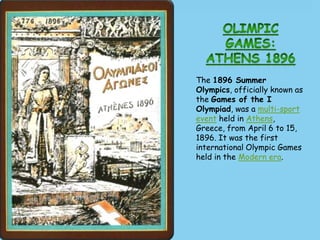
The 1896 Summer
Olympics, officially known as
the Games of the I
Olympiad, was a multi-sport
event held in Athens,
Greece, from April 6 to 15,
1896. It was the first
international Olympic Games
held in the Modern era.
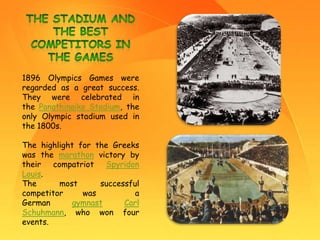
1896 Olympics Games were
regarded as a great success.
They were celebrated in
the Panathinaiko Stadium, the
only Olympic stadium used in
the 1800s.

The highlight for the Greeks
was the marathon victory by
their   compatriot   Spyridon
Louis.
The       most     successful
competitor     was          a
German       gymnast     Carl
Schuhmann, who won four
events.
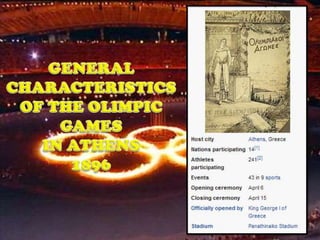
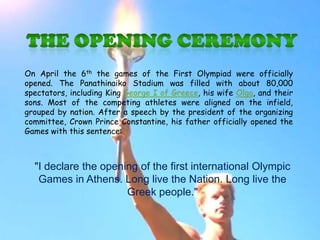
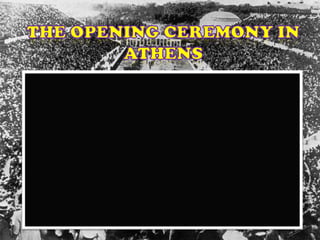
On April the 6th the games of the First Olympiad were officially
opened. The Panathinaiko Stadium was filled with about 80,000
spectators, including King George I of Greece, his wife Olga, and their
sons. Most of the competing athletes were aligned on the infield,
grouped by nation. After a speech by the president of the organizing
committee, Crown Prince Constantine, his father officially opened the
Games with this sentence:


  "I declare the opening of the first international Olympic
   Games in Athens. Long live the Nation. Long live the
                      Greek people."
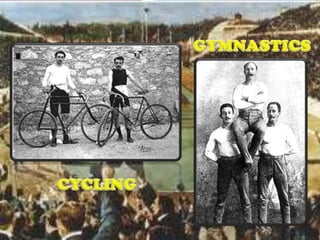
   Athletics
   Cycling
   Fencing
   Gymnastics
   Shooting
   Swimming
   Tennis
   Weighlifting
   Wrestling
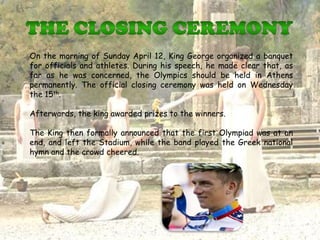
On the morning of Sunday April 12, King George organized a banquet
for officials and athletes. During his speech, he made clear that, as
far as he was concerned, the Olympics should be held in Athens
permanently. The official closing ceremony was held on Wednesday
the 15th.

Afterwards, the king awarded prizes to the winners.

The King then formally announced that the first Olympiad was at an
end, and left the Stadium, while the band played the Greek national
hymn and the crowd cheered.
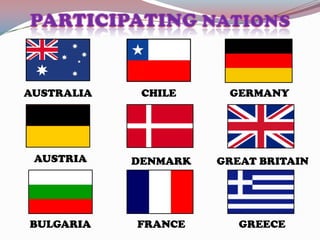
AUSTRALIA    CHILE     GERMANY


 AUSTRIA    DENMARK   GREAT BRITAIN


BULGARIA    FRANCE       GREECE
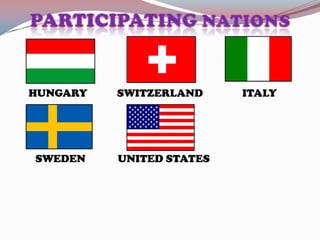
HUNGARY   SWITZERLAND     ITALY


SWEDEN    UNITED STATES
Ten of the 14 participating nations earned medals, in addition to three
medals won by mixed teams.

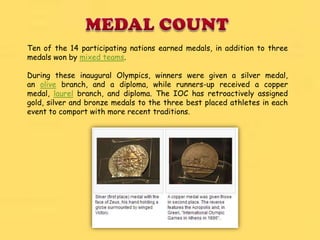
During these inaugural Olympics, winners were given a silver medal,
an olive branch, and a diploma, while runners-up received a copper
medal, laurel branch, and diploma. The IOC has retroactively assigned
gold, silver and bronze medals to the three best placed athletes in each
event to comport with more recent traditions.
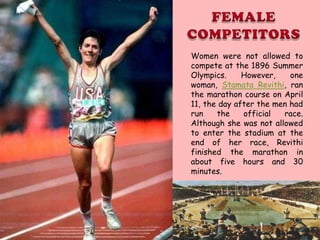
Women were not allowed to
compete at the 1896 Summer
Olympics.     However,    one
woman, Stamata Revithi, ran
the marathon course on April
11, the day after the men had
run    the    official  race.
Although she was not allowed
to enter the stadium at the
end of her race, Revithi
finished the marathon in
about five hours and 30
minutes.
And that’s all about the Olimpic Games in Athens – 1896.

Olympic Games Athens 1896

  • 3.
    The 1896 Summer Olympics,officially known as the Games of the I Olympiad, was a multi-sport event held in Athens, Greece, from April 6 to 15, 1896. It was the first international Olympic Games held in the Modern era.
  • 4.
    1896 Olympics Gameswere regarded as a great success. They were celebrated in the Panathinaiko Stadium, the only Olympic stadium used in the 1800s. The highlight for the Greeks was the marathon victory by their compatriot Spyridon Louis. The most successful competitor was a German gymnast Carl Schuhmann, who won four events.
  • 5.
    On April the6th the games of the First Olympiad were officially opened. The Panathinaiko Stadium was filled with about 80,000 spectators, including King George I of Greece, his wife Olga, and their sons. Most of the competing athletes were aligned on the infield, grouped by nation. After a speech by the president of the organizing committee, Crown Prince Constantine, his father officially opened the Games with this sentence: "I declare the opening of the first international Olympic Games in Athens. Long live the Nation. Long live the Greek people."
  • 7.
    Athletics  Cycling  Fencing  Gymnastics  Shooting  Swimming  Tennis  Weighlifting  Wrestling
  • 9.
    On the morningof Sunday April 12, King George organized a banquet for officials and athletes. During his speech, he made clear that, as far as he was concerned, the Olympics should be held in Athens permanently. The official closing ceremony was held on Wednesday the 15th. Afterwards, the king awarded prizes to the winners. The King then formally announced that the first Olympiad was at an end, and left the Stadium, while the band played the Greek national hymn and the crowd cheered.
  • 10.
    AUSTRALIA CHILE GERMANY AUSTRIA DENMARK GREAT BRITAIN BULGARIA FRANCE GREECE
  • 11.
    HUNGARY SWITZERLAND ITALY SWEDEN UNITED STATES
  • 12.
    Ten of the14 participating nations earned medals, in addition to three medals won by mixed teams. During these inaugural Olympics, winners were given a silver medal, an olive branch, and a diploma, while runners-up received a copper medal, laurel branch, and diploma. The IOC has retroactively assigned gold, silver and bronze medals to the three best placed athletes in each event to comport with more recent traditions.
  • 13.
    Women were notallowed to compete at the 1896 Summer Olympics. However, one woman, Stamata Revithi, ran the marathon course on April 11, the day after the men had run the official race. Although she was not allowed to enter the stadium at the end of her race, Revithi finished the marathon in about five hours and 30 minutes.
  • 14.
    And that’s allabout the Olimpic Games in Athens – 1896.