00  FSB  september 2009
n off hoursFirst Person Little Visit p. 00 The Knowledge p. 00
­supper—barnyard births can be grue-
some—but ultimately I couldn’t resist the
lure of the newborn.
We follow Pasternak and chef Jim
­Denevan, whose Santa Cruz–based­
company, Outstanding in the Field, or-
ganized our dinner, down a dirt road to
the pen. Unfortunately, one little piglet
is trapped between
the hulking mother’s
backside and a wire
fence and doesn’t ap-
pear to be breathing.
I’m standing with 140 other ravenous
diners outside a pigpen on Devil’s Gulch
Ranch, about 30 miles north of San Fran-
cisco, looking at an exhausted 350-pound
sow named Penelope. She’s resting, having
given birth to seven five-pound piglets a
few hours earlier. We had all gathered at
the farm for a $200-per-person alfresco
four-course dinner when Mark Pasternak,
owner of Devil’s Gulch, told us about the
birth. Everyone except me wanted to see
the babies. Having grown up on a farm,
I had misgivings about doing so before
A Movable
FeastAn epicurean entrepreneur brings
foodies to the great outdoors.
n By Deborah Moss
Marin county, calif.
Photographs by lisa romerein
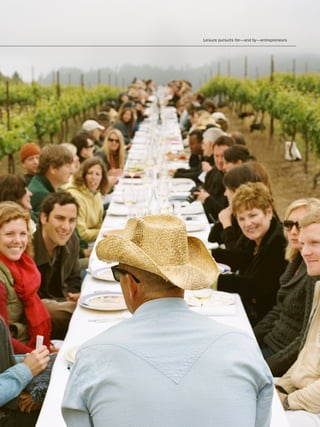
Let’s Eat: The main
course arrives; oppo-
site, Outstanding in
the Field owner Jim
Denevan holds court.
Leisure pursuits for—and by—entrepreneurs
00  FSB  September 2009
off hours n First Person
­Pasternak, who has already showered and
dressed for dinner, enters the pen, nudges
the mother with the tip of his boot and
grabs the tiny creature. He gently places it
under a nearby heat lamp with its porcine
siblings. There’s an audible gasp of relief
when it begins to wriggle around.
Uncomfortably soon after this close
call, a guest wonders how much bacon
could be rendered from a full-grown pig
roaming at the far end of the pen. About
20 pounds, Pasternak says. We may find
his matter-of-factness jolting, but that’s
life—and death—on the farm, and it’s one
of the reasons we’re here.
“Our passion is helping people un-
derstand where their food comes from,”
Pasternak says. “Milk doesn’t come from
a carton. It’s easy to buy prepackaged
meats and have no idea about their ori-
gins, but it’s not good for your health or
the environment.”
Conversations like this inspired Dene-
van to launch Outstanding in the Field
a decade ago. At the time he was the ex-
ecutive chef at Gabriella Café, an Italian
eatery in Santa Cruz, Calif. Occasionally
he would hold special dinners featuring lo-
cal produce and invite the farmers to talk
about the food they had grown. “People
1.
2.
3.
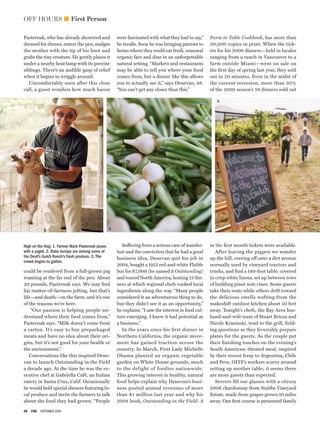
High on the Hog: 1. Farmer Mark Pasternak poses
with a piglet. 2. Baby turnips are among some of
the Devil’s Gulch Ranch’s fresh produce. 3. The
crowd begins to gather.
were fascinated with what they had to say,”
he recalls. Soon he was bringing patrons to
farms where they could eat fresh, seasonal
organic fare and dine in an unforgettable
natural setting. “Markets and restaurants
may be able to tell you where your food
comes from, but a dinner like this allows
you to actually see it,” says Denevan, 48.
“You can’t get any closer than this.”
Suffering from a serious case of wander­
lust and the conviction that he had a good
business idea, Denevan quit his job in
2004, bought a 1953 red-and-white Flxible
bus for $7,000 (he named it Outstanding)
and toured North America, hosting 13 din-
ners at which regional chefs cooked local
ingredients along the way. “Many people
considered it an adventurous thing to do,
but they didn’t see it as an opportunity,”
he explains. “I saw the interest in food cul-
ture emerging. I knew it had potential as
a business.”
In the years since his first dinner in
Northern California, the organic move-
ment has gained traction across the
country. In March, First Lady Michelle
Obama planted an organic vegetable
garden on White House grounds, much
to the delight of foodies nationwide.
This growing interest in healthy, natural
food helps explain why Denevan’s busi-
ness posted annual revenues of more
than $1 million last year and why his
2008 book, Outstanding in the Field: A
Farm to Table Cookbook, has more than
30,000 copies in print. When the tick-
ets for his 2008 dinners—held in locales
ranging from a ranch in Vancouver to a
farm outside Miami—went on sale on
the first day of spring last year, they sold
out in 20 minutes. Even in the midst of
the current recession, more than 30%
of the 2009 season’s 58 dinners sold out
in the first month tickets were available.
After leaving the pigpen we wander
up the hill, veering off onto a dirt avenue
normally used by vineyard tractors and
trucks, and find a 140-foot table, covered
in crisp white linens, set up between rows
of budding pinot noir vines. Some guests
take their seats while others drift toward
the delicious smells wafting from the
makeshift outdoor kitchen about 50 feet
away. Tonight’s chefs, the Bay Area hus-
band-and-wife team of Stuart Brioza and
Nicole Krasinski, tend to the grill, field-
ing questions as they feverishly prepare
plates for the guests. As the couple put
their finishing touches on the evening’s
South American–themed meal, inspired
by their recent foray to Argentina, Chile
and Peru, OITF’s workers scurry around
setting up another table; it seems there
are more guests than expected.
Servers fill our glasses with a citrusy
2006 chardonnay from Stubbs Vineyard
Estate, made from grapes grown 10 miles
away. Our first course is presented family
September 2009  FSB  00
2.
1. 3.
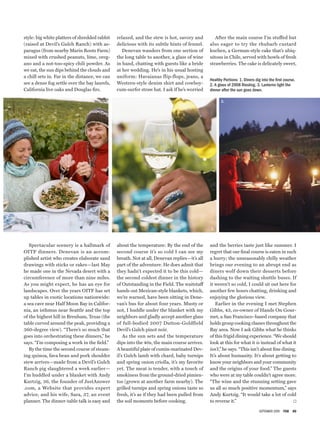
Healthy Portions: 1. Diners dig into the first course.
2. A glass of 2008 Riesling. 3. Lanterns light the
dinner after the sun goes down.
style: big white platters of shredded rabbit
(raised at Devil’s Gulch Ranch) with as-
paragus (from nearby Marin Roots Farm)
mixed with crushed peanuts, lime, oreg-
ano and a not-too-spicy chili powder. As
we eat, the sun dips behind the clouds and
a chill sets in. Far in the distance, we can
see a dense fog settle over the bay laurels,
California live oaks and Douglas firs.
Spectacular scenery is a hallmark of
OITF dinners. Denevan is an accom-
plished artist who creates elaborate sand
drawings with sticks or rakes—last May
he made one in the Nevada desert with a
circumference of more than nine miles.
As you might expect, he has an eye for
landscapes. Over the years OITF has set
up tables in exotic locations nationwide:
a sea cave near Half Moon Bay in Califor-
nia, an isthmus near Seattle and the top
of the highest hill in Brenham, Texas (the
table curved around the peak, providing a
360-degree view). “There’s so much that
goes into orchestrating these dinners,” he
says. “I’m composing a work in the field.”
By the time the second course of steam-
ing quinoa, fava bean and pork shoulder
stew arrives—made from a Devil’s Gulch
Ranch pig slaughtered a week earlier—
I’m huddled under a blanket with Andy
Kurtzig, 36, the founder of JustAnswer­
.com, a Website that provides expert
advice, and his wife, Sara, 37, an event
planner. The dinner-table talk is easy and
relaxed, and the stew is hot, savory and
delicious with its subtle hints of fennel.
Denevan wanders from one section of
the long table to another, a glass of wine
in hand, chatting with guests like a bride
at her wedding. He’s in his usual hosting
uniform: Havaianas flip-flops, jeans, a
Western-style denim shirt and cowboy-
cum-surfer straw hat. I ask if he’s worried
about the temperature: By the end of the
second course it’s so cold I can see my
breath. Not at all, Denevan replies—it’s all
part of the adventure. He does admit that
they hadn’t expected it to be this cold—
the second coldest dinner in the history
of Outstanding in the Field. The waitstaff
hands out Mexican-style blankets, which,
we’re warned, have been sitting in Dene-
van’s bus for about four years. Musty or
not, I huddle under the blanket with my
neighbors and gladly accept another glass
of full-bodied 2007 Dutton-Goldfield
Devil’s Gulch pinot noir.
As the sun sets and the temperature
dips into the 40s, the main course arrives.
A beautiful plate of cumin-marinated Dev-
il’s Gulch lamb with chard, baby turnips
and spring onion criolla, it’s my favorite
yet. The meat is tender, with a touch of
smokiness from the ground-dried pimien-
tos (grown at another farm nearby). The
grilled turnips and spring onions taste so
fresh, it’s as if they had been pulled from
the soil moments before cooking.
After the main course I’m stuffed but
also eager to try the rhubarb custard
kuchen, a German-style cake that’s ubiq-
uitous in Chile, served with bowls of fresh
strawberries. The cake is delicately sweet,
and the berries taste just like summer. I
regret that our final course is eaten in such
a hurry; the unseasonably chilly weather
brings our evening to an abrupt end as
diners wolf down their desserts before
dashing to the waiting shuttle buses. If
it weren’t so cold, I could sit out here for
another few hours chatting, drinking and
enjoying the glorious view.
Earlier in the evening I met Stephen
Gibbs, 43, co-owner of Hands On Gour-
met, a San Francisco–based company that
holds group cooking classes throughout the
Bay area. Now I ask Gibbs what he thinks
of this frigid dining experience. “We should
look at this for what it is instead of what it
isn’t,” he says. “This isn’t about fine dining.
It’s about humanity. It’s about getting to
know your neighbors and your community
and the origins of your food.” The guests
who were at my table couldn’t agree more.
“The wine and the stunning setting gave
us all so much positive momentum,” says
Andy Kurtzig. “It would take a lot of cold
to reverse it.” *

OFF09_v8

  • 1.
    00  FSB  september2009 n off hoursFirst Person Little Visit p. 00 The Knowledge p. 00 ­supper—barnyard births can be grue- some—but ultimately I couldn’t resist the lure of the newborn. We follow Pasternak and chef Jim ­Denevan, whose Santa Cruz–based­ company, Outstanding in the Field, or- ganized our dinner, down a dirt road to the pen. Unfortunately, one little piglet is trapped between the hulking mother’s backside and a wire fence and doesn’t ap- pear to be breathing. I’m standing with 140 other ravenous diners outside a pigpen on Devil’s Gulch Ranch, about 30 miles north of San Fran- cisco, looking at an exhausted 350-pound sow named Penelope. She’s resting, having given birth to seven five-pound piglets a few hours earlier. We had all gathered at the farm for a $200-per-person alfresco four-course dinner when Mark Pasternak, owner of Devil’s Gulch, told us about the birth. Everyone except me wanted to see the babies. Having grown up on a farm, I had misgivings about doing so before A Movable FeastAn epicurean entrepreneur brings foodies to the great outdoors. n By Deborah Moss Marin county, calif. Photographs by lisa romerein Let’s Eat: The main course arrives; oppo- site, Outstanding in the Field owner Jim Denevan holds court.
  • 2.
    Leisure pursuits for—andby—entrepreneurs
  • 3.
    00  FSB  September2009 off hours n First Person ­Pasternak, who has already showered and dressed for dinner, enters the pen, nudges the mother with the tip of his boot and grabs the tiny creature. He gently places it under a nearby heat lamp with its porcine siblings. There’s an audible gasp of relief when it begins to wriggle around. Uncomfortably soon after this close call, a guest wonders how much bacon could be rendered from a full-grown pig roaming at the far end of the pen. About 20 pounds, Pasternak says. We may find his matter-of-factness jolting, but that’s life—and death—on the farm, and it’s one of the reasons we’re here. “Our passion is helping people un- derstand where their food comes from,” Pasternak says. “Milk doesn’t come from a carton. It’s easy to buy prepackaged meats and have no idea about their ori- gins, but it’s not good for your health or the environment.” Conversations like this inspired Dene- van to launch Outstanding in the Field a decade ago. At the time he was the ex- ecutive chef at Gabriella Café, an Italian eatery in Santa Cruz, Calif. Occasionally he would hold special dinners featuring lo- cal produce and invite the farmers to talk about the food they had grown. “People 1. 2. 3. High on the Hog: 1. Farmer Mark Pasternak poses with a piglet. 2. Baby turnips are among some of the Devil’s Gulch Ranch’s fresh produce. 3. The crowd begins to gather. were fascinated with what they had to say,” he recalls. Soon he was bringing patrons to farms where they could eat fresh, seasonal organic fare and dine in an unforgettable natural setting. “Markets and restaurants may be able to tell you where your food comes from, but a dinner like this allows you to actually see it,” says Denevan, 48. “You can’t get any closer than this.” Suffering from a serious case of wander­ lust and the conviction that he had a good business idea, Denevan quit his job in 2004, bought a 1953 red-and-white Flxible bus for $7,000 (he named it Outstanding) and toured North America, hosting 13 din- ners at which regional chefs cooked local ingredients along the way. “Many people considered it an adventurous thing to do, but they didn’t see it as an opportunity,” he explains. “I saw the interest in food cul- ture emerging. I knew it had potential as a business.” In the years since his first dinner in Northern California, the organic move- ment has gained traction across the country. In March, First Lady Michelle Obama planted an organic vegetable garden on White House grounds, much to the delight of foodies nationwide. This growing interest in healthy, natural food helps explain why Denevan’s busi- ness posted annual revenues of more than $1 million last year and why his 2008 book, Outstanding in the Field: A Farm to Table Cookbook, has more than 30,000 copies in print. When the tick- ets for his 2008 dinners—held in locales ranging from a ranch in Vancouver to a farm outside Miami—went on sale on the first day of spring last year, they sold out in 20 minutes. Even in the midst of the current recession, more than 30% of the 2009 season’s 58 dinners sold out in the first month tickets were available. After leaving the pigpen we wander up the hill, veering off onto a dirt avenue normally used by vineyard tractors and trucks, and find a 140-foot table, covered in crisp white linens, set up between rows of budding pinot noir vines. Some guests take their seats while others drift toward the delicious smells wafting from the makeshift outdoor kitchen about 50 feet away. Tonight’s chefs, the Bay Area hus- band-and-wife team of Stuart Brioza and Nicole Krasinski, tend to the grill, field- ing questions as they feverishly prepare plates for the guests. As the couple put their finishing touches on the evening’s South American–themed meal, inspired by their recent foray to Argentina, Chile and Peru, OITF’s workers scurry around setting up another table; it seems there are more guests than expected. Servers fill our glasses with a citrusy 2006 chardonnay from Stubbs Vineyard Estate, made from grapes grown 10 miles away. Our first course is presented family
  • 4.
    September 2009  FSB 00 2. 1. 3. Healthy Portions: 1. Diners dig into the first course. 2. A glass of 2008 Riesling. 3. Lanterns light the dinner after the sun goes down. style: big white platters of shredded rabbit (raised at Devil’s Gulch Ranch) with as- paragus (from nearby Marin Roots Farm) mixed with crushed peanuts, lime, oreg- ano and a not-too-spicy chili powder. As we eat, the sun dips behind the clouds and a chill sets in. Far in the distance, we can see a dense fog settle over the bay laurels, California live oaks and Douglas firs. Spectacular scenery is a hallmark of OITF dinners. Denevan is an accom- plished artist who creates elaborate sand drawings with sticks or rakes—last May he made one in the Nevada desert with a circumference of more than nine miles. As you might expect, he has an eye for landscapes. Over the years OITF has set up tables in exotic locations nationwide: a sea cave near Half Moon Bay in Califor- nia, an isthmus near Seattle and the top of the highest hill in Brenham, Texas (the table curved around the peak, providing a 360-degree view). “There’s so much that goes into orchestrating these dinners,” he says. “I’m composing a work in the field.” By the time the second course of steam- ing quinoa, fava bean and pork shoulder stew arrives—made from a Devil’s Gulch Ranch pig slaughtered a week earlier— I’m huddled under a blanket with Andy Kurtzig, 36, the founder of JustAnswer­ .com, a Website that provides expert advice, and his wife, Sara, 37, an event planner. The dinner-table talk is easy and relaxed, and the stew is hot, savory and delicious with its subtle hints of fennel. Denevan wanders from one section of the long table to another, a glass of wine in hand, chatting with guests like a bride at her wedding. He’s in his usual hosting uniform: Havaianas flip-flops, jeans, a Western-style denim shirt and cowboy- cum-surfer straw hat. I ask if he’s worried about the temperature: By the end of the second course it’s so cold I can see my breath. Not at all, Denevan replies—it’s all part of the adventure. He does admit that they hadn’t expected it to be this cold— the second coldest dinner in the history of Outstanding in the Field. The waitstaff hands out Mexican-style blankets, which, we’re warned, have been sitting in Dene- van’s bus for about four years. Musty or not, I huddle under the blanket with my neighbors and gladly accept another glass of full-bodied 2007 Dutton-Goldfield Devil’s Gulch pinot noir. As the sun sets and the temperature dips into the 40s, the main course arrives. A beautiful plate of cumin-marinated Dev- il’s Gulch lamb with chard, baby turnips and spring onion criolla, it’s my favorite yet. The meat is tender, with a touch of smokiness from the ground-dried pimien- tos (grown at another farm nearby). The grilled turnips and spring onions taste so fresh, it’s as if they had been pulled from the soil moments before cooking. After the main course I’m stuffed but also eager to try the rhubarb custard kuchen, a German-style cake that’s ubiq- uitous in Chile, served with bowls of fresh strawberries. The cake is delicately sweet, and the berries taste just like summer. I regret that our final course is eaten in such a hurry; the unseasonably chilly weather brings our evening to an abrupt end as diners wolf down their desserts before dashing to the waiting shuttle buses. If it weren’t so cold, I could sit out here for another few hours chatting, drinking and enjoying the glorious view. Earlier in the evening I met Stephen Gibbs, 43, co-owner of Hands On Gour- met, a San Francisco–based company that holds group cooking classes throughout the Bay area. Now I ask Gibbs what he thinks of this frigid dining experience. “We should look at this for what it is instead of what it isn’t,” he says. “This isn’t about fine dining. It’s about humanity. It’s about getting to know your neighbors and your community and the origins of your food.” The guests who were at my table couldn’t agree more. “The wine and the stunning setting gave us all so much positive momentum,” says Andy Kurtzig. “It would take a lot of cold to reverse it.” *