eCPPM 2012
                                                                                 eeBDM at ECPPM
                     3rd Workshop on eeBuildings Data
                                   Models
                      (Energy Efficiency Vocabularies)

                                    Session 2 - eeBEMS

                      Paper - Occupancy and Business Modelling


                             Presenter: Dr. Dimitrios Tzovaras

   Dimos Ioannidis, BEng / Research Associate, djoannid@iti.gr
   Dimitrios Tzovaras, PhD / Researcher Grade A, dimitrios.tzovaras@iti.gr
   Centre for Research and Technology Hellas / Information
   Technologies Institute (CERTH/ITI)

   Christos Malavazos, PhD / IT Unit Director, c.malavazos@hypertech.gr
   Hypertech S.A.


                                                              25-27 July 2012 – Reykjavik, Iceland
Outline

 Introduction to Building Occupancy Modeling for Building
  Performance Simulation and Analysis
 Activity Based and Behavioral Occupancy Models
 Business/Enterprise Models
 Combining Behavioral and Business Models
 Enriching BIM with occupancy models
 Utilization of Occupancy models in Building Performance
  Simulation Tools
 Conclusions

eCPPM 2012                  2           25-27 July 2012 – Reykjavik, Iceland
Motivation

 Building performance analysis highly depends on
  occupants behavior
 Building Occupancy Analysis helps predicting space
  utilization and energy usage with increased accuracy,
  granularity and reliability


=> Existing BPS tools have to be enriched with data
    models fully analyzing occupancy patterns as well as
    individual occupant behavior in order to accurately
    predict energy consumption and space utilization in
    facilities under design
eCPPM 2012                 3          25-27 July 2012 – Reykjavik, Iceland
Existing Approaches

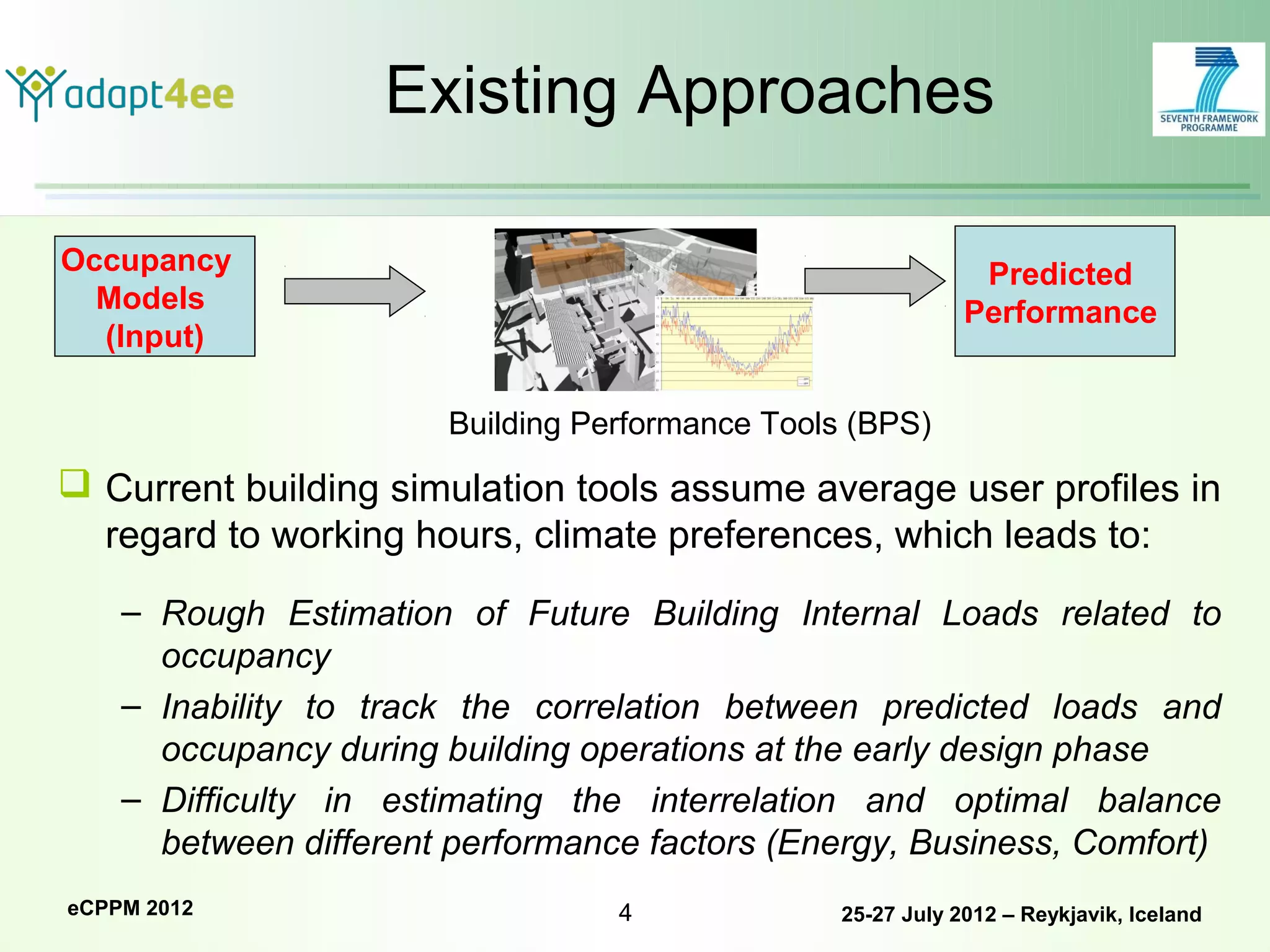
Occupancy                                                     Predicted
  Models                                                     Performance
  (Input)

                       Building Performance Tools (BPS)
 Current building simulation tools assume average user profiles in
  regard to working hours, climate preferences, which leads to:
    – Rough Estimation of Future Building Internal Loads related to
      occupancy
    – Inability to track the correlation between predicted loads and
      occupancy during building operations at the early design phase
    – Difficulty in estimating the interrelation and optimal balance
      between different performance factors (Energy, Business, Comfort)
eCPPM 2012                        4              25-27 July 2012 – Reykjavik, Iceland
Existing Approaches (cont.)

Occupancy                                                  Predicted
  Models                                                  Performance
  (Input)

                    Building Performance Tools (BPS)
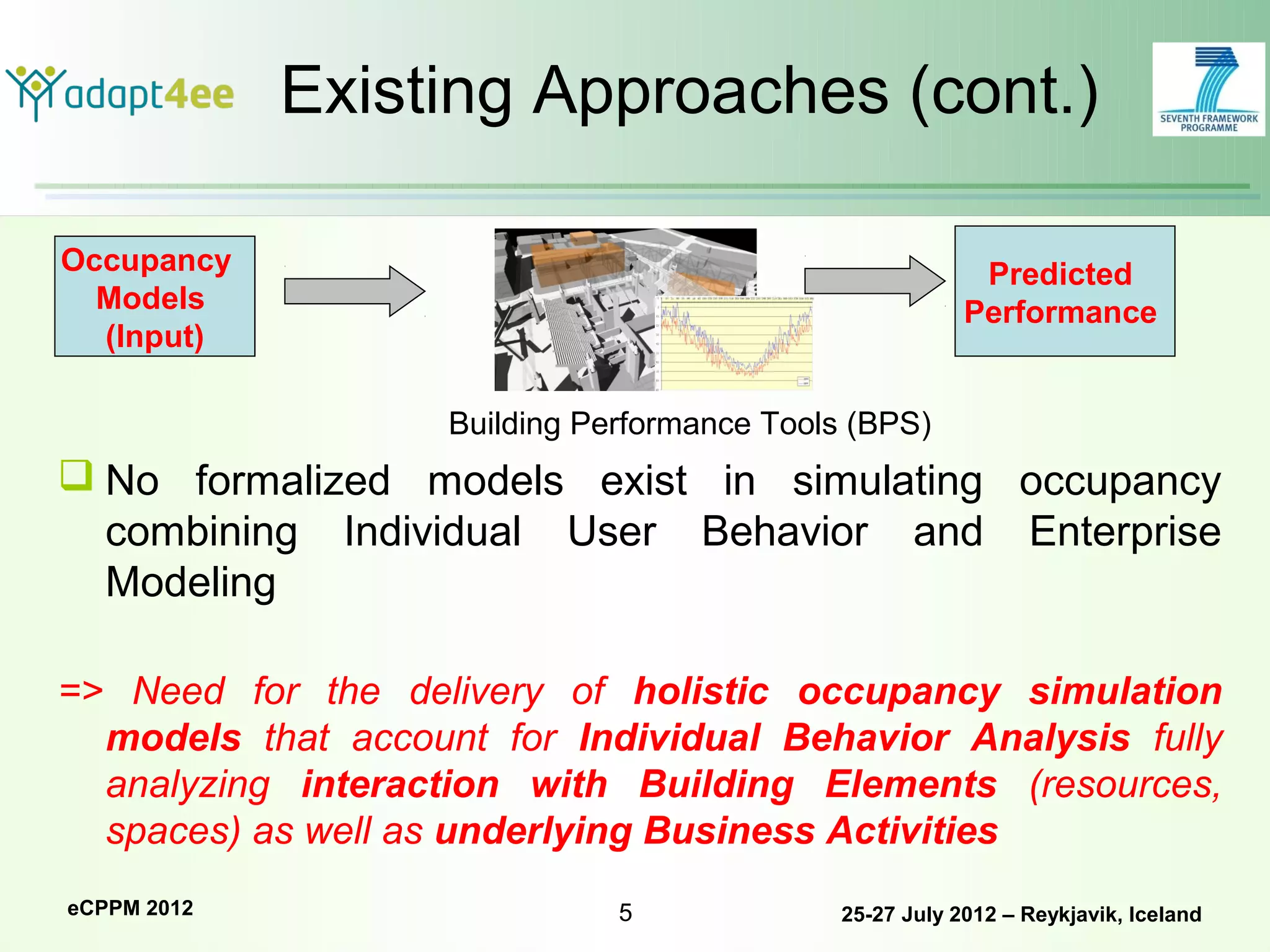
 No formalized models exist in simulating occupancy
  combining Individual User Behavior and Enterprise
  Modeling

=> Need for the delivery of holistic occupancy simulation
  models that account for Individual Behavior Analysis fully
  analyzing interaction with Building Elements (resources,
  spaces) as well as underlying Business Activities
eCPPM 2012                     5              25-27 July 2012 – Reykjavik, Iceland
Existing Occupancy Models

 Standard Occupancy used by BPS tools
     – Daily work hour schedules (occupancy diversity profiles), equal
       for all users not taking into account enterprise-related aspects of
       the building under design
 Reinhart (Lightswitch), Bourgeois (SHOCC)
     – Daily schedules, possible occupant breaks and time variance on
       schedules
     – Several behavior types with regard to light and HVAC control
       and shading
 Page, Liao (Agent Based Approaches)
     – Agent-based model for individual occupants
     – Probabilistic graphical models that are used to effect agent
       behavior and occupancy prediction
     – Validation is needed on multi-room and multi-occupant cases
eCPPM 2012                          6             25-27 July 2012 – Reykjavik, Iceland
Existing Occupancy Models

 Tabak (USSU)
     – Detailed activity model of individuals based on
       observation and interviews
     – Group and solo activities performed by individuals
     – Definition of skeleton and intermediate activities
       performed by individuals
 Zimmermann
     – Activity scheduling similar to USSU
     – User interaction with building and control

=> Lack of models that fully characterize occupancy
  behavior with the Enterprise/Organization that will be
  housed in the facility/building under design
eCPPM 2012                     7           25-27 July 2012 – Reykjavik, Iceland
Activity Based and Behavioral
                          Occupancy Models
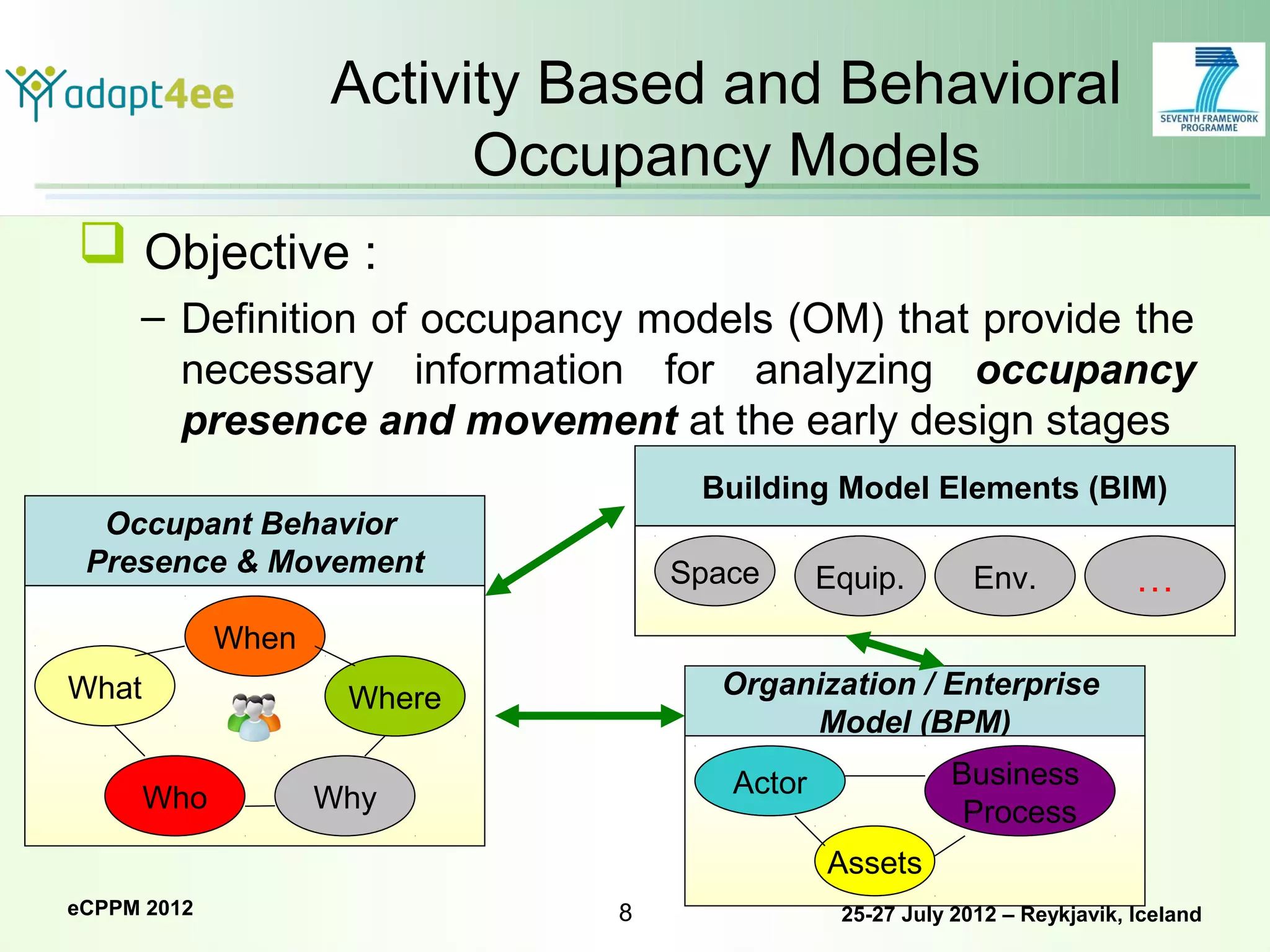
 Objective :
     – Definition of occupancy models (OM) that provide the
       necessary information for analyzing occupancy
       presence and movement at the early design stages
                                   Building Model Elements (BIM)
  Occupant Behavior
 Presence & Movement              Space      Equip.        Env.            …
             When
What                 Where          Organization / Enterprise
                                         Model (BPM)
                                     Actor              Business
       Who          Why                                  Process
                                             Assets
eCPPM 2012                    8               25-27 July 2012 – Reykjavik, Iceland
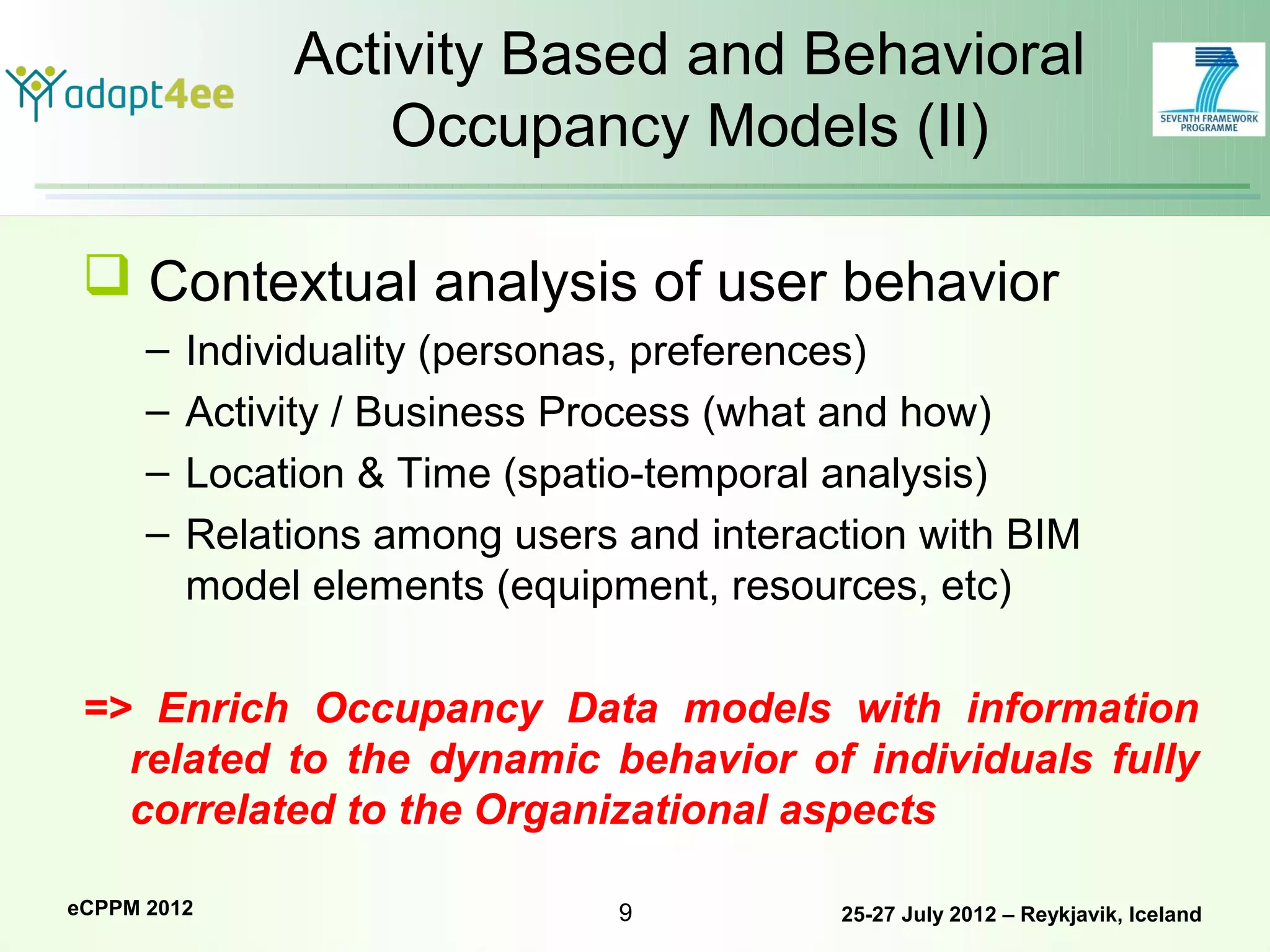
Activity Based and Behavioral
                   Occupancy Models (II)

  Contextual analysis of user behavior
      –   Individuality (personas, preferences)
      –   Activity / Business Process (what and how)
      –   Location & Time (spatio-temporal analysis)
      –   Relations among users and interaction with BIM
          model elements (equipment, resources, etc)

 => Enrich Occupancy Data models with information
   related to the dynamic behavior of individuals fully
   correlated to the Organizational aspects

eCPPM 2012                      9          25-27 July 2012 – Reykjavik, Iceland
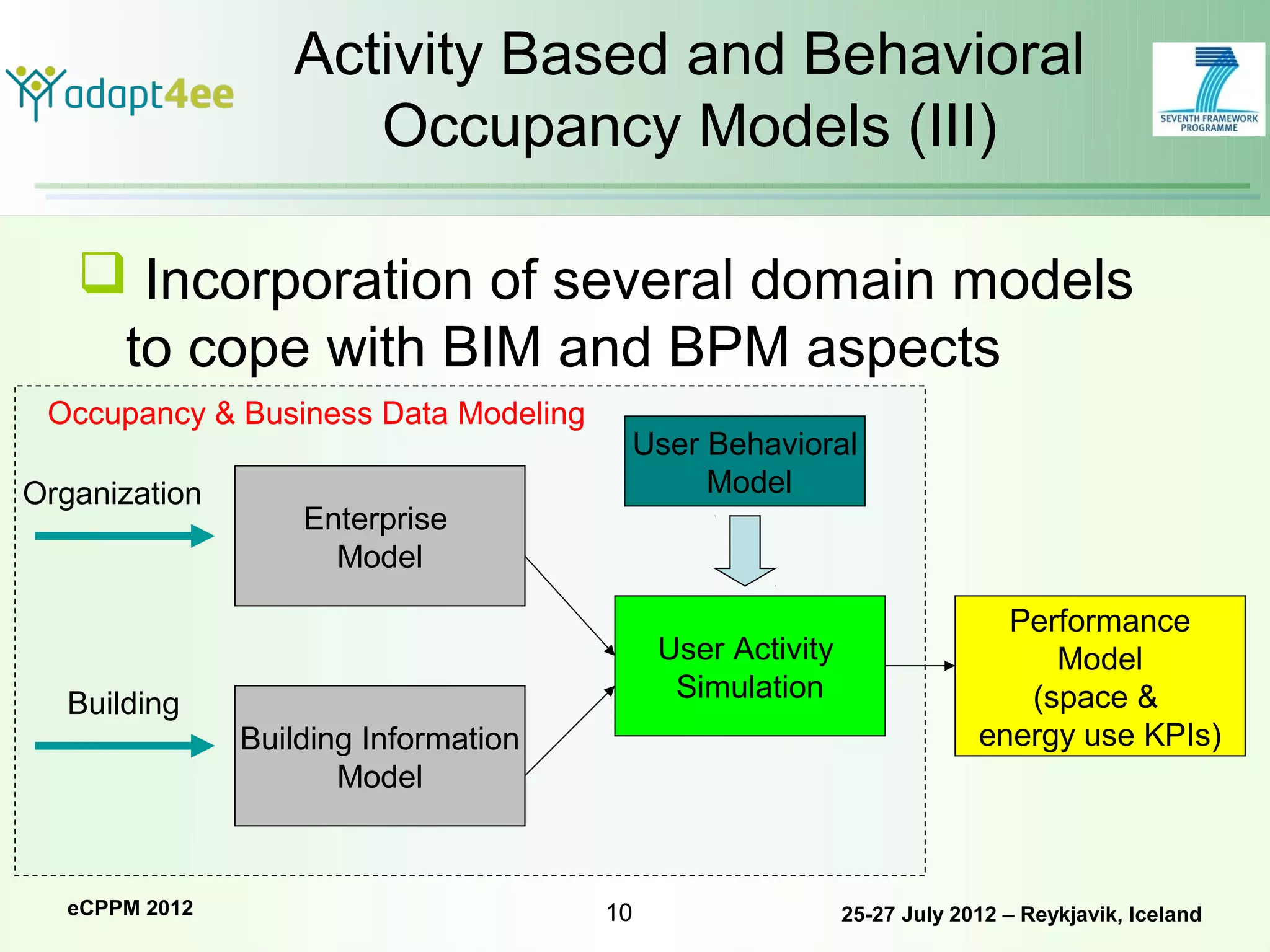
Activity Based and Behavioral
                     Occupancy Models (III)

    Incorporation of several domain models
    to cope with BIM and BPM aspects
 Occupancy & Business Data Modeling
                                       User Behavioral
Organization                                Model
                   Enterprise
                     Model

                                                                          Performance
                                           User Activity                     Model
                                            Simulation                     (space &
  Building
               Building Information                                     energy use KPIs)
                      Model


  eCPPM 2012                          10                   25-27 July 2012 – Reykjavik, Iceland
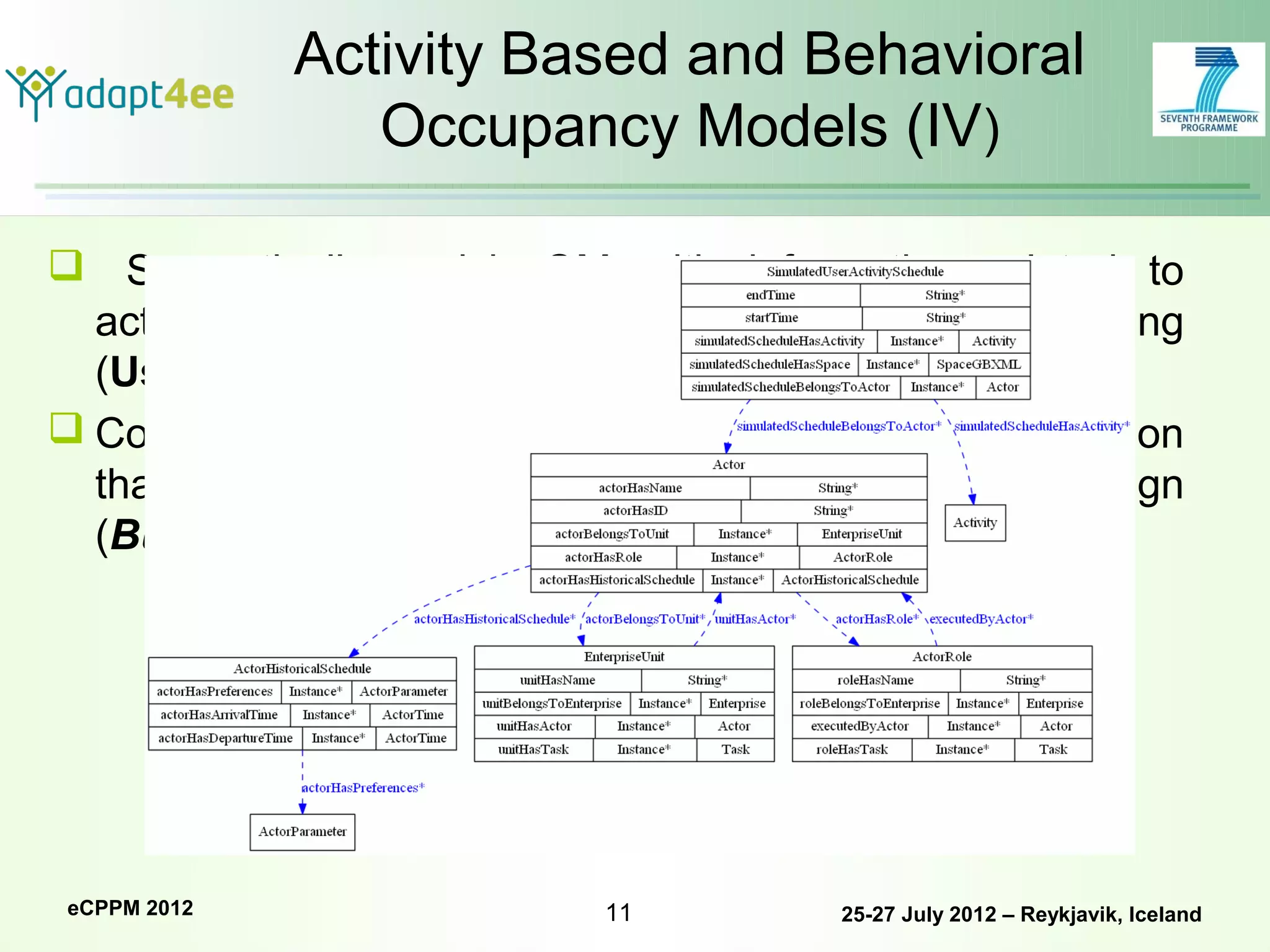
Activity Based and Behavioral
                 Occupancy Models (IV)

 Semantically enrich OM with information related to
  activities performed during human presence in building
  (User Behavior Models)
 Correlation of activities with the enterprise/organization
  that will be “housed” in the building under design
  (Business Process Models)


 eCPPM 2012                  11          25-27 July 2012 – Reykjavik, Iceland
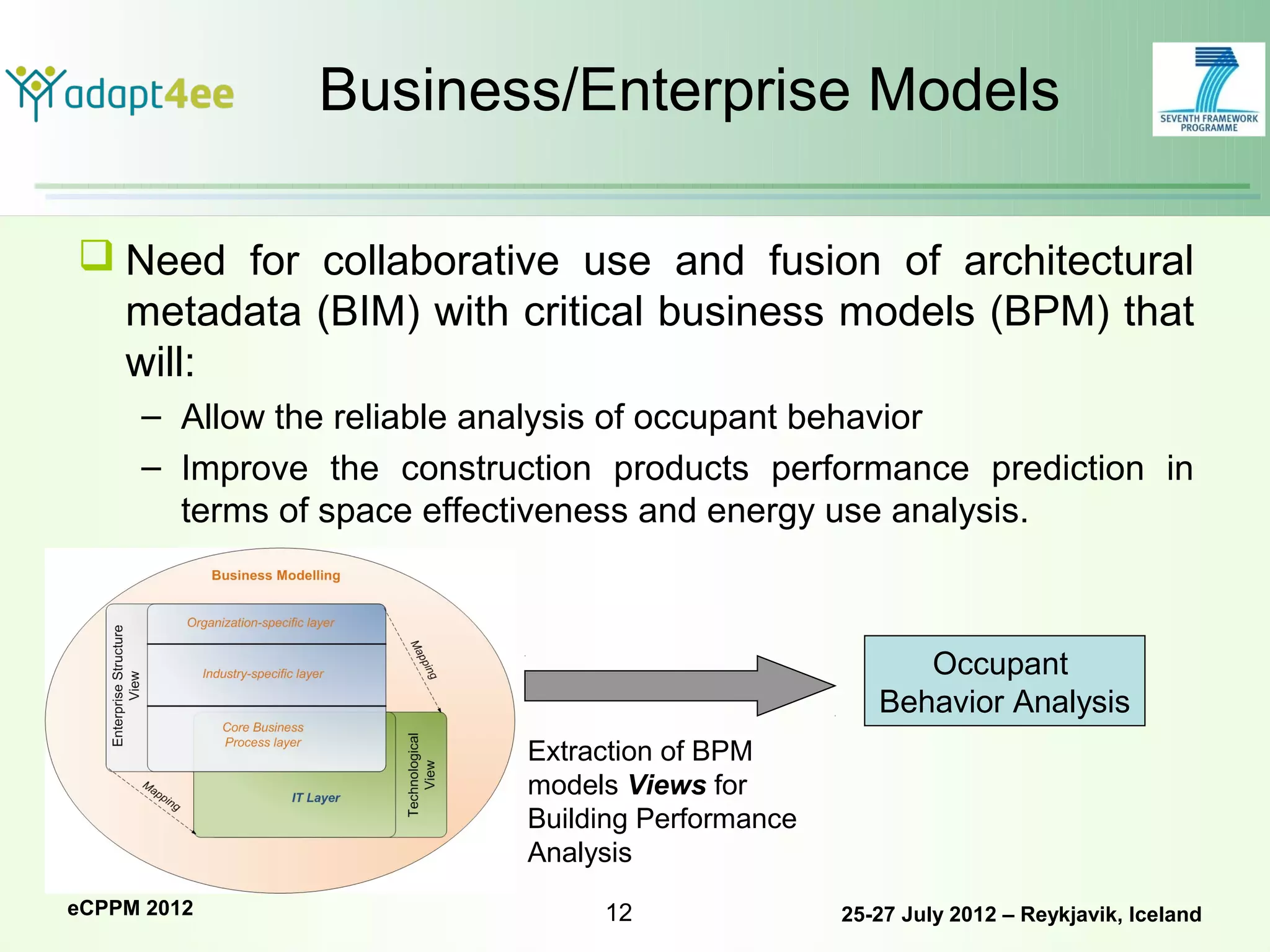
Business/Enterprise Models

 Need for collaborative use and fusion of architectural
  metadata (BIM) with critical business models (BPM) that
  will:
     – Allow the reliable analysis of occupant behavior
     – Improve the construction products performance prediction in
       terms of space effectiveness and energy use analysis.


                                                        Occupant
                                                     Behavior Analysis
                           Extraction of BPM
                           models Views for
                           Building Performance
                           Analysis
eCPPM 2012                      12                25-27 July 2012 – Reykjavik, Iceland
Business/Enterprise Models (II)

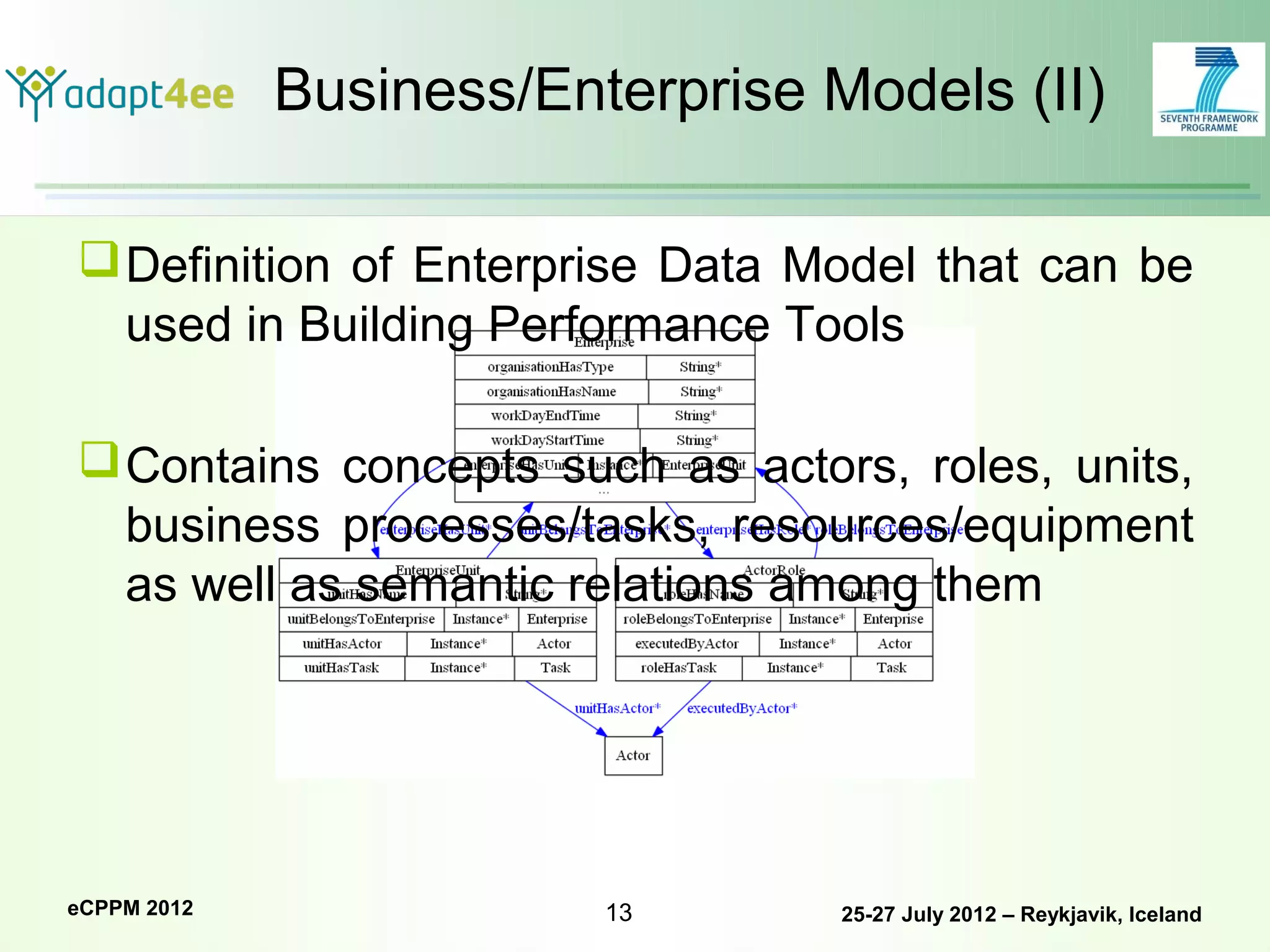
 Definition of Enterprise Data Model that can be
  used in Building Performance Tools

 Contains concepts such as actors, roles, units,
  business processes/tasks, resources/equipment
  as well as semantic relations among them


eCPPM 2012               13       25-27 July 2012 – Reykjavik, Iceland
Business/Enterprise Models (III)

 Ultimate goal to define at organization level those
    business processes (BP) that are of particular
    interest for analyzing the Building Performance

 Definition of Primary/Skeleton and Intermediate
    activities performed at the organization level by:
     – Each Occupant (BPM View)
     – By Multiple Occupants (Group Activities)
     – At a particular Building Area (BIM View) interacting with BIM
       available elements depending on the building Level of Details
       (LOD) (e.g. HVAC, lighting, Enterprise resources/equipment, etc


eCPPM 2012                       14             25-27 July 2012 – Reykjavik, Iceland
Business/Enterprise Models (IV)

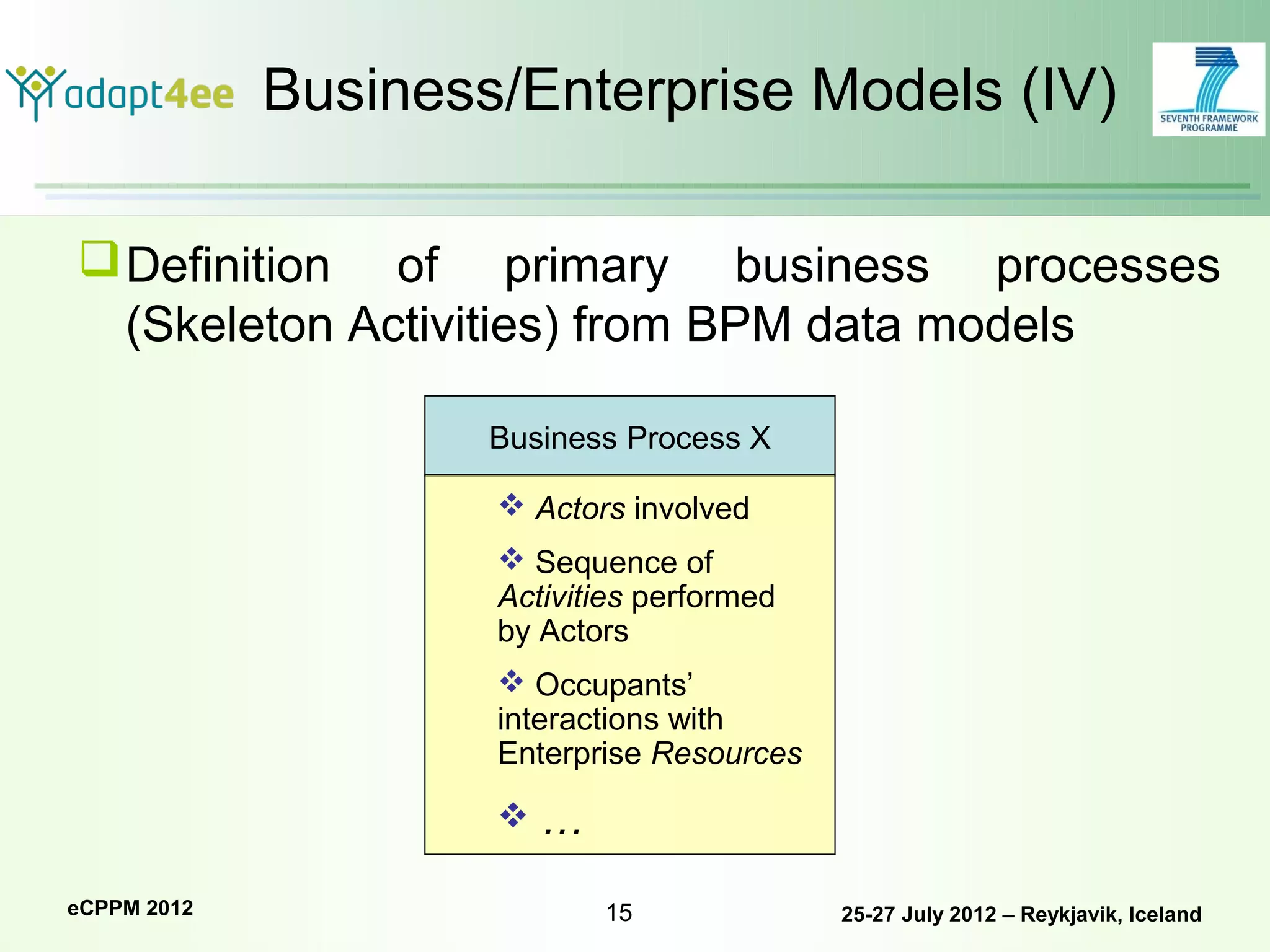
 Definition of primary business processes
  (Skeleton Activities) from BPM data models

                     Business Process X

                      Actors involved
                      Sequence of
                     Activities performed
                     by Actors
                      Occupants’
                     interactions with
                     Enterprise Resources

                     …

eCPPM 2012                  15              25-27 July 2012 – Reykjavik, Iceland
Combining Behavioral and
                  Business Models

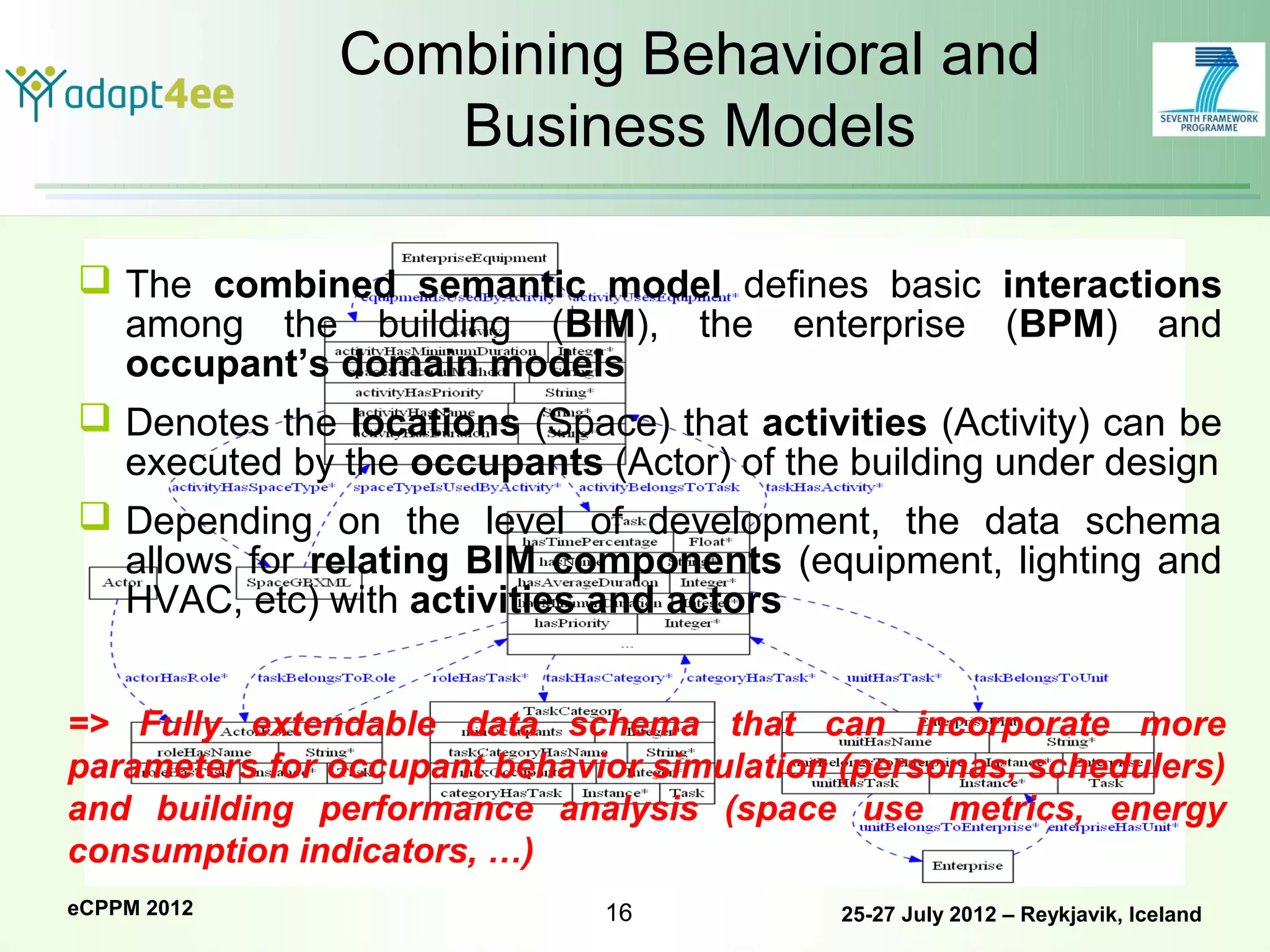
 The combined semantic model defines basic interactions
  among the building (BIM), the enterprise (BPM) and
  occupant’s domain models
 Denotes the locations (Space) that activities (Activity) can be
  executed by the occupants (Actor) of the building under design
 Depending on the level of development, the data schema
  allows for relating BIM components (equipment, lighting and
  HVAC, etc) with activities and actors


=> Fully extendable data schema that can incorporate more
parameters for occupant behavior simulation (personas, schedulers)
and building performance analysis (space use metrics, energy
consumption indicators, …)
eCPPM 2012                    16            25-27 July 2012 – Reykjavik, Iceland
Combining Behavioral and
                     Business Models (II)
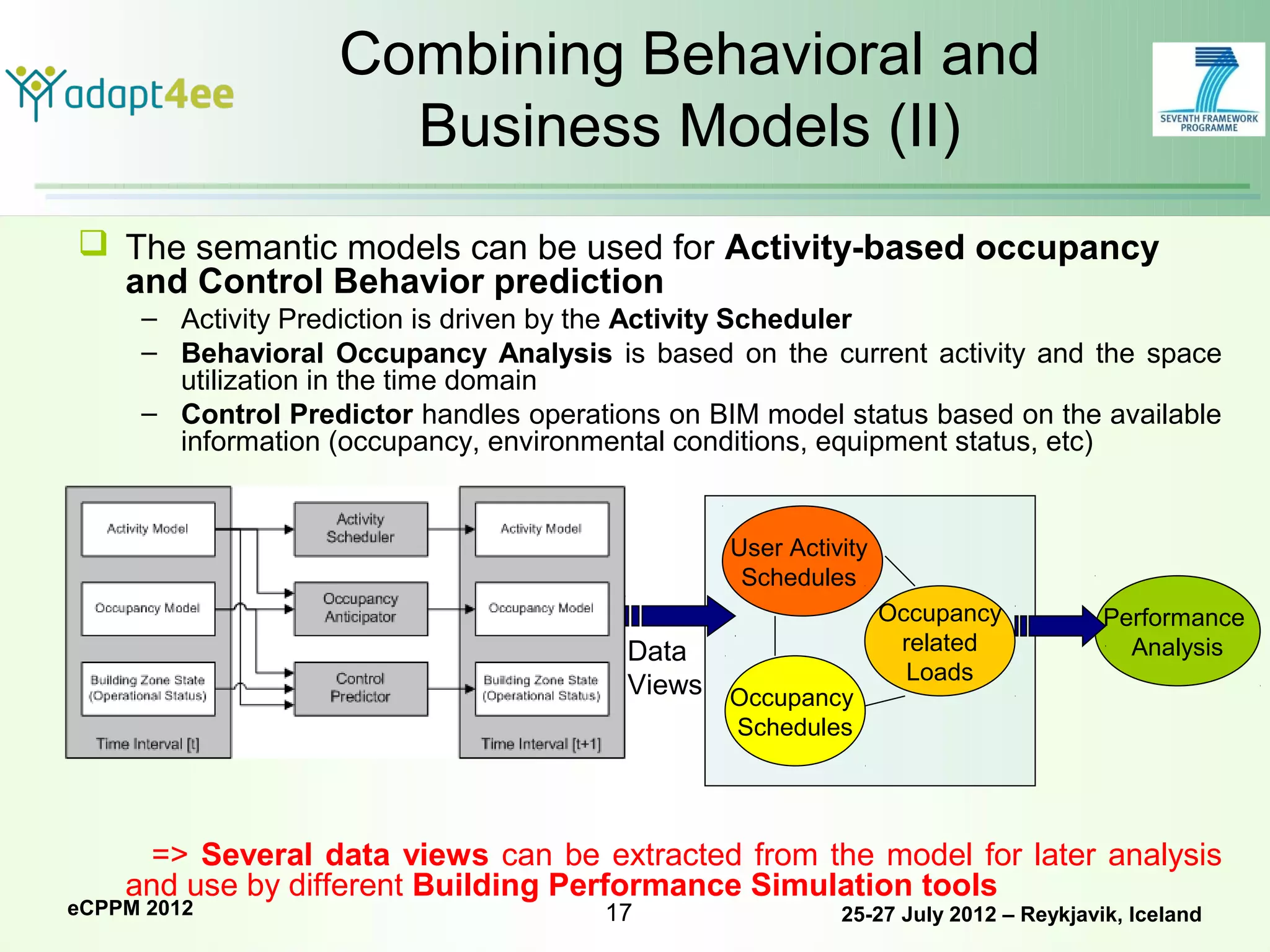
 The semantic models can be used for Activity-based occupancy
  and Control Behavior prediction
     – Activity Prediction is driven by the Activity Scheduler
     – Behavioral Occupancy Analysis is based on the current activity and the space
       utilization in the time domain
     – Control Predictor handles operations on BIM model status based on the available
       information (occupancy, environmental conditions, equipment status, etc)


                                                 User Activity
                                                  Schedules
                                                                 Occupancy           Performance
                                         Data                     related              Analysis
                                                                   Loads
                                         Views Occupancy
                                                 Schedules


     => Several data views can be extracted from the model for later analysis
    and use by different Building Performance Simulation tools
eCPPM 2012                             17                  25-27 July 2012 – Reykjavik, Iceland
Enriching BIM with occupancy
                        models

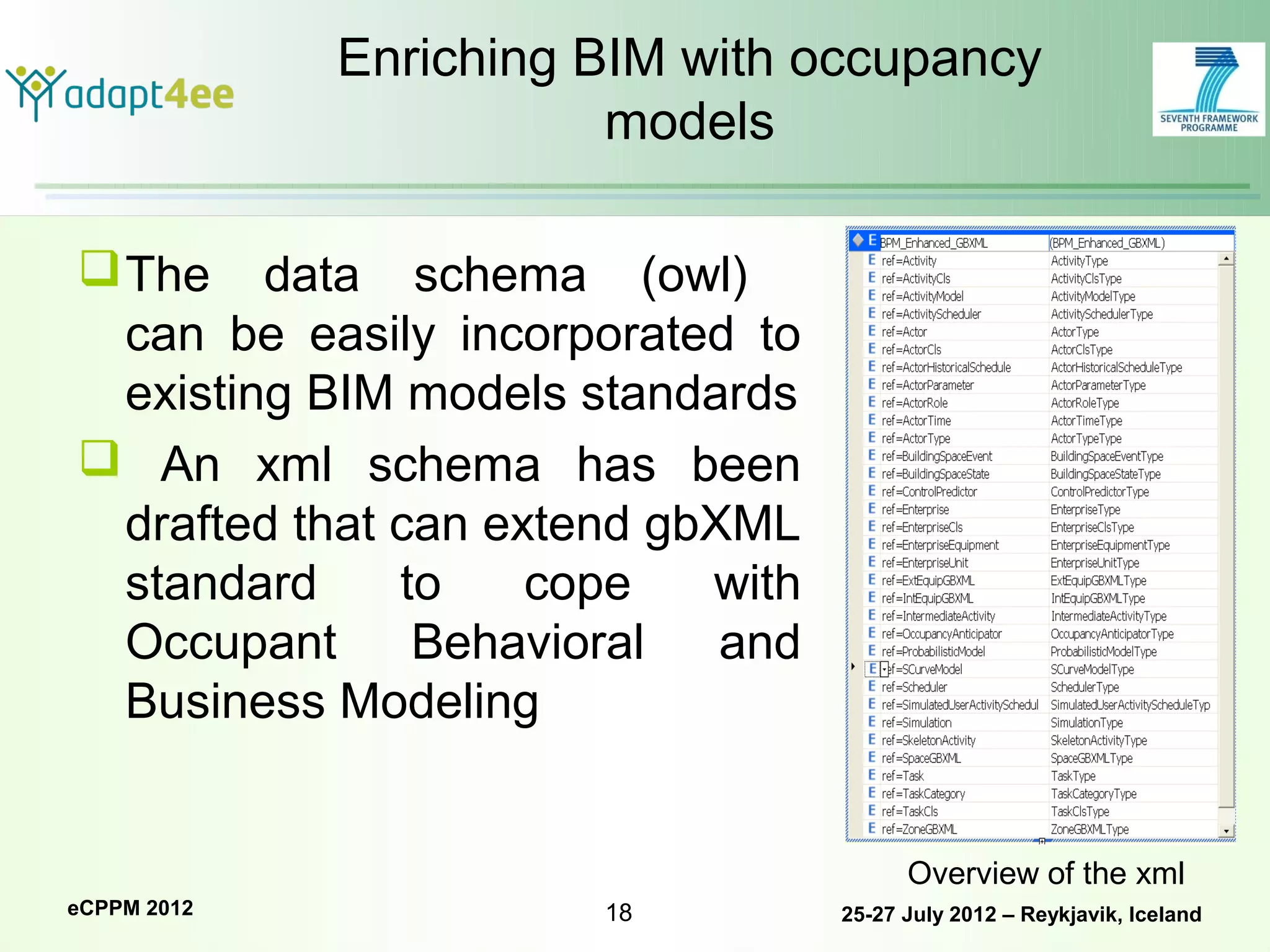
 The data schema (owl)
  can be easily incorporated to
  existing BIM models standards
 An xml schema has been
  drafted that can extend gbXML
  standard     to    cope   with
  Occupant      Behavioral   and
  Business Modeling


                                         Overview of the xml
eCPPM 2012             18          25-27 July 2012 – Reykjavik, Iceland
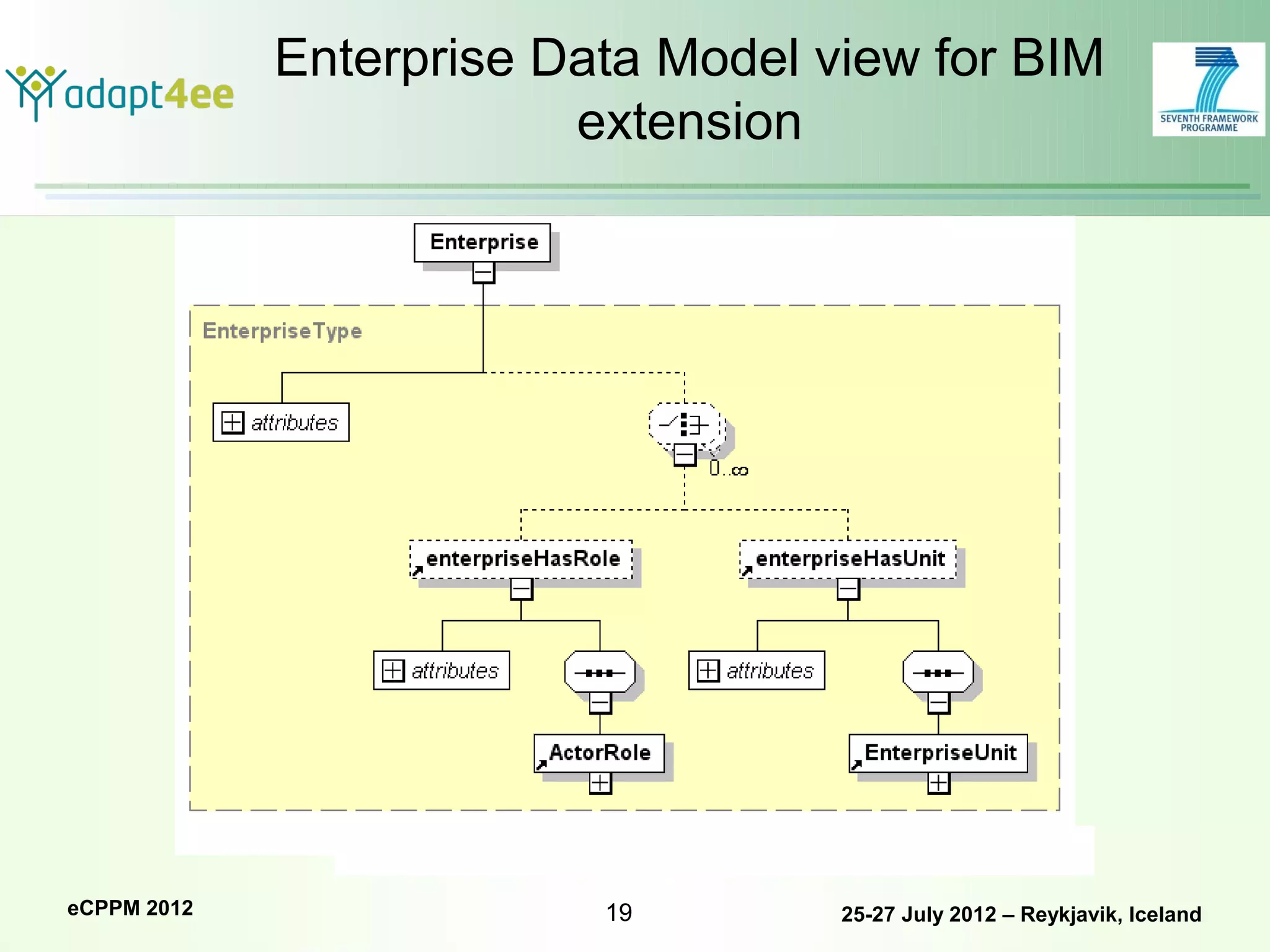
Enterprise Data Model view for BIM
                         extension


eCPPM 2012                19        25-27 July 2012 – Reykjavik, Iceland
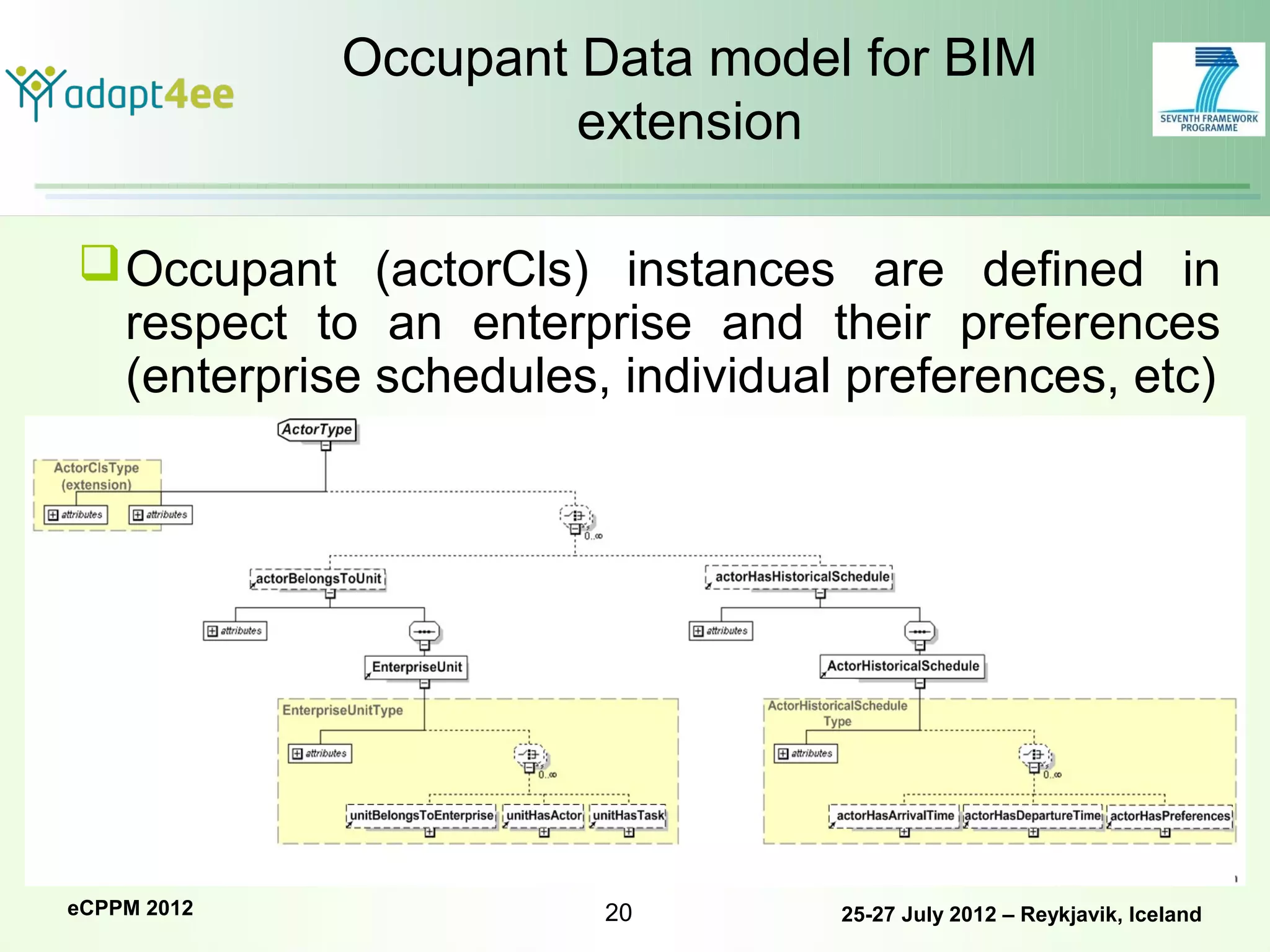
Occupant Data model for BIM
                      extension

 Occupant (actorCls) instances are defined in
  respect to an enterprise and their preferences
  (enterprise schedules, individual preferences, etc)


eCPPM 2012              20         25-27 July 2012 – Reykjavik, Iceland
Use of data models in BPS tools

                               Business Analysts may use
                                the data models to define
                                enterprise-specific
                                instantiations of the models
                                (BPM-view)
                               D&Es may use the behavioral
                                occupancy models for user
                                activity simulation and
                                energy performance
                                analysis of design
                                alternatives (BIM)
                               Nested approach for
                                occupancy prediction &
                                control, allowing interfacing
                                with existing BPS tools
eCPPM 2012               21           25-27 July 2012 – Reykjavik, Iceland
Conclusions

Contributions
 Definition of semantically enriched data models among two currently
  disjoint worlds, BIM and BPM
 Human presence and behavior representation models
 Definition of Occupancy Anticipators, Schedulers and Control
  Predictors for reliable User Behavior Analysis/Prediction

 Impact
  Improve accuracy and reliability of building performance simulation
   due to its occupancy
  Delivery of occupancy models that are granular enough to handle to
   an extend the dynamic behavior of humans in building spaces
  Providing D&Es the ability to reconcile differences between the
   energy analysis of “real” and “simulated” buildings by the fusion of
   two worlds encapsulated by the BIM & BPM data models
 eCPPM 2012                        22             25-27 July 2012 – Reykjavik, Iceland
Next Steps

 Provision for performance models that cope
  with building performance indicators (energy
  consumption,      enterprise-related    indicators
  including space effectiveness analysis)
 Integration of the data models to the Adapt4EE
  Building Simulation Framework


    =>Work presented has been carried out in
    the context of Adapt4EE EC-funded project
                            W: www.adapt4ee.eu

eCPPM 2012              23         25-27 July 2012 – Reykjavik, Iceland
Questions?

Dr. Dimitrios Tzovaras
     Information Technologies Institute
     Dimitrios.Tzovaras@iti.gr


             Information
             Technologies Institute


eCPPM 2012                            24   25-27 July 2012 – Reykjavik, Iceland

Occupancy and business modelling

  • 1.
    eCPPM 2012 eeBDM at ECPPM 3rd Workshop on eeBuildings Data Models (Energy Efficiency Vocabularies) Session 2 - eeBEMS Paper - Occupancy and Business Modelling Presenter: Dr. Dimitrios Tzovaras Dimos Ioannidis, BEng / Research Associate, djoannid@iti.gr Dimitrios Tzovaras, PhD / Researcher Grade A, dimitrios.tzovaras@iti.gr Centre for Research and Technology Hellas / Information Technologies Institute (CERTH/ITI) Christos Malavazos, PhD / IT Unit Director, c.malavazos@hypertech.gr Hypertech S.A. 25-27 July 2012 – Reykjavik, Iceland
  • 2.
    Outline  Introduction toBuilding Occupancy Modeling for Building Performance Simulation and Analysis  Activity Based and Behavioral Occupancy Models  Business/Enterprise Models  Combining Behavioral and Business Models  Enriching BIM with occupancy models  Utilization of Occupancy models in Building Performance Simulation Tools  Conclusions eCPPM 2012 2 25-27 July 2012 – Reykjavik, Iceland
  • 3.
    Motivation  Building performanceanalysis highly depends on occupants behavior  Building Occupancy Analysis helps predicting space utilization and energy usage with increased accuracy, granularity and reliability => Existing BPS tools have to be enriched with data models fully analyzing occupancy patterns as well as individual occupant behavior in order to accurately predict energy consumption and space utilization in facilities under design eCPPM 2012 3 25-27 July 2012 – Reykjavik, Iceland
  • 4.
    Existing Approaches Occupancy Predicted Models Performance (Input) Building Performance Tools (BPS)  Current building simulation tools assume average user profiles in regard to working hours, climate preferences, which leads to: – Rough Estimation of Future Building Internal Loads related to occupancy – Inability to track the correlation between predicted loads and occupancy during building operations at the early design phase – Difficulty in estimating the interrelation and optimal balance between different performance factors (Energy, Business, Comfort) eCPPM 2012 4 25-27 July 2012 – Reykjavik, Iceland
  • 5.
    Existing Approaches (cont.) Occupancy Predicted Models Performance (Input) Building Performance Tools (BPS)  No formalized models exist in simulating occupancy combining Individual User Behavior and Enterprise Modeling => Need for the delivery of holistic occupancy simulation models that account for Individual Behavior Analysis fully analyzing interaction with Building Elements (resources, spaces) as well as underlying Business Activities eCPPM 2012 5 25-27 July 2012 – Reykjavik, Iceland
  • 6.
    Existing Occupancy Models Standard Occupancy used by BPS tools – Daily work hour schedules (occupancy diversity profiles), equal for all users not taking into account enterprise-related aspects of the building under design  Reinhart (Lightswitch), Bourgeois (SHOCC) – Daily schedules, possible occupant breaks and time variance on schedules – Several behavior types with regard to light and HVAC control and shading  Page, Liao (Agent Based Approaches) – Agent-based model for individual occupants – Probabilistic graphical models that are used to effect agent behavior and occupancy prediction – Validation is needed on multi-room and multi-occupant cases eCPPM 2012 6 25-27 July 2012 – Reykjavik, Iceland
  • 7.
    Existing Occupancy Models Tabak (USSU) – Detailed activity model of individuals based on observation and interviews – Group and solo activities performed by individuals – Definition of skeleton and intermediate activities performed by individuals  Zimmermann – Activity scheduling similar to USSU – User interaction with building and control => Lack of models that fully characterize occupancy behavior with the Enterprise/Organization that will be housed in the facility/building under design eCPPM 2012 7 25-27 July 2012 – Reykjavik, Iceland
  • 8.
    Activity Based andBehavioral Occupancy Models  Objective : – Definition of occupancy models (OM) that provide the necessary information for analyzing occupancy presence and movement at the early design stages Building Model Elements (BIM) Occupant Behavior Presence & Movement Space Equip. Env. … When What Where Organization / Enterprise Model (BPM) Actor Business Who Why Process Assets eCPPM 2012 8 25-27 July 2012 – Reykjavik, Iceland
  • 9.
    Activity Based andBehavioral Occupancy Models (II)  Contextual analysis of user behavior – Individuality (personas, preferences) – Activity / Business Process (what and how) – Location & Time (spatio-temporal analysis) – Relations among users and interaction with BIM model elements (equipment, resources, etc) => Enrich Occupancy Data models with information related to the dynamic behavior of individuals fully correlated to the Organizational aspects eCPPM 2012 9 25-27 July 2012 – Reykjavik, Iceland
  • 10.
    Activity Based andBehavioral Occupancy Models (III)  Incorporation of several domain models to cope with BIM and BPM aspects Occupancy & Business Data Modeling User Behavioral Organization Model Enterprise Model Performance User Activity Model Simulation (space & Building Building Information energy use KPIs) Model eCPPM 2012 10 25-27 July 2012 – Reykjavik, Iceland
  • 11.
    Activity Based andBehavioral Occupancy Models (IV)  Semantically enrich OM with information related to activities performed during human presence in building (User Behavior Models)  Correlation of activities with the enterprise/organization that will be “housed” in the building under design (Business Process Models) eCPPM 2012 11 25-27 July 2012 – Reykjavik, Iceland
  • 12.
    Business/Enterprise Models  Needfor collaborative use and fusion of architectural metadata (BIM) with critical business models (BPM) that will: – Allow the reliable analysis of occupant behavior – Improve the construction products performance prediction in terms of space effectiveness and energy use analysis. Occupant Behavior Analysis Extraction of BPM models Views for Building Performance Analysis eCPPM 2012 12 25-27 July 2012 – Reykjavik, Iceland
  • 13.
    Business/Enterprise Models (II) Definition of Enterprise Data Model that can be used in Building Performance Tools  Contains concepts such as actors, roles, units, business processes/tasks, resources/equipment as well as semantic relations among them eCPPM 2012 13 25-27 July 2012 – Reykjavik, Iceland
  • 14.
    Business/Enterprise Models (III) Ultimate goal to define at organization level those business processes (BP) that are of particular interest for analyzing the Building Performance  Definition of Primary/Skeleton and Intermediate activities performed at the organization level by: – Each Occupant (BPM View) – By Multiple Occupants (Group Activities) – At a particular Building Area (BIM View) interacting with BIM available elements depending on the building Level of Details (LOD) (e.g. HVAC, lighting, Enterprise resources/equipment, etc eCPPM 2012 14 25-27 July 2012 – Reykjavik, Iceland
  • 15.
    Business/Enterprise Models (IV) Definition of primary business processes (Skeleton Activities) from BPM data models Business Process X  Actors involved  Sequence of Activities performed by Actors  Occupants’ interactions with Enterprise Resources … eCPPM 2012 15 25-27 July 2012 – Reykjavik, Iceland
  • 16.
    Combining Behavioral and Business Models  The combined semantic model defines basic interactions among the building (BIM), the enterprise (BPM) and occupant’s domain models  Denotes the locations (Space) that activities (Activity) can be executed by the occupants (Actor) of the building under design  Depending on the level of development, the data schema allows for relating BIM components (equipment, lighting and HVAC, etc) with activities and actors => Fully extendable data schema that can incorporate more parameters for occupant behavior simulation (personas, schedulers) and building performance analysis (space use metrics, energy consumption indicators, …) eCPPM 2012 16 25-27 July 2012 – Reykjavik, Iceland
  • 17.
    Combining Behavioral and Business Models (II)  The semantic models can be used for Activity-based occupancy and Control Behavior prediction – Activity Prediction is driven by the Activity Scheduler – Behavioral Occupancy Analysis is based on the current activity and the space utilization in the time domain – Control Predictor handles operations on BIM model status based on the available information (occupancy, environmental conditions, equipment status, etc) User Activity Schedules Occupancy Performance Data related Analysis Loads Views Occupancy Schedules => Several data views can be extracted from the model for later analysis and use by different Building Performance Simulation tools eCPPM 2012 17 25-27 July 2012 – Reykjavik, Iceland
  • 18.
    Enriching BIM withoccupancy models  The data schema (owl) can be easily incorporated to existing BIM models standards  An xml schema has been drafted that can extend gbXML standard to cope with Occupant Behavioral and Business Modeling Overview of the xml eCPPM 2012 18 25-27 July 2012 – Reykjavik, Iceland
  • 19.
    Enterprise Data Modelview for BIM extension eCPPM 2012 19 25-27 July 2012 – Reykjavik, Iceland
  • 20.
    Occupant Data modelfor BIM extension  Occupant (actorCls) instances are defined in respect to an enterprise and their preferences (enterprise schedules, individual preferences, etc) eCPPM 2012 20 25-27 July 2012 – Reykjavik, Iceland
  • 21.
    Use of datamodels in BPS tools  Business Analysts may use the data models to define enterprise-specific instantiations of the models (BPM-view)  D&Es may use the behavioral occupancy models for user activity simulation and energy performance analysis of design alternatives (BIM)  Nested approach for occupancy prediction & control, allowing interfacing with existing BPS tools eCPPM 2012 21 25-27 July 2012 – Reykjavik, Iceland
  • 22.
    Conclusions Contributions  Definition ofsemantically enriched data models among two currently disjoint worlds, BIM and BPM  Human presence and behavior representation models  Definition of Occupancy Anticipators, Schedulers and Control Predictors for reliable User Behavior Analysis/Prediction Impact  Improve accuracy and reliability of building performance simulation due to its occupancy  Delivery of occupancy models that are granular enough to handle to an extend the dynamic behavior of humans in building spaces  Providing D&Es the ability to reconcile differences between the energy analysis of “real” and “simulated” buildings by the fusion of two worlds encapsulated by the BIM & BPM data models eCPPM 2012 22 25-27 July 2012 – Reykjavik, Iceland
  • 23.
    Next Steps  Provisionfor performance models that cope with building performance indicators (energy consumption, enterprise-related indicators including space effectiveness analysis)  Integration of the data models to the Adapt4EE Building Simulation Framework =>Work presented has been carried out in the context of Adapt4EE EC-funded project W: www.adapt4ee.eu eCPPM 2012 23 25-27 July 2012 – Reykjavik, Iceland
  • 24.
    Questions? Dr. Dimitrios Tzovaras Information Technologies Institute Dimitrios.Tzovaras@iti.gr Information Technologies Institute eCPPM 2012 24 25-27 July 2012 – Reykjavik, Iceland

Editor's Notes

  • #7 References if needed by participants Reinhart C F , “Lightswitch 2002: A model for manual control of electric lighting and blinds”, Solar Energy 77:1 pp. 15-28, 2004. Bourgeois, D., Reinhart, C.F., Hand, J., MacDonald, I., 2004. Adding sub-hourly occupancy prediction, occupancy-sensing control and manual environmental control to whole-building energy simulation. In: Proceedings of the CIB World Building Congress 2004, Toronto, Canada, May 2004, p. 8 J. Page, D. Robinson, N. Morel, and J.-L. Scartezzini, “A generalised stochastic model for the simulation of occupant presence,” Energy and Buildings, vol. 40, pp. 83 – 98, 2008 Liao, C., and Barooah, P. 2010. An integrated approach to occupancy modeling and estimation in commercial buildings. American Control Conference.
  • #8 Tabak, Vincent. (2008). User Simulation of Space Utilisation: System for Office Building Usage Simulation. Ph.D. diss. , Eindhoven University of Technology, Netherlands. Zimmerman, G. (2007). Modeling and Simulation of Individual User Behavior for Building Performance Predictions. In Proc. Of the Summer Computer Simulation Conference , San Diego, USA. Zimmermann, G. (2008). Individual Comfort in Open-Plan Offices - A Case study. DDSS2008 , Leende, the Netherlands. Additional from the paper: Hoes, P., Hensen, J.L.M., Loomans, M.G.L.C., Vries, B. de & Bourgeois, D. (2009). User behavior in whole building simulation. Energy and Buildings 41(3): 295-302. Goldstein, R., Tessier, A. and Khan, A. (2010). Schedule-Calibrated Occupant Behavior Simulation. Proceedings of the Symposium on Simulation for Architecture and Urban Design (SimAUD) . Orlando, FL, USA. Goldstein, R., Tessier, A. and Khan, A. (2011). Space Layout in Occupant Behavior Simulation. Conference Proceedings: IBPSA-AIRAH Building Simulation Conference : 1073-1080.
  • #15 Level of Details (LOD)