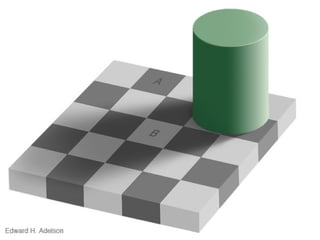
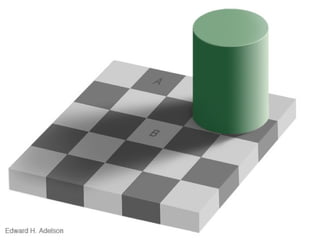
Your brain interprets color based on context rather than objective shading. In an image with two squares labeled A and B of identical gray tones, your brain perceives them as different colors, black and white, due to the contextual cues of the opposite squares suggesting contrasting colors. This demonstrates that the brain often observes things not as they truly are but as expected based on context, highlighting the need to avoid assumptions and check perceptions against objective reality.