Obesity in 3D:
a qualitative comparison of general
practitioners, dietitians and nurses’
views about obesity
Filipa Teixeira (filipa.v.teixeira@gmail.com)
José Luis Pais-Ribeiro (FPCEUP) & Ângela Maia (UMinho)
28th Conference of the European Health Psychology Society
August 27th, 2014
Innsbruck, Austria 1
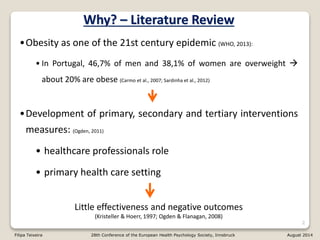
•Obesity as one of the 21st century epidemic (WHO, 2013):
• In Portugal, 46,7% of men and 38,1% of women are overweight 
about 20% are obese (Carmo et al., 2007; Sardinha et al., 2012)
•Development of primary, secondary and tertiary interventions
measures: (Ogden, 2011)
• healthcare professionals role
• primary health care setting
Little effectiveness and negative outcomes
(Kristeller & Hoerr, 1997; Ogden & Flanagan, 2008)
Why? – Literature Review
2
Filipa Teixeira 28th Conference of the European Health Psychology Society, Innsbruck August 2014
3
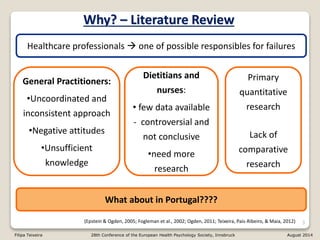
Healthcare professionals  one of possible responsibles for failures
General Practitioners:
•Uncoordinated and
inconsistent approach
•Negative attitudes
•Unsufficient
knowledge
Dietitians and
nurses:
• few data available
- controversial and
not conclusive
•need more
research
(Epstein & Ogden, 2005; Fogleman et al., 2002; Ogden, 2011; Teixeira, Pais-Ribeiro, & Maia, 2012)
Primary
quantitative
research
Lack of
comparative
research
What about in Portugal????
Why? – Literature Review
Filipa Teixeira 28th Conference of the European Health Psychology Society, Innsbruck August 2014
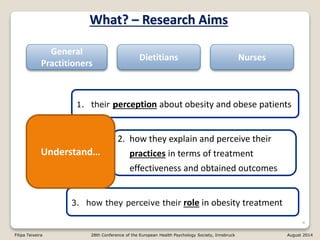
3. how they perceive their role in obesity treatment
2. how they explain and perceive their
practices in terms of treatment
effectiveness and obtained outcomes
4
What? – Research Aims
1. their perception about obesity and obese patients
Understand…
General
Practitioners
Dietitians Nurses
Filipa Teixeira 28th Conference of the European Health Psychology Society, Innsbruck August 2014
5
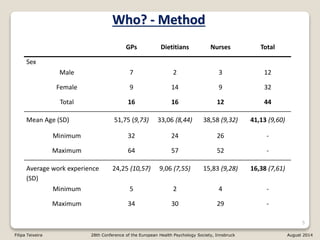
GPs Dietitians Nurses Total
Sex
Male 7 2 3 12
Female 9 14 9 32
Total 16 16 12 44
Mean Age (SD) 51,75 (9,73) 33,06 (8,44) 38,58 (9,32) 41,13 (9,60)
Minimum 32 24 26 -
Maximum 64 57 52 -
Average work experience
(SD)
24,25 (10,57) 9,06 (7,55) 15,83 (9,28) 16,38 (7,61)
Minimum 5 2 4 -
Maximum 34 30 29 -
Who? - Method
Filipa Teixeira 28th Conference of the European Health Psychology Society, Innsbruck August 2014
6
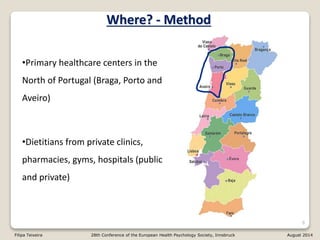
Where? - Method
•Primary healthcare centers in the
North of Portugal (Braga, Porto and
Aveiro)
•Dietitians from private clinics,
pharmacies, gyms, hospitals (public
and private)
Filipa Teixeira 28th Conference of the European Health Psychology Society, Innsbruck August 2014
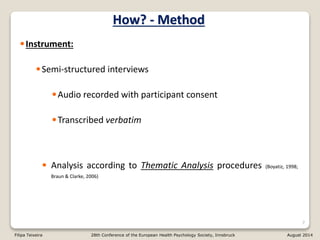
•Instrument:
•Semi-structured interviews
•Audio recorded with participant consent
•Transcribed verbatim
• Analysis according to Thematic Analysis procedures (Boyatiz, 1998;
Braun & Clarke, 2006)
7
How? - Method
Filipa Teixeira 28th Conference of the European Health Psychology Society, Innsbruck August 2014
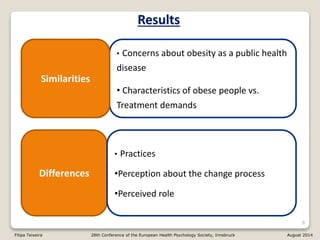
• Concerns about obesity as a public health
disease
• Characteristics of obese people vs.
Treatment demands
8
Results
Similarities
Differences
• Practices
•Perception about the change process
•Perceived role
Filipa Teixeira 28th Conference of the European Health Psychology Society, Innsbruck August 2014
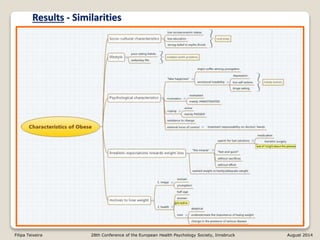
Results - Similarities
9
Filipa Teixeira 28th Conference of the European Health Psychology Society, Innsbruck August 2014
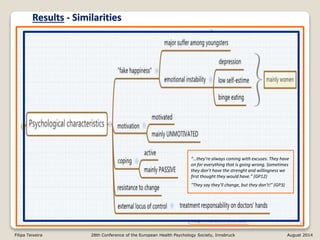
Results - Similarities
10
“…they’re always coming with excuses. They have
on for everything that is going wrong. Sometimes
they don’t have the strenght and willingness we
first thought they would have.” (GP12)
“They say they’ll change, but they don’t!” (GP3)
Filipa Teixeira 28th Conference of the European Health Psychology Society, Innsbruck August 2014
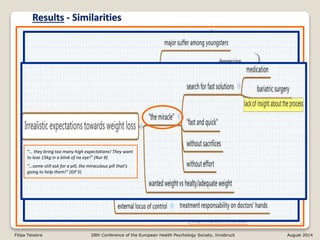
Results - Similarities
11
“…they’re always coming with excuses. They have
on for everything that is going wrong. Sometimes
they don’t have the strenght and willingness we
first thought they would have.” (GP12)
“They say they’ll change, but they don’t!” (GP3)
Filipa Teixeira 28th Conference of the European Health Psychology Society, Innsbruck August 2014
“… they bring too many high expectations! They want
to lose 15kg in a blink of na eye!” (Nur 8)
“…some still ask for a pill, the miraculous pill that’s
going to help them!” (GP 5)
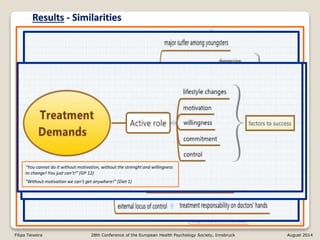
Results - Similarities
12
“…they’re always coming with excuses. They have
on for everything that is going wrong. Sometimes
they don’t have the strenght and willingness we
first thought they would have.” (GP12)
“They say they’ll change, but they don’t!” (GP3)
Filipa Teixeira 28th Conference of the European Health Psychology Society, Innsbruck August 2014
“… they bring too many high expectations! They want
to lose 15kg in a blink of na eye!” (Nur 8)
“…some still ask for a pill, the miraculous pill that’s
going to help them!” (GP 5)
“You cannot do it without motivation, without the strenght and willingness
to change! You just can’t!” (GP 12)
“Without motivation we can’t get anywhere!” (Diet 1)
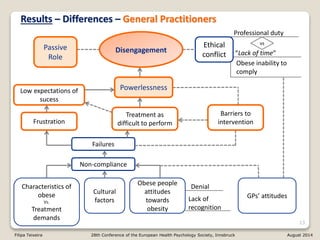
Results – Differences – General Practitioners
13
“Lack of time”Disengagement
Ethical
conflict
Powerlessness
Frustration
Characteristics of
obese
Vs.
Treatment
demands
Cultural
factors
Low expectations of
sucess
Treatment as
difficult to perform
Barriers to
intervention
Obese people
attitudes
towards
obesity
GPs’ attitudes
Denial
Lack of
recognition
Non-compliance
Failures
Passive
Role
Professional duty
Obese inability to
comply
vs
Filipa Teixeira 28th Conference of the European Health Psychology Society, Innsbruck August 2014
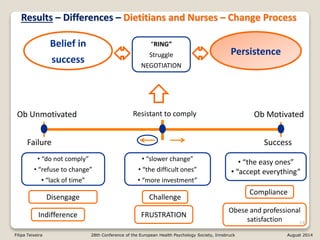
Results – Differences – Dietitians and Nurses – Change Process
14
Failure Success
Ob Unmotivated Ob Motivated
• “the easy ones”
• “accept everything”
• “do not comply”
• “refuse to change”
• “lack of time”
Disengage
Indifference
Compliance
Obese and professional
satisfaction
Resistant to comply
• “slower change”
• “the difficult ones”
• “more investment”
Challenge
Persistence
Belief in
success
“RING”
Struggle
NEGOTIATION
FRUSTRATION
Filipa Teixeira 28th Conference of the European Health Psychology Society, Innsbruck August 2014
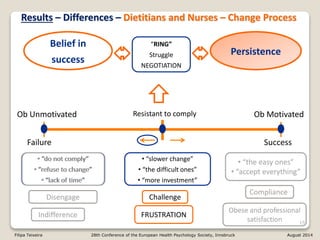
Results – Differences – Dietitians and Nurses – Change Process
15
Failure Success
Ob Unmotivated Ob Motivated
• “the easy ones”
• “accept everything”
• “do not comply”
• “refuse to change”
• “lack of time”
Disengage
Indifference
Compliance
Obese and professional
satisfaction
Resistant to comply
• “slower change”
• “the difficult ones”
• “more investment”
Challenge
Persistence
Belief in
success
“RING”
Struggle
NEGOTIATION
FRUSTRATION
Filipa Teixeira 28th Conference of the European Health Psychology Society, Innsbruck August 2014
Disengage
Indifference
• “the easy ones”
• “accept everything”
Compliance
Obese and professional
satisfaction
• “do not comply”
• “refuse to change”
• “lack of time”
“RING”
Struggle
NEGOTIATION
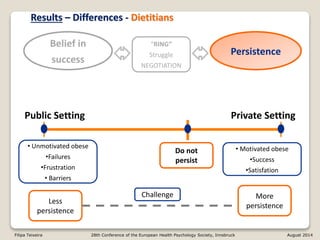
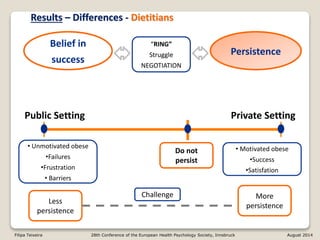
Results – Differences - Dietitians
Public Setting Private Setting
Persistence
• Unmotivated obese
•Failures
•Frustration
• Barriers
Less
persistence
• Motivated obese
•Success
•Satisfation
More
persistence
Do not
persist
Challenge
Filipa Teixeira 28th Conference of the European Health Psychology Society, Innsbruck August 2014
Belief in
success
“RING”
Struggle
NEGOTIATION
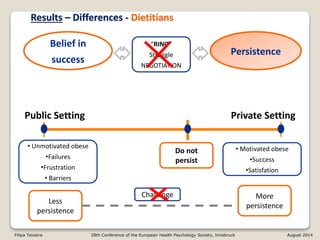
Results – Differences - Dietitians
Public Setting Private Setting
Persistence
• Unmotivated obese
•Failures
•Frustration
• Barriers
Less
persistence
• Motivated obese
•Success
•Satisfation
More
persistence
Do not
persist
Challenge
Filipa Teixeira 28th Conference of the European Health Psychology Society, Innsbruck August 2014
Belief in
success
Belief in
success
“RING”
Struggle
NEGOTIATION
“RING”
Struggle
NEGOTIATION
Results – Differences - Dietitians
Public Setting Private Setting
Persistence
• Unmotivated obese
•Failures
•Frustration
• Barriers
Less
persistence
• Motivated obese
•Success
•Satisfation
More
persistence
Do not
persist
Challenge
Filipa Teixeira 28th Conference of the European Health Psychology Society, Innsbruck August 2014
Belief in
success
Belief in
success
“RING”
Struggle
NEGOTIATION
19
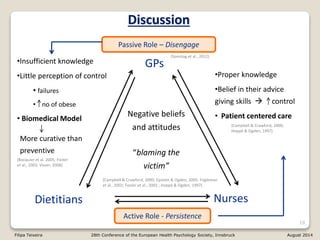
Discussion
GPs
Dietitians Nurses
Active Role - Persistence
Passive Role – Disengage
Negative beliefs
and attitudes
“blaming the
victim”
(Campbell & Crawford, 2000; Epstein & Ogden, 2005; Fogleman
et al., 2002; Foster et al., 2003 ; Hoppé & Ogden, 1997)
•Proper knowledge
•Belief in their advice
giving skills  control
• Patient centered care
(Sonntag et al., 2012)
•Insufficient knowledge
•Little perception of control
• failures
• no of obese
• Biomedical Model
More curative than
preventive
(Bocquier et al. 2005; Foster
et al., 2003; Visser, 2008)
(Campbell & Crawford, 2000;
Hoppé & Ogden, 1997)
Filipa Teixeira 28th Conference of the European Health Psychology Society, Innsbruck August 2014
20
Discussion
GPs
Dietitians Nurses
Active Role - Persistence
Passive Role – Disengage
•Proper knowledge
•Belief in their advice
giving skills  control
• Patient centered care
(Sonntag et al., 2012)
•Insufficient knowledge
•Little perception of control
• failures
• no of obese
• Biomedical Model
More curative than
preventive
(Bocquier et al. 2005; Foster
et al., 2003; Visser, 2008)
(Campbell & Crawford, 2000;
Hoppé & Ogden, 1997)
Filipa Teixeira 28th Conference of the European Health Psychology Society, Innsbruck August 2014
“GAP”
Lack of
communication and
colaboration
Negative beliefs
and attitudes
“blaming the
victim”
(Campbell & Crawford, 2000; Epstein & Ogden, 2005; Fogleman
et al., 2002; Foster et al., 2003 ; Hoppé & Ogden, 1997)
21
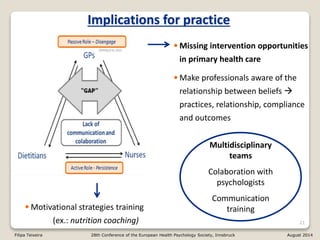
Implications for practice
•Missing intervention opportunities
in primary health care
•Make professionals aware of the
relationship between beliefs 
practices, relationship, compliance
and outcomes
•Motivational strategies training
(ex.: nutrition coaching)
Multidisciplinary
teams
Colaboration with
psychologists
Communication
training
Filipa Teixeira 28th Conference of the European Health Psychology Society, Innsbruck August 2014
Limitations and further research
•Limitations:
•Convinience sampling
• Reduced number of participants
• Specific area of Portugal
•Differences in age and years of experience among GPs and
dietitians/nurses
•Further research:
•obese people perception about their disease and their healthcare
professional;
•Relationship between age, years of experience, own weight and
body image  practices and compliance outcomes 22
Filipa Teixeira 28th Conference of the European Health Psychology Society, Innsbruck August 2014
Thank you for your
attention!
23
Filipa Valente Teixeira
University of Porto
filipa.v.teixeira@gmail.com
Filipa Teixeira 28th Conference of the European Health Psychology Society, Innsbruck August 2014
References
• Bocquier, A., Verger, P., Basdevant, A., Andreotti, G., Baretge, J., Villani, P., & Paraponaris, A. (2005).
Overweight and obesity: knowledge, attitudes, and practices of general practitioners in france. Obes
Res, 13(4), 787–795. doi:10.1038/oby.2005.89.
• Boyatiz, R. (1998). Transforming qualitative information: Thematic analysis and code development.
Sage Publication: Thounsand Oaks.
• Braun, V., & Clarke, V. (2006). Using thematic analysis in psychology. Qualitative Research in
Psychology, 3, 77-101.
• Campbell, K. & Crawford, D. (2000). Management of obesity: attitudes and practices of Australian
dieticians. International Journal of Obesity, 24, 701-710.
• Carmo, I., Santos, O., Camolas, J., Vieira, J., Carreira, M., Medina, L., … Galvão-Teles, A. (2007).
Overweight and obesity in Portugal: national prevalence in 2003-2005. Obesity Reviews, 9, 11-19.
• Epstein. L., & Ogden, J. (2005). A qualitative study of GP’ views of treating obesity. British Journal of
General Practice, 55, 750-54.
24
Filipa Teixeira 28th Conference of the European Health Psychology Society, Innsbruck August 2014
• Fogelman, Y., Vinker, S., Lachter, J., Biderman, A., Itzhak, B., & Kitai, E. (2002). Managing obesity: a
survey of attitudes and practices among Israeli primary care physicians. International Journal of
Obesity, 26, 1393-97.
• Foster, G. D., Wadden, T. a, Makris, A. P., Davidson, D., Sanderson, R. S., Allison, D. B., & Kessler, A.
(2003). Primary care physicians’ attitudes about obesity and its treatment. Obesity Research, 11(10),
1168–77. doi:10.1038/oby.2003.161.
• Hoppé, R., & Ogden, J. (1997). Practice nurses’ beliefs about obesity and weight related
interventions in primary care. International Journal of Obesity and Related Metabolic Disorders,
21(2), 141–6.
• Kristeller, J., & Hoerr, R. (1997). Physicians attitudes toward managing obesity: differences among six
specialty groups. Preventive Medicine, 26, 542-549.
• Ogden, J. (2011). The Psychology of eating: from healthy to disordered behaviour. Blackwell: US/ UK.
• Ogden, J., & Flanagan, Z. (2008). Beliefs about the causes and solutions to obesity: A comparison of
GPs and lay people. Patient Education and Couseling, 71, 72-78. 25
References
Filipa Teixeira 28th Conference of the European Health Psychology Society, Innsbruck August 2014
• Sardinha, L. B., Santos, D. a, Silva, A. M., Coelho-e-Silva, M. J., Raimundo, A. M., Moreira, H., … Mota,
J. (2012). Prevalence of overweight, obesity, and abdominal obesity in a representative sample of
Portuguese adults. PloS One, 7(10), e47883. doi:10.1371/journal.pone.0047883.
• Sonntag, U., Brink, A., Renneberg, B., Braun, V., & Heintze, C. (2012). GPs’ attitudes, objectives and
barriers in counselling for obesity--a qualitative study. The European Journal of General Practice,
18(1), 9–14. doi:10.3109/13814788.2011.627424
• Teixeira, F. V., Pais-Ribeiro, J. L., & Maia, Â. (2012). Beliefs and practices of healthcare providers
regarding obesity: a systematic review. Revista Da Associação Médica Brasileira, 58(2), 254–62.
• World Health Organization (2013). What are overweight and obesity? Retrieved on September, 25th,
2008 from http://www.who.int/mediacentre/factsheets/fs311/en/index.html
• Visser, F., Hiddink, G., Koelen, M., van Binsbergen, J., Tobi, H., & van Woerkum, C. (2008).
Longitudinal changes in GPs’ task perceptions, self-efficacy, barriers and practices of nutrition
education and treatment of overweight. Family Practice, 25 Suppl 1, i105–11.
doi:10.1093/fampra/cmn07.
26
References
Filipa Teixeira 28th Conference of the European Health Psychology Society, Innsbruck August 2014

Obesity in 3D

  • 1.
    Obesity in 3D: aqualitative comparison of general practitioners, dietitians and nurses’ views about obesity Filipa Teixeira (filipa.v.teixeira@gmail.com) José Luis Pais-Ribeiro (FPCEUP) & Ângela Maia (UMinho) 28th Conference of the European Health Psychology Society August 27th, 2014 Innsbruck, Austria 1
  • 2.
    •Obesity as oneof the 21st century epidemic (WHO, 2013): • In Portugal, 46,7% of men and 38,1% of women are overweight  about 20% are obese (Carmo et al., 2007; Sardinha et al., 2012) •Development of primary, secondary and tertiary interventions measures: (Ogden, 2011) • healthcare professionals role • primary health care setting Little effectiveness and negative outcomes (Kristeller & Hoerr, 1997; Ogden & Flanagan, 2008) Why? – Literature Review 2 Filipa Teixeira 28th Conference of the European Health Psychology Society, Innsbruck August 2014
  • 3.
    3 Healthcare professionals one of possible responsibles for failures General Practitioners: •Uncoordinated and inconsistent approach •Negative attitudes •Unsufficient knowledge Dietitians and nurses: • few data available - controversial and not conclusive •need more research (Epstein & Ogden, 2005; Fogleman et al., 2002; Ogden, 2011; Teixeira, Pais-Ribeiro, & Maia, 2012) Primary quantitative research Lack of comparative research What about in Portugal???? Why? – Literature Review Filipa Teixeira 28th Conference of the European Health Psychology Society, Innsbruck August 2014
  • 4.
    3. how theyperceive their role in obesity treatment 2. how they explain and perceive their practices in terms of treatment effectiveness and obtained outcomes 4 What? – Research Aims 1. their perception about obesity and obese patients Understand… General Practitioners Dietitians Nurses Filipa Teixeira 28th Conference of the European Health Psychology Society, Innsbruck August 2014
  • 5.
    5 GPs Dietitians NursesTotal Sex Male 7 2 3 12 Female 9 14 9 32 Total 16 16 12 44 Mean Age (SD) 51,75 (9,73) 33,06 (8,44) 38,58 (9,32) 41,13 (9,60) Minimum 32 24 26 - Maximum 64 57 52 - Average work experience (SD) 24,25 (10,57) 9,06 (7,55) 15,83 (9,28) 16,38 (7,61) Minimum 5 2 4 - Maximum 34 30 29 - Who? - Method Filipa Teixeira 28th Conference of the European Health Psychology Society, Innsbruck August 2014
  • 6.
    6 Where? - Method •Primaryhealthcare centers in the North of Portugal (Braga, Porto and Aveiro) •Dietitians from private clinics, pharmacies, gyms, hospitals (public and private) Filipa Teixeira 28th Conference of the European Health Psychology Society, Innsbruck August 2014
  • 7.
    •Instrument: •Semi-structured interviews •Audio recordedwith participant consent •Transcribed verbatim • Analysis according to Thematic Analysis procedures (Boyatiz, 1998; Braun & Clarke, 2006) 7 How? - Method Filipa Teixeira 28th Conference of the European Health Psychology Society, Innsbruck August 2014
  • 8.
    • Concerns aboutobesity as a public health disease • Characteristics of obese people vs. Treatment demands 8 Results Similarities Differences • Practices •Perception about the change process •Perceived role Filipa Teixeira 28th Conference of the European Health Psychology Society, Innsbruck August 2014
  • 9.
    Results - Similarities 9 FilipaTeixeira 28th Conference of the European Health Psychology Society, Innsbruck August 2014
  • 10.
    Results - Similarities 10 “…they’realways coming with excuses. They have on for everything that is going wrong. Sometimes they don’t have the strenght and willingness we first thought they would have.” (GP12) “They say they’ll change, but they don’t!” (GP3) Filipa Teixeira 28th Conference of the European Health Psychology Society, Innsbruck August 2014
  • 11.
    Results - Similarities 11 “…they’realways coming with excuses. They have on for everything that is going wrong. Sometimes they don’t have the strenght and willingness we first thought they would have.” (GP12) “They say they’ll change, but they don’t!” (GP3) Filipa Teixeira 28th Conference of the European Health Psychology Society, Innsbruck August 2014 “… they bring too many high expectations! They want to lose 15kg in a blink of na eye!” (Nur 8) “…some still ask for a pill, the miraculous pill that’s going to help them!” (GP 5)
  • 12.
    Results - Similarities 12 “…they’realways coming with excuses. They have on for everything that is going wrong. Sometimes they don’t have the strenght and willingness we first thought they would have.” (GP12) “They say they’ll change, but they don’t!” (GP3) Filipa Teixeira 28th Conference of the European Health Psychology Society, Innsbruck August 2014 “… they bring too many high expectations! They want to lose 15kg in a blink of na eye!” (Nur 8) “…some still ask for a pill, the miraculous pill that’s going to help them!” (GP 5) “You cannot do it without motivation, without the strenght and willingness to change! You just can’t!” (GP 12) “Without motivation we can’t get anywhere!” (Diet 1)
  • 13.
    Results – Differences– General Practitioners 13 “Lack of time”Disengagement Ethical conflict Powerlessness Frustration Characteristics of obese Vs. Treatment demands Cultural factors Low expectations of sucess Treatment as difficult to perform Barriers to intervention Obese people attitudes towards obesity GPs’ attitudes Denial Lack of recognition Non-compliance Failures Passive Role Professional duty Obese inability to comply vs Filipa Teixeira 28th Conference of the European Health Psychology Society, Innsbruck August 2014
  • 14.
    Results – Differences– Dietitians and Nurses – Change Process 14 Failure Success Ob Unmotivated Ob Motivated • “the easy ones” • “accept everything” • “do not comply” • “refuse to change” • “lack of time” Disengage Indifference Compliance Obese and professional satisfaction Resistant to comply • “slower change” • “the difficult ones” • “more investment” Challenge Persistence Belief in success “RING” Struggle NEGOTIATION FRUSTRATION Filipa Teixeira 28th Conference of the European Health Psychology Society, Innsbruck August 2014
  • 15.
    Results – Differences– Dietitians and Nurses – Change Process 15 Failure Success Ob Unmotivated Ob Motivated • “the easy ones” • “accept everything” • “do not comply” • “refuse to change” • “lack of time” Disengage Indifference Compliance Obese and professional satisfaction Resistant to comply • “slower change” • “the difficult ones” • “more investment” Challenge Persistence Belief in success “RING” Struggle NEGOTIATION FRUSTRATION Filipa Teixeira 28th Conference of the European Health Psychology Society, Innsbruck August 2014 Disengage Indifference • “the easy ones” • “accept everything” Compliance Obese and professional satisfaction • “do not comply” • “refuse to change” • “lack of time”
  • 16.
    “RING” Struggle NEGOTIATION Results – Differences- Dietitians Public Setting Private Setting Persistence • Unmotivated obese •Failures •Frustration • Barriers Less persistence • Motivated obese •Success •Satisfation More persistence Do not persist Challenge Filipa Teixeira 28th Conference of the European Health Psychology Society, Innsbruck August 2014 Belief in success
  • 17.
    “RING” Struggle NEGOTIATION Results – Differences- Dietitians Public Setting Private Setting Persistence • Unmotivated obese •Failures •Frustration • Barriers Less persistence • Motivated obese •Success •Satisfation More persistence Do not persist Challenge Filipa Teixeira 28th Conference of the European Health Psychology Society, Innsbruck August 2014 Belief in success Belief in success “RING” Struggle NEGOTIATION
  • 18.
    “RING” Struggle NEGOTIATION Results – Differences- Dietitians Public Setting Private Setting Persistence • Unmotivated obese •Failures •Frustration • Barriers Less persistence • Motivated obese •Success •Satisfation More persistence Do not persist Challenge Filipa Teixeira 28th Conference of the European Health Psychology Society, Innsbruck August 2014 Belief in success Belief in success “RING” Struggle NEGOTIATION
  • 19.
    19 Discussion GPs Dietitians Nurses Active Role- Persistence Passive Role – Disengage Negative beliefs and attitudes “blaming the victim” (Campbell & Crawford, 2000; Epstein & Ogden, 2005; Fogleman et al., 2002; Foster et al., 2003 ; Hoppé & Ogden, 1997) •Proper knowledge •Belief in their advice giving skills  control • Patient centered care (Sonntag et al., 2012) •Insufficient knowledge •Little perception of control • failures • no of obese • Biomedical Model More curative than preventive (Bocquier et al. 2005; Foster et al., 2003; Visser, 2008) (Campbell & Crawford, 2000; Hoppé & Ogden, 1997) Filipa Teixeira 28th Conference of the European Health Psychology Society, Innsbruck August 2014
  • 20.
    20 Discussion GPs Dietitians Nurses Active Role- Persistence Passive Role – Disengage •Proper knowledge •Belief in their advice giving skills  control • Patient centered care (Sonntag et al., 2012) •Insufficient knowledge •Little perception of control • failures • no of obese • Biomedical Model More curative than preventive (Bocquier et al. 2005; Foster et al., 2003; Visser, 2008) (Campbell & Crawford, 2000; Hoppé & Ogden, 1997) Filipa Teixeira 28th Conference of the European Health Psychology Society, Innsbruck August 2014 “GAP” Lack of communication and colaboration Negative beliefs and attitudes “blaming the victim” (Campbell & Crawford, 2000; Epstein & Ogden, 2005; Fogleman et al., 2002; Foster et al., 2003 ; Hoppé & Ogden, 1997)
  • 21.
    21 Implications for practice •Missingintervention opportunities in primary health care •Make professionals aware of the relationship between beliefs  practices, relationship, compliance and outcomes •Motivational strategies training (ex.: nutrition coaching) Multidisciplinary teams Colaboration with psychologists Communication training Filipa Teixeira 28th Conference of the European Health Psychology Society, Innsbruck August 2014
  • 22.
    Limitations and furtherresearch •Limitations: •Convinience sampling • Reduced number of participants • Specific area of Portugal •Differences in age and years of experience among GPs and dietitians/nurses •Further research: •obese people perception about their disease and their healthcare professional; •Relationship between age, years of experience, own weight and body image  practices and compliance outcomes 22 Filipa Teixeira 28th Conference of the European Health Psychology Society, Innsbruck August 2014
  • 23.
    Thank you foryour attention! 23 Filipa Valente Teixeira University of Porto filipa.v.teixeira@gmail.com Filipa Teixeira 28th Conference of the European Health Psychology Society, Innsbruck August 2014
  • 24.
    References • Bocquier, A.,Verger, P., Basdevant, A., Andreotti, G., Baretge, J., Villani, P., & Paraponaris, A. (2005). Overweight and obesity: knowledge, attitudes, and practices of general practitioners in france. Obes Res, 13(4), 787–795. doi:10.1038/oby.2005.89. • Boyatiz, R. (1998). Transforming qualitative information: Thematic analysis and code development. Sage Publication: Thounsand Oaks. • Braun, V., & Clarke, V. (2006). Using thematic analysis in psychology. Qualitative Research in Psychology, 3, 77-101. • Campbell, K. & Crawford, D. (2000). Management of obesity: attitudes and practices of Australian dieticians. International Journal of Obesity, 24, 701-710. • Carmo, I., Santos, O., Camolas, J., Vieira, J., Carreira, M., Medina, L., … Galvão-Teles, A. (2007). Overweight and obesity in Portugal: national prevalence in 2003-2005. Obesity Reviews, 9, 11-19. • Epstein. L., & Ogden, J. (2005). A qualitative study of GP’ views of treating obesity. British Journal of General Practice, 55, 750-54. 24 Filipa Teixeira 28th Conference of the European Health Psychology Society, Innsbruck August 2014
  • 25.
    • Fogelman, Y.,Vinker, S., Lachter, J., Biderman, A., Itzhak, B., & Kitai, E. (2002). Managing obesity: a survey of attitudes and practices among Israeli primary care physicians. International Journal of Obesity, 26, 1393-97. • Foster, G. D., Wadden, T. a, Makris, A. P., Davidson, D., Sanderson, R. S., Allison, D. B., & Kessler, A. (2003). Primary care physicians’ attitudes about obesity and its treatment. Obesity Research, 11(10), 1168–77. doi:10.1038/oby.2003.161. • Hoppé, R., & Ogden, J. (1997). Practice nurses’ beliefs about obesity and weight related interventions in primary care. International Journal of Obesity and Related Metabolic Disorders, 21(2), 141–6. • Kristeller, J., & Hoerr, R. (1997). Physicians attitudes toward managing obesity: differences among six specialty groups. Preventive Medicine, 26, 542-549. • Ogden, J. (2011). The Psychology of eating: from healthy to disordered behaviour. Blackwell: US/ UK. • Ogden, J., & Flanagan, Z. (2008). Beliefs about the causes and solutions to obesity: A comparison of GPs and lay people. Patient Education and Couseling, 71, 72-78. 25 References Filipa Teixeira 28th Conference of the European Health Psychology Society, Innsbruck August 2014
  • 26.
    • Sardinha, L.B., Santos, D. a, Silva, A. M., Coelho-e-Silva, M. J., Raimundo, A. M., Moreira, H., … Mota, J. (2012). Prevalence of overweight, obesity, and abdominal obesity in a representative sample of Portuguese adults. PloS One, 7(10), e47883. doi:10.1371/journal.pone.0047883. • Sonntag, U., Brink, A., Renneberg, B., Braun, V., & Heintze, C. (2012). GPs’ attitudes, objectives and barriers in counselling for obesity--a qualitative study. The European Journal of General Practice, 18(1), 9–14. doi:10.3109/13814788.2011.627424 • Teixeira, F. V., Pais-Ribeiro, J. L., & Maia, Â. (2012). Beliefs and practices of healthcare providers regarding obesity: a systematic review. Revista Da Associação Médica Brasileira, 58(2), 254–62. • World Health Organization (2013). What are overweight and obesity? Retrieved on September, 25th, 2008 from http://www.who.int/mediacentre/factsheets/fs311/en/index.html • Visser, F., Hiddink, G., Koelen, M., van Binsbergen, J., Tobi, H., & van Woerkum, C. (2008). Longitudinal changes in GPs’ task perceptions, self-efficacy, barriers and practices of nutrition education and treatment of overweight. Family Practice, 25 Suppl 1, i105–11. doi:10.1093/fampra/cmn07. 26 References Filipa Teixeira 28th Conference of the European Health Psychology Society, Innsbruck August 2014

Editor's Notes

  • #3 Mundialmente, 1,50 mil milhões de adultos têm excesso de peso, dos quais 200 milhões de homens e 300 milhões de mulheres são obesos (Finucane et al., 2011; OMS, 2011) GPs have been critized for their part in the failure to manage obesity
  • #5 Understand the perception GPs, dietitians and nurses about obesity and obese patients; Understand how GPs, dietitians and nurses perceive and explain their practices in terms of treatment effectiveness and outcomes obtained; Understand how GPs, dietitians and nurses perceive thier role in obesity treatment. Compreender o significado e importância que estes profissionais atribuem à obesidade na sua prática profissional; Forma como mensagem é transmitida (conteúdo e ênfase), como é percebida pelo doente, quais as expectativas do doente e que adesão verificam
  • #6 MF: 2 elementos exerciam funções em hospital e os restante quatro laboravam em USF/CS Todos em regime de tempo inteiro 2 participantes de Aveiro, 3 do Porto e 3 de Braga. Nut: 3 aveiro, 5 porto, 6 braga 6 CS, 3 hoppub, 1 hosppriv; 2 clinica privada; 1gym; 1 farma (6 faziam publico e privado; os restantes eram exclusivos)
  • #9 Nas semelhanças falarei apenas do segundo ponto Nas diferenças não irei abordar as práticas e a perceção do processo de mudança e o papel percebido serão abordados em conjunto por uma questão de economia de tempo
  • #10 Muito muito brevemente frizar os pontos fundamentais para que a plateia perceba que as características atribuídas aos obesos são maioritariamente negativas e, acima de tudo, incompatíveis com as exigências do tratamento (papel ativo do doente - motivação para a mudança, força de vontade, sacrifício, compromisso, determinação)
  • #11 Muito muito brevemente frizar os pontos fundamentais para que a plateia perceba que as características atribuídas aos obesos são maioritariamente negativas e, acima de tudo, incompatíveis com as exigências do tratamento (papel ativo do doente - motivação para a mudança, força de vontade, sacrifício, compromisso, determinação)
  • #12 Muito muito brevemente frizar os pontos fundamentais para que a plateia perceba que as características atribuídas aos obesos são maioritariamente negativas e, acima de tudo, incompatíveis com as exigências do tratamento (papel ativo do doente - motivação para a mudança, força de vontade, sacrifício, compromisso, determinação)
  • #13 Muito muito brevemente frizar os pontos fundamentais para que a plateia perceba que as características atribuídas aos obesos são maioritariamente negativas e, acima de tudo, incompatíveis com as exigências do tratamento (papel ativo do doente - motivação para a mudança, força de vontade, sacrifício, compromisso, determinação)
  • #14 Ver se consigo espaço para colocar excertos
  • #15 Apesar de descreverem os obesos de forma maioritariamente negativa, quando descrevem a intervenção, fazem-no enquanto processo, colocando os obesos num contínuo, pois acreditam que ao longo do processo terapêutico e através da sua acção é possível que estes evoluam de um estado de desmotivação para cada vez mais motivados e assim conseguirem alcançar sucessos. No entanto, há doentes que surgem mais ceticos ou que são mais resistentes a esta mudança o que representa um desafio para os nutricionistas. São estes doentes que exigem um maior investimento e que os transporta para um cenário de luta e constante negociação para que, pouco a pouco, as mudanças possam ir ocorrendo. A vitória acontece para ambos quando o doente caminhou um pouco mais no sentido do sucesso conseguindo alterar os seus hábitos. No entanto, para os nutricionistas dá-se uma enorme frustração quando apesar de todo o envolvimento e esforço investido o doente continua a não alcançar mudanças, a não apresentar alterações no peso. Isto leva ao questionamento da parte dos nutricionistas quanto às estratégias utilizadas, à sua própria postura, sendo que pelo menos um chega mesmo a considerar-se responsável pelo fracasso (“Se o doente não conseguiu a culpa é minha porque fui eu que não o consegui motivar”). Esta reflexão ocorre sempre no sentido de se alterarem as práticas e reiniciar-se o processo acreditando-se que a mudança é possível de ocorrer (desistem apenas após inúmeras tentativas fracassadas). Portanto, são profissionais altamente motivados e crentes na sua capacidade de promover mudanças nos hábitos dos obesos, sendo as suas práticas caracterizadas pela persistência.
  • #16 Apesar de descreverem os obesos de forma maioritariamente negativa, quando descrevem a intervenção, fazem-no enquanto processo, colocando os obesos num contínuo, pois acreditam que ao longo do processo terapêutico e através da sua acção é possível que estes evoluam de um estado de desmotivação para cada vez mais motivados e assim conseguirem alcançar sucessos. No entanto, há doentes que surgem mais ceticos ou que são mais resistentes a esta mudança o que representa um desafio para os nutricionistas. São estes doentes que exigem um maior investimento e que os transporta para um cenário de luta e constante negociação para que, pouco a pouco, as mudanças possam ir ocorrendo. A vitória acontece para ambos quando o doente caminhou um pouco mais no sentido do sucesso conseguindo alterar os seus hábitos. No entanto, para os nutricionistas dá-se uma enorme frustração quando apesar de todo o envolvimento e esforço investido o doente continua a não alcançar mudanças, a não apresentar alterações no peso. Isto leva ao questionamento da parte dos nutricionistas quanto às estratégias utilizadas, à sua própria postura, sendo que pelo menos um chega mesmo a considerar-se responsável pelo fracasso (“Se o doente não conseguiu a culpa é minha porque fui eu que não o consegui motivar”). Esta reflexão ocorre sempre no sentido de se alterarem as práticas e reiniciar-se o processo acreditando-se que a mudança é possível de ocorrer (desistem apenas após inúmeras tentativas fracassadas). Portanto, são profissionais altamente motivados e crentes na sua capacidade de promover mudanças nos hábitos dos obesos, sendo as suas práticas caracterizadas pela persistência.
  • #20 Conhecimentos insuficientes contribuem para perceção do tratamento como algo difícil de realizar
  • #21 Conhecimentos insuficientes contribuem para perceção do tratamento como algo difícil de realizar
  • #22 Conhecimentos insuficientes contribuem para perceção do tratamento como algo difícil de realizar
  • #23 De igual modo, carece ainda perceber se fatores como o género do PS, a idade, os anos de experiência profissional, bem como o seu peso e imagem corporal influenciam o investimento e a intervenção no tratamento da obesidade e a adesão destes doentes. Limitação: none of participants were overweight or obese – which might have influenced results Convinience sampling Reduzido número de participantes Proveniência zona Norte do país Futuras investigações – depois da apresentação no congresso Estudos comparativos com diferentes grupos de profissionais de saúde Explorar definições de sucesso para os nutricionistas e como avaliam/medem esse sucesso (se através de indicadores como a evolução do peso, p. ex.) Analisar o ponto de vista dos obesos – que perceções é que estes possuem acerca dos profissionais de saúde – relativamente à responsabilidade do tratamento, estratégias, comunicação, relação terapeutica, adesão, etc.