Disaster Preparedness &
  Business Continuity
    Meg Doherty MSN, ANP-BC, MBA


     bringing care home since 1920
Norwell VNA and Hospice

• Non-profit provider of home health and hospice
  care: 100,000 home visits per year
• 200 + employees: – 75% of whom are field staff
  visiting patients
• Average Daily Patient Census: 600+ in 27 towns
  (Milton to Plymouth)
• Care is provided 24/7, 365 days per year
• Annual Budget $18 M
DISASTER STRIKES

•   40% of businesses will not reopen
•   Another 25% fail within one year (FEMA)
•   United States Small Business Administration indicates >
    90% of businesses fail within two years following disaster


•   Disruption costs $50 per minute for a $14 million
    company.
•   Scaled to the size of a small business, $2,400 is lost
    every 8 hours of downtime.
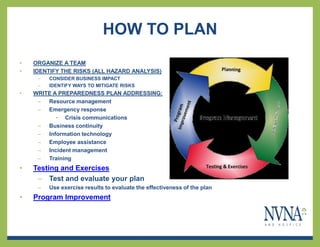
HOW TO PLAN
•   ORGANIZE A TEAM
•   IDENTIFY THE RISKS (ALL HAZARD ANALYSIS)
     –   CONSIDER BUSINESS IMPACT
     –   IDENTIFY WAYS TO MITIGATE RISKS
•   WRITE A PREPAREDNESS PLAN ADDRESSING:
     – Resource management
     – Emergency response
           • Crisis communications
     – Business continuity
     – Information technology
     – Employee assistance
     – Incident management
     – Training
•   Testing and Exercises
     – Test and evaluate your plan
     –   Use exercise results to evaluate the effectiveness of the plan
•   Program Improvement
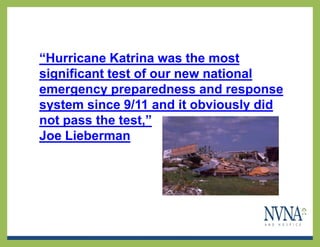
“Hurricane Katrina was the most
significant test of our new national
emergency preparedness and response
system since 9/11 and it obviously did
not pass the test,”
Joe Lieberman
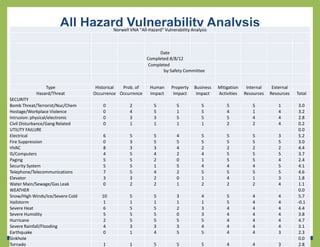
All Hazard Vulnerability Analysis
                                          Norwell VNA "All-Hazard" Vulnerability Analysis


                                                                Date
                                                          Completed:8/8/12
                                                           Completed
                                                                 by:Safety Committee


                Type               Historical Prob. of      Human      Property   Business   Mitigation    Internal    External
            Hazard/Threat         Occurrence Occurrence     Impact      Impact     Impact    Activities   Resources   Resources   Total
SECURITY
Bomb Threat/Terrorist/Nuc/Chem        0           2           5          5            5          5           5           1         3.0
Hostage/Workplace Violence            0           4           5          1            5          4           1           4         3.2
Intrusion: physical/electronic        0           3           3          5            5          5           4           4         2.8
Civil Disturbance/Gang Related        0           1           1          1            1          2           2           4         0.2
UTILITY FAILURE                                                                                                                    0.0
Electrical                            6           5           5          4            5          5           5           3         5.2
Fire Suppression                      0           3           5          5            5          5           5           5         3.0
HVAC                                  8           3           3          4            2          2           2           2         4.4
IS/Computers                          4           5           4          2            4          5           5           5         3.7
Paging                                5           5           2          0            1          5           5           4         2.4
Security System                       5           5           1          5            4          4           4           5         4.1
Telephone/Telecommunications          7           5           4          2            5          5           5           5         4.6
Elevator                              3           3           2          0            1          4           1           3         1.8
Water Main/Sewage/Gas Leak            0           2           2          1            2          2           2           4         1.1
WEATHER                                                                                                                            0.0
Snow/High Winds/Ice/Severe Cold      10           5           5          3            4          5           4           4         5.7
Hailstorm                             1           1           1          1            1          5           4           4        -0.1
Severe Heat                           6           5           5          2            3          4           4           4         4.4
Severe Humidity                       5           5           5          0            3          4           4           4         3.8
Hurricane                             2           5           5          5            5          4           4           4         4.7
Severe Rainfall/Flooding              4           3           3          3            4          4           4           4         3.1
Earthquake                            0           1           4          5            5          4           4           3         2.3
Sinkhole                                                                                                                           0.0
Tornado                               1           1           5          5            5          4           4           3         2.8
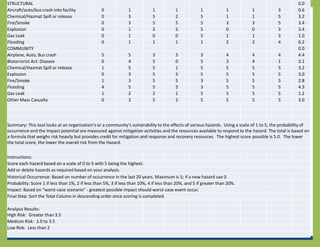
STRUCTURAL                                                                                                                                           0.0
Aircraft/auto/bus crash into facility             0              1            1           1             1             1       1            3         0.6
Chemical/Hazmat Spill or release                  0              3            5           2             5             1       1            5         3.2
Fire/Smoke                                        0              3            5           5             5             3       3            5         3.4
Explosion                                         0              1            5           5             5             0       0            3         3.4
Gas Leak                                          0              1            0           0             5             1       1            3         1.0
Flooding                                          0              1            1           1             1             2       2            4         0.2
COMMUNITY                                                                                                                                            0.0
Airplane, Auto, Bus crash                         5              5            3           5             3             4       4            4         4.4
Bioterrorist Act: Disease                         0              4            5           0             5             3       4            1         3.1
Chemical/Hazmat Spill or release                  1              5            5           1             5             5       5            5         3.2
Explosion                                         0              3            5           5             5             5       5            5         3.0
Fire/Smoke                                        1              3            5           5             3             5       5            5         2.8
Flooding                                          4              5            5           5             3             5       5            5         4.3
Gas Leak                                          1              2            2           1             5             5       5            5         1.2
Other Mass Casualty                               0              3            5           5             5             5       5            5         3.0


Summary: This tool looks at an organization's or a community's vulnerability to the effects of various hazards. Using a scale of 1 to 5, the probability of
occurrence and the impact potential are measured against mitigation activities and the resources available to respond to the hazard. The total is based on
a formula that weighs risk heavily but provides credit for mitigation and response and recovery resources. The highest score possible is 5.0. The lower
the total score, the lower the overall risk from the Hazard.


Instructions:
Score each hazard based on a scale of 0 to 5 with 5 being the highest.
Add or delete hazards as required based on your analysis.
Historical Occurrence: Based on number of occurrence in the last 20 years. Maximum is 5; if a new hazard use 0.
Probability: Score 1 if less than 1%, 2 if less than 5%, 3 if less than 10%, 4 if less than 20%, and 5 if greater than 20%.
Impact: Based on “worst-case scenario” - greatest possible impact should worst-case event occur.
Final Step: Sort the Total Column in descending order once scoring is completed.

Analysis Results:
High Risk: Greater than 3.5
Medium Risk: 2.0 to 3.5
Low Risk: Less than 2
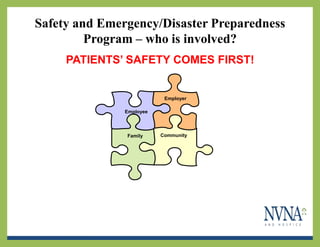
Safety and Emergency/Disaster Preparedness
         Program – who is involved?
     PATIENTS’ SAFETY COMES FIRST!


                           Employer

               Employee


               Family     Community
Sample: NVNA & Hospice
 Emergency Preparedness Policies
• Workplace Safety
    Building Evacuation
    Physical Intrusion of Building
• Safe Driving Guidelines
• Personal Safety in the Community
• Weather Emergency
• Pandemic Policies
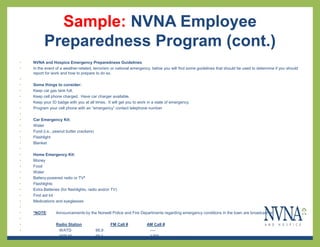
Sample: NVNA Employee
          Preparedness Program (cont.)
•   NVNA and Hospice Emergency Preparedness Guidelines
•   In the event of a weather-related, terrorism or national emergency, below you will find some guidelines that should be used to determine if you should
    report for work and how to prepare to do so.
•
•   Some things to consider:
•   Keep car gas tank full.
•   Keep cell phone charged. Have car charger available.
•   Keep your ID badge with you at all times. It will get you to work in a state of emergency.
•   Program your cell phone with an “emergency” contact telephone number
•
•   Car Emergency Kit:
•   Water
•   Food (i.e., peanut butter crackers)
•   Flashlight
•   Blanket
•
•   Home Emergency Kit:
•   Money
•   Food
•   Water
•   Battery-powered radio or TV*
•   Flashlights
•   Extra Batteries (for flashlights, radio and/or TV)
•   First aid kit
•   Medications and eyeglasses
•
•   *NOTE:       Announcements by the Norwell Police and Fire Departments regarding emergency conditions in the town are broadcast on:
•
•                Radio Station                    FM Call #          AM Call #
•                 WATD                    95.9                        ----
•                 WPLM                    99.1                        1390
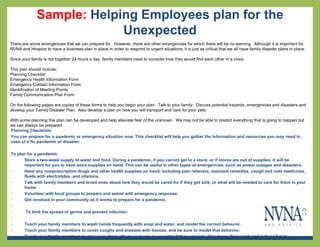
Sample: Helping Employees plan for the
                           Unexpected
There are some emergencies that we can prepare for. However, there are other emergencies for which there will be no warning. Although it is important for
NVNA and Hospice to have a business plan in place in order to respond to urgent situations, it is just as critical that we all have family disaster plans in place.

Since your family is not together 24 hours a day, family members need to consider how they would find each other in a crisis.

This plan should include:
Planning Checklist
Emergency Health Information Form
Emergency Contact Information Form
Identification of Meeting Points
Family Communication Plan Form

On the following pages are copies of these forms to help you begin your plan. Talk to your family. Discuss potential hazards, emergencies and disasters and
develop your Family Disaster Plan. Also develop a plan on how you will transport and care for your pets.

With some planning this plan can be developed and help alleviate fear of the unknown. We may not be able to predict everything that is going to happen but
we can always be prepared.
Planning Checklists
You can prepare for a pandemic or emergency situation now. This checklist will help you gather the information and resources you may need in
case of a flu pandemic or disaster.

To plan for a pandemic:
•     Store a two-week supply of water and food. During a pandemic, if you cannot get to a store, or if stores are out of supplies, it will be
      important for you to have extra supplies on hand. This can be useful in other types of emergencies, such as power outages and disasters.
•     Have any nonprescription drugs and other health supplies on hand, including pain relievers, stomach remedies, cough and cold medicines,
      fluids with electrolytes, and vitamins.
•     Talk with family members and loved ones about how they would be cared for if they got sick, or what will be needed to care for them in your
      home.
•     Volunteer with local groups to prepare and assist with emergency response.
•     Get involved in your community as it works to prepare for a pandemic.
•
•      To limit the spread of germs and prevent infection:
•
•     Teach your family members to wash hands frequently with soap and water, and model the correct behavior.
•     Teach your family members to cover coughs and sneezes with tissues, and be sure to model that behavior.
•     Teach your family members to stay away from others as much as possible if they are sick. Stay home from work and school if sick.
NVNA & HOSPICE – ROLE IN COMMUNITY
              PREPAREDNESS

•   Responsible for Medical Component of Town of Norwell’s
    Public Health which involves (an understanding that local
    response to any emergency may stand alone for 72 hours)
     – Local and regional participation in disaster planning/response (police, fire,
       government officials, volunteers, etc)
     – ID and intervention with special populations (elderly, cognitively impaired)
     – Anticipation and response to pandemic/biologic etc. incidents
     – Local/regional surveillance & reporting of communicable diseases to MA
       Department of Public Health
     – Assistance to all town departments with prevention, education and
       disease mitigation
     – Participation in coop activities – nvna business, town business, other
Information Sources
•   http://pandemicflue.gov
•   http://www.mass.gov.dph
•   http://www.cdc.gov
•   http://www.ready.gov/pandemic

Nvna presentation for co c disaster preparedness workshop

  • 1.
    Disaster Preparedness & Business Continuity Meg Doherty MSN, ANP-BC, MBA bringing care home since 1920
  • 2.
    Norwell VNA andHospice • Non-profit provider of home health and hospice care: 100,000 home visits per year • 200 + employees: – 75% of whom are field staff visiting patients • Average Daily Patient Census: 600+ in 27 towns (Milton to Plymouth) • Care is provided 24/7, 365 days per year • Annual Budget $18 M
  • 3.
    DISASTER STRIKES • 40% of businesses will not reopen • Another 25% fail within one year (FEMA) • United States Small Business Administration indicates > 90% of businesses fail within two years following disaster • Disruption costs $50 per minute for a $14 million company. • Scaled to the size of a small business, $2,400 is lost every 8 hours of downtime.
  • 5.
    HOW TO PLAN • ORGANIZE A TEAM • IDENTIFY THE RISKS (ALL HAZARD ANALYSIS) – CONSIDER BUSINESS IMPACT – IDENTIFY WAYS TO MITIGATE RISKS • WRITE A PREPAREDNESS PLAN ADDRESSING: – Resource management – Emergency response • Crisis communications – Business continuity – Information technology – Employee assistance – Incident management – Training • Testing and Exercises – Test and evaluate your plan – Use exercise results to evaluate the effectiveness of the plan • Program Improvement
  • 6.
    “Hurricane Katrina wasthe most significant test of our new national emergency preparedness and response system since 9/11 and it obviously did not pass the test,” Joe Lieberman
  • 7.
    All Hazard VulnerabilityAnalysis Norwell VNA "All-Hazard" Vulnerability Analysis Date Completed:8/8/12 Completed by:Safety Committee Type Historical Prob. of Human Property Business Mitigation Internal External Hazard/Threat Occurrence Occurrence Impact Impact Impact Activities Resources Resources Total SECURITY Bomb Threat/Terrorist/Nuc/Chem 0 2 5 5 5 5 5 1 3.0 Hostage/Workplace Violence 0 4 5 1 5 4 1 4 3.2 Intrusion: physical/electronic 0 3 3 5 5 5 4 4 2.8 Civil Disturbance/Gang Related 0 1 1 1 1 2 2 4 0.2 UTILITY FAILURE 0.0 Electrical 6 5 5 4 5 5 5 3 5.2 Fire Suppression 0 3 5 5 5 5 5 5 3.0 HVAC 8 3 3 4 2 2 2 2 4.4 IS/Computers 4 5 4 2 4 5 5 5 3.7 Paging 5 5 2 0 1 5 5 4 2.4 Security System 5 5 1 5 4 4 4 5 4.1 Telephone/Telecommunications 7 5 4 2 5 5 5 5 4.6 Elevator 3 3 2 0 1 4 1 3 1.8 Water Main/Sewage/Gas Leak 0 2 2 1 2 2 2 4 1.1 WEATHER 0.0 Snow/High Winds/Ice/Severe Cold 10 5 5 3 4 5 4 4 5.7 Hailstorm 1 1 1 1 1 5 4 4 -0.1 Severe Heat 6 5 5 2 3 4 4 4 4.4 Severe Humidity 5 5 5 0 3 4 4 4 3.8 Hurricane 2 5 5 5 5 4 4 4 4.7 Severe Rainfall/Flooding 4 3 3 3 4 4 4 4 3.1 Earthquake 0 1 4 5 5 4 4 3 2.3 Sinkhole 0.0 Tornado 1 1 5 5 5 4 4 3 2.8
  • 8.
    STRUCTURAL 0.0 Aircraft/auto/bus crash into facility 0 1 1 1 1 1 1 3 0.6 Chemical/Hazmat Spill or release 0 3 5 2 5 1 1 5 3.2 Fire/Smoke 0 3 5 5 5 3 3 5 3.4 Explosion 0 1 5 5 5 0 0 3 3.4 Gas Leak 0 1 0 0 5 1 1 3 1.0 Flooding 0 1 1 1 1 2 2 4 0.2 COMMUNITY 0.0 Airplane, Auto, Bus crash 5 5 3 5 3 4 4 4 4.4 Bioterrorist Act: Disease 0 4 5 0 5 3 4 1 3.1 Chemical/Hazmat Spill or release 1 5 5 1 5 5 5 5 3.2 Explosion 0 3 5 5 5 5 5 5 3.0 Fire/Smoke 1 3 5 5 3 5 5 5 2.8 Flooding 4 5 5 5 3 5 5 5 4.3 Gas Leak 1 2 2 1 5 5 5 5 1.2 Other Mass Casualty 0 3 5 5 5 5 5 5 3.0 Summary: This tool looks at an organization's or a community's vulnerability to the effects of various hazards. Using a scale of 1 to 5, the probability of occurrence and the impact potential are measured against mitigation activities and the resources available to respond to the hazard. The total is based on a formula that weighs risk heavily but provides credit for mitigation and response and recovery resources. The highest score possible is 5.0. The lower the total score, the lower the overall risk from the Hazard. Instructions: Score each hazard based on a scale of 0 to 5 with 5 being the highest. Add or delete hazards as required based on your analysis. Historical Occurrence: Based on number of occurrence in the last 20 years. Maximum is 5; if a new hazard use 0. Probability: Score 1 if less than 1%, 2 if less than 5%, 3 if less than 10%, 4 if less than 20%, and 5 if greater than 20%. Impact: Based on “worst-case scenario” - greatest possible impact should worst-case event occur. Final Step: Sort the Total Column in descending order once scoring is completed. Analysis Results: High Risk: Greater than 3.5 Medium Risk: 2.0 to 3.5 Low Risk: Less than 2
  • 9.
    Safety and Emergency/DisasterPreparedness Program – who is involved? PATIENTS’ SAFETY COMES FIRST! Employer Employee Family Community
  • 10.
    Sample: NVNA &Hospice Emergency Preparedness Policies • Workplace Safety  Building Evacuation  Physical Intrusion of Building • Safe Driving Guidelines • Personal Safety in the Community • Weather Emergency • Pandemic Policies
  • 11.
    Sample: NVNA Employee Preparedness Program (cont.) • NVNA and Hospice Emergency Preparedness Guidelines • In the event of a weather-related, terrorism or national emergency, below you will find some guidelines that should be used to determine if you should report for work and how to prepare to do so. • • Some things to consider: • Keep car gas tank full. • Keep cell phone charged. Have car charger available. • Keep your ID badge with you at all times. It will get you to work in a state of emergency. • Program your cell phone with an “emergency” contact telephone number • • Car Emergency Kit: • Water • Food (i.e., peanut butter crackers) • Flashlight • Blanket • • Home Emergency Kit: • Money • Food • Water • Battery-powered radio or TV* • Flashlights • Extra Batteries (for flashlights, radio and/or TV) • First aid kit • Medications and eyeglasses • • *NOTE: Announcements by the Norwell Police and Fire Departments regarding emergency conditions in the town are broadcast on: • • Radio Station FM Call # AM Call # • WATD 95.9 ---- • WPLM 99.1 1390
  • 12.
    Sample: Helping Employeesplan for the Unexpected There are some emergencies that we can prepare for. However, there are other emergencies for which there will be no warning. Although it is important for NVNA and Hospice to have a business plan in place in order to respond to urgent situations, it is just as critical that we all have family disaster plans in place. Since your family is not together 24 hours a day, family members need to consider how they would find each other in a crisis. This plan should include: Planning Checklist Emergency Health Information Form Emergency Contact Information Form Identification of Meeting Points Family Communication Plan Form On the following pages are copies of these forms to help you begin your plan. Talk to your family. Discuss potential hazards, emergencies and disasters and develop your Family Disaster Plan. Also develop a plan on how you will transport and care for your pets. With some planning this plan can be developed and help alleviate fear of the unknown. We may not be able to predict everything that is going to happen but we can always be prepared. Planning Checklists You can prepare for a pandemic or emergency situation now. This checklist will help you gather the information and resources you may need in case of a flu pandemic or disaster. To plan for a pandemic: • Store a two-week supply of water and food. During a pandemic, if you cannot get to a store, or if stores are out of supplies, it will be important for you to have extra supplies on hand. This can be useful in other types of emergencies, such as power outages and disasters. • Have any nonprescription drugs and other health supplies on hand, including pain relievers, stomach remedies, cough and cold medicines, fluids with electrolytes, and vitamins. • Talk with family members and loved ones about how they would be cared for if they got sick, or what will be needed to care for them in your home. • Volunteer with local groups to prepare and assist with emergency response. • Get involved in your community as it works to prepare for a pandemic. • • To limit the spread of germs and prevent infection: • • Teach your family members to wash hands frequently with soap and water, and model the correct behavior. • Teach your family members to cover coughs and sneezes with tissues, and be sure to model that behavior. • Teach your family members to stay away from others as much as possible if they are sick. Stay home from work and school if sick.
  • 13.
    NVNA & HOSPICE– ROLE IN COMMUNITY PREPAREDNESS • Responsible for Medical Component of Town of Norwell’s Public Health which involves (an understanding that local response to any emergency may stand alone for 72 hours) – Local and regional participation in disaster planning/response (police, fire, government officials, volunteers, etc) – ID and intervention with special populations (elderly, cognitively impaired) – Anticipation and response to pandemic/biologic etc. incidents – Local/regional surveillance & reporting of communicable diseases to MA Department of Public Health – Assistance to all town departments with prevention, education and disease mitigation – Participation in coop activities – nvna business, town business, other
  • 14.
    Information Sources • http://pandemicflue.gov • http://www.mass.gov.dph • http://www.cdc.gov • http://www.ready.gov/pandemic