NUMERICAL MODELING IN
COPPER BILLET CASTING
Ioannis Contopoulos, ELKEME
Numerical Modeling Department 1
ELKEME
• The R&D Center of VIOHALCO
• Founded 1999
• Industrial research, technological
development and analysis of
–Aluminum
–Copper
–Steel
–Zinc
Lab/Section Name 2
ELKEME
• Applied technology research towards
– Quality Improvement of existing products
– Development of new, innovative, high added
value products
– Optimization of Industrial Processes
• Energy and cost efficiency
• Health and safety
• Environment and sustainable growth
Numerical Modeling Department 3
ELKEME
• State of the art laboratories
• Highly capable scientists, engineers,
technicians
• Continuous professional development
• Collaborations with External Laboratories
• Research projects in Metallurgy, Material
Sciences and Environmental Engineering
• Build knowledge and competence network
Numerical Modeling Department 4
ELKEME
• Long term relationships with academic and research
institutes (National Tech. Univ. of Athens, Universities of
Patras, Ioannina, Delft, Ghent, Manchester)
• Supervision of Diploma/Master’s/PhD theses
• Student training programs
• Seminars
• International collaborations
• Participation in international scientific/engineering
associations
• Contributions to scientific journals and conferences
(ICEFA, ICAA, ICEAF, Thermec, TMS, etc.)
Numerical Modeling Department 5
100
120
140
160
180
200
220
-7 -6 -5 -4 -3 -2 -1 0 1 2 3 4 5 6 7(mm)
ΗV1.0
1
Numerical Modeling Department 10
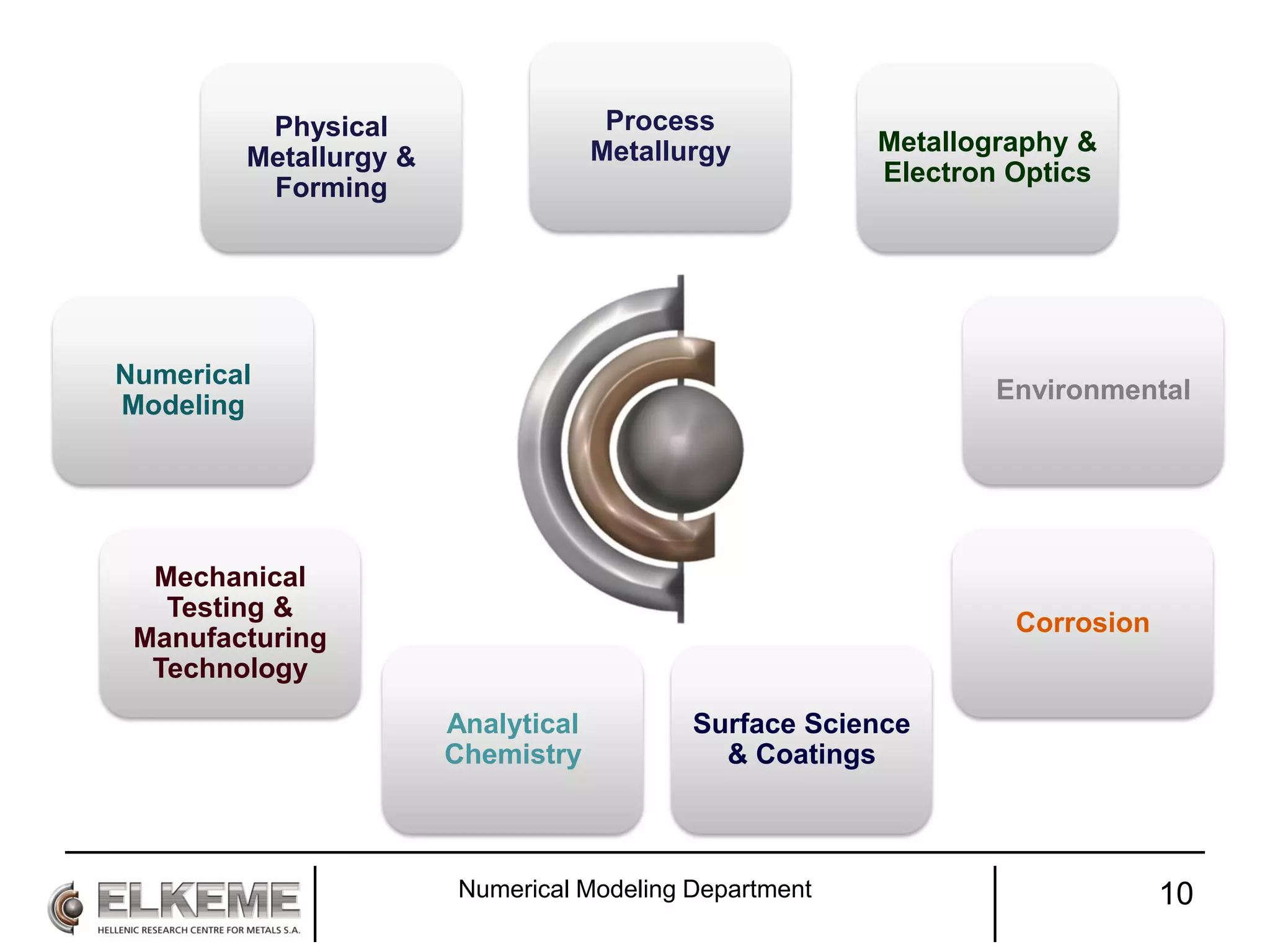
Process
Metallurgy
Physical
Metallurgy &
Forming
Corrosion
Environmental
Metallography &
Electron Optics
Mechanical
Testing &
Manufacturing
Technology
Numerical
Modeling
Surface Science
& Coatings
Analytical
Chemistry
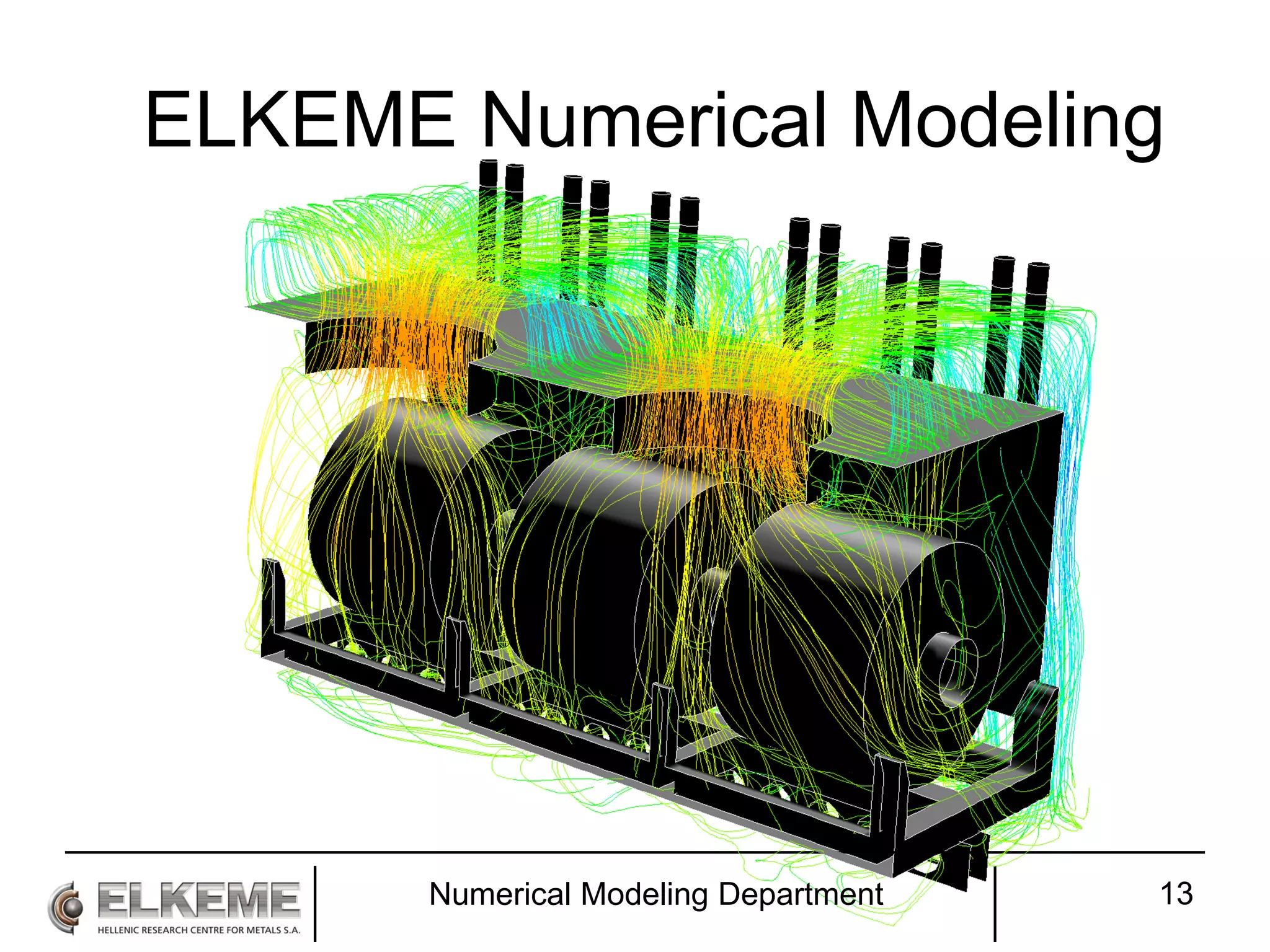
ELKEME Numerical Modeling
13Numerical Modeling Department
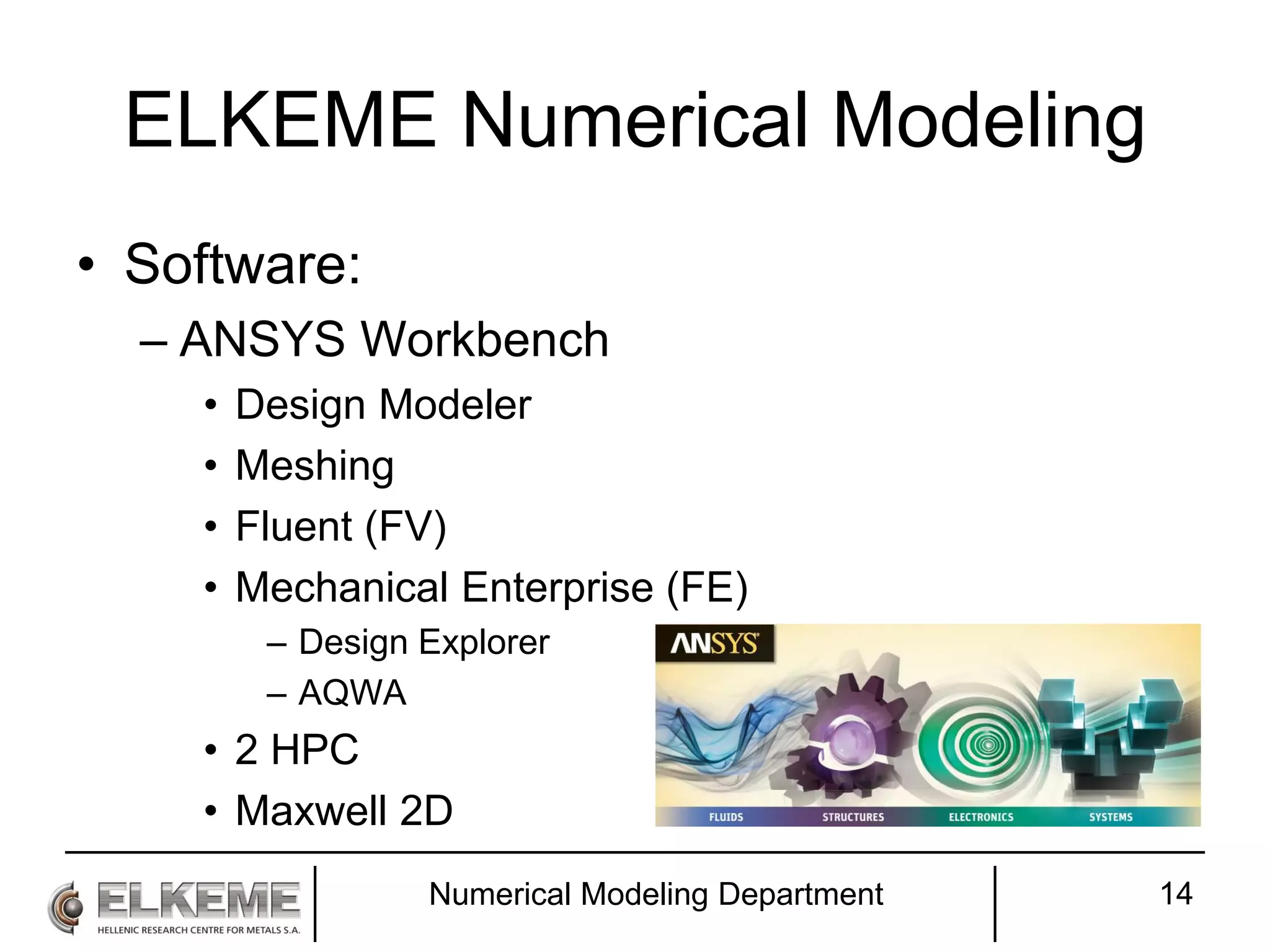
14
ELKEME Numerical Modeling
• Software:
– ANSYS Workbench
• Design Modeler
• Meshing
• Fluent (FV)
• Mechanical Enterprise (FE)
– Design Explorer
– AQWA
• 2 HPC
• Maxwell 2D
Numerical Modeling Department
Numerical Modeling Department 15
NUMERICAL MODELING IN
COPPER BILLET CASTING
Ioannis Contopoulos, ELKEME
Numerical Modeling Department 17
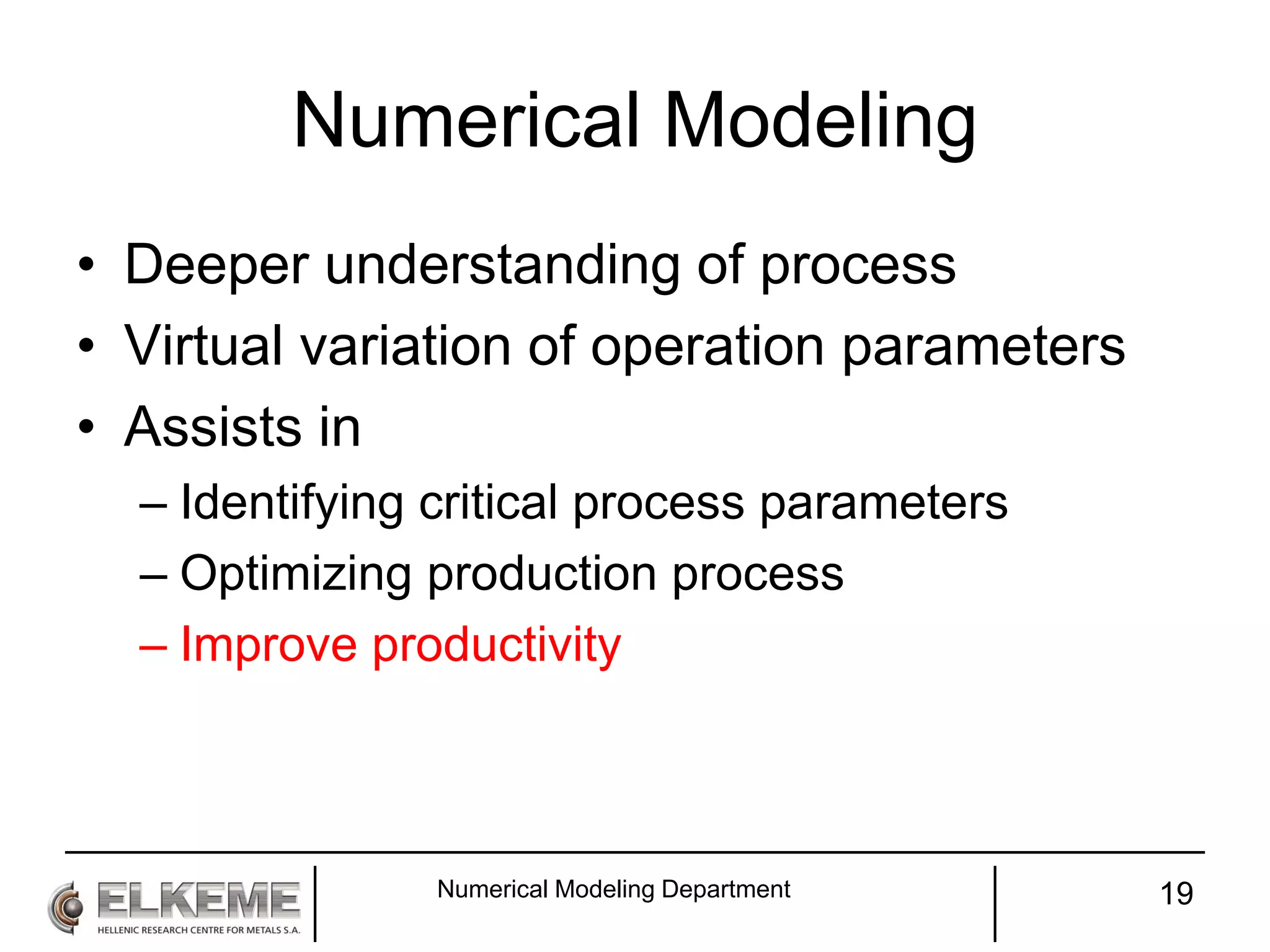
Numerical Modeling
• Deeper understanding of process
• Virtual variation of operation parameters
• Assists in
– Identifying critical process parameters
– Optimizing production process
– Improve productivity
Numerical Modeling Department 19
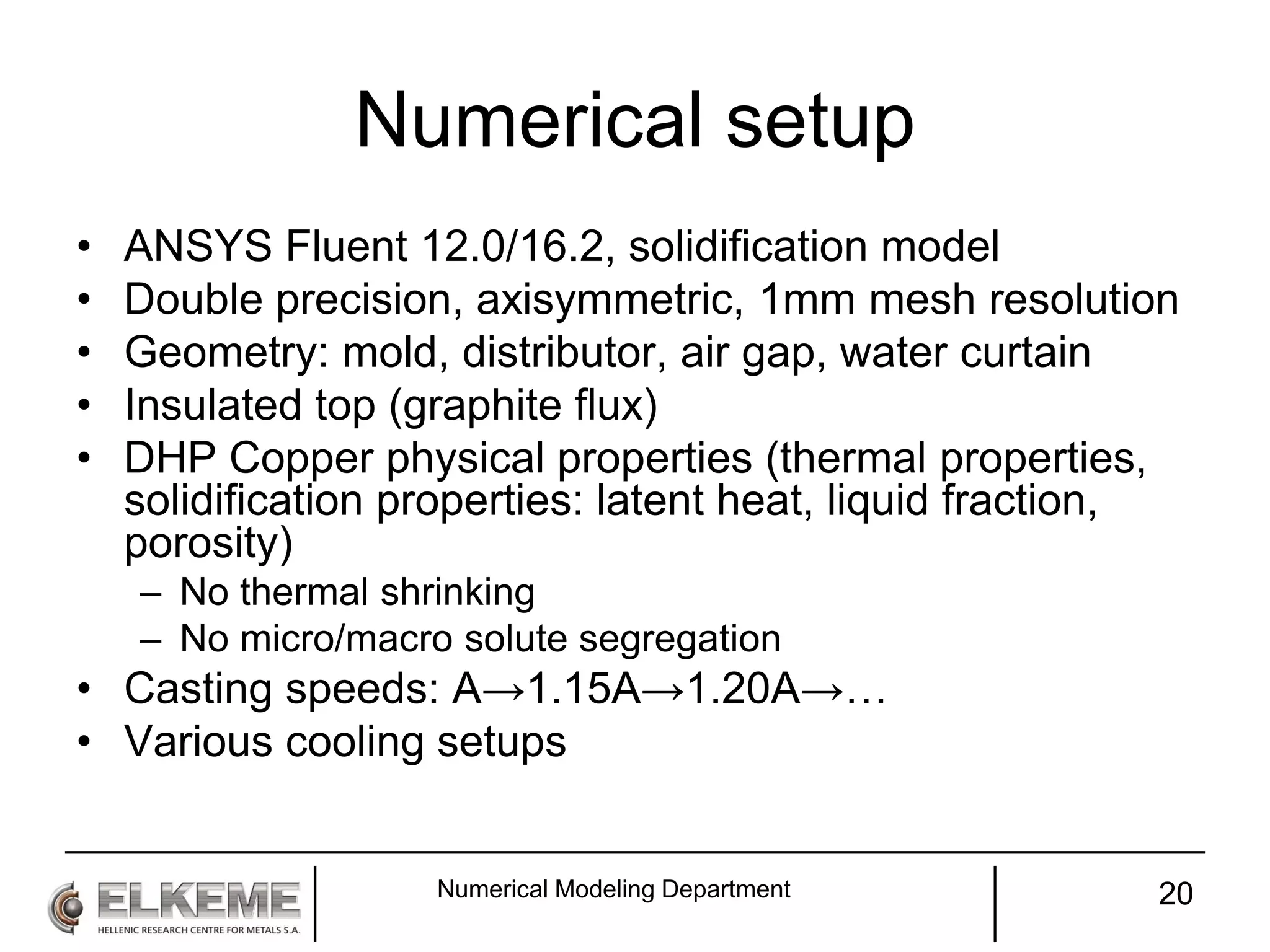
Numerical setup
• ANSYS Fluent 12.0/16.2, solidification model
• Double precision, axisymmetric, 1mm mesh resolution
• Geometry: mold, distributor, air gap, water curtain
• Insulated top (graphite flux)
• DHP Copper physical properties (thermal properties,
solidification properties: latent heat, liquid fraction,
porosity)
– No thermal shrinking
– No micro/macro solute segregation
• Casting speeds: A→1.15A→1.20A→…
• Various cooling setups
Numerical Modeling Department 20
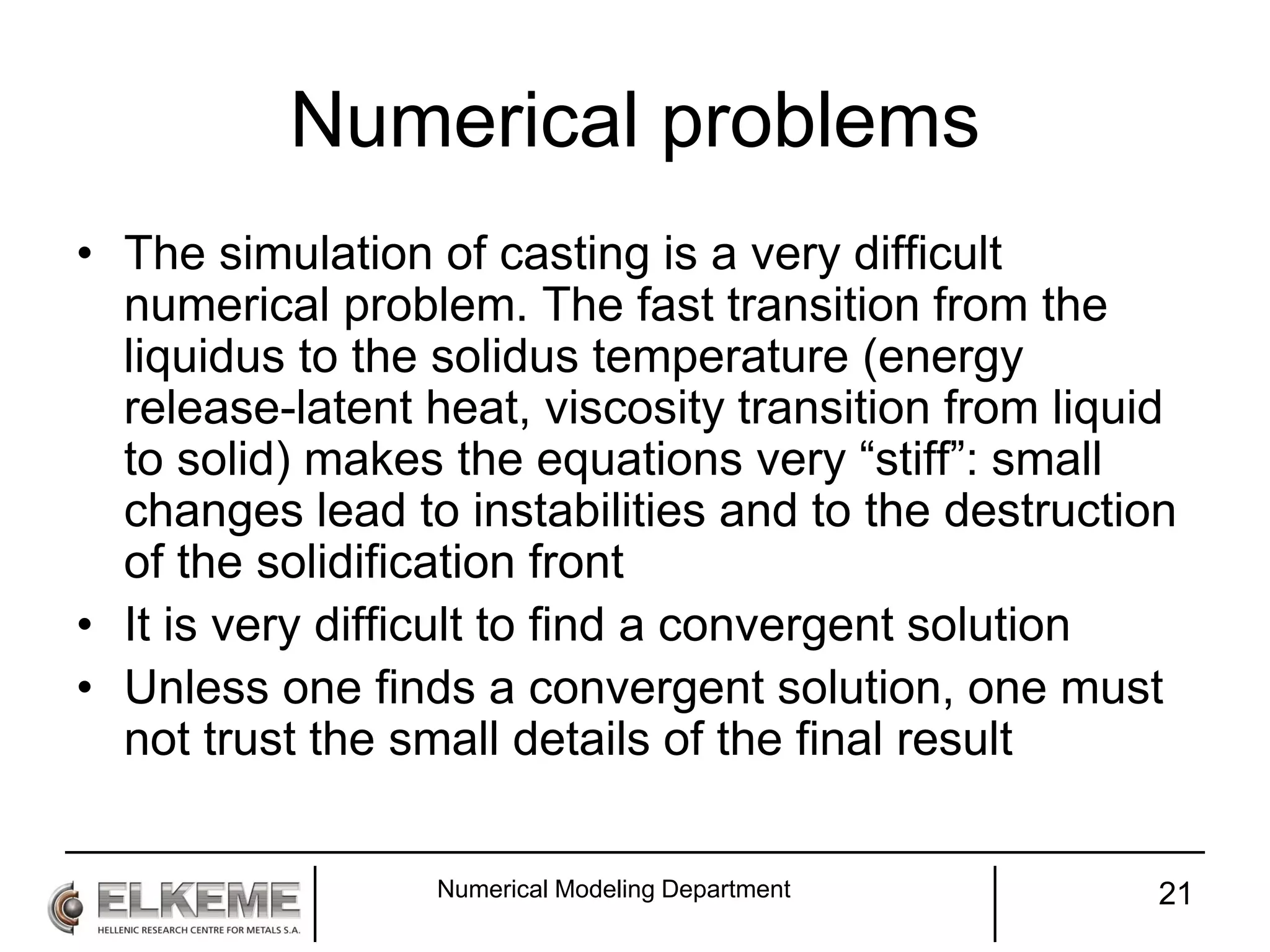
Numerical problems
• The simulation of casting is a very difficult
numerical problem. The fast transition from the
liquidus to the solidus temperature (energy
release-latent heat, viscosity transition from liquid
to solid) makes the equations very “stiff”: small
changes lead to instabilities and to the destruction
of the solidification front
• It is very difficult to find a convergent solution
• Unless one finds a convergent solution, one must
not trust the small details of the final result
Numerical Modeling Department 21
Numerical problems
• We tried many different numerical
approaches
• We were able to obtain convergent
solutions that we can trust!
Numerical Modeling Department 22
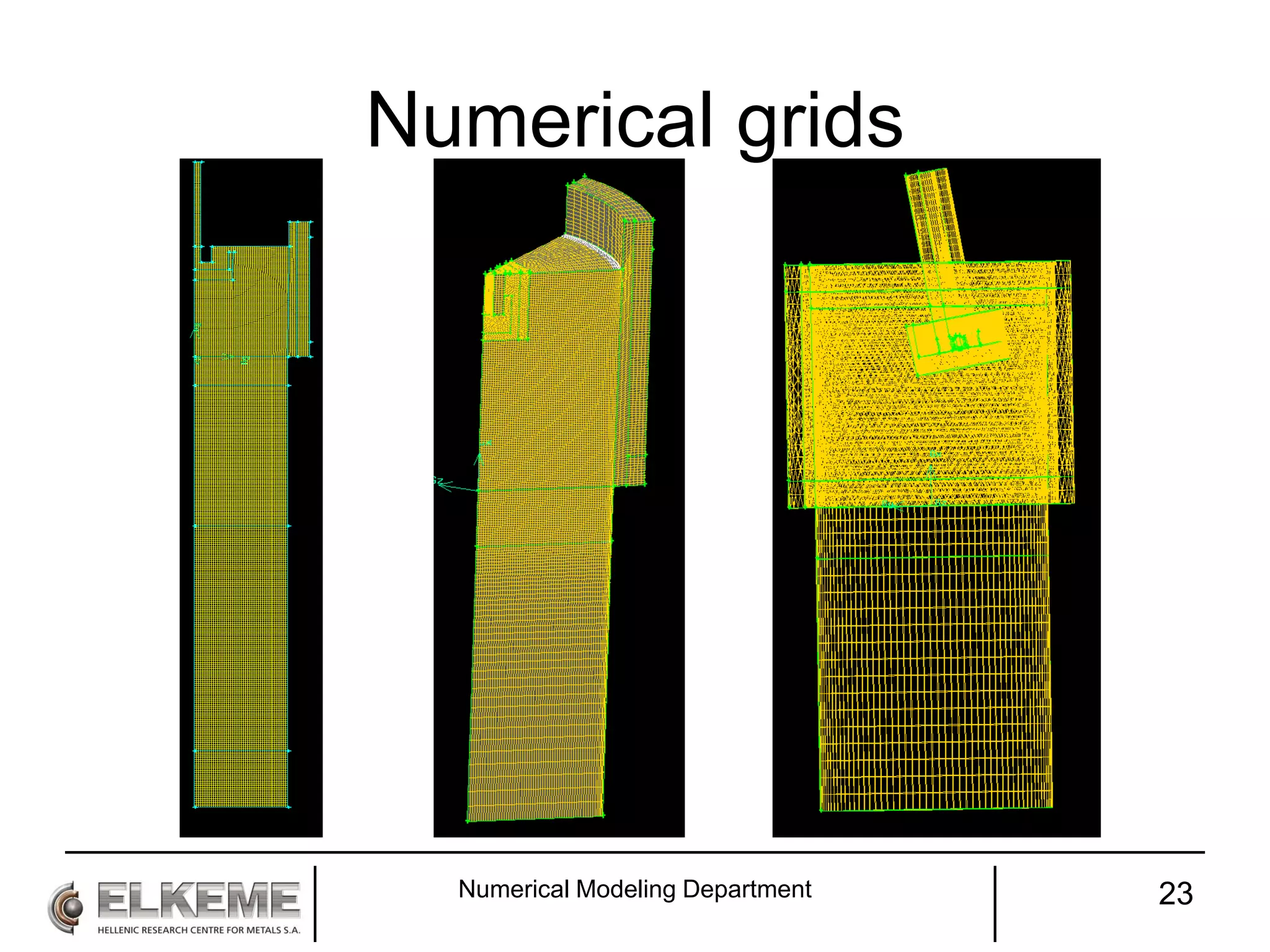
Numerical grids
Numerical Modeling Department 23
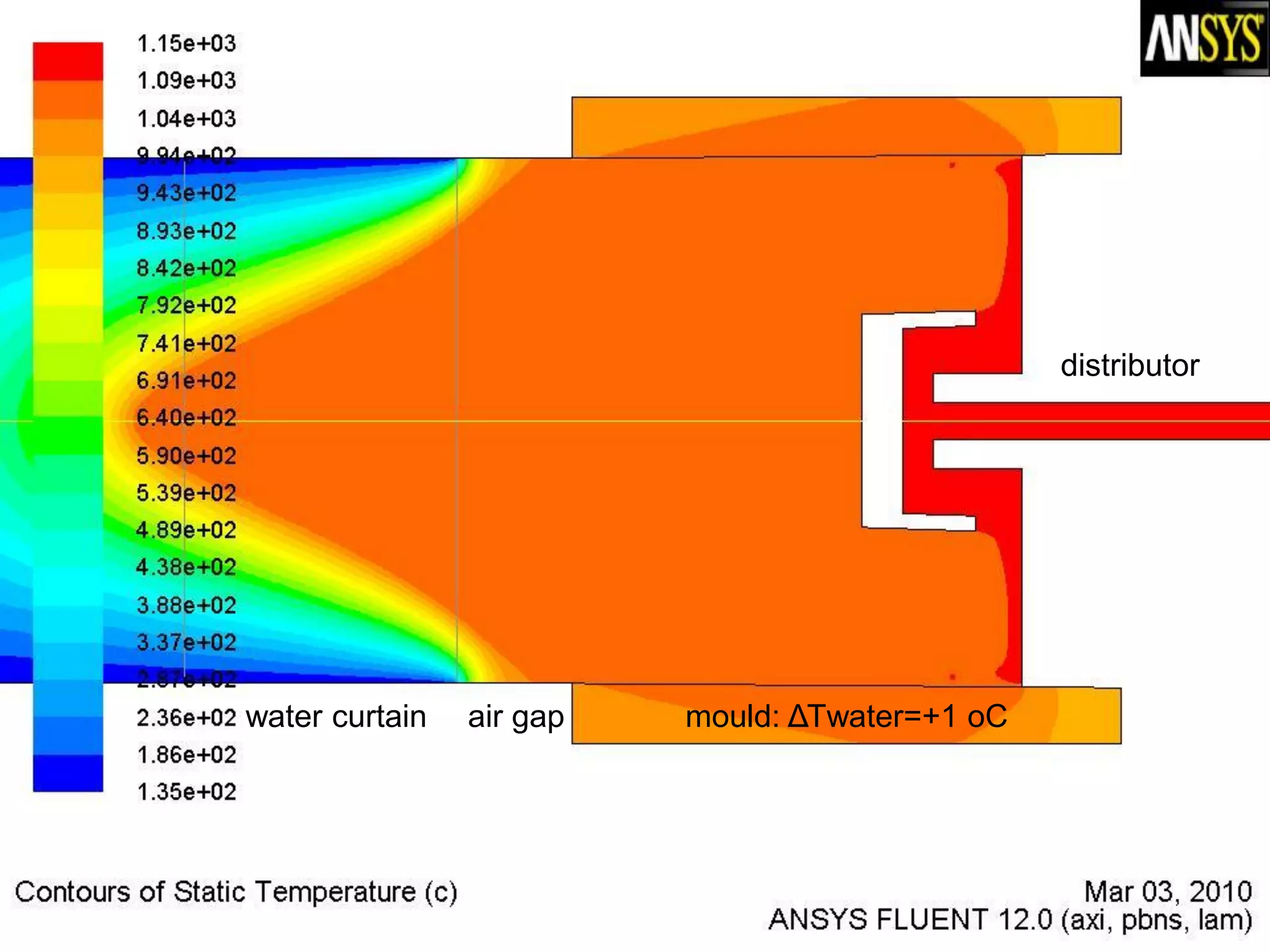
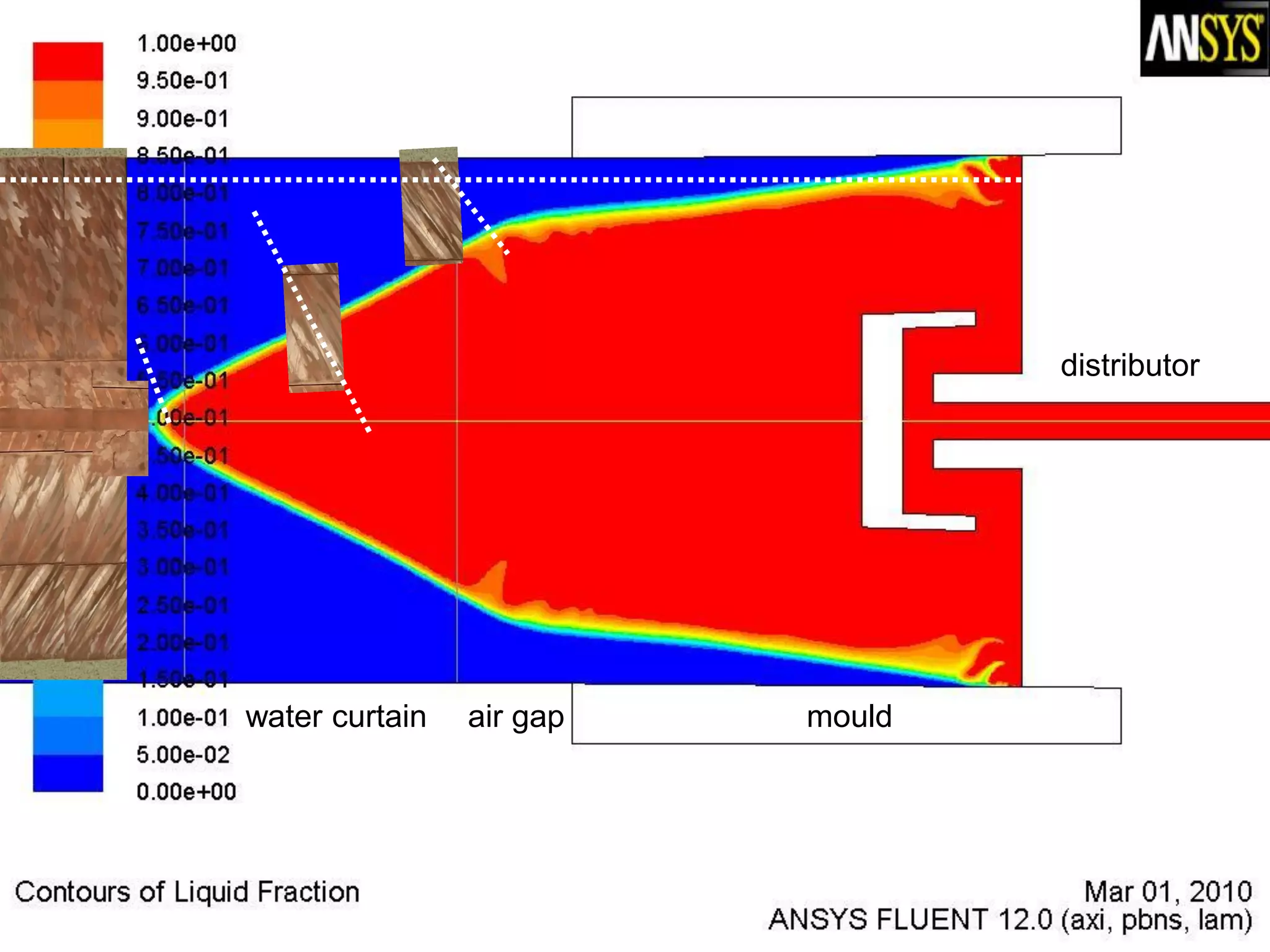
air gap
distributor
water curtain mould: ΔΤwater=+1 oC
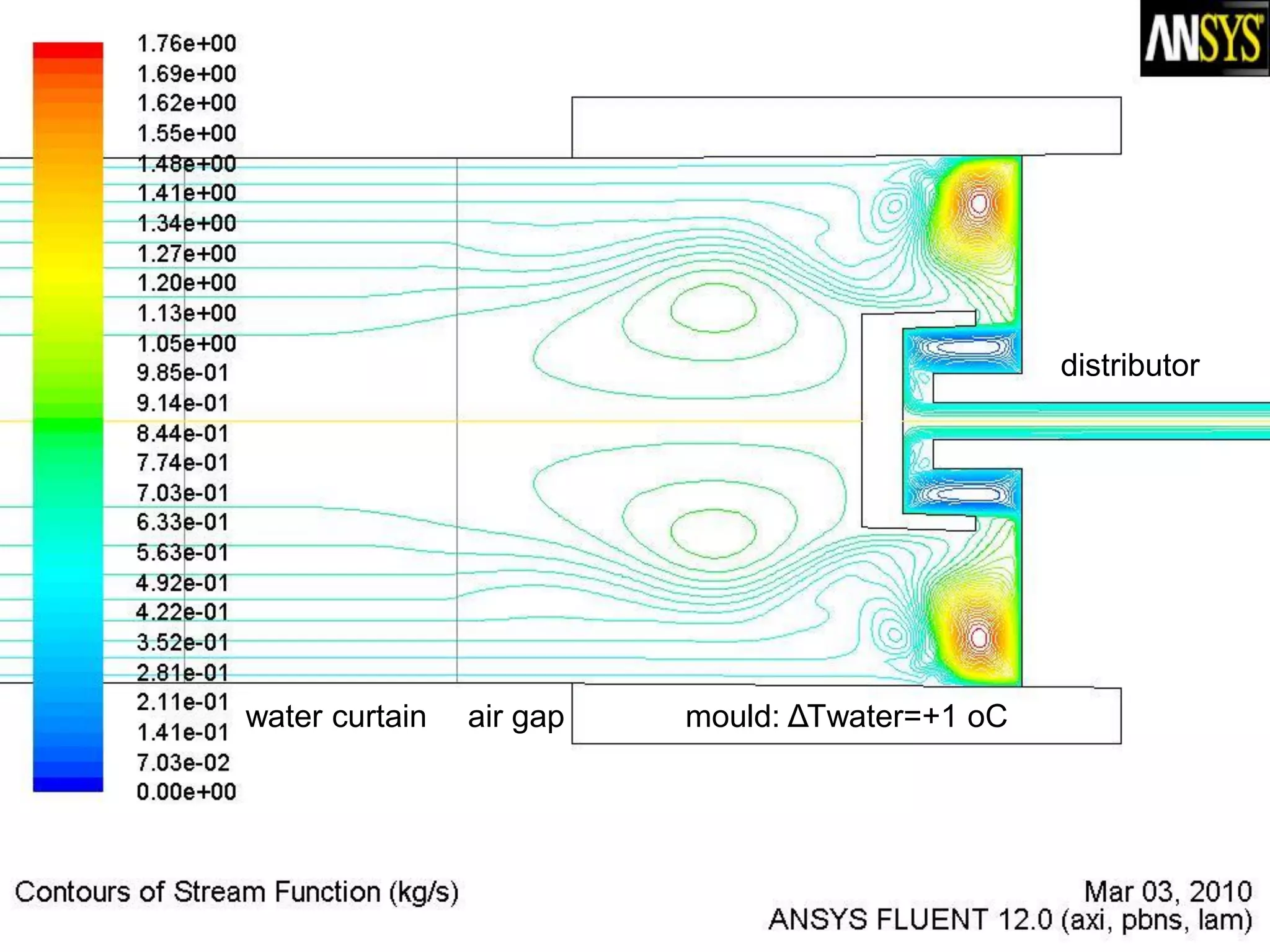
air gap
distributor
water curtain mould: ΔΤwater=+1 oC
air gap mould
distributor
water curtain
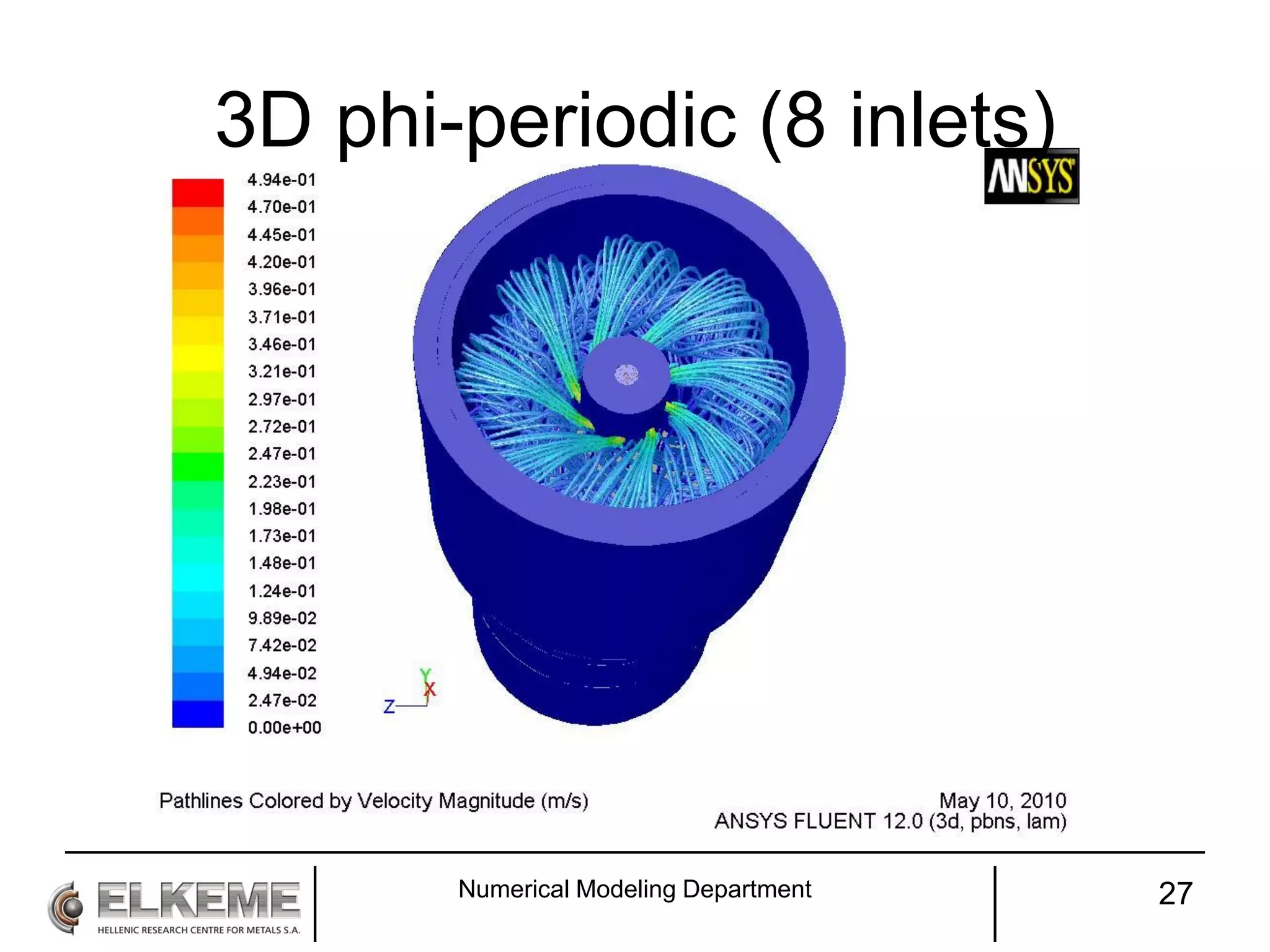
3D phi-periodic (8 inlets)
Numerical Modeling Department 27
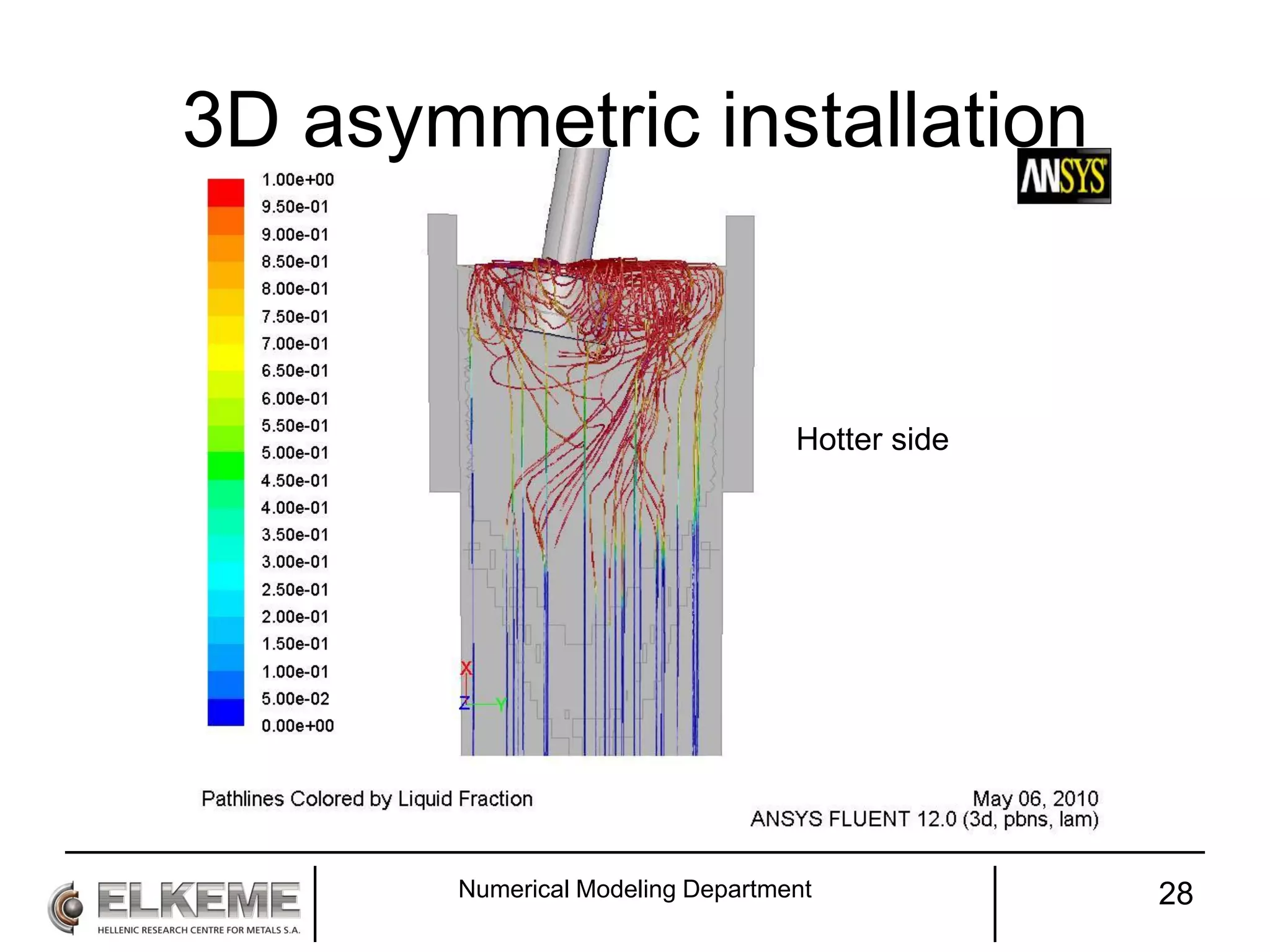
3D asymmetric installation
Hotter side
Numerical Modeling Department 28
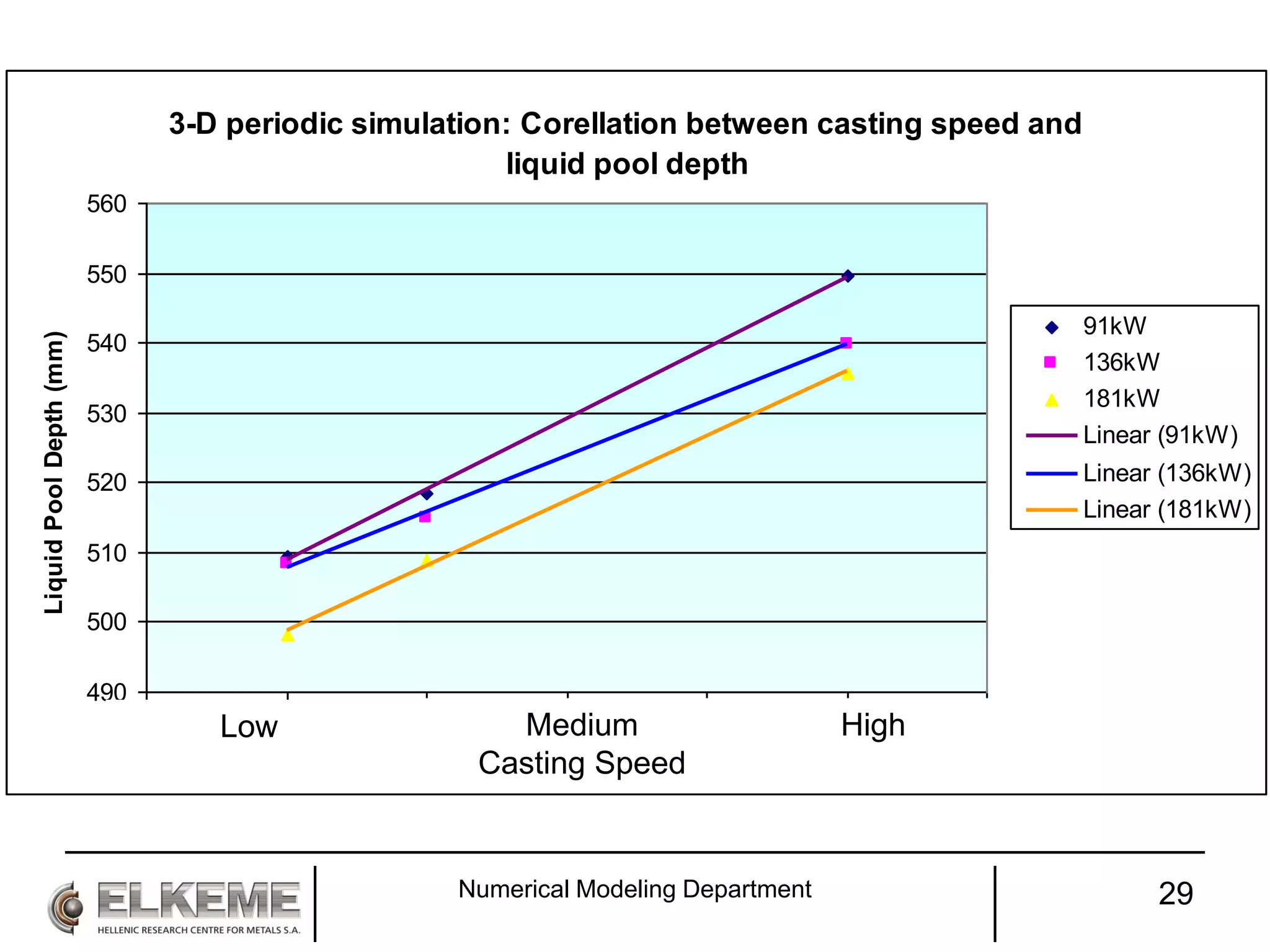
3-D periodic simulation: Corellation between casting speed and
liquid pool depth
490
500
510
520
530
540
550
560
125 130 135 140 145 150 155
Casting Speed (mm/min)
LiquidPoolDepth(mm)
91kW
136kW
181kW
Linear (91kW)
Linear (136kW)
Linear (181kW)
Numerical Modeling Department 29
Low Medium
Casting Speed
High
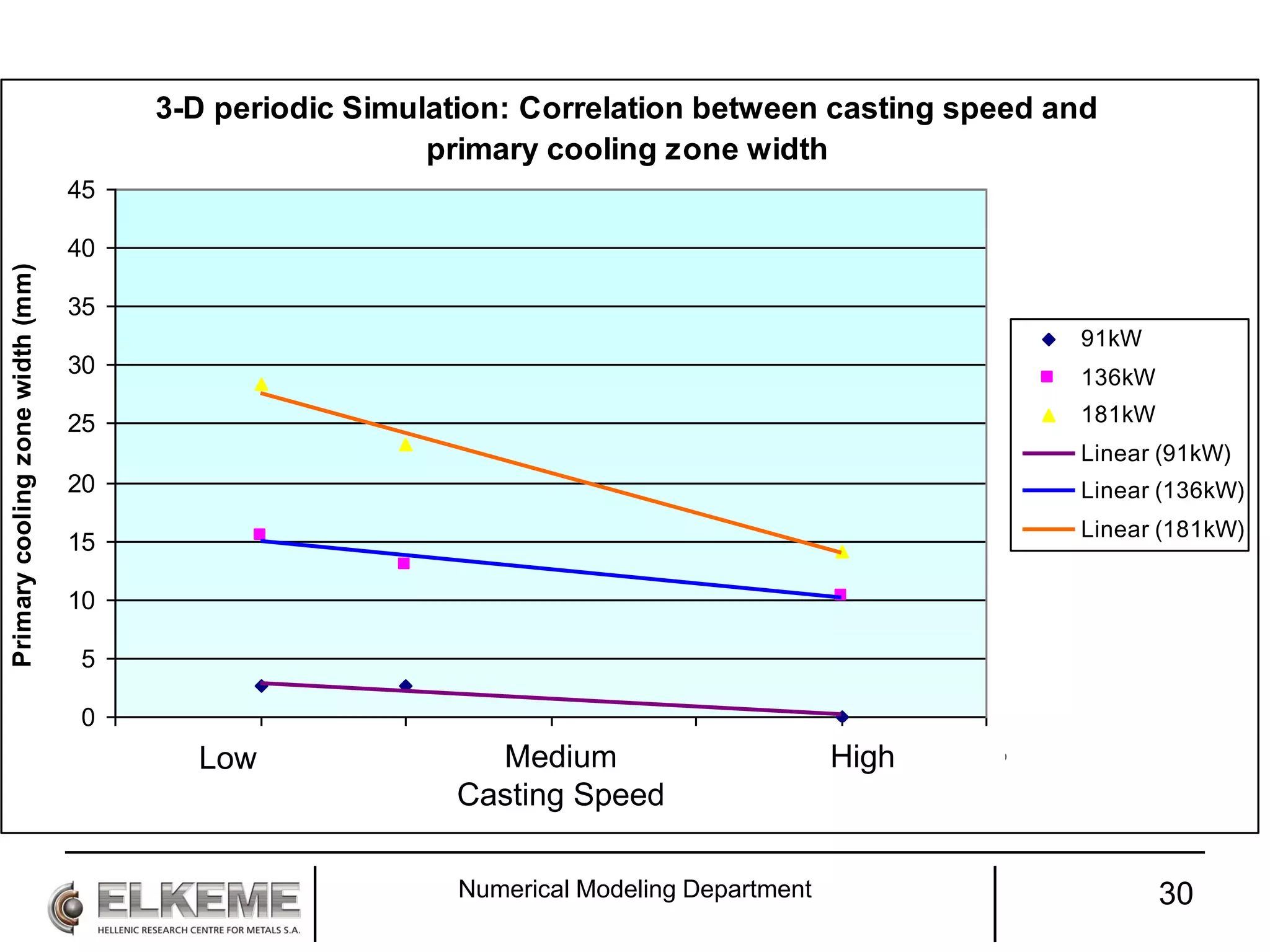
3-D periodic Simulation: Correlation between casting speed and
primary cooling zone width
0
5
10
15
20
25
30
35
40
45
125 130 135 140 145 150 155
Casting Speed (mm/min)
Primarycoolingzonewidth(mm)
91kW
136kW
181kW
Linear (91kW)
Linear (136kW)
Linear (181kW)
Numerical Modeling Department 30
Low Medium
Casting Speed
High
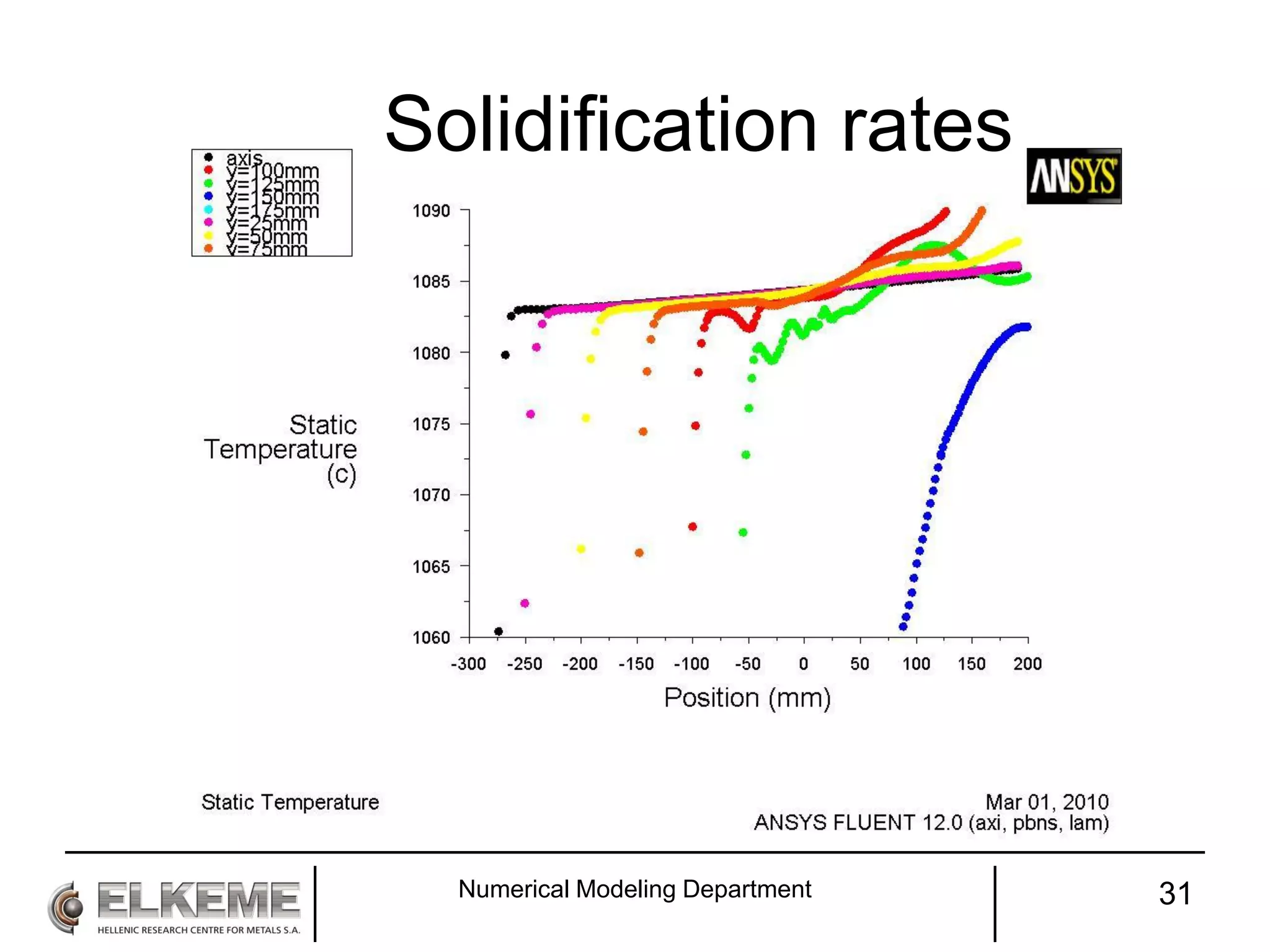
Solidification rates
Numerical Modeling Department 31
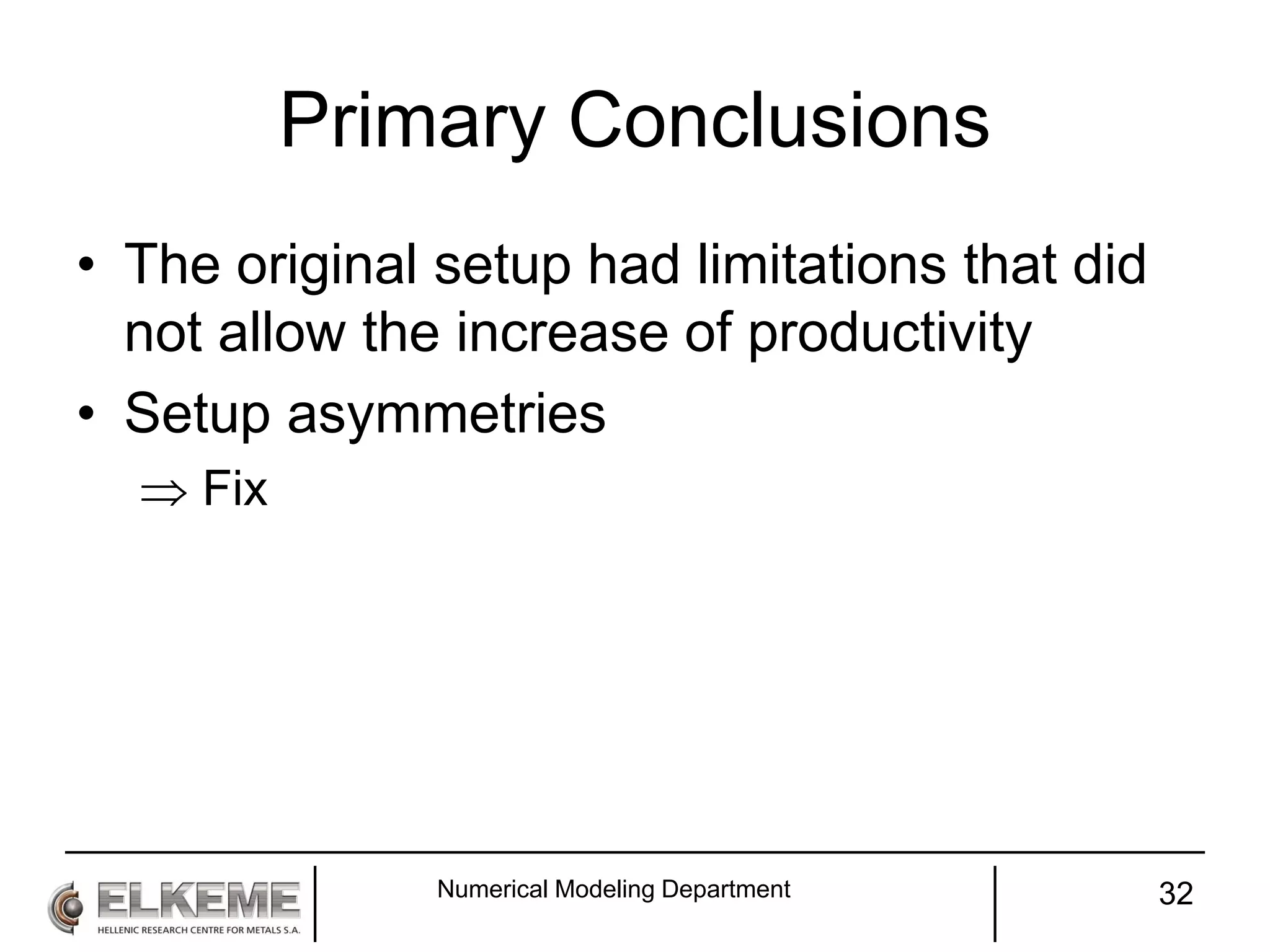
Primary Conclusions
• The original setup had limitations that did
not allow the increase of productivity
• Setup asymmetries
 Fix
Numerical Modeling Department 32
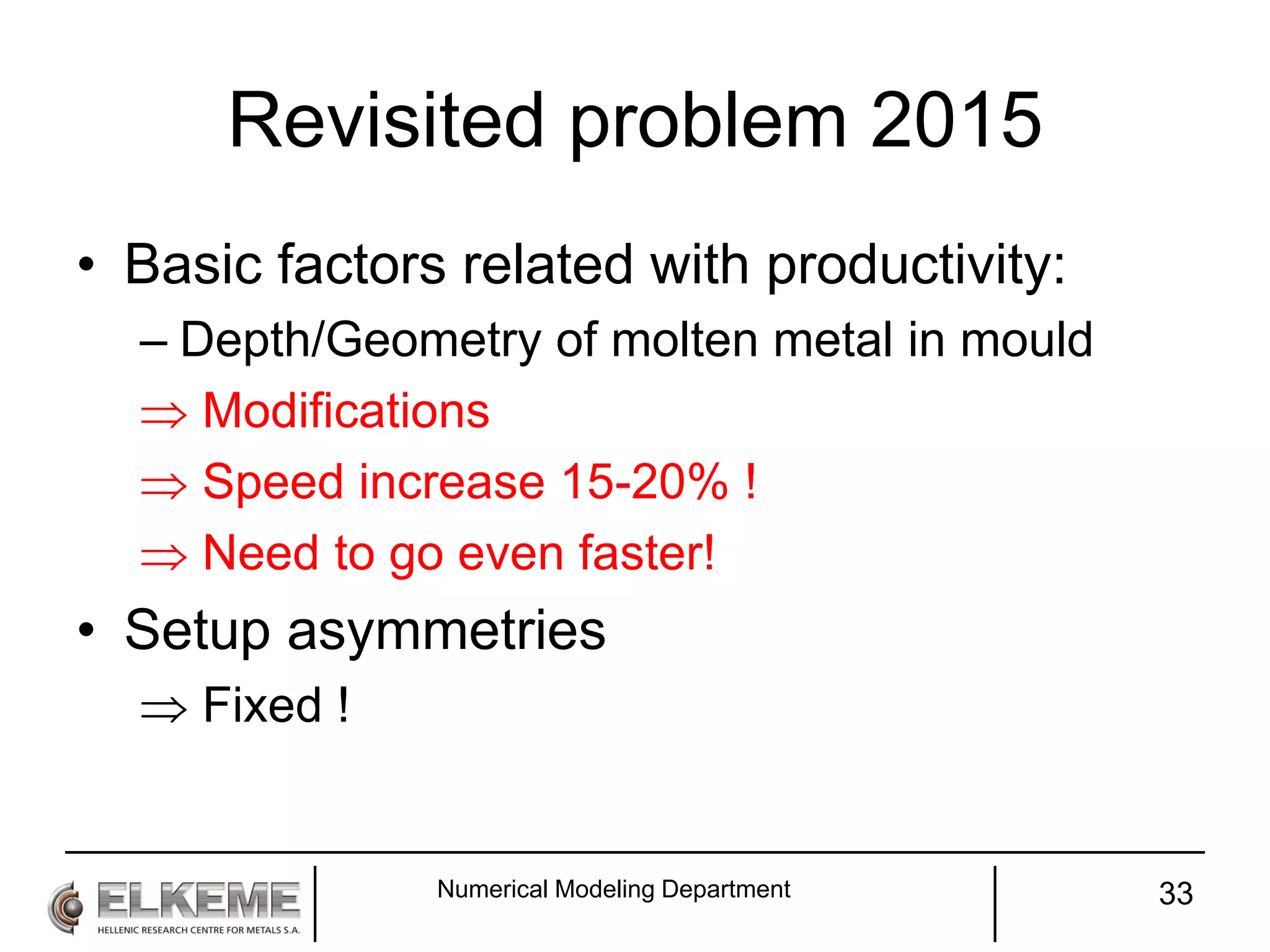
Revisited problem 2015
• Basic factors related with productivity:
– Depth/Geometry of molten metal in mould
 Modifications
 Speed increase 15-20% !
 Need to go even faster!
• Setup asymmetries
 Fixed !
Numerical Modeling Department 33
Preliminary results 2015
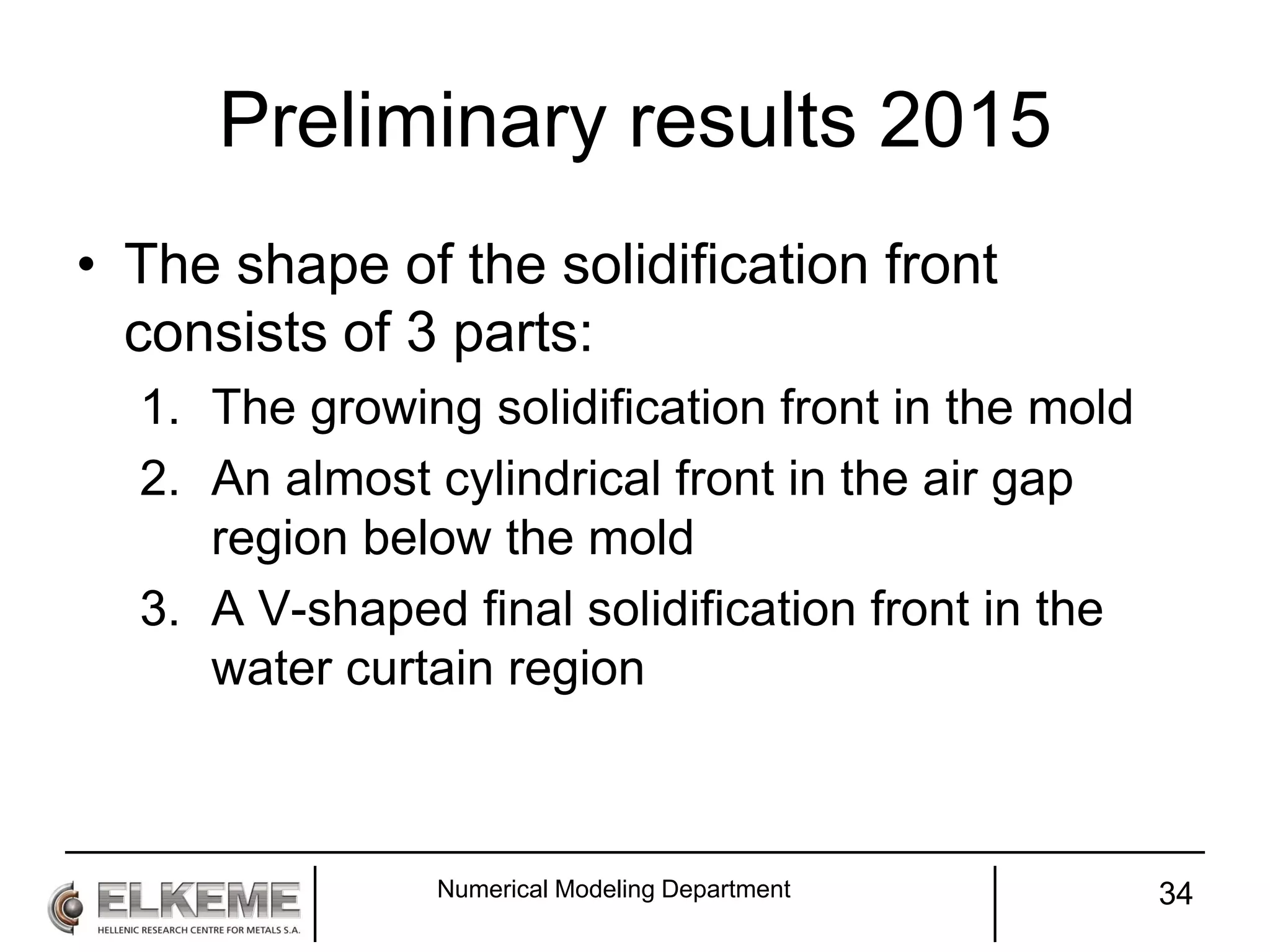
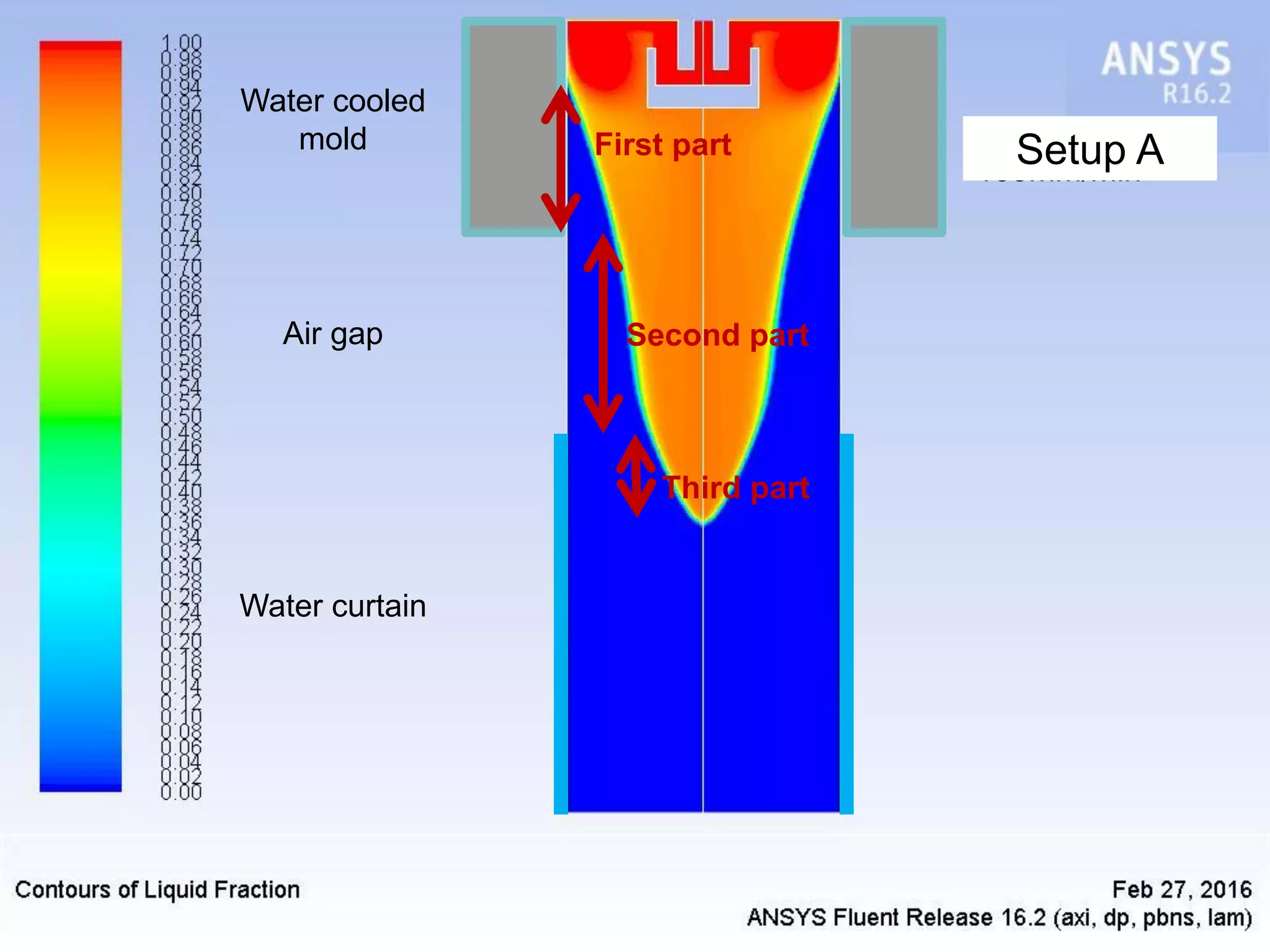
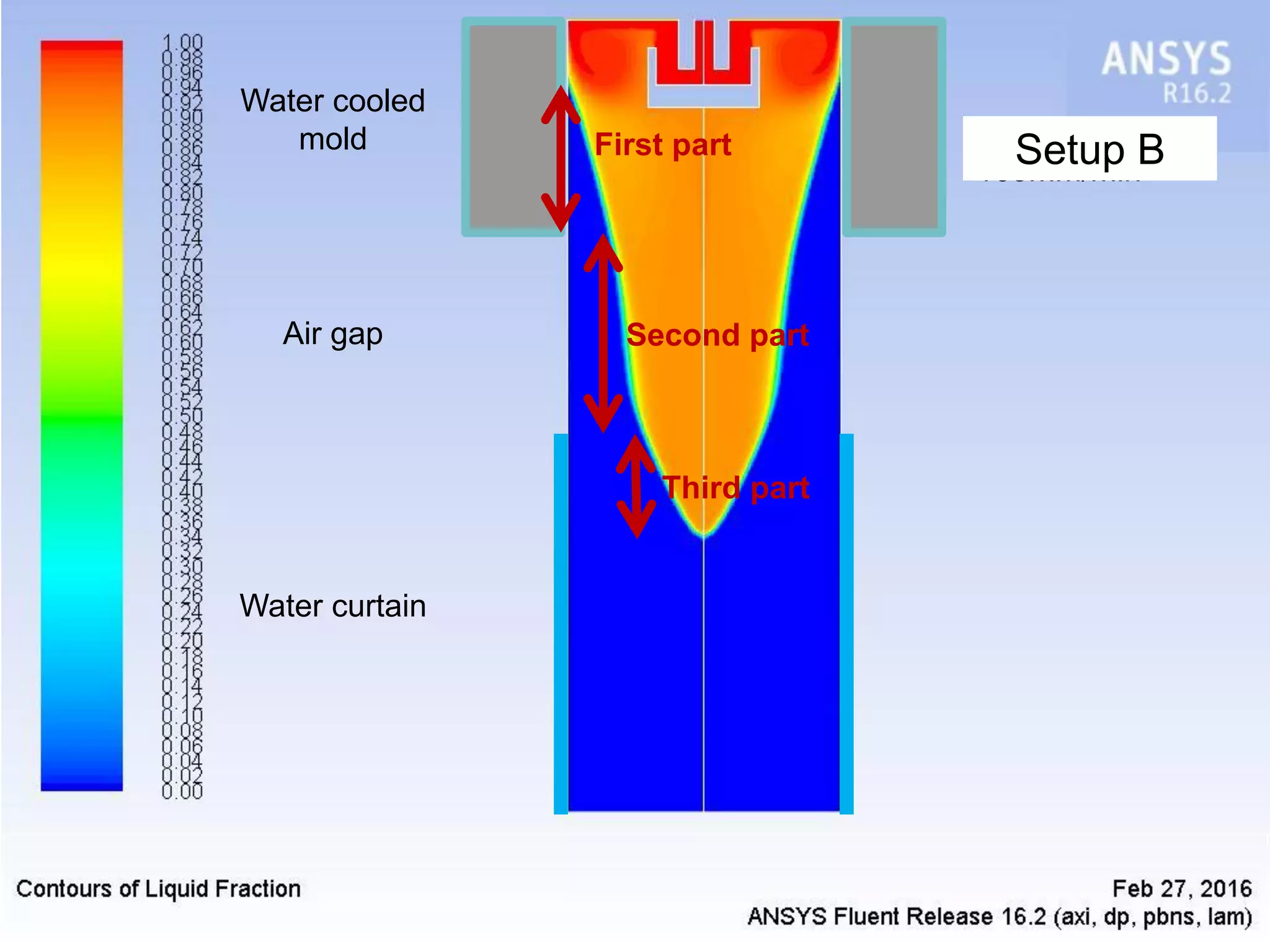
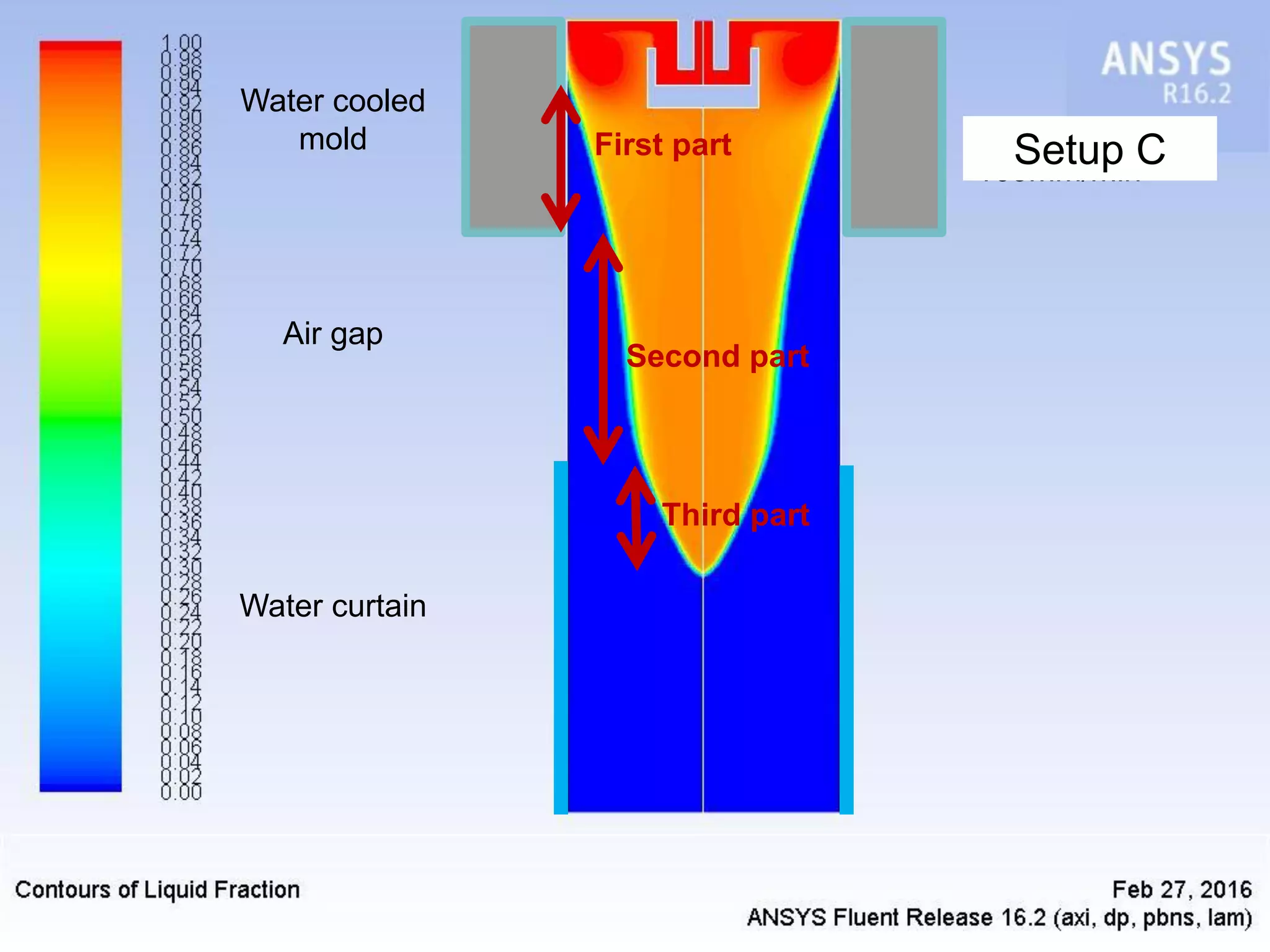
• The shape of the solidification front
consists of 3 parts:
1. The growing solidification front in the mold
2. An almost cylindrical front in the air gap
region below the mold
3. A V-shaped final solidification front in the
water curtain region
Numerical Modeling Department 34
220mm air gap
155mm/min
Water cooled
mold
Air gap
Water curtain
Third part
Second part
First part Setup A
220mm air gap
165mm/min
Water cooled
mold
Air gap
Water curtain
Third part
Second part
First part Setup B
270mm air gap
165mm/min
Water cooled
mold
Air gap
Water curtain
Third part
Second part
First part Setup C
220mm air gap
165mm/min
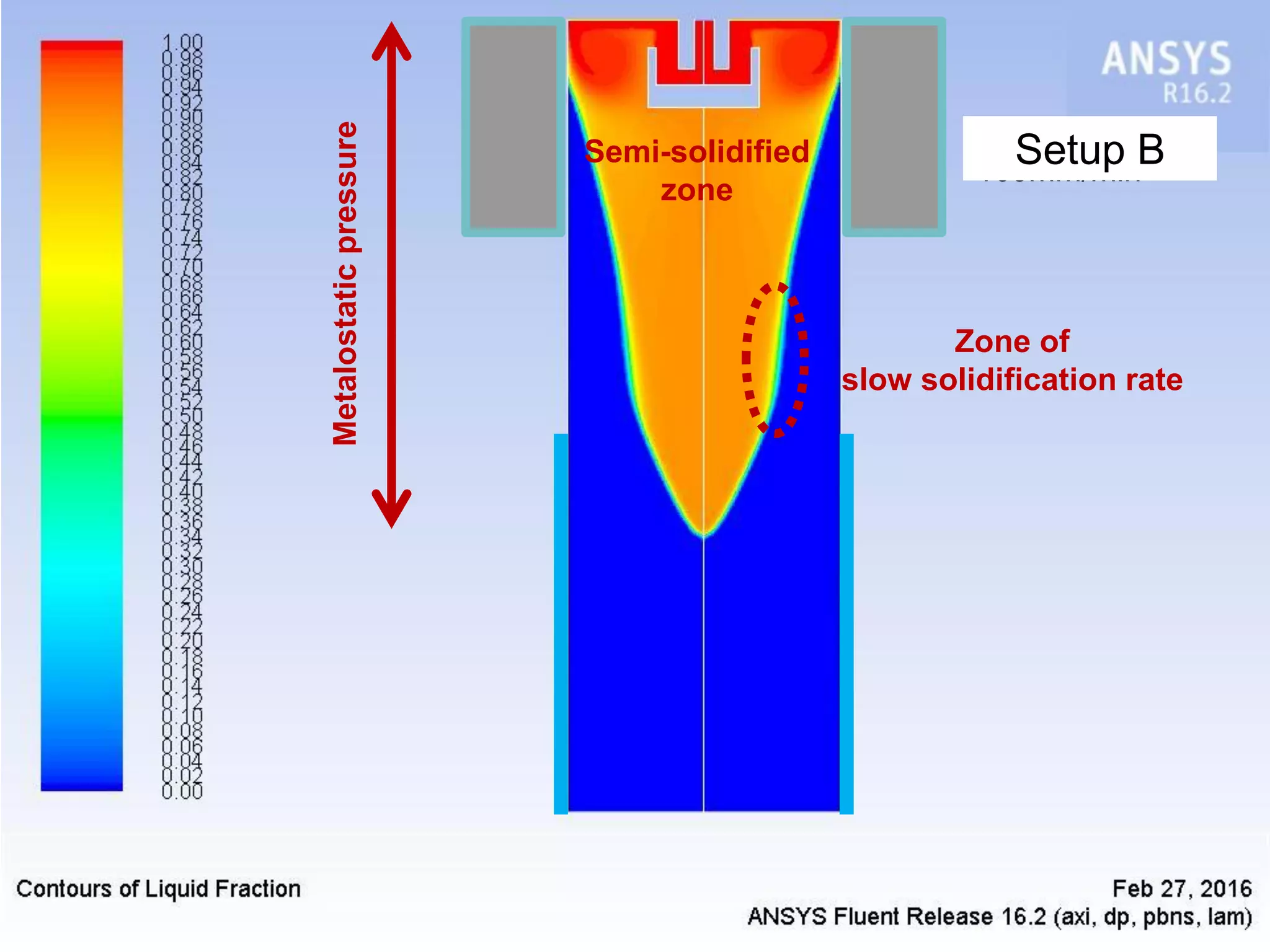
Semi-solidified
zone
Metalostaticpressure Zone of
slow solidification rate
Setup B
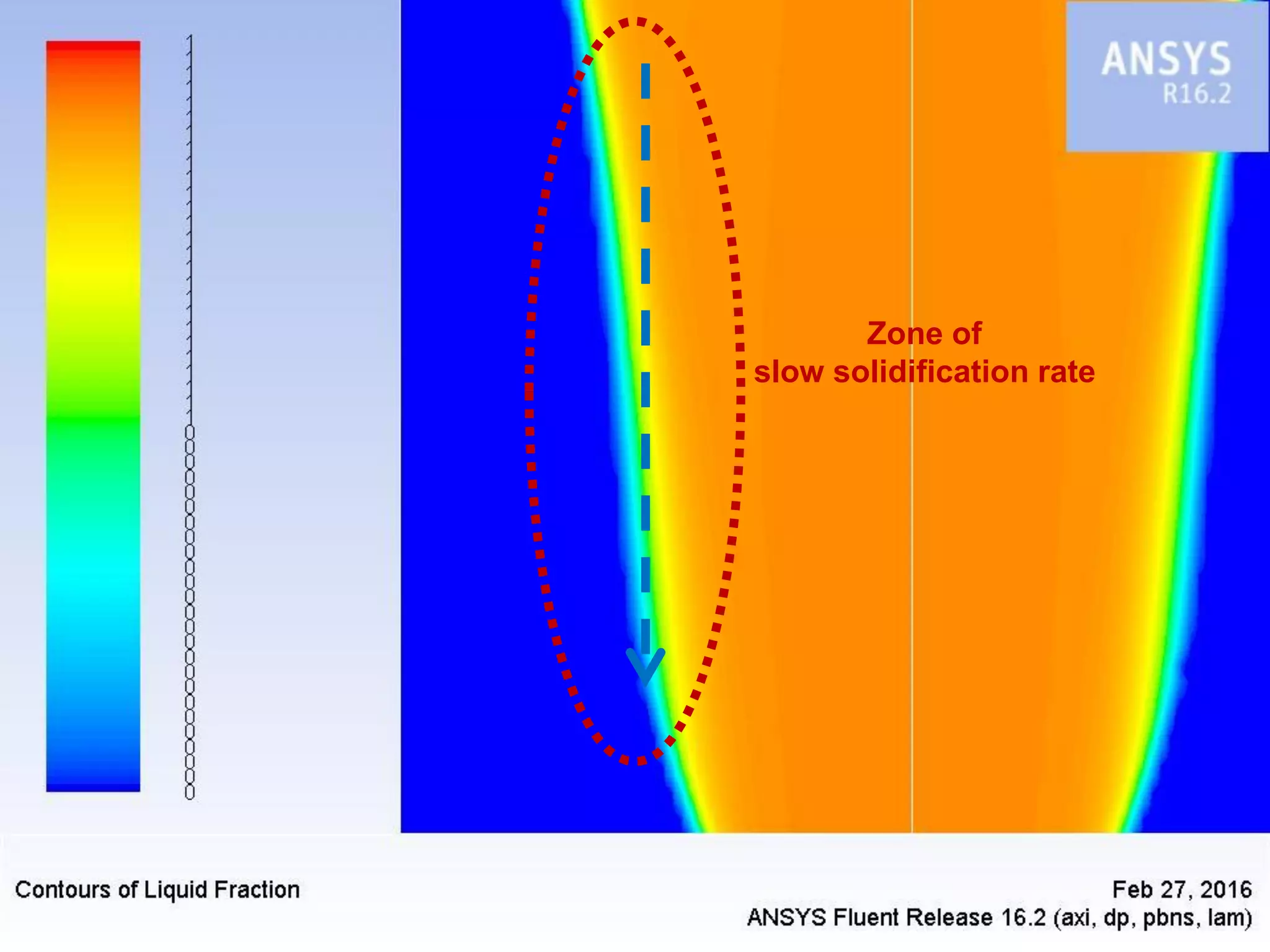
Zone of
slow solidification rate
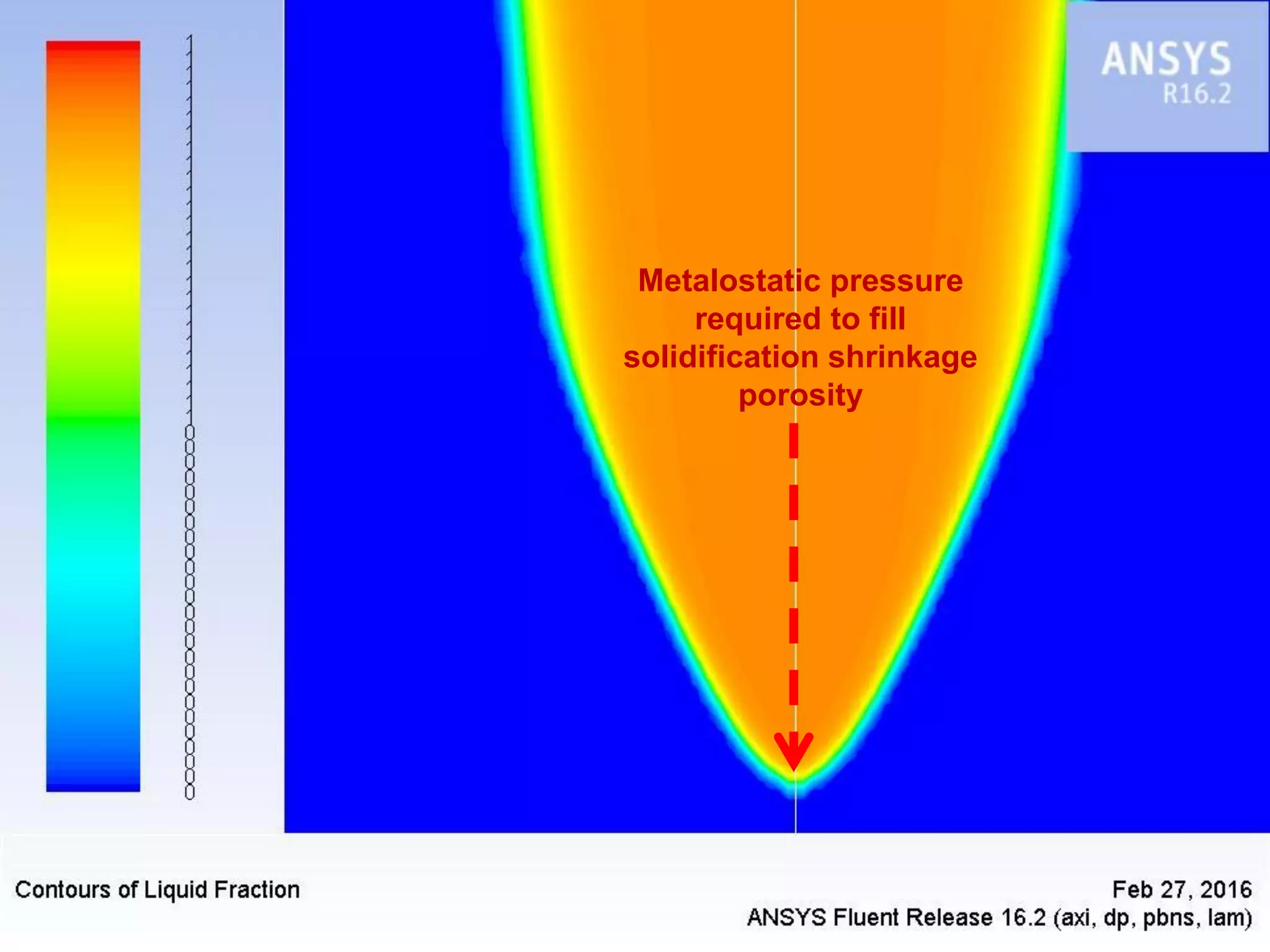
Metalostatic pressure
required to fill
solidification shrinkage
porosity
220mm air gap
165mm/min
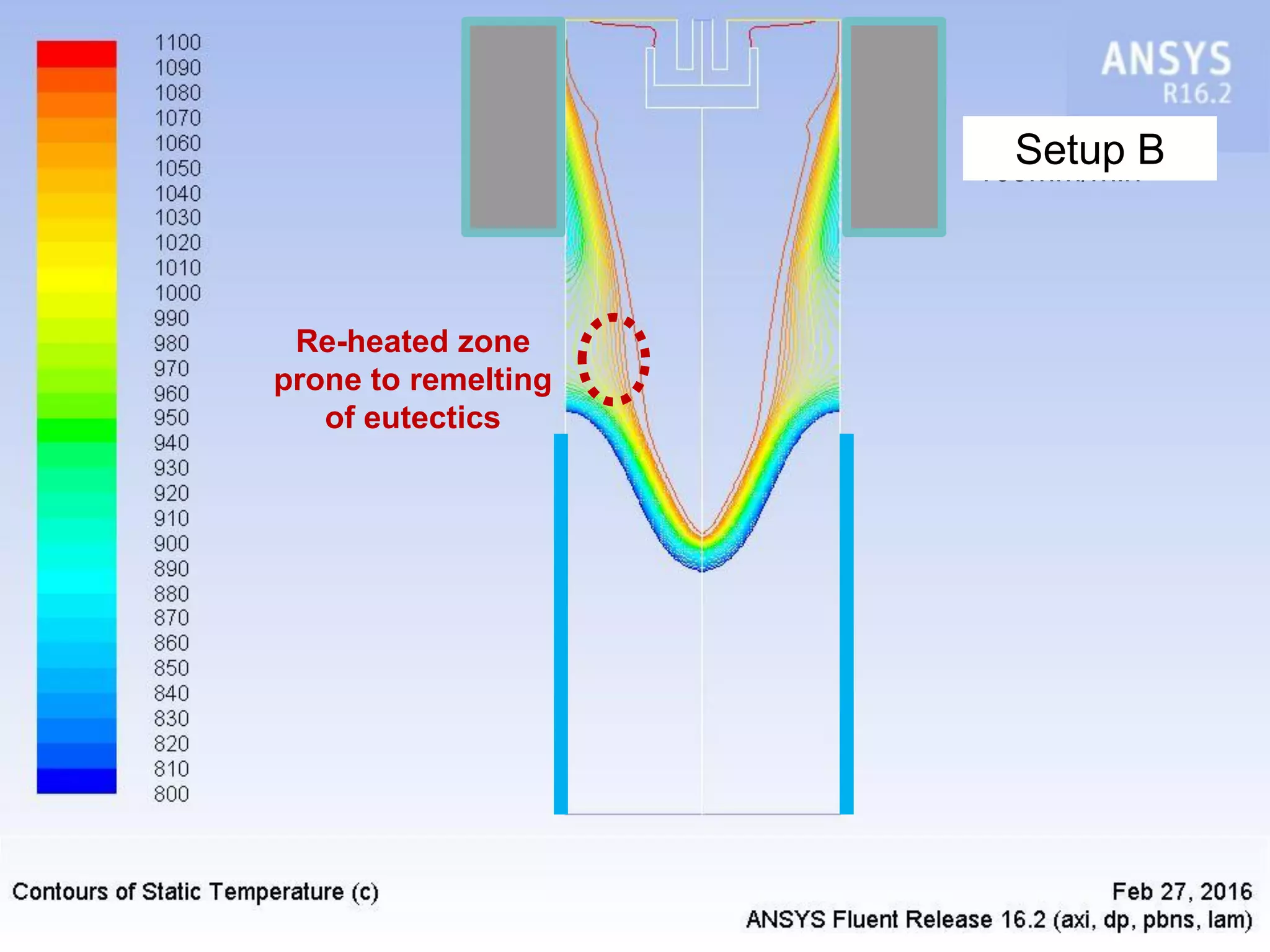
Re-heated zone
prone to remelting
of eutectics
Setup B
220mm air gap
165mm/min
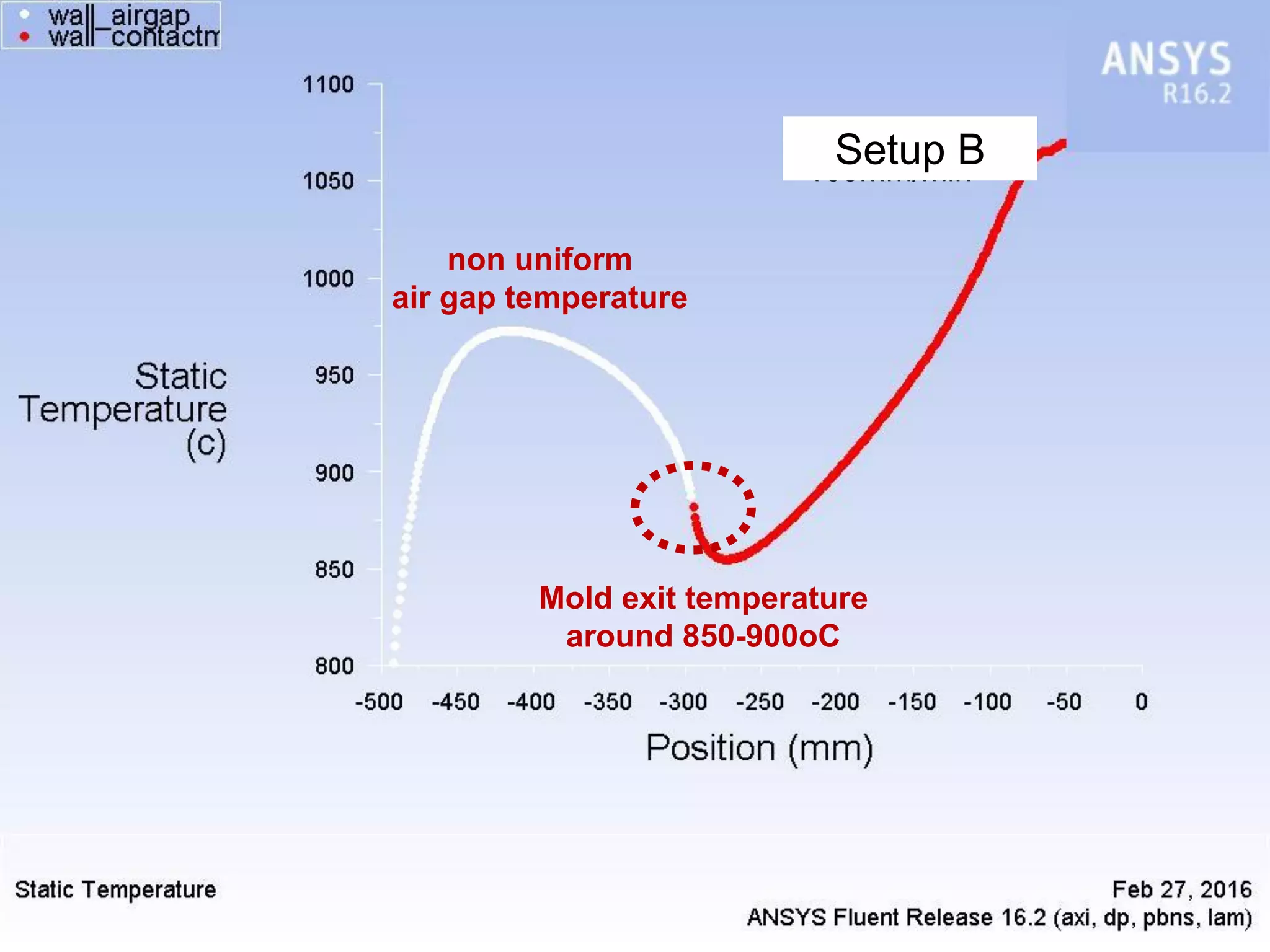
Mold exit temperature
around 850-900oC
non uniform
air gap temperature
Setup B
Conclusions
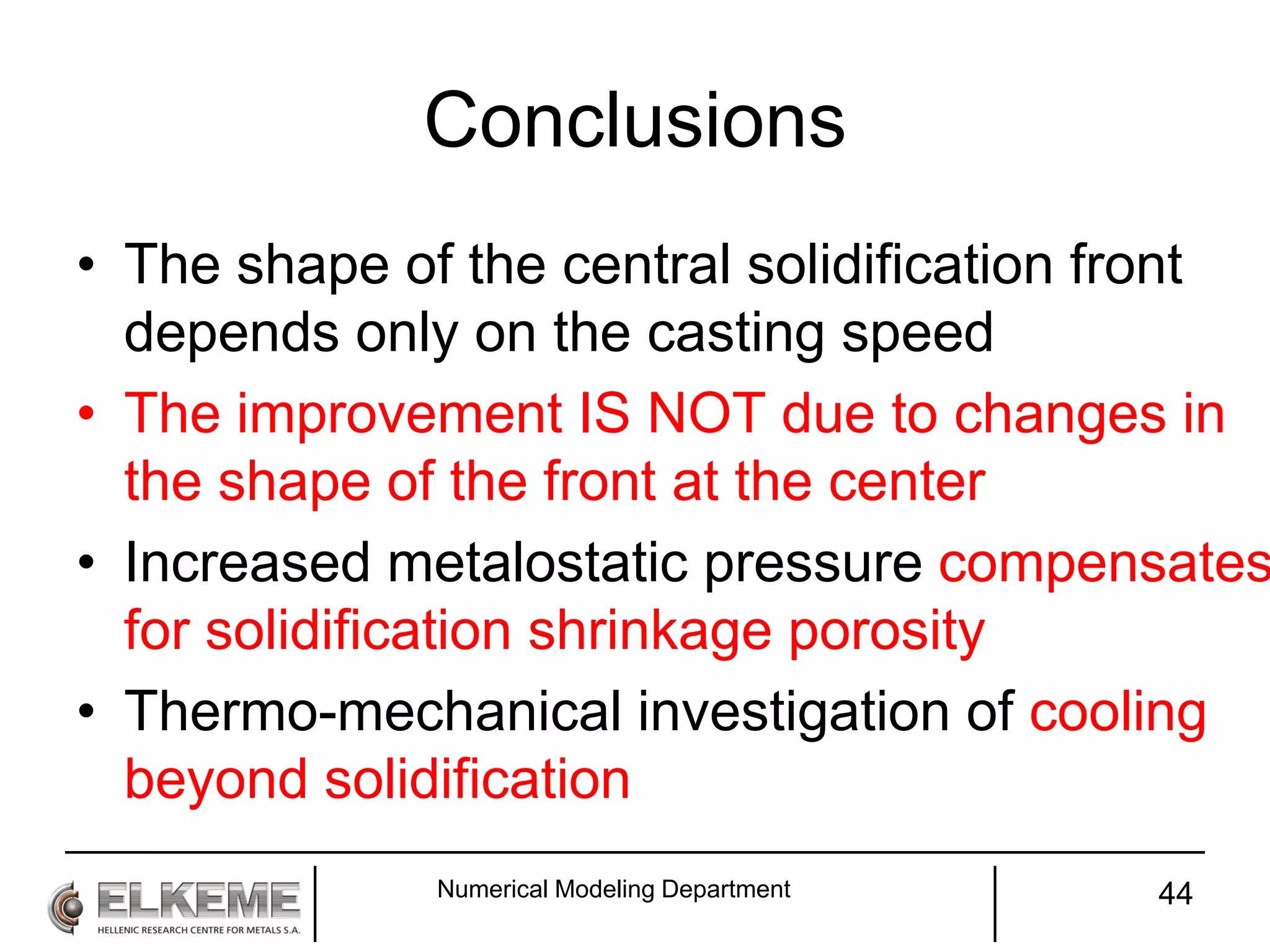
• The shape of the central solidification front
depends only on the casting speed
• The improvement IS NOT due to changes in
the shape of the front at the center
• Increased metalostatic pressure compensates
for solidification shrinkage porosity
• Thermo-mechanical investigation of cooling
beyond solidification
Numerical Modeling Department 44
Conclusions
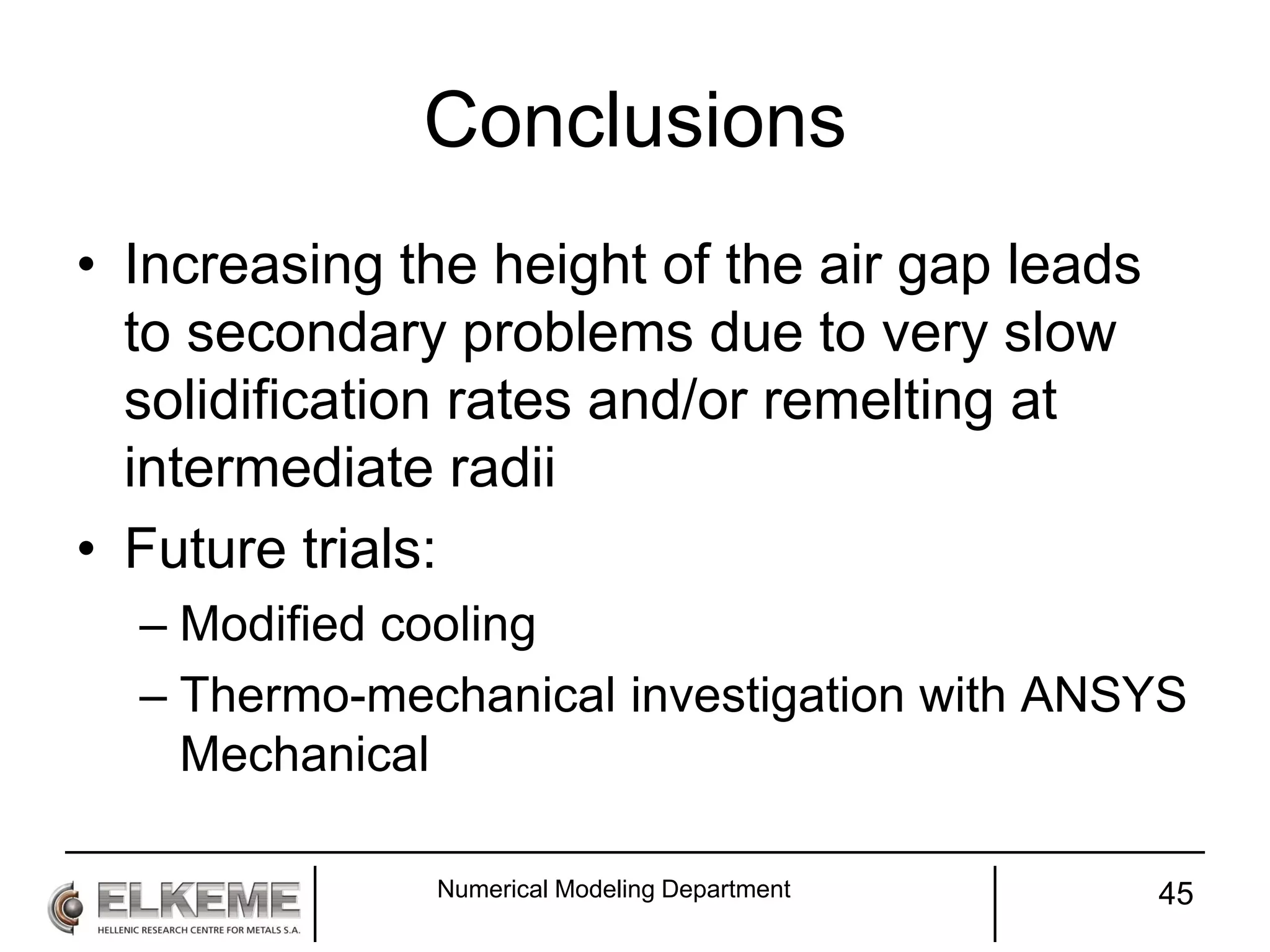
• Increasing the height of the air gap leads
to secondary problems due to very slow
solidification rates and/or remelting at
intermediate radii
• Future trials:
– Modified cooling
– Thermo-mechanical investigation with ANSYS
Mechanical
Numerical Modeling Department 45

Numerical modeling in copper billet casting

  • 1.
    NUMERICAL MODELING IN COPPERBILLET CASTING Ioannis Contopoulos, ELKEME Numerical Modeling Department 1
  • 2.
    ELKEME • The R&DCenter of VIOHALCO • Founded 1999 • Industrial research, technological development and analysis of –Aluminum –Copper –Steel –Zinc Lab/Section Name 2
  • 3.
    ELKEME • Applied technologyresearch towards – Quality Improvement of existing products – Development of new, innovative, high added value products – Optimization of Industrial Processes • Energy and cost efficiency • Health and safety • Environment and sustainable growth Numerical Modeling Department 3
  • 4.
    ELKEME • State ofthe art laboratories • Highly capable scientists, engineers, technicians • Continuous professional development • Collaborations with External Laboratories • Research projects in Metallurgy, Material Sciences and Environmental Engineering • Build knowledge and competence network Numerical Modeling Department 4
  • 5.
    ELKEME • Long termrelationships with academic and research institutes (National Tech. Univ. of Athens, Universities of Patras, Ioannina, Delft, Ghent, Manchester) • Supervision of Diploma/Master’s/PhD theses • Student training programs • Seminars • International collaborations • Participation in international scientific/engineering associations • Contributions to scientific journals and conferences (ICEFA, ICAA, ICEAF, Thermec, TMS, etc.) Numerical Modeling Department 5
  • 6.
    100 120 140 160 180 200 220 -7 -6 -5-4 -3 -2 -1 0 1 2 3 4 5 6 7(mm) ΗV1.0 1
  • 9.
    Numerical Modeling Department10 Process Metallurgy Physical Metallurgy & Forming Corrosion Environmental Metallography & Electron Optics Mechanical Testing & Manufacturing Technology Numerical Modeling Surface Science & Coatings Analytical Chemistry
  • 10.
  • 11.
    14 ELKEME Numerical Modeling •Software: – ANSYS Workbench • Design Modeler • Meshing • Fluent (FV) • Mechanical Enterprise (FE) – Design Explorer – AQWA • 2 HPC • Maxwell 2D Numerical Modeling Department
  • 12.
  • 13.
    NUMERICAL MODELING IN COPPERBILLET CASTING Ioannis Contopoulos, ELKEME Numerical Modeling Department 17
  • 14.
    Numerical Modeling • Deeperunderstanding of process • Virtual variation of operation parameters • Assists in – Identifying critical process parameters – Optimizing production process – Improve productivity Numerical Modeling Department 19
  • 15.
    Numerical setup • ANSYSFluent 12.0/16.2, solidification model • Double precision, axisymmetric, 1mm mesh resolution • Geometry: mold, distributor, air gap, water curtain • Insulated top (graphite flux) • DHP Copper physical properties (thermal properties, solidification properties: latent heat, liquid fraction, porosity) – No thermal shrinking – No micro/macro solute segregation • Casting speeds: A→1.15A→1.20A→… • Various cooling setups Numerical Modeling Department 20
  • 16.
    Numerical problems • Thesimulation of casting is a very difficult numerical problem. The fast transition from the liquidus to the solidus temperature (energy release-latent heat, viscosity transition from liquid to solid) makes the equations very “stiff”: small changes lead to instabilities and to the destruction of the solidification front • It is very difficult to find a convergent solution • Unless one finds a convergent solution, one must not trust the small details of the final result Numerical Modeling Department 21
  • 17.
    Numerical problems • Wetried many different numerical approaches • We were able to obtain convergent solutions that we can trust! Numerical Modeling Department 22
  • 18.
  • 19.
    air gap distributor water curtainmould: ΔΤwater=+1 oC
  • 20.
    air gap distributor water curtainmould: ΔΤwater=+1 oC
  • 21.
  • 22.
    3D phi-periodic (8inlets) Numerical Modeling Department 27
  • 23.
    3D asymmetric installation Hotterside Numerical Modeling Department 28
  • 24.
    3-D periodic simulation:Corellation between casting speed and liquid pool depth 490 500 510 520 530 540 550 560 125 130 135 140 145 150 155 Casting Speed (mm/min) LiquidPoolDepth(mm) 91kW 136kW 181kW Linear (91kW) Linear (136kW) Linear (181kW) Numerical Modeling Department 29 Low Medium Casting Speed High
  • 25.
    3-D periodic Simulation:Correlation between casting speed and primary cooling zone width 0 5 10 15 20 25 30 35 40 45 125 130 135 140 145 150 155 Casting Speed (mm/min) Primarycoolingzonewidth(mm) 91kW 136kW 181kW Linear (91kW) Linear (136kW) Linear (181kW) Numerical Modeling Department 30 Low Medium Casting Speed High
  • 26.
  • 27.
    Primary Conclusions • Theoriginal setup had limitations that did not allow the increase of productivity • Setup asymmetries  Fix Numerical Modeling Department 32
  • 28.
    Revisited problem 2015 •Basic factors related with productivity: – Depth/Geometry of molten metal in mould  Modifications  Speed increase 15-20% !  Need to go even faster! • Setup asymmetries  Fixed ! Numerical Modeling Department 33
  • 29.
    Preliminary results 2015 •The shape of the solidification front consists of 3 parts: 1. The growing solidification front in the mold 2. An almost cylindrical front in the air gap region below the mold 3. A V-shaped final solidification front in the water curtain region Numerical Modeling Department 34
  • 30.
    220mm air gap 155mm/min Watercooled mold Air gap Water curtain Third part Second part First part Setup A
  • 31.
    220mm air gap 165mm/min Watercooled mold Air gap Water curtain Third part Second part First part Setup B
  • 32.
    270mm air gap 165mm/min Watercooled mold Air gap Water curtain Third part Second part First part Setup C
  • 33.
  • 34.
  • 35.
    Metalostatic pressure required tofill solidification shrinkage porosity
  • 36.
    220mm air gap 165mm/min Re-heatedzone prone to remelting of eutectics Setup B
  • 37.
    220mm air gap 165mm/min Moldexit temperature around 850-900oC non uniform air gap temperature Setup B
  • 38.
    Conclusions • The shapeof the central solidification front depends only on the casting speed • The improvement IS NOT due to changes in the shape of the front at the center • Increased metalostatic pressure compensates for solidification shrinkage porosity • Thermo-mechanical investigation of cooling beyond solidification Numerical Modeling Department 44
  • 39.
    Conclusions • Increasing theheight of the air gap leads to secondary problems due to very slow solidification rates and/or remelting at intermediate radii • Future trials: – Modified cooling – Thermo-mechanical investigation with ANSYS Mechanical Numerical Modeling Department 45