Mathematics
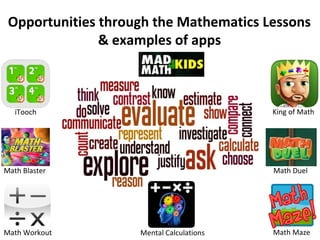
Opportunities through the Mathematics Lessons
& examples of apps
iTooch
Mental Calculations
Math Blaster
Math Workout
Math Duel
King of Math
Math Maze
How could tablets be best used to teach students:
A: Numbers, Number Patterns and Place Value
B: Addition and Subtraction
C: Multiplicaton and Division
D: Fractions, Decimals, Percentages and Proportion
E: Mass (Weight)
F: Capacity
G: Length, Perimeter and Area
H: Time
I: Money
J: Shapes and Symmetry
K: Position, Direction and Angles
L: Data Handling

Numeracy

  • 1.
  • 2.
    Opportunities through theMathematics Lessons & examples of apps iTooch Mental Calculations Math Blaster Math Workout Math Duel King of Math Math Maze
  • 4.
    How could tabletsbe best used to teach students: A: Numbers, Number Patterns and Place Value B: Addition and Subtraction C: Multiplicaton and Division D: Fractions, Decimals, Percentages and Proportion E: Mass (Weight) F: Capacity G: Length, Perimeter and Area H: Time I: Money J: Shapes and Symmetry K: Position, Direction and Angles L: Data Handling

Editor's Notes

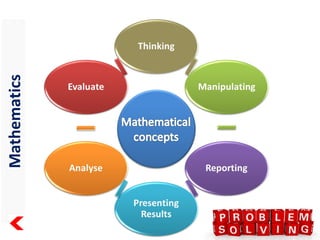
  • #2 Mathematical concepts through systematic teaching and learning activities help children develop numeracy and problem-solving skills. Progression is achieved through thinking, estimating, manipulating, reporting, presenting results, analyse and evaluate. There are different web 2.0 tools and apps that support these skills. Notice great similarities between Mathematical concepts in the NMC and the proposed lesson structure Note to tutors: arrow image linked
  • #3 Other apps and games: Math Blaster: http://www.mathblaster.com/ Singapore Maths: http://www.thesingaporemaths.com/stratf.html Maths Apps: https://www.symbaloo.com/home/mix/mathapps Best Android Apps for learning math: http://www.androidauthority.com/best-android-apps-learning-math-mathematics-number-games-81571/ Maths for pre-school to grade 12: https://eu.ixl.com/promo?partner=google&campaign=1201&adGroup=math&gclid=CPf23fjrw8YCFayWtAod2LEGmQ Fun and educational Maths apps: http://appadvice.com/applists/show/fun-math-apps-for-kids 10 apps for Math fluency: http://www.edutopia.org/blog/10-apps-for-math-fluency-monica-burns 10 best Math apps for kids: http://www.parents.com/kids/education/math-and-science/best-math-apps-for-kids/ Best apps for kids: http://www.bestappsforkids.com/category/apps-for-education/math-apps-apps-for-education/ Symbaloo Math: https://www.symbaloo.com/mix/?q=MATH The best Maths apps for children: http://www.pcadvisor.co.uk/feature/software/best-maths-apps-for-children-3380559/ Maths: http://www.mathlanding.org/ Games: http://primarygamesarena.com/ Games: http://www.learninggamesforkids.com/  
  • #4 More Apps
  • #5 Note for tutors: This is the list of topics that is found in the syllabus, there is no need to read the text from the content area – only refer to it just in case some questions arise. If there is some time left at the end, the teachers are given the chance to search for apps related to these topics. A: NUMBERS, NUMBER PATTERNS AND PLACE VALUE Place value is significant due to the fact that it helps you understand the meaning of a number. Thus, we can say that understanding of place value is central to developing number sense. It is also the basis for the four fundamental operations on numbers. Consequently, place value connects to many other important concepts. B: ADDITION AND SUBTRACTION Addition and subtraction are basic operations in mathematics and are inversely related. These are powerful foundational concepts in mathematics with applications to many problem situations and connections to many other topics. Undoubtedly, their importance extends to real-life situations. C: MULTIPLICATON AND DIVISION Multiplication and division are also basic operations in mathematics and are inversely related. These are powerful foundational concepts in mathematics with applications to many problem situations and connections to many other topics. Undoubtedly, their importance extends to real-life situations. D: FRACTIONS, DECIMALS, PERCENTAGES AND PROPORTION Fractions, percentages, decimals and proportion are closely related. A fraction is any part of a group, number or whole. A decimal is a number containing both an integer part and digits separated by the decimal point, while a percentage is a quantity out of 100. Proportion is a comprehensive concept and it is imbedded in fractions, percentages and decimals. In everyday situations, we continuously move from one form to another and then back again. Despite their strong relationship we must also know when we need to use one form among the others. A good grasp of fractions, decimals, percentages and proportion will help you: evaluate offers, calculate fuel consumption, read a recipe, build a scale model of a car or of an aeroplane and understand a news item or the results from a survey for example. The above is only a basic representation of the importance of fractions, decimals, percentages and proportion. Helping our children understand and appreciate this may be fruitful. E: MASS (WEIGHT) Weight is a quantity. Measuring and understanding weight is of utmost importance. Undoubtedly, you have experienced the measurement of weight many times, such as at the time of physical health check-ups. Or perhaps you may have asked yourself: Is that object too heavy to pick up by myself or do I need something to lift it? When you go to the greengrocer to buy vegetables and fruit, for example, there will be tags attached that tell you the price per kilogram so you can compare the cost of one brand/item over another. Without a standard measure of weight, in this case a kilogram, you wouldn't know exactly what you are paying for. Unlike other quantities, it is very difficult to measure weight in a visible way like length and size. Weight is difficult to judge visually. While you can always make an estimate of the weight of an object, you will need to use a measuring tool such as a measuring tape, a ruler or a trundle wheel to have an accurate measure in grams and/or kilograms. In order to do this, you need to be able to read a scale. The above are only a few life situations where being able to read, measure and understand weight is important. Helping our children understand and appreciate this may be fruitful. Note: The terms mass and weight are different, yet are used interchangeably throughout the Primary years. F: CAPACITY Understanding capacity is especially important in the field of medicine or chemistry when one is dealing constantly with liquid measurement. Nonetheless, understanding capacity is also important in our everyday life. When you are sick and your doctor prescribes medicine you need to take your medicine in the proper amounts. Your health will not benefit if you take too little or too much. Cooking also involves a lot of measurement such as: add 120 ml of water or 50 ml of olive oil. In fact, the kitchen is a good place, though not the only, to measure different capacities. Using a measuring jug you can check the capacity of different items such as cups, glasses, bottles and perhaps the capacity of a kettle. What is the capacity of the milk carton in your fridge? And do you have anything in your kitchen, in the cupboards or in the fridge, which has a capacity of 1 litre? Estimate and then check by reading the label on the container/s. The above are only a few life situations where being able to read, measure and understand capacity is important. Helping our children understand and appreciate this may be fruitful. G: LENGTH, PERIMETER AND AREA Learning how to measure length is an important life skill. Measurements in millimetres, centimetres, metres and kilometres are also very much present in sports and not only. Sometimes, measurements need to be accurate, however many times we simply need to make estimates. Measuring length is also essential for calculating perimeter and area: two important and fundamental mathematical topics. They help you to measure physical space. Perimeter is a measurement of the distance around a shape and the area gives us an idea of how much surface the shape covers. Knowledge of perimeter and area is applied practically by people on a daily basis, such as architects, engineers, and graphic designers… it is mathematics that is very much needed by people in general. Understanding how much space you have and learning how to fit shapes together exactly will help you when you paint a room, buy a home, remodel a kitchen or build a deck. The above are only a few life situations where being able to read, measure, calculate and understand length, perimeter and area is important. Helping our children understand and appreciate this may be fruitful. H: TIME Being able to tell time is a functional mathematical skill. Being punctual is important: whether at school or whether you are meeting your friends. When you grow up you would want to be punctual at work too. Moreover, being able to tell time will help you catch a bus or a flight on time. Usually it is suggested to be at the airport two hours before the departure of our flight. On the other hand if you park your car in a 150 minute parking space, you will need to be careful not to get a ticket. Being able to tell time will further help you not to miss your favourite television programme. And what if you are baking a cake and on the recipe it says that bake time is 45 minutes, you would want to know how to keep the time on your analogue watch or on the digital time display on your oven. Likewise, if your favourite football team is winning 2 – 1, you would want to be able to know how many minutes are left to end of the match. And in order to remember to prepare a birthday card for your best friend you need to be able to read a calendar. The above are only a few life situations when being able to tell time is important. Helping our children understand and appreciate this may be fruitful. I: MONEY Being able to compare offers, read and understand receipts and pay bills at the supermarket, at a restaurant or at our favourite toy shop is very important. Then, you would want to make sure that you have received the correct change if you pay by cash and you do not have the exact amount. However, when you grow older you can also pay by cheque or card. Equally important is being able to make plans related to money. This is what we refer to as budgeting. If you are saving to buy something special, you would want to be able to calculate how much more you need to save and also to know how long it will take you to save up for it. If you or someone within your family have saved up to go on a family holiday, make sure to check the currency used in the country you are travelling to. The euro is the currency used in 18 of the 28 member states of the European Union. The above are only a few life situations when being financially literate is important. Helping our children understand and appreciate this may be fruitful. Note: use the words euro and cent as both singular and plural J: SHAPES AND SYMMETRY There is evidence of geometry everywhere. Buildings, planes, cars and maps all use geometry. For example, the home you live in is made of basic geometry shapes and some skyscrapers have windows made of rectangles and squares. Very often these structures are also symmetrical. Symmetry can be seen almost everywhere in daily life. The human body is an example of symmetry: the kidney, the lungs the brain and to some extent even the face is. Being able to understand the basic properties of 2-D and 3-D shapes, to draw shapes and to create your own patterns, whether symmetrical or not, will help you appreciate better the world we live in and will probably help you in your future career should you wish to become an engineer, a doctor, a scientist, a designer or a mechanic. However there are many other occupations that entail competence in geometry. The above are only a few life situations where understanding of shapes and symmetry is important. Helping our children understand and appreciate this may be fruitful. K: Position, Direction and Angles Being able to read a map to follow and/or give directions are functional skills. Distinguishing between left and right, between clockwise and anticlockwise turns and among the eight compass points will equip you with these skills. A pilot, a sailor, a fisherman, a policeman… and any driver need to have a good grasp of these skills. Furthermore engineers, architects, product designers use knowledge of angles daily. The above are only some instances where position, direction and angles are important. Helping our children understand and appreciate these through their own experiences may be fruitful. L: Data Handling Data handling is an essential activities in which we engage in our everyday life. We are frequently presented with data in various contexts which we need to analyse and interpret. Data can be presented in a variety of forms such as bar charts or pictograms. We often look for patterns and generalities within them and analysis is often confined to identifying the most popular or least popular item. However, we need to engage in more critical thinking. For example, drawing on real data in 2014 NSO has reported that from 2004 to 2013, both rainfall intensity and variability of total rainfall from the climatic norm were the lowest in the past four decades. And in the End of Primary Benchmark, in mathematics, the mean score was 69·20. We can attempt to look deeper into this data. The above are only two instances of data analysis. Helping our children understand and appreciate data handling through their own experiences may be fruitful. Note: At Primary level mean and average are used interchangeably.