Immuno-oncology
Sponsored by
A game-changer for cancer treatment?
Cally Palmer / Nicola Blackwood MP / Gill Nuttall / John Baron MP
01 BMS cover.indd 1 13/01/2017 15:31:08
INFOGRAPHIC
I-O: A QUICK GUIDE
A new kind of treatment
Surgery
Surgery can offer good results,
especially when deployed
early, but it can leave cancer
cells behind.
Radiotherapy
Radiation can be locally targeted
in a similar way to surgery, but it
can also damage healthy tissues
and have other side-effects.
Chemotherapy
Chemotherapy offers a more
widespread attack on cancer cells,
but may also cause systemic and
debilitating side-effects.
Immuno-oncology (I-O)
Rather than trying to directly destroy cancer cells, I-O removes
the ability of cancer cells to defend themselves against the body’s
immune system. The body itself is then able to destroy the cancer
as it would an infection, such as a cold.
Immuno-oncology (I-O) is a new arm of attack against cancer. It
helps the body’s own immune system fight the disease, and for
some patients, the results are revolutionary.
02 infographic.indd 2 13/01/2017 13:02:32
CONTENTS
2nd Floor
71-73 Carter Lane
London EC4V 5EQ
Tel 020 7936 6400
Subscription
inquiries:
Stephen Brasher
sbrasher@
newstatesman.co.uk
0800 731 8496
The paper in this magazine originates from timber that is sourced from sustainable
forests, responsibly managed to strict environmental, social and economic
standards. The manufacturing mills have both FSC and PEFC certification and also
ISO9001 and ISO14001 accreditation.
First published as a supplement to the New Statesman of 20 January 2017.
© New Statesman Ltd. All rights reserved. Registered as a newspaper in the
UK and US.
This supplement and other policy reports can be downloaded from the
NS website at: newstatesman.com/page/supplements
Special Projects Editor
Will Dunn
Special Projects Writer
Rohan Banerjee
Design and Production
Leon Parks
Contents & contributors
Commercial Director
Peter Coombs
+44 (0)20 3096 2268
Account Director
Dominic Rae
+44 (0)20 3096 2273
Nicola
Blackwood MP
Public Health
Minister
MarkMiddleton
ProfessorofExperimental
Cancer Medicine,
Oxford University
Martin
Grange
Trustee, Roy
Castle Lung Cancer
Foundation
Richard
Henry
President,UKOncology
NursingSociety
Dr Nadia
Yousaf
Consultant Oncologist,
Royal Marsden
Emlyn
Samuel
Senior Policy
Manager at Cancer
Research UK
Morfydd
Williams
Programme Director,
NationalCancerServices
NHS England
Gillian
Nuttall
Founder,
Melanoma UK
Richard
Robinson
Associate Director of
Government Affairs,
Bristol-Myers Squibb
4 / Round table discussion
The New Statesman invited the country’s top
policymakers, patient groups and research specialists
to discuss immunotherapy
9 / John Baron MP
The evolution of cancer treatment, and the strategies
the NHS should adopt
10 / Ben Hickey
Medical breakthroughs only help patients
if the NHS can provide the drugs they develop
12 / The patient perspective
Gillian Nuttall looks at what immunotherapy
means to patients, and how they view it
13 / Cally Palmer
NHS England’s National Cancer Director discusses
implementing the Cancer Strategy
14 / Nicola Blackwood MP
The Public Health Minister discusses adapting to
change in cancer treatment
3 | Immuno-oncology
Bristol-Myers Squibb funded this supplement and all articles
have been independently authored, with the exception of
the article by Ben Hickey (p10). Participants were not paid
for their involvement and their views have not been altered
by Bristol-Myers Squibb.
03 contents.indd 3 13/01/2017 15:05:10
ROUND TABLE DISCUSSION
THE CHALLENGES AND POTENTIAL OF I-O
4 | Immuno-oncology
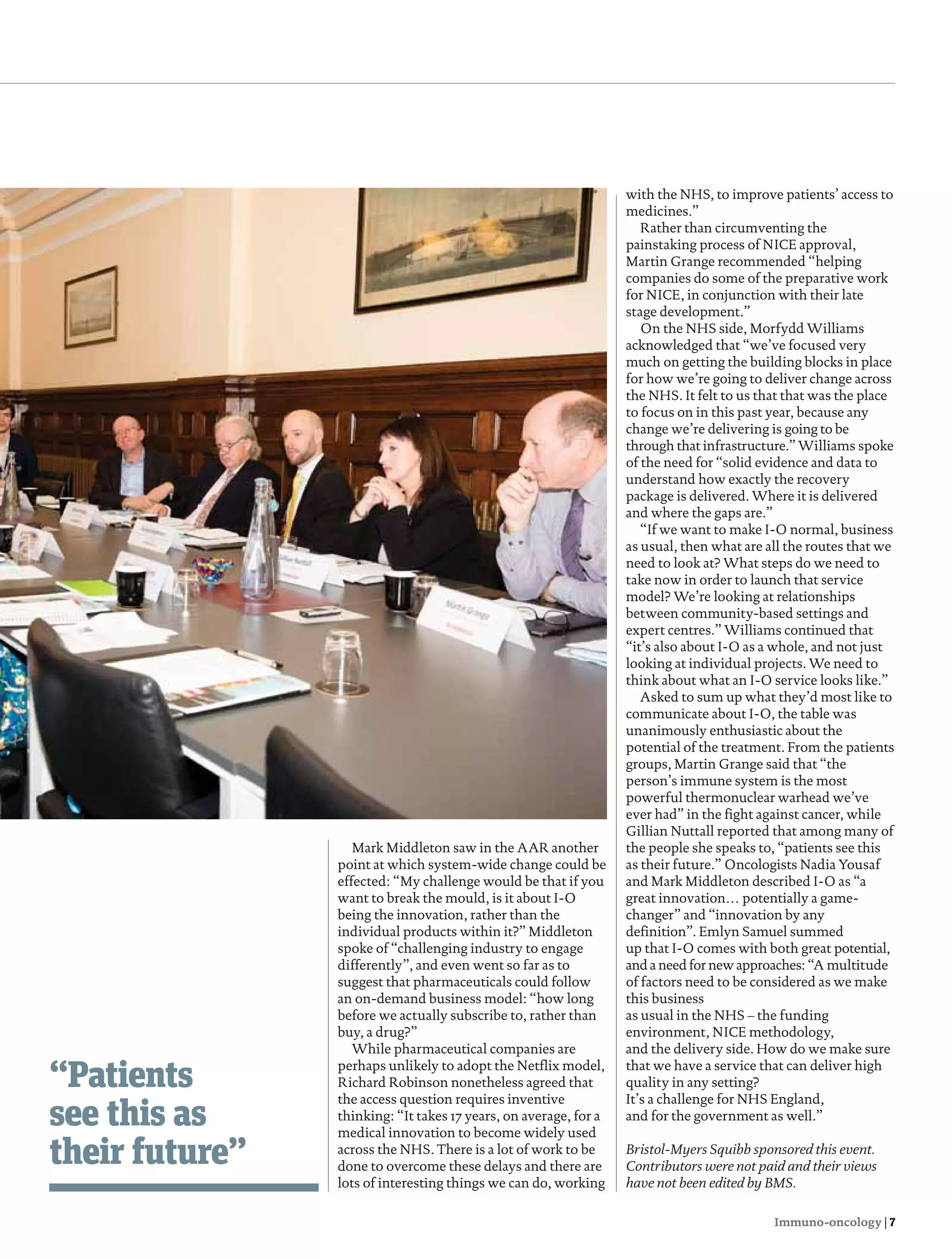
TheNewStatesman
invitedleading
oncologists,patient
groupsandexperts
inpublichealthto
Westminster todiscuss
immuno-oncology’s
potential,andhowthis
transformative
technologycanbecome
‘business
asusual’within
theNHS
“Innovation,
by any
definition”
much imagination to consider that if just
some of those come through from the
laboratory bench through clinical studies to
the patient’s bedside, although exciting, the
implications for the NHS, for patients, and
for our whole system generally, are quite
considerable.”
Gillian Nuttall remembered “a young
man with a couple of children” who had
been suffering from advanced melanoma.
“And I think he’d been told, effectively ‘this
is it’. He and his wife had decided which
songs they were going to have at the funeral.
He was on a clinical trial, a very early
one, but his wife got up one morning and
said ‘that one’s gone, and that one’s gone’,
and that was 2007. He’s still here. So for him
to be able to tell that story, and go back to
work and watch his kids continue to grow
up,
is just amazing.”
Mark Middleton agreed that “if this was
just about melanoma, it would be hugely
exciting for people like Gill and people like
me and so forth. But this about all of cancer.
This is non-small-cell lung cancer, this is
bladder cancer, this is head and neck cancer.
This has activity in certain types of breast
cancer, in colon cancer. It is even starting to
reach cancers that chemotherapy hasn’t
been able to touch.”
“It’s a long way from being a panacea. But
as a clinical director for cancer in an NHS
hospital, the excitement and the challenge
for me is that it’s not just one per cent of
incident cancer. It’s probably going to be
across the board – 20, 30 or 40 per cent of
patients.”
To get to that point will take time. While
some patients respond well to I-O, there is
no surefire system for saying which patients
will benefit from it, and which won’t. Nadia
Yousaf explained that “In lung cancer, our
adoption of immunotherapy has been a
bio-marker based adoption. We’re looking
at PDL1” – a protein found in cell
P
rofessor Mark Middleton, Professor
of Experimental Cancer Medicine at
the University of Oxford, began with
a succinct explanation of immuno-oncology
as the “fifth arm of attack”
in fighting cancer. Middleton said
what excites oncologists about
immunotherapy is “that we’re starting to
see the potential of perhaps a cure for the
metastasis side of solid tumours, solid
tumours which have spread, which we
haven’t really had
a weapon against up until now.”
Dr Nadia Yousaf, Consultant Medical
Oncologist at the Royal Marsden, agreed
that “it’s a very exciting time for us as
oncologists. This is an opportunity to give
people the sort of treatment that may result
in a cure. The frustration, however, is
picking those patients that will benefit most
from this treatment. And that represents the
biggest challenge for us on this front.”
Gillian Nuttall, CEO of Melanoma UK,
described what she’d seen from the
perspective of patients: “It’s been great news
for patients. They’re not glad that they’ve
been diagnosed, but they’re in a better
position, because they know that there’s the
potential for there to be something that’s
good for them. We’ve moved on from a
three to six-month life expectancy 10 years
ago. We’re now seeing patients that have
been on treatments for two, three, four years
plus. Obviously, not all of them benefit from
it, but patients have much more hope than
they had when I first came into this arena.”
Richard Robinson, Associate Director
of Policy, Advocacy and Government Affairs
at Bristol-Myers Squibb (BMS), pointed out
that “BMS developed and launched one of
the first of these new oncology treatments
– a checkpoint inhibitor – five years ago.
It was a very different world then.
There are now thousands of clinical trials
going on worldwide with immuno-
oncology treatments. And it doesn’t take
04-07 BMS Roundtable.indd 4 13/01/2017 15:13:45
Immuno-oncology | 5
“It reaches
cancers that
chemotherapy
can’t touch”
t
membranes that may help cancer cells evade
the patient’s immune system – “as a
bio-marker for whether immunotherapy
will work or not.”
But while this approach does offer some
insight, Yousaf said that “it’s imperfect as a
bio-marker. I’ve seen patients with 100 per
cent PDL1 staining with their tumours that
didn’t have responses; and I’ve seen patients
that have had excellent responses with very
little PDL1 staining. So I think PDL1 is only
one part of the story. I think we need to look
a bit harder to see what it is that can help us
predict response. I think we need something
more robust. I think it’s for academic
medicine to take up that challenge.”
Mark Middleton added: “There’s a
responsibility on industry, as well, to
identify those bio-markers. We just don’t
understand why it works in some patients
and not others, so going all the way back to
fundamental processes and investing in
research all the way along the line is
absolutely vital.”
Richard Henry, President of the United
Kingdom Oncology Nursing Society,
highlighted that knowing which patients
I-O can help is of paramount importance in
a society in which patients are better
informed than ever about new research.
“More and more patients are finding out
about this. Some are actually self-funding
these drugs, when there’s no guarantee that
they are going to work, and may in fact have
adverse effects. I think there’s a big
responsibility on all of us to manage
expectations.”
Henry continued that the increased
longevity I-O brings to some patients also
raises questions about “how we deliver that
drug, and how we support people thereafter,
for what could potentially be a very long
time. Many of these patients may be getting
maintenance doses for months, even years.
They may need a lot of support in terms of
symptom management. One of the big
things is early identification of side effects,
and we need an experienced and
knowledgeable workforce that is able to do
that. A lot of the current care
may be managed, ultimately, by primary
care.”
For Middleton, however, this raises a
fundamental question, and an opportunity,
for revisiting how care is structured to
accommodate a changing situation. “The
closest analogy is probably renal dialysis 40
years ago. If you go back 40 or 50 years, renal
dialysis was a little bit like oncology
treatment is today. It was a specialised
hospital activity - patients came to the big
ivory tower, received their treatment and
went away. Then it became clear that you
could apply dialysis to everybody - the
90-year-old, the 15-year-old, it didn’t have
to be the 35-year-old athlete. They
developed satellite dialysis units with one or
two ‘super nurses’ for routine treatment,
and only the patients who needed the ivory
tower, got to the ivory tower. So that’s one
of the questions - whether all of this needs
to be done by a hugely specialised
workforce. Whether actually some of it, is
routine and can be done by a semi-skilled or
less skilled workforce.”
For Richard Henry, though, “the nearest
comparison is acute oncology,” in which
“specialist oversight is essential. If I were a
patient, I would want to think that my care
was being managed by somebody who
knows what’s going on here, knows
something about the drugs I’m
Morfydd Williams,
Programme Director
of National Cancer
Services at NHS England
04-07 BMS Roundtable.indd 5 13/01/2017 15:13:52
ready to implement. And that would be a
terrible waste.” Robinson highlighted the
AAR’s “important recommendations around
reforming and modernising NICE processes,
which if done rightly, could mean that
patients in England and Wales have access to
some of these new, innovative treatments
where they may otherwise not.”
Robinson said the AAR is particularly
relevant to I-O: “the idea of choosing a
relatively small number of innovative
products and accelerating those into the
system is potentially very exciting.
Depending on the criteria you use for what
is innovative, immuno-oncology could fall
into that. It’s notable that of the 10
medicines that have been selected for the
UK’s Early Access to Medicines Scheme
since it launched, at least half a dozen have
been immuno-oncology agents for various
indications.”
getting and about the potential side
effects, and can advise.”
Middleton responded that “treatment
management is not the same as treatment
delivery. I think that’s what’s got to be
decoupled.”
“Your comments around workforce,”
observed Morfydd Williams, Programme
Director of National Cancer Services at NHS
England, “feed into a lot of discussions that
we’re having in terms of what the future
cancer workforce needs to look like. Do we
always need cancer nurse specialists, who
are quite rare? What is that support that we
need to put in place? How do we allow
patients access back into the service quickly?
There’s a real complexity in terms of making
sure that we put in structures which enable
patients to be supported and gain access into
going back into a service, but which operate
at the right level. If we look at individual GP
practises, we’re going to struggle at that
level. Primary care services should perhaps
be organised in terms of looking at a broader
population, across multiple CCGs, and we
should talk about cancer alliances. We need
to make sure that we’ve got experts who
have a sufficient population to be experts
across.”
For Mark Middleton, “adopting an
incremental approach is missing a massive
opportunity. This is hugely different from
what’s gone before, and it doesn’t
necessarily map onto existing structures.”
Emlyn Samuel, Senior Policy Manager at
Cancer Research UK, followed up by asking
“how can industry support [the NHS] in
considering those questions and delivering
those solutions? Rheumatology is a good
example of where industry has played a role
in shaping, designing and delivering
homecare solutions, which have had huge
benefits for patients and the patients’
convenience.” Samuel said this has also had
benefits for the NHS, “because the NHS
happens to get a 20 per cent VAT saving
through the delivery of homecare
medicine.”
“We’ve got to understand the pathways,”
said Martin Grange, Trustee at the Roy
Castle Lung Cancer Foundation, “not just
the patient pathways but the diagnostic
pathways. Because when we do that, we
could find huge meanders, sometimes, with
new technology. If a patient is initiated in a
major centre and goes back to be managed
more locally, they need to know that they
can go straight back to the hospital, with
someone who knows how to manage their
situation. One of the issues with a top-
down approach is that it doesn’t gather all
that information and all that learning,
because this is something we’ve never been
able to do before. It’s going to take us a
while. We’ve got to actively organise the
structure, gather data and inform and close
the loop, so got a spiral of improving
expertise.”
Samuel noted that “there’s lots of work
going on locally that we can learn from.
We’re doing some work with some
vanguard sites in the north-east, designing
pathways with new oncology patients,
regardless of the type of cancer they have, to
try and identify ways to improve delivery
and outcomes.”
At this stage, many patients simply – and
understandably - want to be treated at what
they perceive as the highest centre of
excellence. “That’s only natural,” said
Gillian Nuttall. “Because of social media,
you will have a group of patients who are
very vocal and they will talk about the ivory
towers, as we’ve described them, and that’s
where they want to be.”
“The challenge,” agreed Mark Middleton,
“has to be to explain to people where
particular expertise is necessary and will
make a difference, and where actually it’s
not appropriate, and they will get excellent
care, with the same outcomes, locally.”
But the attraction of certain hospitals
remains, Nadia Yousaf explained, because
“In my experience, the reason that people
want to be treated at places like the Marsden
is because of access to clinical trials. The key
there is to make information more readily
available as to what trials are going on
where, so that patients can easily move to
the centre if there’s an appropriate trial and
easily move back to their local hospitals
when the same standard of care can be
delivered there just as easily.”
For patients to get immunotherapy
outside of a clinical trial – in any setting – the
NHS will need to ensure they have
widespread access to these new treatments.
The Accelerated Access Review, published
in October 2016, aimed to streamline the
process of bringing new technologies such
as immunotherapy to patients, and to bring
forward patient access by as much a four
years in some cases.
Richard Robinson said that the next step
for the AAR is “an implementation plan.
And really critical to that is NHS
involvement in the plan and the delivery.
There is a risk that the AAR is seen as a
government-created review that’s dropped
from on high, something the NHS isn’t
t
ROUND TABLE DISCUSSION
THE CHALLENGES AND POTENTIAL OF I-O
6 | Immuno-oncology
04-07 BMS Roundtable.indd 6 13/01/2017 15:13:59
Mark Middleton saw in the AAR another
point at which system-wide change could be
effected: “My challenge would be that if you
want to break the mould, is it about I-O
being the innovation, rather than the
individual products within it?” Middleton
spoke of “challenging industry to engage
differently”, and even went so far as to
suggest that pharmaceuticals could follow
an on-demand business model: “how long
before we actually subscribe to, rather than
buy, a drug?”
While pharmaceutical companies are
perhaps unlikely to adopt the Netflix model,
Richard Robinson nonetheless agreed that
the access question requires inventive
thinking: “It takes 17 years, on average, for a
medical innovation to become widely used
across the NHS. There is a lot of work to be
done to overcome these delays and there are
lots of interesting things we can do, working
with the NHS, to improve patients’ access to
medicines.”
Rather than circumventing the
painstaking process of NICE approval,
Martin Grange recommended “helping
companies do some of the preparative work
for NICE, in conjunction with their late
stage development.”
On the NHS side, Morfydd Williams
acknowledged that “we’ve focused very
much on getting the building blocks in place
for how we’re going to deliver change across
the NHS. It felt to us that that was the place
to focus on in this past year, because any
change we’re delivering is going to be
through that infrastructure.” Williams spoke
of the need for “solid evidence and data to
understand how exactly the recovery
package is delivered. Where it is delivered
and where the gaps are.”
“If we want to make I-O normal, business
as usual, then what are all the routes that we
need to look at? What steps do we need to
take now in order to launch that service
model? We’re looking at relationships
between community-based settings and
expert centres.” Williams continued that
“it’s also about I-O as a whole, and not just
looking at individual projects. We need to
think about what an I-O service looks like.”
Asked to sum up what they’d most like to
communicate about I-O, the table was
unanimously enthusiastic about the
potential of the treatment. From the patients
groups, Martin Grange said that “the
person’s immune system is the most
powerful thermonuclear warhead we’ve
ever had” in the fight against cancer, while
Gillian Nuttall reported that among many of
the people she speaks to, “patients see this
as their future.” Oncologists Nadia Yousaf
and Mark Middleton described I-O as “a
great innovation… potentially a game-
changer” and “innovation by any
definition”. Emlyn Samuel summed
up that I-O comes with both great potential,
and a need for new approaches: “A multitude
of factors need to be considered as we make
this business
as usual in the NHS – the funding
environment, NICE methodology,
and the delivery side. How do we make sure
that we have a service that can deliver high
quality in any setting?
It’s a challenge for NHS England,
and for the government as well.”
Bristol-Myers Squibb sponsored this event.
Contributors were not paid and their views
have not been edited by BMS.
“Patients
see this as
their future”
Immuno-oncology | 7
04-07 BMS Roundtable.indd 7 13/01/2017 15:14:02
8 | Immuno-oncology
INFOGRAPHIC
HOW UK CANCER TREATMENT MEASURES UP
Cancer treatment in Britain,
Europe and the wider world
50.1%Survival rate of patients
diagnosed with cancer
in the United Kingdom
and Ireland, the lowest in
Western Europe
£76Cancer expenditure per
person in the UK compared
to £170 in Germany, where
survival rate after five years
is 9% higher
3.8%UK spending on cancer
as a percentage of health
spend is lower than the
EU average (5%)
29.7%Average rate for survival
after one year with lung
cancer, compared to 43.6%
in Sweden
23,625Estimated lives saved per year
if UK matched the best EU
standards for cancer care1
35%Percentage of people in UK
who would forego visiting
a doctor for fear of ‘wasting
their time’ compared to less
than 15% in Scandinavia
169mYears of healthy life that
were lost globally to
cancer in 2008
BY THE NUMBERS
08 UK-EU infographic.indd 8 13/01/2017 13:08:20
Immuno-oncology | 9
JOHN BARON MP
THE FIGHT AGAINST CANCER
What are the main changes you have
seen during your time as Chair of the
All-Party Parliamentary Group on
Cancer (APPGC)?
The last parliament saw a shake-up of the
NHS through the Health and Social Care
Act. There were two overarching themes
– reorganisation and a focus on
outcomes. The APPGC were never in
favour of the former, and made this clear
to Andrew Lansley at the time, but we
remain very supportive of the latter.
As a result, and for almost the first
time in its history, the NHS is now
moving towards assessing the success of
its treatments, rather than the volume.
This is excellent news for patients and
their families, as emphasis is placed on
the quality of healthcare, rather than
merely meeting targets for the number
of procedures.
NHS England published its latest Cancer
Strategy in July 2015. What progress has
been made towards delivering its aims? 
The APPGC’s most recent report looked
at progress one year on from the
publication of the England Cancer
Strategy, and considered three main
areas: funding, transparency and
accountability, and involvement.
The APPGC believes it is imperative
that the government continues to show
its commitment to cancer by setting out
funding pledges for the England Cancer
Strategy per year, for each of the next four
years, in every area of the cancer pathway.
On transparency and accountability,
although progress is being made in key
areas, the APPGC believes there needs to
be further clarity on how the England
JohnBaron,MP
forBasildonand
Billericayand Chair
of the All-Party
ParliamentaryGroup
onCancer discusses
the evolution of
cancertreatment
so far and the
strategies the NHS
mustadoptto
continueits progress
Is Britain
delivering on
cancer treatment?
Cancer Strategy is being delivered, how
recommendations are being rolled out
(particularly at a local level) and how this
will be monitored.
Moreover, the importance of
transparency was emphasised throughout
the inquiry, with the Cancer Dashboard
and Clinical Commissioning Group
Improvement and Assessment
Framework being highlighted as two
ways to improve cancer outcomes.
Finally, there needs to be a greater
effort to involve organisations with
expertise and interest in cancer, along
with their networks of patients and
clinicians, to help shape the roll out and
implementation of the Cancer Strategy.
The UK spent 5 per cent of total health
care expenditure on cancer in 2014;
this is lower than the EU average. Is
the government prioritising cancer
care appropriately?
Whilst investment is important (the
APPGC welcomed the extra funding for
cancer services in the Cancer Strategy),
structures and prioritisation also have a
large role to play. A good example are the
cancer networks, which provided
valuable support and expertise,
particularly to the local NHS. Caught in
the gulf between commissioners and
providers in the post-Lansley NHS,
cancer networks were either disbanded
or withered on the vine, allowing a
significant pool of knowledge and
expertise to ebb away.
Some CCGs, however, have begun
to club together to share information
and expertise, so in a sense the networks
are re-emerging. It will be interesting to
see what role Cancer Alliances, the
creation of which was one of the
Strategy’s 96 recommendations, will
play in this regard.
One area of spending I have tried to
delve into is how our spending on cancer
drugs compares with other countries, as I
suspect the NHS is not as far ahead in
this as we would like to think.
Bristol-Myers Squibb developed the
questions for this interview, but had no
input into the responses.
ONCUK1601517-01SEPTEMBER2016
09 John Baron Q&A.indd 9 13/01/2017 13:09:26
EMERGING TREATMENTS
SAVING LIVES SOONER
10 | Immuno-oncology
treatments. There has never been a better
time to fix the system; these are incredibly
exciting times in cancer research. New
immuno-oncology treatments – which
work by harnessing the power of the
patient’s immune system to fight the
cancer5
– are demonstrating the potential
to improve patient survival across a wide
range of cancers6
. Such advances are
arguably the most transformative in
decades, leading the American Society
of Clinical Oncology to name immuno-
oncology (ASCO’s) Advance of the Year7
.
The scale of research in this field of
science is staggering; there are now more
than 2500 immuno-oncology clinical trials
underway around the world, representing
about a third of all clinical oncology
research8
. With this level of investment
from across the pharmaceutical industry,
it is estimated that immunotherapies will
be used in as many as 60 per cent of cases
of advanced cancer within the next ten
years9
. We have an opportunity now to
ensure that the NHS is prepared for this
wave of medical innovation. If we get it
right, the impact for patients could be
significant. In his speech at the 2016
Conservative Party Conference, the
Secretary of State for Health, Jeremy
Hunt, alongside other aspects of the
Cancer Strategy, explained how access to
new immuno-therapy treatments could
help save an estimated 30,000 lives in the
UK each year10
.
Access to cancer treatments in the UK
Over the past decade the National
Institute for Health and Care Excellence
(NICE) has been more likely to reject new
treatments for cancer than those for other
conditions, with just 58 per cent of cancer
medicines recommended for NHS use
between 2006 and 2014, compared with
85 per cent for non-cancer treatments in
the same period11
. Some progress has been
made in recent years and the introduction
of the Cancer Drugs Fund (CDF), which
was established in recognition of the
limitations of the NICE assessment model
when appraising cancer medicines12
,
led to tens of thousands of patients
accessing treatments not routinely
available on the NHS13
. However, the
CDF has now been overhauled and no
longer provides the same function13,14
,
leaving a missing piece in the jigsaw of
access to cancer medicines. Meanwhile,
the limitations of the NICE assessment
model remains a problem which still
needs urgent attention.
With the introduction of increasingly
innovative treatments which offer
significant potential improvements for
smaller patient populations, there is a
danger that it will be increasingly difficult
to get new cancer treatments through
the NICE appraisal system. This is
a view shared by cancer charities
including Breast Cancer Now, Leukaemia
Care and Bowel Cancer UK who have
expressed their “deep concern” about
the “lack of reform proposed to the wider
NICE processes of appraising
cancer medicines”15
.
New treatment approaches such as
immuno-oncologyhavethepotentialto
transformcancer survival outcomes, but
changeis needed ifNHS patients are to
benefit fully,writesBenHickey
Closing the Cancer
Survival Gap
B
eing told that you have cancer is a
life-changing moment and it is
now estimated that half of all
British people born after 1960 will receive
such a diagnosis during their lifetime1
.
These patients will face their disease with
the support of their families and the care
of dedicated healthcare professionals
working across the NHS. But while much
has been done to improve outcomes, it is
an uncomfortable truth that cancer
survival rates are lagging behind the rest
of Western Europe and, in England,
five-year survival remains 10 per cent
lower than the European average2
.
The causes of this gap are the subject of
ongoing debate but both NHS England
and the National Audit Office identify
that comparatively poor access to
oncology treatment may be one of the
main reasons for the disparity2
. Previous
research has shown that the use of cancer
medicines in the UK is 33 per cent lower
than the European average3
.
If the NHS Cancer Strategy is to be
successful in its aim to “improve radically
the outcomes the NHS delivers for people
affected by cancer”4
, healthcare
professionals, the pharmaceutical
industry, government and patient
organisations will need to work together
to improve patients’ access to cancer
10-11 Ben Hickey.indd 10 13/01/2017 13:10:26
Immuno-oncology | 11
What needs to happen?
As the recently published Accelerated
Access Review (AAR) recognises in its
recommendations to Ministers , we now
need to evolve the process for assessing
emerging treatments16
. This could
particularly benefit a number of new and
emerging treatments like immuno -
oncology therapies, to enable faster access
and unlock their true potential. There are
a number of changes that could help
deliver this goal and help improve cancer
survival rates . Firstly, NICE technology
appraisals should evolve to incorporate a
broader system of value assessment that is
explicitly pro-innovation and sufficiently
flexible to appraise treatments in all
therapy areas, including cancer. Bristol-
Myers Squibb firmly believes that changes
are required to the appraisal process to
distinguish between the effects of standard
chemotherapy and innovative cancer
therapies. The voice of the clinician and
patientshouldremaincentraltotheprocess.
Secondly, we need greater flexibility in
the pricing system so the NHS can tailor
payment to a drug’s use for a particular
disease, and even the outcomes it
provides, rather than the current
one-size-fits-all approach. Finally, it will
be important for regulators, the NHS and
pharmaceutical industry to work together
on improving the collection of so-called
“real world data” to demonstrate the
outcome of new treatments in NHS use.
NHS England restrictions
The AAR is a welcome first step in the
right direction and Bristol-Myers Squibb
looks forward to working with the
Government and NHS to accelerate the
uptake of new treatments. However,
there is a risk that any progress will be
undermined by new restrictive
approaches proposed by NICE and NHS
England. A consultation document
published in October 2016 included
proposals that could limit or delay
patients’ access to some NICE - approved
treatments17
. Restrictions would be
triggered where treating patients in line
with a NICE recommendation would
have an impact on the NHS budget above
a certain threshold17
. When combined
with some of the laudable aims of the
AAR, the approach would be like
stepping on the accelerator and the brake
at the same time. It would also run
counter to a patient’s legal right – described
in the NHS Constitution – to treatments
that have been recommended by NICE for
use in the NHS, if their doctor says they
are clinically appropriate18
. Worryingly,
even before the conclusion of the
consultation, there is evidence that NHS
England is placing restrictions on access
to new cancer treatments which have
been considered cost-effective by NICE19
.
The NHS faces a challenging financial
settlement, but this approach is misguided.
The government has agreed a five-year
voluntary arrangement with the
pharmaceutical industry to protect the
NHS from increases in spending on
medicines. Through the Pharmaceutical
Price Regulation Scheme (PPRS) the
industry has made a commitment to
underwrite growth in the cost of the
branded medicines bill, providing a rebate
to cover NHS spending above the agreed
threshold20
. Since the start of the scheme
in 2014, the industry haspaidalmost
£1.5bntothegovernment21
.
A vision for the future
Achieving the goals of the NHS Cancer
Strategy will also require cooperation and
commitment, leveraging the unique
qualities of the NHS and the world-leading
strengths of the UK life sciences industry.
Scientific advances like immuno-oncology
provide great promise; the medicines
available today are just the start of a
continuing revolution in cancer treatment.
To harness its impact, the arrangements
for appraising medicines will need to
change to reflect their true value, making
it easier for patients to access new and
innovative treatments. Patients deserve a
system which is explicitly pro-innovation
and sufficiently flexible to deal with these
rapid advances in cancer research. If
successful, we can close the cancer survival
gap and help reach the Cancer Strategy’s
goal of radically improving cancer
outcomes for everyone.
Ben Hickey is the General Manager of
Bristol-Myers Squibb UK and Ireland.
Bristol-Myers Squibb (BMS) funded this
supplement and provided this feature, but
the New Statesman was not contractually
obliged to include a piece from BMS.
1 Cancer Research UK (2016): Lifetime risk of cancer, http://bit.
ly/1SuV2st (accessed Dec 2016).
2 National Audit Office (2015): Progress in improving cancer
services and outcomes in England, http://bit.ly/2i9dfjL (accessed
Dec 2016).
3 Association of the British Pharmaceutical Industry (2013): trends
in access to medicines, http://bit.ly/2j3vZRj (accessed Jan 2017).
4 Independent Cancer Taskforce: Achieving World - Class
Cancer Outcomes, a Strategy for England, http://bit.
ly/1Idwf5W (accessed Jan 2017).
5Murphy,JF,ClinicalMedicineInsights:Oncology2010;4:67–80.
6 Luke, JJ; Ott, PA: Oncotarget 2015; 6 (6) 3479 - 92 , http: //bit.
ly/2jyOFJx (accessed Jan 2017).
7 American Society of Clinical Oncology (2016): ASCO Names
Advance of the Year: Cancer Immunotherapy, http://bit.
ly/2cSgk5W (accessed Jan 2017).
8 Kiernan, B. ( 2016): Trends And Challenges In Immuno-
oncology Trials, http://bit.ly/2iXX3zb (accessed Jan 2017).
9 Ledford, H (2014). Cancer treatment: The killer within, http://
go.nature.com/1qcBFmQ (accessed Jan 2017 )
10 Jeremy Hunt, speech to Conservative Conference 2016
(2016), http://bit.ly/2j0tvmj (accessed Jan 2017 )
11AbacusInternational(2015):AnAnalysisofNICESTADecision
Trends over time, http://bit.ly/2j0qkLD (accessed Dec 2016).
12 National Audit Office (2015): Investigation into the Cancer
Drugs Fund, http://bit.ly/2jdLcg5 (accessed Jan 2017).
13 NHS England: Cancer Drugs Fund, http://bit.ly/2ibMhDs
(accessed Jan 2017 ).
14 NICE (2016): Faster access to effective cancer treatments
through new Cancer Drugs Fund, http://bit.ly/2iApW3j
(accessed Jan 2017 )
15 Donnelly, L (2016): Cancer charities in desperate plea to
Cameron over drugs rationing plan, The Telegraph 15/05/2016,
http://bit.ly/1TfAKin (accessed Jan 2017 )
16 Accelerated Access Review: Final Report (2016). Review of
innovative medicines and medical technologies, http://bit.
ly/2eksP5n (accessed Dec 2016)
17 NICE (2016): Consultation on changes to technology
appraisals and highly specialised technologies, http://bit.
ly/2dOGzZt (accessed Jan 2017 )
18 Department of Health (2015): The NHS Constitution for
England, http://bit.ly/2jq9T8c (accessed Jan 2017 )
19 Melanoma UK News (2016): NHS England Restricts Access
To Melanoma Treatment, http://bit.ly/2iAqJkY (accessed Jan 2017).
20 Department of Health (2013): Pharmaceutical price
regulation scheme 2014, http://bit.ly/1eMnSwz (accessed Jan 2017).
21 Blackwood, N: Department of Health written question on
Pharmaceutical Price Regulation Scheme, 31st October 2016,
http://bit.ly/2i995s6 (accessed Jan 2017).
ONCUK1700018-01 ¦ JANUARY 2017
10-11 Ben Hickey.indd 11 13/01/2017 13:10:26
GILL NUTTALL
HOW PATIENTS SEE I-O
12 | Immuno-oncology
Jon Herron spent part of his
29th birthday laid on a surgery
bed, having several lumps
removed from his neck and head.
Diagnosed with melanoma in
2002 and again in 2006, it was only
a matter of time before the disease
would take hold.
By 2007, clinical trials remained
a last option for Jon and he received
tests to see if he would be eligible.
However by this point his condition
had spread to his brain and he
was deemed too unwell to take
part in the trial. Sadly Jon passed
away in May 2008, just a month
after his 30th birthday.
Jon’s story is a reminder that
the treatments now available on
the NHS were once a distant dream.
Historically, advanced melanoma has
been associated with a very poor
prognosis and clinicians faced an
extremely difficult task with limited
treatment options.
Indeed, chemotherapy was the
only available treatment option and
this approach produced neither
significant survival benefits nor was
it easy to tolerate. On average,
patients lived for an average of 8-10
months, with only about 10per cent or
fewer surviving longer than 5 years.
Despite this outlook, there was
considerable excitement about the
emergence of immunotherapy
treatments. These drugs worked
by supercharging the immune system
to fight back against the melanoma
and it was generally felt that this
approach had the potential to be the
GillNuttall
foundedthepatient
groupMelanoma
UK after a close
familyfrienddied
fromthe disease.
Here, she outlines
how pioneering
treatments such as
I-O could change
such outcomes
Immuno-oncology:
the patient
perspective
most exciting development in
cancer for many years.
Eight years on from Jon’s death,
a number of these treatments are
available on the NHS for melanoma
patients, and we now have real
evidence of their ability to halt
certain cancers. Indeed, a diagnosis
which was previously seen as a
death sentence now has the potential
to be viewed as a manageable disease.
This is, understandably, a cause of
considerable excitement.
Of course, these treatments are
not without side-effects and the NHS
needs to work with patients to support
them throughout this process.
However, one of the big questions
currently surrounding
immunotherapy is how long it can
extend survival. These treatments
have not yet been around for long
enough for us to know the full extent
of the benefits they can provide. The
big hope amongst the melanoma
community is that immunotherapy
might be able to teach the body to
recognise or eliminate cancer cells
before they form a tumour.
This is something that every
melanoma patient and family member
sees as a truly remarkable concept.
Melanoma UK gives patients
and their families support during
the very difficult times faced
upon diagnosis. The charity works
with patients, clinicians, with NICE
and as part of the parliamentary
melanoma task force to help develop
cancer policy.
12 Gill Nuttall.indd 12 13/01/2017 13:11:18
Immuno-oncology | 13
CALLY PALMER
NHS CANCER STRATEGY
I
n early 2015, the independent Cancer
Taskforce set an ambitious task for
the NHS – this included making
significant progress in reducing
preventable cancers, increasing cancer
survival, improving patient experience
and quality of life by 2020.
More people than ever are now
surviving cancer – with 2,400 more
cancer survivors over the past year
thanks to improved NHS cancer care.
However, we know we have more to do.
We have access to some of the
greatest research and best technology
in the world and we need to use this
expertise to ensure that all patients, no
matter where they live, receive the best
possible cancer care.
Rapid progress is being made
on putting the infrastructure in place
that will help improve survival and
patient experience.
We have established sixteen Cancer
Alliances bringing together GPs, hospital
clinicians and other local leaders to lead
implementation of the strategy locally
and test more effective and efficient ways
to plan, pay for, direct and deliver
services for patients.
We know early diagnosis is crucial
to improving survival and for most
cancers the earlier a cancer is caught
the more likely treatment is to be
successful. With this in mind, we
have put significant focus on early
diagnosis from getting people into the
system as soon as possible, through
screening and symptom awareness
programmes, to ensuring a quick
response to make a diagnosis. This
includes a National Diagnostics
NHS England’s
National Cancer
Director,
Cally Palmer,
outlines how
the NHS plans to
reduce preventable
disease and improve
outcomes over the
next three years
Achieving world-
class cancer
outcomes
Capacity Fund to support new ways
to increase capacity and productivity
of diagnostic services and testing the
new Faster Diagnosis Standard. The
ambition is for patients referred for
testing by a GP to be definitively
diagnosed with cancer, or have cancer
ruled out, within four weeks.
In October, NHS England launched
its biggest upgrade to NHS cancer
treatment in 15 years, announcing a
£130 million fund to modernise
radiotherapy care.
Around four in 10 of all NHS cancer
patients are treated with radiotherapy.
Radiotherapy is one of the three main
cancer treatments, alongside cancer
surgery and chemotherapy. This
investment will enable better
outcomes, with improved quality of
life for patients and reduced NHS costs
in the long term, through patients
experiencing fewer side effects.
Finally, our workforce is key in
helping ensure the best treatment and
care is provided. It is therefore crucial
that we invest and support them in
delivering the highest quality treatment.
The taskforce recommended the need
to address shortages across the workforce
and progress is being made in this area.
This year, 40 nurse endoscopists
will begin training, in line with the
target to train 180 more nurse
endoscopists by 2018.
The Taskforce set an ambitious
and challenging programme of
improvements for the health system,
including 96 recommendations.
Alongside some of the key early
priority areas mentioned above we
have taken forward, we remain
determined to implement the full
vision of the Taskforce and our
progress is set out in our Annual
Report “One Year On”, published in
October 2016.
The NHS is in a good position
to achieve the Taskforce
recommendations by 2020 and
to ensure that we can improve
prevention, survival and quality of
life, and provide the best cancer services
to patients everywhere.
13 Cally Palmer.indd 13 13/01/2017 13:12:01
14 | Immuno-oncology
NICOLA BLACKWOOD MP
STREAMLINING THE FIGHT AGAINST CANCER
What can be done to get medical
advances to patients more quickly?
We want to be at the cutting edge so that
patients get the best, targeted care as
soon as possible. That’s why the
Department commissioned the
Accelerated Access Review (AAR),
which looked at gaining quicker access to
innovative new diagnostic tools, drugs,
digital healthcare and medical
technologies. We know that the current
process for getting a new product onto
the NHS market can be lengthy and
complex – so I’m really pleased that the
AAR has suggested streamlined processes
that could bring forward access to drugs
by up to four years.
We are also seeing some really exciting
work coming out of the NHS Testbeds.
Each of these is tackling a major health
challenge – diabetes, heart conditions,
asthma and more – in a new way. For
example, the Surrey and north east
Hampshire dementia testbed is providing
individuals and their carers with sensors,
wearables, monitors and other devices,
which will combine into an ‘Internet of
Things’ to monitor their health at home.
Nicola Blackwood
MP explainshow
theAccelerated
Access Review has
helped to speed
upthe process
of deliveringdrugs
tothemarket
andhowthiswill
revolutionise the
UK’s cancer care
Accelerating
access to
innovation
The information from these devices
will help people take more control over
their own health and wellbeing, and
the insights and alerts will enable health
and social care staff to deliver more
responsive, joined up and effective
services. This hopefully should translate
to more personalised care, helping people
maintain their independence and quality
of life.
Testbed projects like this, coupled
with the fast-tracked funding announced
by NHS England in the summer which
will reduce the hassle experienced
by clinicians and innovators in getting
innovation to the frontline, and
programmes like the NHS Innovation
Accelerator (NIA) and the work of
Academic Health Science Networks
across the country, shows how seriously
we take this agenda.
Of course, we can – and must – go
further. We still need to work hard to
support the NHS to embrace new ways
of working, and the new technology that
goes with it. Without streamlining the
process for innovation our patients will
be at a disadvantage. I want everyone to
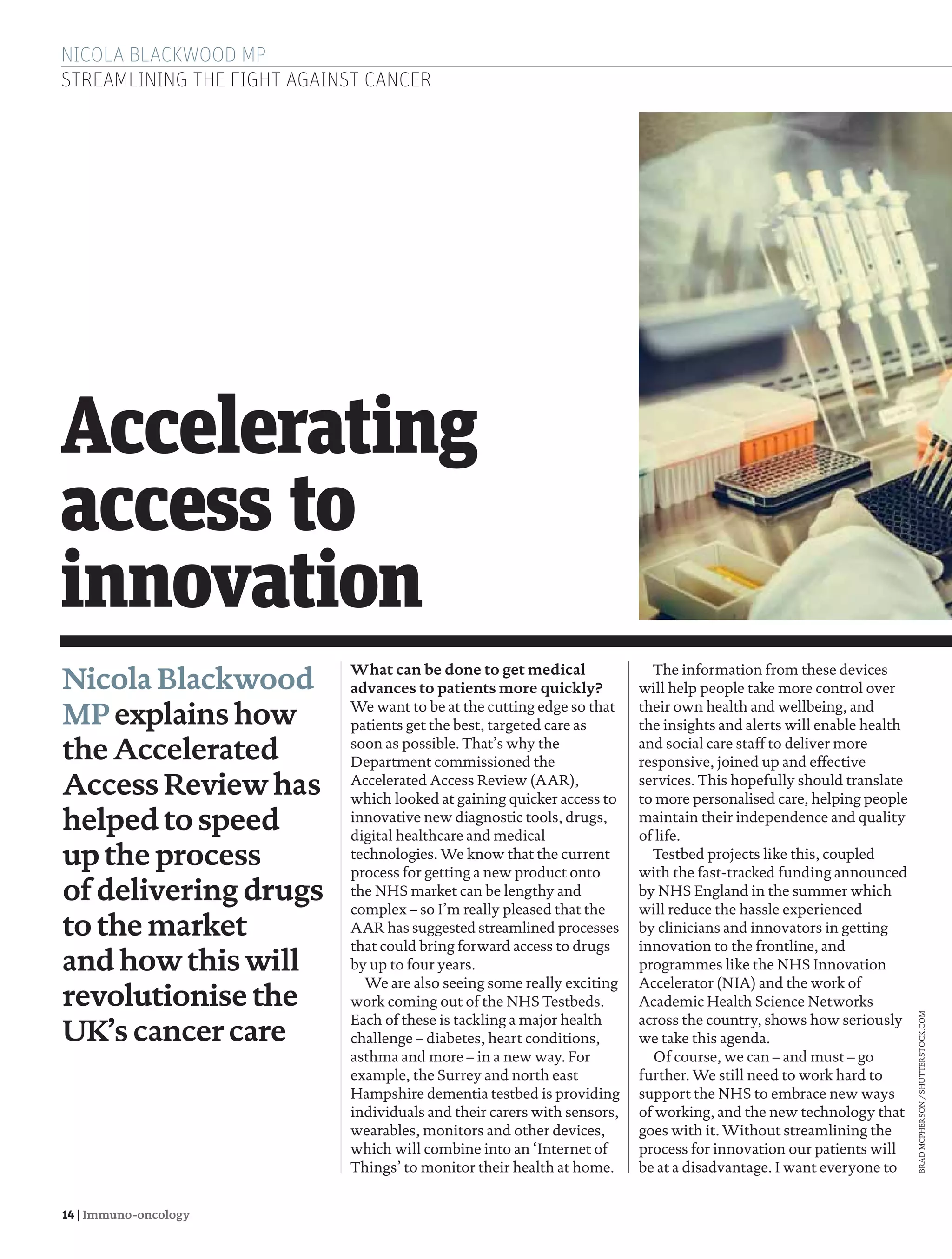
BRADMCPHERSON/SHUTTERSTOCK.COM
14-15 Nicola Blackwood.indd 14 13/01/2017 13:14:36
Immuno-oncology | 15
Help people
take more
control over
their health
get the best care possible. These projects
are a key step towards getting great new
breakthrough treatments and supporting
the NHS of the future.
How will the AAR help prioritise the
use of innovative new treatments?
A key recommendation in the
Accelerated Access Review report
is the creation of the Accelerated Access
Partnership. This will see NHS England,
NHS Improvement, NICE AND MHRA
coming together to prioritise
innovations, based on patient need
and accelerating patient access to key
products. Through the new Partnership,
innovators would be able to access
joined-up help with clinical development,
regulation, and assessment of cost
effectiveness. This will help patients in
the UK to benefit from the revolution in
health technology as quickly as possible.
People are now living longer with
cancer. How do cancer services need
to adapt to reflect this?
We want to be a world-leader for cancer
care, and this is something
Jeremy Hunt has spoken about
passionately and also personally, having
lost a loved one to cancer himself.
We are transforming our approach
to supporting people living with - and
beyond - cancer. As part of this we
announced in September 2015 that by
2020, the 280,000 people diagnosed
with cancer every year will benefit from
a tailored recovery package. These
packages, developed in partnership with
Macmillan Cancer Support, will be
individually designed to help each
person live well beyond cancer,
including elements such as physical
activity programmes, psychological
support and practical advice about
returning to work.
Thanks to improvements in survival
and detection, and our growing older
population, an estimated 2 million
people in England have had a cancer
diagnosis - and that number is projected
to rise to 3.4 million people in 2030.
We are determined that people should
have personalised care that helps prepare
them for the consequences of their
cancer and its treatment.
What are the aims of the NHS
England Cancer Strategy, and what
progress has been made to
implement it so far?
The Cancer Strategy was a fantastic piece
of work that has the potential
to help us make huge strides in
improving our response to the disease.
The government accepted all 96
recommendations in the Strategy
and work is underway to deliver them.
The priorities in the strategy cover
everything from prevention and early
diagnosis to overhauling
commissioning, accountability and
provision. It looks at early diagnosis,
patient experience, investment and
living well beyond cancer – so it’s
really comprehensive and NHS National
Cancer Director Cally Palmer and her
Transformation Board are making good
progress in implementing it already.
Immuno-oncology has been
described as ‘transformative’ – what
does this mean for patients?
The new class of immuno-oncology
drugs coming onto the market certainly
have the potential to make a real
difference to patients in terms of
better survival rates and improved patient
outcomes. This is a fascinating field and
we are keen to harness the power of these
new drugs while delivering excellent
value for money for the taxpayer.
The National Institute for Health and
Care Excellence has already
recommended immuno-oncology drugs
such as ipilimumab (Yervoy®),
pembrolizumab (Keytruda®) and
nivolumab (Opdivo®) for use in the
treatment of skin cancer, which means
that they are now routinely
commissioned by the NHS.
NICE recently recommended
nivolumab for use in kidney cancer (renal
cell carcinoma) and it is currently
developing guidance on immuno-
oncology drugs for other types of cancers
as well, including head and neck and lung
cancers.
14-15 Nicola Blackwood.indd 15 13/01/2017 13:14:38
Untitled-1 1 13/01/2017 13:25:41

NS BMS Supplement Jan 2017

  • 1.
    Immuno-oncology Sponsored by A game-changerfor cancer treatment? Cally Palmer / Nicola Blackwood MP / Gill Nuttall / John Baron MP 01 BMS cover.indd 1 13/01/2017 15:31:08
  • 2.
    INFOGRAPHIC I-O: A QUICKGUIDE A new kind of treatment Surgery Surgery can offer good results, especially when deployed early, but it can leave cancer cells behind. Radiotherapy Radiation can be locally targeted in a similar way to surgery, but it can also damage healthy tissues and have other side-effects. Chemotherapy Chemotherapy offers a more widespread attack on cancer cells, but may also cause systemic and debilitating side-effects. Immuno-oncology (I-O) Rather than trying to directly destroy cancer cells, I-O removes the ability of cancer cells to defend themselves against the body’s immune system. The body itself is then able to destroy the cancer as it would an infection, such as a cold. Immuno-oncology (I-O) is a new arm of attack against cancer. It helps the body’s own immune system fight the disease, and for some patients, the results are revolutionary. 02 infographic.indd 2 13/01/2017 13:02:32
  • 3.
    CONTENTS 2nd Floor 71-73 CarterLane London EC4V 5EQ Tel 020 7936 6400 Subscription inquiries: Stephen Brasher sbrasher@ newstatesman.co.uk 0800 731 8496 The paper in this magazine originates from timber that is sourced from sustainable forests, responsibly managed to strict environmental, social and economic standards. The manufacturing mills have both FSC and PEFC certification and also ISO9001 and ISO14001 accreditation. First published as a supplement to the New Statesman of 20 January 2017. © New Statesman Ltd. All rights reserved. Registered as a newspaper in the UK and US. This supplement and other policy reports can be downloaded from the NS website at: newstatesman.com/page/supplements Special Projects Editor Will Dunn Special Projects Writer Rohan Banerjee Design and Production Leon Parks Contents & contributors Commercial Director Peter Coombs +44 (0)20 3096 2268 Account Director Dominic Rae +44 (0)20 3096 2273 Nicola Blackwood MP Public Health Minister MarkMiddleton ProfessorofExperimental Cancer Medicine, Oxford University Martin Grange Trustee, Roy Castle Lung Cancer Foundation Richard Henry President,UKOncology NursingSociety Dr Nadia Yousaf Consultant Oncologist, Royal Marsden Emlyn Samuel Senior Policy Manager at Cancer Research UK Morfydd Williams Programme Director, NationalCancerServices NHS England Gillian Nuttall Founder, Melanoma UK Richard Robinson Associate Director of Government Affairs, Bristol-Myers Squibb 4 / Round table discussion The New Statesman invited the country’s top policymakers, patient groups and research specialists to discuss immunotherapy 9 / John Baron MP The evolution of cancer treatment, and the strategies the NHS should adopt 10 / Ben Hickey Medical breakthroughs only help patients if the NHS can provide the drugs they develop 12 / The patient perspective Gillian Nuttall looks at what immunotherapy means to patients, and how they view it 13 / Cally Palmer NHS England’s National Cancer Director discusses implementing the Cancer Strategy 14 / Nicola Blackwood MP The Public Health Minister discusses adapting to change in cancer treatment 3 | Immuno-oncology Bristol-Myers Squibb funded this supplement and all articles have been independently authored, with the exception of the article by Ben Hickey (p10). Participants were not paid for their involvement and their views have not been altered by Bristol-Myers Squibb. 03 contents.indd 3 13/01/2017 15:05:10
  • 4.
    ROUND TABLE DISCUSSION THECHALLENGES AND POTENTIAL OF I-O 4 | Immuno-oncology TheNewStatesman invitedleading oncologists,patient groupsandexperts inpublichealthto Westminster todiscuss immuno-oncology’s potential,andhowthis transformative technologycanbecome ‘business asusual’within theNHS “Innovation, by any definition” much imagination to consider that if just some of those come through from the laboratory bench through clinical studies to the patient’s bedside, although exciting, the implications for the NHS, for patients, and for our whole system generally, are quite considerable.” Gillian Nuttall remembered “a young man with a couple of children” who had been suffering from advanced melanoma. “And I think he’d been told, effectively ‘this is it’. He and his wife had decided which songs they were going to have at the funeral. He was on a clinical trial, a very early one, but his wife got up one morning and said ‘that one’s gone, and that one’s gone’, and that was 2007. He’s still here. So for him to be able to tell that story, and go back to work and watch his kids continue to grow up, is just amazing.” Mark Middleton agreed that “if this was just about melanoma, it would be hugely exciting for people like Gill and people like me and so forth. But this about all of cancer. This is non-small-cell lung cancer, this is bladder cancer, this is head and neck cancer. This has activity in certain types of breast cancer, in colon cancer. It is even starting to reach cancers that chemotherapy hasn’t been able to touch.” “It’s a long way from being a panacea. But as a clinical director for cancer in an NHS hospital, the excitement and the challenge for me is that it’s not just one per cent of incident cancer. It’s probably going to be across the board – 20, 30 or 40 per cent of patients.” To get to that point will take time. While some patients respond well to I-O, there is no surefire system for saying which patients will benefit from it, and which won’t. Nadia Yousaf explained that “In lung cancer, our adoption of immunotherapy has been a bio-marker based adoption. We’re looking at PDL1” – a protein found in cell P rofessor Mark Middleton, Professor of Experimental Cancer Medicine at the University of Oxford, began with a succinct explanation of immuno-oncology as the “fifth arm of attack” in fighting cancer. Middleton said what excites oncologists about immunotherapy is “that we’re starting to see the potential of perhaps a cure for the metastasis side of solid tumours, solid tumours which have spread, which we haven’t really had a weapon against up until now.” Dr Nadia Yousaf, Consultant Medical Oncologist at the Royal Marsden, agreed that “it’s a very exciting time for us as oncologists. This is an opportunity to give people the sort of treatment that may result in a cure. The frustration, however, is picking those patients that will benefit most from this treatment. And that represents the biggest challenge for us on this front.” Gillian Nuttall, CEO of Melanoma UK, described what she’d seen from the perspective of patients: “It’s been great news for patients. They’re not glad that they’ve been diagnosed, but they’re in a better position, because they know that there’s the potential for there to be something that’s good for them. We’ve moved on from a three to six-month life expectancy 10 years ago. We’re now seeing patients that have been on treatments for two, three, four years plus. Obviously, not all of them benefit from it, but patients have much more hope than they had when I first came into this arena.” Richard Robinson, Associate Director of Policy, Advocacy and Government Affairs at Bristol-Myers Squibb (BMS), pointed out that “BMS developed and launched one of the first of these new oncology treatments – a checkpoint inhibitor – five years ago. It was a very different world then. There are now thousands of clinical trials going on worldwide with immuno- oncology treatments. And it doesn’t take 04-07 BMS Roundtable.indd 4 13/01/2017 15:13:45
  • 5.
    Immuno-oncology | 5 “Itreaches cancers that chemotherapy can’t touch” t membranes that may help cancer cells evade the patient’s immune system – “as a bio-marker for whether immunotherapy will work or not.” But while this approach does offer some insight, Yousaf said that “it’s imperfect as a bio-marker. I’ve seen patients with 100 per cent PDL1 staining with their tumours that didn’t have responses; and I’ve seen patients that have had excellent responses with very little PDL1 staining. So I think PDL1 is only one part of the story. I think we need to look a bit harder to see what it is that can help us predict response. I think we need something more robust. I think it’s for academic medicine to take up that challenge.” Mark Middleton added: “There’s a responsibility on industry, as well, to identify those bio-markers. We just don’t understand why it works in some patients and not others, so going all the way back to fundamental processes and investing in research all the way along the line is absolutely vital.” Richard Henry, President of the United Kingdom Oncology Nursing Society, highlighted that knowing which patients I-O can help is of paramount importance in a society in which patients are better informed than ever about new research. “More and more patients are finding out about this. Some are actually self-funding these drugs, when there’s no guarantee that they are going to work, and may in fact have adverse effects. I think there’s a big responsibility on all of us to manage expectations.” Henry continued that the increased longevity I-O brings to some patients also raises questions about “how we deliver that drug, and how we support people thereafter, for what could potentially be a very long time. Many of these patients may be getting maintenance doses for months, even years. They may need a lot of support in terms of symptom management. One of the big things is early identification of side effects, and we need an experienced and knowledgeable workforce that is able to do that. A lot of the current care may be managed, ultimately, by primary care.” For Middleton, however, this raises a fundamental question, and an opportunity, for revisiting how care is structured to accommodate a changing situation. “The closest analogy is probably renal dialysis 40 years ago. If you go back 40 or 50 years, renal dialysis was a little bit like oncology treatment is today. It was a specialised hospital activity - patients came to the big ivory tower, received their treatment and went away. Then it became clear that you could apply dialysis to everybody - the 90-year-old, the 15-year-old, it didn’t have to be the 35-year-old athlete. They developed satellite dialysis units with one or two ‘super nurses’ for routine treatment, and only the patients who needed the ivory tower, got to the ivory tower. So that’s one of the questions - whether all of this needs to be done by a hugely specialised workforce. Whether actually some of it, is routine and can be done by a semi-skilled or less skilled workforce.” For Richard Henry, though, “the nearest comparison is acute oncology,” in which “specialist oversight is essential. If I were a patient, I would want to think that my care was being managed by somebody who knows what’s going on here, knows something about the drugs I’m Morfydd Williams, Programme Director of National Cancer Services at NHS England 04-07 BMS Roundtable.indd 5 13/01/2017 15:13:52
  • 6.
    ready to implement.And that would be a terrible waste.” Robinson highlighted the AAR’s “important recommendations around reforming and modernising NICE processes, which if done rightly, could mean that patients in England and Wales have access to some of these new, innovative treatments where they may otherwise not.” Robinson said the AAR is particularly relevant to I-O: “the idea of choosing a relatively small number of innovative products and accelerating those into the system is potentially very exciting. Depending on the criteria you use for what is innovative, immuno-oncology could fall into that. It’s notable that of the 10 medicines that have been selected for the UK’s Early Access to Medicines Scheme since it launched, at least half a dozen have been immuno-oncology agents for various indications.” getting and about the potential side effects, and can advise.” Middleton responded that “treatment management is not the same as treatment delivery. I think that’s what’s got to be decoupled.” “Your comments around workforce,” observed Morfydd Williams, Programme Director of National Cancer Services at NHS England, “feed into a lot of discussions that we’re having in terms of what the future cancer workforce needs to look like. Do we always need cancer nurse specialists, who are quite rare? What is that support that we need to put in place? How do we allow patients access back into the service quickly? There’s a real complexity in terms of making sure that we put in structures which enable patients to be supported and gain access into going back into a service, but which operate at the right level. If we look at individual GP practises, we’re going to struggle at that level. Primary care services should perhaps be organised in terms of looking at a broader population, across multiple CCGs, and we should talk about cancer alliances. We need to make sure that we’ve got experts who have a sufficient population to be experts across.” For Mark Middleton, “adopting an incremental approach is missing a massive opportunity. This is hugely different from what’s gone before, and it doesn’t necessarily map onto existing structures.” Emlyn Samuel, Senior Policy Manager at Cancer Research UK, followed up by asking “how can industry support [the NHS] in considering those questions and delivering those solutions? Rheumatology is a good example of where industry has played a role in shaping, designing and delivering homecare solutions, which have had huge benefits for patients and the patients’ convenience.” Samuel said this has also had benefits for the NHS, “because the NHS happens to get a 20 per cent VAT saving through the delivery of homecare medicine.” “We’ve got to understand the pathways,” said Martin Grange, Trustee at the Roy Castle Lung Cancer Foundation, “not just the patient pathways but the diagnostic pathways. Because when we do that, we could find huge meanders, sometimes, with new technology. If a patient is initiated in a major centre and goes back to be managed more locally, they need to know that they can go straight back to the hospital, with someone who knows how to manage their situation. One of the issues with a top- down approach is that it doesn’t gather all that information and all that learning, because this is something we’ve never been able to do before. It’s going to take us a while. We’ve got to actively organise the structure, gather data and inform and close the loop, so got a spiral of improving expertise.” Samuel noted that “there’s lots of work going on locally that we can learn from. We’re doing some work with some vanguard sites in the north-east, designing pathways with new oncology patients, regardless of the type of cancer they have, to try and identify ways to improve delivery and outcomes.” At this stage, many patients simply – and understandably - want to be treated at what they perceive as the highest centre of excellence. “That’s only natural,” said Gillian Nuttall. “Because of social media, you will have a group of patients who are very vocal and they will talk about the ivory towers, as we’ve described them, and that’s where they want to be.” “The challenge,” agreed Mark Middleton, “has to be to explain to people where particular expertise is necessary and will make a difference, and where actually it’s not appropriate, and they will get excellent care, with the same outcomes, locally.” But the attraction of certain hospitals remains, Nadia Yousaf explained, because “In my experience, the reason that people want to be treated at places like the Marsden is because of access to clinical trials. The key there is to make information more readily available as to what trials are going on where, so that patients can easily move to the centre if there’s an appropriate trial and easily move back to their local hospitals when the same standard of care can be delivered there just as easily.” For patients to get immunotherapy outside of a clinical trial – in any setting – the NHS will need to ensure they have widespread access to these new treatments. The Accelerated Access Review, published in October 2016, aimed to streamline the process of bringing new technologies such as immunotherapy to patients, and to bring forward patient access by as much a four years in some cases. Richard Robinson said that the next step for the AAR is “an implementation plan. And really critical to that is NHS involvement in the plan and the delivery. There is a risk that the AAR is seen as a government-created review that’s dropped from on high, something the NHS isn’t t ROUND TABLE DISCUSSION THE CHALLENGES AND POTENTIAL OF I-O 6 | Immuno-oncology 04-07 BMS Roundtable.indd 6 13/01/2017 15:13:59
  • 7.
    Mark Middleton sawin the AAR another point at which system-wide change could be effected: “My challenge would be that if you want to break the mould, is it about I-O being the innovation, rather than the individual products within it?” Middleton spoke of “challenging industry to engage differently”, and even went so far as to suggest that pharmaceuticals could follow an on-demand business model: “how long before we actually subscribe to, rather than buy, a drug?” While pharmaceutical companies are perhaps unlikely to adopt the Netflix model, Richard Robinson nonetheless agreed that the access question requires inventive thinking: “It takes 17 years, on average, for a medical innovation to become widely used across the NHS. There is a lot of work to be done to overcome these delays and there are lots of interesting things we can do, working with the NHS, to improve patients’ access to medicines.” Rather than circumventing the painstaking process of NICE approval, Martin Grange recommended “helping companies do some of the preparative work for NICE, in conjunction with their late stage development.” On the NHS side, Morfydd Williams acknowledged that “we’ve focused very much on getting the building blocks in place for how we’re going to deliver change across the NHS. It felt to us that that was the place to focus on in this past year, because any change we’re delivering is going to be through that infrastructure.” Williams spoke of the need for “solid evidence and data to understand how exactly the recovery package is delivered. Where it is delivered and where the gaps are.” “If we want to make I-O normal, business as usual, then what are all the routes that we need to look at? What steps do we need to take now in order to launch that service model? We’re looking at relationships between community-based settings and expert centres.” Williams continued that “it’s also about I-O as a whole, and not just looking at individual projects. We need to think about what an I-O service looks like.” Asked to sum up what they’d most like to communicate about I-O, the table was unanimously enthusiastic about the potential of the treatment. From the patients groups, Martin Grange said that “the person’s immune system is the most powerful thermonuclear warhead we’ve ever had” in the fight against cancer, while Gillian Nuttall reported that among many of the people she speaks to, “patients see this as their future.” Oncologists Nadia Yousaf and Mark Middleton described I-O as “a great innovation… potentially a game- changer” and “innovation by any definition”. Emlyn Samuel summed up that I-O comes with both great potential, and a need for new approaches: “A multitude of factors need to be considered as we make this business as usual in the NHS – the funding environment, NICE methodology, and the delivery side. How do we make sure that we have a service that can deliver high quality in any setting? It’s a challenge for NHS England, and for the government as well.” Bristol-Myers Squibb sponsored this event. Contributors were not paid and their views have not been edited by BMS. “Patients see this as their future” Immuno-oncology | 7 04-07 BMS Roundtable.indd 7 13/01/2017 15:14:02
  • 8.
    8 | Immuno-oncology INFOGRAPHIC HOWUK CANCER TREATMENT MEASURES UP Cancer treatment in Britain, Europe and the wider world 50.1%Survival rate of patients diagnosed with cancer in the United Kingdom and Ireland, the lowest in Western Europe £76Cancer expenditure per person in the UK compared to £170 in Germany, where survival rate after five years is 9% higher 3.8%UK spending on cancer as a percentage of health spend is lower than the EU average (5%) 29.7%Average rate for survival after one year with lung cancer, compared to 43.6% in Sweden 23,625Estimated lives saved per year if UK matched the best EU standards for cancer care1 35%Percentage of people in UK who would forego visiting a doctor for fear of ‘wasting their time’ compared to less than 15% in Scandinavia 169mYears of healthy life that were lost globally to cancer in 2008 BY THE NUMBERS 08 UK-EU infographic.indd 8 13/01/2017 13:08:20
  • 9.
    Immuno-oncology | 9 JOHNBARON MP THE FIGHT AGAINST CANCER What are the main changes you have seen during your time as Chair of the All-Party Parliamentary Group on Cancer (APPGC)? The last parliament saw a shake-up of the NHS through the Health and Social Care Act. There were two overarching themes – reorganisation and a focus on outcomes. The APPGC were never in favour of the former, and made this clear to Andrew Lansley at the time, but we remain very supportive of the latter. As a result, and for almost the first time in its history, the NHS is now moving towards assessing the success of its treatments, rather than the volume. This is excellent news for patients and their families, as emphasis is placed on the quality of healthcare, rather than merely meeting targets for the number of procedures. NHS England published its latest Cancer Strategy in July 2015. What progress has been made towards delivering its aims?  The APPGC’s most recent report looked at progress one year on from the publication of the England Cancer Strategy, and considered three main areas: funding, transparency and accountability, and involvement. The APPGC believes it is imperative that the government continues to show its commitment to cancer by setting out funding pledges for the England Cancer Strategy per year, for each of the next four years, in every area of the cancer pathway. On transparency and accountability, although progress is being made in key areas, the APPGC believes there needs to be further clarity on how the England JohnBaron,MP forBasildonand Billericayand Chair of the All-Party ParliamentaryGroup onCancer discusses the evolution of cancertreatment so far and the strategies the NHS mustadoptto continueits progress Is Britain delivering on cancer treatment? Cancer Strategy is being delivered, how recommendations are being rolled out (particularly at a local level) and how this will be monitored. Moreover, the importance of transparency was emphasised throughout the inquiry, with the Cancer Dashboard and Clinical Commissioning Group Improvement and Assessment Framework being highlighted as two ways to improve cancer outcomes. Finally, there needs to be a greater effort to involve organisations with expertise and interest in cancer, along with their networks of patients and clinicians, to help shape the roll out and implementation of the Cancer Strategy. The UK spent 5 per cent of total health care expenditure on cancer in 2014; this is lower than the EU average. Is the government prioritising cancer care appropriately? Whilst investment is important (the APPGC welcomed the extra funding for cancer services in the Cancer Strategy), structures and prioritisation also have a large role to play. A good example are the cancer networks, which provided valuable support and expertise, particularly to the local NHS. Caught in the gulf between commissioners and providers in the post-Lansley NHS, cancer networks were either disbanded or withered on the vine, allowing a significant pool of knowledge and expertise to ebb away. Some CCGs, however, have begun to club together to share information and expertise, so in a sense the networks are re-emerging. It will be interesting to see what role Cancer Alliances, the creation of which was one of the Strategy’s 96 recommendations, will play in this regard. One area of spending I have tried to delve into is how our spending on cancer drugs compares with other countries, as I suspect the NHS is not as far ahead in this as we would like to think. Bristol-Myers Squibb developed the questions for this interview, but had no input into the responses. ONCUK1601517-01SEPTEMBER2016 09 John Baron Q&A.indd 9 13/01/2017 13:09:26
  • 10.
    EMERGING TREATMENTS SAVING LIVESSOONER 10 | Immuno-oncology treatments. There has never been a better time to fix the system; these are incredibly exciting times in cancer research. New immuno-oncology treatments – which work by harnessing the power of the patient’s immune system to fight the cancer5 – are demonstrating the potential to improve patient survival across a wide range of cancers6 . Such advances are arguably the most transformative in decades, leading the American Society of Clinical Oncology to name immuno- oncology (ASCO’s) Advance of the Year7 . The scale of research in this field of science is staggering; there are now more than 2500 immuno-oncology clinical trials underway around the world, representing about a third of all clinical oncology research8 . With this level of investment from across the pharmaceutical industry, it is estimated that immunotherapies will be used in as many as 60 per cent of cases of advanced cancer within the next ten years9 . We have an opportunity now to ensure that the NHS is prepared for this wave of medical innovation. If we get it right, the impact for patients could be significant. In his speech at the 2016 Conservative Party Conference, the Secretary of State for Health, Jeremy Hunt, alongside other aspects of the Cancer Strategy, explained how access to new immuno-therapy treatments could help save an estimated 30,000 lives in the UK each year10 . Access to cancer treatments in the UK Over the past decade the National Institute for Health and Care Excellence (NICE) has been more likely to reject new treatments for cancer than those for other conditions, with just 58 per cent of cancer medicines recommended for NHS use between 2006 and 2014, compared with 85 per cent for non-cancer treatments in the same period11 . Some progress has been made in recent years and the introduction of the Cancer Drugs Fund (CDF), which was established in recognition of the limitations of the NICE assessment model when appraising cancer medicines12 , led to tens of thousands of patients accessing treatments not routinely available on the NHS13 . However, the CDF has now been overhauled and no longer provides the same function13,14 , leaving a missing piece in the jigsaw of access to cancer medicines. Meanwhile, the limitations of the NICE assessment model remains a problem which still needs urgent attention. With the introduction of increasingly innovative treatments which offer significant potential improvements for smaller patient populations, there is a danger that it will be increasingly difficult to get new cancer treatments through the NICE appraisal system. This is a view shared by cancer charities including Breast Cancer Now, Leukaemia Care and Bowel Cancer UK who have expressed their “deep concern” about the “lack of reform proposed to the wider NICE processes of appraising cancer medicines”15 . New treatment approaches such as immuno-oncologyhavethepotentialto transformcancer survival outcomes, but changeis needed ifNHS patients are to benefit fully,writesBenHickey Closing the Cancer Survival Gap B eing told that you have cancer is a life-changing moment and it is now estimated that half of all British people born after 1960 will receive such a diagnosis during their lifetime1 . These patients will face their disease with the support of their families and the care of dedicated healthcare professionals working across the NHS. But while much has been done to improve outcomes, it is an uncomfortable truth that cancer survival rates are lagging behind the rest of Western Europe and, in England, five-year survival remains 10 per cent lower than the European average2 . The causes of this gap are the subject of ongoing debate but both NHS England and the National Audit Office identify that comparatively poor access to oncology treatment may be one of the main reasons for the disparity2 . Previous research has shown that the use of cancer medicines in the UK is 33 per cent lower than the European average3 . If the NHS Cancer Strategy is to be successful in its aim to “improve radically the outcomes the NHS delivers for people affected by cancer”4 , healthcare professionals, the pharmaceutical industry, government and patient organisations will need to work together to improve patients’ access to cancer 10-11 Ben Hickey.indd 10 13/01/2017 13:10:26
  • 11.
    Immuno-oncology | 11 Whatneeds to happen? As the recently published Accelerated Access Review (AAR) recognises in its recommendations to Ministers , we now need to evolve the process for assessing emerging treatments16 . This could particularly benefit a number of new and emerging treatments like immuno - oncology therapies, to enable faster access and unlock their true potential. There are a number of changes that could help deliver this goal and help improve cancer survival rates . Firstly, NICE technology appraisals should evolve to incorporate a broader system of value assessment that is explicitly pro-innovation and sufficiently flexible to appraise treatments in all therapy areas, including cancer. Bristol- Myers Squibb firmly believes that changes are required to the appraisal process to distinguish between the effects of standard chemotherapy and innovative cancer therapies. The voice of the clinician and patientshouldremaincentraltotheprocess. Secondly, we need greater flexibility in the pricing system so the NHS can tailor payment to a drug’s use for a particular disease, and even the outcomes it provides, rather than the current one-size-fits-all approach. Finally, it will be important for regulators, the NHS and pharmaceutical industry to work together on improving the collection of so-called “real world data” to demonstrate the outcome of new treatments in NHS use. NHS England restrictions The AAR is a welcome first step in the right direction and Bristol-Myers Squibb looks forward to working with the Government and NHS to accelerate the uptake of new treatments. However, there is a risk that any progress will be undermined by new restrictive approaches proposed by NICE and NHS England. A consultation document published in October 2016 included proposals that could limit or delay patients’ access to some NICE - approved treatments17 . Restrictions would be triggered where treating patients in line with a NICE recommendation would have an impact on the NHS budget above a certain threshold17 . When combined with some of the laudable aims of the AAR, the approach would be like stepping on the accelerator and the brake at the same time. It would also run counter to a patient’s legal right – described in the NHS Constitution – to treatments that have been recommended by NICE for use in the NHS, if their doctor says they are clinically appropriate18 . Worryingly, even before the conclusion of the consultation, there is evidence that NHS England is placing restrictions on access to new cancer treatments which have been considered cost-effective by NICE19 . The NHS faces a challenging financial settlement, but this approach is misguided. The government has agreed a five-year voluntary arrangement with the pharmaceutical industry to protect the NHS from increases in spending on medicines. Through the Pharmaceutical Price Regulation Scheme (PPRS) the industry has made a commitment to underwrite growth in the cost of the branded medicines bill, providing a rebate to cover NHS spending above the agreed threshold20 . Since the start of the scheme in 2014, the industry haspaidalmost £1.5bntothegovernment21 . A vision for the future Achieving the goals of the NHS Cancer Strategy will also require cooperation and commitment, leveraging the unique qualities of the NHS and the world-leading strengths of the UK life sciences industry. Scientific advances like immuno-oncology provide great promise; the medicines available today are just the start of a continuing revolution in cancer treatment. To harness its impact, the arrangements for appraising medicines will need to change to reflect their true value, making it easier for patients to access new and innovative treatments. Patients deserve a system which is explicitly pro-innovation and sufficiently flexible to deal with these rapid advances in cancer research. If successful, we can close the cancer survival gap and help reach the Cancer Strategy’s goal of radically improving cancer outcomes for everyone. Ben Hickey is the General Manager of Bristol-Myers Squibb UK and Ireland. Bristol-Myers Squibb (BMS) funded this supplement and provided this feature, but the New Statesman was not contractually obliged to include a piece from BMS. 1 Cancer Research UK (2016): Lifetime risk of cancer, http://bit. ly/1SuV2st (accessed Dec 2016). 2 National Audit Office (2015): Progress in improving cancer services and outcomes in England, http://bit.ly/2i9dfjL (accessed Dec 2016). 3 Association of the British Pharmaceutical Industry (2013): trends in access to medicines, http://bit.ly/2j3vZRj (accessed Jan 2017). 4 Independent Cancer Taskforce: Achieving World - Class Cancer Outcomes, a Strategy for England, http://bit. ly/1Idwf5W (accessed Jan 2017). 5Murphy,JF,ClinicalMedicineInsights:Oncology2010;4:67–80. 6 Luke, JJ; Ott, PA: Oncotarget 2015; 6 (6) 3479 - 92 , http: //bit. ly/2jyOFJx (accessed Jan 2017). 7 American Society of Clinical Oncology (2016): ASCO Names Advance of the Year: Cancer Immunotherapy, http://bit. ly/2cSgk5W (accessed Jan 2017). 8 Kiernan, B. ( 2016): Trends And Challenges In Immuno- oncology Trials, http://bit.ly/2iXX3zb (accessed Jan 2017). 9 Ledford, H (2014). Cancer treatment: The killer within, http:// go.nature.com/1qcBFmQ (accessed Jan 2017 ) 10 Jeremy Hunt, speech to Conservative Conference 2016 (2016), http://bit.ly/2j0tvmj (accessed Jan 2017 ) 11AbacusInternational(2015):AnAnalysisofNICESTADecision Trends over time, http://bit.ly/2j0qkLD (accessed Dec 2016). 12 National Audit Office (2015): Investigation into the Cancer Drugs Fund, http://bit.ly/2jdLcg5 (accessed Jan 2017). 13 NHS England: Cancer Drugs Fund, http://bit.ly/2ibMhDs (accessed Jan 2017 ). 14 NICE (2016): Faster access to effective cancer treatments through new Cancer Drugs Fund, http://bit.ly/2iApW3j (accessed Jan 2017 ) 15 Donnelly, L (2016): Cancer charities in desperate plea to Cameron over drugs rationing plan, The Telegraph 15/05/2016, http://bit.ly/1TfAKin (accessed Jan 2017 ) 16 Accelerated Access Review: Final Report (2016). Review of innovative medicines and medical technologies, http://bit. ly/2eksP5n (accessed Dec 2016) 17 NICE (2016): Consultation on changes to technology appraisals and highly specialised technologies, http://bit. ly/2dOGzZt (accessed Jan 2017 ) 18 Department of Health (2015): The NHS Constitution for England, http://bit.ly/2jq9T8c (accessed Jan 2017 ) 19 Melanoma UK News (2016): NHS England Restricts Access To Melanoma Treatment, http://bit.ly/2iAqJkY (accessed Jan 2017). 20 Department of Health (2013): Pharmaceutical price regulation scheme 2014, http://bit.ly/1eMnSwz (accessed Jan 2017). 21 Blackwood, N: Department of Health written question on Pharmaceutical Price Regulation Scheme, 31st October 2016, http://bit.ly/2i995s6 (accessed Jan 2017). ONCUK1700018-01 ¦ JANUARY 2017 10-11 Ben Hickey.indd 11 13/01/2017 13:10:26
  • 12.
    GILL NUTTALL HOW PATIENTSSEE I-O 12 | Immuno-oncology Jon Herron spent part of his 29th birthday laid on a surgery bed, having several lumps removed from his neck and head. Diagnosed with melanoma in 2002 and again in 2006, it was only a matter of time before the disease would take hold. By 2007, clinical trials remained a last option for Jon and he received tests to see if he would be eligible. However by this point his condition had spread to his brain and he was deemed too unwell to take part in the trial. Sadly Jon passed away in May 2008, just a month after his 30th birthday. Jon’s story is a reminder that the treatments now available on the NHS were once a distant dream. Historically, advanced melanoma has been associated with a very poor prognosis and clinicians faced an extremely difficult task with limited treatment options. Indeed, chemotherapy was the only available treatment option and this approach produced neither significant survival benefits nor was it easy to tolerate. On average, patients lived for an average of 8-10 months, with only about 10per cent or fewer surviving longer than 5 years. Despite this outlook, there was considerable excitement about the emergence of immunotherapy treatments. These drugs worked by supercharging the immune system to fight back against the melanoma and it was generally felt that this approach had the potential to be the GillNuttall foundedthepatient groupMelanoma UK after a close familyfrienddied fromthe disease. Here, she outlines how pioneering treatments such as I-O could change such outcomes Immuno-oncology: the patient perspective most exciting development in cancer for many years. Eight years on from Jon’s death, a number of these treatments are available on the NHS for melanoma patients, and we now have real evidence of their ability to halt certain cancers. Indeed, a diagnosis which was previously seen as a death sentence now has the potential to be viewed as a manageable disease. This is, understandably, a cause of considerable excitement. Of course, these treatments are not without side-effects and the NHS needs to work with patients to support them throughout this process. However, one of the big questions currently surrounding immunotherapy is how long it can extend survival. These treatments have not yet been around for long enough for us to know the full extent of the benefits they can provide. The big hope amongst the melanoma community is that immunotherapy might be able to teach the body to recognise or eliminate cancer cells before they form a tumour. This is something that every melanoma patient and family member sees as a truly remarkable concept. Melanoma UK gives patients and their families support during the very difficult times faced upon diagnosis. The charity works with patients, clinicians, with NICE and as part of the parliamentary melanoma task force to help develop cancer policy. 12 Gill Nuttall.indd 12 13/01/2017 13:11:18
  • 13.
    Immuno-oncology | 13 CALLYPALMER NHS CANCER STRATEGY I n early 2015, the independent Cancer Taskforce set an ambitious task for the NHS – this included making significant progress in reducing preventable cancers, increasing cancer survival, improving patient experience and quality of life by 2020. More people than ever are now surviving cancer – with 2,400 more cancer survivors over the past year thanks to improved NHS cancer care. However, we know we have more to do. We have access to some of the greatest research and best technology in the world and we need to use this expertise to ensure that all patients, no matter where they live, receive the best possible cancer care. Rapid progress is being made on putting the infrastructure in place that will help improve survival and patient experience. We have established sixteen Cancer Alliances bringing together GPs, hospital clinicians and other local leaders to lead implementation of the strategy locally and test more effective and efficient ways to plan, pay for, direct and deliver services for patients. We know early diagnosis is crucial to improving survival and for most cancers the earlier a cancer is caught the more likely treatment is to be successful. With this in mind, we have put significant focus on early diagnosis from getting people into the system as soon as possible, through screening and symptom awareness programmes, to ensuring a quick response to make a diagnosis. This includes a National Diagnostics NHS England’s National Cancer Director, Cally Palmer, outlines how the NHS plans to reduce preventable disease and improve outcomes over the next three years Achieving world- class cancer outcomes Capacity Fund to support new ways to increase capacity and productivity of diagnostic services and testing the new Faster Diagnosis Standard. The ambition is for patients referred for testing by a GP to be definitively diagnosed with cancer, or have cancer ruled out, within four weeks. In October, NHS England launched its biggest upgrade to NHS cancer treatment in 15 years, announcing a £130 million fund to modernise radiotherapy care. Around four in 10 of all NHS cancer patients are treated with radiotherapy. Radiotherapy is one of the three main cancer treatments, alongside cancer surgery and chemotherapy. This investment will enable better outcomes, with improved quality of life for patients and reduced NHS costs in the long term, through patients experiencing fewer side effects. Finally, our workforce is key in helping ensure the best treatment and care is provided. It is therefore crucial that we invest and support them in delivering the highest quality treatment. The taskforce recommended the need to address shortages across the workforce and progress is being made in this area. This year, 40 nurse endoscopists will begin training, in line with the target to train 180 more nurse endoscopists by 2018. The Taskforce set an ambitious and challenging programme of improvements for the health system, including 96 recommendations. Alongside some of the key early priority areas mentioned above we have taken forward, we remain determined to implement the full vision of the Taskforce and our progress is set out in our Annual Report “One Year On”, published in October 2016. The NHS is in a good position to achieve the Taskforce recommendations by 2020 and to ensure that we can improve prevention, survival and quality of life, and provide the best cancer services to patients everywhere. 13 Cally Palmer.indd 13 13/01/2017 13:12:01
  • 14.
    14 | Immuno-oncology NICOLABLACKWOOD MP STREAMLINING THE FIGHT AGAINST CANCER What can be done to get medical advances to patients more quickly? We want to be at the cutting edge so that patients get the best, targeted care as soon as possible. That’s why the Department commissioned the Accelerated Access Review (AAR), which looked at gaining quicker access to innovative new diagnostic tools, drugs, digital healthcare and medical technologies. We know that the current process for getting a new product onto the NHS market can be lengthy and complex – so I’m really pleased that the AAR has suggested streamlined processes that could bring forward access to drugs by up to four years. We are also seeing some really exciting work coming out of the NHS Testbeds. Each of these is tackling a major health challenge – diabetes, heart conditions, asthma and more – in a new way. For example, the Surrey and north east Hampshire dementia testbed is providing individuals and their carers with sensors, wearables, monitors and other devices, which will combine into an ‘Internet of Things’ to monitor their health at home. Nicola Blackwood MP explainshow theAccelerated Access Review has helped to speed upthe process of deliveringdrugs tothemarket andhowthiswill revolutionise the UK’s cancer care Accelerating access to innovation The information from these devices will help people take more control over their own health and wellbeing, and the insights and alerts will enable health and social care staff to deliver more responsive, joined up and effective services. This hopefully should translate to more personalised care, helping people maintain their independence and quality of life. Testbed projects like this, coupled with the fast-tracked funding announced by NHS England in the summer which will reduce the hassle experienced by clinicians and innovators in getting innovation to the frontline, and programmes like the NHS Innovation Accelerator (NIA) and the work of Academic Health Science Networks across the country, shows how seriously we take this agenda. Of course, we can – and must – go further. We still need to work hard to support the NHS to embrace new ways of working, and the new technology that goes with it. Without streamlining the process for innovation our patients will be at a disadvantage. I want everyone to BRADMCPHERSON/SHUTTERSTOCK.COM 14-15 Nicola Blackwood.indd 14 13/01/2017 13:14:36
  • 15.
    Immuno-oncology | 15 Helppeople take more control over their health get the best care possible. These projects are a key step towards getting great new breakthrough treatments and supporting the NHS of the future. How will the AAR help prioritise the use of innovative new treatments? A key recommendation in the Accelerated Access Review report is the creation of the Accelerated Access Partnership. This will see NHS England, NHS Improvement, NICE AND MHRA coming together to prioritise innovations, based on patient need and accelerating patient access to key products. Through the new Partnership, innovators would be able to access joined-up help with clinical development, regulation, and assessment of cost effectiveness. This will help patients in the UK to benefit from the revolution in health technology as quickly as possible. People are now living longer with cancer. How do cancer services need to adapt to reflect this? We want to be a world-leader for cancer care, and this is something Jeremy Hunt has spoken about passionately and also personally, having lost a loved one to cancer himself. We are transforming our approach to supporting people living with - and beyond - cancer. As part of this we announced in September 2015 that by 2020, the 280,000 people diagnosed with cancer every year will benefit from a tailored recovery package. These packages, developed in partnership with Macmillan Cancer Support, will be individually designed to help each person live well beyond cancer, including elements such as physical activity programmes, psychological support and practical advice about returning to work. Thanks to improvements in survival and detection, and our growing older population, an estimated 2 million people in England have had a cancer diagnosis - and that number is projected to rise to 3.4 million people in 2030. We are determined that people should have personalised care that helps prepare them for the consequences of their cancer and its treatment. What are the aims of the NHS England Cancer Strategy, and what progress has been made to implement it so far? The Cancer Strategy was a fantastic piece of work that has the potential to help us make huge strides in improving our response to the disease. The government accepted all 96 recommendations in the Strategy and work is underway to deliver them. The priorities in the strategy cover everything from prevention and early diagnosis to overhauling commissioning, accountability and provision. It looks at early diagnosis, patient experience, investment and living well beyond cancer – so it’s really comprehensive and NHS National Cancer Director Cally Palmer and her Transformation Board are making good progress in implementing it already. Immuno-oncology has been described as ‘transformative’ – what does this mean for patients? The new class of immuno-oncology drugs coming onto the market certainly have the potential to make a real difference to patients in terms of better survival rates and improved patient outcomes. This is a fascinating field and we are keen to harness the power of these new drugs while delivering excellent value for money for the taxpayer. The National Institute for Health and Care Excellence has already recommended immuno-oncology drugs such as ipilimumab (Yervoy®), pembrolizumab (Keytruda®) and nivolumab (Opdivo®) for use in the treatment of skin cancer, which means that they are now routinely commissioned by the NHS. NICE recently recommended nivolumab for use in kidney cancer (renal cell carcinoma) and it is currently developing guidance on immuno- oncology drugs for other types of cancers as well, including head and neck and lung cancers. 14-15 Nicola Blackwood.indd 15 13/01/2017 13:14:38
  • 16.