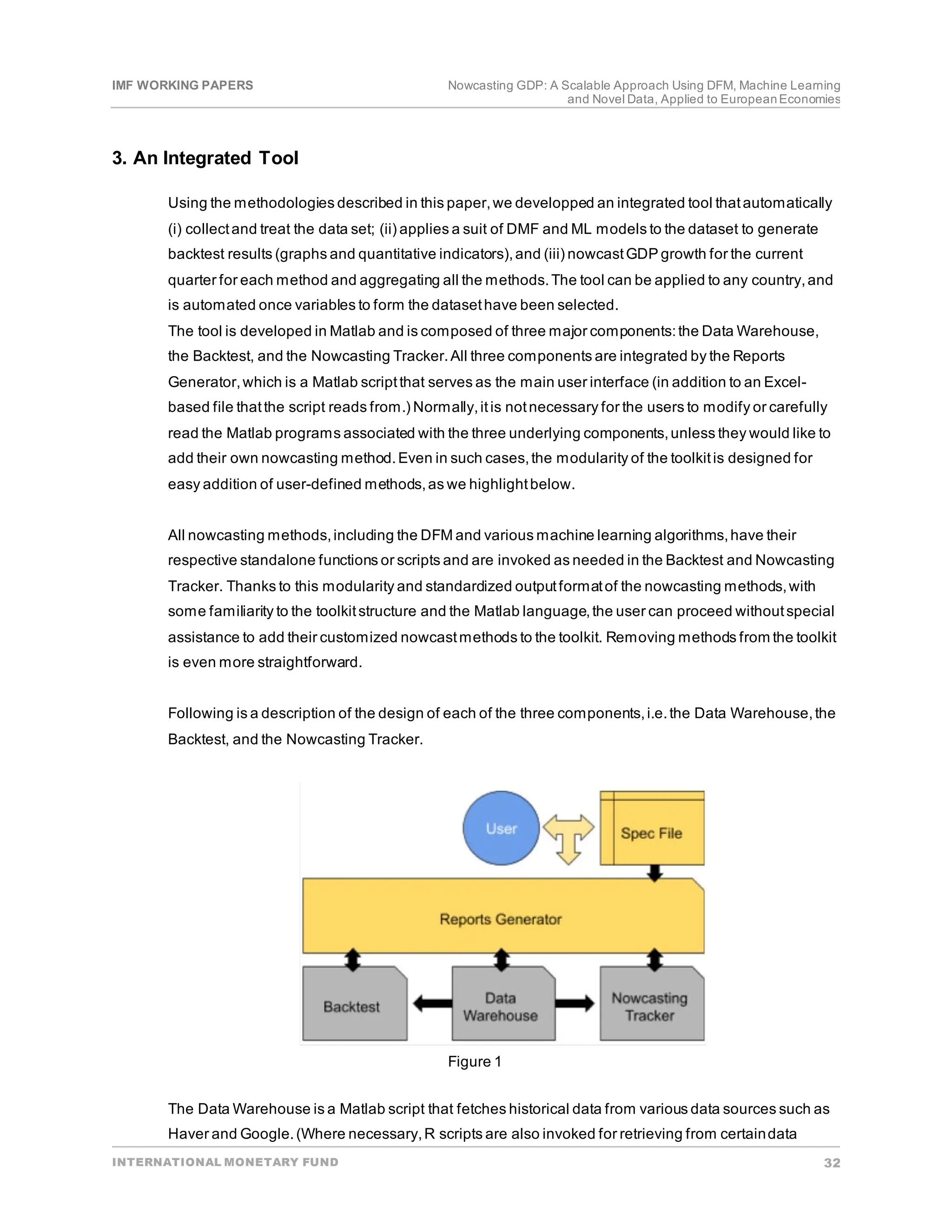
Nowcasting GDP
A Scalable Approach Using DFM,
Machine Learning and Novel Data,
Applied to European Economies
By Jean-François Dauphin, Kamil Dybczak, Morgan Maneely,
Marzie Taheri Sanjani, Nujin Suphaphiphat, Yifei Wang, and
Hanqi Zhang
WP/22/52
IMF Working Papers describe researchin
progress by the author(s) and are published to
elicit comments and to encourage debate.
The views expressed in IMF Working Papers are
those of the author(s)and do not necessarily
representthe views of the IMF, its Executive Board,
or IMF management.
2022
MAR
© 2022 International Monetary Fund WP/22/52
IMF Working Paper
European Department
NowcastingGDP
A Scalable Approach Using DFM, Machine Learning and Novel Data,Applied to European Economies
Preparedby Jean-François Dauphin, KamilDybczak, Morgan Maneely, Marzie Taheri Sanjani,
Nujin Suphaphiphat, Yifei Wang, and Hanqi Zhang
March 2022
IMF Working Papers describe researchinprogress by the author(s) and are published to elicit
comments and to encourage debate. The views expressed in IMF Working Papers are those of the
author(s) and do not necessarily representthe views of the IMF, its Executive Board, or IMF management.
ABSTRACT: This paper describes recentwork to strengthen nowcasting capacity atthe IMF’s European
department.It motivates and compiles datasets of standard and nontraditional variables,such as Google
search and air quality.It applies standard dynamic factor models (DFMs) and several machine learning (ML)
algorithms to nowcastGDP growth across a heterogenous group of European economies during normal and
crisis times.Most of our methods significantly outperform the AR(1) benchmark model.Our DFMs tend to
perform better during normal times while many of the ML methods we used performed strongly atidentifying
turning points.Our approach is easily applicable to other countries,subjectto data availability.
JEL Classification Numbers: E52, C33,C53
Keywords: Nowcasting, Factor Model,Machine Learning,Large Data Sets
Author’s E-Mail Address:
jdauphin@imf.org;kdybczak@imf.org;mmaneely@imf.org;
nsuphaphiphat@imf.org;mtaherisanjani@imf.org;ywang6@imf.org;
hqzhang@nyu.edu
WORKINGPAPERS
Nowcasting GDP
A Scalable Approach Using DFM, Machine Learning
and Novel Data, Applied to European Economies
Prepared by Jean-François Dauphin, Kamil Dybczak, Morgan Maneely,
Marzie Taheri Sanjani, Nujin Suphaphiphat, Yifei Wang, and Hanqi Zhang 1
1
The author(s) would like to thank participants of the IMF Big Data Talks and European Department seminars for suggestions. All
errors and omissions are our own.
IMF WORKING PAPERS Nowcasting GDP: A Scalable Approach Using DFM, Machine Learning
and Novel Data, Applied to EuropeanEconomies
INTERNATIONAL MONETARY FUND 2
Contents
Glossary...............................................................................................................................................................................3
Introduction.........................................................................................................................................................................4
Literature Review...............................................................................................................................................................5
Data.......................................................................................................................................................................................7
Models and Methodology ................................................................................................................................................9
DFMs ...........................................................................................................................................................................10
Machine Learning.......................................................................................................................................................11
Assessment of Predictive Performance..................................................................................................................12
Results...............................................................................................................................................................................14
Summary and Conclusion.............................................................................................................................................18
Appendices .......................................................................................................................................................................20
1. Nowcasting Variables by Country.......................................................................................................................20
2. Sample Results—Hungary...................................................................................................................................27
3. An Integrated Tool.................................................................................................................................................32
4. Machine Learning Algorithms..............................................................................................................................34
1. Regularized Regression methods............................................................................................................34
2. Support Vector Machine............................................................................................................................34
3. Random Forest...........................................................................................................................................36
4. Neural Network...........................................................................................................................................38
5. Indicators of predictive accuracy: Models by Country......................................................................................40
References........................................................................................................................................................................41
FIGURES
Figure 1. Examples of Model Performances..........................................................................................................16
TABLES
Table 1. A Brief Introduction to ML Algorithms......................................................................................................12
Table 2. Full Sample- Model Performance (RMSE) Until 2021Q1.....................................................................17
Table 3. Pre-COVID Samples- Model Performance (RMSE) Until 2019Q4......................................................17
Table 4. During COVID-19 Sample- Model Performance (RMSE) Between 2020Q1-2021Q1………. 18
IMF WORKING PAPERS Nowcasting GDP: A Scalable Approach Using DFM, Machine Learning
and Novel Data, Applied to EuropeanEconomies
INTERNATIONAL MONETARY FUND 3
Glossary
AR Auto Regressive
CNN Convolutional Neural Network
COVID Coronavirus Disease
CPI Consumer Price Index
DFM Dynamic Factor Model
ECB European Central Bank
EM Expectation Maximization
GDP Gross Domestic Product
GPReg Gaussian Process Regression
IMF International Monetary Fund
LASSO LeastAbsolute Shrinkage and Selection Operator
LinReg Linear Regression
LSTM Long Short-Term Memory
MAE Mean Absolute Error
MDA Mean Directional Accuracy
MIDAS Mixed Data Sampling
ML Machine Learning
NN Neural Network
OECD Organization for Economic Co-operation and Development
OLS Ordinary LeastSquares
ReLU Rectifier Linear Unit
RF Random Forest
RMSE Root Mean Squared Error
RNN Recursive Neural Networks
SVM SupportVector Machine
VAR Vector Autoregressive Model
WEI Weekly Economic Index
IMF WORKING PAPERS Nowcasting GDP: A Scalable Approach Using DFM, Machine Learning
and Novel Data, Applied to EuropeanEconomies
INTERNATIONAL MONETARY FUND 4
Introduction
The Covid crisis highlighted the need for a systematic analysis of high-frequency indicators of
economic activity. While in normal times the dynamics of real economic activity can generally be sufficiently
characterized and explained by conventional monthly and quarterly aggregate indicators―e.g.,industrial
production or gross domestic product― during crisis times,businesses,marketanalysts,and policymakers
need higher-frequency information abouteconomic activity.The importance of timely information was vividly
illustrated in 2020,when the COVID pandemic hitthe global economy with unprecedented intensity and
unpredictability.In Europe for instance,the economy recorded in the second quarter its largestcontraction
since World War II. However,the firstofficial GDP growth estimates of the second quarter for European
countries were published only in mid-July,too late to assess the magnitude of the shock and calibrate the
appropriate policy response.Fortunately,other economic indicators had been available muchearlier.A
question arose as to whether a variety of higher frequency data from differentsources could be systematically
analyzed to provide sufficiently accurate information on economic conditions timely enough to usefully inform
policy making.
Over the last decade, at least in advancedcountries, data availability has become less of a constraint
thanks to new technologies, more efficient at collecting and compiling data. As a result, new information,
mainly from non-official sources―such as marketsurveys,sentimentindicators,Google search results,air
quality,etc.―have become available.These indicators―frequently available and possibly capable of quickly
registering sharp changes in economic conditions―can supplementstandard economic indicators produced
and validated by national statistical offices,to help gauge the economic situationatthe aggregate level.
Furthermore,methods that can deal with large datasets containing highly correlatedvariables of
different frequencies and information quality, have also been developed. For more than 20 years,models
based on dynamic factor methodology have been prominentnowcasting tools to quantitatively assess the state
of the economy in the currentperiod or over the very near future.More recently,and not surprisingly,machine
learning methods have gainedpopularity among economists and have been deployed also in nowcasting.
This paper describes an effort to strengthen nowcasting capacity at the IMF’s European department in
early 2020.It adds to the growing literature on nowcasting in several ways.First,it motivates and compiles
datasets of standard variables and new ones,such as Google search and air quality,including country-specific
databases of selected European economies and their transformations.Second,beyondapplying standard
dynamic factor model (DFM),we employ several machine learning (ML) algorithms to nowcastGDP growth.
Third, the paper compares the performance of alternative methods across an heterogenous group of European
economies,during normal and crisis times.
The paper is structuredas follows. Part 2 provides a non-exhaustive literature overview focusing mostly on
DFMs and machine learning methods.Part3 discusses data that could inform aboutan economy’s position
and their statistical treatment.Part4 provides a non-technical summary of DFMs and selected machine
learning approaches.Part5 presents our main results and compares them across alternativetechniques,
including duringnormal and crisis episodes.Part6 concludes.
IMF WORKING PAPERS Nowcasting GDP: A Scalable Approach Using DFM, Machine Learning
and Novel Data, Applied to EuropeanEconomies
INTERNATIONAL MONETARY FUND 5
Literature Review
Economists in academia and policy institutions have sought to predicting quarterly GDP and turning
points of the economic cycle over the near term using higher frequency indicators for a long time.
Nowcasting models,as we know them today,rely on the idea originally formulated by Sargentand Sims (1977)
that the salientfeatures of business cycle fluctuations can be captured by a small number of factors thatcould
be estimated from data.Stock and Watson (1989) were among the firstto construct indices of business cycle
using factor models.
The early models had the state-space representationand were estimatedby maximum-likelihood and
relied on only a limited number of variables.The latent common factors were estimated by Kalman Filter.
The firstmodel by Stock and Watson (1989) extracted a single common factor from a small setof monthly core
indicators (employment,industrial production,sales,and income).
Over time, these models were expandedand improved to deal with a much larger number of variables
and factors used to construct different business cycle indicators. Giannone etal. (2005) and Watson
(2005) showed thatthe findings by Sargentand Sims (1997) also apply to high-dimensional datasets and
proposed to formulate factor models using state-space specificationto reduce the dimensionality of large
economic systems,i.e.to extract unknown common factors.While the large number of variables doesn’t
impose restriction on feasibility of estimation (Doz etal (2012)),it increases the estimation time;hence the
need for selectivity when it comes to picking whatvariables go into a model.
Since then, factor models have been further refined and become widely used tools to monitor
economic conditions. The model of Giannone,Reichlin,and Small (2008) was firstimplemented to nowcast
GDP at the Board of Governors of the Federal Reserve based on a projectthat started in 2003.Various
versions of this model have been builtfor differenteconomies and implementedin other central banks,
including the European Central Bank (ECB,2008) and the International Monetary Fund (Matheson (2011),
Taheri Sanjani (2013)).The models have been continuously refined.In a series of papers,D'Agostino et al.
(2011) and Giannone etal. (2013) further developed the DFM methodology and improved prediction properties
of this group of models by further improving the Kalman-Filter estimation methodlogy and optimizing the data
selection process.
DFMs have been widely used during the COVID-19 pandemic. Sampi and Jooste (2020) introduced Google
mobility indicators into the DFM model to capture the economic effects of the pandemic on industrial production
in Latin America and the Carribean while Lewis etal.(2020a,2020b) produced a Weekly Economic Index
(WEI) to measure real activity.Other work includes Guérin (2020),Chapman and Desai (2021),Antolin-Diaz et
al. (2021),or Corona etal. (2021).
While DFMs have became mainstream tools to nowcast GDP growth, new techniques have emerged,
based on statistical learning and machine learning. These techniques notonly introduce alternative ways to
estimate coefficients butalso perform data driven variables and model selection thatmay lead to smaller
deviations between actual and predicted outcomes,i.e.better out-of-sample prediction.Aboutthirty years ago,
Fagan and Fell (1991) did notinclude non-linear methods and neural networks in their overview of techniques
for short-term economic forecasting,since they were still in their infancy as far as economics was concerned
and not widely used by practitioners.Since then,a lot has changed and,while this is a relatively new area,the
number of articles related to machine learning using big data in economics has been growing fastdue to two
factors.
IMF WORKING PAPERS Nowcasting GDP: A Scalable Approach Using DFM, Machine Learning
and Novel Data, Applied to EuropeanEconomies
INTERNATIONAL MONETARY FUND 6
• First, new data have became available.For example,Google trends data have become a new source
of information.Choi and Varian (2009a) showedthatusing specific keywords,Google trends data may
help predictthe present, especially when economic conditions change rapidly.For example,Varian
and Choi (2009b),Tuhkuri (2016) used Google search data to predictcurrentunemployment.
• Second,a large number ofalgorithms have been developed and improved.Hastie etal. (2009,and
2015) or Gareth et al. (2015) are classic textbooks discussing the main tools.However,the examples
they provide are mostly outside of economics.
As a result, machine learning techniques have become popular among economists.Varian (2014),
Belloni etal. (2014),and Storm (2020) provide an overview of some of the tools for manipulating and analyzing
big data in economics.Amatet.al. (2018) apply machine learning methods to predictfloating exchange rates of
twelve industrial countries and conclude thatthese methods perform better than tools typically used in the
literature.Similarly,using a large scanner paneldatasetwith highly correlated variables,Bajari etal (2015)
apply alternative machine learning methods to estimate consumer demand and find thatthe machine learning
methods predictout-of-sample demand much more accurately than standard panel data and logistic models.
Chakraborty and Joseph (2017) discuss machine learning in the contextof central banking and policy analyses.
Beyond discussing main machine learning concepts and models,they also presentthree case studies using
machine learning atthe central bank.Kohlscheen (2021) examines drivers of inflation relying on regression
trees and random forests.Basuchoudhary et.al. (2014) motivate and apply differentmachine learning
algorithms (Artificial Neural Network,Boosting,Bootstrap Aggregating,Random Forestpredictors and
Regression Tree) to predictlong-term economic growth and the likelihoodof recessions.They use the machine
learning algorithms to assess the significance of various variables ―previously identified by research―in
predicting economic growth.Athey (2019) compares machine learning methods to traditional econometrics,
discusses main advantages of machine learning,and provides examples of using these methods for prediction
and inference in policy analysis.She also predicts thatmachine learning will have a large impacton how
empirical work is conducted.
Although machine learning methods have been primarily developed for prediction, they have started
being applied also for nowcasting. Richardson et. al. (2020) apply machine learning algoriths to a datasetof
about600 domestic and international variables to predictNew Zealand GDP growth.The study shows that
machine learning algorithms—mainly boosted trees,supportvector machine,and neural networks—are able to
outperform a simple autoregressivemodel and DFM.Applying several machine learning algorithms on a
datasetof quarterly macroeconomic and financial data to nowcastIndonesia’s GDP growth,Muchisha et.al.
(2021) arrive at a similar conclusion thatall machine learning models outperform AR(1) benchmark while
Random Forestshowed the best performance.Withoutadding data from more granular and novel data
sources,Jung et. al. (2018) still find thatmachine learning methods—Elastic Net,SuperLearner,and Recurring
Neural Network algorithms—can outperform traditional statistical methods.Tiffin (2016) applies machine
learning algorithms in case of Lebanon—a country with long delays in the publication of its GDP. Using a
datasetof 19 variables,he shows how Elastic Net and Random Forestcan be used to nowcastLebanese GDP
growth before official data is released.Bolhuis and Rayner (2020) apply alternative machine learning
algorithms to nowcastthe Turkish GDP growth.In addition,to further lower forecasterrors,the authors
combine individual machine learning models into ensembles.They find thatthe machine learning models can
reduce forecasterrors by at least30 percentwhen compared to traditional models.In response to rapidly
changing environmendduring the COVID pandemic,Woloszko (2020) constructed the OECD Weekly Tracker
of GDP growth by including Google trends data highlighting the predictive power of specific keywords,including
“bankruptcies”,“economic crisis”,“investment”,“luggage” and “mortgage”.On a sample of OECD and G20
countries,they find thaton average the model’s forecasterror is 17 percentlower than that of an AR(1) model.
IMF WORKING PAPERS Nowcasting GDP: A Scalable Approach Using DFM, Machine Learning
and Novel Data, Applied to EuropeanEconomies
INTERNATIONAL MONETARY FUND 7
The model also captures a sizeable share of business cycle variation and detects well the downturn and
subsequentrebound of the economy.
In addition to DFM and machine learning, nowcastingmodels can be based on other approaches,
including for example bridge equations, mixed data sampling (MIDAS) or mixed-frequencyVARs. Bridge
equations gained in popularity mainly due to its simplicity and low technical requirements.The method relies on
single equation regressions of quarterly GDP growth on a small number of high-frequency variables (such as
industrial production or surveys) aggregated to quarterly data by averaging,summing up,or taking another
transformation (Baffigietal., 2004).To form a forecastof the variable of interest,high-frequency (explanatory)
variables are forecastusing separate time series models with a potentially large numbers lags,resulting in a
large number of parameters to be estimated.Thus,while parsimonious,the main disadvantage of bridge
equations models is a potentially large number of parameters thatneeds to be estimated.MIDAS approach
addresses this issue,e.g., the large number of parameters thatneeds to be estimated,by replacing the
unrestricted lag polynomial structure by non-linear functional forms.While MIDAS approach achieves the
model’s parsimony,its parameters need to be estimated by non-linear estimation methods,which may
complicate empirical work.Mixed frequency VARs are an alternative to single-equation models.These models
operate at the highestfrequency of data,at which,however,notall variables are necessarily available.Lower
frequency variables are assumed to be periodically missing and represented through a state space model.
Over the last decade,these and other new approaches have been introduced to near-term forecasting and
nowcasting literature,all of them having their pros and cons (Camacho and Perez-Quiros (2013)).The
remainder of this paper will focus on nowcasting models based on DFMs and machine learning algorithms.
Data
The basic idea of nowcastingis to exploit a diverse set of timely information that is available before an
official release of a target variable.1 As such,data selection and transformation is key to the success of
nowcasting.
New technologies and approaches to data collection contributed to wider data availability, allowing
economists to rely on large datasets.The so-called high-dimensional datasets or big data often include a
number of explanatory variables thatis close to, or even exceeds,the number of observations.The motivation
behind those large datasets has been to maximize the information setand thus reduce the risk of bias due to
the omission of information.
Unfortunately, the prediction capacityof a fitted model does not always improve when introducing
additional explanatory variables (Hastie et al (2015)).Specifically,introducing additional explanatory
variables into a model increases the risk of overfitting the model―as potentially noisy variables are assigned
non-zero coefficients.In addition,even if explanatory variables are relevantto the model,large datasets often
consistof interconnected clusters of information,within which variables are highly correlatedor presentsimilar
1
Nowcasting methods have beensuccessfully applied in a number of fields, including outside of economics. In economics,
nowcasting methods have been applied notonly in near-term economic activity prediction but also to nowcast inflation or
employment (Knotek and Saeed, 2014;Modugno, 2011; Hutter, 2020). The focus of this work is nowcasting of quarterly GDP
growth.
IMF WORKING PAPERS Nowcasting GDP: A Scalable Approach Using DFM, Machine Learning
and Novel Data, Applied to EuropeanEconomies
INTERNATIONAL MONETARY FUND 8
concepts.2
In general,excessive collinearity among explanatory variables results in the large variance of the
estimated coefficients,which may overweightthe benefits of reduced omitted variable bias.
To address issues arising from large datasets―whichhave become limiting especially in case of
classicalstatisticaltechniques such as linear regression―andto fully exploit their potential, new
techniques and algorithms have been developed. Recently developed techniques and algorithms have
been instrumental in dealing with large datasets (see Models and Methodology section).Some of the models
penalize the introduction of additional variables and some of them have the capacity to fully exclude variables
from the sample and thus shrink the size of the original dataset.While this is an importantfeature thatmakes
the practitioner's task easier,carefully selecting timely and informative variables has remained critical to
nowcasting in the big data environment.
Following standardpractices in nowcasting of GDP growth, our sample contains a wide range of
official and nonofficial, hard and soft, and proxy data. The data used are published with different
frequencies and cover main aspects of the economy and the external environment.3
The datasetdoes not
include detailed sectoral data and uses only headline figures.For example,industrial production is included
only once on the aggregate level,although disaggregated data are available atthe same time.This practice is
in line with the literature showing thatdisaggregated information neither improves,nor harms the quality of the
nowcast.4
The dataset also excludes variables available only since 2020.Proxy of economic activity available at
frequency close to real time (e.g., Google mobility indicators,diningreservations,hotel occupancy rates,etc.)
have gained in popularity over the lastdecade,and the COVID pandemic has accelerated their use in short-
term forecasting.However,while available with high frequency,the time series of mostof these indicators are
often very short and thus does not allow to estimate,train, and test the performance of alternative models on
historical data.5 As such,Google trends, Oxford Stringency Indices and air quality data are the only high
(weekly) frequency variables included in our sample.
The total number of variables ranges between20 to 60 depending on the characteristics of the
economy for which our set of models is applied, and data availability. Data can be organized in the
following clusters:
i. Firm and production data:industrial output,housing and construction indicators such as
manufacturing production and industry turnovers.
ii. Surveys or forward-looking indicators:business surveys,economic sentimentsurvey,and consumer
confidence.
iii. Labor market variables:unemployment,wages,and employmentdata.
iv. Financial variable:stock prices,various interestrates,stock of creditand deposits
2
For example, a nowcasting databasecan consist of many clusters comprising labor market variables, surveys and sentiment
indicators, external sector variables (trade and openness), financial andmonetary variables, and fiscal variables among others.
3
Appendix 1 provides a list of variables used for each country included in our exercise. Each list contains individual variables
description, publication frequency and the adoptedtransformation.
4
Experimenting with a dataset of around200 time series, Giannone et al. (2008) andBanbura andModugno (2010) and Banbura et
al. (2011) conclude that the marginal impact of disaggregated dataon the nowcast precision is minimal. At the same time, these
studies also show that including disaggregated data does not deteriorate theperformanceof the model.
5
For example, Google Mobility Indicators are availableonly since the beginning of theCovid pandemic. Moreover, the publication of
these indices may be discontinued oncethe pandemic is contained, and mobility settles in (potentially new) normal levels.
IMF WORKING PAPERS Nowcasting GDP: A Scalable Approach Using DFM, Machine Learning
and Novel Data, Applied to EuropeanEconomies
INTERNATIONAL MONETARY FUND 9
v. Prices: producer price index,CPI,house prices,commodity price index
vi. Foreign trade:exports and imports volumes and values.
vii. External environment:openness to trade,reliance on Global Value Chain,and main trading partners’
economic variables.
viii. Other variables capturing specific features ofan economy:reliance on tourism 6,commodity export,
vulnerabilities to climate change,presence of domiciled multinational companies in a country among
others.
ix. Additional indicators:air quality index,hotel occupancy rates,Oxford Stringency Indices,frequency of
google searches for specific words thatmay proxy currentposition in the business cycle.7, 8
Before applying the nowcasting models, the variables need to be transformed:
• First, all variables with frequency higher than quarterly (mostly weekly and monthly) mustbe
transformed into quarterly data.The DFM takes advantage of the mixed-frequency data by using
bridge equation and Kalman filter,while in the case of the ML models,weekly and monthly data are
transformed to quarterly frequency,so all the variables in the final datasetare on quarterly basis.9
• Second,as in the case of standard econometric tools,time series must be seasonally adjusted and
detrended.In general,transforming quarterly variables in levels into year-over-year growth rates
addresses both seasonality and non-stationarity of the time series in the dataset.A smaller number of
variables,such as unemploymentrate―already expressed as percent―or outcomes from surveys are
either kept unchanged in levels or transformed to year-over-year differences.10
Models and Methodology
Once the data have been collected and transformed,we need methods to (i) extract information contained in a
large number of variables and (ii) address issues arising from largedatasets,e.g.collinearity and risk of
overfitting.The methods also need to be able to deal with incomplete data and data of differentfrequencies.
The goal is to be able to process new information in real time in a systematic and objective manner.
The remainder of this section discusses main ideas behind techniques applied in this work:(i) DFMs, and (ii)
the tools relying on machine learning.11
6
In countries where tourism represents a large share to GDP, like Malta, tourism-related variables such as tourist arrivals and
numbers of overnight stays have been incorporated in the dataset.
7
Air quality data for European countries can be downloadedfrom the European air Quality Portal.
https://aqportal.discomap.eea.europa.eu/
8
For example, the word unemployment benefit “Arbeitslosengeld” is used to nowcast GDP growth for Austria. In case of Hungary
and Portugal “álláskeresési járadék + munkanélküli segély” and “Subsídiode desemprego” have been used, respectively.
9
Alternatively, weekly and monthly time series can be converted into twelve and threequarterly time series, respectively, the so-
called ”blocking” (Bańbura et. al., 2013). In our experiencewith alternative models over different periods,aggregating weekly
and monthly data into a single quarterly time series does not lead to lower quality of the forecast due to a loss of information but
results in a shorter computational time due to a smaller number of time series.
10
Appendix 1 presents country specific databases and indicates the transformation applied to eachvariable.
11
Appendix 2 and 3 provide additional discussionof DFM and some of the ML based models.
IMF WORKING PAPERS Nowcasting GDP: A Scalable Approach Using DFM, Machine Learning
and Novel Data, Applied to EuropeanEconomies
INTERNATIONAL MONETARY FUND 10
DFMs
DFMs are based on a fundamental idea thata large number of economic variables (N) show similar
developments over the business cycle and thus can be described by a small number of common factors (r),
i.e., r<N.12
Formally,a DFM assumes thatmany observed variables (y1, t,. . ., yn,t ) are driven by a few unobserved
dynamic factors (f1, t,. . ., fr,t),while the features thatare specific to individual series,such as measurement
errors, are captured by idiosyncratic errors (e1, t, ..., en,t):
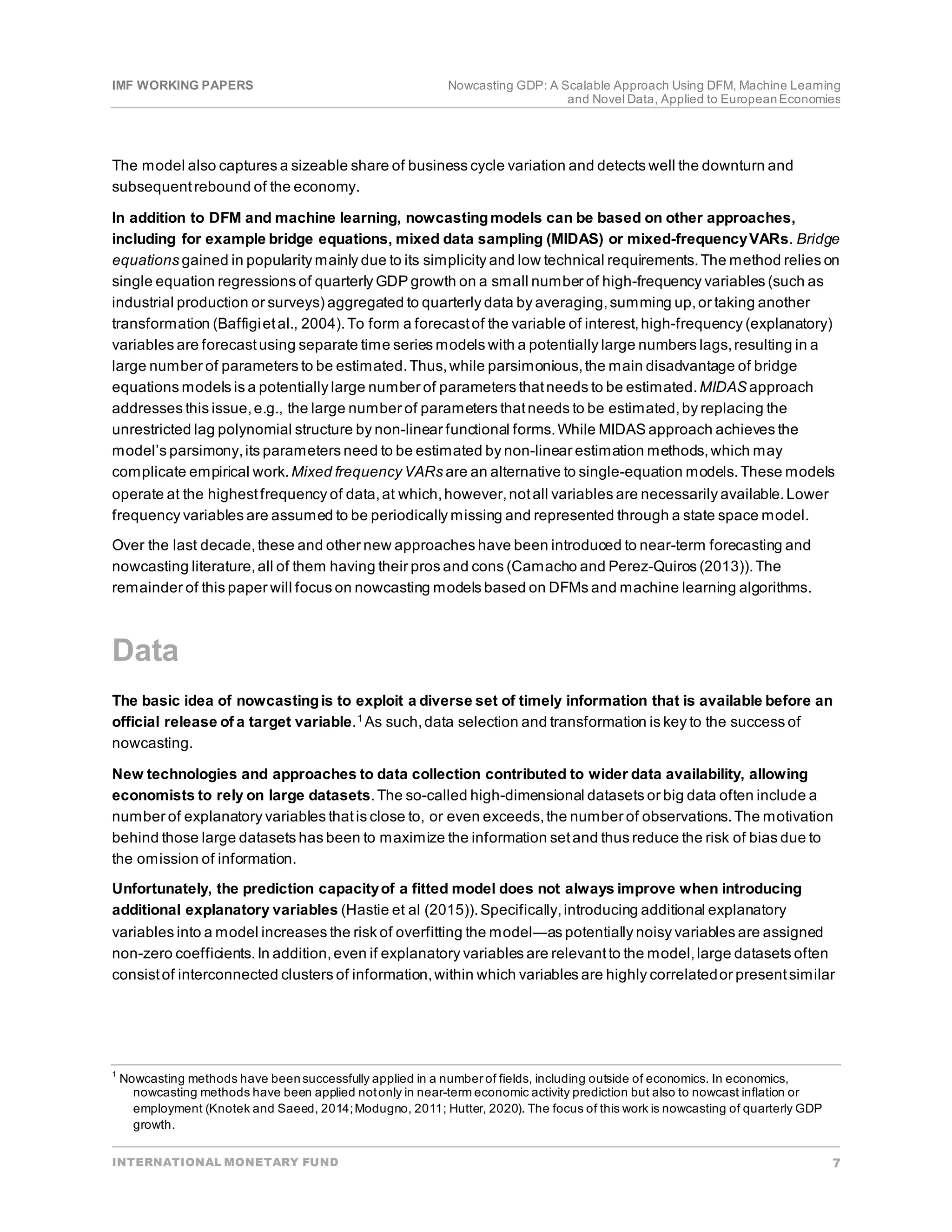
yi,t = λi,1 f1, t + · · · + λi,r fr,t + ei,t, for i = 1, . . ., n (1)
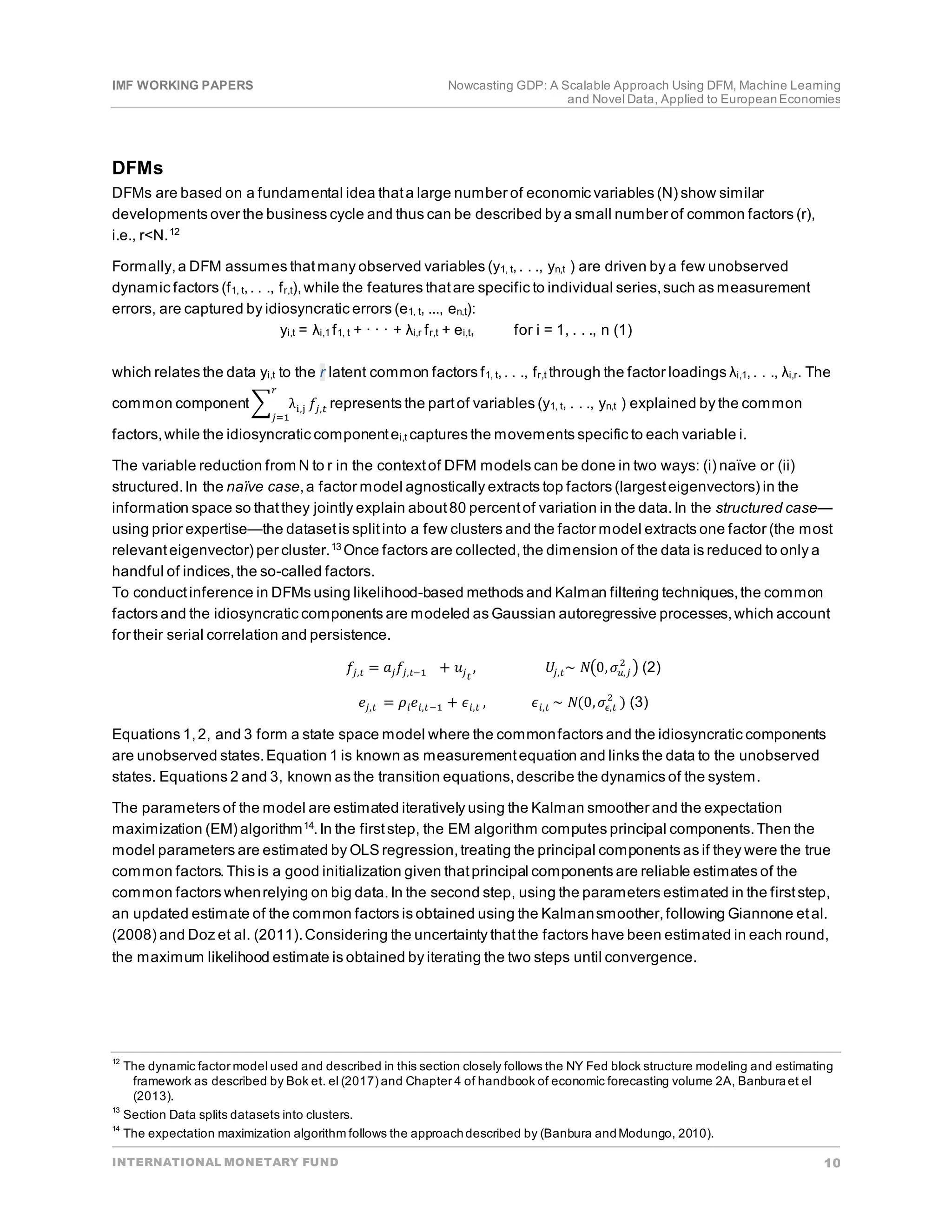
which relates the data yi,t to the r latent common factors f1, t,. . ., fr,t through the factor loadings λi,1,. . ., λi,r. The
common component� λi,j 𝑓𝑓𝑗𝑗,𝑡𝑡
𝑟𝑟
𝑗𝑗=1
represents the partof variables (y1, t, . . ., yn,t ) explained by the common
factors,while the idiosyncratic componentei,t captures the movements specific to each variable i.
The variable reduction from N to r in the contextof DFM models can be done in two ways: (i) naïve or (ii)
structured.In the naïve case,a factor model agnostically extracts top factors (largesteigenvectors) in the
information space so thatthey jointly explain about80 percentof variation in the data.In the structured case—
using prior expertise—the datasetis splitinto a few clusters and the factor model extracts one factor (the most
relevanteigenvector) per cluster.13 Once factors are collected,the dimension of the data is reduced to only a
handful of indices,the so-called factors.
To conductinference in DFMs using likelihood-based methods and Kalman filtering techniques,the common
factors and the idiosyncratic components are modeled as Gaussian autoregressive processes,which account
for their serial correlation and persistence.
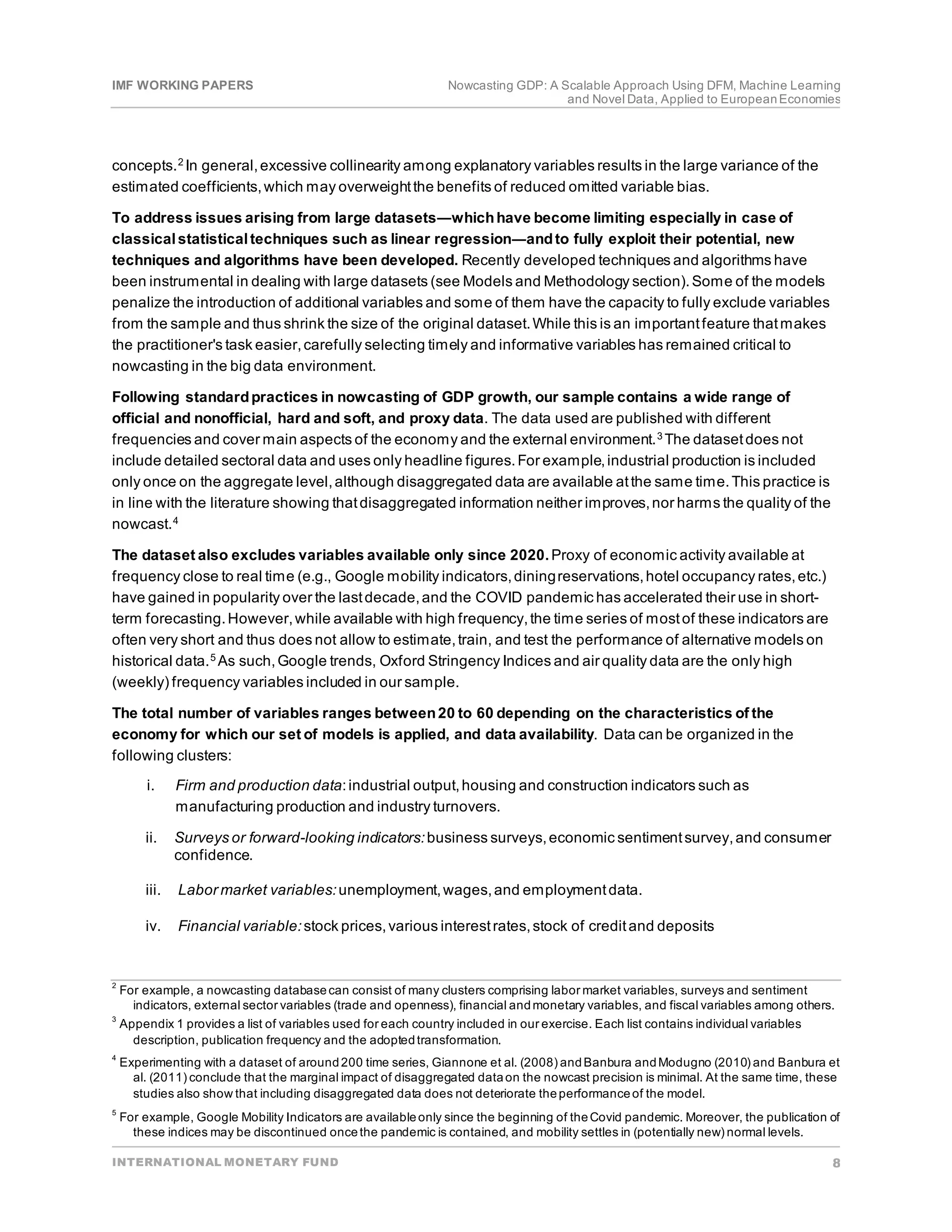
𝑓𝑓𝑗𝑗,𝑡𝑡 = 𝑎𝑎𝑗𝑗𝑓𝑓𝑗𝑗,𝑡𝑡−1 + 𝑢𝑢𝑗𝑗𝑡𝑡
, 𝑈𝑈𝑗𝑗,𝑡𝑡~ 𝑁𝑁�0,𝜎𝜎𝑢𝑢,𝑗𝑗
2
� (2)
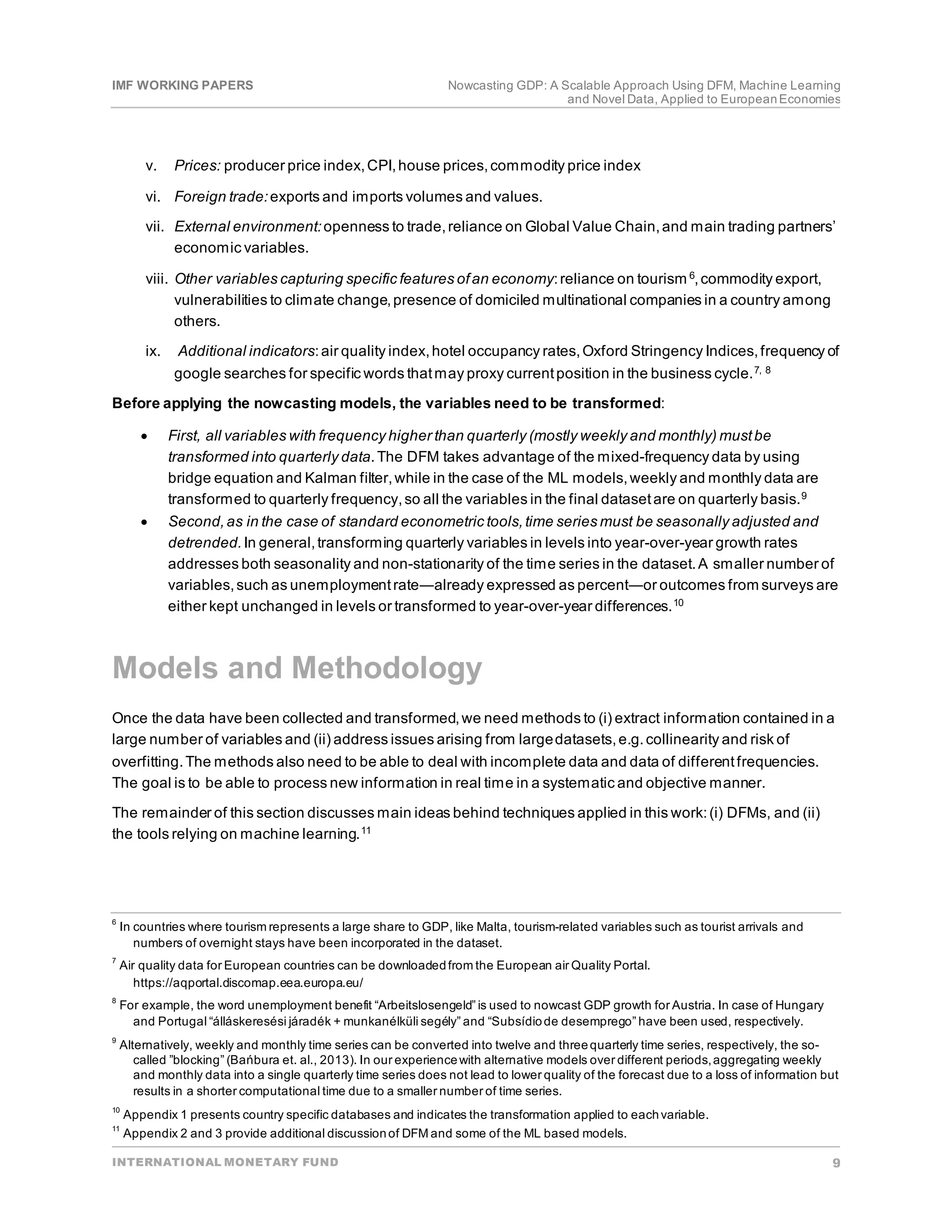
𝑒𝑒𝑗𝑗,𝑡𝑡 = 𝜌𝜌𝑖𝑖𝑒𝑒𝑖𝑖,𝑡𝑡−1 + 𝜖𝜖𝑖𝑖,𝑡𝑡 , 𝜖𝜖𝑖𝑖,𝑡𝑡 ~ 𝑁𝑁(0,𝜎𝜎𝜖𝜖,𝑡𝑡
2
) (3)
Equations 1,2, and 3 form a state space model where the commonfactors and the idiosyncratic components
are unobserved states.Equation 1 is known as measurementequation and links the data to the unobserved
states. Equations 2 and 3, known as the transition equations,describe the dynamics of the system.
The parameters of the model are estimated iteratively using the Kalman smoother and the expectation
maximization (EM) algorithm14
.In the firststep, the EM algorithm computes principal components.Then the
model parameters are estimated by OLS regression,treating the principal components as if they were the true
common factors.This is a good initialization given thatprincipal components are reliable estimates of the
common factors whenrelying on big data.In the second step, using the parameters estimated in the firststep,
an updated estimate of the common factors is obtained using the Kalmansmoother,following Giannone etal.
(2008) and Doz et al. (2011).Considering the uncertainty thatthe factors have been estimated in each round,
the maximum likelihood estimate is obtained by iterating the two steps until convergence.
12
The dynamic factor model used and described in this section closely follows the NY Fed block structure modeling and estimating
framework as described by Bok et. el (2017) and Chapter 4 of handbook of economic forecasting volume 2A, Banburaet el
(2013).
13
Section Data splits datasets into clusters.
14
The expectation maximization algorithm follows the approachdescribed by (Banbura andModungo, 2010).
IMF WORKING PAPERS Nowcasting GDP: A Scalable Approach Using DFM, Machine Learning
and Novel Data, Applied to EuropeanEconomies
INTERNATIONAL MONETARY FUND 11
Machine Learning
ML algorithms have becomewidely used in analyzing large datasets for several reasons:1
- Flexibility:ML algorithms are flexible and effective in capturing patterns in the data. As such,ML
techniques often outperform traditional techniques atlearning from large datasets and predicting
complex and nonlinear relationships.
- Variable selection:Mostof the ML algorithms limitoverfittingby actively and directly seeking the most
suitable setof indicators to predicttarget variables.
- Cross-validation:ML algorithms fine-tune the model parameters by iteratively partitioning the sample
into training and testing subsamples and gaugingthe pseudo out-of-sample performance with test
subsample to minimize the forecasterror.
On the other hand,the research on the interpretability of ML algorithms has been scarce so far (Carvalho etal
2019) and ML algorithms are often seen as black boxes with a clear trade-off between modelperformanceand
interpretability (Linardatos etal 2020).In addition,some ML algorithms seem less robustto missing
observations or incomplete datasetthan DFM.2
1
ML methods have been initially developed for forecasting. Nonetheless, significantprogress has been made in applyingML
techniques for inference. The focus of this study is ML techniques for prediction only.
2
A detailed discussion on handlingmissing data can be found at Marlin (2008). In our toolkit, we use a naïve approach, a
combination of either deleting rows or columns with missing data.
IMF WORKING PAPERS Nowcasting GDP: A Scalable Approach Using DFM, Machine Learning
and Novel Data, Applied to EuropeanEconomies
INTERNATIONAL MONETARY FUND 12
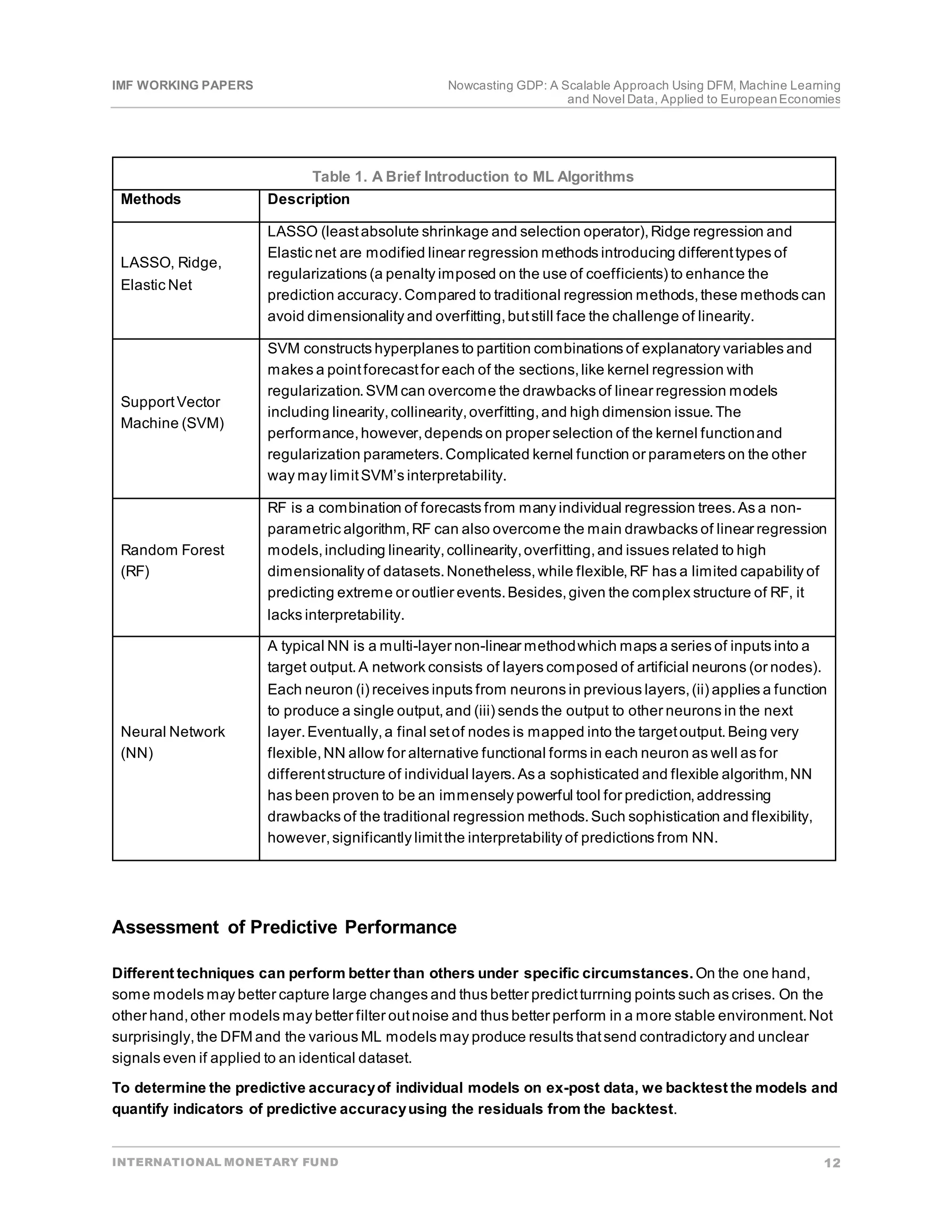
Table 1. A Brief Introduction to ML Algorithms
Methods Description
LASSO, Ridge,
Elastic Net
LASSO (leastabsolute shrinkage and selection operator),Ridge regression and
Elastic net are modified linear regression methods introducing differenttypes of
regularizations (a penalty imposed on the use of coefficients) to enhance the
prediction accuracy.Compared to traditional regression methods,these methods can
avoid dimensionality and overfitting,butstill face the challenge of linearity.
SupportVector
Machine (SVM)
SVM constructs hyperplanes to partition combinations of explanatory variables and
makes a pointforecastfor each of the sections,like kernel regression with
regularization.SVM can overcome the drawbacks of linear regression models
including linearity,collinearity,overfitting,and high dimension issue.The
performance,however,depends on proper selection of the kernel functionand
regularization parameters.Complicated kernel function or parameters on the other
way may limitSVM’s interpretability.
Random Forest
(RF)
RF is a combination of forecasts from many individual regression trees.As a non-
parametric algorithm,RF can also overcome the main drawbacks of linear regression
models,including linearity,collinearity,overfitting,and issues related to high
dimensionality of datasets.Nonetheless,while flexible,RF has a limited capability of
predicting extreme or outlier events.Besides,given the complex structure of RF, it
lacks interpretability.
Neural Network
(NN)
A typical NN is a multi-layer non-linear methodwhich maps a series of inputs into a
target output.A network consists of layers composed of artificial neurons (or nodes).
Each neuron (i) receives inputs from neurons in previous layers,(ii) applies a function
to produce a single output,and (iii) sends the output to other neurons in the next
layer.Eventually,a final setof nodes is mapped into the targetoutput.Being very
flexible,NN allow for alternative functional forms in each neuron as well as for
differentstructure of individual layers.As a sophisticated and flexible algorithm,NN
has been proven to be an immensely powerful tool for prediction,addressing
drawbacks of the traditional regression methods.Such sophistication and flexibility,
however,significantly limitthe interpretability of predictions from NN.
Assessment of Predictive Performance
Different techniques can perform better than others under specific circumstances.On the one hand,
some models may better capture large changes and thus better predictturrning points such as crises. On the
other hand,other models may better filter outnoise and thus better perform in a more stable environment.Not
surprisingly,the DFM and the various ML models may produce results thatsend contradictory and unclear
signals even if applied to an identical dataset.
To determine the predictive accuracyof individual models on ex-post data, we backtest the models and
quantify indicators of predictive accuracyusing the residuals from the backtest.
IMF WORKING PAPERS Nowcasting GDP: A Scalable Approach Using DFM, Machine Learning
and Novel Data, Applied to EuropeanEconomies
INTERNATIONAL MONETARY FUND 13
• Backtesting.In the firststage―to proxy a real-time environment―in each periodt,data on all
explanatory variables are available from the beginning of the sample till the latestquarter t. However,
information on the targetvariable is available only up to the t-1 quarter.In each quarter t, each model’s
parameters are estimated using data up to quarter t-1. Afterwards,the estimated models are applied to
explanatory variables in time tto produce a one-step-ahead out-of-sample prediction (pseudo
nowcast) of the targetvariable.Finally,forecasterrors are quantified by comparing actual and
estimated values of the targetvariable.
• Quantification ofindicators ofpredictive accuracy.In the second stage,using the forecasterrors from
backtesting,a number of differentstatistics can be quantified to assess how closely the forecasted
variable track the actual data.Since, each indicator have certain properties,e.g.,some may putmore
weighton outliers while others on main trends,we use the following statistics:
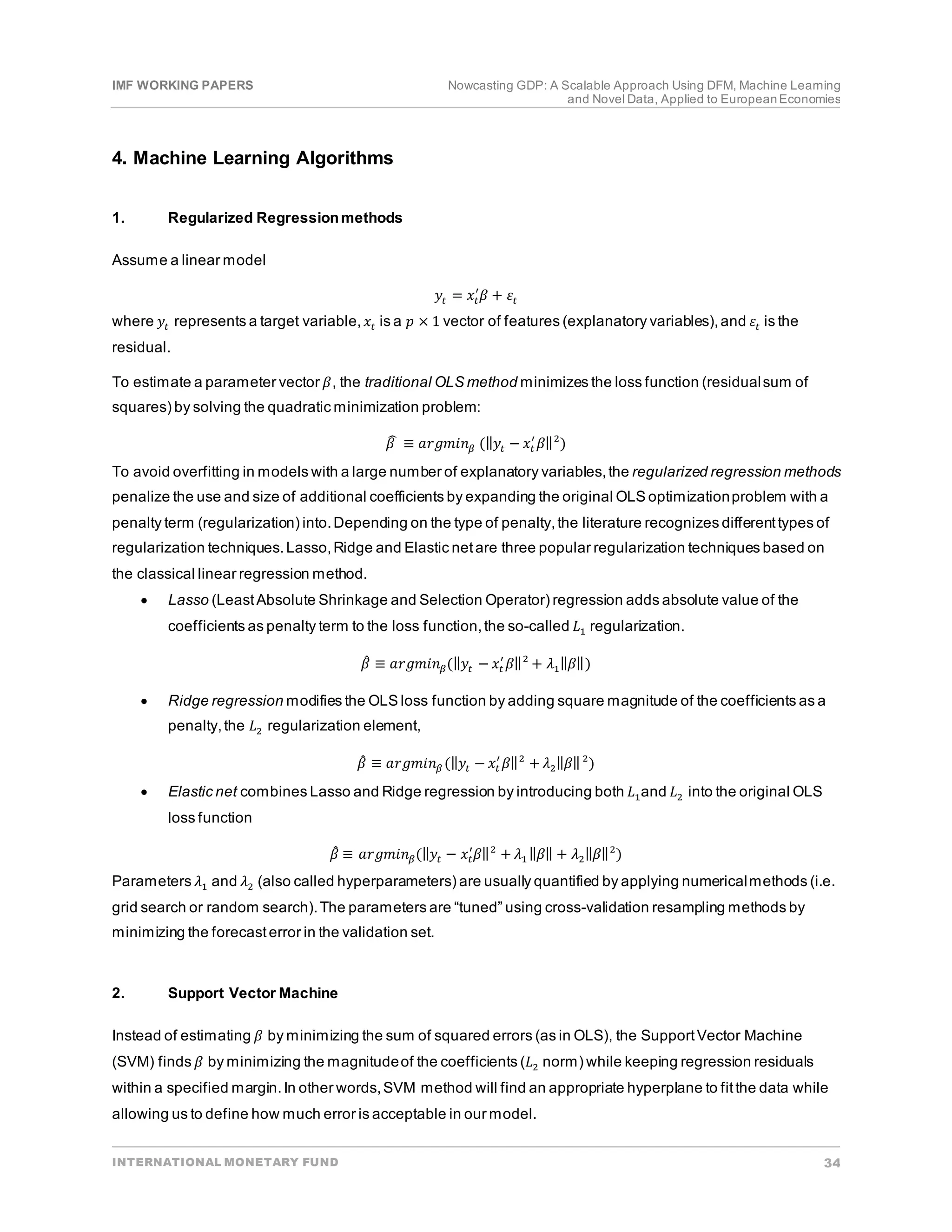
Rootmean squared error (RMSE):
𝑅𝑅𝑅𝑅𝑅𝑅𝑅𝑅 = �
∑ (𝑦𝑦𝑡𝑡 − 𝑦𝑦
�𝑡𝑡)2
𝑁𝑁
𝑡𝑡=1
𝑁𝑁
Mean absolute error (MAE):
𝑀𝑀𝑀𝑀𝑀𝑀 =
∑ 𝐴𝐴𝐴𝐴𝐴𝐴(𝑦𝑦𝑡𝑡 − 𝑦𝑦
�𝑡𝑡 )
𝑁𝑁
𝑡𝑡=1
𝑁𝑁
Mean Directional Accuracy (MDA):
𝑀𝑀𝑀𝑀𝑀𝑀 =
1
𝑁𝑁
∑1[𝑠𝑠𝑠𝑠𝑠𝑠(𝑦𝑦𝑡𝑡 − 𝑦𝑦𝑡𝑡−1) = 𝑠𝑠𝑠𝑠𝑠𝑠(𝑦𝑦
�𝑡𝑡 − 𝑦𝑦𝑡𝑡−1)],
where 1𝐴𝐴(x) = �
1 𝑖𝑖𝑖𝑖 𝑥𝑥 ∈ 𝐴𝐴
0 𝑖𝑖𝑖𝑖 𝑒𝑒𝑒𝑒𝑒𝑒𝑒𝑒
and 𝑠𝑠𝑠𝑠𝑠𝑠(x) = �
−1 𝑖𝑖𝑖𝑖 𝑥𝑥 < 0,
0 𝑖𝑖𝑖𝑖 𝑥𝑥 = 0,
1 𝑖𝑖𝑖𝑖 𝑥𝑥 > 0
The firsttwo indicators (RMSE and MAE) representmeasures of the average model prediction error.
By squaring the error terms,RMSE puts higher weights to large errors.It is a useful indicator to
compare predictive power of differentmodels particularly when large errors are present.While MAE is
only slightly differentin definition from the MSE,it has differentproperties as it assigns same weights
to both large and small errors.Thus,unlike the MSE, MAE is not putting too much weighton outliers
and it provides a generic measure of how well a model is performing.The MDA is a measure of
predictive accuracy thatindicates the probability with which a model forecastthe actual direction of a
time series.In other words,MDA compares the forecastdirection (upward or downward) to the actual
realized direction.
These statistics of predictive accuracynot only inform practitioners of how closely individual models
predict actual data but can also be used to derive weights when aggregating results from individual
models. For example,we have used the inverse RMSEs of each model as their weights to produce a weighted
average of their predictions.
A specific method may outperform others on a a particular data set,however,other methods may work
better on a different data set.3 Similarly―in the contextof nowcasting―a method may perform better during
specific episodes,i.e.,stable growth or a sharp contraction/revival in economic activity.As there is no criteria
for selecting a model a priori based on an individual country’s characteristics,selectinga proper method―for
any given set of data―that produces the bestresults is a critical step.To assess and compare the performance
3
Hastie (2009) or Gareth (2015) provide a more detailed discussion of this issue.
IMF WORKING PAPERS Nowcasting GDP: A Scalable Approach Using DFM, Machine Learning
and Novel Data, Applied to EuropeanEconomies
INTERNATIONAL MONETARY FUND 14
of alternative nowcasting tools during specific episodes,we perform the backtestand quantify the indicators of
predictive accuracy for all tools over:(i) the full sample as well as (ii) during normal times (2015 to 2019Q4),
and (iii) during the period of heightened volatility triggered by the COVID-19 pandemic (2020Q1 up to 2021q4).
Results
We applied the DFM and ML models to a set of six European countries and examinedwhether some of
the models tend to outperform our benchmark model—AR(1)— and the other models.4
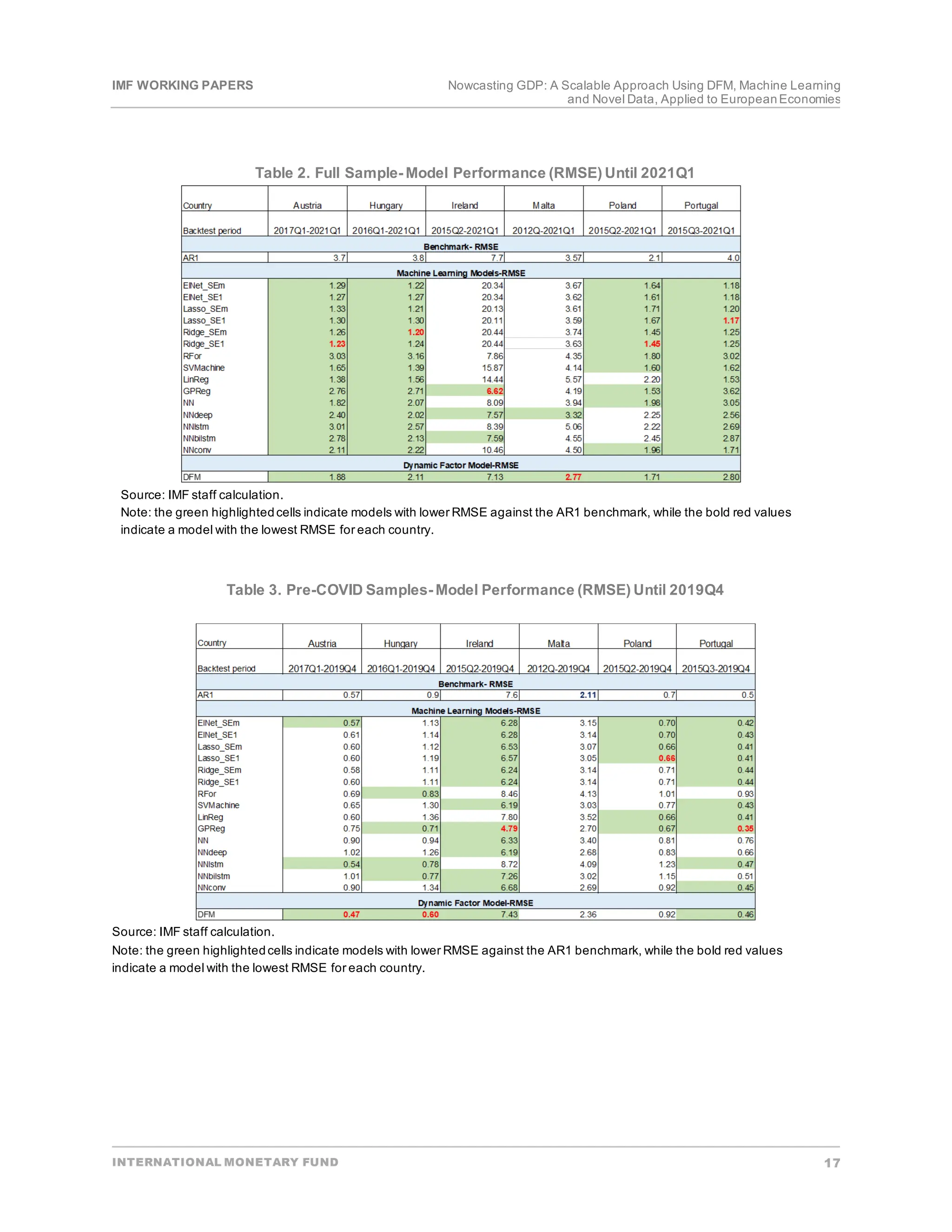
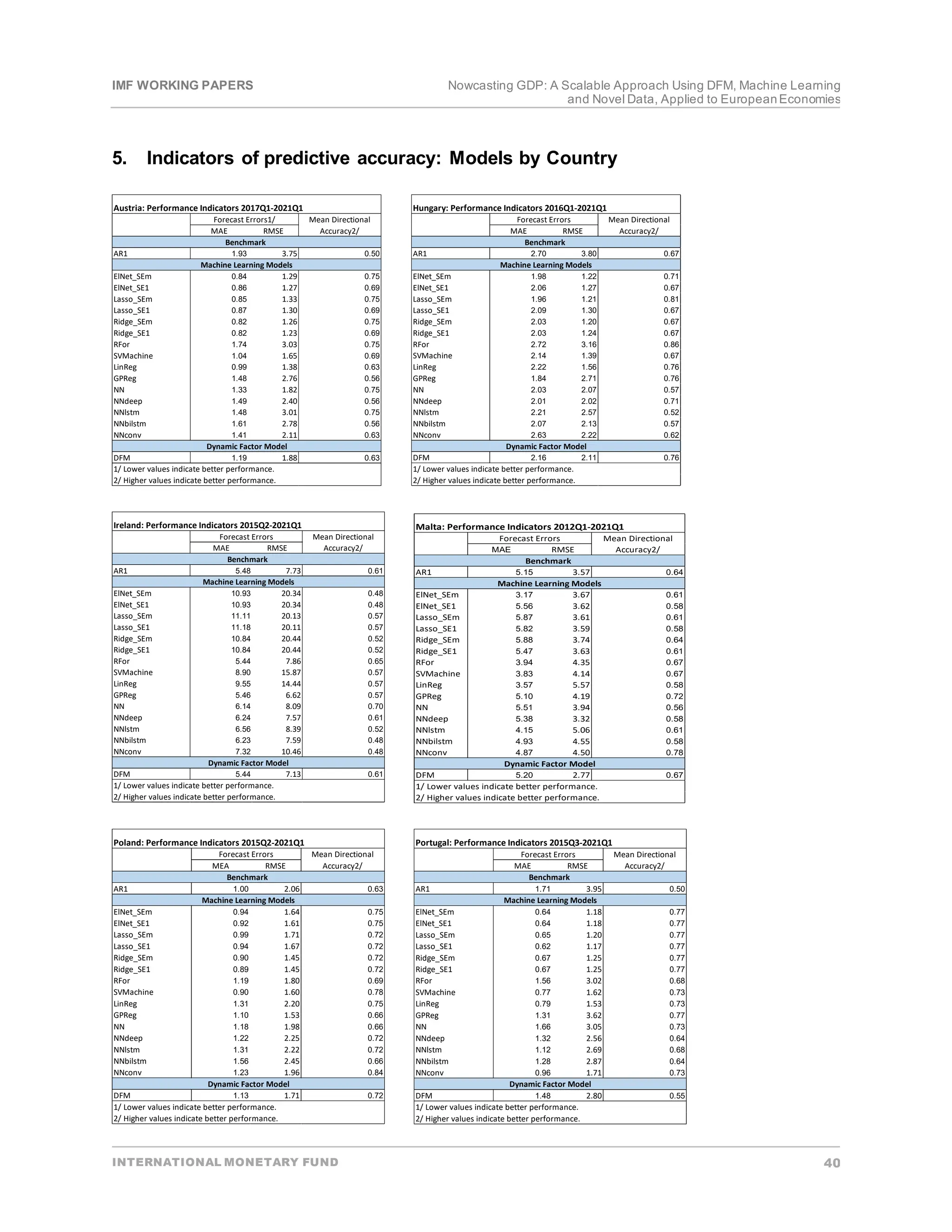
. Tables 2 to 4
presentRMSE of individual nowcasting models and the AR(1) benchmark model.5
The tables provide the
results for the six above mentionedcountries during three sample periods.Table 2 covers the full sample of
available data up to 2021Q1 while Table 3 and 4 provide results for the pre-COVID normal period (data up to
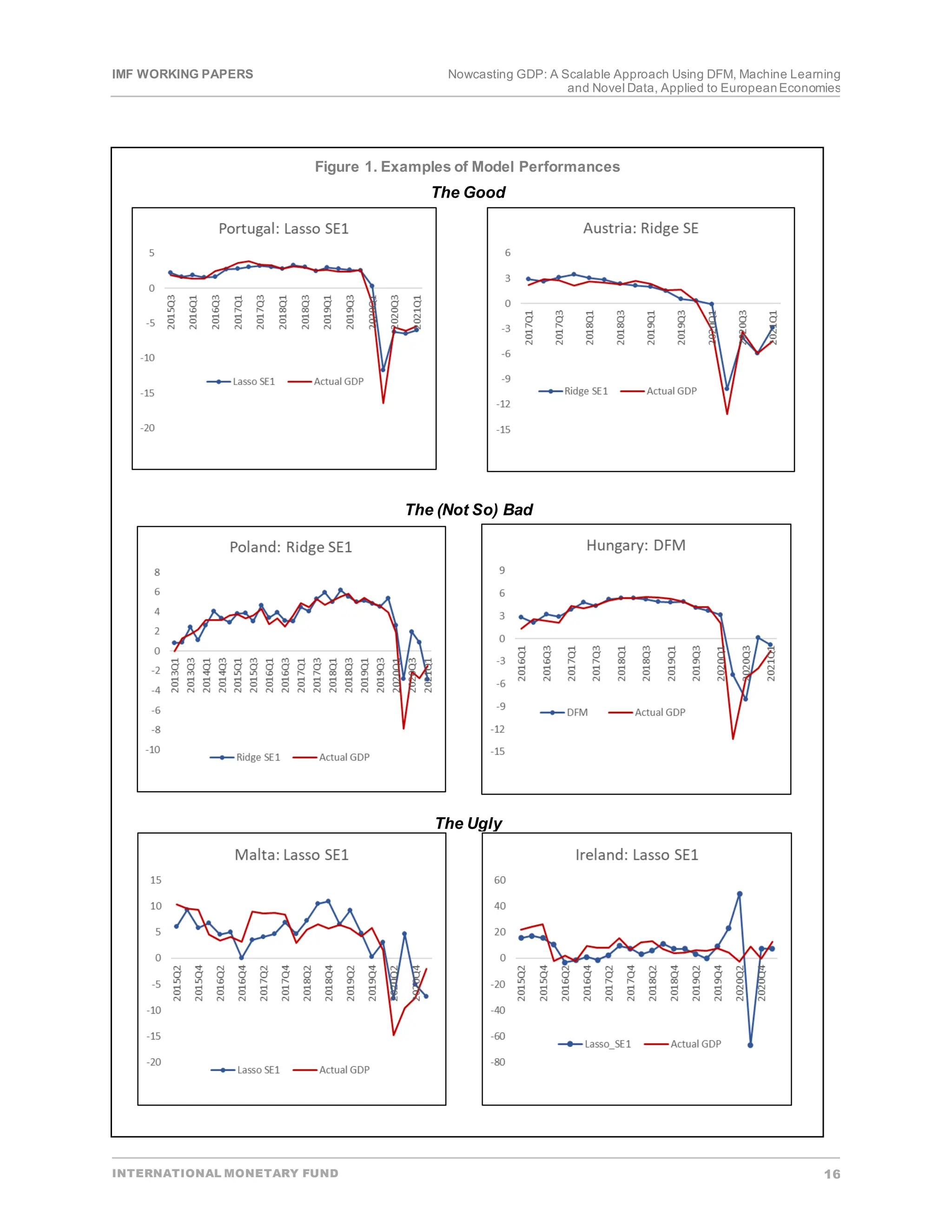
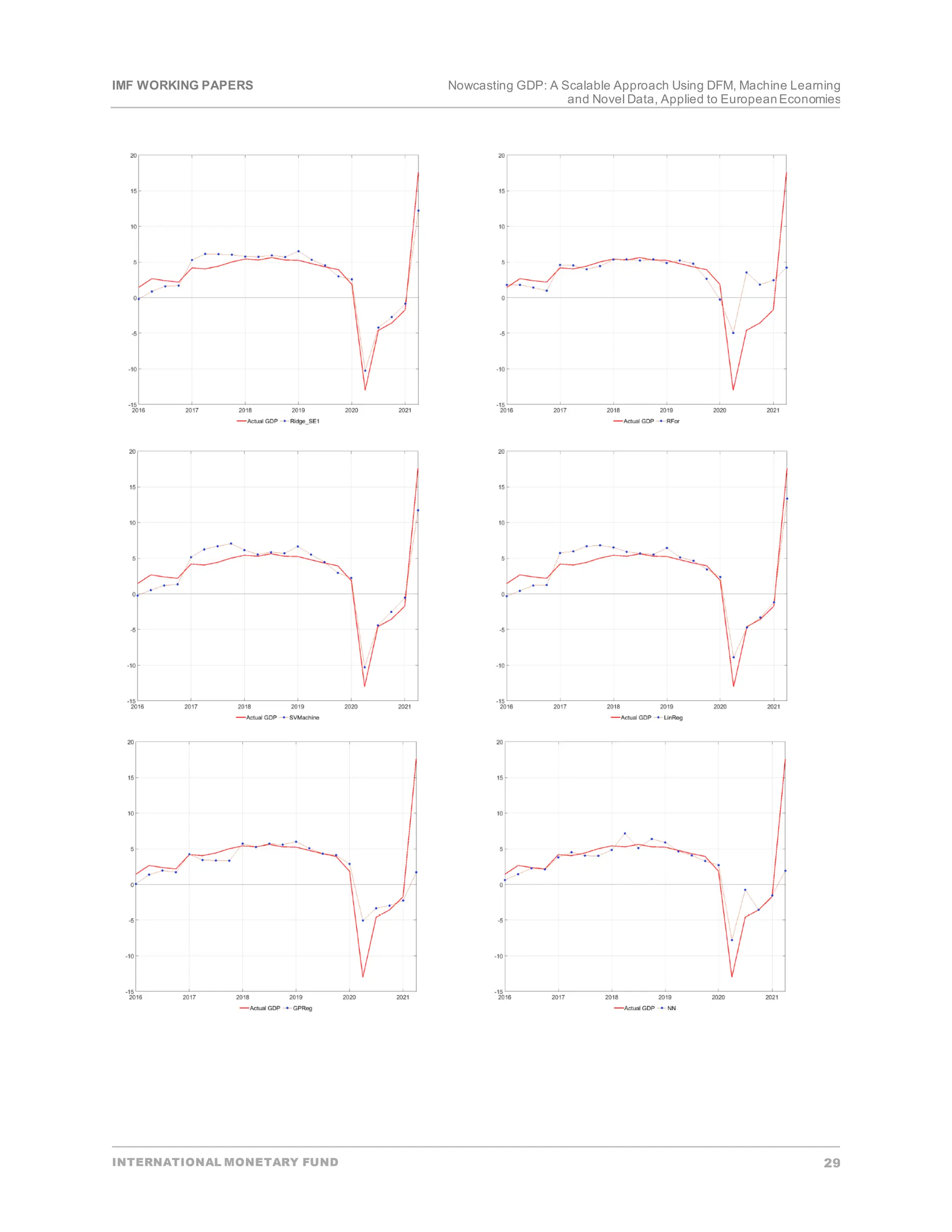
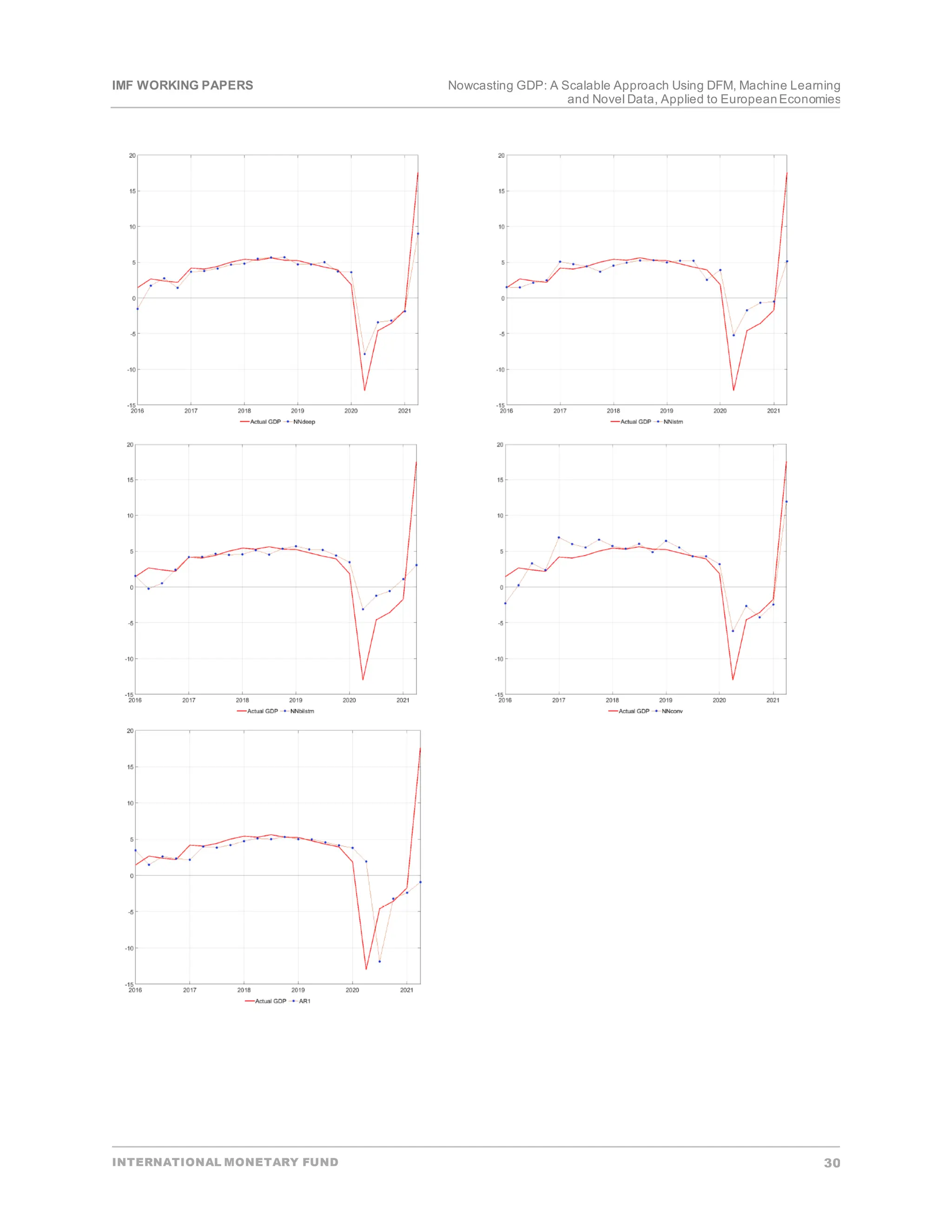
2019Q4) and the COVID pandemic period (2020Q1 to 2021Q1),respectively.Chart1 illustrates the variety of
fit quality we obtained across countries,models,and time periods.The findings from this exercise are specific
to our sample of countries and should notbe generalized.
The key findings from the results include the following:
• Both our DFM and ML models add value, especially during times of hightened volatility. Except
for Ireland and Malta, the DFM and ML models outperform AR(1) in a large majority of cases when
applyied to the whole sample(Table 2).The AR(1) performs quite well during a period of relatively
stable growth and frequently outperforms the other nowcasting models (Table 3).For example,the
AR(1) benchmark model performedbetter than several ML methods during normal times in case of
Austria, Hungary,Malta,and Poland.However,and notsurprisingly,the strength of the DFM and ML
models improved markedly duringthe COVID-19 pandemic (Table 4).In particular,exceptfor Ireland
and Malta, the Ridge regression and Lasso models could significantly reduce the average forecast
errors ranging from 40 to 75 percentrelative to the AR(1) benchmark during the pandemic.For DFM,
the forecasterrors are about50 percentlower than the AR(1) benchmark across all countries.
• The performance of individual models greatly differs across sub-samples (time periods). For
example,Ridge Regression and DFM perform well for Poland and Hungary,respectively,during
normal times butdid notdo well during COVID-19 period.Chart1―middle panel “NotSo
Good”―provides selected country examples of methods with differing performance during pre- and
during COVID periods.Tables 3 and 4 show a full setof the RMSEs for pre- and during COVID
periods.As expected,the RMSEs during normal times (pre-COVID) are lower than thatduring the
COVID period,where all countries experienced highly volatileeconomic growth.Focusing on the
period prior to the pandemic,Table 3 shows thatthe DFM performs relatively well—and often better
than many ML model—in case of many countries and is among the bestperformers for Austria,
Hungary,and Portugal.Nonetheless,the DFM model performed worse than the AR(1) benchmark for
Malta and Poland.For ML methods,Gaussian Process Regression (GPReg) generates the lowest
RSMEs for Ireland and Portugal during normal times,while Linear Regression (LinReg) performs the
best for Poland.The results are quite differentwhen considering nowcasting performances during the
COVID period (Table 4).Particularly,several ML methods appeared to perform better atcapturing
4
At the time of the writing of this paper, the group of countries have increased from six to 9, including Bulgaria, Russia, and
Slovenia.
5
The conclusions presentedin this section are based on RMSE solely. Appendix 4 provides additional results for MAE and MDA.
IMF WORKING PAPERS Nowcasting GDP: A Scalable Approach Using DFM, Machine Learning
and Novel Data, Applied to EuropeanEconomies
INTERNATIONAL MONETARY FUND 15
turning points—notably during 2020Q2-2020Q3—when comparing to both the AR(1) benchmark and
the DFM. This finding is in line with several papers,includingRichardson,Mulder,and Vehbi (2018);
and Soybilgen and Yazgan (2021).
• The performances of individual DFM and ML models can also greatly differ across countries.
Tables 2-4 and Panel Chart1demonstrate thatthere is no one-size-fit-all model.In other words,the
best model thatcaptures GDP dynamics are differentacross countries and across time.For example,
on the one hand,the DFM generates the lowestRMSE for Malta, while Ridge and LASSOperform the
best for Austria,Hungary,and Poland.On the other hand,LASSO does not track well actual GDP
growth in case of Malta and Ireland.
IMF WORKING PAPERS Nowcasting GDP: A Scalable Approach Using DFM, Machine Learning
and Novel Data, Applied to EuropeanEconomies
INTERNATIONAL MONETARY FUND 16
Figure 1. Examples of Model Performances
The Good
The (Not So) Bad
The Ugly
IMF WORKING PAPERS Nowcasting GDP: A Scalable Approach Using DFM, Machine Learning
and Novel Data, Applied to EuropeanEconomies
INTERNATIONAL MONETARY FUND 17
Table 2. Full Sample- Model Performance (RMSE) Until 2021Q1
Source: IMF staff calculation.
Note: the green highlightedcells indicate models with lower RMSE against the AR1 benchmark, while the bold red values
indicate a model with the lowest RMSE for each country.
Table 3. Pre-COVID Samples- Model Performance (RMSE) Until 2019Q4
Source: IMF staff calculation.
Note: the green highlightedcells indicate models with lower RMSE against the AR1 benchmark, while the bold red values
indicate a model with the lowest RMSE for each country.
IMF WORKING PAPERS Nowcasting GDP: A Scalable Approach Using DFM, Machine Learning
and Novel Data, Applied to EuropeanEconomies
INTERNATIONAL MONETARY FUND 18
Table 4. During COVID-19 Sample- Model Performance (RMSE) Between2020Q1-2021Q1
Source: IMF staff calculation.
Note: the green highlightedcells indicate models with lower RMSE against the AR1 benchmark, while the bold red values
indicate a model with the lowest RMSE for each country.
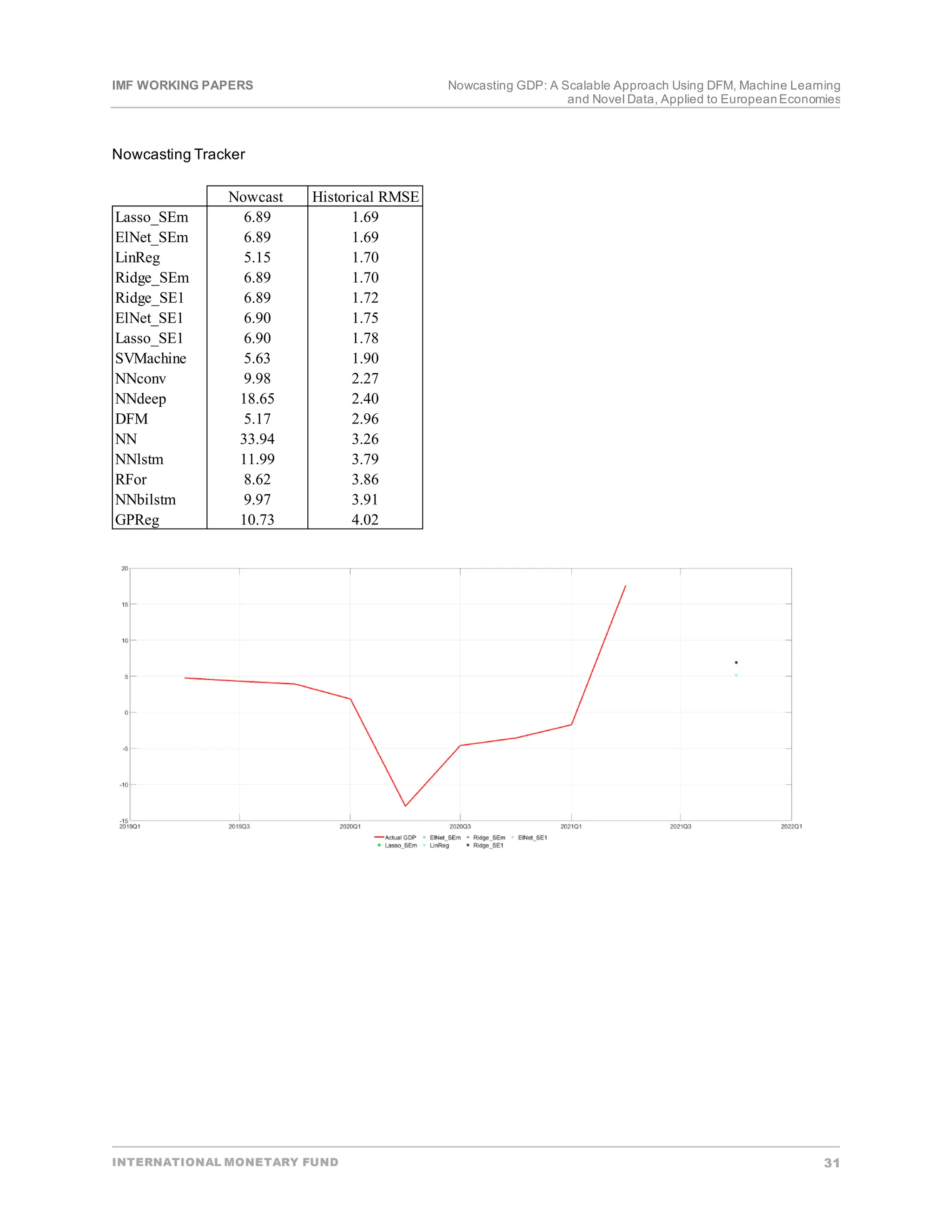
To operationalize our findings, we developed an integrated, fully-automated nowcasting tool. The tool
automatically (i) collects and treats the dataset; (ii) applies a suit of DFM and ML models to the datasetto
perform backtest(charts and indicators of forecasting accuracy);(iii) re-estimate the modeleach time new data
becomes available and produces a nowcastof the currentquarter GDP growth;and, (iv) generates an
aggregated outputfor all the methods across the whole period and the subsamples.Once variables to form the
datasethave been selected,the tool can be easily applied to any country,subjectto data availability
(Annex [2]).
Summary and Conclusion
The COVID-19 pandemic has underscoredthe need for timely data and methods, which allow for the
assessment of economies’current health. We motivate,compile,and discuss datasets for six European
economies and apply and compare traditional and new nowcasting methods for the period 1995Q1-2021Q4 as
well as during normal times (1995-2019) and during the COVID-19 pandemic (2020Q1 up to 2021q4).The
datasets comprise standard variables suggested by the literature as well as new variables thathave become
recently available such as Google Trends and air quality.We provide lists of variables,and their
transformations,for six European countries thatcan serve as examples for other economies.To avoid issues
linked to large datasets (collinearity between explanatory variables and model overfitting),we apply methods
capable of reducing the dimension of the original dataset.As a representative of a standard approach,we
apply a DFM following the New York Fed tradition.Building on the growing evidence of the usefulness of
machine learning methods in economics,we introduce several ML algorithms to our exercise.
Overall, we find that the tools we applied add value and have the power to inform the nowcast of the
current quarter GDP growth. Applying alternative methods and comparing their predictive capability on
historical data,we find that a strong majority of our methods outperform the AR(1) benchmark model.
Specifically,applying the ML methods reduced the average forecasterrors up to 75 percentand the DFM
reduced the forecasterror by half compared to the AR(1) model across all countries.Nonetheless,we found
IMF WORKING PAPERS Nowcasting GDP: A Scalable Approach Using DFM, Machine Learning
and Novel Data, Applied to EuropeanEconomies
INTERNATIONAL MONETARY FUND 19
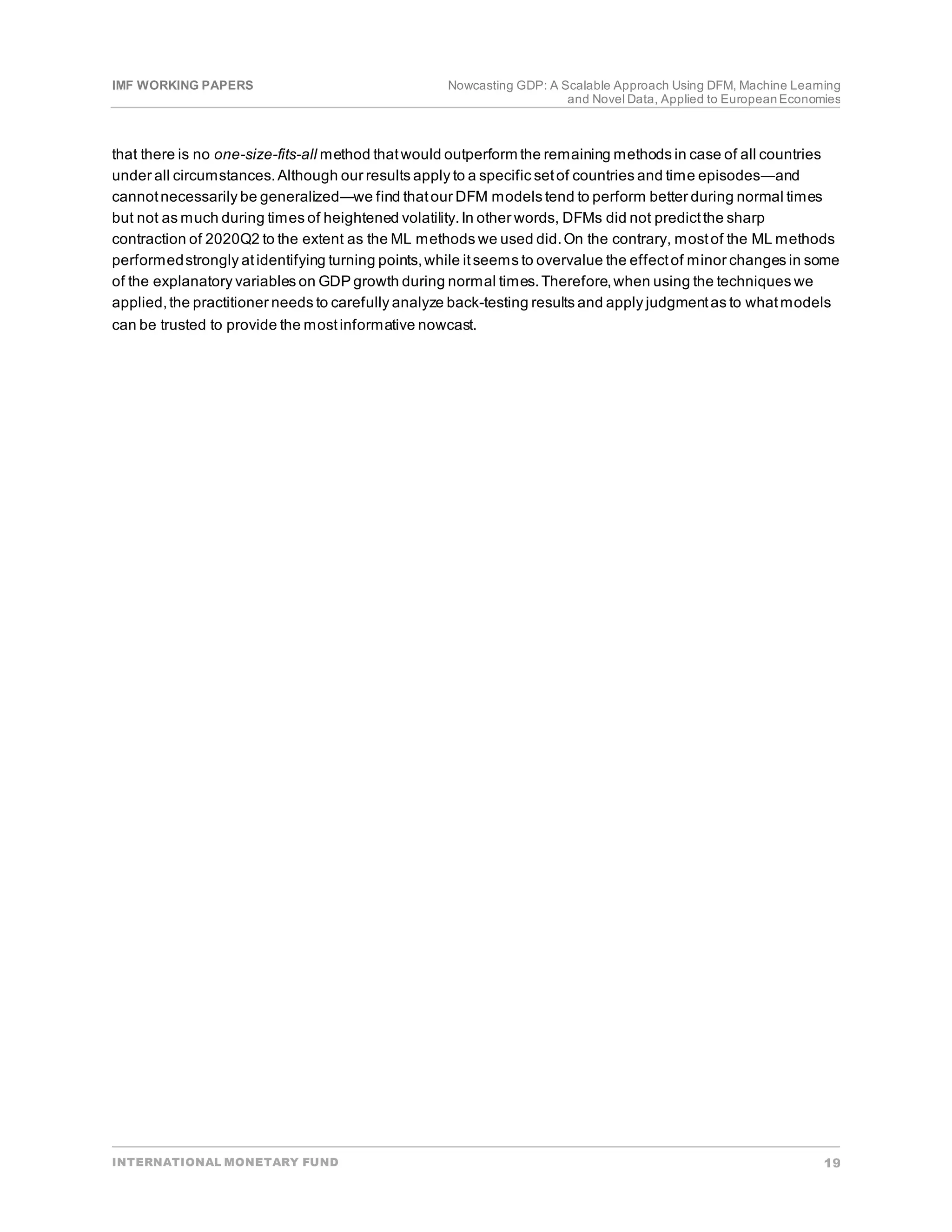
that there is no one-size-fits-all method thatwould outperform the remaining methods in case of all countries
under all circumstances.Although our results apply to a specific setof countries and time episodes―and
cannotnecessarily be generalized―we find thatour DFM models tend to perform better during normal times
but not as much during times of heightened volatility.In other words, DFMs did not predictthe sharp
contraction of 2020Q2 to the extent as the ML methods we used did.On the contrary, mostof the ML methods
performedstrongly atidentifying turning points,while itseems to overvalue the effectof minor changes in some
of the explanatory variables on GDP growth during normal times.Therefore,when using the techniques we
applied,the practitioner needs to carefully analyze back-testing results and apply judgmentas to whatmodels
can be trusted to provide the mostinformative nowcast.
IMF WORKING PAPERS Nowcasting GDP: A Scalable Approach Using DFM, Machine Learning
and Novel Data, Applied to EuropeanEconomies
INTERNATIONAL MONETARY FUND 20
Appendices
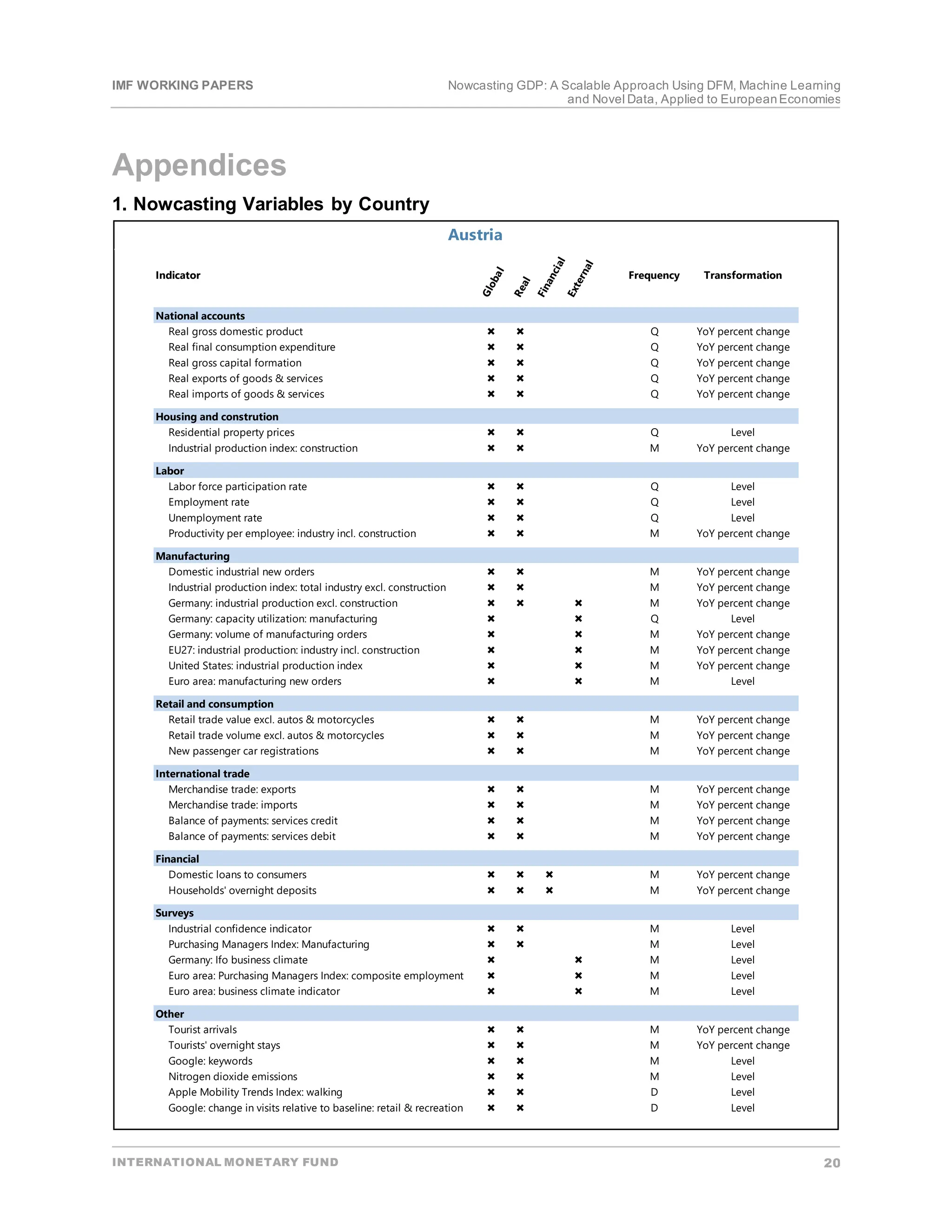
1. Nowcasting Variables by Country
Austria
G
l
o
b
a
l
R
e
a
l
F
i
n
a
n
c
i
a
l
E
x
t
e
r
n
a
l
Frequency Transformation
National accounts
Indicator
Real gross domestic product   Q YoY percent change
Real final consumption expenditure   Q YoY percent change
Real gross capital formation   Q YoY percent change
Real exports of goods & services   Q YoY percent change
Real imports of goods & services   Q YoY percent change
Housing and constrution
Residential property prices   Q Level
Industrial production index: construction   M YoY percent change
Labor
Labor force participation rate   Q Level
Employment rate   Q Level
Unemployment rate   Q Level
Productivity per employee: industry incl. construction   M YoY percent change
Manufacturing
Domestic industrial new orders   M YoY percent change
Industrial production index: total industry excl. construction   M YoY percent change
Germany: industrial production excl. construction    M YoY percent change
Germany: capacity utilization: manufacturing   Q Level
Germany: volume of manufacturing orders   M YoY percent change
EU27: industrial production: industry incl. construction   M YoY percent change
United States: industrial production index   M YoY percent change
Euro area: manufacturing new orders   M Level
Retail and consumption
Retail trade value excl. autos & motorcycles   M YoY percent change
Retail trade volume excl. autos & motorcycles   M YoY percent change
New passenger car registrations   M YoY percent change
International trade
Merchandise trade: exports   M YoY percent change
Merchandise trade: imports   M YoY percent change
Balance of payments: services credit   M YoY percent change
Balance of payments: services debit   M YoY percent change
Financial
Domestic loans to consumers    M YoY percent change
Households' overnight deposits    M YoY percent change
Surveys
Industrial confidence indicator   M Level
Purchasing Managers Index: Manufacturing   M Level
Germany: Ifo business climate   M Level
Euro area: Purchasing Managers Index: composite employment   M Level
Euro area: business climate indicator   M Level
Other
Tourist arrivals   M YoY percent change
Tourists' overnight stays   M YoY percent change
Google: keywords   M Level
Nitrogen dioxide emissions   M Level
Apple Mobility Trends Index: walking   D Level
Google: change in visits relative to baseline: retail & recreation   D Level
IMF WORKING PAPERS Nowcasting GDP: A Scalable Approach Using DFM, Machine Learning
and Novel Data, Applied to EuropeanEconomies
INTERNATIONAL MONETARY FUND 21
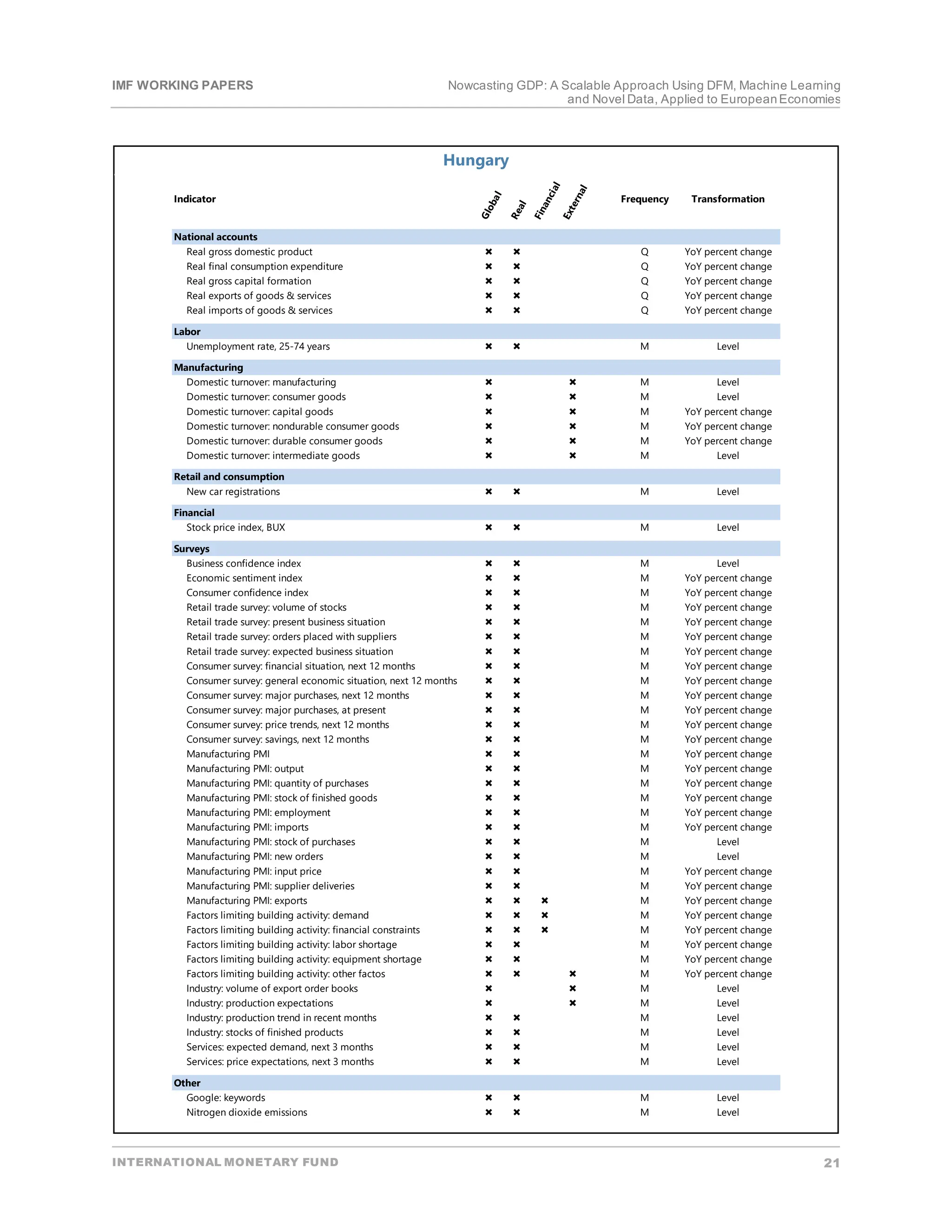
Hungary
G
l
o
b
a
l
R
e
a
l
F
i
n
a
n
c
i
a
l
E
x
t
e
r
n
a
l
Frequency Transformation
National accounts
Indicator
Real gross domestic product   Q YoY percent change
Real final consumption expenditure   Q YoY percent change
Real gross capital formation   Q YoY percent change
Real exports of goods & services   Q YoY percent change
Real imports of goods & services   Q YoY percent change
Labor
Unemployment rate, 25-74 years   M Level
Manufacturing
Domestic turnover: manufacturing   M Level
Domestic turnover: consumer goods   M Level
Domestic turnover: capital goods   M YoY percent change
Domestic turnover: nondurable consumer goods   M YoY percent change
Domestic turnover: durable consumer goods   M YoY percent change
Domestic turnover: intermediate goods   M Level
Retail and consumption
New car registrations   M Level
Financial
Stock price index, BUX   M Level
Surveys
Business confidence index   M Level
Economic sentiment index   M YoY percent change
Consumer confidence index   M YoY percent change
Retail trade survey: volume of stocks   M YoY percent change
Retail trade survey: present business situation   M YoY percent change
Retail trade survey: orders placed with suppliers   M YoY percent change
Retail trade survey: expected business situation   M YoY percent change
Consumer survey: financial situation, next 12 months   M YoY percent change
Consumer survey: general economic situation, next 12 months   M YoY percent change
Consumer survey: major purchases, next 12 months   M YoY percent change
Consumer survey: major purchases, at present   M YoY percent change
Consumer survey: price trends, next 12 months   M YoY percent change
Consumer survey: savings, next 12 months   M YoY percent change
Manufacturing PMI   M YoY percent change
Manufacturing PMI: output   M YoY percent change
Manufacturing PMI: quantity of purchases   M YoY percent change
Manufacturing PMI: stock of finished goods   M YoY percent change
Manufacturing PMI: employment   M YoY percent change
Manufacturing PMI: imports   M YoY percent change
Manufacturing PMI: stock of purchases   M Level
Manufacturing PMI: new orders   M Level
Manufacturing PMI: input price   M YoY percent change
Manufacturing PMI: supplier deliveries   M YoY percent change
Manufacturing PMI: exports    M YoY percent change
Factors limiting building activity: demand    M YoY percent change
Factors limiting building activity: financial constraints    M YoY percent change
Factors limiting building activity: labor shortage   M YoY percent change
Factors limiting building activity: equipment shortage   M YoY percent change
Factors limiting building activity: other factos    M YoY percent change
Industry: volume of export order books   M Level
Industry: production expectations   M Level
Industry: production trend in recent months   M Level
Industry: stocks of finished products   M Level
Services: expected demand, next 3 months   M Level
Services: price expectations, next 3 months   M Level
Other
Google: keywords   M Level
Nitrogen dioxide emissions   M Level
IMF WORKING PAPERS Nowcasting GDP: A Scalable Approach Using DFM, Machine Learning
and Novel Data, Applied to EuropeanEconomies
INTERNATIONAL MONETARY FUND 22
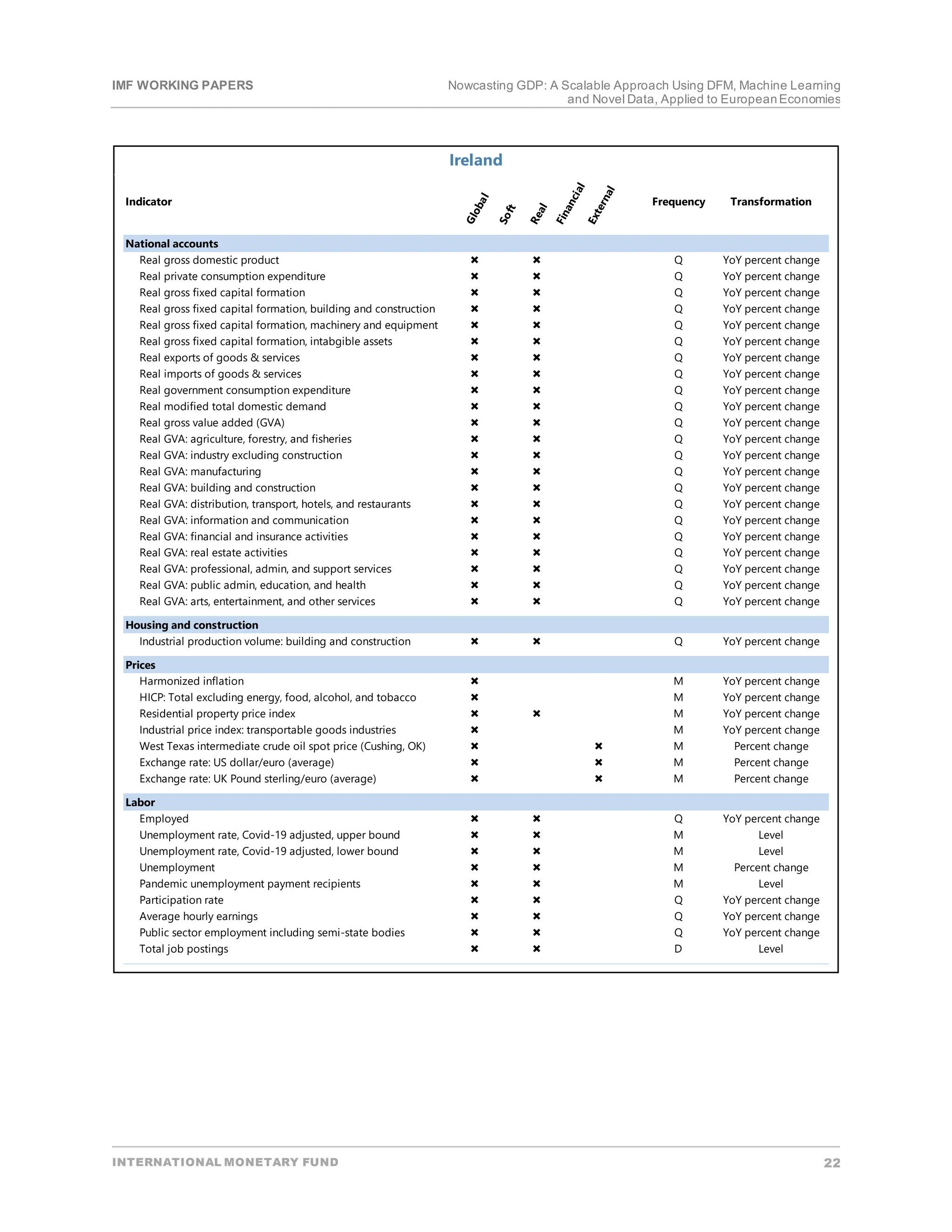
Ireland
G
l
o
b
a
l
S
o
f
t
R
e
a
l
F
i
n
a
n
c
i
a
l
E
x
t
e
r
n
a
l
Frequency Transformation
National accounts
Indicator
Real gross domestic product   Q YoY percent change
Real private consumption expenditure   Q YoY percent change
Real gross fixed capital formation   Q YoY percent change
Real gross fixed capital formation, building and construction   Q YoY percent change
Real gross fixed capital formation, machinery and equipment   Q YoY percent change
Real gross fixed capital formation, intabgible assets   Q YoY percent change
Real exports of goods & services   Q YoY percent change
Real imports of goods & services   Q YoY percent change
Real government consumption expenditure   Q YoY percent change
Real modified total domestic demand   Q YoY percent change
Real gross value added (GVA)   Q YoY percent change
Real GVA: agriculture, forestry, and fisheries   Q YoY percent change
Real GVA: industry excluding construction   Q YoY percent change
Real GVA: manufacturing   Q YoY percent change
Real GVA: building and construction   Q YoY percent change
Real GVA: distribution, transport, hotels, and restaurants   Q YoY percent change
Real GVA: information and communication   Q YoY percent change
Real GVA: financial and insurance activities   Q YoY percent change
Real GVA: real estate activities   Q YoY percent change
Real GVA: professional, admin, and support services   Q YoY percent change
Real GVA: public admin, education, and health   Q YoY percent change
Real GVA: arts, entertainment, and other services   Q YoY percent change
Housing and construction
Industrial production volume: building and construction   Q YoY percent change
Prices
Harmonized inflation  M YoY percent change
HICP: Total excluding energy, food, alcohol, and tobacco  M YoY percent change
Residential property price index   M YoY percent change
Industrial price index: transportable goods industries  M YoY percent change
West Texas intermediate crude oil spot price (Cushing, OK)   M Percent change
Exchange rate: US dollar/euro (average)   M Percent change
Exchange rate: UK Pound sterling/euro (average)   M Percent change
Labor
Employed   Q YoY percent change
Unemployment rate, Covid-19 adjusted, upper bound   M Level
Unemployment rate, Covid-19 adjusted, lower bound   M Level
Unemployment   M Percent change
Pandemic unemployment payment recipients   M Level
Participation rate   Q YoY percent change
Average hourly earnings   Q YoY percent change
Public sector employment including semi-state bodies   Q YoY percent change
Total job postings   D Level
IMF WORKING PAPERS Nowcasting GDP: A Scalable Approach Using DFM, Machine Learning
and Novel Data, Applied to EuropeanEconomies
INTERNATIONAL MONETARY FUND 23
G
l
o
b
a
l
S
o
f
t
R
e
a
l
F
i
n
a
n
c
i
a
l
E
x
t
e
r
n
a
l
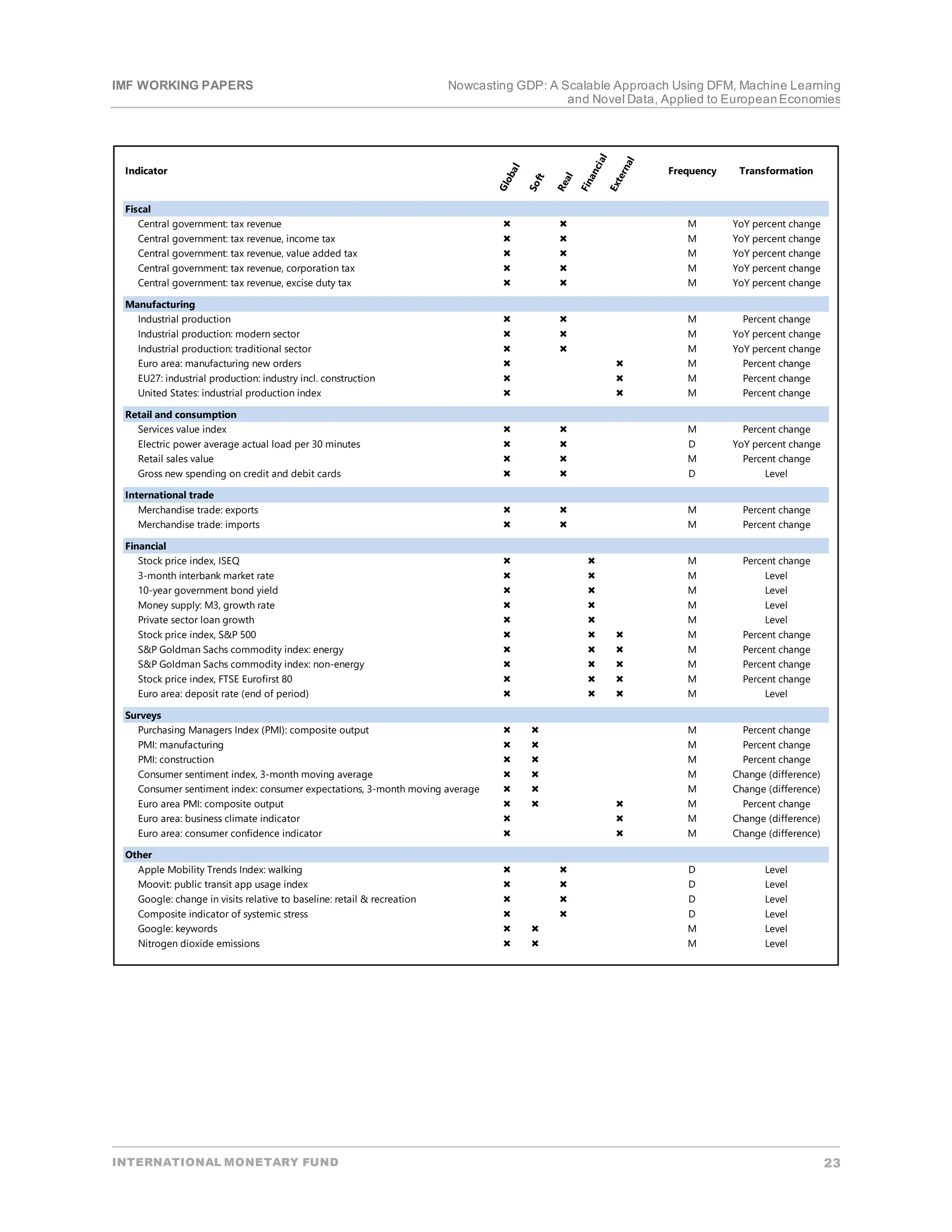
Frequency Transformation
Indicator
Fiscal
Central government: tax revenue   M YoY percent change
Central government: tax revenue, income tax   M YoY percent change
Central government: tax revenue, value added tax   M YoY percent change
Central government: tax revenue, corporation tax   M YoY percent change
Central government: tax revenue, excise duty tax   M YoY percent change
Manufacturing
Industrial production   M Percent change
Industrial production: modern sector   M YoY percent change
Industrial production: traditional sector   M YoY percent change
Euro area: manufacturing new orders   M Percent change
EU27: industrial production: industry incl. construction   M Percent change
United States: industrial production index   M Percent change
Retail and consumption
Services value index   M Percent change
Electric power average actual load per 30 minutes   D YoY percent change
Retail sales value   M Percent change
Gross new spending on credit and debit cards   D Level
International trade
Merchandise trade: exports   M Percent change
Merchandise trade: imports   M Percent change
Financial
Stock price index, ISEQ   M Percent change
3-month interbank market rate   M Level
10-year government bond yield   M Level
Money supply: M3, growth rate   M Level
Private sector loan growth   M Level
Stock price index, S&P 500    M Percent change
S&P Goldman Sachs commodity index: energy    M Percent change
S&P Goldman Sachs commodity index: non-energy    M Percent change
Stock price index, FTSE Eurofirst 80    M Percent change
Euro area: deposit rate (end of period)    M Level
Surveys
Purchasing Managers Index (PMI): composite output   M Percent change
PMI: manufacturing   M Percent change
PMI: construction   M Percent change
Consumer sentiment index, 3-month moving average   M Change (difference)
Consumer sentiment index: consumer expectations, 3-month moving average   M Change (difference)
Euro area PMI: composite output    M Percent change
Euro area: business climate indicator   M Change (difference)
Euro area: consumer confidence indicator   M Change (difference)
Other
Apple Mobility Trends Index: walking   D Level
Moovit: public transit app usage index   D Level
Google: change in visits relative to baseline: retail & recreation   D Level
Composite indicator of systemic stress   D Level
Google: keywords   M Level
Nitrogen dioxide emissions   M Level
IMF WORKING PAPERS Nowcasting GDP: A Scalable Approach Using DFM, Machine Learning
and Novel Data, Applied to EuropeanEconomies
INTERNATIONAL MONETARY FUND 24
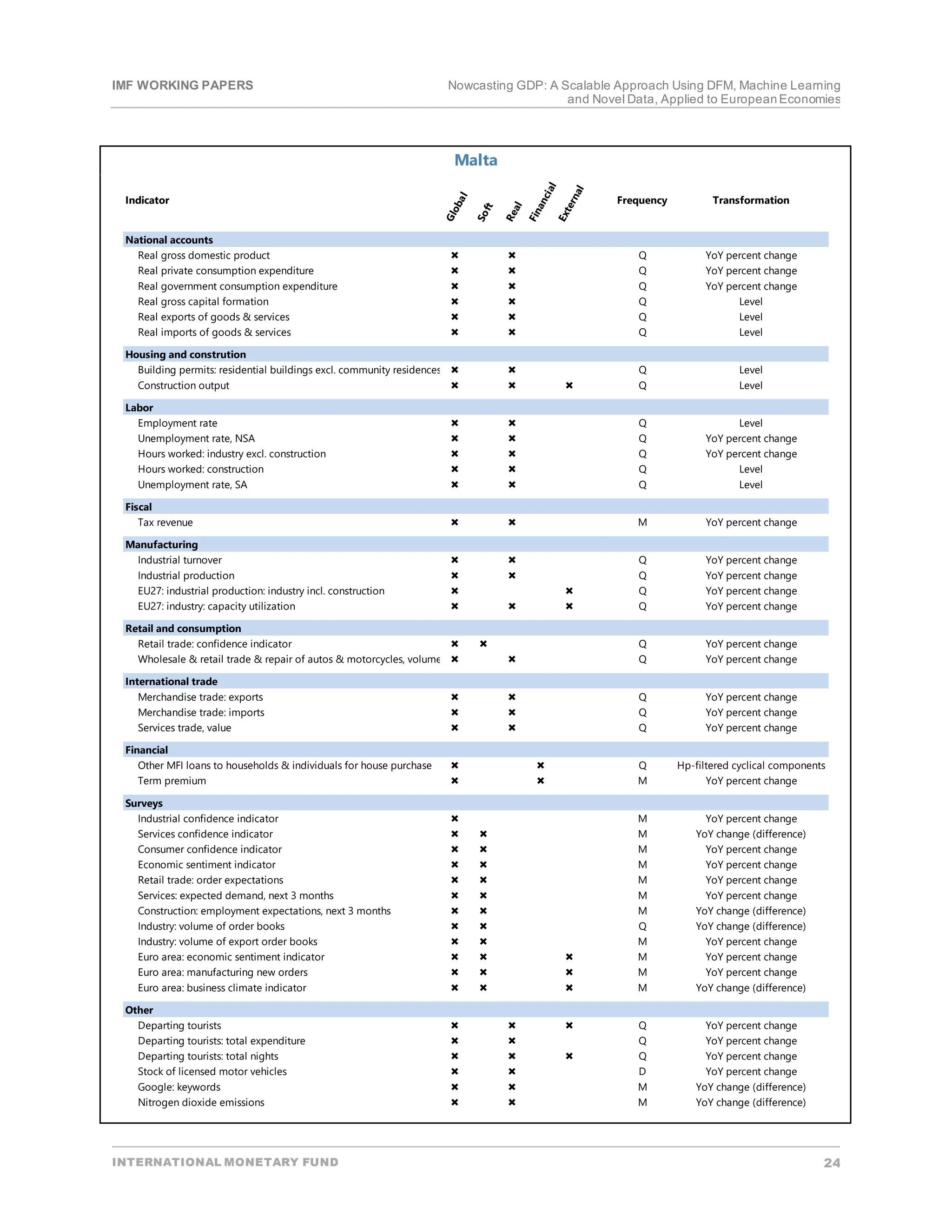
Malta
G
l
o
b
a
l
S
o
f
t
R
e
a
l
F
i
n
a
n
c
i
a
l
E
x
t
e
r
n
a
l
Frequency Transformation
National accounts
Indicator
Real gross domestic product   Q YoY percent change
Real private consumption expenditure   Q YoY percent change
Real government consumption expenditure   Q YoY percent change
Real gross capital formation   Q Level
Real exports of goods & services   Q Level
Real imports of goods & services   Q Level
Housing and constrution
Building permits: residential buildings excl. community residences   Q Level
Construction output    Q Level
Labor
Employment rate   Q Level
Unemployment rate, NSA   Q YoY percent change
Hours worked: industry excl. construction   Q YoY percent change
Hours worked: construction   Q Level
Unemployment rate, SA   Q Level
Fiscal
Tax revenue   M YoY percent change
Manufacturing
Industrial turnover   Q YoY percent change
Industrial production   Q YoY percent change
EU27: industrial production: industry incl. construction   Q YoY percent change
EU27: industry: capacity utilization    Q YoY percent change
Retail and consumption
Retail trade: confidence indicator   Q YoY percent change
Wholesale & retail trade & repair of autos & motorcycles, volume   Q YoY percent change
International trade
Merchandise trade: exports   Q YoY percent change
Merchandise trade: imports   Q YoY percent change
Services trade, value   Q YoY percent change
Financial
Other MFI loans to households & individuals for house purchase   Q Hp-filtered cyclical components
Term premium   M YoY percent change
Surveys
Industrial confidence indicator  M YoY percent change
Services confidence indicator   M YoY change (difference)
Consumer confidence indicator   M YoY percent change
Economic sentiment indicator   M YoY percent change
Retail trade: order expectations   M YoY percent change
Services: expected demand, next 3 months   M YoY percent change
Construction: employment expectations, next 3 months   M YoY change (difference)
Industry: volume of order books   Q YoY change (difference)
Industry: volume of export order books   M YoY percent change
Euro area: economic sentiment indicator    M YoY percent change
Euro area: manufacturing new orders    M YoY percent change
Euro area: business climate indicator    M YoY change (difference)
Other
Departing tourists    Q YoY percent change
Departing tourists: total expenditure   Q YoY percent change
Departing tourists: total nights    Q YoY percent change
Stock of licensed motor vehicles   D YoY percent change
Google: keywords   M YoY change (difference)
Nitrogen dioxide emissions   M YoY change (difference)
IMF WORKING PAPERS Nowcasting GDP: A Scalable Approach Using DFM, Machine Learning
and Novel Data, Applied to EuropeanEconomies
INTERNATIONAL MONETARY FUND 25
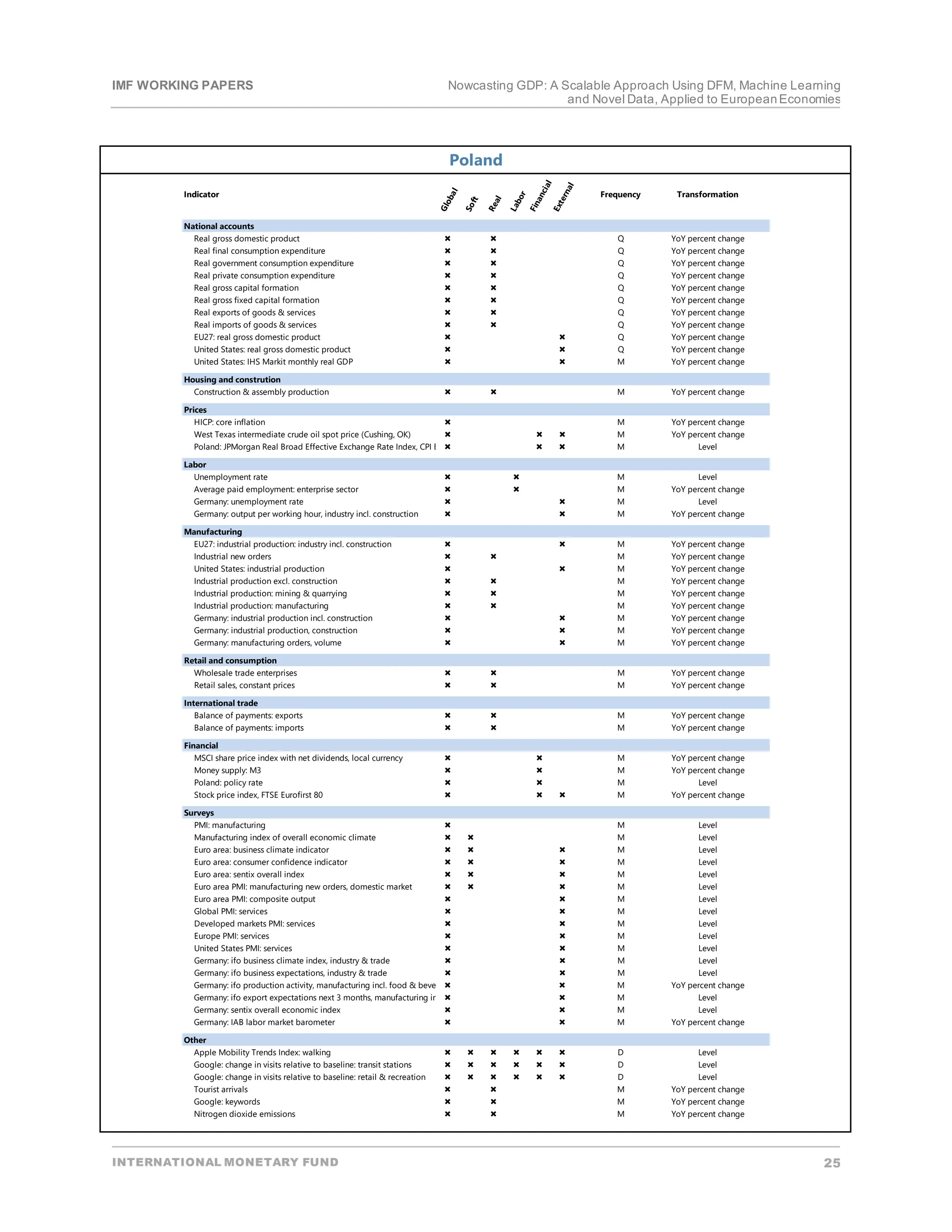
Poland
G
l
o
b
a
l
S
o
f
t
R
e
a
l
L
a
b
o
r
F
i
n
a
n
c
i
a
l
E
x
t
e
r
n
a
l
Frequency Transformation
National accounts
Indicator
Real gross domestic product   Q YoY percent change
Real final consumption expenditure   Q YoY percent change
Real government consumption expenditure   Q YoY percent change
Real private consumption expenditure   Q YoY percent change
Real gross capital formation   Q YoY percent change
Real gross fixed capital formation   Q YoY percent change
Real exports of goods & services   Q YoY percent change
Real imports of goods & services   Q YoY percent change
EU27: real gross domestic product   Q YoY percent change
United States: real gross domestic product   Q YoY percent change
United States: IHS Markit monthly real GDP   M YoY percent change
Housing and constrution
Construction & assembly production   M YoY percent change
Prices
HICP: core inflation  M YoY percent change
West Texas intermediate crude oil spot price (Cushing, OK)    M YoY percent change
Poland: JPMorgan Real Broad Effective Exchange Rate Index, CPI B    M Level
Labor
Unemployment rate   M Level
Average paid employment: enterprise sector   M YoY percent change
Germany: unemployment rate   M Level
Germany: output per working hour, industry incl. construction   M YoY percent change
Manufacturing
EU27: industrial production: industry incl. construction   M YoY percent change
Industrial new orders   M YoY percent change
United States: industrial production   M YoY percent change
Industrial production excl. construction   M YoY percent change
Industrial production: mining & quarrying   M YoY percent change
Industrial production: manufacturing   M YoY percent change
Germany: industrial production incl. construction   M YoY percent change
Germany: industrial production, construction   M YoY percent change
Germany: manufacturing orders, volume   M YoY percent change
Retail and consumption
Wholesale trade enterprises   M YoY percent change
Retail sales, constant prices   M YoY percent change
International trade
Balance of payments: exports   M YoY percent change
Balance of payments: imports   M YoY percent change
Financial
MSCI share price index with net dividends, local currency   M YoY percent change
Money supply: M3   M YoY percent change
Poland: policy rate   M Level
Stock price index, FTSE Eurofirst 80    M YoY percent change
Surveys
PMI: manufacturing  M Level
Manufacturing index of overall economic climate   M Level
Euro area: business climate indicator    M Level
Euro area: consumer confidence indicator    M Level
Euro area: sentix overall index    M Level
Euro area PMI: manufacturing new orders, domestic market    M Level
Euro area PMI: composite output   M Level
Global PMI: services   M Level
Developed markets PMI: services   M Level
Europe PMI: services   M Level
United States PMI: services   M Level
Germany: ifo business climate index, industry & trade   M Level
Germany: ifo business expectations, industry & trade   M Level
Germany: ifo production activity, manufacturing incl. food & beve   M YoY percent change
Germany: ifo export expectations next 3 months, manufacturing in   M Level
Germany: sentix overall economic index   M Level
Germany: IAB labor market barometer   M YoY percent change
Other
Apple Mobility Trends Index: walking       D Level
Google: change in visits relative to baseline: transit stations       D Level
Google: change in visits relative to baseline: retail & recreation       D Level
Tourist arrivals   M YoY percent change
Google: keywords   M YoY percent change
Nitrogen dioxide emissions   M YoY percent change
IMF WORKING PAPERS Nowcasting GDP: A Scalable Approach Using DFM, Machine Learning
and Novel Data, Applied to EuropeanEconomies
INTERNATIONAL MONETARY FUND 26
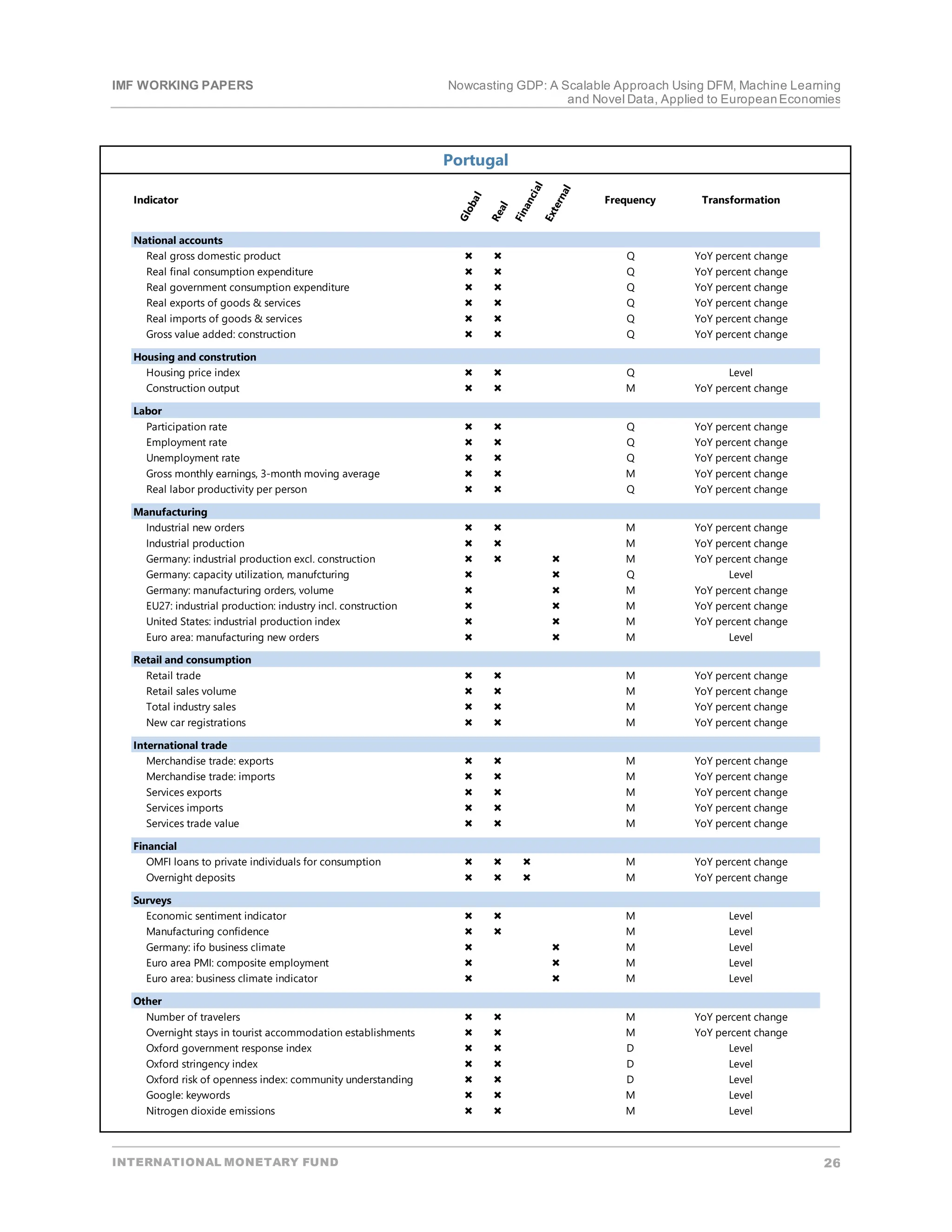
Portugal
G
l
o
b
a
l
R
e
a
l
F
i
n
a
n
c
i
a
l
E
x
t
e
r
n
a
l
Frequency Transformation
National accounts
Indicator
Real gross domestic product   Q YoY percent change
Real final consumption expenditure   Q YoY percent change
Real government consumption expenditure   Q YoY percent change
Real exports of goods & services   Q YoY percent change
Real imports of goods & services   Q YoY percent change
Gross value added: construction   Q YoY percent change
Housing and constrution
Housing price index   Q Level
Construction output   M YoY percent change
Labor
Participation rate   Q YoY percent change
Employment rate   Q YoY percent change
Unemployment rate   Q YoY percent change
Gross monthly earnings, 3-month moving average   M YoY percent change
Real labor productivity per person   Q YoY percent change
Manufacturing
Industrial new orders   M YoY percent change
Industrial production   M YoY percent change
Germany: industrial production excl. construction    M YoY percent change
Germany: capacity utilization, manufcturing   Q Level
Germany: manufacturing orders, volume   M YoY percent change
EU27: industrial production: industry incl. construction   M YoY percent change
United States: industrial production index   M YoY percent change
Euro area: manufacturing new orders   M Level
Retail and consumption
Retail trade   M YoY percent change
Retail sales volume   M YoY percent change
Total industry sales   M YoY percent change
New car registrations   M YoY percent change
International trade
Merchandise trade: exports   M YoY percent change
Merchandise trade: imports   M YoY percent change
Services exports   M YoY percent change
Services imports   M YoY percent change
Services trade value   M YoY percent change
Financial
OMFI loans to private individuals for consumption    M YoY percent change
Overnight deposits    M YoY percent change
Surveys
Economic sentiment indicator   M Level
Manufacturing confidence   M Level
Germany: ifo business climate   M Level
Euro area PMI: composite employment   M Level
Euro area: business climate indicator   M Level
Other
Number of travelers   M YoY percent change
Overnight stays in tourist accommodation establishments   M YoY percent change
Oxford government response index   D Level
Oxford stringency index   D Level
Oxford risk of openness index: community understanding   D Level
Google: keywords   M Level
Nitrogen dioxide emissions   M Level
IMF WORKING PAPERS Nowcasting GDP: A Scalable Approach Using DFM, Machine Learning
and Novel Data, Applied to EuropeanEconomies
INTERNATIONAL MONETARY FUND 27
2. Sample Results—Hungary
This appendix presents an example of a standardized setof results generated by the automated tool.These
specific results refer to Hungary as of November 2011.
The firstpart (Backtest) provides indicators (MFE,RMSE, and MDA) allowing for an assessmentof the
forecasting power of individual models included in the tool on historical data over three differentperiods
(2016Q1 to 2021Q2;2016Q1 to 2019Q4;and 2020Q1 to 2021Q2).The charts compare the actual GDP growth
with out-of-sample prediction by individual models.The indicators and the charts should provide some
guidance on the accuracy and reliability of individual models.
The second part(Nowcasting Tracker) presents currentquarter GDP growth as predicted by individual models.
The table presents results for individual models ranked by the size of their RMSE quantified on historical data,
e.g., lower RMSE indicates better predictive accuracy of a model on historical data.Finally,the nowcasting
chart presents historical GDP growth and the values expected for the currentquarter by the six mostaccurate
models.
Nowcasting models:Backtest
MFE RMSE MDA MFE RMSE MDA MFE RMSE MDA
DFM -0.202 2.893 0.81 -0.063 0.507 0.733 -0.574 5.477 1
ElNet_SEm -0.14 1.6 0.81 -0.133 1.132 0.733 -0.16 2.444 1
ElNet_SE1 -0.196 1.662 0.714 -0.248 1.146 0.6 -0.059 2.575 1
Lasso_SEm -0.129 1.591 0.857 -0.132 1.134 0.8 -0.121 2.419 1
Lasso_SE1 -0.201 1.691 0.762 -0.255 1.183 0.667 -0.059 2.599 1
Ridge_SEm -0.194 1.621 0.714 -0.231 1.109 0.6 -0.097 2.519 1
Ridge_SE1 -0.176 1.632 0.714 -0.234 1.108 0.6 -0.021 2.548 1
RFor -0.282 4.089 0.762 0.248 0.65 0.667 -1.695 7.758 1
SVMachine -0.186 1.827 0.714 -0.284 1.342 0.6 0.075 2.728 1
LinReg -0.262 1.707 0.81 -0.297 1.333 0.733 -0.168 2.438 1
GPReg 0.477 3.866 0.81 0.305 0.759 0.733 0.934 7.298 1
NN 0.341 3.685 0.619 0.119 0.792 0.467 0.931 6.937 1
NNdeep 0.281 2.315 0.762 0.368 0.881 0.667 0.047 4.194 1
NNlstm -0.07 3.351 0.714 0.174 0.736 0.6 -0.721 6.304 1
NNbilstm -0.081 4.024 0.571 0.269 0.989 0.4 -1.015 7.535 1
NNconv -0.363 2.374 0.762 -0.313 1.544 0.667 -0.499 3.782 1
AR1 0.571 5.374 0.714 0.204 0.862 0.667 1.547 10.193 0.8
Note: MFE … Mean Forecast Error, RMSE … Residual Mean Squared Error, and MDA… Mean Directional Accuracy
2016Q1 to 2021Q2 2016Q1 to 2019Q4 2020Q1 to 2021Q2
IMF WORKING PAPERS Nowcasting GDP: A Scalable Approach Using DFM, Machine Learning
and Novel Data, Applied to EuropeanEconomies
INTERNATIONAL MONETARY FUND 28
IMF WORKING PAPERS Nowcasting GDP: A Scalable Approach Using DFM, Machine Learning
and Novel Data, Applied to EuropeanEconomies
INTERNATIONAL MONETARY FUND 29
IMF WORKING PAPERS Nowcasting GDP: A Scalable Approach Using DFM, Machine Learning
and Novel Data, Applied to EuropeanEconomies
INTERNATIONAL MONETARY FUND 30
IMF WORKING PAPERS Nowcasting GDP: A Scalable Approach Using DFM, Machine Learning
and Novel Data, Applied to EuropeanEconomies
INTERNATIONAL MONETARY FUND 31
Nowcasting Tracker
Nowcast Historical RMSE
Lasso_SEm 6.89 1.69
ElNet_SEm 6.89 1.69
LinReg 5.15 1.70
Ridge_SEm 6.89 1.70
Ridge_SE1 6.89 1.72
ElNet_SE1 6.90 1.75
Lasso_SE1 6.90 1.78
SVMachine 5.63 1.90
NNconv 9.98 2.27
NNdeep 18.65 2.40
DFM 5.17 2.96
NN 33.94 3.26
NNlstm 11.99 3.79
RFor 8.62 3.86
NNbilstm 9.97 3.91
GPReg 10.73 4.02
IMF WORKING PAPERS Nowcasting GDP: A Scalable Approach Using DFM, Machine Learning
and Novel Data, Applied to EuropeanEconomies
INTERNATIONAL MONETARY FUND 32
3. An Integrated Tool
Using the methodologies described in this paper,we developped an integrated tool thatautomatically
(i) collectand treat the data set; (ii) applies a suit of DMF and ML models to the dataset to generate
backtest results (graphs and quantitative indicators),and (iii) nowcastGDP growth for the current
quarter for each method and aggregating all the methods.The tool can be applied to any country,and
is automated once variables to form the datasethave been selected.
The tool is developed in Matlab and is composed of three major components:the Data Warehouse,
the Backtest, and the Nowcasting Tracker.All three components are integrated by the Reports
Generator,which is a Matlab scriptthat serves as the main user interface (in addition to an Excel-
based file thatthe script reads from.) Normally,itis notnecessary for the users to modify or carefully
read the Matlab programs associated with the three underlying components,unless they would like to
add their own nowcasting method.Even in such cases,the modularity of the toolkitis designed for
easy addition of user-defined methods,as we highlightbelow.
All nowcasting methods,including the DFM and various machine learning algorithms,have their
respective standalone functions or scripts and are invoked as needed in the Backtest and Nowcasting
Tracker. Thanks to this modularity and standardized outputformatof the nowcasting methods,with
some familiarity to the toolkitstructure and the Matlab language,the user can proceed withoutspecial
assistance to add their customized nowcastmethods to the toolkit. Removing methods from the toolkit
is even more straightforward.
Following is a description of the design of each of the three components,i.e.the Data Warehouse,the
Backtest, and the Nowcasting Tracker.
Figure 1
The Data Warehouse is a Matlab script that fetches historical data from various data sources such as
Haver and Google.(Where necessary,R scripts are also invoked for retrieving from certaindata
IMF WORKING PAPERS Nowcasting GDP: A Scalable Approach Using DFM, Machine Learning
and Novel Data, Applied to EuropeanEconomies
INTERNATIONAL MONETARY FUND 33
sources.) The Matlab script receives instructions aboutwhatHaver series to fetch,what frequency the
data is in, and what data transformation to perform,etc., from an Excel file (the “Spec File,”) which is
part of the user interface and serves as inputto the Reports Generator,as shown in figure 1.
The Backtest performs out-of-sample pseudo-nowcasts on an expandingwindowof historical data,
and produces plots and accuracy metrics for the user to compare the performance of nowcasting
methods againstone another,as well as againstthe actual historical outturns.Specifically,out-of-
sample pseudo-nowcasts assume thatfor a certain historical quarter t = t’, GDP data is available up to
t’-1, and try to predictthe GDP for quarter t’. The backtest resultfor a given nowcasting method
combines n such out-of-sample nowcasts for t= t’, t’-1, …, t’-n+1, where n depends on historical data
availability and the user’s specification.
Finally,the Nowcasting Tracker produces actual nowcasts for the currentquarter using all or some of
the methods tested in the backtest.At this pointthe toolkithas completed a successful execution.A
table and a plot of GDP nowcasts are generated and saved for the user’s information.The user can
base their comprehensive judgementupon each method’s backtestperformance as well as their
knowledge on the economy concerned.
IMF WORKING PAPERS Nowcasting GDP: A Scalable Approach Using DFM, Machine Learning
and Novel Data, Applied to EuropeanEconomies
INTERNATIONAL MONETARY FUND 34
4. Machine Learning Algorithms
1. Regularized Regressionmethods
Assume a linear model
𝑦𝑦𝑡𝑡 = 𝑥𝑥𝑡𝑡
′
𝛽𝛽 + 𝜀𝜀𝑡𝑡
where 𝑦𝑦𝑡𝑡 represents a target variable,𝑥𝑥𝑡𝑡 is a 𝑝𝑝 × 1 vector of features (explanatory variables),and 𝜀𝜀𝑡𝑡 is the
residual.
To estimate a parameter vector 𝛽𝛽, the traditional OLS method minimizes the loss function (residualsum of
squares) by solving the quadratic minimization problem:
𝛽𝛽
� ≡ 𝑎𝑎𝑎𝑎𝑎𝑎𝑎𝑎𝑎𝑎𝑛𝑛𝛽𝛽 (‖𝑦𝑦𝑡𝑡 − 𝑥𝑥𝑡𝑡
′
𝛽𝛽‖2
)
To avoid overfitting in models with a large number of explanatory variables,the regularized regression methods
penalize the use and size of additional coefficients by expanding the original OLS optimizationproblem with a
penalty term (regularization) into.Depending on the type of penalty,the literature recognizes differenttypes of
regularization techniques.Lasso,Ridge and Elastic netare three popular regularization techniques based on
the classical linear regression method.
• Lasso (LeastAbsolute Shrinkage and Selection Operator) regression adds absolute value of the
coefficients as penalty term to the loss function,the so-called 𝐿𝐿1 regularization.
𝛽𝛽
̂ ≡ 𝑎𝑎𝑎𝑎𝑎𝑎𝑎𝑎𝑎𝑎𝑛𝑛𝛽𝛽(‖𝑦𝑦𝑡𝑡 − 𝑥𝑥𝑡𝑡
′
𝛽𝛽‖2
+ 𝜆𝜆1‖𝛽𝛽‖)
• Ridge regression modifies the OLS loss function by adding square magnitude of the coefficients as a
penalty,the 𝐿𝐿2 regularization element,
𝛽𝛽
̂ ≡ 𝑎𝑎𝑎𝑎𝑎𝑎𝑎𝑎𝑎𝑎𝑛𝑛𝛽𝛽 (‖𝑦𝑦𝑡𝑡 − 𝑥𝑥𝑡𝑡
′
𝛽𝛽‖2
+ 𝜆𝜆2‖𝛽𝛽‖2
)
• Elastic net combines Lasso and Ridge regression by introducing both 𝐿𝐿1and 𝐿𝐿2 into the original OLS
loss function
𝛽𝛽
̂ ≡ 𝑎𝑎𝑎𝑎𝑎𝑎𝑎𝑎𝑎𝑎𝑛𝑛𝛽𝛽(‖𝑦𝑦𝑡𝑡 − 𝑥𝑥𝑡𝑡
′
𝛽𝛽‖2
+ 𝜆𝜆1 ‖𝛽𝛽‖ + 𝜆𝜆2‖𝛽𝛽‖2
)
Parameters 𝜆𝜆1 and 𝜆𝜆2 (also called hyperparameters) are usually quantified by applying numericalmethods (i.e.
grid search or random search).The parameters are “tuned” using cross-validation resampling methods by
minimizing the forecasterror in the validation set.
2. Support Vector Machine
Instead of estimating 𝛽𝛽 by minimizing the sum of squared errors (as in OLS), the SupportVector Machine
(SVM) finds 𝛽𝛽 by minimizing the magnitudeof the coefficients (𝐿𝐿2 norm) while keeping regression residuals
within a specified margin.In other words,SVM method will find an appropriate hyperplane to fitthe data while
allowing us to define how much error is acceptable in our model.
IMF WORKING PAPERS Nowcasting GDP: A Scalable Approach Using DFM, Machine Learning
and Novel Data, Applied to EuropeanEconomies
INTERNATIONAL MONETARY FUND 35
Similar to linear regression,SVM is also a linear function in order to predictthe targetvariable 𝑦𝑦𝑡𝑡
𝑓𝑓(𝑥𝑥𝑡𝑡
) = 𝑥𝑥𝑡𝑡
′
𝛽𝛽 + 𝑏𝑏
Formally,SVM algorithm aims atfinding 𝑓𝑓(𝑥𝑥𝑡𝑡) as flatas possible while maintaining the forecasterror capped
within certain band.1 Thus,SVM will minimize its loss function by finding a combination of 𝛽𝛽 and observation-
specific positive slack constants 𝜉𝜉𝑡𝑡 and 𝜉𝜉𝑡𝑡
∗
:
1
2
𝛽𝛽′
𝛽𝛽 + 𝐶𝐶 �(𝜉𝜉𝑡𝑡 + 𝜉𝜉𝑡𝑡
∗
)
𝑇𝑇
𝑡𝑡=1
𝑠𝑠.𝑡𝑡. 𝑦𝑦𝑡𝑡 − 𝑓𝑓(𝑥𝑥𝑡𝑡
) ≤ 𝜀𝜀 + 𝜉𝜉𝑡𝑡
𝑓𝑓(𝑥𝑥𝑡𝑡 ) − 𝑦𝑦𝑡𝑡 ≤ 𝜀𝜀 + 𝜉𝜉𝑡𝑡
∗
Therefore,ateach point, the forecasterror is capped by [−𝜀𝜀, 𝜀𝜀], and can be relaxed by at most𝜉𝜉𝑡𝑡
∗
or 𝜉𝜉𝑡𝑡 at
higher or lower end.The constantC is the regularization hyperparameter and controls the trade-off between
minimizing errors and penalizing overfitting.If C = 0, the algorithm disregards individual deviations and
constructs the simplesthyperplane for which every observation is still within the acceptable margin of 𝜀𝜀.For
sufficiently largeC,the algorithm will constructthe mostcomplex hyperplane thatpredicts the outcome for the
training data with zero error (Bolhuis and Rayner 2020).
Chart[x]: A simple SVM to nowcastGDP
Note: The orange hyperplane is the prediction,while blue dots are actual observations.The model contains
40 regressors,while to visualize,we only use term premium and economic sentiment.
1
Bolhuis and Rayner (2020) define support vector machine(SVM) as an algorithm that constructs hyperplanes to partitionpredictor
combinations and make a point forecast for each of thesections.
IMF WORKING PAPERS Nowcasting GDP: A Scalable Approach Using DFM, Machine Learning
and Novel Data, Applied to EuropeanEconomies
INTERNATIONAL MONETARY FUND 36
In practice,the constraintoptimization problem can be solved using Lagrange dual formulation.2 Introducing
nonnegative Lagrangian multipliers 𝛼𝛼𝑡𝑡 and 𝛼𝛼𝑡𝑡
∗
for each observation 𝑋𝑋𝑡𝑡,the dual Lagrangian is as follows:
𝐿𝐿(𝛼𝛼) =
1
2
� �(𝛼𝛼𝑖𝑖 − 𝛼𝛼𝑖𝑖
∗
)�𝛼𝛼𝑗𝑗 − 𝛼𝛼𝑗𝑗
∗
�𝑥𝑥𝑖𝑖
′
𝑥𝑥𝑗𝑗 +
𝑇𝑇
𝑗𝑗=1
𝑇𝑇
𝑖𝑖=1
𝜀𝜀 �(𝛼𝛼𝑖𝑖 + 𝛼𝛼𝑖𝑖
∗
) + � 𝑦𝑦𝑖𝑖(𝛼𝛼𝑖𝑖
∗
− 𝛼𝛼𝑖𝑖)
𝑇𝑇
𝑖𝑖=1
𝑇𝑇
𝑖𝑖=1
𝑠𝑠.𝑡𝑡. �(𝛼𝛼𝑡𝑡 − 𝛼𝛼𝑡𝑡
∗) = 0
𝑇𝑇
𝑡𝑡=1
∀𝑡𝑡: 0 ≤ 𝛼𝛼𝑡𝑡 ≤ 𝐶𝐶
∀𝑡𝑡: 0 ≤ 𝛼𝛼𝑡𝑡
∗
≤ 𝐶𝐶
Solving the problem,we obtain
𝛽𝛽 = �(𝛼𝛼𝑡𝑡 − 𝛼𝛼𝑡𝑡
∗
)𝑥𝑥𝑡𝑡
𝑇𝑇
𝑡𝑡=1
and consequently for each new observation 𝑥𝑥,the prediction will be
𝑓𝑓(𝑥𝑥) = ∑ (𝛼𝛼𝑡𝑡 − 𝛼𝛼𝑡𝑡
∗)(𝑥𝑥𝑡𝑡
′
𝑥𝑥) + 𝑏𝑏
𝑇𝑇
𝑡𝑡=1 .
Replacing the dot product𝑥𝑥𝑗𝑗
′
𝑥𝑥𝑘𝑘 by other kernel functions,SVM can be applied to non-linear problems.
3. Random Forest
A decision tree is a non-parametric approach thatin each step iteratively splits a sample into two groups
chosen by the algorithm to yield the largestreduction in the forecasterror of the variable of interest(Bolhuis
and Rayner (2020)),the so-called recursive partitioning.Regression tree is nonparametric regression method
that allows for prediction of continuous variables (Chart[x]).Random forest (RF) is an ensemble method based
on a large number of individual decision (regression) trees created from differentsamples.
2
More details can be found in Drucker and others (1997).
IMF WORKING PAPERS Nowcasting GDP: A Scalable Approach Using DFM, Machine Learning
and Novel Data, Applied to EuropeanEconomies
INTERNATIONAL MONETARY FUND 37
Chart[x]: A simple regression tree to nowcastGDP
Note: each terminal node represents a region 𝑅𝑅𝑚𝑚.
A formal expression of a regression tree is
𝑓𝑓
̂(𝑥𝑥) = � 𝑐𝑐̂𝑚𝑚𝐼𝐼(𝑥𝑥 ∈ 𝑅𝑅𝑚𝑚)
𝑀𝑀
𝑚𝑚=1
where 𝐼𝐼(⋅) is the indicator function and 𝑐𝑐̂𝑚𝑚 = 𝑎𝑎𝑎𝑎𝑎𝑎(𝑦𝑦𝑖𝑖|𝑥𝑥𝑖𝑖 ∈ 𝑅𝑅𝑚𝑚),and 𝑅𝑅𝑚𝑚 is regions or the groups after iteratively
partitioned by the tree. The estimation then is seeking the optimized 𝑅𝑅𝑚𝑚 and 𝑐𝑐𝑚𝑚 to minimize the squared error:
min
{𝑅𝑅𝑚𝑚,𝑐𝑐𝑚𝑚}𝑚𝑚=1
𝑀𝑀
��𝑦𝑦𝑡𝑡 − 𝑓𝑓
̂(𝑥𝑥)�
2
A single regression tree tends to overfitdata butalso suffers from path dependence and model instability due
to its reliance on local rather than global optimization.These drawbacks have been addressed by RF. As an
ensemble method,RF uses the bootstrap aggregation (‘bagging’) to create a forestof individual trees,each of
which is estimated by a randomly chosen subsample of the observations as well as the predictors.For
regression tasks,the mean or average prediction of the individual trees is returned.
IMF WORKING PAPERS Nowcasting GDP: A Scalable Approach Using DFM, Machine Learning
and Novel Data, Applied to EuropeanEconomies
INTERNATIONAL MONETARY FUND 38
4. NeuralNetwork
Neural network (NN) is a multi-layer non-linear method to map a series of inputs to a target output.Each layer
contains multiple nodes called artificial neurons. Each node receives inputs either from the inputdata matrix or
from nodes in previous layers and passes its outputeither to nodes in the next layer or as the final outputof the
model.Ateach node,a weighted sum of the inputs is transformed by a non-linear function 𝑓𝑓(⋅) to generate the
output. Typical functions used in neural networks include the rectified linear unit(ReLU) 𝑓𝑓(𝑧𝑧) = max(0,𝑧𝑧), as
well as hyperbolic tangent𝑓𝑓(𝑧𝑧) = (𝑒𝑒𝑧𝑧
− 𝑒𝑒−𝑧𝑧
)/(𝑒𝑒𝑧𝑧
+ 𝑒𝑒−𝑧𝑧
) or logistic function 𝑓𝑓(𝑧𝑧) = 1/(1 + 𝑒𝑒−𝑧𝑧
).
Given the structure of a NN,there is no closed form solution thatcould be estimated.Instead,NN is trained
using stochastic gradientdescentmethod,which (i) generates random weights,(ii) calculates the loss function
between the target variable and the outputpredicted based on these random weights,and (iii) minimizes the
loss function by adjusting weights with calculated gradients (LeCun Bengioand Hinton 2015).
Chart[x]: A simple neural network to nowcastGDP
Note: Each node represents a function 𝑓𝑓(⋅) transforming inputs to outputs.Each link represents the
weight,while black line means positive weight,gray line means negative weight.
In a standard setting,NN is feedforward and fully connected,meaning thatoutputfrom a specific node of each
layer will flow unidirectionally to all other the nodes in the nextlayer. Given the high flexibility in designing
and/or adding layers,several popular variations of NN are also introduced in our toolkit:
• The long short-term memory (LSTM) is a subtype of the larger class recursive neural networks (RNN),
which adds feedback connections in addition to the feedforward connections in classical NN.Such
modification makes LSTM more suitablefor time series prediction.
IMF WORKING PAPERS Nowcasting GDP: A Scalable Approach Using DFM, Machine Learning
and Novel Data, Applied to EuropeanEconomies
INTERNATIONAL MONETARY FUND 39
• Convolutional neural network (CNN) introduces the so-called convolutional and poolinglayers to
addresses computational issues caused by fully connected layers.Compared to networks with full
connectivity between adjacentlayers,CNN is much easier and significantly faster to train (LeCun
Bengio and Hinton 2015).
IMF WORKING PAPERS Nowcasting GDP: A Scalable Approach Using DFM, Machine Learning
and Novel Data, Applied to EuropeanEconomies
INTERNATIONAL MONETARY FUND 40
5. Indicators of predictive accuracy: Models by Country
Austria: Performance Indicators 2017Q1-2021Q1
MAE RMSE
AR1 1.93 3.75 0.50
ElNet_SEm 0.84 1.29 0.75
ElNet_SE1 0.86 1.27 0.69
Lasso_SEm 0.85 1.33 0.75
Lasso_SE1 0.87 1.30 0.69
Ridge_SEm 0.82 1.26 0.75
Ridge_SE1 0.82 1.23 0.69
RFor 1.74 3.03 0.75
SVMachine 1.04 1.65 0.69
LinReg 0.99 1.38 0.63
GPReg 1.48 2.76 0.56
NN 1.33 1.82 0.75
NNdeep 1.49 2.40 0.56
NNlstm 1.48 3.01 0.75
NNbilstm 1.61 2.78 0.56
NNconv 1.41 2.11 0.63
DFM 1.19 1.88 0.63
1/ Lower values indicate better performance.
2/ Higher values indicate better performance.
Machine Learning Models
Dynamic Factor Model
Benchmark
Forecast Errors1/ Mean Directional
Accuracy2/
Hungary: Performance Indicators 2016Q1-2021Q1
MAE RMSE
AR1 2.70 3.80 0.67
ElNet_SEm 1.98 1.22 0.71
ElNet_SE1 2.06 1.27 0.67
Lasso_SEm 1.96 1.21 0.81
Lasso_SE1 2.09 1.30 0.67
Ridge_SEm 2.03 1.20 0.67
Ridge_SE1 2.03 1.24 0.67
RFor 2.72 3.16 0.86
SVMachine 2.14 1.39 0.67
LinReg 2.22 1.56 0.76
GPReg 1.84 2.71 0.76
NN 2.03 2.07 0.57
NNdeep 2.01 2.02 0.71
NNlstm 2.21 2.57 0.52
NNbilstm 2.07 2.13 0.57
NNconv 2.63 2.22 0.62
DFM 2.16 2.11 0.76
1/ Lower values indicate better performance.
2/ Higher values indicate better performance.
Machine Learning Models
Dynamic Factor Model
Benchmark
Forecast Errors Mean Directional
Accuracy2/
Ireland: Performance Indicators 2015Q2-2021Q1
MAE RMSE
AR1 5.48 7.73 0.61
ElNet_SEm 10.93 20.34 0.48
ElNet_SE1 10.93 20.34 0.48
Lasso_SEm 11.11 20.13 0.57
Lasso_SE1 11.18 20.11 0.57
Ridge_SEm 10.84 20.44 0.52
Ridge_SE1 10.84 20.44 0.52
RFor 5.44 7.86 0.65
SVMachine 8.90 15.87 0.57
LinReg 9.55 14.44 0.57
GPReg 5.46 6.62 0.57
NN 6.14 8.09 0.70
NNdeep 6.24 7.57 0.61
NNlstm 6.56 8.39 0.52
NNbilstm 6.23 7.59 0.48
NNconv 7.32 10.46 0.48
DFM 5.44 7.13 0.61
1/ Lower values indicate better performance.
2/ Higher values indicate better performance.
Machine Learning Models
Dynamic Factor Model
Benchmark
Forecast Errors Mean Directional
Accuracy2/
Malta: Performance Indicators 2012Q1-2021Q1
MAE RMSE
AR1 5.15 3.57 0.64
ElNet_SEm 3.17 3.67 0.61
ElNet_SE1 5.56 3.62 0.58
Lasso_SEm 5.87 3.61 0.61
Lasso_SE1 5.82 3.59 0.58
Ridge_SEm 5.88 3.74 0.64
Ridge_SE1 5.47 3.63 0.61
RFor 3.94 4.35 0.67
SVMachine 3.83 4.14 0.67
LinReg 3.57 5.57 0.58
GPReg 5.10 4.19 0.72
NN 5.51 3.94 0.56
NNdeep 5.38 3.32 0.58
NNlstm 4.15 5.06 0.61
NNbilstm 4.93 4.55 0.58
NNconv 4.87 4.50 0.78
DFM 5.20 2.77 0.67
1/ Lower values indicate better performance.
2/ Higher values indicate better performance.
Machine Learning Models
Dynamic Factor Model
Benchmark
Forecast Errors Mean Directional
Accuracy2/
Poland: Performance Indicators 2015Q2-2021Q1
MEA RMSE
AR1 1.00 2.06 0.63
ElNet_SEm 0.94 1.64 0.75
ElNet_SE1 0.92 1.61 0.75
Lasso_SEm 0.99 1.71 0.72
Lasso_SE1 0.94 1.67 0.72
Ridge_SEm 0.90 1.45 0.72
Ridge_SE1 0.89 1.45 0.72
RFor 1.19 1.80 0.69
SVMachine 0.90 1.60 0.78
LinReg 1.31 2.20 0.75
GPReg 1.10 1.53 0.66
NN 1.18 1.98 0.66
NNdeep 1.22 2.25 0.72
NNlstm 1.31 2.22 0.72
NNbilstm 1.56 2.45 0.66
NNconv 1.23 1.96 0.84
DFM 1.13 1.71 0.72
1/ Lower values indicate better performance.
2/ Higher values indicate better performance.
Machine Learning Models
Dynamic Factor Model
Benchmark
Forecast Errors Mean Directional
Accuracy2/
Portugal: Performance Indicators 2015Q3-2021Q1
MAE RMSE
AR1 1.71 3.95 0.50
ElNet_SEm 0.64 1.18 0.77
ElNet_SE1 0.64 1.18 0.77
Lasso_SEm 0.65 1.20 0.77
Lasso_SE1 0.62 1.17 0.77
Ridge_SEm 0.67 1.25 0.77
Ridge_SE1 0.67 1.25 0.77
RFor 1.56 3.02 0.68
SVMachine 0.77 1.62 0.73
LinReg 0.79 1.53 0.73
GPReg 1.31 3.62 0.77
NN 1.66 3.05 0.73
NNdeep 1.32 2.56 0.64
NNlstm 1.12 2.69 0.68
NNbilstm 1.28 2.87 0.64
NNconv 0.96 1.71 0.73
DFM 1.48 2.80 0.55
1/ Lower values indicate better performance.
2/ Higher values indicate better performance.
Machine Learning Models
Dynamic Factor Model
Benchmark
Forecast Errors Mean Directional
Accuracy2/
IMF WORKING PAPERS Nowcasting GDP: A Scalable Approach Using DFM, Machine Learning
and Novel Data, Applied to EuropeanEconomies
INTERNATIONAL MONETARY FUND 41
References
Antolin-Diaz J.,Drechsel T., and Petrella I., 2021.“Advances in Nowcasting Economic Activity:Secular Trends,
Large Shocks and New Data”, CEPR Discussion Papers 15926,C.E.P.R. Discussion Papers.
AmatC., Michalski T., and Stoltz G., 2018."Fundamentals and exchange rate forecastability with simple
machine learning methods,"Journal of International Money and Finance,Elsevier,vol.88(C),pages 1-24.
Athey S., (2019),“The Impactof Machine Learning on Economics”,in The Economics of Artificial Intelligence:
An Agenda,University of Chicago Press.
Bańbura M., Giannone,D., Modugno,M.and Reichlin,L., 2013.Now-casting and the real-time data flow.In
Handbook of economic forecasting (Vol.2,pp. 195-237).Elsevier.
Bańbura M., Modugno M.(2010) Maximum likelihoodestimation of factor models on data sets with arbitrary
pattern of missing data.European Central Bank,Working Paper 1189
Basuchoudhary A,Bang J. T., and Sen T., 2014.“Machine-learning Techniques in Economics - New Tools for
Predicting Economic Growth”,ISSN 2191-5512 (electronic),SpringerBriefs in Economics.
Belloni A., Chernozhukov V.,and Hansen C.,2014."High-Dimensional Methods and Inference on Structural
and TreatmentEffects,"Journal of Economic Perspectives,American Economic Association,vol.28(2),
pages 29-50,Spring.
Bok, Brandyn and Caratelli,Danieleand Giannone,Domenico and Sbordone,Argia M.and Tambalotti,Andrea,
Macroeconomic Nowcasting and Forecasting with Big Data (2017-11-01).FRB of NY Staff ReportNo.
830
Bolhuis,M.A., Rayner,B., 2020.“Deus ex Machina? A Framework for Macro Forecasting with Machine
Learning.” IMF Working Paper No.20/45,Washington,DC.
Camacho M.,Perez-Quiros G., 2010."Introducing the euro-sting:Short-term indicator of euro area growth,"
Journal of Applied Econometrics,John Wiley & Sons, Ltd., vol.25(4), pages 663-694.
Carvalho,D.V., Pereira,E.M. and Cardoso,J.S., 2019.Machine learning interpretability:A survey on methods
and metrics.Electronics,8(8),p.832.
Chapman J.and Desai A., 2021,“Using Payments Data to NowcastMacroeconomic Variables During the
Onset of COVID-19”, Staff Working Papers 21-2,Bank of Canada.
Choi H. and Varian H., 2009a,“Predicting the Presentwith Google Trends”,The Economic Record,The
Economic Society of Australia,vol.88(s1),pages 2-9,June.
Choi H. and Varian H., 2009b,“Predicting initial claims for unemploymentinsurance using Google Trends.”
Technical report,Google,2009b.
Corona F., Gonzalez-Farias G., and Jesus Lopez-Perez,2021.“A nowcasting approach to generate timely
estimates of Mexican economic activity:An application to the period of COVID-19”,Papers 2101.10383,
arXiv.org.
Drucker,H., Burges,C.J., Kaufman,L.,Smola,A. and Vapnik,V., 1997.Supportvector regression machines.
Advances in neural information processing systems,9,pp.155-161.
Fagan,G. and Fell J., 1991. “Tecniques for short-term economic forecasting”,Journal of the Statistical and
Social Inquiry Society of Ireland,Vol XXVI, Part III.
Gareth J., Witten D., Hastie T., Tibshirani R., 2015.An Introduction to Statistical Learning :with Applications in
R. New York :Springer,2015.
Hastie,T., Tibshirani,R., and Friedman,J.H., 2009.The elements of statistical learning:data mining,
inference,and prediction.2nd ed.New York: Springer.
IMF WORKING PAPERS Nowcasting GDP: A Scalable Approach Using DFM, Machine Learning
and Novel Data, Applied to EuropeanEconomies
INTERNATIONAL MONETARY FUND 42
Hastie,T., Tibshirani,R. and Wainwright,M., 2015.“Statistical Learning with Sparsity:The Lasso and
Generalizations.” CRC Press.
Hopp,D., 2021.Economic Nowcasting with Long Short-Term Memory Artificial Neural Networks (LSTM).arXiv
preprintarXiv:2106.08901.
Hutter, Christian,2020.A new indicator for nowcasting employmentsubjectto social security contributions in
Germany,Journal for Labour MarketResearch,Vol.54, Issue. 1.
Kohlscheen,E.,2021.”WhatDoes Machine Learning Say Aboutthe Drivers of Inflation?” ,BIS Working Paper
980.
Knotek, E. S. II, and Saeed Zaman,2014,Nowcasting U.S.Headline and Core Inflation,Federal Reserve Bank
of Cleveland,Working Paper no.14-03.
LeCun,Y., Bengio,Y. and Hinton,G., 2015.Deep learning.nature,521(7553),pp.436-444.
Lewis,D., K. Mertens,J.H. Stock, and M. Trivedi.2020,Measuring Real Activity Using a Weekly Economic
Index, Federal Reserve Bank of New York Staff Reports, no. 920,April, revised September.
Lewis,D., K. Mertens,J.H. Stock, and M. Trivedi.2020,High Frequency Data and a Weekly Economic Index
during the Pandemic,Federal Reserve Bank of New York Staff Reports, no. 954,December.
Linardatos,P., Papastefanopoulos,V.and Kotsiantis,S., 2021.Explainable ai:A review of machine learning
interpretability methods.Entropy,23(1),p.18.
Marlin,B., 2008.Missing data problems in machine learning (Doctoral dissertation).
Modugno,Michele,2011, Nowcasting Inflation Using High Frequency Data,ECB Working Paper No.1324
Muchisha,N. D. ., Tamara,N.., Andriansyah,A., and Soleh,A. M., 2021.“Nowcasting Indonesia’s GDP
Growth Using Machine Learning Algorithms”.Indonesian Journal of Statistics and Its Applications,5(2),
355–368.
Reichlin,L., Giannone,D., Banbura,M., "Nowcasting",in Michael P. Clements and David F.Hendry,editors,
Oxford Handbook on Economic Forecasting,2011
Richardson,A., van Florenstein Mulder,T. and Vehbi,T., 2021.“Nowcasting GDP Using Machine-Learning
Algorithms:A Real-time Assessment.” International Journal of Forecasting,37(2),pp.941-948.
Sampi B.,E. and Jooste,C., 2020."Nowcasting Economic Activity in Times of COVID-19 : An Approximation
from the Google Community Mobility Report,"Policy Research Working Paper Series 9247,The World
Bank.
Storm H., Baylis K., and Heckelei T., 2020."Machine learning in agricultural and applied economics,"European
Review of Agricultural Economics,Foundation for the European Review of Agricultural Economics,vol.
47(3),pages 849-892.
Tiffin,A.J., 2016.“Seeing in the Dark: A Machine-Learning Approach to Nowcasting in Lebanon.” IMFWorking
Paper No. 16/56,Washington,DC.
Tuhkuri J., 2016, "ETLAnow:A Model for Forecasting with Big Data – Forecasting Unemploymentwith Google
Searches in Europe,"ETLA Reports 54, The Research Institute of the Finnish Economy.
Varian H., 2014,“Big Data:New Tricks for Econometrics”,Journal of Economic Perspectives—Volume 28,
Number 2—Spring 2014—Pages 3–28
Woloszko,N., 2020.“Tracking Activity in Real Time with Google Trends (No.1634).” OECD Publishing.
Nowcasting GDP
A Scalable Approach Using DFM, Machine Learning and Novel Data, Applied to European Economies
Working Paper No. WP/22/52

Nowcasting GDP-Scalable Approach Using DFM, Machine Learning.pdf

  • 1.
    Nowcasting GDP A ScalableApproach Using DFM, Machine Learning and Novel Data, Applied to European Economies By Jean-François Dauphin, Kamil Dybczak, Morgan Maneely, Marzie Taheri Sanjani, Nujin Suphaphiphat, Yifei Wang, and Hanqi Zhang WP/22/52 IMF Working Papers describe researchin progress by the author(s) and are published to elicit comments and to encourage debate. The views expressed in IMF Working Papers are those of the author(s)and do not necessarily representthe views of the IMF, its Executive Board, or IMF management. 2022 MAR
  • 2.
    © 2022 InternationalMonetary Fund WP/22/52 IMF Working Paper European Department NowcastingGDP A Scalable Approach Using DFM, Machine Learning and Novel Data,Applied to European Economies Preparedby Jean-François Dauphin, KamilDybczak, Morgan Maneely, Marzie Taheri Sanjani, Nujin Suphaphiphat, Yifei Wang, and Hanqi Zhang March 2022 IMF Working Papers describe researchinprogress by the author(s) and are published to elicit comments and to encourage debate. The views expressed in IMF Working Papers are those of the author(s) and do not necessarily representthe views of the IMF, its Executive Board, or IMF management. ABSTRACT: This paper describes recentwork to strengthen nowcasting capacity atthe IMF’s European department.It motivates and compiles datasets of standard and nontraditional variables,such as Google search and air quality.It applies standard dynamic factor models (DFMs) and several machine learning (ML) algorithms to nowcastGDP growth across a heterogenous group of European economies during normal and crisis times.Most of our methods significantly outperform the AR(1) benchmark model.Our DFMs tend to perform better during normal times while many of the ML methods we used performed strongly atidentifying turning points.Our approach is easily applicable to other countries,subjectto data availability. JEL Classification Numbers: E52, C33,C53 Keywords: Nowcasting, Factor Model,Machine Learning,Large Data Sets Author’s E-Mail Address: jdauphin@imf.org;kdybczak@imf.org;mmaneely@imf.org; nsuphaphiphat@imf.org;mtaherisanjani@imf.org;ywang6@imf.org; hqzhang@nyu.edu
  • 3.
    WORKINGPAPERS Nowcasting GDP A ScalableApproach Using DFM, Machine Learning and Novel Data, Applied to European Economies Prepared by Jean-François Dauphin, Kamil Dybczak, Morgan Maneely, Marzie Taheri Sanjani, Nujin Suphaphiphat, Yifei Wang, and Hanqi Zhang 1 1 The author(s) would like to thank participants of the IMF Big Data Talks and European Department seminars for suggestions. All errors and omissions are our own.
  • 4.
    IMF WORKING PAPERSNowcasting GDP: A Scalable Approach Using DFM, Machine Learning and Novel Data, Applied to EuropeanEconomies INTERNATIONAL MONETARY FUND 2 Contents Glossary...............................................................................................................................................................................3 Introduction.........................................................................................................................................................................4 Literature Review...............................................................................................................................................................5 Data.......................................................................................................................................................................................7 Models and Methodology ................................................................................................................................................9 DFMs ...........................................................................................................................................................................10 Machine Learning.......................................................................................................................................................11 Assessment of Predictive Performance..................................................................................................................12 Results...............................................................................................................................................................................14 Summary and Conclusion.............................................................................................................................................18 Appendices .......................................................................................................................................................................20 1. Nowcasting Variables by Country.......................................................................................................................20 2. Sample Results—Hungary...................................................................................................................................27 3. An Integrated Tool.................................................................................................................................................32 4. Machine Learning Algorithms..............................................................................................................................34 1. Regularized Regression methods............................................................................................................34 2. Support Vector Machine............................................................................................................................34 3. Random Forest...........................................................................................................................................36 4. Neural Network...........................................................................................................................................38 5. Indicators of predictive accuracy: Models by Country......................................................................................40 References........................................................................................................................................................................41 FIGURES Figure 1. Examples of Model Performances..........................................................................................................16 TABLES Table 1. A Brief Introduction to ML Algorithms......................................................................................................12 Table 2. Full Sample- Model Performance (RMSE) Until 2021Q1.....................................................................17 Table 3. Pre-COVID Samples- Model Performance (RMSE) Until 2019Q4......................................................17 Table 4. During COVID-19 Sample- Model Performance (RMSE) Between 2020Q1-2021Q1………. 18
  • 5.
    IMF WORKING PAPERSNowcasting GDP: A Scalable Approach Using DFM, Machine Learning and Novel Data, Applied to EuropeanEconomies INTERNATIONAL MONETARY FUND 3 Glossary AR Auto Regressive CNN Convolutional Neural Network COVID Coronavirus Disease CPI Consumer Price Index DFM Dynamic Factor Model ECB European Central Bank EM Expectation Maximization GDP Gross Domestic Product GPReg Gaussian Process Regression IMF International Monetary Fund LASSO LeastAbsolute Shrinkage and Selection Operator LinReg Linear Regression LSTM Long Short-Term Memory MAE Mean Absolute Error MDA Mean Directional Accuracy MIDAS Mixed Data Sampling ML Machine Learning NN Neural Network OECD Organization for Economic Co-operation and Development OLS Ordinary LeastSquares ReLU Rectifier Linear Unit RF Random Forest RMSE Root Mean Squared Error RNN Recursive Neural Networks SVM SupportVector Machine VAR Vector Autoregressive Model WEI Weekly Economic Index
  • 6.
    IMF WORKING PAPERSNowcasting GDP: A Scalable Approach Using DFM, Machine Learning and Novel Data, Applied to EuropeanEconomies INTERNATIONAL MONETARY FUND 4 Introduction The Covid crisis highlighted the need for a systematic analysis of high-frequency indicators of economic activity. While in normal times the dynamics of real economic activity can generally be sufficiently characterized and explained by conventional monthly and quarterly aggregate indicators―e.g.,industrial production or gross domestic product― during crisis times,businesses,marketanalysts,and policymakers need higher-frequency information abouteconomic activity.The importance of timely information was vividly illustrated in 2020,when the COVID pandemic hitthe global economy with unprecedented intensity and unpredictability.In Europe for instance,the economy recorded in the second quarter its largestcontraction since World War II. However,the firstofficial GDP growth estimates of the second quarter for European countries were published only in mid-July,too late to assess the magnitude of the shock and calibrate the appropriate policy response.Fortunately,other economic indicators had been available muchearlier.A question arose as to whether a variety of higher frequency data from differentsources could be systematically analyzed to provide sufficiently accurate information on economic conditions timely enough to usefully inform policy making. Over the last decade, at least in advancedcountries, data availability has become less of a constraint thanks to new technologies, more efficient at collecting and compiling data. As a result, new information, mainly from non-official sources―such as marketsurveys,sentimentindicators,Google search results,air quality,etc.―have become available.These indicators―frequently available and possibly capable of quickly registering sharp changes in economic conditions―can supplementstandard economic indicators produced and validated by national statistical offices,to help gauge the economic situationatthe aggregate level. Furthermore,methods that can deal with large datasets containing highly correlatedvariables of different frequencies and information quality, have also been developed. For more than 20 years,models based on dynamic factor methodology have been prominentnowcasting tools to quantitatively assess the state of the economy in the currentperiod or over the very near future.More recently,and not surprisingly,machine learning methods have gainedpopularity among economists and have been deployed also in nowcasting. This paper describes an effort to strengthen nowcasting capacity at the IMF’s European department in early 2020.It adds to the growing literature on nowcasting in several ways.First,it motivates and compiles datasets of standard variables and new ones,such as Google search and air quality,including country-specific databases of selected European economies and their transformations.Second,beyondapplying standard dynamic factor model (DFM),we employ several machine learning (ML) algorithms to nowcastGDP growth. Third, the paper compares the performance of alternative methods across an heterogenous group of European economies,during normal and crisis times. The paper is structuredas follows. Part 2 provides a non-exhaustive literature overview focusing mostly on DFMs and machine learning methods.Part3 discusses data that could inform aboutan economy’s position and their statistical treatment.Part4 provides a non-technical summary of DFMs and selected machine learning approaches.Part5 presents our main results and compares them across alternativetechniques, including duringnormal and crisis episodes.Part6 concludes.
  • 7.
    IMF WORKING PAPERSNowcasting GDP: A Scalable Approach Using DFM, Machine Learning and Novel Data, Applied to EuropeanEconomies INTERNATIONAL MONETARY FUND 5 Literature Review Economists in academia and policy institutions have sought to predicting quarterly GDP and turning points of the economic cycle over the near term using higher frequency indicators for a long time. Nowcasting models,as we know them today,rely on the idea originally formulated by Sargentand Sims (1977) that the salientfeatures of business cycle fluctuations can be captured by a small number of factors thatcould be estimated from data.Stock and Watson (1989) were among the firstto construct indices of business cycle using factor models. The early models had the state-space representationand were estimatedby maximum-likelihood and relied on only a limited number of variables.The latent common factors were estimated by Kalman Filter. The firstmodel by Stock and Watson (1989) extracted a single common factor from a small setof monthly core indicators (employment,industrial production,sales,and income). Over time, these models were expandedand improved to deal with a much larger number of variables and factors used to construct different business cycle indicators. Giannone etal. (2005) and Watson (2005) showed thatthe findings by Sargentand Sims (1997) also apply to high-dimensional datasets and proposed to formulate factor models using state-space specificationto reduce the dimensionality of large economic systems,i.e.to extract unknown common factors.While the large number of variables doesn’t impose restriction on feasibility of estimation (Doz etal (2012)),it increases the estimation time;hence the need for selectivity when it comes to picking whatvariables go into a model. Since then, factor models have been further refined and become widely used tools to monitor economic conditions. The model of Giannone,Reichlin,and Small (2008) was firstimplemented to nowcast GDP at the Board of Governors of the Federal Reserve based on a projectthat started in 2003.Various versions of this model have been builtfor differenteconomies and implementedin other central banks, including the European Central Bank (ECB,2008) and the International Monetary Fund (Matheson (2011), Taheri Sanjani (2013)).The models have been continuously refined.In a series of papers,D'Agostino et al. (2011) and Giannone etal. (2013) further developed the DFM methodology and improved prediction properties of this group of models by further improving the Kalman-Filter estimation methodlogy and optimizing the data selection process. DFMs have been widely used during the COVID-19 pandemic. Sampi and Jooste (2020) introduced Google mobility indicators into the DFM model to capture the economic effects of the pandemic on industrial production in Latin America and the Carribean while Lewis etal.(2020a,2020b) produced a Weekly Economic Index (WEI) to measure real activity.Other work includes Guérin (2020),Chapman and Desai (2021),Antolin-Diaz et al. (2021),or Corona etal. (2021). While DFMs have became mainstream tools to nowcast GDP growth, new techniques have emerged, based on statistical learning and machine learning. These techniques notonly introduce alternative ways to estimate coefficients butalso perform data driven variables and model selection thatmay lead to smaller deviations between actual and predicted outcomes,i.e.better out-of-sample prediction.Aboutthirty years ago, Fagan and Fell (1991) did notinclude non-linear methods and neural networks in their overview of techniques for short-term economic forecasting,since they were still in their infancy as far as economics was concerned and not widely used by practitioners.Since then,a lot has changed and,while this is a relatively new area,the number of articles related to machine learning using big data in economics has been growing fastdue to two factors.
  • 8.
    IMF WORKING PAPERSNowcasting GDP: A Scalable Approach Using DFM, Machine Learning and Novel Data, Applied to EuropeanEconomies INTERNATIONAL MONETARY FUND 6 • First, new data have became available.For example,Google trends data have become a new source of information.Choi and Varian (2009a) showedthatusing specific keywords,Google trends data may help predictthe present, especially when economic conditions change rapidly.For example,Varian and Choi (2009b),Tuhkuri (2016) used Google search data to predictcurrentunemployment. • Second,a large number ofalgorithms have been developed and improved.Hastie etal. (2009,and 2015) or Gareth et al. (2015) are classic textbooks discussing the main tools.However,the examples they provide are mostly outside of economics. As a result, machine learning techniques have become popular among economists.Varian (2014), Belloni etal. (2014),and Storm (2020) provide an overview of some of the tools for manipulating and analyzing big data in economics.Amatet.al. (2018) apply machine learning methods to predictfloating exchange rates of twelve industrial countries and conclude thatthese methods perform better than tools typically used in the literature.Similarly,using a large scanner paneldatasetwith highly correlated variables,Bajari etal (2015) apply alternative machine learning methods to estimate consumer demand and find thatthe machine learning methods predictout-of-sample demand much more accurately than standard panel data and logistic models. Chakraborty and Joseph (2017) discuss machine learning in the contextof central banking and policy analyses. Beyond discussing main machine learning concepts and models,they also presentthree case studies using machine learning atthe central bank.Kohlscheen (2021) examines drivers of inflation relying on regression trees and random forests.Basuchoudhary et.al. (2014) motivate and apply differentmachine learning algorithms (Artificial Neural Network,Boosting,Bootstrap Aggregating,Random Forestpredictors and Regression Tree) to predictlong-term economic growth and the likelihoodof recessions.They use the machine learning algorithms to assess the significance of various variables ―previously identified by research―in predicting economic growth.Athey (2019) compares machine learning methods to traditional econometrics, discusses main advantages of machine learning,and provides examples of using these methods for prediction and inference in policy analysis.She also predicts thatmachine learning will have a large impacton how empirical work is conducted. Although machine learning methods have been primarily developed for prediction, they have started being applied also for nowcasting. Richardson et. al. (2020) apply machine learning algoriths to a datasetof about600 domestic and international variables to predictNew Zealand GDP growth.The study shows that machine learning algorithms—mainly boosted trees,supportvector machine,and neural networks—are able to outperform a simple autoregressivemodel and DFM.Applying several machine learning algorithms on a datasetof quarterly macroeconomic and financial data to nowcastIndonesia’s GDP growth,Muchisha et.al. (2021) arrive at a similar conclusion thatall machine learning models outperform AR(1) benchmark while Random Forestshowed the best performance.Withoutadding data from more granular and novel data sources,Jung et. al. (2018) still find thatmachine learning methods—Elastic Net,SuperLearner,and Recurring Neural Network algorithms—can outperform traditional statistical methods.Tiffin (2016) applies machine learning algorithms in case of Lebanon—a country with long delays in the publication of its GDP. Using a datasetof 19 variables,he shows how Elastic Net and Random Forestcan be used to nowcastLebanese GDP growth before official data is released.Bolhuis and Rayner (2020) apply alternative machine learning algorithms to nowcastthe Turkish GDP growth.In addition,to further lower forecasterrors,the authors combine individual machine learning models into ensembles.They find thatthe machine learning models can reduce forecasterrors by at least30 percentwhen compared to traditional models.In response to rapidly changing environmendduring the COVID pandemic,Woloszko (2020) constructed the OECD Weekly Tracker of GDP growth by including Google trends data highlighting the predictive power of specific keywords,including “bankruptcies”,“economic crisis”,“investment”,“luggage” and “mortgage”.On a sample of OECD and G20 countries,they find thaton average the model’s forecasterror is 17 percentlower than that of an AR(1) model.
  • 9.
    IMF WORKING PAPERSNowcasting GDP: A Scalable Approach Using DFM, Machine Learning and Novel Data, Applied to EuropeanEconomies INTERNATIONAL MONETARY FUND 7 The model also captures a sizeable share of business cycle variation and detects well the downturn and subsequentrebound of the economy. In addition to DFM and machine learning, nowcastingmodels can be based on other approaches, including for example bridge equations, mixed data sampling (MIDAS) or mixed-frequencyVARs. Bridge equations gained in popularity mainly due to its simplicity and low technical requirements.The method relies on single equation regressions of quarterly GDP growth on a small number of high-frequency variables (such as industrial production or surveys) aggregated to quarterly data by averaging,summing up,or taking another transformation (Baffigietal., 2004).To form a forecastof the variable of interest,high-frequency (explanatory) variables are forecastusing separate time series models with a potentially large numbers lags,resulting in a large number of parameters to be estimated.Thus,while parsimonious,the main disadvantage of bridge equations models is a potentially large number of parameters thatneeds to be estimated.MIDAS approach addresses this issue,e.g., the large number of parameters thatneeds to be estimated,by replacing the unrestricted lag polynomial structure by non-linear functional forms.While MIDAS approach achieves the model’s parsimony,its parameters need to be estimated by non-linear estimation methods,which may complicate empirical work.Mixed frequency VARs are an alternative to single-equation models.These models operate at the highestfrequency of data,at which,however,notall variables are necessarily available.Lower frequency variables are assumed to be periodically missing and represented through a state space model. Over the last decade,these and other new approaches have been introduced to near-term forecasting and nowcasting literature,all of them having their pros and cons (Camacho and Perez-Quiros (2013)).The remainder of this paper will focus on nowcasting models based on DFMs and machine learning algorithms. Data The basic idea of nowcastingis to exploit a diverse set of timely information that is available before an official release of a target variable.1 As such,data selection and transformation is key to the success of nowcasting. New technologies and approaches to data collection contributed to wider data availability, allowing economists to rely on large datasets.The so-called high-dimensional datasets or big data often include a number of explanatory variables thatis close to, or even exceeds,the number of observations.The motivation behind those large datasets has been to maximize the information setand thus reduce the risk of bias due to the omission of information. Unfortunately, the prediction capacityof a fitted model does not always improve when introducing additional explanatory variables (Hastie et al (2015)).Specifically,introducing additional explanatory variables into a model increases the risk of overfitting the model―as potentially noisy variables are assigned non-zero coefficients.In addition,even if explanatory variables are relevantto the model,large datasets often consistof interconnected clusters of information,within which variables are highly correlatedor presentsimilar 1 Nowcasting methods have beensuccessfully applied in a number of fields, including outside of economics. In economics, nowcasting methods have been applied notonly in near-term economic activity prediction but also to nowcast inflation or employment (Knotek and Saeed, 2014;Modugno, 2011; Hutter, 2020). The focus of this work is nowcasting of quarterly GDP growth.
  • 10.
    IMF WORKING PAPERSNowcasting GDP: A Scalable Approach Using DFM, Machine Learning and Novel Data, Applied to EuropeanEconomies INTERNATIONAL MONETARY FUND 8 concepts.2 In general,excessive collinearity among explanatory variables results in the large variance of the estimated coefficients,which may overweightthe benefits of reduced omitted variable bias. To address issues arising from large datasets―whichhave become limiting especially in case of classicalstatisticaltechniques such as linear regression―andto fully exploit their potential, new techniques and algorithms have been developed. Recently developed techniques and algorithms have been instrumental in dealing with large datasets (see Models and Methodology section).Some of the models penalize the introduction of additional variables and some of them have the capacity to fully exclude variables from the sample and thus shrink the size of the original dataset.While this is an importantfeature thatmakes the practitioner's task easier,carefully selecting timely and informative variables has remained critical to nowcasting in the big data environment. Following standardpractices in nowcasting of GDP growth, our sample contains a wide range of official and nonofficial, hard and soft, and proxy data. The data used are published with different frequencies and cover main aspects of the economy and the external environment.3 The datasetdoes not include detailed sectoral data and uses only headline figures.For example,industrial production is included only once on the aggregate level,although disaggregated data are available atthe same time.This practice is in line with the literature showing thatdisaggregated information neither improves,nor harms the quality of the nowcast.4 The dataset also excludes variables available only since 2020.Proxy of economic activity available at frequency close to real time (e.g., Google mobility indicators,diningreservations,hotel occupancy rates,etc.) have gained in popularity over the lastdecade,and the COVID pandemic has accelerated their use in short- term forecasting.However,while available with high frequency,the time series of mostof these indicators are often very short and thus does not allow to estimate,train, and test the performance of alternative models on historical data.5 As such,Google trends, Oxford Stringency Indices and air quality data are the only high (weekly) frequency variables included in our sample. The total number of variables ranges between20 to 60 depending on the characteristics of the economy for which our set of models is applied, and data availability. Data can be organized in the following clusters: i. Firm and production data:industrial output,housing and construction indicators such as manufacturing production and industry turnovers. ii. Surveys or forward-looking indicators:business surveys,economic sentimentsurvey,and consumer confidence. iii. Labor market variables:unemployment,wages,and employmentdata. iv. Financial variable:stock prices,various interestrates,stock of creditand deposits 2 For example, a nowcasting databasecan consist of many clusters comprising labor market variables, surveys and sentiment indicators, external sector variables (trade and openness), financial andmonetary variables, and fiscal variables among others. 3 Appendix 1 provides a list of variables used for each country included in our exercise. Each list contains individual variables description, publication frequency and the adoptedtransformation. 4 Experimenting with a dataset of around200 time series, Giannone et al. (2008) andBanbura andModugno (2010) and Banbura et al. (2011) conclude that the marginal impact of disaggregated dataon the nowcast precision is minimal. At the same time, these studies also show that including disaggregated data does not deteriorate theperformanceof the model. 5 For example, Google Mobility Indicators are availableonly since the beginning of theCovid pandemic. Moreover, the publication of these indices may be discontinued oncethe pandemic is contained, and mobility settles in (potentially new) normal levels.
  • 11.
    IMF WORKING PAPERSNowcasting GDP: A Scalable Approach Using DFM, Machine Learning and Novel Data, Applied to EuropeanEconomies INTERNATIONAL MONETARY FUND 9 v. Prices: producer price index,CPI,house prices,commodity price index vi. Foreign trade:exports and imports volumes and values. vii. External environment:openness to trade,reliance on Global Value Chain,and main trading partners’ economic variables. viii. Other variables capturing specific features ofan economy:reliance on tourism 6,commodity export, vulnerabilities to climate change,presence of domiciled multinational companies in a country among others. ix. Additional indicators:air quality index,hotel occupancy rates,Oxford Stringency Indices,frequency of google searches for specific words thatmay proxy currentposition in the business cycle.7, 8 Before applying the nowcasting models, the variables need to be transformed: • First, all variables with frequency higher than quarterly (mostly weekly and monthly) mustbe transformed into quarterly data.The DFM takes advantage of the mixed-frequency data by using bridge equation and Kalman filter,while in the case of the ML models,weekly and monthly data are transformed to quarterly frequency,so all the variables in the final datasetare on quarterly basis.9 • Second,as in the case of standard econometric tools,time series must be seasonally adjusted and detrended.In general,transforming quarterly variables in levels into year-over-year growth rates addresses both seasonality and non-stationarity of the time series in the dataset.A smaller number of variables,such as unemploymentrate―already expressed as percent―or outcomes from surveys are either kept unchanged in levels or transformed to year-over-year differences.10 Models and Methodology Once the data have been collected and transformed,we need methods to (i) extract information contained in a large number of variables and (ii) address issues arising from largedatasets,e.g.collinearity and risk of overfitting.The methods also need to be able to deal with incomplete data and data of differentfrequencies. The goal is to be able to process new information in real time in a systematic and objective manner. The remainder of this section discusses main ideas behind techniques applied in this work:(i) DFMs, and (ii) the tools relying on machine learning.11 6 In countries where tourism represents a large share to GDP, like Malta, tourism-related variables such as tourist arrivals and numbers of overnight stays have been incorporated in the dataset. 7 Air quality data for European countries can be downloadedfrom the European air Quality Portal. https://aqportal.discomap.eea.europa.eu/ 8 For example, the word unemployment benefit “Arbeitslosengeld” is used to nowcast GDP growth for Austria. In case of Hungary and Portugal “álláskeresési járadék + munkanélküli segély” and “Subsídiode desemprego” have been used, respectively. 9 Alternatively, weekly and monthly time series can be converted into twelve and threequarterly time series, respectively, the so- called ”blocking” (Bańbura et. al., 2013). In our experiencewith alternative models over different periods,aggregating weekly and monthly data into a single quarterly time series does not lead to lower quality of the forecast due to a loss of information but results in a shorter computational time due to a smaller number of time series. 10 Appendix 1 presents country specific databases and indicates the transformation applied to eachvariable. 11 Appendix 2 and 3 provide additional discussionof DFM and some of the ML based models.
  • 12.
    IMF WORKING PAPERSNowcasting GDP: A Scalable Approach Using DFM, Machine Learning and Novel Data, Applied to EuropeanEconomies INTERNATIONAL MONETARY FUND 10 DFMs DFMs are based on a fundamental idea thata large number of economic variables (N) show similar developments over the business cycle and thus can be described by a small number of common factors (r), i.e., r<N.12 Formally,a DFM assumes thatmany observed variables (y1, t,. . ., yn,t ) are driven by a few unobserved dynamic factors (f1, t,. . ., fr,t),while the features thatare specific to individual series,such as measurement errors, are captured by idiosyncratic errors (e1, t, ..., en,t): yi,t = λi,1 f1, t + · · · + λi,r fr,t + ei,t, for i = 1, . . ., n (1) which relates the data yi,t to the r latent common factors f1, t,. . ., fr,t through the factor loadings λi,1,. . ., λi,r. The common component� λi,j 𝑓𝑓𝑗𝑗,𝑡𝑡 𝑟𝑟 𝑗𝑗=1 represents the partof variables (y1, t, . . ., yn,t ) explained by the common factors,while the idiosyncratic componentei,t captures the movements specific to each variable i. The variable reduction from N to r in the contextof DFM models can be done in two ways: (i) naïve or (ii) structured.In the naïve case,a factor model agnostically extracts top factors (largesteigenvectors) in the information space so thatthey jointly explain about80 percentof variation in the data.In the structured case— using prior expertise—the datasetis splitinto a few clusters and the factor model extracts one factor (the most relevanteigenvector) per cluster.13 Once factors are collected,the dimension of the data is reduced to only a handful of indices,the so-called factors. To conductinference in DFMs using likelihood-based methods and Kalman filtering techniques,the common factors and the idiosyncratic components are modeled as Gaussian autoregressive processes,which account for their serial correlation and persistence. 𝑓𝑓𝑗𝑗,𝑡𝑡 = 𝑎𝑎𝑗𝑗𝑓𝑓𝑗𝑗,𝑡𝑡−1 + 𝑢𝑢𝑗𝑗𝑡𝑡 , 𝑈𝑈𝑗𝑗,𝑡𝑡~ 𝑁𝑁�0,𝜎𝜎𝑢𝑢,𝑗𝑗 2 � (2) 𝑒𝑒𝑗𝑗,𝑡𝑡 = 𝜌𝜌𝑖𝑖𝑒𝑒𝑖𝑖,𝑡𝑡−1 + 𝜖𝜖𝑖𝑖,𝑡𝑡 , 𝜖𝜖𝑖𝑖,𝑡𝑡 ~ 𝑁𝑁(0,𝜎𝜎𝜖𝜖,𝑡𝑡 2 ) (3) Equations 1,2, and 3 form a state space model where the commonfactors and the idiosyncratic components are unobserved states.Equation 1 is known as measurementequation and links the data to the unobserved states. Equations 2 and 3, known as the transition equations,describe the dynamics of the system. The parameters of the model are estimated iteratively using the Kalman smoother and the expectation maximization (EM) algorithm14 .In the firststep, the EM algorithm computes principal components.Then the model parameters are estimated by OLS regression,treating the principal components as if they were the true common factors.This is a good initialization given thatprincipal components are reliable estimates of the common factors whenrelying on big data.In the second step, using the parameters estimated in the firststep, an updated estimate of the common factors is obtained using the Kalmansmoother,following Giannone etal. (2008) and Doz et al. (2011).Considering the uncertainty thatthe factors have been estimated in each round, the maximum likelihood estimate is obtained by iterating the two steps until convergence. 12 The dynamic factor model used and described in this section closely follows the NY Fed block structure modeling and estimating framework as described by Bok et. el (2017) and Chapter 4 of handbook of economic forecasting volume 2A, Banburaet el (2013). 13 Section Data splits datasets into clusters. 14 The expectation maximization algorithm follows the approachdescribed by (Banbura andModungo, 2010).
  • 13.
    IMF WORKING PAPERSNowcasting GDP: A Scalable Approach Using DFM, Machine Learning and Novel Data, Applied to EuropeanEconomies INTERNATIONAL MONETARY FUND 11 Machine Learning ML algorithms have becomewidely used in analyzing large datasets for several reasons:1 - Flexibility:ML algorithms are flexible and effective in capturing patterns in the data. As such,ML techniques often outperform traditional techniques atlearning from large datasets and predicting complex and nonlinear relationships. - Variable selection:Mostof the ML algorithms limitoverfittingby actively and directly seeking the most suitable setof indicators to predicttarget variables. - Cross-validation:ML algorithms fine-tune the model parameters by iteratively partitioning the sample into training and testing subsamples and gaugingthe pseudo out-of-sample performance with test subsample to minimize the forecasterror. On the other hand,the research on the interpretability of ML algorithms has been scarce so far (Carvalho etal 2019) and ML algorithms are often seen as black boxes with a clear trade-off between modelperformanceand interpretability (Linardatos etal 2020).In addition,some ML algorithms seem less robustto missing observations or incomplete datasetthan DFM.2 1 ML methods have been initially developed for forecasting. Nonetheless, significantprogress has been made in applyingML techniques for inference. The focus of this study is ML techniques for prediction only. 2 A detailed discussion on handlingmissing data can be found at Marlin (2008). In our toolkit, we use a naïve approach, a combination of either deleting rows or columns with missing data.
  • 14.
    IMF WORKING PAPERSNowcasting GDP: A Scalable Approach Using DFM, Machine Learning and Novel Data, Applied to EuropeanEconomies INTERNATIONAL MONETARY FUND 12 Table 1. A Brief Introduction to ML Algorithms Methods Description LASSO, Ridge, Elastic Net LASSO (leastabsolute shrinkage and selection operator),Ridge regression and Elastic net are modified linear regression methods introducing differenttypes of regularizations (a penalty imposed on the use of coefficients) to enhance the prediction accuracy.Compared to traditional regression methods,these methods can avoid dimensionality and overfitting,butstill face the challenge of linearity. SupportVector Machine (SVM) SVM constructs hyperplanes to partition combinations of explanatory variables and makes a pointforecastfor each of the sections,like kernel regression with regularization.SVM can overcome the drawbacks of linear regression models including linearity,collinearity,overfitting,and high dimension issue.The performance,however,depends on proper selection of the kernel functionand regularization parameters.Complicated kernel function or parameters on the other way may limitSVM’s interpretability. Random Forest (RF) RF is a combination of forecasts from many individual regression trees.As a non- parametric algorithm,RF can also overcome the main drawbacks of linear regression models,including linearity,collinearity,overfitting,and issues related to high dimensionality of datasets.Nonetheless,while flexible,RF has a limited capability of predicting extreme or outlier events.Besides,given the complex structure of RF, it lacks interpretability. Neural Network (NN) A typical NN is a multi-layer non-linear methodwhich maps a series of inputs into a target output.A network consists of layers composed of artificial neurons (or nodes). Each neuron (i) receives inputs from neurons in previous layers,(ii) applies a function to produce a single output,and (iii) sends the output to other neurons in the next layer.Eventually,a final setof nodes is mapped into the targetoutput.Being very flexible,NN allow for alternative functional forms in each neuron as well as for differentstructure of individual layers.As a sophisticated and flexible algorithm,NN has been proven to be an immensely powerful tool for prediction,addressing drawbacks of the traditional regression methods.Such sophistication and flexibility, however,significantly limitthe interpretability of predictions from NN. Assessment of Predictive Performance Different techniques can perform better than others under specific circumstances.On the one hand, some models may better capture large changes and thus better predictturrning points such as crises. On the other hand,other models may better filter outnoise and thus better perform in a more stable environment.Not surprisingly,the DFM and the various ML models may produce results thatsend contradictory and unclear signals even if applied to an identical dataset. To determine the predictive accuracyof individual models on ex-post data, we backtest the models and quantify indicators of predictive accuracyusing the residuals from the backtest.
  • 15.
    IMF WORKING PAPERSNowcasting GDP: A Scalable Approach Using DFM, Machine Learning and Novel Data, Applied to EuropeanEconomies INTERNATIONAL MONETARY FUND 13 • Backtesting.In the firststage―to proxy a real-time environment―in each periodt,data on all explanatory variables are available from the beginning of the sample till the latestquarter t. However, information on the targetvariable is available only up to the t-1 quarter.In each quarter t, each model’s parameters are estimated using data up to quarter t-1. Afterwards,the estimated models are applied to explanatory variables in time tto produce a one-step-ahead out-of-sample prediction (pseudo nowcast) of the targetvariable.Finally,forecasterrors are quantified by comparing actual and estimated values of the targetvariable. • Quantification ofindicators ofpredictive accuracy.In the second stage,using the forecasterrors from backtesting,a number of differentstatistics can be quantified to assess how closely the forecasted variable track the actual data.Since, each indicator have certain properties,e.g.,some may putmore weighton outliers while others on main trends,we use the following statistics: Rootmean squared error (RMSE): 𝑅𝑅𝑅𝑅𝑅𝑅𝑅𝑅 = � ∑ (𝑦𝑦𝑡𝑡 − 𝑦𝑦 �𝑡𝑡)2 𝑁𝑁 𝑡𝑡=1 𝑁𝑁 Mean absolute error (MAE): 𝑀𝑀𝑀𝑀𝑀𝑀 = ∑ 𝐴𝐴𝐴𝐴𝐴𝐴(𝑦𝑦𝑡𝑡 − 𝑦𝑦 �𝑡𝑡 ) 𝑁𝑁 𝑡𝑡=1 𝑁𝑁 Mean Directional Accuracy (MDA): 𝑀𝑀𝑀𝑀𝑀𝑀 = 1 𝑁𝑁 ∑1[𝑠𝑠𝑠𝑠𝑠𝑠(𝑦𝑦𝑡𝑡 − 𝑦𝑦𝑡𝑡−1) = 𝑠𝑠𝑠𝑠𝑠𝑠(𝑦𝑦 �𝑡𝑡 − 𝑦𝑦𝑡𝑡−1)], where 1𝐴𝐴(x) = � 1 𝑖𝑖𝑖𝑖 𝑥𝑥 ∈ 𝐴𝐴 0 𝑖𝑖𝑖𝑖 𝑒𝑒𝑒𝑒𝑒𝑒𝑒𝑒 and 𝑠𝑠𝑠𝑠𝑠𝑠(x) = � −1 𝑖𝑖𝑖𝑖 𝑥𝑥 < 0, 0 𝑖𝑖𝑖𝑖 𝑥𝑥 = 0, 1 𝑖𝑖𝑖𝑖 𝑥𝑥 > 0 The firsttwo indicators (RMSE and MAE) representmeasures of the average model prediction error. By squaring the error terms,RMSE puts higher weights to large errors.It is a useful indicator to compare predictive power of differentmodels particularly when large errors are present.While MAE is only slightly differentin definition from the MSE,it has differentproperties as it assigns same weights to both large and small errors.Thus,unlike the MSE, MAE is not putting too much weighton outliers and it provides a generic measure of how well a model is performing.The MDA is a measure of predictive accuracy thatindicates the probability with which a model forecastthe actual direction of a time series.In other words,MDA compares the forecastdirection (upward or downward) to the actual realized direction. These statistics of predictive accuracynot only inform practitioners of how closely individual models predict actual data but can also be used to derive weights when aggregating results from individual models. For example,we have used the inverse RMSEs of each model as their weights to produce a weighted average of their predictions. A specific method may outperform others on a a particular data set,however,other methods may work better on a different data set.3 Similarly―in the contextof nowcasting―a method may perform better during specific episodes,i.e.,stable growth or a sharp contraction/revival in economic activity.As there is no criteria for selecting a model a priori based on an individual country’s characteristics,selectinga proper method―for any given set of data―that produces the bestresults is a critical step.To assess and compare the performance 3 Hastie (2009) or Gareth (2015) provide a more detailed discussion of this issue.
  • 16.
    IMF WORKING PAPERSNowcasting GDP: A Scalable Approach Using DFM, Machine Learning and Novel Data, Applied to EuropeanEconomies INTERNATIONAL MONETARY FUND 14 of alternative nowcasting tools during specific episodes,we perform the backtestand quantify the indicators of predictive accuracy for all tools over:(i) the full sample as well as (ii) during normal times (2015 to 2019Q4), and (iii) during the period of heightened volatility triggered by the COVID-19 pandemic (2020Q1 up to 2021q4). Results We applied the DFM and ML models to a set of six European countries and examinedwhether some of the models tend to outperform our benchmark model—AR(1)— and the other models.4 . Tables 2 to 4 presentRMSE of individual nowcasting models and the AR(1) benchmark model.5 The tables provide the results for the six above mentionedcountries during three sample periods.Table 2 covers the full sample of available data up to 2021Q1 while Table 3 and 4 provide results for the pre-COVID normal period (data up to 2019Q4) and the COVID pandemic period (2020Q1 to 2021Q1),respectively.Chart1 illustrates the variety of fit quality we obtained across countries,models,and time periods.The findings from this exercise are specific to our sample of countries and should notbe generalized. The key findings from the results include the following: • Both our DFM and ML models add value, especially during times of hightened volatility. Except for Ireland and Malta, the DFM and ML models outperform AR(1) in a large majority of cases when applyied to the whole sample(Table 2).The AR(1) performs quite well during a period of relatively stable growth and frequently outperforms the other nowcasting models (Table 3).For example,the AR(1) benchmark model performedbetter than several ML methods during normal times in case of Austria, Hungary,Malta,and Poland.However,and notsurprisingly,the strength of the DFM and ML models improved markedly duringthe COVID-19 pandemic (Table 4).In particular,exceptfor Ireland and Malta, the Ridge regression and Lasso models could significantly reduce the average forecast errors ranging from 40 to 75 percentrelative to the AR(1) benchmark during the pandemic.For DFM, the forecasterrors are about50 percentlower than the AR(1) benchmark across all countries. • The performance of individual models greatly differs across sub-samples (time periods). For example,Ridge Regression and DFM perform well for Poland and Hungary,respectively,during normal times butdid notdo well during COVID-19 period.Chart1―middle panel “NotSo Good”―provides selected country examples of methods with differing performance during pre- and during COVID periods.Tables 3 and 4 show a full setof the RMSEs for pre- and during COVID periods.As expected,the RMSEs during normal times (pre-COVID) are lower than thatduring the COVID period,where all countries experienced highly volatileeconomic growth.Focusing on the period prior to the pandemic,Table 3 shows thatthe DFM performs relatively well—and often better than many ML model—in case of many countries and is among the bestperformers for Austria, Hungary,and Portugal.Nonetheless,the DFM model performed worse than the AR(1) benchmark for Malta and Poland.For ML methods,Gaussian Process Regression (GPReg) generates the lowest RSMEs for Ireland and Portugal during normal times,while Linear Regression (LinReg) performs the best for Poland.The results are quite differentwhen considering nowcasting performances during the COVID period (Table 4).Particularly,several ML methods appeared to perform better atcapturing 4 At the time of the writing of this paper, the group of countries have increased from six to 9, including Bulgaria, Russia, and Slovenia. 5 The conclusions presentedin this section are based on RMSE solely. Appendix 4 provides additional results for MAE and MDA.
  • 17.
    IMF WORKING PAPERSNowcasting GDP: A Scalable Approach Using DFM, Machine Learning and Novel Data, Applied to EuropeanEconomies INTERNATIONAL MONETARY FUND 15 turning points—notably during 2020Q2-2020Q3—when comparing to both the AR(1) benchmark and the DFM. This finding is in line with several papers,includingRichardson,Mulder,and Vehbi (2018); and Soybilgen and Yazgan (2021). • The performances of individual DFM and ML models can also greatly differ across countries. Tables 2-4 and Panel Chart1demonstrate thatthere is no one-size-fit-all model.In other words,the best model thatcaptures GDP dynamics are differentacross countries and across time.For example, on the one hand,the DFM generates the lowestRMSE for Malta, while Ridge and LASSOperform the best for Austria,Hungary,and Poland.On the other hand,LASSO does not track well actual GDP growth in case of Malta and Ireland.
  • 18.
    IMF WORKING PAPERSNowcasting GDP: A Scalable Approach Using DFM, Machine Learning and Novel Data, Applied to EuropeanEconomies INTERNATIONAL MONETARY FUND 16 Figure 1. Examples of Model Performances The Good The (Not So) Bad The Ugly
  • 19.
    IMF WORKING PAPERSNowcasting GDP: A Scalable Approach Using DFM, Machine Learning and Novel Data, Applied to EuropeanEconomies INTERNATIONAL MONETARY FUND 17 Table 2. Full Sample- Model Performance (RMSE) Until 2021Q1 Source: IMF staff calculation. Note: the green highlightedcells indicate models with lower RMSE against the AR1 benchmark, while the bold red values indicate a model with the lowest RMSE for each country. Table 3. Pre-COVID Samples- Model Performance (RMSE) Until 2019Q4 Source: IMF staff calculation. Note: the green highlightedcells indicate models with lower RMSE against the AR1 benchmark, while the bold red values indicate a model with the lowest RMSE for each country.
  • 20.
    IMF WORKING PAPERSNowcasting GDP: A Scalable Approach Using DFM, Machine Learning and Novel Data, Applied to EuropeanEconomies INTERNATIONAL MONETARY FUND 18 Table 4. During COVID-19 Sample- Model Performance (RMSE) Between2020Q1-2021Q1 Source: IMF staff calculation. Note: the green highlightedcells indicate models with lower RMSE against the AR1 benchmark, while the bold red values indicate a model with the lowest RMSE for each country. To operationalize our findings, we developed an integrated, fully-automated nowcasting tool. The tool automatically (i) collects and treats the dataset; (ii) applies a suit of DFM and ML models to the datasetto perform backtest(charts and indicators of forecasting accuracy);(iii) re-estimate the modeleach time new data becomes available and produces a nowcastof the currentquarter GDP growth;and, (iv) generates an aggregated outputfor all the methods across the whole period and the subsamples.Once variables to form the datasethave been selected,the tool can be easily applied to any country,subjectto data availability (Annex [2]). Summary and Conclusion The COVID-19 pandemic has underscoredthe need for timely data and methods, which allow for the assessment of economies’current health. We motivate,compile,and discuss datasets for six European economies and apply and compare traditional and new nowcasting methods for the period 1995Q1-2021Q4 as well as during normal times (1995-2019) and during the COVID-19 pandemic (2020Q1 up to 2021q4).The datasets comprise standard variables suggested by the literature as well as new variables thathave become recently available such as Google Trends and air quality.We provide lists of variables,and their transformations,for six European countries thatcan serve as examples for other economies.To avoid issues linked to large datasets (collinearity between explanatory variables and model overfitting),we apply methods capable of reducing the dimension of the original dataset.As a representative of a standard approach,we apply a DFM following the New York Fed tradition.Building on the growing evidence of the usefulness of machine learning methods in economics,we introduce several ML algorithms to our exercise. Overall, we find that the tools we applied add value and have the power to inform the nowcast of the current quarter GDP growth. Applying alternative methods and comparing their predictive capability on historical data,we find that a strong majority of our methods outperform the AR(1) benchmark model. Specifically,applying the ML methods reduced the average forecasterrors up to 75 percentand the DFM reduced the forecasterror by half compared to the AR(1) model across all countries.Nonetheless,we found
  • 21.
    IMF WORKING PAPERSNowcasting GDP: A Scalable Approach Using DFM, Machine Learning and Novel Data, Applied to EuropeanEconomies INTERNATIONAL MONETARY FUND 19 that there is no one-size-fits-all method thatwould outperform the remaining methods in case of all countries under all circumstances.Although our results apply to a specific setof countries and time episodes―and cannotnecessarily be generalized―we find thatour DFM models tend to perform better during normal times but not as much during times of heightened volatility.In other words, DFMs did not predictthe sharp contraction of 2020Q2 to the extent as the ML methods we used did.On the contrary, mostof the ML methods performedstrongly atidentifying turning points,while itseems to overvalue the effectof minor changes in some of the explanatory variables on GDP growth during normal times.Therefore,when using the techniques we applied,the practitioner needs to carefully analyze back-testing results and apply judgmentas to whatmodels can be trusted to provide the mostinformative nowcast.
  • 22.
    IMF WORKING PAPERSNowcasting GDP: A Scalable Approach Using DFM, Machine Learning and Novel Data, Applied to EuropeanEconomies INTERNATIONAL MONETARY FUND 20 Appendices 1. Nowcasting Variables by Country Austria G l o b a l R e a l F i n a n c i a l E x t e r n a l Frequency Transformation National accounts Indicator Real gross domestic product   Q YoY percent change Real final consumption expenditure   Q YoY percent change Real gross capital formation   Q YoY percent change Real exports of goods & services   Q YoY percent change Real imports of goods & services   Q YoY percent change Housing and constrution Residential property prices   Q Level Industrial production index: construction   M YoY percent change Labor Labor force participation rate   Q Level Employment rate   Q Level Unemployment rate   Q Level Productivity per employee: industry incl. construction   M YoY percent change Manufacturing Domestic industrial new orders   M YoY percent change Industrial production index: total industry excl. construction   M YoY percent change Germany: industrial production excl. construction    M YoY percent change Germany: capacity utilization: manufacturing   Q Level Germany: volume of manufacturing orders   M YoY percent change EU27: industrial production: industry incl. construction   M YoY percent change United States: industrial production index   M YoY percent change Euro area: manufacturing new orders   M Level Retail and consumption Retail trade value excl. autos & motorcycles   M YoY percent change Retail trade volume excl. autos & motorcycles   M YoY percent change New passenger car registrations   M YoY percent change International trade Merchandise trade: exports   M YoY percent change Merchandise trade: imports   M YoY percent change Balance of payments: services credit   M YoY percent change Balance of payments: services debit   M YoY percent change Financial Domestic loans to consumers    M YoY percent change Households' overnight deposits    M YoY percent change Surveys Industrial confidence indicator   M Level Purchasing Managers Index: Manufacturing   M Level Germany: Ifo business climate   M Level Euro area: Purchasing Managers Index: composite employment   M Level Euro area: business climate indicator   M Level Other Tourist arrivals   M YoY percent change Tourists' overnight stays   M YoY percent change Google: keywords   M Level Nitrogen dioxide emissions   M Level Apple Mobility Trends Index: walking   D Level Google: change in visits relative to baseline: retail & recreation   D Level
  • 23.
    IMF WORKING PAPERSNowcasting GDP: A Scalable Approach Using DFM, Machine Learning and Novel Data, Applied to EuropeanEconomies INTERNATIONAL MONETARY FUND 21 Hungary G l o b a l R e a l F i n a n c i a l E x t e r n a l Frequency Transformation National accounts Indicator Real gross domestic product   Q YoY percent change Real final consumption expenditure   Q YoY percent change Real gross capital formation   Q YoY percent change Real exports of goods & services   Q YoY percent change Real imports of goods & services   Q YoY percent change Labor Unemployment rate, 25-74 years   M Level Manufacturing Domestic turnover: manufacturing   M Level Domestic turnover: consumer goods   M Level Domestic turnover: capital goods   M YoY percent change Domestic turnover: nondurable consumer goods   M YoY percent change Domestic turnover: durable consumer goods   M YoY percent change Domestic turnover: intermediate goods   M Level Retail and consumption New car registrations   M Level Financial Stock price index, BUX   M Level Surveys Business confidence index   M Level Economic sentiment index   M YoY percent change Consumer confidence index   M YoY percent change Retail trade survey: volume of stocks   M YoY percent change Retail trade survey: present business situation   M YoY percent change Retail trade survey: orders placed with suppliers   M YoY percent change Retail trade survey: expected business situation   M YoY percent change Consumer survey: financial situation, next 12 months   M YoY percent change Consumer survey: general economic situation, next 12 months   M YoY percent change Consumer survey: major purchases, next 12 months   M YoY percent change Consumer survey: major purchases, at present   M YoY percent change Consumer survey: price trends, next 12 months   M YoY percent change Consumer survey: savings, next 12 months   M YoY percent change Manufacturing PMI   M YoY percent change Manufacturing PMI: output   M YoY percent change Manufacturing PMI: quantity of purchases   M YoY percent change Manufacturing PMI: stock of finished goods   M YoY percent change Manufacturing PMI: employment   M YoY percent change Manufacturing PMI: imports   M YoY percent change Manufacturing PMI: stock of purchases   M Level Manufacturing PMI: new orders   M Level Manufacturing PMI: input price   M YoY percent change Manufacturing PMI: supplier deliveries   M YoY percent change Manufacturing PMI: exports    M YoY percent change Factors limiting building activity: demand    M YoY percent change Factors limiting building activity: financial constraints    M YoY percent change Factors limiting building activity: labor shortage   M YoY percent change Factors limiting building activity: equipment shortage   M YoY percent change Factors limiting building activity: other factos    M YoY percent change Industry: volume of export order books   M Level Industry: production expectations   M Level Industry: production trend in recent months   M Level Industry: stocks of finished products   M Level Services: expected demand, next 3 months   M Level Services: price expectations, next 3 months   M Level Other Google: keywords   M Level Nitrogen dioxide emissions   M Level
  • 24.
    IMF WORKING PAPERSNowcasting GDP: A Scalable Approach Using DFM, Machine Learning and Novel Data, Applied to EuropeanEconomies INTERNATIONAL MONETARY FUND 22 Ireland G l o b a l S o f t R e a l F i n a n c i a l E x t e r n a l Frequency Transformation National accounts Indicator Real gross domestic product   Q YoY percent change Real private consumption expenditure   Q YoY percent change Real gross fixed capital formation   Q YoY percent change Real gross fixed capital formation, building and construction   Q YoY percent change Real gross fixed capital formation, machinery and equipment   Q YoY percent change Real gross fixed capital formation, intabgible assets   Q YoY percent change Real exports of goods & services   Q YoY percent change Real imports of goods & services   Q YoY percent change Real government consumption expenditure   Q YoY percent change Real modified total domestic demand   Q YoY percent change Real gross value added (GVA)   Q YoY percent change Real GVA: agriculture, forestry, and fisheries   Q YoY percent change Real GVA: industry excluding construction   Q YoY percent change Real GVA: manufacturing   Q YoY percent change Real GVA: building and construction   Q YoY percent change Real GVA: distribution, transport, hotels, and restaurants   Q YoY percent change Real GVA: information and communication   Q YoY percent change Real GVA: financial and insurance activities   Q YoY percent change Real GVA: real estate activities   Q YoY percent change Real GVA: professional, admin, and support services   Q YoY percent change Real GVA: public admin, education, and health   Q YoY percent change Real GVA: arts, entertainment, and other services   Q YoY percent change Housing and construction Industrial production volume: building and construction   Q YoY percent change Prices Harmonized inflation  M YoY percent change HICP: Total excluding energy, food, alcohol, and tobacco  M YoY percent change Residential property price index   M YoY percent change Industrial price index: transportable goods industries  M YoY percent change West Texas intermediate crude oil spot price (Cushing, OK)   M Percent change Exchange rate: US dollar/euro (average)   M Percent change Exchange rate: UK Pound sterling/euro (average)   M Percent change Labor Employed   Q YoY percent change Unemployment rate, Covid-19 adjusted, upper bound   M Level Unemployment rate, Covid-19 adjusted, lower bound   M Level Unemployment   M Percent change Pandemic unemployment payment recipients   M Level Participation rate   Q YoY percent change Average hourly earnings   Q YoY percent change Public sector employment including semi-state bodies   Q YoY percent change Total job postings   D Level
  • 25.
    IMF WORKING PAPERSNowcasting GDP: A Scalable Approach Using DFM, Machine Learning and Novel Data, Applied to EuropeanEconomies INTERNATIONAL MONETARY FUND 23 G l o b a l S o f t R e a l F i n a n c i a l E x t e r n a l Frequency Transformation Indicator Fiscal Central government: tax revenue   M YoY percent change Central government: tax revenue, income tax   M YoY percent change Central government: tax revenue, value added tax   M YoY percent change Central government: tax revenue, corporation tax   M YoY percent change Central government: tax revenue, excise duty tax   M YoY percent change Manufacturing Industrial production   M Percent change Industrial production: modern sector   M YoY percent change Industrial production: traditional sector   M YoY percent change Euro area: manufacturing new orders   M Percent change EU27: industrial production: industry incl. construction   M Percent change United States: industrial production index   M Percent change Retail and consumption Services value index   M Percent change Electric power average actual load per 30 minutes   D YoY percent change Retail sales value   M Percent change Gross new spending on credit and debit cards   D Level International trade Merchandise trade: exports   M Percent change Merchandise trade: imports   M Percent change Financial Stock price index, ISEQ   M Percent change 3-month interbank market rate   M Level 10-year government bond yield   M Level Money supply: M3, growth rate   M Level Private sector loan growth   M Level Stock price index, S&P 500    M Percent change S&P Goldman Sachs commodity index: energy    M Percent change S&P Goldman Sachs commodity index: non-energy    M Percent change Stock price index, FTSE Eurofirst 80    M Percent change Euro area: deposit rate (end of period)    M Level Surveys Purchasing Managers Index (PMI): composite output   M Percent change PMI: manufacturing   M Percent change PMI: construction   M Percent change Consumer sentiment index, 3-month moving average   M Change (difference) Consumer sentiment index: consumer expectations, 3-month moving average   M Change (difference) Euro area PMI: composite output    M Percent change Euro area: business climate indicator   M Change (difference) Euro area: consumer confidence indicator   M Change (difference) Other Apple Mobility Trends Index: walking   D Level Moovit: public transit app usage index   D Level Google: change in visits relative to baseline: retail & recreation   D Level Composite indicator of systemic stress   D Level Google: keywords   M Level Nitrogen dioxide emissions   M Level
  • 26.
    IMF WORKING PAPERSNowcasting GDP: A Scalable Approach Using DFM, Machine Learning and Novel Data, Applied to EuropeanEconomies INTERNATIONAL MONETARY FUND 24 Malta G l o b a l S o f t R e a l F i n a n c i a l E x t e r n a l Frequency Transformation National accounts Indicator Real gross domestic product   Q YoY percent change Real private consumption expenditure   Q YoY percent change Real government consumption expenditure   Q YoY percent change Real gross capital formation   Q Level Real exports of goods & services   Q Level Real imports of goods & services   Q Level Housing and constrution Building permits: residential buildings excl. community residences   Q Level Construction output    Q Level Labor Employment rate   Q Level Unemployment rate, NSA   Q YoY percent change Hours worked: industry excl. construction   Q YoY percent change Hours worked: construction   Q Level Unemployment rate, SA   Q Level Fiscal Tax revenue   M YoY percent change Manufacturing Industrial turnover   Q YoY percent change Industrial production   Q YoY percent change EU27: industrial production: industry incl. construction   Q YoY percent change EU27: industry: capacity utilization    Q YoY percent change Retail and consumption Retail trade: confidence indicator   Q YoY percent change Wholesale & retail trade & repair of autos & motorcycles, volume   Q YoY percent change International trade Merchandise trade: exports   Q YoY percent change Merchandise trade: imports   Q YoY percent change Services trade, value   Q YoY percent change Financial Other MFI loans to households & individuals for house purchase   Q Hp-filtered cyclical components Term premium   M YoY percent change Surveys Industrial confidence indicator  M YoY percent change Services confidence indicator   M YoY change (difference) Consumer confidence indicator   M YoY percent change Economic sentiment indicator   M YoY percent change Retail trade: order expectations   M YoY percent change Services: expected demand, next 3 months   M YoY percent change Construction: employment expectations, next 3 months   M YoY change (difference) Industry: volume of order books   Q YoY change (difference) Industry: volume of export order books   M YoY percent change Euro area: economic sentiment indicator    M YoY percent change Euro area: manufacturing new orders    M YoY percent change Euro area: business climate indicator    M YoY change (difference) Other Departing tourists    Q YoY percent change Departing tourists: total expenditure   Q YoY percent change Departing tourists: total nights    Q YoY percent change Stock of licensed motor vehicles   D YoY percent change Google: keywords   M YoY change (difference) Nitrogen dioxide emissions   M YoY change (difference)
  • 27.
    IMF WORKING PAPERSNowcasting GDP: A Scalable Approach Using DFM, Machine Learning and Novel Data, Applied to EuropeanEconomies INTERNATIONAL MONETARY FUND 25 Poland G l o b a l S o f t R e a l L a b o r F i n a n c i a l E x t e r n a l Frequency Transformation National accounts Indicator Real gross domestic product   Q YoY percent change Real final consumption expenditure   Q YoY percent change Real government consumption expenditure   Q YoY percent change Real private consumption expenditure   Q YoY percent change Real gross capital formation   Q YoY percent change Real gross fixed capital formation   Q YoY percent change Real exports of goods & services   Q YoY percent change Real imports of goods & services   Q YoY percent change EU27: real gross domestic product   Q YoY percent change United States: real gross domestic product   Q YoY percent change United States: IHS Markit monthly real GDP   M YoY percent change Housing and constrution Construction & assembly production   M YoY percent change Prices HICP: core inflation  M YoY percent change West Texas intermediate crude oil spot price (Cushing, OK)    M YoY percent change Poland: JPMorgan Real Broad Effective Exchange Rate Index, CPI B    M Level Labor Unemployment rate   M Level Average paid employment: enterprise sector   M YoY percent change Germany: unemployment rate   M Level Germany: output per working hour, industry incl. construction   M YoY percent change Manufacturing EU27: industrial production: industry incl. construction   M YoY percent change Industrial new orders   M YoY percent change United States: industrial production   M YoY percent change Industrial production excl. construction   M YoY percent change Industrial production: mining & quarrying   M YoY percent change Industrial production: manufacturing   M YoY percent change Germany: industrial production incl. construction   M YoY percent change Germany: industrial production, construction   M YoY percent change Germany: manufacturing orders, volume   M YoY percent change Retail and consumption Wholesale trade enterprises   M YoY percent change Retail sales, constant prices   M YoY percent change International trade Balance of payments: exports   M YoY percent change Balance of payments: imports   M YoY percent change Financial MSCI share price index with net dividends, local currency   M YoY percent change Money supply: M3   M YoY percent change Poland: policy rate   M Level Stock price index, FTSE Eurofirst 80    M YoY percent change Surveys PMI: manufacturing  M Level Manufacturing index of overall economic climate   M Level Euro area: business climate indicator    M Level Euro area: consumer confidence indicator    M Level Euro area: sentix overall index    M Level Euro area PMI: manufacturing new orders, domestic market    M Level Euro area PMI: composite output   M Level Global PMI: services   M Level Developed markets PMI: services   M Level Europe PMI: services   M Level United States PMI: services   M Level Germany: ifo business climate index, industry & trade   M Level Germany: ifo business expectations, industry & trade   M Level Germany: ifo production activity, manufacturing incl. food & beve   M YoY percent change Germany: ifo export expectations next 3 months, manufacturing in   M Level Germany: sentix overall economic index   M Level Germany: IAB labor market barometer   M YoY percent change Other Apple Mobility Trends Index: walking       D Level Google: change in visits relative to baseline: transit stations       D Level Google: change in visits relative to baseline: retail & recreation       D Level Tourist arrivals   M YoY percent change Google: keywords   M YoY percent change Nitrogen dioxide emissions   M YoY percent change
  • 28.
    IMF WORKING PAPERSNowcasting GDP: A Scalable Approach Using DFM, Machine Learning and Novel Data, Applied to EuropeanEconomies INTERNATIONAL MONETARY FUND 26 Portugal G l o b a l R e a l F i n a n c i a l E x t e r n a l Frequency Transformation National accounts Indicator Real gross domestic product   Q YoY percent change Real final consumption expenditure   Q YoY percent change Real government consumption expenditure   Q YoY percent change Real exports of goods & services   Q YoY percent change Real imports of goods & services   Q YoY percent change Gross value added: construction   Q YoY percent change Housing and constrution Housing price index   Q Level Construction output   M YoY percent change Labor Participation rate   Q YoY percent change Employment rate   Q YoY percent change Unemployment rate   Q YoY percent change Gross monthly earnings, 3-month moving average   M YoY percent change Real labor productivity per person   Q YoY percent change Manufacturing Industrial new orders   M YoY percent change Industrial production   M YoY percent change Germany: industrial production excl. construction    M YoY percent change Germany: capacity utilization, manufcturing   Q Level Germany: manufacturing orders, volume   M YoY percent change EU27: industrial production: industry incl. construction   M YoY percent change United States: industrial production index   M YoY percent change Euro area: manufacturing new orders   M Level Retail and consumption Retail trade   M YoY percent change Retail sales volume   M YoY percent change Total industry sales   M YoY percent change New car registrations   M YoY percent change International trade Merchandise trade: exports   M YoY percent change Merchandise trade: imports   M YoY percent change Services exports   M YoY percent change Services imports   M YoY percent change Services trade value   M YoY percent change Financial OMFI loans to private individuals for consumption    M YoY percent change Overnight deposits    M YoY percent change Surveys Economic sentiment indicator   M Level Manufacturing confidence   M Level Germany: ifo business climate   M Level Euro area PMI: composite employment   M Level Euro area: business climate indicator   M Level Other Number of travelers   M YoY percent change Overnight stays in tourist accommodation establishments   M YoY percent change Oxford government response index   D Level Oxford stringency index   D Level Oxford risk of openness index: community understanding   D Level Google: keywords   M Level Nitrogen dioxide emissions   M Level
  • 29.
    IMF WORKING PAPERSNowcasting GDP: A Scalable Approach Using DFM, Machine Learning and Novel Data, Applied to EuropeanEconomies INTERNATIONAL MONETARY FUND 27 2. Sample Results—Hungary This appendix presents an example of a standardized setof results generated by the automated tool.These specific results refer to Hungary as of November 2011. The firstpart (Backtest) provides indicators (MFE,RMSE, and MDA) allowing for an assessmentof the forecasting power of individual models included in the tool on historical data over three differentperiods (2016Q1 to 2021Q2;2016Q1 to 2019Q4;and 2020Q1 to 2021Q2).The charts compare the actual GDP growth with out-of-sample prediction by individual models.The indicators and the charts should provide some guidance on the accuracy and reliability of individual models. The second part(Nowcasting Tracker) presents currentquarter GDP growth as predicted by individual models. The table presents results for individual models ranked by the size of their RMSE quantified on historical data, e.g., lower RMSE indicates better predictive accuracy of a model on historical data.Finally,the nowcasting chart presents historical GDP growth and the values expected for the currentquarter by the six mostaccurate models. Nowcasting models:Backtest MFE RMSE MDA MFE RMSE MDA MFE RMSE MDA DFM -0.202 2.893 0.81 -0.063 0.507 0.733 -0.574 5.477 1 ElNet_SEm -0.14 1.6 0.81 -0.133 1.132 0.733 -0.16 2.444 1 ElNet_SE1 -0.196 1.662 0.714 -0.248 1.146 0.6 -0.059 2.575 1 Lasso_SEm -0.129 1.591 0.857 -0.132 1.134 0.8 -0.121 2.419 1 Lasso_SE1 -0.201 1.691 0.762 -0.255 1.183 0.667 -0.059 2.599 1 Ridge_SEm -0.194 1.621 0.714 -0.231 1.109 0.6 -0.097 2.519 1 Ridge_SE1 -0.176 1.632 0.714 -0.234 1.108 0.6 -0.021 2.548 1 RFor -0.282 4.089 0.762 0.248 0.65 0.667 -1.695 7.758 1 SVMachine -0.186 1.827 0.714 -0.284 1.342 0.6 0.075 2.728 1 LinReg -0.262 1.707 0.81 -0.297 1.333 0.733 -0.168 2.438 1 GPReg 0.477 3.866 0.81 0.305 0.759 0.733 0.934 7.298 1 NN 0.341 3.685 0.619 0.119 0.792 0.467 0.931 6.937 1 NNdeep 0.281 2.315 0.762 0.368 0.881 0.667 0.047 4.194 1 NNlstm -0.07 3.351 0.714 0.174 0.736 0.6 -0.721 6.304 1 NNbilstm -0.081 4.024 0.571 0.269 0.989 0.4 -1.015 7.535 1 NNconv -0.363 2.374 0.762 -0.313 1.544 0.667 -0.499 3.782 1 AR1 0.571 5.374 0.714 0.204 0.862 0.667 1.547 10.193 0.8 Note: MFE … Mean Forecast Error, RMSE … Residual Mean Squared Error, and MDA… Mean Directional Accuracy 2016Q1 to 2021Q2 2016Q1 to 2019Q4 2020Q1 to 2021Q2
  • 30.
    IMF WORKING PAPERSNowcasting GDP: A Scalable Approach Using DFM, Machine Learning and Novel Data, Applied to EuropeanEconomies INTERNATIONAL MONETARY FUND 28
  • 31.
    IMF WORKING PAPERSNowcasting GDP: A Scalable Approach Using DFM, Machine Learning and Novel Data, Applied to EuropeanEconomies INTERNATIONAL MONETARY FUND 29
  • 32.
    IMF WORKING PAPERSNowcasting GDP: A Scalable Approach Using DFM, Machine Learning and Novel Data, Applied to EuropeanEconomies INTERNATIONAL MONETARY FUND 30
  • 33.
    IMF WORKING PAPERSNowcasting GDP: A Scalable Approach Using DFM, Machine Learning and Novel Data, Applied to EuropeanEconomies INTERNATIONAL MONETARY FUND 31 Nowcasting Tracker Nowcast Historical RMSE Lasso_SEm 6.89 1.69 ElNet_SEm 6.89 1.69 LinReg 5.15 1.70 Ridge_SEm 6.89 1.70 Ridge_SE1 6.89 1.72 ElNet_SE1 6.90 1.75 Lasso_SE1 6.90 1.78 SVMachine 5.63 1.90 NNconv 9.98 2.27 NNdeep 18.65 2.40 DFM 5.17 2.96 NN 33.94 3.26 NNlstm 11.99 3.79 RFor 8.62 3.86 NNbilstm 9.97 3.91 GPReg 10.73 4.02
  • 34.
    IMF WORKING PAPERSNowcasting GDP: A Scalable Approach Using DFM, Machine Learning and Novel Data, Applied to EuropeanEconomies INTERNATIONAL MONETARY FUND 32 3. An Integrated Tool Using the methodologies described in this paper,we developped an integrated tool thatautomatically (i) collectand treat the data set; (ii) applies a suit of DMF and ML models to the dataset to generate backtest results (graphs and quantitative indicators),and (iii) nowcastGDP growth for the current quarter for each method and aggregating all the methods.The tool can be applied to any country,and is automated once variables to form the datasethave been selected. The tool is developed in Matlab and is composed of three major components:the Data Warehouse, the Backtest, and the Nowcasting Tracker.All three components are integrated by the Reports Generator,which is a Matlab scriptthat serves as the main user interface (in addition to an Excel- based file thatthe script reads from.) Normally,itis notnecessary for the users to modify or carefully read the Matlab programs associated with the three underlying components,unless they would like to add their own nowcasting method.Even in such cases,the modularity of the toolkitis designed for easy addition of user-defined methods,as we highlightbelow. All nowcasting methods,including the DFM and various machine learning algorithms,have their respective standalone functions or scripts and are invoked as needed in the Backtest and Nowcasting Tracker. Thanks to this modularity and standardized outputformatof the nowcasting methods,with some familiarity to the toolkitstructure and the Matlab language,the user can proceed withoutspecial assistance to add their customized nowcastmethods to the toolkit. Removing methods from the toolkit is even more straightforward. Following is a description of the design of each of the three components,i.e.the Data Warehouse,the Backtest, and the Nowcasting Tracker. Figure 1 The Data Warehouse is a Matlab script that fetches historical data from various data sources such as Haver and Google.(Where necessary,R scripts are also invoked for retrieving from certaindata
  • 35.
    IMF WORKING PAPERSNowcasting GDP: A Scalable Approach Using DFM, Machine Learning and Novel Data, Applied to EuropeanEconomies INTERNATIONAL MONETARY FUND 33 sources.) The Matlab script receives instructions aboutwhatHaver series to fetch,what frequency the data is in, and what data transformation to perform,etc., from an Excel file (the “Spec File,”) which is part of the user interface and serves as inputto the Reports Generator,as shown in figure 1. The Backtest performs out-of-sample pseudo-nowcasts on an expandingwindowof historical data, and produces plots and accuracy metrics for the user to compare the performance of nowcasting methods againstone another,as well as againstthe actual historical outturns.Specifically,out-of- sample pseudo-nowcasts assume thatfor a certain historical quarter t = t’, GDP data is available up to t’-1, and try to predictthe GDP for quarter t’. The backtest resultfor a given nowcasting method combines n such out-of-sample nowcasts for t= t’, t’-1, …, t’-n+1, where n depends on historical data availability and the user’s specification. Finally,the Nowcasting Tracker produces actual nowcasts for the currentquarter using all or some of the methods tested in the backtest.At this pointthe toolkithas completed a successful execution.A table and a plot of GDP nowcasts are generated and saved for the user’s information.The user can base their comprehensive judgementupon each method’s backtestperformance as well as their knowledge on the economy concerned.
  • 36.
    IMF WORKING PAPERSNowcasting GDP: A Scalable Approach Using DFM, Machine Learning and Novel Data, Applied to EuropeanEconomies INTERNATIONAL MONETARY FUND 34 4. Machine Learning Algorithms 1. Regularized Regressionmethods Assume a linear model 𝑦𝑦𝑡𝑡 = 𝑥𝑥𝑡𝑡 ′ 𝛽𝛽 + 𝜀𝜀𝑡𝑡 where 𝑦𝑦𝑡𝑡 represents a target variable,𝑥𝑥𝑡𝑡 is a 𝑝𝑝 × 1 vector of features (explanatory variables),and 𝜀𝜀𝑡𝑡 is the residual. To estimate a parameter vector 𝛽𝛽, the traditional OLS method minimizes the loss function (residualsum of squares) by solving the quadratic minimization problem: 𝛽𝛽 � ≡ 𝑎𝑎𝑎𝑎𝑎𝑎𝑎𝑎𝑎𝑎𝑛𝑛𝛽𝛽 (‖𝑦𝑦𝑡𝑡 − 𝑥𝑥𝑡𝑡 ′ 𝛽𝛽‖2 ) To avoid overfitting in models with a large number of explanatory variables,the regularized regression methods penalize the use and size of additional coefficients by expanding the original OLS optimizationproblem with a penalty term (regularization) into.Depending on the type of penalty,the literature recognizes differenttypes of regularization techniques.Lasso,Ridge and Elastic netare three popular regularization techniques based on the classical linear regression method. • Lasso (LeastAbsolute Shrinkage and Selection Operator) regression adds absolute value of the coefficients as penalty term to the loss function,the so-called 𝐿𝐿1 regularization. 𝛽𝛽 ̂ ≡ 𝑎𝑎𝑎𝑎𝑎𝑎𝑎𝑎𝑎𝑎𝑛𝑛𝛽𝛽(‖𝑦𝑦𝑡𝑡 − 𝑥𝑥𝑡𝑡 ′ 𝛽𝛽‖2 + 𝜆𝜆1‖𝛽𝛽‖) • Ridge regression modifies the OLS loss function by adding square magnitude of the coefficients as a penalty,the 𝐿𝐿2 regularization element, 𝛽𝛽 ̂ ≡ 𝑎𝑎𝑎𝑎𝑎𝑎𝑎𝑎𝑎𝑎𝑛𝑛𝛽𝛽 (‖𝑦𝑦𝑡𝑡 − 𝑥𝑥𝑡𝑡 ′ 𝛽𝛽‖2 + 𝜆𝜆2‖𝛽𝛽‖2 ) • Elastic net combines Lasso and Ridge regression by introducing both 𝐿𝐿1and 𝐿𝐿2 into the original OLS loss function 𝛽𝛽 ̂ ≡ 𝑎𝑎𝑎𝑎𝑎𝑎𝑎𝑎𝑎𝑎𝑛𝑛𝛽𝛽(‖𝑦𝑦𝑡𝑡 − 𝑥𝑥𝑡𝑡 ′ 𝛽𝛽‖2 + 𝜆𝜆1 ‖𝛽𝛽‖ + 𝜆𝜆2‖𝛽𝛽‖2 ) Parameters 𝜆𝜆1 and 𝜆𝜆2 (also called hyperparameters) are usually quantified by applying numericalmethods (i.e. grid search or random search).The parameters are “tuned” using cross-validation resampling methods by minimizing the forecasterror in the validation set. 2. Support Vector Machine Instead of estimating 𝛽𝛽 by minimizing the sum of squared errors (as in OLS), the SupportVector Machine (SVM) finds 𝛽𝛽 by minimizing the magnitudeof the coefficients (𝐿𝐿2 norm) while keeping regression residuals within a specified margin.In other words,SVM method will find an appropriate hyperplane to fitthe data while allowing us to define how much error is acceptable in our model.
  • 37.
    IMF WORKING PAPERSNowcasting GDP: A Scalable Approach Using DFM, Machine Learning and Novel Data, Applied to EuropeanEconomies INTERNATIONAL MONETARY FUND 35 Similar to linear regression,SVM is also a linear function in order to predictthe targetvariable 𝑦𝑦𝑡𝑡 𝑓𝑓(𝑥𝑥𝑡𝑡 ) = 𝑥𝑥𝑡𝑡 ′ 𝛽𝛽 + 𝑏𝑏 Formally,SVM algorithm aims atfinding 𝑓𝑓(𝑥𝑥𝑡𝑡) as flatas possible while maintaining the forecasterror capped within certain band.1 Thus,SVM will minimize its loss function by finding a combination of 𝛽𝛽 and observation- specific positive slack constants 𝜉𝜉𝑡𝑡 and 𝜉𝜉𝑡𝑡 ∗ : 1 2 𝛽𝛽′ 𝛽𝛽 + 𝐶𝐶 �(𝜉𝜉𝑡𝑡 + 𝜉𝜉𝑡𝑡 ∗ ) 𝑇𝑇 𝑡𝑡=1 𝑠𝑠.𝑡𝑡. 𝑦𝑦𝑡𝑡 − 𝑓𝑓(𝑥𝑥𝑡𝑡 ) ≤ 𝜀𝜀 + 𝜉𝜉𝑡𝑡 𝑓𝑓(𝑥𝑥𝑡𝑡 ) − 𝑦𝑦𝑡𝑡 ≤ 𝜀𝜀 + 𝜉𝜉𝑡𝑡 ∗ Therefore,ateach point, the forecasterror is capped by [−𝜀𝜀, 𝜀𝜀], and can be relaxed by at most𝜉𝜉𝑡𝑡 ∗ or 𝜉𝜉𝑡𝑡 at higher or lower end.The constantC is the regularization hyperparameter and controls the trade-off between minimizing errors and penalizing overfitting.If C = 0, the algorithm disregards individual deviations and constructs the simplesthyperplane for which every observation is still within the acceptable margin of 𝜀𝜀.For sufficiently largeC,the algorithm will constructthe mostcomplex hyperplane thatpredicts the outcome for the training data with zero error (Bolhuis and Rayner 2020). Chart[x]: A simple SVM to nowcastGDP Note: The orange hyperplane is the prediction,while blue dots are actual observations.The model contains 40 regressors,while to visualize,we only use term premium and economic sentiment. 1 Bolhuis and Rayner (2020) define support vector machine(SVM) as an algorithm that constructs hyperplanes to partitionpredictor combinations and make a point forecast for each of thesections.
  • 38.
    IMF WORKING PAPERSNowcasting GDP: A Scalable Approach Using DFM, Machine Learning and Novel Data, Applied to EuropeanEconomies INTERNATIONAL MONETARY FUND 36 In practice,the constraintoptimization problem can be solved using Lagrange dual formulation.2 Introducing nonnegative Lagrangian multipliers 𝛼𝛼𝑡𝑡 and 𝛼𝛼𝑡𝑡 ∗ for each observation 𝑋𝑋𝑡𝑡,the dual Lagrangian is as follows: 𝐿𝐿(𝛼𝛼) = 1 2 � �(𝛼𝛼𝑖𝑖 − 𝛼𝛼𝑖𝑖 ∗ )�𝛼𝛼𝑗𝑗 − 𝛼𝛼𝑗𝑗 ∗ �𝑥𝑥𝑖𝑖 ′ 𝑥𝑥𝑗𝑗 + 𝑇𝑇 𝑗𝑗=1 𝑇𝑇 𝑖𝑖=1 𝜀𝜀 �(𝛼𝛼𝑖𝑖 + 𝛼𝛼𝑖𝑖 ∗ ) + � 𝑦𝑦𝑖𝑖(𝛼𝛼𝑖𝑖 ∗ − 𝛼𝛼𝑖𝑖) 𝑇𝑇 𝑖𝑖=1 𝑇𝑇 𝑖𝑖=1 𝑠𝑠.𝑡𝑡. �(𝛼𝛼𝑡𝑡 − 𝛼𝛼𝑡𝑡 ∗) = 0 𝑇𝑇 𝑡𝑡=1 ∀𝑡𝑡: 0 ≤ 𝛼𝛼𝑡𝑡 ≤ 𝐶𝐶 ∀𝑡𝑡: 0 ≤ 𝛼𝛼𝑡𝑡 ∗ ≤ 𝐶𝐶 Solving the problem,we obtain 𝛽𝛽 = �(𝛼𝛼𝑡𝑡 − 𝛼𝛼𝑡𝑡 ∗ )𝑥𝑥𝑡𝑡 𝑇𝑇 𝑡𝑡=1 and consequently for each new observation 𝑥𝑥,the prediction will be 𝑓𝑓(𝑥𝑥) = ∑ (𝛼𝛼𝑡𝑡 − 𝛼𝛼𝑡𝑡 ∗)(𝑥𝑥𝑡𝑡 ′ 𝑥𝑥) + 𝑏𝑏 𝑇𝑇 𝑡𝑡=1 . Replacing the dot product𝑥𝑥𝑗𝑗 ′ 𝑥𝑥𝑘𝑘 by other kernel functions,SVM can be applied to non-linear problems. 3. Random Forest A decision tree is a non-parametric approach thatin each step iteratively splits a sample into two groups chosen by the algorithm to yield the largestreduction in the forecasterror of the variable of interest(Bolhuis and Rayner (2020)),the so-called recursive partitioning.Regression tree is nonparametric regression method that allows for prediction of continuous variables (Chart[x]).Random forest (RF) is an ensemble method based on a large number of individual decision (regression) trees created from differentsamples. 2 More details can be found in Drucker and others (1997).
  • 39.
    IMF WORKING PAPERSNowcasting GDP: A Scalable Approach Using DFM, Machine Learning and Novel Data, Applied to EuropeanEconomies INTERNATIONAL MONETARY FUND 37 Chart[x]: A simple regression tree to nowcastGDP Note: each terminal node represents a region 𝑅𝑅𝑚𝑚. A formal expression of a regression tree is 𝑓𝑓 ̂(𝑥𝑥) = � 𝑐𝑐̂𝑚𝑚𝐼𝐼(𝑥𝑥 ∈ 𝑅𝑅𝑚𝑚) 𝑀𝑀 𝑚𝑚=1 where 𝐼𝐼(⋅) is the indicator function and 𝑐𝑐̂𝑚𝑚 = 𝑎𝑎𝑎𝑎𝑎𝑎(𝑦𝑦𝑖𝑖|𝑥𝑥𝑖𝑖 ∈ 𝑅𝑅𝑚𝑚),and 𝑅𝑅𝑚𝑚 is regions or the groups after iteratively partitioned by the tree. The estimation then is seeking the optimized 𝑅𝑅𝑚𝑚 and 𝑐𝑐𝑚𝑚 to minimize the squared error: min {𝑅𝑅𝑚𝑚,𝑐𝑐𝑚𝑚}𝑚𝑚=1 𝑀𝑀 ��𝑦𝑦𝑡𝑡 − 𝑓𝑓 ̂(𝑥𝑥)� 2 A single regression tree tends to overfitdata butalso suffers from path dependence and model instability due to its reliance on local rather than global optimization.These drawbacks have been addressed by RF. As an ensemble method,RF uses the bootstrap aggregation (‘bagging’) to create a forestof individual trees,each of which is estimated by a randomly chosen subsample of the observations as well as the predictors.For regression tasks,the mean or average prediction of the individual trees is returned.
  • 40.
    IMF WORKING PAPERSNowcasting GDP: A Scalable Approach Using DFM, Machine Learning and Novel Data, Applied to EuropeanEconomies INTERNATIONAL MONETARY FUND 38 4. NeuralNetwork Neural network (NN) is a multi-layer non-linear method to map a series of inputs to a target output.Each layer contains multiple nodes called artificial neurons. Each node receives inputs either from the inputdata matrix or from nodes in previous layers and passes its outputeither to nodes in the next layer or as the final outputof the model.Ateach node,a weighted sum of the inputs is transformed by a non-linear function 𝑓𝑓(⋅) to generate the output. Typical functions used in neural networks include the rectified linear unit(ReLU) 𝑓𝑓(𝑧𝑧) = max(0,𝑧𝑧), as well as hyperbolic tangent𝑓𝑓(𝑧𝑧) = (𝑒𝑒𝑧𝑧 − 𝑒𝑒−𝑧𝑧 )/(𝑒𝑒𝑧𝑧 + 𝑒𝑒−𝑧𝑧 ) or logistic function 𝑓𝑓(𝑧𝑧) = 1/(1 + 𝑒𝑒−𝑧𝑧 ). Given the structure of a NN,there is no closed form solution thatcould be estimated.Instead,NN is trained using stochastic gradientdescentmethod,which (i) generates random weights,(ii) calculates the loss function between the target variable and the outputpredicted based on these random weights,and (iii) minimizes the loss function by adjusting weights with calculated gradients (LeCun Bengioand Hinton 2015). Chart[x]: A simple neural network to nowcastGDP Note: Each node represents a function 𝑓𝑓(⋅) transforming inputs to outputs.Each link represents the weight,while black line means positive weight,gray line means negative weight. In a standard setting,NN is feedforward and fully connected,meaning thatoutputfrom a specific node of each layer will flow unidirectionally to all other the nodes in the nextlayer. Given the high flexibility in designing and/or adding layers,several popular variations of NN are also introduced in our toolkit: • The long short-term memory (LSTM) is a subtype of the larger class recursive neural networks (RNN), which adds feedback connections in addition to the feedforward connections in classical NN.Such modification makes LSTM more suitablefor time series prediction.
  • 41.
    IMF WORKING PAPERSNowcasting GDP: A Scalable Approach Using DFM, Machine Learning and Novel Data, Applied to EuropeanEconomies INTERNATIONAL MONETARY FUND 39 • Convolutional neural network (CNN) introduces the so-called convolutional and poolinglayers to addresses computational issues caused by fully connected layers.Compared to networks with full connectivity between adjacentlayers,CNN is much easier and significantly faster to train (LeCun Bengio and Hinton 2015).
  • 42.
    IMF WORKING PAPERSNowcasting GDP: A Scalable Approach Using DFM, Machine Learning and Novel Data, Applied to EuropeanEconomies INTERNATIONAL MONETARY FUND 40 5. Indicators of predictive accuracy: Models by Country Austria: Performance Indicators 2017Q1-2021Q1 MAE RMSE AR1 1.93 3.75 0.50 ElNet_SEm 0.84 1.29 0.75 ElNet_SE1 0.86 1.27 0.69 Lasso_SEm 0.85 1.33 0.75 Lasso_SE1 0.87 1.30 0.69 Ridge_SEm 0.82 1.26 0.75 Ridge_SE1 0.82 1.23 0.69 RFor 1.74 3.03 0.75 SVMachine 1.04 1.65 0.69 LinReg 0.99 1.38 0.63 GPReg 1.48 2.76 0.56 NN 1.33 1.82 0.75 NNdeep 1.49 2.40 0.56 NNlstm 1.48 3.01 0.75 NNbilstm 1.61 2.78 0.56 NNconv 1.41 2.11 0.63 DFM 1.19 1.88 0.63 1/ Lower values indicate better performance. 2/ Higher values indicate better performance. Machine Learning Models Dynamic Factor Model Benchmark Forecast Errors1/ Mean Directional Accuracy2/ Hungary: Performance Indicators 2016Q1-2021Q1 MAE RMSE AR1 2.70 3.80 0.67 ElNet_SEm 1.98 1.22 0.71 ElNet_SE1 2.06 1.27 0.67 Lasso_SEm 1.96 1.21 0.81 Lasso_SE1 2.09 1.30 0.67 Ridge_SEm 2.03 1.20 0.67 Ridge_SE1 2.03 1.24 0.67 RFor 2.72 3.16 0.86 SVMachine 2.14 1.39 0.67 LinReg 2.22 1.56 0.76 GPReg 1.84 2.71 0.76 NN 2.03 2.07 0.57 NNdeep 2.01 2.02 0.71 NNlstm 2.21 2.57 0.52 NNbilstm 2.07 2.13 0.57 NNconv 2.63 2.22 0.62 DFM 2.16 2.11 0.76 1/ Lower values indicate better performance. 2/ Higher values indicate better performance. Machine Learning Models Dynamic Factor Model Benchmark Forecast Errors Mean Directional Accuracy2/ Ireland: Performance Indicators 2015Q2-2021Q1 MAE RMSE AR1 5.48 7.73 0.61 ElNet_SEm 10.93 20.34 0.48 ElNet_SE1 10.93 20.34 0.48 Lasso_SEm 11.11 20.13 0.57 Lasso_SE1 11.18 20.11 0.57 Ridge_SEm 10.84 20.44 0.52 Ridge_SE1 10.84 20.44 0.52 RFor 5.44 7.86 0.65 SVMachine 8.90 15.87 0.57 LinReg 9.55 14.44 0.57 GPReg 5.46 6.62 0.57 NN 6.14 8.09 0.70 NNdeep 6.24 7.57 0.61 NNlstm 6.56 8.39 0.52 NNbilstm 6.23 7.59 0.48 NNconv 7.32 10.46 0.48 DFM 5.44 7.13 0.61 1/ Lower values indicate better performance. 2/ Higher values indicate better performance. Machine Learning Models Dynamic Factor Model Benchmark Forecast Errors Mean Directional Accuracy2/ Malta: Performance Indicators 2012Q1-2021Q1 MAE RMSE AR1 5.15 3.57 0.64 ElNet_SEm 3.17 3.67 0.61 ElNet_SE1 5.56 3.62 0.58 Lasso_SEm 5.87 3.61 0.61 Lasso_SE1 5.82 3.59 0.58 Ridge_SEm 5.88 3.74 0.64 Ridge_SE1 5.47 3.63 0.61 RFor 3.94 4.35 0.67 SVMachine 3.83 4.14 0.67 LinReg 3.57 5.57 0.58 GPReg 5.10 4.19 0.72 NN 5.51 3.94 0.56 NNdeep 5.38 3.32 0.58 NNlstm 4.15 5.06 0.61 NNbilstm 4.93 4.55 0.58 NNconv 4.87 4.50 0.78 DFM 5.20 2.77 0.67 1/ Lower values indicate better performance. 2/ Higher values indicate better performance. Machine Learning Models Dynamic Factor Model Benchmark Forecast Errors Mean Directional Accuracy2/ Poland: Performance Indicators 2015Q2-2021Q1 MEA RMSE AR1 1.00 2.06 0.63 ElNet_SEm 0.94 1.64 0.75 ElNet_SE1 0.92 1.61 0.75 Lasso_SEm 0.99 1.71 0.72 Lasso_SE1 0.94 1.67 0.72 Ridge_SEm 0.90 1.45 0.72 Ridge_SE1 0.89 1.45 0.72 RFor 1.19 1.80 0.69 SVMachine 0.90 1.60 0.78 LinReg 1.31 2.20 0.75 GPReg 1.10 1.53 0.66 NN 1.18 1.98 0.66 NNdeep 1.22 2.25 0.72 NNlstm 1.31 2.22 0.72 NNbilstm 1.56 2.45 0.66 NNconv 1.23 1.96 0.84 DFM 1.13 1.71 0.72 1/ Lower values indicate better performance. 2/ Higher values indicate better performance. Machine Learning Models Dynamic Factor Model Benchmark Forecast Errors Mean Directional Accuracy2/ Portugal: Performance Indicators 2015Q3-2021Q1 MAE RMSE AR1 1.71 3.95 0.50 ElNet_SEm 0.64 1.18 0.77 ElNet_SE1 0.64 1.18 0.77 Lasso_SEm 0.65 1.20 0.77 Lasso_SE1 0.62 1.17 0.77 Ridge_SEm 0.67 1.25 0.77 Ridge_SE1 0.67 1.25 0.77 RFor 1.56 3.02 0.68 SVMachine 0.77 1.62 0.73 LinReg 0.79 1.53 0.73 GPReg 1.31 3.62 0.77 NN 1.66 3.05 0.73 NNdeep 1.32 2.56 0.64 NNlstm 1.12 2.69 0.68 NNbilstm 1.28 2.87 0.64 NNconv 0.96 1.71 0.73 DFM 1.48 2.80 0.55 1/ Lower values indicate better performance. 2/ Higher values indicate better performance. Machine Learning Models Dynamic Factor Model Benchmark Forecast Errors Mean Directional Accuracy2/
  • 43.
    IMF WORKING PAPERSNowcasting GDP: A Scalable Approach Using DFM, Machine Learning and Novel Data, Applied to EuropeanEconomies INTERNATIONAL MONETARY FUND 41 References Antolin-Diaz J.,Drechsel T., and Petrella I., 2021.“Advances in Nowcasting Economic Activity:Secular Trends, Large Shocks and New Data”, CEPR Discussion Papers 15926,C.E.P.R. Discussion Papers. AmatC., Michalski T., and Stoltz G., 2018."Fundamentals and exchange rate forecastability with simple machine learning methods,"Journal of International Money and Finance,Elsevier,vol.88(C),pages 1-24. Athey S., (2019),“The Impactof Machine Learning on Economics”,in The Economics of Artificial Intelligence: An Agenda,University of Chicago Press. Bańbura M., Giannone,D., Modugno,M.and Reichlin,L., 2013.Now-casting and the real-time data flow.In Handbook of economic forecasting (Vol.2,pp. 195-237).Elsevier. Bańbura M., Modugno M.(2010) Maximum likelihoodestimation of factor models on data sets with arbitrary pattern of missing data.European Central Bank,Working Paper 1189 Basuchoudhary A,Bang J. T., and Sen T., 2014.“Machine-learning Techniques in Economics - New Tools for Predicting Economic Growth”,ISSN 2191-5512 (electronic),SpringerBriefs in Economics. Belloni A., Chernozhukov V.,and Hansen C.,2014."High-Dimensional Methods and Inference on Structural and TreatmentEffects,"Journal of Economic Perspectives,American Economic Association,vol.28(2), pages 29-50,Spring. Bok, Brandyn and Caratelli,Danieleand Giannone,Domenico and Sbordone,Argia M.and Tambalotti,Andrea, Macroeconomic Nowcasting and Forecasting with Big Data (2017-11-01).FRB of NY Staff ReportNo. 830 Bolhuis,M.A., Rayner,B., 2020.“Deus ex Machina? A Framework for Macro Forecasting with Machine Learning.” IMF Working Paper No.20/45,Washington,DC. Camacho M.,Perez-Quiros G., 2010."Introducing the euro-sting:Short-term indicator of euro area growth," Journal of Applied Econometrics,John Wiley & Sons, Ltd., vol.25(4), pages 663-694. Carvalho,D.V., Pereira,E.M. and Cardoso,J.S., 2019.Machine learning interpretability:A survey on methods and metrics.Electronics,8(8),p.832. Chapman J.and Desai A., 2021,“Using Payments Data to NowcastMacroeconomic Variables During the Onset of COVID-19”, Staff Working Papers 21-2,Bank of Canada. Choi H. and Varian H., 2009a,“Predicting the Presentwith Google Trends”,The Economic Record,The Economic Society of Australia,vol.88(s1),pages 2-9,June. Choi H. and Varian H., 2009b,“Predicting initial claims for unemploymentinsurance using Google Trends.” Technical report,Google,2009b. Corona F., Gonzalez-Farias G., and Jesus Lopez-Perez,2021.“A nowcasting approach to generate timely estimates of Mexican economic activity:An application to the period of COVID-19”,Papers 2101.10383, arXiv.org. Drucker,H., Burges,C.J., Kaufman,L.,Smola,A. and Vapnik,V., 1997.Supportvector regression machines. Advances in neural information processing systems,9,pp.155-161. Fagan,G. and Fell J., 1991. “Tecniques for short-term economic forecasting”,Journal of the Statistical and Social Inquiry Society of Ireland,Vol XXVI, Part III. Gareth J., Witten D., Hastie T., Tibshirani R., 2015.An Introduction to Statistical Learning :with Applications in R. New York :Springer,2015. Hastie,T., Tibshirani,R., and Friedman,J.H., 2009.The elements of statistical learning:data mining, inference,and prediction.2nd ed.New York: Springer.
  • 44.
    IMF WORKING PAPERSNowcasting GDP: A Scalable Approach Using DFM, Machine Learning and Novel Data, Applied to EuropeanEconomies INTERNATIONAL MONETARY FUND 42 Hastie,T., Tibshirani,R. and Wainwright,M., 2015.“Statistical Learning with Sparsity:The Lasso and Generalizations.” CRC Press. Hopp,D., 2021.Economic Nowcasting with Long Short-Term Memory Artificial Neural Networks (LSTM).arXiv preprintarXiv:2106.08901. Hutter, Christian,2020.A new indicator for nowcasting employmentsubjectto social security contributions in Germany,Journal for Labour MarketResearch,Vol.54, Issue. 1. Kohlscheen,E.,2021.”WhatDoes Machine Learning Say Aboutthe Drivers of Inflation?” ,BIS Working Paper 980. Knotek, E. S. II, and Saeed Zaman,2014,Nowcasting U.S.Headline and Core Inflation,Federal Reserve Bank of Cleveland,Working Paper no.14-03. LeCun,Y., Bengio,Y. and Hinton,G., 2015.Deep learning.nature,521(7553),pp.436-444. Lewis,D., K. Mertens,J.H. Stock, and M. Trivedi.2020,Measuring Real Activity Using a Weekly Economic Index, Federal Reserve Bank of New York Staff Reports, no. 920,April, revised September. Lewis,D., K. Mertens,J.H. Stock, and M. Trivedi.2020,High Frequency Data and a Weekly Economic Index during the Pandemic,Federal Reserve Bank of New York Staff Reports, no. 954,December. Linardatos,P., Papastefanopoulos,V.and Kotsiantis,S., 2021.Explainable ai:A review of machine learning interpretability methods.Entropy,23(1),p.18. Marlin,B., 2008.Missing data problems in machine learning (Doctoral dissertation). Modugno,Michele,2011, Nowcasting Inflation Using High Frequency Data,ECB Working Paper No.1324 Muchisha,N. D. ., Tamara,N.., Andriansyah,A., and Soleh,A. M., 2021.“Nowcasting Indonesia’s GDP Growth Using Machine Learning Algorithms”.Indonesian Journal of Statistics and Its Applications,5(2), 355–368. Reichlin,L., Giannone,D., Banbura,M., "Nowcasting",in Michael P. Clements and David F.Hendry,editors, Oxford Handbook on Economic Forecasting,2011 Richardson,A., van Florenstein Mulder,T. and Vehbi,T., 2021.“Nowcasting GDP Using Machine-Learning Algorithms:A Real-time Assessment.” International Journal of Forecasting,37(2),pp.941-948. Sampi B.,E. and Jooste,C., 2020."Nowcasting Economic Activity in Times of COVID-19 : An Approximation from the Google Community Mobility Report,"Policy Research Working Paper Series 9247,The World Bank. Storm H., Baylis K., and Heckelei T., 2020."Machine learning in agricultural and applied economics,"European Review of Agricultural Economics,Foundation for the European Review of Agricultural Economics,vol. 47(3),pages 849-892. Tiffin,A.J., 2016.“Seeing in the Dark: A Machine-Learning Approach to Nowcasting in Lebanon.” IMFWorking Paper No. 16/56,Washington,DC. Tuhkuri J., 2016, "ETLAnow:A Model for Forecasting with Big Data – Forecasting Unemploymentwith Google Searches in Europe,"ETLA Reports 54, The Research Institute of the Finnish Economy. Varian H., 2014,“Big Data:New Tricks for Econometrics”,Journal of Economic Perspectives—Volume 28, Number 2—Spring 2014—Pages 3–28 Woloszko,N., 2020.“Tracking Activity in Real Time with Google Trends (No.1634).” OECD Publishing.
  • 45.
    Nowcasting GDP A ScalableApproach Using DFM, Machine Learning and Novel Data, Applied to European Economies Working Paper No. WP/22/52