November 2010
Comprehensive Preparedness Guide (CPG) 101
Version 2.0
Developing and Maintaining
Emergency Operations Plans
I am pleased to announce the release of Version 2.0 of
Comprehensive Preparedness Guide 101:
Developing and Maintaining Emergency Operations Plans.
Comprehensive Preparedness Guide (CPG) 101 provides
guidance for developing emergency operations
plans. It promotes a common understanding of the fundamentals
of risk-informed planning and decision
making to help planners examine a hazard or threat and produce
integrated, coordinated, and
synchronized plans. The goal of CPG 101 is to assist in making
the planning process routine across all
phases of emergency management and for all homeland security
mission areas. This Guide helps planners
at all levels of government in their efforts to develop and
maintain viable, all-hazards, all-threats
emergency plans.
Based on input from state, territorial, tribal, and local officials
from across the United States, this update
of CPG 101 expands on the fundamentals contained in the first
version. With this edition, greater
emphasis is placed on representing and engaging the whole
community—to include those with access and
functional needs, children, and those with household pets and
service animals.
Residents and all sectors of the community have a critical role
and shared responsibility to take
appropriate actions to protect themselves, their families and
organizations, and their properties. Planning
that engages and includes the whole community serves as the
focal point for building a collaborative and
resilient community.
CPG 101 is the foundation for state, territorial, tribal, and local
emergency planning in the United States.
Planners in other disciplines, organizations, and the private
sector, as well as other levels of government,
may find this Guide useful in the development of their
emergency operations plans. While CPG 101
maintains its link to previous guidance, it also reflects the
reality of the current operational planning
environment. This Guide integrates key concepts from national
preparedness policies and doctrines, as
well as lessons learned from disasters, major incidents, national
assessments, and grant programs.
W. Craig Fugate
Administrator, Federal Emergency Management Agency
This page intentionally left blank.
Preface
Comprehensive Preparedness Guide (CPG) 101 provides Federal
Emergency Management Agency
(FEMA) guidance on the fundamentals of planning and
developing emergency operations plans (EOP).
CPG 101 shows that EOPs are connected to planning efforts in
the areas of prevention, protection,
response, recovery, and mitigation. Version 2.0 of this Guide
expands on these fundamentals and
encourages emergency and homeland security managers to
engage the whole community in addressing all
risks that might impact their jurisdictions.
While CPG 101 maintains its link to previous guidance, it also
reflects the reality of the current
operational planning environment. This Guide integrates key
concepts from national preparedness
policies and doctrines, as well as lessons learned from disasters,
major incidents, national assessments,
and grant programs. CPG 101 provides methods for planners to:
• Conduct community-based planning that engages the whole
community by using a planning process
that represents the actual population in the community and
involves community leaders and the
private sector in the planning process
• Ensure plans are developed through an analysis of risk
• Identify operational assumptions and resource demands
• Prioritize plans and planning efforts to support their seamless
transition from development to
execution for any threat or hazard
• Integrate and synchronize efforts across all levels of
government.
CPG 101 incorporates the following concepts from operational
planning research and day-to-day
experience:
• The process of planning is just as important as the resulting
document.
• Plans are not scripts followed to the letter, but are flexible and
adaptable to the actual situation.
• Effective plans convey the goals and objectives of the
intended operation and the actions needed to
achieve them.
Successful operations occur when organizations know their
roles, understand how they fit into the overall
plan, and are able to execute the plan.
This Guide is part of a series of CPGs published by FEMA.
CPG 101 discusses the steps used to produce
an EOP, possible plan structures, and components of a basic
plan and its annexes. CPGs provide detailed
information about planning considerations for specific
functions, hazards, and threats.
CPG 101 is the foundation for state, territorial, tribal, and local
emergency planning in the United States.
Planners in other disciplines, organizations, and the private
sector, as well as other levels of government,
may find this Guide useful in the development of their EOPs.
i
Comprehensive Preparedness Guide 101
ii
This page intentionally left blank.
Contents
INTRODUCTION AND OVERVIEW
.......................................................................................
INTRO-1
Purpose
.............................................................................................. .
........................................... Intro-1
Applicability and Scope
...............................................................................................
................. Intro-1
Supersession
...............................................................................................
................................... Intro-2
How to Use This Guide
...............................................................................................
.................. Intro-2
Suggested Training
...............................................................................................
......................... Intro-2
National Incident Management System Implementation
.............................................................. Intro-2
Administrative Information
...............................................................................................
............ Intro-2
Revision Process
............................................................................................. ..
............................. Intro-3
1. THE BASICS OF PLANNING
...............................................................................................
............ 1-1
Overview
...............................................................................................
.............................................. 1-1
Planning Fundamentals
...............................................................................................
........................ 1-1
Planning Principles
...............................................................................................
........................ 1-1
Strategic, Operational, and Tactical Planning
............................................................................... 1 -4
Planning Approaches
...............................................................................................
..................... 1-5
Plan Integration
...............................................................................................
.............................. 1-6
Plan Synchronization
...............................................................................................
..................... 1-7
Common Planning Pitfalls
...............................................................................................
............. 1-7
Planning Considerations
...............................................................................................
....................... 1-8
2. UNDERSTANDING THE PLANNING ENVIRONMENT:
FEDERAL, STATE, AND LOCAL
PLANS
...............................................................................................
....................................................... 2-1
Overview
...............................................................................................
.............................................. 2-1
Relationship Between Federal Plans and State Emergency
Operations Plans .................................... 2-1
The National Incident Management System
................................................................................. 2-1
The National Response Framework
..............................................................................................
2-2
Federal Emergency Plans at the National and Regional Levels
................................................... 2-4
State, Territorial, and Tribal Emergency Operations Plans
.......................................................... 2-5
Local Emergency Operations Plans
..............................................................................................
2-5
Linking Federal, State, and Local Emergency Plans
........................................................................... 2-6
3. FORMAT AND FUNCTION: IDENTIFYING THE RIGHT
PLAN FOR THE JOB ................. 3-1
Overview
...............................................................................................
.............................................. 3-1
The Emergency Operations Plan
...............................................................................................
.......... 3-1
State and Local Emergency Operations Plans
.............................................................................. 3 -2
Structuring an Emergency Operations
Plan........................................................................................
. 3-3
Traditional Functional Format
...............................................................................................
....... 3-4
Emergency Support Function Format
...........................................................................................
3-5
Agency-/Department-Focused Format
.......................................................................................... 3 -
7
Using Planning Templates
...............................................................................................
.................... 3-9
Additional Types of Plans
...............................................................................................
.................... 3-9
Procedural Documents
...............................................................................................
................. 3-10
Emergency Operations Plan Content
...................................................................................... .........
.. 3-12
The Basic Plan
...............................................................................................
............................. 3-12
iii
Comprehensive Preparedness Guide 101
iv
Supporting Annexes
...............................................................................................
..................... 3-15
Hazard-, Threat-, or Incident-Specific Annexes
......................................................................... 3 -18
4. THE PLANNING PROCESS
...............................................................................................
.............. 4-1
Overview
...............................................................................................
.............................................. 4-1
Steps in the Planning Process
...............................................................................................
............... 4-1
Step 1: Form a Collaborative Planning Team
............................................................................... 4-2
Step 2: Understand the Situation
...............................................................................................
.... 4-7
Step 3: Determine Goals and Objectives
.................................................................................... 4-11
Step 4: Plan Development
...............................................................................................
............ 4-12
Step 5: Plan Preparation, Review, and Approval
........................................................................ 4-16
Step 6: Plan Implementation and Maintenance
........................................................................... 4-25
APPENDIX A: AUTHORITIES AND REFERENCES
...................................................................... A-1
APPENDIX B: LIST OF ACRONYMS AND GLOSSARY
............................................................... B-1
APPENDIX C: EMERGENCY OPERATIONS PLAN
DEVELOPMENT GUIDE ........................ C-1
APPENDIX D: SUGGESTED TRAINING
.......................................................................................... D -
1
Introduction and Overview
Purpose
Comprehensive Preparedness Guide (CPG) 101 provides
guidelines on developing emergency operations
plans (EOP). It promotes a common understanding of the
fundamentals of risk-informed planning and
decision making to help planners examine a hazard or threat and
produce integrated, coordinated, and
synchronized plans. The goal of CPG 101 is to make the
planning process routine across all phases of
emergency management and for all homeland security mission
areas. This Guide helps planners at all
levels of government in their efforts to develop and maintain
viable all-hazards, all-threats EOPs.
Accomplished properly, planning provides a methodical way to
engage the whole community in thinking
through the life cycle of a potential crisis, determining required
capabilities, and establishing a framework
for roles and responsibilities. It shapes how a community
envisions and shares a desired outcome, selects
effective ways to achieve it, and communicates expected
results. Each jurisdiction’s plans must reflect
what that community will do to address its specific risks with
the unique resources it has or can obtain.
Planners achieve unity of purpose through
coordination and integration of plans across all
levels of government, nongovernmental
organizations, the private sector, and individuals
and families. This supports the fundamental
principle that, in many situations, emergency management and
homeland security operations start at the
local level and expand to include Federal, state, territorial,
tribal, regional, and private sector assets as the
affected jurisdiction requires additional resources and
capabilities. Plans must, therefore, integrate
vertically to ensure a common operational focus. Similarly,
horizontal integration ensures that individual
department and agency EOPs fit into the jurisdiction’s plans,
and that each department or agency
understands, accepts, and is prepared to execute identified
mission assignments. Incorporating vertical
and horizontal integration into a shared planning community
ensures that the sequence and scope of an
operation are synchronized.
“Let our advance worrying become advanced thinking
and planning.”
Winston Churchill
A shared planning community increases the likelihood of
integration and synchronization, makes
planning cycles more efficient and effective, and makes plan
maintenance easier.
Applicability and Scope
The Federal Emergency Management Agency (FEMA)
recommends that teams responsible for
developing EOPs use CPG 101 to guide their efforts. It provides
a context for emergency planning in
light of other existing plans and describes a universal planning
process. This Guide recognizes that many
jurisdictions across the country have already developed EOPs
that address many emergency management
operations. Therefore, CPG 101 establishes no immediate
requirements, but suggests that the next
iteration of all EOPs follow this guidance.
Additionally, regulatory requirements may necessitate the use
of additional guides for the development of
certain EOP annexes (e.g., the requirements for the Radiological
Emergency Preparedness Program).
CPG 101 has been designed to complement the use of those
guides where required by law or regulation.
Intro-1
Comprehensive Preparedness Guide 101
Supersession
CPG 101 replaces State and Local Guide 101, which is
rescinded. In addition, CPG 101 Version 2.0
supersedes CPG 101 Version 1.0, which is rescinded. CPG 101
Version 2.0 also supersedes the Interim
CPG 301, which is rescinded.
How to Use This Guide
CPG 101 is designed to help both novice and experienced
planners navigate the planning process. Used in
its entirety, this Guide provides information and instruction on
the fundamentals of planning and their
application. Chapters 1 and 2 lay the foundation for planning
efforts by providing information on the
basics of planning (Chapter 1) and the environment within
which planners function (Chapter 2). With an
understanding of these fundamentals, the Guide then transitions
from theory to practice by discussing the
different plan formats and functions (Chapter 3) and moving
into an explanation of the planning process
(Chapter 4). A detailed checklist, building upon Chapters 3 and
4, is provided in Appendix C. Because
Appendix C provides a set of detailed questions to consider
throughout the planning process, users are
encouraged to copy or remove this checklist and employ it as
they work through the planning process in
Chapter 4.
Suggested Training
To use this Guide to its fullest, users will benefit from training
in emergency management and emergency
planning. Appendix D provides a suggested list of training
courses to increase users’ understanding of
emergency management and emergency planning concepts.
National Incident Management System
Implementation
In November 2005, FEMA’s National Integration Center
published guides for integrating National
Incident Management System (NIMS) concepts into EOPs.1
CPG 101 incorporates the concepts and
suggestions found in those documents, which have been
discontinued.
Administrative Information
Terms and acronyms in the text come from the FEMA
Acronyms, Abbreviations, and Terms; the National
Response Framework (NRF); the NIMS; or the Homeland
Security Act of 2002. Websites referenced in
this Guide were active at the time of its publication.
CPG 101 uses the following contextual definitions for incident,
state, and local government throughout
the document:
• Incident means an occurrence or event—natural,
technological, or human-caused—that requires a
response to protect life, property, or the environment (e.g.,
major disasters, emergencies, terrorist
attacks, terrorist threats, civil unrest, wildland and urban fires,
floods, hazardous materials
[HAZMAT] spills, nuclear accidents, aircraft accidents,
earthquakes, hurricanes, tornadoes, tropical
1 State NIMS Integration: Integrating the National Incident
Management System into State Emergency Operations Plans and
Standard Operating Procedures
Local and Tribal NIMS Integration: Integrating the National
Incident Management System into Local and Tribal Emergency
Operations Plans and Standard Operating Procedures
Intro-2
Introduction and Overview
storms, tsunamis, war-related disasters, public health and
medical emergencies, other occurrences
requiring an emergency response).
• State means any state of the United States, and includes the
District of Columbia, the Commonwealth
of Puerto Rico, the Virgin Islands, Guam, American Samoa, the
Commonwealth of the Northern
Mariana Islands, a Native American Tribe or organization,2 an
Alaska native village or Regional
Native Corporation, and any possession of the United States.
• Local government means:
– A county, municipality, city, town, township, local public
authority, school district, special
district, intrastate district, council of governments (regardless
of whether the council of
governments is incorporated as a not-for-profit corporation
under state law), regional or interstate
government entity, or agency or instrumentality of a local
government
– A rural community, unincorporated town or village, or other
public entity.
Revision Process
FEMA will revise CPG 101, as needed, and issue change pages
through the publication distribution
system and online through approved sources.
FEMA welcomes recommendations on how to improve this
Guide so it better serves the needs of the
emergency management community. Provide recommendations
for improving this Guide to:
[email protected], ATTN: CPG Initiative – 101.
2 FEMA recognizes that a tribe’s right of self-government flows
from the inherent sovereignty of tribes as nations and that the
Federally-recognized tribes have a unique and direct
relationship with the Federal Government.
Intro-3
Comprehensive Preparedness Guide 101
Intro-4
This page intentionally left blank.
1. The Basics of Planning
Overview
The elected and appointed leaders in each jurisdiction are
responsible for ensuring that necessary and
appropriate actions are taken to protect people and property
from any threat or hazard. When threatened
by any hazard, citizens expect elected or appointed leaders to
take immediate action to help them resolve
the problem. Citizens expect the government to marshal its
resources, channel the efforts of the whole
community—including voluntary organizations and the private
sector—and, if necessary, solicit
assistance from outside the jurisdiction.
Residents and all sectors of the community have a critical role
and shared responsibility to take
appropriate actions to protect themselves, their families and
organizations, and their properties. Planning
that includes the whole community builds a resilient
community.3
This chapter serves as a foundation for the rest of the Guide by
providing an overview of the basics of
planning. It describes how risk-informed, community-based
planning supports decision making. This
chapter also discusses key planning concepts, effective
planning, and planning pitfalls.
Planning Fundamentals
Planning Principles
A
p
pplying the following principles to the planning process is key
to developing an all-hazards plan for
rotecting lives, property, and the environment:
Planning must be community-based,
representing the whole population and its
needs. Understanding the composition of the
population—such as accounting for people with
disabilities, others with access and functional
needs, and for the needs of children—must occur
from the outset of the planning effort. For
example, the demographics of the population, including its
resources and needs, have a profound effect on
evacuation, shelter operations, and family reunification.4
Another key consideration is the integration of
household pets and service animals into the planning process.
Many individuals may make decisions on
whether to comply with protective action measures based on the
jurisdiction’s ability to address the
concerns about their household pets and service animals.
Establishing a profile of the community will also
let planners know if courses of action are feasible. For example,
if the majority of the actual resident
population do not own cars, then planning efforts must account
for greater transportation resource
requirements than if the population was predominately
composed of car-owning households. The
businesses that comprise your jurisdiction must also be a part of
your demographics—your jurisdiction
Community-based planning is the concept that
planning must not only be representative of the actual
population within the community, but also must involve
the whole community in the planning process. The
process for engaging the whole community in
community-based planning is discussed in Chapter 4.
3 Per the Department of Homeland Security Risk Lexicon
(http://www.dhs.gov/xlibrary/assets/dhs_risk_lexicon.pdf),
resiliency is the
ability for governments, infrastructures, systems, businesses,
and citizenry to resist, absorb, recover from, or adapt to an
adverse
occurrence that may cause harm or destruction to our health,
safety, economic well-being, essential services, or public
confidence.
4 Planners should ensure compliance with the requirements of
Title VI of the Civil Rights Act of 1964, Executive Order
13166, the
Americans with Disabilities Act, Section 504 of the
Rehabilitation Act, and other Federal, state, or local laws and
anti-discrimination
laws.
1-1
Comprehensive Preparedness Guide 101
may house the only business providing a critical resource to
your area or the Nation. By fully
understanding the composition and requirements of the actual
population (including all segments of the
community), community-based plans will lead to improved
response and recovery activities and,
ultimately, overall preparedness.
Planning must include participation from all stakeholders in the
community. Effective planning
ensures that the whole community is represented and involved
in the planning process. The most realistic
and complete plans are prepared by a diverse planning team,
including representatives from the
jurisdiction’s departments and agencies, civic leaders,
businesses, and organizations (e.g., civic, social,
faith-based, humanitarian, educational, advocacy, professional)
who are able to contribute critical
perspectives and/or have a role in executing the plan. The
demographics of the community will aid in
determining who to involve as the planning team is constructed.
Including community leaders
representative of the entire community in planning reinforces
the expectation that the community
members have a shared responsibility and strengthens the public
motivation to conduct planning for
themselves, their families, and their organizations. For example,
it is essential to incorporate individuals
with disabilities or specific access and functional needs and
individuals with limited English proficiency,
as well as the groups and organizations that support these
individuals, in all aspects of the planning
process. When the plan considers and incorporates the views of
the individuals and organizations
assigned tasks within it, they are more likely to accept and use
the plan.
Planning uses a logical and analytical problem-solving process
to help address the complexity and
uncertainty inherent in potential hazards and threats. By
following a set of logical steps that includes
gathering and analyzing information, determining operational
objectives, and developing alternative ways
to achieve the objectives, planning allows a jurisdiction or
regional response structure to work through
complex situations. Planning helps a jurisdiction identify the
resources at its disposal to perform critical
tasks and achieve desired outcomes/target levels of
performance. Rather than concentrating on every
detail of how to achieve the objective, an effective plan
structures thinking and supports insight,
creativity, and initiative in the face of an uncertain and fluid
environment. While using a prescribed
planning process cannot guarantee success, inadequate plans
and insufficient planning are proven
contributors to failure.
Planning considers all hazards and threats. While the causes of
emergencies can vary greatly, many of
the effects do not. Planners can address common operational
functions in their basic plans instead of
having unique plans for every type of hazard or threat. For
example, floods, wildfires, HAZMAT releases,
and radiological dispersal devices may lead a jurisdiction to
issue an evacuation order and open shelters.
Even though each hazard’s characteristics (e.g., speed of onset,
size of the affected area) are different, the
general tasks for conducting an evacuation and shelter
operations are the same. Planning for all threats and
hazards ensures that, when addressing emergency functions,
planners identify common tasks and those
responsible for accomplishing the tasks.
Planning should be flexible enough to address both traditional
and catastrophic incidents. Scalable
planning solutions are the most likely to be understood and
executed properly by the operational
personnel who have practice in applying them. Planners can test
whether critical plan elements are
sufficiently flexible by exercising them against scenarios of
varying type and magnitude. In some cases,
planners may determine that exceptional policies and
approaches are necessary for responding to and
recovering from catastrophic incidents. These exceptional
planning solutions should be documented
within plans, along with clear descriptions of the triggers that
indicate they are necessary.
Plans must clearly identify the mission and supporting goals
(with desired results). More than any
other plan element, the clear definition of the mission and
supporting goals (which specify desired
results/end-states) enables unity of effort and consistency of
purpose among the multiple groups and
1-2
1. The Basics of Planning
activities involved in executing the plan. Every other plan
element should be designed and evaluated
according to its contributions to accomplishing the mission and
achieving the goals and desired results.
Planning depicts the anticipated environment for action. This
anticipation promotes early
understanding and agreement on planning assumptions and
risks, as well as the context for interaction. In
situations where a specific hazard has not been experienced,
planning provides the opportunity to
anticipate conditions and systematically identify potential
problems and workable solutions. Planners
should review existing EOPs to ensure current assumptions are
still necessary and valid. After-action
reports (AAR) of recent emergency operations and exercises in
the jurisdiction will help planners develop
a list of lessons learned to address when updating plans.
Planning does not need to start from scratch.
Planners should take advantage of the experience
of other planners, as well as plans generated by
other jurisdictions. Further, many states publish
their own standards and guidance for emergency
planning, conduct workshops and training courses,
and assign their planners to work with local
planners. FEMA offers resident, locally presented,
and independent study emergency planning courses. FEMA also
publishes guidance related to planning
for specific functions and risks. By participating in this training
and reviewing existing emergency or
contingency plans, planners can:
Key infrastructure sectors, often owned and operated
by the private sector, are frequently well prepared to
maintain their business continuity and protect their
employees. Their planning often follows recognized
industry standards or established regulatory
requirements. Use key infrastructure planning to
complement State and local planning.
• Identify applicable authorities and statutes
• Gain insight into community risk perceptions
• Identify organizational arrangements used in the past
• Identify mutual aid agreements (MAA) with other jurisdictions
• Identify private sector planning that can complement and
focus public sector planning
• Learn how historical planning issues were resolved
• Identify preparedness gaps.
Planning identifies tasks, allocates resources to accomplish
those tasks, and establishes
accountability. Decision makers must ensure that they provide
planners with clearly established priorities
and adequate resources; additionally, planners and plan
participants should be held accountable for
effective planning and execution.
Planning includes senior officials throughout the process to
ensure both understanding and
approval. Potential planning team members have many day-to-
day concerns but must be reminded that
emergency planning is a high priority. Senior official buy-in
helps the planning process meet
requirements of time, planning horizons, simplicity, and level of
detail. The more involved decision
makers are in planning, the better the planning product will be.
The emergency or homeland security planner, hereafter referred
to simply as “planner,” must reaffirm the
senior official’s understanding that planning is an iterative,
dynamic process that ultimately facilitates his
or her job in a crisis situation by:
• Identifying and sharing the hazard, risk, and threat analyses
for the jurisdiction
• Discussing readiness and capability assessments, as well as
exercise critiques
1-3
Comprehensive Preparedness Guide 101
• Describing what the government body and the senior official
will have to do prior to, during, and after
an incident to either prevent or minimize the incident’s impact.
Senior officials play a critical role in determining when and
which plans should be developed or revised.
Additionally, they customarily have the authority to approve the
final product in coordination with key
stakeholders. By participating throughout the planning process,
senior officials will better understand how
to implement the plan during an incident.
Time, uncertainty, risk, and experience influence planning.
These factors define the starting point
where planners apply appropriate concepts and methods to
create solutions to particular problems.
Planning is, therefore, often considered to be both an art and a
science in that successful planners are able
to draw from both operational experience and an understanding
of emergency management principles, but
also are intuitive, creative, and have the ability to anticipate the
unexpected. While the science and
fundamental principles of planning can be learned through
training and experience, the art of planning
requires an understanding of the dynamic relationships among
stakeholders, of special political
considerations, and of the complexity imposed by the situation.
Because this activity involves judgment
and the balancing of competing demands, plans should not be
overly detailed—to be followed by the
letter—or so general that they provide insufficient direction.
Mastering the balance of art and science is
the most challenging aspect of becoming a successful planner.
Effective plans tell those with operational responsibilities what
to do and why to do it, and they
instruct those outside the jurisdiction in how to provide support
and what to expect. Plans must
clearly communicate to operational personnel and support
providers what their roles and responsibilities
are and how those complement the activities of others. There
should be no ambiguity regarding who is
responsible for major tasks. This enables personnel to operate
as a productive team more effectively,
reducing duplication of effort and enhancing the benefits of
collaboration.
Planning is fundamentally a process to manage risk. Risk
management is a process by which context is defined, risks are
identified and assessed, and courses of action for managing
those risks are analyzed, decided upon, and implemented,
monitored, and evaluated. As part of the process, planning is a
tool that allows for systematic risk management to reduce or
eliminate risks in the future.
Planning is one of the key components of the preparedness
cycle. The preparedness cycle (Figure 1.1) illustrates the way
that plans are continuously evaluated and improved through a
cycle of planning, organizing, training, equipping, exercising,
evaluating, and taking corrective action.
Strategic, Operational, and Tactical Planning
There are three tiers of planning: strategic planning, operational
planning, and tactical (incident scene) planning. Strategic
planning sets the context and expectations for
operational planning, while operational planning provides the
framework for tactical planning. All three
tiers of planning occur at all levels of government.
Figure 1.1: The Preparedness Cycle
Strategic plans describe how a jurisdiction wants to meet its
emergency management or homeland
security responsibilities over the long-term. These plans are
driven by policy from senior officials and
establish planning priorities.
1-4
1. The Basics of Planning
Operational plans provide a description of roles and
responsibilities, tasks, integration, and actions
required of a jurisdiction or its departments and agencies during
emergencies. Jurisdictions use plans to
provide the goals, roles, and responsibilities that a jurisdiction’s
departments and agencies are assigned,
and to focus on coordinating and integrating the activities of the
many response and support organizations
within a jurisdiction. They also consider private sector planning
efforts as an integral part of community-
based planning, and to ensure efficient allocation of resources.
Department and agency plans do the same
thing for the internal elements of those organizations.
Operational plans tend to focus more on the broader
physical, spatial, and time-related dimensions of an operation;
thus, they tend to be more complex and
comprehensive, yet less defined, than tactical plans.
Tactical plans focus on managing personnel, equipment, and
resources that play a direct role in an
incident response. Pre-incident tactical planning, based upon
existing operational plans, provides the
opportunity to pre-identify personnel, equipment, exercise, and
training requirements. These gaps can
then be filled through various means (e.g., mutual aid, technical
assistance, updates to policy,
procurement, contingency leasing).
Figure 1.2: Relationship Between Strategic, Operational, and
Tactical Planning
Comprehensive and integrated planning can help other levels of
government plan their response to an
incident within a jurisdiction. By knowing the extent of the
jurisdiction’s capability, supporting planners
can pre-identify shortfalls and develop pre-scripted resource
requests.
Planning Approaches
Planners use a number of approaches, either singly or in
combination, to develop plans:
• Scenario-based planning. This approach starts with building a
scenario for a hazard or threat. Then,
planners analyze the impact of the scenario to determine
appropriate courses of action. Planners
1-5
Comprehensive Preparedness Guide 101
typically use this planning concept to develop planning
assumptions, primarily for hazard- or threat-
specific annexes to a basic plan.
• Function-based planning (functional planning). This approach
identifies the common functions that
a jurisdiction must perform during emergencies. Function-based
planning defines the function to be
performed and some combination of government agencies and
departments responsible for its
performance as a course of action.
• Capabilities-based planning. This approach focuses on a
jurisdiction’s capacity to take a course of
action. Capabilities-based planning answers the question, “Do I
have the right mix of training,
organizations, plans, people, leadership and management,
equipment, and facilities to perform a
required emergency function?” Some planners view this
approach as a combination of scenario- and
function-based planning because of its “scenario-to-task-to-
capability” focus.
In reality, planners commonly use a combination of the three
previous approaches to operational
planning. This hybrid planning approach provides the basis for
the planning process discussed in
Chapter 4. Using the hybrid approach converts requirements
generated by a scenario into goals and
objectives that drive the planning process. It leads to a basic
plan that describes overarching roles,
relationships, and responsibilities with functional, hazard, and
threat annexes that reflect sequencing of
actions. A hybrid planning approach helps identify the courses
of action that a jurisdiction must be able to
take and the required functions it must perform based upon a
comprehensive risk analysis; thus, it helps
identify the capabilities a jurisdiction must have. FEMA
strongly advocates the hybrid approach.
Plan Integration
National guidance and consensus standards expect that a
jurisdiction’s plans will be coordinated and
integrated among all levels of government and with critical
infrastructure planning efforts. The NIMS and
NRF support a concept of layered operations. They recognize
that all incidents start at the local level, and,
as needs exceed resources and capabilities, Federal, state,
territorial, tribal, regional, and private sector
assets are applied. This approach means that planning must be
vertically integrated to ensure that all
response levels have a common operational focus. Similarly,
planners at each level must ensure that
department and supporting agency plans fit into their
jurisdiction’s concept of operations (CONOPS)
through horizontal integration. Planners must also appropriately
integrate the community’s
nongovernmental and private sector plans and resources.
Vertical integration is the meshing of planning both up and
down the various levels of government. It
follows the concept that the foundation for operations is at the
local level and that support from Federal,
state, territorial, tribal, regional, and private sector entities is
layered onto the local activities. This means
that as a planning team identifies a support requirement from a
“higher level” during the planning
process, the two levels work together to resolve the situation.
Chapter 2 presents a concept for vertical
integration.
Horizontal integration serves two purposes. First, it integrates
operations across a jurisdiction. For
example, an agency, department, or sector would write its plan
or standard operating procedures/standard
operating guidelines (SOPs/SOGs) for its role in an evacuation
to fit the controlling jurisdiction’s plan for
such an evacuation. Horizontal integration allows departments
and support agencies to produce plans that
meet their internal needs or regulatory requirements and still
integrate into the EOP. Second, horizontal
integration ensures that a jurisdiction’s set of plans supports its
neighboring or partner jurisdictions’
similar sets of plans. A jurisdiction’s plan should include
information about mission assignments that it
executes in conjunction with, in support of, or with support
from its neighbors or partners.
1-6
1. The Basics of Planning
Plan Synchronization
The concept of sequencing creates effective EOPs that are
synchronized in time, space, and purpose. Four
planning concepts help sequence operations: phasing, branches,
planning horizons, and forward and
reverse planning.
Phasing. A phase is a specific part of an operation that is
distinctly different from the ones that precede or
follow. For example, a set of phases might include routine
operations, heightened awareness,
mobilization-activation-deployment, incident response, and
transition to recovery. Planners often use the
factors of time, distance, geography, resources, and critical
events to define phase lengths.
Branches. A branch is an option built into an EOP. For example,
a hurricane may affect a certain state by
moving up its coast, by moving inland and traveling up a large
bay, or by taking a more middle track that
affects both areas. While many elements of the plan would be
the same for all three scenarios, the change
in track could affect response activities. Under the concept of
branching, the hurricane annex of an EOP
would provide options for each major contingency, therefore
allowing the planner to anticipate different
requirements and courses of action. Planners use branches only
for major, critical options and not for
every possible variation in the response.
Planning horizon. A planning horizon is a point in time that
planners use to focus the planning effort.
Because no one can predict when most incidents will occur,
planners typically use planning horizons
expressed in months to years when developing EOPs. For
example, the base components of an EOP may
be updated on a two- to three-year cycle, while key annexes
may be on a shorter cycle. Since planners
develop these plans with little or no specific knowledge of how
a future incident will evolve, the plan
must describe broad concepts that allow for quick and flexible
operations. They must allow for several
courses of action and project potential uses of organizations and
resources during those operations.
Planners should view plans as living contingency plans because
they provide the starting point for
response operations if and when an emergency occurs.
Forward and reverse planning. Forward planning starts with
(assumed) present conditions and lays out
potential decisions and actions forward in time, building an
operation step-by-step toward the desired goal
or objective. Conversely, reverse planning starts with the end in
mind and works backward, identifying
the objectives necessary and the related actions to achieve the
desired end-state. When using reverse
planning, it is essential to have a well-defined goal or objective.
In practice, planners usually use a
combination of the two methods: they use forward planning to
look at what is feasible in the time allotted
and use reverse planning to establish the desired goal (or end-
state) and related objectives.
Common Planning Pitfalls
The most common planning pitfall is the development of
lengthy, overly detailed plans that those
responsible for their execution do not read. A plan that tries to
cover every conceivable condition or that
attempts to address every detail will only frustrate, constrain,
and confuse those charged with its
implementation. Successful plans are simple and flexible.
Another major pitfall faced by planners is failing to account for
the community’s needs, concerns,
capabilities, and desire to help. Often, plans are written based
on the “average citizen” or mirror image of
the planners. However, communities are diverse and comprise a
wide variety of people, including those
with access and functional needs, those requiring the support of
service animals, and those who cannot
independently care for themselves, such as children. This also
includes diverse racial and ethnic
populations and immigrant communities. Failing to base
planning on the demographics and requirements
of the particular community may lead to false planning
assumptions, ineffective courses of action, and
inaccurate resource calculations. Related to this pitfall is the
notion that responders are the only people
1-7
Comprehensive Preparedness Guide 101
who can take action. The public often does their work before
responders arrive. The community must be
engaged in the planning process and included as an integral part
of the plan.
Planning is only as good as the information on which it is
based. Too often, planners rely on untested
assumptions or uncoordinated resources. Planners should ensure
that they have adequately validated
assumptions and properly coordinated with those
agencies/entities that they include in their plan.
Planning needs may be coordinated directly with a required
agency/entity via a memorandum of
agreement (MOA)/memorandum of understanding (MOU) or by
signatory of a designated representative.
Planning is not a theoretical process that occurs without an
understanding of the community, nor is it a
scripting process that tries to prescribe hazard actions and
response actions with unjustified precision.
Community-based plans provide a starting point for operations,
adjusting as the situation dictates and as
facts replace planning assumptions.
Planning Considerations
Emergency planning includes the key areas involved in
addressing any threat or hazard: prevention,
protection, response, recovery, and mitigation. Integrating the
key areas as part of the overall planning
effort allows jurisdictions to produce an effective EOP and
advance overall preparedness.
Prevention consists of actions that reduce risk from human-
caused incidents, primarily terrorism (see
Figure 1.3). Prevention planning can also help mitigate
secondary or opportunistic incidents that may
occur after the primary incident. Incorporating prevention
methods into the comprehensive planning
process also helps a jurisdiction identify information or
intelligence requirements that support the overall
planning process.
Figure 1.3: Types of Hazards
Protection reduces or eliminates a threat to people, property,
and the environment. Primarily focused on
adversarial incidents, the protection of critical infrastructure
and key resources (CIKR) is vital to local
jurisdictions, national security, public health and safety, and
economic vitality. Protection planning
safeguards citizens and their freedoms, critical infrastructure,
property, and the economy from acts of
terrorism, natural disasters, or other emergencies. It includes
actions or measures taken to cover or shield
1-8
1. The Basics of Planning
assets from exposure, injury, or destruction.
Protective actions may occur before, during, or
after an incident and prevent, minimize, or
contain the impact of an incident.
Response embodies the actions taken in the
immediate aftermath of an incident to save and
sustain lives, meet basic human needs, and
reduce the loss of property and the effect on
critical infrastructure and the environment.
Following an incident, response operations
reduce the physical, psychological, social, and
economic effects of an incident. Response
planning provides rapid and disciplined incident
assessment to ensure a quickly scalable,
adaptable, and flexible response. It incorporates
national response doctrine as presented in the
NRF, which defines basic roles and
responsibilities for incident response across all
levels of government and the private sector.
Recovery encompasses both short-term and
long-term efforts for the rebuilding and
revitalization of affected communities.
Recovery planning builds stakeholder
partnerships that lead to community restoration
and future sustainability and resiliency.5
Recovery planning must provide for a near-seamless transition
from response activities to short-term
recovery operations—including restoration of interrupted utility
services, reestablishment of
transportation routes, and the provision of food and shelter to
displaced persons. Planners should design
long-term recovery plans to maximize results through the
efficient use of resources and incorporate
national recovery doctrine. A recovery plan should address:
Planning for Adaptive versus Non-Adaptive Risks
One of the fundamental challenges planners face is how
to address, through their planning efforts, the differences
in risk that a hazard or threat poses to a jurisdiction. One
way to focus those efforts is to determine whether the
hazard’s or threat’s risk is adaptive or non-adaptive. A
hazard or threat shows adaptive risk if it has the ability to
change its behavior or characteristics in reaction to
protection, prevention, response, or recovery measures
taken by a jurisdiction. Only human-caused hazards or
adversarial threats, such as civil disturbances or
terrorism, have adaptive risk characteristics. When facing
a hazard or threat characterized by adaptive risk,
planners must continually evaluate and evolve their plans
as the adversary learns and adapts to existing plans.
Natural and technological hazards fall into the category of
non-adaptive risks. Their physical characteristics and
disaster dimensions do not change when a jurisdiction
takes preventive, protective, or mitigation measures.
Plans for such hazards tend to be more stable, requiring
change only as the characteristics of the jurisdiction
change. Traditional mitigation activities are most
appropriate to deal with these risks. It is important to
remember that this is not a “black and white”
differentiation—extremist groups may take the opportunity
presented by a hurricane (non-adaptive risk) to launch a
terrorist attack (adaptive risk).
• Recovery-related MAAs and regional compacts
• Prewritten emergency ordinances that facilitate recovery
operations, such as those dealing with road
closures, debris removal, and expedited permitting
• Continuity of government (COG) operations (may also be
addressed in a separate continuity of
operations [COOP] plan)
• Strategies for including civic leaders and the public in the
recovery decision-making process
• Community efforts that affect mitigation processes with the
potential to reduce the effects of a threat
or incident.
Mitigation, with its focus on the impact of a hazard,
encompasses the structural and non-structural
approaches taken to eliminate or limit a hazard’s presence;
peoples’ exposure; or interactions with people,
property, and the environment. The emphasis on sustained
actions to reduce long-term risk differentiates
5 Sustainability refers to decision making that does not reduce
the options of future generations, but passes on to them a
natural,
economic, and social environment that provides a high quality
of life. Resiliency refers to the ability to resist, absorb, recover
from,
or successfully adapt to adversity or a change in conditions.
1-9
Comprehensive Preparedness Guide 101
1-10
mitigation from those tasks that are required to survive an
emergency safely. Examples of mitigation
activities include:
• Complying with or exceeding National Flood Insurance
Program floodplain management regulations
• Enforcing stringent building codes, flood-proofing
requirements, seismic design standards, and wind-
bracing requirements for new construction or repairing existing
buildings
• Adopting zoning ordinances that steer development away from
areas subject to flooding, storm surge,
or coastal erosion
• Retrofitting public buildings to withstand ground shaking or
hurricane-strength winds
• Acquiring damaged homes or businesses in flood-prone areas,
relocating the structures, and returning
the property to open space, wetlands, or recreational uses
• Building community shelters and tornado safe rooms to help
protect people in their homes, public
buildings, and schools in hurricane- and tornado-prone areas.
2. Understanding the
Planning Environment:
Federal, State, and Local
Plans
Overview
Understanding the basics of planning is critical to the planner’s
role. Building on that understanding, this
chapter explains the environment within which this planning
occurs, outlines the links between different
levels of government, and summarizes how planning
considerations shape the content of the NRF,
Federal plans, and state/local EOPs.
Relationship Between Federal Plans and State
Emergency Operations Plans
Federal plans and state EOPs describe each respective
government-level approach to emergency
operations. Because these levels of government all provide
support to emergency operations conducted at
the local level, there are similar and overlapping functions in
their plans.
As indicated in Chapter 1, all levels of government must
coordinate plans vertically to ensure a singular
operational focus. The goal is to ensure the effectiveness of
combined Federal and state operations
through integration and synchronization. Key concepts for a
national planning structure—integration and
synchronization—serve different but equally important purposes
in linking Federal plans and state EOPs.
From the Federal perspective, integrated planning helps answer
the question of how Federal agencies and
departments add the right resources at the right time to support
state and local operations. From the states’
perspectives, integrated planning provides answers to questions
about which other organizations to work
with and where to obtain resources.
The National Incident Management System
NIMS provides a consistent framework for incident
management, regardless of the cause, size, or
complexity of the incident. NIMS provides the Nation’s first
responders and authorities with the same
foundation for incident management for all hazards. The
Incident Command System (ICS) is a critical
component of NIMS and is used to manage all domestic
incidents.
2-1
Comprehensive Preparedness Guide 101
As part of the development of EOPs, institutionalizing NIMS
means that government officials:
• Adopt NIMS through executive order, proclamation, or
legislation as the jurisdiction’s official
incident response system
• Direct all incident managers and response organizations in
their jurisdictions to train, exercise, and
use NIMS in their response operations
• Integrate NIMS into functional, system-wide emergency
operations policies, plans, and procedures
• Provide ICS training for responders, supervisors, and
command-level officers
• Conduct exercises for responders at all levels, including
responders from all disciplines and
jurisdictions.
Depending on the jurisdiction, institutionalization means that an
EOP should:
• Use ICS and the multiagency coordination system to manage
and support all incidents, including
recurring and/or planned special events
• Integrate all response agencies and entities into a single,
seamless system, from the incident command
post, to the department emergency operations centers (EOC) and
local EOCs, to the state EOC, and to
regional- and national-level entities
• Develop and implement a public information plan
• Identify and characterize all resources according to
established standards and types
• Ensure that all personnel are trained properly for the jobs they
perform and the training is validated
• Ensure interoperability, accessibility, and redundancy of
communications.
Planners should consider each of these requirements as they
develop or revise their jurisdiction’s EOP.
The National Response Framework
The NRF is a guide to how the Nation conducts all-hazards
incident response. The NRF states that each
Federal department or agency must also plan for its role in
incident response. Virtually every Federal
department and agency possesses resources that a jurisdiction
may need when responding to an incident.
Some Federal departments and agencies have primary
responsibility for specific aspects of incident
response, such as HAZMAT remediation. Others may have
supporting roles in providing different types
of resources, such as communications personnel and equipment.
Regardless of their roles, all Federal
departments and agencies must develop policies, plans, and
procedures governing how they will
effectively locate resources and provide them as part of a
coordinated Federal response. The planning
considerations described for response can also guide prevention
and protection planning.
Planning Considerations
The NRF identifies government responsibility to develop
detailed all-hazards/all-threats EOPs. It states
these plans should:
• Define leadership roles and responsibilities and clearly
articulate the decisions that need to be made,
who will make them, and when
• Include an all-hazards basic plan, as well as hazard- and
threat-specific annexes
• Integrate and incorporate key private sector and
nongovernmental elements
2-2
2. Understanding the Planning Environment: Federal, State, and
Local Plans
• Include strategies for both no-notice and forewarned
evacuations, with particular consideration given
to assisting children, as well as individuals with disabilities,
access and functional needs, or limited
English proficiency.
State, Territorial, and Tribal Government Planning
State, territorial, and tribal governments have significant
resources of their own, including emergency
management and homeland security agencies, police
departments, health agencies, transportation
agencies, incident management teams, specialized teams, and
the National Guard. The NRF states that the
role of a state government during emergency response is to
supplement local efforts before, during, and
after a disaster or emergency situation. If a state anticipates that
its needs may exceed its resources, the
Governor can request assistance from other states through
MAAs (e.g., Emergency Management
Assistance Compact) and/or from the Federal Government.
Local Government Planning Resilient Communities and
Planning
Resilience, broadly defined, is the ability to
resist, absorb, recover from, or adapt to an
adverse occurrence. Engaging the community
in the planning process will improve
community resiliency by increasing the
understanding of threats and hazards,
participating in the planning process, and
communicating the expected actions for the
community to undertake during an
emergency.
At the local and state level, this entails
knowing the community and its
demographics, as well as involving both the
formal and informal community leadership
structure in the planning process. This is true
for all levels of government as each level
works to engage the issues surrounding
individuals with access and functional needs,
individuals with limited English proficiency,
children, and those with household pets and
service animals.
Engaging the private sector is a critical
element of the process. Much of the critical
infrastructure necessary to our communities is
owned and operated by the private sector.
Connecting the government and the private
sector is, therefore, a necessary part of the
planning process.
The NRF emphasizes the concept of resilient
communities. Resiliency begins with prepared individuals
and depends on the leadership and engagement of local
government, civic leaders, and private sector businesses
and organizations. Local police, fire, emergency medical
services (EMS), emergency management, public health
and medical providers, public works, and other community
agencies are often the first to be notified about a threat or
hazard or to respond to an incident. These entities should
work with individuals, families, and service providers for
people with disabilities and others with access and
functional needs to enhance their awareness of risk levels
and specific threats, develop household emergency plans
that include household pets and service animals, and
prepare emergency supply kits.
Concept of Operations
The NRF guides governments at all levels, the private
sector, nongovernmental organizations, and individual
citizens toward a shared and effective response. Upon
receiving the warning that a disaster is likely to occur or
has occurred, elements of the NRF may be implemented in
a scalable and flexible way to improve response.
Functional Organization
The NRF uses 15 Emergency Support Functions (ESF) to
group and describe the kinds of resources and types of
Federal assistance available to augment state and local
response efforts:
2-3
Comprehensive Preparedness Guide 101
• ESF #1 Transportation • ESF #8 Public Health and Medical
Services
• ESF #2 Communications • ESF #9 Search and Rescue
• ESF #3 Public Works and Engineering • ESF #10 Oil and
Hazardous Materials Response
• ESF #4 Firefighting • ESF #11 Agriculture and Natural
Resources
• ESF #5 Emergency Management • ESF #12 Energy
• ESF #6 Mass Care, Emergency
Assistance, Housing, and
Human Services
• ESF #13 Public Safety and Security
• ESF #14 Long-Term Community Recovery
• ESF #7 Logistics Management and
Resource Support
• ESF #15 External Affairs.
Each ESF has a Federal department or agency identified as its
coordinator. During response and recovery
operations, the coordinating agency forms and activates a team
that is responsible for working with the
appropriate state and local officials to identify unmet resource
needs. The team also coordinates the flow
of resources and assistance provided by the Federal Government
to meet these needs.
Federal Emergency Plans at the National and Regional Levels
The NRF serves as the foundation for the development of
national and regional response plans that
implement Federal response activities. At the national level, the
Federal planning structure supports the
NRF.
FEMA Regions are developing plans to address potential
activities and actions taken by regional offices
of Federal departments and agencies in support of state and
local operations. They also provide the
necessary link between the state EOP and the NRF. Within an
identified scope, each Regional plan
addresses one or more of the following:
• Specifies the responsibilities assigned to each of the tasked
Federal departments and agencies for
mobilizing and deploying resources to assist the state(s) in
response/recovery efforts
• Describes the relationship between the responding Federal
agencies/departments and their state
counterparts
• Provides information to the states on the various response
mechanisms, capabilities, and resources
available to them through the Federal Government
• Describes notification procedures and protocols for
communicating with state officials; procedures
and systems for communication; frequency of contact; and
message content
• Provides for Incident Management Assistance Team personnel
to assist in conducting a rapid
situation assessment immediately prior to or after a disaster has
occurred
• Describes coordination responsibilities of the regional liaison
officer(s) and the provisions established
for deployment to the state EOC
• Provides for deployment of Incident Management Assistance
Team members to the state EOC/Joint
Field Office (JFO) and/or staging locations or directly into the
area impacted by the disaster
• Provides for obtaining work space in the state EOC and other
locations for the initial response cadre;
arrangements to obtain work space for the JFO and other
follow-on response teams; and a variety of
other activities that require extensive coordination.
2-4
2. Understanding the Planning Environment: Federal, State, and
Local Plans
State, Territorial, and Tribal Emergency Operations Plans
The state/territorial/tribal EOP addresses several operational
response functions and describes how to
fulfill its mission of providing resources to satisfy unmet needs.
These functions focus on actions, such as
direction and control, warning, public notification, and
evacuation, that the state/territorial/tribal
government must take during the initial phase of response
operations and that fall outside of the Federal
response mission. Thus, they are not appropriate for inclusion in
Federal response plans.
Because state/territorial/tribal governments must channel
Federal assistance provided under the NRF,
some choose to mirror the NRF functions. There is no need to
replicate the Federal ESFs exactly. Some
have successfully used a hybrid approach, either by giving the
counterparts of Federal ESFs extra
responsibilities appropriate to the state/territorial/tribal level or
by creating functions in addition to those
used by the Federal Government to address
state/territorial/tribal responsibilities and concerns. The
important thing is for the choice of functions to fit the
state/territorial/tribal government’s own concept of
operations, policies, governmental structure, and resource base.
That fit is critical, because the EOP
describes what the state/territorial/tribal government will do
when conducting emergency operations. The
EOP:
• Identifies the departments and agencies designated to perform
response and recovery activities and
specifies tasks they must accomplish
• Outlines the assistance that is available to local jurisdictions
during disasters that generate emergency
response and recovery needs beyond what the local jurisdiction
can satisfy
• Specifies the direction, control, and communications
procedures and systems that will be relied upon
to alert, notify, recall, and dispatch emergency response
personnel; warn local jurisdictions; protect
residents and property; and request aid/support from other
jurisdictions and/or the Federal
Government (including the role of the Governor’s Authorized
Representative)
• Describes ways to obtain initial situation assessment
information from the local jurisdiction(s)
directly affected by the disaster or emergency
• Describes how work space and communication support will be
provided to the Regional Liaison
Officers and other Federal teams deployed to the EOC, staging
areas, or the area directly impacted by
the disaster
• Designates a State Coordinating Officer to work directly with
the Federal Coordinating Officer
• Assists the Federal Coordinating Officer in identifying
candidate locations for establishing the JFO
• Provides coordinating instructions and provisions for
implementing interstate compacts, as applicable
• Describes the logistical support for planned operations.
Local Emergency Operations Plans
Local EOPs should largely be consistent with
state/territorial/tribal plans. The EOP addresses several
operational response functions and describes how to fulfill its
mission of providing resources to satisfy
unmet needs. These functions focus on actions, such as
direction and control, warning, public notification,
and evacuation, that the local government must take during the
initial phase of response operations and
that fall outside of the state/territorial/tribal response mission.
Thus, they are not appropriate for inclusion
in those response plans. Local jurisdictions should work with
their state, territorial, or tribal leadership to
clearly delineate roles, responsibilities, and structures as
required.
At a minimum the EOP describes what the local government
will do when conducting emergency
operations. The EOP:
2-5
Comprehensive Preparedness Guide 101
2-6
• Identifies the departments and agencies designated to perform
response and recovery activities and
specifies tasks they must accomplish
• Outlines the integration of assistance that is available to local
jurisdictions during disaster situations
that generate emergency response and recovery needs beyond
what the local jurisdiction can satisfy
• Specifies the direction, control, and communications
procedures and systems that will be relied upon
to alert, notify, recall, and dispatch emergency response
personnel; warn the public; protect residents
and property; and request aid/support from other jurisdictions
and/or the Federal Government
(including the role of the Governor’s Authorized
Representative)
• Provides coordinating instructions and provisions for
implementing MAAs, as applicable
• Describes the logistical support for planned operations.
Linking Federal, State, and Local Emergency Plans
A close analysis of the planning relationships described in the
previous section shows that the FEMA
Region is the interface between the Federal and jurisdictional
planning processes. The FEMA Region is
the place where jurisdictional needs during an incident are
converted into Federal support missions until a
JFO is established. It is through the FEMA Region that planning
for Federal operations is integrated and
synchronized with planning for operations shaped by the
hazards and risks faced by state, territorial,
tribal, and local communities.
Course of action development determines jurisdictional needs
during the planning process. Similarly,
FEMA Regions determine capability gaps, resource shortfalls,
and state expectations for Federal
assistance through the process of gap analysis. FEMA Regions
conduct these analyses by using a joint
planning team with multiple state representatives, individually
with each state, or through some other
method.
To ensure a common operational concept, each Region’s plan
may include an annex that summarizes the
CONOPS, priorities, concerns, and needs of each state within
its jurisdiction.
In short, the relationships established between the FEMA
Region and all Federal, state, and local partners
ensure effective collaboration before, during, and after
emergency operations. The integrated plans
resulting from these relationships clarify the roles and
responsibilities at all levels and result in more
effective operations.
3. Format and Function:
Identifying the Right Plan for
the Job
Overview
The first two chapters provided a foundation for planners by
illustrating not only the basics of planning,
but also the environment in which planning occurs. Chapter 3
shifts from theory to application by
examining the different types of plans and how they are used to
meet the requirements of a jurisdiction.
The Emergency Operations Plan
Traditionally, the focus of a jurisdiction’s operational planning
effort has been the EOP. EOPs are plans
that define the scope of preparedness and emergency
management activities necessary for that
jurisdiction. The EOP structures and concepts that follow
provide an example for jurisdictions to use
when developing any plan. The EOP format works well for both
conventional and complex emergency
operations.
Emergency management involves several kinds of plans, just as
it involves several kinds of actions.
While many jurisdictions consider the EOP the centerpiece of
their planning effort, it is not the only plan
that addresses emergency management functions. Other types of
plans that support and supplement the
EOP are discussed later in this chapter.
A jurisdiction’s EOP is a document that:
• Assigns responsibility to organizations and individuals for
carrying out specific actions that exceed
routine responsibility at projected times and places during an
emergency
• Sets forth lines of authority and organizational relationships
and shows how all actions will be
coordinated
• Describes how people (including unaccompanied minors,
individuals with disabilities, others with
access and functional needs, and individuals with limited
English proficiency) and property are
protected
• Identifies personnel, equipment, facilities, supplies, and other
resources available within the
jurisdiction or by agreement with other jurisdictions
• Reconciles requirements with other jurisdictions.
An EOP is flexible enough for use in all emergencies. A
complete EOP describes: the purpose of the plan;
the situation; assumptions; CONOPS; organization and
assignment of responsibilities; administration and
logistics; plan development and maintenance; and authorities
and references.
3-1
Comprehensive Preparedness Guide 101
The EOP contains annexes appropriate to the jurisdiction’s
organization and operations. EOPs pre-
designate a jurisdictional lead agency and/or functional area
representatives to the incident command,
unified command, or multiagency coordination entity whenever
possible to facilitate responsive and
collaborative incident management.
The EOP facilitates prevention, protection, response, and short-
term recovery, which sets the stage for
successful long-term recovery. Response actions and some post-
disaster recovery issues, such as the
rebuilding and placement of temporary housing facilities, are
time-sensitive. Advance planning makes
performing these tasks easier, especially in a changing
environment. Jurisdictions, especially those with
known severe hazards and vulnerabilities, should integrate
complex housing and overall recovery
planning with that of the EOP.
Typically, an EOP does not detail long-term recovery actions.
However, the EOP should provide for a
transition to a long-term recovery plan, if any exists, and for a
stand-down of response forces. As
mentioned previously, the EOP may cover some short-term
recovery actions that are natural extensions of
response. For example, meeting human needs requires
maintaining logistical support for mass care
actions initiated in the response phase. It could also involve the
restoration of infrastructure “lifelines”
and the removal of debris to facilitate the response. At the
state’s discretion, its disaster assistance plans
for distribution of Federal and state relief funds might be
included as an annex to the EOP. Disaster
assistance plans indicate how to identify, contact, match to aid,
certify, and provide support to eligible aid
recipients.
State and Local Emergency Operations Plans
In the Nation’s system of emergency management, the local
government must act first to address the
public’s emergency needs. Depending on the nature and size of
the emergency, Federal, state, territorial,
tribal, and regional (e.g., the National Capital Region)
assistance may be provided to the local
jurisdiction. The focus of local and tribal EOPs is on the
emergency measures that are essential for
protecting the public. At the minimum, these measures include
warning, emergency public information,
evacuation, and shelter.
States, territories, and regional organizations play three roles:
assisting local jurisdictions whose
capabilities must be augmented or are overwhelmed by an
emergency; responding first to certain
emergencies; and working with the Federal Government when
Federal assistance is necessary. The state
EOP is the framework within which local EOPs are created and
through which the Federal Government
becomes involved. As such, the state EOP ensures that all levels
of government are able to mobilize in a
unified way to safeguard the well-being of their citizens. The
state and regional organization EOPs should
synchronize and integrate with local, tribal, and regional plans.
A planning team’s main concern is to include all essential
information and instructions in the EOP.
FEMA does not mandate a particular format for EOPs. In the
final analysis, an EOP’s format is
acceptable if users understand it, are comfortable with it, and
can extract the information they need. In
designing a format for an all-hazards EOP, the planning team
should consider the following:
• Organization. Do the EOP section and subsection titles help
users find what they need, or must users
sift through information that is not relevant? Can single plan
components be revised without forcing a
substantial rewrite of the entire EOP?
• Progression. In any one section of the EOP, does each element
seem to follow from the previous one,
or are some items strikingly out of place? Can the reader grasp
the rationale for the sequence and scan
for the information he or she needs?
3-2
3. Format and Function: Identifying the Right Plan for the Job
• Consistency. Does each section of the EOP use the same
logical progression of elements, or must the
reader reorient himself or herself in each section?
• Adaptability. Does the EOP’s organization make its
information easy to use during unanticipated
situations?
• Compatibility. Does the EOP format promote or hinder
coordination with other jurisdictions,
including the state and/or Federal Government? Can
reformatting the EOP or making a chart of the
coordinating relationships (i.e., a “crosswalk”) solve problems
in this area?
• Inclusivity. Does the EOP appropriately address the needs of
those with disabilities or other access
and functional needs, children, individuals with limited English
proficiency, and household pets and
service animals?
Structuring an Emergency Operations Plan
While the causes of emergencies vary greatly, their potential
effects do not. Jurisdictions can plan for
effects common to several hazards rather than develop separate
plans for each hazard. For example,
earthquakes, floods, and hurricanes can all force people from
their homes. The jurisdiction can develop a
plan organized around the task of finding shelter and food for
individuals who have been displaced. If
desired, the EOP planners can make minor adjustments to
reflect differences in the speed of onset,
duration, and intensity of the hazards.
This section outlines a variety of formats that a jurisdiction
could use when developing an EOP, including
a functional format, an ESF format, and an agency-/department-
focused format. These format options
come from EOPs used by jurisdictions across the Nation. They
are suggestions for new planners on where
to begin when developing an EOP. Seasoned planners can use
these formats to validate the effectiveness
of their EOP’s organization.
The planning team must try to identify all critical common tasks
or functions that participating
organizations must perform, and assign responsibility for
accomplishing each task or function. The
planning team must work with the heads of tasked organizations
to ensure that they prepare SOPs/SOGs
detailing how they will carry out critical tasks associated with
the jurisdiction’s strategy. Because the
jurisdiction’s goal is a coordinated and integrated response, all
EOP styles should flow from a basic plan
that outlines the jurisdiction’s overall emergency organization
and its policies.
As the planning team begins to develop a new EOP, members
must discuss which format is the most
effective for and applicable to their jurisdiction. The
jurisdiction’s style of government or the results of a
risk assessment may help the team decide which format to use.
For example, in a sprawling metropolitan
county that contains several municipalities and has a complex
government structure, county emergency
operations may assume more of a coordination and support role.
Thus, an ESF approach may be optimal
for that county’s EOP. In contrast, a small rural community
with a limited government structure and staff
that performs multiple duties may benefit from a function-based
EOP. In short, “form follows function”
in the sense that operational needs should help determine the
EOP format a jurisdiction uses. Generally,
the functional or agency/department formats are used by local
jurisdictions, while the ESF format tends to
be used by larger jurisdictions and other levels of government.
None of these formats are mandatory to achieve NIMS
compliance. The planning team may modify any
of these formats to make the EOP fit the jurisdiction’s
emergency management strategy, policy,
resources, and capabilities. Note, however, that some states
prescribe an EOP format for their local
governments.
3-3
Comprehensive Preparedness Guide 101
Traditional Functional Format
The traditional functional structure is probably the most
commonly used EOP format. This is the format
that many jurisdictions have used to develop EOPs since the
1990s, following FEMA’s Civil
Preparedness Guide 1-8 and State and Local Guide 101, which
have been rescinded and replaced by this
Guide. The traditional functional format has three major
sections: the basic plan, functional annexes, and
hazard-specific annexes (see Figure 3.1).6
Figure 3.1: Traditional Functional EOP Format
6 The term annex is used throughout this CPG to refer to
functional, support, hazard/incident-specific, or other
supplements to the
basic plan, consistent with the NRF. Some jurisdictions’ plans
may use the term appendix in the same fashion (e.g., hazard-
specific
appendix).
3-4
3. Format and Function: Identifying the Right Plan for the Job
The basic plan provides an overview of the jurisdiction’s
preparedness and response strategies. It
describes expected hazards, outlines agency roles and
responsibilities, and explains how the jurisdiction
keeps the plan current.
The functional annexes are individual chapters that focus on
missions (e.g., communications, damage
assessment). These annexes describe the actions, roles, and
responsibilities of participating organizations.
Functional annexes discuss how the jurisdiction manages the
function before, during, and after the
emergency, and they identify the agencies that implement that
function. However, each functional annex
addresses only general strategies used for any emergency.
The hazard-, threat-, or incident-specific annexes describe the
policies, situation, CONOPS, and
responsibilities for particular hazards, threats, or incidents.
They explain the procedures that are unique to
that annex for a hazard type. For example, the direction and
control annex may discuss how a local law
enforcement’s command post would coordinate its functions;
this information would only be addressed in
a hazard-, threat-, or incident-specific annex if it would be
different for particular hazards, threats, or
incidents. Strategies already outlined in a functional annex
should not be repeated in a hazard-specific
annex.
The traditional format also uses a specific outline to define the
elements of each annex. When the format
is followed, EOP users can find information in the plan more
easily because the same type of information
is in the same location. The traditional EOP format is flexible
enough to accommodate all jurisdictional
strategies. The planning team can add annexes to include a new
function or a newly identified hazard or
threat. Similarly, the team can separate an operational issue
(e.g., mass care) into two separate annexes
(e.g., sheltering and feeding, distribution of emergency
supplies).
Emergency Support Function Format
The ESF format is the plan structure used in the NRF. Many
state-level EOPs use this format. It begins
with a basic plan, includes unique annexes that support the
whole plan, addresses individual ESF annexes,
and then attaches separate support or incident annexes (see
Figure 3.2).
3-5
Comprehensive Preparedness Guide 101
Figure 3.2: Emergency Support Function EOP Format
The basic plan provides an overview of the jurisdiction’s
emergency management system. It briefly
explains the hazards faced, capabilities, requirements, and the
jurisdiction’s emergency management
structure. It also reviews expected mission execution for each
emergency phase and identifies the
agencies that have the lead for a given ESF. The basic plan then
outlines the ESFs activated during an
emergency.
3-6
3. Format and Function: Identifying the Right Plan for the Job
The ESF annexes identify the ESF coordinator and the primary
and support agencies for each function.
ESFs with multiple primary agencies should designate an ESF
coordinator to coordinate pre-incident
planning. An ESF annex describes expected mission execution
for each emergency phase and identifies
tasks assigned to members of the ESF, including
nongovernmental and private sector partners.
The support annexes describe the framework through which a
jurisdiction’s departments and agencies, the
private sector, not-for-profit and voluntary organizations, and
other nongovernmental organizations
coordinate and execute the common emergency management
strategies. The actions described in the
support annexes apply to nearly every type of emergency. Each
support annex identifies a coordinating
agency, as well as assisting and cooperating agencies. In some
instances, two departments or agencies
share coordinating agency responsibilities.
The hazard-, threat-, or incident-specific annexes describe the
policies, situation, CONOPS, and
responsibilities for particular hazards, threats, or incidents.
Each annex should consider the following
components:
• Policies. The policy section identifies the authorities unique to
the incident type, the special actions or
declarations that may result, and any special policies that may
apply.
• Situation. The situation section describes the incident or
hazard characteristics and the planning
assumptions. It also outlines the management approach for those
instances when key assumptions do
not hold (e.g., how authorities will operate if they lose
communication with senior decision makers).
• Concept of Operations. This section describes the flow of the
emergency management strategy for
accomplishing a mission or set of objectives in order to reach a
desired end-state. It identifies special
coordination structures, specialized response teams or resources
needed, and other considerations
unique to the type of incident or hazard.
• Responsibilities. Each incident annex identifies the
coordinating and cooperating agencies involved
in an incident-, hazard-, or threat-specific response.
Agency-/Department-Focused Format
The agency-/department-focused format addresses each
department’s or agency’s tasks in a separate
section. In addition to the basic plan, this format includes lead
and support agency sections and hazard-
specific procedures for the individual agencies (see Figure 3.3).
Very small communities may find this
format more appropriate for their situation than the other
formats previously presented.
3-7
Comprehensive Preparedness Guide 101
Figure 3.3: Agency-/Department-Focused EOP Format
Like the other EOP formats, the basic plan provides an
overview of a jurisdiction’s ability to prevent,
protect against, respond to, and recover from emergencies. It
summarizes the basic tasks taken to prepare
for a disaster and defines how the plan is developed and
maintained.
Separate lead and support agency sections discuss the
emergency functions completed by individual
departments, agencies, and nongovernmental partners. Each
individual agency section still needs to refer
to other agency sections to ensure coordination with their
respective emergency management strategies.
The hazard-specific procedures section addresses the unique
preparedness, response, and recovery
strategies relevant to each department or agency for specific
disaster types. The hazard-specific
procedures can immediately follow each agency section or be
attached as a separate chapter to the plan.
This format allows EOP users to review only those procedures
specific to their agency without having to
review other agencies’ response tasks. The individual sections
still reference the unique relationships that
need to exist with other agencies during a disaster; however,
they do not contain details on the other
departments’ or agencies’ strategies. If needed, the plan users
can go to the other departments’ or
agencies’ sections and review their procedures to understand the
bigger picture. The level of detail
provided in each section varies according to the needs of the
specific department or agency. Agencies or
departments with detailed SOPs/SOGs may not need much
information in their portion of the plan, while
others may need to provide more details in the EOP.
3-8
3. Format and Function: Identifying the Right Plan for the Job
Using Planning Templates
Managers and planners, particularly at the local level, recognize
that the planning process demands a
significant commitment of time, effort, and resources. To ease
this burden, many planners and
jurisdictions use templates to complete their plans. Some states
provide templates to their local
jurisdictions. Other templates are available through hazard-
specific preparedness programs or
commercially from private sector vendors.
Planners must ensure that using those templates does not
undermine the planning process. For example,
“fill-in-the-blank” templates can defeat the socialization,
mutual learning, and role acceptance that are so
important to achieving effective planning and a successful
response. The best templates are those that
offer a plan format and describe the content that each section
might contain, allowing for tailoring to the
jurisdiction’s geographic, political, and social environment.
With this in mind, planners should consider
CPG 101 a template because it provides plan formats and
content guidance.
When using a planning template, planners should consider
whether:
• The resulting plan represents the jurisdiction’s unique hazard
and threat situation by ensuring that the
underlying facts and assumptions match those applicable to the
jurisdiction
• The hazard and risk assessments match the jurisdiction’s
demographics, infrastructure inventory,
probability of hazard occurrence, etc.
• The template broadly identifies the resources needed to
address the problems generated by an
emergency or disaster
• Using the template stifles creativity and flexibility, thereby
constraining the development of strategies
and tactics needed to solve disaster problems
• Using the templates encourages planning “in a vacuum,” by
allowing a single individual to “write”
the plan.
Regardless of the template used, planners will likely discover
that the template will need to be adjusted to
meet their jurisdiction’s needs. This observation does not mean
that planners should not use templates or
plans from other jurisdictions to help with writing style and
structure. Instead, what it does mean is that
planners must evaluate the usefulness of any planning tool (e.g.,
template, software) used as part of the
planning process.
Additional Types of Plans
Emergency operations involve several kinds of plans, just as
they involve several kinds of actions. While
the EOP is often the centerpiece of emergency planning efforts,
it is not the only plan that addresses
emergency management or homeland security missions. There
are other types of plans that support and
supplement the EOP and its annexes.
Joint Operational Plans or Regional Coordination Plans
typically involve multiple levels of
government to address a specific incident or a special event.
These plans should be developed in a manner
consistent with this Guide and included as an annex or
supplemental plan to the EOP, depending on the
subject of the plan. Standing plans should be an annex to the
related EOPs, while special events plans
should be stand-alone supplements based on the information
contained within the related EOPs.
Administrative plans describe basic policies and procedures to
support a governmental endeavor.
Typically, they deal less with external work products than with
internal processes. Examples include
3-9
Comprehensive Preparedness Guide 101
plans for financial management, personnel management, records
review, and labor relations activities.
Such plans are not the direct concern of an EOP. However,
planners should reference the administrative
plan in the EOP if its provisions apply during an emergency.
Planners should make similar references in
the EOP for exceptions to normal administrative plans permitted
during an emergency.
Preparedness plans address the process for developing and
maintaining capabilities for the whole
community both pre- and post-incident. Preparedness plans
should address capabilities needed for
prevention, protection, response, recovery, and mitigation
activities. These plans include the schedule for
identifying and meeting training needs based on the
expectations created by the EOP; the process and
schedule for developing, conducting, and evaluating exercises
and correcting identified deficiencies; and
plans for procuring, retrofitting, or building facilities and
equipment that could withstand the effects of
the hazards facing the jurisdiction.
Continuity plans outline essential functions that must be
performed during an incident that disrupts
normal operations and the methods by which these functions
will be performed. They also describe the
process for timely resumption of normal operations once the
emergency has ended. COOP plans address
the continued performance of core capabilities and critical
operations during any potential incident. COG
plans address the preservation and/or reconstitution of
government to ensure that constitutional,
legislative, and/or administrative responsibilities are
maintained.
Recovery plans developed prior to a disaster enable
jurisdictions to effectively direct recovery activities
and expedite a unified recovery effort. Pre-incident planning
performed in conjunction with community
development planning helps to establish recovery priorities,
incorporate mitigation strategies in the wake
of an incident, and identify options and changes that should be
considered or implemented after an
incident. Post-incident community recovery planning serves to
integrate the range of complex decisions in
the context of the incident and works as the foundation for
allocating resources.
Mitigation plans outline a jurisdiction’s strategy for mitigating
the hazards it faces. The Disaster
Mitigation Act of 2000 requires jurisdictions seeking certain
disaster assistance funding to have approved
mitigation plans. Mitigation planning is often a long-term effort
and may be part of or tied to the
jurisdiction’s strategic development plan or similar documents.
Mitigation planning committees may
differ from operational planning teams in that they include
zoning boards, floodplain managers, and
individuals with long-term cultural or economic interests.
Existing plans for mitigating hazards are
relevant to an EOP since both originate from a hazard-based
analysis and share similar component
requirements.
Prevention and protection plans typically tend to be more
facility focused and procedural or tactical in
their content. Common jurisdictional prevention and protection
plans include fusion center operations
plans, sector-specific or CIKR security plans, and incident-
specific contingency action plans.
Procedural Documents
Procedural documents describe how to accomplish specific
activities needed to finish a task or achieve a
goal or objective. Put simply, plans describe the “what” and
procedures describe the “how.” Planners
should prepare procedural documents to keep the plan free of
unnecessary detail. The basic criterion is:
What does the audience of this part of the plan need to know or
have set out as a matter of public record?
Information and how-to instructions used by an individual or
small group should appear in procedural
documents. The plan should reference procedural documents as
appropriate.
With regard to many responsibilities in the EOP, it is enough to
assign the responsibility to an individual
(by position or authority) or organization and specify the
assignee’s accountability: to whom does the
3-10
3. Format and Function: Identifying the Right Plan for the Job
person report or with whom does the person coordinate? For
example, a plan assigning responsibility for
extinguishing fires to the fire department would not detail
procedures used at the scene or specify what
fire equipment is most appropriate. In this situation, the EOP
would defer to the fire department’s
SOPs/SOGs. However, the plan would describe the relationship
between the Incident Commander and the
central organization directing the jurisdictional response to the
emergency, of which the fire in question
may be only a part.
Overviews are brief concept summaries of an incident-related
function, team, or capability. There are two
types of overview documents. One type explains general
protocols and procedures. This document serves
as the bridge between all functional or hazard-specific planning
annexes and procedural documentation. It
could contain an EOC layout, describe activation levels, and
identify which functions or sections are
responsible for planning, operational, and support activities. An
easy way to develop an overview
document is to review the assignments and responsibilities
outlined in the EOP and ensure that the
overview document references the procedures developed to
fulfill them. The second type of overview
document is specific to a functional team or area. It describes
the general responsibilities and tasks of a
functional team. This overview document provides enough
information to supporting personnel to aid in
activities related to the function, team, or capability
summarized by the document. It identifies
qualifications to support the team, provides a summary of
operational procedures, and defines possible
missions in greater detail than is described in plan annexes. As
an example, the overview document
addressing transportation would describe the purpose of this
function, composition of support personnel,
requirements for the team or branch, and missions that might be
required. It might also identify the
hazards or conditions that determine when missions are
assigned. A successful overview document helps
orient a newly arriving member of the department or agency
brought in to support a particular function,
mission, or section.
Standard Operating Procedures (SOP)/Standard
Operating Guidelines (SOG) are complete reference
documents that provide the purpose, authorities,
duration, and details of the preferred method for
performing a single function or a number of
interrelated functions in a uniform manner.
SOPs/SOGs often describe processes that evolved
institutionally over the years or document common
practices so that institutional experience is not lost to
the organization as a result of staff turnover.
SOPs/SOGs are sometimes task-specific (e.g., how to activate a
siren system or issue an Emergency Alert
System [EAS] message). SOPs/SOGs should grow naturally out
of the responsibilities identified and
described in the EOP. Staff members who typically engage in
emergency activities should develop the
procedures found in an SOP/SOG.
SOPs/SOGs may include checklists, call-down
rosters, resource listings, maps, and charts.
SOPs/SOGs may also describe how to notify
staff; how to obtain and use equipment,
supplies, and vehicles; how to obtain mutual aid;
how to report information to organizational work
centers and the EOC; and how to communicate
with staff members who are operating from
more than one location.
The planning team works with the senior representatives of
tasked organizations to ensure that the
SOPs/SOGs needed to implement the EOP do, in fact, exist and
do not conflict with the EOP or with one
another.
Field Operations Guides (FOG) or handbooks are durable pocket
or desk guides containing information
required to perform specific assignments or functions. FOGs
provide those individuals assigned to
specific teams, branches, or functions with information about
the procedures they are likely to perform or
portions of an SOP/SOG appropriate for the missions they are
likely to complete. The FOG is a short-
form version of the SOP/SOG and serves as a resource
document. When combined with the overview
document, it gives an accurate and complete picture of the
positions these individuals fill. In addition to
relevant procedures, the FOG or handbook may include
administrative procedures that staff must follow.
3-11
Comprehensive Preparedness Guide 101
Job aids are checklists or other materials that help users
perform a task. Examples of job aids include
telephone rosters, report templates, software or machine
operating instructions, and task lists. Job aids are
often included to help relatively inexperienced EOC personnel
complete their assigned tasks or as a
reference for experienced personnel. Job aids may also reduce
complexity or the opportunity for error in
executing a task (e.g., providing a lookup chart of temperature
conversions rather than providing a
formula for doing the conversion). These job aids do not
eliminate the need for training, but may serve to
address gaps in training during an incident.
Emergency Operations Plan Content
The Basic Plan
The basic plan provides an overview of the jurisdiction’s
approach to emergency operations. It identifies
emergency response policies, describes the response
organization, and assigns tasks. Although the basic
plan guides the development of the more operationally-oriented
annexes, its primary audience consists of
the jurisdiction’s senior official, his or her staff, agency heads,
and the community (as appropriate). The
elements listed in this section should meet the needs of this
audience while providing a solid foundation
for the development of supporting annexes.
Introductory Material
Certain items that enhance accountability and ease of use should
preface an EOP. Typical introductory
material includes the following components:
• Cover Page. The cover page has the title of the plan. It should
include a date and identify the
jurisdiction(s) covered by the plan.
• Promulgation Document. Promulgation is the process that
officially announces/declares a plan (or
law). The promulgation document gives the plan official status.
It gives both the authority and the
responsibility to organizations to perform their tasks. It should
also mention the responsibilities of
tasked organizations with regard to preparing and maintaining
their own procedures/guidelines and
commit those organizations to carrying out the training,
exercises, and plan maintenance needed to
support the plan. In addition, the promulgation document allows
senior officials to affirm their
support for emergency management.
• Approval and Implementation Page. The approval and
implementation page introduces the plan,
outlines its applicability, and indicates that it supersedes all
previous plans. It should include a
delegation of authority for specific modifications that can be
made to the plan and by whom they can
be made without the senior official’s signature. It should also
include a date and should be signed by
the senior official(s) (e.g., governor, tribal leader[s], mayor,
county judge, commissioner[s]).
• Record of Changes. Each update or change to the plan should
be tracked. The record of changes,
usually in table format, contains, at a minimum, a change
number, the date of the change, the name of
the person who made the change, and a summary of the change.
Other relevant information could be
considered.
• Record of Distribution. The record of distribution, usually in
table format, indicates the title and the
name of the person receiving the plan, the agency to which the
recipient belongs, the date of delivery,
and the number of copies delivered. Other relevant information
could be considered. The record of
distribution can be used to prove that tasked individuals and
organizations have acknowledged their
receipt, review, and/or acceptance of the plan. Copies of the
plan can be made available to the public
and media without SOPs/SOGs, call-down lists, or other
sensitive information.
3-12
3. Format and Function: Identifying the Right Plan for the Job
• Table of Contents. The table of contents should be a logically
ordered and clearly identified layout of
the major sections and subsections of the plan that will make
finding information within the plan
easier.
Purpose, Scope, Situation Overview, and Planning Assumptions
The purpose, scope, situation overview, and planning
assumptions section includes the following
components:
• Purpose. The purpose sets the foundation for the rest of the
EOP. The basic plan’s purpose is a
general statement of what the EOP is meant to do. The
statement should be supported by a brief
synopsis of the basic plan and annexes.
• Scope. The EOP should also explicitly state the scope of
emergency and disaster response and the
entities (e.g., departments, agencies, private sector, citizens)
and geographic areas to which the plan
applies.
• Situation Overview. The situation section characterizes the
“planning environment,” making it clear
why an EOP is necessary. The level of detail is a matter of
judgment; some information may be
limited to a few specific annexes and presented there. At a
minimum, the situation section should
summarize hazards faced by the jurisdiction and discuss how
the jurisdiction expects to receive (or
provide) assistance within its regional response structures. The
situation section covers a general
discussion of:
– Relative probability and impact of the hazards
– Geographic areas likely to be affected by particular hazards
– Vulnerable critical facilities (e.g., nursing homes, schools,
hospitals, infrastructure)
– Population distribution and locations, including any
concentrated populations of individuals with
disabilities, others with access and functional needs, or
individuals with limited English
proficiency, as well as unaccompanied minors and children in
daycare and school settings
– Dependencies on other jurisdictions for critical resources
– The process used by the jurisdiction to determine its
capabilities and limits in order to prepare for
and respond to the defined hazards
– The actions taken in advance to minimize an incident’s
impacts, including short- and long-term
strategies.
• Planning Assumptions. These identify what the planning team
assumes to be facts for planning
purposes in order to make it possible to execute the EOP.
During operations, the assumptions indicate
areas where adjustments to the plan have to be made as the facts
of the incident become known.
These also provide the opportunity to communicate the intent of
senior officials regarding emergency
operations priorities.
Concept of Operations (CONOPS)
The audience for the basic plan needs to be able to visualize the
sequence and scope of the planned
emergency response. The CONOPS section is a written or
graphic statement that explains in broad terms
the decision maker’s or leader’s intent with regard to an
operation. The CONOPS should describe how
the response organization accomplishes a mission or set of
objectives in order to reach a desired end-state.
Ideally, it offers clear methodology to realize the goals and
objectives to execute the plan. This may
include a brief discussion of the activation levels identified by
the jurisdiction for its operations center.
The CONOPS should briefly address direction and control, alert
and warning, and continuity matters that
may be dealt with more fully in annexes.
3-13
Comprehensive Preparedness Guide 101
Organization and Assignment of Responsibilities
The basic plan establishes the operational organization that will
be relied on to respond to an emergency
situation. It includes a list of the kinds of tasks to be performed,
by position and organization, without all
of the procedural details included in functional annexes. When
two or more organizations perform the
same kind of task, one should be given primary responsibility,
with the other(s) providing a supporting
role. For the sake of clarity, a matrix of organizations and areas
of responsibility (including functions)
should be included to summarize the primary and supporting
roles. Shared general responsibilities, such
as developing SOPs/SOGs, should not be neglected, and the
matrix might include organizations not under
jurisdictional control, if they have defined responsibilities for
responding to emergencies that might occur
in the jurisdiction. Organization charts, especially those
depicting how a jurisdiction is implementing the
ICS or Multiagency Coordination System structure, are helpful.
This section should also outline agency
and departmental roles related to prevention and protection
activities.
In addition, this section is where a jurisdiction discusses the
option that it uses for organizing emergency
management—ESF, agency and department, functional areas of
ICS/NIMS, or a hybrid. The selected
management structure determines what types of annexes are
included in the EOP and should be carried
through to any hazard annexes.
Direction, Control, and Coordination
This section describes the framework for all direction, control,
and coordination activities. It identifies
who has tactical and operational control of response assets.
Additionally, Direction, Control, and
Coordination explains how multijurisdictional coordination
systems support the efforts of organizations to
coordinate efforts across jurisdictions while allowing each
jurisdiction to retain its own authorities. This
section also provides information on how department and
agency plans nest into the EOP (horizontal
integration) and how higher-level plans are expected to layer on
the EOP (vertical integration).
Information Collection, Analysis, and Dissemination
This section describes the critical or essential information
common to all operations identified during the
planning process. It identifies the type of information needed,
the source of the information, who uses the
information, how the information is shared, the format for
providing the information, and any specific
times the information is needed. State and local prevention and
protection assets must develop the
Information Collection, Analysis, and Dissemination section in
close cooperation with each other. The
contents of this section are best provided in a tabular format.
This section may be expanded as an annex.
Communications
This section describes the communication protocols and
coordination procedures used between response
organizations during emergencies and disasters. It discusses the
framework for delivering
communications support and how the jurisdiction’s
communications integrate into the regional or national
disaster communications network. It does not describe
communications hardware or specific procedures
found in departmental SOPs/SOGs. Planners should identify and
summarize separate interoperable
communications plans. This section may be expanded as an
annex and is usually supplemented by
communications SOPs/SOGs and field guides.
Administration, Finance, and Logistics
This section covers general support requirements and the
availability of services and support for all types
of emergencies, as well as general policies for managing
resources. Planners should address the following
in this section of the plan:
• References to intrastate and interstate MAAs, including the
Emergency Management Assistance
Compact
3-14
3. Format and Function: Identifying the Right Plan for the Job
• Authorities for and policies on augmenting staff by
reassigning public employees and soliciting
volunteers, along with relevant liability provisions
• General policies on keeping financial records, reporting,
tracking resource needs, tracking the source
and use of resources, acquiring ownership of resources, and
compensating the owners of private
property used by the jurisdiction.
If this section is expanded, it should be broken into individual
functional annexes—one for each element.
Plan Development and Maintenance
This section discusses the overall approach to planning and the
assignment of plan development and
maintenance responsibilities. This section should:
• Describe the planning process, participants in that process,
and how development and revision of
different “levels” of the EOP (basic plan, annexes, and
SOPs/SOGs) are coordinated during the
preparedness phase
• Assign responsibility for the overall planning and coordination
to a specific position
• Provide for a regular cycle of training, evaluating, reviewing,
and updating of the EOP.
Authorities and References
This section provides the legal basis for emergency operations
and activities. This section of the plan
includes:
• Lists of laws, statutes, ordinances, executive orders,
regulations, and formal agreements relevant to
emergencies (e.g., MAAs)
• Specification of the extent and limits of the emergency
authorities granted to the senior official,
including the conditions under which these authorities become
effective and when they would be
terminated
• Pre-delegation of emergency authorities (i.e., enabling
measures sufficient to ensure that specific
emergency-related authorities can be exercised by the elected or
appointed leadership or their
designated successors)
• Provisions for COOP and COG (e.g., the succession of
decision-making authority and operational
control) to ensure that critical emergency functions can be
performed.
Supporting Annexes
What follows is a discussion of the purpose and potential
content of supporting annexes to the basic plan.
For consistency, the recommended structure for all annexes is
the same as that of the basic plan.
Functional, Support, Emergency Phase, or Agency-Focused
Annex Content
Functional, support, emergency phase, or agency-focused
annexes add specific information and direction
to the EOP. These annexes are variations of functional annexes
tailored to the EOP format used by the
jurisdiction. They focus on critical operational functions and
who is responsible for carrying them out.
These annexes clearly describe the policies, processes, roles,
and responsibilities that agencies and
departments carry out before, during, and after any emergency.
While the basic plan provides broad,
overarching information relevant to the EOP as a whole, these
annexes focus on specific responsibilities,
tasks, and operational actions that pertain to the performance of
a particular emergency operations
function. These annexes also establish preparedness targets
(e.g., training, exercises, equipment checks
3-15
Comprehensive Preparedness Guide 101
and maintenance) that facilitate achieving function-
related goals and objectives during emergencies and
disasters.
Planners should ensure that specific concerns
of population segments, such as children and
individuals with access and functional needs,
are addressed in specific functional, support,
emergency phase, or agency-focused annexes.
For example:
Incorporating specific sheltering
considerations for individuals with access
and functional needs
Incorporating means and methods by which
transportation requests from schools are
received and processed
Incorporating mechanisms for
disseminating accessible emergency public
information using multiple methods to reach
individuals with sensory and cognitive
disabilities, as well as individuals with
limited English proficiency
An early and very important planning task is to identify
the functions that are critical to successful emergency
response. These core functions become the subjects of
the separate functional, support, emergency phase, or
agency-focused annexes. The constitutional and
organizational structures of a jurisdiction’s government,
the capabilities of its emergency services agencies, and
established policy and intended outcome of emergency
operations influence the choice of core functions. While
no single list of functions applies to all jurisdictions, the
following list of core functions warrants special
attention because they may require specific actions
during emergency response operations:
• Direction, control, and coordination
• Information collection, analysis, and dissemination
• Communications
• Population warning
• Emergency public information
• Public protection
• Mass care and emergency assistance
• Health and medical services
• Resource management.
This list of core functions is not comprehensive. Each
jurisdiction must assess its own needs, and
additional or different annexes from those identified in
Appendix C should be prepared at the planning
team’s discretion. States should encourage their jurisdictions to
use a consistent set of core emergency
functions to facilitate coordination and interoperability.
Some jurisdictions may want to modify their functional annex
structure to use the 15 ESFs identified in
the NRF. Some communities that have adopted the ESF
approach have also added additional ESFs to
meet local needs. The ESF structure facilitates the orderly flow
of local requests for governmental support
to the state and Federal levels and the provision of resources
back down to local government during an
emergency. State and local jurisdictions that choose not to
adopt the ESF structure should cross-reference
their functional annexes with the ESFs.
Table 3.1 shows some possible relationships between the
traditional emergency management core
functions, the department/agency, and ESF structures.
3-16
3. Format and Function: Identifying the Right Plan for the Job
Table 3.1: Comparison of Potential Functional Annex Structures
Emergency Management
Functions Departments and Agencies ESFs
Direction, Control, Coordination All Departments and Agencies
All ESFs
Information Collection, Analysis,
and Dissemination All Departments and Agencies All ESFs
Communications All Departments and Agencies ESF #2 –
Communications
Population Warning
Emergency Management, Fire,
Law Enforcement, Public Safety,
Public Works, Schools
ESF #2 – Communications
ESF #3 – Public Works and
Engineering
ESF #4 – Firefighting
ESF #5 – Emergency
Management
ESF #13 – Public Safety and
Security
ESF #15 – External Affairs
Emergency Public Information All Departments and Agencies
All ESFs
Public Protection
Agriculture, Emergency
Management, Environment, Fire,
Law Enforcement, Public Safety,
Public Works, Roads, Schools,
Transportation
ESF #1 – Transportation
ESF #2 – Communications
ESF #4 – Firefighting
ESF #5 – Emergency
Management
ESF #9 – Search and Rescue
ESF #10 – Oil and Hazardous
Materials Response
ESF #11 – Agriculture and
Natural Resources
ESF #13 – Public Safety and
Security
Mass Care/Emergency
Assistance
Aging, Agriculture, Animal
Control, Community/Faith-Based
Organizations, Corrections,
Disabilities Groups, Emergency
Management, Family Services,
Housing, Labor, Independent
Living Centers, Schools, Social
Services, State Animal Rescue
Teams, Veterinarians, Voluntary
Organizations, Volunteers
ESF #1 – Transportation
ESF #2 – Communications
ESF #5 – Emergency
Management
ESF #6 – Mass Care,
Emergency Assistance, Housing,
and Human Services
ESF #11 – Agriculture and
Natural Resources
ESF #13 – Public Safety and
Security
Health and Medical Services
Emergency Management, EMS,
Health, Hospitals, Nursing
Homes, Assisted Living,
Volunteers
ESF #1 – Transportation
ESF #2 – Communications
ESF #4 – Firefighting
ESF #5 – Emergency
Management
ESF #8 – Public Health and
Medical Services
3-17
Comprehensive Preparedness Guide 101
Emergency Management Departments and Agencies ESFs
Functions
Resource Management
Agriculture, Budget and
Management, Economic
Development, Emergency
Management, Energy, Human
Resources, Labor, Public
Services, Purchasing
ESF #1 – Transportation
ESF #5 – Emergency
Management
ESF #7 – Logistics Management
and Resource Support
ESF #11 – Agriculture and
Natural Resources
ESF #12 – Energy
ESF #14 – Long-Term
Community Recovery
Hazard-, Threat-, or Incident-Specific Annexes
The contents of hazard-, threat-, or incident-specific annexes
focus on the special planning needs
generated by the subject hazard. These annexes contain unique
and regulatory response details that apply
to a single hazard. Depending upon the EOP’s structure, hazard-
specific information may be included in
functional annexes rather than stand-alone hazard-specific
annexes.
Hazard- or incident-specific annexes usually identify hazard-
specific risk areas and evacuation routes,
specify provisions and protocols for warning the public and
disseminating emergency public information,
and specify the types of protective equipment and detection
devices for responders. The annexes have
tabs that serve as work aids for items including maps, charts,
tables, checklists, resource inventories, and
summaries of critical information. As indicated previously,
hazard-specific annexes follow the basic
plan’s content organization. Hazard-specific operations
information is typically provided in the CONOPS
section, and includes:
• Assessment and control of the hazard
• Identification of unique prevention and CIKR protection
activities to be undertaken to address the
hazard or threat, as appropriate
• Selection of protective actions
• Conduct of public warning
• Implementation of protective actions
• Implementation of short-term stabilization actions
• Implementation of recovery actions.
Annex Implementing Instructions
Each annex, as well as the basic plan, may use implementing
instructions in the form of SOPs/SOGs,
maps, charts, tables, forms, and checklists and may be included
as attachments or references. The EOP
planning team may use supporting documents, as needed, to
clarify the contents of the plan or annex. For
example, the evacuation annex may be made clearer by
attaching maps marked with evacuation routes to
it. Because these routes may change depending on the location
of the hazard, hazard-specific maps may
also be included in the evacuation annex. Similarly, the
locations of shelters may be marked on maps
supporting the mass care annex.
3-18
3. Format and Function: Identifying the Right Plan for the Job
Special Preparedness Programs
Some jurisdictions participate in special preparedness programs
that publish their own planning guidance.
Two examples are the Chemical Stockpile Emergency
Preparedness Program and the Radiological
Emergency Preparedness Program. When participating
jurisdictions are developing an EOP, they must
ensure that they meet the special planning requirements of these
programs. Jurisdictions must decide
whether this compliance is best accomplished by incorporating
the requirements across functional
annexes or by developing a hazard-specific annex for the
program.
3-19
Comprehensive Preparedness Guide 101
3-20
This page intentionally left blank.
4. The Planning Process
Overview
This chapter merges information from the first three chapters
and describes an approach for operational
planning that is consistent with processes already familiar to
most planners. When the planning process is
used consistently during the preparedness phase, its use during
operations becomes second nature. The
goal is to make the planning process routine across all phases of
emergency management and for all
homeland security mission areas.
The process described in this chapter blends concepts from a
variety of sources. It applies at all levels of
government and allows private and nongovernmental
organizations to integrate with government planning
efforts. Although individual planners can use this process, it is
most effective when used by a planning
team.
Steps in the Planning Process
There are many ways to produce an EOP. The planning process
that follows is flexible and allows
communities to adapt it to varying characteristics and
situations. While not ideal, if time is a constraint,
steps can be minimized or skipped in order to accelerate the
process. Small communities can follow just
the steps that are appropriate to their size, known risks, and
available planning resources. Figure 4.1
depicts steps in the planning process. At each step in the
planning process, jurisdictions should consider
the impact of the decisions made on training, exercises,
equipment, and other requirements.
Figure 4.1: Steps in the Planning Process
4-1
Comprehensive Preparedness Guide 101
Step 1: Form a Collaborative Planning Team Case Study: A
Small Community
Planning Team
A small community took the following
approach to forming its planning team:
Who was involved in the core planning
team?
The core planning team was composed of
any department or office that was likely to
be involved in most, if not all, responses.
The five to seven most central people in
this community were: the Fire and Police
Chiefs, the Emergency Manager and the
Planner, and the Head of Public Works.
What did they do?
Studied the composition of the
population within the community
Provided information to create a
complete draft plan
Answered questions about the
community for the draft plan
Provided additional commentary on
roles and responsibilities
Gave information about the
community’s standard operations
Clarified command structures
Provided information about resources,
capabilities, threats, and risks
Gave writers information for integration
Who participated in the expanded
planning team?
The expanded planning team included
responders and stakeholders who might
become involved in a major incident. In this
case, the community used a 10- to 20-
member group that included emergency
managers from surrounding communities,
business leaders, secondary responders,
representatives from industry, community
leaders (including leaders from the
disability community), and community
contractors.
What did they do?
Reviewed the full plan
Provided insights and
recommendations for improvement
Integrated additional perspectives
Agreed to provide additional support
Experience and lessons learned indicate that operational
planning is best performed by a team. Using a team or group
approach helps organizations define the role they will play
during an operation. Case studies and research reinforce this
concept by pointing out that the common thread found in
successful operations is that participating organizations have
understood and accepted their roles. In addition, members of
the planning team should be able to understand and accept
the roles of other departments and agencies. One goal of
using a planning team is to build and expand relationships
that help bring creativity and innovation to planning during
an incident. This approach helps establish a planning routine,
so that processes followed before an incident occurs are the
same as those used during and following an incident.
A community benefits from the active participation of all
stakeholders. Some tips for gathering the team together
include the following:
• Plan ahead. The planning team should receive plenty of
notice about where and when the planning meeting will
be held. If time permits, ask the team members to
identify the time(s) and place(s) that will work for the
group.
• Provide information about team expectations. Planners
should explain why participating on the planning team is
important to the participants’ agencies and to the
community itself, showing the participants how their
contributions will lead to more effective operations. In
addition, budget and other project management concerns
should be outlined early in the process.
• Ask the senior elected or appointed official or designee
to sign the meeting announcement. A directive from the
executive office carries the authority of the senior official
and sends a clear signal that the participants are expected
to attend and that operational planning is important to the
community.
• Allow flexibility in scheduling after the first meeting.
Not all team members will need to attend all meetings. In
some cases, task forces or subcommittees can complete
the work. When the planning team chooses to use this
option, it should provide project guidance (e.g., time
frames, milestones) but let the subcommittee members
determine when it is most convenient to meet.
• Consider using external facilitators. Third-party
facilitators can perform a vital function by keeping the
process focused and mediating disagreements.
4-2
4. The Planning Process
The key to planning in a group setting is to allow open and
frank discussion during the process.
Interaction among planners can help elicit a common
operational understanding. Individual group
members must be encouraged to express objections or doubts. If
a planner disagrees with a proposed
solution, that planner must also identify what needs to be fixed.
Identify Core Planning Team
In most jurisdictions, the emergency manager or homeland
security manager is the senior official’s policy
advisor for prevention, protection, response, recovery, and
mitigation strategies, as well as overall
preparedness. The emergency manager or homeland security
manager may also be the prevention and
protection advisor, if that role is not given to a law enforcement
official or other designated advisor. In
these roles, emergency managers or homeland security managers
are often responsible for coordinating
and developing an EOP, filling the role of lead planner. This
means that the emergency manager provides
oversight to a jurisdiction’s planning team. However, other
government agencies or departments may
have statutory authority and responsibility that overlaps or
complements this responsibility. For example,
law enforcement often has the lead in addressing prevention and
protection, while public health addresses
unique epidemiological issues.
It is important to include a hazard mitigation expert on the
planning team. Mitigation planners are a
valuable resource for information concerning hazard analysis,
functional vulnerabilities, critical facilities,
and funding availability. Including mitigation promotes
continuity throughout emergency planning and
helps reduce the number of physical constraints by leveraging
resources to address anticipated operational
requirements.
Increasingly, emergency management agencies are hiring
permanent staff and/or contracting subject
matter experts to provide expertise on disability, access and
functional needs, children, and household
pets and service animals for the emergency planning process.
These experts provide critical perspectives
and information to ensure individuals with disabilities, others
with access and functional needs, and
individuals with limited English proficiency are fully integrated
into EOPs. These experts can also help
ensure compliance with anti-discrimination laws.
Even at this early stage, planners
should begin thinking about the impact
of who is involved in the planning
process, as it will have a major impact
on preparedness and operational
requirements.
For example, if there is no hazardous
materials response capability in a
jurisdiction, planners will need to
consider how to obtain that capability
(through agreements) or develop that
capability (through equipment,
training, licensing, etc.).
Conversely, failure to include groups
in planning (such as advocates for
those with access or functional needs)
will lead to mistakes and/or shortfalls
in capability and resource
requirements.
The planner must ensure that operational planning involves the
jurisdiction’s entire emergency management and homeland
security team. Initially, the team should be small, consisting of
planners from the organizations that usually participate in
emergency or homeland security operations. They form the core
for all planning efforts. As an EOP matures, the core team
expands to include other planners.
Jurisdictions that use an agency and department operational
structure might use a core team consisting of planners from the
following:
• Emergency management
• Law enforcement
• Fire services
• EMS
• Public health
4-3
Comprehensive Preparedness Guide 101
• Hospitals and health care facilities
• Public works
• Utility operators
• Education
• Agriculture
• Animal control
• Social services
• Childcare, child welfare, and juvenile justice facilities
(including courts)
• National Guard
• Private sector
• Civic, social, faith-based, educational, professional, and
advocacy organizations (e.g., those that
address disability and access and functional needs issues,
children’s issues, immigrant and
racial/ethnic community concerns, animal welfare, and service
animals).
A jurisdiction might want to base the core planning team’s
membership on the EOP structure it uses. For
example, jurisdictions using an ESF structure might form a core
team composed of planners from the lead
agencies or departments for ESF #4 (Fire), ESF #5 (Emergency
Management), ESF #6 (Mass Care),
ESF #8 (Public Health and Medical Services), and ESF #13
(Public Safety). Note that these ESF titles are
examples. While the Federal naming convention is preferred for
consistency, a jurisdiction should use its
local ESF naming convention in its plans.
Regardless of the core planning team structure, the involvement
of executives from the member agencies,
departments, or CIKR organizations (where appropriate) is
critical. They are able to speak with authority
on policy, provide subject matter expertise, and provide
accountability as it relates to their agency or
department.
Engaging the Whole Community in Planning
Engaging in community-based planning—planning that is for
the whole community and involves the
whole community—is crucial to the success of any plan.
Determining how to effectively engage the
community in this planning process is one of the biggest
challenges faced by planners. This challenge
may be built on misperceptions about a community’s interest in
participating in the process, security
concerns about involving those outside government, or a failure
to jointly and adequately define the role
of the community in the planning process. Community leaders
have a keen understanding about their
community’s needs and capabilities and are a valuable
stakeholder that can support the planning process
in many ways. Community-based planning should also include
notifying affected, protected groups of
opportunities to participate in planning activities and making
such activities accessible to the entire
community (e.g., use of interpreters and translated
announcements).
Communities may or may not be geographically constrained.
Geographic communities are generally the
basis for emergency management agencies and are constructed
around political boundaries. The
geographic community includes a number of communities of
interest. These communities of interest are
not necessarily confined to the borders of a jurisdiction and may
center on physical, social, cultural, or
philosophical structures. Examples include:
• Civic, social, faith-based, educational, professional, and
advocacy organizations
4-4
4. The Planning Process
• Immigrant and limited English proficiency constituencies
Case Studies: Private Sector
Partnerships
Arlington County, Virginia has
developed the “Safer Arlington
Partnership,” a program engaging
non-profit, private sector, and public
sector organizations in which
members work together to enhance
the level of preparedness in the
County. The program’s mission is
achieved through four task forces:
Training and Exercises, Information
and Tools, Resource Inventory and
Management, and Education and
Outreach. More information regarding
this initiative can be found at
http://www.fema.gov/pdf/privatesector/
safer_arlington_partnership.pdf.
Several large metropolitan areas have
also integrated the private sector into
their catastrophic planning activities,
including Honolulu (pandemic
planning), Los Angeles/ Long Beach
(disaster housing), National Capital
Region (evacuation and contra-flow),
New York/New Jersey (infrastructure
protection, disaster housing), Norfolk
(commodities and resource
management), and Seattle
(evacuation and sheltering).
• Voluntary organizations
• Private service providers
• Critical infrastructure operators
• Local and regional corporations.
The private sector is a critical component in community
engagement. Not only are they often the primary providers of
critical services to the public, they also possess knowledge and
resources to supplement and enhance preparedness, response,
and
recovery efforts. Often, private sector and government missions
overlap—early coordination ensures effective sharing of
information and resources and facilitates the establishment of
common goals and objectives.
Private sector engagement presents unique challenges. The
private
sector plays a critical role in any disaster, and it is important to
ensure they are active participants in the process, including
involvement in jurisdictional training and exercise programs.
An
effective outreach program is critical in developing these
partnerships.
Disasters begin and end locally. After the response is over, it is
the
local community that lives with the decisions made during the
incident. Therefore, communities should have a say in how a
disaster response occurs. They should also shoulder
responsibility
for building their community’s resilience and enhancing its
recovery before, during, and after a disaster. The community
may
have capabilities and resources that do not exist in the volume
needed or at all within the traditional government response
structure.
There are many ways to leverage the community’s capabilities
and knowledge in the preparedness
process. Although often viewed as a challenge, engaging the
community can be successfully
accomplished when approached correctly.
The foundation for community-based planning is knowing the
community (see Figure 4.2). A keen
understanding of the actual population and its needs will have a
profound effect on the success or failure
of any plan. Understanding the requirements of those with
access and functional needs affects mass care
courses of action and the resulting plans. Additionally, the
number of children in the community will
affect the ways in which schools are used as a resource, in turn
defining some of the requirements for
reunification planning. Engaging the community will increase
the likelihood that people follow protective
action measures during a crisis because they understand how
plans address household pets or service
animals. Likewise, taking into account the perceptions and fears
of some populations, such as
undocumented immigrants, may increase the plan’s
effectiveness.
4-5
Comprehensive Preparedness Guide 101
4-6
Figure 4.2: Community Engagement in Planning
Finally, it is critical to include civic leaders, members of the
public, and representatives of community-
based organizations in the planning process. They may serve as
an important resource for validating
assumptions about public needs, capabilities, and reactions.
Because many planning assumptions and
response activities will directly impact the public at large,
involving the whole community during the
planning phase is essential. This involvement should continue
during validation and implementation.
Potential roles include support to planning teams, public
outreach, and establishing Community
Emergency Response Teams (CERT). Planners can obtain
assistance for including the whole community
in the planning process from state or local Citizen Corps
Councils, as well as the Local Emergency
Planning Committee (LEPC). Pre-established partnerships and
relationships are important for leveraging
subject matter expertise and resources during a disaster.
4. The Planning Process
Step 2: Understand the Situation
Effective risk management depends on a consistent comparison
of the hazards a particular jurisdiction
faces. This is typically performed through a threat/hazard
identification and risk assessment process that
collects information about threats and hazards and assigns
values to risk for the purposes of determining
priorities, developing or comparing courses of action, and
informing decision making. Depending on the
resources available and leadership, a jurisdiction could conduct
an in-depth process—cataloging
everything from specific asset vulnerabilities to emergency
personnel staffing levels. Often, however, this
level of analysis is not possible or practical; in such cases,
jurisdictions should conduct a risk assessment
of achievable and appropriate scale and scope.
Identify Threats and Hazards
Planners should start the problem-solving process by conducting
research and analysis on the
jurisdiction’s threats and hazards. Considering the potential
risks a jurisdiction may face brings specificity
to the planning process. If risks are problems and operational
plans are the solution, then hazard and
threat identification and analysis are key steps in the planning
process.
The first step of research focuses on gathering information
about the jurisdiction’s planning framework,
potential risks, resource base, demographics, household pet and
service animal population, and
geographic characteristics that could affect emergency
operations. There are many existing resources
available to support planners in this step.
Threat assessments prepared for or by agencies may provide
information on potential “soft targets” and
threats within the jurisdiction. In addition, jurisdictions’ hazard
mitigation plans are an excellent resource
for this step, as they are required to identify, catalog, and
analyze all natural hazards that have the ability
to impact the specified community. Jurisdictions should take
additional steps to include human-caused
and technological hazards.
Federal and state analyses that include data about historical
incidents faced by the community also
provide valuable information for this step. In addition, local
organizations (e.g., the local chapter of the
American Red Cross), utilities, other businesses, and members
of the planning team can provide records
about their experiences.
As an additional source, planning teams can use state and local
fusion centers to provide analytical
products, such as risk and trend analyses, that are derived from
the systematic collection and evaluation of
threat information. Fusion centers also provide access to
national-level intelligence and can serve as a
mechanism to “deconflict” information.
Sources for expertise on hazard or threat potential include
jurisdictional agencies; academic, industrial,
and public interest group researchers; private consultants
specializing in hazard or threat analysis; and
professional associations concerned with the hazards or threats
on a planner’s list. Sources of information
on the community and possible consequences from risks vary.
To determine the potential consequences of
certain facility-based hazards, planners might check with the
facility owner/operator or the agency
(Federal, state, territorial, tribal, local, or regional) that
regulates that kind of facility. The LEPC may be
able to assist with this information. For demographics, census
data are available, as are off-the-shelf
computer products that organize such data by zip code.
Knowing the number and type of household pets
and service animals the jurisdiction may need to accommodate
during an emergency situation will also
guide preparedness activities. Sources of such data include
market statistics, household pet licensing
databases, and rabies vaccination records.
4-7
Comprehensive Preparedness Guide 101
The planning team should also make extensive use of the
existing information about the jurisdiction. For
example, the local planning and zoning commission or
department may have extensive demographic, land
use, building stock, and similar data. Building inspection
offices maintain data on the structural integrity
of buildings, codes in effect at time of construction, and the
hazard effects that a code addresses. Local
public works (or civil engineering) departments and utilities are
sources for information on potential
damage to and restoration time for the critical infrastructures
threatened by hazard effects. The chamber
of commerce may offer a perspective on damage to businesses
and general economic loss. Other sources
of information mentioned previously—emergency service logs
and reports, universities, professional
associations, etc.—also apply.
Understanding the consequences of a potential incident requires
gathering information about the potential
access and functional needs of residents within the community.
To begin planning, jurisdictions must
have an accurate assessment—an informed estimate of the
number and types of individuals with
disabilities and others with access and functional needs residing
in the community. Emergency planners
should base their assessments on lists and information collected
from multiple relevant sources, such as:
• U.S. Census data • Utility providers
• Social services listings (e.g., dialysis centers,
Meals on Wheels)
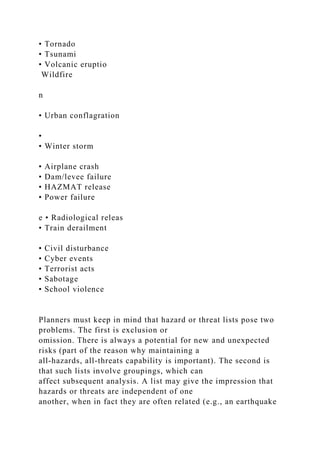
• Congregate settings (e.g., nursing homes,
summer camps)
• Paratransit providers • Schools and universities
• Bureau of motor vehicles (accessible parking
permit holders)
• Medicaid
• Centers for Independent Living • Hospitals
• Home health agencies • Daycare centers (for children or senior
citizens)
• Vocational rehabilitation and job access
services
• Places of worship
• Disability services providers • Homeless shelters
• Health or behavioral health agencies • Housing programs.
If planners compile the numbers from various lists, often
referred to as the “list of lists” concept, they will
have an estimate of the number of individuals residing in their
communities, which will benefit planning
for sufficient transportation and sheltering. Together, these lists
can provide raw numbers vital to
understanding the magnitude of the community’s requirements.
Emergency managers should also gather
as much information as possible regarding the types of services
these individuals require so emergency
staff can be adequately trained and resource needs can be met.
These different types of assessments are sometimes mistakenly
considered the same as registries when, in
fact, they are different. A registry is a database of individuals
who voluntarily sign up and meet the
eligibility requirements for receiving emergency response
services based on a need (the criteria for which
should be established by the jurisdiction).
The next step of the threat and hazard identification process is
to organize the information into a format
that is usable by the planning team. One effective method for
organizing hazard or threat information is to
use a matrix based on dimensions used during the risk analysis
process:
• Probability or frequency of occurrence
• Magnitude (the physical force associated with the hazard or
threat)
4-8
4. The Planning Process
4-9
• Intensity/severity (the impact or damage expected)
• Time available to warn
• Location of the incident (an area of interest or a specific or
indeterminate site or facility)
• Potential size of the affected area
• Speed of onset (how fast the hazard or threat can impact the
public)
• Duration (how long the hazard or threat will be active)
• Cascading effects.
Depending on the kinds of decisions and analyses the
information is meant to support, planners might use
other categories for data organization. For example, the
decision that one hazard poses a greater threat
than another may require only a qualitative estimate (e.g., high
versus medium), whereas planning how to
deal with health and medical needs caused by a particular
hazard may require estimates of likely fatalities
and injuries.
Assess Risk
The risk assessment7 is the basis for EOP development. The
assessment helps a planning team decide what hazards or threats
merit special attention, what actions must be planned for, and
what resources are likely to be needed. The analysis method
inventories, evaluates, and provides loss estimates for assets
deemed critical during the response and recovery phases of an
incident. Planners can also obtain the Hazards U.S. Multi-
Hazard
(HAZUS-MH) model from FEMA. HAZUS-MH is a nationally
applicable and standardized methodology and software program
that estimates potential losses from earthquakes, floods, and
hurricane winds. This type of hazard assessment is similar to
that
which is required for hazard mitigation plans. In fact, if the
community possesses a FEMA-approved multi-hazard mitigation
plan, an assessment may be readily
available. Mitigation plans can be used as reference documents
to simplify the development of most
hazards-based analyses.
The information gathered during the jurisdictional assessment
of individuals with disabilities and others
with access and functional needs requires a detailed analysis.
Emergency planners need to review the
assessment findings and analyze the quantity and types of
resources (including personnel) needed during
different types of incidents. For example, a jurisdiction with a
large number of limited English
proficiency residents might need to identify methods by which
language assistance will be provided (e.g.,
bilingual personnel, interpreters, translated documents) to
support operations, such as evacuation,
sheltering, and recovery. Additionally, planners need to work
with social services agencies to plan for
unaccompanied minors and to assess for types of resources
needed for the community’s children during
and following a disaster.
Hazard and threat analysis requires that the planning team
knows risks that have occurred or could occur
in the jurisdiction. The process should begin with a list of the
risks that concern planners, developed from
research conducted earlier in the planning process. A list of
concerns might include those listed in Table
4.1.
7 FEMA Publication 386-2, Understanding Your Risks:
Identifying Hazards and Estimating Losses, provides a detailed
method for
conducting hazard and risk assessments for many hazards.
Remember that as the situation is
analyzed and hazards or threats are
prioritized, each carries with it training,
equipment, and exercise
requirements. It is not too early—even
if only at a high level—to consider
what is within the scope of capability
of the jurisdiction and how those
capabilities can be enhanced through
preparedness activities and by the
adding or sharing of resources.
Comprehensive Preparedness Guide 101
4-10
Table 4.1: Sample Hazards List
Natural Hazards Technological Hazards Human-Caused Hazards
• Avalanche
• Disease outbreak
• Drought
• Earthquake
c • Epidemi
• Flood
• Hurricane
• Landslide
• Tornado
• Tsunami
• Volcanic eruptio
Wildfire
n
• Urban conflagration
•
• Winter storm
• Airplane crash
• Dam/levee failure
• HAZMAT release
• Power failure
e • Radiological releas
• Train derailment
• Civil disturbance
• Cyber events
• Terrorist acts
• Sabotage
• School violence
Planners must keep in mind that hazard or threat lists pose two
problems. The first is exclusion or
omission. There is always a potential for new and unexpected
risks (part of the reason why maintaining a
all-hazards, all-threats capability is important). The second is
that such lists involve groupings, which can
affect subsequent analysis. A list may give the impression that
hazards or threats are independent of one
another, when in fact they are often related (e.g., an earthquake
might cause dam failure). Lists may gr
very different causes or sequences of events that require
different types of responses under one category
For example, “Flood” might include dam failure, cloudbursts, or
heavy rain upstream. Lists also may
group a whole range of consequences under the category of a
sing
n
oup
.
le hazard. “Terrorism,” for example,
ould include use of conventional explosives against people or
critical infrastructure; nuclear detonation;
s or
t
es,
re static. Some hazards or threats may pose a risk to the
ommunity that is so limited that additional analysis is not
necessary. Others might be dynamic, such as
• Facts are verified pieces of information, such as laws,
regulations, terrain maps, population statistics,
resource inventories, and prior occurrences.
c
or release of lethal chemical, biological, or radiological
material.
Using a risk analysis, the planning team must compare and
prioritize risks to determine which hazard
threats merit special attention in planning (and other emergency
and homeland security management
efforts). The team must consider the frequency of the hazard or
threat and the likelihood or severity
potential of its consequences in order to develop a single
indicator of the risk to the jurisdiction. This
effort allows for comparisons and the setting of priorities.
While a mathematical approach is possible, i
may be easier to manipulate qualitative ratings (e.g., high,
medium, low) or index numbers (e.g., reducing
quantitative information to a 1-to-3, 1-to-5, or 1-to-10 scale
based on defined thresholds) for different
categories of information used in the ranking scheme. Some
approaches involve the consideration of only
two categories—frequency and consequences—and treat them as
equally important. In other approach
potential consequences receive more weight than frequency.
While it is important to have a sense of the
magnitude involved (whether in regard to the single indicator
used to rank hazards or to estimate the
numbers of people affected), these indicators a
c
HAZMAT toxicity and transportation routes.
The analysis process produces facts and assumptions, which can
be distinguished as follows:
4. The Planning Process
• Assumptions consist of information accepted by planners as
being true in the absence of facts in order
to provide a framework or establish expected conditions of an
operational environment so that
planning can proceed. Assumptions are used as facts only if
they are considered valid (or likely to be
true) and are necessary for solving the problem.
Incident managers replace assumptions with facts when they
implement a plan. For example, when
producing a flood annex, planners may assume the location of
the water overflow, size of the flood hazard
area, and speed of the rise in water. When the plan is put into
effect as the incident unfolds, operations
personnel replace assumptions with the facts of the situation
and modify the plan accordingly. Planners
should use assumptions sparingly and put great effort into
performing research and acquiring facts,
including the use of historical precedent.
The outcomes of the analysis process help planners determine
goals and objectives (Step 3) and select the
supporting planning concept they will use when developing the
plan (Step 4).
Step 3: Determine Goals and Objectives
Determine Operational Priorities
Operational priorities specify what the responding organizations
are to accomplish to achieve a desired
end-state for the operation. The senior official may
communicate desired end-states for the operations
addressed in the plans. By using information from the risk
profile developed as part of the analysis
process, the planning team engages the senior official to
establish how the hazard or threat would evolve
in the jurisdiction and what defines a successful outcome for
responders, disaster survivors, and the
community.
Starting with a given intensity for the hazard or threat, the team
imagines an incident’s development from
prevention and protection efforts, through initial warning (if
available) to its impact on the jurisdiction (as
identified through analysis) and its generation of specific
consequences (e.g., collapsed buildings, loss of
critical services or infrastructure, death, injury, displacement).
These scenarios should be realistic and
created on the basis of the jurisdiction’s hazard/threat and risk
data. Planners may use the incidents that
have the greatest impact on the jurisdiction (worst-case), those
that are most likely to occur, or an incident
constructed from the impacts of a variety of risks. During this
process of building an incident scenario,
the planning team identifies the requirements that determine
actions and resources. Planners are looking
for requirements generated by the hazard or threat, the response,
and by constraints/restraints.
• Requirements can be caused by the nature of the hazard or
threat. They lead to functions, such as law
enforcement intervention, public protection, population
warning, and search and rescue. Response
requirements are caused by actions taken in response to an
agent-generated problem. These tend to be
common to all operations. An example is the potential need for
emergency refueling during a large-
scale evacuation. Subsets could include the needs to find a site
for refueling, identify a fuel supplier,
identify a fuel pumping method, control traffic, and collect
stalled vehicles.
• A constraint is something that must be done (“must do”),
while a restraint is something that prohibits
action (“must not do”). They may be caused by a law,
regulation, or management directive; some
physical characteristic (e.g., terrain and road networks that
make east-west evacuations impossible);
or resource limitations.
Once the requirements are identified, the planning team restates
them as priorities and affirms those
priorities with the senior official.
4-11
Comprehensive Preparedness Guide 101
Set Goals and Objectives Example: Relationships among the
Mission, Operational Priorities,
Goals, and Objectives
Plan Mission: Effectively coordinate
and direct available resources to
protect the public and property from
hazards or threats.
Operational Priority: Protect the
public from hurricane weather and
storm surge.
Goal: Complete evacuation before
arrival of tropical storm winds.
Desired result: All self- and assisted
evacuees are safely outside of the
expected impact area prior to impact.
Objective: Complete tourist
evacuation 72 hours before arrival of
tropical storm winds.
Desired result: tourist segment of
public protected prior to hazard onset,
allowing resources to be redirected to
accomplishing other objectives in
support of this goal or other goals.
Goals and objectives must be carefully crafted to ensure they
support accomplishing the plan mission and operational
priorities.
They must also clearly indicate the desired result or end-state
they
are designed to yield. This approach enables unity of effort and
consistency of purpose among the multiple groups and activities
involved in executing the plan.
Goals are broad, general statements that indicate the intended
solution to problems identified by planners during the previous
step. They are what personnel and equipment resources are
supposed to achieve. They help identify when major elements of
the response are complete and when the operation is successful.
Objectives are more specific and identifiable actions carried out
during the operation. They lead to achieving response goals and
determining the actions that participants in the operation must
accomplish. Translating these objectives into activities,
implementing procedures, or operating procedures by
responsible
organizations is part of planning. As goals and objectives are
set,
planners may identify more requirements that will feed into the
development of courses of action as well as the capability
estimate (see Step 4).
Step 4: Plan Development
Develop and Analyze Courses of Action
This step is a process of generating, comparing, and selecting
possible solutions for achieving the goals
and objectives identified in Step 3. Planners consider the
requirements, goals, and objectives to develop
several response alternatives. The art and science of planning
helps determine how many solutions or
alternatives to consider; however, at least two options should
always be considered. Developing only one
solution may speed the planning process, but it will probably
provide for an inadequate response, leading
to more damaging effects on the affected population or
environment.
Developing courses of action uses the hybrid planning approach
previously discussed. When developing
courses of actions, planners depict how an operation unfolds by
building a portrait of the incident’s
actions, decision points, and participant activities. This process
helps planners identify tasks that occur
immediately at incident initiation, tasks that are more mid-
incident focused, and tasks that affect long-
term operations. The planning team should work through this
process by using tools that help members
visualize operational flow, such as a white board, “sticky note”
chart (see Figure 4.3), or some type of
project management or special planning software.
4-12
4. The Planning Process
Figure 4.3: “Sticky Note” Chart
Course of action development follows these steps: Courses of
Action in a Nutshell
Courses of action address the what/
who/when/where/why/how for each
solution.
As each potential course of action is
identified, the planner should consider
where it supports the priorities, goals,
and objectives established by the
senior official. Additionally, the course
of action should be examined to
determine whether it is feasible and
whether the stakeholders that are
needed to implement it find it
acceptable.
• Establish the timeline. Planners should cover all mission
areas in the timeline and typically use the speed of incident
onset to establish the timeline. The timeline may also change
by phases. For example, a hurricane’s speed of onset is
typically days, while a major HAZMAT incident’s speed of
onset is minutes. The timeline for a hurricane might be in
hours and days, particularly during the pre- and post-impact
phases. The timeline for the HAZMAT incident would most
likely be in minutes and hours. For a multijurisdictional or
layered plan, the timeline for a particular scenario is the same
at all participating levels of government. Placement of
decision points and response actions on the timeline depicts
how soon the different entities enter the plan.
• Depict the scenario. Planners use the scenario information
developed in Step 3 and place the incident information on the
timeline.
• Identify and depict decision points. Decision points indicate
the place in time, as incidents unfold,
when leaders anticipate making decisions about a course of
action. They indicate where and when
decisions are required to provide the best chance of achieving
an intermediate objective or response
4-13
Comprehensive Preparedness Guide 101
goal (the desired end-state). They also help planners determine
how much time is available or needed
to complete a sequence of actions.
• Identify and depict operational tasks. For each operational
task depicted, some basic information is
needed. Developing this information helps planners incorporate
the task into the plan when they are
writing it. Planners correctly identify an operational task when
they can answer the following
questions about it:
– What is the action?
– Who is responsible for the action?
– When should the action take place?
– How long should the action take and how much time is
actually available?
– What has to happen before?
– What happens after?
– What resources does the person/entity need to perform the
action?
• Select courses of action. Once the above analysis is complete,
planners must compare the costs and
benefits of each proposed course of action against the mission,
goals, and objectives. Based on this
comparison, planners then select the preferred courses of action
to move forward in the planning
process. While not necessary for every course of action
identified, planners should use their best
judgment and identify when the selection of a course or courses
of action will need to be elevated to
the senior elected or appointed official for approval. Where
practical, the appropriate official should
approve these actions prior to the review and completion of the
plan.
“Red-Teaming” as a Method for Analyzing Courses of Action
A “peer review” process for plans is a useful tool for examining
whether plans contain all of the necessary
elements. Leveraging expertise from outside the jurisdiction
will aid in challenging assumptions and identifying
gaps in the jurisdiction’s courses of action.
For plans dealing with adaptive threats (e.g., terrorism),
examining plans “through the eyes of the adversary” can
lead to significant improvements and a higher probability of
success. This process is known as “red-teaming.”
Essential elements of a red-team review include:
Engaging the law enforcement community and fusion centers to
act as the adversary
Understanding the operational environment (e.g., geography,
demography, economy, culture)
Establishing a potential adversary’s identity, resources, tactics,
and possible courses of action
Evaluating the plan under multiple scenarios and a wide range
of circumstances using tabletop exercises,
facilitated seminars, and computer models and simulations to
aid in analysis.
Red teams should foster a culture of critical thinking,
intellectualism, and self-criticism. Red team members
should be creative, objective, intellectually curious, and able to
manage their egos. Red teams must act with
ingenuity and enthusiasm to develop and apply customized
approaches to every problem. Red teams need to
cultivate expertise, recognize the limitations of their own
knowledge, constantly seek and evaluate new insights,
and have access to the opinions and understanding of truly
informed experts. Finally, red teams need to avoid
being confrontational. Red team members need to work closely
and solicit information from the staff; however, it
is best if they conduct their work in the background to avoid
interference from staff members who may have a
vested interested in a particular course of action.
Red-teaming is most successful when senior officials endorse
and support it. Participants must be able to make
their comments in an atmosphere of confidentiality and non-
attribution.
4-14
4. The Planning Process
4-15
Identify Resources
Once courses of action are selected, the planning team identifies
resources needed to accomplish tasks
without regard to resource availability. The object is to identify
the resources needed to make the
operation work. Once the planning team identifies all the
requirements, they begin matching available
resources to requirements. By tracking obligations and
assignments, the planning team determines
resource shortfalls and develops a list of needs that private
suppliers or other jurisdictions might fill. The
resource base should also include a list of facilities vital to
emergency operations, and the list should
indicate how individual hazards might affect the facilities.
Whenever possible, planners should match
resources with other geographical/regional needs so that
multiple demands for the same or similar
resources can be identified and conflicts resolved. This step
provides planners an opportunity to identify
resource shortfalls to pass to higher levels of government and to
prepare pre-scripted resource requests, as
appropriate. The EOP should account for unsolvable resource
shortfalls so they are not just “assumed
away.” The capability estimate process is critical to this effort.
A capability estimate is a planner’s assessment of a
jurisdiction’s ability to take a course of action.
Capability estimates help planners decide if pursuing a
particular course of action is realistic and
supportable. They help planners better project and understand
what might take place during an operation.
Simply stated, the capability estimate represents the capabilities
and resource types needed to complete a
set of courses of action. The resulting capability estimate will
feed into the resource section of the plan or
annex.
Capability estimates may be written documents, tables or
matrices, or oral presentations. The information
provided in a capability estimate should be able to answer most
questions about a jurisdiction’s ability to
support a given course of action. Planners can use capability
estimates for both future and current
operational planning. At a minimum, planners should prepare
separate capability estimates for personnel,
administration and finance, operational organizations (e.g., fire,
law enforcement, EMS), logistics,
communications, equipment, and facilities. Each capability
estimate compares the courses of action being
considered for a particular operation. They make
recommendations as to which course of action best
supports the operation. Capability estimates should also identify
the criteria used to evaluate each area;
facts and assumptions that affect those areas; and the issues,
differences, and risks associated with a
course of action. Figure 4.4 provides a suggested format for a
capability estimate.
Figure 4.4: Suggested Capability Estimate Format
Comprehensive Preparedness Guide 101
Resource identification is particularly important for supporting
children; individuals with disabilities, access, and functional
needs; and household pets and service animals. These
individuals will require a range of communication,
transportation, sheltering, human service, medical, and other
resources throughout the life of an incident. Examples include,
but are not limited to, durable medical equipment, oxygen,
paratransit vehicles, accessible shelters, personal assistance
services, and sign language interpreters.
Identifying these requirements and the resources for meeting
them ahead of time will help planners fully
support individuals with disabilities and others with access and
functional needs.
When identifying resources, the needs
of children are often forgotten,
including diapers, formula and food
appropriate for all ages, portable cribs/
playpens and the capability to
supervise unaccompanied children.
Identify Information and Intelligence Needs
Another outcome from course of action development is a “list”
of the information and intelligence needs
for each of the response participants. Planners should identify
the information and intelligence they will
need and their deadline(s) for receiving it to drive decisions and
trigger critical actions. These needs
eventually find their way into plan information collection
matrices.
When developing courses of action, the process should be
periodically “frozen” so the planning team can:
• Identify progress made toward the end-state, including goals
and objectives met and new needs or
demands
• Identify “single point failures” (i.e., tasks that, if not
completed, would cause the operation to fall
apart)
• Check for omissions or gaps
• Check for inconsistencies in organizational relationships
• Check for mismatches between the jurisdiction’s plan and
plans from other jurisdictions with which
they are interacting.
Step 5: Plan Preparation, Review, and Approval
Write the Plan
This step turns the results of course of action development into
an EOP. The planning team develops a
rough draft of the basic plan, functional annexes, hazard-
specific annexes, or other parts of the plan as
appropriate. The recorded results from Step 4 provide an outline
for the rough draft. As the planning team
works through successive drafts, the members add necessary
tables, charts, and other graphics. The
planning team prepares and circulates a final draft to obtain the
comments of organizations that have
responsibilities for implementing the plan. (See Chapter 3 for
more information on plan formats.)
Following these simple rules for writing plans and procedures
will help ensure that readers and users
understand their content:
• Keep the language simple and clear by writing in plain
English. Summarize important information
with checklists and visual aids, such as maps and flowcharts.
• Avoid using jargon and minimize the use of acronyms.
• Use short sentences and the active voice. Qualifiers and vague
wording only add to confusion.
• Provide enough detail to convey an easily understood plan that
is actionable. The amount of detail a
plan should provide depends on the target audience and the
amount of certainty about the situation.
4-16
4. The Planning Process
• Format the plan and present its contents so that its readers can
quickly find solutions and options.
Focus on providing mission guidance and not on discussing
policy and regulations. Plans should
provide guidance for carrying out common tasks, as well as
enough insight into intent and vision so
that responders can handle unexpected events. However, when
writing a plan, “stay out of the
weeds.” Procedural documents (e.g., SOPs/SOGs) should
provide the fine details.
• Ensure accessibility by developing tools and documents (e.g.,
print, electronic, video) so they can be
easily converted to alternate formats.
Review the Plan
Planners should check the written plan for its conformity to
applicable regulatory requirements and the
standards of Federal or state agencies, as appropriate, and for
its usefulness in practice. Planners should
consult the next level of government about its plan review
cycle. Reviews of plans allow other agencies
with emergency or homeland security responsibilities to suggest
improvements to a plan on the basis of
their accumulated experience. For example, states may review
local plans, and, upon request, FEMA
regional offices may assist states in the review of EOPs.
Hazard-specific Federal programs, such as the
Radiological Emergency Preparedness Program, require periodic
review of certain sections of the all-
hazards plan and may require review of associated SOPs/SOGs.
Commonly used criteria can help decision makers determine the
effectiveness and efficiency of plans.
These measures include adequacy, feasibility, and acceptability.
Decision makers directly involved in
planning can employ these criteria, along with their
understanding of plan requirements, not only to
determine a plan’s effectiveness and efficiency but also to
assess risks and define costs. Some types of
analysis, such as a determination of acceptability, are largely
intuitive. In this case, decision makers apply
their experience, judgment, intuition, situational awareness, and
discretion. Other analyses, such as a
determination of feasibility, should be rigorous and
standardized to minimize subjectivity and preclude
oversights.
• Adequacy. A plan is adequate if the scope and concept of
planned operations identify and address
critical tasks effectively; the plan can accomplish the assigned
mission while complying with
guidance; and the plan’s assumptions are valid, reasonable, and
comply with guidance.
• Feasibility. A plan is feasible if the organization can
accomplish the assigned mission and critical
tasks by using available resources within the time contemplated
by the plan. The organization
allocates available resources to tasks and tracks the resources
by status (e.g., assigned, out of service).
Available resources include internal assets and those available
through mutual aid or through existing
state, regional, or Federal assistance agreements.
• Acceptability. A plan is acceptable if it meets the
requirements driven by a threat or incident, meets
decision maker and public cost and time limitations, and is
consistent with the law. The plan can be
justified in terms of the cost of resources and if its scale is
proportional to mission requirements.
Planners use both acceptability and feasibility tests to ensure
that the mission can be accomplished
with available resources, without incurring excessive risk
regarding personnel, equipment, material,
or time. They also verify that risk management procedures have
identified, assessed, and applied
control measures to mitigate operational risk (i.e., the risk
associated with achieving operational
objectives).
• Completeness. A plan is complete if it:
– Incorporates all tasks to be accomplished
– Includes all required capabilities
4-17
Comprehensive Preparedness Guide 101
4-18
– Integrates the needs of the general population, children of all
ages, individuals with disabilities
and others with access and functional needs, immigrants,
individuals with limited English
proficiency, and diverse racial and ethnic populations
– Provides a complete picture of the sequence and scope of the
planned response operation (i.e.,
what should happen, when, and at whose direction)
– Makes time estimates for achieving objectives
– Identifies success criteria and a desired end-state.
• Compliance. The plan should comply with guidance and
doctrine to the maximum extent possible,
because these provide a baseline that facilitates both planning
and execution.
When using these five criteria, planners should ask the
following questions:
• Did an action, a process, a decision, or the operational timing
identified in the plan make the situation
worse or better?
• Were new alternate courses of action identified?
• Were the requirements of children, individuals with
disabilities, others with access and functional
needs, immigrants, individuals with limited English proficiency,
and diverse racial and ethnic
populations fully addressed and integrated into all appropriate
aspects of the plan?
• What aspects of the action, process, decision, or operational
timing make it something to keep in the
plan?
• What aspects of the action, process, decision, or operational
timing make it something to avoid or
remove from the plan?
• What specific changes to plans and procedures, personnel,
organizational structures, leadership or
management processes, facilities, or equipment can improve
operational performance?
Additionally, when reviewing the plan, a jurisdiction does not
have to provide all of the resources needed
to meet a capability requirement established during the planning
effort. However, the plan should explain
where the jurisdiction will obtain the resources to support those
required capabilities. For example, many
jurisdictions do not have the bomb squads or urban search and
rescue teams required to meet certain
capabilities. Neighboring jurisdictions can provide those
resources (or capability elements) through
MAAs, MOAs, MOUs, regional compacts, or some other formal
request process.
When conducting this review, the checklist in Appendix C will
provide a useful benchmark to ensure all
planning elements are addressed. In particular, those elements
related to planning for children, individuals
with access and functional needs, and those with household pets
and service animals are critical to each
component of the planning process. When planning for these
groups, consider the following questions,
while being mindful of specific concerns for immigrant,
racial/ethnic communities, and individuals with
limited English proficiency:
Incorporating Children8
• Preparedness
– Does the planning group include individuals with expertise in
pediatric issues, as well as relevant
advocacy groups, service providers, and subject matter experts?
8 For additional information, please see the National
Commission on Children and Disasters—2010 Report to the
President and
Congress
(http://www.childrenanddisasters.acf.hhs.gov/20091014_508IR_
partII.pdf).
4. The Planning Process
– Does the plan include demographic data and information on
the number of children and where
they tend to be (e.g., schools, daycare facilities)?
– Does the plan identify the agency with the lead role for
coordinating planning efforts and
ensuring that children are incorporated into all plans?
– Does the plan identify support agencies to assist the lead
agency in coordinating planning efforts
and ensuring that children are incorporated into all plans?
– Does the plan identify a child coordinator to provide expertise
for the emergency planning
process and to support the Incident Commander, the Planning
Section, and/or the Operations
Section during an emergency?
– Does the plan include mechanisms or processes to effectively
identify children and families who
will need additional assistance with their specific health-related
needs in advance of, during, and
following an emergency?
– Does the plan include mechanisms or processes to secure
medical records to enable children with
disabilities and/or other special health care needs to receive
health care and sustained
rehabilitation in advance of, during, and following an
emergency?
– Does the plan identify which position/agency is authorized to
direct supporting departments and
agencies to furnish materials and commodities for children with
disabilities and/or other special
health care needs?
– Does the plan identify critical human services and ways to
reestablish these services following a
disaster for children and their families?
– Does the plan identify roles and responsibilities for
supporting children?
– Does the plan prioritize governmental, nongovernmental, and
private sector resources to meet
critical needs such as accessible housing, rental assistance,
debris removal, and emergency repairs
for families of children with special health care needs?
– Does the plan describe vetting, training, and use of
spontaneous volunteers who may offer their
services to families with children?
– Does the plan include mechanisms or processes for provision
of emergency childcare services?
– Does the plan include mechanisms or processes for the
reunification of children with families?
– Do exercises include children and child congregate care
settings such as school, childcare, child
welfare, and juvenile justice facilities?
• Evacuation Support
– Does the plan identify which official has the authority to
order an evacuation?
– Does the plan identify the roles and responsibilities for
advanced/early evacuation, which is often
necessary to accommodate children with mobility issues?
– Does the plan identify the agency that has the lead role in
coordinating an evacuation and
ensuring children are incorporated into all evacuation
considerations and planning?
– Does the plan include mechanisms or processes for providing
safe evacuation/transportation
assistance to unaccompanied minors?
– Does the plan include mechanisms or processes for tracking
children, especially unaccompanied
minors, during an evacuation?
4-19
Comprehensive Preparedness Guide 101
– Does the plan include affirmative recognition of the need to
keep children with disabilities with
their caregivers, mobility devices, other durable medical
equipment, and/or service animals
during an evacuation?
– Does the plan include mechanisms or processes to ensure the
availability of sufficient and timely
accessible transportation to evacuate children with disabilities
whose families do not have their
own transportation resources?
– Does the plan identify means and methods by which
evacuation transportation requests from
schools, specifically schools with children who have
disabilities, are collected and consolidated?
– Does the plan identify means by which incoming
transportation requests will be tracked,
recorded, and monitored as they are fulfilled?
– Does the plan identify accessible transportation resources
(including paratransit service vehicles,
school buses, municipal surface transit vehicles, drivers, and/or
trained attendants) that can
provide needed services during an evacuation?
– Does the plan address re-entry?
• Shelter Operations
– Does the plan include mechanisms or processes for ensuring
there will be adequate accessible
shelters that fully address the requirements of children,
including those with medical needs?
– Does the plan address adequate shelter space allocation for
families who have children with
special needs (i.e., disabilities and chronic medical needs) who
may need additional space for
assistive devices (e.g., wheelchairs, walkers)?
– Does the plan address necessary developmentally appropriate
supplies (e.g., diapers, formula, age
appropriate foods), staff, medicines, durable medical
equipment, and supplies that would be
needed during an emergency for children with disabilities and
other special health care needs?
– Does the plan include mechanisms or processes for handling
of and providing for unaccompanied
minors in shelters?
• Public Information and Outreach
– Does the plan identify ways to promote personal preparedness
among children, as well as their
families and caregivers (including school and daycare
personnel)?
– Does the plan identify mechanisms for disseminating timely
and accessible emergency public
information using multiple methods (e.g., television, radio,
Internet, sirens) to reach families of
children with sensory and cognitive disabilities, as well as
families with limited English
proficiency?
Incorporating Individuals with Access and Functional Needs
• Preparedness
– Does the planning group include individuals with disabilities
and others with access and
functional needs, as well as relevant advocacy groups, service
providers, and subject matter
experts?
– Does the plan include a definition for “individuals with
disabilities and others with access and
functional needs,” consistent with all applicable laws?
– Does the plan include demographic data and information on
the number of individuals in the
community with disabilities and others with access and
functional needs (using assessment and
current registry data, if available)?
4-20
4. The Planning Process
– Does the plan identify the agency with the lead role for
coordinating planning efforts and
ensuring that individuals with access and functional needs are
incorporated into all plans?
– Does the plan identify support agencies to assist the lead
agency in coordinating planning efforts
and ensuring individuals with access and functional needs are
incorporated into all plans?
– Does the plan identify a disability advisor to provide expertise
for the emergency planning
process and to support the Incident Commander, the Planning
Section, and/or the Operations
Section during an emergency?
– Does the plan include mechanisms or processes to effectively
identify people who will need
additional assistance and their specific health-related needs in
advance of, during, and following
an emergency?
– Does the plan include mechanisms or processes to secure
medical records to enable persons with
disabilities or access and functional needs and acute health care
needs to receive health care and
sustained rehabilitation in advance of, during, and following an
emergency?
– Does the plan identify which position/agency is authorized to
direct supporting departments and
agencies to furnish materials and commodities for individuals
with disabilities and others with
access and functional needs?
– Does the plan identify critical human services and ways to
reestablish these services following a
disaster for individuals with disabilities and others with access
and functional needs to enable
individuals to regain and maintain their previous level of
independence and functioning?
– Does the plan identify roles and responsibilities for
supporting individuals with disabilities and
others with access and functional needs during both the short-
and long-term recovery process?
– Does the plan prioritize governmental, nongovernmental, and
private sector resources to meet
critical needs such as accessible housing, rental assistance,
debris removal, and emergency repairs
for individuals with disabilities and others with access and
functional needs?
– Does the plan include mechanisms or processes for the
training and use of spontaneous volunteers
who may offer their services to individuals with disabilities and
others with access and functional
needs to assist with physical, programmatic, and
communications access and other functional
needs?
• Evacuation Support
– Does the plan identify which official has the authority to
order an evacuation?
– Does the plan identify the roles and responsibilities for
advanced/early evacuation, which is often
necessary to accommodate persons with mobility issues?
– Does the plan identify the agency that has the lead role in
coordinating an evacuation and
ensuring those individuals with disabilities and others with
access and functional needs are
incorporated into all evacuation considerations and planning?
– Does the plan include affirmative recognition of the need to
keep people with disabilities with
their support systems, mobility devices, other durable medical
equipment, and/or service animals
during an evacuation?
– Does the plan include mechanisms or processes to ensure the
availability of sufficient and timely
accessible transportation to evacuate individuals with
disabilities and others with access and
functional needs who do not have their own transportation
resources?
4-21
Comprehensive Preparedness Guide 101
– Does the plan identify means and methods by which
evacuation transportation requests from
individuals with disabilities and others with access and
functional needs are collected and
consolidated?
– Does the plan identify means by which incoming
transportation requests will be tracked,
recorded, and monitored as they are fulfilled?
– Does the plan identify accessible transportation resources
(including paratransit service vehicles,
school buses, municipal surface transit vehicles, drivers, and/or
trained attendants) that can
provide needed services during an evacuation?
– Does the plan address re-entry?
• Shelter Operations
– Does the plan include mechanisms or processes for ensuring
that general population shelters are
accessible and have planned to fully address the physical,
programmatic, and communications
accessibility requirements of individuals with disabilities and
others with access and functional
needs?
– Does the plan address the need for adequate shelter space
allocation for individuals with
disabilities and others with access and functional needs who
may need additional space for
assistive devices (e.g., wheelchairs, walkers)?
– Does the plan include mechanisms or processes for ensuring
Americans with Disabilities Act
Accessibility Guidelines govern the shelter site selection and
operation?
– Does the plan address necessary staff, medicines, durable
medical equipment, and supplies that
would be needed during an emergency for individuals with
disabilities and others with access and
functional needs?
• Public Information and Outreach
– Does the plan identify ways to promote personal preparedness
among individuals with disabilities
and others with access and functional needs, as well as their
families and service providers?
– Does the plan identify mechanisms for disseminating timely
and accessible emergency public
information using multiple methods (e.g., television, radio,
Internet, sirens) to reach individuals
with sensory, intellectual, and cognitive disabilities, as well as
individuals with limited English
proficiency?
Incorporating Household Pets and Service Animals
• Preparedness
– Does the plan describe the partnership between the
jurisdiction’s emergency management agency,
the animal control authority, the mass care provider(s), and the
owner of each proposed
congregate household pet sheltering facility?
– Does the plan have or refer to an MOA/MOU or MAA that
defines the roles and responsibilities
of each organization involved in household pet and service
animal response?
– Do organizations with agreed upon responsibilities in the plan
have operating procedures that
govern their mobilization and actions?
– Does the plan recommend just-in-time training for
spontaneous volunteers and out-of-state
responders?
4-22
4. The Planning Process
– Does the plan encourage household pet owners and service
animal owners to make arrangements
for private accommodations for themselves and their household
pets and service animals prior to
a disaster or emergency situation?
• Evacuation Support
– Does the plan address the evacuation and transportation of
household pets from their homes or by
their owners or those household pets rescued by responders to
congregate household pet shelters?
– Does the plan address how owners will be informed where
congregate household pet shelters are
located and which shelter to use? Does the plan provide for the
conveyance of household pets or
service animals whose owners are dependent on public
transportation?
– Does the plan address how household pets that are provided
with evacuation assistance are
registered, documented, tracked, and reunited with their owners
if they are separated during
assisted evacuations?
– Does the plan address the responsibility of transportation
providers to transport service animals
with their owners?
• Shelter Operations
– Does the plan identify the agency responsible for coordinating
shelter operations?
– Does the plan provide guidance to human shelter operators on
the admission and treatment of
service animals?
– Does the plan identify an agency in the jurisdiction that
regulates nonemergency, licensed animal
facilities (e.g., animal control shelters, nonprofit household pet
rescue shelters, private breeding
facilities, kennels)?
– Does the plan establish criteria that can be used to
expeditiously identify congregate household
pet shelters and alternate facilities?
– Does the plan provide guidance about utility provisions, such
as running water, adequate lighting,
proper ventilation, electricity, and backup power, at congregate
household pet shelters?
– Does the plan include mechanisms or processes to
reduce/eliminate the risk of injury by an
aggressive or frightened animal, the possibility of disease
transmission, and other health risks for
responders and volunteers staffing the congregate household pet
shelter?
– Does the plan recommend a pre-disaster inspection and
development of agreements for each
congregate household pet facility?
– Does the plan provide for the care and maintenance of each
facility while in use as a shelter?
– Does the plan identify equipment and supplies that may be
needed to operate each congregate
household pet shelter, as well as supplies that household pet
owners may bring with them to the
congregate shelter?
– Does the plan provide for the physical security of each
congregate household pet facility,
including perimeter controls and security personnel?
– Does the plan provide for acceptance of donated resources
(e.g., food, bedding, containers)?
– Does the plan provide for the acquisition, storage, and
security of food and water supplies? Does
the plan provide for the diverse dietary needs of household
pets?
4-23
Comprehensive Preparedness Guide 101
4-24
• Registration and Animal Intake
– Does the plan establish provisions for the sheltering of
unclaimed animals that cannot be
immediately transferred to an animal control shelter?
– Does the plan provide for segregation or seizure of household
pets showing signs of abuse?
– Does the plan provide for household pet registration? Does
the plan provide for installation and
reading of microchip technology for rapid and accurate
identification of household pets?
– Does the plan provide for technical consultation/supervision
by a veterinarian or veterinary
technician as official responders?
– Does the plan identify the need for all animals to have a
current rabies vaccination?
– Does the plan provide for the case when non-eligible animals
are brought to the shelter?9
• Animal Care
– Does the plan provide for the housing of a variety of
household pet species (e.g., size of
crate/cage, temperature control, appropriate lighting)?
– Does the plan provide for separation of household pets based
on appropriate criteria and
requirements?10
– Does the plan provide for the consultation of a veterinarian or
animal care expert with household
pet sheltering experience regarding facility setup and
maintenance?
– Does the plan provide for the setup and maintenance of
household pet confinement areas (e.g.,
crates, cages, pens) for safety, cleanliness, and control of noise
level?
– Does the plan recommend the setup of a household pet first
aid area inside each shelter?
– Does the plan provide for the control of fleas, ticks, and other
pests at each congregate household
pet shelter?
– Does the plan provide criteria for designating and safely
segregating aggressive animals?
– Does the plan provide for the segregation or quarantine of
household pets to prevent the
transmission of disease?
– Does the plan recommend the relocation of a household pet to
an alternate facility (e.g.,
veterinary clinic, animal control shelter) due to illness, injury,
or aggression?
– Does the plan recommend providing controlled areas (indoor
or outdoor) for exercising dogs?
– Does the plan provide for household pet waste and dead
animal disposal?
– Does the plan provide for the reunion of rescued animals with
their owners?
– Does the plan include mechanisms or processes to address the
long-term care, permanent
relocation, or disposal of unclaimed household pets?
• Public Information and Outreach
– Does the plan provide mechanisms for continually updating
public statements on shelter capacity
and availability as people/animals are coming to shelters?
– Does the plan provide for a public education program?
9 According to FEMA Disaster Assistance Policy 9523.19,
household pets do not include reptiles (except turtles),
amphibians, fish,
insects/arachnids, farm animals (including horses), and animals
kept for racing purposes.
10 Animal Welfare Publications and Reports. United States
Department of Agriculture, Animal and Plant Health Inspection
Service.
http://www.aphis.usda.gov/animal_welfare/publications_and_re
ports.shtml.
4. The Planning Process
– Does the plan provide for the coordination of household pet
evacuation and sheltering
information with the jurisdiction’s public information officer or
Joint Information Center?
– Does the plan provide for communication of public
information regarding shelter-in-place
accommodation of household pets, if available?
• Record Keeping
– Does the plan define the methods of pre- and post-declaration
funding for the jurisdiction’s
household pet and service animal preparedness and emergency
response program?
– Does the plan describe how to capture eligible costs for
reimbursement by the Public Assistance
Program as defined in Disaster Assistance Policy (DAP)
9523.19, Eligible Costs Related to Pet
Evacuations and Sheltering?
– Does the plan describe how to capture eligible donations for
volunteer labor and resources as
defined in DAP 9525.2, Donated Resources?
– Does the plan describe how to capture eligible donations for
mutual aid resources as defined in
DAP 9523.6, Mutual Aid Agreements for Public Assistance and
Fire Management Assistance?
Similar checklists can be developed as appropriate by the
jurisdiction to address other critical population
sectors, including populations with diverse languages and
culture, populations with economic challenges,
populations that depend on public transportation, and
nonresident visitors.
Approve and Disseminate the Plan
Once the plan has been validated, the planner should present the
plan to the appropriate elected officials
and obtain official promulgation of the plan. The promulgation
process should be based in a specific
statute, law, or ordinance. Obtaining the senior official’s
approval through a formal promulgation
documentation process is vital to gaining the widest acceptance
possible for the plan. It is also important
to establish the authority required for changes and
modifications to the plan.
Once the senior official grants approval, the planner should
arrange to distribute the plan and maintain a
record of the people and organizations that received a copy (or
copies) of the plan. “Sunshine” laws may
require that a copy of the plan be posted on the jurisdiction’s
website or be placed in some other public
accessible location. The plan should be available in alternate
formats, upon request, to maintain
compliance with the Americans with Disabilities Act.
Step 6: Plan Implementation and Maintenance
Training
After developing a plan, it must be disseminated and managers
must be required to train their personnel
so they have the knowledge, skills, and abilities needed to
perform the tasks identified in the plan.
Personnel should also be trained on the organization-specific
procedures necessary to support those plan
tasks.
Exercise the Plan
Evaluating the effectiveness of plans involves a combination of
training events, exercises, and real-world
incidents to determine whether the goals, objectives, decisions,
actions, and timing outlined in the plan
led to a successful response. In this way, homeland security and
other emergency preparedness exercise
programs become an integral part of the planning process.
Similarly, planners need to be aware of lessons
and practices from other communities. The Lessons Learned
Information Sharing website
4-25
Comprehensive Preparedness Guide 101
4-26
(http://www.llis.dhs.gov) provides an excellent forum for
evaluating concepts identified in a jurisdiction’s
plan against the experiences of others.
A remedial action process can help a planning team identify,
illuminate, and correct problems with the jurisdiction’s EOP.
This
process captures information from exercises, post-disaster
critiques,
self-assessments, audits, administrative reviews, or lessons-
learned
processes that may indicate that deficiencies exist. Members of
the
planning team should reconvene to discuss the problem and to
consider and assign responsibility for generating remedies
across all
mission areas. Remedial actions may involve revising planning
assumptions and operational concepts, changing organizational
tasks,
or modifying organizational implementing instructions (i.e., the
SOPs/SOGs). Remedial actions may also involve providing
refresher
training for an organization’s personnel.
“Living” Plans
Plans must not be placed on a
shelf to collect dust!
Whenever possible, training and
exercise must be conducted for
each plan to ensure that current
and new personnel are familiar
with the priorities, goals,
objectives and courses of action.
Plan maintenance is also critical
to the continued utility of the
plans an organization has
developed. A number of
operations have had setbacks
due to old information, ineffective
procedures, incorrect role
assignments, and outdated laws.
Further, the priorities for a
jurisdiction may change over time
as the makeup of the included
communities change, as
resources expand or contract,
and as capabilities evolve.
Routinely Review Your Plans!
The final component of a remedial action process is a
mechanism for
tracking and following up on the assigned actions. As
appropriate,
significant issues and problems identified through a remedial
action
process and/or the annual review should provide the information
needed to allow the planning team to make the necessary
revision(s)
to the plan.
Review, Revise, and Maintain the Plan
This step closes the loop in the planning process. It focuses on
adding
the information gained by exercising the plan to the research
collected
in Step 2 and starting the planning cycle over again. Remember,
planning is a continuous process that does not stop when the
plan is
published. Plans should evolve as lessons are learned, new
information and insights are obtained, and priorities are
updated.
Planning teams should establish a process for reviewing and
revising the plan. Reviews should be a
recurring activity. Some jurisdictions have found it useful to
review and revise portions of their EOPs
every month. Many accomplish their reviews on an annual
basis. In no case should any part of the plan go
for more than two years without being reviewed and revised.
Teams should also consider reviewing and
updating the plan after the following events:
• A major incident
• A change in operational resources (e.g., policy, personnel,
organizational structures, management
processes, facilities, equipment)
• A formal update of planning guidance or standards
• A change in elected officials
• Each activation
• Major exercises
• A change in the jurisdiction’s demographics or hazard or
threat profile
• A change in the acceptability of various risks
• The enactment of new or amended laws or ordinances.
Appendix A: Authorities and
References
Authorities and Directives
Americans with Disabilities Act of 1990 as amended by the
Americans with Disabilities Act
Amendments Act of 2008, Public Law 110-325.
Architectural Barriers Act of 1968, 41 U.S.C. 4151 et seq.
Civil Rights Act of 1964, Title VI, Public Law 88-352.
Code of Federal Regulations, Title 44, Chapter 1, Federal
Emergency Management Agency,
October 1, 2009.
Consolidated Appropriations Act, 2008, Public Law 110-161.
Disaster Mitigation Act of 2000, Public Law 106-390.
Executive Order 13166, Improving Access to Services for
Persons with Limited English Proficiency,
August 11, 2000.
Executive Order 13347, Individuals with Disabilities in
Emergency Preparedness, July 26, 2004.
Fair Housing Act as amended in 1988, 42 U.S.C 3601.
Homeland Security Act of 2002, 6 U.S.C. 101, et seq., as
amended.
Homeland Security Presidential Directive 5, Management of
Domestic Incidents, February 28, 2003.
Homeland Security Presidential Directive 7, Critical
Infrastructure Identification, Prioritization,
and Protection, December 17, 2003.
Homeland Security Presidential Directive 8, National
Preparedness, December 17, 2003.
Homeland Security Presidential Directive 8, Annex I, National
Planning, February 2008.
National Security Presidential Directive 51/ Homeland Security
Presidential Directive 20, National
Continuity Policy, May 4, 2007.
Pets Evacuation and Transportation Standards Act of 2006,
Public Law 109-308.
Post-Katrina Emergency Management Reform Act of 2006,
Public Law 109-295.
Rehabilitation Act of 1973, Public Law 93-112.
A-1
Comprehensive Preparedness Guide 101
Robert T. Stafford Disaster Relief and Emergency Assistance
Act of 1988, 42 U.S.C. 5121, et seq.,
as amended.
Superfund Amendments and Reauthorization Act of 1986,
Public Law 99-149, as amended.
References
Abbott, L. 2002. “Emergency Planning in Local Authorities.”
Municipal Engineer. 151(4): pp. 245–247.
Alexander, D. 2002. Principles of Emergency Planning and
Management. Oxford University Press.
“Americans with Disabilities Act Best Practices Tool Kit for
State and Local Governments.” U.S.
Department of Justice.
(http://www.usdoj.gov/crt/ada//pcatoolkit/chap7shelterchk.htm).
“An Americans with Disabilities Act Guide for Local
Governments: Making Community Emergency
Preparedness and Response Programs Accessible to People with
Disabilities.” U.S. Department of
Justice. (http://www.usdoj.gov/crt/ada/emergencyprep.htm).
Association of State and Territorial Health Officials. 2002.
Preparedness Planning for State Health
Officials: An Analysis of State Emergency Operations Plans.
Washington, DC: Association of State and
Territorial Health Officials.
Canton, L.G. 2007. Emergency Management: Concepts and
Strategies for Effective Programs. Hoboken,
NJ: John Wiley and Sons.
“Disability Preparedness Resource Center.” Disability
Preparedness. U.S. Department of Homeland
Security. (http://www.DisabilityPreparedness.gov).
Drabek, T. 1986. Human Systems Response to Disaster: An
Inventory of Sociological Findings.
New York, NY: Springer-Verlag.
Drabek, T., H. Tammings, T. Kilijanek, and C. Adams. 1981.
Managing Multiorganizational Emergency
Responses. Boulder, CO: University of Colorado.
Dynes, R.R. 1994. “Community Emergency Planning: False
Assumptions and Inappropriate Analogies.”
International Journal of Mass Emergencies and Disasters. 12
(2): pp. 141–158 (August).
Dynes, R.R., E.L. Quarantelli, and G.A. Kreps. 1981. A
Perspective on Disaster Planning, 3rd ed. Report
Series No. 11. Columbus, OH: Disaster Research Center, The
Ohio State University.
Emergency Management Accreditation Program. 2007.
Emergency Management Accreditation Program
Standard. Lexington, KY: Emergency Management
Accreditation Program.
Emergency Planning and Special Needs Populations. FEMA
Emergency Management Institute.
(http://training.fema.gov/index.asp).
Federal Emergency Management Agency (FEMA). 2008.
Chemical Stockpile Emergency Preparedness
Program Planning Guidance. Washington, DC: FEMA.
2009. Accommodating Individuals with Disabilities in the
Provision of Disaster Mass Care,
Housing, and Human Services. FEMA.
(http://www.fema.gov/oer/reference/).
A-2
Appendix A: Authorities and References
Gordon, J.A. 2002. Comprehensive Emergency Management for
Local Governments: Demystifying
Emergency Planning. New London, CT: Rothstein Associates,
Incorporated.
Hewett, P.L., Jr., J.E. Mitrani, W.C. Metz, and J.J. Vercellone.
2001. “Coordinating, Integrating, and
Synchronizing Disaster Response: Use of an Emergency
Response Synchronization Matrix in Emergency
Planning, Exercises, and Operations.” International Journal of
Mass Emergencies and Disasters 19(3):
pp. 329–348 (August).
Inman, A. 2005. Planning for the Unplanned. New York, NY:
Routledge.
Jablonowski, M. 1999. “Divide and Conquer: A Modular
Approach to Contingency Planning.” Disaster
Recovery Journal. Fall: pp. 70–72.
Kamien, D. (Ed.). 2006. The McGraw Hill Homeland Security
Handbook. New York, NY: McGraw Hill.
Lindell, M.K., and R.W. Perry. 1992. Behavioral Foundations of
Community Emergency Planning.
Washington, DC: Hemisphere Publishing Corporation.
National Fire Protection Association. 2010. National Fire
Protection Association 1600: Standard on
Disaster/Emergency Management and Business Continuity
Programs. Quincy, MA: National Fire
Protection Association.
National Response Team. 2001. NRT 1: Hazardous Materials
Emergency Planning Guide. Washington,
DC: National Response Team.
O’Leary, M. (Ed.). 2004. The First 72 Hours: A Community
Approach to Disaster Preparedness.
New York, NY: iUniverse, Incorporated.
Perry, R.W., and M.K. Lindell. 2007. Emergency Planning.
Hoboken, NJ: John Wiley and Sons.
Quarantelli, E.L. 1995. Disaster Planning, Emergency
Management and Civil Protection: The Historical
Development and Current Characteristics of Organized Efforts
to Prevent and Respond to Disasters.
Paper No. 227. Newark, DE: Disaster Research Center,
University of Delaware.
1989. “Planning and Management for the Prevention and
Mitigation of Natural Disasters,
Especially in a Metropolitan Context: Initial Questions and
Issues Which Need to Be Addressed.”
Planning for Crisis Relief: Towards Comprehensive Resource
Management and Planning for
Natural Disaster Prevention, Volume 3. Nagoya, Japan: United
Nations Centre for Regional
Development.
1988. “Assessing Disaster Preparedness Planning.” Regional
Development Dialogue. 9(1):
pp. 48–69 (Spring).
1987. Criteria Which Could Be Used in Assessing Disaster
Preparedness Planning and
Managing. Paper No. 122. Newark, DE: Disaster Research
Center, University of Delaware.
1985. Organization Behavior in Disasters and Implications for
Planning. Report Series No. 18.
Newark, DE: Disaster Research Center, University of Delaware.
“Saving Lives: Including People with Disabilities in Emergency
Planning.” National Council on
Disability.
(http://www.ncd.gov/newsroom/publications/2005/saving_lives.
htm).
A-3
Comprehensive Preparedness Guide 101
A-4
Schwab, A.K., K. Eschelbach, and D.J. Brower. 2007. Hazard
Mitigation and Preparedness. Hoboken,
NJ: John Wiley and Sons.
Sylves, R.T., and W. Waugh, Jr. 1996. Disaster Management in
the U.S. and Canada: The Politics,
Policymaking, Administration, and Analysis of Emergency
Management. Springfield, IL: Charles C.
Thomas Publisher.
U.S. Department of the Army. 2005. Field Manual 5-0: Army
Planning and Orders Production.
Washington, DC: U.S. Department of the Army.
U.S. Department of Homeland Security (DHS). 2008. DHS Risk
Lexicon. Washington, DC: DHS.
2009. National Infrastructure Protection Plan. Washington, DC:
DHS.
2008. National Incident Management System. Washington, DC:
DHS.
2008. National Response Framework. Washington, DC: DHS.
2007. Accommodating Individuals with Disabilities in the
Provision of Disaster Mass Care,
Housing, and Human Services Reference Guide. Washington,
DC: DHS.
2007. Emergency Management Planning Guide for Special
Needs Populations. Washington, DC:
DHS.
2007. National Preparedness Guidelines. Washington, DC: DHS.
2007. National Strategy for Information Sharing. Washington,
DC: DHS.
2006. Local and Tribal NIMS Integration, Version 1.0.
Washington, DC: DHS.
2006. Nationwide Plan Review Phase 2 Report. Washington,
DC: DHS.
2006. State NIMS Integration, Version 1.0. Washington, DC:
DHS.
2005. National Planning Scenarios. Washington, DC: DHS.
2005. National Preparedness Guidance. Washington, DC: DHS.
Waeckerle, J.F. 1991. “Disaster Planning and Response.” The
New England Journal of Medicine.
324(12): pp. 815–821 (March).
Wang, H.M. 2004. “Contingency Planning: Emergency Planning
for Terrorist Attacks.” IEEE A&E
Systems Magazine: pp. 21–25 (March).
Waugh, W.L., and K. Tierney (Eds.). 2007. Emergency
Management: Principles and Practice for Local
Government, 2nd ed. International City Management
Association.
Working Conference on Emergency Management and
Individuals with Disabilities and the Elderly. U.S.
Department of Health and Human Services and U.S. Department
of Homeland Security. (http://www.add-
em-conf.com/index.htm).
Appendix B: List of
Acronyms and Glossary
List of Acronyms
AAR After-Action Report
CBRNE Chemical, Biological, Radiological, Nuclear, and High-
Yield Explosive
CERT Community Emergency Response Team
CIKR Critical Infrastructure and Key Resources
COG Continuity of Government
CONOPS Concept of Operations
COOP Continuity of Operations
CPG Comprehensive Preparedness Guide
DAP Disaster Assistance Policy
DHS U.S. Department of Homeland Security
EAS Emergency Alert System
EMS Emergency Medical Services
EOC Emergency Operations Center
EOP Emergency Operations Plan
ESF Emergency Support Function
FEMA Federal Emergency Management Agency
FOG Field Operations Guide
HAZMAT Hazardous Material(s)
HAZUS-MH Hazards U.S. Multi-Hazard
ICS Incident Command System
JFO Joint Field Office
LEPC Local Emergency Planning Committee
MAA Mutual Aid Agreement
MOA Memorandum of Agreement
MOU Memorandum of Understanding
NIMS National Incident Management System
NRF National Response Framework
P.L. Public Law
SOG Standard Operating Guideline
SOP Standard Operating Procedure
U.S.C. United States Code
Glossary
Access and Functional Needs
Those actions, services, accommodations, and programmatic,
architectural, and communication
modifications that a covered entity must undertake or provide to
afford individuals with disabilities a full
and equal opportunity to use and enjoy programs, services,
activities, goods, facilities, privileges,
advantages, and accommodations in the most integrated setting.
These actions are in light of the exigent
B-1
Comprehensive Preparedness Guide 101
circumstances of the emergency and the legal obligation to
undertake advance planning and prepare to
meet the disability-related needs of individuals who have
disabilities as defined by the Americans with
Disabilities Act Amendments Act of 2008, P.L. 110-325, and
those associated with them.
Access and functional needs may include modifications to
programs, policies, procedures, architecture,
equipment, services, supplies, and communication methods.
Examples of “access and functional needs”
services may include a reasonable modification of a policy,
practice, or procedure or the provision of
auxiliary aids and services to achieve effective communication,
including but not limited to:
• An exception for service animals in an emergency shelter
where there is a no-pets policy
• The provision of way-finding assistance to someone who is
blind to orient to new surroundings
• The transferring and provision of toileting assistance to an
individual with a mobility disability
• The provision of an interpreter to someone who is deaf and
seeks to fill out paperwork for public
benefits.
American Red Cross
A nongovernmental humanitarian organization led by volunteers
that provides relief to victims of
disasters and helps people prevent, prepare for, respond to, and
recover from emergencies. The American
Red Cross accomplishes this through services that are consistent
with its Congressional Charter and the
Principles of the International Red Cross Movement.
Attack
A hostile action taken against the United States by foreign
forces or terrorists, resulting in the destruction
of or damage to military targets, injury or death to the civilian
population, or damage to or destruction of
public and private property.
Capabilities-based Planning
Planning, under uncertainty, to provide capabilities suitable for
a wide range of threats and hazards while
working within an economic framework that necessitates
prioritization and choice. Capabilities-based
planning addresses uncertainty by analyzing a wide range of
scenarios to identify required capabilities.
Checklist
Written (or computerized) enumeration of actions to be taken by
an individual or organization meant to
aid memory rather than provide detailed instruction.
Citizen Corps
A community-based program, administered by FEMA, which
includes Citizen Corps councils and other
programs that bring government and nongovernmental entities
together to conduct all-hazards emergency
preparedness and operations. Through its network of state,
territorial, tribal and local councils, Citizen
Corps increases community preparedness and response
capabilities through collaborative planning, public
education, outreach, training, and volunteer service.
Additionally, programs like the Community
Emergency Response Team Program train members of the
public in basic disaster response skills, such as
fire safety, light search and rescue, team organization, and
disaster medical operations.
B-2
Appendix B: List of Acronyms and Glossary
Community
Community has more than one definition. Each use depends on
the context:
• A political or geographical entity that has the authority to
adopt and enforce laws and ordinances for
the area under its jurisdiction. In most cases, the community is
an incorporated town, city, township,
village, or unincorporated area of a county. However, each state
defines its own political subdivisions
and forms of government.
• A group of individuals (community of interest) who have a
religion, a lifestyle, activity interests, an
interest in volunteer organizations, or other characteristics in
common. These communities may
belong to more than one geographic community. Examples
include: faith-based and social
organizations; nongovernmental and volunteer organizations;
private service providers; critical
infrastructure operators; and local and regional corporations.
Consequence
An effect of an incident or occurrence.
Dam
A barrier built across a watercourse for the purpose of
impounding, controlling, or diverting the flow of
water.
Damage Assessment
The process used to appraise or determine the number of
injuries and deaths, damage to public and private
property, and status of key facilities and services (e.g.,
hospitals and other health care facilities, fire and
police stations, communications networks, water and sanitation
systems, utilities, transportation
networks) resulting from a human-caused or natural disaster.
Disability
According to the Americans with Disabilities Act, the term
“individual with a disability” refers to “a
person who has a physical or mental impairment that
substantially limits one or more major life activities,
a person who has a history or record of such an impairment, or a
person who is regarded by others as
having such an impairment.” The term “disability” has the same
meaning as that used in the Americans
with Disabilities Act Amendments Act of 2008, P.L. 110-325,
as incorporated into the Americans with
Disabilities Act. See http://www.ada.gov/pubs/ada.htm for the
definition and specific changes to the text
of the Americans with Disabilities Act. State laws and local
ordinances may also include individuals
outside the Federal definition.
Disaster
An occurrence of a natural catastrophe, technological accident,
or human-caused incident that has resulted
in severe property damage, deaths, and/or multiple injuries. As
used in this Guide, a “large-scale disaster”
is one that exceeds the response capability of the local
jurisdiction and requires state, and potentially
Federal, involvement. As used in the Robert T. Stafford
Disaster Relief and Emergency Assistance Act
(Stafford Act), a “major disaster” is “any natural catastrophe
[...] or, regardless of cause, any fire, flood,
or explosion, in any part of the United States, which in the
determination of the President causes damage
of sufficient severity and magnitude to warrant major disaster
assistance under [the] Act to supplement
the efforts and available resources of states, local governments,
and disaster relief organizations in
alleviating the damage, loss, hardship, or suffering caused
thereby” (Stafford Act, Sec. 102(2), 42 U.S.C.
5122(2)).
B-3
Comprehensive Preparedness Guide 101
Earthquake
The sudden motion or trembling of the ground produced by
abrupt displacement of rock masses, usually
within the upper 10 to 20 miles of the earth’s surface.
Emergency
Any incident, whether natural or human-caused, that requires
responsive action to protect life or property.
Under the Stafford Act, an emergency “means any occasion or
instance for which, in the determination of
the President, Federal assistance is needed to supplement state
and local efforts and capabilities to save
lives and to protect property and public health and safety, or to
lessen or avert the threat of a catastrophe
in any part of the United States” (Stafford Act, Sec. 102(1), 42
U.S.C. 5122(1)).
Emergency Assistance
According to the National Response Framework, emergency
assistance is “[a]ssistance required by
individuals, families, and their communities to ensure that
immediate needs beyond the scope of the
traditional ‘mass care’ services provided at the local level are
addressed. These services include: support
to evacuations (including registration and tracking of evacuees);
reunification of families; provision of aid
and services to special needs populations; evacuation,
sheltering, and other emergency services for
household pets and services animals; support to specialized
shelters; support to medical shelters;
nonconventional shelter management; coordination of donated
goods and services; and coordination of
voluntary agency assistance.”
Emergency Medical Services
Services, including personnel, facilities, and equipment,
required to ensure proper medical care for the
sick and injured from the time of injury to the time of final
disposition (which includes medical
disposition within a hospital, temporary medical facility, or
special care facility; release from the site; or
being declared dead). Further, emergency medical services
specifically includes those services
immediately required to ensure proper medical care and
specialized treatment for patients in a hospital
and coordination of related hospital services.
Emergency Operations Center
The physical location at which the coordination of information
and resources to support incident
management (on-scene operations) activities normally takes
place. An Emergency Operations Center may
be a temporary facility or may be located in a more central or
permanently established facility, perhaps at
a higher level of organization within a jurisdiction. Emergency
Operations Centers may be organized by
major functional disciplines (e.g., fire, law enforcement,
medical services), by jurisdiction (e.g., Federal,
state, tribal, regional, city, county), or by some combination
thereof.
Emergency Operations Plan
The ongoing plan maintained by various jurisdictional levels for
responding to a wide variety of potential
hazards. It describes how people and property will be protected;
details who is responsible for carrying
out specific actions; identifies the personnel, equipment,
facilities, supplies, and other resources available;
and outlines how all actions will be coordinated.
Emergency Support Function
Used by the Federal Government and many state governments as
the primary mechanism at the
operational level to organize and provide assistance. Emergency
Support Functions align categories of
resources and provide strategic objectives for their use.
Emergency Support Functions use standardized
B-4
Appendix B: List of Acronyms and Glossary
resource management concepts such as typing, inventorying,
and tracking to facilitate the dispatch,
deployment, and recovery of resources before, during, and after
an incident.
Evacuation
The organized, phased, and supervised withdrawal, dispersal, or
removal of civilians from dangerous or
potentially dangerous areas, and their reception and care in safe
areas.
• A spontaneous evacuation occurs when residents or citizens in
the threatened areas observe an
incident or receive unofficial word of an actual or perceived
threat and, without receiving instructions
to do so, elect to evacuate the area. Their movement, means,
and direction of travel are unorganized
and unsupervised.
• A voluntary evacuation is a warning to persons within a
designated area that a threat to life and
property exists or is likely to exist in the immediate future.
Individuals issued this type of warning or
order are not required to evacuate; however, it would be to their
advantage to do so.
• A mandatory or directed evacuation is a warning to persons
within the designated area that an
imminent threat to life and property exists and individuals must
evacuate in accordance with the
instructions of local officials.
Evacuees
All persons removed or moving from areas threatened or struck
by a disaster.
Federal Coordinating Officer
The official appointed by the President to execute Stafford Act
authorities, including the commitment of
FEMA resources and mission assignments of other Federal
departments or agencies. In all cases, the
Federal Coordinating Officer represents the FEMA
Administrator in the field to discharge all FEMA
responsibilities for the response and recovery efforts underway.
For Stafford Act incidents, the Federal
Coordinating Officer is the primary Federal representative with
whom the State Coordinating Officer and
other response officials interface to determine the most urgent
needs and to set objectives for an effective
response in collaboration with the Unified Coordination Group.
Flood
A general and temporary condition of partial or complete
inundation of normally dry land areas from
overflow of inland or tidal waters, unusual or rapid
accumulation or runoff of surface waters, or
mudslides/mudflows caused by accumulation of water.
Governor’s Authorized Representative
An individual empowered by a Governor to: (1) execute all
necessary documents for disaster assistance
on behalf of the state, including certification of applications for
public assistance; (2) represent the
Governor of the impacted state in the Unified Coordination
Group, when required; (3) coordinate and
supervise the state disaster assistance program to include
serving as its grant administrator; and (4)
identify, in coordination with the State Coordinating Officer,
the state’s critical information needs for
incorporation into a list of Essential Elements of Information.
Hazard
A natural, technological, or human-caused source or cause of
harm or difficulty.
B-5
Comprehensive Preparedness Guide 101
Hazardous Material
Any substance or material that, when involved in an accident
and released in sufficient quantities, poses a
risk to people’s health, safety, and/or property. These
substances and materials include explosives,
radioactive materials, flammable liquids or solids, combustible
liquids or solids, poisons, oxidizers,
toxins, and corrosive materials.
Household Pet
According to FEMA Disaster Assistance Policy 9253.19, “[a]
domesticated animal, such as a dog, cat,
bird, rabbit, rodent, or turtle, that is traditionally kept in the
home for pleasure rather than for commercial
purposes, can travel in commercial carriers, and be housed in
temporary facilities. Household pets do not
include reptiles (except turtles), amphibians, fish,
insects/arachnids, farm animals (including horses), and
animals kept for racing purposes.” This definition is used by
FEMA to determine assistance that FEMA
will reimburse and is the definition used in the production of
this Guide. Individual jurisdictions may
have different definitions based on other criteria.
Hurricane
A tropical cyclone, formed in the atmosphere over warm ocean
areas, in which wind speeds reach 74
miles per hour or more and blow in a large spiral around a
relatively calm center or eye. Circulation is
counter-clockwise in the Northern Hemisphere and clockwise in
the Southern Hemisphere.
Incident
An occurrence or event—natural, technological, or human-
caused—that requires a response to protect
life, property, or the environment (e.g., major disasters,
emergencies, terrorist attacks, terrorist threats,
civil unrest, wildland and urban fires, floods, hazardous
materials spills, nuclear accidents, aircraft
accidents, earthquakes, hurricanes, tornadoes, tropical storms,
tsunamis, war-related disasters, public
health and medical emergencies, other occurrences requiring an
emergency response).
Incident Command System
A standardized on-scene emergency management construct
specifically designed to provide an integrated
organizational structure that reflects the complexity and
demands of single or multiple incidents, without
being hindered by jurisdictional boundaries. The Incident
Command System is the combination of
facilities, equipment, personnel, procedures, and
communications operating within a common
organizational structure and designed to aid in the management
of resources during incidents. It is used
for all kinds of emergencies and is applicable to small, as well
as large and complex, incidents. The
Incident Command System is used by various jurisdictions and
functional agencies, both public and
private, to organize field-level incident management operations.
Incident Management Assistance Team
A national-based or regional-based team composed of SMEs and
incident management professionals,
usually composed of personnel from multiple Federal
departments and agencies, which provide incident
management support during a major incident.
Joint Field Office
The primary Federal incident management field structure. The
Joint Field Office is a temporary Federal
facility that provides a central location for the coordination of
Federal, state, territorial, tribal, and local
governments and private sector and nongovernmental
organizations with primary responsibility for
response and recovery. The Joint Field Office structure is
organized, staffed, and managed in a manner
consistent with National Incident Management System
principles and is led by the Unified Coordination
B-6
Appendix B: List of Acronyms and Glossary
Group. Although the Joint Field Office uses an Incident
Command System structure, the Joint Field
Office does not manage on-scene operations. Instead, the Joint
Field Office focuses on providing support
to on-scene efforts and conducting broader support operations
that may extend beyond the incident site.
Joint Information Center
A facility established to coordinate all incident-related public
information activities. It is the central point
of contact for all news media. Public information officials from
all participating agencies should co-locate
at the Joint Information Center.
Jurisdiction
Jurisdiction has more than one definition. Each use depends on
the context:
• A range or sphere of authority. Public agencies have
jurisdiction at an incident related to their legal
responsibilities and authority. Jurisdictional authority at an
incident can be political or geographical
(e.g., city, county, tribal, state, or Federal boundary lines) or
functional (e.g., law enforcement, public
health).
• A political subdivision (e.g., Federal, state, county, parish,
municipality) with the responsibility for
ensuring public safety, health, and welfare within its legal
authorities and geographic boundaries.
Likelihood
Estimate of the potential for an incident’s occurrence.
Limited English Proficiency
Persons who do not speak English as their primary language and
who have a limited ability to read, speak,
write, or understand English.
Mass Care
The actions that are taken to protect evacuees and other disaster
victims from the effects of the disaster.
Activities include mass evacuation, mass sheltering, mass
feeding, access and functional needs support,
and household pet and service animal coordination.
Mitigation
Activities providing a critical foundation in the effort to reduce
the loss of life and property from natural
and/or human-caused disasters by avoiding or lessening the
impact of a disaster and providing value to
the public by creating safer communities. Mitigation seeks to
fix the cycle of disaster damage,
reconstruction, and repeated damage. These activities or
actions, in most cases, will have a long-term
sustained effect.
National Incident Management System
A set of principles that provides a systematic, proactive
approach guiding government agencies at all
levels, nongovernmental organizations, and the private sector to
work seamlessly to prevent, protect
against, respond to, recover from, and mitigate the effects of
incidents, regardless of cause, size, location,
or complexity, in order to reduce the loss of life or property and
harm to the environment.
National Response Framework
This document establishes a comprehensive, national, all-
hazards approach to domestic incident response.
It serves as a guide to enable responders at all levels of
government and beyond to provide a unified
B-7
Comprehensive Preparedness Guide 101
national response to a disaster. It defines the key principles,
roles, and structures that organize the way
U.S. jurisdictions plan and respond.
Nongovernmental Organization
An entity with an association that is based on the interests of its
members, individuals, or institutions. It is
not created by a government, but it may work cooperatively
with government. Such organizations serve a
public purpose and are not for private benefit. Examples of
nongovernmental organizations include faith-
based charity organizations and the American Red Cross.
Planning Assumptions
Parameters that are expected and used as a context, basis, or
requirement for the development of response
and recovery plans, processes, and procedures. If a planning
assumption is not valid for a specific
incident’s circumstances, the plan may not be adequate to
ensure response success. Alternative methods
may be needed. For example, if a decontamination capability is
based on the planning assumption that the
facility is not within the zone of release, this assumption must
be verified at the beginning of the response.
Preparedness
Actions that involve a combination of planning, resources,
training, exercising, and organizing to build,
sustain, and improve operational capabilities. Preparedness is
the process of identifying the personnel,
training, and equipment needed for a wide range of potential
incidents, and developing jurisdiction-
specific plans for delivering capabilities when needed for an
incident.
Prevention
Actions to avoid an incident or to intervene to stop an incident
from occurring. Prevention involves
actions to protect lives and property. It involves applying
intelligence and other information to a range of
activities that may include such countermeasures as deterrence
operations; heightened inspections;
improved surveillance and security operations; investigations to
determine the full nature and source of
the threat; public health and agricultural surveillance and
testing processes; immunizations, isolation, or
quarantine; and, as appropriate, specific law enforcement
operations aimed at deterring, preempting,
interdicting, or disrupting illegal activity and apprehending
potential perpetrators and bringing them to
justice.
Protected Group
A group of people qualified for special protection by a law,
policy, or similar authority. For example,
Title VI of the Civil Rights Act of 1964 protects against
discrimination on the grounds of race, color, or
national origin.
Protection
Actions to reduce or eliminate a threat to people, property, and
the environment. Primarily focused on
adversarial incidents, the protection of critical infrastructure
and key resources is vital to local
jurisdictions, national security, public health and safety, and
economic vitality. Protective actions may
occur before, during, or after an incident and prevent, minimize,
or contain the impact of an incident.
Recovery
The development, coordination, and execution of service and
site restoration plans; the reconstitution of
government operations and services; individual, private sector,
nongovernmental, and public assistance
programs to provide housing and to promote restoration; long-
term care and treatment of affected
persons; additional measures for social, political,
environmental, and economic restoration; evaluation of
B-8
Appendix B: List of Acronyms and Glossary
the incident to identify lessons learned; post-incident reporting;
and development of initiatives to mitigate
the effects of future incidents.
Resource Management
A system for identifying available resources at all jurisdictional
levels to enable timely, efficient, and
unimpeded access to resources needed to prepare for, respond
to, or recover from an incident. Resource
management under the National Incident Management System
includes mutual aid and assistance
agreements; the use of special Federal, state, territorial, tribal,
and local teams; and resource mobilization
protocols.
Response
Immediate actions to save and sustain lives, protect property
and the environment, and meet basic human
needs. Response also includes the execution of plans and
actions to support short-term recovery.
Risk
The potential for an unwanted outcome resulting from an
incident or occurrence, as determined by its
likelihood and the associated consequences.
Risk Analysis
A systematic examination of the components and characteristics
of risk.
Risk Assessment
A product or process that collects information and assigns
values to risks for the purpose of informing
priorities, developing or comparing courses of action, and
informing decision making.
Risk Identification
The process of finding, recognizing, and describing potential
risks.
Risk Management
The process of identifying, analyzing, assessing, and
communicating risk and accepting, avoiding,
transferring, or controlling it to an acceptable level at an
acceptable cost.
Scenario
Hypothetical situation composed of a hazard, an entity impacted
by that hazard, and associated conditions
including consequences when appropriate.
Scenario-based Planning
A planning approach that uses a hazard vulnerability assessment
to assess the hazard’s impact on an
organization on the basis of various threats that the organization
could encounter. These threats (e.g.,
hurricane, terrorist attack) become the basis of the scenario.
Senior Official
The elected or appointed official who, by statute, is charged
with implementing and administering laws,
ordinances, and regulations for a jurisdiction. He or she may be
a mayor, city manager, etc.
B-9
Comprehensive Preparedness Guide 101
Service Animal
Any guide dog, signal dog, or other animal individually trained
to assist an individual with a disability.
Service animals’ jobs include, but are not limited to:
• Guiding individuals with impaired vision
• Alerting individuals with impaired hearing (to intruders or
sounds such as a baby’s cry, the doorbell,
and fire alarms)
• Pulling a wheelchair
• Retrieving dropped items
• Alerting people of impending seizures
• Assisting people who have mobility disabilities with balance
or stability.
Standard Operating Procedure/Guideline
A reference document or operations manual that provides the
purpose, authorities, duration, and details
for the preferred method of performing a single function or a
number of interrelated functions in a
uniform manner.
State Coordinating Officer
The individual appointed by the Governor to coordinate state
disaster assistance efforts with those of the
Federal Government. The State Coordinating Officer plays a
critical role in managing the state response
and recovery operations following Stafford Act declarations.
The Governor of the affected state appoints
the State Coordinating Officer, and lines of authority flow from
the Governor to the State Coordinating
Officer, following the state’s policies and laws.
Storm Surge
A dome of sea water created by strong winds and low
barometric pressure in a hurricane that causes
severe coastal flooding as the hurricane strikes land.
Terrorism
Activity that involves an act that is dangerous to human life or
potentially destructive of critical
infrastructure or key resources; is a violation of the criminal
laws of the United States or of any state or
other subdivision of the United States; and appears to be
intended to intimidate or coerce a civilian
population, to influence the policy of a government by
intimidation or coercion, or to affect the conduct
of a government by mass destruction, assassination, or
kidnapping.
Tornado
A local atmospheric storm, generally of short duration, formed
by winds rotating at very high speeds,
usually in a counter-clockwise direction. The vortex, up to
several hundred yards wide, is visible to the
observer as a whirlpool-like column of winds rotating about a
hollow cavity or funnel. Winds can be as
low as 65 miles per hour, but may reach 300 miles per hour or
higher.
Tsunami
Sea waves produced by an undersea earthquake. Such sea waves
can reach a significant height resulting
in damage or devastation to coastal cities and low-lying coastal
areas.
B-10
Appendix B: List of Acronyms and Glossary
Uncertainty
The degree to which a calculated, estimated, or observed value
may deviate from the true value.
Vulnerability
A physical feature or operational attribute that renders an entity
open to exploitation or susceptible to a
given hazard.
Warning
The alerting of emergency response personnel and the public to
the threat of extraordinary danger and the
related effects that specific hazards may cause.
B-11
Comprehensive Preparedness Guide 101
B-12
This page intentionally left blank.
Appendix C: Emergency
Operations Plan Development
Guide
This appendix provides a pull-out guide that applies the
planning process described in Chapter 4 and
provides content guidance for various elements of an emergency
operations plan (EOP). It includes a list
of key planning elements that should be included in the basic
plan and its annexes. It is not all-inclusive
or intended to prescribe any particular plan format, and it is not
meant to indicate that all items are
appropriate to every level of government. Statutes may assign
authority to perform various functions. A
brief reference should be made to these statutes in the plan
where applicable.
Steps in the Planning Process
Step 1: Form a Collaborative Planning Team. Planners must
ensure that operational planning not only
involves the jurisdiction’s entire emergency management and
homeland security team, but also actively
engages the whole community in the planning process. Planning
must also be community-based,
integrating the needs of the entire community. This includes
addressing the critical planning requirements
of children, individuals with disabilities, others with access and
functional needs, and individuals with
limited English proficiency. Using a team or group approach
helps organizations define their perception
of the role they will play during an operation. Involvement of
the private sector is especially critical in
this process. Initially, the team should be small, consisting of
planners from the organizations that usually
participate in emergency or homeland security operations. They
form the core for all planning efforts.
Disasters begin and end locally. When the response is over, it is
the local community that has to live with
the decisions made during the incident. Therefore, communities
should have a say in how a disaster
response occurs. They should also shoulder responsibility for
building their community’s resilience and
enhancing its recovery before, during, and after a disaster. The
community can bring capabilities and
resources to an incident that may not exist in the volume needed
or at all within the traditional
government structure. Engaging the whole community as part of
the planning team is critical for
resilience. Figure 4.2 provides methods for engaging the
community in the planning process.
Step 2: Understand the Situation. Planners should begin the
problem-solving process by conducting
research and analysis on the jurisdiction’s threats, hazards, and
resources. Giving consideration to the
potential risks a jurisdiction may face brings specificity to the
planning process. If risks are viewed as
problems and operational plans are the solution, then hazard and
threat identification and analysis are key
steps in the planning process.
The first step of research focuses on gathering information
about the jurisdiction’s planning framework,
potential risks, resource base, demographics, household pet and
service animal population, and
geographic characteristics that could affect emergency
operations. There are many existing resources
available to support planners in this step, including threat
assessments, mitigation plans, local
organizations (e.g., businesses, nongovernmental entities,
utilities), Federal and state analyses that include
data about historical incidents, and registries for population
demographics.
C-1
Comprehensive Preparedness Guide 101
The second step of the threat and hazard identification process
is to organize the information into a format
that is usable by the planning team. One effective method for
organizing hazard or threat information is to
use a matrix based on dimensions used during the risk analysis
process, including the (1) probability or
frequency of occurrence; (2) magnitude (i.e., the physical force
associated with the hazard or threat); (3)
intensity/severity (i.e., the impact or damage expected); (4) time
available to warn; (5) location of the
incident (i.e., an area of interest or a specific or indeterminate
site or facility); (6) potential size of the
affected area; (7) speed of onset (i.e., how fast the hazard or
threat can impact the public); (8) duration
(i.e., how long the hazard or threat will be active); and (9)
cascading effects.
The risk assessment is the basis for EOP development. The
assessment helps a planning team decide what
hazards or threats merit special attention, what actions must be
planned for, and what resources are likely
to be needed. In order to set planning priorities, the planning
team must consider the frequency of the
hazard or threat and the likelihood or potential severity of its
consequences in order to develop a single
indicator of the risk to the jurisdiction. This can be done using a
mathematical approach, qualitative
ratings, or index numbers. While a mathematical approach is
possible, it may be easier to manipulate
qualitative ratings (e.g., high, medium, low) or index numbers
(e.g., reducing quantitative information to a
1-to-3, 1-to-5, or 1-to-10 scale based on defined thresholds) for
different categories of information used in
the ranking scheme. Some approaches involve the consideration
of only two categories—frequency and
consequences—and treat them as equally important. In other
approaches, potential consequences receive
more weight than frequency. While it is important to have a
sense of the magnitude involved (i.e.,
whether in regard to the single indicator used to rank hazards or
to estimate the numbers of people
affected), these indicators are static. Some hazards or threats
may pose a limited risk to the community;
therefore, additional analysis is not necessary.
Step 3: Determine Goals and Objectives. Using information
from the hazard profile developed as part of the analysis
process,
the planning team should think about how the hazard or threat
would evolve in the jurisdiction and what defines a successful
operation. During this process, the planning team identifies
requirements that determine actions and resources, including the
following:
Example: Relationships among the
Mission, Operational Priorities,
Goals, and Objectives
Plan Mission: Effectively coordinate
and direct available resources to
protect the public and property from
hazards or threats.
Operational Priority: Protect the
public from hurricane weather and
storm surge.
Goal: Complete evacuation before
arrival of tropical storm winds.
Desired result: all self- and assisted
evacuees are safely outside of the
expected impact area prior to impact.
Objective: Complete tourist
evacuation 72 hours before arrival of
tropical storm winds.
Desired result: tourist segment of
public protected prior to hazard onset,
allowing resources to be redirected to
accomplishing other objectives in
support of this goal or other goals.
• Agent requirements are caused by the nature of the hazard or
threat.
• Response requirements are caused by actions taken in response
to an incident-generated problem.
• Constraint/restraint demands are caused by things planners
must do, are prohibited from doing,
and/or are not able to do.
Once the planning team identifies requirements, they restate
them
as priorities, goals, and objectives. Priorities indicate a desired
end-state for the operation. A critical source for these priorities
is
the vision and desired end-state communicated by senior
officials.
Goals are broad, general statements that indicate the intended
methods for achieving the mission and priorities, specifying
desired results. Objectives are more specific and identifiable
actions carried out during the operation. Clear definition of
goals
and objectives enables unity of effort and consistency of
purpose
C-2
Appendix C: Emergency Operations Plan Development Guide
among the multiple groups and activities involved in executing
the plan.
Step 4: Plan Development. First, develop and analyze courses of
action. This is a process of generating
and comparing possible solutions for achieving the goals and
objectives identified in Step 3. Use a
process that combines aspects of scenario-based, functional, and
capabilities-based planning. Depict how
the operation unfolds by using a visual process that shows
relationships among the incident’s actions,
decision points, and participant activities that allow the planner
to anticipate challenges. Typically, such a
process follows these steps:
• Establish the timeline. Planners typically use the speed of an
incident’s onset to establish the
timeline. Placement of decision points and response actions on
the timeline depicts how soon the
different entities enter the plan.
• Depict the scenario. Planners use the scenario information
developed in Step 3 and place the incident
information on the timeline.
• Identify and depict decision points. Decision points indicate
the place in time, as incidents unfold,
when leaders anticipate making decisions about a course of
action. They indicate where and when
decisions are required to provide the best chance of achieving
an intermediate objective or response
goal (i.e., the desired end-state). They also help planners
determine how much time is available or
needed to complete a sequence of actions.
• Identify and depict operational tasks. For each operational
task depicted, some basic information is
needed.
– What is the action?
– Who is responsible for the action?
– When should the action take place?
– How long should the action take and how much time is
actually available?
– What has to happen before?
– What happens after?
– What resources does the person/entity performing the action
need?
• Select courses of action. Planners must compare the costs and
benefits of each proposed course of
action against the mission, goals, and objectives. Based on this
comparison, planners then select the
preferred courses of action to move forward in the planning
process. To the extent possible and
appropriate, senior officials should approve course of action
decisions during plan development.
• Identify resources. Initially, the planning team identifies
resources needed to accomplish operational
tasks in an unlimited manner. Once the planning team identifies
all the requirements, they begin
matching available resources to requirements. The EOP should
account for unsolvable resource
shortfalls so they are not just “assumed away.”
• Identify information needs. Planners identify a “list” of the
information needs for each of the
response participants, including the time they need it, to drive
decisions and trigger critical actions.
• Assess progress. This process should be periodically “frozen”
so the planning team can:
– Identify progress made toward the end-state
– Identify goals and objectives met and new needs or demands
– Identify “single point failures” (i.e., tasks that, if not
completed, would cause the operation
to fall apart)
C-3
Comprehensive Preparedness Guide 101
– Check for omissions or gaps
– Check for inconsistencies in organizational relationships.
The planning team should work through this process by using
tools that help members visualize
operational flow, such as a white board, “sticky note” chart, or
some type of project management or
planning software.
Step 5: Plan Preparation, Review, and Approval. This step turns
the results of the course of action
development performed in Step 4 into an EOP. The planning
team develops a rough draft of the basic
plan or annexes. As the planning team works through successive
drafts, they add necessary tables, charts,
and other graphics. The team prepares a final draft and
circulates it for comment to organizations that
have responsibilities for implementing the plan. The written
plan should be checked for its conformity to
applicable regulatory requirements and the standards of Federal
or state agencies (as appropriate) and for
its usefulness in practice. Once validated, the planning team
presents the plan to the appropriate officials
for signature and promulgation. The promulgation process
should be based on specific statute, law, or
ordinance. Once approved, the planner should arrange to
distribute the plan to stakeholders who have
roles in implementing the plan.
Step 6: Plan Implementation and Maintenance. Evaluating the
effectiveness of plans involves a
combination of training events, exercises, and real-world
incidents to determine whether the goals,
objectives, decisions, actions, and timing outlined in the plan
led to a successful response. Commonly
used criteria can help decision makers determine the
effectiveness and efficiency of plans. These
measures include adequacy, feasibility, acceptability,
completeness, and compliance with guidance or
doctrine. When evaluating the plan, planners should ask the
following questions:
• Did an action, process, decision, or the operational timing
identified in the plan make the situation
worse or better?
• Were new alternate courses of action identified?
• Were the requirements of children, individuals with
disabilities, and others with access and functional
needs fully addressed and integrated into all appropriate aspects
of the plan?
• What aspects of the action, process, decision, or operational
timing make it something to keep in the
plan?
• What aspects of the action, process, decision, or operational
timing make it something to avoid or
remove from the plan?
• What specific changes to plans and procedures, personnel,
organizational structures, leadership or
management processes, facilities, or equipment can improve
operational performance?
Planning teams should establish a recurring process for
reviewing and revising the plan. For example,
each component of the plan is reviewed and revised at a
minimum of once every two years. Teams should
also consider reviewing and updating the plan after the
following events:
• A change in operational resources
• A formal update of planning guidance or standards
• A change in elected or appointed officials
• A plan activation or major exercise
C-4
Appendix C: Emergency Operations Plan Development Guide
• A change in the jurisdiction’s demographics or hazard or
threat profile
• The enactment of new or amended laws or ordinances.
Figure 4.1 (page 4-1) depicts the process for planners to use
when moving through the planning steps.
Basic Plan Content Guide
The basic plan provides an overview of the jurisdiction’s
emergency management/response program and
its ability to prepare for, respond to, and recover from
disasters/emergencies.
Promulgation Document/Signature Page
This document/page is a signed statement formally recognizing
and adopting the plan as the jurisdiction’s
all-hazards EOP.
• Include a Promulgation Statement signed by the jurisdiction’s
senior elected or appointed official(s).
(Note: This statement must be updated each time a new senior
elected or appointed official takes
office.)
Approval and Implementation
This page introduces the plan, outlines its applicability, and
indicates that it supersedes all previous plans.
• Include a delegation of authority for specific modifications
that can be made to the plan and by whom
they can be made without the senior official’s signature.
• Include a date and ensure that the page is signed by the senior
official(s) (e.g., governor, tribal
leader[s], mayor, county judge, commissioner[s]).
Record of Changes
The record of changes, usually in table format, contains, at a
minimum, a change number, the date of the
change, the name of the person who made the change, and a
summary of the change. Other relevant
information could be considered.
Record of Distribution
The record of distribution is usually a table with fields that
indicate the title and the name of the person
receiving the plan, the agency to which the receiver belongs, the
date of delivery, and the number of
copies delivered.
Table of Contents
This item outlines the plan’s format, key sections, attachments,
charts, etc. and identifies the major
sections/chapters and/or key elements within the EOP.
Purpose, Scope, Situation, Assumptions
This section explains the plan’s intent, who is involved, and
why it was developed.
Purpose
This section describes the purpose for developing and
maintaining an EOP (e.g., coordinate local agency
SOPs/SOGs, define disaster-specific procedures, outline roles
and limitations).
C-5
Comprehensive Preparedness Guide 101
Scope
This section describes at what times or under what conditions
this plan would be activated (e.g., major
county disaster versus minor local emergency; major state-wide
disaster; terrorist attack within the local
community, county, or state).
Situation Overview
This section provides an overview of the steps taken by the
jurisdiction to prepare for disasters.
Hazard and Threat Analysis Summary. This section summarizes
the major findings identified from a
completed hazard and threat analysis of the hazards or threats
likely to impact the jurisdiction and how
the jurisdiction expects to receive (or provide) assistance within
its regional response structures. Note:
The hazard and threat analysis information can be presented as
a tab to the EOP or maintained as a part of
the local mitigation plan.11
• Summarize/identify the hazards that pose a unique risk to the
jurisdiction and would result in the need
to activate this plan (e.g., threatened or actual natural disasters,
acts of terrorism, other human-caused
disasters).
• Summarize/identify the probable high-risk areas (i.e.,
population, infrastructure, and environmental)
that are likely to be impacted by the defined hazards (e.g.,
hospitals, congregate care facilities,
wildlife refuges, types/numbers of homes/businesses in
floodplains, areas around chemical facilities).
• Summarize/identify the defined risks that have occurred and
the likelihood they will continue to occur
within the jurisdiction (e.g., historical frequency, probable
future risk, national security threat
assessments).
• Describe how the intelligence from threat analysis via
state/local fusion centers, joint terrorism task
forces, national intelligence organizations, etc. has been
incorporated into the jurisdiction’s hazard
and threat analysis.
• Describe how critical infrastructure and key resources (CIKR)
protection activities have been
incorporated into the vulnerability and impact analysis.
• Describe how agricultural security; food supply security;
cyber security; chemical, biological,
radiological, nuclear, and high-yield explosive (CBRNE)
incidents; and pandemics (those
located/originating in the jurisdiction, as well as a nonlocal,
nationwide, or global incident) have been
assessed and incorporated.
• Describe the assumptions made and the methods used to
complete the jurisdiction’s hazard and threat
analysis, including what tools or methodologies were used to
complete the analysis (e.g., a state’s
hazard analysis and risk assessment manual, mitigation plan
guidance, vulnerability assessment
criteria, consequence analysis criteria).
• Include maps that show the high-risk areas that are likely to be
impacted by the identified risks
(e.g., residential/commercial areas within defined floodplains,
earthquake fault zones, vulnerable
zones for hazardous materials [HAZMAT] facilities/routes,
areas within ingestion zones for nuclear
power plants, critical infrastructure).
• Describe/identify the risks that could originate in a
neighboring jurisdiction and could create
hazardous conditions in this jurisdiction (e.g., critical
infrastructure loss, watershed runoff, chemical
incident, riot/terrorist act).
11 A hazard is defined as a natural, technological, or human-
caused source or cause of harm or difficulty. Risk is defined as
the
potential for an unwanted outcome resulting from an incident or
occurrence, as determined by its likelihood and the associated
consequences.
C-6
Appendix C: Emergency Operations Plan Development Guide
• Describe/identify the unique time variables that may influence
the hazard and threat analysis and
preplanning for the emergency (e.g., rush hours, annual
festivals, seasonal events, how quickly the
incident occurs, the time of day that the incident occurs).
Capability Assessment. Describe the process used by the
jurisdiction to determine its capabilities and
limits in order to prepare for and respond to the defined
hazards. Note: The jurisdiction may wish to
address this topic as part of the hazard-specific annexes. This
decision would allow the jurisdiction to
address the unique readiness issues and limitations for each
specific hazard. In this case, this section
should provide an overview of the jurisdiction’s abilities and
then refer the reader to the hazard-specific
annexes for more detailed information.
• Summarize the jurisdiction’s prevention, protection, response,
and recovery capabilities involving the
defined hazards.
• Describe the jurisdiction’s limitations on the basis of training,
equipment, or personnel.
Planning Assumptions
This section identifies what the planning team assumes to be
facts for planning purposes in order
to make it possible to execute the EOP.
Concept of Operations
This CONOPS section explains in broad terms the decision
maker’s or leader’s intent with regard to an operation. This
section is designed to give an overall picture of how the
response organization accomplishes a mission or set of
objectives in order to reach a desired end-state. Ideally it
offers clear methodology to realize the goals and objectives
to execute the plan. This may include a brief discussion of
the activation levels identified by the jurisdiction for its
operations center. It may touch on direction and control,
alert and warning, and continuity matters that may be dealt with
more fully in annexes.
Plans must comply with the Americans with
Disabilities Act, which requires that
emergency policies be modified to enable
people with disabilities to evacuate, use
emergency transportation, stay in shelters,
and participate in all emergency and
disaster-related programs together with their
service animals.
• Describe who has the authority to activate the plan (e.g.,
emergency management agency, senior
official, state official, fire/police chief).
• Describe the process, templates, and individuals involved in
issuing a declaration of emergency for a
given hazard and how the declaration will be coordinated with
neighboring jurisdictions and the state.
• Describe how legal questions/issues are resolved as a result of
preparedness, response, or recovery
actions, including what liability protection is available to
responders.
• Describe the process by which the emergency management
agency coordinates with all appropriate
agencies, boards, or divisions within the jurisdiction.
• Describe how plans take into account the essential needs of
children.
• Describe how plans take into account the physical,
programmatic, and communications needs of
individuals with disabilities and others with access and
functional needs.
• Describe how plans take into account the essential needs of
household pets and service animals.
• Identify other response/support agency plans that directly
support the implementation of this plan
(e.g., hospital, school emergency, facility plans).
C-7
Comprehensive Preparedness Guide 101
Organization and Assignment of Responsibilities
This section provides an overview of the key functions that
state or local agencies will accomplish during
an emergency, including the roles that Federal, state, territorial,
tribal, local, regional, and private sector
agencies will take to support local operations.
• Identify/outline the responsibilities assigned to each
organization that has a mission assignment
defined in the plan, including (but not limited to) the following:
– Local senior elected or appointed officials (e.g., governor,
mayor, commissioner, administrative
judge, council, executive director)
– Local departments and agencies (e.g., fire, law enforcement,
emergency medical services [EMS],
public health, emergency management, social services, animal
control)
– State agencies most often and/or likely to be used to support
local operations (e.g., Department of
Transportation, State Police/Highway Patrol, Department of
Agriculture, Department of Natural
Resources, Environmental Protection/Quality, Emergency
Management, Homeland Security,
Department of Health/Public Health, National Guard)
– Regional organizations or groups most often and/or likely to
be used to support local operations
– Federal agencies most often and/or likely to be used to
support local operations (e.g., FEMA,
U.S. Coast Guard, U.S. Department of Justice, Federal Bureau
of Investigation, Federal Aviation
Administration, National Transportation Safety Board, U.S.
Department of Defense, U.S.
Department of Transportation, U.S. Department of Agriculture)
– Government-sponsored volunteer resources (e.g., Community
Emergency Response Teams, Fire
Corps and/or Medical Reserve Corps, Volunteers in Police
Service, Auxiliary Police)
– Private sector and voluntary organizations (e.g., organizations
that assist with sheltering, feeding,
services for persons with disabilities, animal response, social
services, health-related needs,
community and faith-based organizations, animal welfare and/or
humane organizations,
independent living centers, disability advocacy groups, business
and industry participation).
• Describe how prevention roles and responsibilities will be
addressed, including linkages with fusion
centers where applicable.
• Describe how roles and responsibilities for CIKR protection
and restoration are managed within the
jurisdiction.
• Describe how roles and responsibilities will be determined for
unaffiliated volunteers and how to
incorporate these individuals into the emergency operation.
• Describe/identify what mutual aid agreements (MAA) are in
place for the quick activation and
sharing of resources during an emergency. Examples of
agreements that may exist include the
following:
– Agreements between response groups (e.g., fire, police, EMS)
– Agreements for additional resources/assistance between
neighboring jurisdictions’ response
forces (e.g., fire, police, EMS)
– Agreements for providing and receiving additional resources
through the Emergency
Management Assistance Compact
– Agreements for alert and notification and dissemination of
emergency public information
– Resource agreements (e.g., outside assistance, personnel,
equipment)
C-8
Appendix C: Emergency Operations Plan Development Guide
– Agreements between medical facilities inside and outside the
jurisdiction (e.g., for using
facilities, accepting patients)
– Agreements between water and wastewater utilities inside and
outside the jurisdiction
– Evacuation agreements (e.g., use of buildings, restaurants, and
homes as shelters/lodging;
relocation centers; transportation support), including
agreements between jurisdictions for the
acceptance of evacuees.
• Describe how the jurisdiction maintains a current list of
available NIMS typed resources and
credentialed personnel.
• Describe how all tasked organizations maintain current
notification rosters, SOPs/SOGs, and
checklists to carry out their assigned tasks.
• Provide a matrix that summarizes which tasked organizations
have the primary lead versus a
secondary support role for each defined response function.
• Describe the jurisdiction’s policies regarding public safety
enforcement actions required to maintain
the public order during a crisis response, including teams of
enforcement officers needed to handle
persons who are disrupting the public order, violating laws,
requiring quarantine, etc.
Direction, Control, and Coordination
This section describes the framework for all direction, control,
and coordination activities.
• Identify who has tactical and operational control of response
assets.
• Discuss multijurisdictional coordination systems and
processes used during an emergency.
Information Collection, Analysis, and Dissemination
This section describes the required critical or essential
information common to all operations identified
during the planning process.
• Identify intelligence position (e.g., fusion center liaison)
requirements for the emergency operations
center’s (EOC) Planning Section.
• Describe plans for coordination between the Planning Section
and the jurisdiction’s fusion center.
• Describe information dissemination methods (e.g., verbal,
electronic, graphics) and protocols.
• Describe critical information needs and collection priorities.
• Describe long-term information collection, analysis, and
dissemination strategies.
• Describe collaboration with the general public, to include
sector-specific watch programs.
Communications
This section describes the communication and coordination
protocols used between response
organizations during an incident.
• Describe the framework for delivering communications
support and how the jurisdiction’s
communications integrate into the regional or national disaster
communications network.
• Identify and summarize separate interoperable
communications plans.
C-9
Comprehensive Preparedness Guide 101
Administration, Finance, and Logistics
Administration
This section describes administrative protocols used during an
emergency operation.
Documentation is an administrative process used by a
jurisdiction to document the response to and
recovery from a disaster. Note: This information can also be
discussed for each emergency response
function or for the specific hazards.
• Describe the process and agencies used to document the
actions taken during and after the emergency
(e.g., incident and damage assessment, incident command logs,
cost recovery).
• Describe/summarize the reasons for documenting the actions
taken during both the response and
recovery phases of the disaster (e.g., create historical records,
recover costs, address insurance needs,
develop mitigation strategies).
• Include copies of the reports that are required (e.g., cost
recovery, damage assessment, incident
critique, historical record).
• Describe the agencies and methods used to create a permanent
historical record of the incident (after-
action report) and include information identifying the actions
taken, resources expended, economic
and human impacts, and lessons learned as a result of the
disaster.
The after-action report (AAR) results from an administrative
process used by the jurisdiction to review
and discuss the response in order to identify strengths and
weaknesses in the emergency management and
response program. The AAR should:
• Describe the reasons and need to conduct an AAR (e.g.,
review actions taken, identify equipment
shortcomings, improve operational readiness, highlight
strengths/initiatives)
• Describe the methods and agencies used to organize and
conduct a review of the disaster, including
how recommendations are documented to improve local
readiness (e.g., change plans/procedures,
acquire new or replace outdated resources, retrain personnel)
• Describe the links and connections between the processes used
to critique the response to an
emergency/disaster and the processes used to document
recommendations for the jurisdiction’s
exercise program
• Describe how the jurisdiction ensures that the deficiencies and
recommendations identified in the
AAR are corrected/completed.
Finance
This section describes finance protocols used to recover the
costs incurred during an emergency
operation.
• Describe/identify the various programs that allow local
political jurisdictions and their
response/support agencies to recover their costs (e.g., Small
Business Administration, Public
Assistance Program).
• Identify and describe the actions that will be taken to
document the costs incurred during response
and recovery operations (e.g., personnel overtime, equipment
used/expended, contracts initiated).
• Describe/identify the programs and how the jurisdiction
assists the general public to recover their
costs and begin rebuilding (e.g., Small Business Administration,
unemployment, worker’s
compensation).
C-10
Appendix C: Emergency Operations Plan Development Guide
• Describe the methods used to educate responders and local
officials about the cost recovery process.
• Describe the impact and role that insurance has in recovering
costs (e.g., self-insured, participation in
the National Flood Insurance Program, homeowner policies).
• Describe the methods of pre- and post-declaration funding for
the jurisdiction’s household pets and
service animals preparedness and emergency response program,
including how to capture eligible
costs for reimbursement by the Public Assistance Program,
eligible donations for volunteer labor and
resources, and eligible donations for mutual aid resources (as
defined in Disaster Assistance Policy
[DAP] 9523.19).
Logistics
This section describes the logistics and resource management
mechanisms used to identify and acquire
resources in advance of and during emergency operations,
especially to overcome gaps possibly identified
in a capability assessment.
• Describe/identify the methods and agencies involved in using
the existing risk analysis and capability
assessment to identify what resources are needed for a response
to a defined hazard, including using
past incident critiques to identify/procure additional resources.
• Describe/identify the steps taken to overcome the
jurisdiction’s identified resource shortfalls,
including identifying the resources that are only available
outside the jurisdiction (e.g., HAZMAT,
water rescue, search and rescue teams, CBRNE) and the process
to request those resources.
• Provide a brief summary statement about specialized
equipment, facilities, personnel, and emergency
response organizations currently available to respond to the
defined hazards. Note: A tab to the plan
or a separate resource manual should be used to list the types of
resources available, amounts on
hand, locations maintained, and any restrictions on use.
• Provide information about specialized equipment, facilities,
personnel, and emergency response
organizations currently available to support children,
individuals with disabilities, and others with
access and functional needs.
• Describe the process used to identify private
agencies/contractors that will support resource
management issues (e.g., waste haulers, spill contractors,
landfill operators). Identify existing
memorandums of agreement (MOA)/memorandums of
understanding (MOU) and contingency
contracts with these organizations.
Plan Development and Maintenance
This section describes the process used to regularly review and
update the EOP.
• Describe how this plan was coordinated with the EOPs from
adjoining/intra-state regional
jurisdictions to include local political subdivisions that develop
their own EOPs in accordance with
state statute.
• Describe the process used to review and revise the plan each
year or—if changes in the jurisdiction
warrant (e.g., changes in administration or procedures, newly
added resources/training, revised phone
contacts or numbers)—more often.
• Describe the responsibility of each organization/agency
(governmental, nongovernmental, and private
sector) to review and submit changes to its respective portion(s)
of the plan.
• Identify/summarize to whom the plan is distributed, including
whether it is shared with other
jurisdictions. Include a plan distribution list. Note: This list can
be included as a tab to the plan.
• Describe/identify how or where the plan is made available to
the public.
C-11
Comprehensive Preparedness Guide 101
• Summarize the process used to submit the plan for review,
coordination, and/or evaluation by other
jurisdictions/organizations.
• Include a page to document when the changes are received and
entered into the plan.
Authorities and References
This section provides the legal basis for emergency operations
and activities.
• Identify/describe the Federal, state, and local laws that
specifically apply to the development and
implementation of this plan, including (but not limited to) the
following:
– Local and regional ordinances and statutes
– State laws or revised code sections that apply to emergency
management and homeland security
– State administrative code sections that define roles,
responsibilities, and operational procedures
– State Attorney General opinions
– Federal laws, regulations, and standards (e.g., Stafford Act,
FEMA Policy, Patriot Act, Americans
with Disabilities Act).
• Identify/describe the reference manuals used to develop the
plan and/or help prepare for and respond
to disasters or emergencies, including (but not limited to) the
following:
– General planning tools
– Technical references
– Computer software.
• Identify/define the words, phrases, acronyms, and
abbreviations that have special meaning with
regard to emergency management and are used repeatedly in the
plan.
Functional Annexes Content Guide
These annexes contain detailed descriptions of the methods that
government agencies and departments
follow for critical operational functions during emergency
operations. Functional annexes support the
EOP as they do hazard-specific annexes. There are core
functional support activities that should be
incorporated, and specific functional support activities that
support incident response. The essence of
these support functions should be incorporated into plans, rather
than be stand-alone. The checklists in
this section can be used for either functional annexes or
emergency support function annexes.
Transportation (ESF #1)
• Describe/identify the process for monitoring and reporting the
status of, and damage to, the
transportation system and infrastructure as a result of an
incident.
• Describe alternative transportation solutions that can be
implemented when systems or infrastructure
are damaged, unavailable, or overwhelmed.
• Describe the methods by which appropriate aviation, maritime,
surface, railroad, and pipeline incident
management measures will be implemented.
• Describe the method of coordinating the restoration and
recovery of the transportation systems and
infrastructure.
C-12
Appendix C: Emergency Operations Plan Development Guide
Communications (ESF #2)
• Identify and describe the actions that will be taken to manage
communications between the on-scene
personnel/agencies (e.g., radio frequencies/tactical channels,
cell phones, data links, command post
liaisons, communications vehicle/van) in order to establish and
maintain a common operating picture
of the incident.
• Identify and describe the actions that will be taken to identify
and overcome communications
shortfalls (e.g., personnel with incompatible equipment) with
the use of alternative methods (e.g.,
Amateur Radio Emergency Services/Radio Amateur Civil
Emergency Service at the command
post/off-site locations, CB radios).
• Identify and describe the actions that will be taken to manage
communications between the on-scene
and off-site personnel/agencies (e.g., shelters, hospitals,
emergency management agency).
• Identify and describe the actions that will be taken by
911/dispatch centers to support/coordinate
communications for the on-scene personnel/agencies, including
alternate methods of service if
911/dispatch is out of operation (e.g., resource mobilization,
documentation, backup).
• Describe the arrangements that exist to protect emergency
circuits with telecommunications service
priority for prompt restoration/provisioning.
• Describe how communications are made accessible to
individuals with communication disabilities
working in emergency operations, in accordance with the
Americans with Disabilities Act.
• Identify and describe the actions that will be taken by an EOC
to support and coordinate
communications between the on- and off-scene personnel and
agencies.
• Describe/identify the interoperable communications plan and
compatible frequencies used by
agencies during a response (e.g., who can talk to whom,
including contiguous jurisdictions and
private agencies).
• Identify and describe the actions that will be taken to notify
neighboring jurisdictions when an
incident occurs.
• Describe how 24-hour communications are provided and
maintained.
Public Works and Engineering (ESF #3)/Critical Infrastructure
and Key Resources
Restoration
• Identify and describe the actions that will be taken to
determine qualified contractors offering
recovery/restoration services.
• Identify and describe the actions that will be taken to
coordinate credentialing protocols so personnel
have access to critical sites following an incident.
• Identify and describe the actions that will be taken to identify,
prioritize, and coordinate the work to
repair/restore local roads, bridges, and culverts (e.g., along city,
county, township, state, interstate,
and U.S. routes).
• Identify and describe the actions that will be taken to
repair/restore local water and wastewater
systems (e.g., water/waste treatment plants, water/sewer lines,
public/private wells), including
providing temporary water distribution and wastewater
collection systems until normal operations
resume.
C-13
Comprehensive Preparedness Guide 101
• Identify and describe the actions that will be taken to
prioritize and coordinate the repair/restoration
of services (e.g., gas, electric, phone), including conducting
safety inspections before the general
public is allowed to return to the impacted area.
• Identify and describe the actions that will be taken to
incorporate and coordinate assistance from
Federal, state, and private organizations (e.g., Federal Highway
Administration, state building
inspectors/contractors, state/local historical preservation office,
private contractors).
• Describe/identify the likely types of energy and utility
problems that will be created as a result of the
emergency (e.g., downed power lines, wastewater discharges,
ruptured underground storage tanks).
• Identify and describe the actions that will be taken to identify,
prioritize, and coordinate energy and
utility problems that will result from the disaster (e.g., shut off
gas/electricity to flooded areas, restore
critical systems, control underground water/gas main breaks).
• Identify and describe the actions that will be taken to
determine, prioritize, and coordinate the
removal of debris from roadways to ensure access for local
responders (e.g., snow/debris removal,
clearance of debris/ice from streams), including coordinating
road closures and establishing alternate
routes of access.
• Identify and describe the actions that will be taken to protect
affected populations during a disaster
when there are periods of extreme temperature and/or shortages
of energy, including how the
jurisdiction coordinates with energy-providing companies
during outages.
• Describe the methods by which the reestablishment of critical
human services for children and their
families, as well as individuals with disabilities and others with
access and functional needs, will be
accomplished.
Damage Assessment
• Identify and describe the actions that will be taken to conduct
and coordinate damage assessments on
private property (e.g., home owners, businesses, renters).
• Identify and describe the actions that will be taken to conduct
and coordinate damage assessments on
public property (e.g., government, private, not-for-profit).
• Identify and describe the actions that will be taken to collect,
organize, and report damage
information to other county, state, or Federal operations centers
within the first 12 to 36 hours of the
disaster/emergency.
• Identify and describe the actions that will be taken to request
supplemental state/Federal assistance
through the state emergency management agency.
• Include copies of the damage assessment forms used locally
(e.g., state-adopted or state-
recommended emergency management agency’s damage and
needs assessment form or a county
equivalent). Note: These may be attached as a tab to the plan.
Debris Management
Note: Planners should see if their state has developed specific
planning guidance on how to develop a
debris management program and subsequent plans.
• Identify and describe the actions that will be taken to
coordinate the debris collection and removal
process (e.g., gather and recycle materials, establish temporary
storage sites, sort/haul debris).
• Identify and describe the actions that will be taken to
communicate debris management instructions to
the general public (e.g., separation/sorting of debris, scheduled
pickup times, drop-off sites for
different materials), including a process for issuing routine
updates.
C-14
Appendix C: Emergency Operations Plan Development Guide
• Identify and describe the actions that will be taken to assess
and resolve potential health issues related
to the debris removal process (e.g., mosquito/fly infestation,
hazardous and infectious wastes).
• Identify critical locations (e.g., water and wastewater
facilities) that need to be cleared of debris
immediately to provide effective emergency services.
• Identify and describe the actions that will be taken to inspect
and arrange for the inspection and
subsequent disposal of contaminated food supplies (e.g., from
restaurants, grocery stores).
• Identify the agencies likely to be used to provide technical
assistance on the debris removal process
(e.g., state environmental protection agency, state department of
health, state department of
agriculture, local and surrounding county health departments).
• Identify and describe the actions that will be taken to
condemn, demolish, and dispose of structures
that present a safety hazard to the public.
• Pre-identify potential trash collection and temporary storage
sites, including final landfill sites for
specific waste categories (e.g., vegetation, food, dead animals,
hazardous and infectious wastes,
construction debris, tires/vehicles).
Firefighting (ESF #4)
• Describe the process used to detect and suppress wildland,
rural, and urban fires resulting from, or
occurring coincidentally with, an incident response.
• Describe existing interstate and intrastate firefighting
assistance agreements.
• Describe the methods by which situation and damage
assessment information will be transmitted
through established channels.
Emergency Management (ESF #5)/Direction, Control, and
Coordination
Initial Notification
• Identify and describe the actions that will be taken to receive
and document the initial notification that
an emergency has occurred.
• Identify and describe the actions that will be taken to
coordinate, manage, and disseminate
notifications effectively to alert/dispatch response and support
agencies (e.g., 911 centers, individual
fire/police dispatch offices, call trees) under all hazards and
conditions.
• Identify and describe the actions that will be taken to notify
and coordinate with adjacent
jurisdiction(s) about a local emergency that may pose a risk
(e.g., flash flood, chemical release,
terrorist act).
• Describe the use of Emergency Condition/Action Levels in the
initial notification process (e.g., Snow
Emergency Levels 1–3, Chemical Levels 1–3, Crisis Stages 1–4)
where defined by statute, authority,
or other guidance.
Incident Assessment
• Identify and describe the actions that will be taken to gather
essential information and assess the
immediate risks posed by the emergency.
• Describe how the initial assessment is disseminated/shared in
order to make protective action
decisions and establish response priorities, including the need
to declare a state of emergency.
C-15
Comprehensive Preparedness Guide 101
• Identify and describe the actions that will be taken to monitor
the movement and future effects that
may result from the emergency.
Incident Command
• Identify and describe the actions that will be taken to
implement the Incident Command System (ICS)
and coordinate response operations, including identifying the
key positions used to staff the ICS (e.g.,
Operations, Agency Liaisons, Safety) and using FEMA ICS
forms.12
• Describe how/where an incident command post will be
established (e.g., chief’s car, command bus,
nearest enclosed structure) and how it will be identified during
the emergency (e.g., green light, flag,
radio call).
• Describe the process used to coordinate activities between the
incident command post and an
activated EOC, including how/when an Incident Commander can
request the activation of an EOC.
• Identify and describe the actions that will be taken to
coordinate direct communications between the
on-scene responders, as well as with the off-scene agencies that
have a response role (e.g., hospital,
American Red Cross).
• Describe the process the Incident Commander will use to
secure additional resources/support when
local assets are exhausted or become limited, including planned
state, Federal, and private assets.
• Describe the process the Incident Commander will use to
coordinate and integrate the unplanned
arrival of individuals and volunteer groups into the response
system and to clarify their limits on
liability protection.
Emergency Operations Center
Note: EOC functions may be addressed in an SOP/SOG. If a
separate SOP/SOG is used, it should be
identified in the EOP.
• Describe the purpose and functions of an EOC during an
emergency or declared disaster.
• Describe/identify under what conditions the jurisdiction will
activate a primary and/or alternate EOC
and who makes this determination.
• Identify the primary and alternate sites that will likely be used
as an EOC for the jurisdiction
(e.g., city hall, fire department, emergency management agency,
dedicated facility).
• Describe the process used to activate the primary or alternate
EOC (e.g., staff notification, equipment
setup), including the process for moving from one EOC to
another.
• Identify who is in charge of the EOC (e.g., emergency
management agency director, senior official,
fire/police chief, department/agency director), and describe how
operations will be managed in the
EOC.
• Describe/identify the EOC staff and equipment requirements
necessary for an EOC (e.g., first
response liaisons, elected or appointed officials, support
agencies, communications, administrative
support).
• Identify and describe the actions that will be taken to gather
and share pertinent information between
the scene, outside agencies, and the EOC (e.g., damage
observations, response priorities, resource
needs), including sharing information between neighboring and
state EOCs.
12 More information may be found at
http://www.training.fema.gov/EMIWeb/IS/ICSResource/index.h
tm.
C-16
Appendix C: Emergency Operations Plan Development Guide
• Describe the EOC’s ability to manage an emergency response
that lasts longer than 24 hours
(e.g., staffing needs, shift changes, resource needs, feeding,
alternate power).
• Identify and describe the actions that will be taken to
transition from response to recovery operations.
• Describe the process used to deactivate/close the EOC (e.g.,
staff releases, equipment cleanup,
documentation).
• Identify the lead official and at least two alternates
responsible for staffing each key position at the
primary EOC, as well as the alternates (if different) to be
consistent with NIMS.
• Identify and describe the actions that will be taken to
routinely brief senior officials not present in the
EOC on the emergency situation (e.g., governor, commissioner,
administrative judge, mayor, city
council, trustees) and to authorize emergency actions (e.g.,
declare an emergency, request state and
Federal assistance, purchase resources).
• Identify and describe the actions that will be taken to manage
public information.
• Provide a diagram of the primary and alternate EOCs (e.g.,
locations, floor plans, displays) and
identify and describe the critical communications equipment
available/needed (e.g., phone numbers,
radio frequencies, faxes).
• Provide copies of specific forms or logs to be used by EOC
personnel.
Mass Care, Emergency Assistance, Housing, and Human
Services (ESF #6)
• Identify and describe the actions that will be taken to identify,
open, and staff emergency shelters,
including temporarily using reception centers while waiting for
shelters to open officially.
• Describe the agencies and methods used to provide essential
care (e.g., food, water) to promote the
well-being of evacuees throughout the entire process (including
household pets and service animals).
• Describe the partnership between the jurisdiction’s emergency
management agency, the animal
control authority, the mass care provider(s), and the owner of
each proposed congregate household
pet sheltering facility.
• Describe the agencies and methods used to provide care and
support for institutionalized populations
(e.g., long-term care and assisted living facilities, group
homes), individuals with disabilities, and
others with access and functional needs (e.g., medical and
prescription support, personal assistance
services, durable medical equipment, consumable medical
supplies, childcare, transportation
[including accessible transportation], foreign language
interpreters), including their caregivers.
• Describe how the jurisdiction will ensure physical and
programmatic accessibility of shelter facilities,
effective communication using multiple methods, full access to
emergency services, and reasonable
modification of programs or policies where needed.
• Identify and describe the actions that will be taken to ensure
that the Americans with Disabilities Act
Accessibility Guidelines govern shelter site selection and
operation.
• Describe the method for ensuring adequate shelter space
allocation is provided for children, as well as
individuals with disabilities and others with access and
functional needs who may need additional
space for assistive devices (e.g., wheelchairs, walkers).
• Identify and describe the actions that will be taken to provide
alternate shelter accommodations for
evacuees from domestic violence shelters.
• Describe how shelters coordinate their operations with on-
scene and other off-site support agencies
(e.g., expected numbers evacuated, emergency medical support).
C-17
Comprehensive Preparedness Guide 101
• Describe how shelters keep evacuees informed about the status
of the disaster, including information
about actions evacuees may need to take when returning home.
• Describe the method by which necessary developmentally
appropriate supplies (e.g., diapers,
formula, age appropriate foods), staff, medicines, durable
medical equipment, and supplies that would
be needed during an emergency for children with disabilities
and other special health care needs will
be addressed.
• Identify and describe the actions that will be taken to care for
household pets and service animals
brought to shelters by evacuees.
• Identify and describe the actions that will be taken to notify or
inform the public about the status of
injured or missing relatives.
• Describe the methods used to identify, screen, and handle
evacuees exposed to the hazards posed by
the disaster (e.g., infectious waste, polluted floodwaters,
chemical hazards) and the methods used to
keep the shelter free of contamination.
• Describe arrangements in place with other jurisdictions for
receiving their assistance in sheltering,
including providing shelters when it is not practical locally
(e.g., there are no available shelters or
staff support).
• Describe the agencies/organizations and methods for providing
feeding services both within the
shelter facilities and at other identified feeding sites or mobile
feeding operations.
• Describe the plans, methods, and agencies/organizations
responsible for the distribution of emergency
relief items (e.g., hygiene kits, cleanup items, infant care
supplies).
• Identify and describe the actions that will be taken to identify
and address the general public’s “unmet
needs” during the disaster.
• Describe the mechanisms or processes for provision of
emergency childcare services.
• Describe the mechanisms or processes for handling and
providing for unaccompanied minors in
shelters.
• Describe the provisions for the sheltering of unclaimed
animals that cannot be immediately
transferred to an animal control shelter or when non-eligible
animals are brought to a shelter.
• Identify and describe the actions that will be taken to
segregate or seize household pets showing signs
of abuse.
• Describe the method for household pet registration (including
identification of a current rabies
vaccination for all animals).
• Describe the method to provide guidance to human shelter
operators on the admission and treatment
of service animals.
• Describe the criteria that can be used to expeditiously identify
congregate household pet shelters and
alternate facilities.
• Describe the method for utility provisions, such as running
water, adequate lighting, proper
ventilation, electricity, and backup power, at congregate
household pet shelters.
• Identify and describe the actions that will be taken to address
the risk of injury by an aggressive or
frightened animal, the possibility of disease transmission, and
other health risks for responders and
volunteers staffing the congregate household pet shelter.
C-18
Appendix C: Emergency Operations Plan Development Guide
• Identify and describe the actions that will be taken for pre-
disaster inspections and development of
agreements for each congregate household pet facility.
• Describe the method of care and maintenance of each facility
while in use as a shelter.
• Describe the method for identifying equipment and supplies
that may be needed to operate each
congregate household pet shelter, as well as supplies that
household pet owners may bring with them
to the congregate shelter.
• Describe the method for physical security of each congregate
household pet facility, including
perimeter controls and security personnel.
• Describe the method for providing for the housing of a variety
of household pet species (e.g., size of
crate/cage, temperature control, appropriate lighting).
• Describe the method for providing for the separation of
household pets based on appropriate criteria
and requirements.13
• Describe the method for providing for the setup and
maintenance of household pet confinement areas
(e.g., crates, cages, pens) for safety, cleanliness, and control of
noise level, as well as a household pet
first aid area inside each shelter.
• Describe the method for control of fleas, ticks, and other pests
at each congregate household pet
shelter.
• Describe the criteria for designating and safely segregating
aggressive animals.
• Describe the method for segregation of household pets to
prevent the transmission of disease.
• Identify and describe the actions that will be taken for the
relocation of a household pet due to illness,
injury, or aggression to an alternate facility (e.g., veterinary
clinic, animal control shelter).
• Describe the method for providing controlled areas (indoor or
outdoor) for exercising household pets.
• Describe the method for household pet waste and dead animal
disposal.
• Describe the method for the reunion of rescued animals with
their owners.
• Identify and describe the actions that will be taken to address
the long-term care, permanent
relocation, or disposal of unclaimed pets.
Logistics Management and Resource Support (ESF #7)
• Identify and describe the actions that will be taken for
resource management in accordance with the
NIMS resource typing and include the pre-positioning of
resources to efficiently and effectively
respond to an incident.
• Describe the process used to identify, deploy, use, support,
dismiss, and demobilize affiliated and
spontaneous unaffiliated volunteers.
• Describe the process used to manage unsolicited donations.
• Describe plans for establishing logistical staging areas for
internal and external response personnel,
equipment, and supplies.
• Describe plans for establishing points of distribution across
the jurisdiction.
13 Animal Welfare Publications and Reports. United States
Department of Agriculture, Animal and Plant Health Inspection
Service.
http://www.aphis.usda.gov/animal_welfare/publications_and_re
ports.shtml.
C-19
Comprehensive Preparedness Guide 101
• Describe plans for providing support for a larger, regional
incident.
• Describe strategies for transporting materials through
restricted areas, quarantine lines, law
enforcement checkpoints, and so forth that are agreed upon by
all affected parties.
Public Health and Medical Services (ESF #8)
Public Health
• Describe the agencies and methods used to maintain efficient
surveillance systems supported by
information systems to facilitate early detection, reporting,
mitigation, and evaluation of expected and
unexpected public health conditions.
• Describe the agencies and methods used to identify the public
health issues created by the disaster
(e.g., food/water safety, biological concerns) and to prioritize
how the issues will be managed,
including how this process is coordinated with the incident
command post/EOC (e.g., issue
vaccinations, establish quarantines).
• Describe the agencies and alternate methods used to provide
potable water, bulk water, and temporary
water distribution systems to the jurisdiction when the water
systems are not functioning (e.g., private
sources, boil orders, private wells).
• Describe the agencies and methods used to provide alternate
sources for human waste disposal (e.g.,
arrange portable latrines, encourage sharing with those who
have their own septic systems).
• Identify the lead agency for providing health and medical
support to individuals with disabilities and
others with access and functional needs.
• Describe the mechanisms or processes to effectively identify
children and families who will need
additional assistance, as well as individuals with disabilities
and others with access and functional
needs, with their specific health-related needs in advance of,
during, and following an emergency.
• Identify and describe the actions that will be taken to secure
medical records to enable children with
disabilities and/or other special health care needs, as well as
individuals with disabilities and others
with access and functional needs, to receive health care and
sustained rehabilitation in advance of,
during, and following an emergency.
• Identify and describe the actions that will be taken to assess
and provide mental health services for the
general public (including individuals with disabilities and
others with access and functional needs)
impacted by the disaster.
• Identify and describe the actions that will be taken to assess
and provide vector control services (e.g.,
insect and rodent controls, biological wastes/contamination, use
of pesticides).
• Identify and describe the actions that will be taken to assess
and provide food production and
agricultural safety services (e.g., conducting a coordinated
investigation of food and agricultural
events or agricultural or animal disease outbreaks).
• Describe the use and coordination of health professionals,
incident commanders, and public
information officers to issue public health media releases and
alert the media.
• Identify and describe the actions that will be taken to initiate,
maintain, and demobilize medical surge
capacity, including MAAs for medical facilities and equipment.
• Identify and describe the actions that will be taken to assess
and provide animal care services (e.g.,
remove and dispose of carcasses, rescue/recover displaced
household pets/livestock, provide
C-20
Appendix C: Emergency Operations Plan Development Guide
emergency veterinary care, treat endangered wildlife) and the
individuals/agencies used in this
process (e.g., veterinarians, animal hospitals, Humane Society,
state department of natural resources).
• Identify and describe the actions that will be taken to identify
and respond to gravesites/cemeteries
that are impacted by the disaster (e.g., recover and replace
unearthed/floating/missing coffins, review
records to confirm identification, manage closed/historical
gravesites).
• Describe the use and coordination of health professionals from
outside agencies to support local
response needs (e.g., poison control centers, state/local
departments of health, Centers for Disease
Control and Prevention, Funeral Directors Association, U.S.
Department of Agriculture, Food and
Drug Administration, Medical Reserve Corps).
• Identify potential sources for medical and general health
supplies that will be needed during a disaster
(e.g., medical equipment, pharmaceutical supplies, laboratories,
toxicologists). Note: This
information could be maintained under a separate tab or as part
of a comprehensive resource manual.
Medical/Patient Care/Mass Casualty/Mass Fatality
• Identify and describe the actions that will be taken by
emergency medical personnel to contain and
stabilize a disaster (e.g., set up triage, provide initial treatment,
identify access and functional needs,
conduct/coordinate transport).
• Identify and describe the actions that will be taken to track
patients from the incident scene through
their courses of care.
• Describe how emergency system patient transport and tracking
systems are interoperable with
national and U.S. Department of Defense systems.
• Identify and describe the actions that will be taken to
coordinate with private agencies to support on-
scene medical operations (e.g., air ambulance, private EMS),
including the process of staging and
integrating those assets at the scene.
• Identify and describe the actions that will be taken to manage
on-scene functions of mass
casualty/fatality incidents (e.g., identification of bodies,
expansion of mortuary services, notification
of next of kin).
• Identify and describe the process for using hospitals, nursing
homes, and/or other facilities as
emergency treatment centers or as mass casualty collection
points.
• Identify and describe the process for identifying shortfalls in
medical supplies (e.g., backboards,
medicines) and then acquiring those additional resources either
locally or from external sources.
• Identify and describe the process for identifying shortfalls in
durable medical equipment.
• Identify and describe the actions that hospitals, within or
outside of the jurisdiction, will take to assist
medical operations with on-scene personnel (e.g., prioritize
patient arrival, divert patients to other
sites when current site is full/less capable, provide triage team
support).
• Identify and describe the actions that will be taken to
decontaminate patients, individuals with access
and functional needs, children, and household pets and service
animals for exposure to chemical,
biological, nuclear, and radiological hazards both at the scene
of the incident and at treatment
facilities.
• Identify and describe the actions the Coroner will take during
a disaster (e.g., victim identification,
morgue expansion, mortuary services, Disaster Mortuary
Operational Response Team activation) and
how they will be coordinated with responders (e.g., EMS
officer, incident command post/EOC, local
hospitals).
C-21
Comprehensive Preparedness Guide 101
• Describe plans for recovering human remains, transferring
them to the mortuary facility, establishing
a family assistance center, assisting with personal effects
recovery, conducting autopsies, identifying
victims, and returning remains to the victims’ families for final
disposition.
• Identify and describe the actions that health department
personnel will take to support on-scene
medical and local hospitals in obtaining additional resources
when local supplies are likely to be
exhausted.
Search and Rescue (ESF #9)
• Identify and describe the actions that will be taken to conduct
structural collapse (urban) search and
rescue, waterborne search and rescue, inland/wilderness search
and rescue, and aeronautical search
and rescue operations.
• Identify and describe the actions that will be taken to monitor
distress, communications, location of
distressed personnel, coordination, and execution of rescue
operations including extrication or
evacuation along with the provisioning of medical assistance
and civilian services through the use of
public and private resources to assist persons and property in
potential or actual distress.
Oil and Hazardous Materials Response (ESF #10)
• Describe the actions to prevent, minimize, or mitigate an oil
or hazardous materials release.
• Describe the methods to detect and assess the extent of
contamination (including sampling and
analysis and environmental monitoring).
• Describe the methods to stabilize a release and prevent the
spread of contamination.
• Describe the options for environmental cleanup and waste
disposition; implementation of
environmental cleanup; and storage, treatment, and disposal of
oil and hazardous materials.
Agriculture and Natural Resources (ESF #11)
• Describe the process to determine nutrition assistance needs,
obtain appropriate food supplies, and
arrange for delivery of the supplies.
• Describe the plan to respond to animal and plant diseases and
pests, including an outbreak of a highly
contagious or economically devastating animal/zoonotic disease
or an outbreak of a harmful or
economically significant plant pest or disease.
• Describe the methods to ensure the safety and security of the
food supply.
• Describe the response actions to preserve, conserve,
rehabilitate, recover, and restore natural and
cultural resources and historic properties.
Energy (ESF #12)
• Describe the process to address significant disruptions in
energy supplies for any reason, whether
caused by physical disruption of energy transmission and
distribution systems, unexpected
operational failure of such systems, or unusual economic or
international political events.
• Describe the process to address the impact that damage to an
energy system in one geographic region
may have on energy supplies, systems, and components in other
regions relying on the same system.
• Describe/identify the energy-centric critical assets and
infrastructures, as well as the method to
monitor those resources to identify and mitigate vulnerabilities
to energy facilities.
C-22
Appendix C: Emergency Operations Plan Development Guide
Public Safety and Security (ESF #13)
• Describe the method by which public safety and security
resources will be provided to support
incident operations, including threat or pre-incident and post-
incident situations.
• Describe the process to determine public safety and security
requirements and to determine resource
priorities.
• Describe the process to maintain communication with
supporting agencies to determine capabilities,
assess the availability of resources, and track resources.
Long-Term Community Recovery (ESF #14)
• Describe the coordination mechanisms and requirements for
post-incident assessments, plans, and
activities.
• Describe the methods of identifying long-term recovery needs
of special needs populations and
incorporating these needs into recovery strategies.
• Describe the methods of identifying long-term environmental
restoration issues.
• Describe the method of coordination with animal welfare and
agricultural stakeholders and service
providers in long-term community recovery efforts.
External Affairs (ESF #15)/Emergency Public Information
• Identify and describe the actions that will be taken to provide
continuous and accessible public
information about the disaster (e.g., media briefings, press
releases, cable interruptions, EAS, text
messages, door-to-door warnings), secondary effects, and
recovery activities.
• Identify and describe the actions that will be taken to ensure
that information provided by all sources
includes the content necessary to enable reviewers to determine
its authenticity and potential validity.
• Identify and describe plans, programs, and systems to control
rumors by correcting misinformation
rapidly.
• Identify and describe the actions that will be taken to inform
individuals with sensory, intellectual, or
cognitive disabilities; individuals with limited English
proficiency; and others with access and
functional needs in the workplace, public venues, and in their
homes.
• Describe the role of a public information officer and the
actions this person will take to coordinate
public information releases (e.g., working with media at the
scene, using a Joint Information Center,
coordinating information among agencies/elected and appointed
officials), including household pet
evacuation and sheltering information.
• Describe how responders/local officials will use and work
with the media during an emergency
(e.g., schedule press briefings; establish media centers on-
scene; control access to the scene,
responders, and victims).
• Include prepared public instructions for identified hazards,
including materials for managers of
congregate care facilities, such as childcare centers, group
homes, assisted living centers, and nursing
homes.
• Identify and describe the actions that will be taken to manage
rumor control on- and off-scene
(e.g., monitoring AM/FM radio and television broadcasts).
C-23
Comprehensive Preparedness Guide 101
• Describe how public statements on shelter capacity and
availability will be updated as people/animals
are coming to shelters.
• List the local media contacts and describe their abilities to
provide warnings.
Population Protection
• Identify and describe the actions that will be taken to
coordinate evacuations and sheltering-in-place
for all segments of the population, including children,
individuals with disabilities, and others with
access and functional needs.
• Describe the protocols and criteria used to decide when to
recommend evacuation or sheltering-in-
place.
• Describe the conditions necessary to initiate an evacuation or
sheltering-in-place and identify who has
the authority to initiate such action.
• Identify and describe the actions that will be taken to conduct
the evacuation (e.g., of high-density
areas, neighborhoods, high-rise buildings, subways, airports,
schools, special events venues, areas
with a high concentration of children and individuals with
disabilities) and to provide security for the
evacuation area.
• Identify and describe the actions that will be taken to perform
advanced/early evacuation, which is
often necessary to accommodate children and others with
mobility issues.
• Identify and describe the actions that will be taken to provide
safe evacuation/transportation
assistance to unaccompanied minors.
• Identify and describe the actions that will be taken to track
unaccompanied minors and to reunite
children with their families.
• Identify and describe the actions that will be taken to protect
target at-risk groups and/or facilities
(e.g., racial, ethnic, religious) in the event of a terrorism alert.
• Describe the plan for receiving those evacuated as a result of
hazards in neighboring jurisdictions,
including household pets and service animals.
• Describe the methods used to keep children and others with
disabilities with their caregivers, mobility
devices, other durable medical equipment, and/or service
animals during an evacuation.
• Identify and describe the actions that will be taken to
exchange registration and tracking information
between and among the evacuating jurisdiction, the receiving
jurisdiction(s), and the jurisdictions that
evacuees will pass through.
• Describe the coordination strategies for managing and
possibly relocating incarcerated persons during
a crisis response.
• Describe how and when the public is notified (including
individuals with sensory disabilities and
individuals with limited English proficiency), explaining the
actions they may be advised to follow
during an evacuation, while sheltering-in-place, upon the
decision to terminate sheltering-in-place,
and throughout the incident.
• Describe the protocols and criteria the jurisdiction will use to
recommend termination of sheltering-
in-place.
• Identify and describe the actions that will be taken to identify
and assist moving evacuees, including
assisting individuals with disabilities and others with access and
functional needs.
C-24
Appendix C: Emergency Operations Plan Development Guide
• Identify and describe the actions that will be taken to provide
for the care of the evacuees’ household
pets and service animals or to instruct evacuees on how to
manage their household pets and service
animals during an evacuation and in returning home when
permitted.
• Describe how agencies coordinate the decision to return
evacuees to their homes, including informing
evacuees about any health or physical access concerns or
actions they should take when returning to
homes/businesses.
• Identify and describe the actions that will be taken to identify
and assist the return of evacuees to their
homes/communities, including individuals with disabilities and
others with access and functional
needs.
• Identify and describe the actions that will be taken when the
general public refuses to evacuate (e.g.,
implement forced removal, contact next of kin, place unique
markings on homes, take no action).
• Identify and describe the actions that will be taken to ensure
the availability of sufficient and timely
accessible transportation to evacuate children and other
individuals with access and functional needs
whose families do not have their own transportation resources.
• Describe the means and methods by which evacuation
transportation requests from schools,
individuals with disabilities, and others with access and
functional needs are collected and
consolidated.
• Describe the means by which incoming transportation requests
will be tracked, recorded, and
monitored as they are fulfilled.
• Describe how accessible transportation resources (including
paratransit service vehicles, school
buses, municipal surface transit vehicles, drivers, and/or trained
attendants) that can provide needed
services during an evacuation are identified.
• Describe the evacuation and transportation of household pets
from their homes or by their owners or
those household pets rescued by responders to congregate
household pet shelters.
• Describe how household pet owners will determine where
congregate household pet shelters are
located and which shelter to use.
• Describe methods of transportation for household pets or
service animals whose owners are
dependent on public transportation.
• Describe how household pets that are provided with
evacuation assistance are registered,
documented, tracked, and reunited with their owners if they are
separated during assisted evacuations.
Continuity of Government/Operations
Note: Continuity of government (COG)/continuity of operations
(COOP) may have a separate plan from
the EOP. If a separate COG/COOP plan is used, it should be
identified in the EOP.
• Describe essential functions, such as providing vital services,
exercising civil authority, maintaining
the safety and well-being of the populace, and sustaining the
industrial/economic base in an
emergency.
• Describe plans for establishing recovery time objectives,
recovery point objectives, or recovery
priorities for each essential function.
• Identify personnel and/or teams needed to perform essential
functions.
• Describe orders of succession and delegations of authority.
• Describe continuity/alternate facilities and continuity
communications methods.
C-25
Comprehensive Preparedness Guide 101
• Describe plans for vital records and human capital
management.
• Describe plans for devolution or direction and control.
• Describe plans for reconstitution of operations.
• Identify applicable training and exercise programs.
• Describe the processes for evaluations, AARs, and lessons
learned.
• Describe the process and criteria for corrective action plans.
Warning
• Identify and describe the actions that will be taken to
initiate/disseminate the initial notification that a
disaster or threat is imminent or has occurred (e.g., Emergency
Alert System [EAS] activation, door-
to-door warnings, sirens, cable/TV messages).
• Describe the use of emergency condition levels in the public
notification process (e.g., snow
emergencies, HAZMAT incidents, nuclear power plant
incidents).
• Identify and describe the actions that will be taken to alert
individuals with sensory or cognitive
disabilities and others with access and functional needs in the
workplace, public venues, and in their
homes.
• Include pre-scripted EAS messages for identified hazards.
Financial Management
• Identify and describe the actions that will be taken to ensure
that funds are provided expeditiously and
that financial operations are conducted in accordance with
established law, policies, regulations, and
standards.
Mutual Aid/Multijurisdictional Coordination
• Describe the processes to establish and execute mutual aid
agreements and multijurisdictional
coordination in support of incident response.
Private Sector Coordination
• Describe the processes to ensure effective coordination and
integration with the private sector, both
for-profit and not-for-profit, engaged in incident response and
recovery activities.
• Describe the processes to ensure a shared situational
awareness across sectors and between the
jurisdiction and the private sector as a whole.
Volunteer and Donations Management
• Describe the method by which unaffiliated volunteers and
unaffiliated organizations will be managed
and their resources applied to incident response and recovery
activities.
• Identify and describe the actions that will be taken to establish
and staff donation management
functions (e.g., set up toll-free hotlines, create databases,
appoint a donations liaison/office, use
support organizations).
• Identify and describe the actions that will be taken to verify
and/or vet voluntary organizations and/or
organizations operating relief funds.
C-26
Appendix C: Emergency Operations Plan Development Guide
• Identify and describe the actions that will be taken to collect,
sort, manage, and distribute in-kind
contributions, including methods for disposing of or refusing
goods that are not acceptable.
• Identify and describe the actions that will be taken to
coordinate donation management issues with
neighboring districts and the state’s donations management
system.
• Describe the process used to tell the general public about the
donations program (e.g., instructions on
items to bring and not bring, scheduled drop-off sites and times,
the way to send monies), including a
process for issuing routine updates.
• Identify and describe the actions that will be taken to handle
the spontaneous influx of volunteers.
• Identify and describe the actions that will be taken to receive,
manage, and distribute cash
contributions.
• Pre-identify sites that will likely be used to sort and manage
in-kind contributions (e.g., private
warehouses, government facilities).
Worker Safety and Health
• Describe the processes to ensure response and recovery worker
safety and health during incident
response and recovery.
Prevention and Protection Activities
This annex describes the methods to be followed to conduct
basic prevention and protection activities.
Prevention Activities
This process is used to identify prevention activities designed to
reduce the risk of terrorism.
• Describe the process for managing and ensuring operational
and threat awareness among government
organizations and sectors.
• Describe the process for sharing information between the
fusion center(s) and the EOC(s).
• Describe the integration of prevention activities in support of
response and recovery operations.
Protection Activities
This process is used to identify protection activities designed to
reduce the risk of terrorism.
• Describe the process for managing the CIKR identification and
protection efforts involving all threats
and hazards.
• Describe the integration of protection activities in support of
response and recovery operations.
Hazard- or Threat-Specific Annexes Content Guide
These annexes describe emergency response strategies that
apply to a specific hazard. Future CPGs will
provide greater detail on developing these annexes.
Local communities may integrate hazard-specific information
into functional annexes if they believe such
integration would make the plan easier to read and use.
Conversely, the unique functional needs generated
by the hazard should be addressed in the hazard/threat annex.
C-27
Comprehensive Preparedness Guide 101
Local communities may find it appropriate to address specific
hazards or threats in completely separate
and stand-alone plans. In this case, the EOP must specifically
reference those plans and provide a brief
summary of how the EOP is to be coordinated with the stand-
alone plans.
Some hazards have unique planning requirements directed by
specific state and Federal laws. The local
emergency management agency must review those requirements
and determine how the EOP can best
address and meet those legal requirements.
Human-Caused Hazards
These are disasters created by man, either intentionally or by
accident.
Civil Unrest
This section of the annex should address the hazard-specific
methods the jurisdiction uses to prepare for
and respond to civil unrest emergencies/disasters. The section
should also identify and describe the
jurisdiction’s specific concerns, capabilities, training, agencies,
and resources that will be used to mitigate
against, prepare for, respond to, and recover from civil unrest
emergencies (e.g., riots, school shootings).
Terrorism
This section of the annex should identify and describe the
jurisdiction’s specific concerns, capabilities,
training, agencies, and resources that will be used to prevent,
protect against, prepare for, respond to, and
recover from terrorist acts. The attacks covered should include,
but not be limited to, attacks involving
weapons of mass destruction, such as CBRNE incidents. Note:
Some state emergency management
agencies or homeland security offices have developed specific
guidance for this planning element.
Specific planning criteria are established in that guidance, and
it must be reviewed in order to develop the
terrorism plan. Planners should ensure that the EOP is
compliant with any state, territorial, or tribal
terrorism planning criteria.
Natural Hazards
Biological Incidents
This section of the annex should identify and describe the
jurisdiction’s specific concerns, capabilities,
training, agencies, and resources that will be used to mitigate
against, prepare for, respond to, and recover
from epidemic diseases and biological incidents (e.g., West Nile
virus, hoof and mouth disease,
smallpox). Include a hazard analysis summary that discusses
where/how biological incidents are likely to
impact the community.
Droughts
This section of the annex should identify and describe the
jurisdiction’s specific concerns, capabilities,
training, agencies, and resources that will be used to mitigate
against, prepare for, respond to, and recover
from droughts (e.g., water conservation, public water outages,
and wildfire issues). Include a hazard
analysis summary that discusses where/how droughts are likely
to impact the jurisdiction.
Earthquakes
This section of the annex should identify and describe the
jurisdiction’s specific concerns, capabilities,
training, agencies, and resources that will be used to mitigate
against, prepare for, respond to, and recover
from earthquakes. Include a hazard analysis summary that
discusses where/how earthquakes are likely to
impact the jurisdiction.
C-28
Appendix C: Emergency Operations Plan Development Guide
Flood/Dam Failures
This section of the annex should identify and describe the
jurisdiction’s specific concerns, capabilities,
training, agencies, and resources that will be used to mitigate
against, prepare for, respond to, and recover
from flood/dam emergencies/disasters (e.g., flash floods,
inundation floods, floods resulting from dam
failures or ice jams). Include a hazard summary that discusses
where (e.g., 100-year and common
floodplains) and how floods are likely to impact the
jurisdiction.
Hurricanes/Severe Storms
This section of the annex should identify and describe the
jurisdiction’s specific concerns, capabilities,
training, agencies, and resources that will be used to mitigate
against, prepare for, respond to, and recover
from hurricanes/severe storms. Include a hazard analysis
summary that discusses where/how
hurricanes/severe storms are likely to impact the jurisdiction.
Tornadoes
This section of the annex should identify and describe the
jurisdiction’s specific concerns, capabilities,
training, agencies, and resources that will be used to mitigate
against, prepare for, respond to, and recover
from tornadoes. Include a hazard analysis summary that
discusses where/how tornadoes are likely to
impact the jurisdiction (e.g., historical/seasonal trends, damage
levels F1 through F5).
Winter Storms
This section of the annex should identify and describe the
jurisdiction’s specific concerns, capabilities,
training, agencies, and resources that will be used to mitigate
against, prepare for, respond to, and recover
from winter storms (e.g., blizzards, ice jams, ice storms).
Include a hazard analysis summary that
discusses where/how winter storms are likely to impact the
jurisdiction.
Technological Hazards
These incidents involve materials created by man and that pose
a unique hazard to the general public and
environment. The jurisdiction needs to consider incidents that
are caused by accident (e.g., mechanical
failure, human mistake), result from an emergency caused by
another hazard (e.g., flood, storm), or are
caused intentionally.
Hazardous Materials
This section of the annex should address the hazard-specific
procedures and methods used to prepare for
and respond to releases that involve HAZMAT that is
manufactured, stored, or used at fixed facilities or
in transport (if not addressed in a functional annex, such as ESF
#10). This section may include materials
that exhibit incendiary or explosive properties when released.
Note: Some states have laws that require
each Local Emergency Planning Committee (LEPC) to develop
a Chemical Emergency Preparedness and
Response Plan on this topic. Some states have laws requiring
the local emergency management agency to
incorporate the LEPC’s plan into the emergency management
agency’s planning and preparedness
activities. Specific planning criteria established by a State
Emergency Response Commission must be
reviewed and addressed in order to develop the LEPC plan.
• For LEPCs that complete a stand-alone plan, describe how the
jurisdiction coordinates that plan with
the EOP.
• For LEPC plans that are part of the EOP, describe how the
planning team used and adhered to the
State Emergency Response Commission criteria in order to be in
compliance with those requirements
and the EOP requirements discussed previously.
C-29
Comprehensive Preparedness Guide 101
C-30
Lethal Chemical Agents and Munitions
This section of the annex should identify and describe the
jurisdiction’s specific concerns, capabilities,
training, agencies, and resources used to mitigate against,
prepare for, respond to, and recover from lethal
chemical agent and munitions incidents (e.g., sarin, mustard,
and VX). Include a hazard analysis summary
that discusses where/how chemical agent incidents are likely to
impact the community.
Radiological Incidents
This section of the annex should address the hazard-specific
methods to prepare for and respond to
releases that involve radiological materials that are at licensed
facilities or in transport.
• Describe/identify the jurisdiction’s specific concerns,
capabilities, training, agencies, and resources
that will be used to mitigate against, prepare for, respond to,
and recover from radiological hazards.
Include a hazard analysis summary that discusses where/how
radiological materials are likely to
impact the jurisdiction, including incidents that occur at fixed
facilities, along transportation routes, or
as fallout from a nuclear weapon.
• If applicable, address the requirements of FEMA/U.S. Nuclear
Regulatory Commission NUREG-
0654 and Code of Federal Regulations Part 44, Section 350 as it
applies to the jurisdiction’s planning
for emergencies/disasters involving regulated nuclear power
plants.
Additional Hazards (as Applicable)
Add additional annexes to include other hazards identified
through the jurisdiction’s hazard analysis
(e.g., mass casualty, plane crash, train crash/derailment, school
emergencies).
• Describe/identify the jurisdiction’s specific concerns,
capabilities, training, agencies, and resources
that will be used to mitigate against, prepare for, respond to,
and recover from other hazards as
defined in the jurisdiction’s hazard analysis.
Appendix D: Suggested
Training
At a minimum, the Federal Emergency Management Agency
(FEMA) suggests completing the following
independent study courses offered by FEMA’s Emergency
Management Institute
(http://training.fema.gov/IS/):
• IS-1: Emergency Manager: An Orientation to the Position
• IS-10: Animals in Disaster, Module A – Awareness and
Preparedness
• IS-11: Animals in Disaster, Module B – Community Planning
• IS-100.a: Introduction to Incident Command System
• IS-120.a: An Introduction to Exercises
• IS-130: Exercise Evaluation and Improvement Planning
• IS-197.EM: Special Needs Planning Considerations –
Emergency Management
• IS-200.a: ICS for Single Resources and Initial Action
Incidents
• IS-208.a: State Disaster Management
• IS-230.a: Fundamentals of Emergency Management
• IS-235: Emergency Planning
• IS-288: The Role of Voluntary Agencies in Emergency
Management
• IS-366: Planning for the Needs of Children in Disasters
• IS-547.a: Introduction to Continuity of Operations
• IS-650.a: Building Partnerships with Tribal Governments
• IS-700.a: NIMS – An Introduction
• IS-701.a: NIMS Multiagency Coordination Systems
• IS-702.a: NIMS Public Information Systems
• IS-703.a: NIMS Resource Management
• IS-704: NIMS Communications and Information Management
• IS-706: NIMS Intrastate Mutual Aid – An Introduction
• IS-800.b: National Response Framework, An Introduction
• IS-860.a: National Infrastructure Protection Plan
• Additional Training Sources:
– Center for Domestic Preparedness (http://cdp.dhs.gov)
D-1
Comprehensive Preparedness Guide 101
D-2
– Counter Terrorism Operations Support Program
(http://www.ctosnnsa.org/index.html)
– Emergency Management Institute
(http://training.fema.gov/EMICourses)
– Emergency Management Institute Courses Conducted by
States
(http://training.fema.gov/EMIWeb/STCourses)
– Energetic Materials Research and Testing Center at New
Mexico Institute of Mining and
Technology (http://www.emrtc.nmt.edu)
– Learn About Risk (http://www.learnaboutrisk.com)
– National Center for Biomedical Research and Training at
Louisiana State University
(http://www.ncbrt.lsu.edu)
– National Incident Management System
(http://www.fema.gov/emergency/nims/NIMSTrainingCourses.s
htm)
– National Training and Education Division
(https://www.firstrespondertraining.gov)
– Office of the Director of National Intelligence’s Program
Manager – Information Sharing
Environment (http://www.ise.gov/training/awareness/sco1.aspx)
– Texas Engineering Extension Service at Texas A&M
University (http://teexweb.tamu.edu)
Comprehensive Preparedness Guide 101
D-2
PurposeApplicability and ScopeSupersessionHow to Use This
GuideSuggested TrainingNational Incident Management System
ImplementationAdministrative InformationRevision Process1.
The Basics of PlanningOverviewPlanning
FundamentalsPlanning PrinciplesStrategic, Operational, and
Tactical PlanningPlanning ApproachesPlan IntegrationPlan
SynchronizationCommon Planning PitfallsPlanning
Considerations2. Understanding the Planning Environment:
Federal, State, and Local PlansOverviewRelationship Between
Federal Plans and State Emergency Operations PlansThe
National Incident Management SystemThe National Response
FrameworkPlanning ConsiderationsState, Territorial, and Tribal
Government PlanningLocal Government PlanningConcept of
OperationsFunctional OrganizationFederal Emergency Plans at
the National and Regional LevelsState, Territorial, and Tribal
Emergency Operations PlansLocal Emergency Operations
PlansLinking Federal, State, and Local Emergency Plans3.
Format and Function: Identifying the Right Plan for the
JobOverviewThe Emergency Operations PlanState and Local
Emergency Operations PlansStructuring an Emergency
Operations PlanTraditional Functional FormatEmergency
Support Function FormatAgency-/Department-Focused
FormatUsing Planning TemplatesAdditional Types of
PlansProcedural DocumentsEmergency Operations Plan
ContentThe Basic PlanIntroductory MaterialPurpose, Scope,
Situation Overview, and Planning AssumptionsConcept of
Operations (CONOPS)Organization and Assignment of
ResponsibilitiesDirection, Control, and
CoordinationInformation Collection, Analysis, and
DisseminationCommunicationsAdministration, Finance, and
LogisticsPlan Development and MaintenanceAuthorities and
ReferencesSupporting AnnexesFunctional, Support, Emergency
Phase, or Agency-Focused Annex ContentHazard-, Threat-, or
Incident-Specific AnnexesAnnex Implementing
InstructionsSpecial Preparedness Programs4. The Planning
ProcessOverviewSteps in the Planning ProcessStep 1: Form a
Collaborative Planning TeamIdentify Core Planning
TeamEngaging the Whole Community in PlanningStep 2:
Understand the SituationIdentify Threats and HazardsAssess
RiskStep 3: Determine Goals and ObjectivesDetermine
Operational PrioritiesSet Goals and ObjectivesGoals and
objectives must be carefully crafted to ensure they support
accomplishing the plan mission and operational priorities. They
must also clearly indicate the desired result or end-state they
are designed to yield. This approach enables unity of effort and
consistency of purpose among the multiple groups and activities
involved in executing the plan.Step 4: Plan
DevelopmentDevelop and Analyze Courses of ActionIdentify
ResourcesIdentify Information and Intelligence NeedsStep 5:
Plan Preparation, Review, and ApprovalWrite the PlanReview
the PlanIncorporating ChildrenIncorporating Individuals with
Access and Functional NeedsIncorporating Household Pets and
Service AnimalsApprove and Disseminate the PlanStep 6: Plan
Implementation and MaintenanceTrainingExercise the
PlanReview, Revise, and Maintain the PlanAppendix A:
Authorities and ReferencesAppendix B: List of Acronyms and
GlossaryAppendix C: Emergency Operations Plan Development
GuidePurposeScopeSituation OverviewPlanning
AssumptionsAdministrationFinanceLogisticsDamage
AssessmentDebris ManagementInitial NotificationIncident
AssessmentIncident CommandEmergency Operations
CenterPublic HealthMedical/Patient Care/Mass Casualty/Mass
FatalityPrevention ActivitiesProtection ActivitiesCivil
UnrestTerrorismBiological
IncidentsDroughtsEarthquakesFlood/Dam
FailuresHurricanes/Severe StormsTornadoesWinter
StormsHazardous MaterialsLethal Chemical Agents and
MunitionsRadiological IncidentsAppendix D: Suggested
Training

November 2010 Comprehensive Preparedness Guide (CPG) 101.docx

  • 1.
    November 2010 Comprehensive PreparednessGuide (CPG) 101 Version 2.0 Developing and Maintaining Emergency Operations Plans I am pleased to announce the release of Version 2.0 of Comprehensive Preparedness Guide 101: Developing and Maintaining Emergency Operations Plans. Comprehensive Preparedness Guide (CPG) 101 provides guidance for developing emergency operations plans. It promotes a common understanding of the fundamentals of risk-informed planning and decision
  • 2.
    making to helpplanners examine a hazard or threat and produce integrated, coordinated, and synchronized plans. The goal of CPG 101 is to assist in making the planning process routine across all phases of emergency management and for all homeland security mission areas. This Guide helps planners at all levels of government in their efforts to develop and maintain viable, all-hazards, all-threats emergency plans. Based on input from state, territorial, tribal, and local officials from across the United States, this update of CPG 101 expands on the fundamentals contained in the first version. With this edition, greater emphasis is placed on representing and engaging the whole community—to include those with access and functional needs, children, and those with household pets and service animals. Residents and all sectors of the community have a critical role and shared responsibility to take appropriate actions to protect themselves, their families and organizations, and their properties. Planning that engages and includes the whole community serves as the focal point for building a collaborative and resilient community. CPG 101 is the foundation for state, territorial, tribal, and local emergency planning in the United States. Planners in other disciplines, organizations, and the private sector, as well as other levels of government, may find this Guide useful in the development of their emergency operations plans. While CPG 101 maintains its link to previous guidance, it also reflects the reality of the current operational planning environment. This Guide integrates key concepts from national
  • 3.
    preparedness policies anddoctrines, as well as lessons learned from disasters, major incidents, national assessments, and grant programs. W. Craig Fugate Administrator, Federal Emergency Management Agency This page intentionally left blank. Preface Comprehensive Preparedness Guide (CPG) 101 provides Federal Emergency Management Agency (FEMA) guidance on the fundamentals of planning and developing emergency operations plans (EOP). CPG 101 shows that EOPs are connected to planning efforts in the areas of prevention, protection, response, recovery, and mitigation. Version 2.0 of this Guide expands on these fundamentals and encourages emergency and homeland security managers to engage the whole community in addressing all risks that might impact their jurisdictions.
  • 4.
    While CPG 101maintains its link to previous guidance, it also reflects the reality of the current operational planning environment. This Guide integrates key concepts from national preparedness policies and doctrines, as well as lessons learned from disasters, major incidents, national assessments, and grant programs. CPG 101 provides methods for planners to: • Conduct community-based planning that engages the whole community by using a planning process that represents the actual population in the community and involves community leaders and the private sector in the planning process • Ensure plans are developed through an analysis of risk • Identify operational assumptions and resource demands • Prioritize plans and planning efforts to support their seamless transition from development to execution for any threat or hazard • Integrate and synchronize efforts across all levels of government. CPG 101 incorporates the following concepts from operational planning research and day-to-day experience: • The process of planning is just as important as the resulting document. • Plans are not scripts followed to the letter, but are flexible and adaptable to the actual situation. • Effective plans convey the goals and objectives of the
  • 5.
    intended operation andthe actions needed to achieve them. Successful operations occur when organizations know their roles, understand how they fit into the overall plan, and are able to execute the plan. This Guide is part of a series of CPGs published by FEMA. CPG 101 discusses the steps used to produce an EOP, possible plan structures, and components of a basic plan and its annexes. CPGs provide detailed information about planning considerations for specific functions, hazards, and threats. CPG 101 is the foundation for state, territorial, tribal, and local emergency planning in the United States. Planners in other disciplines, organizations, and the private sector, as well as other levels of government, may find this Guide useful in the development of their EOPs. i Comprehensive Preparedness Guide 101 ii This page intentionally left blank. Contents INTRODUCTION AND OVERVIEW
  • 6.
    ....................................................................................... INTRO-1 Purpose .............................................................................................. . ........................................... Intro-1 Applicabilityand Scope ............................................................................................... ................. Intro-1 Supersession ............................................................................................... ................................... Intro-2 How to Use This Guide ............................................................................................... .................. Intro-2 Suggested Training ............................................................................................... ......................... Intro-2 National Incident Management System Implementation .............................................................. Intro-2 Administrative Information ............................................................................................... ............ Intro-2 Revision Process ............................................................................................. .. ............................. Intro-3 1. THE BASICS OF PLANNING ............................................................................................... ............ 1-1 Overview ............................................................................................... .............................................. 1-1 Planning Fundamentals ............................................................................................... ........................ 1-1
  • 7.
    Planning Principles ............................................................................................... ........................ 1-1 Strategic,Operational, and Tactical Planning ............................................................................... 1 -4 Planning Approaches ............................................................................................... ..................... 1-5 Plan Integration ............................................................................................... .............................. 1-6 Plan Synchronization ............................................................................................... ..................... 1-7 Common Planning Pitfalls ............................................................................................... ............. 1-7 Planning Considerations ............................................................................................... ....................... 1-8 2. UNDERSTANDING THE PLANNING ENVIRONMENT: FEDERAL, STATE, AND LOCAL PLANS ............................................................................................... ....................................................... 2-1 Overview ............................................................................................... .............................................. 2-1 Relationship Between Federal Plans and State Emergency Operations Plans .................................... 2-1 The National Incident Management System
  • 8.
    ................................................................................. 2-1 The NationalResponse Framework .............................................................................................. 2-2 Federal Emergency Plans at the National and Regional Levels ................................................... 2-4 State, Territorial, and Tribal Emergency Operations Plans .......................................................... 2-5 Local Emergency Operations Plans .............................................................................................. 2-5 Linking Federal, State, and Local Emergency Plans ........................................................................... 2-6 3. FORMAT AND FUNCTION: IDENTIFYING THE RIGHT PLAN FOR THE JOB ................. 3-1 Overview ............................................................................................... .............................................. 3-1 The Emergency Operations Plan ............................................................................................... .......... 3-1 State and Local Emergency Operations Plans .............................................................................. 3 -2 Structuring an Emergency Operations Plan........................................................................................ . 3-3 Traditional Functional Format ............................................................................................... ....... 3-4 Emergency Support Function Format ........................................................................................... 3-5
  • 9.
    Agency-/Department-Focused Format .......................................................................................... 3- 7 Using Planning Templates ............................................................................................... .................... 3-9 Additional Types of Plans ............................................................................................... .................... 3-9 Procedural Documents ............................................................................................... ................. 3-10 Emergency Operations Plan Content ...................................................................................... ......... .. 3-12 The Basic Plan ............................................................................................... ............................. 3-12 iii Comprehensive Preparedness Guide 101 iv Supporting Annexes ............................................................................................... ..................... 3-15 Hazard-, Threat-, or Incident-Specific Annexes ......................................................................... 3 -18
  • 10.
    4. THE PLANNINGPROCESS ............................................................................................... .............. 4-1 Overview ............................................................................................... .............................................. 4-1 Steps in the Planning Process ............................................................................................... ............... 4-1 Step 1: Form a Collaborative Planning Team ............................................................................... 4-2 Step 2: Understand the Situation ............................................................................................... .... 4-7 Step 3: Determine Goals and Objectives .................................................................................... 4-11 Step 4: Plan Development ............................................................................................... ............ 4-12 Step 5: Plan Preparation, Review, and Approval ........................................................................ 4-16 Step 6: Plan Implementation and Maintenance ........................................................................... 4-25 APPENDIX A: AUTHORITIES AND REFERENCES ...................................................................... A-1 APPENDIX B: LIST OF ACRONYMS AND GLOSSARY ............................................................... B-1 APPENDIX C: EMERGENCY OPERATIONS PLAN DEVELOPMENT GUIDE ........................ C-1 APPENDIX D: SUGGESTED TRAINING .......................................................................................... D -
  • 11.
    1 Introduction and Overview Purpose ComprehensivePreparedness Guide (CPG) 101 provides guidelines on developing emergency operations plans (EOP). It promotes a common understanding of the fundamentals of risk-informed planning and decision making to help planners examine a hazard or threat and produce integrated, coordinated, and synchronized plans. The goal of CPG 101 is to make the planning process routine across all phases of emergency management and for all homeland security mission areas. This Guide helps planners at all levels of government in their efforts to develop and maintain viable all-hazards, all-threats EOPs. Accomplished properly, planning provides a methodical way to engage the whole community in thinking through the life cycle of a potential crisis, determining required capabilities, and establishing a framework for roles and responsibilities. It shapes how a community envisions and shares a desired outcome, selects effective ways to achieve it, and communicates expected results. Each jurisdiction’s plans must reflect what that community will do to address its specific risks with the unique resources it has or can obtain. Planners achieve unity of purpose through coordination and integration of plans across all levels of government, nongovernmental organizations, the private sector, and individuals
  • 12.
    and families. Thissupports the fundamental principle that, in many situations, emergency management and homeland security operations start at the local level and expand to include Federal, state, territorial, tribal, regional, and private sector assets as the affected jurisdiction requires additional resources and capabilities. Plans must, therefore, integrate vertically to ensure a common operational focus. Similarly, horizontal integration ensures that individual department and agency EOPs fit into the jurisdiction’s plans, and that each department or agency understands, accepts, and is prepared to execute identified mission assignments. Incorporating vertical and horizontal integration into a shared planning community ensures that the sequence and scope of an operation are synchronized. “Let our advance worrying become advanced thinking and planning.” Winston Churchill A shared planning community increases the likelihood of integration and synchronization, makes planning cycles more efficient and effective, and makes plan maintenance easier. Applicability and Scope The Federal Emergency Management Agency (FEMA) recommends that teams responsible for developing EOPs use CPG 101 to guide their efforts. It provides a context for emergency planning in light of other existing plans and describes a universal planning process. This Guide recognizes that many jurisdictions across the country have already developed EOPs
  • 13.
    that address manyemergency management operations. Therefore, CPG 101 establishes no immediate requirements, but suggests that the next iteration of all EOPs follow this guidance. Additionally, regulatory requirements may necessitate the use of additional guides for the development of certain EOP annexes (e.g., the requirements for the Radiological Emergency Preparedness Program). CPG 101 has been designed to complement the use of those guides where required by law or regulation. Intro-1 Comprehensive Preparedness Guide 101 Supersession CPG 101 replaces State and Local Guide 101, which is rescinded. In addition, CPG 101 Version 2.0 supersedes CPG 101 Version 1.0, which is rescinded. CPG 101 Version 2.0 also supersedes the Interim CPG 301, which is rescinded. How to Use This Guide CPG 101 is designed to help both novice and experienced planners navigate the planning process. Used in its entirety, this Guide provides information and instruction on the fundamentals of planning and their application. Chapters 1 and 2 lay the foundation for planning efforts by providing information on the basics of planning (Chapter 1) and the environment within which planners function (Chapter 2). With an understanding of these fundamentals, the Guide then transitions from theory to practice by discussing the
  • 14.
    different plan formatsand functions (Chapter 3) and moving into an explanation of the planning process (Chapter 4). A detailed checklist, building upon Chapters 3 and 4, is provided in Appendix C. Because Appendix C provides a set of detailed questions to consider throughout the planning process, users are encouraged to copy or remove this checklist and employ it as they work through the planning process in Chapter 4. Suggested Training To use this Guide to its fullest, users will benefit from training in emergency management and emergency planning. Appendix D provides a suggested list of training courses to increase users’ understanding of emergency management and emergency planning concepts. National Incident Management System Implementation In November 2005, FEMA’s National Integration Center published guides for integrating National Incident Management System (NIMS) concepts into EOPs.1 CPG 101 incorporates the concepts and suggestions found in those documents, which have been discontinued. Administrative Information Terms and acronyms in the text come from the FEMA Acronyms, Abbreviations, and Terms; the National Response Framework (NRF); the NIMS; or the Homeland Security Act of 2002. Websites referenced in this Guide were active at the time of its publication. CPG 101 uses the following contextual definitions for incident, state, and local government throughout the document:
  • 15.
    • Incident meansan occurrence or event—natural, technological, or human-caused—that requires a response to protect life, property, or the environment (e.g., major disasters, emergencies, terrorist attacks, terrorist threats, civil unrest, wildland and urban fires, floods, hazardous materials [HAZMAT] spills, nuclear accidents, aircraft accidents, earthquakes, hurricanes, tornadoes, tropical 1 State NIMS Integration: Integrating the National Incident Management System into State Emergency Operations Plans and Standard Operating Procedures Local and Tribal NIMS Integration: Integrating the National Incident Management System into Local and Tribal Emergency Operations Plans and Standard Operating Procedures Intro-2 Introduction and Overview storms, tsunamis, war-related disasters, public health and medical emergencies, other occurrences requiring an emergency response). • State means any state of the United States, and includes the District of Columbia, the Commonwealth of Puerto Rico, the Virgin Islands, Guam, American Samoa, the Commonwealth of the Northern Mariana Islands, a Native American Tribe or organization,2 an Alaska native village or Regional Native Corporation, and any possession of the United States.
  • 16.
    • Local governmentmeans: – A county, municipality, city, town, township, local public authority, school district, special district, intrastate district, council of governments (regardless of whether the council of governments is incorporated as a not-for-profit corporation under state law), regional or interstate government entity, or agency or instrumentality of a local government – A rural community, unincorporated town or village, or other public entity. Revision Process FEMA will revise CPG 101, as needed, and issue change pages through the publication distribution system and online through approved sources. FEMA welcomes recommendations on how to improve this Guide so it better serves the needs of the emergency management community. Provide recommendations for improving this Guide to: [email protected], ATTN: CPG Initiative – 101. 2 FEMA recognizes that a tribe’s right of self-government flows from the inherent sovereignty of tribes as nations and that the Federally-recognized tribes have a unique and direct relationship with the Federal Government. Intro-3 Comprehensive Preparedness Guide 101
  • 17.
    Intro-4 This page intentionallyleft blank. 1. The Basics of Planning Overview The elected and appointed leaders in each jurisdiction are responsible for ensuring that necessary and appropriate actions are taken to protect people and property from any threat or hazard. When threatened by any hazard, citizens expect elected or appointed leaders to take immediate action to help them resolve the problem. Citizens expect the government to marshal its resources, channel the efforts of the whole community—including voluntary organizations and the private sector—and, if necessary, solicit assistance from outside the jurisdiction. Residents and all sectors of the community have a critical role and shared responsibility to take appropriate actions to protect themselves, their families and organizations, and their properties. Planning that includes the whole community builds a resilient community.3 This chapter serves as a foundation for the rest of the Guide by providing an overview of the basics of planning. It describes how risk-informed, community-based planning supports decision making. This chapter also discusses key planning concepts, effective planning, and planning pitfalls.
  • 18.
    Planning Fundamentals Planning Principles A p pplyingthe following principles to the planning process is key to developing an all-hazards plan for rotecting lives, property, and the environment: Planning must be community-based, representing the whole population and its needs. Understanding the composition of the population—such as accounting for people with disabilities, others with access and functional needs, and for the needs of children—must occur from the outset of the planning effort. For example, the demographics of the population, including its resources and needs, have a profound effect on evacuation, shelter operations, and family reunification.4 Another key consideration is the integration of household pets and service animals into the planning process. Many individuals may make decisions on whether to comply with protective action measures based on the jurisdiction’s ability to address the concerns about their household pets and service animals. Establishing a profile of the community will also let planners know if courses of action are feasible. For example, if the majority of the actual resident population do not own cars, then planning efforts must account for greater transportation resource requirements than if the population was predominately composed of car-owning households. The businesses that comprise your jurisdiction must also be a part of your demographics—your jurisdiction
  • 19.
    Community-based planning isthe concept that planning must not only be representative of the actual population within the community, but also must involve the whole community in the planning process. The process for engaging the whole community in community-based planning is discussed in Chapter 4. 3 Per the Department of Homeland Security Risk Lexicon (http://www.dhs.gov/xlibrary/assets/dhs_risk_lexicon.pdf), resiliency is the ability for governments, infrastructures, systems, businesses, and citizenry to resist, absorb, recover from, or adapt to an adverse occurrence that may cause harm or destruction to our health, safety, economic well-being, essential services, or public confidence. 4 Planners should ensure compliance with the requirements of Title VI of the Civil Rights Act of 1964, Executive Order 13166, the Americans with Disabilities Act, Section 504 of the Rehabilitation Act, and other Federal, state, or local laws and anti-discrimination laws. 1-1 Comprehensive Preparedness Guide 101 may house the only business providing a critical resource to your area or the Nation. By fully understanding the composition and requirements of the actual population (including all segments of the community), community-based plans will lead to improved
  • 20.
    response and recoveryactivities and, ultimately, overall preparedness. Planning must include participation from all stakeholders in the community. Effective planning ensures that the whole community is represented and involved in the planning process. The most realistic and complete plans are prepared by a diverse planning team, including representatives from the jurisdiction’s departments and agencies, civic leaders, businesses, and organizations (e.g., civic, social, faith-based, humanitarian, educational, advocacy, professional) who are able to contribute critical perspectives and/or have a role in executing the plan. The demographics of the community will aid in determining who to involve as the planning team is constructed. Including community leaders representative of the entire community in planning reinforces the expectation that the community members have a shared responsibility and strengthens the public motivation to conduct planning for themselves, their families, and their organizations. For example, it is essential to incorporate individuals with disabilities or specific access and functional needs and individuals with limited English proficiency, as well as the groups and organizations that support these individuals, in all aspects of the planning process. When the plan considers and incorporates the views of the individuals and organizations assigned tasks within it, they are more likely to accept and use the plan. Planning uses a logical and analytical problem-solving process to help address the complexity and uncertainty inherent in potential hazards and threats. By following a set of logical steps that includes
  • 21.
    gathering and analyzinginformation, determining operational objectives, and developing alternative ways to achieve the objectives, planning allows a jurisdiction or regional response structure to work through complex situations. Planning helps a jurisdiction identify the resources at its disposal to perform critical tasks and achieve desired outcomes/target levels of performance. Rather than concentrating on every detail of how to achieve the objective, an effective plan structures thinking and supports insight, creativity, and initiative in the face of an uncertain and fluid environment. While using a prescribed planning process cannot guarantee success, inadequate plans and insufficient planning are proven contributors to failure. Planning considers all hazards and threats. While the causes of emergencies can vary greatly, many of the effects do not. Planners can address common operational functions in their basic plans instead of having unique plans for every type of hazard or threat. For example, floods, wildfires, HAZMAT releases, and radiological dispersal devices may lead a jurisdiction to issue an evacuation order and open shelters. Even though each hazard’s characteristics (e.g., speed of onset, size of the affected area) are different, the general tasks for conducting an evacuation and shelter operations are the same. Planning for all threats and hazards ensures that, when addressing emergency functions, planners identify common tasks and those responsible for accomplishing the tasks. Planning should be flexible enough to address both traditional and catastrophic incidents. Scalable planning solutions are the most likely to be understood and executed properly by the operational
  • 22.
    personnel who havepractice in applying them. Planners can test whether critical plan elements are sufficiently flexible by exercising them against scenarios of varying type and magnitude. In some cases, planners may determine that exceptional policies and approaches are necessary for responding to and recovering from catastrophic incidents. These exceptional planning solutions should be documented within plans, along with clear descriptions of the triggers that indicate they are necessary. Plans must clearly identify the mission and supporting goals (with desired results). More than any other plan element, the clear definition of the mission and supporting goals (which specify desired results/end-states) enables unity of effort and consistency of purpose among the multiple groups and 1-2 1. The Basics of Planning activities involved in executing the plan. Every other plan element should be designed and evaluated according to its contributions to accomplishing the mission and achieving the goals and desired results. Planning depicts the anticipated environment for action. This anticipation promotes early understanding and agreement on planning assumptions and risks, as well as the context for interaction. In situations where a specific hazard has not been experienced, planning provides the opportunity to anticipate conditions and systematically identify potential
  • 23.
    problems and workablesolutions. Planners should review existing EOPs to ensure current assumptions are still necessary and valid. After-action reports (AAR) of recent emergency operations and exercises in the jurisdiction will help planners develop a list of lessons learned to address when updating plans. Planning does not need to start from scratch. Planners should take advantage of the experience of other planners, as well as plans generated by other jurisdictions. Further, many states publish their own standards and guidance for emergency planning, conduct workshops and training courses, and assign their planners to work with local planners. FEMA offers resident, locally presented, and independent study emergency planning courses. FEMA also publishes guidance related to planning for specific functions and risks. By participating in this training and reviewing existing emergency or contingency plans, planners can: Key infrastructure sectors, often owned and operated by the private sector, are frequently well prepared to maintain their business continuity and protect their employees. Their planning often follows recognized industry standards or established regulatory requirements. Use key infrastructure planning to complement State and local planning. • Identify applicable authorities and statutes • Gain insight into community risk perceptions • Identify organizational arrangements used in the past • Identify mutual aid agreements (MAA) with other jurisdictions
  • 24.
    • Identify privatesector planning that can complement and focus public sector planning • Learn how historical planning issues were resolved • Identify preparedness gaps. Planning identifies tasks, allocates resources to accomplish those tasks, and establishes accountability. Decision makers must ensure that they provide planners with clearly established priorities and adequate resources; additionally, planners and plan participants should be held accountable for effective planning and execution. Planning includes senior officials throughout the process to ensure both understanding and approval. Potential planning team members have many day-to- day concerns but must be reminded that emergency planning is a high priority. Senior official buy-in helps the planning process meet requirements of time, planning horizons, simplicity, and level of detail. The more involved decision makers are in planning, the better the planning product will be. The emergency or homeland security planner, hereafter referred to simply as “planner,” must reaffirm the senior official’s understanding that planning is an iterative, dynamic process that ultimately facilitates his or her job in a crisis situation by: • Identifying and sharing the hazard, risk, and threat analyses for the jurisdiction • Discussing readiness and capability assessments, as well as
  • 25.
    exercise critiques 1-3 Comprehensive PreparednessGuide 101 • Describing what the government body and the senior official will have to do prior to, during, and after an incident to either prevent or minimize the incident’s impact. Senior officials play a critical role in determining when and which plans should be developed or revised. Additionally, they customarily have the authority to approve the final product in coordination with key stakeholders. By participating throughout the planning process, senior officials will better understand how to implement the plan during an incident. Time, uncertainty, risk, and experience influence planning. These factors define the starting point where planners apply appropriate concepts and methods to create solutions to particular problems. Planning is, therefore, often considered to be both an art and a science in that successful planners are able to draw from both operational experience and an understanding of emergency management principles, but also are intuitive, creative, and have the ability to anticipate the unexpected. While the science and fundamental principles of planning can be learned through training and experience, the art of planning requires an understanding of the dynamic relationships among stakeholders, of special political considerations, and of the complexity imposed by the situation.
  • 26.
    Because this activityinvolves judgment and the balancing of competing demands, plans should not be overly detailed—to be followed by the letter—or so general that they provide insufficient direction. Mastering the balance of art and science is the most challenging aspect of becoming a successful planner. Effective plans tell those with operational responsibilities what to do and why to do it, and they instruct those outside the jurisdiction in how to provide support and what to expect. Plans must clearly communicate to operational personnel and support providers what their roles and responsibilities are and how those complement the activities of others. There should be no ambiguity regarding who is responsible for major tasks. This enables personnel to operate as a productive team more effectively, reducing duplication of effort and enhancing the benefits of collaboration. Planning is fundamentally a process to manage risk. Risk management is a process by which context is defined, risks are identified and assessed, and courses of action for managing those risks are analyzed, decided upon, and implemented, monitored, and evaluated. As part of the process, planning is a tool that allows for systematic risk management to reduce or eliminate risks in the future. Planning is one of the key components of the preparedness cycle. The preparedness cycle (Figure 1.1) illustrates the way that plans are continuously evaluated and improved through a cycle of planning, organizing, training, equipping, exercising, evaluating, and taking corrective action. Strategic, Operational, and Tactical Planning There are three tiers of planning: strategic planning, operational
  • 27.
    planning, and tactical(incident scene) planning. Strategic planning sets the context and expectations for operational planning, while operational planning provides the framework for tactical planning. All three tiers of planning occur at all levels of government. Figure 1.1: The Preparedness Cycle Strategic plans describe how a jurisdiction wants to meet its emergency management or homeland security responsibilities over the long-term. These plans are driven by policy from senior officials and establish planning priorities. 1-4 1. The Basics of Planning Operational plans provide a description of roles and responsibilities, tasks, integration, and actions required of a jurisdiction or its departments and agencies during emergencies. Jurisdictions use plans to provide the goals, roles, and responsibilities that a jurisdiction’s departments and agencies are assigned, and to focus on coordinating and integrating the activities of the many response and support organizations within a jurisdiction. They also consider private sector planning efforts as an integral part of community- based planning, and to ensure efficient allocation of resources. Department and agency plans do the same thing for the internal elements of those organizations. Operational plans tend to focus more on the broader
  • 28.
    physical, spatial, andtime-related dimensions of an operation; thus, they tend to be more complex and comprehensive, yet less defined, than tactical plans. Tactical plans focus on managing personnel, equipment, and resources that play a direct role in an incident response. Pre-incident tactical planning, based upon existing operational plans, provides the opportunity to pre-identify personnel, equipment, exercise, and training requirements. These gaps can then be filled through various means (e.g., mutual aid, technical assistance, updates to policy, procurement, contingency leasing). Figure 1.2: Relationship Between Strategic, Operational, and Tactical Planning Comprehensive and integrated planning can help other levels of government plan their response to an incident within a jurisdiction. By knowing the extent of the jurisdiction’s capability, supporting planners can pre-identify shortfalls and develop pre-scripted resource requests. Planning Approaches Planners use a number of approaches, either singly or in combination, to develop plans: • Scenario-based planning. This approach starts with building a scenario for a hazard or threat. Then, planners analyze the impact of the scenario to determine appropriate courses of action. Planners 1-5
  • 29.
    Comprehensive Preparedness Guide101 typically use this planning concept to develop planning assumptions, primarily for hazard- or threat- specific annexes to a basic plan. • Function-based planning (functional planning). This approach identifies the common functions that a jurisdiction must perform during emergencies. Function-based planning defines the function to be performed and some combination of government agencies and departments responsible for its performance as a course of action. • Capabilities-based planning. This approach focuses on a jurisdiction’s capacity to take a course of action. Capabilities-based planning answers the question, “Do I have the right mix of training, organizations, plans, people, leadership and management, equipment, and facilities to perform a required emergency function?” Some planners view this approach as a combination of scenario- and function-based planning because of its “scenario-to-task-to- capability” focus. In reality, planners commonly use a combination of the three previous approaches to operational planning. This hybrid planning approach provides the basis for the planning process discussed in Chapter 4. Using the hybrid approach converts requirements generated by a scenario into goals and objectives that drive the planning process. It leads to a basic
  • 30.
    plan that describesoverarching roles, relationships, and responsibilities with functional, hazard, and threat annexes that reflect sequencing of actions. A hybrid planning approach helps identify the courses of action that a jurisdiction must be able to take and the required functions it must perform based upon a comprehensive risk analysis; thus, it helps identify the capabilities a jurisdiction must have. FEMA strongly advocates the hybrid approach. Plan Integration National guidance and consensus standards expect that a jurisdiction’s plans will be coordinated and integrated among all levels of government and with critical infrastructure planning efforts. The NIMS and NRF support a concept of layered operations. They recognize that all incidents start at the local level, and, as needs exceed resources and capabilities, Federal, state, territorial, tribal, regional, and private sector assets are applied. This approach means that planning must be vertically integrated to ensure that all response levels have a common operational focus. Similarly, planners at each level must ensure that department and supporting agency plans fit into their jurisdiction’s concept of operations (CONOPS) through horizontal integration. Planners must also appropriately integrate the community’s nongovernmental and private sector plans and resources. Vertical integration is the meshing of planning both up and down the various levels of government. It follows the concept that the foundation for operations is at the local level and that support from Federal, state, territorial, tribal, regional, and private sector entities is layered onto the local activities. This means that as a planning team identifies a support requirement from a
  • 31.
    “higher level” duringthe planning process, the two levels work together to resolve the situation. Chapter 2 presents a concept for vertical integration. Horizontal integration serves two purposes. First, it integrates operations across a jurisdiction. For example, an agency, department, or sector would write its plan or standard operating procedures/standard operating guidelines (SOPs/SOGs) for its role in an evacuation to fit the controlling jurisdiction’s plan for such an evacuation. Horizontal integration allows departments and support agencies to produce plans that meet their internal needs or regulatory requirements and still integrate into the EOP. Second, horizontal integration ensures that a jurisdiction’s set of plans supports its neighboring or partner jurisdictions’ similar sets of plans. A jurisdiction’s plan should include information about mission assignments that it executes in conjunction with, in support of, or with support from its neighbors or partners. 1-6 1. The Basics of Planning Plan Synchronization The concept of sequencing creates effective EOPs that are synchronized in time, space, and purpose. Four planning concepts help sequence operations: phasing, branches, planning horizons, and forward and reverse planning. Phasing. A phase is a specific part of an operation that is
  • 32.
    distinctly different fromthe ones that precede or follow. For example, a set of phases might include routine operations, heightened awareness, mobilization-activation-deployment, incident response, and transition to recovery. Planners often use the factors of time, distance, geography, resources, and critical events to define phase lengths. Branches. A branch is an option built into an EOP. For example, a hurricane may affect a certain state by moving up its coast, by moving inland and traveling up a large bay, or by taking a more middle track that affects both areas. While many elements of the plan would be the same for all three scenarios, the change in track could affect response activities. Under the concept of branching, the hurricane annex of an EOP would provide options for each major contingency, therefore allowing the planner to anticipate different requirements and courses of action. Planners use branches only for major, critical options and not for every possible variation in the response. Planning horizon. A planning horizon is a point in time that planners use to focus the planning effort. Because no one can predict when most incidents will occur, planners typically use planning horizons expressed in months to years when developing EOPs. For example, the base components of an EOP may be updated on a two- to three-year cycle, while key annexes may be on a shorter cycle. Since planners develop these plans with little or no specific knowledge of how a future incident will evolve, the plan must describe broad concepts that allow for quick and flexible operations. They must allow for several courses of action and project potential uses of organizations and resources during those operations.
  • 33.
    Planners should viewplans as living contingency plans because they provide the starting point for response operations if and when an emergency occurs. Forward and reverse planning. Forward planning starts with (assumed) present conditions and lays out potential decisions and actions forward in time, building an operation step-by-step toward the desired goal or objective. Conversely, reverse planning starts with the end in mind and works backward, identifying the objectives necessary and the related actions to achieve the desired end-state. When using reverse planning, it is essential to have a well-defined goal or objective. In practice, planners usually use a combination of the two methods: they use forward planning to look at what is feasible in the time allotted and use reverse planning to establish the desired goal (or end- state) and related objectives. Common Planning Pitfalls The most common planning pitfall is the development of lengthy, overly detailed plans that those responsible for their execution do not read. A plan that tries to cover every conceivable condition or that attempts to address every detail will only frustrate, constrain, and confuse those charged with its implementation. Successful plans are simple and flexible. Another major pitfall faced by planners is failing to account for the community’s needs, concerns, capabilities, and desire to help. Often, plans are written based on the “average citizen” or mirror image of the planners. However, communities are diverse and comprise a wide variety of people, including those with access and functional needs, those requiring the support of service animals, and those who cannot
  • 34.
    independently care forthemselves, such as children. This also includes diverse racial and ethnic populations and immigrant communities. Failing to base planning on the demographics and requirements of the particular community may lead to false planning assumptions, ineffective courses of action, and inaccurate resource calculations. Related to this pitfall is the notion that responders are the only people 1-7 Comprehensive Preparedness Guide 101 who can take action. The public often does their work before responders arrive. The community must be engaged in the planning process and included as an integral part of the plan. Planning is only as good as the information on which it is based. Too often, planners rely on untested assumptions or uncoordinated resources. Planners should ensure that they have adequately validated assumptions and properly coordinated with those agencies/entities that they include in their plan. Planning needs may be coordinated directly with a required agency/entity via a memorandum of agreement (MOA)/memorandum of understanding (MOU) or by signatory of a designated representative. Planning is not a theoretical process that occurs without an understanding of the community, nor is it a scripting process that tries to prescribe hazard actions and response actions with unjustified precision. Community-based plans provide a starting point for operations,
  • 35.
    adjusting as thesituation dictates and as facts replace planning assumptions. Planning Considerations Emergency planning includes the key areas involved in addressing any threat or hazard: prevention, protection, response, recovery, and mitigation. Integrating the key areas as part of the overall planning effort allows jurisdictions to produce an effective EOP and advance overall preparedness. Prevention consists of actions that reduce risk from human- caused incidents, primarily terrorism (see Figure 1.3). Prevention planning can also help mitigate secondary or opportunistic incidents that may occur after the primary incident. Incorporating prevention methods into the comprehensive planning process also helps a jurisdiction identify information or intelligence requirements that support the overall planning process. Figure 1.3: Types of Hazards Protection reduces or eliminates a threat to people, property, and the environment. Primarily focused on adversarial incidents, the protection of critical infrastructure and key resources (CIKR) is vital to local jurisdictions, national security, public health and safety, and economic vitality. Protection planning safeguards citizens and their freedoms, critical infrastructure, property, and the economy from acts of terrorism, natural disasters, or other emergencies. It includes actions or measures taken to cover or shield
  • 36.
    1-8 1. The Basicsof Planning assets from exposure, injury, or destruction. Protective actions may occur before, during, or after an incident and prevent, minimize, or contain the impact of an incident. Response embodies the actions taken in the immediate aftermath of an incident to save and sustain lives, meet basic human needs, and reduce the loss of property and the effect on critical infrastructure and the environment. Following an incident, response operations reduce the physical, psychological, social, and economic effects of an incident. Response planning provides rapid and disciplined incident assessment to ensure a quickly scalable, adaptable, and flexible response. It incorporates national response doctrine as presented in the NRF, which defines basic roles and responsibilities for incident response across all levels of government and the private sector. Recovery encompasses both short-term and long-term efforts for the rebuilding and revitalization of affected communities. Recovery planning builds stakeholder partnerships that lead to community restoration and future sustainability and resiliency.5 Recovery planning must provide for a near-seamless transition from response activities to short-term recovery operations—including restoration of interrupted utility
  • 37.
    services, reestablishment of transportationroutes, and the provision of food and shelter to displaced persons. Planners should design long-term recovery plans to maximize results through the efficient use of resources and incorporate national recovery doctrine. A recovery plan should address: Planning for Adaptive versus Non-Adaptive Risks One of the fundamental challenges planners face is how to address, through their planning efforts, the differences in risk that a hazard or threat poses to a jurisdiction. One way to focus those efforts is to determine whether the hazard’s or threat’s risk is adaptive or non-adaptive. A hazard or threat shows adaptive risk if it has the ability to change its behavior or characteristics in reaction to protection, prevention, response, or recovery measures taken by a jurisdiction. Only human-caused hazards or adversarial threats, such as civil disturbances or terrorism, have adaptive risk characteristics. When facing a hazard or threat characterized by adaptive risk, planners must continually evaluate and evolve their plans as the adversary learns and adapts to existing plans. Natural and technological hazards fall into the category of non-adaptive risks. Their physical characteristics and disaster dimensions do not change when a jurisdiction takes preventive, protective, or mitigation measures. Plans for such hazards tend to be more stable, requiring change only as the characteristics of the jurisdiction change. Traditional mitigation activities are most appropriate to deal with these risks. It is important to remember that this is not a “black and white” differentiation—extremist groups may take the opportunity presented by a hurricane (non-adaptive risk) to launch a terrorist attack (adaptive risk).
  • 38.
    • Recovery-related MAAsand regional compacts • Prewritten emergency ordinances that facilitate recovery operations, such as those dealing with road closures, debris removal, and expedited permitting • Continuity of government (COG) operations (may also be addressed in a separate continuity of operations [COOP] plan) • Strategies for including civic leaders and the public in the recovery decision-making process • Community efforts that affect mitigation processes with the potential to reduce the effects of a threat or incident. Mitigation, with its focus on the impact of a hazard, encompasses the structural and non-structural approaches taken to eliminate or limit a hazard’s presence; peoples’ exposure; or interactions with people, property, and the environment. The emphasis on sustained actions to reduce long-term risk differentiates 5 Sustainability refers to decision making that does not reduce the options of future generations, but passes on to them a natural, economic, and social environment that provides a high quality of life. Resiliency refers to the ability to resist, absorb, recover from, or successfully adapt to adversity or a change in conditions. 1-9
  • 39.
    Comprehensive Preparedness Guide101 1-10 mitigation from those tasks that are required to survive an emergency safely. Examples of mitigation activities include: • Complying with or exceeding National Flood Insurance Program floodplain management regulations • Enforcing stringent building codes, flood-proofing requirements, seismic design standards, and wind- bracing requirements for new construction or repairing existing buildings • Adopting zoning ordinances that steer development away from areas subject to flooding, storm surge, or coastal erosion • Retrofitting public buildings to withstand ground shaking or hurricane-strength winds • Acquiring damaged homes or businesses in flood-prone areas, relocating the structures, and returning the property to open space, wetlands, or recreational uses • Building community shelters and tornado safe rooms to help protect people in their homes, public buildings, and schools in hurricane- and tornado-prone areas.
  • 40.
    2. Understanding the PlanningEnvironment: Federal, State, and Local Plans Overview Understanding the basics of planning is critical to the planner’s role. Building on that understanding, this chapter explains the environment within which this planning occurs, outlines the links between different levels of government, and summarizes how planning considerations shape the content of the NRF, Federal plans, and state/local EOPs. Relationship Between Federal Plans and State Emergency Operations Plans Federal plans and state EOPs describe each respective government-level approach to emergency operations. Because these levels of government all provide support to emergency operations conducted at the local level, there are similar and overlapping functions in their plans. As indicated in Chapter 1, all levels of government must coordinate plans vertically to ensure a singular operational focus. The goal is to ensure the effectiveness of combined Federal and state operations through integration and synchronization. Key concepts for a national planning structure—integration and synchronization—serve different but equally important purposes in linking Federal plans and state EOPs. From the Federal perspective, integrated planning helps answer the question of how Federal agencies and departments add the right resources at the right time to support state and local operations. From the states’ perspectives, integrated planning provides answers to questions
  • 41.
    about which otherorganizations to work with and where to obtain resources. The National Incident Management System NIMS provides a consistent framework for incident management, regardless of the cause, size, or complexity of the incident. NIMS provides the Nation’s first responders and authorities with the same foundation for incident management for all hazards. The Incident Command System (ICS) is a critical component of NIMS and is used to manage all domestic incidents. 2-1 Comprehensive Preparedness Guide 101 As part of the development of EOPs, institutionalizing NIMS means that government officials: • Adopt NIMS through executive order, proclamation, or legislation as the jurisdiction’s official incident response system • Direct all incident managers and response organizations in their jurisdictions to train, exercise, and use NIMS in their response operations • Integrate NIMS into functional, system-wide emergency operations policies, plans, and procedures • Provide ICS training for responders, supervisors, and command-level officers
  • 42.
    • Conduct exercisesfor responders at all levels, including responders from all disciplines and jurisdictions. Depending on the jurisdiction, institutionalization means that an EOP should: • Use ICS and the multiagency coordination system to manage and support all incidents, including recurring and/or planned special events • Integrate all response agencies and entities into a single, seamless system, from the incident command post, to the department emergency operations centers (EOC) and local EOCs, to the state EOC, and to regional- and national-level entities • Develop and implement a public information plan • Identify and characterize all resources according to established standards and types • Ensure that all personnel are trained properly for the jobs they perform and the training is validated • Ensure interoperability, accessibility, and redundancy of communications. Planners should consider each of these requirements as they develop or revise their jurisdiction’s EOP. The National Response Framework The NRF is a guide to how the Nation conducts all-hazards incident response. The NRF states that each
  • 43.
    Federal department oragency must also plan for its role in incident response. Virtually every Federal department and agency possesses resources that a jurisdiction may need when responding to an incident. Some Federal departments and agencies have primary responsibility for specific aspects of incident response, such as HAZMAT remediation. Others may have supporting roles in providing different types of resources, such as communications personnel and equipment. Regardless of their roles, all Federal departments and agencies must develop policies, plans, and procedures governing how they will effectively locate resources and provide them as part of a coordinated Federal response. The planning considerations described for response can also guide prevention and protection planning. Planning Considerations The NRF identifies government responsibility to develop detailed all-hazards/all-threats EOPs. It states these plans should: • Define leadership roles and responsibilities and clearly articulate the decisions that need to be made, who will make them, and when • Include an all-hazards basic plan, as well as hazard- and threat-specific annexes • Integrate and incorporate key private sector and nongovernmental elements 2-2
  • 44.
    2. Understanding thePlanning Environment: Federal, State, and Local Plans • Include strategies for both no-notice and forewarned evacuations, with particular consideration given to assisting children, as well as individuals with disabilities, access and functional needs, or limited English proficiency. State, Territorial, and Tribal Government Planning State, territorial, and tribal governments have significant resources of their own, including emergency management and homeland security agencies, police departments, health agencies, transportation agencies, incident management teams, specialized teams, and the National Guard. The NRF states that the role of a state government during emergency response is to supplement local efforts before, during, and after a disaster or emergency situation. If a state anticipates that its needs may exceed its resources, the Governor can request assistance from other states through MAAs (e.g., Emergency Management Assistance Compact) and/or from the Federal Government. Local Government Planning Resilient Communities and Planning Resilience, broadly defined, is the ability to resist, absorb, recover from, or adapt to an adverse occurrence. Engaging the community in the planning process will improve community resiliency by increasing the understanding of threats and hazards, participating in the planning process, and communicating the expected actions for the community to undertake during an emergency.
  • 45.
    At the localand state level, this entails knowing the community and its demographics, as well as involving both the formal and informal community leadership structure in the planning process. This is true for all levels of government as each level works to engage the issues surrounding individuals with access and functional needs, individuals with limited English proficiency, children, and those with household pets and service animals. Engaging the private sector is a critical element of the process. Much of the critical infrastructure necessary to our communities is owned and operated by the private sector. Connecting the government and the private sector is, therefore, a necessary part of the planning process. The NRF emphasizes the concept of resilient communities. Resiliency begins with prepared individuals and depends on the leadership and engagement of local government, civic leaders, and private sector businesses and organizations. Local police, fire, emergency medical services (EMS), emergency management, public health and medical providers, public works, and other community agencies are often the first to be notified about a threat or hazard or to respond to an incident. These entities should work with individuals, families, and service providers for people with disabilities and others with access and functional needs to enhance their awareness of risk levels and specific threats, develop household emergency plans that include household pets and service animals, and prepare emergency supply kits.
  • 46.
    Concept of Operations TheNRF guides governments at all levels, the private sector, nongovernmental organizations, and individual citizens toward a shared and effective response. Upon receiving the warning that a disaster is likely to occur or has occurred, elements of the NRF may be implemented in a scalable and flexible way to improve response. Functional Organization The NRF uses 15 Emergency Support Functions (ESF) to group and describe the kinds of resources and types of Federal assistance available to augment state and local response efforts: 2-3 Comprehensive Preparedness Guide 101 • ESF #1 Transportation • ESF #8 Public Health and Medical Services • ESF #2 Communications • ESF #9 Search and Rescue • ESF #3 Public Works and Engineering • ESF #10 Oil and Hazardous Materials Response • ESF #4 Firefighting • ESF #11 Agriculture and Natural Resources • ESF #5 Emergency Management • ESF #12 Energy • ESF #6 Mass Care, Emergency Assistance, Housing, and Human Services
  • 47.
    • ESF #13Public Safety and Security • ESF #14 Long-Term Community Recovery • ESF #7 Logistics Management and Resource Support • ESF #15 External Affairs. Each ESF has a Federal department or agency identified as its coordinator. During response and recovery operations, the coordinating agency forms and activates a team that is responsible for working with the appropriate state and local officials to identify unmet resource needs. The team also coordinates the flow of resources and assistance provided by the Federal Government to meet these needs. Federal Emergency Plans at the National and Regional Levels The NRF serves as the foundation for the development of national and regional response plans that implement Federal response activities. At the national level, the Federal planning structure supports the NRF. FEMA Regions are developing plans to address potential activities and actions taken by regional offices of Federal departments and agencies in support of state and local operations. They also provide the necessary link between the state EOP and the NRF. Within an identified scope, each Regional plan addresses one or more of the following: • Specifies the responsibilities assigned to each of the tasked Federal departments and agencies for mobilizing and deploying resources to assist the state(s) in
  • 48.
    response/recovery efforts • Describesthe relationship between the responding Federal agencies/departments and their state counterparts • Provides information to the states on the various response mechanisms, capabilities, and resources available to them through the Federal Government • Describes notification procedures and protocols for communicating with state officials; procedures and systems for communication; frequency of contact; and message content • Provides for Incident Management Assistance Team personnel to assist in conducting a rapid situation assessment immediately prior to or after a disaster has occurred • Describes coordination responsibilities of the regional liaison officer(s) and the provisions established for deployment to the state EOC • Provides for deployment of Incident Management Assistance Team members to the state EOC/Joint Field Office (JFO) and/or staging locations or directly into the area impacted by the disaster • Provides for obtaining work space in the state EOC and other locations for the initial response cadre; arrangements to obtain work space for the JFO and other follow-on response teams; and a variety of other activities that require extensive coordination. 2-4
  • 49.
    2. Understanding thePlanning Environment: Federal, State, and Local Plans State, Territorial, and Tribal Emergency Operations Plans The state/territorial/tribal EOP addresses several operational response functions and describes how to fulfill its mission of providing resources to satisfy unmet needs. These functions focus on actions, such as direction and control, warning, public notification, and evacuation, that the state/territorial/tribal government must take during the initial phase of response operations and that fall outside of the Federal response mission. Thus, they are not appropriate for inclusion in Federal response plans. Because state/territorial/tribal governments must channel Federal assistance provided under the NRF, some choose to mirror the NRF functions. There is no need to replicate the Federal ESFs exactly. Some have successfully used a hybrid approach, either by giving the counterparts of Federal ESFs extra responsibilities appropriate to the state/territorial/tribal level or by creating functions in addition to those used by the Federal Government to address state/territorial/tribal responsibilities and concerns. The important thing is for the choice of functions to fit the state/territorial/tribal government’s own concept of operations, policies, governmental structure, and resource base. That fit is critical, because the EOP describes what the state/territorial/tribal government will do when conducting emergency operations. The EOP:
  • 50.
    • Identifies thedepartments and agencies designated to perform response and recovery activities and specifies tasks they must accomplish • Outlines the assistance that is available to local jurisdictions during disasters that generate emergency response and recovery needs beyond what the local jurisdiction can satisfy • Specifies the direction, control, and communications procedures and systems that will be relied upon to alert, notify, recall, and dispatch emergency response personnel; warn local jurisdictions; protect residents and property; and request aid/support from other jurisdictions and/or the Federal Government (including the role of the Governor’s Authorized Representative) • Describes ways to obtain initial situation assessment information from the local jurisdiction(s) directly affected by the disaster or emergency • Describes how work space and communication support will be provided to the Regional Liaison Officers and other Federal teams deployed to the EOC, staging areas, or the area directly impacted by the disaster • Designates a State Coordinating Officer to work directly with the Federal Coordinating Officer • Assists the Federal Coordinating Officer in identifying candidate locations for establishing the JFO • Provides coordinating instructions and provisions for implementing interstate compacts, as applicable
  • 51.
    • Describes thelogistical support for planned operations. Local Emergency Operations Plans Local EOPs should largely be consistent with state/territorial/tribal plans. The EOP addresses several operational response functions and describes how to fulfill its mission of providing resources to satisfy unmet needs. These functions focus on actions, such as direction and control, warning, public notification, and evacuation, that the local government must take during the initial phase of response operations and that fall outside of the state/territorial/tribal response mission. Thus, they are not appropriate for inclusion in those response plans. Local jurisdictions should work with their state, territorial, or tribal leadership to clearly delineate roles, responsibilities, and structures as required. At a minimum the EOP describes what the local government will do when conducting emergency operations. The EOP: 2-5 Comprehensive Preparedness Guide 101 2-6 • Identifies the departments and agencies designated to perform response and recovery activities and specifies tasks they must accomplish • Outlines the integration of assistance that is available to local
  • 52.
    jurisdictions during disastersituations that generate emergency response and recovery needs beyond what the local jurisdiction can satisfy • Specifies the direction, control, and communications procedures and systems that will be relied upon to alert, notify, recall, and dispatch emergency response personnel; warn the public; protect residents and property; and request aid/support from other jurisdictions and/or the Federal Government (including the role of the Governor’s Authorized Representative) • Provides coordinating instructions and provisions for implementing MAAs, as applicable • Describes the logistical support for planned operations. Linking Federal, State, and Local Emergency Plans A close analysis of the planning relationships described in the previous section shows that the FEMA Region is the interface between the Federal and jurisdictional planning processes. The FEMA Region is the place where jurisdictional needs during an incident are converted into Federal support missions until a JFO is established. It is through the FEMA Region that planning for Federal operations is integrated and synchronized with planning for operations shaped by the hazards and risks faced by state, territorial, tribal, and local communities. Course of action development determines jurisdictional needs during the planning process. Similarly, FEMA Regions determine capability gaps, resource shortfalls, and state expectations for Federal assistance through the process of gap analysis. FEMA Regions
  • 53.
    conduct these analysesby using a joint planning team with multiple state representatives, individually with each state, or through some other method. To ensure a common operational concept, each Region’s plan may include an annex that summarizes the CONOPS, priorities, concerns, and needs of each state within its jurisdiction. In short, the relationships established between the FEMA Region and all Federal, state, and local partners ensure effective collaboration before, during, and after emergency operations. The integrated plans resulting from these relationships clarify the roles and responsibilities at all levels and result in more effective operations. 3. Format and Function: Identifying the Right Plan for the Job Overview The first two chapters provided a foundation for planners by illustrating not only the basics of planning, but also the environment in which planning occurs. Chapter 3 shifts from theory to application by examining the different types of plans and how they are used to meet the requirements of a jurisdiction. The Emergency Operations Plan Traditionally, the focus of a jurisdiction’s operational planning effort has been the EOP. EOPs are plans that define the scope of preparedness and emergency
  • 54.
    management activities necessaryfor that jurisdiction. The EOP structures and concepts that follow provide an example for jurisdictions to use when developing any plan. The EOP format works well for both conventional and complex emergency operations. Emergency management involves several kinds of plans, just as it involves several kinds of actions. While many jurisdictions consider the EOP the centerpiece of their planning effort, it is not the only plan that addresses emergency management functions. Other types of plans that support and supplement the EOP are discussed later in this chapter. A jurisdiction’s EOP is a document that: • Assigns responsibility to organizations and individuals for carrying out specific actions that exceed routine responsibility at projected times and places during an emergency • Sets forth lines of authority and organizational relationships and shows how all actions will be coordinated • Describes how people (including unaccompanied minors, individuals with disabilities, others with access and functional needs, and individuals with limited English proficiency) and property are protected • Identifies personnel, equipment, facilities, supplies, and other resources available within the jurisdiction or by agreement with other jurisdictions
  • 55.
    • Reconciles requirementswith other jurisdictions. An EOP is flexible enough for use in all emergencies. A complete EOP describes: the purpose of the plan; the situation; assumptions; CONOPS; organization and assignment of responsibilities; administration and logistics; plan development and maintenance; and authorities and references. 3-1 Comprehensive Preparedness Guide 101 The EOP contains annexes appropriate to the jurisdiction’s organization and operations. EOPs pre- designate a jurisdictional lead agency and/or functional area representatives to the incident command, unified command, or multiagency coordination entity whenever possible to facilitate responsive and collaborative incident management. The EOP facilitates prevention, protection, response, and short- term recovery, which sets the stage for successful long-term recovery. Response actions and some post- disaster recovery issues, such as the rebuilding and placement of temporary housing facilities, are time-sensitive. Advance planning makes performing these tasks easier, especially in a changing environment. Jurisdictions, especially those with known severe hazards and vulnerabilities, should integrate complex housing and overall recovery planning with that of the EOP.
  • 56.
    Typically, an EOPdoes not detail long-term recovery actions. However, the EOP should provide for a transition to a long-term recovery plan, if any exists, and for a stand-down of response forces. As mentioned previously, the EOP may cover some short-term recovery actions that are natural extensions of response. For example, meeting human needs requires maintaining logistical support for mass care actions initiated in the response phase. It could also involve the restoration of infrastructure “lifelines” and the removal of debris to facilitate the response. At the state’s discretion, its disaster assistance plans for distribution of Federal and state relief funds might be included as an annex to the EOP. Disaster assistance plans indicate how to identify, contact, match to aid, certify, and provide support to eligible aid recipients. State and Local Emergency Operations Plans In the Nation’s system of emergency management, the local government must act first to address the public’s emergency needs. Depending on the nature and size of the emergency, Federal, state, territorial, tribal, and regional (e.g., the National Capital Region) assistance may be provided to the local jurisdiction. The focus of local and tribal EOPs is on the emergency measures that are essential for protecting the public. At the minimum, these measures include warning, emergency public information, evacuation, and shelter. States, territories, and regional organizations play three roles: assisting local jurisdictions whose capabilities must be augmented or are overwhelmed by an emergency; responding first to certain emergencies; and working with the Federal Government when
  • 57.
    Federal assistance isnecessary. The state EOP is the framework within which local EOPs are created and through which the Federal Government becomes involved. As such, the state EOP ensures that all levels of government are able to mobilize in a unified way to safeguard the well-being of their citizens. The state and regional organization EOPs should synchronize and integrate with local, tribal, and regional plans. A planning team’s main concern is to include all essential information and instructions in the EOP. FEMA does not mandate a particular format for EOPs. In the final analysis, an EOP’s format is acceptable if users understand it, are comfortable with it, and can extract the information they need. In designing a format for an all-hazards EOP, the planning team should consider the following: • Organization. Do the EOP section and subsection titles help users find what they need, or must users sift through information that is not relevant? Can single plan components be revised without forcing a substantial rewrite of the entire EOP? • Progression. In any one section of the EOP, does each element seem to follow from the previous one, or are some items strikingly out of place? Can the reader grasp the rationale for the sequence and scan for the information he or she needs? 3-2 3. Format and Function: Identifying the Right Plan for the Job
  • 58.
    • Consistency. Doeseach section of the EOP use the same logical progression of elements, or must the reader reorient himself or herself in each section? • Adaptability. Does the EOP’s organization make its information easy to use during unanticipated situations? • Compatibility. Does the EOP format promote or hinder coordination with other jurisdictions, including the state and/or Federal Government? Can reformatting the EOP or making a chart of the coordinating relationships (i.e., a “crosswalk”) solve problems in this area? • Inclusivity. Does the EOP appropriately address the needs of those with disabilities or other access and functional needs, children, individuals with limited English proficiency, and household pets and service animals? Structuring an Emergency Operations Plan While the causes of emergencies vary greatly, their potential effects do not. Jurisdictions can plan for effects common to several hazards rather than develop separate plans for each hazard. For example, earthquakes, floods, and hurricanes can all force people from their homes. The jurisdiction can develop a plan organized around the task of finding shelter and food for individuals who have been displaced. If desired, the EOP planners can make minor adjustments to reflect differences in the speed of onset, duration, and intensity of the hazards. This section outlines a variety of formats that a jurisdiction could use when developing an EOP, including
  • 59.
    a functional format,an ESF format, and an agency-/department- focused format. These format options come from EOPs used by jurisdictions across the Nation. They are suggestions for new planners on where to begin when developing an EOP. Seasoned planners can use these formats to validate the effectiveness of their EOP’s organization. The planning team must try to identify all critical common tasks or functions that participating organizations must perform, and assign responsibility for accomplishing each task or function. The planning team must work with the heads of tasked organizations to ensure that they prepare SOPs/SOGs detailing how they will carry out critical tasks associated with the jurisdiction’s strategy. Because the jurisdiction’s goal is a coordinated and integrated response, all EOP styles should flow from a basic plan that outlines the jurisdiction’s overall emergency organization and its policies. As the planning team begins to develop a new EOP, members must discuss which format is the most effective for and applicable to their jurisdiction. The jurisdiction’s style of government or the results of a risk assessment may help the team decide which format to use. For example, in a sprawling metropolitan county that contains several municipalities and has a complex government structure, county emergency operations may assume more of a coordination and support role. Thus, an ESF approach may be optimal for that county’s EOP. In contrast, a small rural community with a limited government structure and staff that performs multiple duties may benefit from a function-based EOP. In short, “form follows function” in the sense that operational needs should help determine the
  • 60.
    EOP format ajurisdiction uses. Generally, the functional or agency/department formats are used by local jurisdictions, while the ESF format tends to be used by larger jurisdictions and other levels of government. None of these formats are mandatory to achieve NIMS compliance. The planning team may modify any of these formats to make the EOP fit the jurisdiction’s emergency management strategy, policy, resources, and capabilities. Note, however, that some states prescribe an EOP format for their local governments. 3-3 Comprehensive Preparedness Guide 101 Traditional Functional Format The traditional functional structure is probably the most commonly used EOP format. This is the format that many jurisdictions have used to develop EOPs since the 1990s, following FEMA’s Civil Preparedness Guide 1-8 and State and Local Guide 101, which have been rescinded and replaced by this Guide. The traditional functional format has three major sections: the basic plan, functional annexes, and hazard-specific annexes (see Figure 3.1).6 Figure 3.1: Traditional Functional EOP Format 6 The term annex is used throughout this CPG to refer to
  • 61.
    functional, support, hazard/incident-specific,or other supplements to the basic plan, consistent with the NRF. Some jurisdictions’ plans may use the term appendix in the same fashion (e.g., hazard- specific appendix). 3-4 3. Format and Function: Identifying the Right Plan for the Job The basic plan provides an overview of the jurisdiction’s preparedness and response strategies. It describes expected hazards, outlines agency roles and responsibilities, and explains how the jurisdiction keeps the plan current. The functional annexes are individual chapters that focus on missions (e.g., communications, damage assessment). These annexes describe the actions, roles, and responsibilities of participating organizations. Functional annexes discuss how the jurisdiction manages the function before, during, and after the emergency, and they identify the agencies that implement that function. However, each functional annex addresses only general strategies used for any emergency. The hazard-, threat-, or incident-specific annexes describe the policies, situation, CONOPS, and responsibilities for particular hazards, threats, or incidents. They explain the procedures that are unique to that annex for a hazard type. For example, the direction and control annex may discuss how a local law enforcement’s command post would coordinate its functions;
  • 62.
    this information wouldonly be addressed in a hazard-, threat-, or incident-specific annex if it would be different for particular hazards, threats, or incidents. Strategies already outlined in a functional annex should not be repeated in a hazard-specific annex. The traditional format also uses a specific outline to define the elements of each annex. When the format is followed, EOP users can find information in the plan more easily because the same type of information is in the same location. The traditional EOP format is flexible enough to accommodate all jurisdictional strategies. The planning team can add annexes to include a new function or a newly identified hazard or threat. Similarly, the team can separate an operational issue (e.g., mass care) into two separate annexes (e.g., sheltering and feeding, distribution of emergency supplies). Emergency Support Function Format The ESF format is the plan structure used in the NRF. Many state-level EOPs use this format. It begins with a basic plan, includes unique annexes that support the whole plan, addresses individual ESF annexes, and then attaches separate support or incident annexes (see Figure 3.2). 3-5 Comprehensive Preparedness Guide 101 Figure 3.2: Emergency Support Function EOP Format
  • 63.
    The basic planprovides an overview of the jurisdiction’s emergency management system. It briefly explains the hazards faced, capabilities, requirements, and the jurisdiction’s emergency management structure. It also reviews expected mission execution for each emergency phase and identifies the agencies that have the lead for a given ESF. The basic plan then outlines the ESFs activated during an emergency. 3-6 3. Format and Function: Identifying the Right Plan for the Job The ESF annexes identify the ESF coordinator and the primary and support agencies for each function. ESFs with multiple primary agencies should designate an ESF coordinator to coordinate pre-incident planning. An ESF annex describes expected mission execution for each emergency phase and identifies tasks assigned to members of the ESF, including nongovernmental and private sector partners. The support annexes describe the framework through which a jurisdiction’s departments and agencies, the private sector, not-for-profit and voluntary organizations, and other nongovernmental organizations coordinate and execute the common emergency management strategies. The actions described in the support annexes apply to nearly every type of emergency. Each support annex identifies a coordinating agency, as well as assisting and cooperating agencies. In some
  • 64.
    instances, two departmentsor agencies share coordinating agency responsibilities. The hazard-, threat-, or incident-specific annexes describe the policies, situation, CONOPS, and responsibilities for particular hazards, threats, or incidents. Each annex should consider the following components: • Policies. The policy section identifies the authorities unique to the incident type, the special actions or declarations that may result, and any special policies that may apply. • Situation. The situation section describes the incident or hazard characteristics and the planning assumptions. It also outlines the management approach for those instances when key assumptions do not hold (e.g., how authorities will operate if they lose communication with senior decision makers). • Concept of Operations. This section describes the flow of the emergency management strategy for accomplishing a mission or set of objectives in order to reach a desired end-state. It identifies special coordination structures, specialized response teams or resources needed, and other considerations unique to the type of incident or hazard. • Responsibilities. Each incident annex identifies the coordinating and cooperating agencies involved in an incident-, hazard-, or threat-specific response. Agency-/Department-Focused Format The agency-/department-focused format addresses each department’s or agency’s tasks in a separate
  • 65.
    section. In additionto the basic plan, this format includes lead and support agency sections and hazard- specific procedures for the individual agencies (see Figure 3.3). Very small communities may find this format more appropriate for their situation than the other formats previously presented. 3-7 Comprehensive Preparedness Guide 101 Figure 3.3: Agency-/Department-Focused EOP Format Like the other EOP formats, the basic plan provides an overview of a jurisdiction’s ability to prevent, protect against, respond to, and recover from emergencies. It summarizes the basic tasks taken to prepare for a disaster and defines how the plan is developed and maintained. Separate lead and support agency sections discuss the emergency functions completed by individual departments, agencies, and nongovernmental partners. Each individual agency section still needs to refer to other agency sections to ensure coordination with their respective emergency management strategies. The hazard-specific procedures section addresses the unique preparedness, response, and recovery strategies relevant to each department or agency for specific disaster types. The hazard-specific procedures can immediately follow each agency section or be attached as a separate chapter to the plan.
  • 66.
    This format allowsEOP users to review only those procedures specific to their agency without having to review other agencies’ response tasks. The individual sections still reference the unique relationships that need to exist with other agencies during a disaster; however, they do not contain details on the other departments’ or agencies’ strategies. If needed, the plan users can go to the other departments’ or agencies’ sections and review their procedures to understand the bigger picture. The level of detail provided in each section varies according to the needs of the specific department or agency. Agencies or departments with detailed SOPs/SOGs may not need much information in their portion of the plan, while others may need to provide more details in the EOP. 3-8 3. Format and Function: Identifying the Right Plan for the Job Using Planning Templates Managers and planners, particularly at the local level, recognize that the planning process demands a significant commitment of time, effort, and resources. To ease this burden, many planners and jurisdictions use templates to complete their plans. Some states provide templates to their local jurisdictions. Other templates are available through hazard- specific preparedness programs or commercially from private sector vendors. Planners must ensure that using those templates does not undermine the planning process. For example, “fill-in-the-blank” templates can defeat the socialization,
  • 67.
    mutual learning, androle acceptance that are so important to achieving effective planning and a successful response. The best templates are those that offer a plan format and describe the content that each section might contain, allowing for tailoring to the jurisdiction’s geographic, political, and social environment. With this in mind, planners should consider CPG 101 a template because it provides plan formats and content guidance. When using a planning template, planners should consider whether: • The resulting plan represents the jurisdiction’s unique hazard and threat situation by ensuring that the underlying facts and assumptions match those applicable to the jurisdiction • The hazard and risk assessments match the jurisdiction’s demographics, infrastructure inventory, probability of hazard occurrence, etc. • The template broadly identifies the resources needed to address the problems generated by an emergency or disaster • Using the template stifles creativity and flexibility, thereby constraining the development of strategies and tactics needed to solve disaster problems • Using the templates encourages planning “in a vacuum,” by allowing a single individual to “write” the plan. Regardless of the template used, planners will likely discover
  • 68.
    that the templatewill need to be adjusted to meet their jurisdiction’s needs. This observation does not mean that planners should not use templates or plans from other jurisdictions to help with writing style and structure. Instead, what it does mean is that planners must evaluate the usefulness of any planning tool (e.g., template, software) used as part of the planning process. Additional Types of Plans Emergency operations involve several kinds of plans, just as they involve several kinds of actions. While the EOP is often the centerpiece of emergency planning efforts, it is not the only plan that addresses emergency management or homeland security missions. There are other types of plans that support and supplement the EOP and its annexes. Joint Operational Plans or Regional Coordination Plans typically involve multiple levels of government to address a specific incident or a special event. These plans should be developed in a manner consistent with this Guide and included as an annex or supplemental plan to the EOP, depending on the subject of the plan. Standing plans should be an annex to the related EOPs, while special events plans should be stand-alone supplements based on the information contained within the related EOPs. Administrative plans describe basic policies and procedures to support a governmental endeavor. Typically, they deal less with external work products than with internal processes. Examples include 3-9
  • 69.
    Comprehensive Preparedness Guide101 plans for financial management, personnel management, records review, and labor relations activities. Such plans are not the direct concern of an EOP. However, planners should reference the administrative plan in the EOP if its provisions apply during an emergency. Planners should make similar references in the EOP for exceptions to normal administrative plans permitted during an emergency. Preparedness plans address the process for developing and maintaining capabilities for the whole community both pre- and post-incident. Preparedness plans should address capabilities needed for prevention, protection, response, recovery, and mitigation activities. These plans include the schedule for identifying and meeting training needs based on the expectations created by the EOP; the process and schedule for developing, conducting, and evaluating exercises and correcting identified deficiencies; and plans for procuring, retrofitting, or building facilities and equipment that could withstand the effects of the hazards facing the jurisdiction. Continuity plans outline essential functions that must be performed during an incident that disrupts normal operations and the methods by which these functions will be performed. They also describe the process for timely resumption of normal operations once the emergency has ended. COOP plans address the continued performance of core capabilities and critical operations during any potential incident. COG plans address the preservation and/or reconstitution of
  • 70.
    government to ensurethat constitutional, legislative, and/or administrative responsibilities are maintained. Recovery plans developed prior to a disaster enable jurisdictions to effectively direct recovery activities and expedite a unified recovery effort. Pre-incident planning performed in conjunction with community development planning helps to establish recovery priorities, incorporate mitigation strategies in the wake of an incident, and identify options and changes that should be considered or implemented after an incident. Post-incident community recovery planning serves to integrate the range of complex decisions in the context of the incident and works as the foundation for allocating resources. Mitigation plans outline a jurisdiction’s strategy for mitigating the hazards it faces. The Disaster Mitigation Act of 2000 requires jurisdictions seeking certain disaster assistance funding to have approved mitigation plans. Mitigation planning is often a long-term effort and may be part of or tied to the jurisdiction’s strategic development plan or similar documents. Mitigation planning committees may differ from operational planning teams in that they include zoning boards, floodplain managers, and individuals with long-term cultural or economic interests. Existing plans for mitigating hazards are relevant to an EOP since both originate from a hazard-based analysis and share similar component requirements. Prevention and protection plans typically tend to be more facility focused and procedural or tactical in their content. Common jurisdictional prevention and protection
  • 71.
    plans include fusioncenter operations plans, sector-specific or CIKR security plans, and incident- specific contingency action plans. Procedural Documents Procedural documents describe how to accomplish specific activities needed to finish a task or achieve a goal or objective. Put simply, plans describe the “what” and procedures describe the “how.” Planners should prepare procedural documents to keep the plan free of unnecessary detail. The basic criterion is: What does the audience of this part of the plan need to know or have set out as a matter of public record? Information and how-to instructions used by an individual or small group should appear in procedural documents. The plan should reference procedural documents as appropriate. With regard to many responsibilities in the EOP, it is enough to assign the responsibility to an individual (by position or authority) or organization and specify the assignee’s accountability: to whom does the 3-10 3. Format and Function: Identifying the Right Plan for the Job person report or with whom does the person coordinate? For example, a plan assigning responsibility for extinguishing fires to the fire department would not detail procedures used at the scene or specify what fire equipment is most appropriate. In this situation, the EOP would defer to the fire department’s SOPs/SOGs. However, the plan would describe the relationship
  • 72.
    between the IncidentCommander and the central organization directing the jurisdictional response to the emergency, of which the fire in question may be only a part. Overviews are brief concept summaries of an incident-related function, team, or capability. There are two types of overview documents. One type explains general protocols and procedures. This document serves as the bridge between all functional or hazard-specific planning annexes and procedural documentation. It could contain an EOC layout, describe activation levels, and identify which functions or sections are responsible for planning, operational, and support activities. An easy way to develop an overview document is to review the assignments and responsibilities outlined in the EOP and ensure that the overview document references the procedures developed to fulfill them. The second type of overview document is specific to a functional team or area. It describes the general responsibilities and tasks of a functional team. This overview document provides enough information to supporting personnel to aid in activities related to the function, team, or capability summarized by the document. It identifies qualifications to support the team, provides a summary of operational procedures, and defines possible missions in greater detail than is described in plan annexes. As an example, the overview document addressing transportation would describe the purpose of this function, composition of support personnel, requirements for the team or branch, and missions that might be required. It might also identify the hazards or conditions that determine when missions are assigned. A successful overview document helps orient a newly arriving member of the department or agency
  • 73.
    brought in tosupport a particular function, mission, or section. Standard Operating Procedures (SOP)/Standard Operating Guidelines (SOG) are complete reference documents that provide the purpose, authorities, duration, and details of the preferred method for performing a single function or a number of interrelated functions in a uniform manner. SOPs/SOGs often describe processes that evolved institutionally over the years or document common practices so that institutional experience is not lost to the organization as a result of staff turnover. SOPs/SOGs are sometimes task-specific (e.g., how to activate a siren system or issue an Emergency Alert System [EAS] message). SOPs/SOGs should grow naturally out of the responsibilities identified and described in the EOP. Staff members who typically engage in emergency activities should develop the procedures found in an SOP/SOG. SOPs/SOGs may include checklists, call-down rosters, resource listings, maps, and charts. SOPs/SOGs may also describe how to notify staff; how to obtain and use equipment, supplies, and vehicles; how to obtain mutual aid; how to report information to organizational work centers and the EOC; and how to communicate with staff members who are operating from more than one location. The planning team works with the senior representatives of tasked organizations to ensure that the SOPs/SOGs needed to implement the EOP do, in fact, exist and do not conflict with the EOP or with one
  • 74.
    another. Field Operations Guides(FOG) or handbooks are durable pocket or desk guides containing information required to perform specific assignments or functions. FOGs provide those individuals assigned to specific teams, branches, or functions with information about the procedures they are likely to perform or portions of an SOP/SOG appropriate for the missions they are likely to complete. The FOG is a short- form version of the SOP/SOG and serves as a resource document. When combined with the overview document, it gives an accurate and complete picture of the positions these individuals fill. In addition to relevant procedures, the FOG or handbook may include administrative procedures that staff must follow. 3-11 Comprehensive Preparedness Guide 101 Job aids are checklists or other materials that help users perform a task. Examples of job aids include telephone rosters, report templates, software or machine operating instructions, and task lists. Job aids are often included to help relatively inexperienced EOC personnel complete their assigned tasks or as a reference for experienced personnel. Job aids may also reduce complexity or the opportunity for error in executing a task (e.g., providing a lookup chart of temperature conversions rather than providing a formula for doing the conversion). These job aids do not eliminate the need for training, but may serve to
  • 75.
    address gaps intraining during an incident. Emergency Operations Plan Content The Basic Plan The basic plan provides an overview of the jurisdiction’s approach to emergency operations. It identifies emergency response policies, describes the response organization, and assigns tasks. Although the basic plan guides the development of the more operationally-oriented annexes, its primary audience consists of the jurisdiction’s senior official, his or her staff, agency heads, and the community (as appropriate). The elements listed in this section should meet the needs of this audience while providing a solid foundation for the development of supporting annexes. Introductory Material Certain items that enhance accountability and ease of use should preface an EOP. Typical introductory material includes the following components: • Cover Page. The cover page has the title of the plan. It should include a date and identify the jurisdiction(s) covered by the plan. • Promulgation Document. Promulgation is the process that officially announces/declares a plan (or law). The promulgation document gives the plan official status. It gives both the authority and the responsibility to organizations to perform their tasks. It should also mention the responsibilities of tasked organizations with regard to preparing and maintaining their own procedures/guidelines and commit those organizations to carrying out the training, exercises, and plan maintenance needed to support the plan. In addition, the promulgation document allows
  • 76.
    senior officials toaffirm their support for emergency management. • Approval and Implementation Page. The approval and implementation page introduces the plan, outlines its applicability, and indicates that it supersedes all previous plans. It should include a delegation of authority for specific modifications that can be made to the plan and by whom they can be made without the senior official’s signature. It should also include a date and should be signed by the senior official(s) (e.g., governor, tribal leader[s], mayor, county judge, commissioner[s]). • Record of Changes. Each update or change to the plan should be tracked. The record of changes, usually in table format, contains, at a minimum, a change number, the date of the change, the name of the person who made the change, and a summary of the change. Other relevant information could be considered. • Record of Distribution. The record of distribution, usually in table format, indicates the title and the name of the person receiving the plan, the agency to which the recipient belongs, the date of delivery, and the number of copies delivered. Other relevant information could be considered. The record of distribution can be used to prove that tasked individuals and organizations have acknowledged their receipt, review, and/or acceptance of the plan. Copies of the plan can be made available to the public and media without SOPs/SOGs, call-down lists, or other sensitive information. 3-12
  • 77.
    3. Format andFunction: Identifying the Right Plan for the Job • Table of Contents. The table of contents should be a logically ordered and clearly identified layout of the major sections and subsections of the plan that will make finding information within the plan easier. Purpose, Scope, Situation Overview, and Planning Assumptions The purpose, scope, situation overview, and planning assumptions section includes the following components: • Purpose. The purpose sets the foundation for the rest of the EOP. The basic plan’s purpose is a general statement of what the EOP is meant to do. The statement should be supported by a brief synopsis of the basic plan and annexes. • Scope. The EOP should also explicitly state the scope of emergency and disaster response and the entities (e.g., departments, agencies, private sector, citizens) and geographic areas to which the plan applies. • Situation Overview. The situation section characterizes the “planning environment,” making it clear why an EOP is necessary. The level of detail is a matter of judgment; some information may be limited to a few specific annexes and presented there. At a minimum, the situation section should summarize hazards faced by the jurisdiction and discuss how the jurisdiction expects to receive (or
  • 78.
    provide) assistance withinits regional response structures. The situation section covers a general discussion of: – Relative probability and impact of the hazards – Geographic areas likely to be affected by particular hazards – Vulnerable critical facilities (e.g., nursing homes, schools, hospitals, infrastructure) – Population distribution and locations, including any concentrated populations of individuals with disabilities, others with access and functional needs, or individuals with limited English proficiency, as well as unaccompanied minors and children in daycare and school settings – Dependencies on other jurisdictions for critical resources – The process used by the jurisdiction to determine its capabilities and limits in order to prepare for and respond to the defined hazards – The actions taken in advance to minimize an incident’s impacts, including short- and long-term strategies. • Planning Assumptions. These identify what the planning team assumes to be facts for planning purposes in order to make it possible to execute the EOP. During operations, the assumptions indicate areas where adjustments to the plan have to be made as the facts of the incident become known. These also provide the opportunity to communicate the intent of senior officials regarding emergency
  • 79.
    operations priorities. Concept ofOperations (CONOPS) The audience for the basic plan needs to be able to visualize the sequence and scope of the planned emergency response. The CONOPS section is a written or graphic statement that explains in broad terms the decision maker’s or leader’s intent with regard to an operation. The CONOPS should describe how the response organization accomplishes a mission or set of objectives in order to reach a desired end-state. Ideally, it offers clear methodology to realize the goals and objectives to execute the plan. This may include a brief discussion of the activation levels identified by the jurisdiction for its operations center. The CONOPS should briefly address direction and control, alert and warning, and continuity matters that may be dealt with more fully in annexes. 3-13 Comprehensive Preparedness Guide 101 Organization and Assignment of Responsibilities The basic plan establishes the operational organization that will be relied on to respond to an emergency situation. It includes a list of the kinds of tasks to be performed, by position and organization, without all of the procedural details included in functional annexes. When two or more organizations perform the same kind of task, one should be given primary responsibility, with the other(s) providing a supporting role. For the sake of clarity, a matrix of organizations and areas of responsibility (including functions)
  • 80.
    should be includedto summarize the primary and supporting roles. Shared general responsibilities, such as developing SOPs/SOGs, should not be neglected, and the matrix might include organizations not under jurisdictional control, if they have defined responsibilities for responding to emergencies that might occur in the jurisdiction. Organization charts, especially those depicting how a jurisdiction is implementing the ICS or Multiagency Coordination System structure, are helpful. This section should also outline agency and departmental roles related to prevention and protection activities. In addition, this section is where a jurisdiction discusses the option that it uses for organizing emergency management—ESF, agency and department, functional areas of ICS/NIMS, or a hybrid. The selected management structure determines what types of annexes are included in the EOP and should be carried through to any hazard annexes. Direction, Control, and Coordination This section describes the framework for all direction, control, and coordination activities. It identifies who has tactical and operational control of response assets. Additionally, Direction, Control, and Coordination explains how multijurisdictional coordination systems support the efforts of organizations to coordinate efforts across jurisdictions while allowing each jurisdiction to retain its own authorities. This section also provides information on how department and agency plans nest into the EOP (horizontal integration) and how higher-level plans are expected to layer on the EOP (vertical integration). Information Collection, Analysis, and Dissemination
  • 81.
    This section describesthe critical or essential information common to all operations identified during the planning process. It identifies the type of information needed, the source of the information, who uses the information, how the information is shared, the format for providing the information, and any specific times the information is needed. State and local prevention and protection assets must develop the Information Collection, Analysis, and Dissemination section in close cooperation with each other. The contents of this section are best provided in a tabular format. This section may be expanded as an annex. Communications This section describes the communication protocols and coordination procedures used between response organizations during emergencies and disasters. It discusses the framework for delivering communications support and how the jurisdiction’s communications integrate into the regional or national disaster communications network. It does not describe communications hardware or specific procedures found in departmental SOPs/SOGs. Planners should identify and summarize separate interoperable communications plans. This section may be expanded as an annex and is usually supplemented by communications SOPs/SOGs and field guides. Administration, Finance, and Logistics This section covers general support requirements and the availability of services and support for all types of emergencies, as well as general policies for managing resources. Planners should address the following in this section of the plan: • References to intrastate and interstate MAAs, including the
  • 82.
    Emergency Management Assistance Compact 3-14 3.Format and Function: Identifying the Right Plan for the Job • Authorities for and policies on augmenting staff by reassigning public employees and soliciting volunteers, along with relevant liability provisions • General policies on keeping financial records, reporting, tracking resource needs, tracking the source and use of resources, acquiring ownership of resources, and compensating the owners of private property used by the jurisdiction. If this section is expanded, it should be broken into individual functional annexes—one for each element. Plan Development and Maintenance This section discusses the overall approach to planning and the assignment of plan development and maintenance responsibilities. This section should: • Describe the planning process, participants in that process, and how development and revision of different “levels” of the EOP (basic plan, annexes, and SOPs/SOGs) are coordinated during the preparedness phase • Assign responsibility for the overall planning and coordination to a specific position
  • 83.
    • Provide fora regular cycle of training, evaluating, reviewing, and updating of the EOP. Authorities and References This section provides the legal basis for emergency operations and activities. This section of the plan includes: • Lists of laws, statutes, ordinances, executive orders, regulations, and formal agreements relevant to emergencies (e.g., MAAs) • Specification of the extent and limits of the emergency authorities granted to the senior official, including the conditions under which these authorities become effective and when they would be terminated • Pre-delegation of emergency authorities (i.e., enabling measures sufficient to ensure that specific emergency-related authorities can be exercised by the elected or appointed leadership or their designated successors) • Provisions for COOP and COG (e.g., the succession of decision-making authority and operational control) to ensure that critical emergency functions can be performed. Supporting Annexes What follows is a discussion of the purpose and potential content of supporting annexes to the basic plan. For consistency, the recommended structure for all annexes is the same as that of the basic plan.
  • 84.
    Functional, Support, EmergencyPhase, or Agency-Focused Annex Content Functional, support, emergency phase, or agency-focused annexes add specific information and direction to the EOP. These annexes are variations of functional annexes tailored to the EOP format used by the jurisdiction. They focus on critical operational functions and who is responsible for carrying them out. These annexes clearly describe the policies, processes, roles, and responsibilities that agencies and departments carry out before, during, and after any emergency. While the basic plan provides broad, overarching information relevant to the EOP as a whole, these annexes focus on specific responsibilities, tasks, and operational actions that pertain to the performance of a particular emergency operations function. These annexes also establish preparedness targets (e.g., training, exercises, equipment checks 3-15 Comprehensive Preparedness Guide 101 and maintenance) that facilitate achieving function- related goals and objectives during emergencies and disasters. Planners should ensure that specific concerns of population segments, such as children and individuals with access and functional needs, are addressed in specific functional, support, emergency phase, or agency-focused annexes. For example: Incorporating specific sheltering
  • 85.
    considerations for individualswith access and functional needs Incorporating means and methods by which transportation requests from schools are received and processed Incorporating mechanisms for disseminating accessible emergency public information using multiple methods to reach individuals with sensory and cognitive disabilities, as well as individuals with limited English proficiency An early and very important planning task is to identify the functions that are critical to successful emergency response. These core functions become the subjects of the separate functional, support, emergency phase, or agency-focused annexes. The constitutional and organizational structures of a jurisdiction’s government, the capabilities of its emergency services agencies, and established policy and intended outcome of emergency operations influence the choice of core functions. While no single list of functions applies to all jurisdictions, the following list of core functions warrants special attention because they may require specific actions during emergency response operations: • Direction, control, and coordination • Information collection, analysis, and dissemination • Communications
  • 86.
    • Population warning •Emergency public information • Public protection • Mass care and emergency assistance • Health and medical services • Resource management. This list of core functions is not comprehensive. Each jurisdiction must assess its own needs, and additional or different annexes from those identified in Appendix C should be prepared at the planning team’s discretion. States should encourage their jurisdictions to use a consistent set of core emergency functions to facilitate coordination and interoperability. Some jurisdictions may want to modify their functional annex structure to use the 15 ESFs identified in the NRF. Some communities that have adopted the ESF approach have also added additional ESFs to meet local needs. The ESF structure facilitates the orderly flow of local requests for governmental support to the state and Federal levels and the provision of resources back down to local government during an emergency. State and local jurisdictions that choose not to adopt the ESF structure should cross-reference their functional annexes with the ESFs. Table 3.1 shows some possible relationships between the traditional emergency management core functions, the department/agency, and ESF structures.
  • 87.
    3-16 3. Format andFunction: Identifying the Right Plan for the Job Table 3.1: Comparison of Potential Functional Annex Structures Emergency Management Functions Departments and Agencies ESFs Direction, Control, Coordination All Departments and Agencies All ESFs Information Collection, Analysis, and Dissemination All Departments and Agencies All ESFs Communications All Departments and Agencies ESF #2 – Communications Population Warning Emergency Management, Fire, Law Enforcement, Public Safety, Public Works, Schools ESF #2 – Communications ESF #3 – Public Works and Engineering ESF #4 – Firefighting ESF #5 – Emergency Management ESF #13 – Public Safety and Security ESF #15 – External Affairs Emergency Public Information All Departments and Agencies
  • 88.
    All ESFs Public Protection Agriculture,Emergency Management, Environment, Fire, Law Enforcement, Public Safety, Public Works, Roads, Schools, Transportation ESF #1 – Transportation ESF #2 – Communications ESF #4 – Firefighting ESF #5 – Emergency Management ESF #9 – Search and Rescue ESF #10 – Oil and Hazardous Materials Response ESF #11 – Agriculture and Natural Resources ESF #13 – Public Safety and Security Mass Care/Emergency Assistance Aging, Agriculture, Animal Control, Community/Faith-Based Organizations, Corrections, Disabilities Groups, Emergency Management, Family Services, Housing, Labor, Independent Living Centers, Schools, Social Services, State Animal Rescue Teams, Veterinarians, Voluntary Organizations, Volunteers
  • 89.
    ESF #1 –Transportation ESF #2 – Communications ESF #5 – Emergency Management ESF #6 – Mass Care, Emergency Assistance, Housing, and Human Services ESF #11 – Agriculture and Natural Resources ESF #13 – Public Safety and Security Health and Medical Services Emergency Management, EMS, Health, Hospitals, Nursing Homes, Assisted Living, Volunteers ESF #1 – Transportation ESF #2 – Communications ESF #4 – Firefighting ESF #5 – Emergency Management ESF #8 – Public Health and Medical Services 3-17 Comprehensive Preparedness Guide 101 Emergency Management Departments and Agencies ESFs Functions
  • 90.
    Resource Management Agriculture, Budgetand Management, Economic Development, Emergency Management, Energy, Human Resources, Labor, Public Services, Purchasing ESF #1 – Transportation ESF #5 – Emergency Management ESF #7 – Logistics Management and Resource Support ESF #11 – Agriculture and Natural Resources ESF #12 – Energy ESF #14 – Long-Term Community Recovery Hazard-, Threat-, or Incident-Specific Annexes The contents of hazard-, threat-, or incident-specific annexes focus on the special planning needs generated by the subject hazard. These annexes contain unique and regulatory response details that apply to a single hazard. Depending upon the EOP’s structure, hazard- specific information may be included in functional annexes rather than stand-alone hazard-specific annexes. Hazard- or incident-specific annexes usually identify hazard- specific risk areas and evacuation routes, specify provisions and protocols for warning the public and disseminating emergency public information, and specify the types of protective equipment and detection
  • 91.
    devices for responders.The annexes have tabs that serve as work aids for items including maps, charts, tables, checklists, resource inventories, and summaries of critical information. As indicated previously, hazard-specific annexes follow the basic plan’s content organization. Hazard-specific operations information is typically provided in the CONOPS section, and includes: • Assessment and control of the hazard • Identification of unique prevention and CIKR protection activities to be undertaken to address the hazard or threat, as appropriate • Selection of protective actions • Conduct of public warning • Implementation of protective actions • Implementation of short-term stabilization actions • Implementation of recovery actions. Annex Implementing Instructions Each annex, as well as the basic plan, may use implementing instructions in the form of SOPs/SOGs, maps, charts, tables, forms, and checklists and may be included as attachments or references. The EOP planning team may use supporting documents, as needed, to clarify the contents of the plan or annex. For example, the evacuation annex may be made clearer by attaching maps marked with evacuation routes to it. Because these routes may change depending on the location of the hazard, hazard-specific maps may
  • 92.
    also be includedin the evacuation annex. Similarly, the locations of shelters may be marked on maps supporting the mass care annex. 3-18 3. Format and Function: Identifying the Right Plan for the Job Special Preparedness Programs Some jurisdictions participate in special preparedness programs that publish their own planning guidance. Two examples are the Chemical Stockpile Emergency Preparedness Program and the Radiological Emergency Preparedness Program. When participating jurisdictions are developing an EOP, they must ensure that they meet the special planning requirements of these programs. Jurisdictions must decide whether this compliance is best accomplished by incorporating the requirements across functional annexes or by developing a hazard-specific annex for the program. 3-19 Comprehensive Preparedness Guide 101 3-20 This page intentionally left blank.
  • 93.
    4. The PlanningProcess Overview This chapter merges information from the first three chapters and describes an approach for operational planning that is consistent with processes already familiar to most planners. When the planning process is used consistently during the preparedness phase, its use during operations becomes second nature. The goal is to make the planning process routine across all phases of emergency management and for all homeland security mission areas. The process described in this chapter blends concepts from a variety of sources. It applies at all levels of government and allows private and nongovernmental organizations to integrate with government planning efforts. Although individual planners can use this process, it is most effective when used by a planning team. Steps in the Planning Process There are many ways to produce an EOP. The planning process that follows is flexible and allows communities to adapt it to varying characteristics and situations. While not ideal, if time is a constraint, steps can be minimized or skipped in order to accelerate the process. Small communities can follow just the steps that are appropriate to their size, known risks, and available planning resources. Figure 4.1 depicts steps in the planning process. At each step in the planning process, jurisdictions should consider the impact of the decisions made on training, exercises, equipment, and other requirements.
  • 94.
    Figure 4.1: Stepsin the Planning Process 4-1 Comprehensive Preparedness Guide 101 Step 1: Form a Collaborative Planning Team Case Study: A Small Community Planning Team A small community took the following approach to forming its planning team: Who was involved in the core planning team? The core planning team was composed of any department or office that was likely to be involved in most, if not all, responses. The five to seven most central people in this community were: the Fire and Police Chiefs, the Emergency Manager and the Planner, and the Head of Public Works. What did they do? Studied the composition of the population within the community Provided information to create a complete draft plan Answered questions about the
  • 95.
    community for thedraft plan Provided additional commentary on roles and responsibilities Gave information about the community’s standard operations Clarified command structures Provided information about resources, capabilities, threats, and risks Gave writers information for integration Who participated in the expanded planning team? The expanded planning team included responders and stakeholders who might become involved in a major incident. In this case, the community used a 10- to 20- member group that included emergency managers from surrounding communities, business leaders, secondary responders, representatives from industry, community leaders (including leaders from the disability community), and community contractors. What did they do? Reviewed the full plan Provided insights and recommendations for improvement Integrated additional perspectives Agreed to provide additional support
  • 96.
    Experience and lessonslearned indicate that operational planning is best performed by a team. Using a team or group approach helps organizations define the role they will play during an operation. Case studies and research reinforce this concept by pointing out that the common thread found in successful operations is that participating organizations have understood and accepted their roles. In addition, members of the planning team should be able to understand and accept the roles of other departments and agencies. One goal of using a planning team is to build and expand relationships that help bring creativity and innovation to planning during an incident. This approach helps establish a planning routine, so that processes followed before an incident occurs are the same as those used during and following an incident. A community benefits from the active participation of all stakeholders. Some tips for gathering the team together include the following: • Plan ahead. The planning team should receive plenty of notice about where and when the planning meeting will be held. If time permits, ask the team members to identify the time(s) and place(s) that will work for the group. • Provide information about team expectations. Planners should explain why participating on the planning team is important to the participants’ agencies and to the community itself, showing the participants how their contributions will lead to more effective operations. In addition, budget and other project management concerns should be outlined early in the process. • Ask the senior elected or appointed official or designee to sign the meeting announcement. A directive from the executive office carries the authority of the senior official
  • 97.
    and sends aclear signal that the participants are expected to attend and that operational planning is important to the community. • Allow flexibility in scheduling after the first meeting. Not all team members will need to attend all meetings. In some cases, task forces or subcommittees can complete the work. When the planning team chooses to use this option, it should provide project guidance (e.g., time frames, milestones) but let the subcommittee members determine when it is most convenient to meet. • Consider using external facilitators. Third-party facilitators can perform a vital function by keeping the process focused and mediating disagreements. 4-2 4. The Planning Process The key to planning in a group setting is to allow open and frank discussion during the process. Interaction among planners can help elicit a common operational understanding. Individual group members must be encouraged to express objections or doubts. If a planner disagrees with a proposed solution, that planner must also identify what needs to be fixed. Identify Core Planning Team In most jurisdictions, the emergency manager or homeland security manager is the senior official’s policy advisor for prevention, protection, response, recovery, and mitigation strategies, as well as overall
  • 98.
    preparedness. The emergencymanager or homeland security manager may also be the prevention and protection advisor, if that role is not given to a law enforcement official or other designated advisor. In these roles, emergency managers or homeland security managers are often responsible for coordinating and developing an EOP, filling the role of lead planner. This means that the emergency manager provides oversight to a jurisdiction’s planning team. However, other government agencies or departments may have statutory authority and responsibility that overlaps or complements this responsibility. For example, law enforcement often has the lead in addressing prevention and protection, while public health addresses unique epidemiological issues. It is important to include a hazard mitigation expert on the planning team. Mitigation planners are a valuable resource for information concerning hazard analysis, functional vulnerabilities, critical facilities, and funding availability. Including mitigation promotes continuity throughout emergency planning and helps reduce the number of physical constraints by leveraging resources to address anticipated operational requirements. Increasingly, emergency management agencies are hiring permanent staff and/or contracting subject matter experts to provide expertise on disability, access and functional needs, children, and household pets and service animals for the emergency planning process. These experts provide critical perspectives and information to ensure individuals with disabilities, others with access and functional needs, and individuals with limited English proficiency are fully integrated into EOPs. These experts can also help
  • 99.
    ensure compliance withanti-discrimination laws. Even at this early stage, planners should begin thinking about the impact of who is involved in the planning process, as it will have a major impact on preparedness and operational requirements. For example, if there is no hazardous materials response capability in a jurisdiction, planners will need to consider how to obtain that capability (through agreements) or develop that capability (through equipment, training, licensing, etc.). Conversely, failure to include groups in planning (such as advocates for those with access or functional needs) will lead to mistakes and/or shortfalls in capability and resource requirements. The planner must ensure that operational planning involves the jurisdiction’s entire emergency management and homeland security team. Initially, the team should be small, consisting of planners from the organizations that usually participate in emergency or homeland security operations. They form the core for all planning efforts. As an EOP matures, the core team expands to include other planners. Jurisdictions that use an agency and department operational structure might use a core team consisting of planners from the following:
  • 100.
    • Emergency management •Law enforcement • Fire services • EMS • Public health 4-3 Comprehensive Preparedness Guide 101 • Hospitals and health care facilities • Public works • Utility operators • Education • Agriculture • Animal control • Social services • Childcare, child welfare, and juvenile justice facilities (including courts) • National Guard
  • 101.
    • Private sector •Civic, social, faith-based, educational, professional, and advocacy organizations (e.g., those that address disability and access and functional needs issues, children’s issues, immigrant and racial/ethnic community concerns, animal welfare, and service animals). A jurisdiction might want to base the core planning team’s membership on the EOP structure it uses. For example, jurisdictions using an ESF structure might form a core team composed of planners from the lead agencies or departments for ESF #4 (Fire), ESF #5 (Emergency Management), ESF #6 (Mass Care), ESF #8 (Public Health and Medical Services), and ESF #13 (Public Safety). Note that these ESF titles are examples. While the Federal naming convention is preferred for consistency, a jurisdiction should use its local ESF naming convention in its plans. Regardless of the core planning team structure, the involvement of executives from the member agencies, departments, or CIKR organizations (where appropriate) is critical. They are able to speak with authority on policy, provide subject matter expertise, and provide accountability as it relates to their agency or department. Engaging the Whole Community in Planning Engaging in community-based planning—planning that is for the whole community and involves the whole community—is crucial to the success of any plan. Determining how to effectively engage the community in this planning process is one of the biggest
  • 102.
    challenges faced byplanners. This challenge may be built on misperceptions about a community’s interest in participating in the process, security concerns about involving those outside government, or a failure to jointly and adequately define the role of the community in the planning process. Community leaders have a keen understanding about their community’s needs and capabilities and are a valuable stakeholder that can support the planning process in many ways. Community-based planning should also include notifying affected, protected groups of opportunities to participate in planning activities and making such activities accessible to the entire community (e.g., use of interpreters and translated announcements). Communities may or may not be geographically constrained. Geographic communities are generally the basis for emergency management agencies and are constructed around political boundaries. The geographic community includes a number of communities of interest. These communities of interest are not necessarily confined to the borders of a jurisdiction and may center on physical, social, cultural, or philosophical structures. Examples include: • Civic, social, faith-based, educational, professional, and advocacy organizations 4-4 4. The Planning Process • Immigrant and limited English proficiency constituencies
  • 103.
    Case Studies: PrivateSector Partnerships Arlington County, Virginia has developed the “Safer Arlington Partnership,” a program engaging non-profit, private sector, and public sector organizations in which members work together to enhance the level of preparedness in the County. The program’s mission is achieved through four task forces: Training and Exercises, Information and Tools, Resource Inventory and Management, and Education and Outreach. More information regarding this initiative can be found at http://www.fema.gov/pdf/privatesector/ safer_arlington_partnership.pdf. Several large metropolitan areas have also integrated the private sector into their catastrophic planning activities, including Honolulu (pandemic planning), Los Angeles/ Long Beach (disaster housing), National Capital Region (evacuation and contra-flow), New York/New Jersey (infrastructure protection, disaster housing), Norfolk (commodities and resource management), and Seattle (evacuation and sheltering). • Voluntary organizations
  • 104.
    • Private serviceproviders • Critical infrastructure operators • Local and regional corporations. The private sector is a critical component in community engagement. Not only are they often the primary providers of critical services to the public, they also possess knowledge and resources to supplement and enhance preparedness, response, and recovery efforts. Often, private sector and government missions overlap—early coordination ensures effective sharing of information and resources and facilitates the establishment of common goals and objectives. Private sector engagement presents unique challenges. The private sector plays a critical role in any disaster, and it is important to ensure they are active participants in the process, including involvement in jurisdictional training and exercise programs. An effective outreach program is critical in developing these partnerships. Disasters begin and end locally. After the response is over, it is the local community that lives with the decisions made during the incident. Therefore, communities should have a say in how a disaster response occurs. They should also shoulder responsibility for building their community’s resilience and enhancing its recovery before, during, and after a disaster. The community may have capabilities and resources that do not exist in the volume needed or at all within the traditional government response
  • 105.
    structure. There are manyways to leverage the community’s capabilities and knowledge in the preparedness process. Although often viewed as a challenge, engaging the community can be successfully accomplished when approached correctly. The foundation for community-based planning is knowing the community (see Figure 4.2). A keen understanding of the actual population and its needs will have a profound effect on the success or failure of any plan. Understanding the requirements of those with access and functional needs affects mass care courses of action and the resulting plans. Additionally, the number of children in the community will affect the ways in which schools are used as a resource, in turn defining some of the requirements for reunification planning. Engaging the community will increase the likelihood that people follow protective action measures during a crisis because they understand how plans address household pets or service animals. Likewise, taking into account the perceptions and fears of some populations, such as undocumented immigrants, may increase the plan’s effectiveness. 4-5 Comprehensive Preparedness Guide 101 4-6
  • 106.
    Figure 4.2: CommunityEngagement in Planning Finally, it is critical to include civic leaders, members of the public, and representatives of community- based organizations in the planning process. They may serve as an important resource for validating assumptions about public needs, capabilities, and reactions. Because many planning assumptions and response activities will directly impact the public at large, involving the whole community during the planning phase is essential. This involvement should continue during validation and implementation. Potential roles include support to planning teams, public outreach, and establishing Community Emergency Response Teams (CERT). Planners can obtain assistance for including the whole community in the planning process from state or local Citizen Corps Councils, as well as the Local Emergency Planning Committee (LEPC). Pre-established partnerships and relationships are important for leveraging subject matter expertise and resources during a disaster. 4. The Planning Process Step 2: Understand the Situation Effective risk management depends on a consistent comparison of the hazards a particular jurisdiction faces. This is typically performed through a threat/hazard identification and risk assessment process that collects information about threats and hazards and assigns values to risk for the purposes of determining priorities, developing or comparing courses of action, and informing decision making. Depending on the
  • 107.
    resources available andleadership, a jurisdiction could conduct an in-depth process—cataloging everything from specific asset vulnerabilities to emergency personnel staffing levels. Often, however, this level of analysis is not possible or practical; in such cases, jurisdictions should conduct a risk assessment of achievable and appropriate scale and scope. Identify Threats and Hazards Planners should start the problem-solving process by conducting research and analysis on the jurisdiction’s threats and hazards. Considering the potential risks a jurisdiction may face brings specificity to the planning process. If risks are problems and operational plans are the solution, then hazard and threat identification and analysis are key steps in the planning process. The first step of research focuses on gathering information about the jurisdiction’s planning framework, potential risks, resource base, demographics, household pet and service animal population, and geographic characteristics that could affect emergency operations. There are many existing resources available to support planners in this step. Threat assessments prepared for or by agencies may provide information on potential “soft targets” and threats within the jurisdiction. In addition, jurisdictions’ hazard mitigation plans are an excellent resource for this step, as they are required to identify, catalog, and analyze all natural hazards that have the ability to impact the specified community. Jurisdictions should take additional steps to include human-caused and technological hazards.
  • 108.
    Federal and stateanalyses that include data about historical incidents faced by the community also provide valuable information for this step. In addition, local organizations (e.g., the local chapter of the American Red Cross), utilities, other businesses, and members of the planning team can provide records about their experiences. As an additional source, planning teams can use state and local fusion centers to provide analytical products, such as risk and trend analyses, that are derived from the systematic collection and evaluation of threat information. Fusion centers also provide access to national-level intelligence and can serve as a mechanism to “deconflict” information. Sources for expertise on hazard or threat potential include jurisdictional agencies; academic, industrial, and public interest group researchers; private consultants specializing in hazard or threat analysis; and professional associations concerned with the hazards or threats on a planner’s list. Sources of information on the community and possible consequences from risks vary. To determine the potential consequences of certain facility-based hazards, planners might check with the facility owner/operator or the agency (Federal, state, territorial, tribal, local, or regional) that regulates that kind of facility. The LEPC may be able to assist with this information. For demographics, census data are available, as are off-the-shelf computer products that organize such data by zip code. Knowing the number and type of household pets and service animals the jurisdiction may need to accommodate during an emergency situation will also guide preparedness activities. Sources of such data include market statistics, household pet licensing
  • 109.
    databases, and rabiesvaccination records. 4-7 Comprehensive Preparedness Guide 101 The planning team should also make extensive use of the existing information about the jurisdiction. For example, the local planning and zoning commission or department may have extensive demographic, land use, building stock, and similar data. Building inspection offices maintain data on the structural integrity of buildings, codes in effect at time of construction, and the hazard effects that a code addresses. Local public works (or civil engineering) departments and utilities are sources for information on potential damage to and restoration time for the critical infrastructures threatened by hazard effects. The chamber of commerce may offer a perspective on damage to businesses and general economic loss. Other sources of information mentioned previously—emergency service logs and reports, universities, professional associations, etc.—also apply. Understanding the consequences of a potential incident requires gathering information about the potential access and functional needs of residents within the community. To begin planning, jurisdictions must have an accurate assessment—an informed estimate of the number and types of individuals with disabilities and others with access and functional needs residing in the community. Emergency planners should base their assessments on lists and information collected
  • 110.
    from multiple relevantsources, such as: • U.S. Census data • Utility providers • Social services listings (e.g., dialysis centers, Meals on Wheels) • Congregate settings (e.g., nursing homes, summer camps) • Paratransit providers • Schools and universities • Bureau of motor vehicles (accessible parking permit holders) • Medicaid • Centers for Independent Living • Hospitals • Home health agencies • Daycare centers (for children or senior citizens) • Vocational rehabilitation and job access services • Places of worship • Disability services providers • Homeless shelters • Health or behavioral health agencies • Housing programs. If planners compile the numbers from various lists, often referred to as the “list of lists” concept, they will have an estimate of the number of individuals residing in their communities, which will benefit planning for sufficient transportation and sheltering. Together, these lists
  • 111.
    can provide rawnumbers vital to understanding the magnitude of the community’s requirements. Emergency managers should also gather as much information as possible regarding the types of services these individuals require so emergency staff can be adequately trained and resource needs can be met. These different types of assessments are sometimes mistakenly considered the same as registries when, in fact, they are different. A registry is a database of individuals who voluntarily sign up and meet the eligibility requirements for receiving emergency response services based on a need (the criteria for which should be established by the jurisdiction). The next step of the threat and hazard identification process is to organize the information into a format that is usable by the planning team. One effective method for organizing hazard or threat information is to use a matrix based on dimensions used during the risk analysis process: • Probability or frequency of occurrence • Magnitude (the physical force associated with the hazard or threat) 4-8 4. The Planning Process 4-9 • Intensity/severity (the impact or damage expected)
  • 112.
    • Time availableto warn • Location of the incident (an area of interest or a specific or indeterminate site or facility) • Potential size of the affected area • Speed of onset (how fast the hazard or threat can impact the public) • Duration (how long the hazard or threat will be active) • Cascading effects. Depending on the kinds of decisions and analyses the information is meant to support, planners might use other categories for data organization. For example, the decision that one hazard poses a greater threat than another may require only a qualitative estimate (e.g., high versus medium), whereas planning how to deal with health and medical needs caused by a particular hazard may require estimates of likely fatalities and injuries. Assess Risk The risk assessment7 is the basis for EOP development. The assessment helps a planning team decide what hazards or threats merit special attention, what actions must be planned for, and what resources are likely to be needed. The analysis method inventories, evaluates, and provides loss estimates for assets deemed critical during the response and recovery phases of an incident. Planners can also obtain the Hazards U.S. Multi- Hazard (HAZUS-MH) model from FEMA. HAZUS-MH is a nationally applicable and standardized methodology and software program
  • 113.
    that estimates potentiallosses from earthquakes, floods, and hurricane winds. This type of hazard assessment is similar to that which is required for hazard mitigation plans. In fact, if the community possesses a FEMA-approved multi-hazard mitigation plan, an assessment may be readily available. Mitigation plans can be used as reference documents to simplify the development of most hazards-based analyses. The information gathered during the jurisdictional assessment of individuals with disabilities and others with access and functional needs requires a detailed analysis. Emergency planners need to review the assessment findings and analyze the quantity and types of resources (including personnel) needed during different types of incidents. For example, a jurisdiction with a large number of limited English proficiency residents might need to identify methods by which language assistance will be provided (e.g., bilingual personnel, interpreters, translated documents) to support operations, such as evacuation, sheltering, and recovery. Additionally, planners need to work with social services agencies to plan for unaccompanied minors and to assess for types of resources needed for the community’s children during and following a disaster. Hazard and threat analysis requires that the planning team knows risks that have occurred or could occur in the jurisdiction. The process should begin with a list of the risks that concern planners, developed from research conducted earlier in the planning process. A list of concerns might include those listed in Table 4.1.
  • 114.
    7 FEMA Publication386-2, Understanding Your Risks: Identifying Hazards and Estimating Losses, provides a detailed method for conducting hazard and risk assessments for many hazards. Remember that as the situation is analyzed and hazards or threats are prioritized, each carries with it training, equipment, and exercise requirements. It is not too early—even if only at a high level—to consider what is within the scope of capability of the jurisdiction and how those capabilities can be enhanced through preparedness activities and by the adding or sharing of resources. Comprehensive Preparedness Guide 101 4-10 Table 4.1: Sample Hazards List Natural Hazards Technological Hazards Human-Caused Hazards • Avalanche • Disease outbreak • Drought • Earthquake c • Epidemi • Flood • Hurricane • Landslide
  • 115.
    • Tornado • Tsunami •Volcanic eruptio Wildfire n • Urban conflagration • • Winter storm • Airplane crash • Dam/levee failure • HAZMAT release • Power failure e • Radiological releas • Train derailment • Civil disturbance • Cyber events • Terrorist acts • Sabotage • School violence Planners must keep in mind that hazard or threat lists pose two problems. The first is exclusion or omission. There is always a potential for new and unexpected risks (part of the reason why maintaining a all-hazards, all-threats capability is important). The second is that such lists involve groupings, which can affect subsequent analysis. A list may give the impression that hazards or threats are independent of one another, when in fact they are often related (e.g., an earthquake
  • 116.
    might cause damfailure). Lists may gr very different causes or sequences of events that require different types of responses under one category For example, “Flood” might include dam failure, cloudbursts, or heavy rain upstream. Lists also may group a whole range of consequences under the category of a sing n oup . le hazard. “Terrorism,” for example, ould include use of conventional explosives against people or critical infrastructure; nuclear detonation; s or t es, re static. Some hazards or threats may pose a risk to the ommunity that is so limited that additional analysis is not necessary. Others might be dynamic, such as • Facts are verified pieces of information, such as laws, regulations, terrain maps, population statistics, resource inventories, and prior occurrences. c or release of lethal chemical, biological, or radiological material.
  • 117.
    Using a riskanalysis, the planning team must compare and prioritize risks to determine which hazard threats merit special attention in planning (and other emergency and homeland security management efforts). The team must consider the frequency of the hazard or threat and the likelihood or severity potential of its consequences in order to develop a single indicator of the risk to the jurisdiction. This effort allows for comparisons and the setting of priorities. While a mathematical approach is possible, i may be easier to manipulate qualitative ratings (e.g., high, medium, low) or index numbers (e.g., reducing quantitative information to a 1-to-3, 1-to-5, or 1-to-10 scale based on defined thresholds) for different categories of information used in the ranking scheme. Some approaches involve the consideration of only two categories—frequency and consequences—and treat them as equally important. In other approach potential consequences receive more weight than frequency. While it is important to have a sense of the magnitude involved (whether in regard to the single indicator used to rank hazards or to estimate the numbers of people affected), these indicators a c HAZMAT toxicity and transportation routes. The analysis process produces facts and assumptions, which can be distinguished as follows: 4. The Planning Process • Assumptions consist of information accepted by planners as being true in the absence of facts in order to provide a framework or establish expected conditions of an
  • 118.
    operational environment sothat planning can proceed. Assumptions are used as facts only if they are considered valid (or likely to be true) and are necessary for solving the problem. Incident managers replace assumptions with facts when they implement a plan. For example, when producing a flood annex, planners may assume the location of the water overflow, size of the flood hazard area, and speed of the rise in water. When the plan is put into effect as the incident unfolds, operations personnel replace assumptions with the facts of the situation and modify the plan accordingly. Planners should use assumptions sparingly and put great effort into performing research and acquiring facts, including the use of historical precedent. The outcomes of the analysis process help planners determine goals and objectives (Step 3) and select the supporting planning concept they will use when developing the plan (Step 4). Step 3: Determine Goals and Objectives Determine Operational Priorities Operational priorities specify what the responding organizations are to accomplish to achieve a desired end-state for the operation. The senior official may communicate desired end-states for the operations addressed in the plans. By using information from the risk profile developed as part of the analysis process, the planning team engages the senior official to establish how the hazard or threat would evolve in the jurisdiction and what defines a successful outcome for responders, disaster survivors, and the
  • 119.
    community. Starting with agiven intensity for the hazard or threat, the team imagines an incident’s development from prevention and protection efforts, through initial warning (if available) to its impact on the jurisdiction (as identified through analysis) and its generation of specific consequences (e.g., collapsed buildings, loss of critical services or infrastructure, death, injury, displacement). These scenarios should be realistic and created on the basis of the jurisdiction’s hazard/threat and risk data. Planners may use the incidents that have the greatest impact on the jurisdiction (worst-case), those that are most likely to occur, or an incident constructed from the impacts of a variety of risks. During this process of building an incident scenario, the planning team identifies the requirements that determine actions and resources. Planners are looking for requirements generated by the hazard or threat, the response, and by constraints/restraints. • Requirements can be caused by the nature of the hazard or threat. They lead to functions, such as law enforcement intervention, public protection, population warning, and search and rescue. Response requirements are caused by actions taken in response to an agent-generated problem. These tend to be common to all operations. An example is the potential need for emergency refueling during a large- scale evacuation. Subsets could include the needs to find a site for refueling, identify a fuel supplier, identify a fuel pumping method, control traffic, and collect stalled vehicles. • A constraint is something that must be done (“must do”), while a restraint is something that prohibits
  • 120.
    action (“must notdo”). They may be caused by a law, regulation, or management directive; some physical characteristic (e.g., terrain and road networks that make east-west evacuations impossible); or resource limitations. Once the requirements are identified, the planning team restates them as priorities and affirms those priorities with the senior official. 4-11 Comprehensive Preparedness Guide 101 Set Goals and Objectives Example: Relationships among the Mission, Operational Priorities, Goals, and Objectives Plan Mission: Effectively coordinate and direct available resources to protect the public and property from hazards or threats. Operational Priority: Protect the public from hurricane weather and storm surge. Goal: Complete evacuation before arrival of tropical storm winds. Desired result: All self- and assisted evacuees are safely outside of the expected impact area prior to impact.
  • 121.
    Objective: Complete tourist evacuation72 hours before arrival of tropical storm winds. Desired result: tourist segment of public protected prior to hazard onset, allowing resources to be redirected to accomplishing other objectives in support of this goal or other goals. Goals and objectives must be carefully crafted to ensure they support accomplishing the plan mission and operational priorities. They must also clearly indicate the desired result or end-state they are designed to yield. This approach enables unity of effort and consistency of purpose among the multiple groups and activities involved in executing the plan. Goals are broad, general statements that indicate the intended solution to problems identified by planners during the previous step. They are what personnel and equipment resources are supposed to achieve. They help identify when major elements of the response are complete and when the operation is successful. Objectives are more specific and identifiable actions carried out during the operation. They lead to achieving response goals and determining the actions that participants in the operation must accomplish. Translating these objectives into activities, implementing procedures, or operating procedures by responsible organizations is part of planning. As goals and objectives are set, planners may identify more requirements that will feed into the development of courses of action as well as the capability estimate (see Step 4).
  • 122.
    Step 4: PlanDevelopment Develop and Analyze Courses of Action This step is a process of generating, comparing, and selecting possible solutions for achieving the goals and objectives identified in Step 3. Planners consider the requirements, goals, and objectives to develop several response alternatives. The art and science of planning helps determine how many solutions or alternatives to consider; however, at least two options should always be considered. Developing only one solution may speed the planning process, but it will probably provide for an inadequate response, leading to more damaging effects on the affected population or environment. Developing courses of action uses the hybrid planning approach previously discussed. When developing courses of actions, planners depict how an operation unfolds by building a portrait of the incident’s actions, decision points, and participant activities. This process helps planners identify tasks that occur immediately at incident initiation, tasks that are more mid- incident focused, and tasks that affect long- term operations. The planning team should work through this process by using tools that help members visualize operational flow, such as a white board, “sticky note” chart (see Figure 4.3), or some type of project management or special planning software. 4-12 4. The Planning Process
  • 123.
    Figure 4.3: “StickyNote” Chart Course of action development follows these steps: Courses of Action in a Nutshell Courses of action address the what/ who/when/where/why/how for each solution. As each potential course of action is identified, the planner should consider where it supports the priorities, goals, and objectives established by the senior official. Additionally, the course of action should be examined to determine whether it is feasible and whether the stakeholders that are needed to implement it find it acceptable. • Establish the timeline. Planners should cover all mission areas in the timeline and typically use the speed of incident onset to establish the timeline. The timeline may also change by phases. For example, a hurricane’s speed of onset is typically days, while a major HAZMAT incident’s speed of onset is minutes. The timeline for a hurricane might be in hours and days, particularly during the pre- and post-impact phases. The timeline for the HAZMAT incident would most likely be in minutes and hours. For a multijurisdictional or layered plan, the timeline for a particular scenario is the same at all participating levels of government. Placement of decision points and response actions on the timeline depicts how soon the different entities enter the plan.
  • 124.
    • Depict thescenario. Planners use the scenario information developed in Step 3 and place the incident information on the timeline. • Identify and depict decision points. Decision points indicate the place in time, as incidents unfold, when leaders anticipate making decisions about a course of action. They indicate where and when decisions are required to provide the best chance of achieving an intermediate objective or response 4-13 Comprehensive Preparedness Guide 101 goal (the desired end-state). They also help planners determine how much time is available or needed to complete a sequence of actions. • Identify and depict operational tasks. For each operational task depicted, some basic information is needed. Developing this information helps planners incorporate the task into the plan when they are writing it. Planners correctly identify an operational task when they can answer the following questions about it: – What is the action? – Who is responsible for the action? – When should the action take place?
  • 125.
    – How longshould the action take and how much time is actually available? – What has to happen before? – What happens after? – What resources does the person/entity need to perform the action? • Select courses of action. Once the above analysis is complete, planners must compare the costs and benefits of each proposed course of action against the mission, goals, and objectives. Based on this comparison, planners then select the preferred courses of action to move forward in the planning process. While not necessary for every course of action identified, planners should use their best judgment and identify when the selection of a course or courses of action will need to be elevated to the senior elected or appointed official for approval. Where practical, the appropriate official should approve these actions prior to the review and completion of the plan. “Red-Teaming” as a Method for Analyzing Courses of Action A “peer review” process for plans is a useful tool for examining whether plans contain all of the necessary elements. Leveraging expertise from outside the jurisdiction will aid in challenging assumptions and identifying gaps in the jurisdiction’s courses of action. For plans dealing with adaptive threats (e.g., terrorism),
  • 126.
    examining plans “throughthe eyes of the adversary” can lead to significant improvements and a higher probability of success. This process is known as “red-teaming.” Essential elements of a red-team review include: Engaging the law enforcement community and fusion centers to act as the adversary Understanding the operational environment (e.g., geography, demography, economy, culture) Establishing a potential adversary’s identity, resources, tactics, and possible courses of action Evaluating the plan under multiple scenarios and a wide range of circumstances using tabletop exercises, facilitated seminars, and computer models and simulations to aid in analysis. Red teams should foster a culture of critical thinking, intellectualism, and self-criticism. Red team members should be creative, objective, intellectually curious, and able to manage their egos. Red teams must act with ingenuity and enthusiasm to develop and apply customized approaches to every problem. Red teams need to cultivate expertise, recognize the limitations of their own knowledge, constantly seek and evaluate new insights, and have access to the opinions and understanding of truly informed experts. Finally, red teams need to avoid being confrontational. Red team members need to work closely and solicit information from the staff; however, it is best if they conduct their work in the background to avoid interference from staff members who may have a vested interested in a particular course of action. Red-teaming is most successful when senior officials endorse and support it. Participants must be able to make their comments in an atmosphere of confidentiality and non- attribution.
  • 127.
    4-14 4. The PlanningProcess 4-15 Identify Resources Once courses of action are selected, the planning team identifies resources needed to accomplish tasks without regard to resource availability. The object is to identify the resources needed to make the operation work. Once the planning team identifies all the requirements, they begin matching available resources to requirements. By tracking obligations and assignments, the planning team determines resource shortfalls and develops a list of needs that private suppliers or other jurisdictions might fill. The resource base should also include a list of facilities vital to emergency operations, and the list should indicate how individual hazards might affect the facilities. Whenever possible, planners should match resources with other geographical/regional needs so that multiple demands for the same or similar resources can be identified and conflicts resolved. This step provides planners an opportunity to identify resource shortfalls to pass to higher levels of government and to prepare pre-scripted resource requests, as appropriate. The EOP should account for unsolvable resource shortfalls so they are not just “assumed away.” The capability estimate process is critical to this effort. A capability estimate is a planner’s assessment of a jurisdiction’s ability to take a course of action.
  • 128.
    Capability estimates helpplanners decide if pursuing a particular course of action is realistic and supportable. They help planners better project and understand what might take place during an operation. Simply stated, the capability estimate represents the capabilities and resource types needed to complete a set of courses of action. The resulting capability estimate will feed into the resource section of the plan or annex. Capability estimates may be written documents, tables or matrices, or oral presentations. The information provided in a capability estimate should be able to answer most questions about a jurisdiction’s ability to support a given course of action. Planners can use capability estimates for both future and current operational planning. At a minimum, planners should prepare separate capability estimates for personnel, administration and finance, operational organizations (e.g., fire, law enforcement, EMS), logistics, communications, equipment, and facilities. Each capability estimate compares the courses of action being considered for a particular operation. They make recommendations as to which course of action best supports the operation. Capability estimates should also identify the criteria used to evaluate each area; facts and assumptions that affect those areas; and the issues, differences, and risks associated with a course of action. Figure 4.4 provides a suggested format for a capability estimate. Figure 4.4: Suggested Capability Estimate Format
  • 129.
    Comprehensive Preparedness Guide101 Resource identification is particularly important for supporting children; individuals with disabilities, access, and functional needs; and household pets and service animals. These individuals will require a range of communication, transportation, sheltering, human service, medical, and other resources throughout the life of an incident. Examples include, but are not limited to, durable medical equipment, oxygen, paratransit vehicles, accessible shelters, personal assistance services, and sign language interpreters. Identifying these requirements and the resources for meeting them ahead of time will help planners fully support individuals with disabilities and others with access and functional needs. When identifying resources, the needs of children are often forgotten, including diapers, formula and food appropriate for all ages, portable cribs/ playpens and the capability to supervise unaccompanied children. Identify Information and Intelligence Needs Another outcome from course of action development is a “list” of the information and intelligence needs for each of the response participants. Planners should identify the information and intelligence they will need and their deadline(s) for receiving it to drive decisions and trigger critical actions. These needs eventually find their way into plan information collection matrices. When developing courses of action, the process should be periodically “frozen” so the planning team can:
  • 130.
    • Identify progressmade toward the end-state, including goals and objectives met and new needs or demands • Identify “single point failures” (i.e., tasks that, if not completed, would cause the operation to fall apart) • Check for omissions or gaps • Check for inconsistencies in organizational relationships • Check for mismatches between the jurisdiction’s plan and plans from other jurisdictions with which they are interacting. Step 5: Plan Preparation, Review, and Approval Write the Plan This step turns the results of course of action development into an EOP. The planning team develops a rough draft of the basic plan, functional annexes, hazard- specific annexes, or other parts of the plan as appropriate. The recorded results from Step 4 provide an outline for the rough draft. As the planning team works through successive drafts, the members add necessary tables, charts, and other graphics. The planning team prepares and circulates a final draft to obtain the comments of organizations that have responsibilities for implementing the plan. (See Chapter 3 for more information on plan formats.) Following these simple rules for writing plans and procedures will help ensure that readers and users understand their content:
  • 131.
    • Keep thelanguage simple and clear by writing in plain English. Summarize important information with checklists and visual aids, such as maps and flowcharts. • Avoid using jargon and minimize the use of acronyms. • Use short sentences and the active voice. Qualifiers and vague wording only add to confusion. • Provide enough detail to convey an easily understood plan that is actionable. The amount of detail a plan should provide depends on the target audience and the amount of certainty about the situation. 4-16 4. The Planning Process • Format the plan and present its contents so that its readers can quickly find solutions and options. Focus on providing mission guidance and not on discussing policy and regulations. Plans should provide guidance for carrying out common tasks, as well as enough insight into intent and vision so that responders can handle unexpected events. However, when writing a plan, “stay out of the weeds.” Procedural documents (e.g., SOPs/SOGs) should provide the fine details. • Ensure accessibility by developing tools and documents (e.g., print, electronic, video) so they can be easily converted to alternate formats.
  • 132.
    Review the Plan Plannersshould check the written plan for its conformity to applicable regulatory requirements and the standards of Federal or state agencies, as appropriate, and for its usefulness in practice. Planners should consult the next level of government about its plan review cycle. Reviews of plans allow other agencies with emergency or homeland security responsibilities to suggest improvements to a plan on the basis of their accumulated experience. For example, states may review local plans, and, upon request, FEMA regional offices may assist states in the review of EOPs. Hazard-specific Federal programs, such as the Radiological Emergency Preparedness Program, require periodic review of certain sections of the all- hazards plan and may require review of associated SOPs/SOGs. Commonly used criteria can help decision makers determine the effectiveness and efficiency of plans. These measures include adequacy, feasibility, and acceptability. Decision makers directly involved in planning can employ these criteria, along with their understanding of plan requirements, not only to determine a plan’s effectiveness and efficiency but also to assess risks and define costs. Some types of analysis, such as a determination of acceptability, are largely intuitive. In this case, decision makers apply their experience, judgment, intuition, situational awareness, and discretion. Other analyses, such as a determination of feasibility, should be rigorous and standardized to minimize subjectivity and preclude oversights. • Adequacy. A plan is adequate if the scope and concept of planned operations identify and address critical tasks effectively; the plan can accomplish the assigned
  • 133.
    mission while complyingwith guidance; and the plan’s assumptions are valid, reasonable, and comply with guidance. • Feasibility. A plan is feasible if the organization can accomplish the assigned mission and critical tasks by using available resources within the time contemplated by the plan. The organization allocates available resources to tasks and tracks the resources by status (e.g., assigned, out of service). Available resources include internal assets and those available through mutual aid or through existing state, regional, or Federal assistance agreements. • Acceptability. A plan is acceptable if it meets the requirements driven by a threat or incident, meets decision maker and public cost and time limitations, and is consistent with the law. The plan can be justified in terms of the cost of resources and if its scale is proportional to mission requirements. Planners use both acceptability and feasibility tests to ensure that the mission can be accomplished with available resources, without incurring excessive risk regarding personnel, equipment, material, or time. They also verify that risk management procedures have identified, assessed, and applied control measures to mitigate operational risk (i.e., the risk associated with achieving operational objectives). • Completeness. A plan is complete if it: – Incorporates all tasks to be accomplished – Includes all required capabilities
  • 134.
    4-17 Comprehensive Preparedness Guide101 4-18 – Integrates the needs of the general population, children of all ages, individuals with disabilities and others with access and functional needs, immigrants, individuals with limited English proficiency, and diverse racial and ethnic populations – Provides a complete picture of the sequence and scope of the planned response operation (i.e., what should happen, when, and at whose direction) – Makes time estimates for achieving objectives – Identifies success criteria and a desired end-state. • Compliance. The plan should comply with guidance and doctrine to the maximum extent possible, because these provide a baseline that facilitates both planning and execution. When using these five criteria, planners should ask the following questions: • Did an action, a process, a decision, or the operational timing identified in the plan make the situation worse or better? • Were new alternate courses of action identified?
  • 135.
    • Were therequirements of children, individuals with disabilities, others with access and functional needs, immigrants, individuals with limited English proficiency, and diverse racial and ethnic populations fully addressed and integrated into all appropriate aspects of the plan? • What aspects of the action, process, decision, or operational timing make it something to keep in the plan? • What aspects of the action, process, decision, or operational timing make it something to avoid or remove from the plan? • What specific changes to plans and procedures, personnel, organizational structures, leadership or management processes, facilities, or equipment can improve operational performance? Additionally, when reviewing the plan, a jurisdiction does not have to provide all of the resources needed to meet a capability requirement established during the planning effort. However, the plan should explain where the jurisdiction will obtain the resources to support those required capabilities. For example, many jurisdictions do not have the bomb squads or urban search and rescue teams required to meet certain capabilities. Neighboring jurisdictions can provide those resources (or capability elements) through MAAs, MOAs, MOUs, regional compacts, or some other formal request process. When conducting this review, the checklist in Appendix C will
  • 136.
    provide a usefulbenchmark to ensure all planning elements are addressed. In particular, those elements related to planning for children, individuals with access and functional needs, and those with household pets and service animals are critical to each component of the planning process. When planning for these groups, consider the following questions, while being mindful of specific concerns for immigrant, racial/ethnic communities, and individuals with limited English proficiency: Incorporating Children8 • Preparedness – Does the planning group include individuals with expertise in pediatric issues, as well as relevant advocacy groups, service providers, and subject matter experts? 8 For additional information, please see the National Commission on Children and Disasters—2010 Report to the President and Congress (http://www.childrenanddisasters.acf.hhs.gov/20091014_508IR_ partII.pdf). 4. The Planning Process – Does the plan include demographic data and information on the number of children and where they tend to be (e.g., schools, daycare facilities)? – Does the plan identify the agency with the lead role for
  • 137.
    coordinating planning effortsand ensuring that children are incorporated into all plans? – Does the plan identify support agencies to assist the lead agency in coordinating planning efforts and ensuring that children are incorporated into all plans? – Does the plan identify a child coordinator to provide expertise for the emergency planning process and to support the Incident Commander, the Planning Section, and/or the Operations Section during an emergency? – Does the plan include mechanisms or processes to effectively identify children and families who will need additional assistance with their specific health-related needs in advance of, during, and following an emergency? – Does the plan include mechanisms or processes to secure medical records to enable children with disabilities and/or other special health care needs to receive health care and sustained rehabilitation in advance of, during, and following an emergency? – Does the plan identify which position/agency is authorized to direct supporting departments and agencies to furnish materials and commodities for children with disabilities and/or other special health care needs? – Does the plan identify critical human services and ways to reestablish these services following a disaster for children and their families?
  • 138.
    – Does theplan identify roles and responsibilities for supporting children? – Does the plan prioritize governmental, nongovernmental, and private sector resources to meet critical needs such as accessible housing, rental assistance, debris removal, and emergency repairs for families of children with special health care needs? – Does the plan describe vetting, training, and use of spontaneous volunteers who may offer their services to families with children? – Does the plan include mechanisms or processes for provision of emergency childcare services? – Does the plan include mechanisms or processes for the reunification of children with families? – Do exercises include children and child congregate care settings such as school, childcare, child welfare, and juvenile justice facilities? • Evacuation Support – Does the plan identify which official has the authority to order an evacuation? – Does the plan identify the roles and responsibilities for advanced/early evacuation, which is often necessary to accommodate children with mobility issues? – Does the plan identify the agency that has the lead role in coordinating an evacuation and ensuring children are incorporated into all evacuation considerations and planning?
  • 139.
    – Does theplan include mechanisms or processes for providing safe evacuation/transportation assistance to unaccompanied minors? – Does the plan include mechanisms or processes for tracking children, especially unaccompanied minors, during an evacuation? 4-19 Comprehensive Preparedness Guide 101 – Does the plan include affirmative recognition of the need to keep children with disabilities with their caregivers, mobility devices, other durable medical equipment, and/or service animals during an evacuation? – Does the plan include mechanisms or processes to ensure the availability of sufficient and timely accessible transportation to evacuate children with disabilities whose families do not have their own transportation resources? – Does the plan identify means and methods by which evacuation transportation requests from schools, specifically schools with children who have disabilities, are collected and consolidated? – Does the plan identify means by which incoming transportation requests will be tracked, recorded, and monitored as they are fulfilled?
  • 140.
    – Does theplan identify accessible transportation resources (including paratransit service vehicles, school buses, municipal surface transit vehicles, drivers, and/or trained attendants) that can provide needed services during an evacuation? – Does the plan address re-entry? • Shelter Operations – Does the plan include mechanisms or processes for ensuring there will be adequate accessible shelters that fully address the requirements of children, including those with medical needs? – Does the plan address adequate shelter space allocation for families who have children with special needs (i.e., disabilities and chronic medical needs) who may need additional space for assistive devices (e.g., wheelchairs, walkers)? – Does the plan address necessary developmentally appropriate supplies (e.g., diapers, formula, age appropriate foods), staff, medicines, durable medical equipment, and supplies that would be needed during an emergency for children with disabilities and other special health care needs? – Does the plan include mechanisms or processes for handling of and providing for unaccompanied minors in shelters? • Public Information and Outreach – Does the plan identify ways to promote personal preparedness among children, as well as their
  • 141.
    families and caregivers(including school and daycare personnel)? – Does the plan identify mechanisms for disseminating timely and accessible emergency public information using multiple methods (e.g., television, radio, Internet, sirens) to reach families of children with sensory and cognitive disabilities, as well as families with limited English proficiency? Incorporating Individuals with Access and Functional Needs • Preparedness – Does the planning group include individuals with disabilities and others with access and functional needs, as well as relevant advocacy groups, service providers, and subject matter experts? – Does the plan include a definition for “individuals with disabilities and others with access and functional needs,” consistent with all applicable laws? – Does the plan include demographic data and information on the number of individuals in the community with disabilities and others with access and functional needs (using assessment and current registry data, if available)? 4-20 4. The Planning Process
  • 142.
    – Does theplan identify the agency with the lead role for coordinating planning efforts and ensuring that individuals with access and functional needs are incorporated into all plans? – Does the plan identify support agencies to assist the lead agency in coordinating planning efforts and ensuring individuals with access and functional needs are incorporated into all plans? – Does the plan identify a disability advisor to provide expertise for the emergency planning process and to support the Incident Commander, the Planning Section, and/or the Operations Section during an emergency? – Does the plan include mechanisms or processes to effectively identify people who will need additional assistance and their specific health-related needs in advance of, during, and following an emergency? – Does the plan include mechanisms or processes to secure medical records to enable persons with disabilities or access and functional needs and acute health care needs to receive health care and sustained rehabilitation in advance of, during, and following an emergency? – Does the plan identify which position/agency is authorized to direct supporting departments and agencies to furnish materials and commodities for individuals with disabilities and others with access and functional needs?
  • 143.
    – Does theplan identify critical human services and ways to reestablish these services following a disaster for individuals with disabilities and others with access and functional needs to enable individuals to regain and maintain their previous level of independence and functioning? – Does the plan identify roles and responsibilities for supporting individuals with disabilities and others with access and functional needs during both the short- and long-term recovery process? – Does the plan prioritize governmental, nongovernmental, and private sector resources to meet critical needs such as accessible housing, rental assistance, debris removal, and emergency repairs for individuals with disabilities and others with access and functional needs? – Does the plan include mechanisms or processes for the training and use of spontaneous volunteers who may offer their services to individuals with disabilities and others with access and functional needs to assist with physical, programmatic, and communications access and other functional needs? • Evacuation Support – Does the plan identify which official has the authority to order an evacuation? – Does the plan identify the roles and responsibilities for advanced/early evacuation, which is often necessary to accommodate persons with mobility issues?
  • 144.
    – Does theplan identify the agency that has the lead role in coordinating an evacuation and ensuring those individuals with disabilities and others with access and functional needs are incorporated into all evacuation considerations and planning? – Does the plan include affirmative recognition of the need to keep people with disabilities with their support systems, mobility devices, other durable medical equipment, and/or service animals during an evacuation? – Does the plan include mechanisms or processes to ensure the availability of sufficient and timely accessible transportation to evacuate individuals with disabilities and others with access and functional needs who do not have their own transportation resources? 4-21 Comprehensive Preparedness Guide 101 – Does the plan identify means and methods by which evacuation transportation requests from individuals with disabilities and others with access and functional needs are collected and consolidated? – Does the plan identify means by which incoming transportation requests will be tracked, recorded, and monitored as they are fulfilled? – Does the plan identify accessible transportation resources
  • 145.
    (including paratransit servicevehicles, school buses, municipal surface transit vehicles, drivers, and/or trained attendants) that can provide needed services during an evacuation? – Does the plan address re-entry? • Shelter Operations – Does the plan include mechanisms or processes for ensuring that general population shelters are accessible and have planned to fully address the physical, programmatic, and communications accessibility requirements of individuals with disabilities and others with access and functional needs? – Does the plan address the need for adequate shelter space allocation for individuals with disabilities and others with access and functional needs who may need additional space for assistive devices (e.g., wheelchairs, walkers)? – Does the plan include mechanisms or processes for ensuring Americans with Disabilities Act Accessibility Guidelines govern the shelter site selection and operation? – Does the plan address necessary staff, medicines, durable medical equipment, and supplies that would be needed during an emergency for individuals with disabilities and others with access and functional needs? • Public Information and Outreach
  • 146.
    – Does theplan identify ways to promote personal preparedness among individuals with disabilities and others with access and functional needs, as well as their families and service providers? – Does the plan identify mechanisms for disseminating timely and accessible emergency public information using multiple methods (e.g., television, radio, Internet, sirens) to reach individuals with sensory, intellectual, and cognitive disabilities, as well as individuals with limited English proficiency? Incorporating Household Pets and Service Animals • Preparedness – Does the plan describe the partnership between the jurisdiction’s emergency management agency, the animal control authority, the mass care provider(s), and the owner of each proposed congregate household pet sheltering facility? – Does the plan have or refer to an MOA/MOU or MAA that defines the roles and responsibilities of each organization involved in household pet and service animal response? – Do organizations with agreed upon responsibilities in the plan have operating procedures that govern their mobilization and actions? – Does the plan recommend just-in-time training for spontaneous volunteers and out-of-state responders?
  • 147.
    4-22 4. The PlanningProcess – Does the plan encourage household pet owners and service animal owners to make arrangements for private accommodations for themselves and their household pets and service animals prior to a disaster or emergency situation? • Evacuation Support – Does the plan address the evacuation and transportation of household pets from their homes or by their owners or those household pets rescued by responders to congregate household pet shelters? – Does the plan address how owners will be informed where congregate household pet shelters are located and which shelter to use? Does the plan provide for the conveyance of household pets or service animals whose owners are dependent on public transportation? – Does the plan address how household pets that are provided with evacuation assistance are registered, documented, tracked, and reunited with their owners if they are separated during assisted evacuations? – Does the plan address the responsibility of transportation providers to transport service animals with their owners?
  • 148.
    • Shelter Operations –Does the plan identify the agency responsible for coordinating shelter operations? – Does the plan provide guidance to human shelter operators on the admission and treatment of service animals? – Does the plan identify an agency in the jurisdiction that regulates nonemergency, licensed animal facilities (e.g., animal control shelters, nonprofit household pet rescue shelters, private breeding facilities, kennels)? – Does the plan establish criteria that can be used to expeditiously identify congregate household pet shelters and alternate facilities? – Does the plan provide guidance about utility provisions, such as running water, adequate lighting, proper ventilation, electricity, and backup power, at congregate household pet shelters? – Does the plan include mechanisms or processes to reduce/eliminate the risk of injury by an aggressive or frightened animal, the possibility of disease transmission, and other health risks for responders and volunteers staffing the congregate household pet shelter? – Does the plan recommend a pre-disaster inspection and development of agreements for each congregate household pet facility? – Does the plan provide for the care and maintenance of each
  • 149.
    facility while inuse as a shelter? – Does the plan identify equipment and supplies that may be needed to operate each congregate household pet shelter, as well as supplies that household pet owners may bring with them to the congregate shelter? – Does the plan provide for the physical security of each congregate household pet facility, including perimeter controls and security personnel? – Does the plan provide for acceptance of donated resources (e.g., food, bedding, containers)? – Does the plan provide for the acquisition, storage, and security of food and water supplies? Does the plan provide for the diverse dietary needs of household pets? 4-23 Comprehensive Preparedness Guide 101 4-24 • Registration and Animal Intake – Does the plan establish provisions for the sheltering of unclaimed animals that cannot be immediately transferred to an animal control shelter? – Does the plan provide for segregation or seizure of household pets showing signs of abuse?
  • 150.
    – Does theplan provide for household pet registration? Does the plan provide for installation and reading of microchip technology for rapid and accurate identification of household pets? – Does the plan provide for technical consultation/supervision by a veterinarian or veterinary technician as official responders? – Does the plan identify the need for all animals to have a current rabies vaccination? – Does the plan provide for the case when non-eligible animals are brought to the shelter?9 • Animal Care – Does the plan provide for the housing of a variety of household pet species (e.g., size of crate/cage, temperature control, appropriate lighting)? – Does the plan provide for separation of household pets based on appropriate criteria and requirements?10 – Does the plan provide for the consultation of a veterinarian or animal care expert with household pet sheltering experience regarding facility setup and maintenance? – Does the plan provide for the setup and maintenance of household pet confinement areas (e.g., crates, cages, pens) for safety, cleanliness, and control of noise level?
  • 151.
    – Does theplan recommend the setup of a household pet first aid area inside each shelter? – Does the plan provide for the control of fleas, ticks, and other pests at each congregate household pet shelter? – Does the plan provide criteria for designating and safely segregating aggressive animals? – Does the plan provide for the segregation or quarantine of household pets to prevent the transmission of disease? – Does the plan recommend the relocation of a household pet to an alternate facility (e.g., veterinary clinic, animal control shelter) due to illness, injury, or aggression? – Does the plan recommend providing controlled areas (indoor or outdoor) for exercising dogs? – Does the plan provide for household pet waste and dead animal disposal? – Does the plan provide for the reunion of rescued animals with their owners? – Does the plan include mechanisms or processes to address the long-term care, permanent relocation, or disposal of unclaimed household pets? • Public Information and Outreach – Does the plan provide mechanisms for continually updating public statements on shelter capacity
  • 152.
    and availability aspeople/animals are coming to shelters? – Does the plan provide for a public education program? 9 According to FEMA Disaster Assistance Policy 9523.19, household pets do not include reptiles (except turtles), amphibians, fish, insects/arachnids, farm animals (including horses), and animals kept for racing purposes. 10 Animal Welfare Publications and Reports. United States Department of Agriculture, Animal and Plant Health Inspection Service. http://www.aphis.usda.gov/animal_welfare/publications_and_re ports.shtml. 4. The Planning Process – Does the plan provide for the coordination of household pet evacuation and sheltering information with the jurisdiction’s public information officer or Joint Information Center? – Does the plan provide for communication of public information regarding shelter-in-place accommodation of household pets, if available? • Record Keeping – Does the plan define the methods of pre- and post-declaration funding for the jurisdiction’s household pet and service animal preparedness and emergency response program? – Does the plan describe how to capture eligible costs for
  • 153.
    reimbursement by thePublic Assistance Program as defined in Disaster Assistance Policy (DAP) 9523.19, Eligible Costs Related to Pet Evacuations and Sheltering? – Does the plan describe how to capture eligible donations for volunteer labor and resources as defined in DAP 9525.2, Donated Resources? – Does the plan describe how to capture eligible donations for mutual aid resources as defined in DAP 9523.6, Mutual Aid Agreements for Public Assistance and Fire Management Assistance? Similar checklists can be developed as appropriate by the jurisdiction to address other critical population sectors, including populations with diverse languages and culture, populations with economic challenges, populations that depend on public transportation, and nonresident visitors. Approve and Disseminate the Plan Once the plan has been validated, the planner should present the plan to the appropriate elected officials and obtain official promulgation of the plan. The promulgation process should be based in a specific statute, law, or ordinance. Obtaining the senior official’s approval through a formal promulgation documentation process is vital to gaining the widest acceptance possible for the plan. It is also important to establish the authority required for changes and modifications to the plan. Once the senior official grants approval, the planner should arrange to distribute the plan and maintain a
  • 154.
    record of thepeople and organizations that received a copy (or copies) of the plan. “Sunshine” laws may require that a copy of the plan be posted on the jurisdiction’s website or be placed in some other public accessible location. The plan should be available in alternate formats, upon request, to maintain compliance with the Americans with Disabilities Act. Step 6: Plan Implementation and Maintenance Training After developing a plan, it must be disseminated and managers must be required to train their personnel so they have the knowledge, skills, and abilities needed to perform the tasks identified in the plan. Personnel should also be trained on the organization-specific procedures necessary to support those plan tasks. Exercise the Plan Evaluating the effectiveness of plans involves a combination of training events, exercises, and real-world incidents to determine whether the goals, objectives, decisions, actions, and timing outlined in the plan led to a successful response. In this way, homeland security and other emergency preparedness exercise programs become an integral part of the planning process. Similarly, planners need to be aware of lessons and practices from other communities. The Lessons Learned Information Sharing website 4-25 Comprehensive Preparedness Guide 101
  • 155.
    4-26 (http://www.llis.dhs.gov) provides anexcellent forum for evaluating concepts identified in a jurisdiction’s plan against the experiences of others. A remedial action process can help a planning team identify, illuminate, and correct problems with the jurisdiction’s EOP. This process captures information from exercises, post-disaster critiques, self-assessments, audits, administrative reviews, or lessons- learned processes that may indicate that deficiencies exist. Members of the planning team should reconvene to discuss the problem and to consider and assign responsibility for generating remedies across all mission areas. Remedial actions may involve revising planning assumptions and operational concepts, changing organizational tasks, or modifying organizational implementing instructions (i.e., the SOPs/SOGs). Remedial actions may also involve providing refresher training for an organization’s personnel. “Living” Plans Plans must not be placed on a shelf to collect dust! Whenever possible, training and exercise must be conducted for each plan to ensure that current and new personnel are familiar
  • 156.
    with the priorities,goals, objectives and courses of action. Plan maintenance is also critical to the continued utility of the plans an organization has developed. A number of operations have had setbacks due to old information, ineffective procedures, incorrect role assignments, and outdated laws. Further, the priorities for a jurisdiction may change over time as the makeup of the included communities change, as resources expand or contract, and as capabilities evolve. Routinely Review Your Plans! The final component of a remedial action process is a mechanism for tracking and following up on the assigned actions. As appropriate, significant issues and problems identified through a remedial action process and/or the annual review should provide the information needed to allow the planning team to make the necessary revision(s) to the plan. Review, Revise, and Maintain the Plan This step closes the loop in the planning process. It focuses on adding the information gained by exercising the plan to the research
  • 157.
    collected in Step 2and starting the planning cycle over again. Remember, planning is a continuous process that does not stop when the plan is published. Plans should evolve as lessons are learned, new information and insights are obtained, and priorities are updated. Planning teams should establish a process for reviewing and revising the plan. Reviews should be a recurring activity. Some jurisdictions have found it useful to review and revise portions of their EOPs every month. Many accomplish their reviews on an annual basis. In no case should any part of the plan go for more than two years without being reviewed and revised. Teams should also consider reviewing and updating the plan after the following events: • A major incident • A change in operational resources (e.g., policy, personnel, organizational structures, management processes, facilities, equipment) • A formal update of planning guidance or standards • A change in elected officials • Each activation • Major exercises • A change in the jurisdiction’s demographics or hazard or threat profile • A change in the acceptability of various risks
  • 158.
    • The enactmentof new or amended laws or ordinances. Appendix A: Authorities and References Authorities and Directives Americans with Disabilities Act of 1990 as amended by the Americans with Disabilities Act Amendments Act of 2008, Public Law 110-325. Architectural Barriers Act of 1968, 41 U.S.C. 4151 et seq. Civil Rights Act of 1964, Title VI, Public Law 88-352. Code of Federal Regulations, Title 44, Chapter 1, Federal Emergency Management Agency, October 1, 2009. Consolidated Appropriations Act, 2008, Public Law 110-161. Disaster Mitigation Act of 2000, Public Law 106-390. Executive Order 13166, Improving Access to Services for Persons with Limited English Proficiency, August 11, 2000. Executive Order 13347, Individuals with Disabilities in Emergency Preparedness, July 26, 2004. Fair Housing Act as amended in 1988, 42 U.S.C 3601. Homeland Security Act of 2002, 6 U.S.C. 101, et seq., as amended.
  • 159.
    Homeland Security PresidentialDirective 5, Management of Domestic Incidents, February 28, 2003. Homeland Security Presidential Directive 7, Critical Infrastructure Identification, Prioritization, and Protection, December 17, 2003. Homeland Security Presidential Directive 8, National Preparedness, December 17, 2003. Homeland Security Presidential Directive 8, Annex I, National Planning, February 2008. National Security Presidential Directive 51/ Homeland Security Presidential Directive 20, National Continuity Policy, May 4, 2007. Pets Evacuation and Transportation Standards Act of 2006, Public Law 109-308. Post-Katrina Emergency Management Reform Act of 2006, Public Law 109-295. Rehabilitation Act of 1973, Public Law 93-112. A-1 Comprehensive Preparedness Guide 101 Robert T. Stafford Disaster Relief and Emergency Assistance Act of 1988, 42 U.S.C. 5121, et seq., as amended.
  • 160.
    Superfund Amendments andReauthorization Act of 1986, Public Law 99-149, as amended. References Abbott, L. 2002. “Emergency Planning in Local Authorities.” Municipal Engineer. 151(4): pp. 245–247. Alexander, D. 2002. Principles of Emergency Planning and Management. Oxford University Press. “Americans with Disabilities Act Best Practices Tool Kit for State and Local Governments.” U.S. Department of Justice. (http://www.usdoj.gov/crt/ada//pcatoolkit/chap7shelterchk.htm). “An Americans with Disabilities Act Guide for Local Governments: Making Community Emergency Preparedness and Response Programs Accessible to People with Disabilities.” U.S. Department of Justice. (http://www.usdoj.gov/crt/ada/emergencyprep.htm). Association of State and Territorial Health Officials. 2002. Preparedness Planning for State Health Officials: An Analysis of State Emergency Operations Plans. Washington, DC: Association of State and Territorial Health Officials. Canton, L.G. 2007. Emergency Management: Concepts and Strategies for Effective Programs. Hoboken, NJ: John Wiley and Sons. “Disability Preparedness Resource Center.” Disability Preparedness. U.S. Department of Homeland Security. (http://www.DisabilityPreparedness.gov). Drabek, T. 1986. Human Systems Response to Disaster: An
  • 161.
    Inventory of SociologicalFindings. New York, NY: Springer-Verlag. Drabek, T., H. Tammings, T. Kilijanek, and C. Adams. 1981. Managing Multiorganizational Emergency Responses. Boulder, CO: University of Colorado. Dynes, R.R. 1994. “Community Emergency Planning: False Assumptions and Inappropriate Analogies.” International Journal of Mass Emergencies and Disasters. 12 (2): pp. 141–158 (August). Dynes, R.R., E.L. Quarantelli, and G.A. Kreps. 1981. A Perspective on Disaster Planning, 3rd ed. Report Series No. 11. Columbus, OH: Disaster Research Center, The Ohio State University. Emergency Management Accreditation Program. 2007. Emergency Management Accreditation Program Standard. Lexington, KY: Emergency Management Accreditation Program. Emergency Planning and Special Needs Populations. FEMA Emergency Management Institute. (http://training.fema.gov/index.asp). Federal Emergency Management Agency (FEMA). 2008. Chemical Stockpile Emergency Preparedness Program Planning Guidance. Washington, DC: FEMA. 2009. Accommodating Individuals with Disabilities in the Provision of Disaster Mass Care, Housing, and Human Services. FEMA. (http://www.fema.gov/oer/reference/). A-2
  • 162.
    Appendix A: Authoritiesand References Gordon, J.A. 2002. Comprehensive Emergency Management for Local Governments: Demystifying Emergency Planning. New London, CT: Rothstein Associates, Incorporated. Hewett, P.L., Jr., J.E. Mitrani, W.C. Metz, and J.J. Vercellone. 2001. “Coordinating, Integrating, and Synchronizing Disaster Response: Use of an Emergency Response Synchronization Matrix in Emergency Planning, Exercises, and Operations.” International Journal of Mass Emergencies and Disasters 19(3): pp. 329–348 (August). Inman, A. 2005. Planning for the Unplanned. New York, NY: Routledge. Jablonowski, M. 1999. “Divide and Conquer: A Modular Approach to Contingency Planning.” Disaster Recovery Journal. Fall: pp. 70–72. Kamien, D. (Ed.). 2006. The McGraw Hill Homeland Security Handbook. New York, NY: McGraw Hill. Lindell, M.K., and R.W. Perry. 1992. Behavioral Foundations of Community Emergency Planning. Washington, DC: Hemisphere Publishing Corporation. National Fire Protection Association. 2010. National Fire Protection Association 1600: Standard on Disaster/Emergency Management and Business Continuity Programs. Quincy, MA: National Fire
  • 163.
    Protection Association. National ResponseTeam. 2001. NRT 1: Hazardous Materials Emergency Planning Guide. Washington, DC: National Response Team. O’Leary, M. (Ed.). 2004. The First 72 Hours: A Community Approach to Disaster Preparedness. New York, NY: iUniverse, Incorporated. Perry, R.W., and M.K. Lindell. 2007. Emergency Planning. Hoboken, NJ: John Wiley and Sons. Quarantelli, E.L. 1995. Disaster Planning, Emergency Management and Civil Protection: The Historical Development and Current Characteristics of Organized Efforts to Prevent and Respond to Disasters. Paper No. 227. Newark, DE: Disaster Research Center, University of Delaware. 1989. “Planning and Management for the Prevention and Mitigation of Natural Disasters, Especially in a Metropolitan Context: Initial Questions and Issues Which Need to Be Addressed.” Planning for Crisis Relief: Towards Comprehensive Resource Management and Planning for Natural Disaster Prevention, Volume 3. Nagoya, Japan: United Nations Centre for Regional Development. 1988. “Assessing Disaster Preparedness Planning.” Regional Development Dialogue. 9(1): pp. 48–69 (Spring). 1987. Criteria Which Could Be Used in Assessing Disaster Preparedness Planning and
  • 164.
    Managing. Paper No.122. Newark, DE: Disaster Research Center, University of Delaware. 1985. Organization Behavior in Disasters and Implications for Planning. Report Series No. 18. Newark, DE: Disaster Research Center, University of Delaware. “Saving Lives: Including People with Disabilities in Emergency Planning.” National Council on Disability. (http://www.ncd.gov/newsroom/publications/2005/saving_lives. htm). A-3 Comprehensive Preparedness Guide 101 A-4 Schwab, A.K., K. Eschelbach, and D.J. Brower. 2007. Hazard Mitigation and Preparedness. Hoboken, NJ: John Wiley and Sons. Sylves, R.T., and W. Waugh, Jr. 1996. Disaster Management in the U.S. and Canada: The Politics, Policymaking, Administration, and Analysis of Emergency Management. Springfield, IL: Charles C. Thomas Publisher. U.S. Department of the Army. 2005. Field Manual 5-0: Army Planning and Orders Production. Washington, DC: U.S. Department of the Army. U.S. Department of Homeland Security (DHS). 2008. DHS Risk
  • 165.
    Lexicon. Washington, DC:DHS. 2009. National Infrastructure Protection Plan. Washington, DC: DHS. 2008. National Incident Management System. Washington, DC: DHS. 2008. National Response Framework. Washington, DC: DHS. 2007. Accommodating Individuals with Disabilities in the Provision of Disaster Mass Care, Housing, and Human Services Reference Guide. Washington, DC: DHS. 2007. Emergency Management Planning Guide for Special Needs Populations. Washington, DC: DHS. 2007. National Preparedness Guidelines. Washington, DC: DHS. 2007. National Strategy for Information Sharing. Washington, DC: DHS. 2006. Local and Tribal NIMS Integration, Version 1.0. Washington, DC: DHS. 2006. Nationwide Plan Review Phase 2 Report. Washington, DC: DHS. 2006. State NIMS Integration, Version 1.0. Washington, DC: DHS. 2005. National Planning Scenarios. Washington, DC: DHS. 2005. National Preparedness Guidance. Washington, DC: DHS.
  • 166.
    Waeckerle, J.F. 1991.“Disaster Planning and Response.” The New England Journal of Medicine. 324(12): pp. 815–821 (March). Wang, H.M. 2004. “Contingency Planning: Emergency Planning for Terrorist Attacks.” IEEE A&E Systems Magazine: pp. 21–25 (March). Waugh, W.L., and K. Tierney (Eds.). 2007. Emergency Management: Principles and Practice for Local Government, 2nd ed. International City Management Association. Working Conference on Emergency Management and Individuals with Disabilities and the Elderly. U.S. Department of Health and Human Services and U.S. Department of Homeland Security. (http://www.add- em-conf.com/index.htm). Appendix B: List of Acronyms and Glossary List of Acronyms AAR After-Action Report CBRNE Chemical, Biological, Radiological, Nuclear, and High- Yield Explosive CERT Community Emergency Response Team CIKR Critical Infrastructure and Key Resources COG Continuity of Government CONOPS Concept of Operations COOP Continuity of Operations CPG Comprehensive Preparedness Guide DAP Disaster Assistance Policy
  • 167.
    DHS U.S. Departmentof Homeland Security EAS Emergency Alert System EMS Emergency Medical Services EOC Emergency Operations Center EOP Emergency Operations Plan ESF Emergency Support Function FEMA Federal Emergency Management Agency FOG Field Operations Guide HAZMAT Hazardous Material(s) HAZUS-MH Hazards U.S. Multi-Hazard ICS Incident Command System JFO Joint Field Office LEPC Local Emergency Planning Committee MAA Mutual Aid Agreement MOA Memorandum of Agreement MOU Memorandum of Understanding NIMS National Incident Management System NRF National Response Framework P.L. Public Law SOG Standard Operating Guideline SOP Standard Operating Procedure U.S.C. United States Code Glossary Access and Functional Needs Those actions, services, accommodations, and programmatic, architectural, and communication modifications that a covered entity must undertake or provide to afford individuals with disabilities a full and equal opportunity to use and enjoy programs, services, activities, goods, facilities, privileges, advantages, and accommodations in the most integrated setting. These actions are in light of the exigent B-1
  • 168.
    Comprehensive Preparedness Guide101 circumstances of the emergency and the legal obligation to undertake advance planning and prepare to meet the disability-related needs of individuals who have disabilities as defined by the Americans with Disabilities Act Amendments Act of 2008, P.L. 110-325, and those associated with them. Access and functional needs may include modifications to programs, policies, procedures, architecture, equipment, services, supplies, and communication methods. Examples of “access and functional needs” services may include a reasonable modification of a policy, practice, or procedure or the provision of auxiliary aids and services to achieve effective communication, including but not limited to: • An exception for service animals in an emergency shelter where there is a no-pets policy • The provision of way-finding assistance to someone who is blind to orient to new surroundings • The transferring and provision of toileting assistance to an individual with a mobility disability • The provision of an interpreter to someone who is deaf and seeks to fill out paperwork for public benefits. American Red Cross A nongovernmental humanitarian organization led by volunteers that provides relief to victims of
  • 169.
    disasters and helpspeople prevent, prepare for, respond to, and recover from emergencies. The American Red Cross accomplishes this through services that are consistent with its Congressional Charter and the Principles of the International Red Cross Movement. Attack A hostile action taken against the United States by foreign forces or terrorists, resulting in the destruction of or damage to military targets, injury or death to the civilian population, or damage to or destruction of public and private property. Capabilities-based Planning Planning, under uncertainty, to provide capabilities suitable for a wide range of threats and hazards while working within an economic framework that necessitates prioritization and choice. Capabilities-based planning addresses uncertainty by analyzing a wide range of scenarios to identify required capabilities. Checklist Written (or computerized) enumeration of actions to be taken by an individual or organization meant to aid memory rather than provide detailed instruction. Citizen Corps A community-based program, administered by FEMA, which includes Citizen Corps councils and other programs that bring government and nongovernmental entities together to conduct all-hazards emergency preparedness and operations. Through its network of state, territorial, tribal and local councils, Citizen Corps increases community preparedness and response capabilities through collaborative planning, public education, outreach, training, and volunteer service.
  • 170.
    Additionally, programs likethe Community Emergency Response Team Program train members of the public in basic disaster response skills, such as fire safety, light search and rescue, team organization, and disaster medical operations. B-2 Appendix B: List of Acronyms and Glossary Community Community has more than one definition. Each use depends on the context: • A political or geographical entity that has the authority to adopt and enforce laws and ordinances for the area under its jurisdiction. In most cases, the community is an incorporated town, city, township, village, or unincorporated area of a county. However, each state defines its own political subdivisions and forms of government. • A group of individuals (community of interest) who have a religion, a lifestyle, activity interests, an interest in volunteer organizations, or other characteristics in common. These communities may belong to more than one geographic community. Examples include: faith-based and social organizations; nongovernmental and volunteer organizations; private service providers; critical infrastructure operators; and local and regional corporations. Consequence An effect of an incident or occurrence.
  • 171.
    Dam A barrier builtacross a watercourse for the purpose of impounding, controlling, or diverting the flow of water. Damage Assessment The process used to appraise or determine the number of injuries and deaths, damage to public and private property, and status of key facilities and services (e.g., hospitals and other health care facilities, fire and police stations, communications networks, water and sanitation systems, utilities, transportation networks) resulting from a human-caused or natural disaster. Disability According to the Americans with Disabilities Act, the term “individual with a disability” refers to “a person who has a physical or mental impairment that substantially limits one or more major life activities, a person who has a history or record of such an impairment, or a person who is regarded by others as having such an impairment.” The term “disability” has the same meaning as that used in the Americans with Disabilities Act Amendments Act of 2008, P.L. 110-325, as incorporated into the Americans with Disabilities Act. See http://www.ada.gov/pubs/ada.htm for the definition and specific changes to the text of the Americans with Disabilities Act. State laws and local ordinances may also include individuals outside the Federal definition. Disaster An occurrence of a natural catastrophe, technological accident, or human-caused incident that has resulted in severe property damage, deaths, and/or multiple injuries. As
  • 172.
    used in thisGuide, a “large-scale disaster” is one that exceeds the response capability of the local jurisdiction and requires state, and potentially Federal, involvement. As used in the Robert T. Stafford Disaster Relief and Emergency Assistance Act (Stafford Act), a “major disaster” is “any natural catastrophe [...] or, regardless of cause, any fire, flood, or explosion, in any part of the United States, which in the determination of the President causes damage of sufficient severity and magnitude to warrant major disaster assistance under [the] Act to supplement the efforts and available resources of states, local governments, and disaster relief organizations in alleviating the damage, loss, hardship, or suffering caused thereby” (Stafford Act, Sec. 102(2), 42 U.S.C. 5122(2)). B-3 Comprehensive Preparedness Guide 101 Earthquake The sudden motion or trembling of the ground produced by abrupt displacement of rock masses, usually within the upper 10 to 20 miles of the earth’s surface. Emergency Any incident, whether natural or human-caused, that requires responsive action to protect life or property. Under the Stafford Act, an emergency “means any occasion or instance for which, in the determination of the President, Federal assistance is needed to supplement state and local efforts and capabilities to save lives and to protect property and public health and safety, or to
  • 173.
    lessen or avertthe threat of a catastrophe in any part of the United States” (Stafford Act, Sec. 102(1), 42 U.S.C. 5122(1)). Emergency Assistance According to the National Response Framework, emergency assistance is “[a]ssistance required by individuals, families, and their communities to ensure that immediate needs beyond the scope of the traditional ‘mass care’ services provided at the local level are addressed. These services include: support to evacuations (including registration and tracking of evacuees); reunification of families; provision of aid and services to special needs populations; evacuation, sheltering, and other emergency services for household pets and services animals; support to specialized shelters; support to medical shelters; nonconventional shelter management; coordination of donated goods and services; and coordination of voluntary agency assistance.” Emergency Medical Services Services, including personnel, facilities, and equipment, required to ensure proper medical care for the sick and injured from the time of injury to the time of final disposition (which includes medical disposition within a hospital, temporary medical facility, or special care facility; release from the site; or being declared dead). Further, emergency medical services specifically includes those services immediately required to ensure proper medical care and specialized treatment for patients in a hospital and coordination of related hospital services. Emergency Operations Center The physical location at which the coordination of information
  • 174.
    and resources tosupport incident management (on-scene operations) activities normally takes place. An Emergency Operations Center may be a temporary facility or may be located in a more central or permanently established facility, perhaps at a higher level of organization within a jurisdiction. Emergency Operations Centers may be organized by major functional disciplines (e.g., fire, law enforcement, medical services), by jurisdiction (e.g., Federal, state, tribal, regional, city, county), or by some combination thereof. Emergency Operations Plan The ongoing plan maintained by various jurisdictional levels for responding to a wide variety of potential hazards. It describes how people and property will be protected; details who is responsible for carrying out specific actions; identifies the personnel, equipment, facilities, supplies, and other resources available; and outlines how all actions will be coordinated. Emergency Support Function Used by the Federal Government and many state governments as the primary mechanism at the operational level to organize and provide assistance. Emergency Support Functions align categories of resources and provide strategic objectives for their use. Emergency Support Functions use standardized B-4 Appendix B: List of Acronyms and Glossary resource management concepts such as typing, inventorying,
  • 175.
    and tracking tofacilitate the dispatch, deployment, and recovery of resources before, during, and after an incident. Evacuation The organized, phased, and supervised withdrawal, dispersal, or removal of civilians from dangerous or potentially dangerous areas, and their reception and care in safe areas. • A spontaneous evacuation occurs when residents or citizens in the threatened areas observe an incident or receive unofficial word of an actual or perceived threat and, without receiving instructions to do so, elect to evacuate the area. Their movement, means, and direction of travel are unorganized and unsupervised. • A voluntary evacuation is a warning to persons within a designated area that a threat to life and property exists or is likely to exist in the immediate future. Individuals issued this type of warning or order are not required to evacuate; however, it would be to their advantage to do so. • A mandatory or directed evacuation is a warning to persons within the designated area that an imminent threat to life and property exists and individuals must evacuate in accordance with the instructions of local officials. Evacuees All persons removed or moving from areas threatened or struck by a disaster. Federal Coordinating Officer
  • 176.
    The official appointedby the President to execute Stafford Act authorities, including the commitment of FEMA resources and mission assignments of other Federal departments or agencies. In all cases, the Federal Coordinating Officer represents the FEMA Administrator in the field to discharge all FEMA responsibilities for the response and recovery efforts underway. For Stafford Act incidents, the Federal Coordinating Officer is the primary Federal representative with whom the State Coordinating Officer and other response officials interface to determine the most urgent needs and to set objectives for an effective response in collaboration with the Unified Coordination Group. Flood A general and temporary condition of partial or complete inundation of normally dry land areas from overflow of inland or tidal waters, unusual or rapid accumulation or runoff of surface waters, or mudslides/mudflows caused by accumulation of water. Governor’s Authorized Representative An individual empowered by a Governor to: (1) execute all necessary documents for disaster assistance on behalf of the state, including certification of applications for public assistance; (2) represent the Governor of the impacted state in the Unified Coordination Group, when required; (3) coordinate and supervise the state disaster assistance program to include serving as its grant administrator; and (4) identify, in coordination with the State Coordinating Officer, the state’s critical information needs for incorporation into a list of Essential Elements of Information. Hazard A natural, technological, or human-caused source or cause of
  • 177.
    harm or difficulty. B-5 ComprehensivePreparedness Guide 101 Hazardous Material Any substance or material that, when involved in an accident and released in sufficient quantities, poses a risk to people’s health, safety, and/or property. These substances and materials include explosives, radioactive materials, flammable liquids or solids, combustible liquids or solids, poisons, oxidizers, toxins, and corrosive materials. Household Pet According to FEMA Disaster Assistance Policy 9253.19, “[a] domesticated animal, such as a dog, cat, bird, rabbit, rodent, or turtle, that is traditionally kept in the home for pleasure rather than for commercial purposes, can travel in commercial carriers, and be housed in temporary facilities. Household pets do not include reptiles (except turtles), amphibians, fish, insects/arachnids, farm animals (including horses), and animals kept for racing purposes.” This definition is used by FEMA to determine assistance that FEMA will reimburse and is the definition used in the production of this Guide. Individual jurisdictions may have different definitions based on other criteria. Hurricane A tropical cyclone, formed in the atmosphere over warm ocean areas, in which wind speeds reach 74 miles per hour or more and blow in a large spiral around a
  • 178.
    relatively calm centeror eye. Circulation is counter-clockwise in the Northern Hemisphere and clockwise in the Southern Hemisphere. Incident An occurrence or event—natural, technological, or human- caused—that requires a response to protect life, property, or the environment (e.g., major disasters, emergencies, terrorist attacks, terrorist threats, civil unrest, wildland and urban fires, floods, hazardous materials spills, nuclear accidents, aircraft accidents, earthquakes, hurricanes, tornadoes, tropical storms, tsunamis, war-related disasters, public health and medical emergencies, other occurrences requiring an emergency response). Incident Command System A standardized on-scene emergency management construct specifically designed to provide an integrated organizational structure that reflects the complexity and demands of single or multiple incidents, without being hindered by jurisdictional boundaries. The Incident Command System is the combination of facilities, equipment, personnel, procedures, and communications operating within a common organizational structure and designed to aid in the management of resources during incidents. It is used for all kinds of emergencies and is applicable to small, as well as large and complex, incidents. The Incident Command System is used by various jurisdictions and functional agencies, both public and private, to organize field-level incident management operations. Incident Management Assistance Team A national-based or regional-based team composed of SMEs and incident management professionals,
  • 179.
    usually composed ofpersonnel from multiple Federal departments and agencies, which provide incident management support during a major incident. Joint Field Office The primary Federal incident management field structure. The Joint Field Office is a temporary Federal facility that provides a central location for the coordination of Federal, state, territorial, tribal, and local governments and private sector and nongovernmental organizations with primary responsibility for response and recovery. The Joint Field Office structure is organized, staffed, and managed in a manner consistent with National Incident Management System principles and is led by the Unified Coordination B-6 Appendix B: List of Acronyms and Glossary Group. Although the Joint Field Office uses an Incident Command System structure, the Joint Field Office does not manage on-scene operations. Instead, the Joint Field Office focuses on providing support to on-scene efforts and conducting broader support operations that may extend beyond the incident site. Joint Information Center A facility established to coordinate all incident-related public information activities. It is the central point of contact for all news media. Public information officials from all participating agencies should co-locate at the Joint Information Center.
  • 180.
    Jurisdiction Jurisdiction has morethan one definition. Each use depends on the context: • A range or sphere of authority. Public agencies have jurisdiction at an incident related to their legal responsibilities and authority. Jurisdictional authority at an incident can be political or geographical (e.g., city, county, tribal, state, or Federal boundary lines) or functional (e.g., law enforcement, public health). • A political subdivision (e.g., Federal, state, county, parish, municipality) with the responsibility for ensuring public safety, health, and welfare within its legal authorities and geographic boundaries. Likelihood Estimate of the potential for an incident’s occurrence. Limited English Proficiency Persons who do not speak English as their primary language and who have a limited ability to read, speak, write, or understand English. Mass Care The actions that are taken to protect evacuees and other disaster victims from the effects of the disaster. Activities include mass evacuation, mass sheltering, mass feeding, access and functional needs support, and household pet and service animal coordination. Mitigation Activities providing a critical foundation in the effort to reduce the loss of life and property from natural and/or human-caused disasters by avoiding or lessening the
  • 181.
    impact of adisaster and providing value to the public by creating safer communities. Mitigation seeks to fix the cycle of disaster damage, reconstruction, and repeated damage. These activities or actions, in most cases, will have a long-term sustained effect. National Incident Management System A set of principles that provides a systematic, proactive approach guiding government agencies at all levels, nongovernmental organizations, and the private sector to work seamlessly to prevent, protect against, respond to, recover from, and mitigate the effects of incidents, regardless of cause, size, location, or complexity, in order to reduce the loss of life or property and harm to the environment. National Response Framework This document establishes a comprehensive, national, all- hazards approach to domestic incident response. It serves as a guide to enable responders at all levels of government and beyond to provide a unified B-7 Comprehensive Preparedness Guide 101 national response to a disaster. It defines the key principles, roles, and structures that organize the way U.S. jurisdictions plan and respond. Nongovernmental Organization An entity with an association that is based on the interests of its members, individuals, or institutions. It is
  • 182.
    not created bya government, but it may work cooperatively with government. Such organizations serve a public purpose and are not for private benefit. Examples of nongovernmental organizations include faith- based charity organizations and the American Red Cross. Planning Assumptions Parameters that are expected and used as a context, basis, or requirement for the development of response and recovery plans, processes, and procedures. If a planning assumption is not valid for a specific incident’s circumstances, the plan may not be adequate to ensure response success. Alternative methods may be needed. For example, if a decontamination capability is based on the planning assumption that the facility is not within the zone of release, this assumption must be verified at the beginning of the response. Preparedness Actions that involve a combination of planning, resources, training, exercising, and organizing to build, sustain, and improve operational capabilities. Preparedness is the process of identifying the personnel, training, and equipment needed for a wide range of potential incidents, and developing jurisdiction- specific plans for delivering capabilities when needed for an incident. Prevention Actions to avoid an incident or to intervene to stop an incident from occurring. Prevention involves actions to protect lives and property. It involves applying intelligence and other information to a range of activities that may include such countermeasures as deterrence operations; heightened inspections; improved surveillance and security operations; investigations to
  • 183.
    determine the fullnature and source of the threat; public health and agricultural surveillance and testing processes; immunizations, isolation, or quarantine; and, as appropriate, specific law enforcement operations aimed at deterring, preempting, interdicting, or disrupting illegal activity and apprehending potential perpetrators and bringing them to justice. Protected Group A group of people qualified for special protection by a law, policy, or similar authority. For example, Title VI of the Civil Rights Act of 1964 protects against discrimination on the grounds of race, color, or national origin. Protection Actions to reduce or eliminate a threat to people, property, and the environment. Primarily focused on adversarial incidents, the protection of critical infrastructure and key resources is vital to local jurisdictions, national security, public health and safety, and economic vitality. Protective actions may occur before, during, or after an incident and prevent, minimize, or contain the impact of an incident. Recovery The development, coordination, and execution of service and site restoration plans; the reconstitution of government operations and services; individual, private sector, nongovernmental, and public assistance programs to provide housing and to promote restoration; long- term care and treatment of affected persons; additional measures for social, political, environmental, and economic restoration; evaluation of
  • 184.
    B-8 Appendix B: Listof Acronyms and Glossary the incident to identify lessons learned; post-incident reporting; and development of initiatives to mitigate the effects of future incidents. Resource Management A system for identifying available resources at all jurisdictional levels to enable timely, efficient, and unimpeded access to resources needed to prepare for, respond to, or recover from an incident. Resource management under the National Incident Management System includes mutual aid and assistance agreements; the use of special Federal, state, territorial, tribal, and local teams; and resource mobilization protocols. Response Immediate actions to save and sustain lives, protect property and the environment, and meet basic human needs. Response also includes the execution of plans and actions to support short-term recovery. Risk The potential for an unwanted outcome resulting from an incident or occurrence, as determined by its likelihood and the associated consequences. Risk Analysis A systematic examination of the components and characteristics of risk.
  • 185.
    Risk Assessment A productor process that collects information and assigns values to risks for the purpose of informing priorities, developing or comparing courses of action, and informing decision making. Risk Identification The process of finding, recognizing, and describing potential risks. Risk Management The process of identifying, analyzing, assessing, and communicating risk and accepting, avoiding, transferring, or controlling it to an acceptable level at an acceptable cost. Scenario Hypothetical situation composed of a hazard, an entity impacted by that hazard, and associated conditions including consequences when appropriate. Scenario-based Planning A planning approach that uses a hazard vulnerability assessment to assess the hazard’s impact on an organization on the basis of various threats that the organization could encounter. These threats (e.g., hurricane, terrorist attack) become the basis of the scenario. Senior Official The elected or appointed official who, by statute, is charged with implementing and administering laws, ordinances, and regulations for a jurisdiction. He or she may be a mayor, city manager, etc. B-9
  • 186.
    Comprehensive Preparedness Guide101 Service Animal Any guide dog, signal dog, or other animal individually trained to assist an individual with a disability. Service animals’ jobs include, but are not limited to: • Guiding individuals with impaired vision • Alerting individuals with impaired hearing (to intruders or sounds such as a baby’s cry, the doorbell, and fire alarms) • Pulling a wheelchair • Retrieving dropped items • Alerting people of impending seizures • Assisting people who have mobility disabilities with balance or stability. Standard Operating Procedure/Guideline A reference document or operations manual that provides the purpose, authorities, duration, and details for the preferred method of performing a single function or a number of interrelated functions in a uniform manner. State Coordinating Officer The individual appointed by the Governor to coordinate state disaster assistance efforts with those of the Federal Government. The State Coordinating Officer plays a critical role in managing the state response
  • 187.
    and recovery operationsfollowing Stafford Act declarations. The Governor of the affected state appoints the State Coordinating Officer, and lines of authority flow from the Governor to the State Coordinating Officer, following the state’s policies and laws. Storm Surge A dome of sea water created by strong winds and low barometric pressure in a hurricane that causes severe coastal flooding as the hurricane strikes land. Terrorism Activity that involves an act that is dangerous to human life or potentially destructive of critical infrastructure or key resources; is a violation of the criminal laws of the United States or of any state or other subdivision of the United States; and appears to be intended to intimidate or coerce a civilian population, to influence the policy of a government by intimidation or coercion, or to affect the conduct of a government by mass destruction, assassination, or kidnapping. Tornado A local atmospheric storm, generally of short duration, formed by winds rotating at very high speeds, usually in a counter-clockwise direction. The vortex, up to several hundred yards wide, is visible to the observer as a whirlpool-like column of winds rotating about a hollow cavity or funnel. Winds can be as low as 65 miles per hour, but may reach 300 miles per hour or higher. Tsunami Sea waves produced by an undersea earthquake. Such sea waves can reach a significant height resulting
  • 188.
    in damage ordevastation to coastal cities and low-lying coastal areas. B-10 Appendix B: List of Acronyms and Glossary Uncertainty The degree to which a calculated, estimated, or observed value may deviate from the true value. Vulnerability A physical feature or operational attribute that renders an entity open to exploitation or susceptible to a given hazard. Warning The alerting of emergency response personnel and the public to the threat of extraordinary danger and the related effects that specific hazards may cause. B-11 Comprehensive Preparedness Guide 101 B-12 This page intentionally left blank.
  • 189.
    Appendix C: Emergency OperationsPlan Development Guide This appendix provides a pull-out guide that applies the planning process described in Chapter 4 and provides content guidance for various elements of an emergency operations plan (EOP). It includes a list of key planning elements that should be included in the basic plan and its annexes. It is not all-inclusive or intended to prescribe any particular plan format, and it is not meant to indicate that all items are appropriate to every level of government. Statutes may assign authority to perform various functions. A brief reference should be made to these statutes in the plan where applicable. Steps in the Planning Process Step 1: Form a Collaborative Planning Team. Planners must ensure that operational planning not only involves the jurisdiction’s entire emergency management and homeland security team, but also actively engages the whole community in the planning process. Planning must also be community-based, integrating the needs of the entire community. This includes addressing the critical planning requirements of children, individuals with disabilities, others with access and functional needs, and individuals with limited English proficiency. Using a team or group approach helps organizations define their perception of the role they will play during an operation. Involvement of the private sector is especially critical in this process. Initially, the team should be small, consisting of planners from the organizations that usually participate in emergency or homeland security operations. They
  • 190.
    form the corefor all planning efforts. Disasters begin and end locally. When the response is over, it is the local community that has to live with the decisions made during the incident. Therefore, communities should have a say in how a disaster response occurs. They should also shoulder responsibility for building their community’s resilience and enhancing its recovery before, during, and after a disaster. The community can bring capabilities and resources to an incident that may not exist in the volume needed or at all within the traditional government structure. Engaging the whole community as part of the planning team is critical for resilience. Figure 4.2 provides methods for engaging the community in the planning process. Step 2: Understand the Situation. Planners should begin the problem-solving process by conducting research and analysis on the jurisdiction’s threats, hazards, and resources. Giving consideration to the potential risks a jurisdiction may face brings specificity to the planning process. If risks are viewed as problems and operational plans are the solution, then hazard and threat identification and analysis are key steps in the planning process. The first step of research focuses on gathering information about the jurisdiction’s planning framework, potential risks, resource base, demographics, household pet and service animal population, and geographic characteristics that could affect emergency operations. There are many existing resources available to support planners in this step, including threat assessments, mitigation plans, local organizations (e.g., businesses, nongovernmental entities,
  • 191.
    utilities), Federal andstate analyses that include data about historical incidents, and registries for population demographics. C-1 Comprehensive Preparedness Guide 101 The second step of the threat and hazard identification process is to organize the information into a format that is usable by the planning team. One effective method for organizing hazard or threat information is to use a matrix based on dimensions used during the risk analysis process, including the (1) probability or frequency of occurrence; (2) magnitude (i.e., the physical force associated with the hazard or threat); (3) intensity/severity (i.e., the impact or damage expected); (4) time available to warn; (5) location of the incident (i.e., an area of interest or a specific or indeterminate site or facility); (6) potential size of the affected area; (7) speed of onset (i.e., how fast the hazard or threat can impact the public); (8) duration (i.e., how long the hazard or threat will be active); and (9) cascading effects. The risk assessment is the basis for EOP development. The assessment helps a planning team decide what hazards or threats merit special attention, what actions must be planned for, and what resources are likely to be needed. In order to set planning priorities, the planning team must consider the frequency of the hazard or threat and the likelihood or potential severity of its consequences in order to develop a single
  • 192.
    indicator of therisk to the jurisdiction. This can be done using a mathematical approach, qualitative ratings, or index numbers. While a mathematical approach is possible, it may be easier to manipulate qualitative ratings (e.g., high, medium, low) or index numbers (e.g., reducing quantitative information to a 1-to-3, 1-to-5, or 1-to-10 scale based on defined thresholds) for different categories of information used in the ranking scheme. Some approaches involve the consideration of only two categories—frequency and consequences—and treat them as equally important. In other approaches, potential consequences receive more weight than frequency. While it is important to have a sense of the magnitude involved (i.e., whether in regard to the single indicator used to rank hazards or to estimate the numbers of people affected), these indicators are static. Some hazards or threats may pose a limited risk to the community; therefore, additional analysis is not necessary. Step 3: Determine Goals and Objectives. Using information from the hazard profile developed as part of the analysis process, the planning team should think about how the hazard or threat would evolve in the jurisdiction and what defines a successful operation. During this process, the planning team identifies requirements that determine actions and resources, including the following: Example: Relationships among the Mission, Operational Priorities, Goals, and Objectives Plan Mission: Effectively coordinate and direct available resources to
  • 193.
    protect the publicand property from hazards or threats. Operational Priority: Protect the public from hurricane weather and storm surge. Goal: Complete evacuation before arrival of tropical storm winds. Desired result: all self- and assisted evacuees are safely outside of the expected impact area prior to impact. Objective: Complete tourist evacuation 72 hours before arrival of tropical storm winds. Desired result: tourist segment of public protected prior to hazard onset, allowing resources to be redirected to accomplishing other objectives in support of this goal or other goals. • Agent requirements are caused by the nature of the hazard or threat. • Response requirements are caused by actions taken in response to an incident-generated problem. • Constraint/restraint demands are caused by things planners must do, are prohibited from doing, and/or are not able to do. Once the planning team identifies requirements, they restate them as priorities, goals, and objectives. Priorities indicate a desired
  • 194.
    end-state for theoperation. A critical source for these priorities is the vision and desired end-state communicated by senior officials. Goals are broad, general statements that indicate the intended methods for achieving the mission and priorities, specifying desired results. Objectives are more specific and identifiable actions carried out during the operation. Clear definition of goals and objectives enables unity of effort and consistency of purpose C-2 Appendix C: Emergency Operations Plan Development Guide among the multiple groups and activities involved in executing the plan. Step 4: Plan Development. First, develop and analyze courses of action. This is a process of generating and comparing possible solutions for achieving the goals and objectives identified in Step 3. Use a process that combines aspects of scenario-based, functional, and capabilities-based planning. Depict how the operation unfolds by using a visual process that shows relationships among the incident’s actions, decision points, and participant activities that allow the planner to anticipate challenges. Typically, such a process follows these steps: • Establish the timeline. Planners typically use the speed of an incident’s onset to establish the timeline. Placement of decision points and response actions on
  • 195.
    the timeline depictshow soon the different entities enter the plan. • Depict the scenario. Planners use the scenario information developed in Step 3 and place the incident information on the timeline. • Identify and depict decision points. Decision points indicate the place in time, as incidents unfold, when leaders anticipate making decisions about a course of action. They indicate where and when decisions are required to provide the best chance of achieving an intermediate objective or response goal (i.e., the desired end-state). They also help planners determine how much time is available or needed to complete a sequence of actions. • Identify and depict operational tasks. For each operational task depicted, some basic information is needed. – What is the action? – Who is responsible for the action? – When should the action take place? – How long should the action take and how much time is actually available? – What has to happen before? – What happens after? – What resources does the person/entity performing the action need?
  • 196.
    • Select coursesof action. Planners must compare the costs and benefits of each proposed course of action against the mission, goals, and objectives. Based on this comparison, planners then select the preferred courses of action to move forward in the planning process. To the extent possible and appropriate, senior officials should approve course of action decisions during plan development. • Identify resources. Initially, the planning team identifies resources needed to accomplish operational tasks in an unlimited manner. Once the planning team identifies all the requirements, they begin matching available resources to requirements. The EOP should account for unsolvable resource shortfalls so they are not just “assumed away.” • Identify information needs. Planners identify a “list” of the information needs for each of the response participants, including the time they need it, to drive decisions and trigger critical actions. • Assess progress. This process should be periodically “frozen” so the planning team can: – Identify progress made toward the end-state – Identify goals and objectives met and new needs or demands – Identify “single point failures” (i.e., tasks that, if not completed, would cause the operation to fall apart) C-3
  • 197.
    Comprehensive Preparedness Guide101 – Check for omissions or gaps – Check for inconsistencies in organizational relationships. The planning team should work through this process by using tools that help members visualize operational flow, such as a white board, “sticky note” chart, or some type of project management or planning software. Step 5: Plan Preparation, Review, and Approval. This step turns the results of the course of action development performed in Step 4 into an EOP. The planning team develops a rough draft of the basic plan or annexes. As the planning team works through successive drafts, they add necessary tables, charts, and other graphics. The team prepares a final draft and circulates it for comment to organizations that have responsibilities for implementing the plan. The written plan should be checked for its conformity to applicable regulatory requirements and the standards of Federal or state agencies (as appropriate) and for its usefulness in practice. Once validated, the planning team presents the plan to the appropriate officials for signature and promulgation. The promulgation process should be based on specific statute, law, or ordinance. Once approved, the planner should arrange to distribute the plan to stakeholders who have roles in implementing the plan. Step 6: Plan Implementation and Maintenance. Evaluating the effectiveness of plans involves a
  • 198.
    combination of trainingevents, exercises, and real-world incidents to determine whether the goals, objectives, decisions, actions, and timing outlined in the plan led to a successful response. Commonly used criteria can help decision makers determine the effectiveness and efficiency of plans. These measures include adequacy, feasibility, acceptability, completeness, and compliance with guidance or doctrine. When evaluating the plan, planners should ask the following questions: • Did an action, process, decision, or the operational timing identified in the plan make the situation worse or better? • Were new alternate courses of action identified? • Were the requirements of children, individuals with disabilities, and others with access and functional needs fully addressed and integrated into all appropriate aspects of the plan? • What aspects of the action, process, decision, or operational timing make it something to keep in the plan? • What aspects of the action, process, decision, or operational timing make it something to avoid or remove from the plan? • What specific changes to plans and procedures, personnel, organizational structures, leadership or management processes, facilities, or equipment can improve operational performance?
  • 199.
    Planning teams shouldestablish a recurring process for reviewing and revising the plan. For example, each component of the plan is reviewed and revised at a minimum of once every two years. Teams should also consider reviewing and updating the plan after the following events: • A change in operational resources • A formal update of planning guidance or standards • A change in elected or appointed officials • A plan activation or major exercise C-4 Appendix C: Emergency Operations Plan Development Guide • A change in the jurisdiction’s demographics or hazard or threat profile • The enactment of new or amended laws or ordinances. Figure 4.1 (page 4-1) depicts the process for planners to use when moving through the planning steps. Basic Plan Content Guide The basic plan provides an overview of the jurisdiction’s emergency management/response program and its ability to prepare for, respond to, and recover from disasters/emergencies. Promulgation Document/Signature Page
  • 200.
    This document/page isa signed statement formally recognizing and adopting the plan as the jurisdiction’s all-hazards EOP. • Include a Promulgation Statement signed by the jurisdiction’s senior elected or appointed official(s). (Note: This statement must be updated each time a new senior elected or appointed official takes office.) Approval and Implementation This page introduces the plan, outlines its applicability, and indicates that it supersedes all previous plans. • Include a delegation of authority for specific modifications that can be made to the plan and by whom they can be made without the senior official’s signature. • Include a date and ensure that the page is signed by the senior official(s) (e.g., governor, tribal leader[s], mayor, county judge, commissioner[s]). Record of Changes The record of changes, usually in table format, contains, at a minimum, a change number, the date of the change, the name of the person who made the change, and a summary of the change. Other relevant information could be considered. Record of Distribution The record of distribution is usually a table with fields that indicate the title and the name of the person receiving the plan, the agency to which the receiver belongs, the date of delivery, and the number of copies delivered.
  • 201.
    Table of Contents Thisitem outlines the plan’s format, key sections, attachments, charts, etc. and identifies the major sections/chapters and/or key elements within the EOP. Purpose, Scope, Situation, Assumptions This section explains the plan’s intent, who is involved, and why it was developed. Purpose This section describes the purpose for developing and maintaining an EOP (e.g., coordinate local agency SOPs/SOGs, define disaster-specific procedures, outline roles and limitations). C-5 Comprehensive Preparedness Guide 101 Scope This section describes at what times or under what conditions this plan would be activated (e.g., major county disaster versus minor local emergency; major state-wide disaster; terrorist attack within the local community, county, or state). Situation Overview This section provides an overview of the steps taken by the jurisdiction to prepare for disasters. Hazard and Threat Analysis Summary. This section summarizes the major findings identified from a completed hazard and threat analysis of the hazards or threats likely to impact the jurisdiction and how
  • 202.
    the jurisdiction expectsto receive (or provide) assistance within its regional response structures. Note: The hazard and threat analysis information can be presented as a tab to the EOP or maintained as a part of the local mitigation plan.11 • Summarize/identify the hazards that pose a unique risk to the jurisdiction and would result in the need to activate this plan (e.g., threatened or actual natural disasters, acts of terrorism, other human-caused disasters). • Summarize/identify the probable high-risk areas (i.e., population, infrastructure, and environmental) that are likely to be impacted by the defined hazards (e.g., hospitals, congregate care facilities, wildlife refuges, types/numbers of homes/businesses in floodplains, areas around chemical facilities). • Summarize/identify the defined risks that have occurred and the likelihood they will continue to occur within the jurisdiction (e.g., historical frequency, probable future risk, national security threat assessments). • Describe how the intelligence from threat analysis via state/local fusion centers, joint terrorism task forces, national intelligence organizations, etc. has been incorporated into the jurisdiction’s hazard and threat analysis. • Describe how critical infrastructure and key resources (CIKR) protection activities have been incorporated into the vulnerability and impact analysis. • Describe how agricultural security; food supply security;
  • 203.
    cyber security; chemical,biological, radiological, nuclear, and high-yield explosive (CBRNE) incidents; and pandemics (those located/originating in the jurisdiction, as well as a nonlocal, nationwide, or global incident) have been assessed and incorporated. • Describe the assumptions made and the methods used to complete the jurisdiction’s hazard and threat analysis, including what tools or methodologies were used to complete the analysis (e.g., a state’s hazard analysis and risk assessment manual, mitigation plan guidance, vulnerability assessment criteria, consequence analysis criteria). • Include maps that show the high-risk areas that are likely to be impacted by the identified risks (e.g., residential/commercial areas within defined floodplains, earthquake fault zones, vulnerable zones for hazardous materials [HAZMAT] facilities/routes, areas within ingestion zones for nuclear power plants, critical infrastructure). • Describe/identify the risks that could originate in a neighboring jurisdiction and could create hazardous conditions in this jurisdiction (e.g., critical infrastructure loss, watershed runoff, chemical incident, riot/terrorist act). 11 A hazard is defined as a natural, technological, or human- caused source or cause of harm or difficulty. Risk is defined as the potential for an unwanted outcome resulting from an incident or occurrence, as determined by its likelihood and the associated consequences.
  • 204.
    C-6 Appendix C: EmergencyOperations Plan Development Guide • Describe/identify the unique time variables that may influence the hazard and threat analysis and preplanning for the emergency (e.g., rush hours, annual festivals, seasonal events, how quickly the incident occurs, the time of day that the incident occurs). Capability Assessment. Describe the process used by the jurisdiction to determine its capabilities and limits in order to prepare for and respond to the defined hazards. Note: The jurisdiction may wish to address this topic as part of the hazard-specific annexes. This decision would allow the jurisdiction to address the unique readiness issues and limitations for each specific hazard. In this case, this section should provide an overview of the jurisdiction’s abilities and then refer the reader to the hazard-specific annexes for more detailed information. • Summarize the jurisdiction’s prevention, protection, response, and recovery capabilities involving the defined hazards. • Describe the jurisdiction’s limitations on the basis of training, equipment, or personnel. Planning Assumptions This section identifies what the planning team assumes to be facts for planning purposes in order
  • 205.
    to make itpossible to execute the EOP. Concept of Operations This CONOPS section explains in broad terms the decision maker’s or leader’s intent with regard to an operation. This section is designed to give an overall picture of how the response organization accomplishes a mission or set of objectives in order to reach a desired end-state. Ideally it offers clear methodology to realize the goals and objectives to execute the plan. This may include a brief discussion of the activation levels identified by the jurisdiction for its operations center. It may touch on direction and control, alert and warning, and continuity matters that may be dealt with more fully in annexes. Plans must comply with the Americans with Disabilities Act, which requires that emergency policies be modified to enable people with disabilities to evacuate, use emergency transportation, stay in shelters, and participate in all emergency and disaster-related programs together with their service animals. • Describe who has the authority to activate the plan (e.g., emergency management agency, senior official, state official, fire/police chief). • Describe the process, templates, and individuals involved in issuing a declaration of emergency for a given hazard and how the declaration will be coordinated with neighboring jurisdictions and the state. • Describe how legal questions/issues are resolved as a result of preparedness, response, or recovery actions, including what liability protection is available to
  • 206.
    responders. • Describe theprocess by which the emergency management agency coordinates with all appropriate agencies, boards, or divisions within the jurisdiction. • Describe how plans take into account the essential needs of children. • Describe how plans take into account the physical, programmatic, and communications needs of individuals with disabilities and others with access and functional needs. • Describe how plans take into account the essential needs of household pets and service animals. • Identify other response/support agency plans that directly support the implementation of this plan (e.g., hospital, school emergency, facility plans). C-7 Comprehensive Preparedness Guide 101 Organization and Assignment of Responsibilities This section provides an overview of the key functions that state or local agencies will accomplish during an emergency, including the roles that Federal, state, territorial, tribal, local, regional, and private sector agencies will take to support local operations. • Identify/outline the responsibilities assigned to each organization that has a mission assignment
  • 207.
    defined in theplan, including (but not limited to) the following: – Local senior elected or appointed officials (e.g., governor, mayor, commissioner, administrative judge, council, executive director) – Local departments and agencies (e.g., fire, law enforcement, emergency medical services [EMS], public health, emergency management, social services, animal control) – State agencies most often and/or likely to be used to support local operations (e.g., Department of Transportation, State Police/Highway Patrol, Department of Agriculture, Department of Natural Resources, Environmental Protection/Quality, Emergency Management, Homeland Security, Department of Health/Public Health, National Guard) – Regional organizations or groups most often and/or likely to be used to support local operations – Federal agencies most often and/or likely to be used to support local operations (e.g., FEMA, U.S. Coast Guard, U.S. Department of Justice, Federal Bureau of Investigation, Federal Aviation Administration, National Transportation Safety Board, U.S. Department of Defense, U.S. Department of Transportation, U.S. Department of Agriculture) – Government-sponsored volunteer resources (e.g., Community Emergency Response Teams, Fire Corps and/or Medical Reserve Corps, Volunteers in Police Service, Auxiliary Police) – Private sector and voluntary organizations (e.g., organizations
  • 208.
    that assist withsheltering, feeding, services for persons with disabilities, animal response, social services, health-related needs, community and faith-based organizations, animal welfare and/or humane organizations, independent living centers, disability advocacy groups, business and industry participation). • Describe how prevention roles and responsibilities will be addressed, including linkages with fusion centers where applicable. • Describe how roles and responsibilities for CIKR protection and restoration are managed within the jurisdiction. • Describe how roles and responsibilities will be determined for unaffiliated volunteers and how to incorporate these individuals into the emergency operation. • Describe/identify what mutual aid agreements (MAA) are in place for the quick activation and sharing of resources during an emergency. Examples of agreements that may exist include the following: – Agreements between response groups (e.g., fire, police, EMS) – Agreements for additional resources/assistance between neighboring jurisdictions’ response forces (e.g., fire, police, EMS) – Agreements for providing and receiving additional resources through the Emergency Management Assistance Compact
  • 209.
    – Agreements foralert and notification and dissemination of emergency public information – Resource agreements (e.g., outside assistance, personnel, equipment) C-8 Appendix C: Emergency Operations Plan Development Guide – Agreements between medical facilities inside and outside the jurisdiction (e.g., for using facilities, accepting patients) – Agreements between water and wastewater utilities inside and outside the jurisdiction – Evacuation agreements (e.g., use of buildings, restaurants, and homes as shelters/lodging; relocation centers; transportation support), including agreements between jurisdictions for the acceptance of evacuees. • Describe how the jurisdiction maintains a current list of available NIMS typed resources and credentialed personnel. • Describe how all tasked organizations maintain current notification rosters, SOPs/SOGs, and checklists to carry out their assigned tasks. • Provide a matrix that summarizes which tasked organizations have the primary lead versus a secondary support role for each defined response function.
  • 210.
    • Describe thejurisdiction’s policies regarding public safety enforcement actions required to maintain the public order during a crisis response, including teams of enforcement officers needed to handle persons who are disrupting the public order, violating laws, requiring quarantine, etc. Direction, Control, and Coordination This section describes the framework for all direction, control, and coordination activities. • Identify who has tactical and operational control of response assets. • Discuss multijurisdictional coordination systems and processes used during an emergency. Information Collection, Analysis, and Dissemination This section describes the required critical or essential information common to all operations identified during the planning process. • Identify intelligence position (e.g., fusion center liaison) requirements for the emergency operations center’s (EOC) Planning Section. • Describe plans for coordination between the Planning Section and the jurisdiction’s fusion center. • Describe information dissemination methods (e.g., verbal, electronic, graphics) and protocols. • Describe critical information needs and collection priorities. • Describe long-term information collection, analysis, and
  • 211.
    dissemination strategies. • Describecollaboration with the general public, to include sector-specific watch programs. Communications This section describes the communication and coordination protocols used between response organizations during an incident. • Describe the framework for delivering communications support and how the jurisdiction’s communications integrate into the regional or national disaster communications network. • Identify and summarize separate interoperable communications plans. C-9 Comprehensive Preparedness Guide 101 Administration, Finance, and Logistics Administration This section describes administrative protocols used during an emergency operation. Documentation is an administrative process used by a jurisdiction to document the response to and recovery from a disaster. Note: This information can also be discussed for each emergency response function or for the specific hazards.
  • 212.
    • Describe theprocess and agencies used to document the actions taken during and after the emergency (e.g., incident and damage assessment, incident command logs, cost recovery). • Describe/summarize the reasons for documenting the actions taken during both the response and recovery phases of the disaster (e.g., create historical records, recover costs, address insurance needs, develop mitigation strategies). • Include copies of the reports that are required (e.g., cost recovery, damage assessment, incident critique, historical record). • Describe the agencies and methods used to create a permanent historical record of the incident (after- action report) and include information identifying the actions taken, resources expended, economic and human impacts, and lessons learned as a result of the disaster. The after-action report (AAR) results from an administrative process used by the jurisdiction to review and discuss the response in order to identify strengths and weaknesses in the emergency management and response program. The AAR should: • Describe the reasons and need to conduct an AAR (e.g., review actions taken, identify equipment shortcomings, improve operational readiness, highlight strengths/initiatives) • Describe the methods and agencies used to organize and conduct a review of the disaster, including
  • 213.
    how recommendations aredocumented to improve local readiness (e.g., change plans/procedures, acquire new or replace outdated resources, retrain personnel) • Describe the links and connections between the processes used to critique the response to an emergency/disaster and the processes used to document recommendations for the jurisdiction’s exercise program • Describe how the jurisdiction ensures that the deficiencies and recommendations identified in the AAR are corrected/completed. Finance This section describes finance protocols used to recover the costs incurred during an emergency operation. • Describe/identify the various programs that allow local political jurisdictions and their response/support agencies to recover their costs (e.g., Small Business Administration, Public Assistance Program). • Identify and describe the actions that will be taken to document the costs incurred during response and recovery operations (e.g., personnel overtime, equipment used/expended, contracts initiated). • Describe/identify the programs and how the jurisdiction assists the general public to recover their costs and begin rebuilding (e.g., Small Business Administration, unemployment, worker’s compensation).
  • 214.
    C-10 Appendix C: EmergencyOperations Plan Development Guide • Describe the methods used to educate responders and local officials about the cost recovery process. • Describe the impact and role that insurance has in recovering costs (e.g., self-insured, participation in the National Flood Insurance Program, homeowner policies). • Describe the methods of pre- and post-declaration funding for the jurisdiction’s household pets and service animals preparedness and emergency response program, including how to capture eligible costs for reimbursement by the Public Assistance Program, eligible donations for volunteer labor and resources, and eligible donations for mutual aid resources (as defined in Disaster Assistance Policy [DAP] 9523.19). Logistics This section describes the logistics and resource management mechanisms used to identify and acquire resources in advance of and during emergency operations, especially to overcome gaps possibly identified in a capability assessment. • Describe/identify the methods and agencies involved in using the existing risk analysis and capability assessment to identify what resources are needed for a response to a defined hazard, including using past incident critiques to identify/procure additional resources.
  • 215.
    • Describe/identify thesteps taken to overcome the jurisdiction’s identified resource shortfalls, including identifying the resources that are only available outside the jurisdiction (e.g., HAZMAT, water rescue, search and rescue teams, CBRNE) and the process to request those resources. • Provide a brief summary statement about specialized equipment, facilities, personnel, and emergency response organizations currently available to respond to the defined hazards. Note: A tab to the plan or a separate resource manual should be used to list the types of resources available, amounts on hand, locations maintained, and any restrictions on use. • Provide information about specialized equipment, facilities, personnel, and emergency response organizations currently available to support children, individuals with disabilities, and others with access and functional needs. • Describe the process used to identify private agencies/contractors that will support resource management issues (e.g., waste haulers, spill contractors, landfill operators). Identify existing memorandums of agreement (MOA)/memorandums of understanding (MOU) and contingency contracts with these organizations. Plan Development and Maintenance This section describes the process used to regularly review and update the EOP. • Describe how this plan was coordinated with the EOPs from adjoining/intra-state regional jurisdictions to include local political subdivisions that develop
  • 216.
    their own EOPsin accordance with state statute. • Describe the process used to review and revise the plan each year or—if changes in the jurisdiction warrant (e.g., changes in administration or procedures, newly added resources/training, revised phone contacts or numbers)—more often. • Describe the responsibility of each organization/agency (governmental, nongovernmental, and private sector) to review and submit changes to its respective portion(s) of the plan. • Identify/summarize to whom the plan is distributed, including whether it is shared with other jurisdictions. Include a plan distribution list. Note: This list can be included as a tab to the plan. • Describe/identify how or where the plan is made available to the public. C-11 Comprehensive Preparedness Guide 101 • Summarize the process used to submit the plan for review, coordination, and/or evaluation by other jurisdictions/organizations. • Include a page to document when the changes are received and entered into the plan. Authorities and References
  • 217.
    This section providesthe legal basis for emergency operations and activities. • Identify/describe the Federal, state, and local laws that specifically apply to the development and implementation of this plan, including (but not limited to) the following: – Local and regional ordinances and statutes – State laws or revised code sections that apply to emergency management and homeland security – State administrative code sections that define roles, responsibilities, and operational procedures – State Attorney General opinions – Federal laws, regulations, and standards (e.g., Stafford Act, FEMA Policy, Patriot Act, Americans with Disabilities Act). • Identify/describe the reference manuals used to develop the plan and/or help prepare for and respond to disasters or emergencies, including (but not limited to) the following: – General planning tools – Technical references – Computer software. • Identify/define the words, phrases, acronyms, and abbreviations that have special meaning with regard to emergency management and are used repeatedly in the
  • 218.
    plan. Functional Annexes ContentGuide These annexes contain detailed descriptions of the methods that government agencies and departments follow for critical operational functions during emergency operations. Functional annexes support the EOP as they do hazard-specific annexes. There are core functional support activities that should be incorporated, and specific functional support activities that support incident response. The essence of these support functions should be incorporated into plans, rather than be stand-alone. The checklists in this section can be used for either functional annexes or emergency support function annexes. Transportation (ESF #1) • Describe/identify the process for monitoring and reporting the status of, and damage to, the transportation system and infrastructure as a result of an incident. • Describe alternative transportation solutions that can be implemented when systems or infrastructure are damaged, unavailable, or overwhelmed. • Describe the methods by which appropriate aviation, maritime, surface, railroad, and pipeline incident management measures will be implemented. • Describe the method of coordinating the restoration and recovery of the transportation systems and infrastructure. C-12
  • 219.
    Appendix C: EmergencyOperations Plan Development Guide Communications (ESF #2) • Identify and describe the actions that will be taken to manage communications between the on-scene personnel/agencies (e.g., radio frequencies/tactical channels, cell phones, data links, command post liaisons, communications vehicle/van) in order to establish and maintain a common operating picture of the incident. • Identify and describe the actions that will be taken to identify and overcome communications shortfalls (e.g., personnel with incompatible equipment) with the use of alternative methods (e.g., Amateur Radio Emergency Services/Radio Amateur Civil Emergency Service at the command post/off-site locations, CB radios). • Identify and describe the actions that will be taken to manage communications between the on-scene and off-site personnel/agencies (e.g., shelters, hospitals, emergency management agency). • Identify and describe the actions that will be taken by 911/dispatch centers to support/coordinate communications for the on-scene personnel/agencies, including alternate methods of service if 911/dispatch is out of operation (e.g., resource mobilization, documentation, backup). • Describe the arrangements that exist to protect emergency
  • 220.
    circuits with telecommunicationsservice priority for prompt restoration/provisioning. • Describe how communications are made accessible to individuals with communication disabilities working in emergency operations, in accordance with the Americans with Disabilities Act. • Identify and describe the actions that will be taken by an EOC to support and coordinate communications between the on- and off-scene personnel and agencies. • Describe/identify the interoperable communications plan and compatible frequencies used by agencies during a response (e.g., who can talk to whom, including contiguous jurisdictions and private agencies). • Identify and describe the actions that will be taken to notify neighboring jurisdictions when an incident occurs. • Describe how 24-hour communications are provided and maintained. Public Works and Engineering (ESF #3)/Critical Infrastructure and Key Resources Restoration • Identify and describe the actions that will be taken to determine qualified contractors offering recovery/restoration services. • Identify and describe the actions that will be taken to coordinate credentialing protocols so personnel
  • 221.
    have access tocritical sites following an incident. • Identify and describe the actions that will be taken to identify, prioritize, and coordinate the work to repair/restore local roads, bridges, and culverts (e.g., along city, county, township, state, interstate, and U.S. routes). • Identify and describe the actions that will be taken to repair/restore local water and wastewater systems (e.g., water/waste treatment plants, water/sewer lines, public/private wells), including providing temporary water distribution and wastewater collection systems until normal operations resume. C-13 Comprehensive Preparedness Guide 101 • Identify and describe the actions that will be taken to prioritize and coordinate the repair/restoration of services (e.g., gas, electric, phone), including conducting safety inspections before the general public is allowed to return to the impacted area. • Identify and describe the actions that will be taken to incorporate and coordinate assistance from Federal, state, and private organizations (e.g., Federal Highway Administration, state building inspectors/contractors, state/local historical preservation office, private contractors). • Describe/identify the likely types of energy and utility
  • 222.
    problems that willbe created as a result of the emergency (e.g., downed power lines, wastewater discharges, ruptured underground storage tanks). • Identify and describe the actions that will be taken to identify, prioritize, and coordinate energy and utility problems that will result from the disaster (e.g., shut off gas/electricity to flooded areas, restore critical systems, control underground water/gas main breaks). • Identify and describe the actions that will be taken to determine, prioritize, and coordinate the removal of debris from roadways to ensure access for local responders (e.g., snow/debris removal, clearance of debris/ice from streams), including coordinating road closures and establishing alternate routes of access. • Identify and describe the actions that will be taken to protect affected populations during a disaster when there are periods of extreme temperature and/or shortages of energy, including how the jurisdiction coordinates with energy-providing companies during outages. • Describe the methods by which the reestablishment of critical human services for children and their families, as well as individuals with disabilities and others with access and functional needs, will be accomplished. Damage Assessment • Identify and describe the actions that will be taken to conduct and coordinate damage assessments on private property (e.g., home owners, businesses, renters).
  • 223.
    • Identify anddescribe the actions that will be taken to conduct and coordinate damage assessments on public property (e.g., government, private, not-for-profit). • Identify and describe the actions that will be taken to collect, organize, and report damage information to other county, state, or Federal operations centers within the first 12 to 36 hours of the disaster/emergency. • Identify and describe the actions that will be taken to request supplemental state/Federal assistance through the state emergency management agency. • Include copies of the damage assessment forms used locally (e.g., state-adopted or state- recommended emergency management agency’s damage and needs assessment form or a county equivalent). Note: These may be attached as a tab to the plan. Debris Management Note: Planners should see if their state has developed specific planning guidance on how to develop a debris management program and subsequent plans. • Identify and describe the actions that will be taken to coordinate the debris collection and removal process (e.g., gather and recycle materials, establish temporary storage sites, sort/haul debris). • Identify and describe the actions that will be taken to communicate debris management instructions to the general public (e.g., separation/sorting of debris, scheduled pickup times, drop-off sites for different materials), including a process for issuing routine
  • 224.
    updates. C-14 Appendix C: EmergencyOperations Plan Development Guide • Identify and describe the actions that will be taken to assess and resolve potential health issues related to the debris removal process (e.g., mosquito/fly infestation, hazardous and infectious wastes). • Identify critical locations (e.g., water and wastewater facilities) that need to be cleared of debris immediately to provide effective emergency services. • Identify and describe the actions that will be taken to inspect and arrange for the inspection and subsequent disposal of contaminated food supplies (e.g., from restaurants, grocery stores). • Identify the agencies likely to be used to provide technical assistance on the debris removal process (e.g., state environmental protection agency, state department of health, state department of agriculture, local and surrounding county health departments). • Identify and describe the actions that will be taken to condemn, demolish, and dispose of structures that present a safety hazard to the public. • Pre-identify potential trash collection and temporary storage sites, including final landfill sites for specific waste categories (e.g., vegetation, food, dead animals, hazardous and infectious wastes,
  • 225.
    construction debris, tires/vehicles). Firefighting(ESF #4) • Describe the process used to detect and suppress wildland, rural, and urban fires resulting from, or occurring coincidentally with, an incident response. • Describe existing interstate and intrastate firefighting assistance agreements. • Describe the methods by which situation and damage assessment information will be transmitted through established channels. Emergency Management (ESF #5)/Direction, Control, and Coordination Initial Notification • Identify and describe the actions that will be taken to receive and document the initial notification that an emergency has occurred. • Identify and describe the actions that will be taken to coordinate, manage, and disseminate notifications effectively to alert/dispatch response and support agencies (e.g., 911 centers, individual fire/police dispatch offices, call trees) under all hazards and conditions. • Identify and describe the actions that will be taken to notify and coordinate with adjacent jurisdiction(s) about a local emergency that may pose a risk (e.g., flash flood, chemical release, terrorist act).
  • 226.
    • Describe theuse of Emergency Condition/Action Levels in the initial notification process (e.g., Snow Emergency Levels 1–3, Chemical Levels 1–3, Crisis Stages 1–4) where defined by statute, authority, or other guidance. Incident Assessment • Identify and describe the actions that will be taken to gather essential information and assess the immediate risks posed by the emergency. • Describe how the initial assessment is disseminated/shared in order to make protective action decisions and establish response priorities, including the need to declare a state of emergency. C-15 Comprehensive Preparedness Guide 101 • Identify and describe the actions that will be taken to monitor the movement and future effects that may result from the emergency. Incident Command • Identify and describe the actions that will be taken to implement the Incident Command System (ICS) and coordinate response operations, including identifying the key positions used to staff the ICS (e.g., Operations, Agency Liaisons, Safety) and using FEMA ICS forms.12
  • 227.
    • Describe how/wherean incident command post will be established (e.g., chief’s car, command bus, nearest enclosed structure) and how it will be identified during the emergency (e.g., green light, flag, radio call). • Describe the process used to coordinate activities between the incident command post and an activated EOC, including how/when an Incident Commander can request the activation of an EOC. • Identify and describe the actions that will be taken to coordinate direct communications between the on-scene responders, as well as with the off-scene agencies that have a response role (e.g., hospital, American Red Cross). • Describe the process the Incident Commander will use to secure additional resources/support when local assets are exhausted or become limited, including planned state, Federal, and private assets. • Describe the process the Incident Commander will use to coordinate and integrate the unplanned arrival of individuals and volunteer groups into the response system and to clarify their limits on liability protection. Emergency Operations Center Note: EOC functions may be addressed in an SOP/SOG. If a separate SOP/SOG is used, it should be identified in the EOP. • Describe the purpose and functions of an EOC during an emergency or declared disaster.
  • 228.
    • Describe/identify underwhat conditions the jurisdiction will activate a primary and/or alternate EOC and who makes this determination. • Identify the primary and alternate sites that will likely be used as an EOC for the jurisdiction (e.g., city hall, fire department, emergency management agency, dedicated facility). • Describe the process used to activate the primary or alternate EOC (e.g., staff notification, equipment setup), including the process for moving from one EOC to another. • Identify who is in charge of the EOC (e.g., emergency management agency director, senior official, fire/police chief, department/agency director), and describe how operations will be managed in the EOC. • Describe/identify the EOC staff and equipment requirements necessary for an EOC (e.g., first response liaisons, elected or appointed officials, support agencies, communications, administrative support). • Identify and describe the actions that will be taken to gather and share pertinent information between the scene, outside agencies, and the EOC (e.g., damage observations, response priorities, resource needs), including sharing information between neighboring and state EOCs. 12 More information may be found at
  • 229.
    http://www.training.fema.gov/EMIWeb/IS/ICSResource/index.h tm. C-16 Appendix C: EmergencyOperations Plan Development Guide • Describe the EOC’s ability to manage an emergency response that lasts longer than 24 hours (e.g., staffing needs, shift changes, resource needs, feeding, alternate power). • Identify and describe the actions that will be taken to transition from response to recovery operations. • Describe the process used to deactivate/close the EOC (e.g., staff releases, equipment cleanup, documentation). • Identify the lead official and at least two alternates responsible for staffing each key position at the primary EOC, as well as the alternates (if different) to be consistent with NIMS. • Identify and describe the actions that will be taken to routinely brief senior officials not present in the EOC on the emergency situation (e.g., governor, commissioner, administrative judge, mayor, city council, trustees) and to authorize emergency actions (e.g., declare an emergency, request state and Federal assistance, purchase resources). • Identify and describe the actions that will be taken to manage public information.
  • 230.
    • Provide adiagram of the primary and alternate EOCs (e.g., locations, floor plans, displays) and identify and describe the critical communications equipment available/needed (e.g., phone numbers, radio frequencies, faxes). • Provide copies of specific forms or logs to be used by EOC personnel. Mass Care, Emergency Assistance, Housing, and Human Services (ESF #6) • Identify and describe the actions that will be taken to identify, open, and staff emergency shelters, including temporarily using reception centers while waiting for shelters to open officially. • Describe the agencies and methods used to provide essential care (e.g., food, water) to promote the well-being of evacuees throughout the entire process (including household pets and service animals). • Describe the partnership between the jurisdiction’s emergency management agency, the animal control authority, the mass care provider(s), and the owner of each proposed congregate household pet sheltering facility. • Describe the agencies and methods used to provide care and support for institutionalized populations (e.g., long-term care and assisted living facilities, group homes), individuals with disabilities, and others with access and functional needs (e.g., medical and prescription support, personal assistance services, durable medical equipment, consumable medical
  • 231.
    supplies, childcare, transportation [includingaccessible transportation], foreign language interpreters), including their caregivers. • Describe how the jurisdiction will ensure physical and programmatic accessibility of shelter facilities, effective communication using multiple methods, full access to emergency services, and reasonable modification of programs or policies where needed. • Identify and describe the actions that will be taken to ensure that the Americans with Disabilities Act Accessibility Guidelines govern shelter site selection and operation. • Describe the method for ensuring adequate shelter space allocation is provided for children, as well as individuals with disabilities and others with access and functional needs who may need additional space for assistive devices (e.g., wheelchairs, walkers). • Identify and describe the actions that will be taken to provide alternate shelter accommodations for evacuees from domestic violence shelters. • Describe how shelters coordinate their operations with on- scene and other off-site support agencies (e.g., expected numbers evacuated, emergency medical support). C-17 Comprehensive Preparedness Guide 101 • Describe how shelters keep evacuees informed about the status
  • 232.
    of the disaster,including information about actions evacuees may need to take when returning home. • Describe the method by which necessary developmentally appropriate supplies (e.g., diapers, formula, age appropriate foods), staff, medicines, durable medical equipment, and supplies that would be needed during an emergency for children with disabilities and other special health care needs will be addressed. • Identify and describe the actions that will be taken to care for household pets and service animals brought to shelters by evacuees. • Identify and describe the actions that will be taken to notify or inform the public about the status of injured or missing relatives. • Describe the methods used to identify, screen, and handle evacuees exposed to the hazards posed by the disaster (e.g., infectious waste, polluted floodwaters, chemical hazards) and the methods used to keep the shelter free of contamination. • Describe arrangements in place with other jurisdictions for receiving their assistance in sheltering, including providing shelters when it is not practical locally (e.g., there are no available shelters or staff support). • Describe the agencies/organizations and methods for providing feeding services both within the shelter facilities and at other identified feeding sites or mobile feeding operations.
  • 233.
    • Describe theplans, methods, and agencies/organizations responsible for the distribution of emergency relief items (e.g., hygiene kits, cleanup items, infant care supplies). • Identify and describe the actions that will be taken to identify and address the general public’s “unmet needs” during the disaster. • Describe the mechanisms or processes for provision of emergency childcare services. • Describe the mechanisms or processes for handling and providing for unaccompanied minors in shelters. • Describe the provisions for the sheltering of unclaimed animals that cannot be immediately transferred to an animal control shelter or when non-eligible animals are brought to a shelter. • Identify and describe the actions that will be taken to segregate or seize household pets showing signs of abuse. • Describe the method for household pet registration (including identification of a current rabies vaccination for all animals). • Describe the method to provide guidance to human shelter operators on the admission and treatment of service animals. • Describe the criteria that can be used to expeditiously identify congregate household pet shelters and alternate facilities.
  • 234.
    • Describe themethod for utility provisions, such as running water, adequate lighting, proper ventilation, electricity, and backup power, at congregate household pet shelters. • Identify and describe the actions that will be taken to address the risk of injury by an aggressive or frightened animal, the possibility of disease transmission, and other health risks for responders and volunteers staffing the congregate household pet shelter. C-18 Appendix C: Emergency Operations Plan Development Guide • Identify and describe the actions that will be taken for pre- disaster inspections and development of agreements for each congregate household pet facility. • Describe the method of care and maintenance of each facility while in use as a shelter. • Describe the method for identifying equipment and supplies that may be needed to operate each congregate household pet shelter, as well as supplies that household pet owners may bring with them to the congregate shelter. • Describe the method for physical security of each congregate household pet facility, including perimeter controls and security personnel. • Describe the method for providing for the housing of a variety
  • 235.
    of household petspecies (e.g., size of crate/cage, temperature control, appropriate lighting). • Describe the method for providing for the separation of household pets based on appropriate criteria and requirements.13 • Describe the method for providing for the setup and maintenance of household pet confinement areas (e.g., crates, cages, pens) for safety, cleanliness, and control of noise level, as well as a household pet first aid area inside each shelter. • Describe the method for control of fleas, ticks, and other pests at each congregate household pet shelter. • Describe the criteria for designating and safely segregating aggressive animals. • Describe the method for segregation of household pets to prevent the transmission of disease. • Identify and describe the actions that will be taken for the relocation of a household pet due to illness, injury, or aggression to an alternate facility (e.g., veterinary clinic, animal control shelter). • Describe the method for providing controlled areas (indoor or outdoor) for exercising household pets. • Describe the method for household pet waste and dead animal disposal. • Describe the method for the reunion of rescued animals with their owners.
  • 236.
    • Identify anddescribe the actions that will be taken to address the long-term care, permanent relocation, or disposal of unclaimed pets. Logistics Management and Resource Support (ESF #7) • Identify and describe the actions that will be taken for resource management in accordance with the NIMS resource typing and include the pre-positioning of resources to efficiently and effectively respond to an incident. • Describe the process used to identify, deploy, use, support, dismiss, and demobilize affiliated and spontaneous unaffiliated volunteers. • Describe the process used to manage unsolicited donations. • Describe plans for establishing logistical staging areas for internal and external response personnel, equipment, and supplies. • Describe plans for establishing points of distribution across the jurisdiction. 13 Animal Welfare Publications and Reports. United States Department of Agriculture, Animal and Plant Health Inspection Service. http://www.aphis.usda.gov/animal_welfare/publications_and_re ports.shtml. C-19
  • 237.
    Comprehensive Preparedness Guide101 • Describe plans for providing support for a larger, regional incident. • Describe strategies for transporting materials through restricted areas, quarantine lines, law enforcement checkpoints, and so forth that are agreed upon by all affected parties. Public Health and Medical Services (ESF #8) Public Health • Describe the agencies and methods used to maintain efficient surveillance systems supported by information systems to facilitate early detection, reporting, mitigation, and evaluation of expected and unexpected public health conditions. • Describe the agencies and methods used to identify the public health issues created by the disaster (e.g., food/water safety, biological concerns) and to prioritize how the issues will be managed, including how this process is coordinated with the incident command post/EOC (e.g., issue vaccinations, establish quarantines). • Describe the agencies and alternate methods used to provide potable water, bulk water, and temporary water distribution systems to the jurisdiction when the water systems are not functioning (e.g., private sources, boil orders, private wells). • Describe the agencies and methods used to provide alternate
  • 238.
    sources for humanwaste disposal (e.g., arrange portable latrines, encourage sharing with those who have their own septic systems). • Identify the lead agency for providing health and medical support to individuals with disabilities and others with access and functional needs. • Describe the mechanisms or processes to effectively identify children and families who will need additional assistance, as well as individuals with disabilities and others with access and functional needs, with their specific health-related needs in advance of, during, and following an emergency. • Identify and describe the actions that will be taken to secure medical records to enable children with disabilities and/or other special health care needs, as well as individuals with disabilities and others with access and functional needs, to receive health care and sustained rehabilitation in advance of, during, and following an emergency. • Identify and describe the actions that will be taken to assess and provide mental health services for the general public (including individuals with disabilities and others with access and functional needs) impacted by the disaster. • Identify and describe the actions that will be taken to assess and provide vector control services (e.g., insect and rodent controls, biological wastes/contamination, use of pesticides). • Identify and describe the actions that will be taken to assess and provide food production and
  • 239.
    agricultural safety services(e.g., conducting a coordinated investigation of food and agricultural events or agricultural or animal disease outbreaks). • Describe the use and coordination of health professionals, incident commanders, and public information officers to issue public health media releases and alert the media. • Identify and describe the actions that will be taken to initiate, maintain, and demobilize medical surge capacity, including MAAs for medical facilities and equipment. • Identify and describe the actions that will be taken to assess and provide animal care services (e.g., remove and dispose of carcasses, rescue/recover displaced household pets/livestock, provide C-20 Appendix C: Emergency Operations Plan Development Guide emergency veterinary care, treat endangered wildlife) and the individuals/agencies used in this process (e.g., veterinarians, animal hospitals, Humane Society, state department of natural resources). • Identify and describe the actions that will be taken to identify and respond to gravesites/cemeteries that are impacted by the disaster (e.g., recover and replace unearthed/floating/missing coffins, review records to confirm identification, manage closed/historical gravesites).
  • 240.
    • Describe theuse and coordination of health professionals from outside agencies to support local response needs (e.g., poison control centers, state/local departments of health, Centers for Disease Control and Prevention, Funeral Directors Association, U.S. Department of Agriculture, Food and Drug Administration, Medical Reserve Corps). • Identify potential sources for medical and general health supplies that will be needed during a disaster (e.g., medical equipment, pharmaceutical supplies, laboratories, toxicologists). Note: This information could be maintained under a separate tab or as part of a comprehensive resource manual. Medical/Patient Care/Mass Casualty/Mass Fatality • Identify and describe the actions that will be taken by emergency medical personnel to contain and stabilize a disaster (e.g., set up triage, provide initial treatment, identify access and functional needs, conduct/coordinate transport). • Identify and describe the actions that will be taken to track patients from the incident scene through their courses of care. • Describe how emergency system patient transport and tracking systems are interoperable with national and U.S. Department of Defense systems. • Identify and describe the actions that will be taken to coordinate with private agencies to support on- scene medical operations (e.g., air ambulance, private EMS), including the process of staging and integrating those assets at the scene.
  • 241.
    • Identify anddescribe the actions that will be taken to manage on-scene functions of mass casualty/fatality incidents (e.g., identification of bodies, expansion of mortuary services, notification of next of kin). • Identify and describe the process for using hospitals, nursing homes, and/or other facilities as emergency treatment centers or as mass casualty collection points. • Identify and describe the process for identifying shortfalls in medical supplies (e.g., backboards, medicines) and then acquiring those additional resources either locally or from external sources. • Identify and describe the process for identifying shortfalls in durable medical equipment. • Identify and describe the actions that hospitals, within or outside of the jurisdiction, will take to assist medical operations with on-scene personnel (e.g., prioritize patient arrival, divert patients to other sites when current site is full/less capable, provide triage team support). • Identify and describe the actions that will be taken to decontaminate patients, individuals with access and functional needs, children, and household pets and service animals for exposure to chemical, biological, nuclear, and radiological hazards both at the scene of the incident and at treatment facilities. • Identify and describe the actions the Coroner will take during
  • 242.
    a disaster (e.g.,victim identification, morgue expansion, mortuary services, Disaster Mortuary Operational Response Team activation) and how they will be coordinated with responders (e.g., EMS officer, incident command post/EOC, local hospitals). C-21 Comprehensive Preparedness Guide 101 • Describe plans for recovering human remains, transferring them to the mortuary facility, establishing a family assistance center, assisting with personal effects recovery, conducting autopsies, identifying victims, and returning remains to the victims’ families for final disposition. • Identify and describe the actions that health department personnel will take to support on-scene medical and local hospitals in obtaining additional resources when local supplies are likely to be exhausted. Search and Rescue (ESF #9) • Identify and describe the actions that will be taken to conduct structural collapse (urban) search and rescue, waterborne search and rescue, inland/wilderness search and rescue, and aeronautical search and rescue operations. • Identify and describe the actions that will be taken to monitor distress, communications, location of
  • 243.
    distressed personnel, coordination,and execution of rescue operations including extrication or evacuation along with the provisioning of medical assistance and civilian services through the use of public and private resources to assist persons and property in potential or actual distress. Oil and Hazardous Materials Response (ESF #10) • Describe the actions to prevent, minimize, or mitigate an oil or hazardous materials release. • Describe the methods to detect and assess the extent of contamination (including sampling and analysis and environmental monitoring). • Describe the methods to stabilize a release and prevent the spread of contamination. • Describe the options for environmental cleanup and waste disposition; implementation of environmental cleanup; and storage, treatment, and disposal of oil and hazardous materials. Agriculture and Natural Resources (ESF #11) • Describe the process to determine nutrition assistance needs, obtain appropriate food supplies, and arrange for delivery of the supplies. • Describe the plan to respond to animal and plant diseases and pests, including an outbreak of a highly contagious or economically devastating animal/zoonotic disease or an outbreak of a harmful or economically significant plant pest or disease. • Describe the methods to ensure the safety and security of the
  • 244.
    food supply. • Describethe response actions to preserve, conserve, rehabilitate, recover, and restore natural and cultural resources and historic properties. Energy (ESF #12) • Describe the process to address significant disruptions in energy supplies for any reason, whether caused by physical disruption of energy transmission and distribution systems, unexpected operational failure of such systems, or unusual economic or international political events. • Describe the process to address the impact that damage to an energy system in one geographic region may have on energy supplies, systems, and components in other regions relying on the same system. • Describe/identify the energy-centric critical assets and infrastructures, as well as the method to monitor those resources to identify and mitigate vulnerabilities to energy facilities. C-22 Appendix C: Emergency Operations Plan Development Guide Public Safety and Security (ESF #13) • Describe the method by which public safety and security resources will be provided to support incident operations, including threat or pre-incident and post-
  • 245.
    incident situations. • Describethe process to determine public safety and security requirements and to determine resource priorities. • Describe the process to maintain communication with supporting agencies to determine capabilities, assess the availability of resources, and track resources. Long-Term Community Recovery (ESF #14) • Describe the coordination mechanisms and requirements for post-incident assessments, plans, and activities. • Describe the methods of identifying long-term recovery needs of special needs populations and incorporating these needs into recovery strategies. • Describe the methods of identifying long-term environmental restoration issues. • Describe the method of coordination with animal welfare and agricultural stakeholders and service providers in long-term community recovery efforts. External Affairs (ESF #15)/Emergency Public Information • Identify and describe the actions that will be taken to provide continuous and accessible public information about the disaster (e.g., media briefings, press releases, cable interruptions, EAS, text messages, door-to-door warnings), secondary effects, and recovery activities.
  • 246.
    • Identify anddescribe the actions that will be taken to ensure that information provided by all sources includes the content necessary to enable reviewers to determine its authenticity and potential validity. • Identify and describe plans, programs, and systems to control rumors by correcting misinformation rapidly. • Identify and describe the actions that will be taken to inform individuals with sensory, intellectual, or cognitive disabilities; individuals with limited English proficiency; and others with access and functional needs in the workplace, public venues, and in their homes. • Describe the role of a public information officer and the actions this person will take to coordinate public information releases (e.g., working with media at the scene, using a Joint Information Center, coordinating information among agencies/elected and appointed officials), including household pet evacuation and sheltering information. • Describe how responders/local officials will use and work with the media during an emergency (e.g., schedule press briefings; establish media centers on- scene; control access to the scene, responders, and victims). • Include prepared public instructions for identified hazards, including materials for managers of congregate care facilities, such as childcare centers, group homes, assisted living centers, and nursing homes.
  • 247.
    • Identify anddescribe the actions that will be taken to manage rumor control on- and off-scene (e.g., monitoring AM/FM radio and television broadcasts). C-23 Comprehensive Preparedness Guide 101 • Describe how public statements on shelter capacity and availability will be updated as people/animals are coming to shelters. • List the local media contacts and describe their abilities to provide warnings. Population Protection • Identify and describe the actions that will be taken to coordinate evacuations and sheltering-in-place for all segments of the population, including children, individuals with disabilities, and others with access and functional needs. • Describe the protocols and criteria used to decide when to recommend evacuation or sheltering-in- place. • Describe the conditions necessary to initiate an evacuation or sheltering-in-place and identify who has the authority to initiate such action. • Identify and describe the actions that will be taken to conduct the evacuation (e.g., of high-density areas, neighborhoods, high-rise buildings, subways, airports,
  • 248.
    schools, special eventsvenues, areas with a high concentration of children and individuals with disabilities) and to provide security for the evacuation area. • Identify and describe the actions that will be taken to perform advanced/early evacuation, which is often necessary to accommodate children and others with mobility issues. • Identify and describe the actions that will be taken to provide safe evacuation/transportation assistance to unaccompanied minors. • Identify and describe the actions that will be taken to track unaccompanied minors and to reunite children with their families. • Identify and describe the actions that will be taken to protect target at-risk groups and/or facilities (e.g., racial, ethnic, religious) in the event of a terrorism alert. • Describe the plan for receiving those evacuated as a result of hazards in neighboring jurisdictions, including household pets and service animals. • Describe the methods used to keep children and others with disabilities with their caregivers, mobility devices, other durable medical equipment, and/or service animals during an evacuation. • Identify and describe the actions that will be taken to exchange registration and tracking information between and among the evacuating jurisdiction, the receiving jurisdiction(s), and the jurisdictions that evacuees will pass through.
  • 249.
    • Describe thecoordination strategies for managing and possibly relocating incarcerated persons during a crisis response. • Describe how and when the public is notified (including individuals with sensory disabilities and individuals with limited English proficiency), explaining the actions they may be advised to follow during an evacuation, while sheltering-in-place, upon the decision to terminate sheltering-in-place, and throughout the incident. • Describe the protocols and criteria the jurisdiction will use to recommend termination of sheltering- in-place. • Identify and describe the actions that will be taken to identify and assist moving evacuees, including assisting individuals with disabilities and others with access and functional needs. C-24 Appendix C: Emergency Operations Plan Development Guide • Identify and describe the actions that will be taken to provide for the care of the evacuees’ household pets and service animals or to instruct evacuees on how to manage their household pets and service animals during an evacuation and in returning home when permitted. • Describe how agencies coordinate the decision to return
  • 250.
    evacuees to theirhomes, including informing evacuees about any health or physical access concerns or actions they should take when returning to homes/businesses. • Identify and describe the actions that will be taken to identify and assist the return of evacuees to their homes/communities, including individuals with disabilities and others with access and functional needs. • Identify and describe the actions that will be taken when the general public refuses to evacuate (e.g., implement forced removal, contact next of kin, place unique markings on homes, take no action). • Identify and describe the actions that will be taken to ensure the availability of sufficient and timely accessible transportation to evacuate children and other individuals with access and functional needs whose families do not have their own transportation resources. • Describe the means and methods by which evacuation transportation requests from schools, individuals with disabilities, and others with access and functional needs are collected and consolidated. • Describe the means by which incoming transportation requests will be tracked, recorded, and monitored as they are fulfilled. • Describe how accessible transportation resources (including paratransit service vehicles, school buses, municipal surface transit vehicles, drivers, and/or trained attendants) that can provide needed
  • 251.
    services during anevacuation are identified. • Describe the evacuation and transportation of household pets from their homes or by their owners or those household pets rescued by responders to congregate household pet shelters. • Describe how household pet owners will determine where congregate household pet shelters are located and which shelter to use. • Describe methods of transportation for household pets or service animals whose owners are dependent on public transportation. • Describe how household pets that are provided with evacuation assistance are registered, documented, tracked, and reunited with their owners if they are separated during assisted evacuations. Continuity of Government/Operations Note: Continuity of government (COG)/continuity of operations (COOP) may have a separate plan from the EOP. If a separate COG/COOP plan is used, it should be identified in the EOP. • Describe essential functions, such as providing vital services, exercising civil authority, maintaining the safety and well-being of the populace, and sustaining the industrial/economic base in an emergency. • Describe plans for establishing recovery time objectives, recovery point objectives, or recovery priorities for each essential function.
  • 252.
    • Identify personneland/or teams needed to perform essential functions. • Describe orders of succession and delegations of authority. • Describe continuity/alternate facilities and continuity communications methods. C-25 Comprehensive Preparedness Guide 101 • Describe plans for vital records and human capital management. • Describe plans for devolution or direction and control. • Describe plans for reconstitution of operations. • Identify applicable training and exercise programs. • Describe the processes for evaluations, AARs, and lessons learned. • Describe the process and criteria for corrective action plans. Warning • Identify and describe the actions that will be taken to initiate/disseminate the initial notification that a disaster or threat is imminent or has occurred (e.g., Emergency Alert System [EAS] activation, door- to-door warnings, sirens, cable/TV messages).
  • 253.
    • Describe theuse of emergency condition levels in the public notification process (e.g., snow emergencies, HAZMAT incidents, nuclear power plant incidents). • Identify and describe the actions that will be taken to alert individuals with sensory or cognitive disabilities and others with access and functional needs in the workplace, public venues, and in their homes. • Include pre-scripted EAS messages for identified hazards. Financial Management • Identify and describe the actions that will be taken to ensure that funds are provided expeditiously and that financial operations are conducted in accordance with established law, policies, regulations, and standards. Mutual Aid/Multijurisdictional Coordination • Describe the processes to establish and execute mutual aid agreements and multijurisdictional coordination in support of incident response. Private Sector Coordination • Describe the processes to ensure effective coordination and integration with the private sector, both for-profit and not-for-profit, engaged in incident response and recovery activities. • Describe the processes to ensure a shared situational awareness across sectors and between the
  • 254.
    jurisdiction and theprivate sector as a whole. Volunteer and Donations Management • Describe the method by which unaffiliated volunteers and unaffiliated organizations will be managed and their resources applied to incident response and recovery activities. • Identify and describe the actions that will be taken to establish and staff donation management functions (e.g., set up toll-free hotlines, create databases, appoint a donations liaison/office, use support organizations). • Identify and describe the actions that will be taken to verify and/or vet voluntary organizations and/or organizations operating relief funds. C-26 Appendix C: Emergency Operations Plan Development Guide • Identify and describe the actions that will be taken to collect, sort, manage, and distribute in-kind contributions, including methods for disposing of or refusing goods that are not acceptable. • Identify and describe the actions that will be taken to coordinate donation management issues with neighboring districts and the state’s donations management system. • Describe the process used to tell the general public about the
  • 255.
    donations program (e.g.,instructions on items to bring and not bring, scheduled drop-off sites and times, the way to send monies), including a process for issuing routine updates. • Identify and describe the actions that will be taken to handle the spontaneous influx of volunteers. • Identify and describe the actions that will be taken to receive, manage, and distribute cash contributions. • Pre-identify sites that will likely be used to sort and manage in-kind contributions (e.g., private warehouses, government facilities). Worker Safety and Health • Describe the processes to ensure response and recovery worker safety and health during incident response and recovery. Prevention and Protection Activities This annex describes the methods to be followed to conduct basic prevention and protection activities. Prevention Activities This process is used to identify prevention activities designed to reduce the risk of terrorism. • Describe the process for managing and ensuring operational and threat awareness among government organizations and sectors. • Describe the process for sharing information between the fusion center(s) and the EOC(s).
  • 256.
    • Describe theintegration of prevention activities in support of response and recovery operations. Protection Activities This process is used to identify protection activities designed to reduce the risk of terrorism. • Describe the process for managing the CIKR identification and protection efforts involving all threats and hazards. • Describe the integration of protection activities in support of response and recovery operations. Hazard- or Threat-Specific Annexes Content Guide These annexes describe emergency response strategies that apply to a specific hazard. Future CPGs will provide greater detail on developing these annexes. Local communities may integrate hazard-specific information into functional annexes if they believe such integration would make the plan easier to read and use. Conversely, the unique functional needs generated by the hazard should be addressed in the hazard/threat annex. C-27 Comprehensive Preparedness Guide 101 Local communities may find it appropriate to address specific hazards or threats in completely separate and stand-alone plans. In this case, the EOP must specifically
  • 257.
    reference those plansand provide a brief summary of how the EOP is to be coordinated with the stand- alone plans. Some hazards have unique planning requirements directed by specific state and Federal laws. The local emergency management agency must review those requirements and determine how the EOP can best address and meet those legal requirements. Human-Caused Hazards These are disasters created by man, either intentionally or by accident. Civil Unrest This section of the annex should address the hazard-specific methods the jurisdiction uses to prepare for and respond to civil unrest emergencies/disasters. The section should also identify and describe the jurisdiction’s specific concerns, capabilities, training, agencies, and resources that will be used to mitigate against, prepare for, respond to, and recover from civil unrest emergencies (e.g., riots, school shootings). Terrorism This section of the annex should identify and describe the jurisdiction’s specific concerns, capabilities, training, agencies, and resources that will be used to prevent, protect against, prepare for, respond to, and recover from terrorist acts. The attacks covered should include, but not be limited to, attacks involving weapons of mass destruction, such as CBRNE incidents. Note: Some state emergency management agencies or homeland security offices have developed specific guidance for this planning element. Specific planning criteria are established in that guidance, and
  • 258.
    it must bereviewed in order to develop the terrorism plan. Planners should ensure that the EOP is compliant with any state, territorial, or tribal terrorism planning criteria. Natural Hazards Biological Incidents This section of the annex should identify and describe the jurisdiction’s specific concerns, capabilities, training, agencies, and resources that will be used to mitigate against, prepare for, respond to, and recover from epidemic diseases and biological incidents (e.g., West Nile virus, hoof and mouth disease, smallpox). Include a hazard analysis summary that discusses where/how biological incidents are likely to impact the community. Droughts This section of the annex should identify and describe the jurisdiction’s specific concerns, capabilities, training, agencies, and resources that will be used to mitigate against, prepare for, respond to, and recover from droughts (e.g., water conservation, public water outages, and wildfire issues). Include a hazard analysis summary that discusses where/how droughts are likely to impact the jurisdiction. Earthquakes This section of the annex should identify and describe the jurisdiction’s specific concerns, capabilities, training, agencies, and resources that will be used to mitigate against, prepare for, respond to, and recover from earthquakes. Include a hazard analysis summary that discusses where/how earthquakes are likely to impact the jurisdiction.
  • 259.
    C-28 Appendix C: EmergencyOperations Plan Development Guide Flood/Dam Failures This section of the annex should identify and describe the jurisdiction’s specific concerns, capabilities, training, agencies, and resources that will be used to mitigate against, prepare for, respond to, and recover from flood/dam emergencies/disasters (e.g., flash floods, inundation floods, floods resulting from dam failures or ice jams). Include a hazard summary that discusses where (e.g., 100-year and common floodplains) and how floods are likely to impact the jurisdiction. Hurricanes/Severe Storms This section of the annex should identify and describe the jurisdiction’s specific concerns, capabilities, training, agencies, and resources that will be used to mitigate against, prepare for, respond to, and recover from hurricanes/severe storms. Include a hazard analysis summary that discusses where/how hurricanes/severe storms are likely to impact the jurisdiction. Tornadoes This section of the annex should identify and describe the jurisdiction’s specific concerns, capabilities, training, agencies, and resources that will be used to mitigate against, prepare for, respond to, and recover from tornadoes. Include a hazard analysis summary that discusses where/how tornadoes are likely to impact the jurisdiction (e.g., historical/seasonal trends, damage
  • 260.
    levels F1 throughF5). Winter Storms This section of the annex should identify and describe the jurisdiction’s specific concerns, capabilities, training, agencies, and resources that will be used to mitigate against, prepare for, respond to, and recover from winter storms (e.g., blizzards, ice jams, ice storms). Include a hazard analysis summary that discusses where/how winter storms are likely to impact the jurisdiction. Technological Hazards These incidents involve materials created by man and that pose a unique hazard to the general public and environment. The jurisdiction needs to consider incidents that are caused by accident (e.g., mechanical failure, human mistake), result from an emergency caused by another hazard (e.g., flood, storm), or are caused intentionally. Hazardous Materials This section of the annex should address the hazard-specific procedures and methods used to prepare for and respond to releases that involve HAZMAT that is manufactured, stored, or used at fixed facilities or in transport (if not addressed in a functional annex, such as ESF #10). This section may include materials that exhibit incendiary or explosive properties when released. Note: Some states have laws that require each Local Emergency Planning Committee (LEPC) to develop a Chemical Emergency Preparedness and Response Plan on this topic. Some states have laws requiring the local emergency management agency to incorporate the LEPC’s plan into the emergency management agency’s planning and preparedness
  • 261.
    activities. Specific planningcriteria established by a State Emergency Response Commission must be reviewed and addressed in order to develop the LEPC plan. • For LEPCs that complete a stand-alone plan, describe how the jurisdiction coordinates that plan with the EOP. • For LEPC plans that are part of the EOP, describe how the planning team used and adhered to the State Emergency Response Commission criteria in order to be in compliance with those requirements and the EOP requirements discussed previously. C-29 Comprehensive Preparedness Guide 101 C-30 Lethal Chemical Agents and Munitions This section of the annex should identify and describe the jurisdiction’s specific concerns, capabilities, training, agencies, and resources used to mitigate against, prepare for, respond to, and recover from lethal chemical agent and munitions incidents (e.g., sarin, mustard, and VX). Include a hazard analysis summary that discusses where/how chemical agent incidents are likely to impact the community. Radiological Incidents This section of the annex should address the hazard-specific methods to prepare for and respond to releases that involve radiological materials that are at licensed
  • 262.
    facilities or intransport. • Describe/identify the jurisdiction’s specific concerns, capabilities, training, agencies, and resources that will be used to mitigate against, prepare for, respond to, and recover from radiological hazards. Include a hazard analysis summary that discusses where/how radiological materials are likely to impact the jurisdiction, including incidents that occur at fixed facilities, along transportation routes, or as fallout from a nuclear weapon. • If applicable, address the requirements of FEMA/U.S. Nuclear Regulatory Commission NUREG- 0654 and Code of Federal Regulations Part 44, Section 350 as it applies to the jurisdiction’s planning for emergencies/disasters involving regulated nuclear power plants. Additional Hazards (as Applicable) Add additional annexes to include other hazards identified through the jurisdiction’s hazard analysis (e.g., mass casualty, plane crash, train crash/derailment, school emergencies). • Describe/identify the jurisdiction’s specific concerns, capabilities, training, agencies, and resources that will be used to mitigate against, prepare for, respond to, and recover from other hazards as defined in the jurisdiction’s hazard analysis. Appendix D: Suggested Training
  • 263.
    At a minimum,the Federal Emergency Management Agency (FEMA) suggests completing the following independent study courses offered by FEMA’s Emergency Management Institute (http://training.fema.gov/IS/): • IS-1: Emergency Manager: An Orientation to the Position • IS-10: Animals in Disaster, Module A – Awareness and Preparedness • IS-11: Animals in Disaster, Module B – Community Planning • IS-100.a: Introduction to Incident Command System • IS-120.a: An Introduction to Exercises • IS-130: Exercise Evaluation and Improvement Planning • IS-197.EM: Special Needs Planning Considerations – Emergency Management • IS-200.a: ICS for Single Resources and Initial Action Incidents • IS-208.a: State Disaster Management • IS-230.a: Fundamentals of Emergency Management • IS-235: Emergency Planning • IS-288: The Role of Voluntary Agencies in Emergency Management • IS-366: Planning for the Needs of Children in Disasters
  • 264.
    • IS-547.a: Introductionto Continuity of Operations • IS-650.a: Building Partnerships with Tribal Governments • IS-700.a: NIMS – An Introduction • IS-701.a: NIMS Multiagency Coordination Systems • IS-702.a: NIMS Public Information Systems • IS-703.a: NIMS Resource Management • IS-704: NIMS Communications and Information Management • IS-706: NIMS Intrastate Mutual Aid – An Introduction • IS-800.b: National Response Framework, An Introduction • IS-860.a: National Infrastructure Protection Plan • Additional Training Sources: – Center for Domestic Preparedness (http://cdp.dhs.gov) D-1 Comprehensive Preparedness Guide 101 D-2 – Counter Terrorism Operations Support Program (http://www.ctosnnsa.org/index.html) – Emergency Management Institute
  • 265.
    (http://training.fema.gov/EMICourses) – Emergency ManagementInstitute Courses Conducted by States (http://training.fema.gov/EMIWeb/STCourses) – Energetic Materials Research and Testing Center at New Mexico Institute of Mining and Technology (http://www.emrtc.nmt.edu) – Learn About Risk (http://www.learnaboutrisk.com) – National Center for Biomedical Research and Training at Louisiana State University (http://www.ncbrt.lsu.edu) – National Incident Management System (http://www.fema.gov/emergency/nims/NIMSTrainingCourses.s htm) – National Training and Education Division (https://www.firstrespondertraining.gov) – Office of the Director of National Intelligence’s Program Manager – Information Sharing Environment (http://www.ise.gov/training/awareness/sco1.aspx) – Texas Engineering Extension Service at Texas A&M University (http://teexweb.tamu.edu)
  • 266.
    Comprehensive Preparedness Guide101 D-2 PurposeApplicability and ScopeSupersessionHow to Use This GuideSuggested TrainingNational Incident Management System ImplementationAdministrative InformationRevision Process1. The Basics of PlanningOverviewPlanning FundamentalsPlanning PrinciplesStrategic, Operational, and Tactical PlanningPlanning ApproachesPlan IntegrationPlan SynchronizationCommon Planning PitfallsPlanning Considerations2. Understanding the Planning Environment: Federal, State, and Local PlansOverviewRelationship Between Federal Plans and State Emergency Operations PlansThe National Incident Management SystemThe National Response FrameworkPlanning ConsiderationsState, Territorial, and Tribal Government PlanningLocal Government PlanningConcept of OperationsFunctional OrganizationFederal Emergency Plans at the National and Regional LevelsState, Territorial, and Tribal Emergency Operations PlansLocal Emergency Operations PlansLinking Federal, State, and Local Emergency Plans3. Format and Function: Identifying the Right Plan for the JobOverviewThe Emergency Operations PlanState and Local Emergency Operations PlansStructuring an Emergency Operations PlanTraditional Functional FormatEmergency Support Function FormatAgency-/Department-Focused FormatUsing Planning TemplatesAdditional Types of PlansProcedural DocumentsEmergency Operations Plan ContentThe Basic PlanIntroductory MaterialPurpose, Scope, Situation Overview, and Planning AssumptionsConcept of Operations (CONOPS)Organization and Assignment of ResponsibilitiesDirection, Control, and CoordinationInformation Collection, Analysis, and DisseminationCommunicationsAdministration, Finance, and LogisticsPlan Development and MaintenanceAuthorities and
  • 267.
    ReferencesSupporting AnnexesFunctional, Support,Emergency Phase, or Agency-Focused Annex ContentHazard-, Threat-, or Incident-Specific AnnexesAnnex Implementing InstructionsSpecial Preparedness Programs4. The Planning ProcessOverviewSteps in the Planning ProcessStep 1: Form a Collaborative Planning TeamIdentify Core Planning TeamEngaging the Whole Community in PlanningStep 2: Understand the SituationIdentify Threats and HazardsAssess RiskStep 3: Determine Goals and ObjectivesDetermine Operational PrioritiesSet Goals and ObjectivesGoals and objectives must be carefully crafted to ensure they support accomplishing the plan mission and operational priorities. They must also clearly indicate the desired result or end-state they are designed to yield. This approach enables unity of effort and consistency of purpose among the multiple groups and activities involved in executing the plan.Step 4: Plan DevelopmentDevelop and Analyze Courses of ActionIdentify ResourcesIdentify Information and Intelligence NeedsStep 5: Plan Preparation, Review, and ApprovalWrite the PlanReview the PlanIncorporating ChildrenIncorporating Individuals with Access and Functional NeedsIncorporating Household Pets and Service AnimalsApprove and Disseminate the PlanStep 6: Plan Implementation and MaintenanceTrainingExercise the PlanReview, Revise, and Maintain the PlanAppendix A: Authorities and ReferencesAppendix B: List of Acronyms and GlossaryAppendix C: Emergency Operations Plan Development GuidePurposeScopeSituation OverviewPlanning AssumptionsAdministrationFinanceLogisticsDamage AssessmentDebris ManagementInitial NotificationIncident AssessmentIncident CommandEmergency Operations CenterPublic HealthMedical/Patient Care/Mass Casualty/Mass FatalityPrevention ActivitiesProtection ActivitiesCivil UnrestTerrorismBiological IncidentsDroughtsEarthquakesFlood/Dam FailuresHurricanes/Severe StormsTornadoesWinter StormsHazardous MaterialsLethal Chemical Agents and
  • 268.