Rupak Bhattacharyya et al. (Eds) : ACER 2013,
pp. 419–425, 2013. © CS & IT-CSCP 2013 DOI : 10.5121/csit.2013.3239
NOVEL BAND-REJECT FILTER DESIGN USING
MULTILAYER BRAGG MIRROR AT 1550 NM
Krishanu Nandy1
, Suhrid Biswas2
, Rahul Bhattacharyya3
,
Soumendra Nath Saha4
, Arpan Deyasi5
1,2,3,4,5
Department of Electronics of Communication Engineering, RCC Institute
of Information Technology, Canal South Road, Kolkata-700015
{krishrcc91, suhridbiswas3, rahulrcciit91}@gmail.com
4
soumendra91@yahoo.com, 5
deyasi_arpan@yahoo.co.in
ABSTRACT
Novel band-reject filter is proposed using multilayer Bragg mirror structure by computing
reflection coefficient at 1550 nm wavelength for optical communication. Dimension of different
layers and material composition are modified to study the effect on rejection bandwidth, and no.
of layers is also varied for analyzing passband characteristics. GaN/AlxGa1-xN composiiton is
taken as the choice for simulation purpose, carried out using propagation matrix method.
Refractive indices of the materials are considered as function of bandgap, operating wavelength
and material composition following Adachi’s model. One interesting result arises from the
computation that band-reject filter may be converted into band-pass one by suitably varying
ratio of thicknesses of unit cell, or by varying Al mole fraction. Simulated results can be utilised
to design VCSEL mirror as optical transmitter.
KEYWORDS
Bragg mirror, Reflection coefficient, Multilayer structure, Band-reject filter
1. INTRODUCTION
Bragg reflectors have already attracted interest of researchers for their possible novel applications
as optical transmitter [1-2], LED [3], reflectivity modulators [4], solar cell [5]. Highly transparent
dielectric materials are required are used to construct Bragg mirrors in order to minimize the loss
due to optical absorption [6-8]. It is a structure formed from multiple layers of alternating
materials with periodic variation of refractive index, where each layer boundary causes a partial
reflection of an optical wave. For waves whose wavelength is approximately four times the
optical thickness of the layers, reflections then combine with constructive interference, and the
layers act as a high-quality reflector. For design of such highly reflecting multilayer structure
using dielectric materials, its reflectivity plays a critical role along with dispersion and phase [9].
By suitably choosing the refractive indices of the constituting layers along with dimension of
slabs, required filter characteristics can be obtained from reflection coefficient profile; when
computed for the desired frequency region. Depending on the position of passband, it can be
utilized as band-reject or bandpass filter, depending on the requirement for optical
communication purpose.
In this paper, reflectivity of multilayer Bragg mirror is computed using propagation matrix
method at 1550 nm considering GaN/AlxGa1-xN material composiiton. It is observed that by
suitably choosign dimension of slabs and Al mole fraction of AlxGa1-xN layer, the structure can be
420 Computer Science & Information Technology (CS & IT)
used as band-reject or bandpass filter. Rsults can be utilized to design multilayer VCSEL
structure.
2. MATHEMATICAL MODELLING
We consider the simplest three layers having refractive indices as shown in Fig 1:
Figure 1: Three-layer interface with r. i as n1, n2, n1
We consider wavevectors k0, k1, k2 defined as in terms of wavelength, and assume normal
incidence of light on the structure. For wave at media interface having propagation constant k1
and k2 respectively, satisfaction of boundary conditions give the following equation-
z)exp(ikB+z)exp(-ikB=z)exp(ikA+z)exp(-ikA 22211211 (1)
Then interface matrices can in general be represented as-






−
=
ii
i
kk
D
11
(2)
where
ii nk
λ
π2
= (3)
Considering propagation matrices as P1, P2, P3; we can write it in general-





 −
=
)exp(0
0)exp(
ii
ii
i
djk
djk
P (4)
Gain can be calculated as-
( )( ) ( )( )1
111
1 −
+++
−
= iiiiiii DPDDPDG (5)
3. MATERIAL PARAMETER
Several models already have been reported to calculate refractive index but up to now Adachi’s
model is considered most accurate model. Several research groups have proposed own values of
Adachi’s fitting parameters that give different level of accuracy for a range of composition of Al
in nitride alloys. The continuous equation to calculate the refractive index for all nitrides material
proposed by Adachi and later simplified [10-11] is given below:
Computer Science & Information Technology (CS & IT) 421








+
























−−
















+−








=
−
B
EEE
AEn
ggg
ωωω hhh
112)(
2
where Eg is the bandgap energy of the material, ω is the frequency of the laser emission and A
and B are the fitting parameters. For simulation purpose, we have considered GaN/AlxGa1-xN
composition.
4. RESULTS & DISCUSSION
Using the equations, reflectance of Bragg’s mirror is computed for multilayer structure by varying
thicknesses and material composition of the layers, as well as no of layers also. Fig 2a shows the
reflection coefficient of 11-layer structure centered at 1.55 µm, and by suitably choosing the ratio
of thickness of the unit cell and also material composition, reflectivity can be made unity near the
desired frequency range of interest. Hence it can be considered as a band-reject filter for noise. It
is also observed that by increasing no. of layers, bandwidth slightly increases; and reflectivity at
passbands monotonically decreases following exponential nature. This is plotted in Fig 2b.
Figure 2a: Reflection coefficient with wavelength centered at 1.55 µm for 11-layer Bragg mirror structure
Figure 2b: Reflection coefficient with wavelength centered at 1.55 µm for 20-layer Bragg mirror structure
422 Computer Science & Information Technology (CS & IT)
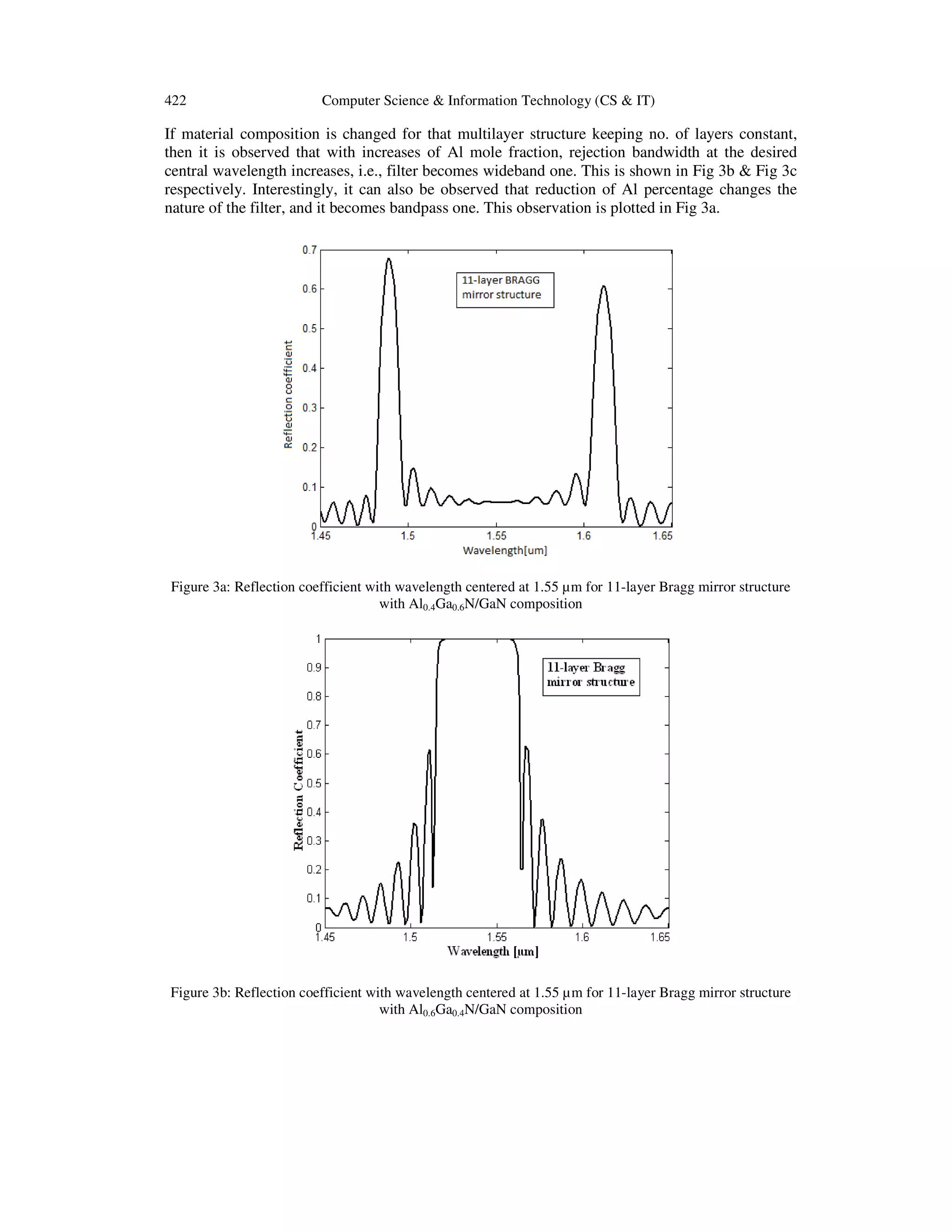
If material composition is changed for that multilayer structure keeping no. of layers constant,
then it is observed that with increases of Al mole fraction, rejection bandwidth at the desired
central wavelength increases, i.e., filter becomes wideband one. This is shown in Fig 3b & Fig 3c
respectively. Interestingly, it can also be observed that reduction of Al percentage changes the
nature of the filter, and it becomes bandpass one. This observation is plotted in Fig 3a.
Figure 3a: Reflection coefficient with wavelength centered at 1.55 µm for 11-layer Bragg mirror structure
with Al0.4Ga0.6N/GaN composition
Figure 3b: Reflection coefficient with wavelength centered at 1.55 µm for 11-layer Bragg mirror structure
with Al0.6Ga0.4N/GaN composition
Computer Science & Information Technology (CS & IT) 423
Figure 3c: Reflection coefficient with wavelength centered at 1.55 µm for 11-layer Bragg mirror structure
with Al0.7Ga0.3N/GaN composition
By varying the dimension of different layers keeping no. of layers and material composition
constant, it is observed that increasing the width of either of the layer ultimately shift the
predetermined filter bandwidth from the desired optical communication wavelength and hence
optimization of layer thickness is very much essential. In Fig 4a, reflection coefficient is plotted
with variation of AlxGa1-xN layer thickness. It is observed that the filter characterisitcs for 11-
layer structure with Al0.6Ga0.4N/GaN composition is optimized for 3.5 µm width, and decreasing
or increasing the dimension converts it in a bandpass filter. This effect is simulated considering
the GaN thickness as 2.7 µm. Now keeping thickness of Al0.6Ga0.4N layer as 3.5 µm, if width of
GaN layer is varied, then also filter characteristic changes; as evident from Fig 4b.
Figure 4a: Reflection coefficient with wavelength centered at 1.55 µm for 11-layer Bragg mirror with
Al0.6Ga0.4N/GaN composition for different thickness of Al0.6Ga0.4N but constant GaN thickness
424 Computer Science & Information Technology (CS & IT)
Figure 4b: Reflection coefficient with wavelength centered at 1.55 µm for 11-layer Bragg mirror with
Al0.6Ga0.4N/GaN composition for different GaN thickness of but constant Al0.6Ga0.4N thickness
5. CONCLUSION
Throughout the simulation work, filter property of multilayer Bragg mirror structure is analyzed
by means of reflection coefficient at 1550 nm. Dimension of different layers and material
compositions are varied to observe the effect on optical property. Numbers of layers are varied to
observe the variation of width of desired region. In this work we considered the dependence of
refractive indices of different layers on material composition and frequency of interest.
Propagation matrix method is considered for material analysis. Optimized profile is generated for
the structure combining the effect of number of layers, their dimension and material composition.
Results are very helpful to analyze vertical cavity surface emitting laser analysis.
REFERENCES
[1] M. Achtenhagen, N. V. Amarasinghe, L. Jiang, J. Threadgill, P. Youn, (2009), “Spectral Properties of
High-Power Distributed Bragg Reflector Lasers”, Journal of Lightwave Technology, vol. 27, pp.
3433-3437.
[2] M. Achtenhagen, N.V. Amarasinghe, G.A. Evans, (2007), High-power Distributed Bragg Reflector
Lasers Operating at 1065nm", Electronic Letters, vol. 43.
[3] D. Wang, I. T. Ferguson, J. A. Buck, (2007), GaN-based Distributed Bragg Reflector for High-
Brightness LED and Solid-State Lighting", Applied Optics, vol. 46, pp. 4763-4767.
[4] J. Y. Tsai, T. C. Lu, S. C. Wang, (2003), "High Reflectivity Distributed Bragg Reflectors for 1.55 µm
VCSELs using InP/Airgap", Solid State Electronics, vol. 47, pp. 1825-1828.
Computer Science & Information Technology (CS & IT) 425
[5] Y. Shimizu, Y. Okada, (2003), "GaAs/Si Solar Cells with Internal Bragg Reflector Superlattice
Structure", Proceedings of 3rd World Conference on Photovoltaic Energy Conversion, vol. 1, 781-
784.
[6] A. V. Kavokin, M. A. Kaliteevski, (1996), "Light absorption Effect on bragg Interference in
Multilayer Semiconductor Heterostructures", Journal of Applied Physics, vol. 79, pp. 595-598.
[7] V. V. Evstropov, M. A. Kaliteevski, A. L. Lipko, M. A. Sinitsyn, B. V. Tsarenkov, Y. M.
Shernyakov, B. S. Yavich, (1996), "Semiconductor bragg reflector with absorbing Layers",
Semiconductors, Vol 30, pp.57-59.
[8] J. L. Shen, C. Y. Chang, H. C. Liu, W. C. Chou, Y. F. Chen, T. Jung, M. C. Wu, (2001), "Reflectivity
and Photoluminescence Studies in Bragg Reflectors with Absorbing Layers", Semiconductor Science
and Technology, vol 16, pp. 548-552.
[9] J. L. Chen, C. Y. Chang, W. C. Chou, (2001), “Temperature Dependence of the Reflectivity in
Absorbing Bragg Reflectors”, Optics express, vol. 9, pp. 287-292.
[10] M. Gudan, J. Piprek, (1996), “Material Parameters of Quaternary III-V Semiconductors for Multilayer
mirrors at 1.55 Micron wavelength”, Modelling and Simulation of Material Science Engineering, vol.
4, pp. 349-357.
[11] G. M. Laws, E. C. Larkins, I. Harrison, C. Molloy, D. Somerford, (2001), “Improved Refractive index
Formulas for the AlGaN and InGaN Alloys”, Journal of applied Physics, vol. 89, pp. 1108-1115.

NOVEL BAND-REJECT FILTER DESIGN USING MULTILAYER BRAGG MIRROR AT 1550 NM

  • 1.
    Rupak Bhattacharyya etal. (Eds) : ACER 2013, pp. 419–425, 2013. © CS & IT-CSCP 2013 DOI : 10.5121/csit.2013.3239 NOVEL BAND-REJECT FILTER DESIGN USING MULTILAYER BRAGG MIRROR AT 1550 NM Krishanu Nandy1 , Suhrid Biswas2 , Rahul Bhattacharyya3 , Soumendra Nath Saha4 , Arpan Deyasi5 1,2,3,4,5 Department of Electronics of Communication Engineering, RCC Institute of Information Technology, Canal South Road, Kolkata-700015 {krishrcc91, suhridbiswas3, rahulrcciit91}@gmail.com 4 soumendra91@yahoo.com, 5 deyasi_arpan@yahoo.co.in ABSTRACT Novel band-reject filter is proposed using multilayer Bragg mirror structure by computing reflection coefficient at 1550 nm wavelength for optical communication. Dimension of different layers and material composition are modified to study the effect on rejection bandwidth, and no. of layers is also varied for analyzing passband characteristics. GaN/AlxGa1-xN composiiton is taken as the choice for simulation purpose, carried out using propagation matrix method. Refractive indices of the materials are considered as function of bandgap, operating wavelength and material composition following Adachi’s model. One interesting result arises from the computation that band-reject filter may be converted into band-pass one by suitably varying ratio of thicknesses of unit cell, or by varying Al mole fraction. Simulated results can be utilised to design VCSEL mirror as optical transmitter. KEYWORDS Bragg mirror, Reflection coefficient, Multilayer structure, Band-reject filter 1. INTRODUCTION Bragg reflectors have already attracted interest of researchers for their possible novel applications as optical transmitter [1-2], LED [3], reflectivity modulators [4], solar cell [5]. Highly transparent dielectric materials are required are used to construct Bragg mirrors in order to minimize the loss due to optical absorption [6-8]. It is a structure formed from multiple layers of alternating materials with periodic variation of refractive index, where each layer boundary causes a partial reflection of an optical wave. For waves whose wavelength is approximately four times the optical thickness of the layers, reflections then combine with constructive interference, and the layers act as a high-quality reflector. For design of such highly reflecting multilayer structure using dielectric materials, its reflectivity plays a critical role along with dispersion and phase [9]. By suitably choosing the refractive indices of the constituting layers along with dimension of slabs, required filter characteristics can be obtained from reflection coefficient profile; when computed for the desired frequency region. Depending on the position of passband, it can be utilized as band-reject or bandpass filter, depending on the requirement for optical communication purpose. In this paper, reflectivity of multilayer Bragg mirror is computed using propagation matrix method at 1550 nm considering GaN/AlxGa1-xN material composiiton. It is observed that by suitably choosign dimension of slabs and Al mole fraction of AlxGa1-xN layer, the structure can be
  • 2.
    420 Computer Science& Information Technology (CS & IT) used as band-reject or bandpass filter. Rsults can be utilized to design multilayer VCSEL structure. 2. MATHEMATICAL MODELLING We consider the simplest three layers having refractive indices as shown in Fig 1: Figure 1: Three-layer interface with r. i as n1, n2, n1 We consider wavevectors k0, k1, k2 defined as in terms of wavelength, and assume normal incidence of light on the structure. For wave at media interface having propagation constant k1 and k2 respectively, satisfaction of boundary conditions give the following equation- z)exp(ikB+z)exp(-ikB=z)exp(ikA+z)exp(-ikA 22211211 (1) Then interface matrices can in general be represented as-       − = ii i kk D 11 (2) where ii nk λ π2 = (3) Considering propagation matrices as P1, P2, P3; we can write it in general-       − = )exp(0 0)exp( ii ii i djk djk P (4) Gain can be calculated as- ( )( ) ( )( )1 111 1 − +++ − = iiiiiii DPDDPDG (5) 3. MATERIAL PARAMETER Several models already have been reported to calculate refractive index but up to now Adachi’s model is considered most accurate model. Several research groups have proposed own values of Adachi’s fitting parameters that give different level of accuracy for a range of composition of Al in nitride alloys. The continuous equation to calculate the refractive index for all nitrides material proposed by Adachi and later simplified [10-11] is given below:
  • 3.
    Computer Science &Information Technology (CS & IT) 421         +                         −−                 +−         = − B EEE AEn ggg ωωω hhh 112)( 2 where Eg is the bandgap energy of the material, ω is the frequency of the laser emission and A and B are the fitting parameters. For simulation purpose, we have considered GaN/AlxGa1-xN composition. 4. RESULTS & DISCUSSION Using the equations, reflectance of Bragg’s mirror is computed for multilayer structure by varying thicknesses and material composition of the layers, as well as no of layers also. Fig 2a shows the reflection coefficient of 11-layer structure centered at 1.55 µm, and by suitably choosing the ratio of thickness of the unit cell and also material composition, reflectivity can be made unity near the desired frequency range of interest. Hence it can be considered as a band-reject filter for noise. It is also observed that by increasing no. of layers, bandwidth slightly increases; and reflectivity at passbands monotonically decreases following exponential nature. This is plotted in Fig 2b. Figure 2a: Reflection coefficient with wavelength centered at 1.55 µm for 11-layer Bragg mirror structure Figure 2b: Reflection coefficient with wavelength centered at 1.55 µm for 20-layer Bragg mirror structure
  • 4.
    422 Computer Science& Information Technology (CS & IT) If material composition is changed for that multilayer structure keeping no. of layers constant, then it is observed that with increases of Al mole fraction, rejection bandwidth at the desired central wavelength increases, i.e., filter becomes wideband one. This is shown in Fig 3b & Fig 3c respectively. Interestingly, it can also be observed that reduction of Al percentage changes the nature of the filter, and it becomes bandpass one. This observation is plotted in Fig 3a. Figure 3a: Reflection coefficient with wavelength centered at 1.55 µm for 11-layer Bragg mirror structure with Al0.4Ga0.6N/GaN composition Figure 3b: Reflection coefficient with wavelength centered at 1.55 µm for 11-layer Bragg mirror structure with Al0.6Ga0.4N/GaN composition
  • 5.
    Computer Science &Information Technology (CS & IT) 423 Figure 3c: Reflection coefficient with wavelength centered at 1.55 µm for 11-layer Bragg mirror structure with Al0.7Ga0.3N/GaN composition By varying the dimension of different layers keeping no. of layers and material composition constant, it is observed that increasing the width of either of the layer ultimately shift the predetermined filter bandwidth from the desired optical communication wavelength and hence optimization of layer thickness is very much essential. In Fig 4a, reflection coefficient is plotted with variation of AlxGa1-xN layer thickness. It is observed that the filter characterisitcs for 11- layer structure with Al0.6Ga0.4N/GaN composition is optimized for 3.5 µm width, and decreasing or increasing the dimension converts it in a bandpass filter. This effect is simulated considering the GaN thickness as 2.7 µm. Now keeping thickness of Al0.6Ga0.4N layer as 3.5 µm, if width of GaN layer is varied, then also filter characteristic changes; as evident from Fig 4b. Figure 4a: Reflection coefficient with wavelength centered at 1.55 µm for 11-layer Bragg mirror with Al0.6Ga0.4N/GaN composition for different thickness of Al0.6Ga0.4N but constant GaN thickness
  • 6.
    424 Computer Science& Information Technology (CS & IT) Figure 4b: Reflection coefficient with wavelength centered at 1.55 µm for 11-layer Bragg mirror with Al0.6Ga0.4N/GaN composition for different GaN thickness of but constant Al0.6Ga0.4N thickness 5. CONCLUSION Throughout the simulation work, filter property of multilayer Bragg mirror structure is analyzed by means of reflection coefficient at 1550 nm. Dimension of different layers and material compositions are varied to observe the effect on optical property. Numbers of layers are varied to observe the variation of width of desired region. In this work we considered the dependence of refractive indices of different layers on material composition and frequency of interest. Propagation matrix method is considered for material analysis. Optimized profile is generated for the structure combining the effect of number of layers, their dimension and material composition. Results are very helpful to analyze vertical cavity surface emitting laser analysis. REFERENCES [1] M. Achtenhagen, N. V. Amarasinghe, L. Jiang, J. Threadgill, P. Youn, (2009), “Spectral Properties of High-Power Distributed Bragg Reflector Lasers”, Journal of Lightwave Technology, vol. 27, pp. 3433-3437. [2] M. Achtenhagen, N.V. Amarasinghe, G.A. Evans, (2007), High-power Distributed Bragg Reflector Lasers Operating at 1065nm", Electronic Letters, vol. 43. [3] D. Wang, I. T. Ferguson, J. A. Buck, (2007), GaN-based Distributed Bragg Reflector for High- Brightness LED and Solid-State Lighting", Applied Optics, vol. 46, pp. 4763-4767. [4] J. Y. Tsai, T. C. Lu, S. C. Wang, (2003), "High Reflectivity Distributed Bragg Reflectors for 1.55 µm VCSELs using InP/Airgap", Solid State Electronics, vol. 47, pp. 1825-1828.
  • 7.
    Computer Science &Information Technology (CS & IT) 425 [5] Y. Shimizu, Y. Okada, (2003), "GaAs/Si Solar Cells with Internal Bragg Reflector Superlattice Structure", Proceedings of 3rd World Conference on Photovoltaic Energy Conversion, vol. 1, 781- 784. [6] A. V. Kavokin, M. A. Kaliteevski, (1996), "Light absorption Effect on bragg Interference in Multilayer Semiconductor Heterostructures", Journal of Applied Physics, vol. 79, pp. 595-598. [7] V. V. Evstropov, M. A. Kaliteevski, A. L. Lipko, M. A. Sinitsyn, B. V. Tsarenkov, Y. M. Shernyakov, B. S. Yavich, (1996), "Semiconductor bragg reflector with absorbing Layers", Semiconductors, Vol 30, pp.57-59. [8] J. L. Shen, C. Y. Chang, H. C. Liu, W. C. Chou, Y. F. Chen, T. Jung, M. C. Wu, (2001), "Reflectivity and Photoluminescence Studies in Bragg Reflectors with Absorbing Layers", Semiconductor Science and Technology, vol 16, pp. 548-552. [9] J. L. Chen, C. Y. Chang, W. C. Chou, (2001), “Temperature Dependence of the Reflectivity in Absorbing Bragg Reflectors”, Optics express, vol. 9, pp. 287-292. [10] M. Gudan, J. Piprek, (1996), “Material Parameters of Quaternary III-V Semiconductors for Multilayer mirrors at 1.55 Micron wavelength”, Modelling and Simulation of Material Science Engineering, vol. 4, pp. 349-357. [11] G. M. Laws, E. C. Larkins, I. Harrison, C. Molloy, D. Somerford, (2001), “Improved Refractive index Formulas for the AlGaN and InGaN Alloys”, Journal of applied Physics, vol. 89, pp. 1108-1115.