PRESENTATION
TOPIC:
OPTICAL PROPERTIES of 2D MATERIALS
Presented By:
USAMA INAYAT 19011710-007
MARIA ASHRAF 19011710-008
1
What are the Optical Properties?
 Optical properties of materials are those properties which are defined by the
interaction of light with materials i.e. it define interaction of light with
material.
 OPTICAL = “Operating in or employing in the visible part of the
electromagnetic spectrum” OR “relating to sight, especially in relation to
the action of light”.
 The simple picture start by considering a ‘ray’ of an electromagnetic wave
of a single frequency entering a medium from vacuum. This could be
reflected, transmitted (refracted) or absorbed.
2
Optical Properties
 From more fundamental perspective., there are only two possibilities of
interaction of a medium with electromagnetic radiation
i. Scattering
ii. Absorption
 If one considers a wider spectrum of frequencies, the some part of the
spectrum could be absorbed while the other frequencies could be scattered.
3
List of Properties
1. Dielectric Constant -- Dielectric constant is a measure of how a material
responds to an electric field, particularly how much separation of charge occurs.
It consist of real part 𝜀1 and imaginary part 𝜀2 as
𝜀 = 𝜀1 − 𝑖𝜀2
2. Reflectivity -- The ratio between the reflected intensity, IR, and the incoming
intensity, I0, of the light serves as a definition for the reflectivity:
R = IR/I0
3. Energy Loss Function – Loss of energy per unit length is defined as energy loss
function.
4. Absorption Coefficient -- Absorption is related to the transition between
occupied and unoccupied states caused from the
light and electron interaction
4
Literature Review
Lashgari, H., et al. [1] studied the electronic and optical properties of 2D graphene
like titanium carbides and nitrides Tin+1Xn through DFT by applying SCF and FP-
LAPW methods respectively.
 Optical properties were including
• Dielectric function
• Refelectivity
• Electron loss function
• Absorption coefficient
 There are two parts of dielectric function real and imaginary parts. Real part
obtained from Kramer Kroning Relations as
5
The imaginary part is obtained by the following relation
The graphs of real and imaginary part of dielectric functions are shown in Fig. 1
and Fig. 2 respectively.
.
Fig. 1. Real Part of dielectric function of Tin+1Xn Fig. 2. imaginary Part of dielectric function of Tin+1Xn
6
𝑲 𝑬
 The reflectivity graph is shown in Fig. 3. The formula of reflectivity is
Fig. 3. The reflectivity for Tin+1Xn compounds
7
 Energy loss function can be calculated from following relation and shown in Fig. 4
Fig. 4. The Eloss spectra for Tin+1Xn compounds
8
 The absorption coefficient graph is shown in Fig. 5. and calculated as following relation
Fig. 5. The absorption coefficient for Tin+1Xn compounds
9
Muhammad Rizwan ., et al. [2] studied the Optical Properties by
Implementation of Magnesium Doping in SrTiO3 through Density Function
Theory by applying,
generalized gradient approximation (GGA) is used.
 Optical properties were including
• ε1 Real Part of Dielectric function
• ε2 Imaginary Part of Dielectric function
• Electron loss function
• Absorption coefficient
• Refelectivity
• Refractive index
Literature Review10
ℇ is dielectric function, ℇ1 is real and ℇ2 imaginary part (I) expresses the absorption
coefficient (K) extinction coefficient (N) complex refractive index (L) energy loss
function (n) refractive index (r) reflectivity coefficient.
Formula’s
11
The optical spectra are computed from the interband transition. The complex dielectric
functions have two parts first is real part ℇ1that defines the polarization
imaginary part ℇ2 shows the absorption as shown in figure(b). In pure SrTiO3 the
imaginary part of the dielectric function is zero at 0eV that shows there is no absorption
(dissipation) of energy but for the Mg-doped system ℇ2 gives positive value at 0eV that
9
12
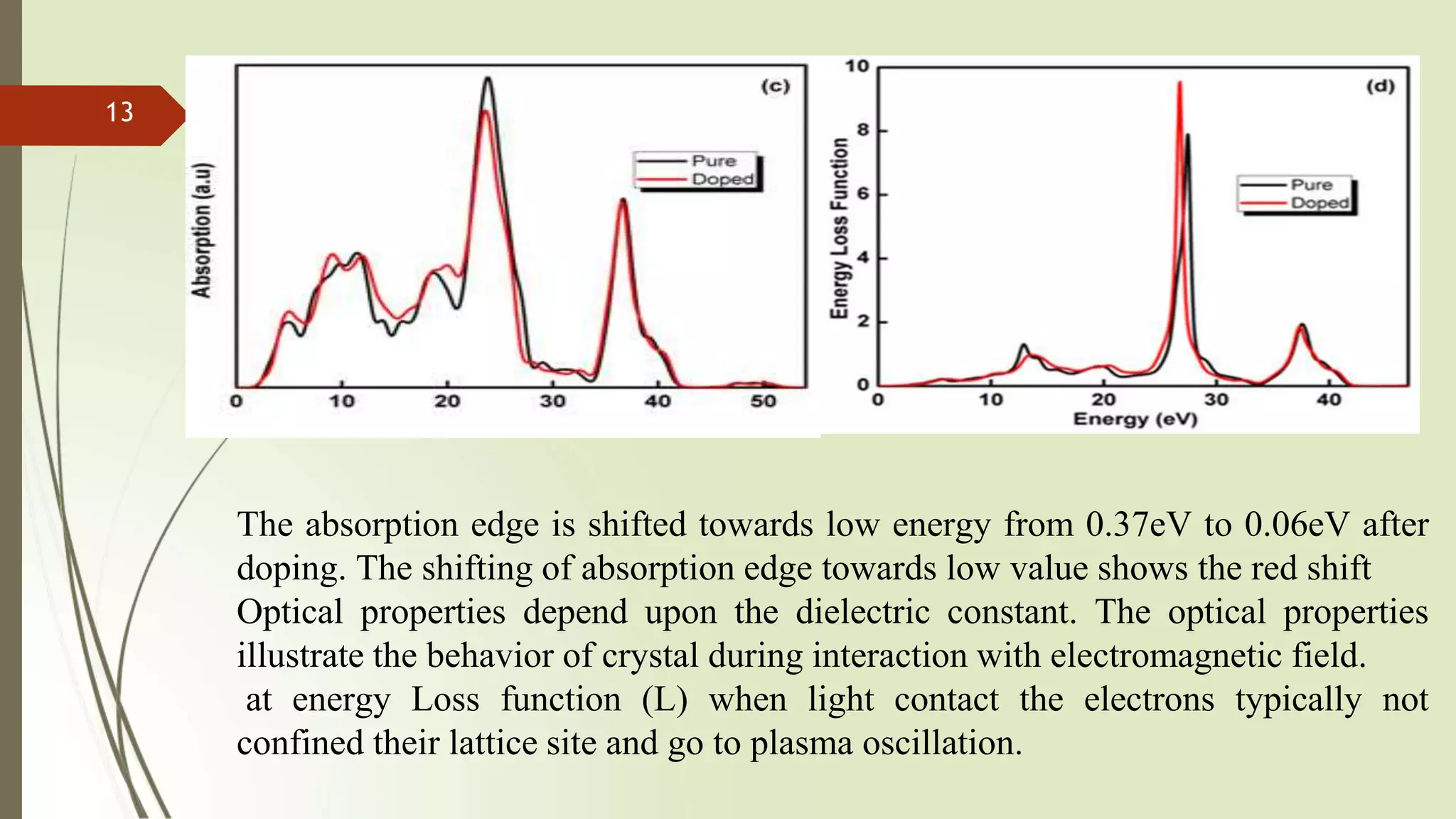
The absorption edge is shifted towards low energy from 0.37eV to 0.06eV after
doping. The shifting of absorption edge towards low value shows the red shift
Optical properties depend upon the dielectric constant. The optical properties
illustrate the behavior of crystal during interaction with electromagnetic field.
at energy Loss function (L) when light contact the electrons typically not
confined their lattice site and go to plasma oscillation.
13
The complex refractive index N has two parts, the refractive index and
extinction coefficient K shown in figure(f).The refractive index (n) for pure
system is 2.49 and doped system is 2.52eV
The increasing of the refractive index after doping is the confirmation of the
increases of band gap.
14
Before and after Mg doping, the structures display p-type semiconducting
behavior and an increase in the band gap was observed (i.e. 1.866eV).
An indirect band gap before and after Mg-doping was observed.
Mg doping not only affect the structure but also alter its optical properties.
The absorption edge shows the red shift.
The refractive index increases from 2.49 to 2.52 after Mg doping.
Results and Discussion
15
Comprehensive understanding of optical properties (absorption, emission,
transmission, and reflection) is vital in various scientific and industrial
applications such as laser technology, (mirrors, lenses and optical windows),
contactless temperature measurement, optics, modeling, heat transfer, energy,
photovoltaic and aerospace industry etc.
i. Used tunable microwave capacitors
ii. Flat panel displays
iii. Magnetic field sensitive thermometers
iv. Scanning microscopes
v. Semiconductive ceramics
vi. Detectors
Applications
16
References
[1]Lashgari, H., Abolhassani, M. R., Boochani, A., Elahi, S. M., & Khodadadi, J. (2014). Electronic
and optical properties of 2D graphene-like compounds titanium carbides and nitrides: DFT
calculations. Solid State Communications, 195, 61-69. doi:10.1016/j.ssc.2014.06.008
[2] Rizwan, M., Anwar, M., Usman, Z., Shakil, M., Gillani, S. S. A., Jin, H. B., ... & Mushtaq, U. (2019).
Implementation of magnesium doping in SrTiO3 for correlating electronic, structural and optical
properties: A DFT study. Chinese Journal of Physics, 62, 388-394.
17
18

Optical properties of 2D materials

  • 1.
    PRESENTATION TOPIC: OPTICAL PROPERTIES of2D MATERIALS Presented By: USAMA INAYAT 19011710-007 MARIA ASHRAF 19011710-008 1
  • 2.
    What are theOptical Properties?  Optical properties of materials are those properties which are defined by the interaction of light with materials i.e. it define interaction of light with material.  OPTICAL = “Operating in or employing in the visible part of the electromagnetic spectrum” OR “relating to sight, especially in relation to the action of light”.  The simple picture start by considering a ‘ray’ of an electromagnetic wave of a single frequency entering a medium from vacuum. This could be reflected, transmitted (refracted) or absorbed. 2
  • 3.
    Optical Properties  Frommore fundamental perspective., there are only two possibilities of interaction of a medium with electromagnetic radiation i. Scattering ii. Absorption  If one considers a wider spectrum of frequencies, the some part of the spectrum could be absorbed while the other frequencies could be scattered. 3
  • 4.
    List of Properties 1.Dielectric Constant -- Dielectric constant is a measure of how a material responds to an electric field, particularly how much separation of charge occurs. It consist of real part 𝜀1 and imaginary part 𝜀2 as 𝜀 = 𝜀1 − 𝑖𝜀2 2. Reflectivity -- The ratio between the reflected intensity, IR, and the incoming intensity, I0, of the light serves as a definition for the reflectivity: R = IR/I0 3. Energy Loss Function – Loss of energy per unit length is defined as energy loss function. 4. Absorption Coefficient -- Absorption is related to the transition between occupied and unoccupied states caused from the light and electron interaction 4
  • 5.
    Literature Review Lashgari, H.,et al. [1] studied the electronic and optical properties of 2D graphene like titanium carbides and nitrides Tin+1Xn through DFT by applying SCF and FP- LAPW methods respectively.  Optical properties were including • Dielectric function • Refelectivity • Electron loss function • Absorption coefficient  There are two parts of dielectric function real and imaginary parts. Real part obtained from Kramer Kroning Relations as 5
  • 6.
    The imaginary partis obtained by the following relation The graphs of real and imaginary part of dielectric functions are shown in Fig. 1 and Fig. 2 respectively. . Fig. 1. Real Part of dielectric function of Tin+1Xn Fig. 2. imaginary Part of dielectric function of Tin+1Xn 6
  • 7.
    𝑲 𝑬  Thereflectivity graph is shown in Fig. 3. The formula of reflectivity is Fig. 3. The reflectivity for Tin+1Xn compounds 7
  • 8.
     Energy lossfunction can be calculated from following relation and shown in Fig. 4 Fig. 4. The Eloss spectra for Tin+1Xn compounds 8
  • 9.
     The absorptioncoefficient graph is shown in Fig. 5. and calculated as following relation Fig. 5. The absorption coefficient for Tin+1Xn compounds 9
  • 10.
    Muhammad Rizwan .,et al. [2] studied the Optical Properties by Implementation of Magnesium Doping in SrTiO3 through Density Function Theory by applying, generalized gradient approximation (GGA) is used.  Optical properties were including • ε1 Real Part of Dielectric function • ε2 Imaginary Part of Dielectric function • Electron loss function • Absorption coefficient • Refelectivity • Refractive index Literature Review10
  • 11.
    ℇ is dielectricfunction, ℇ1 is real and ℇ2 imaginary part (I) expresses the absorption coefficient (K) extinction coefficient (N) complex refractive index (L) energy loss function (n) refractive index (r) reflectivity coefficient. Formula’s 11
  • 12.
    The optical spectraare computed from the interband transition. The complex dielectric functions have two parts first is real part ℇ1that defines the polarization imaginary part ℇ2 shows the absorption as shown in figure(b). In pure SrTiO3 the imaginary part of the dielectric function is zero at 0eV that shows there is no absorption (dissipation) of energy but for the Mg-doped system ℇ2 gives positive value at 0eV that 9 12
  • 13.
    The absorption edgeis shifted towards low energy from 0.37eV to 0.06eV after doping. The shifting of absorption edge towards low value shows the red shift Optical properties depend upon the dielectric constant. The optical properties illustrate the behavior of crystal during interaction with electromagnetic field. at energy Loss function (L) when light contact the electrons typically not confined their lattice site and go to plasma oscillation. 13
  • 14.
    The complex refractiveindex N has two parts, the refractive index and extinction coefficient K shown in figure(f).The refractive index (n) for pure system is 2.49 and doped system is 2.52eV The increasing of the refractive index after doping is the confirmation of the increases of band gap. 14
  • 15.
    Before and afterMg doping, the structures display p-type semiconducting behavior and an increase in the band gap was observed (i.e. 1.866eV). An indirect band gap before and after Mg-doping was observed. Mg doping not only affect the structure but also alter its optical properties. The absorption edge shows the red shift. The refractive index increases from 2.49 to 2.52 after Mg doping. Results and Discussion 15
  • 16.
    Comprehensive understanding ofoptical properties (absorption, emission, transmission, and reflection) is vital in various scientific and industrial applications such as laser technology, (mirrors, lenses and optical windows), contactless temperature measurement, optics, modeling, heat transfer, energy, photovoltaic and aerospace industry etc. i. Used tunable microwave capacitors ii. Flat panel displays iii. Magnetic field sensitive thermometers iv. Scanning microscopes v. Semiconductive ceramics vi. Detectors Applications 16
  • 17.
    References [1]Lashgari, H., Abolhassani,M. R., Boochani, A., Elahi, S. M., & Khodadadi, J. (2014). Electronic and optical properties of 2D graphene-like compounds titanium carbides and nitrides: DFT calculations. Solid State Communications, 195, 61-69. doi:10.1016/j.ssc.2014.06.008 [2] Rizwan, M., Anwar, M., Usman, Z., Shakil, M., Gillani, S. S. A., Jin, H. B., ... & Mushtaq, U. (2019). Implementation of magnesium doping in SrTiO3 for correlating electronic, structural and optical properties: A DFT study. Chinese Journal of Physics, 62, 388-394. 17
  • 18.

Editor's Notes

  • #14 absorption and reflectance have converse relation. Wherever reflectance give the maximum value at the same point absorption and imaginary part of CDF give minimum value.
  • #15 By taking square root of CDF the refractive index is obtained.