Chronic kidney disease
Dr. Kollum
Kollum 2
Objectives
• Define Chronic Kidney Disease (CKD)
• Staging of CKD
• Estimation of GFR: Formulae used
• Causes of CKD
• Clinical manifestation
• Significance of CKD
• Principles of treatment
• Prognosis
9/6/2022
Kollum 3
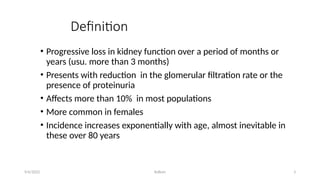
Definition
• Progressive loss in kidney function over a period of months or
years (usu. more than 3 months)
• Presents with reduction in the glomerular filtration rate or the
presence of proteinuria
• Affects more than 10% in most populations
• More common in females
• Incidence increases exponentially with age, almost inevitable in
these over 80 years
9/6/2022
Kollum 4
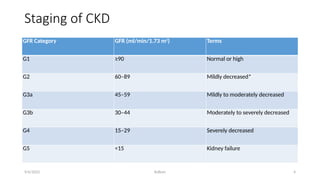
Staging of CKD
GFR Category GFR (ml/min/1.73 m2
) Terms
G1 ≥90 Normal or high
G2 60–89 Mildly decreased*
G3a 45–59 Mildly to moderately decreased
G3b 30–44 Moderately to severely decreased
G4 15–29 Severely decreased
G5 <15 Kidney failure
9/6/2022
Kollum 5
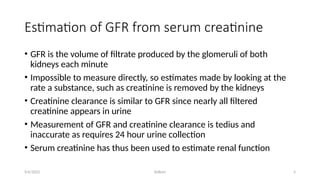
Estimation of GFR from serum creatinine
• GFR is the volume of filtrate produced by the glomeruli of both
kidneys each minute
• Impossible to measure directly, so estimates made by looking at the
rate a substance, such as creatinine is removed by the kidneys
• Creatinine clearance is similar to GFR since nearly all filtered
creatinine appears in urine
• Measurement of GFR and creatinine clearance is tedius and
inaccurate as requires 24 hour urine collection
• Serum creatinine has thus been used to estimate renal function
9/6/2022
Kollum 6
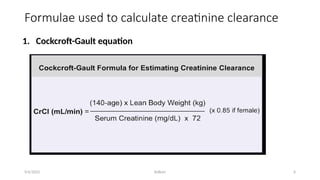
Formulae used to calculate creatinine clearance
1. Cockcroft-Gault equation
9/6/2022
Kollum 7
Formulae…..
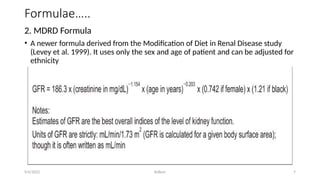
2. MDRD Formula
• A newer formula derived from the Modification of Diet in Renal Disease study
(Levey et al. 1999). It uses only the sex and age of patient and can be adjusted for
ethnicity
9/6/2022
Kollum 8
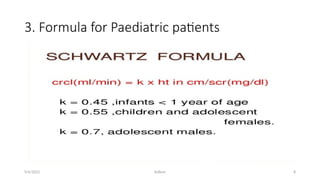
3. Formula for Paediatric patients
9/6/2022
Kollum 9
Estimation of renal function using urea
• Serum Urea is also commonly used to assess renal function
• Demerits: variable production rate and diurnal fluctuations in
response to protein content of diet, elevated by dehydration or an
increase in protein catabolism such as in GI hemorrhage, sepsis,
trauma, high dose steroid
• Rapid elevation of urea before any rise in corresponding creatinine
indicates progress into a prerenal state
9/6/2022
Kollum 10
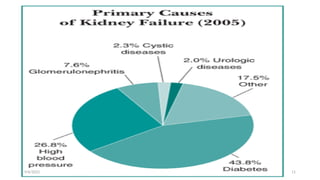
Causes of CKD
• Reduction in renal function results from damage to the infrastructure
of the kidney
• Nephrons are lost as complete units as well as the function, those left
have to cope with increased demand
• Patient remains well until so many nephrons are lost and the GFR
cannot be maintained despite activation of compensatory mechanisms
• Hence GFR progressively declines
• Identifying cause is useful to identify and eliminate reversible factors
and planning for likely outcomes and treatments
9/6/2022
Kollum 11
9/6/2022
Kollum 12
Clinical manifestations of CKD
• Urinary symptoms
• Fluid retention
• Uremia
• Anemia
• Electrolyte disturbances
• Renal osteodystrophy
• Others
9/6/2022
Kollum 13
1. Urinary symptoms
Polyuria due to medullary damage and osmotic effect of high plasma
urea levels (>40mmol/L)
Nocturia occurs as ability to concentrate urine is lost plus failure of
physiological nocturnal antidiuresis
Proteinuria: results from glomerular leaks, infection, failure of protein
reabsorption in the tubules or overflow of excess plasma proteins(as in
myeloma). Proteinuria greater than 2g in a 24 hour collection indicates
glomerular aetiology
9/6/2022
Kollum 14
2. Fluid retention
Failure to excrete salt and water as GFR falls.
• Retention of extracellular fluid manifests as both peripheral and pulmonary
edema and ascites.
• In severe CKD sodium retention leads to circulatory volume expansion
leading to hypertension. Volume dependent hypertension occurs in 80% of
patients
• Raised BP exacerbates renal damage. Hypertension causes damage to
intrarenal vasculature, thickening walls of arterioles and small vessels. This
reduces renal perfusion leading to stimulation of the renin angiotensin
aldosterone system, leads to vasoconstriction result which exacerbate
degree of hypertension
9/6/2022
Kollum 15
3. Uremia
• Blood level of urea is used to estimate the degree of toxin
accumulation in uremia.
• Symptoms are many and vary: anorexia, nausea, vomiting,
constipation, foul taste, skin discoloration and severe pruritus.
• Severe cases crystalline urea is deposited on the skin (uremia frost),
increased tendency to bleed
9/6/2022
Kollum 16
4. Anaemia
• Normochromic, normocytic anemia, Hb levels fall to 6-8g/dl in end-
stage renal failure.
• Principal cause is damage of peritubular cells hence inadequate
secretion of erythropoietin which is main regulator of red cell
proliferation and differentiation in the bone marrow
• Major cause of fatigue, breathlessness at rest and on exertion,
lethargy and angina
• Compensatory hemodynamic changes occur such as increased cardiac
output though leads to tachycardia and palpitations
9/6/2022
Kollum 17
5. Electrolyte Disturbances
• Hypernatraemia and hyponatraemia depends on condition and
therapy employed
• Hyperkalemia: levels of over 7.0 mmol/L are life threatening and can
lead to cardiac arrest.
• Hydrogen ions: common end product of many metabolic processes.
About 40-80 mmol are excreted daily. In renal failure it is retained
causing acidosis
9/6/2022
Kollum 18
6. Renal osteodystrophy
Four types of bone disease associated with CKD:
i. Secondary hyperparathyroidism
ii. Osteomalacia: reduced mineralization
iii. Mixed renal osteodystrophy: both hyperparathyroidism and
osteomalacia
iv. Adynamic bone disease: reduced bone formation and resorption
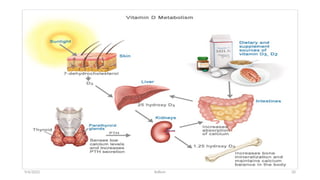
Impaired hydroxylation of cholecalciferal in kidney – vitamin D
deficiency – defective mineralization of bone and osteomalacia
9/6/2022
Kollum 19
7. Others
• Hypocalcaemia: vitamin D deficiency, reduced absorption from the
gut
• Hyperphosphataemia: due to reduced phosphate excretion,
sequesters calcium in bone and soft tissue as calcium phosphate
• Low calcium and low vitamin D results in increased secretion of
parathyroid hormone (PTH) leading to osteosclerosis(hardening of
bone)
• Neurological changes: non specific. Inability to concentrate, memory
impairment, irritability, stupor
• Muscle cramps and restless leg especially at night
9/6/2022
Kollum 20
9/6/2022
Kollum 21
Diagnosis of CKD
• May be suspected because of signs and symptoms
• Most often discovered during routine investigations for other diseases
• Family, drug and social histories are key in elucidating causes of renal
failure
• Physical exam may be helpful: signs of anemia and skin pigmentation,
ankle edema and raised jugular venous pressure suggests fluid
retention, in severe disease fishy smell in breath (uraemic factor),
palpable kidney and bladder
9/6/2022
Kollum 22
Diagnosis…..
• Kidney function assessment: serum creatinine, serum urea,
hyperkalemia, acidosis with low serum bicarbonate, hypocalcaemia,
hyperphosphataemia
• Urine examination visually and microscopically
• Structural assessment of the kidneys: ultrasound, intravenous
urography, abdominal radiography, CT scan, MRI and MRA
• Renal biopsy
• Graphic plots of GFR
9/6/2022
Kollum 23
Treatment
Main aims are:
1. Reverse or arrest the process causing renal
damage
2. Relieve symptoms and avoid worsening conditions
3. Implement regular dialysis and/ or transplantation
9/6/2022
Kollum 24
1. Reversal or arrest of primary disease
• Surgical removal of post renal obstruction
• Treat glomerulonephritis with immunosuppresants or steroids
• Stop offending agent in drug induced renal disease
9/6/2022
Kollum 25
2. Relieve symptoms and avoid worsening conditions
Hypertension
• Adequate control of BP is most crucial to avoid vicious circle of events
• Antihypertensive therapy may lead to improvement in renal function
• Drugs used same as those in other forms of hypertension
• Diuretics are used in fluid overload, loop diuretics
9/6/2022
Kollum 26
Management of uremia
• Dietary modifications: reduced dietary protein intake, sodium
restriction, potassium restriction and vitamin supplementation
• Fluid retention: Dialysis and diuretics used, restrict fluid intake
• GIT symptoms: nausea and vomiting may require antiemetics
Constipation: Laxatives
• Pruritus: Antihistamines
9/6/2022
Kollum 27
Anemia
• Use of recombinant human erythropoietin (epoietin alpha and β
• Correct any iron and folate deficiency before therapy
• Concurrent iron supplements required
• Initial epoietin dose of 50units/kg iv or sc is given three times a week
then increased in steps of 25 units/kg every 4 weeks to produce a Hb
of not more than 2g/dl per month
• Correcting anemia helps control symptoms of lethargy and myopathy
9/6/2022
Kollum 28
Acidosis
• CKD may result in metabolic acidosis. May be treated with sodium
bicarbonate 1-6g/day
• If severe, dialysis may be required
9/6/2022
Kollum 29
Osteodystrophy
Due to 3 factors:
I. Hyperphosphatemia: Restrict diet, use phosphate binders
II. Vitamin D deficiency: Synthetic vitamin D analogues may be used,
doses adjusted with serum calcium level in consideration
III. Hyperparathyroidism: manage calcium levels, surgery may apply
9/6/2022
Kollum 30
Dialysis and renal transplant
• End stage renal failure patients require dialysis or transplantation to
survive
9/6/2022
Kollum 31
Significance of CKD
• CKD indicates progression to end-stage renal failure (ESRF)
• Strong association with accelerated cardiovascular disease, increases with
severity
• Inadequate control of blood pressure may enhance progression to more severe
stages and ESRF
• Most patients with mild CKD (stages 1 to 3) may remain stable for years or
decades and are frequently asymptomatic
• Recognition of these mild stages allows for early treatment of cardiovascular
risk factors and identify those with progressive disease
• Severe CKD(stages 4 and 5) frequently have symptoms of uremia, though
onset is slow and insidious
• Common for patients to present when already in ESRF
9/6/2022
Kollum 32
Resources
• Roger Walker, Cate Whittlesea. Clinical Pharmacy and Therapeutics.
4th Edition
• https://www.utoledo.edu/med/depts/medicine/.../Vetteth_Chronic_
Kidney_Disease.ppt
9/6/2022

Notes on Chronic kidney disease lecture.pptx

  • 1.
  • 2.
    Kollum 2 Objectives • DefineChronic Kidney Disease (CKD) • Staging of CKD • Estimation of GFR: Formulae used • Causes of CKD • Clinical manifestation • Significance of CKD • Principles of treatment • Prognosis 9/6/2022
  • 3.
    Kollum 3 Definition • Progressiveloss in kidney function over a period of months or years (usu. more than 3 months) • Presents with reduction in the glomerular filtration rate or the presence of proteinuria • Affects more than 10% in most populations • More common in females • Incidence increases exponentially with age, almost inevitable in these over 80 years 9/6/2022
  • 4.
    Kollum 4 Staging ofCKD GFR Category GFR (ml/min/1.73 m2 ) Terms G1 ≥90 Normal or high G2 60–89 Mildly decreased* G3a 45–59 Mildly to moderately decreased G3b 30–44 Moderately to severely decreased G4 15–29 Severely decreased G5 <15 Kidney failure 9/6/2022
  • 5.
    Kollum 5 Estimation ofGFR from serum creatinine • GFR is the volume of filtrate produced by the glomeruli of both kidneys each minute • Impossible to measure directly, so estimates made by looking at the rate a substance, such as creatinine is removed by the kidneys • Creatinine clearance is similar to GFR since nearly all filtered creatinine appears in urine • Measurement of GFR and creatinine clearance is tedius and inaccurate as requires 24 hour urine collection • Serum creatinine has thus been used to estimate renal function 9/6/2022
  • 6.
    Kollum 6 Formulae usedto calculate creatinine clearance 1. Cockcroft-Gault equation 9/6/2022
  • 7.
    Kollum 7 Formulae….. 2. MDRDFormula • A newer formula derived from the Modification of Diet in Renal Disease study (Levey et al. 1999). It uses only the sex and age of patient and can be adjusted for ethnicity 9/6/2022
  • 8.
    Kollum 8 3. Formulafor Paediatric patients 9/6/2022
  • 9.
    Kollum 9 Estimation ofrenal function using urea • Serum Urea is also commonly used to assess renal function • Demerits: variable production rate and diurnal fluctuations in response to protein content of diet, elevated by dehydration or an increase in protein catabolism such as in GI hemorrhage, sepsis, trauma, high dose steroid • Rapid elevation of urea before any rise in corresponding creatinine indicates progress into a prerenal state 9/6/2022
  • 10.
    Kollum 10 Causes ofCKD • Reduction in renal function results from damage to the infrastructure of the kidney • Nephrons are lost as complete units as well as the function, those left have to cope with increased demand • Patient remains well until so many nephrons are lost and the GFR cannot be maintained despite activation of compensatory mechanisms • Hence GFR progressively declines • Identifying cause is useful to identify and eliminate reversible factors and planning for likely outcomes and treatments 9/6/2022
  • 11.
  • 12.
    Kollum 12 Clinical manifestationsof CKD • Urinary symptoms • Fluid retention • Uremia • Anemia • Electrolyte disturbances • Renal osteodystrophy • Others 9/6/2022
  • 13.
    Kollum 13 1. Urinarysymptoms Polyuria due to medullary damage and osmotic effect of high plasma urea levels (>40mmol/L) Nocturia occurs as ability to concentrate urine is lost plus failure of physiological nocturnal antidiuresis Proteinuria: results from glomerular leaks, infection, failure of protein reabsorption in the tubules or overflow of excess plasma proteins(as in myeloma). Proteinuria greater than 2g in a 24 hour collection indicates glomerular aetiology 9/6/2022
  • 14.
    Kollum 14 2. Fluidretention Failure to excrete salt and water as GFR falls. • Retention of extracellular fluid manifests as both peripheral and pulmonary edema and ascites. • In severe CKD sodium retention leads to circulatory volume expansion leading to hypertension. Volume dependent hypertension occurs in 80% of patients • Raised BP exacerbates renal damage. Hypertension causes damage to intrarenal vasculature, thickening walls of arterioles and small vessels. This reduces renal perfusion leading to stimulation of the renin angiotensin aldosterone system, leads to vasoconstriction result which exacerbate degree of hypertension 9/6/2022
  • 15.
    Kollum 15 3. Uremia •Blood level of urea is used to estimate the degree of toxin accumulation in uremia. • Symptoms are many and vary: anorexia, nausea, vomiting, constipation, foul taste, skin discoloration and severe pruritus. • Severe cases crystalline urea is deposited on the skin (uremia frost), increased tendency to bleed 9/6/2022
  • 16.
    Kollum 16 4. Anaemia •Normochromic, normocytic anemia, Hb levels fall to 6-8g/dl in end- stage renal failure. • Principal cause is damage of peritubular cells hence inadequate secretion of erythropoietin which is main regulator of red cell proliferation and differentiation in the bone marrow • Major cause of fatigue, breathlessness at rest and on exertion, lethargy and angina • Compensatory hemodynamic changes occur such as increased cardiac output though leads to tachycardia and palpitations 9/6/2022
  • 17.
    Kollum 17 5. ElectrolyteDisturbances • Hypernatraemia and hyponatraemia depends on condition and therapy employed • Hyperkalemia: levels of over 7.0 mmol/L are life threatening and can lead to cardiac arrest. • Hydrogen ions: common end product of many metabolic processes. About 40-80 mmol are excreted daily. In renal failure it is retained causing acidosis 9/6/2022
  • 18.
    Kollum 18 6. Renalosteodystrophy Four types of bone disease associated with CKD: i. Secondary hyperparathyroidism ii. Osteomalacia: reduced mineralization iii. Mixed renal osteodystrophy: both hyperparathyroidism and osteomalacia iv. Adynamic bone disease: reduced bone formation and resorption Impaired hydroxylation of cholecalciferal in kidney – vitamin D deficiency – defective mineralization of bone and osteomalacia 9/6/2022
  • 19.
    Kollum 19 7. Others •Hypocalcaemia: vitamin D deficiency, reduced absorption from the gut • Hyperphosphataemia: due to reduced phosphate excretion, sequesters calcium in bone and soft tissue as calcium phosphate • Low calcium and low vitamin D results in increased secretion of parathyroid hormone (PTH) leading to osteosclerosis(hardening of bone) • Neurological changes: non specific. Inability to concentrate, memory impairment, irritability, stupor • Muscle cramps and restless leg especially at night 9/6/2022
  • 20.
  • 21.
    Kollum 21 Diagnosis ofCKD • May be suspected because of signs and symptoms • Most often discovered during routine investigations for other diseases • Family, drug and social histories are key in elucidating causes of renal failure • Physical exam may be helpful: signs of anemia and skin pigmentation, ankle edema and raised jugular venous pressure suggests fluid retention, in severe disease fishy smell in breath (uraemic factor), palpable kidney and bladder 9/6/2022
  • 22.
    Kollum 22 Diagnosis….. • Kidneyfunction assessment: serum creatinine, serum urea, hyperkalemia, acidosis with low serum bicarbonate, hypocalcaemia, hyperphosphataemia • Urine examination visually and microscopically • Structural assessment of the kidneys: ultrasound, intravenous urography, abdominal radiography, CT scan, MRI and MRA • Renal biopsy • Graphic plots of GFR 9/6/2022
  • 23.
    Kollum 23 Treatment Main aimsare: 1. Reverse or arrest the process causing renal damage 2. Relieve symptoms and avoid worsening conditions 3. Implement regular dialysis and/ or transplantation 9/6/2022
  • 24.
    Kollum 24 1. Reversalor arrest of primary disease • Surgical removal of post renal obstruction • Treat glomerulonephritis with immunosuppresants or steroids • Stop offending agent in drug induced renal disease 9/6/2022
  • 25.
    Kollum 25 2. Relievesymptoms and avoid worsening conditions Hypertension • Adequate control of BP is most crucial to avoid vicious circle of events • Antihypertensive therapy may lead to improvement in renal function • Drugs used same as those in other forms of hypertension • Diuretics are used in fluid overload, loop diuretics 9/6/2022
  • 26.
    Kollum 26 Management ofuremia • Dietary modifications: reduced dietary protein intake, sodium restriction, potassium restriction and vitamin supplementation • Fluid retention: Dialysis and diuretics used, restrict fluid intake • GIT symptoms: nausea and vomiting may require antiemetics Constipation: Laxatives • Pruritus: Antihistamines 9/6/2022
  • 27.
    Kollum 27 Anemia • Useof recombinant human erythropoietin (epoietin alpha and β • Correct any iron and folate deficiency before therapy • Concurrent iron supplements required • Initial epoietin dose of 50units/kg iv or sc is given three times a week then increased in steps of 25 units/kg every 4 weeks to produce a Hb of not more than 2g/dl per month • Correcting anemia helps control symptoms of lethargy and myopathy 9/6/2022
  • 28.
    Kollum 28 Acidosis • CKDmay result in metabolic acidosis. May be treated with sodium bicarbonate 1-6g/day • If severe, dialysis may be required 9/6/2022
  • 29.
    Kollum 29 Osteodystrophy Due to3 factors: I. Hyperphosphatemia: Restrict diet, use phosphate binders II. Vitamin D deficiency: Synthetic vitamin D analogues may be used, doses adjusted with serum calcium level in consideration III. Hyperparathyroidism: manage calcium levels, surgery may apply 9/6/2022
  • 30.
    Kollum 30 Dialysis andrenal transplant • End stage renal failure patients require dialysis or transplantation to survive 9/6/2022
  • 31.
    Kollum 31 Significance ofCKD • CKD indicates progression to end-stage renal failure (ESRF) • Strong association with accelerated cardiovascular disease, increases with severity • Inadequate control of blood pressure may enhance progression to more severe stages and ESRF • Most patients with mild CKD (stages 1 to 3) may remain stable for years or decades and are frequently asymptomatic • Recognition of these mild stages allows for early treatment of cardiovascular risk factors and identify those with progressive disease • Severe CKD(stages 4 and 5) frequently have symptoms of uremia, though onset is slow and insidious • Common for patients to present when already in ESRF 9/6/2022
  • 32.
    Kollum 32 Resources • RogerWalker, Cate Whittlesea. Clinical Pharmacy and Therapeutics. 4th Edition • https://www.utoledo.edu/med/depts/medicine/.../Vetteth_Chronic_ Kidney_Disease.ppt 9/6/2022

Editor's Notes

  • #4 Mild CKD is very common and does not cause symptoms All grades of CKD are important risk factors for cardiovascular disease In severe CKD virtually all body systems are adversely affected End-stage renal failure (ESRF) is the point at which life can only be sustained by dialysis or transplantation
  • #5 Serum creatinine is dependent on rate of its production, which is determined by muscle mass and in turn related to age, sex and weight When muscle mass is stable any change in serum creatinine levels reflect a change in its clearance by filtration
  • #11 Chronic pyelonephritis- inflammation of renal parenchyma with scarring, mostly due to recurrent urine infection Metabolic diseases – commonly Diabetes Mellitus may lead chronic glomerulonephritis Urological diseases cause Urinary obstruction Interstitial nephritis- mainly associated with toxins and drugs Congenital abnormalities – adult polycystic kidney disease
  • #16 Other causes of renal anaemia: shortened red cell survival, marrow suppression by uremic toxins, iron and folate deficiency due to poor intake and increased losses
  • #25 Calcium channel blockers: may cause headache, facial flushing and edema which may be confused with fluid overload
  • #26 Dietary modifications: reduced dietary protein intake, sodium restriction, potassium restriction and vitamin supplementation Fluid retention: due to sodium and water retention as well as hypoalbuminaemia as protein is lost renally Dialysis and diuretics used, restrict fluid intake Gastrointestinal symptoms: nausea and vomiting may require antiemetics Constipation is common and should be avoided especially in PD patients. Laxative therapy as well as high fibre diet may be effective Pruritus: several mechanisms postulated to cause itching such as precipitation of divalent ions, elevated PTH levels, increased dermal mast cell activity. Correction of phosphate and calcium levels improves the condition. Antihistamines
  • #29 Management of hyperphosphataemia: restrict diet Phosphate binders to reduce absorption of orally ingested phosphate. These are salts of di- or trivalent metallic ions such as aluminium, calcium, mg Aluminium hydroxide widely used. Disadvantage of deposition of Al in tissues causing side effects Calcium carbonate is used and has advantage of correction of concurrent hypocalcaemia. Less effective, doses of 10g per day may be needed. Calcium acetate achieves phosphate control at less doses Sevelamer ia a hydrophilic insoluble polymeric compound is used as a phosphate binder in HD patients. Efficiency similar to calcium acetate but with decreased likelihood of hypercalcaemia Hypophosphatemia should be controlled before using vitamin D