Document-oriented data access for
domain-driven .NET systems with
PostgreSQL & Marten
Bojan Veljanovski, CTO at HASELT
October, 2017 @ Macedonian .NET User Group
1
What we are going to talk about?
● Limitations in relational-only DBs for storing true domain
aggregates
● How document-oriented DBs come into play
● Marten as document DB for .NET with PostgreSQL
● SQL + NoSQL => best of both worlds
2
Setting context
● How I got interested in document-oriented DBs?
Why it makes so much sense?
● Why PostgreSQL?
Why not MongoDb, CouchDb, RavenDb?
What about SQL Server, MySQL?
● Who else uses this approach?
3
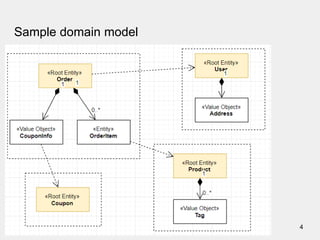
Sample domain model
4
DDD Aggregate
Cluster of domain objects that can be treated as a
single unit.
● Consists of
○ Aggregate Root (or Root Entity)
○ Entities
○ Value Objects
○ Services
○ Repositories 5
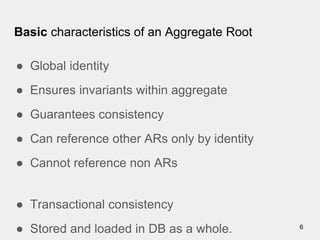
Basic characteristics of an Aggregate Root
● Global identity
● Ensures invariants within aggregate
● Guarantees consistency
● Can reference other ARs only by identity
● Cannot reference non ARs
● Transactional consistency
● Stored and loaded in DB as a whole. 6
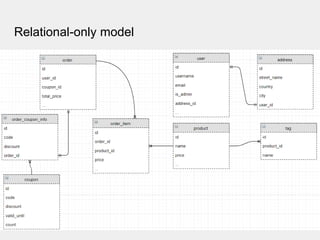
Relational-only model
7
Sample domain model in code
Let’s see the sample codebase in Visual Studio.
8
Limitations when working with
domain models in relational-only DBs...
● Cannot store an array of values
○ Needs new table with 1-m relation
● ...an array of objects
○ Needs new table with 1-m relation
● …a nested object
○ Needs new table with 1-1 relation
● …an AR in a single table
○ AR is spanned across many tables, and needs joinsThese limitations often lead to...
9
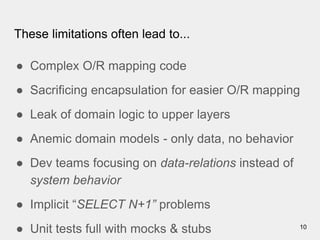
These limitations often lead to...
● Complex O/R mapping code
● Sacrificing encapsulation for easier O/R mapping
● Leak of domain logic to upper layers
● Anemic domain models - only data, no behavior
● Dev teams focusing on data-relations instead of
system behavior
● Implicit “SELECT N+1” problems
● Unit tests full with mocks & stubs 10
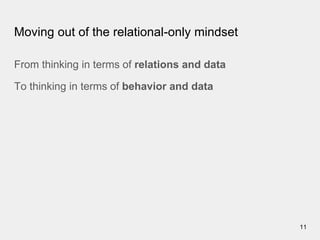
Moving out of the relational-only mindset
From thinking in terms of relations and data
To thinking in terms of behavior and data
11
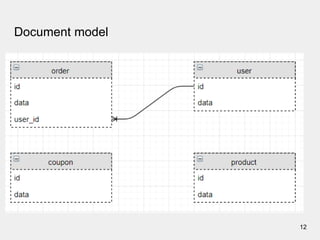
Document model
12
How document-oriented DBs come into play
● Single document per [whole] aggregate
● Can store complex object graphs
● Can store arrays, collections, nested objects
● No need for ORM
● No limitations for creating rich domain models
● Dev team focus is in on behavior and logic
● Models are easy to unit test
13
Introducing PostgreSQL
14
Introducing PostgreSQL
● Object-relational database
● ACID
● Transactional
● Highly Extendable
● Open Source
● Free
15
PostgreSQL NoSQL data types
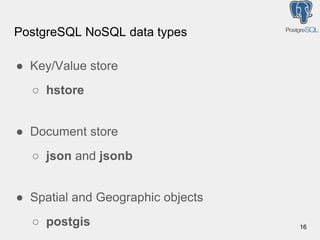
● Key/Value store
○ hstore
● Document store
○ json and jsonb
● Spatial and Geographic objects
○ postgis 16
PostgreSQL as document store:
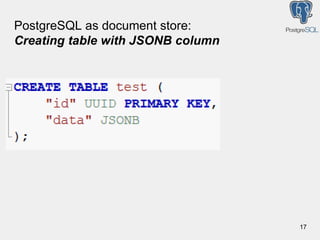
Creating table with JSONB column
17
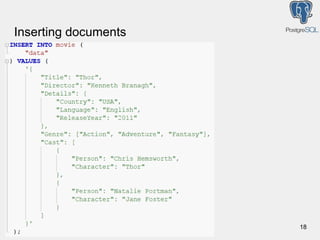
Inserting documents
18
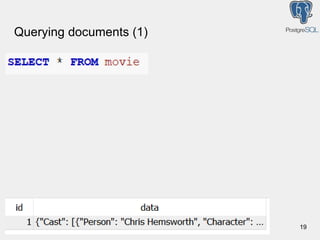
Querying documents (1)
19
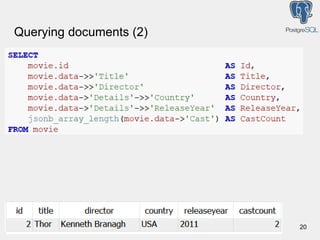
Querying documents (2)
20
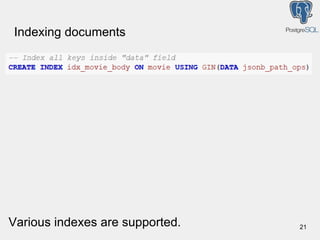
Indexing documents
Various indexes are supported. 21
Marten as Document DB for
.NET with PostgreSQL
22
Introducing Marten
● OSS .NET library that provides polyglot persistence
● Document store
● Event store
● Uses PostgreSQL’s powerful JSON support
● Initial pre-alpha release on 08.12.2015
● Current version 2.3.2
● Community chat: gitter.im/JasperFx/marten
23
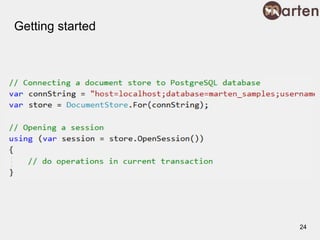
Getting started
24
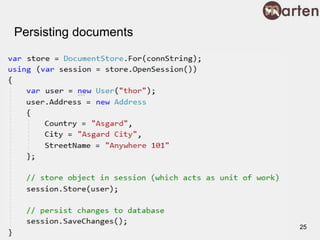
Persisting documents
25
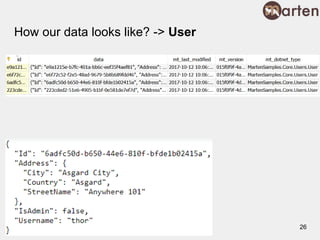
How our data looks like? -> User
26
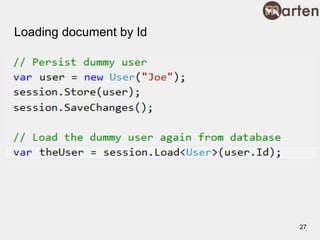
Loading document by Id
27
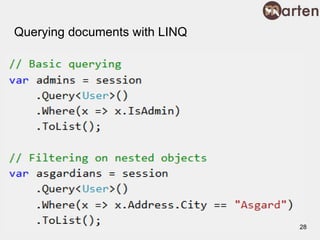
Querying documents with LINQ
28
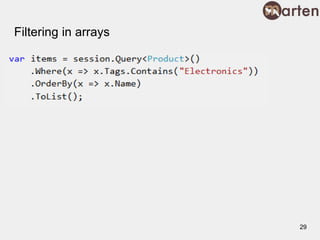
Filtering in arrays
29
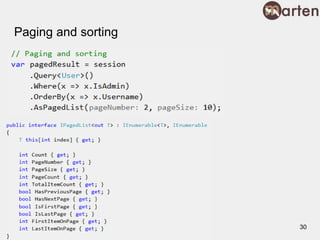
Paging and sorting
30
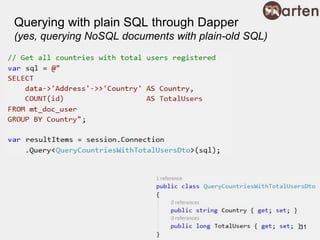
Querying with plain SQL through Dapper
(yes, querying NoSQL documents with plain-old SQL)
31
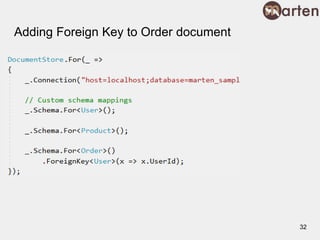
Adding Foreign Key to Order document
32
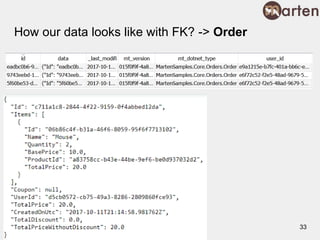
How our data looks like with FK? -> Order
33
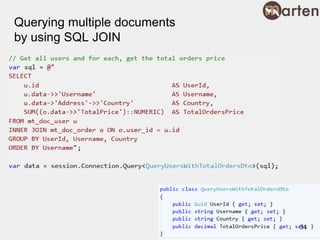
Querying multiple documents
by using SQL JOIN
34
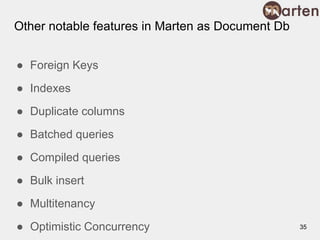
Other notable features in Marten as Document Db
● Foreign Keys
● Indexes
● Duplicate columns
● Batched queries
● Compiled queries
● Bulk insert
● Multitenancy
● Optimistic Concurrency 35
Closing
36
Summary
● Relational-only DBs limit the ability to craft good
domain models
● Document DBs are natural fit for DDD Aggregates
● SQL + NoSQL in Postgres = best of both worlds
in a single DB provider
● Marten helps .NET devs leverage PostgreSQL as
polyglot database
● Polyglot data access mindset - there is no single
approach
37
Resources
● Marten
○ https://jasperfx.github.io/marten
○ https://gitter.im/JasperFx/marten
● PostgreSQL JSON Functions and Operators
○ https://www.postgresql.org
● This presentation’s code samples
○ https://github.com/bojanv91/MartenPostgreSamples
● Other useful articles
○ https://martinfowler.com/bliki/AggregateOrientedDatabase.html
38

NoSQL document oriented data access for .net systems with postgresql and marten

  • 1.
    Document-oriented data accessfor domain-driven .NET systems with PostgreSQL & Marten Bojan Veljanovski, CTO at HASELT October, 2017 @ Macedonian .NET User Group 1
  • 2.
    What we aregoing to talk about? ● Limitations in relational-only DBs for storing true domain aggregates ● How document-oriented DBs come into play ● Marten as document DB for .NET with PostgreSQL ● SQL + NoSQL => best of both worlds 2
  • 3.
    Setting context ● HowI got interested in document-oriented DBs? Why it makes so much sense? ● Why PostgreSQL? Why not MongoDb, CouchDb, RavenDb? What about SQL Server, MySQL? ● Who else uses this approach? 3
  • 4.
  • 5.
    DDD Aggregate Cluster ofdomain objects that can be treated as a single unit. ● Consists of ○ Aggregate Root (or Root Entity) ○ Entities ○ Value Objects ○ Services ○ Repositories 5
  • 6.
    Basic characteristics ofan Aggregate Root ● Global identity ● Ensures invariants within aggregate ● Guarantees consistency ● Can reference other ARs only by identity ● Cannot reference non ARs ● Transactional consistency ● Stored and loaded in DB as a whole. 6
  • 7.
  • 8.
    Sample domain modelin code Let’s see the sample codebase in Visual Studio. 8
  • 9.
    Limitations when workingwith domain models in relational-only DBs... ● Cannot store an array of values ○ Needs new table with 1-m relation ● ...an array of objects ○ Needs new table with 1-m relation ● …a nested object ○ Needs new table with 1-1 relation ● …an AR in a single table ○ AR is spanned across many tables, and needs joinsThese limitations often lead to... 9
  • 10.
    These limitations oftenlead to... ● Complex O/R mapping code ● Sacrificing encapsulation for easier O/R mapping ● Leak of domain logic to upper layers ● Anemic domain models - only data, no behavior ● Dev teams focusing on data-relations instead of system behavior ● Implicit “SELECT N+1” problems ● Unit tests full with mocks & stubs 10
  • 11.
    Moving out ofthe relational-only mindset From thinking in terms of relations and data To thinking in terms of behavior and data 11
  • 12.
  • 13.
    How document-oriented DBscome into play ● Single document per [whole] aggregate ● Can store complex object graphs ● Can store arrays, collections, nested objects ● No need for ORM ● No limitations for creating rich domain models ● Dev team focus is in on behavior and logic ● Models are easy to unit test 13
  • 14.
  • 15.
    Introducing PostgreSQL ● Object-relationaldatabase ● ACID ● Transactional ● Highly Extendable ● Open Source ● Free 15
  • 16.
    PostgreSQL NoSQL datatypes ● Key/Value store ○ hstore ● Document store ○ json and jsonb ● Spatial and Geographic objects ○ postgis 16
  • 17.
    PostgreSQL as documentstore: Creating table with JSONB column 17
  • 18.
  • 19.
  • 20.
  • 21.
  • 22.
    Marten as DocumentDB for .NET with PostgreSQL 22
  • 23.
    Introducing Marten ● OSS.NET library that provides polyglot persistence ● Document store ● Event store ● Uses PostgreSQL’s powerful JSON support ● Initial pre-alpha release on 08.12.2015 ● Current version 2.3.2 ● Community chat: gitter.im/JasperFx/marten 23
  • 24.
  • 25.
  • 26.
    How our datalooks like? -> User 26
  • 27.
  • 28.
  • 29.
  • 30.
  • 31.
    Querying with plainSQL through Dapper (yes, querying NoSQL documents with plain-old SQL) 31
  • 32.
    Adding Foreign Keyto Order document 32
  • 33.
    How our datalooks like with FK? -> Order 33
  • 34.
  • 35.
    Other notable featuresin Marten as Document Db ● Foreign Keys ● Indexes ● Duplicate columns ● Batched queries ● Compiled queries ● Bulk insert ● Multitenancy ● Optimistic Concurrency 35
  • 36.
  • 37.
    Summary ● Relational-only DBslimit the ability to craft good domain models ● Document DBs are natural fit for DDD Aggregates ● SQL + NoSQL in Postgres = best of both worlds in a single DB provider ● Marten helps .NET devs leverage PostgreSQL as polyglot database ● Polyglot data access mindset - there is no single approach 37
  • 38.
    Resources ● Marten ○ https://jasperfx.github.io/marten ○https://gitter.im/JasperFx/marten ● PostgreSQL JSON Functions and Operators ○ https://www.postgresql.org ● This presentation’s code samples ○ https://github.com/bojanv91/MartenPostgreSamples ● Other useful articles ○ https://martinfowler.com/bliki/AggregateOrientedDatabase.html 38