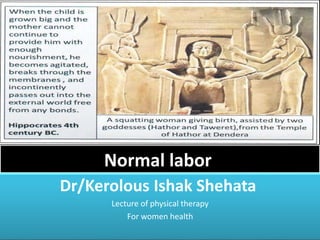
Normal labor
Dr/Kerolous Ishak Shehata
Lecture of physical therapy
For women health
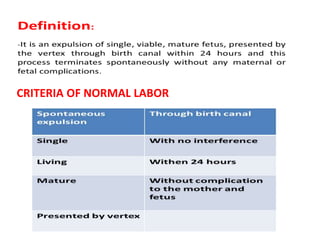
CRITERIA OF NORMAL LABOR
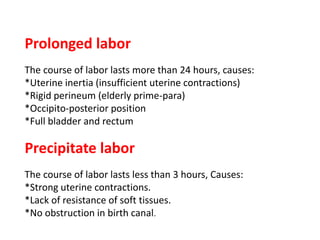
Prolonged labor
The course of labor lasts more than 24 hours, causes:
*Uterine inertia (insufficient uterine contractions)
*Rigid perineum (elderly prime-para)
*Occipito-posterior position
*Full bladder and rectum
Precipitate labor
The course of labor lasts less than 3 hours, Causes:
*Strong uterine contractions.
*Lack of resistance of soft tissues.
*No obstruction in birth canal.
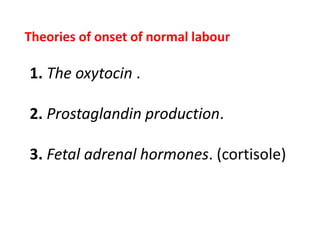
Theories of onset of normal labour
1. The oxytocin .
2. Prostaglandin production.
3. Fetal adrenal hormones. (cortisole)
Symptoms of onset of labor:
1-Show
Mucous mixed with blood due to starting of cervical dilatation
2- True labor pain
*Regular, increase in intensity, frequency and duration uterine contraction
*Discomfort of abdomen, referred to the back
*Accompanied by hardening of the uterus
*Contractions are not affected by sedation
*Enhanced by enema
*Accompanied by progressive cervical dilatation
3-Rupture of membrane
Associated by leakage of amniotic fluid, about 1 liter.
The functions of amniotic fluid:
*Protection of the fetus
*Medium for the fetal movement
*Keep fetal temperature constant
Antiseptic fluid for birth canal after rupture of membrane.
Causes of labor pain
1) Myometrial hypoxia during contraction (like angina).
2) Stretching of the peritoneum over the fundus.
3) Compression on the nerve ganglion.
Forces of labor:
Uterine force (main force)
Successive contractions and retractions (sustained partial
contraction or incomplete relaxation).
Auxiliary forces
Forces to increase intra-abdominal pressure by voluntary
bearing down through deep breathing associated with
abdominal muscles contraction.
First Stage of Labor (stage of cervical dilatation)
In prime-para is about 8-12 hours and in multipara is about 6-8 hours.
Stage 1 Labor or cervical dilatation (3 phases in this
stage) :
Cervical dilatation ( prime vs multi)
Relaxation keys during labor:
1)Verbal communication
2)massage
3)Warm bath
4)Deep breathing
5)Acupressure
6)Music
7)Relaxation technique
Positioning first stage (early and active)
Stage 2 Labor (Delivery or expulsion of fetus)
-Complete cervical dilation (10 cm) with spontaneous
expulsion efforts by the mother that end with the birth of
the baby
-Duration of 2nd stage ranged from few minutes to one
hour.
-Mother lies in lithotomy position .
-Episiotomy should be done at proper time to avoid
perineal tear.
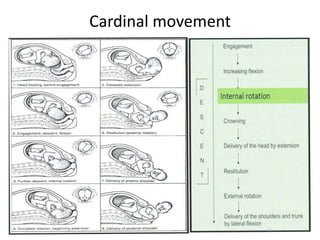
Cardinal movement
Physical therapy
interventions:
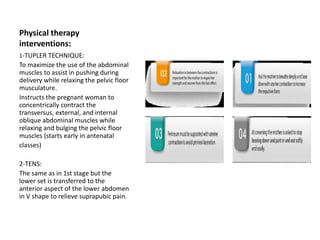
1-TUPLER TECHNIQUE:
To maximize the use of the abdominal
muscles to assist in pushing during
delivery while relaxing the pelvic floor
musculature.
Instructs the pregnant woman to
concentrically contract the
transversus, external, and internal
oblique abdominal muscles while
relaxing and bulging the pelvic floor
muscles (starts early in antenatal
classes)
2-TENS:
The same as in 1st stage but the
lower set is transferred to the
anterior aspect of the lower abdomen
in V shape to relieve suprapubic pain.
Positioning second stage of labor
Stage 3 After birth or expulsion of placenta
•The placenta, amniotic sac and umbilical cord are expelled within5 or
10 minutes to 1 hour.
The newborn baby suckling at the breast stimulates oxytocin release
from posterior pituitary, enhancing the uterine contractions that result
in expulsion.
Medical intervention:
*Any laceration of the perineum should be repaired.
*Observe the mother carefully for one hour for fear of post-partum
hemorrhage.
Physical therapy intervention:
Massaging the uterus during separation and descend of the placenta to
help it to contract to stop bleeding.
Values of post-Partum exercises
Program of Post-partum Exercise (7days)
1st day: Circulatory and Respiratory exercises ,Static abdominal contraction
and Relaxation on face (Daily time rest)
2nd day: +++ Leg exercises, Pelvic floor exercises and Arm exercises
3rd day: +++ Pelvic rocking exercises
4th day: +++ Hip shrugging exercises, Pelvic rotation exercises and Postural
correction exercises
5th day: +++ 1st step of trunk flexion
1ststep of trunk rotation
6th day: +++
7th day: Other steps of trunk flexion and Other steps of trunk rotation…. Till
end of puerperieum.
Dystocia : is inability of the
fetus to descend through the
pelvis in a timely manner
Recommended positioning to increase
pelvic diameter
Causes :
1-cephalopelvic disproportion
2-Lack of anterior movement
of the cervix
3-Maternal dehydration
4-Exhaustion
5-Severe maternal lumbar
lordosis
6-Lack of mobility of the lumbar
spine
7-Lack of sacral mobility
8-In adequate abdominal muscle
tone
9-A scarred cervix from previous
surgery or birthing.
Episiotomy
-It is an incision of the perineum aiming to widen the
vaginal facilitate passage of the fetus (it is the most
common operation in obstetrics).
Advantages:
1-prevent perineal lacerations.
2-prevent injuries of the fetal skull.
3-prevent stretch of pelvic floor and subsequent pelvic floor
dysfunction.
Types of episiotomy :
Mediolateral Median
Physical therapy role:
1-pain and wound healing problems
A) Acute perineal pain:
1-Ice
-Ice pack or crushed ice in a plastic glove for 4-5minutes
-Ice cube in a wet swab for 2-3 minutes
2-U.S
-Pulsed intensity -0.5-1 w/cm² -3:5 minutes
-Use water filled condom covered with gel
3-I.R.
-10-20 minutes twice daily
-It produces surface vasodilatation and pain relief
-It helps surface healing and dry wound but does not affect
deeper level
-Contraindicated in hemorrhoids
4- Pulsed electromagnetic energy(PEME)
Used for wound healing
-frequency: 27 MHz -Pulse rate: 100 pulse/sec, Pulse width: 40-65 ms with duration
10-15 minutes
-Single head monopole positioned very close to the perineum
Effects:
↓Swelling-inflammation, Reabsorption of haematoma, ↑Fibrin and collagen
deposition and organization
5-Low level laser therapy(LLLT)
-Used for healing and pain relief
- it is applied very close without contact at 1 cm interval along episiotomy wound.
*wound healing:
Wave length 600-700 nm &Intensity 0.5-4 J/cm²
Frequency < 1000 Hz
*Pain relief:
Shorter wave length &Intensity 0.5-4 J/cm²
Maximum frequency
*Scar treatment:
Wave length 750-905 nm
Intensity 4-6 J/cm²& Frequency > 1000 Hz
B) Chronic perineal pain
Pain persist for weeks or months or Painful intercourse
1-U.S.
Intensity 0.5-1W/cm²
-Frequency 3 MHz
5 minutes for 8 sessions
Effects:
-Breakdown scars
- ↑ Extensibility of collagen bands
-Aids resorption of scars
2- PEMF

Normal_labour.pptx

  • 1.
    Normal labor Dr/Kerolous IshakShehata Lecture of physical therapy For women health
  • 2.
  • 3.
    Prolonged labor The courseof labor lasts more than 24 hours, causes: *Uterine inertia (insufficient uterine contractions) *Rigid perineum (elderly prime-para) *Occipito-posterior position *Full bladder and rectum Precipitate labor The course of labor lasts less than 3 hours, Causes: *Strong uterine contractions. *Lack of resistance of soft tissues. *No obstruction in birth canal.
  • 4.
    Theories of onsetof normal labour 1. The oxytocin . 2. Prostaglandin production. 3. Fetal adrenal hormones. (cortisole)
  • 5.
    Symptoms of onsetof labor: 1-Show Mucous mixed with blood due to starting of cervical dilatation 2- True labor pain *Regular, increase in intensity, frequency and duration uterine contraction *Discomfort of abdomen, referred to the back *Accompanied by hardening of the uterus *Contractions are not affected by sedation *Enhanced by enema *Accompanied by progressive cervical dilatation 3-Rupture of membrane Associated by leakage of amniotic fluid, about 1 liter.
  • 6.
    The functions ofamniotic fluid: *Protection of the fetus *Medium for the fetal movement *Keep fetal temperature constant Antiseptic fluid for birth canal after rupture of membrane. Causes of labor pain 1) Myometrial hypoxia during contraction (like angina). 2) Stretching of the peritoneum over the fundus. 3) Compression on the nerve ganglion.
  • 7.
    Forces of labor: Uterineforce (main force) Successive contractions and retractions (sustained partial contraction or incomplete relaxation). Auxiliary forces Forces to increase intra-abdominal pressure by voluntary bearing down through deep breathing associated with abdominal muscles contraction.
  • 9.
    First Stage ofLabor (stage of cervical dilatation) In prime-para is about 8-12 hours and in multipara is about 6-8 hours.
  • 10.
    Stage 1 Laboror cervical dilatation (3 phases in this stage) :
  • 11.
    Cervical dilatation (prime vs multi)
  • 14.
    Relaxation keys duringlabor: 1)Verbal communication 2)massage 3)Warm bath 4)Deep breathing 5)Acupressure 6)Music 7)Relaxation technique
  • 15.
    Positioning first stage(early and active)
  • 17.
    Stage 2 Labor(Delivery or expulsion of fetus) -Complete cervical dilation (10 cm) with spontaneous expulsion efforts by the mother that end with the birth of the baby -Duration of 2nd stage ranged from few minutes to one hour. -Mother lies in lithotomy position . -Episiotomy should be done at proper time to avoid perineal tear.
  • 18.
  • 19.
    Physical therapy interventions: 1-TUPLER TECHNIQUE: Tomaximize the use of the abdominal muscles to assist in pushing during delivery while relaxing the pelvic floor musculature. Instructs the pregnant woman to concentrically contract the transversus, external, and internal oblique abdominal muscles while relaxing and bulging the pelvic floor muscles (starts early in antenatal classes) 2-TENS: The same as in 1st stage but the lower set is transferred to the anterior aspect of the lower abdomen in V shape to relieve suprapubic pain.
  • 20.
  • 22.
    Stage 3 Afterbirth or expulsion of placenta •The placenta, amniotic sac and umbilical cord are expelled within5 or 10 minutes to 1 hour. The newborn baby suckling at the breast stimulates oxytocin release from posterior pituitary, enhancing the uterine contractions that result in expulsion. Medical intervention: *Any laceration of the perineum should be repaired. *Observe the mother carefully for one hour for fear of post-partum hemorrhage. Physical therapy intervention: Massaging the uterus during separation and descend of the placenta to help it to contract to stop bleeding.
  • 23.
  • 24.
    Program of Post-partumExercise (7days) 1st day: Circulatory and Respiratory exercises ,Static abdominal contraction and Relaxation on face (Daily time rest) 2nd day: +++ Leg exercises, Pelvic floor exercises and Arm exercises 3rd day: +++ Pelvic rocking exercises 4th day: +++ Hip shrugging exercises, Pelvic rotation exercises and Postural correction exercises 5th day: +++ 1st step of trunk flexion 1ststep of trunk rotation 6th day: +++ 7th day: Other steps of trunk flexion and Other steps of trunk rotation…. Till end of puerperieum.
  • 25.
    Dystocia : isinability of the fetus to descend through the pelvis in a timely manner Recommended positioning to increase pelvic diameter Causes : 1-cephalopelvic disproportion 2-Lack of anterior movement of the cervix 3-Maternal dehydration 4-Exhaustion 5-Severe maternal lumbar lordosis 6-Lack of mobility of the lumbar spine 7-Lack of sacral mobility 8-In adequate abdominal muscle tone 9-A scarred cervix from previous surgery or birthing.
  • 26.
    Episiotomy -It is anincision of the perineum aiming to widen the vaginal facilitate passage of the fetus (it is the most common operation in obstetrics). Advantages: 1-prevent perineal lacerations. 2-prevent injuries of the fetal skull. 3-prevent stretch of pelvic floor and subsequent pelvic floor dysfunction.
  • 28.
    Types of episiotomy: Mediolateral Median
  • 29.
    Physical therapy role: 1-painand wound healing problems A) Acute perineal pain: 1-Ice -Ice pack or crushed ice in a plastic glove for 4-5minutes -Ice cube in a wet swab for 2-3 minutes 2-U.S -Pulsed intensity -0.5-1 w/cm² -3:5 minutes -Use water filled condom covered with gel 3-I.R. -10-20 minutes twice daily -It produces surface vasodilatation and pain relief -It helps surface healing and dry wound but does not affect deeper level -Contraindicated in hemorrhoids
  • 30.
    4- Pulsed electromagneticenergy(PEME) Used for wound healing -frequency: 27 MHz -Pulse rate: 100 pulse/sec, Pulse width: 40-65 ms with duration 10-15 minutes -Single head monopole positioned very close to the perineum Effects: ↓Swelling-inflammation, Reabsorption of haematoma, ↑Fibrin and collagen deposition and organization 5-Low level laser therapy(LLLT) -Used for healing and pain relief - it is applied very close without contact at 1 cm interval along episiotomy wound. *wound healing: Wave length 600-700 nm &Intensity 0.5-4 J/cm² Frequency < 1000 Hz *Pain relief: Shorter wave length &Intensity 0.5-4 J/cm² Maximum frequency *Scar treatment: Wave length 750-905 nm Intensity 4-6 J/cm²& Frequency > 1000 Hz
  • 31.
    B) Chronic perinealpain Pain persist for weeks or months or Painful intercourse 1-U.S. Intensity 0.5-1W/cm² -Frequency 3 MHz 5 minutes for 8 sessions Effects: -Breakdown scars - ↑ Extensibility of collagen bands -Aids resorption of scars 2- PEMF