Introduction to Normalization
•Normalization is a process to organize data in a database.
• Reduces redundancy (duplicate data) and improves data integrity.
• Divides larger tables into smaller, related tables.
• Ensures data is stored efficiently.
3.
Need for Normalization
•Avoids data duplication.
• Prevents update, insert, and delete anomalies.
• Makes database more flexible and efficient.
• Improves consistency and accuracy of data.
4.
Anomalies in Databases
•Update Anomaly: Changing data in one place but not another.
• Insert Anomaly: Cannot insert data without another piece of data.
• Delete Anomaly: Deleting data unintentionally removes other important data.
5.
First Normal Form(1NF)
• Ensures each column has atomic (indivisible) values.
• Each record is unique (no duplicate rows).
• Example: Splitting full name into first and last name.
6.
Second Normal Form(2NF)
• Must already be in 1NF.
• All non-key attributes depend on the whole primary key.
• Removes partial dependency.
7.
Third Normal Form(3NF)
• Must already be in 2NF.
• No transitive dependency (non-key attribute depending on another non-key attribute).
• Improves data independence.
8.
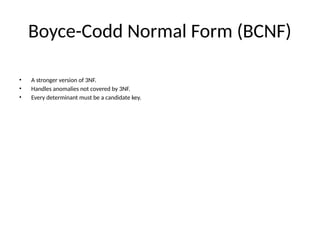
Boyce-Codd Normal Form(BCNF)
• A stronger version of 3NF.
• Handles anomalies not covered by 3NF.
• Every determinant must be a candidate key.
9.
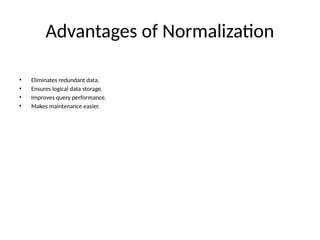
Advantages of Normalization
•Eliminates redundant data.
• Ensures logical data storage.
• Improves query performance.
• Makes maintenance easier.
10.
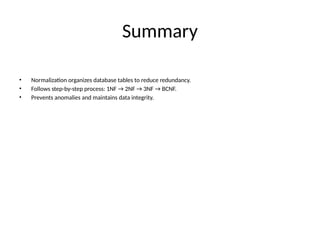
Summary
• Normalization organizesdatabase tables to reduce redundancy.
• Follows step-by-step process: 1NF → 2NF → 3NF → BCNF.
• Prevents anomalies and maintains data integrity.


![Normalizing_to_DBMS[1].pptx dfgtdhtdtggdf](https://cdn.slidesharecdn.com/ss_thumbnails/normalizingtodbms1-250924023126-fcabd742-thumbnail.jpg?width=640&height=640&fit=bounds)


