Parks for People
Heritage Lottery Fund
Big Lottery Fund
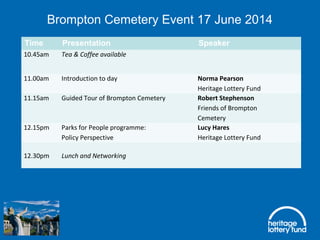
Brompton Cemetery Event 17 June 2014
Time Presentation Speaker
10.45am Tea & Coffee available
 
11.00am Introduction to day Norma Pearson
Heritage Lottery Fund
11.15am Guided Tour of Brompton Cemetery Robert Stephenson
Friends of Brompton
Cemetery
12.15pm Parks for People programme:                       
Policy Perspective
Lucy Hares
Heritage Lottery Fund
12.30pm Lunch and Networking
 
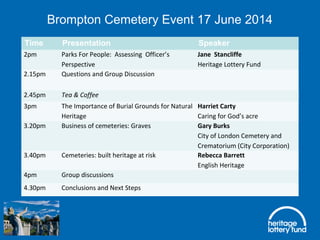
Brompton Cemetery Event 17 June 2014
Time Presentation Speaker
2pm Parks For People:  Assessing  Officer’s 
Perspective
Jane Stancliffe
Heritage Lottery Fund
2.15pm Questions and Group Discussion  
2.45pm Tea & Coffee
3pm The Importance of Burial Grounds for Natural 
Heritage
Harriet Carty
Caring for God’s acre
3.20pm Business of cemeteries: Graves Gary Burks
City of London Cemetery and 
Crematorium (City Corporation)
3.40pm Cemeteries: built heritage at risk Rebecca Barrett
English Heritage
4pm Group discussions  
4.30pm Conclusions and Next Steps  
Michael Murray
Development Manager
michaelm@hlf.org.uk
Norma Pearson
Development Officer
normap@hlf.org.uk
Introductions
The programme’s priority is to conserve the existing
heritage of a designed park or cemetery
HLF and BIG dedicated budget for Parks for People
programme is £30m per year for England.
Same application process:
Application dates: 28 February for decision in June
31 August for decision in December
Parks for People programme
➜ Two round process with a development phase
➜ Development phase 24 months
➜ Three month assessment time
➜ Projects compete nationally
• Project enquiry form
Application Process
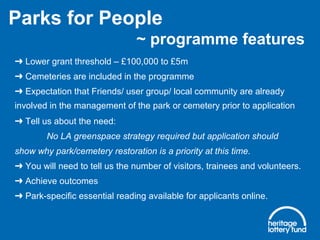
➜ Lower grant threshold – £100,000 to £5m
Cemeteries are included in the programme➜
Expectation that Friends/ user group/ local community are already➜
involved in the management of the park or cemetery prior to application
Tell us about the need:➜
No LA greenspace strategy required but application should
show why park/cemetery restoration is a priority at this time.
You will need to tell us the number of visitors, trainees and volunteers.➜
Achieve outcomes➜
Park-specific essential reading available for applicants online.➜
Parks for People
~ programme features
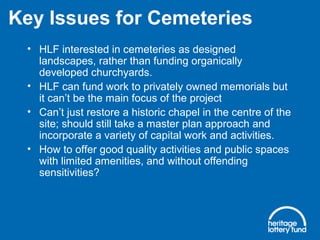
• HLF interested in cemeteries as designed
landscapes, rather than funding organically
developed churchyards.
• HLF can fund work to privately owned memorials but
it can’t be the main focus of the project
• Can’t just restore a historic chapel in the centre of the
site; should still take a master plan approach and
incorporate a variety of capital work and activities.
• How to offer good quality activities and public spaces
with limited amenities, and without offending
sensitivities?
Key Issues for Cemeteries
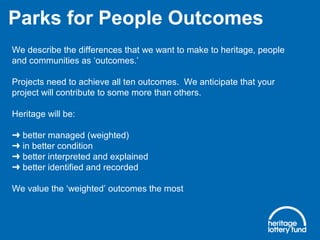
We describe the differences that we want to make to heritage, people
and communities as ‘outcomes.’
Projects need to achieve all ten outcomes. We anticipate that your
project will contribute to some more than others.
Heritage will be:
better managed (weighted)➜
in better condition➜
better interpreted and explained➜
better identified and recorded➜
We value the ‘weighted’ outcomes the most
Parks for People Outcomes
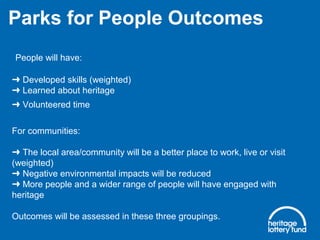
People will have:
Developed skills (weighted)➜
Learned about heritage➜
Volunteered time➜
For communities:
The local area/community will be a better place to work, live or visit➜
(weighted)
Negative environmental impacts will be reduced➜
More people and a wider range of people will have engaged with➜
heritage
Outcomes will be assessed in these three groupings.
Parks for People Outcomes
• Developing skills
• Demonstrating the difference funding will make
• Master plan for the whole site – long term vision
• Delivering the project at the right time (why now?)
• Long term management and maintenance resources
• Consultation - strong stakeholder / community
actively engaged
• Capacity and capability of organisation
• Cultural change within an organisation
• High quality project team
• Governance of project and organisation
What makes a good Parks Project for HLF?
Norma pearson cemetaries presentation 17 june 2014

Norma pearson cemetaries presentation 17 june 2014

  • 2.
    Parks for People HeritageLottery Fund Big Lottery Fund
  • 3.
    Brompton Cemetery Event17 June 2014 Time Presentation Speaker 10.45am Tea & Coffee available   11.00am Introduction to day Norma Pearson Heritage Lottery Fund 11.15am Guided Tour of Brompton Cemetery Robert Stephenson Friends of Brompton Cemetery 12.15pm Parks for People programme:                        Policy Perspective Lucy Hares Heritage Lottery Fund 12.30pm Lunch and Networking  
  • 4.
    Brompton Cemetery Event17 June 2014 Time Presentation Speaker 2pm Parks For People:  Assessing  Officer’s  Perspective Jane Stancliffe Heritage Lottery Fund 2.15pm Questions and Group Discussion   2.45pm Tea & Coffee 3pm The Importance of Burial Grounds for Natural  Heritage Harriet Carty Caring for God’s acre 3.20pm Business of cemeteries: Graves Gary Burks City of London Cemetery and  Crematorium (City Corporation) 3.40pm Cemeteries: built heritage at risk Rebecca Barrett English Heritage 4pm Group discussions   4.30pm Conclusions and Next Steps  
  • 5.
    Michael Murray Development Manager michaelm@hlf.org.uk NormaPearson Development Officer normap@hlf.org.uk
  • 6.
  • 7.
    The programme’s priorityis to conserve the existing heritage of a designed park or cemetery HLF and BIG dedicated budget for Parks for People programme is £30m per year for England. Same application process: Application dates: 28 February for decision in June 31 August for decision in December Parks for People programme
  • 8.
    ➜ Two roundprocess with a development phase ➜ Development phase 24 months ➜ Three month assessment time ➜ Projects compete nationally • Project enquiry form Application Process
  • 9.
    ➜ Lower grantthreshold – £100,000 to £5m Cemeteries are included in the programme➜ Expectation that Friends/ user group/ local community are already➜ involved in the management of the park or cemetery prior to application Tell us about the need:➜ No LA greenspace strategy required but application should show why park/cemetery restoration is a priority at this time. You will need to tell us the number of visitors, trainees and volunteers.➜ Achieve outcomes➜ Park-specific essential reading available for applicants online.➜ Parks for People ~ programme features
  • 10.
    • HLF interestedin cemeteries as designed landscapes, rather than funding organically developed churchyards. • HLF can fund work to privately owned memorials but it can’t be the main focus of the project • Can’t just restore a historic chapel in the centre of the site; should still take a master plan approach and incorporate a variety of capital work and activities. • How to offer good quality activities and public spaces with limited amenities, and without offending sensitivities? Key Issues for Cemeteries
  • 11.
    We describe thedifferences that we want to make to heritage, people and communities as ‘outcomes.’ Projects need to achieve all ten outcomes. We anticipate that your project will contribute to some more than others. Heritage will be: better managed (weighted)➜ in better condition➜ better interpreted and explained➜ better identified and recorded➜ We value the ‘weighted’ outcomes the most Parks for People Outcomes
  • 12.
    People will have: Developedskills (weighted)➜ Learned about heritage➜ Volunteered time➜ For communities: The local area/community will be a better place to work, live or visit➜ (weighted) Negative environmental impacts will be reduced➜ More people and a wider range of people will have engaged with➜ heritage Outcomes will be assessed in these three groupings. Parks for People Outcomes
  • 13.
    • Developing skills •Demonstrating the difference funding will make • Master plan for the whole site – long term vision • Delivering the project at the right time (why now?) • Long term management and maintenance resources • Consultation - strong stakeholder / community actively engaged • Capacity and capability of organisation • Cultural change within an organisation • High quality project team • Governance of project and organisation What makes a good Parks Project for HLF?

Editor's Notes