NON-
MENDELIAN
GENETICS
Kurt Lester R. Ramirez
Fr. George Heinemann, SVD
What is a Non- Mendelian traits?
Well genetically, they’re rule
breakers. They don’t follow the
regular Mendelian rule that
having a dominant allele means
the dominant trait will show.
CODOMINANCE
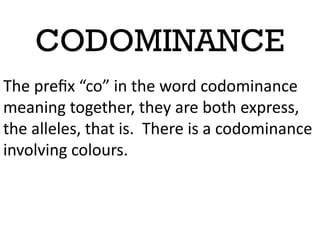
The prefix “co” in the word codominance
meaning together, they are both express,
the alleles, that is. There is a codominance
involving colours.
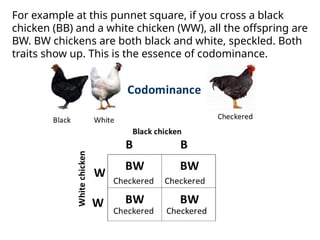
For example at this punnet square, if you cross a black
chicken (BB) and a white chicken (WW), all the offspring are
BW. BW chickens are both black and white, speckled. Both
traits show up. This is the essence of codominance.
INCOMPLETE DOMINANCE
For example, in snapdragon genetics,
there can be 3 phenotypes. Red,
white and the colour in between,
pink. It’s called Incomplete
Dominance. In Incomplete
Dominance, the dominant allele is
not completely expressed even when
the recessive allele is around.
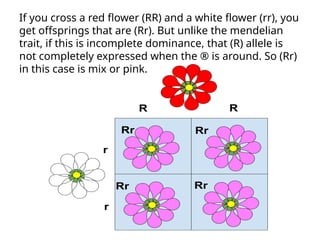
If you cross a red flower (RR) and a white flower (rr), you
get offsprings that are (Rr). But unlike the mendelian
trait, if this is incomplete dominance, that (R) allele is
not completely expressed when the ® is around. So (Rr)
in this case is mix or pink.
POLYGENIC
INHERITANCE
For example, in height, you may
be taller than the rest of your
siblings even though you’re the
youngest. There’s a lot of genes
that determine your height.
That’s when polygenic
inheritance come.
It’s not the regular AA or Aa or aa. It may be
represented as AABBCcDD etc. to determine
your height. And you inherit one allele for each
of the height genes – from each parents. All of
these genes work together to determine your
height. Your skin colour is also determined by
many genes just like your height . These are
called polygenic traits, “poly” means many.
Meaning many genes coding for one trait is
what polygenic means. Still, skin and height
can be influenced by environmental factors as
well but the polygenic genes are still there.
EPISTASIS
Epistasis is when one gene really
depends on another gene for it
to be expressed. Take a llama for
example. Lets say that one llama
has a dominant (B) allele, which
means the wool will be black.
Which means (BB) or (Bb) means it will
have a black wool. Lets say another llama
has a recessive (bb) allele which means it
will have a white wool. But there can be a
gene that will take control if a trait should
be express in the first place. A llama can
have a phenotype of CC, Cc, or cc for this
epistatis. However, if a llama has the
genotype of cc, it will not allow the other
gene for the colour of the wool to be
expressed.
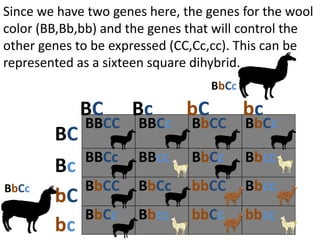
Since we have two genes here, the genes for the wool
color (BB,Bb,bb) and the genes that will control the
other genes to be expressed (CC,Cc,cc). This can be
represented as a sixteen square dihybrid.
BBCC BBCc BbCC BbCc
BBCc BBcc BbCc Bbcc
BbCC BbCc bbCC Bbcc
BbCc Bbcc bbCc bbcc
BC Bc bC bc
BC
Bc
bC
bc
BbCc
BbCc
If you notice in the dyhibrid, crossing two
heterozygote llamas (BBCc or BbCc), BB
and Bb will typically give a black llama.
And bb will typically be brown llama in all
cases unless they have the epistatic gene
inherited (cc), that will give an albino
llama.
MULTIPLE ALLELES
More than two alleles for a gene are
within the population at a specific
loci. At that time we say within the
population the multiples alleles
occur. It’s not a gene having multiple
copies of allele in a single individual
but the multiples alleles occur within
the population.
So in that way genotype has only two
alleles for a gene, but if you talk about
multiple alleles, its a gene controlling
any phenotype which is having different
copies of alleles bound within the
population there too on a specific loci.
For example, let’s consider a gene that specifies coat
colour in rabbits, called the C gene. The C gene comes
in four common alleles: C, , and c:
• A CC rabbit has a black or brown fur
• A has a grayish fur
• A has a pattern of white and black
• A cc is an albino
Multiple alleles makes for many possible
relationships. In this case, black C allele is completely
dominant to all others, the allele is incompletly
dominant to the and albino c alleles; and the allele is
completely dominant to c albino alleles.
PLEIOTROPY
In Mendel’s experiment with purple-
flowered plants and white-flowered
plants, he notice that the flower colours
are always correlated with two other
features: the colour of the seed coat and
the colour of the axils. In white flowers,
the seed coats and axils were colorless.
In plants with purple flowers on the other
hand, the seed coat were brown-gray and
the axils were reddish.
Thus, rather than affecting just one
characteristic, the flower colour gene
actually affected three. Importantly, allele
of pleiotropic genes are transmitted in the
same way as allele of genes that affect the
single traits. Although the phenotype has
multiple elements, these elements
specified as a package, and the dominant
and recessive versions of the package
would appear in the offspring of two
heterozygotes in ratio 3:1.
LETHAL GENES
For lethal genes that Mendel studied,
it was equally possible to get
homozygous dominant, homozygous
recessive and heterozygous
genotypes.
That is, none of these genotypes
affected the survival of pea plants.
However, this not all the case in all
genes and alleles.
Many genes in an organism’s genome
are needed for survival. If an allele
makes one of these genotypes non
functional, causes it to take an
abnormal, harmful activity. It may be
possible to get a living organism with
a homozygous (or in some cases, a
heterozygous) genotype.
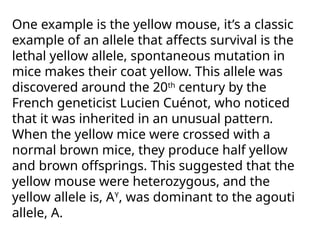
One example is the yellow mouse, it’s a classic
example of an allele that affects survival is the
lethal yellow allele, spontaneous mutation in
mice makes their coat yellow. This allele was
discovered around the 20th
century by the
French geneticist Lucien Cuénot, who noticed
that it was inherited in an unusual pattern.
When the yellow mice were crossed with a
normal brown mice, they produce half yellow
and brown offsprings. This suggested that the
yellow mouse were heterozygous, and the
yellow allele is, AY
, was dominant to the agouti
allele, A.
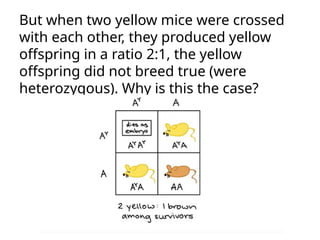
But when two yellow mice were crossed
with each other, they produced yellow
offspring in a ratio 2:1, the yellow
offspring did not breed true (were
heterozygous). Why is this the case?
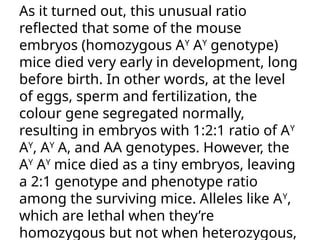
As it turned out, this unusual ratio
reflected that some of the mouse
embryos (homozygous AY
AY
genotype)
mice died very early in development, long
before birth. In other words, at the level
of eggs, sperm and fertilization, the
colour gene segregated normally,
resulting in embryos with 1:2:1 ratio of AY
AY
, AY
A, and AA genotypes. However, the
AY
AY
mice died as a tiny embryos, leaving
a 2:1 genotype and phenotype ratio
among the surviving mice. Alleles like AY
,
which are lethal when they’re
homozygous but not when heterozygous,
SEX-LINKED INHERITANCE
Red-green color blindness is a sex-
linked trait. Someone who has red-
green color blindness cannot see
red, instead both red and green
appear the same. Red-green color
blindness are more common in
men than women. But why is this?
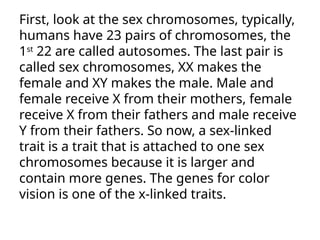
First, look at the sex chromosomes, typically,
humans have 23 pairs of chromosomes, the
1st
22 are called autosomes. The last pair is
called sex chromosomes, XX makes the
female and XY makes the male. Male and
female receive X from their mothers, female
receive X from their fathers and male receive
Y from their fathers. So now, a sex-linked
trait is a trait that is attached to one sex
chromosomes because it is larger and
contain more genes. The genes for color
vision is one of the x-linked traits.
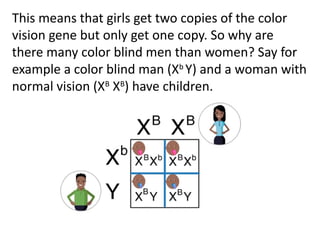
This means that girls get two copies of the color
vision gene but only get one copy. So why are
there many color blind men than women? Say for
example a color blind man (Xb
Y) and a woman with
normal vision (XB
XB
) have children.
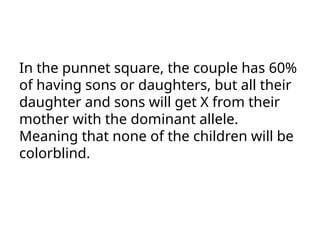
In the punnet square, the couple has 60%
of having sons or daughters, but all their
daughter and sons will get X from their
mother with the dominant allele.
Meaning that none of the children will be
colorblind.
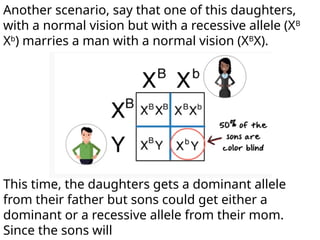
Another scenario, say that one of this daughters,
with a normal vision but with a recessive allele (XB
Xb
) marries a man with a normal vision (XB
X).
This time, the daughters gets a dominant allele
from their father but sons could get either a
dominant or a recessive allele from their mom.
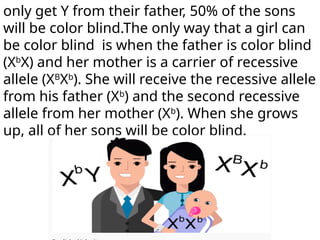
Since the sons will
only get Y from their father, 50% of the sons
will be color blind.The only way that a girl can
be color blind is when the father is color blind
(Xb
X) and her mother is a carrier of recessive
allele (XB
Xb
). She will receive the recessive allele
from his father (Xb
) and the second recessive
allele from her mother (Xb
). When she grows
up, all of her sons will be color blind.
NON-MENDELIAN GENETICS A BRIEF INTRODUCTION

  • 1.
    NON- MENDELIAN GENETICS Kurt Lester R.Ramirez Fr. George Heinemann, SVD
  • 2.
    What is aNon- Mendelian traits? Well genetically, they’re rule breakers. They don’t follow the regular Mendelian rule that having a dominant allele means the dominant trait will show.
  • 3.
    CODOMINANCE The prefix “co”in the word codominance meaning together, they are both express, the alleles, that is. There is a codominance involving colours.
  • 4.
    For example atthis punnet square, if you cross a black chicken (BB) and a white chicken (WW), all the offspring are BW. BW chickens are both black and white, speckled. Both traits show up. This is the essence of codominance.
  • 5.
    INCOMPLETE DOMINANCE For example,in snapdragon genetics, there can be 3 phenotypes. Red, white and the colour in between, pink. It’s called Incomplete Dominance. In Incomplete Dominance, the dominant allele is not completely expressed even when the recessive allele is around.
  • 6.
    If you crossa red flower (RR) and a white flower (rr), you get offsprings that are (Rr). But unlike the mendelian trait, if this is incomplete dominance, that (R) allele is not completely expressed when the ® is around. So (Rr) in this case is mix or pink.
  • 7.
    POLYGENIC INHERITANCE For example, inheight, you may be taller than the rest of your siblings even though you’re the youngest. There’s a lot of genes that determine your height. That’s when polygenic inheritance come.
  • 8.
    It’s not theregular AA or Aa or aa. It may be represented as AABBCcDD etc. to determine your height. And you inherit one allele for each of the height genes – from each parents. All of these genes work together to determine your height. Your skin colour is also determined by many genes just like your height . These are called polygenic traits, “poly” means many. Meaning many genes coding for one trait is what polygenic means. Still, skin and height can be influenced by environmental factors as well but the polygenic genes are still there.
  • 9.
    EPISTASIS Epistasis is whenone gene really depends on another gene for it to be expressed. Take a llama for example. Lets say that one llama has a dominant (B) allele, which means the wool will be black.
  • 10.
    Which means (BB)or (Bb) means it will have a black wool. Lets say another llama has a recessive (bb) allele which means it will have a white wool. But there can be a gene that will take control if a trait should be express in the first place. A llama can have a phenotype of CC, Cc, or cc for this epistatis. However, if a llama has the genotype of cc, it will not allow the other gene for the colour of the wool to be expressed.
  • 11.
    Since we havetwo genes here, the genes for the wool color (BB,Bb,bb) and the genes that will control the other genes to be expressed (CC,Cc,cc). This can be represented as a sixteen square dihybrid. BBCC BBCc BbCC BbCc BBCc BBcc BbCc Bbcc BbCC BbCc bbCC Bbcc BbCc Bbcc bbCc bbcc BC Bc bC bc BC Bc bC bc BbCc BbCc
  • 12.
    If you noticein the dyhibrid, crossing two heterozygote llamas (BBCc or BbCc), BB and Bb will typically give a black llama. And bb will typically be brown llama in all cases unless they have the epistatic gene inherited (cc), that will give an albino llama.
  • 13.
    MULTIPLE ALLELES More thantwo alleles for a gene are within the population at a specific loci. At that time we say within the population the multiples alleles occur. It’s not a gene having multiple copies of allele in a single individual but the multiples alleles occur within the population.
  • 14.
    So in thatway genotype has only two alleles for a gene, but if you talk about multiple alleles, its a gene controlling any phenotype which is having different copies of alleles bound within the population there too on a specific loci.
  • 15.
    For example, let’sconsider a gene that specifies coat colour in rabbits, called the C gene. The C gene comes in four common alleles: C, , and c: • A CC rabbit has a black or brown fur • A has a grayish fur • A has a pattern of white and black • A cc is an albino Multiple alleles makes for many possible relationships. In this case, black C allele is completely dominant to all others, the allele is incompletly dominant to the and albino c alleles; and the allele is completely dominant to c albino alleles.
  • 16.
    PLEIOTROPY In Mendel’s experimentwith purple- flowered plants and white-flowered plants, he notice that the flower colours are always correlated with two other features: the colour of the seed coat and the colour of the axils. In white flowers, the seed coats and axils were colorless. In plants with purple flowers on the other hand, the seed coat were brown-gray and the axils were reddish.
  • 17.
    Thus, rather thanaffecting just one characteristic, the flower colour gene actually affected three. Importantly, allele of pleiotropic genes are transmitted in the same way as allele of genes that affect the single traits. Although the phenotype has multiple elements, these elements specified as a package, and the dominant and recessive versions of the package would appear in the offspring of two heterozygotes in ratio 3:1.
  • 18.
    LETHAL GENES For lethalgenes that Mendel studied, it was equally possible to get homozygous dominant, homozygous recessive and heterozygous genotypes. That is, none of these genotypes affected the survival of pea plants. However, this not all the case in all genes and alleles.
  • 19.
    Many genes inan organism’s genome are needed for survival. If an allele makes one of these genotypes non functional, causes it to take an abnormal, harmful activity. It may be possible to get a living organism with a homozygous (or in some cases, a heterozygous) genotype.
  • 20.
    One example isthe yellow mouse, it’s a classic example of an allele that affects survival is the lethal yellow allele, spontaneous mutation in mice makes their coat yellow. This allele was discovered around the 20th century by the French geneticist Lucien Cuénot, who noticed that it was inherited in an unusual pattern. When the yellow mice were crossed with a normal brown mice, they produce half yellow and brown offsprings. This suggested that the yellow mouse were heterozygous, and the yellow allele is, AY , was dominant to the agouti allele, A.
  • 21.
    But when twoyellow mice were crossed with each other, they produced yellow offspring in a ratio 2:1, the yellow offspring did not breed true (were heterozygous). Why is this the case?
  • 22.
    As it turnedout, this unusual ratio reflected that some of the mouse embryos (homozygous AY AY genotype) mice died very early in development, long before birth. In other words, at the level of eggs, sperm and fertilization, the colour gene segregated normally, resulting in embryos with 1:2:1 ratio of AY AY , AY A, and AA genotypes. However, the AY AY mice died as a tiny embryos, leaving a 2:1 genotype and phenotype ratio among the surviving mice. Alleles like AY , which are lethal when they’re homozygous but not when heterozygous,
  • 23.
    SEX-LINKED INHERITANCE Red-green colorblindness is a sex- linked trait. Someone who has red- green color blindness cannot see red, instead both red and green appear the same. Red-green color blindness are more common in men than women. But why is this?
  • 24.
    First, look atthe sex chromosomes, typically, humans have 23 pairs of chromosomes, the 1st 22 are called autosomes. The last pair is called sex chromosomes, XX makes the female and XY makes the male. Male and female receive X from their mothers, female receive X from their fathers and male receive Y from their fathers. So now, a sex-linked trait is a trait that is attached to one sex chromosomes because it is larger and contain more genes. The genes for color vision is one of the x-linked traits.
  • 25.
    This means thatgirls get two copies of the color vision gene but only get one copy. So why are there many color blind men than women? Say for example a color blind man (Xb Y) and a woman with normal vision (XB XB ) have children.
  • 26.
    In the punnetsquare, the couple has 60% of having sons or daughters, but all their daughter and sons will get X from their mother with the dominant allele. Meaning that none of the children will be colorblind.
  • 27.
    Another scenario, saythat one of this daughters, with a normal vision but with a recessive allele (XB Xb ) marries a man with a normal vision (XB X). This time, the daughters gets a dominant allele from their father but sons could get either a dominant or a recessive allele from their mom. Since the sons will
  • 28.
    only get Yfrom their father, 50% of the sons will be color blind.The only way that a girl can be color blind is when the father is color blind (Xb X) and her mother is a carrier of recessive allele (XB Xb ). She will receive the recessive allele from his father (Xb ) and the second recessive allele from her mother (Xb ). When she grows up, all of her sons will be color blind.