L&T Heavy Engineering
1/102
HED-HZW-HRD-S-009 & Revision No: 1
Dec 14, 2024
• Introduction to Ultrasonic Testing
• Ultrasonic wave modes
• Transducers
• Couplant
• Data presentations
• Advantages and disadvantages of ultrasonic testing.
• Operator Qualifications
• Calibration blocks, Qualification blocks & their purpose
• UT equipment
• Surface preparation required for UT
• UT hands on training
• Acceptance standards
• References
Ultrasonic Testing (UT)
L&T Heavy Engineering
2/102
HED-HZW-HRD-S-009 & Revision No: 1
Dec 14, 2024
Ultrasonic Testing (UT)
• In 1912 Following the Great Disaster of Giant Ship TITANIC , It was suggested
after research That Ultrasound can be used for detection of iceberg in the
ocean , later it was used in World War-1 for detecting submarines in the sea.
After that journey continues......
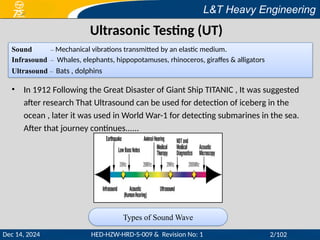
Sound – Mechanical vibrations transmitted by an elastic medium.
Infrasound – Whales, elephants, hippopotamuses, rhinoceros, giraffes & alligators
Ultrasound – Bats , dolphins
Types of Sound Wave
L&T Heavy Engineering
3/102
HED-HZW-HRD-S-009 & Revision No: 1
Dec 14, 2024
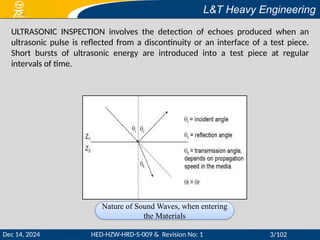
ULTRASONIC INSPECTION involves the detection of echoes produced when an
ultrasonic pulse is reflected from a discontinuity or an interface of a test piece.
Short bursts of ultrasonic energy are introduced into a test piece at regular
intervals of time.
Nature of Sound Waves, when entering
the Materials
L&T Heavy Engineering
4/102
HED-HZW-HRD-S-009 & Revision No: 1
Dec 14, 2024
How it Generates ?
Crystals :- A three-dimensional array or atoms having a certain regularity in its
arrangement primarily made of :- Quartz, Lithium Sulphate, Barium Titanate, Lead
Zirconium titanate (PZT).
Piezoelectric Effect :
Piezo Electric
Pressure (Mechanical Energy) Electric (Electrical Energy) & Vice-Versa
The conversion of electrical pulses to mechanical vibrations and the conversion of
returned mechanical vibrations back into electrical energy is the basis for
ultrasonic testing.
Wavelength (  ) : The distance needed for a wave to go through a complete
cycle.
Frequency ( f ) : The number of waves that pass a given point in a specified unit of
time.
Velocity ( v ) : Distance traveled per unit time.
Wavelength : Velocity / Frequency
L&T Heavy Engineering
5/102
HED-HZW-HRD-S-009 & Revision No: 1
Dec 14, 2024
Types of Ultrasonic Waves
On the basis of particle displacement in the medium ultrasonic waves are
classified. Velocity remains the same in the given medium but differs when the
method of vibration changes.
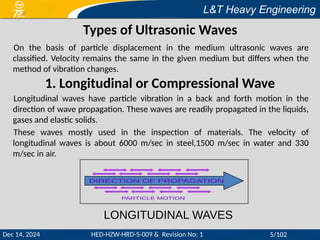
1. Longitudinal or Compressional Wave
Longitudinal waves have particle vibration in a back and forth motion in the
direction of wave propagation. These waves are readily propagated in the liquids,
gases and elastic solids.
These waves mostly used in the inspection of materials. The velocity of
longitudinal waves is about 6000 m/sec in steel,1500 m/sec in water and 330
m/sec in air.
L&T Heavy Engineering
6/102
HED-HZW-HRD-S-009 & Revision No: 1
Dec 14, 2024
2. Transverse or Shear Wave
These wave have particle vibration perpendicular to the direction of wave
motion. These waves will not travel through liquid, gases because force of
attraction between molecules are too small . the velocity of these waves is about
50% the longitudinal waves for the same medium.
L&T Heavy Engineering
7/102
HED-HZW-HRD-S-009 & Revision No: 1
Dec 14, 2024
3. Surface or Rayleigh Wave
These waves travel along the flat or curved surface of relatively thick solid parts. The
velocity of these waves are 90% of the transverse waves in the same material. Surface
waves are useful for detecting surface cracks. Vibration of particle follow an elliptical path.
4. Plate or Lamb Wave
These waves also another type of ultrasonic waves used to detect surface defect
and penetrates only up to half of wave length. These waves propagate in plate
only.
L&T Heavy Engineering
8/102
HED-HZW-HRD-S-009 & Revision No: 1
Dec 14, 2024
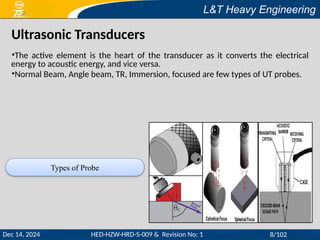
Ultrasonic Transducers
•The active element is the heart of the transducer as it converts the electrical
energy to acoustic energy, and vice versa.
•Normal Beam, Angle beam, TR, Immersion, focused are few types of UT probes.
Types of Probe
L&T Heavy Engineering
9/102
HED-HZW-HRD-S-009 & Revision No: 1
Dec 14, 2024
Couplant
A couplant is a material (usually liquid or semi liquid) that facilitates the
transmission of ultrasonic energy from the transducer into the test specimen.
The couplant displaces the air and makes it possible to get more sound energy
into the test specimen so that a usable ultrasonic signal can be obtained.
Couplant
L&T Heavy Engineering
10/102
HED-HZW-HRD-S-009 & Revision No: 1
Dec 14, 2024
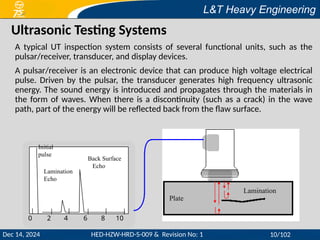
Ultrasonic Testing Systems
A typical UT inspection system consists of several functional units, such as the
pulsar/receiver, transducer, and display devices.
A pulsar/receiver is an electronic device that can produce high voltage electrical
pulse. Driven by the pulsar, the transducer generates high frequency ultrasonic
energy. The sound energy is introduced and propagates through the materials in
the form of waves. When there is a discontinuity (such as a crack) in the wave
path, part of the energy will be reflected back from the flaw surface.
0 2 4 6 8 10
Initial
pulse
Lamination
Echo
Back Surface
Echo
Plate
Lamination
L&T Heavy Engineering
11/102
HED-HZW-HRD-S-009 & Revision No: 1
Dec 14, 2024
Probe Placement for Various Joint Configuration
L&T Heavy Engineering
12/102
HED-HZW-HRD-S-009 & Revision No: 1
Dec 14, 2024
Data Presentation
A Scan
Display amplitude on y
axis ,distance between two
reflector on X - axis
B scan – Cross sectional View of the
material
C Scan
Top View of the material
L&T Heavy Engineering
13/102
HED-HZW-HRD-S-009 & Revision No: 1
Dec 14, 2024
Advantages of UT
It is sensitive to both surface and subsurface discontinuities.
The depth of penetration for flaw detection or measurement is superior to
other NDT methods.
Only single-sided access is needed when the pulse-echo technique is used.
It is high accuracy in determining reflector position and estimating size and
shape.
Minimal part preparation required.
Electronic equipment provides instantaneous results.
Detailed images can be produced with automated systems.
It has other uses such as thickness measurements, in addition to flaw detection.
L&T Heavy Engineering
14/102
HED-HZW-HRD-S-009 & Revision No: 1
Dec 14, 2024
Disadvantages of UT
Surface must be accessible to transmit ultrasound.
Skill and training is more extensive than with some other methods.
It normally requires a coupling medium to promote transfer of sound
energy into test specimen.
Materials that are rough, irregular in shape, very small, exceptionally thin or
not homogeneous are difficult to inspect.
Cast iron and other coarse grained materials are difficult to inspect due to
low sound transmission and high signal noise.
Linear defects oriented parallel to the sound beam may go undetected.
L&T Heavy Engineering
15/102
HED-HZW-HRD-S-009 & Revision No: 1
Dec 14, 2024
Operator Qualifications
• The personnel employed for conducting the examination shall be trained,
examined and qualified for ultrasonic testing Level II or III (UT) as per L & T
Written Practice No. NDT-WP -01.
• Written practice for certification/re-certification of NDE personnel shall be
prepared in consultation with HOD-Quality by Level III.
• Recommendations of SNT-TC-1A, 2006 edition are fully incorporated in the
written practice
L&T Heavy Engineering
16/102
HED-HZW-HRD-S-009 & Revision No: 1
Dec 14, 2024
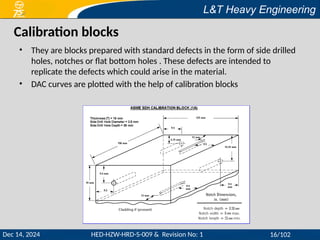
Calibration blocks
• They are blocks prepared with standard defects in the form of side drilled
holes, notches or flat bottom holes . These defects are intended to
replicate the defects which could arise in the material.
• DAC curves are plotted with the help of calibration blocks
L&T Heavy Engineering
17/102
HED-HZW-HRD-S-009 & Revision No: 1
Dec 14, 2024
Surface preparation for UT
• Surface preparation is very important in contact UT as the probe needs to
have a proper contact with the surface to transfer the ultrasound energy
into the material.
• Surface roughness also causes additional noise and false indications which
needs to be avoided for reliable ultrasonic test results.
• Minor surface roughness may be compensated by the application of
viscous couplant.
L&T Heavy Engineering
18/102
HED-HZW-HRD-S-009 & Revision No: 1
Dec 14, 2024
Reference Code Section & Acceptance Standard
• ASME Section V, 2011a addenda
• Subsection – A
• ARTICLE 4 - Ultrasonic Examination Methods for Welds
• ARTICLE 5 - Ultrasonic Examination Methods for Materials
• Subsection – B
• ARTICLE 23 – 13 Sub Articles
• Acceptance Criteria
– ASME Sec. VIII Div. I & II
L&T Heavy Engineering
19/102
HED-HZW-HRD-S-009 & Revision No: 1
Dec 14, 2024
THANK YOU

Non Destructive Ultrasonic Testing Presentation

  • 1.
    L&T Heavy Engineering 1/102 HED-HZW-HRD-S-009& Revision No: 1 Dec 14, 2024 • Introduction to Ultrasonic Testing • Ultrasonic wave modes • Transducers • Couplant • Data presentations • Advantages and disadvantages of ultrasonic testing. • Operator Qualifications • Calibration blocks, Qualification blocks & their purpose • UT equipment • Surface preparation required for UT • UT hands on training • Acceptance standards • References Ultrasonic Testing (UT)
  • 2.
    L&T Heavy Engineering 2/102 HED-HZW-HRD-S-009& Revision No: 1 Dec 14, 2024 Ultrasonic Testing (UT) • In 1912 Following the Great Disaster of Giant Ship TITANIC , It was suggested after research That Ultrasound can be used for detection of iceberg in the ocean , later it was used in World War-1 for detecting submarines in the sea. After that journey continues...... Sound – Mechanical vibrations transmitted by an elastic medium. Infrasound – Whales, elephants, hippopotamuses, rhinoceros, giraffes & alligators Ultrasound – Bats , dolphins Types of Sound Wave
  • 3.
    L&T Heavy Engineering 3/102 HED-HZW-HRD-S-009& Revision No: 1 Dec 14, 2024 ULTRASONIC INSPECTION involves the detection of echoes produced when an ultrasonic pulse is reflected from a discontinuity or an interface of a test piece. Short bursts of ultrasonic energy are introduced into a test piece at regular intervals of time. Nature of Sound Waves, when entering the Materials
  • 4.
    L&T Heavy Engineering 4/102 HED-HZW-HRD-S-009& Revision No: 1 Dec 14, 2024 How it Generates ? Crystals :- A three-dimensional array or atoms having a certain regularity in its arrangement primarily made of :- Quartz, Lithium Sulphate, Barium Titanate, Lead Zirconium titanate (PZT). Piezoelectric Effect : Piezo Electric Pressure (Mechanical Energy) Electric (Electrical Energy) & Vice-Versa The conversion of electrical pulses to mechanical vibrations and the conversion of returned mechanical vibrations back into electrical energy is the basis for ultrasonic testing. Wavelength (  ) : The distance needed for a wave to go through a complete cycle. Frequency ( f ) : The number of waves that pass a given point in a specified unit of time. Velocity ( v ) : Distance traveled per unit time. Wavelength : Velocity / Frequency
  • 5.
    L&T Heavy Engineering 5/102 HED-HZW-HRD-S-009& Revision No: 1 Dec 14, 2024 Types of Ultrasonic Waves On the basis of particle displacement in the medium ultrasonic waves are classified. Velocity remains the same in the given medium but differs when the method of vibration changes. 1. Longitudinal or Compressional Wave Longitudinal waves have particle vibration in a back and forth motion in the direction of wave propagation. These waves are readily propagated in the liquids, gases and elastic solids. These waves mostly used in the inspection of materials. The velocity of longitudinal waves is about 6000 m/sec in steel,1500 m/sec in water and 330 m/sec in air.
  • 6.
    L&T Heavy Engineering 6/102 HED-HZW-HRD-S-009& Revision No: 1 Dec 14, 2024 2. Transverse or Shear Wave These wave have particle vibration perpendicular to the direction of wave motion. These waves will not travel through liquid, gases because force of attraction between molecules are too small . the velocity of these waves is about 50% the longitudinal waves for the same medium.
  • 7.
    L&T Heavy Engineering 7/102 HED-HZW-HRD-S-009& Revision No: 1 Dec 14, 2024 3. Surface or Rayleigh Wave These waves travel along the flat or curved surface of relatively thick solid parts. The velocity of these waves are 90% of the transverse waves in the same material. Surface waves are useful for detecting surface cracks. Vibration of particle follow an elliptical path. 4. Plate or Lamb Wave These waves also another type of ultrasonic waves used to detect surface defect and penetrates only up to half of wave length. These waves propagate in plate only.
  • 8.
    L&T Heavy Engineering 8/102 HED-HZW-HRD-S-009& Revision No: 1 Dec 14, 2024 Ultrasonic Transducers •The active element is the heart of the transducer as it converts the electrical energy to acoustic energy, and vice versa. •Normal Beam, Angle beam, TR, Immersion, focused are few types of UT probes. Types of Probe
  • 9.
    L&T Heavy Engineering 9/102 HED-HZW-HRD-S-009& Revision No: 1 Dec 14, 2024 Couplant A couplant is a material (usually liquid or semi liquid) that facilitates the transmission of ultrasonic energy from the transducer into the test specimen. The couplant displaces the air and makes it possible to get more sound energy into the test specimen so that a usable ultrasonic signal can be obtained. Couplant
  • 10.
    L&T Heavy Engineering 10/102 HED-HZW-HRD-S-009& Revision No: 1 Dec 14, 2024 Ultrasonic Testing Systems A typical UT inspection system consists of several functional units, such as the pulsar/receiver, transducer, and display devices. A pulsar/receiver is an electronic device that can produce high voltage electrical pulse. Driven by the pulsar, the transducer generates high frequency ultrasonic energy. The sound energy is introduced and propagates through the materials in the form of waves. When there is a discontinuity (such as a crack) in the wave path, part of the energy will be reflected back from the flaw surface. 0 2 4 6 8 10 Initial pulse Lamination Echo Back Surface Echo Plate Lamination
  • 11.
    L&T Heavy Engineering 11/102 HED-HZW-HRD-S-009& Revision No: 1 Dec 14, 2024 Probe Placement for Various Joint Configuration
  • 12.
    L&T Heavy Engineering 12/102 HED-HZW-HRD-S-009& Revision No: 1 Dec 14, 2024 Data Presentation A Scan Display amplitude on y axis ,distance between two reflector on X - axis B scan – Cross sectional View of the material C Scan Top View of the material
  • 13.
    L&T Heavy Engineering 13/102 HED-HZW-HRD-S-009& Revision No: 1 Dec 14, 2024 Advantages of UT It is sensitive to both surface and subsurface discontinuities. The depth of penetration for flaw detection or measurement is superior to other NDT methods. Only single-sided access is needed when the pulse-echo technique is used. It is high accuracy in determining reflector position and estimating size and shape. Minimal part preparation required. Electronic equipment provides instantaneous results. Detailed images can be produced with automated systems. It has other uses such as thickness measurements, in addition to flaw detection.
  • 14.
    L&T Heavy Engineering 14/102 HED-HZW-HRD-S-009& Revision No: 1 Dec 14, 2024 Disadvantages of UT Surface must be accessible to transmit ultrasound. Skill and training is more extensive than with some other methods. It normally requires a coupling medium to promote transfer of sound energy into test specimen. Materials that are rough, irregular in shape, very small, exceptionally thin or not homogeneous are difficult to inspect. Cast iron and other coarse grained materials are difficult to inspect due to low sound transmission and high signal noise. Linear defects oriented parallel to the sound beam may go undetected.
  • 15.
    L&T Heavy Engineering 15/102 HED-HZW-HRD-S-009& Revision No: 1 Dec 14, 2024 Operator Qualifications • The personnel employed for conducting the examination shall be trained, examined and qualified for ultrasonic testing Level II or III (UT) as per L & T Written Practice No. NDT-WP -01. • Written practice for certification/re-certification of NDE personnel shall be prepared in consultation with HOD-Quality by Level III. • Recommendations of SNT-TC-1A, 2006 edition are fully incorporated in the written practice
  • 16.
    L&T Heavy Engineering 16/102 HED-HZW-HRD-S-009& Revision No: 1 Dec 14, 2024 Calibration blocks • They are blocks prepared with standard defects in the form of side drilled holes, notches or flat bottom holes . These defects are intended to replicate the defects which could arise in the material. • DAC curves are plotted with the help of calibration blocks
  • 17.
    L&T Heavy Engineering 17/102 HED-HZW-HRD-S-009& Revision No: 1 Dec 14, 2024 Surface preparation for UT • Surface preparation is very important in contact UT as the probe needs to have a proper contact with the surface to transfer the ultrasound energy into the material. • Surface roughness also causes additional noise and false indications which needs to be avoided for reliable ultrasonic test results. • Minor surface roughness may be compensated by the application of viscous couplant.
  • 18.
    L&T Heavy Engineering 18/102 HED-HZW-HRD-S-009& Revision No: 1 Dec 14, 2024 Reference Code Section & Acceptance Standard • ASME Section V, 2011a addenda • Subsection – A • ARTICLE 4 - Ultrasonic Examination Methods for Welds • ARTICLE 5 - Ultrasonic Examination Methods for Materials • Subsection – B • ARTICLE 23 – 13 Sub Articles • Acceptance Criteria – ASME Sec. VIII Div. I & II
  • 19.
    L&T Heavy Engineering 19/102 HED-HZW-HRD-S-009& Revision No: 1 Dec 14, 2024 THANK YOU