DENTAL NUMBERING SYSTEMS
Thereare three different numbering systems used to identify the teeth in dentistry.
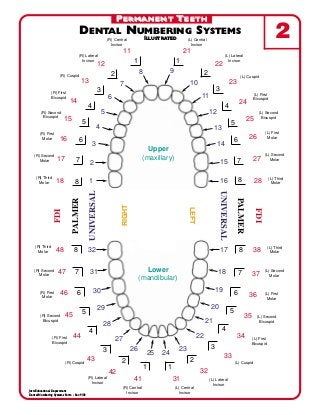
1.The Universal Numbering System has been adopted by the ADA and is in use by most
general dentists today.
Tooth number 1 is the tooth farthest back on the right side of your mouth in the upper (max-
illary) jaw. Numbering continues along your upper teeth toward the front and across to the
tooth farthest back on the top left side number 16.The numbers continue by dropping down
to the lower (mandibular) jaw. Number 17 is the tooth farthest back on the left side of your
mouth on the bottom. Numbering continues again toward the front and across to the tooth
farthest back on the bottom right side of you mouth number 32. In this system, the teeth that
should be there are numbered. If you are missing your third molars, your first number will be 2
instead of 1, acknowledging the missing tooth. If you’ve had teeth removed or teeth missing,
the missing teeth will be numbered as well.
2.The Palmer Notation Numbering System is used by some orthodontists, pedodontists,
and oral surgeons. Originally called the Zsigmondy system after an Austrian dentist of that
name who developed the idea in 1861.
The mouth is divided into four sections called quadrants.The numbers 1 through 8 and a
unique symbol is used to identify the teeth in each quadrant.The numbering runs from the
center of the mouth to the back. In the upper right quadrant tooth, number 1 is the incisor.
The numbers continue to the right and back to tooth number 8, which is the third molar.The
numbers sit inside an L-shaped symbol used to identify the quadrant.The L is right side up for
the teeth in the upper right quadrant.The teeth in the upper left use a backwards L. For the
bottom quadrants, the L is upside down following the same pattern from the uppers. Letters
such as UR or URQ for the upper right or upper right quadrant may also identify the quad-
rants.
3.The Federation Dentaire Internationale Numbering System (FDI). Internationally
the two- digit system is used worldwide. Every branch of dentistry uses this system.
Each quadrant is assigned a number.The maxillary right quadrant is assigned the number 1, the
maxillary left quadrant is assigned the number 2, the mandibular left quadrant is assigned the
number 3, and the mandibular right quadrant is assigned the number 4.The teeth within each
quadrant are assigned a number from 1 through 8 with 1 being the central incisor and 8 being
the third molar.
DENTAL NUMBERING SYSTEMS
Permanent Teeth
There are three different numbering systems used to identify the teeth in dentistry.
The Universal Numbering System was adopted by the ADA and is in use by most general
dentists today.
Tooth number 1 is the tooth farthest back on the right side of the mouth in the upper
(maxillary) jaw. Numbering continues along the upper teeth toward the front and across to the
tooth farthest back on the top left side number 16.The numbers continue by dropping down
to the lower (mandibular) jaw. Number 17 is the tooth farthest back on the left side of the
mouth on the bottom. Numbering continues again toward the front and across to the tooth
farthest back on the bottom right side of the mouth number 32. In this system, the teeth that
should be there are numbered. If you are missing your third molars, your first
number will be 2 instead of 1, acknowledging the missing tooth. If you’ve had teeth removed
or teeth missing, the missing teeth will be numbered as well.
The Palmer Notation Numbering System is used by some orthodontists, pedodontists,
and oral surgeons. Originally called the Zsigmondy system after an Austrian dentist of that
name who developed the idea in 1861.
The mouth is divided into four sections called quadrants.The numbers 1 through 8 and a
unique symbol is used to identify the teeth in each quadrant.The numbering runs from the
center of the mouth to the back. In the upper right quadrant tooth, number 1 is the incisor.
The numbers continue to the right and back to tooth number 8, which is the third molar.The
numbers sit inside an L-shaped symbol used to identify the quadrant.The L is right side up for
the teeth in the upper left quadrant.The teeth in the upper right use a backwards L. For the
bottom quadrants, the L is upside down following the same pattern from the uppers. Letters
such as UR or URQ for the upper right or upper right quadrant may also identify the
quadrants.
The Federation Dentaire Internationale Numbering System (FDI). Internationally the
two-digit system is used worldwide. Every branch of dentistry uses this system.
Each quadrant is assigned a number.The maxillary right quadrant is assigned the number 1, the
maxillary left quadrant is assigned the number 2, the mandibular left quadrant is assigned the
number 3, and the mandibular right quadrant is assigned the number 4.The teeth within each
quadrant are assigned a number from 1 through 8 with 1 being the central incisor and 8 being
the third molar.
Justi Educational Department
Dental Numbering Systems Perm - Rev. 9/03
2.
DENTAL NUMBERING SYSTEMS
ILLUSTRATED
JustiEducational Department
Dental Numbering Systems Perm - Rev. 9/03
32
31
30
29
28
27
26
25
17
18
19
20
21
22
24
23
Lower
(mandibular)
Upper
(maxillary)
(R) Third
Molar
8
LEFT
RIGHT
48
7
6
5
4
3
2
1
47
46
45
44
43
42
41
38
37
8
7
6
5
4
3
2
1
36
35
34
33
32
31
1
8
18
2
7
17
3
6
16
4
5
15
5
4
14
6
3
13 7
2
12
8
1
11
16 28
8
15 27
7
14
26
6
13
25
5
12
24
4
11
23
3
10
22
2
9
21
1
FDI
PALMER
UNIVERSAL
FDI
PALMER
UNIVERSAL
(R) Second
Molar
(R) First
Molar
(R) Second
Bicuspid
(R) First
Bicuspid
(R) Cuspid
(R) Lateral
Incisor
(R) Central
Incisor
(L) Third
Molar
(L) Second
Molar
(L) First
Molar
(L) Second
Bicuspid
(L) First
Bicuspid
(L) Central
Incisor
(L) Lateral
Incisor
(L) Cuspid
(R) Third
Molar
(L) Third
Molar
(R) Second
Molar
(L) Second
Molar
(R) First
Molar
(L) First
Molar
(R) Second
Bicuspid
(L) Second
Bicuspid
(R) First
Bicuspid
(L) First
Bicuspid
(R) Cuspid (L) Cuspid
(R) Lateral
Incisor
(L) Lateral
Incisor
(R) Central
Incisor
(L) Central
Incisor
2
P
PERMANENT
ERMANENT T
TEETH
EETH