NITA Funnel Method:
Basic Idea: One of the principal reasons for taking an expert’s deposition
is to discover all you can about the factual bases,
methodology, and principles underlying the expressed
opinions, and to box the expert in so that she cannot
introduce new opinions or new explanations at trial. The
Funnel Method allows you to do at least that, which is
gracious plenty.
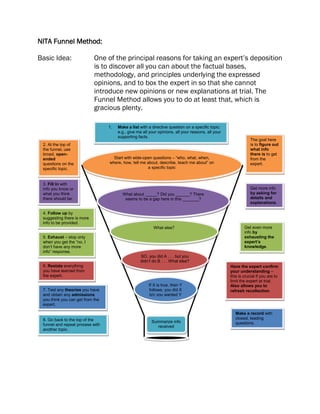
Start with wide-open questions – “who, what, when,
where, how, tell me about, describe, teach me about” on
a specific topic
What about _____? Did you ______? There
seems to be a gap here in this _______?
What else?
SO, you did A . . . but you
didn’t do B . . . What else?
If X is true, then Y
follows; you did X
b/c you wanted Y
Summarize info
received
The goal here
is to figure out
what info
there is to get
from the
expert.
2. At the top of
the funnel, use
broad, open-
ended
questions on the
specific topic.
3. Fill in with
info you know or
what you think
there should be.
Get more info
by asking for
details and
explanations.
4. Follow up by
suggesting there is more
info to be provided.
Get even more
info by
exhausting the
expert’s
knowledge.
5. Exhaust – stop only
when you get the “no, I
don’t have any more
info” response.
6. Restate everything
you have learned from
the expert.
Have the expert confirm
your understanding –
this is crucial if you are to
limit the expert at trial.
Also allows you to
refresh recollection.7. Test any theories you have
and obtain any admissions
you think you can get from the
expert.
Make a record with
closed, leading
questions.
8. Go back to the top of the
funnel and repeat process with
another topic.
1. Make a list with a directive question on a specific topic:
e.g., give me all your opinions, all your reasons, all your
supporting facts.

NITA Funnel Method

  • 1.
    NITA Funnel Method: BasicIdea: One of the principal reasons for taking an expert’s deposition is to discover all you can about the factual bases, methodology, and principles underlying the expressed opinions, and to box the expert in so that she cannot introduce new opinions or new explanations at trial. The Funnel Method allows you to do at least that, which is gracious plenty. Start with wide-open questions – “who, what, when, where, how, tell me about, describe, teach me about” on a specific topic What about _____? Did you ______? There seems to be a gap here in this _______? What else? SO, you did A . . . but you didn’t do B . . . What else? If X is true, then Y follows; you did X b/c you wanted Y Summarize info received The goal here is to figure out what info there is to get from the expert. 2. At the top of the funnel, use broad, open- ended questions on the specific topic. 3. Fill in with info you know or what you think there should be. Get more info by asking for details and explanations. 4. Follow up by suggesting there is more info to be provided. Get even more info by exhausting the expert’s knowledge. 5. Exhaust – stop only when you get the “no, I don’t have any more info” response. 6. Restate everything you have learned from the expert. Have the expert confirm your understanding – this is crucial if you are to limit the expert at trial. Also allows you to refresh recollection.7. Test any theories you have and obtain any admissions you think you can get from the expert. Make a record with closed, leading questions. 8. Go back to the top of the funnel and repeat process with another topic. 1. Make a list with a directive question on a specific topic: e.g., give me all your opinions, all your reasons, all your supporting facts.