New Perspectives on HTML5 CSS3 JavaScript 6th Edition Carey Solutions Manual
1.
Visit https://testbankbell.com todownload the full version and
explore more testbank or solutions manual
New Perspectives on HTML5 CSS3 JavaScript 6th
Edition Carey Solutions Manual
_____ Click the link below to download _____
http://testbankbell.com/product/new-perspectives-on-
html5-css3-javascript-6th-edition-carey-solutions-manual/
Explore and download more testbank or solutions manual at testbankbell.com
2.
Here are somerecommended products that we believe you will be
interested in. You can click the link to download.
New Perspectives on HTML5 CSS3 JavaScript 6th Edition
Carey Test Bank
http://testbankbell.com/product/new-perspectives-on-
html5-css3-javascript-6th-edition-carey-test-bank/
Solution manual for New Perspectives on HTML5, CSS3, and
JavaScript 7th Edition by Carey
http://testbankbell.com/product/solution-manual-for-new-perspectives-
on-html5-css3-and-javascript-7th-edition-by-carey/
HTML5 and CSS3 Illustrated Introductory 2nd Edition Vodnik
Solutions Manual
http://testbankbell.com/product/html5-and-css3-illustrated-
introductory-2nd-edition-vodnik-solutions-manual/
Advocacy and Opposition An Introduction to Argumentation
7th Edition Rybacki Rybacki Test Bank
http://testbankbell.com/product/advocacy-and-opposition-an-
introduction-to-argumentation-7th-edition-rybacki-rybacki-test-bank/
3.
Test Bank forClinical Nursing Skills and Techniques, 8th
Edition : Perry
http://testbankbell.com/product/test-bank-for-clinical-nursing-skills-
and-techniques-8th-edition-perry/
Test Bank for Interpersonal Communication: Everyday
Encounters 9th Edition Julia T. Wood
http://testbankbell.com/product/test-bank-for-interpersonal-
communication-everyday-encounters-9th-edition-julia-t-wood/
Solution Manual for Data Structures and Abstractions with
Java, 3/E 3rd Edition : 0136100910
http://testbankbell.com/product/solution-manual-for-data-structures-
and-abstractions-with-java-3-e-3rd-edition-0136100910/
Test Bank for Seeley’s Anatomy Physiology 12th by VanPutte
http://testbankbell.com/product/test-bank-for-seeleys-anatomy-
physiology-12th-by-vanputte/
Test Bank for American Politics Today Essentials, 6th
Edition, William T Bianco, David T Canon,
http://testbankbell.com/product/test-bank-for-american-politics-today-
essentials-6th-edition-william-t-bianco-david-t-canon/
4.
Hazard Mitigation andPreparedness An Introductory Text
for Emergency Management and Planning Professionals 2nd
Schwab Solution Manual
http://testbankbell.com/product/hazard-mitigation-and-preparedness-an-
introductory-text-for-emergency-management-and-planning-
professionals-2nd-schwab-solution-manual/
5.
New Perspectives onHTML5 CSS3 JavaScript
6th Edition Carey Solutions Manual
Full download chapter at: https://testbankbell.com/product/new-
perspectives-on-html5-css3-javascript-6th-edition-carey-solutions-
manual/
6.
Discover the thoroughinstruction you need to build dynamic, interactive Web sites from
scratch with NEW PERSPECTIVES ON HTML5, CSS3, AND JAVASCRIPT, 6E. This
user-friendly book provides comprehensive coverage of HTML, CSS, and JavaScript
with an inviting approach that starts with the basics and does not require any prior
knowledge on the subject. Detailed explanations of key concepts and skills make even
the most challenging topics clear and accessible. Case scenarios and case problems
place the most complex concepts within an understandable and practical context. You
develop important problem solving skills as you work through realistic exercises. Proven
applications and an interesting approach help you retain the material and apply what
you’ve learned in a professional environment.
1. Preface
2. Brief Contents
3. Table of Contents
4. Tutorial 1: Getting Started with HTML5: Creating a Website for a Food Vendor
5. Session 1.1 Visual Overview: The Structure of an HTML Document
6. Exploring the World Wide Web
7. Introducing HTML
8. Tools for Working with HTML
9. Exploring an HTML Document
10. Creating the Document Head
11. Adding Comments to Your Document
12. Session 1.1 Quick Check
13. Session 1.2 Visual Overview: HTML Page Elements
14. Writing the Page Body
15. Linking an HTML Document to a Style Sheet
16. Working with Character Sets and Special Characters
17. Working with Inline Images
18. Working with Block Quotes and Other Elements
19. Session 1.2 Quick Check
20. Session 1.3 Visual Overview: Lists and Hypertext Links
21. Working with Lists
22. Working with Hypertext Links
23. Specifying the Folder Path
24. Linking to a Location within a Document
25. Linking to the Internet and Other Resources
26. Working with Hypertext Attributes
27. Session 1.3 Quick Check
28. Review Assignments
29. Case Problems
30. Tutorial 2: Getting Started with CSS: Designing a Website for a Fitness Club
31. Session 2.1 Visual Overview: CSS Styles and Colors
32. Introducing CSS
33. Exploring Style Rules
34. Creating a Style Sheet
7.
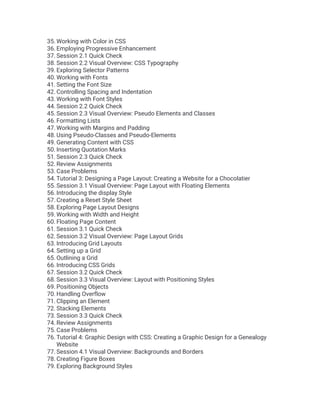
35. Working withColor in CSS
36. Employing Progressive Enhancement
37. Session 2.1 Quick Check
38. Session 2.2 Visual Overview: CSS Typography
39. Exploring Selector Patterns
40. Working with Fonts
41. Setting the Font Size
42. Controlling Spacing and Indentation
43. Working with Font Styles
44. Session 2.2 Quick Check
45. Session 2.3 Visual Overview: Pseudo Elements and Classes
46. Formatting Lists
47. Working with Margins and Padding
48. Using Pseudo-Classes and Pseudo-Elements
49. Generating Content with CSS
50. Inserting Quotation Marks
51. Session 2.3 Quick Check
52. Review Assignments
53. Case Problems
54. Tutorial 3: Designing a Page Layout: Creating a Website for a Chocolatier
55. Session 3.1 Visual Overview: Page Layout with Floating Elements
56. Introducing the display Style
57. Creating a Reset Style Sheet
58. Exploring Page Layout Designs
59. Working with Width and Height
60. Floating Page Content
61. Session 3.1 Quick Check
62. Session 3.2 Visual Overview: Page Layout Grids
63. Introducing Grid Layouts
64. Setting up a Grid
65. Outlining a Grid
66. Introducing CSS Grids
67. Session 3.2 Quick Check
68. Session 3.3 Visual Overview: Layout with Positioning Styles
69. Positioning Objects
70. Handling Overflow
71. Clipping an Element
72. Stacking Elements
73. Session 3.3 Quick Check
74. Review Assignments
75. Case Problems
76. Tutorial 4: Graphic Design with CSS: Creating a Graphic Design for a Genealogy
Website
77. Session 4.1 Visual Overview: Backgrounds and Borders
78. Creating Figure Boxes
79. Exploring Background Styles
8.
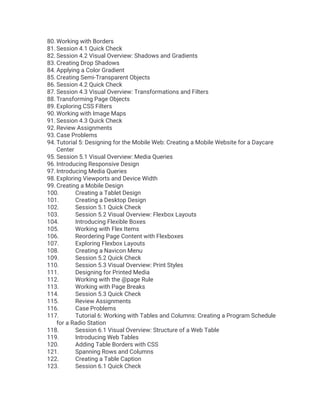
80. Working withBorders
81. Session 4.1 Quick Check
82. Session 4.2 Visual Overview: Shadows and Gradients
83. Creating Drop Shadows
84. Applying a Color Gradient
85. Creating Semi-Transparent Objects
86. Session 4.2 Quick Check
87. Session 4.3 Visual Overview: Transformations and Filters
88. Transforming Page Objects
89. Exploring CSS Filters
90. Working with Image Maps
91. Session 4.3 Quick Check
92. Review Assignments
93. Case Problems
94. Tutorial 5: Designing for the Mobile Web: Creating a Mobile Website for a Daycare
Center
95. Session 5.1 Visual Overview: Media Queries
96. Introducing Responsive Design
97. Introducing Media Queries
98. Exploring Viewports and Device Width
99. Creating a Mobile Design
100. Creating a Tablet Design
101. Creating a Desktop Design
102. Session 5.1 Quick Check
103. Session 5.2 Visual Overview: Flexbox Layouts
104. Introducing Flexible Boxes
105. Working with Flex Items
106. Reordering Page Content with Flexboxes
107. Exploring Flexbox Layouts
108. Creating a Navicon Menu
109. Session 5.2 Quick Check
110. Session 5.3 Visual Overview: Print Styles
111. Designing for Printed Media
112. Working with the @page Rule
113. Working with Page Breaks
114. Session 5.3 Quick Check
115. Review Assignments
116. Case Problems
117. Tutorial 6: Working with Tables and Columns: Creating a Program Schedule
for a Radio Station
118. Session 6.1 Visual Overview: Structure of a Web Table
119. Introducing Web Tables
120. Adding Table Borders with CSS
121. Spanning Rows and Columns
122. Creating a Table Caption
123. Session 6.1 Quick Check
9.
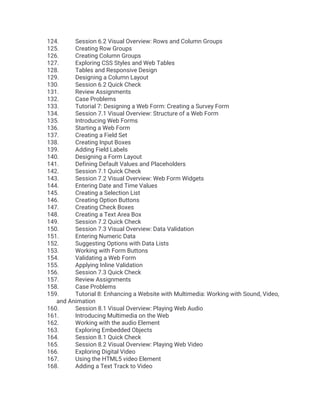
124. Session 6.2Visual Overview: Rows and Column Groups
125. Creating Row Groups
126. Creating Column Groups
127. Exploring CSS Styles and Web Tables
128. Tables and Responsive Design
129. Designing a Column Layout
130. Session 6.2 Quick Check
131. Review Assignments
132. Case Problems
133. Tutorial 7: Designing a Web Form: Creating a Survey Form
134. Session 7.1 Visual Overview: Structure of a Web Form
135. Introducing Web Forms
136. Starting a Web Form
137. Creating a Field Set
138. Creating Input Boxes
139. Adding Field Labels
140. Designing a Form Layout
141. Defining Default Values and Placeholders
142. Session 7.1 Quick Check
143. Session 7.2 Visual Overview: Web Form Widgets
144. Entering Date and Time Values
145. Creating a Selection List
146. Creating Option Buttons
147. Creating Check Boxes
148. Creating a Text Area Box
149. Session 7.2 Quick Check
150. Session 7.3 Visual Overview: Data Validation
151. Entering Numeric Data
152. Suggesting Options with Data Lists
153. Working with Form Buttons
154. Validating a Web Form
155. Applying Inline Validation
156. Session 7.3 Quick Check
157. Review Assignments
158. Case Problems
159. Tutorial 8: Enhancing a Website with Multimedia: Working with Sound, Video,
and Animation
160. Session 8.1 Visual Overview: Playing Web Audio
161. Introducing Multimedia on the Web
162. Working with the audio Element
163. Exploring Embedded Objects
164. Session 8.1 Quick Check
165. Session 8.2 Visual Overview: Playing Web Video
166. Exploring Digital Video
167. Using the HTML5 video Element
168. Adding a Text Track to Video
10.
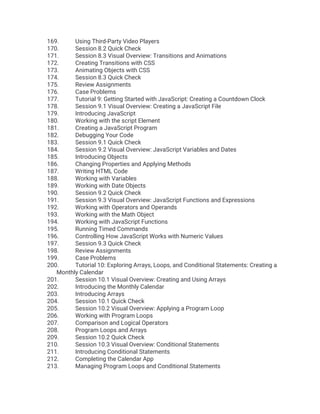
169. Using Third-PartyVideo Players
170. Session 8.2 Quick Check
171. Session 8.3 Visual Overview: Transitions and Animations
172. Creating Transitions with CSS
173. Animating Objects with CSS
174. Session 8.3 Quick Check
175. Review Assignments
176. Case Problems
177. Tutorial 9: Getting Started with JavaScript: Creating a Countdown Clock
178. Session 9.1 Visual Overview: Creating a JavaScript File
179. Introducing JavaScript
180. Working with the script Element
181. Creating a JavaScript Program
182. Debugging Your Code
183. Session 9.1 Quick Check
184. Session 9.2 Visual Overview: JavaScript Variables and Dates
185. Introducing Objects
186. Changing Properties and Applying Methods
187. Writing HTML Code
188. Working with Variables
189. Working with Date Objects
190. Session 9.2 Quick Check
191. Session 9.3 Visual Overview: JavaScript Functions and Expressions
192. Working with Operators and Operands
193. Working with the Math Object
194. Working with JavaScript Functions
195. Running Timed Commands
196. Controlling How JavaScript Works with Numeric Values
197. Session 9.3 Quick Check
198. Review Assignments
199. Case Problems
200. Tutorial 10: Exploring Arrays, Loops, and Conditional Statements: Creating a
Monthly Calendar
201. Session 10.1 Visual Overview: Creating and Using Arrays
202. Introducing the Monthly Calendar
203. Introducing Arrays
204. Session 10.1 Quick Check
205. Session 10.2 Visual Overview: Applying a Program Loop
206. Working with Program Loops
207. Comparison and Logical Operators
208. Program Loops and Arrays
209. Session 10.2 Quick Check
210. Session 10.3 Visual Overview: Conditional Statements
211. Introducing Conditional Statements
212. Completing the Calendar App
213. Managing Program Loops and Conditional Statements
11.
214. Session 10.3Quick Check
215. Review Assignments
216. Case Problems
217. Tutorial 11: Working with Events and Styles: Designing an Interactive Puzzle
218. Session 11.1 Visual Overview: Event Handlers and Event Objects
219. Introducing JavaScript Events
220. Creating an Event Handler
221. Using the Event Object
222. Exploring Object Properties
223. Session 11.1 Quick Check
224. Session 11.2 Visual Overview: Event Listeners and Cursors
225. Working with Mouse Events
226. Introducing the Event Model
227. Exploring Keyboard Events
228. Changing the Cursor Style
229. Session 11.2 Quick Check
230. Session 11.3 Visual Overview: Anonymous Functions and Dialog Boxes
231. Working with Functions as Objects
232. Displaying Dialog Boxes
233. Session 11.3 Quick Check
234. Review Assignments
235. Case Problems
236. Tutorial 12: Working with Document Nodes and Style Sheets: Creating a
Dynamic Document Outline
237. Session 12.1 Visual Overview: Exploring the Node Tree
238. Introducing Nodes
239. Creating and Appending Nodes
240. Working with Node Types, Names, and Values
241. Session 12.1 Quick Check
242. Session 12.2 Visual Overview: Exploring Attribute Nodes
243. Creating a Nested List
244. Working with Attribute Nodes
245. Session 12.2 Quick Check
246. Session 12.3 Visual Overview: Style Sheets and Style Rules
247. Working with Style Sheets
248. Working with Style Sheet Rules
249. Session 12.3 Quick Check
250. Review Assignments
251. Case Problems
252. Tutorial 13: Programming for Web Forms: Creatings Forms for Orders and
Payments
253. Session 13.1 Visual Overview: Forms and Elements
254. Exploring the Forms Object
255. Working with Form Elements
256. Working with Input Fields
257. Working with Selection Lists
12.
258. Working withOptions Buttons and Check Boxes
259. Formatting Numeric Values
260. Applying Form Events
261. Working with Hidden Fields
262. Session 13.1 Quick Check
263. Session 13.2 Visual Overview: Passing Data between Forms
264. Sharing Data between Forms
265. Working with Text Strings
266. Introducing Regular Expressions
267. Programming with Regular Expressions
268. Session 13.2 Quick Check
269. Session 13.3 Visual Overview: Validating Form Data
270. Validating Data with JavaScript
271. Testing a Form Field against a Regular Expression
272. Testing for Legitimate Card Numbers
273. Session 13.3 Quick Check
274. Review Assignments
275. Case Problems
276. Tutorial 14: Exploring Object-Based Programming: Designing an Online Poker
Game
277. Session 14.1 Visual Overview: Custom Objects, Properties, and Methods
278. Working with Nested Functions
279. Introducing Custom Objects
280. Session 14.1 Quick Check
281. Session 14.2 Visual Overview: Object Classes and Prototypes
282. Defining an Object Type
283. Working with Object Prototypes
284. Session 14.2 Quick Check
285. Session 14.3 Visual Overview: Objects and Arrays
286. Combining Objects
287. Combining Objects and Arrays
288. Session 14.3 Quick Check
289. Review Assignments
290. Case Problems
291. Appendix A: Color Names with Color Values, and HTML Character Entities
292. Appendix B: HTML Elements and Attributes
293. Appendix C: Cascading Styles and Selectors
294. Appendix D: Making the Web More Accessible
295. Appendix E: Designing for the Web
296. Appendix F: Page Validation with XHTML
297. Glossary
298. Index
his Court areto be honored in this hall. Since man has ceased to pay
us worshipful homage, our own felicity be our sole care.” In
response to this effusion of friendship Odin signified his pleasure by
ordering his black elves, to whose skilful workmanship Thor was
indebted for his wonderful hammer, to throw an arched span of gold
over the hollow which separated the mountains of Terror and
Erebus. But the long-nosed, dirty little artificers durst not face
Phœbus, whose glare brought them death; wherefore the blazing
chariot of the sun-god made room for Aurora Australis, when the
bridge rose like a vision, competing with the rainbow in multicolored
brilliancy. For once Vulcan confessed surprise at the exquisite
mastery in metal work in which he had thought himself unrivalled,
while Pluto was amazed at the lavishness of the precious material,
which he knew to be limited in quantity. Once more did Heimdall
sound his horn, this time to proclaim the opening of the grand feast
in which all the gods, goddesses, heroes and dependencies of
Asgard were required to participate.
On their side the Olympians were neither to be eclipsed in splendor
nor outdone in all that goes to make a feast of gods. Robed in
supernal glory, each god and goddess, surrounded by their retinues,
wore the symbols of their respective powers and attributes, but
stood overawed by the transcendent magnificence of their chief,
whom no mortal eye could behold without being consumed. From
his throne above the clouds, surrounded by his family, who shone
like stars, Jupiter beheld Odin issue from Valhalla, mounted on his
eight-legged steed, Sleipnir, who could leap over mountains. Him
followed Frigga and Freya, his wife and daughter, the one as
beautiful as Iris, the other, who stood for love, blushing like sweet
Aurora, escorted by Thor and his inseparable attendant, Thialfi. Like
a stream of radiant gold, flowed behind them a host of sunny elves,
diminutive creatures, stirring the air with weird music. In their wake,
leading another host of those unsightly elves clad in burnished
brass, and blowing sonorous instruments of the same metal, came
Frey in a chariot drawn by the boar Gullinbursti, along with Heimdall
bestriding his horse, Gulltopp. The train’s rear was taken up by a
15.
great number ofinferior gods, heroes and mountain giants, as well
as their colossal frost companions.
Gratifying his mischievous nature, Cupid perched himself on the
main entrance guarded by Seasons, and as this goddess opened it to
admit Odin and his cortege, a shower of love’s arrows descended on
the unsuspicious powers of Asgard, who were received by Pluto and
Neptune, and led into the assembly hall of Jupiter’s palace. Here the
Olympian dynasty were found standing, except Jupiter and Juno,
who likewise rose, while Venus, wearing the Cestus which imparts
ineffable grace to the wearer, welcomed the head of Asgard and
escorted him to a lofty throne at the left hand of her father. A sweet
fragrance was diffused among the star-like assembly by a heavenly
smile from Jupiter, who was at once captivated by the eyes of Freya,
the goddess of love. Odin found it impossible to make a secret of his
enchantment by Venus, while Thor had no eye for anyone but Hebe.
Heimdall found in Juno the crown of sweetness, Thialfi bowed to
Diana, and Frey paid his tender respects to Minerva. The other
deities selected their partners in accordance with their natural bent
of mind, or destined appointment in the divine economy.
Without, the subordinate attendants grouped themselves
harmoniously, so that no sooner were the strains of Apollo’s lyre
heard, accompanied by the enravishing song of the Muses, than the
broad spaces between the dwellings of the gods teemed with the
airy dancers. Elf, nymph, naiad, satyr and dryad abandoned
themselves to the spell of Apollo’s music. This was only a faint reflex
of what was doing in the star-illumined hall of the Olympian
thunderer. Here the celestial food and beverage were being offered
by Hebe, after the first grand march of the superior gods. Odin, who
never tasted of Shrimnir’s flesh, and indulged in but drink of the
mead of the she-goat Heidrun, now emptied a capacious goblet of
nectar handed him by Hebe, at the same time that one was given to
Thor. The head of Asgard’s Court found it hard to swallow the
strange liquid, so unlike mead, and, unable to retain it, ejected it in
a manner to bring up the Olympian host and his entire house. As to
16.
Thor, the unspeakabledrink and the mirth provoked by his ludicrous
grimaces enraged him to such an extent that, but for the subduing
charm of Hebe’s look, he would have dashed his mallet against the
very throne which filled gods with awe. Good nature prevailed,
however, and as the refreshments passed around, the hilarity grew
at the cost of Asgard.
Now struck Terpsichore her instrument, the graces joining to swell
the strains which cause the gods to move in rhythmic measure.
Looked at from the vantage ground occupied by Damon, the divine
spectacle resembled a scattered constellation, the stars moving in
pairs, then grouping in clusters, then spreading in lines, straight and
curved, then forming in circles, then breaking up to renew and
multiply the harmonious evolutions. There appeared nothing to
intercept the minutest detail of the celestial scene, and Damon was
intoxicated with felicity, ear and eye being equally ravished. While
the feast was at its height, Erebus shook with a convulsion which
reminded Jupiter of the summons he had sent to Tartarus, and that
the Titans had access to the upper world by way of the lava-
vomiting mountain. At the same instant Heimdall gave the alarm, his
ear having recognized the tramp of the Jotuns for whom Odin had
sent his son, Hermond the Nimble. Quick as were the gods in
rushing to arms, and in manning every strategic and vulnerable
point, they were not quick enough to prevent a collision between
Briareus on one side and Skrymir on the other, each one sustained
by his gigantic followers, who tore up glaciers and made icebergs fly
as flakes of snow driven by a storm. As if by a tacit understanding,
Thor and Jupiter combined their terrific instruments of destruction,
hurling them from opposite directions at the monstrous combatants,
who heaped Pelion on Ossa in their furious efforts to crush each
other. Briareus disappeared like a flash in the womb of Erebus,
drawing his companions after him; the Jotuns took to their heels as
fast as their gigantic limbs could carry them.
But there was no clearing of the atmosphere. The mountains
trembled, the air grew oppressive and seemed saturated with fetid
17.
gases. A moment’sominous quiet was broken by another far-
reaching convulsion, followed by a crack which terrified the gods and
threw Damon out of his seat deep down into a chasm. The womb of
Erebus opened wide. A deluge of fire burst from the bowels of the
earth, melting glaciers and causing frozen seas to boil. Heaven
glowed like a furnace, and Damon beheld with terror a stream of
liquid metal pour down in a cataract from a height above his head.
His attempt to flee from destruction proved his limbs to be of lead;
he could not budge. He was going to be buried under fathoms of
molten ore. Once more he tried to get to his feet, the glowing metal
bursting on him from every side. In growing terror he grasped for
something to assist him in his struggle for life, striking out right and
left. His numbness gave way; his limbs softened in their joints, and a
vitalizing energy enabled him to raise his head. What did he see? A
full-rounded moon shedding a silver flood on a slumbering
landscape, glorified by a weird maze of far-away dazzling white,
varied by domes and spires of other hues. It was neither Asgard nor
the heavenly city built by Hephæstus; it was Damascus, oblivious of
her impending doom. Damon was grateful to be here, conscious of
the fact that the wizard he had followed had but sported with him.
Yet what he had seen was worth the sacrifice. How much greater
the God of infinity, how much holier than they of Asgard and
Olympus, He with whom a myriad galaxies count for naught as He
sways the boundless Universe by the breath of His mouth!
18.
I
KING SOLOMON ANDASHMODAI.
T is well known that after Solomon had succeeded his father
David as ruler over Israel he had a vision wherein the Lord gave
him the choice between riches and wisdom, and that the youthful
monarch gave wisdom the preference. In recognition of this he was
not alone endowed with an understanding heart, but was given the
means of acquiring great wealth, such as enabled him to build the
most gorgeous of temples and the most sumptuous of palaces. The
secret of Solomon’s power was his possession of the Omnipotent
Name engraved on his signet-ring, the use of which he was to learn
by an accident.
The first great problem Solomon was called upon to solve was how
to build God’s Temple in compliance with the unaccountable
injunction not to employ iron implements in cutting, fitting or
smoothing the materials of the sacred edifice. This prohibition
implied the existence of a rock-splitting instrument of which neither
the King nor his wisest counselors had any knowledge. Eldad the
lonely dweller of the sacred caves, the reader of the stars, the
wanderer of the desert, the recorder of traditions, Eldad, who at the
age of one hundred and nineteen years had no wrinkle on his face,
preserving his faculties in all their strength by means of the occult
sciences, this wizard who was the engraver of the Ineffable Name on
the King’s ring, was summoned to appear before His Majesty to
answer this question:
“Thou knowest, O, Eldad, that I am to build the House of God with
materials unprepared by the use of any iron implement; no doubt
Providence has provided the means for the raising of His Sanctuary;
my advisers have failed to give me light on the mystery; should it be
19.
beyond thy powerto enlighten me on this matter, I shall not know
whither to turn for the solution of the difficulty,” spoke the King. To
whom Eldad replied: “Know, O King, that in the beginning of things,
as creation was nearing its completion, before the sun of the sixth
day had withdrawn his last mellow beam from the earth, fourteen
additional wonders were called into being, things which the
foreknowledge of the All-knowing destined to play a part in this
nether world. They are, the mouth of the earth that swallowed
Korah and his rebellious followers; the mouth of the fountain known
as Miriam’s Well, the unfailing spring whose flow accompanied Israel
through the desert, joining in the hymn of praise; the mouth of the
brute that spoke to Balaam, after the heathen prophet had beaten it
three times, he not having seen the angel that deterred it from
advancing; the multicolored rainbow which symbolizes God’s mercy
to frail man; the manna, Israel’s food for forty years; the staff
wherewith Moses performed all his miracles; the two sapphires out
of which the tablets of the Law were cut; the gems that spelt the
Ten Commandments; the letters of the alphabet; the sepulchre of
Moses never seen by a mortal eye; the ram destined to be the
substitute of Isaac when on the point of being sacrificed; the first
pair of tongs, without which no iron could ever be forged; the spirits,
both good and evil, the Sabbath having begun before bodies could
be formed for some souls, thus left forever disembodied; and the
Shamir, a worm not larger than a grain of barley, but stronger than
rock, which it splits by the mere touch. The Shamir, O, King, is the
only might in creation to do the work in accordance with the divine
behest. Those priceless gems of which the tablets and the letters
thereon are cut have been fashioned by the Shamir.”
“That Shamir shall be in my power, O, Eldad, it being there for the
building of God’s house, as it was there to materialize His immutable
Word. But tell me who on earth claims possession of that wonderful
creature? Is it to be had by trade, purchase, strategy, or force?”
cried the King, deeply agitated.
20.
“King, beyond whatI have told thee my knowledge goes not. The
abyss says: It is not in me, and the ocean says: I own it not.
Hitherto the Shamir has been beyond the reach of human eye.
Whether it can be had, the future will tell. Here my wisdom ends,”
concluded the hoary wizard, withdrawing from the royal presence. It
was late in the evening when the King retired to a restless bed. Light
and fitful as were his slumbers, his mind was haunted by weird
visions of desolate scenes, cliffs infested with fierce carrion birds,
and chasms teeming with venomous reptiles. The first blush of the
morning found the monarch on one of his gilded balconies from
which he surveyed the floral glories of his exuberant gardens,
inhaling the odoriferous breezes of the peaceful morrow. Nature
stood in her loveliness, and animate creation seemed to breathe
peace. Suddenly there was a scream of pain in one of the towering
clusters of green, and the next instant two specimens of the
feathered tribes dropped at the feet of the King. In the talons of a
carnivorous fowl was closed the tender wing of a trembling dove as
white as snow. Moved by the impulse of pity, the King had his strong
grip on the neck of the obscene bird of prey, relieving the other, but
not before the victim’s wing was broken. Great as was the anger of
the King to see the poor dove bleeding and helpless, his
astonishment was greater at the instantaneous transformation of the
ferocious fowl in his grasp; fowl no more but demon, black and
mighty, swelling to enormous proportions, and beseeching the royal
captor to set him free.—“Whatever thou biddest me I will do, O,
master, the ring on thy finger giving thee power over Ashmodai and
his legions, to which I belong doing service as commanded,” stated
the dark agent submissively.
“And what cause underlies thy vicious onslaught against so pure a
creature as this dove?” asked Solomon, the revelation breaking on
him that his signet-ring invested him with a power akin to
omnipotence.
“A symbol of purity, the dove comes under the ban of us who are of
Ashmodai’s dark legion,”[8] explained the fiend with unreserved
21.
candor.
[8] Talmudic angelologyassigns to Ashmodai the inferior rank of
presiding over the evil demons under the rule of Samaël (אשמדאי
דשידאי רבא ;)מלכא [Transliteration] while Matatron is the
recognized chief of the infinite hosts teeming throughout the
universe, holding at the same time the office of benign
intercession between man and Supreme Grace, and Synadalphon
is the next in power, standing on earth with his head reaching to
the highest cherubim (אצל מגיע וראשו בארץ עומד אחד מלאג
שמו סנדלפין )החיות [Transliteration]. Like Samaël and Lilith,
Ashmodai impersonates evil in a variety of manifestations. Neither
Dumah, the prince of the winds and the custodian of the dead,
nor Rohab, the lord of the ocean, are to be degraded to the rank
of Ashmodai who dwells in the clouds but depends for his
sustenance on what the earth produces. It is to be remarked,
however, that the Rabbis take the dark and the bright powers to
represent physical forces co-existent with creation (קב״ה כשבקש
.השרת מלאכי של כת ברא העולם )לבראות [Transliteration] This
idea is sustained by the additional assertion that the creative
energy is incessant, Omnipotence calling forth daily new ministers
to carry out His inscrutable designs. (בנהר השרת מלאכי נבראין
.מלאך נברא קב״ה מפי שיצא דיבור מכל ,)דינור [Transliteration]
[Back]
“Thou shalt not go hence before I learn of thee who treasures the
Shamir,” said Solomon firmly, assuming the demon to know
something about it.
“What art thou seeking of me, O, master, who am one of inferior
rank bending to the will of our chief Ashmodai, the mighty spirit of
this world? Him thou art to question, because he is the one to satisfy
thy demand,” replied the demon. “Describe his retreat to me and its
approaches, and thou shalt go free,” commanded the son of David.
“He is to be found where no creature of flesh and blood can long
endure; it is not heaven; neither is it earth; in the heart of the
Orient, on the highest peak of the highest mountain range, a hollow
summit crowned with eternal snow, holding under seal before a
recess of frozen crystal the purest spring under the heaven to give
him drink, that is Ashmodai’s retreat. Hither he descends from his
22.
cloud-vested realm, scansthe seal to assure himself that no impurity
has polluted his delicious beverage, when, having quenched his
thirst, he re-seals the fountain, gives audience to his court, who
flock hither to receive their orders, and, refreshed by slumber, re-
ascends to control the elements and survey the work of his active
host,” was the information, which insured the demon’s release.
In earnest consultation with his general Benaiah, Solomon matured
the plan for the attack of Ashmodai’s retreat, and ere long a well-
equipped expedition of a few picked men headed by that undaunted
warrior, departed secretly. The haunt of the demoniac chief was not
only far to the south-east of the Holy Land, but it was so located
that in order to approach it the adventurers had to cross deserts,
traverse pestiferous swamps infested with scorpions and dragons,
ford wild rivers, and bridge over chasms, only to see themselves in a
labyrinth of stupendous rocks, supermounted by a chain of sky-
towering peaks lost in dense fogs. Benaiah’s eagle eye swept the
clouded outlines of the snow-capped heights, trying in vain to locate
the spot to be invaded. The impenetrable curtain of shifting fogs
precluded accurate observation, and for once the dashing general
felt that he was more in need of daring and of patience than of
strategy. Retiring with his men to a cave at the base of the
mountain, Benaiah took a position which commanded the loftiest
point of the summit, hoping that something would occur to betray
the object of his quest. Benaiah was struck by the contrast of the
frowning mountain-crest on one hand, and the sun’s pure effulgence
on the other. As he had his eyes riveted on the broken summit, the
dense mass of fog darkened perceptibly. A noise as of a boisterous
sea repelled by a rocky shore was the precursor of a tempest and an
earthquake which convulsed the entire region within and without,
thunder and lightning adding to the uproar. The eternal snows on
the crest rose pulverized by the fury of a chaotic storm,—a hurricane
intermixed with flashes of red fire,—the whole reducing itself within
a few seconds to a funnel-shaped whirlwind, revolving with furious
speed, its pivot centred in a hollow betwixt mighty cliffs, rendered
visible by the convulsive phenomenon. Benaiah knew what it meant,
23.
and he wasconfirmed in his assumption that Ashmodai was
descending by observing the same disturbance a few hours later
when the demon re-ascended to his airy empire.
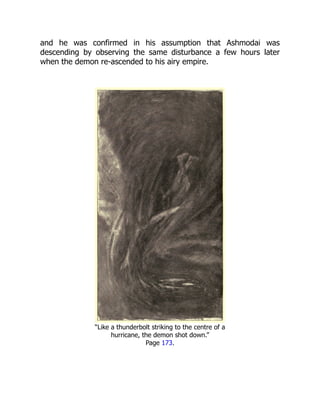
“Like a thunderbolt striking to the centre of a
hurricane, the demon shot down.”
Page 173.
24.
Like a goodstrategist, the general took a little time to study the
situation. The ascent of the mountain had to be made with great
care, and the proceedings of the chief demon observed from as near
a station as was compatible with safety. The climbing was attended
with much toil and great danger, but the point was reached, the
ground surveyed, and a hiding place secured in a recess barred by a
wall of solid ice. Here everything was held in readiness for the next
step.
If Ashmodai’s descent startled the adventurers from a distance,
nearness to the spot of his landing filled them with dismay, the
atmospheric and subterranean agitation threatening to sweep them
out of their hiding place. Like a thunderbolt striking to the centre of
a hurricane, the demon shot down, unsealed his well, plunged his
lips in the beryl fluid, drawing up a great quantity, and then sealed it
up again. He was hardly ready when the table-land around him was
thick with files of demons, who arrived to report what had been
accomplished, and to take orders for new tasks. They were all
chiefs, of various ranks, each one having legions to carry out his
behests. From the reports and the schemes discussed it was clear
that they represented three kinds of spirits as to their relation to
mankind—of hostility, friendliness, and neutrality. There was a
division of labor,—hostile, benevolent, and neutral.
It is impossible to say how the daring band of interlopers would have
fared at the hands of the terrible chief and his demonic army had
not Benaiah possessed the Omnipotent Name to shield him from
discovery. As matters stood the demons, unconscious of any
unwelcome presence, departed, leaving Ashmodai to take his
accustomed slumber, after which he darted up like a flash, with the
phenomenal accompaniment of elemental disturbance as before.
Now came Benaiah’s opportunity. Without touching the seal on the
cover of the well, the contents were drawn out through a hole
skilfully bored beneath the surface of the liquid. This done, the hole
was carefully closed, and another one was bored on the opposite
side at a higher level, through which wine was poured to fill the
25.
emptied well. Withevery trace removed to avoid suspicion, and
every detail ready for the emergency, Benaiah waited patiently for
the next day when everything passed off as before, except the
astonishment of the dreaded power when he found that his well
contained wine instead of water. Doomed by destiny to fall into the
trap set for him, and urged by a parching thirst, Ashmodai took but
little time to consider the advisability of drinking the intoxicating
beverage, balancing Scriptural texts pro and con, and soon deciding
to try its effect on his semi-ethereal nature. This was just what
Solomon and his general had counted on. Ashmodai had scarcely
dismissed his military Council when the wine began to do its work;
he felt as he had never felt before, and he discussed with himself
the singular mood into which he found himself plunged, in what way
he could not account for, the sensation being wholly new in his
superhuman experience. Sleep was on him, and there he lay,
stretched out as helpless as a senseless block. Benaiah was at hand
with a chain rendered resistless by the Omnipotent Name engraved
upon its links. Slipping it around the waist and the neck of the prince
of demons, his potency was disposed of. Ashmodai’s consternation
when awakened words cannot describe. A roar of rage darkened all
nature, shook the mountains to their foundation, and horrified all his
legions who fled to hide themselves in the deepest chasms, even in
the bowels of the earth and under the waters of the sea. For a
moment Benaiah lost his speech, while his companions fell prostrate
on the ground. The demon assumed every shape of horror to
overawe the enemies of his freedom. In a few moments he gave
himself the deterring shapes of all that is monstrous and deadly in
nature, from the enraged tiger to the hissing serpent whose bite is
death; all in vain.—“In the Name of the Most High, I, Benaiah, chief
of King Solomon’s army, do herewith command thee, Ashmodai,
mighty Prince of genii, to follow me to the seat of the wisest King,
who needs thy aid to build the Temple of God.”
The conjuration conquered all resistance, and the demon was led off
disarmed and humiliated. Realizing the hopelessness of gaining
anything by violence, Ashmodai feigned submissiveness, assumed
26.
the form andmanner of a most polished and affable courtier, and,
ushered into the presence of the King, charmed His Majesty by
discourse of things far above the comprehension of ordinary men.
“Thou art to deliver to me the Shamir so that God’s House be built
without the use of iron implements,” said Solomon to Ashmodai.
“The Shamir is not in my keeping, great King; the spirit of the ocean
has entrusted it to the fowl Awza that it be preserved forever in a
state of perfection,” replied Ashmodai, adding, “and no man can
come near that bird.”
“Tell me where Awza breeds her young,” commanded the King.
“South of the great desert there is a mountain with a towering cliff
and walls so steep and smooth that a spider has difficulty to climb it.
On the top of that rock is the nest of Awza, a fowl with claws of
steel and eyes of fire, swift as the swallow, larger than the vulture,
and fiercer than the eagle,” answered the demon.
Again Benaiah was placed at the head of an expedition, and many
were the hardships before the solitary pile rose before the eyes of
the indomitable general. There was neither a bird to be seen nor a
nest. The head of the precipitous rock was so high above the clouds
that there seemed no possibility of scaling it. But Benaiah was full of
resources and had anticipated the difficulty by bringing with him a
pair of pigeons. Having left a man with the female bird this side of
the mountain, the general made a detour for the opposite side with
the male, tied a cord to his foot, and allowed him to rise. Guided by
his instinct, the pigeon soon soared above the rock, descending to
join his mate. This accomplished, a heavier cord was trailed over,
followed by a still heavier rope strong enough to lift a man. This
man was Benaiah who, in the dark of night, was hauled up by his
attendants. Awza was thus to be circumvented.
Great was the general’s joy when he found himself before the nest
occupied by its fledglings, Awza being happily away in search for
food. A transparent stone is laid securely over the nest. Awza
27.
arrives, finds herfledglings imprisoned, hungry, and crying. With
motherly tenderness she hurries to split the stone by applying the
Shamir. Benaiah’s great chance is come. From behind a bowlder he
bursts forth and frightens the bird; she drops the invaluable worm.
Benaiah pounces upon it like an eagle. The male bird is soon on the
spot. A desperate struggle ensues between the enraged birds and
the daring Benaiah. He is armed against iron claws, and is not
deterred by fiery eyes. He has the trophy and he holds it, placing it
in due time at the feet of his master, to the great surprise of
Ashmodai. Thus is the building of God’s Temple proceeded with, the
Shamir splitting and fitting the materials.
Solomon’s thirst for wisdom grew with his growing consciousness of
the painful limitations as regards its acquisition by man, and
Ashmodai availed himself of the King’s avidity for knowledge in the
hope of throwing him off his guard. He taught him the secrets of the
vegetable and mineral kingdoms, and gave him the clue to
intercourse with animal creation, including the mind-reading faculty.
As a final achievement he suggested the weaving of a prodigious air-
float large enough to transport the King on his throne, an army fully
equipped, and a host of spirits. On this air-ship, sixty miles square,
Solomon, ever accompanied by Ashmodai, traversed great distances,
soaring above the clouds, higher than the eagle, and looking down
on earth like a god. Woven by genii of the most subtile essences of
nature, the texture of that air-island was of azurean translucency,
green-blue in color, floating in the sun’s radiance like a rippled sea
bathed in gold.
But the marvel of the marvelous equipage was its circular pavilion
vast in extent and fashioned of rainbow-tints, which photographed,
enormously magnified, whatever came within the range of the eye
that controlled its course, laying bare the mysteries of land and
ocean, and revealing the multifarious activities of the spirit-world
under the rule of Ashmodai. Here Solomon’s wonder-throne,
ascended by seven steps, each one guarded by a pair of magnificent
animals chosen from the respective species of the lion, the elephant,
28.
the tiger, thebear, the serpent, the antelope, and the eagle, stood
on a dais, lofty and brilliant, eclipsed only by the monarch’s crown
which rivaled the sun in splendor. Solomon began to believe that he
was really more than human, and Ashmodai lost no chance to swell
the autocrat’s overbearing vanity. Solomon was so delighted with his
triumph over the chief of demons and the deep secrets he had
wrested from him, that he indefinitely deferred setting him free long
after the Temple had been dedicated with grand ceremony, and,
thanks to rock-bursting Shamir, cargoes of gold were pouring into
the royal treasury.
One early morning the sovereign of the richest kingdom upon earth
bade the winds raise and waft his imponderable encampment toward
the rising day, he being enthroned in his pavilion with Ashmodai at
his feet. Up soared the magic float, lighter than air, transparent as
ether, and stronger than adamant, hurrying eastward as an
undulating firmament, suffused with purple and gold. The soundless
vast above, coupled with the radiant flood that broke from the East,
and the amazing kaleidoscope of animal and spirit life startlingly
reflected by the walls of the glowing pavilion, overawed the mind of
the most daring of kings, who exclaimed: “How great the all-
powerful God, in whose infinity we are not more than an atom in the
universe of matter!”
“Great King, thy head is the microcosm of the immensity whose
contemplation overpowers thee. The heavens hide nothing which
man cannot own if he but knew how,” said Ashmodai with a pull at
his chain.
“Thou art speaking riddles, potent spirit. Give me certainty that my
grave is not the end, and thy chains shall be broken,” cried Solomon.
“King, disembodied thou art my like, spirit of the everlasting Source,
unchanged by change, but for the time dimmed, because engrossed
with what is unethereal here. Yet even in thy mortal coil I can give
thee, if restored to liberty, by virtue of thy signet-ring, a glimpse of
things above thy highest dreams, provided thou wilt give me leave
29.
to stimulate thyspiritual essence for the transmutation by harmony
such as, at thy bidding, I can cause my spirits to produce,” promised
Ashmodai.
“Then let the air vibrate with melody such as will fit my grosser
substance for thy suggested change,” commanded Solomon,
thoughtlessly.
At this the atmosphere trembles with the voices of a myriad chorus,
throwing the King into an ecstasy of delight, ravishing his soul and
causing his tears to flow. In his ecstatic transport the monarch bids
Ashmodai to come within the reach of his hand; a touch breaks the
chains of the wily demon, another movement of the hand delivers to
him the signet-ring—and then—the symphony sounds like the
hissing of twenty thousand serpents, night swallows the rays of the
sun, a burst as of a hundred batteries shakes the firmament, a
tremendous pillar of lurid flame shoots up into the height of azure,
from its core darts forth a bundle and vanishes beyond the sea;—it
is Solomon whom, by the might of his regained breath, Ashmodai
has hurled to the end of earth,[9] allowing him to fall unhurt; the
ring the demon drops into the deep. All this is the work of a
moment, after which the atmosphere is clear and bright, the hissing
ceases, and Solomon is on his throne,—that is it is Ashmodai in the
guise of Solomon robed in royalty to mock the power of the
castaway autocrat.
[9] The old version of the Talmud has it thus: “Solomon sent
Benaiah to bring him the Shamir from Ashmodai, and he threw
him out of his kingdom.” השמיר לו להביא לבניהו שלך שלמה
ממלכותו והשליכו מאשמדאי [Transliteration] [Back]
Who could be wise enough to unmask the fraudulent usurper? Who
would blame a spirit for avenging an outrageous humiliation? The
court was informed that the chief of demons had escaped, and
everything went on as before, including the tender attention due to
the inmates of the royal harem.
30.
Poor Solomon pickedhimself up in a far distant land, astonished and
confused. His memory failed him; he stood transformed in face and
form, and only darkly remembered that he had been a king
somewhere. From his situation he could well infer that he had had
some foolish dream of pomp and lordship. In reality he was a
homeless beggar, shattered in health and unsound in mind.
Starvation forced him to beg for bread, and vagabonds were his
bed-fellows in the wretched retreats open to the outcasts of
humanity. His hours were divided between waking and dreaming;
sane moments were followed by invasions of melancholy. Sometimes
he doubted that his name was Solomon, that the world around him
was real. A hard time was in store for the befooled wise man. Slowly
the faculty of memory returned, and the singular circumstances
which placed him where he found himself rose clearly before his
recollection.
However, the knowledge of things immaterial which Solomon had
acquired by his intimate intercourse with Ashmodai afforded him
some help and comfort during his long wanderings from place to
place,—unhonored, often the target of ridicule to such as heard him
descant on his Solomonic pretensions. Great was his pain on hearing
one day a strange traveller speak of the real Solomon’s wisdom, his
glorious rule, and the uncounted wealth that reached him by land
and sea. “Can it be that I am mad? If Solomon reigns in Jerusalem,
who am I?” asked of himself the confounded beggar king, and
prayed humbly that he might be enlightened as to the nature of his
condition. His pride was broken.
One late afternoon the royal wayfarer arrived, tired and hungry,
before the gate of an inhospitable city. At first the unfriendly
inhabitants denied him admission, but on hearing him claim the title
of Solomon the Wise, they allowed his majesty to enter, convinced
that they had a madman before them. Beyond this their hospitality
did not extend. With a crust of bread as his supper, the unpitied
monarch found no softer couch than the turf of a roofless enclosure,
with many animals as his companions. The night was cold, and the
31.
situation tormenting fora starved man who had nothing wherewith
to cover himself. After a few hours of restless slumber, Solomon felt
his limbs so badly cramped that he was obliged to rise and walk to
keep his blood in circulation. In the dimness of a clouded moon
Solomon came near an old mare full of bruises, and so emaciated
that one had no difficulty in counting her ribs. Solomon’s experience
rendered him accessible to sympathy with life in misery, and he
derived sad consolation from the sight of other creatures who were
even more wretched than he. He reflected that man is the source of
great torments and wretchedness here below in inflicting pain on
creatures entrusted him by a kind Providence.
It was about midnight when the royal beggar rose again to renew
his walk, finding it impossible to drown his worry in oblivious sleep.
The moon shone brightly, and the deep silence held the weird
landscape in magic repose, forming a strong contrast with the
agitation suppressed in the king’s bosom. Presently familiar notes fell
on Solomon’s ear; it was the speech of the ill-fated mare, who spoke
words of sorrow to her inexperienced family, giving them her
maternal advice, now that her end was near. With bated breath the
man listened to the story of a life-long agony, recited by a creature
of the noblest species under human control.
“Yes, I have often been whipped and kicked by my cruel master. Ah,
hunger, too, and thirst,—the heat by day and the cold by night, I
endured; toiling, toiling under the rod, and now that I am old he has
turned me out that I perish unsheltered, unfed. Too weak am I to
drive off the flies which torture me, and death will not come. Once I
was led to believe that we horses had an advantage over the
animals that are slaughtered for food. The sight of a victim’s blood
shed by the carnivorous lust of man made me shudder. I have seen
the head of the fowl twisted off, have seen lambs swim in their
blood, have seen the calf taken for slaughter from the side of her
dam who rent the air with lamentation, have seen cattle felled by
the deadly club in the hand of gluttonous man. And have I not, in
my younger days, been used in the chase? Mounted on me, my
32.
master, in companyof his like, thought it great sport to unleash a
pack of bloody hounds in pursuit of a frightened hare, fox, or deer.
Hunted down, the agonized creatures fell, to be torn to pieces. Man
is our devil, helpless, dumb animals that we are. Enough is there in
nature to glut his hunger. The hen supplies him with her eggs, the
cow with her milk and with butter and cheese, and the lamb with its
wool; while we carry him and his burdens, multiply his strength in
battle, and gratify his love of pomp and pleasure. Honey, fruits,
mushrooms, and a variety of grains and vegetables should protect
animate creation from his deathful greed.”
“There will be a dead fellow to-morrow,” said a lusty colt made hot
by his dam’s tale of woe. “That master of thine will not long be
master of mine; one kick of my hind legs will do for him; let him try
it with me; he won’t whip me a second time.”
“Child, never try it, if thou lovest me,” cried the intelligent, but
much-abused mare. “A vicious horse, as they brand one who resents
abuse, is sure to get his double share of torture; I have tried it and
had the worst of it. Kick once your master and his vengeance will
take years to bleed you to death.”
“But I won’t stand it. I will kick right and left, break windows, bones,
vehicles, break whatever comes in my way, and break myself if it
must be. They will be kept busy watching my legs; I won’t stand it,”
answered the colt determinedly.
“Thou mayest as well kick against a rock and have thy hind legs
broken, or throw thyself into a millpond and be drowned, as seek
revenge by hurting thy master. We are not unavenged, however.
Nature, our common mother, does not allow her offenders to go
unpunished. If man would simply be content to live on what the
animal and vegetable kingdoms freely give him, he would be a much
happier, tamer, healthier and nobler being. Chase and slaughter
create that ferocious temper which revels in bloodshed, so that his
own kindred bleed, victims of his atrocity. Child, I, too, have revolted
in my time. Exasperated by the cuts of a whip in the hand of a
33.
miscreant, I oncemade a wild break for deliverance, fled madly
through the street, dashed against everything in my way,—dashed
against a throng of men, women and children, who tried vainly to
escape,—did all the harm I could, and landed bruised and breathless
among the terrified children in an open schoolyard, killing one and
hurting others. Thereafter I was treated as the savage beast, was
kicked in and out of time, my legs being fettered and my head held
fast by a chain tied to the wall. When employed, the bit in my mouth
was cruelly tight; and that was all I gained. A higher will must have
decreed this to be our lot,” concluded the starving mare, lowering
her head mournfully.
Solomon, whom the equine group had not noticed, approached and
astonished them by addressing them in the language they so well
understood. The luckless mare raised her head, and her glazed eyes
flashed as the soft voice of the king uttered this:
“Thou art right, Oh, noble creature, in charging thy master with
unkindness and ingratitude toward thy high-spirited race that has
rendered him invaluable service. Yea, man is as yet a child and a
slave of habit, but will in due time rise to an understanding of his
duties toward the myriad lives around him, not created for wanton
abuse or ruthless destruction. Indeed, he pays dearly for the
gratification of his lower instincts, the benign Creator having meant
him to be prompted by the gentler, deeper, sweeter qualities of his
being. The day will come when he will shudder at the idea of
sustaining his life by the immolation of others, when the flesh-eater
will be seen in the same light as the cannibal.—My name is Solomon,
and in my kingdom they called me The Wise, but my wisdom fails to
enlighten me why things are as they are when they could be so
much better. Believe me, man has tortures of body and soul, and
has, like you, his devil to plague and circumvent him. Holy Writ
contains beautiful words in praise of the horse, he, armed with
thunder, nobler than the lion, fearless as the eagle, graceful as the
zebra, strong as the wave, quick as the wind, the pride of the
warrior, the pleasure of the prince, the seat of the king. Once
34.
restored to power,I will remember the burden of thy grievance,
faithful mare, and thy race will be benefited as far as my will shall
prevail.”
The horses were pleased with the sympathetic words of their
distinguished friend, and the ambitious colt offered to carry him as
far as he wished. Solomon had plenty of leisure to explain the
difficulty into which he had been plunged by the wiles of Ashmodai,
and that he was sure of restoration the moment he could enter the
gates of his beloved Jerusalem.
“May thy wisdom, thy kindness and thy kingdom spread far and
wide, Oh, King! so that my helpless offsprings be spared the
torments that I have endured during the length of my days!” prayed
the mare, with a tremor which betrayed extreme weakness. The
next instant saw the poor brute tremble, stagger, fall and expire.
If Solomon had counted on an easy triumph over his formidable
adversary, his arrival at Jerusalem, after years of untold hardships
and trials, undeceived him. The city showed every indication of great
prosperity; the kingdom stood firmly established, and the brilliance
of the royal Court had no rival in the gorgeous Orient. Embassies
came to pay the homage of princedoms and empires near and far,
bringing presents of rare animals, gold, costly products, and precious
stones, and they departed overawed by the superhuman wisdom of
Israel’s mighty ruler, who amazed the ambassadors not alone by
addressing each one in his native language but by showing a minute
acquaintance with their secret matters of state, and by reading their
hidden thoughts. The envoys reported to their sovereigns that a
demi-god had come to reign over an earthly kingdom.
For a shabby mendicant to overthrow a power of Ashmodai’s devices
and resources was indeed a business to make even a Solomon
despair of success.
Having entered the city, the beggar-king sought the haunts of the
paupers without breathing a syllable as to his identity, lest Ashmodai
35.
be alarmed byhis presence, which was a circumstance to be feared.
Solomon the beggar knew that he looked so unlike Solomon the
Wise that he long hesitated to approach his whilom faithful Benaiah,
who, innocent of the demon’s fraud, continued as dashing and as
loyal as ever before. The attempt at an interview resulted in the
general’s throwing a silver coin to get rid of the importunate beggar,
who dared accost him as though he was his equal. In his
despondency Solomon turned his back on his endeared capital,
roamed about for many days distracted with grief, until, having
caught sight of the sea, he fell prostrate on the shore, prayed in
great humility, wept and fell asleep. He had a dream in which Eldad,
who had died during his wanderings, appeared to him in the guise of
an angler, unloosening a large fish from his hook which he presented
to the dreamer. A scream in the air startled Solomon from his sleep,
and a slap on his cheek by some cold thing brought him to his feet.
Before him lay a fish in contortions, above him two birds were
soaring, one higher than the other, who, in their fight for the prey,
evidently had allowed it to drop on the sleeper’s face. Parched with
thirst and stung by hunger, Solomon tore the fish open, when, lo!
the ring, Eldad’s gift, the all-controlling charm, was there. No sooner
was it on the King’s finger than an appalling earthquake shook the
shore, while from the heart of God’s city burst a prodigious pillar of
smoke and flame, losing itself in the deep azure. Useless to add that
this was the trail of Ashmodai’s precipitous flight, who, immediately
apprised of his adversary’s triumph, fled as fast as he could,
spreading consternation as he went.
Solomon by this time had enough experience with the chief of
demons to last him for the rest of his life; yet nothing else but
Ashmodai’s subsequent vengeance was the cause of his falling from
grace in after years, so that the wisest of ancient kings not alone
forfeited the power vested in the Omnipotent Name, but closed a
glorious career so ingloriously that he died an object of pity to some
of his subjects and of hatred to the rest. Having secured the means
of building the Temple without the aid of ordinary implements, he
would have acted wisely in dismissing the chief of invisible hosts
36.
instead of detaininghim unjustly, and preying into mysteries not
intended for man. Solomon’s aspiration to be more than human,
while it gratified his vanity, brought on eventually his ruin, while his
mind was never at ease, even under the constant guardianship of
the “Heroic Sixty,” his close bodyguard.
Note.—“We also tried Solomon, and placed on his throne a
counterfeit body; afterward he turned unto God and said, O
Lord, forgive me, and give me a kingdom which may not be
obtained by any after me; for thou art the bestower of
kingdoms. And we made the wind subject to him; it ran
gently at his command whithersoever he directed, and we
also put the demons in subjection under him, and among
them such as were every way skilled in building, and in diving
for pearls.” (Koran, Surah 38.)
The Talmudic version of Solomon’s temporary dethronement
runs thus:—Conscious of the fact that the stability of his
kingdom depended on the signet on his finger, Solomon had
but one trusty concubine named Amina whom he entrusted
with the invaluable jewel during moments when the body’s
natural functions rendered its removal obligatory, it bearing
the ineffable Name. One day Sakhar, a malicious demon,
appeared to Amina in the shape of Solomon, possessed
himself of the ring, usurped the throne, transformed or
deformed the real monarch, and ruled the land to suit
himself, altering the laws, and doing all the mischief a devil is
capable of doing. In the meantime Solomon, distracted by the
incident, and wholly unknown to his court, wandered about,
depending on alms for subsistence. This misadventure of the
wise king was brought about by an image of himself made for
worship at his order by another devil to comfort his favorite
wife, Jerada, the beautiful princess of Sidon, whose father
had fallen during the siege of that city by Solomon’s army. As
soon as the worship of the image ceased, the devil fled the
palace and threw the signet into the sea. A fish swallowed the
37.
thaumaturgic ring, wascaught, and providentially fell into
Solomon’s hand, thus possessing him of the omnipotent
charm which enabled him to recover his kingdom. As to
Sakhar, he was caught, a stone was tied around his neck, and
he was ruthlessly thrown into the lake of Tiberias. Sakhar
standing for the Hebrew noun sheker—falsehood, and Amina
for emunah,—faith or firmness, the deeper sense of the
allegory needs no further elucidation. Among the most
familiar legends which cluster around Solomon’s rule is that of
his green carpet woven of silk and of a magnitude sufficiently
ample not alone to hold his throne, but an army of men to his
right hand and a host of spirits to his left. At the king’s
command the winds transported the entire equipment, slow
or fast, according to his majesty’s pleasure, while the royal
head was shaded by an enormous flock of birds on the wing.
Countenance is given to this fable in the Koran,—“And his
armies were gathered together unto Solomon, consisting of
genii, and men, and birds.” (Surah, 27.)
38.
Welcome to ourwebsite – the ideal destination for book lovers and
knowledge seekers. With a mission to inspire endlessly, we offer a
vast collection of books, ranging from classic literary works to
specialized publications, self-development books, and children's
literature. Each book is a new journey of discovery, expanding
knowledge and enriching the soul of the reade
Our website is not just a platform for buying books, but a bridge
connecting readers to the timeless values of culture and wisdom. With
an elegant, user-friendly interface and an intelligent search system,
we are committed to providing a quick and convenient shopping
experience. Additionally, our special promotions and home delivery
services ensure that you save time and fully enjoy the joy of reading.
Let us accompany you on the journey of exploring knowledge and
personal growth!
testbankbell.com




![“King, beyond what I have told thee my knowledge goes not. The
abyss says: It is not in me, and the ocean says: I own it not.
Hitherto the Shamir has been beyond the reach of human eye.
Whether it can be had, the future will tell. Here my wisdom ends,”
concluded the hoary wizard, withdrawing from the royal presence. It
was late in the evening when the King retired to a restless bed. Light
and fitful as were his slumbers, his mind was haunted by weird
visions of desolate scenes, cliffs infested with fierce carrion birds,
and chasms teeming with venomous reptiles. The first blush of the
morning found the monarch on one of his gilded balconies from
which he surveyed the floral glories of his exuberant gardens,
inhaling the odoriferous breezes of the peaceful morrow. Nature
stood in her loveliness, and animate creation seemed to breathe
peace. Suddenly there was a scream of pain in one of the towering
clusters of green, and the next instant two specimens of the
feathered tribes dropped at the feet of the King. In the talons of a
carnivorous fowl was closed the tender wing of a trembling dove as
white as snow. Moved by the impulse of pity, the King had his strong
grip on the neck of the obscene bird of prey, relieving the other, but
not before the victim’s wing was broken. Great as was the anger of
the King to see the poor dove bleeding and helpless, his
astonishment was greater at the instantaneous transformation of the
ferocious fowl in his grasp; fowl no more but demon, black and
mighty, swelling to enormous proportions, and beseeching the royal
captor to set him free.—“Whatever thou biddest me I will do, O,
master, the ring on thy finger giving thee power over Ashmodai and
his legions, to which I belong doing service as commanded,” stated
the dark agent submissively.
“And what cause underlies thy vicious onslaught against so pure a
creature as this dove?” asked Solomon, the revelation breaking on
him that his signet-ring invested him with a power akin to
omnipotence.
“A symbol of purity, the dove comes under the ban of us who are of
Ashmodai’s dark legion,”[8] explained the fiend with unreserved](https://image.slidesharecdn.com/53911-250308082219-3585495d/85/New-Perspectives-on-HTML5-CSS3-JavaScript-6th-Edition-Carey-Solutions-Manual-20-320.jpg)
![candor.
[8] Talmudic angelology assigns to Ashmodai the inferior rank of
presiding over the evil demons under the rule of Samaël (אשמדאי
דשידאי רבא ;)מלכא [Transliteration] while Matatron is the
recognized chief of the infinite hosts teeming throughout the
universe, holding at the same time the office of benign
intercession between man and Supreme Grace, and Synadalphon
is the next in power, standing on earth with his head reaching to
the highest cherubim (אצל מגיע וראשו בארץ עומד אחד מלאג
שמו סנדלפין )החיות [Transliteration]. Like Samaël and Lilith,
Ashmodai impersonates evil in a variety of manifestations. Neither
Dumah, the prince of the winds and the custodian of the dead,
nor Rohab, the lord of the ocean, are to be degraded to the rank
of Ashmodai who dwells in the clouds but depends for his
sustenance on what the earth produces. It is to be remarked,
however, that the Rabbis take the dark and the bright powers to
represent physical forces co-existent with creation (קב״ה כשבקש
.השרת מלאכי של כת ברא העולם )לבראות [Transliteration] This
idea is sustained by the additional assertion that the creative
energy is incessant, Omnipotence calling forth daily new ministers
to carry out His inscrutable designs. (בנהר השרת מלאכי נבראין
.מלאך נברא קב״ה מפי שיצא דיבור מכל ,)דינור [Transliteration]
[Back]
“Thou shalt not go hence before I learn of thee who treasures the
Shamir,” said Solomon firmly, assuming the demon to know
something about it.
“What art thou seeking of me, O, master, who am one of inferior
rank bending to the will of our chief Ashmodai, the mighty spirit of
this world? Him thou art to question, because he is the one to satisfy
thy demand,” replied the demon. “Describe his retreat to me and its
approaches, and thou shalt go free,” commanded the son of David.
“He is to be found where no creature of flesh and blood can long
endure; it is not heaven; neither is it earth; in the heart of the
Orient, on the highest peak of the highest mountain range, a hollow
summit crowned with eternal snow, holding under seal before a
recess of frozen crystal the purest spring under the heaven to give
him drink, that is Ashmodai’s retreat. Hither he descends from his](https://image.slidesharecdn.com/53911-250308082219-3585495d/85/New-Perspectives-on-HTML5-CSS3-JavaScript-6th-Edition-Carey-Solutions-Manual-21-320.jpg)
![to stimulate thy spiritual essence for the transmutation by harmony
such as, at thy bidding, I can cause my spirits to produce,” promised
Ashmodai.
“Then let the air vibrate with melody such as will fit my grosser
substance for thy suggested change,” commanded Solomon,
thoughtlessly.
At this the atmosphere trembles with the voices of a myriad chorus,
throwing the King into an ecstasy of delight, ravishing his soul and
causing his tears to flow. In his ecstatic transport the monarch bids
Ashmodai to come within the reach of his hand; a touch breaks the
chains of the wily demon, another movement of the hand delivers to
him the signet-ring—and then—the symphony sounds like the
hissing of twenty thousand serpents, night swallows the rays of the
sun, a burst as of a hundred batteries shakes the firmament, a
tremendous pillar of lurid flame shoots up into the height of azure,
from its core darts forth a bundle and vanishes beyond the sea;—it
is Solomon whom, by the might of his regained breath, Ashmodai
has hurled to the end of earth,[9] allowing him to fall unhurt; the
ring the demon drops into the deep. All this is the work of a
moment, after which the atmosphere is clear and bright, the hissing
ceases, and Solomon is on his throne,—that is it is Ashmodai in the
guise of Solomon robed in royalty to mock the power of the
castaway autocrat.
[9] The old version of the Talmud has it thus: “Solomon sent
Benaiah to bring him the Shamir from Ashmodai, and he threw
him out of his kingdom.” השמיר לו להביא לבניהו שלך שלמה
ממלכותו והשליכו מאשמדאי [Transliteration] [Back]
Who could be wise enough to unmask the fraudulent usurper? Who
would blame a spirit for avenging an outrageous humiliation? The
court was informed that the chief of demons had escaped, and
everything went on as before, including the tender attention due to
the inmates of the royal harem.](https://image.slidesharecdn.com/53911-250308082219-3585495d/85/New-Perspectives-on-HTML5-CSS3-JavaScript-6th-Edition-Carey-Solutions-Manual-29-320.jpg)



![Web Design & UI/UX Bootcamp [Online & Offline] In Bangla](https://cdn.slidesharecdn.com/ss_thumbnails/uiuxwebdesignboothcamp-200705134701-thumbnail.jpg?width=640&height=640&fit=bounds)


