New Perspectives on HTML5 CSS3 JavaScript 6th Edition Carey Solutions Manual
1.
Visit https://testbankmall.com todownload the full version and
explore more testbank or solutions manual
New Perspectives on HTML5 CSS3 JavaScript 6th
Edition Carey Solutions Manual
_____ Click the link below to download _____
https://testbankmall.com/product/new-perspectives-on-
html5-css3-javascript-6th-edition-carey-solutions-manual/
Explore and download more testbank or solutions manual at testbankmall.com
2.
Here are somerecommended products that we believe you will be
interested in. You can click the link to download.
New Perspectives on HTML5 CSS3 JavaScript 6th Edition
Carey Test Bank
https://testbankmall.com/product/new-perspectives-on-
html5-css3-javascript-6th-edition-carey-test-bank/
Solution manual for New Perspectives on HTML5, CSS3, and
JavaScript 7th Edition by Carey
https://testbankmall.com/product/solution-manual-for-new-perspectives-
on-html5-css3-and-javascript-7th-edition-by-carey/
HTML5 and CSS3 Illustrated Introductory 2nd Edition Vodnik
Solutions Manual
https://testbankmall.com/product/html5-and-css3-illustrated-
introductory-2nd-edition-vodnik-solutions-manual/
Solution Manual for New Perspectives Microsoft Office 365
& Excel 2019 Comprehensive 1st Edition Carey
https://testbankmall.com/product/solution-manual-for-new-perspectives-
microsoft-office-365-excel-2019-comprehensive-1st-edition-carey/
3.
Solution Manual forNew Perspectives on Microsoft Excel
2013, Brief, 1st Edition
https://testbankmall.com/product/solution-manual-for-new-perspectives-
on-microsoft-excel-2013-brief-1st-edition/
Solution Manual for New Perspectives on Microsoft Excel
2010 Comprehensive, 1st Edition
https://testbankmall.com/product/solution-manual-for-new-perspectives-
on-microsoft-excel-2010-comprehensive-1st-edition/
Solution Manual for New Perspectives on HTML, CSS, and
XML, Comprehensive, 4th Edition
https://testbankmall.com/product/solution-manual-for-new-perspectives-
on-html-css-and-xml-comprehensive-4th-edition/
Solution Manual for The New Perspectives Collection,
Microsoft Office 365 & Office 2019, 1st Edition, Patrick
Carey
https://testbankmall.com/product/solution-manual-for-the-new-
perspectives-collection-microsoft-office-365-office-2019-1st-edition-
patrick-carey/
Test Bank for New Perspectives Microsoft Office 365 &
Excel 2019 Comprehensive 1st Edition Carey
https://testbankmall.com/product/test-bank-for-new-perspectives-
microsoft-office-365-excel-2019-comprehensive-1st-edition-carey/
5.
Discover the thoroughinstruction you need to build dynamic, interactive Web sites from
scratch with NEW PERSPECTIVES ON HTML5, CSS3, AND JAVASCRIPT, 6E. This
user-friendly book provides comprehensive coverage of HTML, CSS, and JavaScript
with an inviting approach that starts with the basics and does not require any prior
knowledge on the subject. Detailed explanations of key concepts and skills make even
the most challenging topics clear and accessible. Case scenarios and case problems
place the most complex concepts within an understandable and practical context. You
develop important problem solving skills as you work through realistic exercises. Proven
applications and an interesting approach help you retain the material and apply what
you’ve learned in a professional environment.
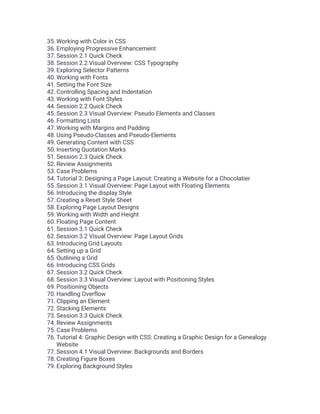
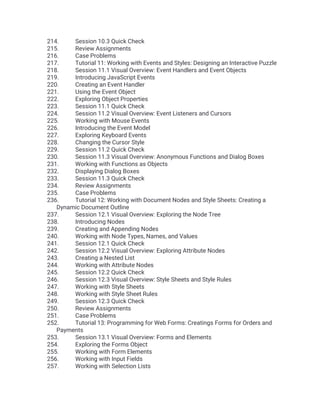
1. Preface
2. Brief Contents
3. Table of Contents
4. Tutorial 1: Getting Started with HTML5: Creating a Website for a Food Vendor
5. Session 1.1 Visual Overview: The Structure of an HTML Document
6. Exploring the World Wide Web
7. Introducing HTML
8. Tools for Working with HTML
9. Exploring an HTML Document
10. Creating the Document Head
11. Adding Comments to Your Document
12. Session 1.1 Quick Check
13. Session 1.2 Visual Overview: HTML Page Elements
14. Writing the Page Body
15. Linking an HTML Document to a Style Sheet
16. Working with Character Sets and Special Characters
17. Working with Inline Images
18. Working with Block Quotes and Other Elements
19. Session 1.2 Quick Check
20. Session 1.3 Visual Overview: Lists and Hypertext Links
21. Working with Lists
22. Working with Hypertext Links
23. Specifying the Folder Path
24. Linking to a Location within a Document
25. Linking to the Internet and Other Resources
26. Working with Hypertext Attributes
27. Session 1.3 Quick Check
28. Review Assignments
29. Case Problems
30. Tutorial 2: Getting Started with CSS: Designing a Website for a Fitness Club
31. Session 2.1 Visual Overview: CSS Styles and Colors
32. Introducing CSS
33. Exploring Style Rules
34. Creating a Style Sheet
6.
35. Working withColor in CSS
36. Employing Progressive Enhancement
37. Session 2.1 Quick Check
38. Session 2.2 Visual Overview: CSS Typography
39. Exploring Selector Patterns
40. Working with Fonts
41. Setting the Font Size
42. Controlling Spacing and Indentation
43. Working with Font Styles
44. Session 2.2 Quick Check
45. Session 2.3 Visual Overview: Pseudo Elements and Classes
46. Formatting Lists
47. Working with Margins and Padding
48. Using Pseudo-Classes and Pseudo-Elements
49. Generating Content with CSS
50. Inserting Quotation Marks
51. Session 2.3 Quick Check
52. Review Assignments
53. Case Problems
54. Tutorial 3: Designing a Page Layout: Creating a Website for a Chocolatier
55. Session 3.1 Visual Overview: Page Layout with Floating Elements
56. Introducing the display Style
57. Creating a Reset Style Sheet
58. Exploring Page Layout Designs
59. Working with Width and Height
60. Floating Page Content
61. Session 3.1 Quick Check
62. Session 3.2 Visual Overview: Page Layout Grids
63. Introducing Grid Layouts
64. Setting up a Grid
65. Outlining a Grid
66. Introducing CSS Grids
67. Session 3.2 Quick Check
68. Session 3.3 Visual Overview: Layout with Positioning Styles
69. Positioning Objects
70. Handling Overflow
71. Clipping an Element
72. Stacking Elements
73. Session 3.3 Quick Check
74. Review Assignments
75. Case Problems
76. Tutorial 4: Graphic Design with CSS: Creating a Graphic Design for a Genealogy
Website
77. Session 4.1 Visual Overview: Backgrounds and Borders
78. Creating Figure Boxes
79. Exploring Background Styles
7.
80. Working withBorders
81. Session 4.1 Quick Check
82. Session 4.2 Visual Overview: Shadows and Gradients
83. Creating Drop Shadows
84. Applying a Color Gradient
85. Creating Semi-Transparent Objects
86. Session 4.2 Quick Check
87. Session 4.3 Visual Overview: Transformations and Filters
88. Transforming Page Objects
89. Exploring CSS Filters
90. Working with Image Maps
91. Session 4.3 Quick Check
92. Review Assignments
93. Case Problems
94. Tutorial 5: Designing for the Mobile Web: Creating a Mobile Website for a Daycare
Center
95. Session 5.1 Visual Overview: Media Queries
96. Introducing Responsive Design
97. Introducing Media Queries
98. Exploring Viewports and Device Width
99. Creating a Mobile Design
100. Creating a Tablet Design
101. Creating a Desktop Design
102. Session 5.1 Quick Check
103. Session 5.2 Visual Overview: Flexbox Layouts
104. Introducing Flexible Boxes
105. Working with Flex Items
106. Reordering Page Content with Flexboxes
107. Exploring Flexbox Layouts
108. Creating a Navicon Menu
109. Session 5.2 Quick Check
110. Session 5.3 Visual Overview: Print Styles
111. Designing for Printed Media
112. Working with the @page Rule
113. Working with Page Breaks
114. Session 5.3 Quick Check
115. Review Assignments
116. Case Problems
117. Tutorial 6: Working with Tables and Columns: Creating a Program Schedule
for a Radio Station
118. Session 6.1 Visual Overview: Structure of a Web Table
119. Introducing Web Tables
120. Adding Table Borders with CSS
121. Spanning Rows and Columns
122. Creating a Table Caption
123. Session 6.1 Quick Check
8.
124. Session 6.2Visual Overview: Rows and Column Groups
125. Creating Row Groups
126. Creating Column Groups
127. Exploring CSS Styles and Web Tables
128. Tables and Responsive Design
129. Designing a Column Layout
130. Session 6.2 Quick Check
131. Review Assignments
132. Case Problems
133. Tutorial 7: Designing a Web Form: Creating a Survey Form
134. Session 7.1 Visual Overview: Structure of a Web Form
135. Introducing Web Forms
136. Starting a Web Form
137. Creating a Field Set
138. Creating Input Boxes
139. Adding Field Labels
140. Designing a Form Layout
141. Defining Default Values and Placeholders
142. Session 7.1 Quick Check
143. Session 7.2 Visual Overview: Web Form Widgets
144. Entering Date and Time Values
145. Creating a Selection List
146. Creating Option Buttons
147. Creating Check Boxes
148. Creating a Text Area Box
149. Session 7.2 Quick Check
150. Session 7.3 Visual Overview: Data Validation
151. Entering Numeric Data
152. Suggesting Options with Data Lists
153. Working with Form Buttons
154. Validating a Web Form
155. Applying Inline Validation
156. Session 7.3 Quick Check
157. Review Assignments
158. Case Problems
159. Tutorial 8: Enhancing a Website with Multimedia: Working with Sound, Video,
and Animation
160. Session 8.1 Visual Overview: Playing Web Audio
161. Introducing Multimedia on the Web
162. Working with the audio Element
163. Exploring Embedded Objects
164. Session 8.1 Quick Check
165. Session 8.2 Visual Overview: Playing Web Video
166. Exploring Digital Video
167. Using the HTML5 video Element
168. Adding a Text Track to Video
9.
169. Using Third-PartyVideo Players
170. Session 8.2 Quick Check
171. Session 8.3 Visual Overview: Transitions and Animations
172. Creating Transitions with CSS
173. Animating Objects with CSS
174. Session 8.3 Quick Check
175. Review Assignments
176. Case Problems
177. Tutorial 9: Getting Started with JavaScript: Creating a Countdown Clock
178. Session 9.1 Visual Overview: Creating a JavaScript File
179. Introducing JavaScript
180. Working with the script Element
181. Creating a JavaScript Program
182. Debugging Your Code
183. Session 9.1 Quick Check
184. Session 9.2 Visual Overview: JavaScript Variables and Dates
185. Introducing Objects
186. Changing Properties and Applying Methods
187. Writing HTML Code
188. Working with Variables
189. Working with Date Objects
190. Session 9.2 Quick Check
191. Session 9.3 Visual Overview: JavaScript Functions and Expressions
192. Working with Operators and Operands
193. Working with the Math Object
194. Working with JavaScript Functions
195. Running Timed Commands
196. Controlling How JavaScript Works with Numeric Values
197. Session 9.3 Quick Check
198. Review Assignments
199. Case Problems
200. Tutorial 10: Exploring Arrays, Loops, and Conditional Statements: Creating a
Monthly Calendar
201. Session 10.1 Visual Overview: Creating and Using Arrays
202. Introducing the Monthly Calendar
203. Introducing Arrays
204. Session 10.1 Quick Check
205. Session 10.2 Visual Overview: Applying a Program Loop
206. Working with Program Loops
207. Comparison and Logical Operators
208. Program Loops and Arrays
209. Session 10.2 Quick Check
210. Session 10.3 Visual Overview: Conditional Statements
211. Introducing Conditional Statements
212. Completing the Calendar App
213. Managing Program Loops and Conditional Statements
10.
214. Session 10.3Quick Check
215. Review Assignments
216. Case Problems
217. Tutorial 11: Working with Events and Styles: Designing an Interactive Puzzle
218. Session 11.1 Visual Overview: Event Handlers and Event Objects
219. Introducing JavaScript Events
220. Creating an Event Handler
221. Using the Event Object
222. Exploring Object Properties
223. Session 11.1 Quick Check
224. Session 11.2 Visual Overview: Event Listeners and Cursors
225. Working with Mouse Events
226. Introducing the Event Model
227. Exploring Keyboard Events
228. Changing the Cursor Style
229. Session 11.2 Quick Check
230. Session 11.3 Visual Overview: Anonymous Functions and Dialog Boxes
231. Working with Functions as Objects
232. Displaying Dialog Boxes
233. Session 11.3 Quick Check
234. Review Assignments
235. Case Problems
236. Tutorial 12: Working with Document Nodes and Style Sheets: Creating a
Dynamic Document Outline
237. Session 12.1 Visual Overview: Exploring the Node Tree
238. Introducing Nodes
239. Creating and Appending Nodes
240. Working with Node Types, Names, and Values
241. Session 12.1 Quick Check
242. Session 12.2 Visual Overview: Exploring Attribute Nodes
243. Creating a Nested List
244. Working with Attribute Nodes
245. Session 12.2 Quick Check
246. Session 12.3 Visual Overview: Style Sheets and Style Rules
247. Working with Style Sheets
248. Working with Style Sheet Rules
249. Session 12.3 Quick Check
250. Review Assignments
251. Case Problems
252. Tutorial 13: Programming for Web Forms: Creatings Forms for Orders and
Payments
253. Session 13.1 Visual Overview: Forms and Elements
254. Exploring the Forms Object
255. Working with Form Elements
256. Working with Input Fields
257. Working with Selection Lists
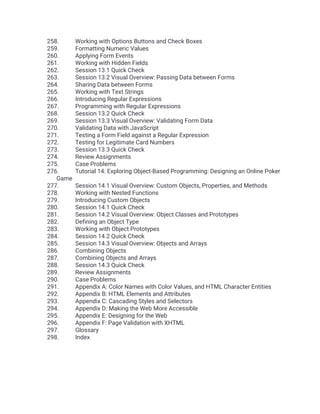
11.
258. Working withOptions Buttons and Check Boxes
259. Formatting Numeric Values
260. Applying Form Events
261. Working with Hidden Fields
262. Session 13.1 Quick Check
263. Session 13.2 Visual Overview: Passing Data between Forms
264. Sharing Data between Forms
265. Working with Text Strings
266. Introducing Regular Expressions
267. Programming with Regular Expressions
268. Session 13.2 Quick Check
269. Session 13.3 Visual Overview: Validating Form Data
270. Validating Data with JavaScript
271. Testing a Form Field against a Regular Expression
272. Testing for Legitimate Card Numbers
273. Session 13.3 Quick Check
274. Review Assignments
275. Case Problems
276. Tutorial 14: Exploring Object-Based Programming: Designing an Online Poker
Game
277. Session 14.1 Visual Overview: Custom Objects, Properties, and Methods
278. Working with Nested Functions
279. Introducing Custom Objects
280. Session 14.1 Quick Check
281. Session 14.2 Visual Overview: Object Classes and Prototypes
282. Defining an Object Type
283. Working with Object Prototypes
284. Session 14.2 Quick Check
285. Session 14.3 Visual Overview: Objects and Arrays
286. Combining Objects
287. Combining Objects and Arrays
288. Session 14.3 Quick Check
289. Review Assignments
290. Case Problems
291. Appendix A: Color Names with Color Values, and HTML Character Entities
292. Appendix B: HTML Elements and Attributes
293. Appendix C: Cascading Styles and Selectors
294. Appendix D: Making the Web More Accessible
295. Appendix E: Designing for the Web
296. Appendix F: Page Validation with XHTML
297. Glossary
298. Index
proficiency actually throughthe use of the telescope. I feel that this
would be an advantage.
Mr. Specter. How many shots in your opinion would a man like
Oswald have to take in order to be able to operate a rifle with a
four-power scope, based on the training he had received in the
Marine Corps?
Sergeant Zahm. Based on that training, his basic knowledge in
sight manipulation and trigger squeeze and what not, I would say
that he would be capable of sighting that rifle in well, firing it, with
10 rounds.
Mr. Specter. Would dry runs be an aid to a man like Oswald in
learning how to operate a rifle with a scope on it.
Sergeant Zahm. Yes.
Mr. Specter. Would you describe for the record what is meant in
marksmanship terms by a dry run?
Sergeant Zahm. Dry firing is working the bolt and manipulating
the trigger and alining the sights, whether it be scope or iron,
without any ammunition. The advantage in the scope in dry firing is
that when he snaps the trigger or squeezes the trigger, he can see
any apparent error in his trigger manipulation, movement of the
piece, by the jump of the crosshair much easier than he can with
iron sights.
Mr. Specter. Would the use of a four-power scope be a real
advantage to a marksman of Mr. Oswald's capabilities or of a slight
advantage, or how would you characterize the advantage that he
would obtain, if any, from the use of such a scope?
Sergeant Zahm. I consider it a real advantage, particularly at the
range of 100 yards, in identifying your target. It allows you to see
your target clearly, and it is still of a minimum amount of power that
it doesn't exaggerate your own body movements. It just is an aid in
seeing in the fact that you only have the one element, the crosshair,
14.
in relation tothe target as opposed to iron sights with alining the
sights and then alining them on the target. It is a real aid.
Mr. Specter. Sergeant Zahm, I am now going to show you the
same photographs which I showed to Major Anderson in setting the
basis for asking you a hypothetical question on capabilities here. As
the record will show, we have heretofore before the President's
Commission entered into evidence Exhibit No. 347 which is an
overhead shot of Dealey Plaza. Commission Exhibit No. 348, which I
am now displaying to you, is a photograph of the Texas School Book
Depository Building. The evidence in the record indicates that the
marksman stood at the point designated "A" with the lower half of
the window being raised halfway, and the gun protruding out of that
window pointing down the street called Elm Street in approximately
the angle of my pencil which is virtually although not exactly straight
down the street. Elm Street declines 3° as it slopes under the triple
underpass.
As the evidence will further show, Commission Exhibits Nos. 893
and 895 respectively depict frames 210 and 225 of the Zapruder film
which is a range of the first shot from 176.9 feet to 190.8 feet. In
the lower left-hand corner under designation "Photograph through
rifle scope" there is shown the view of the marksman from the sixth
floor of the depository building as he looked down at President
Kennedy with this picture being taken of a stand-in for President
Kennedy, with the white mark designating the spot on the President
where the first bullet struck him.
Now assuming that the President was struck under those
circumstances at a distance of from 176.9 feet to 190.8 feet, using a
6.5 mm Mannlicher-Carcano rifle with a four-power scope, would a
man with Oswald's marksmanship capabilities be able to complete
such a shot and strike the target on the white mark there?
Sergeant Zahm. Very definitely.
Mr. Specter. How would you characterize that, as a difficult, not
too difficult, easy, or how would you characterize that shot?
15.
Sergeant Zahm. Withthe equipment he had and with his ability, I
consider it a very easy shot.
Mr. Specter. Now taking a look at Commission Exhibit No. 902,
which as the record will show, has been introduced into evidence to
depict the shot which struck President Kennedy in the head at a
distance from the rifle in the window to the part of the President's
body being 265.3 feet. Assuming the same factors about using a
Mannlicher-Carcano rifle and pointing it down Elm Street as shown
on Commission Exhibit No. 347, would a marksman of Mr. Oswald's
capabilities using such a rifle with a 4-power scope be able to strike
the President in the back of the head? Would Mr. Oswald possess the
capability to complete such a shot which did, in this situation, strike
the President in the back of the head?
Sergeant Zahm. Yes; I think that aiming at the mass of what
portion of the President is visible at that distance and with his
equipment, he would very easily have attained a hit, not necessarily
aiming and hitting in the head. This would have been a little more
difficult and probably be to the top of his ability, aiming and striking
the President in the head. But assuming that he aimed at the mass
to the center portion of the President's body, he would have hit him
very definitely someplace, and the fact that he hit him in the head,
but he could have hit, got a hit.
Mr. Specter. So you would have expected a man of Oswald's
capabilities at a distance of 265.3 feet to strike the President
someplace aiming at him under those circumstances?
Sergeant Zahm. Yes.
Mr. Specter. And within the range of where you would expect him
to hit him, would that include the President's head?
Sergeant Zahm. Yes.
Mr. Specter. And how would you characterize that shot with
respect to whether it was difficult or not difficult?
(Discussion off the record.)
16.
Mr. Specter. Let'sgo back on the record. May the record show
that Sergeant Zahm has questioned the appearance of the
"photograph through rifle scope" which appear on Exhibits Nos. 895
and 902. And as the record will show, there are only four
photographs on Exhibit No. 895 whereas there are eight on
Commission Exhibit No. 902, so that necessarily the photograph
through the rifle scope is much smaller as it is depicted on Exhibit
No. 902, and I want you to bear that in mind, Sergeant Zahm, in
answering the question as to whether you consider the shot at a
distance of 265.3 feet to be difficult or not difficult; or characterize it
for me in your own words.
Sergeant Zahm. I consider it still an easy shot, a little more
difficult from the President's body position and increase in distance
of approximately 40 feet, but I still consider it an easy shot for a
man with the equipment he had and his ability.
Mr. Specter. Assuming that there were three shots fired in a
range of 4.8 to 5.6 seconds, would that speed of firing at that range
indicated in the prior questions be within Mr. Oswald's capabilities as
a marksman?
Sergeant Zahm. Yes.
Mr. Specter. What effect if any would the alinement of the street
have on the moving vehicle in the way that it is shown on the
picture, Exhibit No. 348?
Sergeant Zahm. This is a definite advantage to the shooter, the
vehicle moving directly away from him and the downgrade of the
street, and he being in an elevated position made an almost
stationary target while he was aiming in, very little movement if any.
Mr. Specter. How would the fact that the street had a 3° decline
affect the difficulty of the shot.
Sergeant Zahm. It would make it easier because Oswald was in
an elevated position, and therefore if the car was traveling on a level
terrain, it would apparently—he would have to keep adjusting by
17.
holding up alittle bit as the car traveled. But by going downgrade
this just straightened out his line of sight that much better.
Mr. Specter. So that if the car had been proceeding on a level,
the assassin would have had to have raised his weapon as the
distance between the rifle and the car increased to allow for
trajectory?
Sergeant Zahm. No; just to allow for the movement of the
targets, the travel. Assume that you are aiming standing at ground
level and aiming down a little at somebody walking straight away
from you, and you could hold your finger and point to him and never
have to move it. But when he gets to the bottom of the hill and the
ground levels out, then as he continues on you have to point your
finger——
Mr. Specter. Raise your finger as you are indicating with your
finger now?
Sergeant Zahm. Right; you would have to raise your finger to
track the target.
Mr. Specter. So that if you were aiming at a man in a moving car
driving on the horizontal, as he got farther away from you, would
you (a) hold your rifle at the same level, (b) lower it, or (c) raise it?
Sergeant Zahm. If you were in an elevated, a slightly elevated
position, and he was driving on straight level terrain, you would have
to continually track and raise your weapon as he increased his
distance from you.
Mr. Specter. And if he was going down in an angle of descent,
would that decrease the necessity for you to raise your rifle in
tracking him?
Sergeant Zahm. Right; it would slow the movement down. There
still might be a slight movement, but it wouldn't be as fast.
Therefore, not affecting the aiming or possibly having to introduce a
lead in your aiming, because the target is staying relatively in the
same position on the line of sight.
18.
Mr. Specter. Sothen it would have been an aid to the assassin to
have had the President's car going on a downgrade because that
would have taken into consideration some of the adjustment
necessary by virtue of the greater distance between the rifle and the
victim?
Sergeant Zahm. Yes.
Mr. Specter. Do you have anything to add, Sergeant Zahm, which
you think might be helpful in this analysis?
Sergeant Zahm. No, sir; I don't think so.
Mr. Specter. Thank you very much for appearing before the
Commission today, sir.
19.
TESTIMONY OF C.A. HAMBLEN
The testimony of C. A. Hamblen was taken at 2:50 p.m., on July
23, 1964, in the office of the U.S. attorney, 301 Post Office Building,
Bryan and Ervay Streets, Dallas, Tex., by Mr. Wesley J. Liebeler,
assistant counsel of the President's Commission.
Mr. Liebeler. You may remain seated. Will you raise your right
hand? Do you solemnly swear that the testimony you are about to
give will be the truth, the whole truth, and nothing but the truth, so
help you God?
Mr. Hamblen. I do.
Mr. Liebeler. My name is Wesley J. Liebeler. I am an attorney on
the President's Commission investigating the assassination of
President Kennedy. I have been authorized to take your testimony by
the Commission pursuant to authority granted to it by Executive
Order 11130, dated November 29, 1963, and the joint resolution of
Congress, No. 137. You are entitled under the rules of the
Commission governing the taking of testimony of witnesses to have
an attorney present, should you wish. I understand that you are
present pursuant to a subpena that was served on you some days
ago by the U.S. Secret Service, and I presume since you don't have
an attorney with you at this time, you are prepared to proceed with
your testimony without an attorney?
Mr. Hamblen. I don't need an attorney. You might wish to make a
little correction. This should be C. A. Hamblen instead of C. R.
Mr. Liebeler. Your name is C. A. H-a-m-b-l-e-n?
20.
Mr. Hamblen. That'sright.
Mr. Liebeler. How old are you?
Mr. Hamblen. I will be 50 in December.
Mr. Liebeler. You are employed by the Western Union Telegraph
Co.; isn't that right?
Mr. Hamblen. Yes.
Mr. Liebeler. How long have you worked for them?
Mr. Hamblen. It will be 38 years the 6th day of August.
Mr. Liebeler. I want to come right to the point in this deposition. I
think you know basically the reason we have asked you to come
over. It is my understanding that you had a conversation with a
newspaper reporter by the name of Bob Fenley shortly after the
assassination, in which you told him, in substance, that you thought
that a man who you thought looked like Lee Oswald had been in
your office and had either sent a telegram or cashed a money order
telegram that he had in his possession; is that correct?
Mr. Hamblen. Not exactly.
Mr. Liebeler. What is it exactly?
Mr. Hamblen. During that time, I came in contact with newspaper
correspondents from all over the world. In my years of service to the
company, I have never disclosed the contents of a telegram, who
they were addressed to, who they were from, or anything pertaining
to them.
I don't think I told Mr. Fenley that a Lee Oswald had been in
there, because talking with those correspondents, I wouldn't divulge
any patron coming into the telegraph office in search of any of our
services, money orders, telegrams, collateral services, collection
services, anything that we have to offer. I believe there is some
misunderstanding on Mr. Fenley's part there. Perhaps I did tell him
that I thought I had seen someone that looked like the man that I
saw over television.
21.
Mr. Liebeler. Doyou remember——
Mr. Hamblen. I thought he was the assassinator.
Mr. Liebeler. Do you remember talking to Mr. Fenley about this?
Mr. Hamblen. I don't remember telling anyone that, of anyone
filing a telegram with us. I remember talking with Fenley, but I
wouldn't disclose any information.
Mr. Liebeler. What did you say to Fenley?
Mr. Hamblen. Just in general conversation like I would with Wes
Wise or any of the other reporters that I come in contact with.
Mr. Liebeler. Didn't you tell Fenley that you thought you had seen
somebody that reminded you of Oswald in your office?
Mr. Hamblen. Yes; I did tell him that I had saw Oswald. I may
have told him that. I don't recall what all was said—as many of
those correspondents that I talked to during that period of time.
Then the employees under me, we never discuss any telegrams
unless it is necessary for them to ask me to pass upon a telegram so
it could be transmitted.
Mr. Liebeler. Do you remember telling Fenley that when you saw
the picture of the alleged assassin on television, that he looked very
much like a man that had caused you a hard time on several
instances in your office?
Mr. Hamblen. I don't remember telling Fenley anything like that.
Mr. Liebeler. Do you remember signing a statement to that effect
for Mr. Wilcox on December 2, 1963, and I show you a copy.
Mr. Hamblen. That I told Fenley that I saw that man in there?
Mr. Liebeler. Yes.
Mr. Hamblen. I told Wilcox that I thought I saw him, but I don't
think I told Fenley.
Mr. Liebeler. Read the first paragraph of that statement.
22.
Mr. Hamblen (reading).I don't think I told Fenley that. I
remember telling Mr. Wilcox that I thought a party had been in there
that resembled Oswald, on several different occasions.
Mr. Liebeler. Well, now the statement that I have shown you
here, which is Wilcox Exhibit No. 3005, is a copy of a statement that
you signed on December 2, 1963, isn't it? That is your signature?
Mr. Hamblen. Yes; that is my signature.
Mr. Liebeler. Could I have it back, please? Now, that statement
says, and I quote:
"I was in conversation with a reporter at the counter and
remarked to him that I was watching my TV, enjoying the Ernie Ford
show, when word was flashed that the President had been shot and
that I thought to myself what a coincidence it was that I recognized
the picture of the accused gunman when I recognized it when he
was slain in jail. He asked me how I could remember so vividly the
photo and my answer to him that the picture was or was the spit
image of a party that had caused me a hard time on several
instances in his transactions of business within the past several
months. (Mr. Bob Fenley was the reporter.)"
Mr. Hamblen. Well, now, if I gave Bob any information like that, I
don't recall it now. I might have at the time that I wrote the
statement.
Mr. Liebeler. Now you had several conversations with Mr. Wilcox
about this whole matter over a period of time?
Mr. Hamblen. Yes.
Mr. Liebeler. Mr. Wilcox and the company conducted a thorough
investigation of the files?
Mr. Hamblen. I am sure they did.
Mr. Liebeler. And tried to find the telegrams that you thought this
man that was in there may have sent; isn't that right?
Mr. Hamblen. Yes.
23.
Mr. Liebeler. Wereyou able to find them?
Mr. Hamblen. I wasn't able to detect any one.
Mr. Liebeler. After this investigation was made, Mr. Wilcox showed
you these telegrams that you have associated or thought might be
associated with Oswald?
Mr. Hamblen. They were brought to me in the presence of Mr.
Wilcox and the vice president of the company in charge of this
investigation.
Mr. Liebeler. You weren't able to identify any of those telegrams
as having been sent by this man you thought looked like Oswald;
isn't that right?
Mr. Hamblen. That's right. And I think I am pretty good on
recognizing handwriting after handling as many as I have over those
years of time.
Mr. Liebeler. To the best of your recollection at this time, do you
think that Lee Oswald was ever in your office?
Mr. Hamblen. I wouldn't say that it was Lee Oswald. I would say it
was someone that resembled him from the picture that I had seen in
the paper and on TV.
Mr. Liebeler. But you aren't able to state positively that it was Lee
Oswald?
Mr. Hamblen. No, sir.
Mr. Liebeler. Now, I show you a photograph that has been
marked Pizzo Exhibit No. 453-A, and ask you if you can see anybody
in that picture that you think might have been the man that was in
your office that we have been talking about.
Mr. Hamblen. No, sir.
Mr. Liebeler. I show you a picture that has been marked Bringuier
Exhibit No. 1, and ask you if you recognize anybody in that picture.
Mr. Hamblen. No, sir; I do not.
24.
Mr. Liebeler. Doyou recall specifically that Mr. Aubrey Lee Lewis
at one time in the fall of 1963 had some trouble paying somebody a
money order because this fellow expected to get the money order
without proper identification; that you became involved in this and
helped Mr. Lewis handle it?
Mr. Hamblen. Yes, sir; I did.
Mr. Liebeler. Do you remember what the fellow looked like?
Mr. Hamblen. No; I can't tell you what he looked like.
Mr. Liebeler. Do you know if it was Lee Harvey Oswald?
Mr. Hamblen. I wouldn't say that it was.
Mr. Liebeler. Do you think he resembled Oswald in any way?
Mr. Hamblen. No; I don't. Different ways people dress and
everything, they come in one time and we pay them money orders
and the next time they come in we hardly recognize them. I
remember it was a very small money order, too small to quibble
over. I can't remember where it was from. I know it was under $10,
I know that.
Usually I pay people without identification when it is a small
money order, which the clerks are not allowed to do. They have to
get my permission before they can make payment on a money order
where a person is unable to furnish proper identification. But on
small amounts, I take it upon myself to assume the responsibility,
hoping that I will pay the right man.
Mr. Liebeler. After looking at this picture that we have looked at,
and after reviewing your recollection, you are not able to identify
any of the people who you saw in your office during that period as
being Lee Harvey Oswald, isn't that a fact?
Mr. Hamblen. No, sir.
Mr. Liebeler. Am I correct in assuming that you are quite certain
that Oswald was not a regular customer, in any event? He was never
coming into your office at regular intervals, is that correct?
25.
Mr. Hamblen. Well,I wouldn't say Lee Oswald came in there at
regular intervals. We have patrons that visit us sometimes once a
week, sometimes half a dozen times a week. If it was him, he was
very infrequent. I will say if it was him, he wasn't there over three
times, that I recall.
Mr. Liebeler. There was a fellow that you thought resembled
Oswald to some extent that did come in on occasion, or at least two
or three times, but you are not able to positively state that it was
Oswald?
Mr. Hamblen. No, sir.
Mr. Liebeler. Am I correct in understanding that in your
discussions with Mr. Wilcox and with the other officials of the
company, you did the best that you could to straighten this whole
matter out and determine whether it was Oswald or not?
Mr. Hamblen. I certainly did.
Mr. Liebeler. You were unable, after working with Mr. Wilcox, to
pin down any of these telegrams or money orders that would
indicate that it was Oswald?
Mr. Hamblen. That is correct.
Mr. Liebeler. Now, specifically, I show you a picture marked "Pizzo
Exhibit No. 453-C," and ask you if that looks like that man who was
in your office.
Mr. Hamblen. No; I wouldn't say that that was the man that was
in there. No resemblance.
Mr. Liebeler. I want to cut your testimony as short as I possibly
can, because you are not feeling well. We appreciate your
cooperation in coming in when you don't feel well like you have.
Mr. Hamblen. I appreciate it. I was in the X-ray all morning and
yesterday morning for 2 hours.
Mr. Liebeler. Thank you very much, Mr. Hamblen, for coming in. I
appreciate it very much.
26.
Mr. Hamblen. IfI can help you any further, well, you have my
address.
Mr. Liebeler. We will get in touch with you.
27.
TESTIMONY OF ROBERTGENE
FENLEY
The testimony of Robert Gene Fenley, was taken at 9:45 a.m.,
on July 14, 1964, in the office of the U.S. attorney, 301 Post Office
Building, Bryan and Ervay Streets, Dallas, Tex. by Mr. Leon D.
Hubert, Jr., assistant counsel of the President's Commission. Sam
Kelley, assistant attorney general of Texas, was present.
Mr. Hubert. This is the deposition of Robert Gene Fenley. Mr.
Fenley, my name is Leon Hubert. I am a member of the advisory
staff of the general counsel of the President's Commission.
Under the provisions of Executive Order 11130 dated November
29, 1963, and the joint resolution of Congress No. 137, and the rules
of procedure adopted by the President's Commission in conformance
with that Executive order and the joint resolution, I have been
authorized to take a sworn deposition from you. I state to you now
that the general nature of the Commission's inquiry is to ascertain,
evaluate and report upon the facts relevant to the assassination of
President Kennedy and the subsequent violent death of Lee Harvey
Oswald.
In particular as to you, Mr. Fenley, the nature of the inquiry
today is to determine what facts you know about the death of
Oswald and any other pertinent facts you may know about the
general inquiry. Now, I understand that you are appearing here
today by virtue of a letter request mailed to you by Mr. J. Lee
28.
Rankin, general counselof the staff of the President's Commission,
which you received about 4 days ago?
Mr. Fenley. That is correct.
Mr. Hubert. Will you please rise so I may administer the oath? Do
you solemnly swear that the testimony you are about to give in this
matter will be the truth, the whole truth, and nothing but the truth,
so help you God?
Mr. Fenley. I do.
Mr. Hubert. Will you state your full name?
Mr. Fenley. Robert Gene Fenley.
Mr. Hubert. G-e-n-e is your middle name?
Mr. Fenley. Correct.
Mr. Hubert. Where do you live, sir?
Mr. Fenley. 3701 Strayhorn Drive, Mesquite, Tex.
Mr. Hubert. What is your occupation, Mr. Fenley?
Mr. Fenley. Reporter for the Dallas Times Herald.
Mr. Hubert. How long have you been so employed?
Mr. Fenley. Nine years.
Mr. Hubert. How old are you?
Mr. Fenley. Thirty-six.
Mr. Hubert. Were you in newspaper work before you joined the
Times Herald?
Mr. Fenley. Yes.
Mr. Hubert. With what newspaper?
Mr. Fenley. Prior to the Times Herald, I was with the Lubbock
Avalanche Journal, the Denton Record Chronicle, and the Pryor,
Oklahoma, Times Democrat.
29.
Mr. Hubert. Didyou go to college, sir?
Mr. Fenley. I went to Oklahoma University.
Mr. Hubert. Did you graduate?
Mr. Fenley. Four years. No; I did not graduate.
Mr. Hubert. Study journalism?
Mr. Fenley. Yes; part of the time.
Mr. Hubert. Your whole adult experience, I gather, therefore, has
been in newspaper work?
Mr. Fenley. That is true.
Mr. Hubert. Now, do you know a Mr. Hamblen connected with the
Western Union Co. here in Dallas?
Mr. Fenley. Yes; I have talked with him on one occasion. I don't
know him personally.
Mr. Hubert. What was that one occasion?
Mr. Fenley. The date is rather vague in my mind.
Mr. Hubert. Can you tell us perhaps the occasion?
Mr. Fenley. Yes; I am a stringer.
Mr. Hubert. A what?
Mr. Fenley. A stringer. A correspondent for Time magazine, and I
had written a long piece which we transmitted by Western Union,
and I had gone into Western Union to hand this over for
transmitting, and I fell in conversation with Mr. Hamblen.
Mr. Hubert. Had you known him prior to that time?
Mr. Fenley. No; I had not.
Mr. Hubert. Could you tell us about what time of day it was?
Mr. Fenley. It was at night. I forget the exact time of night, but I
believe I had driven from Mesquite with the story to give it to
30.
Western Union. Itmight have been 11 or 12 o'clock.
Mr. Hubert. It happened that Hamblen was the clerk or employee
of the Western Union in service?
Mr. Fenley. Yes, sir.
Mr. Hubert. Can you tell us how you came to engage him in
conversation?
Mr. Fenley. He noticed the wire or press message which I had,
and it had to do with the assassination, or Oswald, frankly. I can't
remember the content of the wire, but we sort of chatted there for a
moment, and he recalled that he was certain that Oswald had come
into the office on occasion.
I don't know whether he used the word several. I took it to
mean that. And received some various small amounts of money
orders. And certainly this was interesting to me. We kept chatting
and I asked him, now how big were the amounts of the orders, and
he said, "I don't think there would be anything over $15, $10 or
$15." And I asked him, "Now, you are pretty sure this was Oswald? I
mean, the guy you have seen in the pictures and things like that?"
And he replied he was. He said, "He used to come in and would give
the girls a hard time. He was a cantankerous individual."
Mr. Hubert. Did he mention what girls?
Mr. Fenley. No; not by name. So he said, "I believe the last
time"—and he couldn't recall the date or anything—"that he came in,
he went himself to wait on the fellow because he knew that he was
sort of difficult to deal with." Well, this was certainly interesting to
me as a newspaperman.
Mr. Hubert. Had you heard that story before?
Mr. Fenley. No; I had not.
Mr. Hubert. In other words, your coming upon this story was
something of a gratuity?
31.
Mr. Fenley. Itcertainly was. I was slightly amazed. And the other
thing, there was a marble countertop there in the office, and he
said, or he recalled that Oswald had written in what he described a
curious sort of printing with, as best he could tell, he wrote out
some letters. For instance, an "N" he said as printed by Oswald
would have a high rising right side to it. He said it was a rather
curious sort of printing.
Mr. Hubert. Did he demonstrate that to you?
Mr. Fenley. He demonstrated this on the marble.
Mr. Hubert. Hamblen did so?
Mr. Fenley. Yes.
Mr. Hubert. Did he indicate that it was in a foreign alphabet?
Mr. Fenley. No.
Mr. Hubert. Just a peculiar art?
Mr. Fenley. I took it to be certainly the English alphabet, but with
a peculiar sort of printing.
Mr. Hubert. Did he indicate what was the nature of the difficulty
that he had had on previous occasions with the man he said was
Oswald?
Mr. Fenley. Nothing other than an indication that Oswald was
difficult to deal with.
Mr. Hubert. But he didn't say how he was difficult to deal with?
Mr. Fenley. No; not specifically. Well, at this moment I thought,
well, this sounds like quite an interesting story. And Hamblen gave
me his card. So I went home, and the next day——
Mr. Hubert. How long was the conversation?
Mr. Fenley. Oh, not over 10 minutes long. I asked him also, which
I failed to mention, how could we get the records, or how could
anyone get the records, and he indicated it would be very difficult.
32.
Of course, thiswould be very helpful if you would get the names
or the identification of people who had sent any money orders to
Oswald, and he indicated that there were so many of that type of
money order coming in that they just couldn't keep all the records.
And I got the impression that it would be either impossible or almost
impossible to run it down.
Mr. Hubert. You mentioned, I think, that you were particularly
interested as to the certainty of his identification of Oswald as the
man, and that you made some inquiry along that line?
Mr. Fenley. Yes.
Mr. Hubert. What did you do by way of testing him, as it were, on
that identification?
Mr. Fenley. Well, as I said, I went home that night, and, of
course, we don't have—we are an afternoon newspaper and don't
have deadlines until the morning.
The next morning I went to talk to our police reporter, whose
name is George Carter, and I hold him what Hamblen had told me. I
said I am not too sure of it. I think it needs a double check. And he
said, well, I know the guy.
Mr. Hubert. Meaning Hamblen?
Mr. Fenley. Yes; he said he knew the fellow over at Western
Union, and he said, "I know he is in at Mike's, which is a little
barbecue stand across from the city hall." Hamblen would come into
Mike's on occasion, and George knew him.
And I said, "George, why don't you go talk to him and see if he
will tell you the same thing?" And George did. When he did, we
compared notes, and he had told George just precisely, as best we
knew, the same content he told me. So George wrote the story.
Mr. Hubert. Did you yourself make any notes contemporaneously
with the conversation with Hamblen or later?
33.
Mr. Fenley. No;I may have made some at home, jotted down a
couple of things on a scrap of paper. In fact, I know I did.
Mr. Hubert. Is that available?
Mr. Fenley. I doubt it. I am sure I have thrown it away. I was very
interested in the story, but I was sort of afraid to take notes in front
of him, since a lot of people will suddenly freeze up when you start
taking notes.
Mr. Hubert. But to come back to the question of identification, I
think you mentioned that it struck you that that was the key to the
story, as it were?
Mr. Fenley. Yes.
Mr. Hubert. Did you press him in any way about the
identification?
Mr. Fenley. Not a great deal. I really, after asking another
question about it, saying, "Now you really feel like you saw Oswald,"
then I didn't press the matter any further, because I was afraid he
would freeze up.
Mr. Hubert. I understand too that his identification, as he stated
it to you, was based upon comparison of the mental image he had of
the man that had come in with the pictures of Oswald he had seen
since the assassination?
Mr. Fenley. On television. And frankly, for that reason, I wasn't
too darn sure that he knew what he was talking about. So I mean,
you always have this suspicion that somebody is trying to identify in
the case or something, and this is precisely why I went to Carter and
said, "Why don't you talk to him?"
Mr. Hubert. In other words even on that day you were wondering
whether this man really had seen Oswald or not?
Mr. Fenley. Yes.
Mr. Hubert. Did he mention to you anything about Oswald having
come to collect any money order in company with the person of





![Web Design & UI/UX Bootcamp [Online & Offline] In Bangla](https://cdn.slidesharecdn.com/ss_thumbnails/uiuxwebdesignboothcamp-200705134701-thumbnail.jpg?width=640&height=640&fit=bounds)


