New generation fungicides with
novel modes of action
• It includes systemic as well as contact
fungicides with novel mode of action
developed from 2001 to till date
• Technical feature of new generation fungicides
are target specific action and safer to non
target sites
• Several truly novel compounds have been launched
commercially and have reached an advanced stage of
development which effects on respiration, cell
membrane components, protein synthesis, signal
transduction, and cell mitosis
• Many of the important plant diseases, which were not
controlled satisfactorily by the previous traditional
fungicides , can now well managed by the new
compounds which are mostly systemic in nature
• The process of fungicides discovery has
undergone a noteworthy change over the
period of time.
• After the era of broad spectrum multisite and
site specific systemic fungicides, several novel
action fungicides of different chemical classes
have been developed in the past two decades.
• These are more eco- friendly as these are used
at much lower doses as compared to the
earlier compounds.
• Most important among these are the
strobilurins (QoIs), derived from Strobilurus
tenacellus, a wild mushroom
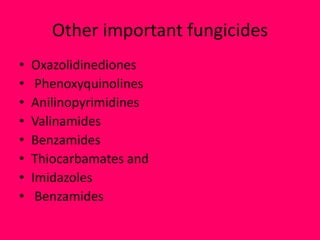
Other important fungicides
• Oxazolidinediones
• Phenoxyquinolines
• Anilinopyrimidines
• Valinamides
• Benzamides
• Thiocarbamates and
• Imidazoles
• Benzamides
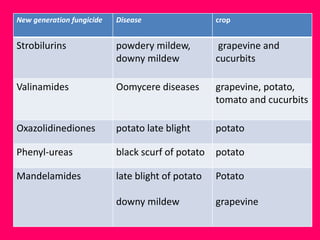
New generation fungicide Disease crop
Strobilurins powdery mildew,
downy mildew
grapevine and
cucurbits
Valinamides Oomycere diseases grapevine, potato,
tomato and cucurbits
Oxazolidinediones potato late blight potato
Phenyl-ureas black scurf of potato potato
Mandelamides late blight of potato
downy mildew
Potato
grapevine
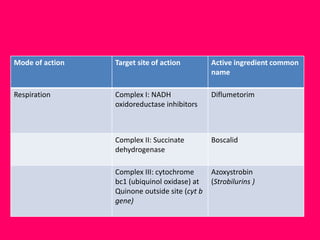
Mode of action Target site of action Active ingredient common
name
Respiration Complex I: NADH
oxidoreductase inhibitors
Diflumetorim
Complex II: Succinate
dehydrogenase
Boscalid
Complex III: cytochrome
bc1 (ubiquinol oxidase) at
Quinone outside site (cyt b
gene)
Azoxystrobin
(Strobilurins )
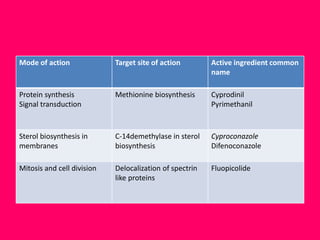
Mode of action Target site of action Active ingredient common
name
Protein synthesis
Signal transduction
Methionine biosynthesis Cyprodinil
Pyrimethanil
Sterol biosynthesis in
membranes
C-14demethylase in sterol
biosynthesis
Cyproconazole
Difenoconazole
Mitosis and cell division Delocalization of spectrin
like proteins
Fluopicolide
New Generation Fungicides

New Generation Fungicides

  • 2.
    New generation fungicideswith novel modes of action • It includes systemic as well as contact fungicides with novel mode of action developed from 2001 to till date • Technical feature of new generation fungicides are target specific action and safer to non target sites
  • 3.
    • Several trulynovel compounds have been launched commercially and have reached an advanced stage of development which effects on respiration, cell membrane components, protein synthesis, signal transduction, and cell mitosis • Many of the important plant diseases, which were not controlled satisfactorily by the previous traditional fungicides , can now well managed by the new compounds which are mostly systemic in nature
  • 4.
    • The processof fungicides discovery has undergone a noteworthy change over the period of time. • After the era of broad spectrum multisite and site specific systemic fungicides, several novel action fungicides of different chemical classes have been developed in the past two decades.
  • 5.
    • These aremore eco- friendly as these are used at much lower doses as compared to the earlier compounds. • Most important among these are the strobilurins (QoIs), derived from Strobilurus tenacellus, a wild mushroom
  • 6.
    Other important fungicides •Oxazolidinediones • Phenoxyquinolines • Anilinopyrimidines • Valinamides • Benzamides • Thiocarbamates and • Imidazoles • Benzamides
  • 7.
    New generation fungicideDisease crop Strobilurins powdery mildew, downy mildew grapevine and cucurbits Valinamides Oomycere diseases grapevine, potato, tomato and cucurbits Oxazolidinediones potato late blight potato Phenyl-ureas black scurf of potato potato Mandelamides late blight of potato downy mildew Potato grapevine
  • 8.
    Mode of actionTarget site of action Active ingredient common name Respiration Complex I: NADH oxidoreductase inhibitors Diflumetorim Complex II: Succinate dehydrogenase Boscalid Complex III: cytochrome bc1 (ubiquinol oxidase) at Quinone outside site (cyt b gene) Azoxystrobin (Strobilurins )
  • 9.
    Mode of actionTarget site of action Active ingredient common name Protein synthesis Signal transduction Methionine biosynthesis Cyprodinil Pyrimethanil Sterol biosynthesis in membranes C-14demethylase in sterol biosynthesis Cyproconazole Difenoconazole Mitosis and cell division Delocalization of spectrin like proteins Fluopicolide