Nerve Supply of
the Teeth
This presentation will delve into the intricate network of
nerves
that supply our teeth, exploring their anatomy, function, and
clinical significance. We will examine how these nerves
contribute to our sensory perception, pain responses, and
overall oral health.
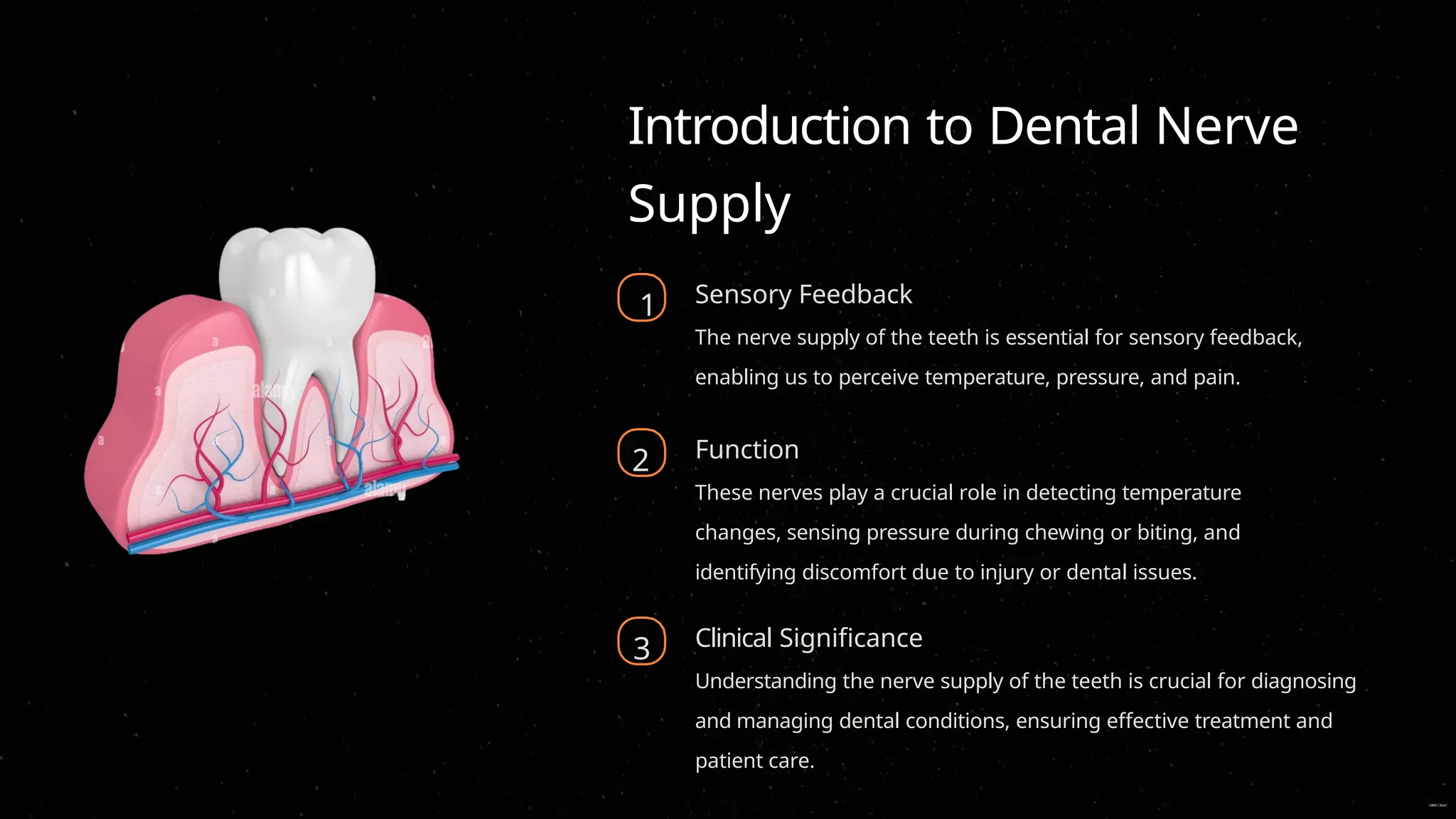
Introduction to Dental Nerve
Supply
1 Sensory Feedback
The nerve supply of the teeth is essential for sensory feedback,
enabling us to perceive temperature, pressure, and pain.
2 Function
These nerves play a crucial role in detecting temperature
changes, sensing pressure during chewing or biting, and
identifying discomfort due to injury or dental issues.
3 Clinical Significance
Understanding the nerve supply of the teeth is crucial for diagnosing
and managing dental conditions, ensuring effective treatment and
patient care.
Sensory Feedback from the
TTeempeertahture
DNeertveesctiniothne teeth
allow us to sense hot and cold
stimuli, providing valuable
information about the
temperature of food or
beverages.
Pressure Sensing
These nerves measure the
force applied during chewing
or biting, ensuring proper bite
coordination and preventing
damage to teeth and
surrounding structures.
Pain Perception
Pain perception is a vital
protective mechanism,
alerting us to potential injury
or dental issues, prompting
us to seek appropriate care.
Mechanism of Pain
PercepA-dteilota nFibers
These fibers transmit sharp, localized pain signals, providing a rapid response to
sudden stimuli.
• 1-6 μm in diameter
• Involved in fast, sharp pain
• Sensitive to ischemia
• Lower threshold
C Fibers
C fibers convey dull, aching pain, often associated with prolonged or persistent
stimuli
• 0.4-1.2 μm diameter
• Involved in slow, dull pain
• Sensitive to anaesthetics
• Stimulated by direct pulp damage
• Higher threshold
Pain Pathway
Pain signals travel from the tooth to the brain via the trigeminal nerve, allowing
us to perceive and localize pain.
Reflex Responses
Involving Dental Nerves
Protective Reflexes
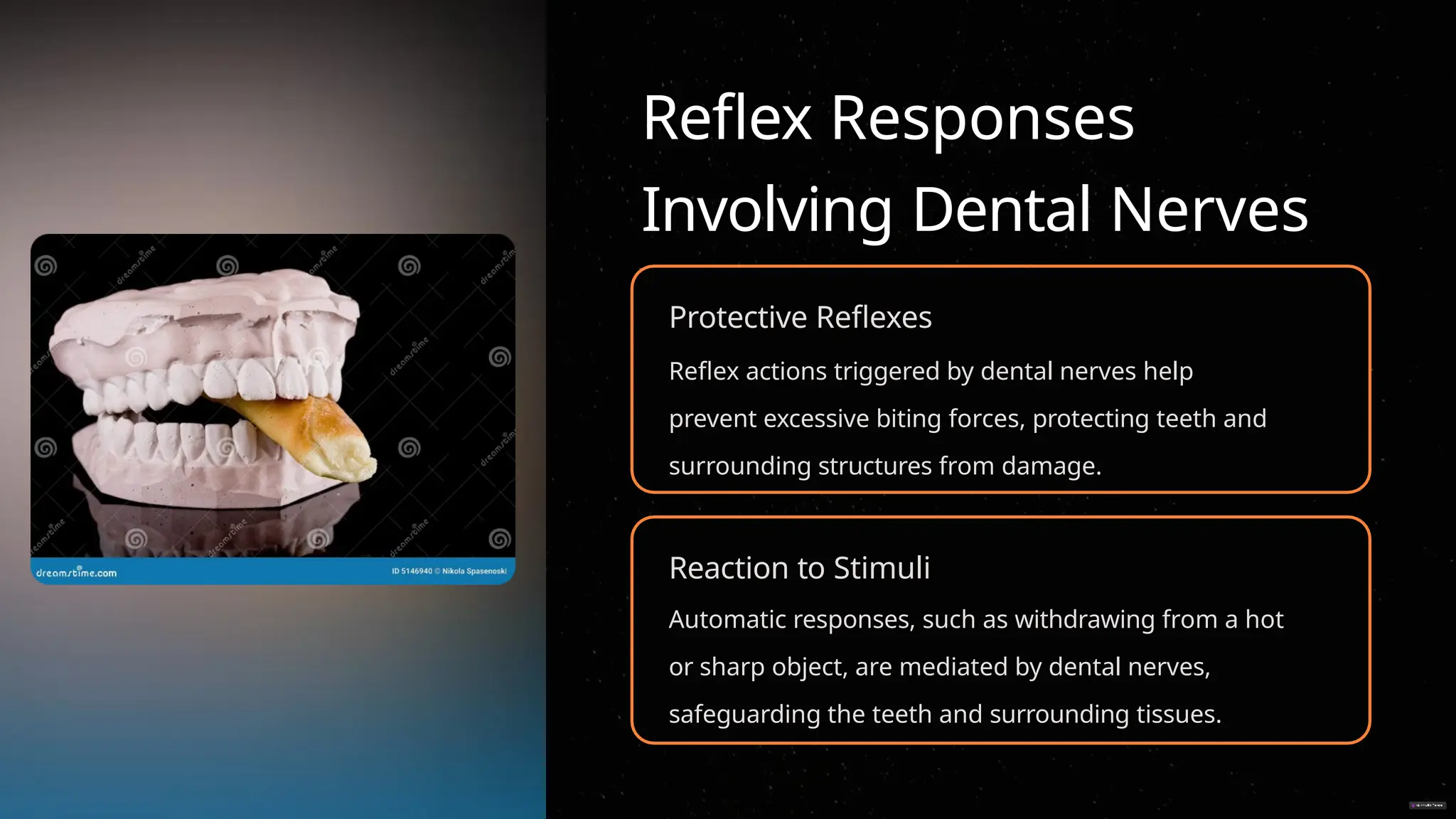
Reflex actions triggered by dental nerves help
prevent excessive biting forces, protecting teeth and
surrounding structures from damage.
Reaction to Stimuli
Automatic responses, such as withdrawing from a hot
or sharp object, are mediated by dental nerves,
safeguarding the teeth and surrounding tissues.
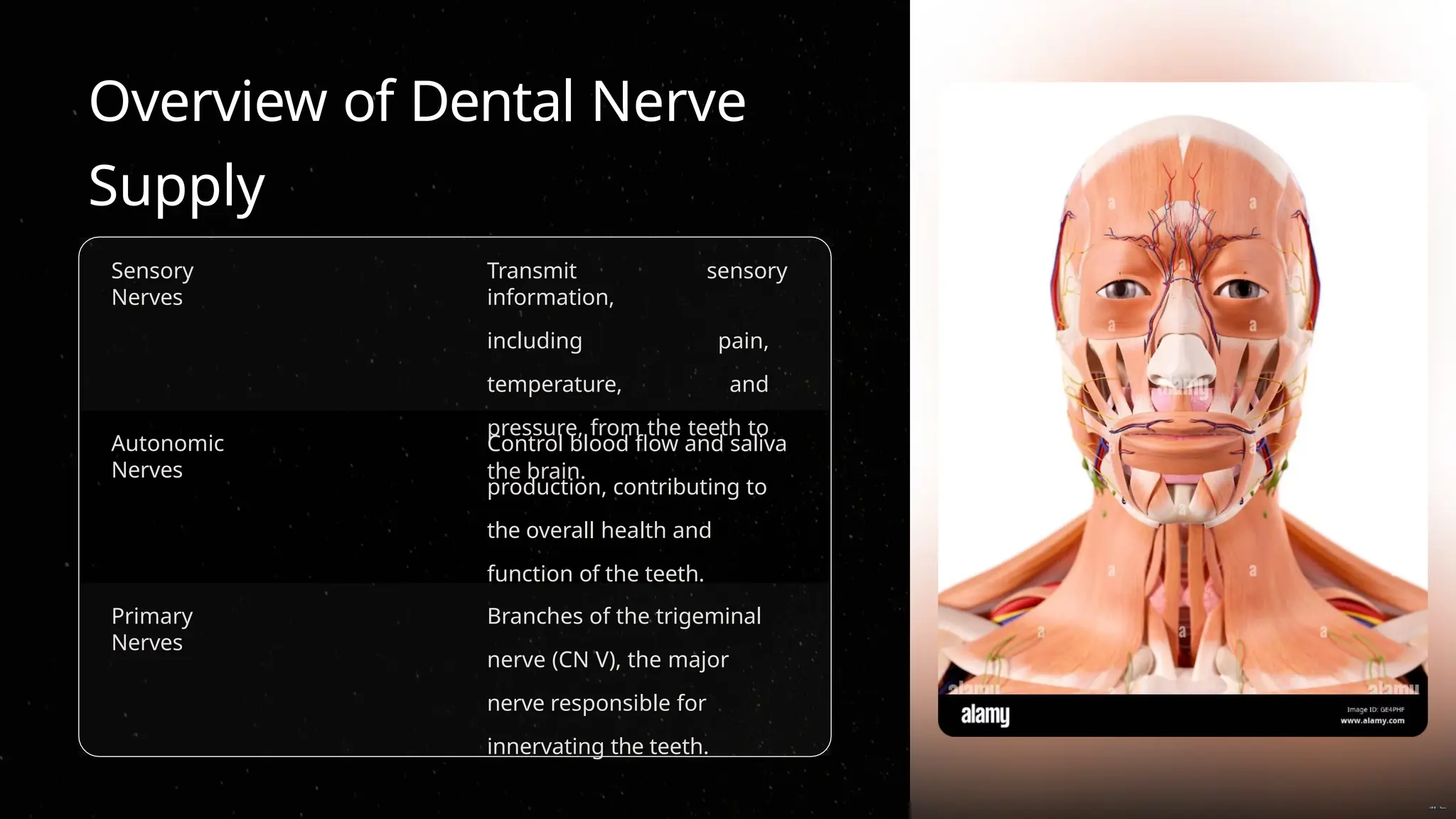
Overview of Dental Nerve
Supply
Sensory
Nerves
Transmit sensory
information,
including pain,
temperature, and
pressure, from the teeth to
the brain.
Autonomic
Nerves
Control blood flow and saliva
production, contributing to
the overall health and
function of the teeth.
Primary
Nerves
Branches of the trigeminal
nerve (CN V), the major
nerve responsible for
innervating the teeth.
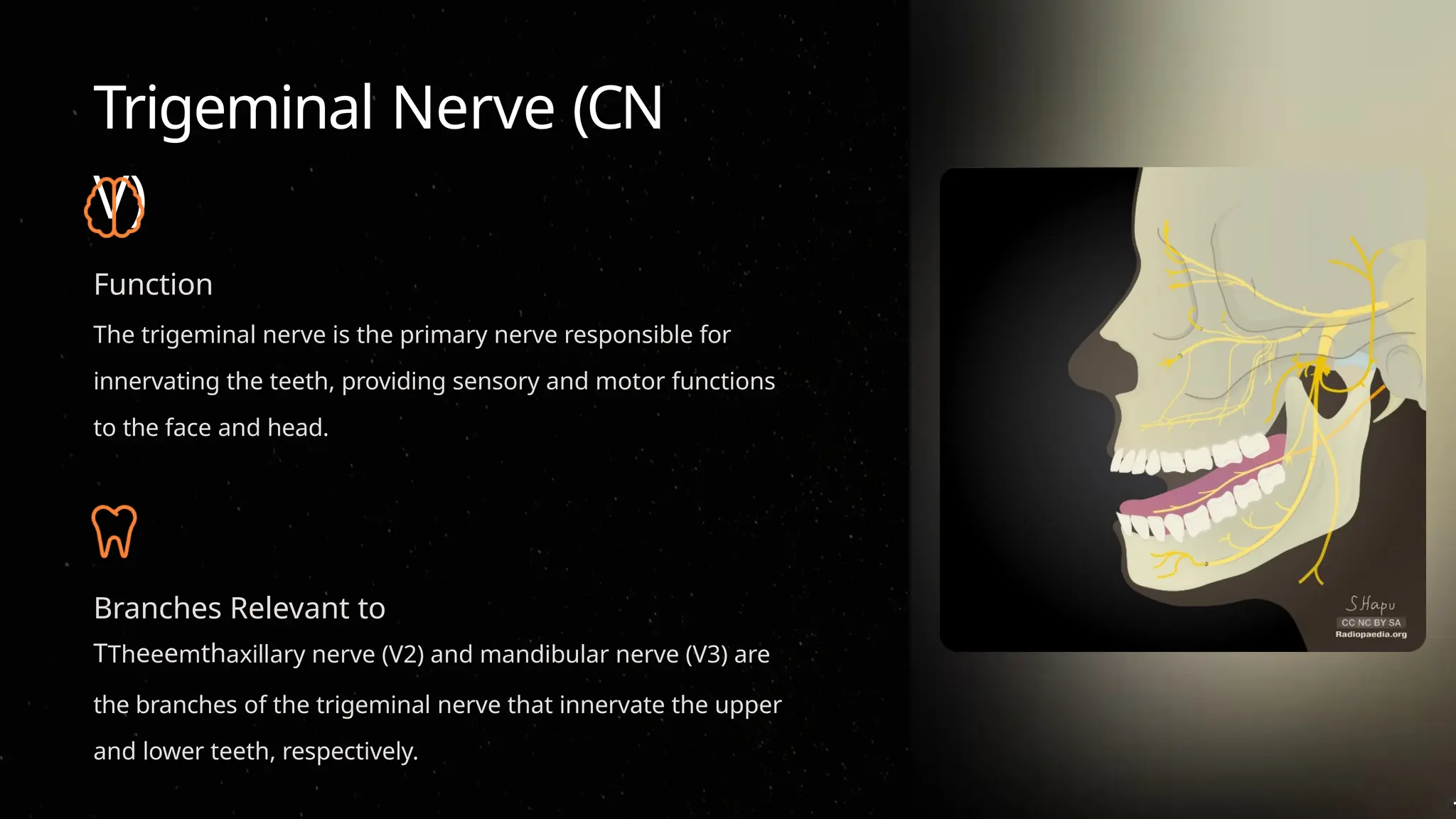
Trigeminal Nerve (CN
V)
Function
The trigeminal nerve is the primary nerve responsible for
innervating the teeth, providing sensory and motor functions
to the face and head.
Branches Relevant to
TTheeemthaxillary nerve (V2) and mandibular nerve (V3) are
the branches of the trigeminal nerve that innervate the upper
and lower teeth, respectively.
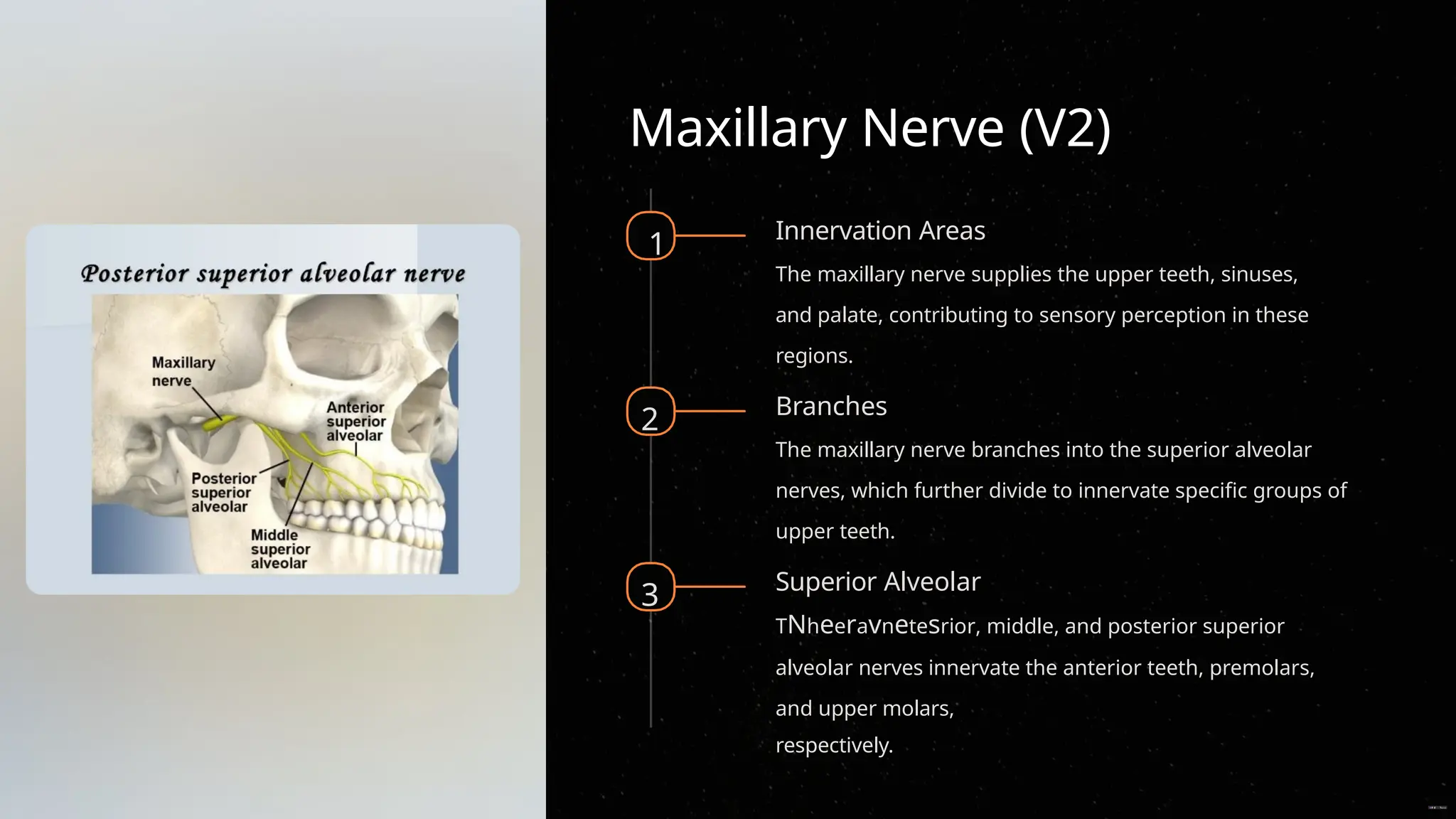
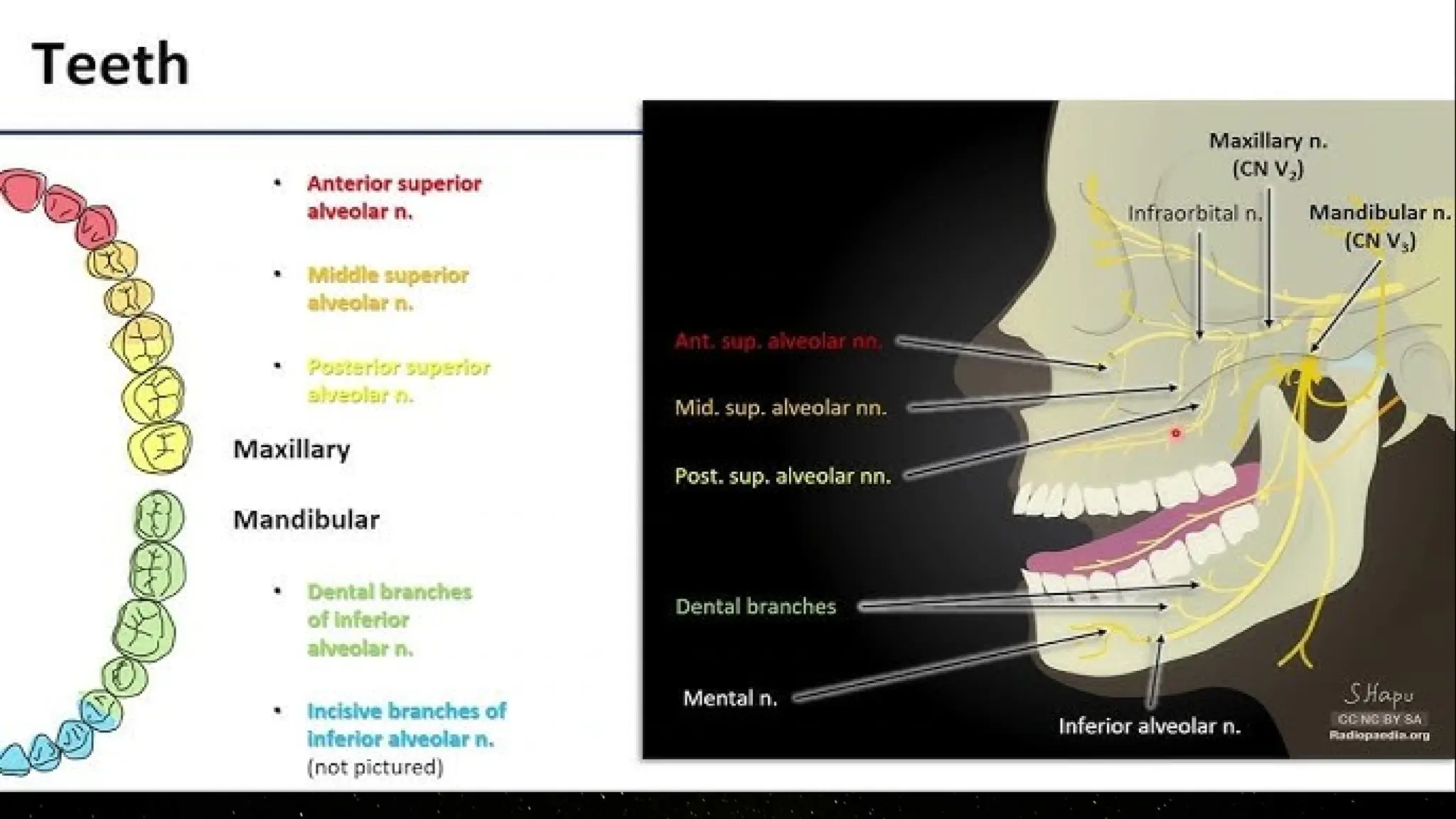
Maxillary Nerve (V2)
1 Innervation Areas
The maxillary nerve supplies the upper teeth, sinuses,
and palate, contributing to sensory perception in these
regions.
2 Branches
The maxillary nerve branches into the superior alveolar
nerves, which further divide to innervate specific groups of
upper teeth.
3 Superior Alveolar
TNheeravnetesrior, middle, and posterior superior
alveolar nerves innervate the anterior teeth, premolars,
and upper molars,
respectively.
Mandibular
Nerve
(V3)
1 2 Branches
The mandibular nerve
branches into the inferior
alveolar nerve, mental
nerve, and buccal nerve,
each serving specific
functions.
3 Inferior Alveolar
NTheerivnfeerior alveolar
nerve is responsible for
innervating all lower
teeth, providing sensory
feedback and pain
perception.
4
Innervation Areas
The mandibular nerve
supplies the lower
teeth, tongue, and
chin, contributing to
sensory perception
and motor control in
these regions.
Mental Nerve
The mental nerve supplies the chin and lower
lip,
playing a role in sensory perception and
motor control in these areas.
5 Buccal Nerve
The buccal nerve supplies the buccal
mucosa, the inner cheek, and is not directly
involved in tooth innervation.
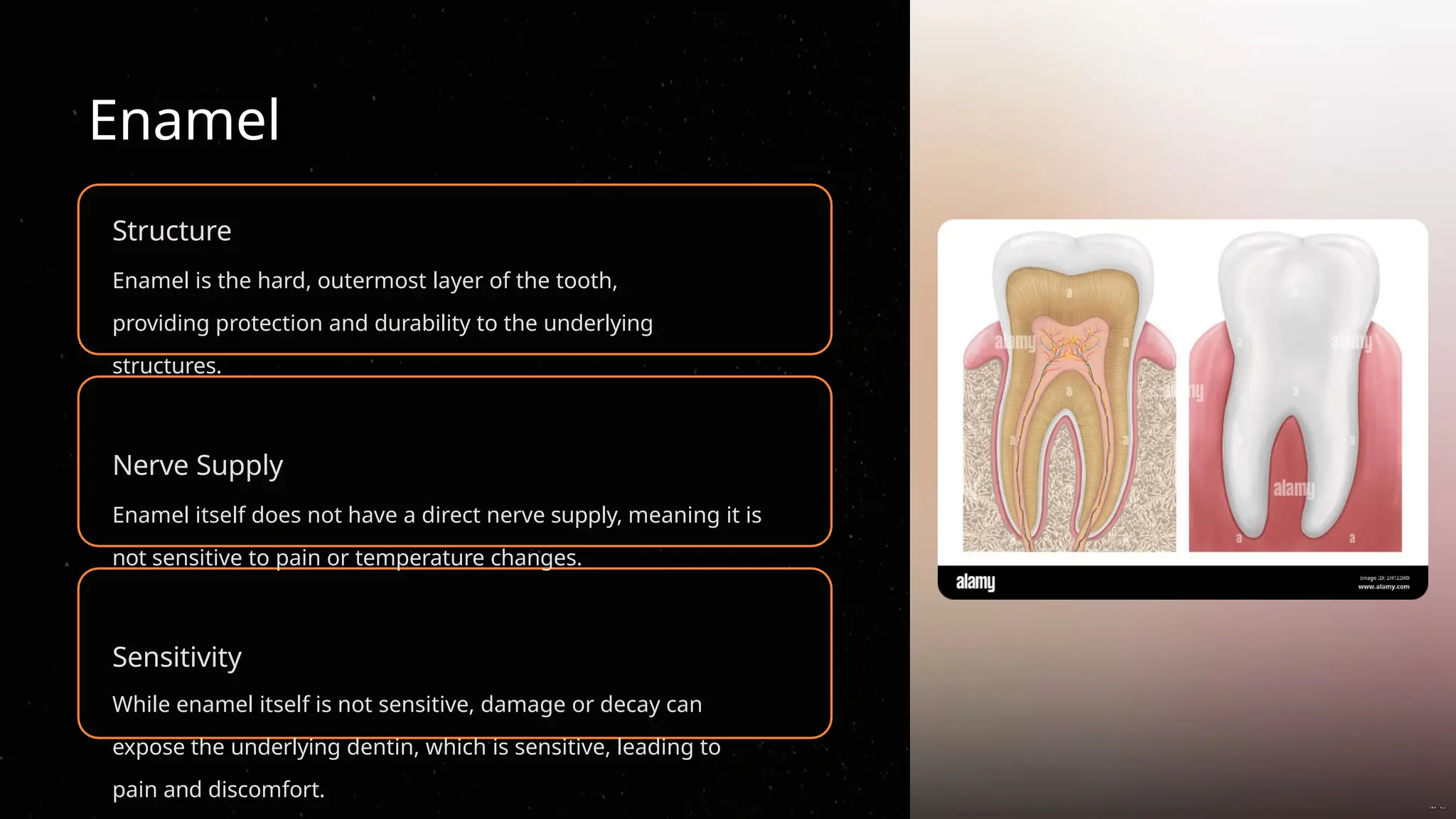
Enamel
Structure
Enamel is the hard, outermost layer of the tooth,
providing protection and durability to the underlying
structures.
Nerve Supply
Enamel itself does not have a direct nerve supply, meaning it is
not sensitive to pain or temperature changes.
Sensitivity
While enamel itself is not sensitive, damage or decay can
expose the underlying dentin, which is sensitive, leading to
pain and discomfort.
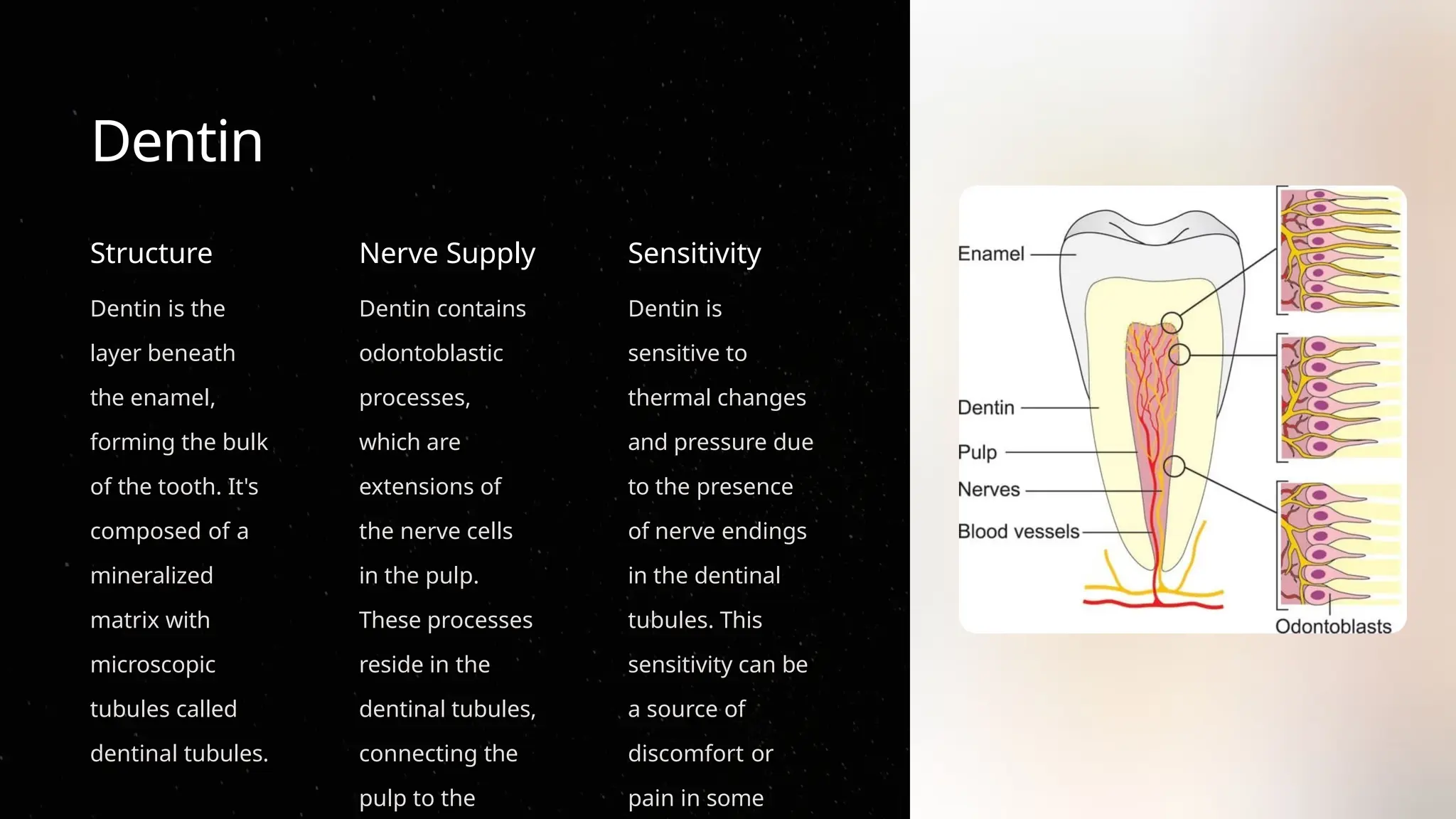
Dentin
Structure
Dentin is the
layer beneath
the enamel,
forming the bulk
of the tooth. It's
composed of a
mineralized
matrix with
microscopic
tubules called
dentinal tubules.
Nerve Supply
Dentin contains
odontoblastic
processes,
which are
extensions of
the nerve cells
in the pulp.
These processes
reside in the
dentinal tubules,
connecting the
pulp to the
Sensitivity
Dentin is
sensitive to
thermal changes
and pressure due
to the presence
of nerve endings
in the dentinal
tubules. This
sensitivity can be
a source of
discomfort or
pain in some
We have learned about this in the chapter
"Dentin"
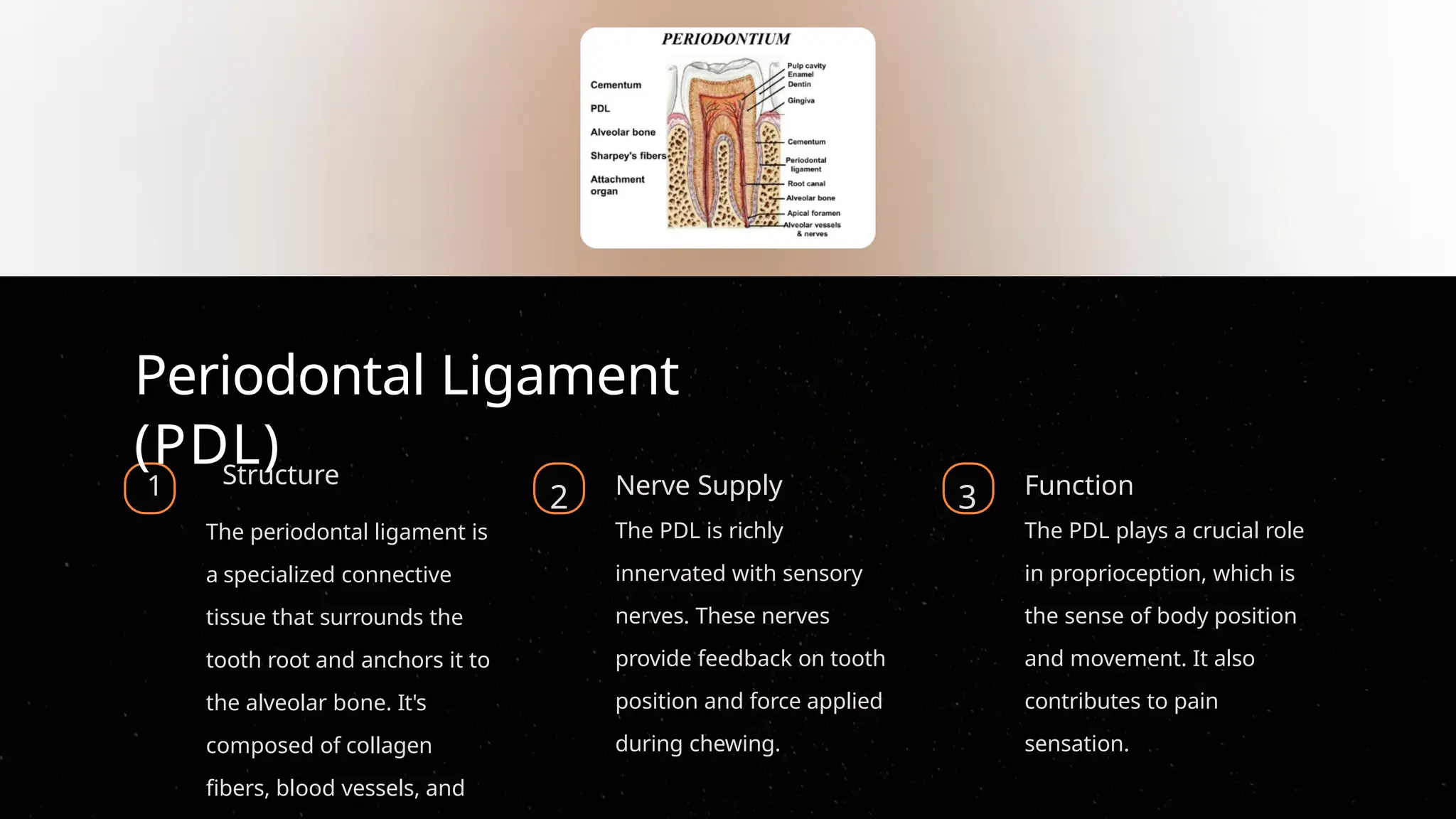
Periodontal Ligament
(PDL)
1 Structure
The periodontal ligament is
a specialized connective
tissue that surrounds the
tooth root and anchors it to
the alveolar bone. It's
composed of collagen
fibers, blood vessels, and
2 Nerve Supply
The PDL is richly
innervated with sensory
nerves. These nerves
provide feedback on tooth
position and force applied
during chewing.
3 Function
The PDL plays a crucial role
in proprioception, which is
the sense of body position
and movement. It also
contributes to pain
sensation.
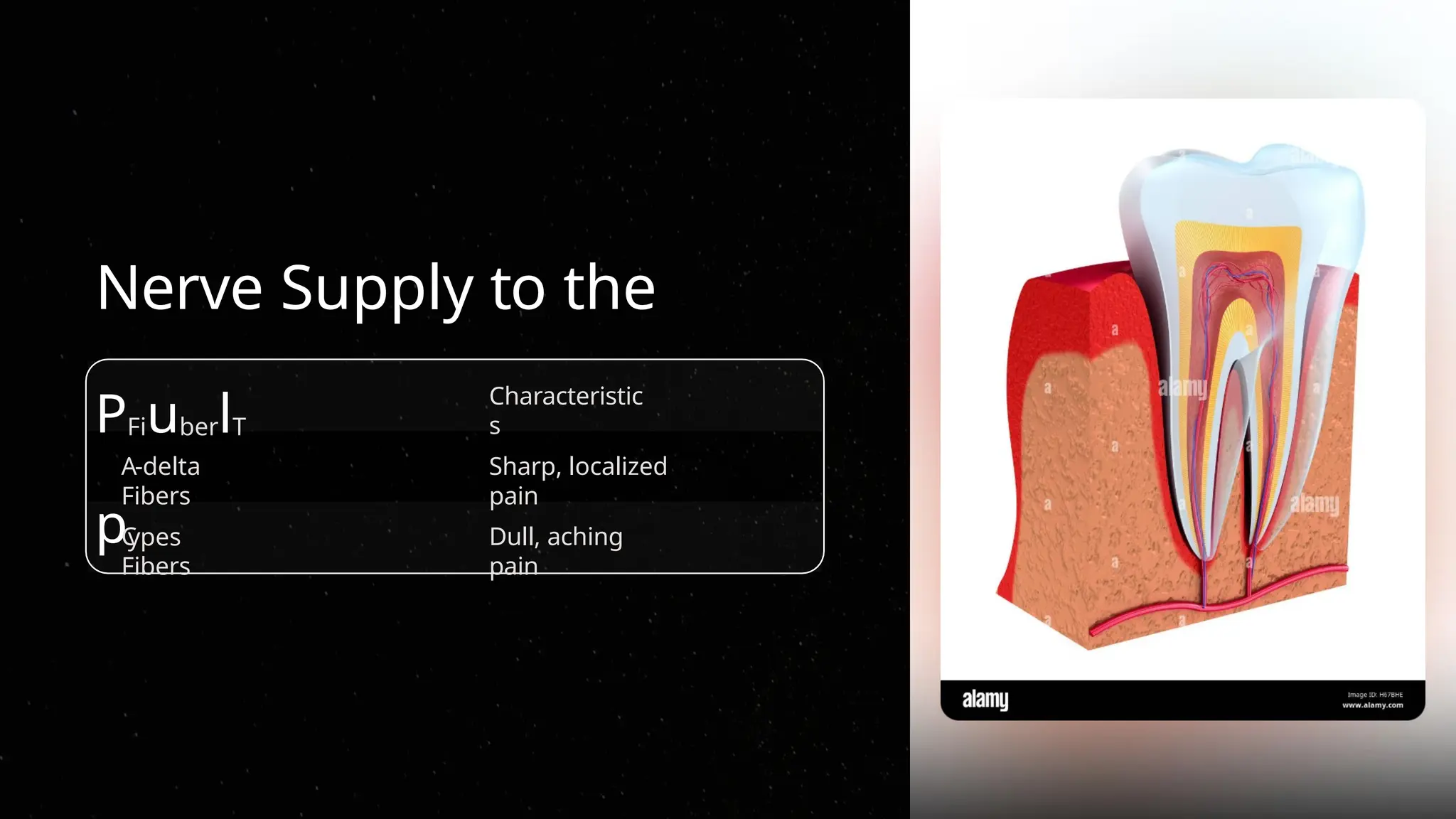
Nerve Supply to the
PFiuberlT
pypes
Characteristic
s
A-delta
Fibers
Sharp, localized
pain
C
Fibers
Dull, aching
pain
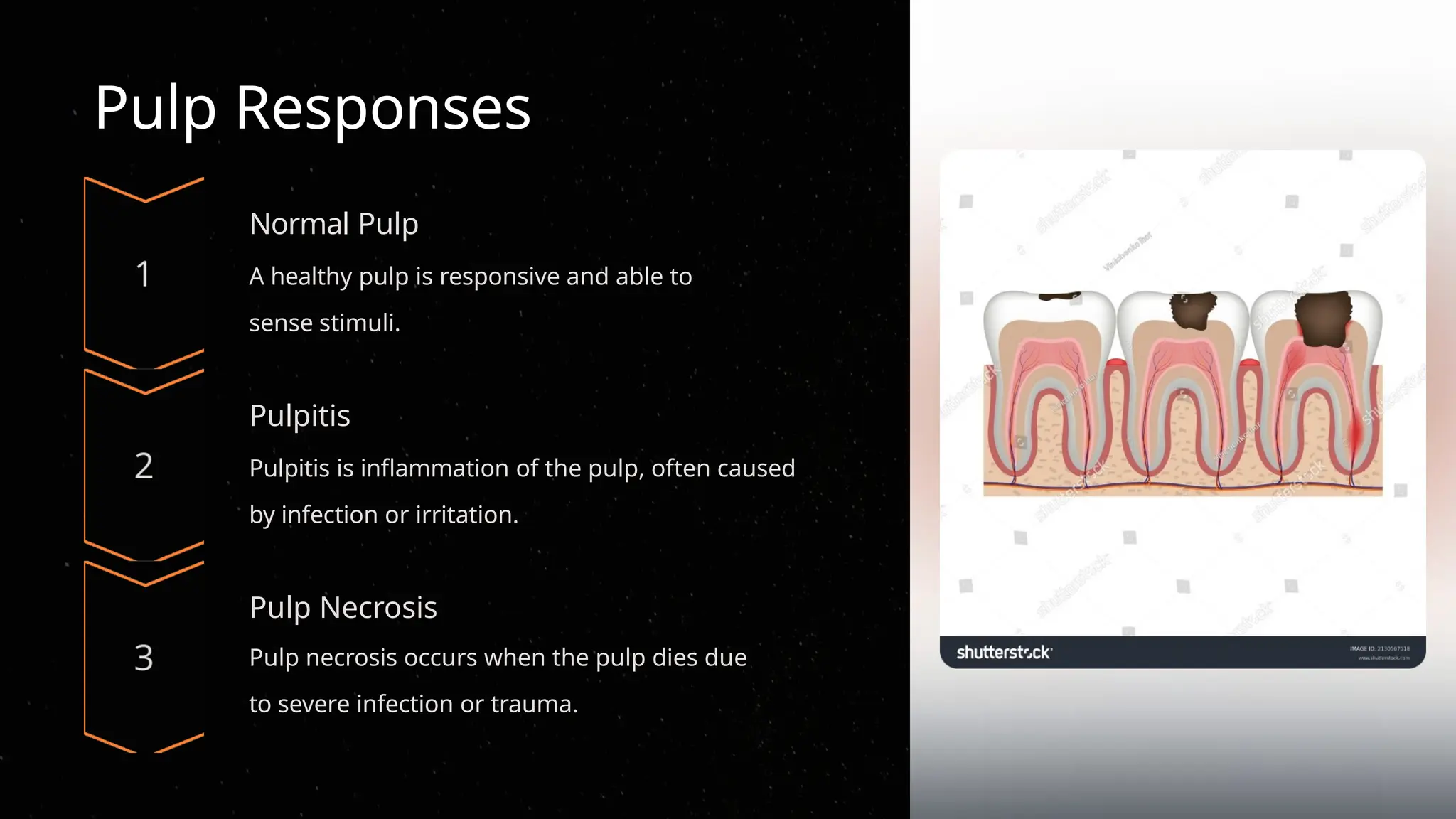
Pulp Responses
Normal Pulp
A healthy pulp is responsive and able to
sense stimuli.
Pulpitis
Pulpitis is inflammation of the pulp, often caused
by infection or irritation.
Pulp Necrosis
Pulp necrosis occurs when the pulp dies due
to severe infection or trauma.
Clinical Considerations:
Dental Anesthesia
Purpose
Dental anesthesia is used to numb the nerve endings for
patient comfort during dental procedures.
Techniques
Local infiltration is used for small areas, while nerve block
anesthesia is for larger areas or multiple teeth.
Considerations
Effective pain management is essential, and complications such
as bruising or bleeding must be avoided.
Clinical Considerations:
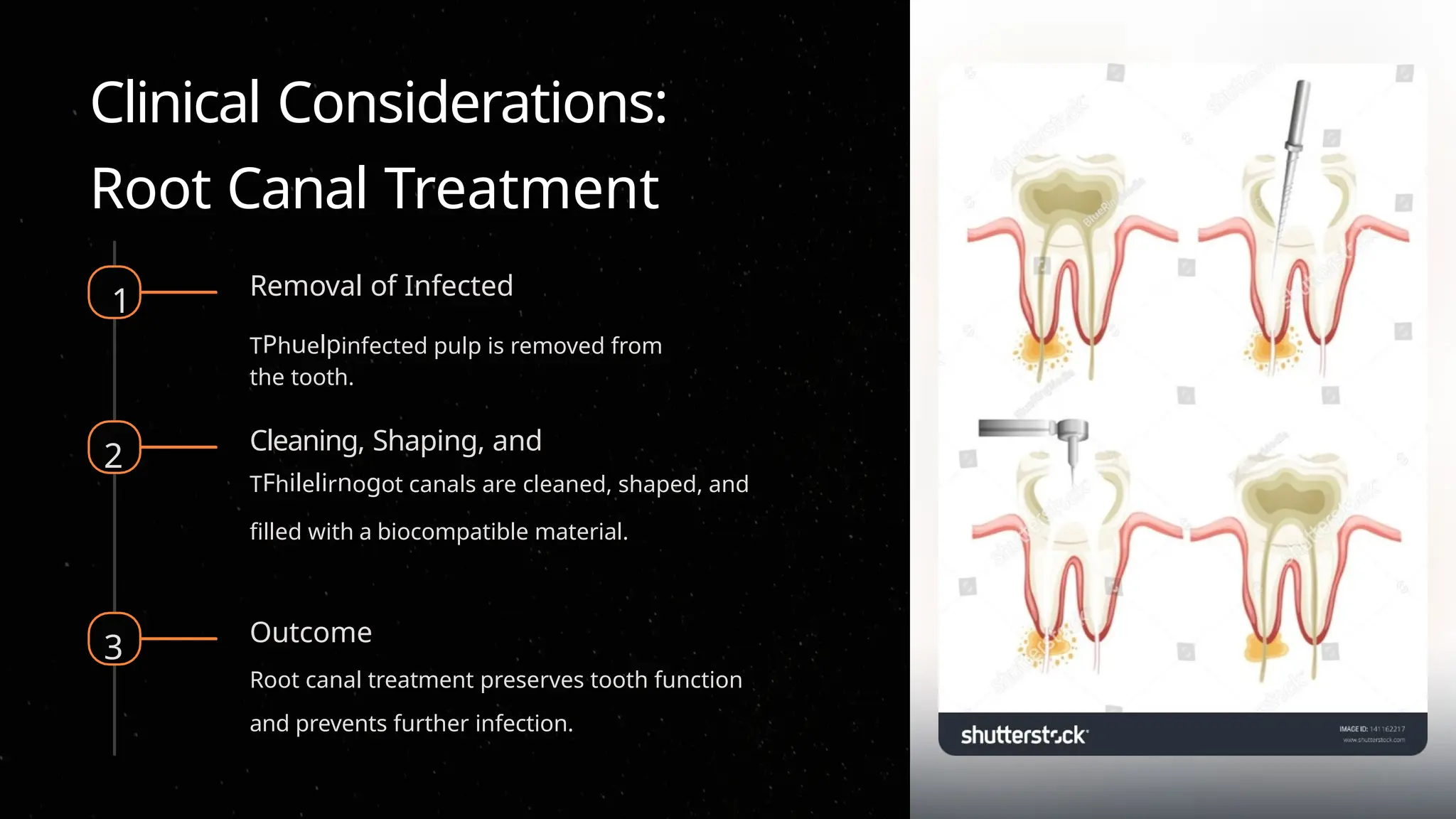
Root Canal Treatment
1
Removal of Infected
TPhuelpinfected pulp is removed from
the tooth.
2
Cleaning, Shaping, and
TFhilelirnogot canals are cleaned, shaped, and
filled with a biocompatible material.
3 Outcome
Root canal treatment preserves tooth function
and prevents further infection.
Additional Clinical Considerations
Diagnosis of Dental
DPiaffienrentiating between types of pain (sharp vs. dull) is crucial for accurate
diagnosis.
Complications
Potential issues such as failed anesthesia or persistent pain must be
addressed.
Postoperative
MMoonnitoitroinrginengsures proper healing and timely management
of complications.
Thank you

Nerve supply of teeth dental histology dental anatomy.pptx

  • 1.
    Nerve Supply of theTeeth This presentation will delve into the intricate network of nerves that supply our teeth, exploring their anatomy, function, and clinical significance. We will examine how these nerves contribute to our sensory perception, pain responses, and overall oral health.
  • 2.
    Introduction to DentalNerve Supply 1 Sensory Feedback The nerve supply of the teeth is essential for sensory feedback, enabling us to perceive temperature, pressure, and pain. 2 Function These nerves play a crucial role in detecting temperature changes, sensing pressure during chewing or biting, and identifying discomfort due to injury or dental issues. 3 Clinical Significance Understanding the nerve supply of the teeth is crucial for diagnosing and managing dental conditions, ensuring effective treatment and patient care.
  • 3.
    Sensory Feedback fromthe TTeempeertahture DNeertveesctiniothne teeth allow us to sense hot and cold stimuli, providing valuable information about the temperature of food or beverages. Pressure Sensing These nerves measure the force applied during chewing or biting, ensuring proper bite coordination and preventing damage to teeth and surrounding structures. Pain Perception Pain perception is a vital protective mechanism, alerting us to potential injury or dental issues, prompting us to seek appropriate care.
  • 4.
    Mechanism of Pain PercepA-dteilotanFibers These fibers transmit sharp, localized pain signals, providing a rapid response to sudden stimuli. • 1-6 μm in diameter • Involved in fast, sharp pain • Sensitive to ischemia • Lower threshold C Fibers C fibers convey dull, aching pain, often associated with prolonged or persistent stimuli • 0.4-1.2 μm diameter • Involved in slow, dull pain • Sensitive to anaesthetics • Stimulated by direct pulp damage • Higher threshold Pain Pathway Pain signals travel from the tooth to the brain via the trigeminal nerve, allowing us to perceive and localize pain.
  • 5.
    Reflex Responses Involving DentalNerves Protective Reflexes Reflex actions triggered by dental nerves help prevent excessive biting forces, protecting teeth and surrounding structures from damage. Reaction to Stimuli Automatic responses, such as withdrawing from a hot or sharp object, are mediated by dental nerves, safeguarding the teeth and surrounding tissues.
  • 6.
    Overview of DentalNerve Supply Sensory Nerves Transmit sensory information, including pain, temperature, and pressure, from the teeth to the brain. Autonomic Nerves Control blood flow and saliva production, contributing to the overall health and function of the teeth. Primary Nerves Branches of the trigeminal nerve (CN V), the major nerve responsible for innervating the teeth.
  • 7.
    Trigeminal Nerve (CN V) Function Thetrigeminal nerve is the primary nerve responsible for innervating the teeth, providing sensory and motor functions to the face and head. Branches Relevant to TTheeemthaxillary nerve (V2) and mandibular nerve (V3) are the branches of the trigeminal nerve that innervate the upper and lower teeth, respectively.
  • 8.
    Maxillary Nerve (V2) 1Innervation Areas The maxillary nerve supplies the upper teeth, sinuses, and palate, contributing to sensory perception in these regions. 2 Branches The maxillary nerve branches into the superior alveolar nerves, which further divide to innervate specific groups of upper teeth. 3 Superior Alveolar TNheeravnetesrior, middle, and posterior superior alveolar nerves innervate the anterior teeth, premolars, and upper molars, respectively.
  • 9.
    Mandibular Nerve (V3) 1 2 Branches Themandibular nerve branches into the inferior alveolar nerve, mental nerve, and buccal nerve, each serving specific functions. 3 Inferior Alveolar NTheerivnfeerior alveolar nerve is responsible for innervating all lower teeth, providing sensory feedback and pain perception. 4 Innervation Areas The mandibular nerve supplies the lower teeth, tongue, and chin, contributing to sensory perception and motor control in these regions. Mental Nerve The mental nerve supplies the chin and lower lip, playing a role in sensory perception and motor control in these areas. 5 Buccal Nerve The buccal nerve supplies the buccal mucosa, the inner cheek, and is not directly involved in tooth innervation.
  • 11.
    Enamel Structure Enamel is thehard, outermost layer of the tooth, providing protection and durability to the underlying structures. Nerve Supply Enamel itself does not have a direct nerve supply, meaning it is not sensitive to pain or temperature changes. Sensitivity While enamel itself is not sensitive, damage or decay can expose the underlying dentin, which is sensitive, leading to pain and discomfort.
  • 12.
    Dentin Structure Dentin is the layerbeneath the enamel, forming the bulk of the tooth. It's composed of a mineralized matrix with microscopic tubules called dentinal tubules. Nerve Supply Dentin contains odontoblastic processes, which are extensions of the nerve cells in the pulp. These processes reside in the dentinal tubules, connecting the pulp to the Sensitivity Dentin is sensitive to thermal changes and pressure due to the presence of nerve endings in the dentinal tubules. This sensitivity can be a source of discomfort or pain in some
  • 13.
    We have learnedabout this in the chapter "Dentin"
  • 14.
    Periodontal Ligament (PDL) 1 Structure Theperiodontal ligament is a specialized connective tissue that surrounds the tooth root and anchors it to the alveolar bone. It's composed of collagen fibers, blood vessels, and 2 Nerve Supply The PDL is richly innervated with sensory nerves. These nerves provide feedback on tooth position and force applied during chewing. 3 Function The PDL plays a crucial role in proprioception, which is the sense of body position and movement. It also contributes to pain sensation.
  • 15.
    Nerve Supply tothe PFiuberlT pypes Characteristic s A-delta Fibers Sharp, localized pain C Fibers Dull, aching pain
  • 16.
    Pulp Responses Normal Pulp Ahealthy pulp is responsive and able to sense stimuli. Pulpitis Pulpitis is inflammation of the pulp, often caused by infection or irritation. Pulp Necrosis Pulp necrosis occurs when the pulp dies due to severe infection or trauma.
  • 17.
    Clinical Considerations: Dental Anesthesia Purpose Dentalanesthesia is used to numb the nerve endings for patient comfort during dental procedures. Techniques Local infiltration is used for small areas, while nerve block anesthesia is for larger areas or multiple teeth. Considerations Effective pain management is essential, and complications such as bruising or bleeding must be avoided.
  • 18.
    Clinical Considerations: Root CanalTreatment 1 Removal of Infected TPhuelpinfected pulp is removed from the tooth. 2 Cleaning, Shaping, and TFhilelirnogot canals are cleaned, shaped, and filled with a biocompatible material. 3 Outcome Root canal treatment preserves tooth function and prevents further infection.
  • 19.
    Additional Clinical Considerations Diagnosisof Dental DPiaffienrentiating between types of pain (sharp vs. dull) is crucial for accurate diagnosis. Complications Potential issues such as failed anesthesia or persistent pain must be addressed. Postoperative MMoonnitoitroinrginengsures proper healing and timely management of complications.
  • 20.