Neonatal Fc Receptor–Targeted Therapies
in Neurology
by
Dr. Ch. Anuhya Krishna
 Neonatal Fc-receptor (FcRn) is responsible for the transfer of humoral immunity from the
mother to the newborn .
 Recycles IgG and extends its half-life in the circulation.
 Half life is majorly increased by binding within acidifying recycling endosomes and
releasing at the cell surface, where the pH is neutral.
 Blocking FcRn function lead to significant decreases in endogenous IgG levels.
Sturcture
The 1- 2- 3
α α α domains of FcRn with 2-
β microglobulin
( 2
β m), forming a heterodimer
2 FcRn– 2
β m heterodimers engage a
IgG (in a T conformation), which presumably occurs on the
membrane of acidified recycling endosomes.
A short stalk, the transmembrane domain and
the cytoplasmic domain
 IgG and albumin bind to FcRn at distinct sites under acidic but not neutral pH conditions.
 At neutral pH  Binding is lost
 With IgG Fc engineering, IgG variants with different binding affinities were produced
either
To enhance FcRn binding for extending IgG half-life.
Or
forcing the degradation of IgG antibodies. decreasing half life
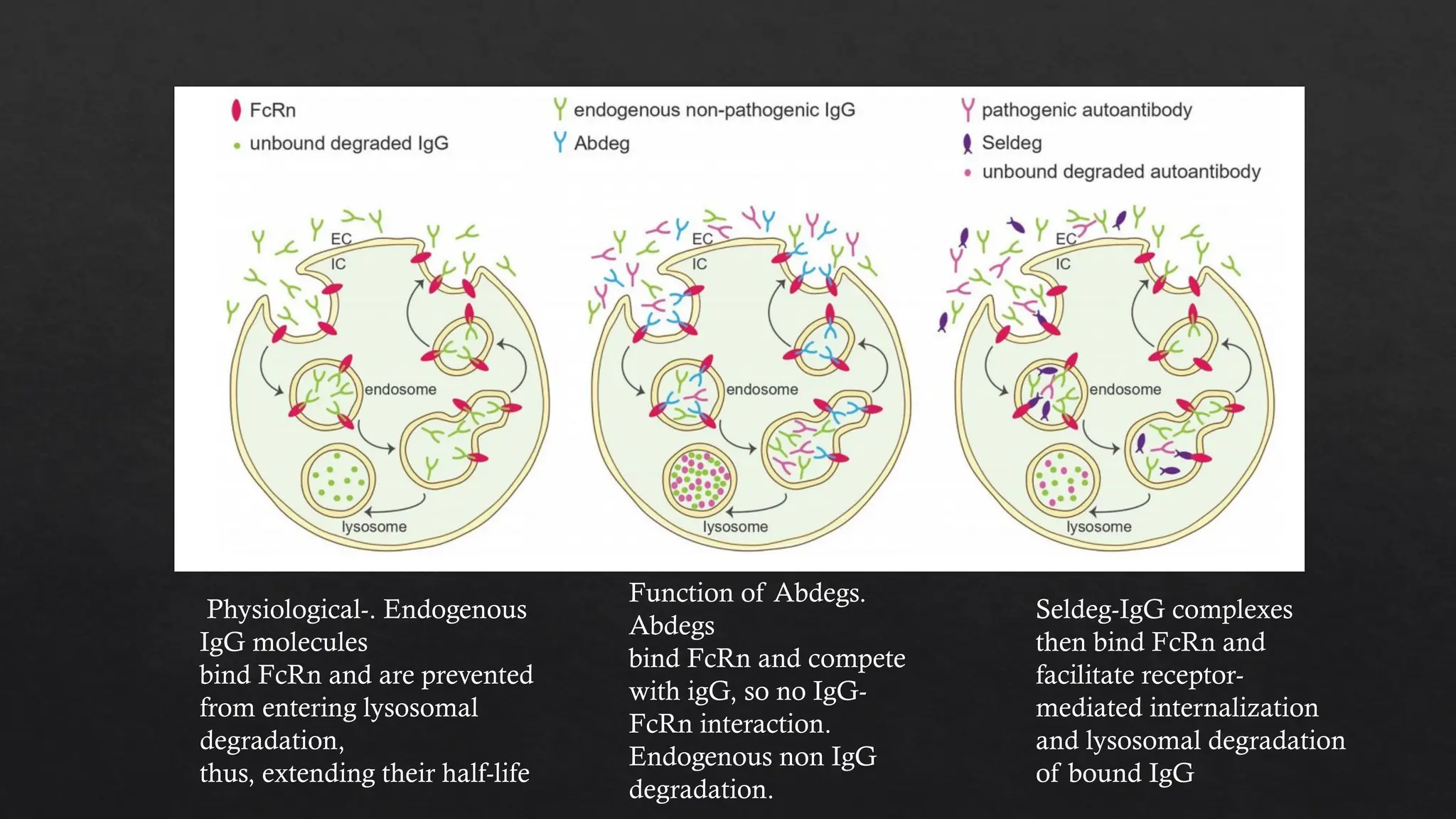
Physiological-. Endogenous
IgG molecules
bind FcRn and are prevented
from entering lysosomal
degradation,
thus, extending their half-life
Function of Abdegs.
Abdegs
bind FcRn and compete
with igG, so no IgG-
FcRn interaction.
Endogenous non IgG
degradation.
Seldeg-IgG complexes
then bind FcRn and
facilitate receptor-
mediated internalization
and lysosomal degradation
of bound IgG
FcRn Targeted Therapy
 Abdegs (ab that enhance IgG degradation decreases the concentration in
body.
EFGARTIGIMOD-
 First FDA approved FcRn antagonist.
 Modified human igG-derived fc fragment
 Enhance its binding affinity for FcRn in both acidic and neutral environmet
 First FcRn inhibitor to be approved by the FDA for the treatment of anti
Ach antibody positive gMG
 Although it is primarily used for the treatment of gMG, efgartigimod has
also shown some success in phase 2 clinical trials for CIDP (ADHERE )trial
 10 mg/kg weekly for 4 doses.
 ROZANOLIXIZUMAB -is a human anti-FcRn IgG4 monoclonal antibody
approved in 2023 in MuSK and AChR antibody-positive patients.
 NIPOCALIMAB and BATOCLIMAB are human monoclonal antibody that
binds the FcRn, inhibiting recycling, and has completed a phase II study of
generalized MG AChR antibody-positive patients.
 RAVULIZUMAB-an engineered form of eculizumab with improved
pharmacokinetics by incorporating histidine switches resulting in a long
half-life that permits a maintenance dosing interval of 1 infusion every 8
weeks. FDA approval- AChR positive generalized MG
 MOG- SELDEG
 a MOG-Fc fusion protein
 Seldegs were shown to selectively clear MOG-specific antibodies with no
effect on the levels of other antigen-specific/protective antibodies
 SATRALIZUMAB-
 a monoclonal antibody that blocks the interleukin-6 (IL-6) receptor and is
approved for the treatment of (NMOSD) in patients who are aquaporin-4
immunoglobulin G (AQP4-IgG) seropositive.
 The efficacy of Satralizumab for ameliorating NMSOD a phase III,
randomized, double-blinded, placebo-controlled trial investigated
Satralizumab as add on to baseline immunosuppressants
THANK YOU

Neonatal Fc Receptor–Targeted Therapies in.pptx

  • 1.
    Neonatal Fc Receptor–TargetedTherapies in Neurology by Dr. Ch. Anuhya Krishna
  • 2.
     Neonatal Fc-receptor(FcRn) is responsible for the transfer of humoral immunity from the mother to the newborn .  Recycles IgG and extends its half-life in the circulation.  Half life is majorly increased by binding within acidifying recycling endosomes and releasing at the cell surface, where the pH is neutral.  Blocking FcRn function lead to significant decreases in endogenous IgG levels.
  • 3.
    Sturcture The 1- 2-3 α α α domains of FcRn with 2- β microglobulin ( 2 β m), forming a heterodimer 2 FcRn– 2 β m heterodimers engage a IgG (in a T conformation), which presumably occurs on the membrane of acidified recycling endosomes. A short stalk, the transmembrane domain and the cytoplasmic domain
  • 4.
     IgG andalbumin bind to FcRn at distinct sites under acidic but not neutral pH conditions.  At neutral pH  Binding is lost  With IgG Fc engineering, IgG variants with different binding affinities were produced either To enhance FcRn binding for extending IgG half-life. Or forcing the degradation of IgG antibodies. decreasing half life
  • 5.
    Physiological-. Endogenous IgG molecules bindFcRn and are prevented from entering lysosomal degradation, thus, extending their half-life Function of Abdegs. Abdegs bind FcRn and compete with igG, so no IgG- FcRn interaction. Endogenous non IgG degradation. Seldeg-IgG complexes then bind FcRn and facilitate receptor- mediated internalization and lysosomal degradation of bound IgG
  • 7.
    FcRn Targeted Therapy Abdegs (ab that enhance IgG degradation decreases the concentration in body. EFGARTIGIMOD-  First FDA approved FcRn antagonist.  Modified human igG-derived fc fragment  Enhance its binding affinity for FcRn in both acidic and neutral environmet  First FcRn inhibitor to be approved by the FDA for the treatment of anti Ach antibody positive gMG  Although it is primarily used for the treatment of gMG, efgartigimod has also shown some success in phase 2 clinical trials for CIDP (ADHERE )trial  10 mg/kg weekly for 4 doses.
  • 8.
     ROZANOLIXIZUMAB -isa human anti-FcRn IgG4 monoclonal antibody approved in 2023 in MuSK and AChR antibody-positive patients.  NIPOCALIMAB and BATOCLIMAB are human monoclonal antibody that binds the FcRn, inhibiting recycling, and has completed a phase II study of generalized MG AChR antibody-positive patients.  RAVULIZUMAB-an engineered form of eculizumab with improved pharmacokinetics by incorporating histidine switches resulting in a long half-life that permits a maintenance dosing interval of 1 infusion every 8 weeks. FDA approval- AChR positive generalized MG
  • 9.
     MOG- SELDEG a MOG-Fc fusion protein  Seldegs were shown to selectively clear MOG-specific antibodies with no effect on the levels of other antigen-specific/protective antibodies  SATRALIZUMAB-  a monoclonal antibody that blocks the interleukin-6 (IL-6) receptor and is approved for the treatment of (NMOSD) in patients who are aquaporin-4 immunoglobulin G (AQP4-IgG) seropositive.  The efficacy of Satralizumab for ameliorating NMSOD a phase III, randomized, double-blinded, placebo-controlled trial investigated Satralizumab as add on to baseline immunosuppressants
  • 10.