NEONATAL DEATHS IN
     ODISHA
DR. SUDHIRA KUMAR PARIDA.
DEFINITION
• Deaths occuring during the neonatal period
  i.e., within 28 completed days of birth.
• Calculated as no. of neonatal deaths in a given
  yr / 1,000 live births in that yr.
IMPORTANCE
• Over 2/3rd of IMR &
• ½ of U5MR
• 90% of neonatal deaths-within 1st 14 days of
  life
• ½ of neonatal deaths-within 1st 7 days
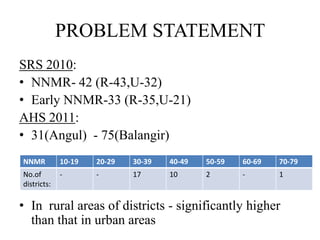
PROBLEM STATEMENT
SRS 2010:
• NNMR- 42 (R-43,U-32)
• Early NNMR-33 (R-35,U-21)
AHS 2011:
• 31(Angul) - 75(Balangir)
NNMR         10-19   20-29   30-39   40-49   50-59   60-69   70-79
No.of        -       -       17      10      2       -       1
districts:

• In rural areas of districts - significantly higher
  than that in urban areas
IMR & NNMR
70

60

50

40
                                      9 (14.8% 0f IMR)
30                61

20
                                     33 (54% of IMR: R-55%,
10                                                   U-50%)

0
                  IMR               NNMR


     [SRS 2010]
U5MR & NNMR
90
80
70
60
50
              78
40
30
                                     42 ( 54% of U5MR )
20
10
0
                   U5MR           NNMR


     [SRS 2010]
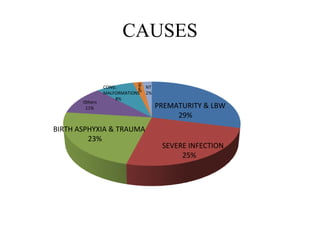
CAUSES

                            D
                CONG.       2 NT
                            %
                MALFORMATIONS 2%
                    8%
       Others
        11%                        PREMATURITY & LBW
                                        29%
BIRTH ASPHYXIA & TRAUMA
         23%
                                    SEVERE INFECTION
                                         25%
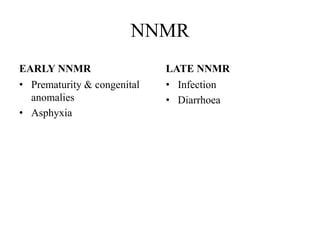
NNMR
EARLY NNMR                   LATE NNMR
• Prematurity & congenital   • Infection
  anomalies                  • Diarrhoea
• Asphyxia
DETERMINANTS
ANC
120%

           98
100%

80%                           77
                                           58.4
60%

40%                                                      37.5

20%

 0%
             at least 1         2+         3+     full


       [COVERAGE EVALUATION SURVEY 2009]
CONSUMPTION OF IFA DURING
      PREGNANCY
                             %

                      None
                      10%


            30 days              100 days
              16%
                                  47%


             31-90 days
               27%


   [COVERAGE EVALUATION SURVEY 2009]
PLACE OF DELIVERY
                          %


       At home
        24.5%


                            Institutional
                                75.5%


[COVERAGE EVALUATION SURVEY 2009]
Duration of stay at health facility

                           4+ days
                             8%
                  3 days
                    8%

               2 days
                                       1 day
                12%
                                        44%


                        1 day
                        28%


   [COVERAGE EVALUATION SURVEY 2009]
DELIVERY ATTENDED BY SBA
90
             79%
80
70
60
50
40
30                                          21%
20
10
0
                   SBA               none

 [COVERAGE EVALUATION SURVEY 2009]
INSTITUTIONAL DELIVERIES & JSY

                    JSY                                     60.7 %


Institutional deliveries
                                                                     75.5 %


                       0.00%    20.00%         40.00%   60.00%       80.00%


           [COVERAGE EVALUATION SURVEY 2009]
BF AFTER CHILD BIRTH
70.00%
          63.7
60.00%

50.00%

40.00%

30.00%                       27.2
20.00%
                                               8.8
10.00%
                                                      0.3
 0.00%
            < 1 hr          1-23 hr      ³ 24 hr     No BF

     [COVERAGE EVALUATION SURVEY 2009]
INTERVENTIONS
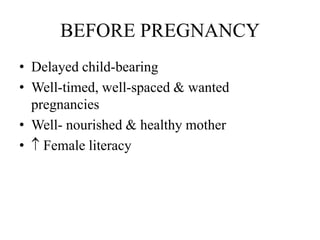
BEFORE PREGNANCY
• Delayed child-bearing
• Well-timed, well-spaced & wanted
  pregnancies
• Well- nourished & healthy mother
• Female literacy
DURING PREGNANCY(ANC)
•   Early registration
•   TT
•   IFA
•   Good diet
•   Counseling on birth preparedness & BF
•   Identification of major risk factors of
    obstructed labor.
INTRAPARTUM & IMMEDIATE
          NEWBORN CARE
•   PROM-Antibiotics
•   Complications- EmOBC
•   SBA
•   5 ”C’’s
•   Prevention of hypothermia
•   Early EBF
•   Cord & eye care
•   Neonatal resuscitation
•   Spl. care for LBW
EARLY NBC
•   EBF
•   Temp maintenance
•   Optimal cord care & hygiene
•   Immunisation
•   Care for LBW baby
•   Management of sickness
LATE NBC
• EBF
• Cord care & hygiene
• Care for LBW baby
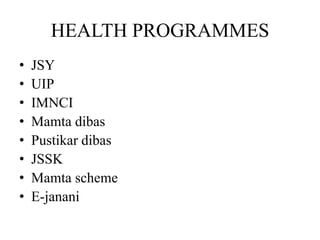
HEALTH PROGRAMMES
•   JSY
•   UIP
•   IMNCI
•   Mamta dibas
•   Pustikar dibas
•   JSSK
•   Mamta scheme
•   E-janani
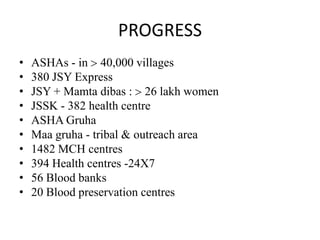
PROGRESS
•   ASHAs - in 40,000 villages
•   380 JSY Express
•   JSY + Mamta dibas : 26 lakh women
•   JSSK - 382 health centre
•   ASHA Gruha
•   Maa gruha - tribal & outreach area
•   1482 MCH centres
•   394 Health centres -24 7
•   56 Blood banks
•   20 Blood preservation centres
REFERENCES
• SRS 2010
• AHS 2011
• UNICEF’s Coverage evaluation survey 2009
• PARK’S textbook of preventive & social
  medicine. 21st edition
• Textbook of preventive & social medicine :
  sunderlal
• RCH module for MO(PHC).
Neonatal deaths in odisha

Neonatal deaths in odisha

  • 1.
    NEONATAL DEATHS IN ODISHA DR. SUDHIRA KUMAR PARIDA.
  • 2.
    DEFINITION • Deaths occuringduring the neonatal period i.e., within 28 completed days of birth. • Calculated as no. of neonatal deaths in a given yr / 1,000 live births in that yr.
  • 3.
    IMPORTANCE • Over 2/3rdof IMR & • ½ of U5MR • 90% of neonatal deaths-within 1st 14 days of life • ½ of neonatal deaths-within 1st 7 days
  • 4.
    PROBLEM STATEMENT SRS 2010: •NNMR- 42 (R-43,U-32) • Early NNMR-33 (R-35,U-21) AHS 2011: • 31(Angul) - 75(Balangir) NNMR 10-19 20-29 30-39 40-49 50-59 60-69 70-79 No.of - - 17 10 2 - 1 districts: • In rural areas of districts - significantly higher than that in urban areas
  • 5.
    IMR & NNMR 70 60 50 40 9 (14.8% 0f IMR) 30 61 20 33 (54% of IMR: R-55%, 10 U-50%) 0 IMR NNMR [SRS 2010]
  • 6.
    U5MR & NNMR 90 80 70 60 50 78 40 30 42 ( 54% of U5MR ) 20 10 0 U5MR NNMR [SRS 2010]
  • 7.
    CAUSES D CONG. 2 NT % MALFORMATIONS 2% 8% Others 11% PREMATURITY & LBW 29% BIRTH ASPHYXIA & TRAUMA 23% SEVERE INFECTION 25%
  • 8.
    NNMR EARLY NNMR LATE NNMR • Prematurity & congenital • Infection anomalies • Diarrhoea • Asphyxia
  • 9.
  • 10.
    ANC 120% 98 100% 80% 77 58.4 60% 40% 37.5 20% 0% at least 1 2+ 3+ full [COVERAGE EVALUATION SURVEY 2009]
  • 11.
    CONSUMPTION OF IFADURING PREGNANCY % None 10% 30 days 100 days 16% 47% 31-90 days 27% [COVERAGE EVALUATION SURVEY 2009]
  • 12.
    PLACE OF DELIVERY % At home 24.5% Institutional 75.5% [COVERAGE EVALUATION SURVEY 2009]
  • 13.
    Duration of stayat health facility 4+ days 8% 3 days 8% 2 days 1 day 12% 44% 1 day 28% [COVERAGE EVALUATION SURVEY 2009]
  • 14.
    DELIVERY ATTENDED BYSBA 90 79% 80 70 60 50 40 30 21% 20 10 0 SBA none [COVERAGE EVALUATION SURVEY 2009]
  • 15.
    INSTITUTIONAL DELIVERIES &JSY JSY 60.7 % Institutional deliveries 75.5 % 0.00% 20.00% 40.00% 60.00% 80.00% [COVERAGE EVALUATION SURVEY 2009]
  • 16.
    BF AFTER CHILDBIRTH 70.00% 63.7 60.00% 50.00% 40.00% 30.00% 27.2 20.00% 8.8 10.00% 0.3 0.00% < 1 hr 1-23 hr ³ 24 hr No BF [COVERAGE EVALUATION SURVEY 2009]
  • 17.
  • 18.
    BEFORE PREGNANCY • Delayedchild-bearing • Well-timed, well-spaced & wanted pregnancies • Well- nourished & healthy mother • Female literacy
  • 19.
    DURING PREGNANCY(ANC) • Early registration • TT • IFA • Good diet • Counseling on birth preparedness & BF • Identification of major risk factors of obstructed labor.
  • 20.
    INTRAPARTUM & IMMEDIATE NEWBORN CARE • PROM-Antibiotics • Complications- EmOBC • SBA • 5 ”C’’s • Prevention of hypothermia • Early EBF • Cord & eye care • Neonatal resuscitation • Spl. care for LBW
  • 21.
    EARLY NBC • EBF • Temp maintenance • Optimal cord care & hygiene • Immunisation • Care for LBW baby • Management of sickness
  • 22.
    LATE NBC • EBF •Cord care & hygiene • Care for LBW baby
  • 23.
    HEALTH PROGRAMMES • JSY • UIP • IMNCI • Mamta dibas • Pustikar dibas • JSSK • Mamta scheme • E-janani
  • 24.
    PROGRESS • ASHAs - in 40,000 villages • 380 JSY Express • JSY + Mamta dibas : 26 lakh women • JSSK - 382 health centre • ASHA Gruha • Maa gruha - tribal & outreach area • 1482 MCH centres • 394 Health centres -24 7 • 56 Blood banks • 20 Blood preservation centres
  • 25.
    REFERENCES • SRS 2010 •AHS 2011 • UNICEF’s Coverage evaluation survey 2009 • PARK’S textbook of preventive & social medicine. 21st edition • Textbook of preventive & social medicine : sunderlal • RCH module for MO(PHC).

Editor's Notes

  • #5 Early-78.57%
  • #11 Coverage evaluation survey 2009.