PHYSICAL LAYER
DATA & DIGITAL COMMUNICATION
TABLE OF CONTENTS
Purpose of the
Physical Layer
01 Physical Layer
Characteristics
02 Cooper Cabling
03
UTP Cabling
04 Fiber-Optic
Cabling
05 Wireless
Media
06
PURPOSE OF THE
PHYSICAL LAYER
01
WHAT IS PHYSICAL
LAYER?
The physical layer is responsible for
sending computer bits from one device to
another along the network.
WHAT IS THE MAIN ROLE OF
PHYSICAL LAYER?
Physical Layer is responsible for the communication of the
unstructured raw data streams over a physical medium. Physical
Layer maintains the data rate (how many bits a sender can send
per second). It performs Synchronization of
To do this, the physical layer performs a variety of functions,
including:
Defining bits: Determines how bits are converted from 0s and 1s to a signal.
Data rate: Determines how fast the data flows, in bits per second.
Synchronization: Ensures that sending and receiving devices are
synchronized.
Transmission mode: Determines the direction of transmissions and whether
those are simplex (one signal is transmitted in one direction), half-
duplex (data goes in both directions, but not at the same time) and full-
duplex (data is transmitted in both directions, simultaneously)
Interface: Determines how devices are connected to a transmission medium
such as Ethernet or radio waves
PHYSICAL LAYER
CHARACTERISTICS
02
PHYSICAL LAYER CHARACTERISTICS
COPPER CABLING
03
WHAT IS COPPER USED
FOR?
Copper is the electrical conductor in many categories of electrical
wiring. Copper wire is used in power generation, power
transmission, power distribution, telecommunications, electronics
circuitry, and countless types of electrical equipment. Copper and
its alloys are also used to make electrical contacts.
.
COPPER WIRES
WHAT IS THE PURPOSE OF
COPPER?
The function of network cabling is to transfer information and data
between networked devices, such as routers, computers, switches,
hubs, repeaters, storage networks and more.
WHAT IS THE PURPOSE OF
COPPER?
The function of network cabling is to transfer information and data
between networked devices, such as routers, computers, switches,
hubs, repeaters, storage networks and more.
UTP CABLING
04
WHAT IS THE USE OF UTP
CABLE?
UTP cables are commonly used as telephone wired and Ethernet
cables in telephone connections and LAN (Local Area Networks).
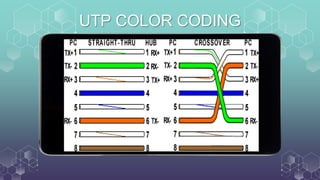
UTP COLOR CODING
UTP COLOR CODING
UTP COLOR CODING
FABRIC- OPTIC
CABLING
05
WHAT IS THE USE OF FIBR
OPTIC CABLE?
Fiber optics is used for long-distance and high-performance
data networking.
FIBR-OPTIC CABLE
WIRELESS MEDIA
06
WHAT IS WIRELESS MEDIA?
Wireless media are also one of the means of communication in which
we transmit data and information from one place to another place
wirelessly without any use of an electrical conductor as a
medium.
THANK YOU SO
MUCH FOR
LISTENING!

NEIL-FERDINAND-PPT.pptx

  • 1.
    PHYSICAL LAYER DATA &DIGITAL COMMUNICATION
  • 2.
    TABLE OF CONTENTS Purposeof the Physical Layer 01 Physical Layer Characteristics 02 Cooper Cabling 03 UTP Cabling 04 Fiber-Optic Cabling 05 Wireless Media 06
  • 3.
  • 4.
    WHAT IS PHYSICAL LAYER? Thephysical layer is responsible for sending computer bits from one device to another along the network.
  • 5.
    WHAT IS THEMAIN ROLE OF PHYSICAL LAYER? Physical Layer is responsible for the communication of the unstructured raw data streams over a physical medium. Physical Layer maintains the data rate (how many bits a sender can send per second). It performs Synchronization of
  • 6.
    To do this,the physical layer performs a variety of functions, including: Defining bits: Determines how bits are converted from 0s and 1s to a signal. Data rate: Determines how fast the data flows, in bits per second. Synchronization: Ensures that sending and receiving devices are synchronized. Transmission mode: Determines the direction of transmissions and whether those are simplex (one signal is transmitted in one direction), half- duplex (data goes in both directions, but not at the same time) and full- duplex (data is transmitted in both directions, simultaneously) Interface: Determines how devices are connected to a transmission medium such as Ethernet or radio waves
  • 7.
  • 8.
  • 9.
  • 10.
    WHAT IS COPPERUSED FOR? Copper is the electrical conductor in many categories of electrical wiring. Copper wire is used in power generation, power transmission, power distribution, telecommunications, electronics circuitry, and countless types of electrical equipment. Copper and its alloys are also used to make electrical contacts. .
  • 11.
  • 12.
    WHAT IS THEPURPOSE OF COPPER? The function of network cabling is to transfer information and data between networked devices, such as routers, computers, switches, hubs, repeaters, storage networks and more.
  • 13.
    WHAT IS THEPURPOSE OF COPPER? The function of network cabling is to transfer information and data between networked devices, such as routers, computers, switches, hubs, repeaters, storage networks and more.
  • 14.
  • 15.
    WHAT IS THEUSE OF UTP CABLE? UTP cables are commonly used as telephone wired and Ethernet cables in telephone connections and LAN (Local Area Networks).
  • 16.
  • 17.
  • 18.
  • 19.
  • 20.
    WHAT IS THEUSE OF FIBR OPTIC CABLE? Fiber optics is used for long-distance and high-performance data networking.
  • 21.
  • 22.
  • 23.
    WHAT IS WIRELESSMEDIA? Wireless media are also one of the means of communication in which we transmit data and information from one place to another place wirelessly without any use of an electrical conductor as a medium.
  • 24.
    THANK YOU SO MUCHFOR LISTENING!