Lecture 1
By Nosheen Qamar
University of Lahore, Pakistan
 What is Web Engineering
 Need for Web Engineering
 Categories of web Application
 Quality Attribute of web Application
Web Engineering is concerned with the establishment
and use of sound scientific, engineering, and
management principles and disciplined and
systematic approaches to the successful
development, deployment, and maintenance of high
quality Web-based systems and applications
OR
Web Engineering is the use of scientific, engineering
and management principles and systematic
approaches with the aim of successfully developing,
deploying and maintaining high quality Web-based
systems and applications.
 Industries such as Construction, Education,
Hospitality, manufacturing, banking,
government and business utilised web based
applications to improve and increase their
operations. In addition, the Web allows for
development of corporate intranet web
applications.
 To Date the development of web applications has
been in general ad hoc, resulting in poor quality
applications, which are difficult to maintain. The
main reasons for such problems are Unsuitable
Design and Development Process, poor Project
Management Practices.
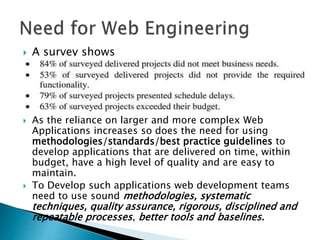
 A survey shows
 As the reliance on larger and more complex Web
Applications increases so does the need for using
methodologies/standards/best practice guidelines to
develop applications that are delivered on time, within
budget, have a high level of quality and are easy to
maintain.
 To Develop such applications web development teams
need to use sound methodologies, systematic
techniques, quality assurance, rigorous, disciplined and
repeatable processes, better tools and baselines.
 The Categories of Web Application are:
Informational
 Read-only content is provided with simple
navigation and links.
Download
 A user downloads information from the
appropriate server.
Interaction
 Communication among a community of users
occurs via chat room, instant messaging.
Customizable
 The user customizes content to specific
needs.
User Input
 Forms-based input is the primary mechanism
for communicating need.
Transaction oriented.
 The user makes a request (e.g., places an
order) that is fulfilled by the WebApp.
 The application provides a service to the user
(e.g., assists the user in determining a
mortgage payment).
Portal
 The application channels the user to other
Web content or services outside the domain
of the portal application.
 Database access. The user queries a large
database and extracts information.
 Data warehousing. The user queries a
collection of large databases and extracts
information.
Usability
Usability defines how well the application meets the requirements of the
user and consumer by being intuitive, easy to localize and globalize,
providing good access for disabled users, and resulting in a good overall
user experience.
 Global site understandability
 On-line feedback and help features
 Interface and aesthetic features
 Special features
Functionality
 Searching and retrieving capability
 Navigation and browsing features
 Application domain-related features
Reliability
 Correct link processing
 Error recovery
 User input validation and recovery
Efficiency
 Response time performance
 Page generation speed
 Graphics generation speed
Maintainability
 Ease of correction
Adaptability
 The ease with which a system or parts of the system may be
adapted to the changing requirements.
Extensibility
 is a system design principle where the implementation takes into
consideration future growth.
 It is a systemic measure of the ability to extend a system and the
level of effort required to implement the extension.
 Extensions can be through the addition of new functionality or
through modification of existing functionality
Q & A

Need for Web Engineering

  • 1.
    Lecture 1 By NosheenQamar University of Lahore, Pakistan
  • 2.
     What isWeb Engineering  Need for Web Engineering  Categories of web Application  Quality Attribute of web Application
  • 3.
    Web Engineering isconcerned with the establishment and use of sound scientific, engineering, and management principles and disciplined and systematic approaches to the successful development, deployment, and maintenance of high quality Web-based systems and applications OR Web Engineering is the use of scientific, engineering and management principles and systematic approaches with the aim of successfully developing, deploying and maintaining high quality Web-based systems and applications.
  • 4.
     Industries suchas Construction, Education, Hospitality, manufacturing, banking, government and business utilised web based applications to improve and increase their operations. In addition, the Web allows for development of corporate intranet web applications.  To Date the development of web applications has been in general ad hoc, resulting in poor quality applications, which are difficult to maintain. The main reasons for such problems are Unsuitable Design and Development Process, poor Project Management Practices.
  • 5.
     A surveyshows  As the reliance on larger and more complex Web Applications increases so does the need for using methodologies/standards/best practice guidelines to develop applications that are delivered on time, within budget, have a high level of quality and are easy to maintain.  To Develop such applications web development teams need to use sound methodologies, systematic techniques, quality assurance, rigorous, disciplined and repeatable processes, better tools and baselines.
  • 6.
     The Categoriesof Web Application are: Informational  Read-only content is provided with simple navigation and links. Download  A user downloads information from the appropriate server.
  • 7.
    Interaction  Communication amonga community of users occurs via chat room, instant messaging. Customizable  The user customizes content to specific needs. User Input  Forms-based input is the primary mechanism for communicating need.
  • 8.
    Transaction oriented.  Theuser makes a request (e.g., places an order) that is fulfilled by the WebApp.  The application provides a service to the user (e.g., assists the user in determining a mortgage payment).
  • 9.
    Portal  The applicationchannels the user to other Web content or services outside the domain of the portal application.  Database access. The user queries a large database and extracts information.  Data warehousing. The user queries a collection of large databases and extracts information.
  • 10.
    Usability Usability defines howwell the application meets the requirements of the user and consumer by being intuitive, easy to localize and globalize, providing good access for disabled users, and resulting in a good overall user experience.  Global site understandability  On-line feedback and help features  Interface and aesthetic features  Special features Functionality  Searching and retrieving capability  Navigation and browsing features  Application domain-related features Reliability  Correct link processing  Error recovery  User input validation and recovery
  • 11.
    Efficiency  Response timeperformance  Page generation speed  Graphics generation speed Maintainability  Ease of correction Adaptability  The ease with which a system or parts of the system may be adapted to the changing requirements. Extensibility  is a system design principle where the implementation takes into consideration future growth.  It is a systemic measure of the ability to extend a system and the level of effort required to implement the extension.  Extensions can be through the addition of new functionality or through modification of existing functionality
  • 12.