Navigating Change:
Recommendations for
Advancing Undergraduate
Public Relations Education
An Executive Summary and A Call to Action
The 50th
Anniversary Report
Commission on Public Relations Education
Editors
Elizabeth L. Toth
Pamela G. Bourland-Davis
November 2023
www.commissionpred.org
Funded by the Weiss Family Trust
C E L E B R A T I N G 50 Y E A R S
CPRE Executive Summary.qxp_Layout 1 10/9/23 6:14 PM Page 1
The Commission on Public Relations Education gratefully acknowledges the
valuable support for its 2023 Report from the following:*
Title Sponsor - $30,000
The Weiss Family Trust, Audra and Jim Weiss
Golden Anniversary Sponsor - $10,000
The Grossman Group, David Grossman, APR, Fellow PRSA
Initial Research and Development Sponsor - $10,000
PR Council
Future of Education Sponsors - $6,000
The Grossman Group, David Grossman, APR, Fellow PRSA (Chapter: Future of the Workplace)
Omnicom (Chapter: Diversity, Equity and Inclusion)
University of Florida, College of Journalism and Communications, Department of Public Relations
(Chapter: PR as a Driver of Social Change)
Golden Patrons - $500+
Anthony D'Angelo, APR, Fellow PRSA
Gary D. McCormick, APR, Fellow PRSA
Jackson, Jackson & Wagner
Maria P. Russell, APR, Fellow PRSA
The Arthur W. Page Society
Commission Members’ Gifts
Anne Gregory, PhD
Chris Brathwaite
Cornelius Foote
Douglas Cannon, PhD, APR, Fellow PRSA
Elizabeth Toth, PhD, APR, Fellow PRSA
Gabriel Sadi Sosa, PhD
Julie O’Neil, PhD, APR
Kathleen Rennie, PhD, APR, Fellow PRSA
Kelly Davis, APR, Fellow PRSA
Kenneth Plowman, PhD, APR
Marlene Neill, PhD, APR, Fellow PRSA
Acknowledgements
2
Report Research and Development Team Leaders
Elizabeth L. Toth, Co-Chair
Pamela G. Bourland-Davis, Co-Chair
Denise Bortree
Karla Gower
Emily Kinsky
Anna Klyueva
With gratitude, the Commission recognizes its partner organization, The Institute
for Public Relations, for its generous in-kind support.
The Commission is also grateful to the active representatives of its member organizations – those individual educators and practitioners who have
played a central role in producing this report, thereby helping to strengthen the bond between public relations education and its practice. Together,
our efforts are dedicated toward ensuring that properly qualified professionals are prepared to drive the public relations profession ever forward
as globalization, technology, social movements and other pervasive factors continually alter the field’s requirements.
*As of October 3, 2023.
Nneka Logan
Charles Lubbers
Hua Jiang
Ken Plowman
Hongmei Shen
Friends of CPRE - $150-499
Gemma R. Puglisi
John Paluszek, APR, Fellow PRSA
Judith Phair, APR, Fellow PRSA
Deborah A. Silverman, PhD, APR, Fellow, PRSA
Mickey G. Nall, APR, Fellow PRSA
Oluwole M. Adamolekun, PhD
Pamela G Bourland-Davis, PhD
Richard Woods
Sabine Einwiller
Sandra Duhe, PhD, APR, Fellow PRSA
Shelley Spector
Spiro Kiousis, PhD, APR
Stacey Smith, APR, Fellow PRSA
Stephanie and Kevin Saghy
Terence Flynn, PhD, APR, FCPRS
CPRE Executive Summary.qxp_Layout 1 10/9/23 6:14 PM Page 2
Navigating Change:
Recommendations for
Advancing Undergraduate
Public Relations Education
An Executive Summary and A Call to Action
This Signature Report of the Commission on Public Relations
Education has great import given the multiple organizational and
societal recalibrations underway in the five years since the last
study, and with change accelerated by the pandemic: hence our
title choice, “Navigating Change.”
As with any large-scale crisis, the result is that we come out of
it changed. Yet, despite the profound transformations in the
work of organizations and public relations, this report reaffirms
many of the key abilities expected by practitioners and taught
by educators, including the continued essential value placed
on writing, communication and storytelling.
But it also lays bare the additional critical requirement for
professionals, new and experienced, to be able to
• Take a systemic ethical approach to the practice, and
• Approach the practice from a broader world view,
informed by the seismic changes in technology,
society, politics, the economy, and global conflicts.
What we have recognized over a year’s worth of discussions
and research are increased professional expectations for
undergraduate education that center on the need for talented
entry-level practitioners who are critical and strategic
thinkers, who understand the impact of data—and who
have learned the standards for ethical practice, the need for
addressing the issues of DEI, and the role of public relations in
contributing to social change.
This CPRE report recommends several directives to
educators to adapt to the evolving learning styles of individual
students while maintaining their adherence to best practices in
pedagogy and standards, and identifies six broader public
relations industry expectations of future practitioners. It also
reinforces the need for educators and practitioners to
remain wholly connected to, and involved in, shaping the
direction our educational institutions take now and in the future.
Approach and Methodology
With the involvement of CPRE’s 65-member board,
preparations began in the spring of 2022 with CPRE members
participating in four brainstorming sessions to generate topics
they felt should be addressed in the 2023 report. Consensus
topics were crowdsourced in April of 2022 in two surveys of the
CPRE Board members and members of the PR Council. Topics
were refined in two focus groups of Page Society members
conducted in September 2022. Then, member teams developed
questions for a quantitative survey to obtain benchmark
perceptions of six topics. The Research Committee included
curriculum-related questions from past surveys as well, for
comparative purposes. Survey participation by public relations
practitioners and educators representing United States and
international public relations associations yielded sufficient
numbers to allow advanced data analysis and interpretation.
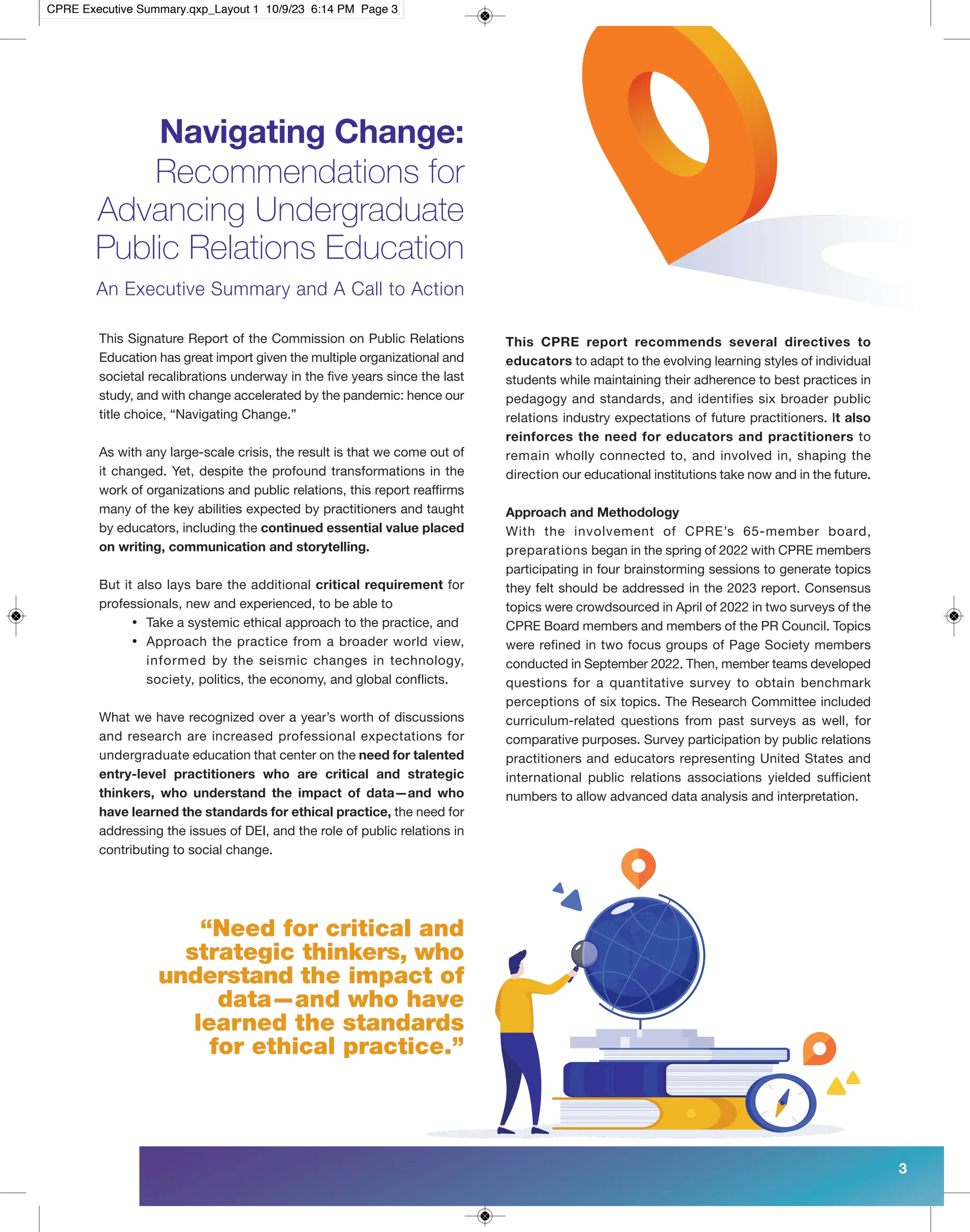
“Need for critical and
strategic thinkers, who
understand the impact of
data—and who have
learned the standards
for ethical practice.”
3
CPRE Executive Summary.qxp_Layout 1 10/9/23 6:14 PM Page 3
Executive Summary and
A Call to Action
Navigating Change:
Recommendations for Undergraduate PR Education
Workplace challenges addressed include work-life balance and
hybrid working environments; mental health and accommodations;
DEI commitment and assessment; and artificial intelligence (AI).
Within this context, also considered were the GenZ expectations
of employers, and how employers can adapt for this new group
of new hires.
• Educators and practitioners should work together to develop
experiential learning opportunities for students that will enhance
their exposure to professional behavior and workplace
expectations, as well as helping develop the students’ soft skills.
• Educators should include specific course content (case studies,
reports, presentations, etc.) on the ethical challenges of
contemporary practice.
• Educators must prepare students to understand their personal
values and priorities and how they should fit into their job search
and career plans.
• Educators should develop course content with a strong focus
on students communicating on a personal level with key audiences,
including effective networking for the short and long term.
• Employers must adapt their onboarding practices for new hires,
including interns, to better represent a new workplace.
Findings
The 2023 data reflects substantial similarities in practitioner
and educator views on key Knowledge, Skills and Abilities (KSAs),
as well as hiring qualities. The five-course standard introduced in
1999 (PR principles, writing, research, cases/campaigns &
internship) has taken a firm hold in public relations programs,
but the five-course topics are not always offered in dedicated
public relations courses.
CPRE’s recommended sixth course in public relations ethics
must be required in public relations curricula, given that ethics is
a top knowledge area in 2023 as a necessity in public relations
education and practice.
The Future of the Public Relations Workplace –
Experiential Learning Necessary
Essential KSAs and the Six-Course Standard –
The Six-Course Standard is Key
• CPRE must continue to promote the six-course standard: public
relations courses in principles, research, writing, campaigns/cases,
internship, and ethics.
• Practitioners should continue connecting with courses and
programs (speakers, clients, campaign coaches or evaluators).
• Programs and administrators should value the inclusion of
professors of practice.
• Internships should be promoted for students, programs and
practitioners.
• Administrators should attach value (reassigned time, etc.) to
internship coordinators.
• Practitioners should continue to value PR coursework and
degrees–in ads and when hiring.
• CPRE must promote public relations ethics as a sixth required
course to meet its standard for professional public relations
career preparation.
4
Recommendations Recommendations
Findings Findings
CPRE Executive Summary.qxp_Layout 1 10/9/23 6:14 PM Page 4
“While students do not need to become data
scientists, they must have a solid grounding in
quantitative and qualitative research. Teaching
the data analysis process can be approached
as an extension of critical thinking.”
Critical Strategic Thinking –
Strategic is Critical
Public relations practitioners have repeatedly ranked critical and
strategic thinking as a most sought-after skill for entry-level career
success. This was confirmed in the CPRE 2023 survey. However,
research has suggested that most critical thinking instruction is
a side element in public relations undergraduate education.
This chapter argues for and presents ways to make explicit
critical strategic thinking instruction. Critical thinking involves
analysis followed by strategic thinking to determine creative
direction, both required in the process of developing communication
strategy. The chapter’s authors introduce the DASA model
(Detecting, Analyzing Strategizing, Acting), a critical strategic
model as a way of thinking through the traditional research, planning,
implementation and evaluation in public relations.
• Public Relations sequences must include critical strategic
thinking, ideally using the DASA model.
Principles - introduction to critical strategic model
(through learning objectives)
Writing and Research - practicing the model by learning
its application
Capstone - applying the model to real-world problems to
master critical strategic thinking.
• Request relevant public relations organizations such as PRSA
to change the term in pedagogy language from critical to critical
strategic thinking.
• Integrate critical strategic thinking into learning objectives for
syllabi.
• Hands-on activities must incorporate and be informed by theory.
• Use real-world case studies to understand critical strategy.
The need for early career public relations practitioners to
understand the basics of analytic metrics and data analysis could
not be clearer, especially now with the pressing issues of AI. The
practice of public relations depends on developing data insights,
analyzing their meaning, and communicating them effectively to
managers and clients.
While students do not need to become data scientists, they
must have a solid grounding in quantitative and qualitative
research. Teaching the data analysis process can be approached
as an extension of critical thinking. Educators are encouraged to
teach students to align measurable organizational outcomes with
public relations objectives, prioritize data ethics, and encourage
student curiosity.
Data Insights and Strategy – Align Data Analysis
and AI through Education for Practice
Educators should:
• Integrate KSAs related to data analytics and AI into academic
programs.
• Build a solid foundation in quantitative and qualitative research
for students.
• Teach basic “spreadsheeting” and business data analysis.
• Encourage curiosity.
• Prioritize data ethics, particularly given the growing usage of
artificial intelligence in public relations practice.
• Teach students to align data analysis with measurable
organizational outcomes and public relations objectives rather
than low-level outputs.
• Educators need administrative support to invest in ongoing
training and learning to stay abreast of changes in PR practice
fueled by developments in technology.
5
Recommendations Recommendations
Findings Findings
m
m
m
CPRE Executive Summary.qxp_Layout 1 10/9/23 6:14 PM Page 5
6
Executive Summary and
A Call to Action
Navigating Change:
Recommendations for Undergraduate PR Education
While public relations professionals and educators continue to
rank ethics at the top of the list of most desired KSAs for
entry-level practitioners, survey results indicated that our newest
professionals are not adequately prepared to address public
relations’ ethical challenges.
Practitioners were especially critical of young professionals’
lack of mastery of essential skills in their first five years, particularly
their lack of ethics skills in critical thinking, strategic planning, and
developing a personal code of ethics.
A top priority for future educational efforts should be to develop
ethical critical thinking skills. Also, it should be noted here that
new professionals reported experiencing hostile workplace
environments and harassment more than anticipated.
• Ethics should be a required course in all public relations
programs.
• Public relations educators should continue to incorporate ethics
into all courses across the curriculum.
• Educators should review the core ethics competencies identified
in our research and find ways to integrate these knowledge,
skills and abilities into their courses.
• Hostile work environment/harassment should be an area for
honest conversations in the classroom in preparation for
workplace experiences.
Recommendations Recommendations
Findings Findings
Successful organizational practices in diversity, equity,
and inclusion center on appreciating human differences, treating
all people fairly, and ensuring that all individuals and communities
feel valued, actions that lend themselves well to public relations
practice.
This chapter’s research confirmed that the public relations field
continues to value DEI knowledge, skills, and abilities but
expressed concern that they are not adequately developed in
entry-level practitioners.
The report recommends five ways to improve DEI public
relations education so future professionals are well prepared to
address DEI with their organization’s stakesholders and in their
own work lives.
Ethics – An Essential But Neglected
Competency
DEI – An Ethical Social Responsibility
Educators must:
• Understand DEI as an ethical social responsibility that should
be embedded in the curriculum.
• Actualize a DEI mission.
• Take a comprehensive approach to DEI in public relations.
• Create Public Relations DEI course materials; expand awareness
of, and access to, them.
• Prepare for pushback.
CPRE Executive Summary.qxp_Layout 1 10/9/23 6:14 PM Page 6
“The public relations
field continues to
value DEI knowledge,
skills, and abilities.”
7
Recommendations
Findings
PR as a Driver of Social Change –
Being Courageous
This chapter considered public relations’ role as a social and
cultural practice that generates public engagement and discourse
around issues that shape society.
Based on strong survey agreement by both practitioners and
educators that public relations drives social change, it follows that
students need to be prepared for the social role of organizations
in which they work.
Suggestions include a variety of ways that public relations
educators can develop the critical thinking of students about social
change: engaged scholarship; value-based case studies;
classroom activities; guest speakers, and materials such as the
Arthur W. Page Center teaching modules.
• Educators must be courageous in addressing challenging issues
including gender identity, sexuality, racism, ableism, poverty.
• Public relations educators should ensure undergraduate public
relations majors understand their role in driving social change.
• Educators should consider how social change content can be
combined with skills-based and technical content, so that it is
genuinely integrated, rather than treated as separate from
mainstream practice.
• Educators should consider the resource implications of doing
social change work, such as engaged scholarship.
No research is ever complete. This report highlights
recommendations based on navigating the changes
needed for undergraduate public relations education to ensure
our graduates are prepared for contemporary public relations
practice. It represents the best expert thinking of CPRE
members; but their ideas preceded broader concerns
about Artificial Intelligence. Future research will have to
examine AI’s impact on public relations practice much
more closely.
The study also preceded the systemic attack on DEI
programs and learning. How we navigate the continued
need for this important work in the current environment
needs to be examined.
The Commission on Public Relations Education also needs
to turn its attention to elevating standards for graduate
public relations education, not addressed since 2012.
And CPRE must address those who teach public relations,
not only those in the tenure-track, but the many professors
of practice and adjunct faculty whowhoenrichpublicrelations
classrooms. They work sometimes in the shadows of academia
without mentoring or financial remuneration.
Future Research
Finally: A Call To Action
This report of recommendations corresponds with what
CPRE practitioners and educators feel are the highest priorities
in 2022-23 for improving undergraduate public relations
education. Their choices signal high expectations of new
practitioners to contribute more to organizational and client
problem-solving through the wider knowledge of public
relations’ strategic/critical role in relationship building.
These newly hired practitioners should arrive able to navigate
a world that is changing dramatically through globalization,
technology, social expectations, and a hybrid workplace.
These priorities should not be lost on educators who are in
the trenches with a generation (GenZ) of students who learn
differently and who have different expectations for their
employment (and their personal lives) than did their instructors.
Nor should these priorities be lost on practitioners who
seek to hire a new generation of digital natives who
bring a new worldview to their organizations, their
managers and their clients.
We know much work is still needed to achieve an excellent
standardization of public relations degrees across the
United States and to make this standardization welcomed
by the public relations industry. It will take ongoing dialogue
between educators and practitioners and investments of
time and finances. It will take a strong professional
commitment from educators and practitioners to achieve
CPRE’s ambitious mission established for itself over 50
years because of its belief that a profession must have an
established body of knowledge and practice standards
formed through education. We look forward to continuing
the future dialogue that CPRE will lead.
CPRE Executive Summary.qxp_Layout 1 10/9/23 6:14 PM Page 7
C E L E B R A T I N G 50 Y E A R S
Get Involved To Shape the Future
About CPRE: The Commission on Public Relations Education, the authoritative voice on public relations education,
was founded in 1973 by the Public Relations Division of the Association for Education in Journalism and the Public Relations
Society of America to address the quality of public relations education in the United States.
Since then, CPRE has issued periodic research reports and recommendations on undergraduate and graduate
education in public relations for universities, accrediting bodies, and professional associations around the world. Today,
with 24 member organizations in the U.S. and abroad, CPRE operates year-round as a 501(c)3 organization in partnership
with the Institute for Public Relations and continues to offer a forum for public relations education with a global perspective.
Learn more: commissionpred.org
Email us at commissionpred@gmail.com to inquire about organization memberships, volunteer opportunities and/or
participation in the new research panel.
Make a donation: https://secure.givelively.org/donate/commission-on-public-relations-education-inc/commission-on-
public-relations-education-cpre
Mail us:
CPRE
C/O Institute for Public Relations
P.O. Box 118400
Gainesville, FL 32611-8400
CPRE Organizational Members
• Arthur W. Page Center
• Arthur W. Page Society
• Association for Education in Journalism and Mass Communication Public Relations Division
• Canadian Public Relations Society
• Chartered Institute of Public Relations
• Conference Board
• European Public Relations Education and Research Association
• Global Alliance for Public Relations and Management
• Institute for Public Relations
• International Association of Business Communicators
• International Communication Association
• International Communications Consultancy Organisation
• Journal of Public Relations Education
• The Museum of Public Relations
• National Black Public Relations Society
• National Communication Association
• Plank Center for Leadership in Public Relations
• PR Council
• PRSA College of Fellows
• PRSA Foundation
• Public Relations Society of America
• Public Relations Society of America Educators Academy
• Public Relations Society of America Educational Affairs Committee
• Universal Accreditation Board
For the full report including research, findings and a full list of recommendations, go to CPRE’s website:
www.commissionpred.org Additional information is available including spotlight reports and past reports.
CPRE Executive Summary.qxp_Layout 1 10/9/23 6:14 PM Page 8

Navigating Change: Recommendations for Advancing Undergraduate PR Education

  • 1.
    Navigating Change: Recommendations for AdvancingUndergraduate Public Relations Education An Executive Summary and A Call to Action The 50th Anniversary Report Commission on Public Relations Education Editors Elizabeth L. Toth Pamela G. Bourland-Davis November 2023 www.commissionpred.org Funded by the Weiss Family Trust C E L E B R A T I N G 50 Y E A R S CPRE Executive Summary.qxp_Layout 1 10/9/23 6:14 PM Page 1
  • 2.
    The Commission onPublic Relations Education gratefully acknowledges the valuable support for its 2023 Report from the following:* Title Sponsor - $30,000 The Weiss Family Trust, Audra and Jim Weiss Golden Anniversary Sponsor - $10,000 The Grossman Group, David Grossman, APR, Fellow PRSA Initial Research and Development Sponsor - $10,000 PR Council Future of Education Sponsors - $6,000 The Grossman Group, David Grossman, APR, Fellow PRSA (Chapter: Future of the Workplace) Omnicom (Chapter: Diversity, Equity and Inclusion) University of Florida, College of Journalism and Communications, Department of Public Relations (Chapter: PR as a Driver of Social Change) Golden Patrons - $500+ Anthony D'Angelo, APR, Fellow PRSA Gary D. McCormick, APR, Fellow PRSA Jackson, Jackson & Wagner Maria P. Russell, APR, Fellow PRSA The Arthur W. Page Society Commission Members’ Gifts Anne Gregory, PhD Chris Brathwaite Cornelius Foote Douglas Cannon, PhD, APR, Fellow PRSA Elizabeth Toth, PhD, APR, Fellow PRSA Gabriel Sadi Sosa, PhD Julie O’Neil, PhD, APR Kathleen Rennie, PhD, APR, Fellow PRSA Kelly Davis, APR, Fellow PRSA Kenneth Plowman, PhD, APR Marlene Neill, PhD, APR, Fellow PRSA Acknowledgements 2 Report Research and Development Team Leaders Elizabeth L. Toth, Co-Chair Pamela G. Bourland-Davis, Co-Chair Denise Bortree Karla Gower Emily Kinsky Anna Klyueva With gratitude, the Commission recognizes its partner organization, The Institute for Public Relations, for its generous in-kind support. The Commission is also grateful to the active representatives of its member organizations – those individual educators and practitioners who have played a central role in producing this report, thereby helping to strengthen the bond between public relations education and its practice. Together, our efforts are dedicated toward ensuring that properly qualified professionals are prepared to drive the public relations profession ever forward as globalization, technology, social movements and other pervasive factors continually alter the field’s requirements. *As of October 3, 2023. Nneka Logan Charles Lubbers Hua Jiang Ken Plowman Hongmei Shen Friends of CPRE - $150-499 Gemma R. Puglisi John Paluszek, APR, Fellow PRSA Judith Phair, APR, Fellow PRSA Deborah A. Silverman, PhD, APR, Fellow, PRSA Mickey G. Nall, APR, Fellow PRSA Oluwole M. Adamolekun, PhD Pamela G Bourland-Davis, PhD Richard Woods Sabine Einwiller Sandra Duhe, PhD, APR, Fellow PRSA Shelley Spector Spiro Kiousis, PhD, APR Stacey Smith, APR, Fellow PRSA Stephanie and Kevin Saghy Terence Flynn, PhD, APR, FCPRS CPRE Executive Summary.qxp_Layout 1 10/9/23 6:14 PM Page 2
  • 3.
    Navigating Change: Recommendations for AdvancingUndergraduate Public Relations Education An Executive Summary and A Call to Action This Signature Report of the Commission on Public Relations Education has great import given the multiple organizational and societal recalibrations underway in the five years since the last study, and with change accelerated by the pandemic: hence our title choice, “Navigating Change.” As with any large-scale crisis, the result is that we come out of it changed. Yet, despite the profound transformations in the work of organizations and public relations, this report reaffirms many of the key abilities expected by practitioners and taught by educators, including the continued essential value placed on writing, communication and storytelling. But it also lays bare the additional critical requirement for professionals, new and experienced, to be able to • Take a systemic ethical approach to the practice, and • Approach the practice from a broader world view, informed by the seismic changes in technology, society, politics, the economy, and global conflicts. What we have recognized over a year’s worth of discussions and research are increased professional expectations for undergraduate education that center on the need for talented entry-level practitioners who are critical and strategic thinkers, who understand the impact of data—and who have learned the standards for ethical practice, the need for addressing the issues of DEI, and the role of public relations in contributing to social change. This CPRE report recommends several directives to educators to adapt to the evolving learning styles of individual students while maintaining their adherence to best practices in pedagogy and standards, and identifies six broader public relations industry expectations of future practitioners. It also reinforces the need for educators and practitioners to remain wholly connected to, and involved in, shaping the direction our educational institutions take now and in the future. Approach and Methodology With the involvement of CPRE’s 65-member board, preparations began in the spring of 2022 with CPRE members participating in four brainstorming sessions to generate topics they felt should be addressed in the 2023 report. Consensus topics were crowdsourced in April of 2022 in two surveys of the CPRE Board members and members of the PR Council. Topics were refined in two focus groups of Page Society members conducted in September 2022. Then, member teams developed questions for a quantitative survey to obtain benchmark perceptions of six topics. The Research Committee included curriculum-related questions from past surveys as well, for comparative purposes. Survey participation by public relations practitioners and educators representing United States and international public relations associations yielded sufficient numbers to allow advanced data analysis and interpretation. “Need for critical and strategic thinkers, who understand the impact of data—and who have learned the standards for ethical practice.” 3 CPRE Executive Summary.qxp_Layout 1 10/9/23 6:14 PM Page 3
  • 4.
    Executive Summary and ACall to Action Navigating Change: Recommendations for Undergraduate PR Education Workplace challenges addressed include work-life balance and hybrid working environments; mental health and accommodations; DEI commitment and assessment; and artificial intelligence (AI). Within this context, also considered were the GenZ expectations of employers, and how employers can adapt for this new group of new hires. • Educators and practitioners should work together to develop experiential learning opportunities for students that will enhance their exposure to professional behavior and workplace expectations, as well as helping develop the students’ soft skills. • Educators should include specific course content (case studies, reports, presentations, etc.) on the ethical challenges of contemporary practice. • Educators must prepare students to understand their personal values and priorities and how they should fit into their job search and career plans. • Educators should develop course content with a strong focus on students communicating on a personal level with key audiences, including effective networking for the short and long term. • Employers must adapt their onboarding practices for new hires, including interns, to better represent a new workplace. Findings The 2023 data reflects substantial similarities in practitioner and educator views on key Knowledge, Skills and Abilities (KSAs), as well as hiring qualities. The five-course standard introduced in 1999 (PR principles, writing, research, cases/campaigns & internship) has taken a firm hold in public relations programs, but the five-course topics are not always offered in dedicated public relations courses. CPRE’s recommended sixth course in public relations ethics must be required in public relations curricula, given that ethics is a top knowledge area in 2023 as a necessity in public relations education and practice. The Future of the Public Relations Workplace – Experiential Learning Necessary Essential KSAs and the Six-Course Standard – The Six-Course Standard is Key • CPRE must continue to promote the six-course standard: public relations courses in principles, research, writing, campaigns/cases, internship, and ethics. • Practitioners should continue connecting with courses and programs (speakers, clients, campaign coaches or evaluators). • Programs and administrators should value the inclusion of professors of practice. • Internships should be promoted for students, programs and practitioners. • Administrators should attach value (reassigned time, etc.) to internship coordinators. • Practitioners should continue to value PR coursework and degrees–in ads and when hiring. • CPRE must promote public relations ethics as a sixth required course to meet its standard for professional public relations career preparation. 4 Recommendations Recommendations Findings Findings CPRE Executive Summary.qxp_Layout 1 10/9/23 6:14 PM Page 4
  • 5.
    “While students donot need to become data scientists, they must have a solid grounding in quantitative and qualitative research. Teaching the data analysis process can be approached as an extension of critical thinking.” Critical Strategic Thinking – Strategic is Critical Public relations practitioners have repeatedly ranked critical and strategic thinking as a most sought-after skill for entry-level career success. This was confirmed in the CPRE 2023 survey. However, research has suggested that most critical thinking instruction is a side element in public relations undergraduate education. This chapter argues for and presents ways to make explicit critical strategic thinking instruction. Critical thinking involves analysis followed by strategic thinking to determine creative direction, both required in the process of developing communication strategy. The chapter’s authors introduce the DASA model (Detecting, Analyzing Strategizing, Acting), a critical strategic model as a way of thinking through the traditional research, planning, implementation and evaluation in public relations. • Public Relations sequences must include critical strategic thinking, ideally using the DASA model. Principles - introduction to critical strategic model (through learning objectives) Writing and Research - practicing the model by learning its application Capstone - applying the model to real-world problems to master critical strategic thinking. • Request relevant public relations organizations such as PRSA to change the term in pedagogy language from critical to critical strategic thinking. • Integrate critical strategic thinking into learning objectives for syllabi. • Hands-on activities must incorporate and be informed by theory. • Use real-world case studies to understand critical strategy. The need for early career public relations practitioners to understand the basics of analytic metrics and data analysis could not be clearer, especially now with the pressing issues of AI. The practice of public relations depends on developing data insights, analyzing their meaning, and communicating them effectively to managers and clients. While students do not need to become data scientists, they must have a solid grounding in quantitative and qualitative research. Teaching the data analysis process can be approached as an extension of critical thinking. Educators are encouraged to teach students to align measurable organizational outcomes with public relations objectives, prioritize data ethics, and encourage student curiosity. Data Insights and Strategy – Align Data Analysis and AI through Education for Practice Educators should: • Integrate KSAs related to data analytics and AI into academic programs. • Build a solid foundation in quantitative and qualitative research for students. • Teach basic “spreadsheeting” and business data analysis. • Encourage curiosity. • Prioritize data ethics, particularly given the growing usage of artificial intelligence in public relations practice. • Teach students to align data analysis with measurable organizational outcomes and public relations objectives rather than low-level outputs. • Educators need administrative support to invest in ongoing training and learning to stay abreast of changes in PR practice fueled by developments in technology. 5 Recommendations Recommendations Findings Findings m m m CPRE Executive Summary.qxp_Layout 1 10/9/23 6:14 PM Page 5
  • 6.
    6 Executive Summary and ACall to Action Navigating Change: Recommendations for Undergraduate PR Education While public relations professionals and educators continue to rank ethics at the top of the list of most desired KSAs for entry-level practitioners, survey results indicated that our newest professionals are not adequately prepared to address public relations’ ethical challenges. Practitioners were especially critical of young professionals’ lack of mastery of essential skills in their first five years, particularly their lack of ethics skills in critical thinking, strategic planning, and developing a personal code of ethics. A top priority for future educational efforts should be to develop ethical critical thinking skills. Also, it should be noted here that new professionals reported experiencing hostile workplace environments and harassment more than anticipated. • Ethics should be a required course in all public relations programs. • Public relations educators should continue to incorporate ethics into all courses across the curriculum. • Educators should review the core ethics competencies identified in our research and find ways to integrate these knowledge, skills and abilities into their courses. • Hostile work environment/harassment should be an area for honest conversations in the classroom in preparation for workplace experiences. Recommendations Recommendations Findings Findings Successful organizational practices in diversity, equity, and inclusion center on appreciating human differences, treating all people fairly, and ensuring that all individuals and communities feel valued, actions that lend themselves well to public relations practice. This chapter’s research confirmed that the public relations field continues to value DEI knowledge, skills, and abilities but expressed concern that they are not adequately developed in entry-level practitioners. The report recommends five ways to improve DEI public relations education so future professionals are well prepared to address DEI with their organization’s stakesholders and in their own work lives. Ethics – An Essential But Neglected Competency DEI – An Ethical Social Responsibility Educators must: • Understand DEI as an ethical social responsibility that should be embedded in the curriculum. • Actualize a DEI mission. • Take a comprehensive approach to DEI in public relations. • Create Public Relations DEI course materials; expand awareness of, and access to, them. • Prepare for pushback. CPRE Executive Summary.qxp_Layout 1 10/9/23 6:14 PM Page 6
  • 7.
    “The public relations fieldcontinues to value DEI knowledge, skills, and abilities.” 7 Recommendations Findings PR as a Driver of Social Change – Being Courageous This chapter considered public relations’ role as a social and cultural practice that generates public engagement and discourse around issues that shape society. Based on strong survey agreement by both practitioners and educators that public relations drives social change, it follows that students need to be prepared for the social role of organizations in which they work. Suggestions include a variety of ways that public relations educators can develop the critical thinking of students about social change: engaged scholarship; value-based case studies; classroom activities; guest speakers, and materials such as the Arthur W. Page Center teaching modules. • Educators must be courageous in addressing challenging issues including gender identity, sexuality, racism, ableism, poverty. • Public relations educators should ensure undergraduate public relations majors understand their role in driving social change. • Educators should consider how social change content can be combined with skills-based and technical content, so that it is genuinely integrated, rather than treated as separate from mainstream practice. • Educators should consider the resource implications of doing social change work, such as engaged scholarship. No research is ever complete. This report highlights recommendations based on navigating the changes needed for undergraduate public relations education to ensure our graduates are prepared for contemporary public relations practice. It represents the best expert thinking of CPRE members; but their ideas preceded broader concerns about Artificial Intelligence. Future research will have to examine AI’s impact on public relations practice much more closely. The study also preceded the systemic attack on DEI programs and learning. How we navigate the continued need for this important work in the current environment needs to be examined. The Commission on Public Relations Education also needs to turn its attention to elevating standards for graduate public relations education, not addressed since 2012. And CPRE must address those who teach public relations, not only those in the tenure-track, but the many professors of practice and adjunct faculty whowhoenrichpublicrelations classrooms. They work sometimes in the shadows of academia without mentoring or financial remuneration. Future Research Finally: A Call To Action This report of recommendations corresponds with what CPRE practitioners and educators feel are the highest priorities in 2022-23 for improving undergraduate public relations education. Their choices signal high expectations of new practitioners to contribute more to organizational and client problem-solving through the wider knowledge of public relations’ strategic/critical role in relationship building. These newly hired practitioners should arrive able to navigate a world that is changing dramatically through globalization, technology, social expectations, and a hybrid workplace. These priorities should not be lost on educators who are in the trenches with a generation (GenZ) of students who learn differently and who have different expectations for their employment (and their personal lives) than did their instructors. Nor should these priorities be lost on practitioners who seek to hire a new generation of digital natives who bring a new worldview to their organizations, their managers and their clients. We know much work is still needed to achieve an excellent standardization of public relations degrees across the United States and to make this standardization welcomed by the public relations industry. It will take ongoing dialogue between educators and practitioners and investments of time and finances. It will take a strong professional commitment from educators and practitioners to achieve CPRE’s ambitious mission established for itself over 50 years because of its belief that a profession must have an established body of knowledge and practice standards formed through education. We look forward to continuing the future dialogue that CPRE will lead. CPRE Executive Summary.qxp_Layout 1 10/9/23 6:14 PM Page 7
  • 8.
    C E LE B R A T I N G 50 Y E A R S Get Involved To Shape the Future About CPRE: The Commission on Public Relations Education, the authoritative voice on public relations education, was founded in 1973 by the Public Relations Division of the Association for Education in Journalism and the Public Relations Society of America to address the quality of public relations education in the United States. Since then, CPRE has issued periodic research reports and recommendations on undergraduate and graduate education in public relations for universities, accrediting bodies, and professional associations around the world. Today, with 24 member organizations in the U.S. and abroad, CPRE operates year-round as a 501(c)3 organization in partnership with the Institute for Public Relations and continues to offer a forum for public relations education with a global perspective. Learn more: commissionpred.org Email us at commissionpred@gmail.com to inquire about organization memberships, volunteer opportunities and/or participation in the new research panel. Make a donation: https://secure.givelively.org/donate/commission-on-public-relations-education-inc/commission-on- public-relations-education-cpre Mail us: CPRE C/O Institute for Public Relations P.O. Box 118400 Gainesville, FL 32611-8400 CPRE Organizational Members • Arthur W. Page Center • Arthur W. Page Society • Association for Education in Journalism and Mass Communication Public Relations Division • Canadian Public Relations Society • Chartered Institute of Public Relations • Conference Board • European Public Relations Education and Research Association • Global Alliance for Public Relations and Management • Institute for Public Relations • International Association of Business Communicators • International Communication Association • International Communications Consultancy Organisation • Journal of Public Relations Education • The Museum of Public Relations • National Black Public Relations Society • National Communication Association • Plank Center for Leadership in Public Relations • PR Council • PRSA College of Fellows • PRSA Foundation • Public Relations Society of America • Public Relations Society of America Educators Academy • Public Relations Society of America Educational Affairs Committee • Universal Accreditation Board For the full report including research, findings and a full list of recommendations, go to CPRE’s website: www.commissionpred.org Additional information is available including spotlight reports and past reports. CPRE Executive Summary.qxp_Layout 1 10/9/23 6:14 PM Page 8